

Submitted:
15 February 2026
Posted:
03 March 2026
You are already at the latest version
Abstract
Background: Few currently available mental health group therapy programs have been co-designed with key stakeholders to meet the needs of autistic adult consumers. The current study formed part of a co-designed project with both autistic adults, and mental health clinicians. The goal of the study was to develop a fit-for-purpose mental health therapy program for autistic adults. This brief report outlines the major findings of the clinician portion of the project. Methods: Semi-structured interviews were conducted with mental health clinicians, asking about their experiences working with autistic adults and their thoughts and ideas for an autism specific group mental health therapy program. A constructivist grounded theory qualitative approach was used to analyse the qualitative data. Results: 18 mental health clinicians participated. Three main themes, and a further nine sub-themes, were identified. Main themes were: 1) capacity and experience of clinicians in identifying autistic clients; 2) how group sessions run: barriers and clinicians; 3) therapies that do/don’t work well and recommendations. Conclusions: Mental health clinicians reported varying confidence working effectively with autistic adult clients. Therapeutic alliance was discussed as key for stronger outcomes, along with a strengths-based approach and specific-skills based intervention.
Keywords:
adults
; autism
; co-design
; clinicians
; group therapy
; mental health
; therapy
; qualitative
1. Introduction
Autistic adults experience higher rates of co-occurring mental health conditions [1]. Despite this, they often have difficulty: accessing mental health care, finding clinicians skilled in working with autistic clients, and being delivered support that meets their needs [2]. Similarly, clinicians often feel underprepared to work effectively in this area [3]. Thus, there is evidence on both sides of the therapeutic relationship that more work is needed to develop fit-for-purpose mental healthcare for autistic adults.
Although the need is clear, there is little existing research showing co- creation, design and production approaches being utilized, to develop new therapies, or tailor existing therapeutic approaches, for acceptable and therapeutic use with autistic adults. Whilst modifications have been made to standard therapies, to attempt to account for autistic needs and preferences, this generally occurs without indication of consumer or lived experience involvement, or input from clinicians to ensure they feel equipped to use the therapy modality effectively with autistic clients [4,5,6,7].
This study formed part of a larger project that aimed to develop a fit-for-purpose mental health therapy program for autistic adults through co-creation. Other parts of the project involved collecting qualitative data from 12 autistic adults, over two phases, to inform the consumer and lived-experience information gathering portion of the project [8,9,10]. In keeping with evidence-based co-design principles, service provider (aka clinician) data was also sought to minimize data asymmetry [11]. It is the clinician portion of the project that will be outlined in this study. The aim of this study was to gain information from mental health clinicians who have worked with autistic clients, to inform the development of group mental health therapy program specifically for autistic adults.
2. Materials and Methods
The study was designed by the neuropsychology service of a large private mental health service, in Melbourne Australia, based on feedback provided by autistic adult clients of the service. Whilst the clients were generally happy with the strengths-based approach to autism assessment utilized by the service, many indicated a lack of autism-specific mental health and post-diagnostic support [8,9,10]. The study was approved by the service’s Human Research Ethics Committee (TMC HREC Project Number 339, 11 December 2020). Mental health clinicians from the service with experience working with autistic clients were invited to participate in a semi-structured interview with a research clinician. The interview questions were designed to find out which psychological approaches are most useful for autistic clients. Ideas about how an autism specific group mental health program could run successfully are also sought. The qualitative questions and interview format followed the principles outlined by Braun and Clarke [12]. The six interview questions, and additional prompts that were used in the semi-structured interviews are provided below:
1. Can you please describe your experiences, as a mental health clinician, working with clients who have an autism diagnosis?
(Prompts: Roughly how many autistic clients have you worked with? Are there any things that stand-out to you as a clinician? Do you alter your therapy approach when working with autistic clients?)
2. Which therapy approaches have you utilised in your approach with autistic clients?
(Prompts: Have you implemented one-on-one therapy, and if yes, which approach(es) did you use? Have you referred your autistic clients for group therapy, and if yes, which programs? Have you facilitated/co-facilitated a group therapy program that included autistic clients, if yes, which groups were these?)
3. What are your thoughts on the suitability of various therapeutic approaches (e.g., CBT, ACT, Mindfulness, DBT etc) for autistic clients?
(Prompts: Do you consider a client’s autistic status when choosing a therapy type? Are there any approaches you think are not suitable? Do you have a ‘go-to’ approach that often works well in your experience?)
4. To your knowledge, either as the direct treating clinician, or as the referring clinician to a therapist or program, which psychological therapy approaches have worked well for your autistic clients?
(Prompts: Can you describe any positive mental health treatment outcomes you can recall for autistic clients following psychological intervention/therapy? Which specific aspects of this therapy do you think assisted the clients?)
5. To your knowledge, either as the direct treating clinician, or as the referring clinician to a therapist or program, which psychological therapy approaches have not worked well for your autistic clients?
(Prompts: Can you describe any negative mental health treatment outcomes you can recall for autistic clients following psychological therapy? Which specific aspects of this therapy do you think were difficult/ unsuitable for the clients?)
6. Do you have any recommendations about engaging autistic people in a psychological therapy outpatient group program?
(Prompts: Is there anything else important that should be considered? Can you think of any barriers that might affect how well this program runs?)
The interviews were conducted by two senior clinical neuropsychologists (CF & ET) with 10 years or more clinical and research experience. They were conducted one-on-one, either face to face or online depending on clinician participant preferences, or COVID-19 protocols at the time of the data collection. All interviews were audio-recorded, transcribed, and double coded using NVIVO by two researchers (NG & SL), one a senior clinical neuropsychologist (10 years’ experience), and the other an undergraduate psychology research intern. A constructivist grounded theory approach was taken with the qualitative analysis[13]. This is an iterative, comparative process that makes conjectures and construct hypotheses about information categories (themes or subthemes), and then checks them against data.
Early emerging themes were recorded by the interviewing researchers, as the interviews were conducted, and provided to the rest of the research team. Initial, total full theming was undertaken by two researchers (BJ & SL), the academic researchers on the team (who were independent of the clinical service and had no collegial associations to the participating interviewed clinicians). Final, full theming was conducted by three members of the research team (BJ, SL, NG).
3. Results
Eighteen multi-disciplinary clinicians participated in the semi-structured interviews. The professional disciplines of the participants and number for each discipline were: Nurse (5), Clinical Psychologists (3), Occupational Therapist (3), Consultant Psychiatrists (2), Social Worker (1), Art Therapist (1), Psychiatry Registrar (1), Clinical Neuropsychologist (1), general Psychologist (1). The gender identity of 13 participants was eight female and five male.
Figure 1.
Major themes and sub-themes emerging from the qualitative analysis.
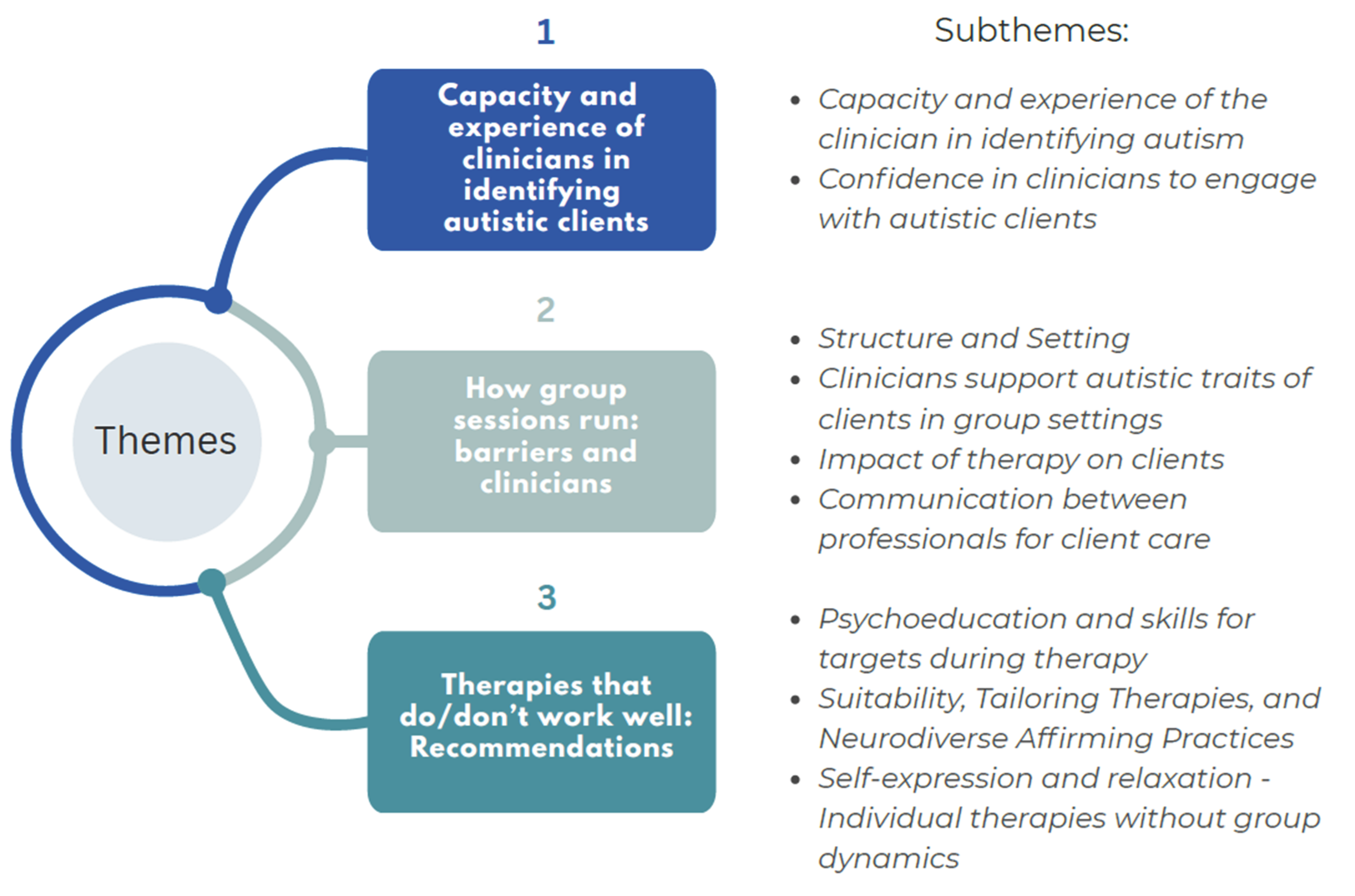
Three 1. The first theme was the Capacity and Experience of Clinicians in Identifying Autistic Clients, which encompassed two more specified subthemes. Subtheme 1.1 was the Capacity and Experience of the Clinician in Identifying Autism. Participants noted varying levels of experience in recognising autistic traits in their autistic clients. Common indicators noted by clinicians included body language, such as clients avoiding eye contact or engaging in limited non-verbal communication, and challenges in social communication within group settings. An example quote for this subtheme:
“Probably, what eye contact, sometimes is a, is something that I notice or observe as eye contact or their behavior in the room. Um, social skills, I guess, kind of in the waiting room or here with the nurses, sometimes I notice.” Female, Clinical Psychologist.
Participants emphasised the importance of reframing behavioural observations through an Autism lens to better understand client behaviours. For example, for participants who were less familiar with autistic presentations, behaviours such as difficulty adapting to change, were misinterpreted as difficulty shifting focus or non-compliance. Participants also mentioned that time with clients was crucial in developing an understanding of their unique autism traits and how these impacted therapeutic engagement. An example quote:
“…she didn’t make sense to me because …I didn’t think I saw many…girls with autism. And I think that’s another sort of factor is that in girls, it tends to be, we don’t tend to think of the diagnosis straightaway. It comes, it comes later. And only when she represented to me at the age of 15, after several years, and it was much clearer then.” Male, Consultant Psychiatrist
Subtheme 1.2 was the Confidence in Clinicians to Engage with Autistic Clients. In line with the expertise of the sample, clinicians expressed a mixed level of confidence when working with autistic clients. Those with more experience reported feeling relatively comfortable, while others indicated that they felt less confident, especially when navigating complex needs or engaging clients with high sensory sensitivities and related preferences. An example quote:
“So in any case, I also don’t think there is enough education with the staff members on autism, in how it’s presented. Like for example, I learned a lot going to, [Prominent Autism clinician/researcher]… I attended this seminar on eating disorders and Autism. And that was such an eye opener…” Female, Nurse.
The second major theme was How Group Sessions Run: Barriers and Clinicians. Subtheme 2.1 was Structure and Setting. Clinicians highlighted the importance of group structure, such as the number of people present and the composition of the group (e.g., whether the group contained both autistic and non-autistic members). They noted that the connectedness between participants could either facilitate or hinder engagement. An example quote:
“…a lot of people with autism need a sense of connectedness…. Being in the group itself gives them that sense of connectedness and therefore, giving them tools to be connected, meaning a lot of icebreaker stuff.” Female, Nurse.
The therapeutic qualities of the facilitator were seen as key, with a focus on developing a therapeutic alliance, using direct communication, and employing humor and analogies to make complex concepts more relatable and accessible. An example quote:
“So sort of using those interests, like you talked about earlier, to help develop a therapeutic alliance, and then using that as a platform to build the therapy.” Female, Art therapist
The physical space of the session was critical to success; clinicians often mentioned the hospital’s noise and sensory overwhelm as challenges, while some addressed this by lowering the lights to create a calming environment.
“… perhaps even in the physical environment, so these lights here would be too overwhelming, for well, for this particular client, and she reported that. So considering the physical environment and how it can be more sensory friendly” Female, Occupational Therapist.
The organisation of the sessions emerged as a key factor: Participants reported that breaking down tasks into smaller steps, using visual prompts, and clearly communicating goals and expectations helped create an environment conducive to learning and participation. The clarity of course materials, including both written and visual components, was emphasized as essential in enhancing understanding for autistic clients. Furthermore, pacing of content was discussed, both within and between sessions: clinicians highlighted the need for down time between sessions and ensuring that there was sufficient time for clients to process information and respond to questions. An example quote:
“I think it’s just the EMP [Emotion Management Program] and DBT [Dialectical Behaviour Therapy] in general is very structured, quite logical. And sequential, there’s an order, steps that you need to do.” Female, Nurse
Subtheme 2.2 was Facilitators Navigate Autistic Traits of Clients in Group Settings. Participants identified that literal interpretations and navigating challenges with turn-taking had to be carefully navigated between clients. Participants also flagged the difficulty in navigating the engagement of clients with topics that were not of immediate interest to them. Therapists also discussed the importance of recognising emotion dysregulation and emotional expression as part of the therapeutic process. When working with clients prone to rigidity or repetition, clinicians emphasized the need for flexibility in how content is presented. Clinicians also focused on identifying potential meltdowns or dysregulation early, being mindful of how the client’s autistic identity may influence their responses to therapy. An example quote:
“…this is from the feedback that they gave us, they felt that the skills, as they were taught, were quite neurotypical, and sort of designed for people who had a neurotypical outlook.” Male, Social Worker
Subtheme 2.3 was Impact of Therapy on Clients. Participants discussed the significant impact of therapy in validating the client’s experiences. Many clinicians reported that for some clients, receiving an Autism diagnosis provided a sense of relief, with one client noting it was “like a revelation.” Participants emphasised the importance of clients viewing themselves as the experts in their own experience, which helped foster a more collaborative and empowering therapeutic relationship. An example quote:
“...you know, [client] “people don’t seem to understand me, I’m probably not all that”, the low self-esteem that comes along with it as well. So what’s been interesting is when people actually receive a diagnosis, it’s, especially women. It’s like this revelation, you know, of “Oh right, okay”.” Female, Psychiatry Registrar
For subtheme 2.4 the focus was Communication Between Multi-Disciplinary Professionals in Relation to Client Care. Clinicians acknowledged that communication between multidisciplinary team (MDT) professionals could be challenging, especially in terms of the costs associated with assessments and the application process for services like NDIS (National Disability Insurance Scheme). Issues surrounding psychiatrist-GP collaboration were also noted as barriers to seamless care. An example quote:
“So he’s only about 26 and you know, I’m very concerned about him. So I said to him that I’m going to get in touch with his psychiatrist and GP and see if we can organize a way of him getting a proper assessment and also then perhaps with a view to me helping him perhaps apply for NDIS, or something like that.” Female, Clinical Neuropsychologist.
The third and final theme was: Therapies That Do or Don’t Work Well for Autistic Clients – Recommendations. Sub-theme 3.1 was characterised by Psychoeducation and Skills for Targets During Therapy. Clinicians highlighted the importance of psychoeducation and skill-building in therapy, focusing on areas such as emotion regulation, goal-directed functional skills (e.g., organisation, scheduling), flexibility, and relationship-building skills. Specific strategies for clients included distress tolerance, sensory coping techniques, and the importance of helping clients identify strengths and values. Sensory modulation through therapies like art therapy was also identified as a valuable approach, as well as targeting multiple approaches - practical, intellectual understanding and emotional.
“”I guess, I think DBT would be very beneficial too, in terms of the interpersonal effectiveness and skill building, for regulating emotions. I think that that really can suit that client group…. I guess. In terms of OT [Occupational Therapy]. I definitely think sensory modulation is helpful in lots of ways. And I’ve seen it to be helpful.” Female, Occupational Therapist.
Subtheme 3.2 was Suitability, Tailoring Therapies, and Neurodiverse Affirming Practices. A key recommendation was the need to modify traditional therapeutic frameworks like Acceptance and Commitment Therapy (ACT) and Dialectical Behavior Therapy (DBT) to be more appropriate for autistic clients. Strengths-based approaches that celebrated clients’ special interests and provided clear structure and clarity in therapy were emphasised. Clinicians also recommended offering a mix of therapeutic options (e.g., visual, individual, group) to cater to the diverse needs of autistic clients and ensure a more neurodiversity-affirming approach. An example quote:
“...but the content of DBT… I think would be so advantageous, but set up in a different way. And I don’t know what that way would look like. But it’s just not enough time and too much content to sort of sink like a barrage of words, I think…. And, obviously, an array of like visual and verbal, you know, like, a number of different ways to take in… I don’t know, giving as many [real] life examples.” Female, general Psychologist.
The final subtheme, 3.3, was Expression and Relaxation - Individual Therapies Without Group Dynamics. Individual therapies such as mindfulness, art therapy, and other self-exploration techniques were identified as beneficial, especially when group dynamics were not as conducive to expression or relaxation. Clinicians observed that these therapies offered clients space to explore their identity, connect with themselves, and regulate sensory experiences without the pressure of group interaction. These methods were also valuable in promoting connectedness and helping clients express themselves in ways that felt authentic to them. An example quote:
“[in reference to an art therapy approach] I mean, I may be biassed here, but I obviously definitely recommend it. Just as an example to like, whether they’re working through all those things I talked about before and you know, emotional regulation and that sort of thing, even just connecting with their sense of identity and self.” Female, Art Therapist”
4. Discussion
The confidence of mental health clinicians to work effectively with autistic clients was variable. This finding is consistent with other research indicating that few therapists have completed additional training on autism, but that many are aware that this would be beneficial and are open to receiving it. [3] Similarly, across studies many therapists perceive their competence and experience in this area as low, relative to other diagnoses [3]. Thus, a clear primary recommendation from this study is a concerted focus in mental health clinical training and professional development in the area of neurodiversity and neuro-affirming care, and autism in particular[14]. The development of professional supervision networks with experienced neuro-affirming clinicians is also needed to reinforce and continuously develop skills. It has also been suggested that clinicians hold “cultural competency” in their understanding of autistic communication preferences, and have a thorough understanding of the double empathy problem. [15] The double-empathy paradigm indicates that neurotypical people are just as likely to misinterpret autistic communication and intentions, as autistic people are likely to do in reverse. Thus, neurotypical clinicians, in particular, should be aware of the impact their own biases may have on working effectively with clients who have neurotypes different from their own.
Similarly, clinicians noted that the therapeutic alliance with the clinician/group facilitator was a key determinant for client outcomes. This has been raised as important by others in the field, and also linked to clinician understanding and skill levels, working with this client group [15]. It has been proposed that therapists with a better understanding of the impact of social differences on therapy engagement may be more effective at building more robust alliances[3]
There were similarities in key focus areas reported for mental health support between mental clinicians in this study and autistic adults themselves, in the client portion of the co-design project[9,16]. These included identifying strengths and values, emotion regulation, relationship building, distress tolerance and sensory coping strategies. These commonalities form a strong basis for the development of the content of an autism-specific group mental health therapy program, and show the areas of alignment between key intervention areas between autistic adults themselves and the perceptions of clinicians of useful approaches and areas to work on.
A strength of this research is the broad range of mental health clinician disciplines represented in the participant group. Six different professions, across nursing, allied health and medical staff were involved, with a range of sub-specialties (e.g., clinical, neuro- and general psychologists) and seniority levels (junior psychiatrists – registrars; senior psychiatrists – consultants). This enabled the research team to view the opinions and experiences of the broad range of disciplines an adult with autism may encounter, when seeking mental health support. A limitation of the study, was that it was conducted at a single site (albeit a very large facility, with 203 inpatient beds, outpatient and outreach programs), which operated within the private mental health sector. It is possible that different results may have been obtained, if multiple sites had been included, and/or the study was conducted with the inclusion of public mental health services clinicians.
The autism specific mental health therapy program that was developed, based on the findings of this research and the companion patient studies in the project has now been piloted in a cohort of 20 autistic adult clients, with the study data being prepared for publication. [8,9,16] This research seeks to expand knowledge about mental health support and interventions that are appropriate, acceptable and effective for autistic adults.
Author Contributions
For research articles with several authors, a short paragraph specifying their individual contributions must be provided. The following statements should be used “Conceptualization, CF, NG, ES. and JP.; methodology, CF, NG, ES. and JP.; software, NG & SL.; validation, NG., SL. and BJ.; formal analysis, NG., SL. and BJ; investigation, CF, ES & NG.; resources, all.; data curation, NG., SL. and BJ; writing—original draft preparation, NG, BJ & CF; writing—review and editing, NG, BJ & CF.; visualization, NG, BJ, SL & CF; supervision, CF, NG & BJ.; project administration, NG & CF.; funding acquisition, N/A. All authors have read and agreed to the published version of the manuscript.
Funding
This research received no external funding.
Institutional Review Board Statement
“The study was conducted in accordance with the Declaration of Helsinki, and approved by the Institutional Review Board (or Ethics Committee) of . The study was approved by The Melbourne Clinic Human Research Ethics Committee (TMC HREC Project Number 339, 11 December 2020).
Informed Consent Statement
Informed consent was obtained from all subjects involved in the study.
Data Availability Statement
Raw data cannot be provided as it is possible that it may identify participants.
Acknowledgments
We thank Gaylyn Cairns, Lisa Stokes and Phoebe Sra for their service leadership support of this research.
Conflicts of Interest
Four authors, NG, CF, ES and JP are employed at the mental health clinic at which this research was conducted, and the clinician participants were their colleagues. To attempt to reduce the impact of bias, academic university-based researchers, BJ & SL, with no employment connection to the clinic, were included in the research team. BJ & SL the academic university-based researchers conducted the first draft of the theming for the student independently, and forms two-thirds of the research team that finalised the themes.
References
- Lai, M. C.; Kassee, C.; Besney, R.; Bonato, S.; Hull, L.; Mandy, W.; Szatmari, P.; Ameis, S. H. Prevalence of Co-Occurring Mental Health Diagnoses in the Autism Population: A Systematic Review and Meta-Analysis. Lancet Psychiatry, 2019, 6 (10), 819–829. [CrossRef]
- Camm-Crosbie, L.; Bradley, L.; Shaw, R.; Baron-Cohen, S.; Cassidy, S. ‘People like Me Don’t Get Support’: Autistic Adults’ Experiences of Support and Treatment for Mental Health Difficulties, Self-Injury and Suicidality. Autism, 2019, 23 (6), 1431–1441. [CrossRef]
- Lipinski, S.; Boegl, K.; Blanke, E. S.; Suenkel, U.; Dziobek, I. A Blind Spot in Mental Healthcare? Psychotherapists Lack Education and Expertise for the Support of Adults on the Autism Spectrum. Autism, 2022, 26 (6), 1509–1521. [CrossRef]
- Bemmer, E. R.; Boulton, K. A.; Thomas, E. E.; Larke, B.; Lah, S.; Hickie, I. B.; Guastella, A. J. Modified CBT for Social Anxiety and Social Functioning in Young Adults with Autism Spectrum Disorder. Mol. Autism, 2021, 12 (1), 1–15. [CrossRef]
- Bemmouna, D.; Coutelle, R.; Weibel, S.; Weiner, L. Feasibility, Acceptability and Preliminary Efficacy of Dialectical Behavior Therapy for Autistic Adults without Intellectual Disability: A Mixed Methods Study. J. Autism Dev. Disord., 2022, 52 (10), 4337–4354. [CrossRef]
- Cooper, K.; Loades, M. E.; Russell, A. Adapting Psychological Therapies for Autism. Res. Autism Spectr. Disord., 2018, 45, 43–50. [CrossRef]
- Hartmann, K.; Urbano, M.; Manser, K.; Okwara, L. Modified Dialectical Behavior Therapy to Improve Emotion Regulation in Autism Spectrum Disorders; 2012.
- Fisher, C. A.; Grace, N.; Tsang, E.; Lewis, J.; Pieters, J. Neuropsychology Strengths-Based Approach for the Assessment of Autism in Adults: Qualitative Thematic Analysis of Clients’ Experiences of the Diagnosis and Feedback Process. J. Autism Dev. Disord., 2025. [CrossRef]
- Fisher, C. A.; Grace, N.; Tsang, E.; Pieters, J. Development of a Group Mental Health Therapy Program for Autistic Adults Using a Partial Consumer Co-Design Framework. Academia Mental Health and Wellbeing (Accepted, In press).
- Fisher, C. A.; Pieters, J.; Tsang, E.; Lewis, J.; Stolz-Grobusch, B.; Grace, N. Qualitative Content Analysis of Ten Autistic Adults’ Experiences of Mental Health Therapy and Their Interest and Preferences for a Group Program: Informing Co-Production. Under review.
- Green, T.; Bonner, A.; Teleni, L.; Bradford, N.; Purtell, L.; Douglas, C.; Yates, P.; Macandrew, M.; Dao, H. Y.; Chan, R. J. Use and Reporting of Experience-Based Codesign Studies in the Healthcare Setting: A Systematic Review. BMJ Quality and Safety. BMJ Publishing Group January 1, 2020, pp 64–76. [CrossRef]
- Braun, V.; Clarke, V. Successful Qualitative Research: A Practical Guide for Beginners; Sage: London, 2013.
- Charmaz, K. Constructivist Grounded Theory. J. Posit. Psychol., 2017, 12 (3), 299–300. [CrossRef]
- Flower, R. L.; Benn, R.; Bury, S.; Camin, M.; Muggleton, J.; Richardson, E. K.; Bulluss, E. K.; Calabria, B.; Curran, A.; Giugni, M.; et al. Defining Neurodiversity Affirming Psychology Practice for Autistic Adults: A Delphi Study Integrating Psychologist and Client Perspectives. Autism in Adulthood, 2025. [CrossRef]
- Jellett, R.; Flower, R. L. How Can Psychologists Meet the Needs of Autistic Adults? Autism. SAGE Publications Ltd. February 1, 2024, pp 520–522. [CrossRef]
- Fisher, C.; Pieters, J.; Tsang, E.; Lewis, J.; Stolz-Grobusch, B. J.; Grace, N. Qualitative Content Analysis of Ten Autistic Adults’ Experiences of Mental Health Therapy and Their Interest and Preferences for a Group Program: Informing Co-Production. February 2, 2026. [CrossRef]
Disclaimer/Publisher’s Note: The statements, opinions and data contained in all publications are solely those of the individual author(s) and contributor(s) and not of MDPI and/or the editor(s). MDPI and/or the editor(s) disclaim responsibility for any injury to people or property resulting from any ideas, methods, instructions or products referred to in the content. |
© 2026 by the authors. Licensee MDPI, Basel, Switzerland. This article is an open access article distributed under the terms and conditions of the Creative Commons Attribution (CC BY) license (http://creativecommons.org/licenses/by/4.0/).
Copyright: This open access article is published under a Creative Commons CC BY 4.0 license, which permit the free download, distribution, and reuse, provided that the author and preprint are cited in any reuse.