

Submitted:
27 February 2026
Posted:
28 February 2026
You are already at the latest version
Abstract
Unlike geometry, spheres in topology have been seen as topological invariants, where their structures are defined as topological spaces. Forgetting the exact notion of geometry, and the impossibility of embedding one into another, homotopy theory relates how a sphere of one dimension can wrap around, or map into, a sphere of another dimension. This paper revisits the classical theory of homotopy groups of spheres, providing a detailed exploration of their computation and structure. We place special emphasis on the pivotal role of Hopf fibrations in revealing the higher homotopy groups of spheres, particularly the exotic and fascinating case of π3(S2). Furthermore, we explore the elegant geometric connection to Villarceau circles, demonstrating how these circles on a torus are intimately linked to the Hopf fibration of S3. This work serves as a comprehensive guide, bridging abstract algebraic topology with tangible geometric phenomena. This version expands significantly on the foundational ideas, providing deeper insights and connections to contemporary research, including stable homotopy theory, the Adams conjecture, and generalizations to Calabi-Yau manifolds. (An earlier version of this work was published as: D. Bhattacharjee, S. Singha Roy, R. Sadhu, “Homotopy group of spheres, Hopf fibrations and Villarceau c ircles”, EPRA International Journal of Research & Development (IJRD), Vol. 7, Issue 9, September 2022. DOI: https://doi.org/10.36713/epra11212)
Keywords:
homotopy groups
; Hopf fibrations
; Villarceau circles
; stable homotopy theory
; Calabi-Yau manifolds
MSC: Primary 55Q05; Secondary 55R10; 57M99
1. Introduction
The study of spheres is a cornerstone of topology. While in geometry we are concerned with exact distances and curvature, topology treats spheres as fundamental shapes that can be stretched and deformed. The central question of homotopy theory is: How can one sphere be continuously deformed into another? More formally, we study the set of continuous maps from one sphere to another, up to continuous deformation, or homotopy. These sets form groups, known as the homotopy groups of spheres, denoted .1
At first glance, one might think that is trivial for , as it seems impossible to wrap a smaller sphere around a larger one in an essential way. This is indeed true: for .2 The first non-trivial case appears when , where , classified by the degree of the map.3 The true complexity and beauty of the subject emerge when . For instance, , a result that is not at all obvious from a geometric standpoint. How can a 3-sphere wrap around a 2-sphere in an infinite number of essentially different ways? The answer lies in the Hopf fibration.
This paper aims to demystify these concepts. We will start with the fundamentals of homotopy theory, then delve into the theory of fibrations, with a laser focus on the Hopf fibrations. We will show how the Hopf map serves as the generator of . Finally, we will uncover the surprising link to Villarceau circles, showing that the fibers of the Hopf map are not just abstract circles, but are precisely the Villarceau circles that lie on nested tori filling . This connection provides a tangible geometric visualization of a deep topological fact.
The subject of homotopy groups of spheres has a rich history, from the early work of Brouwer and Hopf to the modern era of stable homotopy theory and chromatic methods. The calculation of these groups remains one of the most challenging and fundamental problems in algebraic topology. In this expanded exposition, we aim to provide a thorough grounding in the classical results while also pointing toward contemporary developments. We will discuss the Freudenthal suspension theorem, the stable homotopy groups, the Hopf invariant one problem solved by Adams, and the recent connections to Calabi-Yau manifolds and mirror symmetry. Throughout, we emphasize the interplay between algebraic and geometric methods.
The structure of the paper is as follows. Section 2 covers the foundational concepts of homotopy, homotopy equivalence, and the basic properties of homotopy groups. Section 3 introduces fibrations and the long exact sequence, with many examples. Section 4 is devoted entirely to the Hopf fibrations, including the real, complex, quaternionic, and octonionic cases, and their role in computing homotopy groups. Section 5 explores the beautiful geometry of Villarceau circles and their relation to the Hopf fibration. Section 6 discusses stable homotopy theory and the known calculations. Section 7 outlines recent generalizations to Calabi-Yau manifolds and the SYZ conjecture. Finally, Section 8 concludes with open problems and future directions. Several appendices provide detailed proofs, tables of homotopy groups, and algorithmic approaches to computations.
2. Foundations of Homotopy Theory
To understand the homotopy groups of spheres, we must first establish the formal language of homotopy theory. This section provides the necessary definitions and foundational theorems, accompanied by numerous examples and exercises.
2.1. Homotopy and Homotopy Equivalence
Definition 2.1
(Homotopy). Let be continuous maps between topological spaces. A homotopy from f to g is a continuous map
such that and for all . If such a homotopy exists, we say f is homotopic to g, and write .4
Definition 2.2
(Homotopy Equivalence). Two spaces X and Y are homotopy equivalent, or have the same homotopy type, if there exist continuous maps and such that  and . The maps f and g are called homotopy equivalences.5
and . The maps f and g are called homotopy equivalences.5
Example 2.3
(Contractible Spaces). A space that is homotopy equivalent to a point is called contractible. For instance, is contractible: the map gives a homotopy from the identity to the constant map at the origin. Similarly, any convex subset of is contractible.
Example 2.4
(Homotopy Equivalence of and ). The circle and the punctured plane are homotopy equivalent. Define as inclusion, and by . Then , and is homotopic to the identity via . This homotopy is well-defined because the line segment from x to its unit normalization never passes through the origin.
Definition 2.5
(Relative Homotopy). Let be a subspace. Two maps are homotopic relative to A if there is a homotopy such that for all and all . We write .
2.2. Cell Complexes and CW Approximation
Many spaces of interest, including spheres, can be built by attaching cells. This structure is captured by the notion of a CW complex, introduced by J. H. C. Whitehead. CW complexes are particularly convenient for homotopy theory because of the cellular approximation theorem.
Definition 2.6
(CW Complex). A CW complex is a topological space X equipped with a filtration
such that:
- is a discrete set of points (0-cells).
- For each , is obtained from by attaching n-cells via attaching maps .
- The topology on X is the weak topology: a set is closed iff its intersection with each is closed.
- X has the closure-finite condition: each cell meets only finitely many other cells.
Spheres have a natural CW structure: can be built from one 0-cell and one n-cell, with the attaching map collapsing the boundary of the n-disk to the point.
Theorem 2.7
(Cellular Approximation Theorem). Every continuous map between CW complexes is homotopic to a cellular map, i.e., a map satisfying for all n. Moreover, if f is already cellular on a subcomplex, the homotopy can be chosen to be stationary on that subcomplex.
For a proof, see ([1] Theorem 4.8). This theorem is instrumental in proving many basic results about homotopy groups.
2.3. Homotopy Groups
Homotopy groups are higher-dimensional analogs of the fundamental group. They capture information about the number of “holes” in a space in each dimension.
Definition 2.8
(Homotopy Group). Let X be a topological space with a chosen basepoint . Consider the set of continuous maps , where is the n-dimensional cube and is its boundary. Two such maps are considered equivalent if they are homotopic through maps that keep the boundary fixed at . The set of equivalence classes, denoted , forms a group under concatenation of maps. For , this is the n-th homotopy group. For , this is the fundamental group.6
Remark 2.9.
For path-connected spaces, the homotopy groups are independent of the basepoint up to isomorphism, so we often write .
Example 2.10.
- for all n.
- , for because the universal cover is contractible.
- , generated by the identity map.
- , as we will see via the Hopf fibration.
2.4. First Calculations and the Freudenthal Suspension Theorem
The very first calculations are straightforward for .
Theorem 2.11.
For , . For , .7
The case is far more intricate. A fundamental tool for understanding the relationship between homotopy groups in different dimensions is the Freudenthal suspension theorem.
Definition 2.12
(Suspension). The (reduced) suspension of a pointed space is the quotient
For a sphere, . Given a map , the suspension is defined by .
Theorem 2.13
(Freudenthal Suspension Theorem). The suspension homomorphism is an isomorphism for and a surjection for .8
The Freudenthal theorem is proved using CW approximation and the fact that the suspension map induces an isomorphism in a certain range. It implies that for fixed n, the groups eventually become constant as k increases. This stable value is denoted , the n-th stable homotopy group of spheres.

Table 1.
Some low-dimensional homotopy groups of spheres (source: [11])
Table 1.
Some low-dimensional homotopy groups of spheres (source: [11])
| 1 | 2 | 3 | 4 | 5 | 6 | |
|---|---|---|---|---|---|---|
| 1 | 0 | 0 | 0 | 0 | 0 | |
| 2 | 0 | |||||
| 3 | 0 | 0 | ||||
| 4 | 0 | 0 | 0 | |||
| 5 | 0 | 0 | 0 | 0 | ||
| 6 | 0 | 0 | 0 | 0 | 0 |
2.5. Relative Homotopy Groups and Exact Sequences
For a pair with basepoint , one defines relative homotopy groups consisting of homotopy classes of maps . There is a long exact sequence:
This sequence is a fundamental tool for computations. For a fibration, a similar long exact sequence exists, which we will explore in the next section.
3. Fibrations and Covering Spaces
To compute higher homotopy groups, we need tools that relate the homotopy groups of different spaces. Fibrations are one such tool, acting as a topological version of a projection map with a “homotopy lifting property.”
3.1. Definition and Homotopy Lifting Property
Definition 3.1
(Fibration). A continuous map has the homotopy lifting property with respect to a space X if for every homotopy and a lift of (i.e., ), there exists a homotopy lifting (i.e., ). A map is a fibration (or Hurewicz fibration) if it has the homotopy lifting property with respect to all spaces X. A Serre fibration has this property for all cubes .9
Example 3.2
(Product Fibrations). The projection is a fibration (in fact a trivial fiber bundle). The fiber is F. Lifting a homotopy is simply given by where is the F-component of the initial lift.
Example 3.3
(Covering Spaces). A covering space is a fibration with discrete fiber. The homotopy lifting property holds uniquely; this is the classical path-lifting property.
Example 3.4
(Hopf Fibrations). The Hopf maps , , are fibrations with fibers respectively. They are not product fibrations; they are nontrivial fiber bundles.
3.2. The Long Exact Sequence of a Fibration
The primary utility of a fibration is the long exact sequence of homotopy groups it induces.
Theorem 3.5
(Long Exact Sequence of a Fibration). For a Serre fibration with fiber , there is a long exact sequence of homotopy groups:
where is the inclusion, and ∂ is the connecting homomorphism.10
The proof uses the homotopy lifting property to construct the boundary map and exactness is verified by standard diagram chasing. A detailed proof can be found in ([1] Section 4.2).
Example 3.6
(Hopf fibration ). Applying the long exact sequence:
We know for and . Also . Thus we get:
so . The generator is the homotopy class of the Hopf map itself.
Example 3.7
(Hopf fibration ). The long exact sequence gives:
Using known facts: , (this is a deep result), and . The sequence helps compute ; it turns out to be . This is a nontrivial calculation that illustrates the power of the long exact sequence.
3.3. More Examples of Fibrations
- Path-loop fibration: For any space X with basepoint, the evaluation map from the space of paths starting at the basepoint is a fibration with fiber the loop space . The long exact sequence gives a relationship between homotopy groups of X and loop spaces: .
- Sphere bundles: The tangent sphere bundle of a manifold is a fibration. For , the unit tangent bundle is , giving a fibration again.
- Principal bundles: Given a topological group G and a principal G-bundle , the long exact sequence relates homotopy groups of G, E, and B.
4. The Hopf Fibrations
The Hopf fibrations are a family of four remarkable fibrations of spheres by spheres. They are the only such fibrations and are deeply connected to the real numbers, complex numbers, quaternions, and octonions.
4.1. The Complex Hopf Fibration:
This is the most famous and the one most relevant to this paper.
Definition 4.1
(Hopf Map). Consider as the set of points in with , and as the complex projective line , which is the set of complex lines through the origin in . The Hopf map is defined by
In terms of coordinates on , this is often written as , interpreting the result as a point on the Riemann sphere.11
Theorem 4.2.
The Hopf map is the generator of .12
4.2. The Quaternionic Hopf Fibration:
Using quaternions , we define as unit vectors. The Hopf map is given by , the quaternionic projective line, which is homeomorphic to . The fibers are quaternionic lines, i.e., copies of (unit quaternions). This yields a fibration .
Theorem 4.3.
The quaternionic Hopf map generates a nontrivial element in . Using the long exact sequence, one can show that , where the factor is generated by the Hopf map.
4.3. The Octonionic Hopf Fibration:
Octonions are non-associative, but one can still define a map by with the understanding that projectivization requires care due to non-associativity. Nevertheless, this gives a fibration in the sense of a fiber bundle (though not a principal bundle because of non-associativity). It is still a Serre fibration.
Theorem 4.4
(Adams’ Theorem on Hopf Invariant One). The only spheres that can support a Hopf fibration (i.e., a fiber bundle ) occur for . These correspond exactly to the real normed division algebras: , , , . Moreover, there is no such fibration for any other a because the Hopf invariant of such a map would be one, and Adams proved that elements of Hopf invariant one only exist in dimensions 1, 2, 4, 8 (i.e., for ). [3]
Table 2.
The four Hopf fibrations
| Fiber | Total space | Base space | Division algebra |
|---|---|---|---|
4.4. Linking and the Hopf Invariant
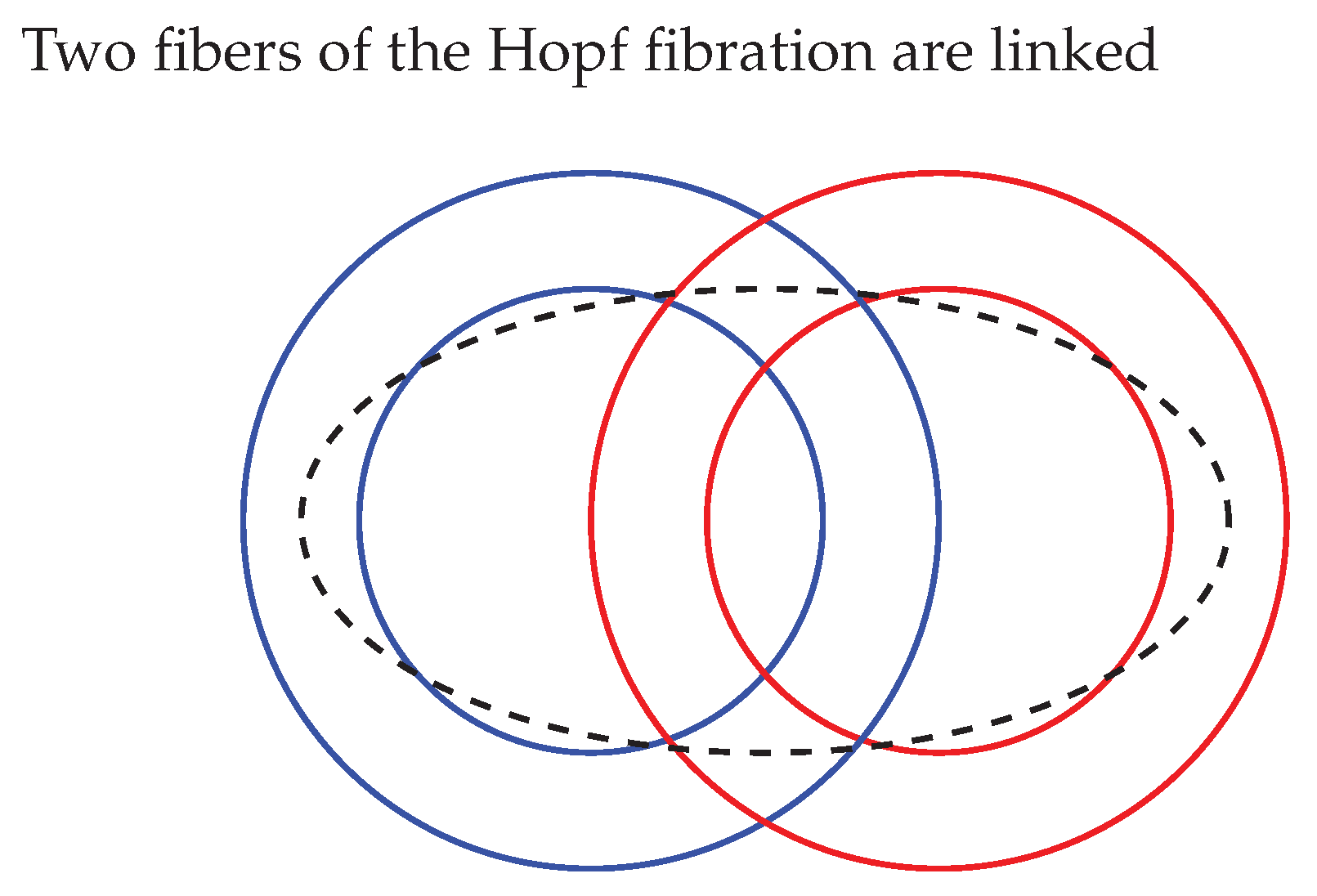
Given a map , one can define the Hopf invariant . For the Hopf maps, . The Hopf invariant is a homotopy invariant and is closely related to linking numbers of fibers. For the complex Hopf fibration, any two distinct fibers are linked with linking number 1. This geometric fact is a manifestation of the nontrivial Hopf invariant.
Figure 1.
Schematic representation of linked circles (fibers) in . In the actual 3-sphere, these circles are great circles and are linked exactly once.
Figure 1.
Schematic representation of linked circles (fibers) in . In the actual 3-sphere, these circles are great circles and are linked exactly once.
5. Villarceau Circles and the Hopf Fibration
The Hopf fibration is an abstract topological object, but it has a beautiful concrete geometric realization involving Villarceau circles on a torus.
5.1. Geometry of the Torus and Villarceau Circles
A torus is typically thought of as a surface of revolution. However, a torus also has a lesser-known set of circles, the Villarceau circles.
Definition 5.1
(Villarceau Circles). Given a torus embedded in or , a Villarceau circle is a circle on the torus that is not a meridian (longitude) or a parallel (latitude). They are obtained by intersecting the torus with a plane that is tangent to it at two points. On any given torus, there are two such families of circles, each filling the torus.13
Parametrically, a torus in can be given by
A Villarceau circle corresponds to a line of constant (or ) after an appropriate rotation. In terms of the two angles, a Villarceau circle is a curve where and vary linearly with equal speed.
5.2. Linking and the Hopf Fibration
The connection to the Hopf fibration becomes clear when we consider the 3-sphere. The 3-sphere can be filled by nested tori. One common way to see this is through stereographic projection.
Theorem 5.2.
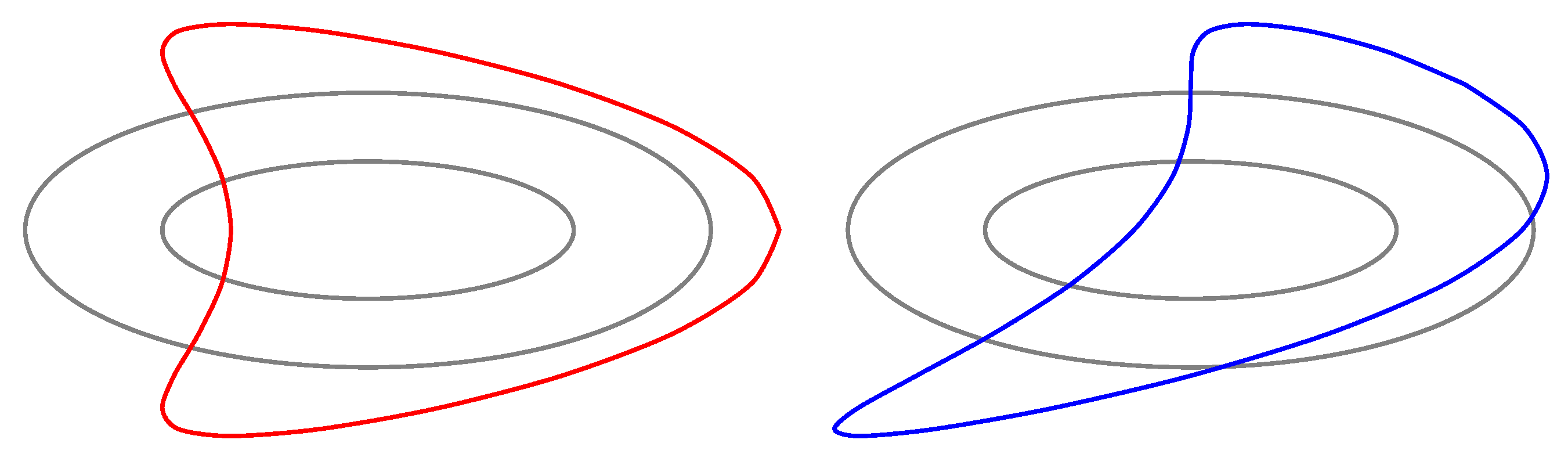
The fibers of the Hopf fibration are great circles. When is viewed as a union of nested tori (e.g., the preimages of circles of latitude on ), the Hopf fibers on each torus are precisely the Villarceau circles of that torus. Furthermore, any two distinct fibers are linked.14
Figure 2.
Two Villarceau circles on a torus. They wrap around both the meridian and longitude directions. In the Hopf fibration, each such circle is a fiber.
Figure 2.
Two Villarceau circles on a torus. They wrap around both the meridian and longitude directions. In the Hopf fibration, each such circle is a fiber.
To see this explicitly, use coordinates on :
Let be the set where , with . This is a torus. The Hopf map sends to the ratio . On this torus, the fibers are given by fixing the argument of , i.e., . This is exactly a line of constant slope in the coordinates, which corresponds to a Villarceau circle. For an in-depth discussion, see [8].
5.3. Visualization with Stereographic Projection
Stereographic projection maps to . Under this projection, the Hopf fibers become a family of linked circles in that fill space. The nested tori become nested tori of revolution in . This classic visualization can be found in many online resources and is an excellent way to build intuition.
6. Stable Homotopy Groups and the Adams Conjecture
The Freudenthal suspension theorem tells us that for each n, the groups stabilize as . The stable value is denoted , the n-th stable homotopy group of spheres. These groups are of central importance in algebraic topology; they are the homotopy groups of the sphere spectrum, and they appear in many contexts (e.g., the framed cobordism theorem of Pontryagin and Thom).
6.1. Definition and Basic Properties
Definition 6.1
(Stable Homotopy Groups). The n-th stable homotopy group of spheres is
where the limit is taken with respect to the suspension homomorphisms.
The stable groups are finite for (by a theorem of Serre), and they exhibit a rich structure. They are also the coefficient groups for the Adams spectral sequence, which is a primary computational tool.
Table 3.
Stable homotopy groups of spheres for (source: [12])
Table 3.
Stable homotopy groups of spheres for (source: [12])
| n | |
|---|---|
| 0 | |
| 1 | |
| 2 | |
| 3 | |
| 4 | 0 |
| 5 | 0 |
| 6 | |
| 7 | |
| 8 | |
| 9 | |
| 10 | |
| 11 | |
| 12 | 0 |
| 13 | |
| 14 | |
| 15 |
6.2. The Adams Spectral Sequence
The Adams spectral sequence is a powerful tool for computing stable homotopy groups. It takes the form
where is the mod p Steenrod algebra. For the sphere spectrum, this becomes a computation of the cohomology of the Steenrod algebra. The Adams spectral sequence has been completely worked out for many primes and dimensions, leading to the known stable groups.
| Algorithm 1 Adams Spectral Sequence Computation (sketch) |
|
6.3. The Adams Conjecture and Its Resolution
The Adams conjecture concerns the behavior of the J-homomorphism and the image of J in the stable homotopy groups. It was proved by Quillen and Sullivan in the 1970s. The J-homomorphism maps from the homotopy groups of the stable orthogonal group to stable homotopy. The image of J is a cyclic summand in for certain n. The Adams conjecture states that the image of J is exactly the summand predicted by Adams in his work on the Hopf invariant one problem.
7. Generalizations and Recent Developments
The ideas of Hopf fibrations extend far beyond spheres. They are a special case of sphere bundles and have deep connections to various areas of mathematics and theoretical physics.
7.1. Hopf-like Fibrations on Calabi-Yau Manifolds
Recent work has explored the existence of fibrations with similar properties on more complex manifolds, such as Calabi-Yau manifolds. These manifolds are of central importance in string theory.
Remark 7.1.
The structure of a Calabi-Yau manifold often allows for the construction of torus fibrations that are reminiscent of the Hopf fibration. These are known as special Lagrangian fibrations and are a key component of the SYZ conjecture in mirror symmetry. The fibers are special Lagrangian tori, and the base is a 3-sphere, mirroring the structure in a higher-dimensional, more complex setting.15
The SYZ conjecture, proposed by Strominger, Yau, and Zaslow, asserts that a Calabi-Yau manifold should admit a special Lagrangian torus fibration over a 3-sphere, and mirror symmetry corresponds to T-duality on the fibers. This is a deep generalization of the Hopf fibration, where the fibers are now tori of dimension 3 (or higher) and the base is a sphere.
7.2. Other Generalizations
- Twistor fibrations: For oriented Riemannian 4-manifolds, the twistor space fibers over the manifold with fiber . This is analogous to the Hopf fibration in the context of complex geometry.
- Quaternionic Hopf fibrations and instantons: The quaternionic Hopf map is related to the construction of instantons in Yang-Mills theory.
- Octonionic Hopf fibration and exceptional structures: The octonionic fibration appears in the context of the exceptional Lie groups and the classification of Riemannian holonomy.
8. Conclusion
The homotopy groups of spheres are a deep and intricate subject, sitting at the heart of algebraic topology. The Hopf fibrations provide a crucial bridge between abstract homotopy theory and concrete geometry. They not only allow for the computation of the first non-trivial higher homotopy group, , but also reveal a profound geometric structure within the 3-sphere itself.
The appearance of Villarceau circles as the fibers of this fibration is a beautiful example of how topology and geometry intertwine. It transforms the abstract notion of a homotopy class into a tangible picture of linked circles filling space. The legacy of these ideas continues to grow, finding new expressions in modern research on Calabi-Yau manifolds and mirror symmetry, proving that even classical results can illuminate the frontiers of science.
Future directions include a deeper understanding of the stable homotopy groups via chromatic homotopy theory, the exploration of higher-dimensional analogs in the context of M-theory, and the continued development of computational tools. The Hopf fibrations remain a source of inspiration and a testbed for new theories.
Funding
This research received no external grant from any public, commercial, or non-profit funding agency.
Data Availability Statement
No new data were generated or analyzed in support of this research.
AI Disclosuree
This document was typeset using  . An AI language model assisted with grammatical refinements and the generation of explanatory footnotes based on the author’s detailed instructions and conceptual framework.
. An AI language model assisted with grammatical refinements and the generation of explanatory footnotes based on the author’s detailed instructions and conceptual framework. AI Ethics
The use of AI was limited to the aforementioned tasks.
Acknowledgments
Conflicts of Interest
The author declares no competing interests.
A. Appendix: Detailed Proofs
A.1.Proof of the Freudenthal Suspension Theorem (Sketch)
The theorem is proved using the notions of CW complexes and the homotopy excision theorem. For a detailed proof, see ([1] Chapter 4). The key idea is to consider the suspension map and show that it is an isomorphism for by constructing an inverse using the fact that the inclusion is -connected.
A.2. Construction of the Connecting Homomorphism
For a fibration , the connecting map is defined as follows: represent an element of by a map sending to the basepoint. Consider . Define a homotopy by . Lift this homotopy to starting with a constant lift at the basepoint. Then maps into the fiber, yielding an element of .
Table 4.
Low-dimensional homotopy groups of spheres for small (compiled from [11])
Table 4.
Low-dimensional homotopy groups of spheres for small (compiled from [11])
| 1 | 2 | 3 | 4 | 5 | 6 | 7 | 8 | |
| 1 | 0 | 0 | 0 | 0 | 0 | 0 | 0 | |
| 2 | 0 | |||||||
| 3 | 0 | 0 | ||||||
| 4 | 0 | 0 | 0 | |||||
| 5 | 0 | 0 | 0 | 0 | ||||
| 6 | 0 | 0 | 0 | 0 | 0 | |||
| 7 | 0 | 0 | 0 | 0 | 0 | 0 | ||
| 8 | 0 | 0 | 0 | 0 | 0 | 0 | 0 |
B. Appendix: Algorithmic Approaches
The computation of homotopy groups of spheres can be approached algorithmically using spectral sequences and computer algebra. Here we outline a simplified algorithm for computing for small using the Serre spectral sequence for the path-loop fibration.
| Algorithm 2 Compute via the Serre spectral sequence (simplified) |
|
This is a highly idealized description; in practice, the computations become extremely complex and have been carried out only for low dimensions.
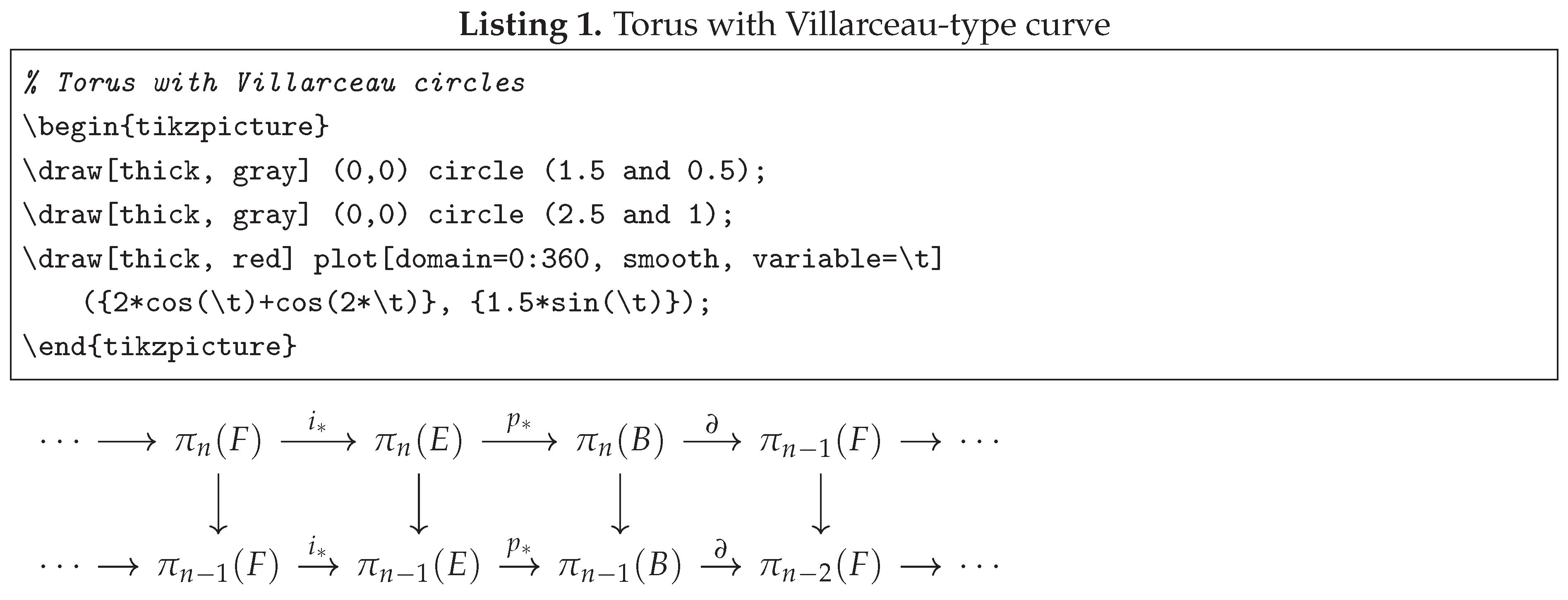
C. Appendix: TikZ Code for Figures
Here we provide the TikZ code used to generate some of the figures in this paper.
References
- A. Hatcher, Algebraic Topology. Cambridge University Press, 2002. [Link].
- R. Bott and L. W. Tu, Differential Forms in Algebraic Topology. Graduate Texts in Mathematics, vol. 82. Springer-Verlag, 1982. [Link].
- J. F. Adams, “On the non-existence of elements of Hopf invariant one,” Annals of Mathematics, vol. 72, no. 1, pp. 20-104, 1960. [JSTOR].
- D. Bhattacharjee, S. Singha Roy, and R. Sadhu, “Homotopy group of spheres, Hopf fibrations and Villarceau circles,” EPRA International Journal of Research & Development (IJRD), vol. 7, no. 9, September 2022. [CrossRef]
- D. Bhattacharjee and O. Frederick, “Hopf-Like Fibrations on Calabi-Yau Manifolds,” Preprints, 2025. [CrossRef]
- E. H. Spanier, Algebraic Topology. Springer-Verlag, 1981. [Link].
- G. W. Whitehead, Elements of Homotopy Theory. Graduate Texts in Mathematics, vol. 61. Springer-Verlag, 1978. [Link].
- D. W. Lyons, “An Elementary Introduction to the Hopf Fibration,” Mathematics Magazine, vol. 76, no. 2, pp. 87-98, 2003. [JSTOR].
- R. Penrose, The Road to Reality: A Complete Guide to the Laws of the Universe. Jonathan Cape, 2004. [Link].
- M. Nakahara, Geometry, Topology and Physics, 2nd ed. Institute of Physics Publishing, 2003. [Link].
- H. Toda, Composition Methods in Homotopy Groups of Spheres. Annals of Mathematics Studies, No. 49. Princeton University Press, 1962.
- D. C. Ravenel, Complex Cobordism and Stable Homotopy Groups of Spheres. Academic Press, 1986.
- J. P. May, A Concise Course in Algebraic Topology. University of Chicago Press, 1999.
- R. M. Switzer, Algebraic Topology — Homotopy and Homology. Springer-Verlag, 1975.
- A. Strominger, S.-T. Yau, and E. Zaslow, “Mirror symmetry is T-duality,” Nuclear Physics B, vol. 479, no. 1-2, pp. 243-259, 1996.
- M. F. Atiyah, “The Hopf fibration and the geometry of the octonions,” in Michael Atiyah: Collected Works, vol. 5, pp. 201-213, 1988.
| 1 | The notation represents the n-th homotopy group of the k-sphere. It is the group of homotopy classes of continuous maps from the n-sphere to the k-sphere . For a pointed space, these maps are required to send a basepoint to a basepoint. The group operation is induced by concatenation of maps. For an introduction, see [1]. |
| 2 | This result can be intuited by considering smooth maps and applying Sard’s theorem, which states that the image of a smooth map from a lower-dimensional manifold to a higher-dimensional one cannot be surjective, and can be deformed to a point. A rigorous proof uses cellular approximation. |
| 3 | The degree of a map is a integer that counts how many times the domain sphere wraps around the target sphere, taking orientation into account. A constant map has degree 0, the identity map has degree 1, and the antipodal map has degree . |
| 4 | Think of the interval as a time parameter. At time , we have the map f. As time progresses, the map continuously deforms f into g. At time , we have the map g. This is a continuous deformation of the entire mapping. |
| 5 | This is the topological analog of a bijection in set theory or an isomorphism in group theory. Instead of requiring to be exactly the identity, we only require it to be homotopic to it. For example, a solid disk is homotopy equivalent to a point, as you can continuously shrink the disk down to the point. |
| 6 | The group operation for is commutative, a fact which is not true for the fundamental group () in general. This is one of the many reasons why higher homotopy groups are both more complex and more structured than the fundamental group. For a detailed construction, see [1]. |
| 7 | The proof for often uses the Simplicial Approximation Theorem. The result for is a classic theorem by Heinz Hopf, which uses the concept of the degree of a map to establish the isomorphism with the integers. |
| 8 | The suspension E of a map is a map , where denotes the reduced suspension. This theorem tells us that the homotopy groups of spheres stabilize as the dimension increases. For , the group is independent of k for sufficiently large k. These stable groups are the stable homotopy groups of spheres, denoted . |
| 9 | In practice, most useful fibrations in algebraic topology are Serre fibrations. The key idea is that you can lift homotopies from the base space B to the total space E, given an initial lift. This allows us to relate homotopy groups of E, B, and the fiber . |
| 10 | This is one of the most powerful computational tools in homotopy theory. It shows how the homotopy groups of the base, total space, and fiber are intertwined. If two of the three are known, this sequence often helps determine the third. The map ∂ is defined by lifting a map from a sphere in the base to a map from a disk in the total space and then restricting to the boundary, which lies in the fiber. |
| 11 | If , we define . The map is well-defined because multiplying by a complex scalar of unit norm yields the same point in . The fibers, , are all the complex multiples of a given that lie on , which form a circle . Hence, we have a fibration . |
| 12 |
Proof sketch: The long exact sequence of the Hopf fibration gives:
We know and because the universal cover of is , which is contractible. Also, , generated by the identity map. The sequence becomes:
Thus, is an isomorphism, and the homotopy class of the Hopf map generates . This is a classic and beautiful result.
|
| 13 | Imagine a donut. The usual circles are the small loop around the donut hole (meridian) and the large loop around the outside (parallel). Now imagine cutting the donut with a plane that just skims the inner hole and the outer edge simultaneously. The intersection curve is a Villarceau circle. It winds around the torus in a helical fashion, once in the meridional direction and once in the longitudinal direction. |
| 14 | This is a stunning geometric fact. The Hopf fibration provides a decomposition of into a continuous family of circles, one for each point on . When you look at the tori that are the preimages of circles of latitude on , each such torus is foliated by these Hopf fibers. These fibers are exactly the Villarceau circles. Moreover, any two of these circles are linked, just like two links in a chain. The linking number of any two distinct Hopf fibers is 1. This linking is a geometric manifestation of the non-trivial homotopy class of the map. |
| 15 | Recent research, such as that by Bhattacharjee and Frederick [5], investigates the explicit construction and properties of such “Hopf-like” fibrations. They explore how the non-trivial linking and winding numbers manifest in the context of these Ricci-flat, Kähler manifolds, potentially offering new insights into both geometry and theoretical physics. |
Disclaimer/Publisher’s Note: The statements, opinions and data contained in all publications are solely those of the individual author(s) and contributor(s) and not of MDPI and/or the editor(s). MDPI and/or the editor(s) disclaim responsibility for any injury to people or property resulting from any ideas, methods, instructions or products referred to in the content. |
© 2026 by the authors. Licensee MDPI, Basel, Switzerland. This article is an open access article distributed under the terms and conditions of the Creative Commons Attribution (CC BY) license (http://creativecommons.org/licenses/by/4.0/).
Copyright: This open access article is published under a Creative Commons CC BY 4.0 license, which permit the free download, distribution, and reuse, provided that the author and preprint are cited in any reuse.


