

Submitted:
27 February 2026
Posted:
28 February 2026
You are already at the latest version
Abstract
Standard accuracy benchmarks evaluate whether a language model produces correct outputs but not whether it produces them consistently. We demonstrate that accuracy and output predictability are independent dimensions (Pearson r = -0.24, p = 0.56, N = 8 medical LLMs) when evaluated at a critical clinical summarization position. This independence yields a four-class behavioral taxonomy: IDEAL (convergent and accurate), EMPTY (convergent but inaccurate), DIVERGENT (high variance with incomplete outputs), and RICH (moderate variance with high accuracy).The DIVERGENT class exhibits stochastic incompleteness—summaries that are factually accurate but randomly incomplete across trials, with zero hallucinations. LAD occlusion, a critical clinical finding in STEMI cases, appears in only 22% of Llama 4 Scout summaries despite the model correctly identifying it when directly queried. This failure mode is invisible to standard benchmarks that average across outputs rather than measuring trial-to-trial variance.We propose a two-dimensional framework (Predictability × Accuracy) as a minimum requirement for clinical AI assessment, identify specific models unsuitable for deployment (Llama 4 Scout with Variance Ratio = 7.46; Llama 4 Maverick with Variance Ratio = 2.64), and flag one model requiring safety filter reconfiguration (Gemini Flash, 16% accuracy due to over-refusal). These findings demonstrate that current single-metric evaluation approaches systematically miss critical safety failures in clinical AI systems.
Keywords:
large language models
; clinical AI
; deployment safety
; predictability
; variance analysis
; stochastic incompleteness
; behavioral taxonomy
; multi-turn conversation
; AI evaluation
; model stability
1. Introduction
The deployment of large language models (LLMs) in clinical settings has accelerated rapidly, with applications ranging from diagnostic support to medical summarization (Singhal et al. 2023; Thirunavukarasu et al. 2023). Current evaluation paradigms focus almost exclusively on accuracy metrics—whether the model produces correct outputs on benchmark datasets. However, accuracy alone may be insufficient for clinical deployment, where consistency and predictability are equally critical.
Recent work has demonstrated that LLMs exhibit significant position-dependent behavior in multi-turn conversations (Laban et al. 2025; Liu et al. 2024), and that output consistency does not necessarily correlate with accuracy (Shyr et al. 2025). These findings suggest that clinical AI evaluation requires multiple dimensions beyond traditional benchmarks.
We introduce a two-dimensional evaluation framework that measures both accuracy and predictability, operationalized through Variance Ratio (the ratio of response variance with context to variance without context). This framework reveals a four-class taxonomy of model behavior, including a previously undescribed failure mode we term stochastic incompleteness—outputs that are factually correct but randomly incomplete across repeated trials.
Our contributions are:
- Demonstration that accuracy and predictability are statistically independent (, )
- A four-class behavioral taxonomy (IDEAL, EMPTY, DIVERGENT, RICH) with distinct clinical implications
- Identification of stochastic incompleteness as a novel failure mode invisible to standard benchmarks
- A deployment decision framework based on two-dimensional evaluation
2. Related Work
2.1. Clinical LLM Evaluation
The evaluation of LLMs for clinical applications has evolved from simple accuracy metrics to more comprehensive frameworks. Singhal et al. (2023) established that LLMs can achieve physician-level performance on medical examinations, while Thirunavukarasu et al. (2023) reviewed broader clinical applications. However, these evaluations primarily focus on correctness rather than consistency.
Asgari et al. (2025) introduced a framework distinguishing hallucination (fabricated content) from omission (missing information) in clinical summaries, finding hallucination rates of 1.47% and omission rates of 3.45% across clinical note generation tasks. Our work extends this by showing that omission can be stochastic—the same model omits different information across trials.
2.2. Output Consistency and Reproducibility
Wang & Wang (2025) conducted extensive experiments with 50 independent runs across multiple tasks, finding substantial but task-dependent consistency. Shyr et al. (2025) proposed a statistical framework for repeatability and reproducibility, critically finding that “repeatability did not correlate with diagnostic accuracy”—a finding our work independently confirms and extends.
2.3. Position Effects in Multi-Turn Conversations
Liu et al. (2024) demonstrated the “lost in the middle” phenomenon where models struggle with information in middle positions of long contexts. Laban et al. (2025) extended this to multi-turn conversations, showing degradation over conversational depth. Our prior work established that context sensitivity follows predictable patterns across positions (Laxman 2026a), with entanglement dynamics captured through variance ratios (Laxman 2026b).
3. Methods
3.1. Experimental Design
We evaluated 8 LLMs on a clinical summarization task using a standardized STEMI (ST-Elevation Myocardial Infarction) case. Each model completed 50 independent trials of a 30-position conversation, yielding 12,000 total responses per model.
Models evaluated: DeepSeek V3.1, Kimi K2, Ministral 14B, Mistral Small 24B, Qwen3 235B, Gemini Flash, Llama 4 Maverick, Llama 4 Scout.
Task: At position 30 (P30), models were asked to provide a comprehensive clinical summary of the STEMI case discussed throughout the conversation. This position represents the critical summarization moment where all prior context should be integrated.
3.2. Metrics
Clinical Accuracy: Summaries were scored against 16 critical clinical elements (STEMI diagnosis, LAD occlusion, troponin elevation, ECG findings, treatment performed, etc.). Accuracy = elements correctly included / 16.
Variance Ratio (VR): Following Laxman (2026b), we computed:
where RCI (Response Coherence Index) measures pairwise cosine similarity of response embeddings across trials. VR indicates context amplifies variance (divergent); VR indicates context reduces variance (convergent).
Embeddings were computed using Sentence-BERT (Reimers & Gurevych 2019) with the all-MiniLM-L6-v2 model (384 dimensions).
3.3. Statistical Analysis
Independence of accuracy and VR was tested using Pearson correlation. The four-class taxonomy was derived by crossing two dimensions: Accuracy (> 70% vs ≤ 70%) and Predictability (VR < 1.2 for convergent, VR 1.2–2.0 for moderate, VR > 2.0 for divergent).
4. Results
4.1. Independence of Accuracy and Predictability
Accuracy and Variance Ratio showed no significant correlation across the 8 models (Pearson , ). This independence is visualized in Figure 1, where models distribute across all four quadrants of the Accuracy × Predictability space.
4.2. Four-Class Behavioral Taxonomy
The independence of accuracy and predictability yields four distinct behavioral classes (Table 1):
IDEAL Class: Four models (DeepSeek V3.1, Kimi K2, Ministral 14B, Mistral Small 24B) achieved high accuracy (83–92%) with convergent behavior (VR < 1.2). These models consistently produce similar, accurate summaries across trials.
EMPTY Class: Gemini Flash showed highly convergent behavior (VR = 0.60) but extremely low accuracy (16%). Investigation revealed systematic over-refusal due to safety filters, producing consistent but uninformative responses.
DIVERGENT Class: Both Llama models exhibited high variance (VR = 2.64–7.46) with moderate accuracy (47–55%). These models produce unpredictable outputs that vary substantially across trials.
RICH Class: Qwen3 235B achieved the highest accuracy (95%) with moderate variance (VR = 1.45), suggesting diverse but accurate response strategies.
4.3. Stochastic Incompleteness
The DIVERGENT class revealed a novel failure mode we term stochastic incompleteness. Unlike hallucination (fabricating false information) or systematic omission (consistently missing specific elements), stochastic incompleteness involves random omission of different elements across trials.
Figure 2 shows the trial-level variability and per-element detection rates. Llama 4 Scout correctly identifies LAD occlusion when directly queried but includes it in only 22% of summaries. The 78% gap represents stochastic incompleteness—the model “knows” the information but randomly omits it.
Critically, across all 100 Llama trials (50 Scout + 50 Maverick), we observed zero hallucinations. Every fact included in the summaries was correct. The failure mode is purely one of omission, and the omissions are stochastic rather than systematic.
4.4. Embedding Space Visualization
Figure 3 visualizes the response distributions in embedding space, clearly showing the three archetypal patterns:
4.5. Single-Metric Evaluation Failures
Figure 4 demonstrates why single-metric evaluation is insufficient:
4.6. Position-Dependent Variance
The Llama models’ extreme variance emerges specifically at P30, the summarization position. Figure 5 shows position-level Variance Ratio across the conversation:
4.7. Deployment Decision Framework
Based on these findings, we propose a decision framework for clinical AI deployment (Figure 6):
5. Discussion
5.1. Clinical Implications of Stochastic Incompleteness
The discovery of stochastic incompleteness has significant implications for clinical AI deployment. Unlike hallucination, which produces false positives that clinicians might catch, stochastic incompleteness produces false negatives that are harder to detect. A clinician reviewing an AI-generated summary has no way to know that LAD occlusion was mentioned in the source but omitted from this particular summary.
This failure mode is particularly dangerous because:
- It is invisible to accuracy-only benchmarks that average across trials
- It produces no hallucinations, passing factual verification
- The omitted information varies across trials, defeating systematic checks
- Critical clinical findings (LAD occlusion, ejection fraction) are affected
Our findings align with Asgari et al. (2025), who identified omission as a distinct failure mode from hallucination, but extend their work by showing that omission can be stochastic at the trial level rather than systematic at the model level.
5.2. Independence of Accuracy and Predictability
The statistical independence of accuracy and predictability (, ) has important methodological implications. Current LLM leaderboards rank models by accuracy alone, implicitly assuming that higher accuracy implies safer deployment. Our findings demonstrate this assumption is false.
This independence was independently observed by Shyr et al. (2025), who found “repeatability did not correlate with diagnostic accuracy.” Together, these findings suggest that clinical AI evaluation must adopt multi-dimensional frameworks as a minimum standard.
5.3. Limitations
This study has several limitations:
- Single clinical case (STEMI) may not generalize to other conditions
- Eight models may not represent the full LLM landscape
- 50 trials per model may underestimate rare failure modes
- Position 30 analysis may miss other critical positions
Future work should extend this framework across multiple clinical scenarios, larger model sets, and comprehensive position analysis.
6. Conclusion
We demonstrate that accuracy and predictability are independent dimensions in clinical LLM evaluation, yielding a four-class behavioral taxonomy with distinct deployment implications. The DIVERGENT class exhibits stochastic incompleteness—accurate but randomly incomplete outputs that evade standard benchmarks.
These findings argue for mandatory two-dimensional evaluation (Predictability × Accuracy) before clinical AI deployment. Models with high variance ratios (Llama 4 Scout: VR = 7.46; Llama 4 Maverick: VR = 2.64) should not be deployed regardless of accuracy metrics. Single-metric evaluation systematically misses critical safety failures.
Data Availability Statement
All data and analysis code are available at: https://github.com/LaxmanNandi/MCH-Research.
Acknowledgments
The author thanks the AI research community for open-source tools and models that enabled this work. Computational analysis was assisted by AI tools (Claude, DeepSeek) for code generation and statistical verification.
Conflicts of Interest
The author declares no conflicts of interest.
References
- Asgari, E., N. Montaña-Brown, M. Dubois, and et al. 2025. A framework to assess clinical safety and hallucination rates of LLMs for medical text summarisation. npj Digital Medicine 8: 274. [Google Scholar] [CrossRef] [PubMed]
- Laban, P., H. Hayashi, Y. Zhou, and J. Neville. 2025. LLMs get lost in multi-turn conversation. arXiv arXiv:2505.06120. [Google Scholar] [CrossRef]
- Laxman, M. M. 2026a. Context curves behavior: Measuring AI relational dynamics with DRCI. Preprints.org. [Google Scholar] [CrossRef]
- Laxman, M. M. 2026b. Engagement as entanglement: Variance signatures of bidirectional context coupling in large language models. Preprints.org. submitted. [Google Scholar]
- Liu, N. F., K. Lin, J. Hewitt, and et al. 2024. Lost in the middle: How language models use long contexts. Transactions of the Association for Computational Linguistics 12: 157–173. [Google Scholar] [CrossRef]
- Reimers, N., and I. Gurevych. 2019. Sentence-BERT: Sentence embeddings using Siamese BERT-networks. Proceedings of EMNLP-IJCNLP, 3982–3992. [Google Scholar]
- Shyr, C., and et al. 2025. A statistical framework for evaluating repeatability and reproducibility of large language models. medRxiv preprint. [Google Scholar]
- Singhal, K., S. Azizi, T. Tu, and et al. 2023. Large language models encode clinical knowledge. Nature 620, 7972: 172–180. [Google Scholar] [CrossRef] [PubMed]
- Thirunavukarasu, A. J., D. S. Ting, K. Elangovan, and et al. 2023. Large language models in medicine. Nature Medicine 29, 8: 1930–1940. [Google Scholar] [CrossRef] [PubMed]
- Wang, J., and Y. Wang. 2025. Assessing consistency and reproducibility in the outputs of large language models: Evidence across diverse finance and accounting tasks. arXiv arXiv:2503.16974. [Google Scholar] [CrossRef]
Figure 1.
Deployment Safety Matrix. Eight medical LLMs plotted by Variance Ratio (x-axis) and Clinical Accuracy (y-axis). The four quadrants define distinct behavioral classes with different deployment implications. Colors indicate taxonomy class: green (IDEAL), yellow (EMPTY), red (DIVERGENT), blue (RICH).
Figure 1.
Deployment Safety Matrix. Eight medical LLMs plotted by Variance Ratio (x-axis) and Clinical Accuracy (y-axis). The four quadrants define distinct behavioral classes with different deployment implications. Colors indicate taxonomy class: green (IDEAL), yellow (EMPTY), red (DIVERGENT), blue (RICH).
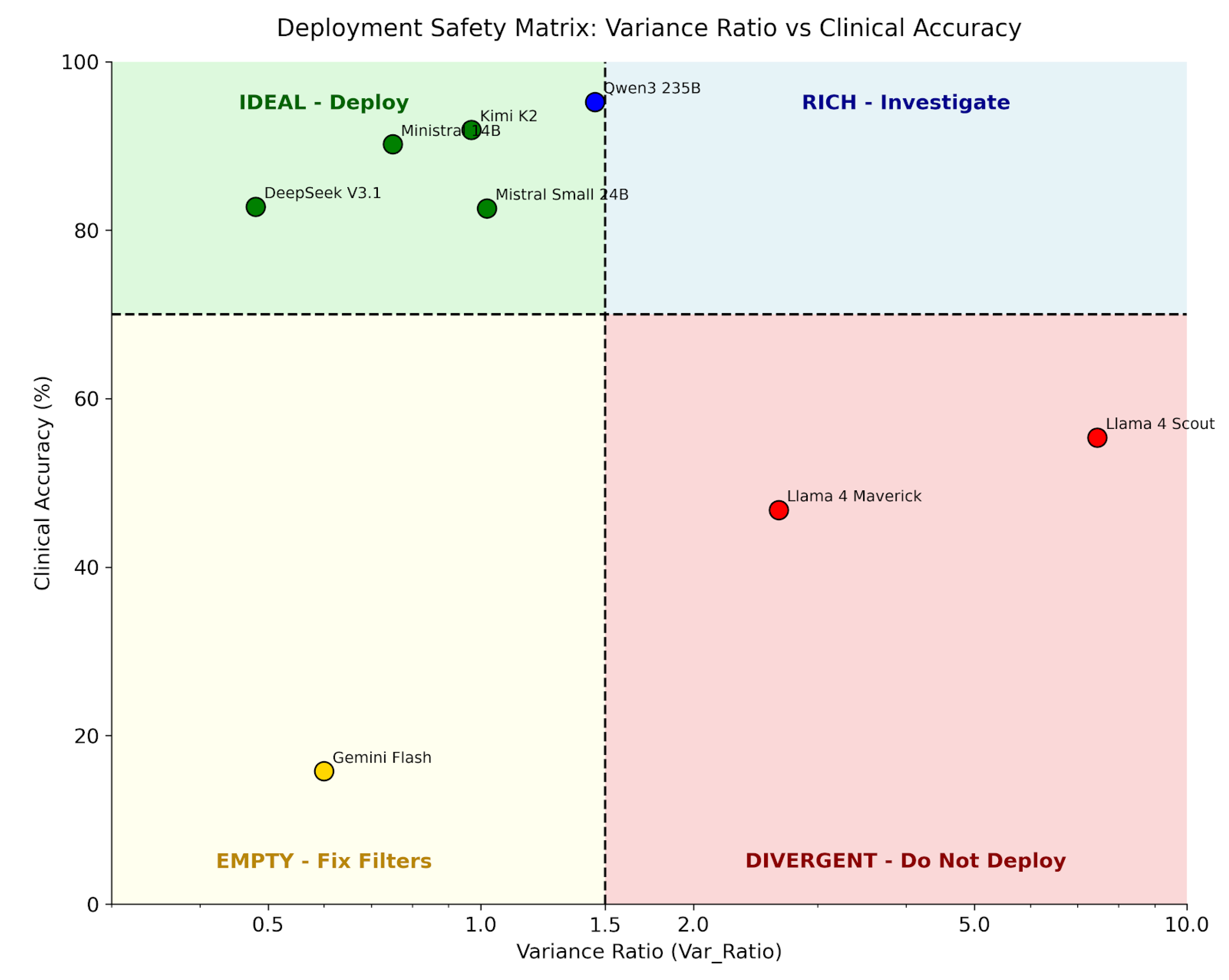
Figure 2.
Trial-Level Variability and Clinical Element Analysis. (A) Score distribution across 50 trials for three archetypal models. DeepSeek (IDEAL) shows tight clustering near perfect scores; Llama Scout (DIVERGENT) shows wide spread; Gemini Flash (EMPTY) clusters at zero due to over-refusal. (B) Per-element detection rates reveal critical gaps: LAD occlusion (78% gap), Cardiac Rehab (78% gap), and New Murmur (50% gap) are stochastically omitted by Llama Scout.
Figure 2.
Trial-Level Variability and Clinical Element Analysis. (A) Score distribution across 50 trials for three archetypal models. DeepSeek (IDEAL) shows tight clustering near perfect scores; Llama Scout (DIVERGENT) shows wide spread; Gemini Flash (EMPTY) clusters at zero due to over-refusal. (B) Per-element detection rates reveal critical gaps: LAD occlusion (78% gap), Cardiac Rehab (78% gap), and New Murmur (50% gap) are stochastically omitted by Llama Scout.
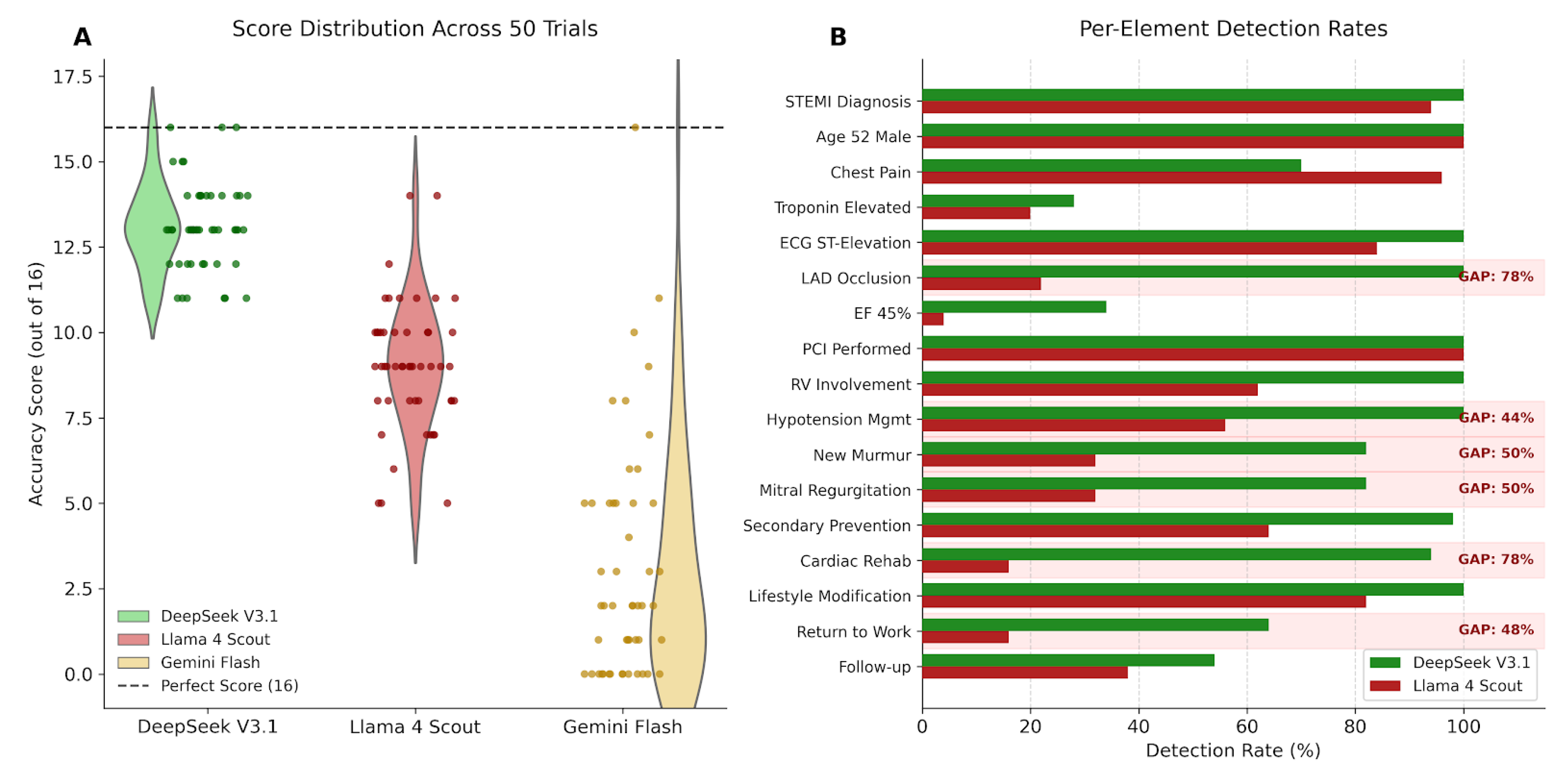
Figure 3.
Response Distribution Archetypes in Embedding Space. UMAP projections of P30 summaries across 50 trials, colored by accuracy score (red = low, green = high). (A) DeepSeek V3.1 (IDEAL): tight cluster, high accuracy. (B) Gemini Flash (EMPTY): tight cluster, low accuracy. (C) Llama 4 Scout (DIVERGENT): scattered distribution, variable accuracy.
Figure 3.
Response Distribution Archetypes in Embedding Space. UMAP projections of P30 summaries across 50 trials, colored by accuracy score (red = low, green = high). (A) DeepSeek V3.1 (IDEAL): tight cluster, high accuracy. (B) Gemini Flash (EMPTY): tight cluster, low accuracy. (C) Llama 4 Scout (DIVERGENT): scattered distribution, variable accuracy.
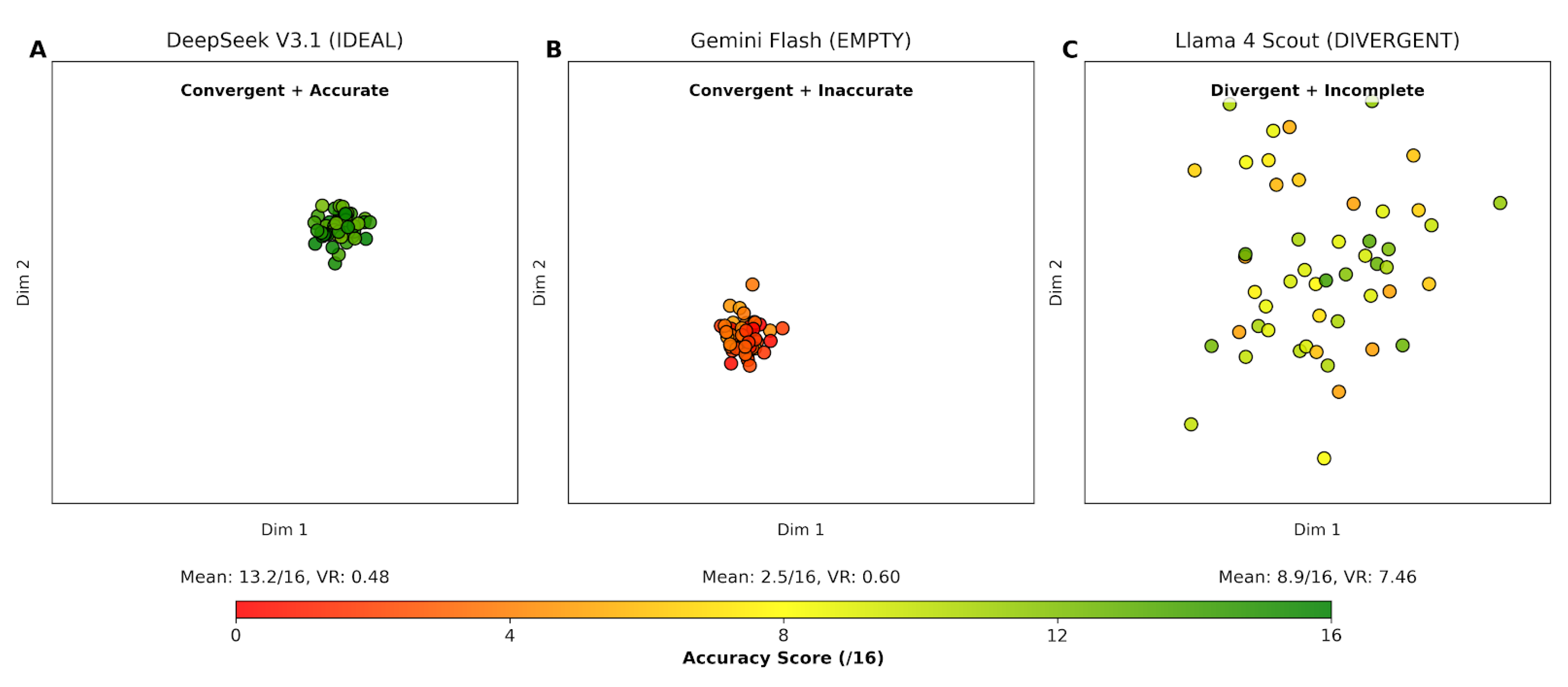
Figure 4.
Single-Metric Rankings Miss Critical Safety Failures. (A) Ranked by Variance Ratio only: Gemini Flash appears safest (low VR) but has only 16% accuracy. (B) Ranked by Accuracy only: Llama Scout’s moderate accuracy (55%) masks extreme instability (VR = 7.46).
Figure 4.
Single-Metric Rankings Miss Critical Safety Failures. (A) Ranked by Variance Ratio only: Gemini Flash appears safest (low VR) but has only 16% accuracy. (B) Ranked by Accuracy only: Llama Scout’s moderate accuracy (55%) masks extreme instability (VR = 7.46).
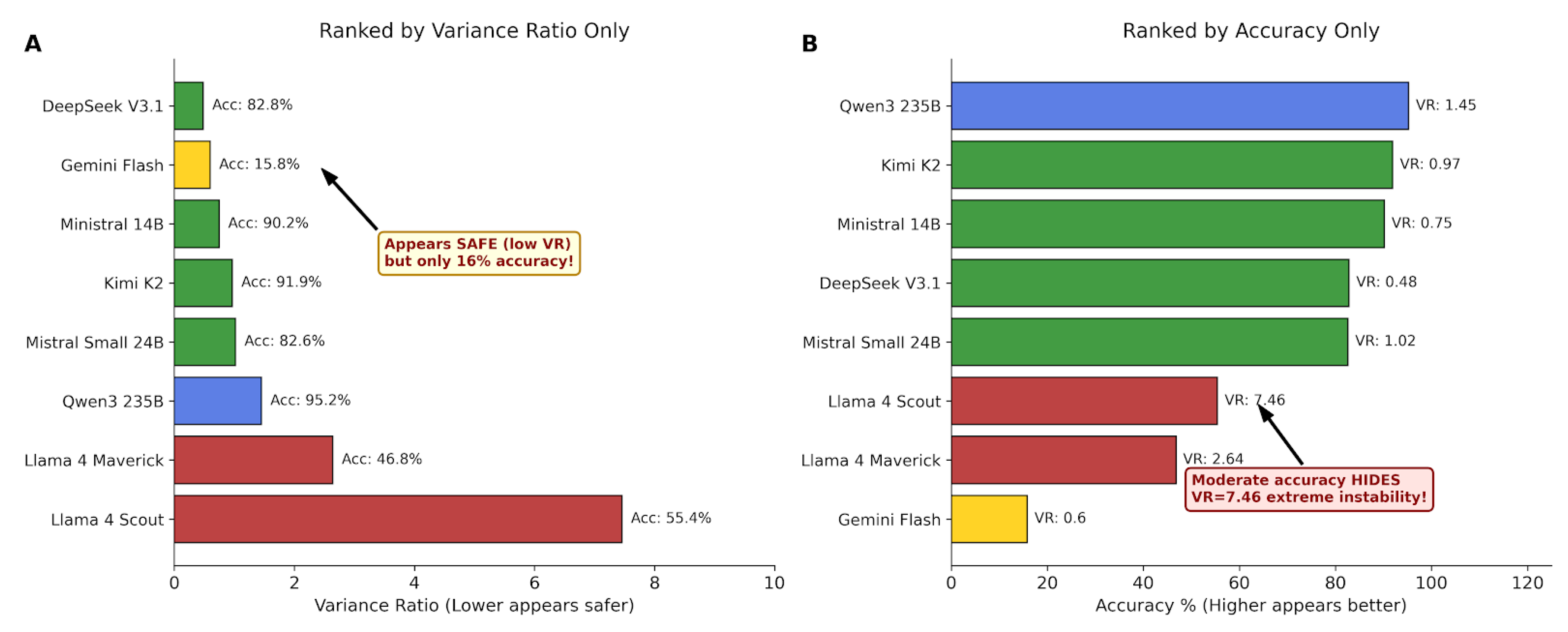
Figure 5.
Position-Level Variance Ratio Across Three Archetypes. All models show similar VR (≈ 1.0) through positions 1–29. At P30 (summarization), Llama 4 Scout spikes to VR = 7.46 while IDEAL and EMPTY models remain stable. This position-specific instability is invisible to position-averaged metrics.
Figure 5.
Position-Level Variance Ratio Across Three Archetypes. All models show similar VR (≈ 1.0) through positions 1–29. At P30 (summarization), Llama 4 Scout spikes to VR = 7.46 while IDEAL and EMPTY models remain stable. This position-specific instability is invisible to position-averaged metrics.
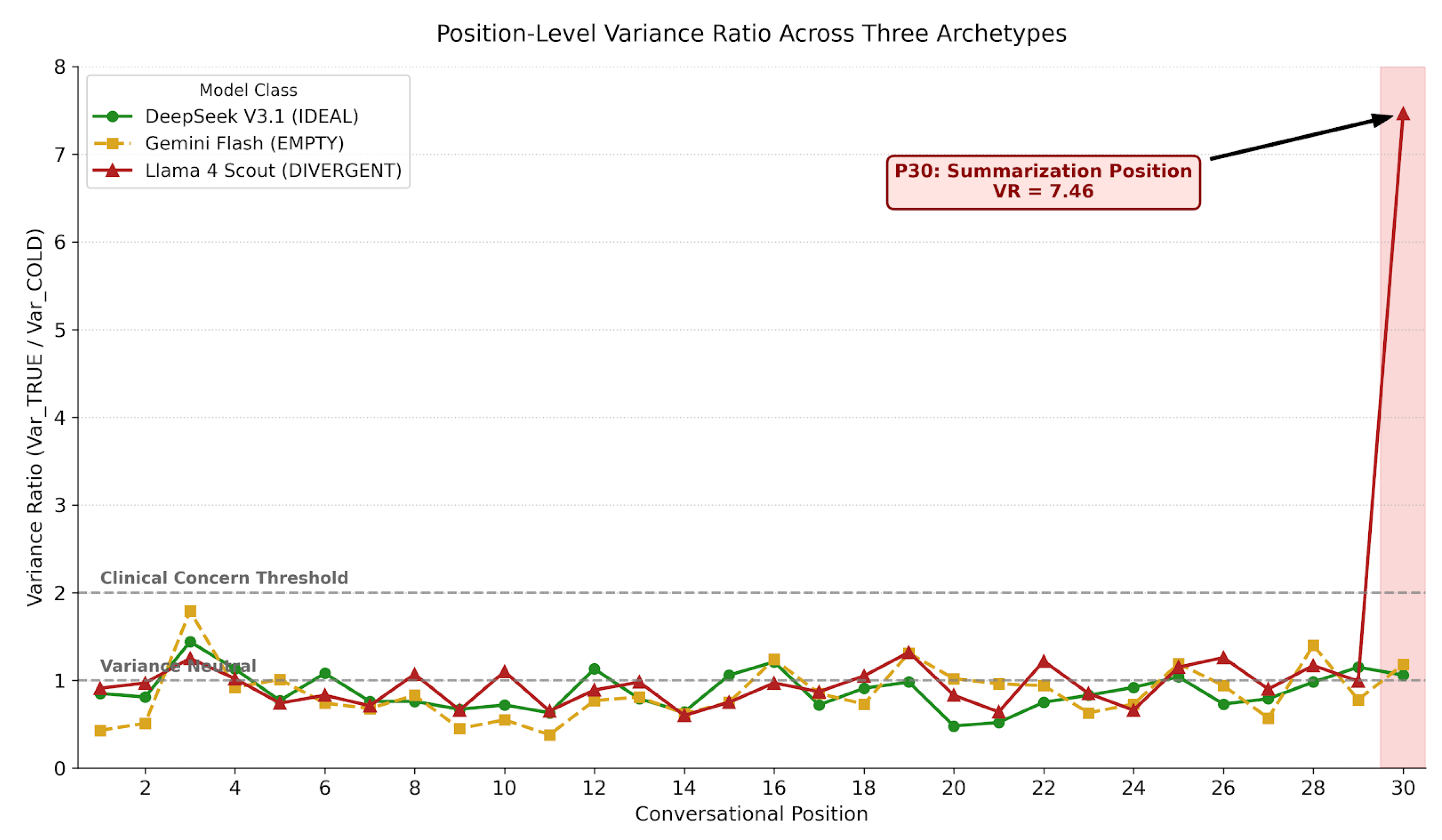
Figure 6.
Clinical AI Deployment Decision Framework. Sequential evaluation first checks Variance Ratio (VR > 2.0 triggers rejection), then accuracy (< 70% requires investigation), then moderate variance (VR 1.2–2.0 warrants monitoring). Only models passing all checks are cleared for deployment.
Figure 6.
Clinical AI Deployment Decision Framework. Sequential evaluation first checks Variance Ratio (VR > 2.0 triggers rejection), then accuracy (< 70% requires investigation), then moderate variance (VR 1.2–2.0 warrants monitoring). Only models passing all checks are cleared for deployment.
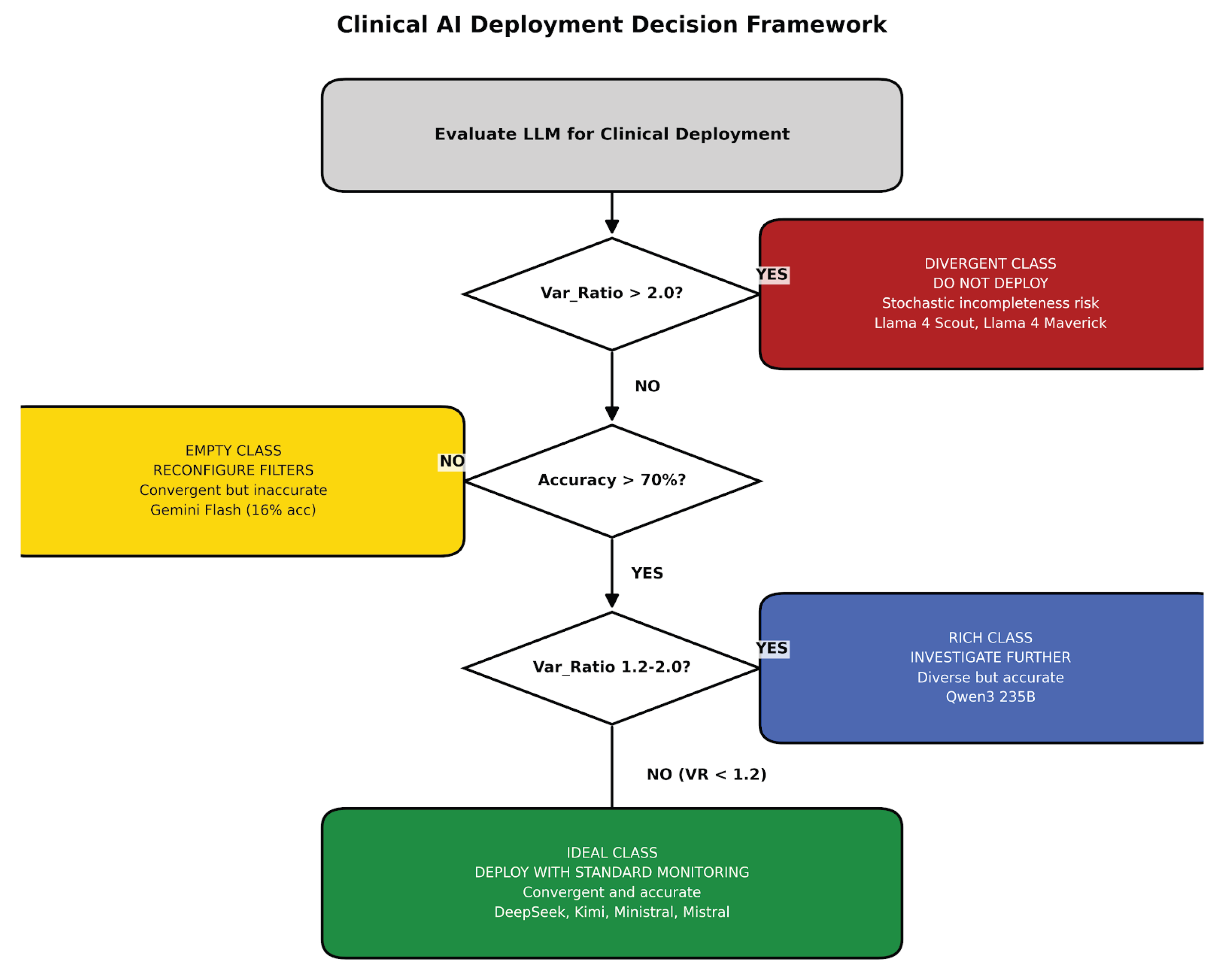

Table 1.
Four-Class Behavioral Taxonomy at P30 Clinical Summarization.
| Class | Models | Accuracy | VR | Recommendation |
|---|---|---|---|---|
| IDEAL | DeepSeek, Kimi, Ministral, Mistral | 83–92% | 0.48–1.02 | Deploy |
| EMPTY | Gemini Flash | 16% | 0.60 | Fix Filters |
| DIVERGENT | Llama Scout, Llama Maverick | 47–55% | 2.64–7.46 | Do Not Deploy |
| RICH | Qwen3 235B | 95% | 1.45 | Investigate |
Disclaimer/Publisher’s Note: The statements, opinions and data contained in all publications are solely those of the individual author(s) and contributor(s) and not of MDPI and/or the editor(s). MDPI and/or the editor(s) disclaim responsibility for any injury to people or property resulting from any ideas, methods, instructions or products referred to in the content. |
© 2026 by the author. Licensee MDPI, Basel, Switzerland. This article is an open access article distributed under the terms and conditions of the Creative Commons Attribution (CC BY) license (http://creativecommons.org/licenses/by/4.0/).
Copyright: This open access article is published under a Creative Commons CC BY 4.0 license, which permit the free download, distribution, and reuse, provided that the author and preprint are cited in any reuse.


