

Submitted:
25 February 2026
Posted:
28 February 2026
You are already at the latest version
Abstract
China's "Double Reduction" policy, introduced in 2021 to curtail excessive academic tutoring, has redirected millions of families toward extracurricular arts education, particularly music. Yet this surge in demand has exposed longstanding structural weaknesses in China's extracurricular music education system, including an entrenched examination-grading culture, market fragmentation, and a narrow conception of musical learning centered on technical reproduction rather than creative engagement. This paper presents a comparative analysis of extracurricular music education systems in the United States, Germany, and Japan, examining how each country has developed distinct institutional arrangements to support music learning outside the formal school curriculum. The United States relies on a decentralized, community-driven model that privileges creative expression and cultural pluralism. Germany maintains an extensive network of publicly funded music schools (Musikschulen) organized as a complement to general schooling. Japan embeds much of its extracurricular music activity within the school-based club (bukatsu) system, supplemented by well-established industry-education partnerships with corporations such as Yamaha and Suzuki. Drawing on policy documents, institutional data, and existing scholarship in comparative education and music education, we identify both shared principles and irreducible differences across these three models. The analysis suggests that China's current predicament cannot be resolved through market expansion alone; rather, it requires a reconfiguration of institutional design, pedagogical orientation, and the relationship between assessment and musical experience. We conclude by outlining a set of policy directions, including reforming the graded examination system, expanding public provision at the community level, and reorienting teacher education toward broader conceptions of musicianship.
Keywords:
extracurricular music education
; double reduction policy
; comparative education
; music examination system
; community music
; China
1. Introduction
In July 2021, the General Office of the Central Committee of the Communist Party of China and the General Office of the State Council jointly issued the "Opinions on Further Reducing the Burden of Homework and Off-Campus Training for Students in Compulsory Education," commonly referred to as the "Double Reduction" (shuang jian) policy. The immediate target was the sprawling shadow education industry in academic subjects. Within eighteen months, approximately 96 percent of offline academic tutoring institutions had been shut down or converted, and more than 82 percent of surviving education companies pivoted toward what the Chinese policy lexicon terms "quality education" (suzhi jiaoyu), a broad category encompassing arts, sports, and STEM enrichment (Ministry of Education, 2022). Music education, which already occupied 29 percent of the children's arts training market, became one of the principal beneficiaries of this redirection.
The scale of the resulting market is considerable. According to industry reports, the total output value of China's music education and training sector reached 161.67 billion yuan (approximately 22.4 billion U.S. dollars) in 2023, representing a year-on-year increase of 14.6 percent (China Music Education Industry Report, 2024). The graded music examination system alone generated an estimated 149.46 billion yuan in associated revenue, with roughly 4.22 million candidates sitting examinations annually. Online music education, accelerated by pandemic-era habits, accounted for an additional 26.95 billion yuan. K-12 students made up 56.5 percent of all users, concentrated in first-tier, new first-tier, and second-tier cities (iResearch, 2023).
These figures, however, obscure a deeper set of problems. The rapid commercialization of extracurricular music education in China has produced a system that is, in many respects, structurally misaligned with the stated goals of quality education. The dominant mode of engagement remains preparation for graded examinations administered by conservatories and music associations, a practice widely criticized for encouraging "grade inflation" (ba gao), in which students attempt repertoire far beyond their technical and musical readiness. The colloquial summary is blunt: "learned a skill, hated an art" (xue le yi men jishu, hen le yi men yishu). In 2023, Chinese People's Political Consultative Conference member Li Xincao, a prominent conductor, formally proposed adjusting or abolishing the music grading examination system, arguing that it had become detached from genuine musical development (Xinhua, 2023). Meanwhile, on the supply side, the market experienced significant contraction. Over 7,000 piano studios closed in 2024, and Zhujiang (Pearl River) Piano, China's largest piano manufacturer, reported a sharp decline in net profits, signaling that the post-Double Reduction boom may already be giving way to a correction driven by demographic decline and consumer fatigue.
This paper argues that China's extracurricular music education crisis is not simply a market adjustment problem. It reflects a more fundamental tension between the instrumental logic that has long governed Chinese education policy and the intrinsic, experiential dimensions of musical learning that research in music education consistently identifies as central to sustained engagement and development (Hallam, 2010; McPherson & Welch, 2018). The Double Reduction policy has opened a window for rethinking these arrangements, but the direction of reform remains unclear.
Comparative analysis offers a productive way forward. By examining how other countries have organized extracurricular music education, we can identify alternative institutional designs, pedagogical assumptions, and policy frameworks that may inform, though not simply be transplanted into, the Chinese context. As Heimonen (2003) has shown in her comparison of music education governance in Sweden and Finland, even countries with broadly similar cultural orientations can diverge significantly in how they structure extracurricular provision, and these structural choices carry consequences for access, quality, and educational outcomes. Guo et al. (2022), drawing on longitudinal data from China, have demonstrated reciprocal effects between extracurricular music activities and academic achievement, suggesting that the relationship between musical engagement and broader educational goals is more complex than either advocates or skeptics of music education typically acknowledge. Meanwhile, Luo and Guan (2025) have documented the patterns and constraints of music participation among public school students in China, providing an empirical baseline against which the effects of the Double Reduction policy can begin to be assessed. Ho (2022) has examined the tensions between creative education rhetoric and classroom reality in Chinese schools, finding that structural and cultural barriers continue to limit the scope of creative music pedagogy even when policy discourse is supportive. These studies, taken together, suggest that the challenges facing Chinese music education are embedded in institutional and cultural systems that comparative analysis is well positioned to examine.
We focus on three countries: the United States, Germany, and Japan. The selection is deliberate. Each represents a distinct model of extracurricular music provision. The United States exemplifies a community-driven, market-pluralist approach with deep historical roots in community music traditions dating to the nineteenth century. Germany offers a case of systematic public provision through its network of over 900 publicly funded Musikschulen, coordinated at the national level by the Verband deutscher Musikschulen (VdM). Japan presents a school-embedded model in which the bukatsu (extracurricular club) system absorbs a large share of adolescent music activity, complemented by influential corporate music education programs such as those run by Yamaha and Suzuki. Together, these three cases encompass a range of institutional types, from community-based to state-supported to school-embedded, and a range of cultural orientations, from American creative pluralism to German civic-educational ideals to Japanese emphases on group discipline and mentorship.
Our comparative framework draws on the tradition of structured comparison in comparative education, particularly the work of Bray and Thomas (1995) on multilevel comparative frameworks and Bereday's (1964) sequential method of description, interpretation, juxtaposition, and comparison. Rather than seeking universal "best practices," we aim to identify the institutional preconditions, cultural assumptions, and policy trade-offs that shape extracurricular music education in each context. This approach aligns with what Phillips and Schweisfurth (2014) describe as "contextually sensitive comparison," which resists the temptation to abstract policy lessons from their enabling conditions.
The paper proceeds as follows. Section 2 maps the current state of extracurricular music education in China, examining market structure, the transmission effects of the Double Reduction policy, and the underlying predicament across institutional, ideological, and practical dimensions. Section 3 presents detailed accounts of the American, German, and Japanese models of extracurricular music education, drawing on both English-language scholarship and key Chinese-language secondary sources that have synthesized these international experiences for Chinese readers (Liu, 2001; Xie et al., 2011; Miao et al., 2011). Section 4 offers a structured comparative analysis, identifying convergences and divergences across the three models and their respective tensions. Section 5 turns to policy implications for China, considering how comparative insights might inform reforms in examination culture, public provision, community music development, teacher education, and the broader relationship between the music industry and educational purpose. Section 6 concludes with a summary of the argument, acknowledgment of limitations, and suggestions for future research.
Two caveats are necessary at the outset. The term "extracurricular music education" is itself contested and varies in scope across national contexts. In this paper, we use it broadly to refer to structured music learning that takes place outside the formal, compulsory school music curriculum, whether in private studios, community institutions, school-based clubs, or commercial training centers. We recognize that the boundary between curricular and extracurricular is itself a variable of interest, not a fixed category. Second, while we draw on the best available data, systematic and comparable statistics on extracurricular music participation across countries remain scarce. Much of our analysis relies on institutional descriptions, policy documents, and the existing comparative and case-study literature, supplemented by Chinese industry data where available. We treat this as an exercise in structured qualitative comparison rather than a quantitative benchmarking study.
2. The State of Extracurricular Music Education in China
2.1. Market scale and structural characteristics
To understand the current condition of extracurricular music education in China, one must first reckon with its sheer scale. The music education training sector is not a niche market; it is a major commercial industry operating within the broader ecosystem of China's shadow education economy. In 2023, the sector's total output value reached approximately 161.67 billion yuan (22.4 billion U.S. dollars), with a growth rate of 14.6 percent over the previous year (China Music Education Industry Report, 2024). This figure encompasses private music studios, chain training institutions, online platforms, instrument retail, and associated services such as examination preparation materials and accompaniment recordings.
The graded music examination system sits at the structural center of this market. An estimated 4.22 million students took graded examinations in 2023, and the examination-related economy, which includes tuition fees oriented toward exam preparation, instrument purchases, examination registration, and textbook sales, accounted for roughly 149.46 billion yuan. The examinations are administered by multiple bodies, including the Central Conservatory of Music, the China Conservatory, the Chinese Musicians' Association, and various provincial-level institutions, each with its own syllabi, repertoire lists, and grading standards. There is no unified national framework governing these examinations, and the resulting fragmentation has contributed to inconsistency in standards and to competitive pressures that incentivize grade escalation.
The market is geographically concentrated. K-12 students, who comprise 56.5 percent of all music training consumers, are disproportionately located in first-tier cities (Beijing, Shanghai, Guangzhou, Shenzhen), new first-tier cities, and second-tier cities. Access in smaller cities, towns, and rural areas remains limited, reflecting a broader pattern of educational resource inequality in China that has been extensively documented in comparative education scholarship (Hannum et al., 2008; Zhang et al., 2018). Online music education, which reached 26.95 billion yuan in 2023, has partially mitigated this geographic disparity, but the effectiveness of remote instruction for instrumental music, which typically requires close attention to posture, technique, and acoustic feedback, remains an open question.
The supply side of the market is characterized by low barriers to entry, minimal regulatory oversight, and high rates of business failure. The vast majority of music training institutions are small, privately owned enterprises. Many are sole proprietorships run by conservatory graduates or amateur musicians with limited pedagogical training. Chain operations and franchises exist but account for a minority of the market. The closures of over 7,000 piano studios in 2024, alongside the sharp profit decline reported by Zhujiang Piano, suggest that the sector is undergoing a painful correction after a period of speculative overexpansion driven in part by the post-Double Reduction demand surge.
It is worth situating this market structure in a broader comparative context. In most developed countries, extracurricular music education operates through a mix of public, nonprofit, and commercial institutions, with the relative weight of each varying according to national tradition and policy choice. What distinguishes the Chinese case is the near-total dominance of the commercial sector. Public provision of extracurricular music education is negligible outside of a small number of government-sponsored arts centers in major cities. Nonprofit organizations play a marginal role. The result is a system in which educational quality is determined almost entirely by market incentives, and those incentives, as we discuss in Section 2.3, tend to reward examination pass rates and enrollment numbers rather than educational depth or breadth of access.
2.2. The transmission effects of the "Double Reduction" policy
The Double Reduction policy was not designed with music education in mind. Its primary targets were the academic tutoring companies, particularly in mathematics, English, and Chinese language, that had grown into a trillion-yuan industry widely perceived as exacerbating educational inequality and student mental health crises. Yet the policy's effects on extracurricular music education have been substantial, operating through several transmission channels.
The most direct channel has been demand redirection. As academic tutoring options were curtailed, families, particularly middle-class urban families accustomed to investing heavily in their children's education, redirected spending toward arts and sports training. Survey data suggest that the quality education sector grew from approximately 297.4 billion yuan in 2022 to a projected 425.5 billion yuan by 2025, with music education capturing a significant share of this expansion (Frost & Sullivan, 2023). This demand shift, however, has been largely quantitative rather than qualitative. Families are spending more on music education, but many continue to approach it through the same instrumental logic that characterized their engagement with academic tutoring: as a means of accumulating credentials, specifically examination grades, that may confer advantages in school admissions or demonstrate cultural capital.
A second transmission channel operates through institutional conversion. Many former academic tutoring companies, facing existential regulatory pressure, rebranded as quality education providers. Some entered the music education market with little expertise in music pedagogy but with considerable experience in marketing, customer acquisition, and scalable business models. The result has been an influx of commercially sophisticated but pedagogically shallow entrants, some of which have prioritized enrollment numbers and examination pass rates over educational quality.
A third and less visible channel concerns the policy's signaling effects. The Double Reduction policy has been interpreted, both by families and by local governments, as part of a broader shift in Chinese education toward "all-round development" (quanmian fazhan). This framing has created expectations that extracurricular arts education will play an expanded role in children's lives. Yet the institutional infrastructure to support this expanded role, including qualified teachers, appropriate curricula, accessible venues, and meaningful assessment alternatives, has not developed at a pace commensurate with the rhetorical commitment. The gap between policy aspiration and institutional capacity is, in some respects, the defining feature of the current moment.
2.3. Three dimensions of the underlying predicament
The difficulties confronting extracurricular music education in China predate the Double Reduction policy. We identify three interrelated dimensions: institutional, ideological, and practical.
The institutional dimension concerns the governance vacuum in which extracurricular music education operates. Unlike the formal school system, which is subject to detailed curricular standards, teacher certification requirements, and inspection regimes, the extracurricular music training market is regulated primarily as a commercial activity rather than an educational one. Local bureaus of education, culture, and market regulation share overlapping but poorly coordinated jurisdiction. The graded examination system, which functions as the de facto quality benchmark, is itself administered by competing organizations with no overarching regulatory body. This institutional fragmentation means that quality control depends almost entirely on market signals, principally reputation and word-of-mouth, rather than on systematic standards.
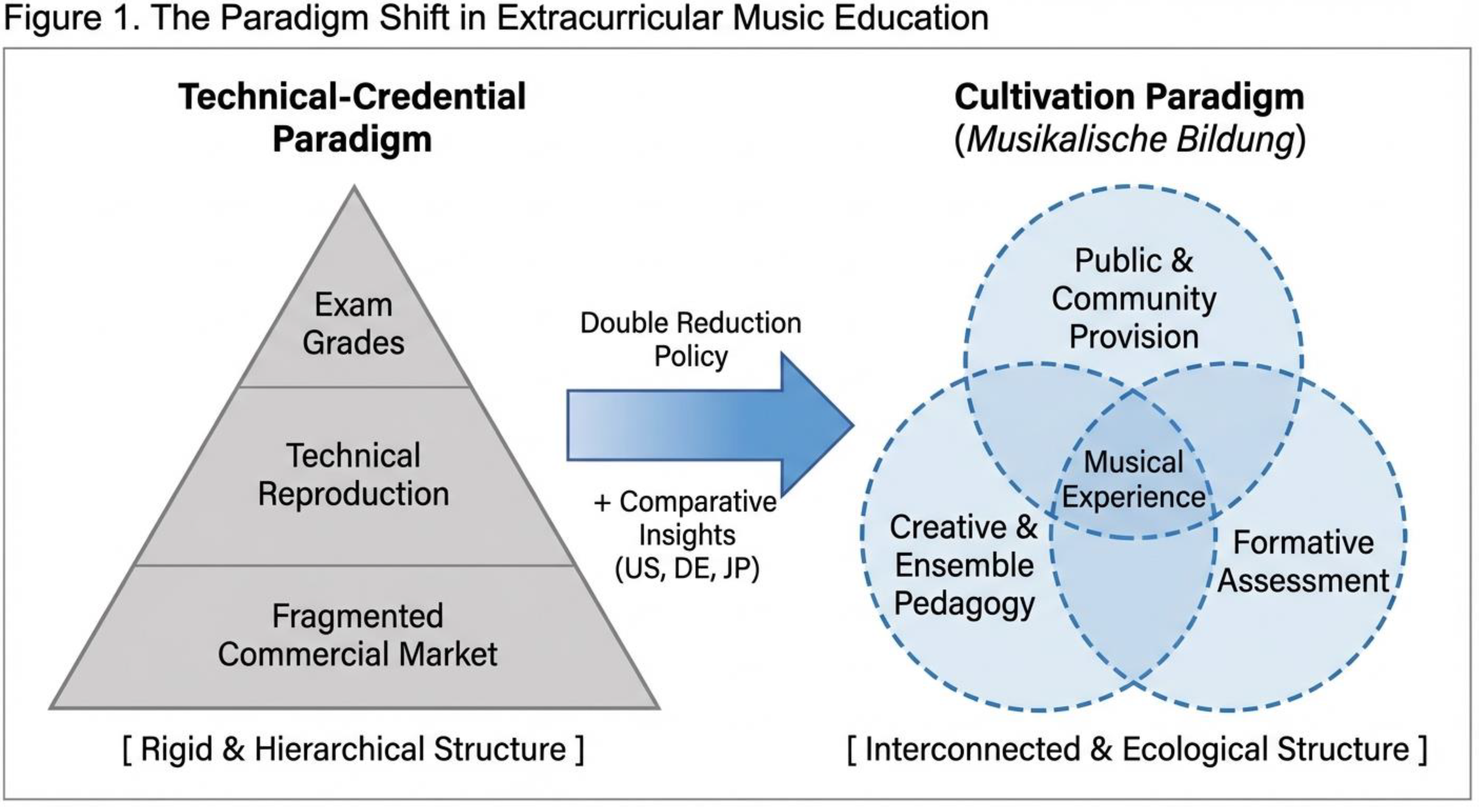
The ideological dimension is more diffuse but arguably more consequential. Chinese extracurricular music education is dominated by what we term a "technical-credential" paradigm, in which musical learning is conceived primarily as the acquisition of measurable technical proficiency, validated through graded examinations, and valued instrumentally as a form of cultural or educational capital. This paradigm has deep roots in the examination-oriented culture that pervades Chinese education more broadly (Dello-Iacovo, 2009), and it is reinforced by parental expectations, institutional incentives, and the structure of the examination system itself. What is largely absent from this paradigm is attention to the experiential, creative, and social dimensions of musical participation that feature prominently in international music education scholarship (Elliott & Silverman, 2015; Small, 1998). The phrase "learned a skill, hated an art" captures a real and recurring outcome: students who achieve high examination grades but develop neither a lasting relationship with music nor the capacity for independent musical activity.
The practical dimension encompasses a range of on-the-ground problems. Teacher quality is uneven; many instructors in private studios lack formal training in music education pedagogy, relying instead on conservatory-style master-apprentice methods that may be effective for advanced students but are often poorly suited to young beginners. Curricula tend to be examination-driven, with repertoire selection dictated by grading syllabi rather than by developmental appropriateness or musical diversity. Repertoire itself skews heavily toward Western classical music, with limited engagement with Chinese traditional music, popular music, or world music traditions. Access is sharply stratified by geography and income, and the costs of instrumental music education, which include instrument purchase, lesson fees, and examination fees, place it beyond the reach of many families outside the urban middle class.
These three dimensions interact. The absence of institutional regulation allows the technical-credential paradigm to dominate unchecked, while the practical problems of teacher quality and curricular narrowness are, in part, consequences of an ideological framework that reduces music education to examination preparation. Addressing any one dimension in isolation is unlikely to produce meaningful change.
A brief comparison with historical developments in other countries reinforces this point. Both the British and German systems of extracurricular music education underwent significant reform during the twentieth century, in each case requiring coordinated changes across institutional, pedagogical, and financial dimensions. In Britain, the recent reorganization of local music services into 43 Music Hubs, supported by 101 million pounds in annual government funding (Arts Council England, 2024), represents the latest iteration of a decades-long effort to create a more coherent public infrastructure for extracurricular music learning. The path from a fragmented, market-dependent system to one with meaningful public coordination has been neither smooth nor complete, but it illustrates the kind of multi-dimensional reform that the Chinese situation appears to require. It is this recognition that motivates our turn to comparative analysis.
Figure 1.
Divergent trajectories of extracurricular music education in China. The current technical-credential loop (left) contrasts with a proposed institutional reconfiguration pathway (right) derived from cross-national comparative analysis.
Figure 1.
Divergent trajectories of extracurricular music education in China. The current technical-credential loop (left) contrasts with a proposed institutional reconfiguration pathway (right) derived from cross-national comparative analysis.
3. International Experiences: Three Models of Extracurricular Music Education
3.1. The United States: community tradition and creative pluralism
The American approach to extracurricular music education is best understood as a layered system with multiple institutional actors, no centralized coordination, and a strong tradition of community-based music activity that predates formal school music education. This system is messy by design, reflecting the decentralized character of American education governance and the country's cultural emphasis on individual expression and local initiative.
Community music in the United States has roots stretching back to the nineteenth century, when singing schools, church choirs, town bands, and immigrant musical societies provided widespread opportunities for participatory music-making (Veblen, 2004). These traditions established a cultural expectation that music is a communal activity, not solely a professional pursuit. The International Council for Community Music Activity (CMA), founded in part by American and British scholars, articulated this vision in its 1984 declaration, which asserted the right of all people to engage in music-making regardless of technical ability. This philosophical orientation continues to influence American music education at multiple levels.
Within the formal school system, music occupies a variable but often substantial position. Many school districts require students to select an instrumental or vocal music course beginning in the sixth grade, effectively making some form of music participation compulsory through middle school. High school music programs, while elective, remain a significant feature of American secondary education, particularly through marching bands, jazz ensembles, choral groups, and orchestras. These ensembles serve dual functions: they provide musical training, and they operate as important social institutions within school communities, cultivating what participants and educators describe as persistence, teamwork, competitive drive, and leadership capacity (Elpus & Abril, 2019).
What distinguishes the American model in the extracurricular sphere is its emphasis on creative engagement and stylistic pluralism. Students in school jazz bands, for instance, are expected not merely to reproduce notated scores but to improvise, arrange, and adapt musical material. This expectation extends to popular music and world music contexts, where composition, arrangement, and genre-crossing experimentation are encouraged. At the post-secondary level, music education programs at state universities increasingly require coursework in world music, multicultural music pedagogy, and community engagement, reflecting a disciplinary consensus that music education should prepare teachers to work across cultural boundaries (Campbell, 2004).
Beyond the school, the American extracurricular music landscape includes a vast network of private studios, community music schools, church music programs, summer camps, and youth orchestras. Many of these are organized as nonprofit entities and receive philanthropic support. The Settlement Music School in Philadelphia, founded in 1908, and the Community Music Center of San Francisco, founded in 1921, are among the oldest continuously operating community music schools in the country. These institutions typically offer instruction across a wide range of genres and instruments, with fee structures that include sliding-scale or scholarship options to promote access.
The American model has well-documented limitations. Access to school music programs is unevenly distributed, with schools in low-income districts significantly less likely to offer robust music instruction (Elpus & Abril, 2019). Private instruction is expensive, and community music schools, while valuable, serve a small fraction of the population. The decentralized system means that quality varies enormously, and there is no national framework for ensuring that all children have access to meaningful music education outside the classroom. The reliance on local funding, whether through school district budgets, philanthropic donations, or fee revenue, creates structural instability. Programs are frequently among the first to be cut during budget crises, a pattern that disproportionately affects students in already disadvantaged communities.
Nevertheless, the American model's strengths are instructive for the Chinese case. Its emphasis on creativity, its cultural pluralism, its community embeddedness, and its conception of music education as a form of participatory cultural practice (rather than solely as technical training) represent a fundamentally different orientation from the examination-driven model that prevails in China. The tradition of community music, in particular, offers a conceptual resource for thinking about extracurricular music education as a public good rather than a private commodity.
3.2. Germany: public provision and the Musikschule system
Germany presents the most systematically organized model of extracurricular music education among the three cases considered here. The cornerstone of this system is the Musikschule (music school), a publicly funded institution that operates outside the formal school system but is conceived as a complement (Erganzung) to, rather than a replacement for, school-based music education. The German model reflects a broader cultural and political commitment to Bildung, the idea that education should cultivate the whole person, including aesthetic sensibility and cultural literacy, and that the state bears responsibility for ensuring access to such cultivation.
The institutional infrastructure is extensive. As of recent data, 934 public music schools operate under the umbrella of the Verband deutscher Musikschulen (VdM, the Association of German Music Schools), distributed across approximately 21,000 teaching locations. The average distance between teaching points is roughly five kilometers, reflecting a deliberate policy of geographic accessibility. In addition, approximately 450 independent music schools operate under the Bundesverband der Freien Musikschulen (bdfm, the Federal Association of Independent Music Schools), employing some 6,300 teachers and enrolling around 127,000 students. Together, the public and independent sectors provide a dense network of music learning opportunities across the country.
The German system is organized along a three-tier pathway. The Musikschule forms the base, offering introductory and intermediate instruction to students of all ages. For students who demonstrate particular aptitude and commitment, the Konservatorium (conservatory) provides more advanced pre-professional training. The Musikhochschule (academy of music or university of music) represents the tertiary level, leading to professional qualifications in performance, composition, and music education. This tiered structure creates a legible progression path, but the system's design intentionally emphasizes breadth over selection at the lower levels. The Musikschule is not a talent-filtering mechanism; it is conceived as a space for general musical cultivation open to the wider public.
Several features of the German model merit attention. The pedagogical orientation of the Musikschulen tends to emphasize Musikalische Bildung (musical cultivation or formation) rather than competitive achievement. While examinations and certificates exist, they do not occupy the structurally central position that graded examinations hold in the Chinese system. Ensemble playing, group instruction, and collaborative music-making are standard elements of the curriculum, reflecting a philosophical commitment to music as a social practice. Repertoire is eclectic, encompassing Western classical music, popular genres, jazz, and increasingly, music from non-European traditions.
The governance structure reflects Germany's federal organization. Education policy, including cultural education, falls under the legislative authority of the sixteen Lander (federal states), each of which has its own education laws and funding arrangements. This federal structure introduces variation across states, but the VdM provides a coordinating function, establishing quality standards, curricula guidelines, and teacher qualification requirements that create a degree of national coherence. Public Musikschulen typically receive funding from municipal budgets, supplemented by state subsidies and tuition fees, which are generally set at levels intended to be affordable, with reductions available for low-income families and for families enrolling multiple children.
The German model also exhibits an interesting temporal dimension. In recent years, there has been growing interest in intergenerational music education (Generationenubergreifende Musikerziehung), with some Musikschulen offering programs that bring together participants of different ages. This reflects a broader recognition that music education need not be confined to childhood and adolescence but can serve as a lifelong activity with social and civic value. The concept connects with wider European discussions about lifelong learning and active aging, and it represents a dimension of extracurricular music education that is almost entirely absent from Chinese discourse, where the focus remains overwhelmingly on children and young people preparing for examinations.
The relationship between the Musikschule system and the formal school system also warrants comment. While the Musikschule is institutionally separate from the general school, cooperation between the two has increased in recent decades. Many Musikschulen offer programs within school premises, sometimes during the extended school day (Ganztagsschule), and collaborative projects between school music teachers and Musikschule instructors are common in some regions. This cooperation blurs the boundary between curricular and extracurricular in ways that may be instructive for China, where the two spheres remain sharply separated both institutionally and conceptually.
The model is not without tensions. Funding pressures have affected some Musikschulen, particularly in economically weaker municipalities and in the eastern states. The status and remuneration of Musikschule teachers, while better regulated than in the Chinese commercial market, remain subjects of professional concern. The relationship between the public Musikschulen and private music schools raises questions about competition, standards, and the appropriate role of the state. There is also an ongoing debate about whether the Musikschule curriculum has been sufficiently responsive to the musical interests and cultural backgrounds of an increasingly diverse German population.
For the comparative purposes of this paper, the German model's most significant contribution is its demonstration that extracurricular music education can be organized as a form of public provision, with explicit commitments to geographic accessibility, pedagogical quality, and cultural purpose. It offers a concrete alternative to the market-driven model that currently dominates Chinese extracurricular music education, and its emphasis on musical cultivation over competitive examination is directly relevant to the ideological predicament identified in Section 2.
3.3. Japan: the bukatsu system and industry-education partnerships
Japan's approach to extracurricular music education is distinctive in that a large proportion of organized musical activity for young people takes place within the school itself, through the bukatsu (club activity) system. This school-embedded model, combined with Japan's well-established corporate music education programs, creates a hybrid system that differs from both the American community-based model and the German public-provision model.
The bukatsu system is one of the most prominent features of Japanese secondary education. Participation rates are high: approximately 92 percent of junior high school students and 81 percent of senior high school students participate in some form of club activity (Cave, 2004; Hebert, 2012). While bukatsu encompass sports, academic interests, and cultural pursuits, music clubs, particularly wind bands (suisogaku-bu), choral groups, and traditional music ensembles, are among the most popular. In many schools, the wind band club is the largest extracurricular organization, sometimes enrolling over a hundred members.
What makes the bukatsu system educationally distinctive is its organizational structure. Clubs are substantially student-run. While a faculty advisor is formally assigned, day-to-day leadership, rehearsal planning, repertoire selection, and organizational management rest largely with student officers, particularly upper-class students who assume mentorship roles vis-a-vis their juniors. This senpai-kohai (senior-junior) relationship is a defining social feature of bukatsu life, and it functions as a mechanism for transmitting both musical skills and behavioral norms across student generations. Activity periods typically run from approximately 4:00 to 6:00 p.m. on school days, with additional hours on weekends and during school breaks, particularly in the lead-up to competitions.
Hebert (2012) has argued that Japanese school wind bands serve as important sites of cultural identity formation, where students develop not only musical skills but also the dispositions of group solidarity, perseverance (ganbaru), and self-management that Japanese society values. The competitive dimension is significant: national wind band competitions (the All Japan Band Association contests) are major events that drive high levels of commitment and intensive preparation. The competitive structure motivates sustained engagement, but it also generates pressures that have been criticized, including excessive practice hours, stress, and a narrowing of repertoire to contest-oriented selections (Hebert, 2012).
Outside the bukatsu system, Japan's extracurricular music landscape has been shaped by two corporate music education programs of global influence. The Yamaha Music Education System, established in the 1950s, operates a worldwide network of music schools (Yamaha Music Schools) that enroll millions of students. In Japan, these schools provide group-based music instruction beginning in early childhood, with a pedagogical approach that emphasizes ear training, creative activity (including composition and arrangement), and ensemble playing before formal notation reading. The Suzuki Method, developed by Shinichi Suzuki in the mid-twentieth century, takes a different approach, using the "mother tongue" analogy to argue that musical ability, like language ability, can be developed in all children through immersion, repetition, and a supportive environment. Both methods have been widely adopted internationally, but their domestic significance in Japan lies in their provision of systematic, high-quality extracurricular music instruction that complements both school music education and the bukatsu system.
The Japanese model's strengths are closely tied to its institutional embedding within the school system. Because bukatsu are part of school life, they are accessible to all enrolled students regardless of family income. The costs are minimal compared to private lessons or commercial training. The student-led organizational structure develops capacities, including leadership, planning, conflict resolution, and collaborative decision-making, that extend well beyond musical competence. The corporate programs (Yamaha, Suzuki) add a layer of pedagogically sophisticated instruction that is, in important respects, more educationally grounded than much of the commercial music training available in China.
The limitations of the Japanese model are also apparent. The bukatsu system places considerable demands on students' time, and there is growing debate within Japan about whether bukatsu expectations have become excessive, contributing to student fatigue and crowding out other activities and rest (Japan Sports Agency, 2018). The senpai-kohai hierarchy, while educationally productive in many respects, can also reproduce rigid social norms and, in some cases, facilitate bullying. The competitive orientation of many music clubs, particularly wind bands, tends to privilege a narrow range of repertoire and performance standards, with less attention to individual creativity, improvisation, or exploration of diverse musical traditions. Teacher (advisor) workload is another concern; faculty advisors for bukatsu often work long unpaid hours, and recruitment of willing advisors has become increasingly difficult.
For the Chinese context, the Japanese model is instructive on two levels. The bukatsu system demonstrates that meaningful extracurricular music education can be organized within the school at relatively low cost, provided that institutional culture supports student initiative and that schools allocate appropriate time and space. The Yamaha and Suzuki examples illustrate how commercial music education enterprises can operate with genuine pedagogical integrity, a contrast to the examination-driven commercialism that characterizes much of the Chinese market. At the same time, the Japanese experience cautions against over-reliance on competitive structures and excessive time demands, problems that resonate with aspects of the Chinese educational culture.
It is also worth noting the historical relationship between Japan and China in music education. Japanese music education practices, including the Suzuki Method and certain elements of school music pedagogy, have been influential in China since the early twentieth century, when Chinese reformers looked to Japan (and through Japan, to the West) for models of modern education (Miao et al., 2011). This historical connection means that Japanese practices are not entirely foreign to the Chinese context; rather, they represent a partially shared educational heritage that has diverged over the course of the past century. Understanding why the bukatsu model developed in Japan but not in China, despite certain shared cultural values around education, effort, and group membership, is itself a question that comparative education might productively address.
4. Comparative Analysis: Convergences and Divergences
4.1. Three institutional types: community-driven, public provision, school-embedded
The three national cases examined in this paper represent three distinct institutional logics for organizing extracurricular music education. The United States exemplifies a community-driven model in which extracurricular music activity is distributed across a diverse ecology of actors, including school-affiliated ensembles, community music schools, private studios, churches, and nonprofit organizations, with no single coordinating authority. Germany represents a public-provision model in which the state, operating through municipal and Land-level institutions, assumes primary responsibility for ensuring accessible, quality-controlled extracurricular music instruction through the Musikschule network. Japan illustrates a school-embedded model in which the bukatsu system absorbs a substantial share of extracurricular music activity within the organizational structure of the school itself, supplemented by corporate educational programs.
These institutional types are, of course, ideal-typical constructions. Each country contains elements of all three logics. American schools host extensive music programs; German communities have active private teaching; Japanese students take private lessons outside the bukatsu system. But the dominant institutional logic in each case shapes the system's characteristic strengths and weaknesses in ways that are analytically useful for comparative purposes.
The choice of institutional logic has consequences for several key variables: access (who can participate), quality (what standards govern instruction), orientation (what conception of musical learning prevails), and sustainability (how the system is funded and maintained over time). Community-driven systems tend to be flexible and culturally responsive but uneven in access and vulnerable to funding instability. Public-provision systems tend to be more equitable and quality-controlled but potentially bureaucratic and slow to adapt. School-embedded systems tend to be accessible and cost-efficient but constrained by school schedules, competitive pressures, and the limits of student self-governance.

Table 1.
Comparative Typologies of Extracurricular Music Education.
| Country Model | Dominant Institutional Base | Primary Funding Mechanism | Core Pedagogical Orientation | Key Structural Tension |
| United States | Community & School network | Mixed (Local tax, fees, philanthropy) | Creative pluralism & ensemble participation | Uneven access & market stratification |
| Germany | Public provision (*Musikschule*) | Public (Municipal & State subsidies) | *Musikalische Bildung* (Musical cultivation) | Fiscal constraints & demographic adaptation |
| Japan | School-embedded (*Bukatsu*) | Mixed (School budget & corporate training) | Character formation & group discipline | Heavy time burden & competitive exclusion |
| China (Current) | Commercial market | Private (Family out-of-pocket) | Technical-credential acquisition (Exam-driven) | Institutional fragmentation & high cost barriers |
4.2. Common patterns across the three countries
Despite their institutional differences, the three models share several features that are largely absent from the Chinese extracurricular music education system in its current form. These common patterns are worth identifying because they suggest principles that may have cross-contextual applicability, even as their specific institutional expressions vary.
Across the three comparison countries, extracurricular music education is conceived as something broader than the acquisition of technical proficiency on an instrument or in voice. American community music traditions foreground participatory engagement and cultural identity. German Musikschulen operate under the guiding ideal of Musikalische Bildung, which frames musical learning as integral to personal cultivation. Japanese bukatsu are valued as sites for developing character, group solidarity, and self-management. The distance between aspiration and practice naturally varies within and across these systems, yet a shared orientation is discernible: music education is treated as a formative experience in which personal and social growth matters alongside, or even above, technical mastery. This orientation stands in clear contrast to the technical-credential paradigm that dominates Chinese extracurricular practice.
Each of the three systems also maintains some form of institutional coordination or quality assurance that operates beyond pure market mechanisms. In the United States, this function is served, imperfectly, by professional organizations such as the National Association for Music Education (NAfME) and by university-based teacher education programs that establish pedagogical norms. In Germany, the VdM plays a direct coordinating role, setting standards for curricula, teacher qualifications, and institutional quality. In Japan, the bukatsu system is embedded within the school's institutional framework, and corporate programs like Yamaha maintain their own rigorous pedagogical standards and teacher training systems. None of these mechanisms achieves comprehensive coverage, but each provides a counterweight to the situation in which market logic alone determines what is taught, by whom, and to what standard.
Equally notable is the central place that ensemble and collaborative music-making occupies in all three comparison countries. American school bands and community ensembles, German Musikschule orchestras and chamber groups, and Japanese bukatsu wind bands and choral clubs all place collective music-making at the heart of the learning experience. In the Chinese system, by contrast, individual instrumental or vocal instruction oriented toward solo examination performance remains the dominant mode, with ensemble experience available primarily to students in specialized or elite programs.
A further point of convergence, one less frequently examined in comparative studies, concerns the pathways that connect extracurricular music engagement with broader cultural and civic life. American community music programs often serve as connective tissue between schools, neighborhoods, and cultural institutions. German Musikschulen frequently collaborate with schools, churches, and municipal cultural organizations. Japanese bukatsu performances at school festivals, community events, and regional competitions tie student music-making to local social life. These connections sustain motivation, provide authentic performance opportunities, and situate music education within a larger social ecology. In China, by contrast, the performance dimension of extracurricular music education is largely confined to examination settings and, for a select few, to competition stages. The ordinary social contexts in which music-making might be shared with families, peers, and communities are still underdeveloped.
Closely related to these civic connections is the role of peer interaction and collaborative learning within the learning process itself. In all three comparison countries, extracurricular music education routinely involves students playing and singing together in groups. The American school band, the German Musikschule ensemble, and the Japanese bukatsu are all, at their core, collective enterprises. Research in music education has documented the benefits of such ensemble participation for musical development, social competence, and sustained motivation (Hallam, 2010). The Chinese system's emphasis on individual lessons and solo examination performance bypasses this collective dimension almost entirely. Group classes do exist in some commercial settings, but they tend to be organized for cost efficiency rather than for the pedagogical benefits that collaborative music-making can provide.
4.3. Tensions and limitations within each model
No system is without its contradictions, and honest comparative analysis requires attention to the internal tensions that characterize each model.
In the United States, the fundamental tension is between the ideal of universal access and the reality of market-driven inequality. School music programs, while widespread, are unevenly funded and have been subject to repeated budget cuts. Community music schools serve a relatively small population and depend on philanthropic support that is itself unevenly distributed. The American emphasis on individual expression and creative freedom, while pedagogically valuable, can sometimes come at the expense of systematic skill development, leaving students with expressive intentions but insufficient technical foundation. There is also an ongoing tension between the classical music tradition that still dominates many school and university programs and the popular and vernacular music cultures in which most Americans actually participate.
In Germany, the principal tension is between the system's universalist aspirations and the fiscal pressures that constrain their realization. Not all municipalities can or do fund Musikschulen at the levels necessary to keep fees low, maintain high teacher-to-student ratios, and offer a broad curriculum. In the eastern states, the legacies of reunification continue to affect cultural infrastructure. The relationship between the public Musikschulen and private music schools raises questions about competition, standards, and the appropriate role of the state. There is also a question about cultural responsiveness: the Musikschule curriculum has historically been centered on the Western classical tradition, and adapting to the musical interests and cultural backgrounds of a changing population remains a work in progress.
In Japan, the tension between the educational benefits of the bukatsu system and its demands on students and teachers has become a subject of national debate. Calls for bukatsu reform, including proposals to reduce practice hours, shift some activities to community settings, and relieve teachers of advisory duties, have gained momentum in recent years (Japan Sports Agency, 2018). The competitive dimension of bukatsu music, while motivating, can also be exclusionary, privileging technical excellence over broad participation. The corporate music education programs (Yamaha, Suzuki), though pedagogically sophisticated, operate as commercial enterprises with their own brand interests, and their relationship to public educational goals is negotiated rather than given.
These tensions are not disqualifying. They are, rather, the normal condition of complex educational systems operating under multiple and sometimes competing demands. For the Chinese case, acknowledging these tensions is important because it guards against the temptation to idealize any single foreign model and encourages a more discriminating engagement with comparative evidence.
5. Policy Implications for China
The comparative analysis presented in the preceding sections is not intended to produce a simple list of transferable "best practices." Educational policies and institutions are embedded in particular historical, cultural, and institutional contexts, and direct transplantation rarely succeeds (Steiner-Khamsi, 2014). What comparative analysis can offer is a broadened range of institutional imagination: a set of alternative ways of organizing extracurricular music education that may stimulate, inform, and refine domestic reform thinking. With this caveat, we outline several policy directions that emerge from our analysis.
The most immediate issue concerns the reform of the graded examination system. The current system, in which multiple competing examination bodies administer graded assessments with inconsistent standards and strong commercial incentives, has become a structural driver of the technical-credential paradigm. Reform need not entail abolition, as CPPCC member Li Xincao has suggested, but it does require several changes: the establishment of a unified national framework for examination standards, a reduction in the number of grade levels to discourage the "grade inflation" that results from excessively fine gradations, and a broadening of assessment criteria to include ensemble skills, creative tasks (such as simple arrangement, improvisation, and ear-training exercises), and musical knowledge beyond the examined repertoire. The German model, in which examinations exist but do not dominate the pedagogical landscape, and the British Associated Board of the Royal Schools of Music (ABRSM) model, which has increasingly incorporated aural, sight-reading, and musical understanding components, both offer useful reference points. The goal should be to transform the examination from an end in itself into one component of a broader system of musical development.
Alongside examination reform, there is a case for expanding public provision. China's extracurricular music education system is almost entirely market-driven, with minimal public investment outside the formal school system. The German Musikschule model demonstrates that a publicly funded network of music schools can provide accessible, quality-controlled extracurricular instruction at scale. We do not suggest that China can or should replicate the German system wholesale. The fiscal, demographic, and governance conditions are very different. But the principle that public investment in extracurricular music education can serve cultural, social, and educational goals that market provision alone cannot achieve is one that Chinese policymakers would do well to consider. Pilot programs in selected municipalities, perhaps utilizing existing community cultural centers (wenhua zhan) or school facilities during after-school hours, could provide a basis for experimentation and evaluation. The recent British experience with Music Hubs, which consolidated 116 local music services into 43 larger hubs with 101 million pounds in government funding in 2024 (Arts Council England, 2024), offers another example of state-organized coordination of extracurricular music provision, though at a more modest scale than the German system.
Public provision, however, need not be confined to formal institutions. Cultivating a broader community music ecology is equally important. The American experience suggests that extracurricular music education is most resilient and most socially embedded when it is rooted in community institutions, not only commercial enterprises, but also schools, cultural centers, religious organizations, neighborhood associations, and civic groups. China's rapid urbanization has created new residential communities that, in many cases, lack the cultural infrastructure that older neighborhoods possessed. Creating spaces and institutional supports for community music-making, including amateur ensembles, intergenerational music groups, and community performance venues, would represent a shift from a purely consumer-oriented model of music education to one that recognizes music as a form of social participation. Such a shift aligns with the stated goals of the Double Reduction policy and with broader Chinese policy discourse around "community governance" (shequ zhili) and "cultural self-confidence" (wenhua zixin).
None of these structural changes will achieve their potential without corresponding attention to teacher education and professional development. The comparative cases reveal that the quality of extracurricular music education depends critically on the preparation and ongoing development of teachers. In Germany, Musikschule teachers are expected to hold recognized qualifications, and the VdM coordinates professional development activities. Yamaha in Japan maintains its own teacher training and certification system. In the United States, state university music education programs increasingly emphasize multicultural musicianship, community engagement, and creative pedagogy. In China, by contrast, the commercial music training sector operates largely without formal teacher qualification requirements. Conservatory graduates, who form the primary labor supply, typically receive intensive training in performance but minimal preparation in pedagogy, developmental psychology, or curriculum design. Establishing minimum qualification standards for extracurricular music teachers, expanding pedagogy-focused degree programs in music education, and creating professional development pathways for practicing teachers are necessary steps. These measures would address the practical dimension of the predicament identified in Section 2 while also gradually shifting the ideological orientation of the teaching workforce.
Finally, the role of the music industry in educational reform deserves consideration. The Japanese examples of Yamaha and Suzuki demonstrate that commercial music enterprises can operate with genuine pedagogical commitment, developing proprietary but educationally grounded curricula and investing in teacher training. In China, the relationship between the music industry (instrument manufacturers, training chains, technology companies) and educational purpose has been largely extractive, with commercial interests driving pedagogical choices rather than the reverse. The contraction of the piano market and the closure of thousands of studios represent both a crisis and an opportunity. Industry actors that invest in pedagogical quality, teacher development, and accessible pricing may emerge as more sustainable enterprises in a maturing market. Policy incentives, such as tax benefits for institutions meeting educational quality standards or public-private partnerships for community music provision, could encourage this reorientation.
These directions are interconnected. Examination reform without alternative quality frameworks risks creating a vacuum, just as expanding public provision will yield little if the teaching workforce remains unprepared. Community music and teacher education initiatives, in turn, require institutional support and aligned market incentives to gain traction. A comprehensive approach, pursued incrementally and with attention to local conditions, is more likely to produce lasting change than any single intervention.
One final observation about the politics of reform is necessary. The Double Reduction policy demonstrated that the Chinese state has both the will and the capacity to intervene decisively in the education market when political conditions align. Whether similar political will can be mobilized for the reform of extracurricular music education is uncertain. Music education does not carry the same political salience as academic tutoring, which was linked to concerns about educational inequality, demographic decline, and family financial burden that had reached the highest levels of political attention. Yet the broader policy discourse around quality education, cultural confidence, and the "all-round development of the person" provides a discursive framework within which music education reform could, under favorable conditions, gain traction. The comparative evidence presented in this paper is intended, in part, to contribute to that discursive environment by demonstrating that the institutional status quo is neither natural nor necessary, and that workable alternatives exist in other national settings.
6. Conclusion
This paper has argued that the challenges facing extracurricular music education in China are structural rather than cyclical. The Double Reduction policy has amplified demand for music training, but the underlying system remains organized around a technical-credential paradigm that reduces musical learning to examination preparation, limits access to urban middle-class families, and generates widespread disenchantment among the young people it is ostensibly designed to serve. The comparative analysis of the United States, Germany, and Japan reveals that alternative institutional arrangements are possible, each with its own strengths and limitations but all sharing a broader conception of what extracurricular music education is for.
Whereas the American case highlights the value of community embeddedness and creative pluralism, it also exposes the equity gaps that accompany decentralized, market-dependent provision. The German Musikschule network, meanwhile, demonstrates that public investment can secure both access and quality at scale, yet it contends with fiscal constraints and questions about cultural responsiveness in a diversifying society. Japan's bukatsu system shows that school-embedded club activities can deliver accessible, character-forming musical experiences, though not without imposing heavy time demands on students and teachers or narrowing the scope of musical engagement through competitive pressures. None of these models is directly transferable to China, but taken together they expand the range of institutional options available to Chinese policymakers and educators.
The policy directions outlined in Section 5, which include examination reform, expanded public provision, community music development, teacher education, and industry reorientation, are intended as a framework for incremental reform rather than a prescription for wholesale system change. We recognize that the political, economic, and cultural conditions shaping Chinese education are distinct, and that reform processes will inevitably be shaped by domestic priorities and constraints. The contribution of comparative analysis is not to provide ready-made solutions but to challenge the assumption that the current arrangements are natural or inevitable, and to demonstrate that other ways of organizing extracurricular music education have been developed, tested, and sustained in other national contexts.
Several limitations of this study should be acknowledged. We have relied primarily on published scholarship, policy documents, and industry data rather than on original empirical research. The descriptions of the American, German, and Japanese systems, while informed by the comparative literature, are necessarily simplified and may not capture important regional or institutional variation within each country. Our treatment of the Chinese case draws on aggregate market data and policy analysis rather than on detailed case studies of specific institutions or communities. Future research would benefit from comparative fieldwork examining how extracurricular music education is experienced by students, teachers, and families across national contexts. Longitudinal studies tracking the effects of the Double Reduction policy on music education participation, quality, and outcomes in China would be particularly valuable. Research examining the perspectives of students themselves, whose voices are largely absent from the policy literature, would contribute significantly to our understanding of what extracurricular music education means in the lives of the young people who participate in it.
The Double Reduction policy has created an opening. Whether that opening leads to genuine reform or simply to a reshuffling of commercial arrangements will depend, in large part, on whether Chinese policymakers, educators, and families are willing to reconsider both the structure and the underlying purpose of extracurricular music education.
References
- Arts Council England. Music Hubs. 2024. Available online: https://www.artscouncil.org.uk/music-education/music-hubs.
- Bereday, G. Z. F. Comparative method in education; Holt, Rinehart and Winston, 1964. [Google Scholar]
- Bray, M.; Thomas, R. M. Levels of comparison in educational studies: Different insights from different literatures and the value of multilevel analyses. Harvard Educational Review 1995, 65(3), 472–490. [Google Scholar] [CrossRef]
- Campbell, P. S. Teaching music globally: Experiencing music, expressing culture; Oxford University Press, 2004. [Google Scholar]
- Cave, P. Bukatsudo: The educational role of Japanese school clubs. Journal of Japanese Studies 2004, 30(2), 383–415. [Google Scholar] [CrossRef]
- China Music Education Industry Report. 2023 nian Zhongguo yinyue jiaoyu peixun hangye baogao [2023 China music education and training industry report]. in Chinese; 2024. [Google Scholar]
- Dello-Iacovo, B. Curriculum reform and "quality education" in China: An overview. International Journal of Educational Development 2009, 29(3), 241–249. [Google Scholar] [CrossRef]
- Elliott, D. J.; Silverman, M. Music matters: A philosophy of music education, 2nd ed.; Oxford University Press, 2015. [Google Scholar]
- Elpus, K.; Abril, C. R. Who enrolls in high school music? A national profile of U.S. students, 2009-2013. Journal of Research in Music Education 2019, 67(3), 323–338. [Google Scholar] [CrossRef]
- Frost; Sullivan. China quality education market report; 2023. [Google Scholar]
- Guo, Z.; Marsh, H. W.; Parker, P. D.; Dicke, T. Extracurricular music activities and academic achievement: New evidence from a reciprocal effects model. Psychology of Music 2022, 50(4), 1141–1158. [Google Scholar]
- Hallam, S. The power of music: Its impact on the intellectual, social and personal development of children and young people. International Journal of Music Education 2010, 28(3), 269–289. [Google Scholar] [CrossRef]
- Hannum, E.; Park, A.; Cheng, K. M. Introduction: Market reforms and educational opportunity in China. In Education and reform in China; Hannum, E., Park, A., Eds.; Routledge, 2008; pp. 1–23. [Google Scholar]
- Hebert, D. G. Wind bands and cultural identity in Japanese schools; Springer, 2012. [Google Scholar]
- Heimonen, M. Music education and the law of compulsory school attendance in Sweden and Finland. Arts Education Policy Review 2003, 104(3), 11–16. [Google Scholar]
- Ho, W. C. Creative education and music in China's schools. Music Education Research 2022, 24(2), 217–232. [Google Scholar]
- iResearch. 2023 nian Zhongguo shaonian ertai suzhi jiaoyu hangye baogao [2023 China children's quality education industry report]. in Chinese. 2023.
- Japan Sports Agency. Undoubu katsudo no arikata ni kansuru sogoteki na gaidorain [Comprehensive guidelines on the ideal state of sports club activities]; in Japanese; Ministry of Education, Culture, Sports, Science and Technology, 2018. [Google Scholar]
- Liu, P. Meiguo yinyue jiaoyu gaikuang [An overview of music education in the United States]; in Chinese; Shanghai Education Press, 2001. [Google Scholar]
- Luo, Y.; Guan, J. Music participation among public school students in China. Journal of Research in Music Education 2025, 73(1), 45–63. [Google Scholar] [CrossRef]
- The Oxford handbook of music education; McPherson, G. E., Welch, G. F., Eds.; Oxford University Press, 2018; Vol. 1. [Google Scholar]
- Miao, P.; et al. Riben yinyue jiaoyu gaikuang [An overview of music education in Japan]; in Chinese; Shanghai Education Press, 2011. [Google Scholar]
- Ministry of Education of the People's Republic of China. Shuangjian gongzuo jinzhan qingkuang [Progress report on the "Double Reduction" policy implementation]. in Chinese; 2022. [Google Scholar]
- Phillips, D.; Schweisfurth, M. Comparative and international education: An introduction to theory, method, and practice, 2nd ed.; Bloomsbury, 2014. [Google Scholar]
- Small, C. Musicking: The meanings of performing and listening; Wesleyan University Press, 1998. [Google Scholar]
- Steiner-Khamsi, G. Cross-national policy borrowing: Understanding reception and translation. Asia Pacific Journal of Education 2014, 34(2), 153–167. [Google Scholar] [CrossRef]
- Veblen, K. K. The many ways of community music. International Journal of Community Music 2004, 1(1), 5–21. [Google Scholar] [CrossRef] [PubMed]
- Xie, J.; et al. Deguo yinyue jiaoyu gaikuang [An overview of music education in Germany]; in Chinese; Shanghai Education Press, 2011. [Google Scholar]
- Xinhua. Zhengxie weiyuan Li Xincao: Jianyi tiaozheng huo quxiao yinyue kaoji zhidu [CPPCC member Li Xincao: Proposal to adjust or abolish the music grading examination system; in Chinese; Xinhua News Agency, 7 March 2023. [Google Scholar]
- Zhang, D.; Li, X.; Xue, J. Education inequality between rural and urban areas of the People's Republic of China, migrants' children education, and some implications. Asian Development Review 2018, 32(1), 196–224. [Google Scholar] [CrossRef]
Disclaimer/Publisher’s Note: The statements, opinions and data contained in all publications are solely those of the individual author(s) and contributor(s) and not of MDPI and/or the editor(s). MDPI and/or the editor(s) disclaim responsibility for any injury to people or property resulting from any ideas, methods, instructions or products referred to in the content. |
© 2026 by the authors. Licensee MDPI, Basel, Switzerland. This article is an open access article distributed under the terms and conditions of the Creative Commons Attribution (CC BY) license (http://creativecommons.org/licenses/by/4.0/).
Copyright: This open access article is published under a Creative Commons CC BY 4.0 license, which permit the free download, distribution, and reuse, provided that the author and preprint are cited in any reuse.