

Submitted:
23 February 2026
Posted:
28 February 2026
You are already at the latest version
Abstract
The rapid proliferation of artificial intelligence technologies across organizational contexts has generated unprecedented opportunities alongside substantial risks that demand systematic management approaches. This article presents a comprehensive analysis of AI-related risks and develops an integrated framework for organizational risk management. Drawing upon interdisciplinary scholarship spanning computer science, management, law, and ethics, the analysis identifies and categorizes the multifaceted risks associated with AI deployment, including technical risks such as algorithmic bias, opacity, and security vulnerabilities; organizational risks encompassing operational disruptions, strategic misalignment, and governance challenges; and broader societal risks involving ethical concerns, systemic effects, and environmental impacts. The article critically examines existing governance frameworks at international, national, and organizational levels, evaluating their effectiveness in addressing the distinctive characteristics of AI systems. Furthermore, it proposes evidence-based mitigation strategies that organizations can implement across the AI lifecycle, from conception through deployment and ongoing operation. The framework emphasizes the importance of contextual adaptation, recognizing that effective AI risk management must account for sector-specific considerations, organizational maturity, and stakeholder expectations. By synthesizing theoretical insights with practical guidance, this article contributes to the growing body of knowledge supporting responsible AI adoption while enabling organizations to realize the transformative potential of these technologies.
Keywords:
artificial intelligence
; risk management
; algorithmic governance
; AI ethics
; organizational governance
; technology policy
; machine learning
; responsible AI
1. Introduction
The integration of artificial intelligence into organizational operations represents one of the most significant technological transformations of the contemporary era. From healthcare diagnostics to financial services, from supply chain optimization to human resource management, AI systems increasingly mediate consequential decisions affecting individuals, organizations, and society at large (Davenport & Ronanki, 2018). This technological diffusion, however, proceeds amid growing recognition that AI systems introduce novel and complex risks that existing governance frameworks may be ill-equipped to address (Cath et al., 2018).
The urgency of developing robust AI risk management approaches has been underscored by numerous high-profile incidents revealing the potential for AI systems to cause significant harm. Algorithmic systems have demonstrated discriminatory outcomes in criminal justice contexts, perpetuating racial disparities in risk assessment instruments (Angwin et al., 2016). Facial recognition technologies have exhibited substantially higher error rates for individuals with darker skin tones, raising profound concerns about equitable treatment (Buolamwini & Gebru, 2018). Healthcare algorithms have been shown to systematically underestimate the health needs of Black patients, potentially exacerbating existing health disparities (Obermeyer et al., 2019). These incidents illustrate that AI risks are not merely theoretical concerns but manifest realities with tangible consequences for affected populations.
Figure 1 presents an integrated conceptual framework for organizational AI risk management, illustrating the cyclical nature of risk identification, assessment, mitigation, and monitoring, situated within broader organizational, governance, and environmental contexts. This framework provides the conceptual foundation for the analysis that follows.
The challenge of AI risk management is compounded by the distinctive characteristics of contemporary AI systems. Unlike traditional software governed by explicit programming logic, machine learning systems derive their decision-making patterns from training data in ways that may be opaque even to their developers (Burrell, 2016). This opacity, combined with the capacity for AI systems to evolve through continued learning, creates novel challenges for oversight and accountability (Mittelstadt et al., 2016). Furthermore, the sociotechnical nature of AI systems means that risks emerge not merely from technical properties but from the complex interactions between technical artifacts, organizational contexts, and social environments (Selbst et al., 2019).
Against this backdrop, the present article undertakes a comprehensive examination of AI risk management, synthesizing insights from computer science, management studies, law, philosophy, and public policy to develop an integrated analytical framework. The analysis addresses several interconnected objectives: first, to provide a systematic taxonomy of AI-related risks that organizations face; second, to critically evaluate existing governance approaches at multiple levels; third, to identify evidence-based mitigation strategies; and fourth, to offer practical guidance for organizational implementation. By pursuing these objectives, the article aims to contribute to both scholarly understanding and practitioner capability in navigating the complex terrain of AI risk management.
The structure of the article proceeds as follows. Section 2 establishes the theoretical foundations by examining the evolution of AI governance discourse and situating AI risk management within broader frameworks of technology governance and organizational risk management. Section 3 presents a comprehensive analysis of AI-related risks, developing a taxonomy that encompasses technical, organizational, and societal dimensions. Section 4 explores organizational factors that shape AI risk profiles and management capabilities. Section 5 critically examines governance approaches at international, national, and organizational levels, as illustrated in Table 1. Section 6 proposes a comprehensive set of mitigation strategies, drawing upon the detailed analysis in Table 4. Section 7 discusses implementation considerations and future directions, while Section 8 offers concluding observations.
2. Theoretical Foundations and Governance Evolution
2.1. Defining Artificial Intelligence in Organizational Contexts
The term artificial intelligence encompasses a broad spectrum of technologies characterized by the capacity to perform tasks that typically require human intelligence. Contemporary definitions emphasize AI as systems that can perceive environments, reason about information, learn from experience, and take actions to achieve specified objectives (Russell & Norvig, 2021). For organizational purposes, AI most commonly manifests through machine learning systems that derive patterns from data to make predictions or classifications, natural language processing systems that interpret and generate human language, and computer vision systems that analyze visual information (Jordan & Mitchell, 2015).
The definitional boundaries of AI remain contested, with implications for governance and risk management. Narrow definitions focusing on specific technical characteristics may exclude relevant systems, while expansive definitions risk encompassing ordinary software with limited risk implications (Scherer, 2016). The European Union's AI Act, a landmark regulatory framework, has adopted a broad definition encompassing machine learning approaches, logic-based systems, and statistical methods, while focusing regulatory attention on applications presenting elevated risks (European Commission, 2024). This risk-based approach reflects growing consensus that governance should attend primarily to potential impacts rather than technical classifications alone.
2.2. Evolution of AI Governance Discourse
The contemporary discourse on AI governance has evolved through several identifiable phases. Early discussions, emerging prominently in the mid-2010s, focused substantially on speculative risks associated with advanced artificial general intelligence, including existential scenarios involving systems that might escape human control (Bostrom, 2014). While these discussions raised important long-term considerations, they were criticized for diverting attention from near-term harms affecting populations currently subject to algorithmic decision-making (Crawford, 2021).
A subsequent phase witnessed increased attention to algorithmic fairness and bias, catalyzed by investigative journalism and academic research documenting discriminatory outcomes across numerous domains. The ProPublica investigation of the COMPAS recidivism prediction instrument revealed that Black defendants were substantially more likely to be incorrectly classified as high risk, while white defendants were more likely to be incorrectly classified as low risk (Angwin et al., 2016). This investigation, along with the Gender Shades project documenting facial recognition disparities (Buolamwini & Gebru, 2018), helped shift discourse toward concrete, measurable harms affecting marginalized communities.
The current phase is characterized by regulatory crystallization, with governments moving from principles and guidelines toward binding legal requirements. The European Union has assumed a leadership role through the AI Act, establishing the world's first comprehensive legal framework for AI governance (Bradford, 2023). Other jurisdictions, including the United States, United Kingdom, and various Asian nations, have pursued alternative approaches reflecting different regulatory philosophies and institutional contexts. This regulatory divergence creates challenges for organizations operating across jurisdictions while also enabling comparative assessment of different governance models, as detailed in Table 1.
2.3. Risk Management Theoretical Frameworks
The application of risk management principles to AI systems draws upon established frameworks from multiple domains while requiring adaptation to address novel characteristics of these technologies. Traditional risk management approaches, exemplified by the ISO 31000 standard, conceptualize risk as the effect of uncertainty on objectives and prescribe systematic processes for risk identification, analysis, evaluation, and treatment (ISO, 2018). These generic frameworks provide valuable structural guidance but require supplementation to address AI-specific considerations.
Domain-specific risk management traditions offer additional insights. Financial services risk management, governed by frameworks such as Basel III and SR 11-7 model risk management guidance, has developed sophisticated approaches to model validation, ongoing monitoring, and governance that are increasingly relevant to AI systems (Board of Governors of the Federal Reserve System, 2011). Safety-critical systems engineering, informed by standards such as IEC 61508, contributes methods for hazard analysis, failure mode identification, and safety assurance that translate, with adaptation, to AI contexts (Leveson, 2011). Cybersecurity risk management, particularly the NIST Cybersecurity Framework, offers approaches to threat identification, vulnerability assessment, and defensive measures applicable to AI security considerations (NIST, 2018).
The distinctive characteristics of AI systems, however, necessitate extensions to traditional frameworks. The opacity of machine learning systems challenges conventional assumptions about the availability of explicit decision logic for review (Burrell, 2016). The emergent properties of complex AI systems mean that risks may arise from interactions that cannot be fully anticipated through component-level analysis (Amodei et al., 2016). The sociotechnical embedding of AI systems means that risks emerge from human-machine interactions, organizational contexts, and societal structures, not merely from technical properties (Selbst et al., 2019). Effective AI risk management must therefore integrate technical risk assessment with organizational and societal analysis.
2.4. The NIST AI Risk Management Framework
The National Institute of Standards and Technology AI Risk Management Framework, released in January 2023, represents the most comprehensive governmental effort to provide structured guidance for AI risk management (NIST, 2023). The framework is organized around four core functions: Govern, Map, Measure, and Manage. The Govern function addresses organizational structures, policies, and cultures that enable risk management. The Map function concerns contextual understanding of AI systems and their potential impacts. The Measure function involves assessment methodologies for identifying and analyzing risks. The Manage function encompasses strategies for addressing identified risks through prioritization, response, and monitoring.
The NIST framework makes several valuable contributions to AI risk management practice. It articulates characteristics of trustworthy AI—including validity, reliability, safety, security, resilience, accountability, transparency, explainability, privacy enhancement, and fairness—that can serve as evaluative criteria (NIST, 2023). It emphasizes the importance of stakeholder engagement throughout the AI lifecycle and recognizes that risk management must extend beyond technical measures to encompass governance and cultural dimensions. The framework's voluntary nature preserves flexibility for organizational adaptation while potentially limiting consistent adoption absent regulatory mandates.
3. Critical Analysis of AI-Related Risks
3.1. Taxonomic Approach to Risk Classification
A systematic approach to AI risk management requires a comprehensive taxonomy that captures the diverse ways in which AI systems may generate adverse outcomes. This section develops such a taxonomy, organizing risks into three primary categories: technical risks arising from the properties of AI systems themselves; organizational risks emerging from the deployment of AI within institutional contexts; and societal risks concerning broader impacts on communities, democratic processes, and the environment.
Figure 2 presents a hierarchical taxonomy of AI-related risks, visually organizing the relationships between primary categories, subcategories, and specific risk types discussed throughout this section.
Table 2 provides a comprehensive breakdown of this taxonomy, including risk descriptions, manifestations, impact dimensions, likelihood factors, and illustrative examples for each risk type.

Table 2.
Comprehensive Taxonomy of AI-Related Risks in Organizational Contexts.
| Risk Category | Risk Subcategory | Specific Risk Types | Description and Manifestation | Potential Organizational Impact | Likelihood Factors | Detection Difficulty | Illustrative Examples |
|---|---|---|---|---|---|---|---|
| Technical Risks | Algorithmic | Bias and discrimination | Systematic unfairness in AI outputs affecting protected groups | Legal liability; reputational damage; stakeholder harm | Training data imbalances; proxy variables; historical patterns | Medium-High | Credit scoring disparities; hiring algorithm discrimination |
| Accuracy degradation | Declining model performance over time due to data drift or concept drift | Operational failures; poor decisions; safety incidents | Environmental changes; evolving user behavior; data quality issues | Medium | Fraud detection missing new patterns; diagnostic accuracy decline | ||
| Opacity and inexplicability | Inability to understand or explain AI decision-making processes | Regulatory non-compliance; accountability gaps; user distrust | Model complexity; deep learning architectures; proprietary systems | High | Black-box medical diagnoses; unexplainable credit denials | ||
| Robustness failures | System brittleness when encountering novel or adversarial inputs | Unpredictable behavior; exploitation vulnerability; safety risks | Limited training data diversity; insufficient stress testing | High | Autonomous vehicle edge cases; image recognition failures | ||
| Data-Related | Data quality issues | Errors, incompleteness, or inconsistencies in training or operational data | Model unreliability; biased outputs; operational errors | Poor data governance; integration challenges; legacy systems | Medium | Customer segmentation errors; inventory prediction failures | |
| Privacy violations | Unauthorized collection, use, or inference of personal information | Regulatory penalties; reputational harm; individual harm | Insufficient anonymization; data aggregation; inference attacks | Medium-High | Re-identification from anonymized data; behavioral profiling | ||
| Data poisoning | Malicious manipulation of training data to corrupt model behavior | Compromised system integrity; manipulated outputs | Inadequate data provenance; insufficient validation; insider threats | High | Manipulated recommendation systems; corrupted fraud models | ||
| Security | Adversarial attacks | Deliberate inputs designed to deceive or manipulate AI systems | System exploitation; incorrect outputs; safety compromises | Model accessibility; limited adversarial training; known vulnerabilities | High | Image perturbation attacks; voice spoofing | |
| Model extraction | Unauthorized replication of proprietary AI models through query access | Intellectual property theft; competitive disadvantage | Excessive API access; insufficient monitoring | High | Reverse engineering of commercial models | ||
| Infrastructure vulnerabilities | Security weaknesses in AI system deployment and operation | Data breaches; system compromise; operational disruption | Complex technology stacks; rapid deployment; inadequate security testing | Medium | Cloud configuration errors; API vulnerabilities | ||
| Organizational Risks | Operational | Integration failures | Difficulties incorporating AI into existing workflows and systems | Project delays; cost overruns; abandoned initiatives | Legacy system complexity; inadequate change management | Low-Medium | ERP integration challenges; workflow disruption |
| Skill gaps | Insufficient organizational capabilities to develop, deploy, or oversee AI | Implementation failures; vendor dependence; governance gaps | Talent scarcity; inadequate training; rapid technology evolution | Low | Inability to audit models; poor vendor oversight | ||
| Vendor dependence | Over-reliance on external AI providers with limited organizational control | Continuity risks; cost escalation; reduced customization | Outsourcing strategies; proprietary solutions; limited internal capacity | Low | Provider discontinuation; pricing changes; feature limitations | ||
| Strategic | Automation displacement | Workforce disruption from AI-enabled automation of human tasks | Employee relations issues; knowledge loss; transition costs | Aggressive automation targets; inadequate transition planning | Low | Customer service automation; manufacturing robotics | |
| Deskilling | Erosion of human expertise through over-reliance on AI assistance | Capability atrophy; reduced human judgment; succession risks | Extended AI dependence; reduced human practice; knowledge management gaps | Medium | Diagnostic skill erosion in radiology; reduced analytical capabilities | ||
| Competitive disruption | Strategic risks from AI-enabled market changes or competitor advantages | Market share loss; business model obsolescence | Industry dynamics; technology adoption patterns | Medium | Fintech disruption of traditional banking; AI-native competitors | ||
| Governance | Accountability gaps | Unclear responsibility allocation for AI-related decisions and outcomes | Legal exposure; governance failures; stakeholder harm | Distributed development; complex systems; inadequate policies | Medium | Unclear liability for autonomous decisions | |
| Oversight failures | Inadequate monitoring and control mechanisms for AI system behavior | Undetected problems; compliance violations; harm accumulation | Resource constraints; technical complexity; monitoring gaps | Medium-High | Undetected model drift; unmonitored bias emergence | ||
| Societal Risks | Ethical | Autonomy infringement | AI systems that manipulate, deceive, or unduly influence human decision-making | Individual harm; trust erosion; regulatory intervention | Persuasive design; behavioral targeting; dark patterns | Medium-High | Manipulative recommendation algorithms; deceptive chatbots |
| Dignity violations | AI applications that demean, objectify, or violate human dignity | Reputational damage; stakeholder opposition; regulatory action | Insufficient ethical review; misaligned incentives | Medium | Exploitative emotion recognition; invasive surveillance | ||
| Systemic | Concentration of power | AI capabilities that entrench market dominance or social inequalities | Antitrust scrutiny; social opposition; regulatory intervention | Platform economics; data advantages; network effects | Low | AI-enabled market manipulation; entrenched monopolies | |
| Democratic erosion | AI applications that undermine democratic processes or public discourse | Political backlash; regulatory response; social instability | Misinformation generation; micro-targeting; deepfakes | Medium | Election interference; synthetic media manipulation | ||
| Environmental | Computational footprint | Energy consumption and carbon emissions from AI training and operation | Sustainability goal conflicts; stakeholder criticism; regulatory requirements | Large model training; inefficient infrastructure; scaling practices | Low | Large language model training emissions; data center energy use |
Note.Risk categories are not mutually exclusive; individual AI applications may present multiple concurrent risks across categories. Likelihood and detection difficulty assessments represent general tendencies and vary significantly based on organizational context, application domain, and implementation practices. Adapted from frameworks presented in Kessler et al. (2022); NIST (2023); Floridi et al. (2018).
3.2. Technical Risks
3.2.1. Algorithmic Bias and Discrimination
Algorithmic bias represents one of the most extensively documented categories of AI risk, with demonstrated impacts across numerous domains. Bias in AI systems typically originates from training data that reflects historical patterns of discrimination, feature selection that incorporates proxies for protected characteristics, or optimization objectives that inadvertently disadvantage certain groups (Barocas & Selbst, 2016). The propagation of such bias through algorithmic systems can amplify and entrench existing inequalities while lending them a veneer of technical objectivity (O'Neil, 2016).
The manifestations of algorithmic bias span critical domains. In criminal justice, risk assessment instruments have exhibited differential accuracy across racial groups, with higher rates of false positives for Black defendants and false negatives for white defendants (Angwin et al., 2016). In healthcare, algorithms used to allocate care management resources have systematically underestimated the health needs of Black patients, leading to reduced access to beneficial interventions (Obermeyer et al., 2019). In employment, automated screening systems have been found to penalize applications from women, reflecting patterns in historical hiring data (Dastin, 2018). These cases demonstrate that bias is not an occasional malfunction but a systemic risk inherent in data-driven systems trained on historically inequitable patterns.
Addressing algorithmic bias presents substantial technical and organizational challenges. Multiple mathematical definitions of fairness exist, and these definitions are frequently mutually incompatible—it is provably impossible to simultaneously satisfy certain fairness criteria except in cases where base rates are equal across groups (Chouldechova, 2017). The selection among fairness criteria therefore requires normative judgments that cannot be resolved through technical means alone (Mitchell et al., 2021). Organizations must develop governance processes that involve affected stakeholders in articulating fairness requirements and that enable ongoing assessment and adjustment as systems operate in practice.
3.2.2. Opacity and Inexplicability
The opacity of machine learning systems—particularly deep learning architectures—presents fundamental challenges for accountability, oversight, and trust. Unlike traditional rule-based systems where decision logic is explicitly specified, machine learning systems derive their decision-making patterns through training processes that may yield complex, distributed representations resistant to human interpretation (Burrell, 2016). This opacity has implications across multiple governance dimensions.
From an accountability perspective, opacity complicates the attribution of responsibility for algorithmic decisions. When the basis for a decision cannot be articulated, it becomes difficult to assess whether appropriate factors were considered, whether prohibited factors influenced the outcome, or whether the decision reflects legitimate organizational purposes (Doshi-Velez & Kim, 2017). Regulatory frameworks increasingly require explanations for automated decisions affecting individuals, as exemplified by the GDPR's provisions regarding automated decision-making, yet the technical capacity to generate meaningful explanations remains limited for many system architectures (Selbst & Powles, 2017).
The field of explainable AI has emerged in response to these challenges, developing techniques to render machine learning systems more interpretable. These approaches range from inherently interpretable models that sacrifice some predictive accuracy for transparency, to post-hoc explanation methods that attempt to approximate the behavior of complex models (Rudin, 2019). However, explanations face fundamental tensions: simplified explanations may misrepresent actual model behavior, while faithful explanations may exceed human cognitive capacities. The appropriate level and form of explanation depends critically on audience and purpose, requiring organizations to develop differentiated explanation strategies for different stakeholder groups (Miller, 2019).
3.2.3. Security Vulnerabilities
AI systems present distinctive security considerations that extend beyond traditional cybersecurity concerns. Adversarial attacks exploit the mathematical properties of machine learning models to induce incorrect outputs through carefully crafted inputs that appear benign to human observers (Goodfellow et al., 2015). Image classification systems, for example, can be deceived by perturbations imperceptible to humans, with potential implications for safety-critical applications such as autonomous vehicles or medical imaging. The demonstrated vulnerability of AI systems to adversarial manipulation raises concerns about the reliability of these systems in contested environments.
Beyond adversarial inputs, AI systems face security risks throughout their development and deployment lifecycle. Training data can be poisoned by adversaries seeking to introduce backdoors or degrade model performance (Gu et al., 2017). Model extraction attacks can enable the theft of proprietary algorithms through systematic querying of deployed systems (Tramèr et al., 2016). The complex software supply chains underlying AI systems—including frameworks, libraries, and pre-trained models—introduce dependencies that may harbor vulnerabilities. Organizations deploying AI systems must therefore extend their security practices to encompass these AI-specific attack surfaces.
3.2.4. Reliability and Robustness
The reliability of AI systems across diverse operating conditions represents a critical risk dimension, particularly for applications with significant consequences. Machine learning systems may perform well on data resembling their training distribution while failing unpredictably when encountering novel situations—a challenge known as distributional shift (Amodei et al., 2016). The brittleness of current systems in edge cases and unfamiliar contexts raises concerns about deployment in safety-critical applications where failures may have severe consequences.
The phenomenon of concept drift further complicates reliability assurance. As real-world patterns evolve over time, models trained on historical data may become progressively less accurate, requiring ongoing monitoring and retraining (Gama et al., 2014). Organizations must implement processes for detecting performance degradation and responding through model updates, recognizing that static validation at deployment provides limited assurance of ongoing reliability.
3.3. Organizational Risks
3.3.1. Operational Disruption and Integration Challenges
The integration of AI systems into organizational workflows presents substantial operational risks. AI implementations frequently encounter difficulties in interfacing with legacy systems, adapting to established business processes, and achieving user adoption (Ransbotham et al., 2017). Failed or troubled AI initiatives can result in significant financial losses, operational disruptions, and opportunity costs. Survey evidence suggests that a substantial proportion of AI initiatives fail to progress from pilot to production deployment, reflecting the challenges of organizational integration (Gartner, 2019).
The technical complexity of AI systems exacerbates integration challenges. Machine learning systems typically require substantial data infrastructure, computational resources, and specialized expertise that may exceed organizational capabilities (Amershi et al., 2019). The maintenance burden of AI systems—including monitoring, retraining, and adaptation to changing conditions—is frequently underestimated in initial planning. Organizations must develop realistic assessments of the capabilities required for successful AI deployment and ensure that adequate resources are allocated throughout the system lifecycle.
3.3.2. Workforce and Capability Implications
AI deployment carries significant implications for organizational workforces. Automation of tasks previously performed by humans raises concerns about displacement, with potential impacts on employment, skills, and organizational knowledge (Acemoglu & Restrepo, 2019). While technological transitions have historically generated new employment opportunities alongside displacement, the distribution of benefits and burdens across the workforce is rarely uniform, and transitions may be disruptive for affected workers.
Beyond displacement, extended reliance on AI systems may lead to deskilling—the erosion of human capabilities through disuse as AI assumes tasks previously requiring human expertise (Carr, 2014). Healthcare professionals, for example, may experience atrophy of diagnostic skills if they consistently defer to AI recommendations. Such deskilling has implications both for individual career resilience and for organizational capacity to function if AI systems fail or require human override. Organizations must consider strategies for maintaining human expertise alongside AI augmentation.
3.3.3. Governance and Accountability Structures
The deployment of AI systems strains traditional governance and accountability structures. Responsibility for AI-related outcomes may be diffused across technical developers, business owners, executives, and external vendors in ways that complicate accountability (Nissenbaum, 1996). The technical complexity of AI systems may impede meaningful oversight by governance bodies lacking specialized expertise. And the rapid pace of AI development may outstrip the capacity of organizational policies and procedures to adapt.
Organizations must therefore develop governance structures specifically designed for AI contexts. This includes clarifying roles and responsibilities for AI-related decisions, ensuring that oversight bodies have access to appropriate expertise, and establishing processes for identifying and escalating AI-related concerns. The emerging practice of establishing dedicated AI ethics committees or extending the mandates of existing risk committees to encompass AI reflects organizational efforts to address these governance challenges.
3.4. Societal Risks
3.4.1. Erosion of Autonomy and Human Agency
AI systems present risks to human autonomy through their capacity to influence, manipulate, or substitute for human decision-making. Recommendation algorithms that shape information consumption, persuasive systems that exploit psychological vulnerabilities, and predictive systems that constrain future options all raise concerns about the preservation of meaningful human agency (Yeung, 2017). The increasing delegation of consequential decisions to automated systems may gradually erode the sphere of human self-determination.
These concerns are particularly acute where AI systems operate on vulnerable populations or in contexts of power asymmetry. Algorithmic management systems that monitor and direct worker behavior, for example, may reduce worker autonomy and intensify labor in ways that raise concerns about dignity and well-being (Kellogg et al., 2020). Organizations must consider the implications of AI deployment for the autonomy of affected individuals and implement safeguards against manipulative or dignity-undermining applications.
3.4.2. Systemic and Societal Implications
Beyond impacts on individuals and organizations, AI deployment carries systemic implications for broader social structures. The concentration of AI capabilities among a small number of dominant technology firms raises concerns about market power, economic inequality, and democratic governance (Zuboff, 2019). AI-enabled surveillance systems may shift the balance of power between states and citizens in ways that threaten civil liberties and political freedoms. And the potential for AI to influence public discourse—through content moderation, recommendation algorithms, and synthetic media—raises concerns about the epistemic foundations of democratic deliberation.
3.4.3. Environmental Considerations
The environmental footprint of AI systems has emerged as an increasingly recognized risk dimension. Training large language models requires substantial computational resources, with corresponding energy consumption and carbon emissions (Strubell et al., 2019). While estimates vary, the training of a single large model may generate carbon emissions equivalent to multiple transatlantic flights. As AI systems proliferate and scale, their aggregate environmental impact merits consideration alongside other risk dimensions.
Organizations should incorporate environmental considerations into AI deployment decisions, including assessment of computational efficiency, selection of low-carbon computing infrastructure where available, and evaluation of whether resource-intensive approaches are necessary for intended applications. The development of more efficient model architectures and training approaches represents an active area of research with implications for sustainable AI deployment.
4. Organizational Dimensions of AI Risk
4.1. Sector-Specific Risk Profiles
The risks associated with AI deployment vary substantially across sectors, reflecting differences in application domains, stakeholder relationships, regulatory environments, and institutional contexts. Understanding these sectoral variations is essential for tailoring risk management approaches to organizational circumstances.
Table 3 presents a detailed analysis of sector-specific AI applications, risks, and regulatory considerations across eight major sectors: healthcare, financial services, criminal justice, human resources, autonomous systems, education, content moderation, and retail.
4.1.1. Healthcare Sector
Healthcare AI applications present distinctive risk profiles shaped by the life-critical nature of medical decisions, the complexity of biological systems, and the extensive regulatory infrastructure governing medical practice. Diagnostic AI systems, if unreliable or biased, may lead to missed diagnoses, inappropriate treatment, or exacerbation of health disparities (Topol, 2019). The opacity of AI recommendations may conflict with norms of informed consent and shared decision-making. And the integration of AI into clinical workflows raises questions about professional responsibility, liability allocation, and the preservation of clinical judgment.
The regulatory landscape for healthcare AI has evolved substantially, with the U.S. Food and Drug Administration developing frameworks for the oversight of AI-based medical devices, including provisions for continuous learning systems that update after deployment (FDA, 2021). Healthcare organizations must navigate this evolving regulatory environment while implementing internal governance mechanisms appropriate to the clinical stakes of AI applications.
4.1.2. Financial Services Sector
Financial services present a sector where AI deployment has been particularly extensive and where regulatory frameworks for model risk management are relatively mature. Credit scoring, fraud detection, trading algorithms, and customer service automation represent widespread applications with significant implications for consumers and markets (Buchanan, 2019). Concerns about discriminatory lending, algorithmic trading instability, and consumer protection have prompted regulatory attention, including efforts by the Consumer Financial Protection Bureau to address the implications of AI for fair lending compliance.
Table 3.
Sector-Specific AI Applications, Risks, and Regulatory Considerations.
| Sector | Primary AI Applications | Unique Sector Characteristics | Predominant Risk Types | Sector-Specific Risk Manifestations | Key Regulatory/Legal Considerations | Notable Incidents/Cases | Emerging Best Practices |
|---|---|---|---|---|---|---|---|
| Healthcare and Life Sciences | Clinical decision support; medical imaging analysis; drug discovery; patient monitoring; administrative automation; precision medicine | Life-safety criticality; extensive regulation; professional liability; patient vulnerability; data sensitivity | Accuracy and reliability; bias in health outcomes; privacy; explainability; liability allocation | Diagnostic errors affecting treatment; algorithmic bias in risk scores by race/ethnicity; unauthorized health inferences; inability to explain recommendations to clinicians | FDA regulation of AI/ML medical devices; HIPAA privacy requirements; medical malpractice liability; informed consent obligations; CE marking (EU) | Optum algorithm racial bias in care allocation (Obermeyer et al., 2019); IBM Watson oncology concerns; Epic sepsis model performance issues | Clinical validation requirements; diverse training data mandates; human-in-the-loop for critical decisions; post-market surveillance; algorithmic impact assessments |
| Financial Services | Credit scoring and lending decisions; fraud detection; algorithmic trading; customer service automation; anti-money laundering; insurance underwriting | Extensive regulatory oversight; systemic risk potential; consumer protection focus; discrimination concerns; high-frequency decision-making | Discrimination in lending; market manipulation; systemic instability; opacity in consumer decisions; security vulnerabilities | Discriminatory credit denials; flash crashes from algorithmic trading; unexplainable loan rejections; biased insurance pricing | Fair lending laws (ECOA, FHA); CFPB oversight; SEC trading regulations; GDPR right to explanation; state insurance regulations; Basel III considerations | Apple Card gender bias allegations; flash crash events; discriminatory auto lending settlements | Fair lending testing protocols; model risk management (SR 11-7); algorithmic auditing; adverse action explanation systems; stress testing for AI models |
| Criminal Justice and Public Safety | Recidivism risk assessment; facial recognition; predictive policing; evidence analysis; surveillance systems | Constitutional protections; due process requirements; civil liberties concerns; racial justice implications; high-stakes individual consequences | Bias perpetuating historical discrimination; due process violations; privacy and surveillance overreach; opacity in consequential decisions | Racially biased risk scores; wrongful identifications; over-policing of minority communities; inability to challenge algorithmic assessments | Constitutional due process protections; Fourth Amendment considerations; state facial recognition bans; CJIS requirements; consent decree requirements | COMPAS recidivism tool bias (Angwin et al., 2016); wrongful facial recognition arrests; predictive policing discrimination concerns | Independent algorithmic audits; mandatory human review; transparency requirements; moratoriums on high-risk applications; community oversight boards |
| Human Resources and Employment | Resume screening; candidate assessment; interview analysis; performance evaluation; workforce planning; employee monitoring | Employment discrimination laws; power asymmetries; worker privacy; collective bargaining implications | Hiring discrimination; privacy invasion; fairness in evaluations; worker surveillance concerns | Screening out protected groups; biased video interview analysis; invasive productivity monitoring; discriminatory performance ratings | Title VII and EEOC guidance; ADA considerations; GDPR employment provisions; state biometric laws; emerging AI hiring laws (NYC Local Law 144) | Amazon hiring tool gender bias; HireVue concerns; Illinois BIPA litigation | Adverse impact testing; third-party audits; candidate notification requirements; human review of automated rejections; transparency in evaluation criteria |
| Autonomous Systems and Transportation | Self-driving vehicles; aviation autopilot; drone operations; logistics optimization; traffic management | Physical safety primacy; complex liability allocation; infrastructure integration; public space operation | Safety-critical failures; liability uncertainty; cybersecurity vulnerabilities; ethical decision-making in emergencies | Collision fatalities; unclear crash liability; vehicle system hacking; trolley problem scenarios | NHTSA automated vehicle guidance; FAA drone regulations; state autonomous vehicle laws; product liability doctrine; international standards (ISO/SAE) | Tesla Autopilot fatalities; Uber autonomous vehicle pedestrian death; Boeing 737 MAX MCAS failures | Operational design domain specifications; disengagement reporting; safety case frameworks; graduated deployment; mandatory incident reporting |
| Education | Adaptive learning systems; automated grading; student performance prediction; administrative automation; proctoring systems | Vulnerable populations (minors); developmental considerations; equity concerns; educational mission alignment | Bias affecting educational opportunities; privacy of minors; surveillance concerns; equity in access | Biased tracking into educational pathways; student data commercialization; invasive exam proctoring; achievement gap amplification | FERPA privacy protections; COPPA for younger students; IEP requirements; state student privacy laws; civil rights obligations | Proctoring software bias and disability discrimination; student data breaches; adaptive learning equity concerns | Parental consent requirements; bias testing in educational algorithms; data minimization; human review of high-stakes decisions; equity impact assessments |
| Content Moderation and Media | Content recommendation; misinformation detection; content filtering; synthetic media detection; advertising targeting | Free expression considerations; platform scale; content velocity; cultural context variability | Censorship concerns; amplification of harmful content; political bias allegations; deepfake proliferation | Over-removal of legitimate speech; viral misinformation spread; algorithmic radicalization; synthetic media manipulation | Section 230 considerations; Digital Services Act (EU); election integrity laws; advertising disclosure requirements; right to be forgotten | Facebook algorithmic amplification concerns; YouTube radicalization studies; deepfake political manipulation | Transparency reports; appeal mechanisms; human review for complex cases; content provenance systems; researcher data access |
| Retail and Consumer Services | Personalized recommendations; dynamic pricing; inventory optimization; customer service chatbots; demand forecasting | Consumer protection focus; competitive dynamics; personalization expectations; price sensitivity | Price discrimination; manipulative personalization; consumer privacy; deceptive practices | Discriminatory pricing by demographics; addictive design patterns; excessive behavioral tracking; misleading chatbot interactions | FTC unfair and deceptive practices authority; state consumer protection laws; GDPR consent requirements; price discrimination concerns | Amazon pricing algorithm concerns; targeted advertising discrimination; dark pattern enforcement | Price transparency requirements; opt-out mechanisms; clear bot disclosure; algorithmic pricing audits; personalization controls |
Note. Regulatory considerations reflect the United States and European Union legal environments primarily, with international standards noted where applicable. Sector boundaries are illustrative; many organizations operate across multiple sectors with corresponding regulatory complexity. Adapted from Buolamwini and Gebru (2018); Angwin et al. (2016); Obermeyer et al. (2019); European Commission (2024).
The financial services sector's experience with model risk management offers relevant lessons for AI governance more broadly. The Federal Reserve's SR 11-7 guidance established expectations for model validation, ongoing monitoring, and governance that apply to AI systems within its scope (Board of Governors of the Federal Reserve System, 2011). Financial institutions have developed substantial capabilities in model risk management that can inform practices in other sectors, while also encountering challenges specific to the complexity and opacity of contemporary AI systems.
4.1.3. Criminal Justice Sector
The use of AI in criminal justice contexts—including risk assessment instruments, facial recognition, and predictive policing—raises particularly acute concerns given the fundamental rights at stake and the historical patterns of discrimination in criminal justice systems. The COMPAS controversy, documented by ProPublica, brought widespread attention to the potential for algorithmic systems to perpetuate racial disparities in the administration of justice (Angwin et al., 2016). Subsequent research has demonstrated that many risk assessment instruments exhibit differential accuracy or impact across demographic groups, raising questions about their appropriateness for consequential criminal justice decisions.
The criminal justice context also presents distinctive governance challenges. Constitutional protections, including due process requirements and prohibitions on cruel and unusual punishment, apply to algorithmic decision-making in ways that may not have been fully adjudicated. The distributed nature of criminal justice systems—spanning police, prosecutors, courts, and corrections—complicates the implementation of consistent governance practices. And the power asymmetries inherent in criminal justice processes mean that affected individuals may have limited capacity to challenge algorithmic determinations.
4.2. Organizational Maturity and Capabilities
The capacity of organizations to effectively manage AI risks varies substantially based on organizational maturity, resources, and capabilities. Larger organizations with extensive AI experience may possess sophisticated governance frameworks, dedicated AI ethics functions, and substantial technical expertise. Smaller organizations or those newer to AI may lack these capabilities, potentially increasing their risk exposure.
Organizational culture represents a critical determinant of AI risk management effectiveness. Cultures that encourage psychological safety, ethical reflection, and escalation of concerns are better positioned to identify and address AI-related risks before they manifest as harms (Edmondson, 2019). Conversely, cultures characterized by excessive production pressure, siloed functions, or resistance to external feedback may impede effective risk management. The development of a "culture of responsibility" around AI requires sustained attention to values, incentives, and organizational norms.
4.3. Supply Chain and Vendor Considerations
Contemporary AI deployment frequently involves complex supply chains encompassing external vendors, cloud providers, open-source components, and pre-trained models. This distributed architecture creates dependencies and potential risk transmission channels that organizations must manage. Vendor-provided AI systems may operate as black boxes, with limited organizational capacity to assess or address embedded risks (Sloane et al., 2020). Third-party components, including model libraries and training data, may introduce vulnerabilities or biases that propagate into downstream applications.
Organizations should extend their AI risk management practices to encompass supply chain considerations. This includes due diligence on AI vendors, contractual provisions addressing risk-related requirements, ongoing monitoring of third-party components, and contingency planning for vendor dependencies. The development of AI-specific vendor assessment frameworks and contract templates represents an emerging area of practice.
5. Governance Approaches and Regulatory Frameworks
5.1. International and Multi-Stakeholder Initiatives
The governance of AI has been the subject of extensive international attention, with numerous multi-stakeholder initiatives seeking to establish shared principles and coordinate regulatory approaches. The OECD Principles on Artificial Intelligence, adopted in 2019, represent a foundational international effort, articulating commitments to inclusive growth, human-centered values, transparency, robustness, and accountability among member countries (OECD, 2019). These principles have influenced subsequent regulatory developments and provided a reference point for national and organizational governance efforts.
The UNESCO Recommendation on the Ethics of Artificial Intelligence, adopted in 2021, represents the first global standard-setting instrument on AI ethics, with endorsement from 193 member states (UNESCO, 2021). The recommendation articulates values including human rights, environmental sustainability, and diversity while addressing governance and policy dimensions. While lacking binding legal force, such international instruments contribute to normative convergence and provide legitimacy resources for domestic governance efforts.
5.2. National and Regional Regulatory Approaches
National and regional regulatory approaches to AI governance exhibit substantial variation in scope, stringency, and methodology. The European Union's Artificial Intelligence Act, formally adopted in 2024, represents the most comprehensive binding legal framework, establishing risk-based categories with differentiated requirements (European Commission, 2024). Prohibited applications include social scoring systems, manipulative techniques, and certain forms of biometric identification. High-risk applications—encompassing AI in critical infrastructure, education, employment, essential services, law enforcement, and migration—are subject to requirements including conformity assessment, risk management systems, data governance, transparency, human oversight, and accuracy.
The United States has pursued a more fragmented approach, relying on sector-specific regulation, agency guidance, and voluntary frameworks rather than comprehensive AI legislation. The White House Blueprint for an AI Bill of Rights, released in 2022, articulated principles including safe and effective systems, protection against algorithmic discrimination, data privacy, notice and explanation, and human alternatives (White House, 2022). These principles, while influential, lack binding legal force. The October 2023 Executive Order on Safe, Secure, and Trustworthy AI established additional requirements for federal agencies and certain AI developers, representing an expansion of federal oversight within existing authorities (White House, 2023).
Other jurisdictions have developed distinctive approaches reflecting their regulatory traditions and policy priorities. The United Kingdom has adopted a principles-based approach emphasizing existing sector regulators rather than centralized AI authority. Singapore has developed a model AI governance framework oriented toward practical implementation guidance. China has enacted regulations addressing specific applications, including algorithmic recommendation and generative AI, within a broader framework of state oversight.
As illustrated in Table 1, the variation across these approaches presents both challenges and opportunities. Organizations operating across jurisdictions face complexity in navigating different requirements, while the diversity of approaches enables comparative assessment of different regulatory models and provides options for regulatory experimentation.
5.3. Organizational Governance Structures
Beyond compliance with external regulations, organizations must develop internal governance structures appropriate to their AI activities and risk profiles. Effective organizational AI governance typically encompasses several elements: clear allocation of roles and responsibilities; policies and standards governing AI development and use; processes for risk assessment and review; mechanisms for oversight and accountability; and capabilities for monitoring and assurance.
The allocation of governance responsibilities across organizational functions remains an area of active experimentation. Some organizations have established dedicated Chief AI Officer roles with responsibility for AI strategy and governance. Others have extended the mandates of existing functions—such as Chief Risk Officers, Chief Technology Officers, or General Counsel—to encompass AI-related responsibilities. Cross-functional AI ethics committees have emerged as mechanisms for bringing diverse perspectives to governance decisions. The optimal configuration depends on organizational context, AI maturity, and the nature of AI applications deployed.
5.4. Challenges in AI Governance Implementation
The implementation of AI governance frameworks faces several persistent challenges. The pace of technological change may outstrip the capacity of governance frameworks to adapt, creating gaps between emerging capabilities and applicable oversight mechanisms (Marchetti, 2021). The global nature of AI development and deployment creates jurisdictional complexities, as activities may span multiple regulatory regimes or occur in regulatory gaps. The technical complexity of AI systems may exceed the expertise available to governance bodies, creating information asymmetries between those who develop systems and those responsible for oversight.
Furthermore, governance frameworks must contend with tensions between multiple objectives. The promotion of innovation may conflict with precautionary approaches to risk management. Requirements for transparency may tension with legitimate interests in proprietary protection. And the standardization necessary for regulatory compliance may impede the contextual adaptation required for responsible AI in diverse settings. Effective governance requires navigation of these tensions rather than their elimination.
6. Mitigation Strategies and Best Practices
6.1. Technical Interventions
6.1.1. Algorithmic Auditing and Testing
Systematic auditing of AI systems represents a foundational element of risk mitigation. Algorithmic audits assess systems for bias, accuracy, compliance with specifications, and other risk-relevant properties through structured testing and analysis methodologies (Raji et al., 2020). Effective auditing programs encompass multiple dimensions: pre-deployment testing against fairness metrics and performance benchmarks; ongoing monitoring during production operation; and periodic comprehensive reviews as part of lifecycle management.
The development of auditing methodologies has advanced substantially, with multiple frameworks and toolkits available to support assessment. Fairness metrics, including demographic parity, equalized odds, and calibration, provide quantitative measures for bias assessment, though the selection among competing metrics requires normative judgment (Mitchell et al., 2021). Intersectional analysis, examining outcomes across combinations of demographic characteristics, addresses the limitations of single-axis fairness assessment (Buolamwini & Gebru, 2018). And adversarial testing probes system robustness against malicious inputs and edge cases.
Organizations should establish auditing programs proportionate to the risk levels of their AI applications. High-stakes applications warrant more extensive testing, including external third-party audits, while lower-risk applications may be adequately addressed through internal review processes. The documentation of audit methodologies, findings, and remediation actions supports accountability and continuous improvement.
Table 4.
Comprehensive Mitigation Strategies for AI-Related Risks.
| Strategy Category | Specific Strategy | Target Risk Types | Implementation Level | Description and Key Activities | Resource Requirements | Implementation Complexity | Evidence of Effectiveness | Key Implementation Challenges | Enabling Standards/Frameworks |
|---|---|---|---|---|---|---|---|---|---|
| Technical Interventions | Algorithmic auditing | Bias; discrimination; accuracy; compliance | Technical; Organizational | Systematic examination of AI systems for bias, accuracy, and compliance through statistical testing, outcome analysis, and fairness metric evaluation | High (specialized expertise, tools, ongoing commitment) | High | Strong evidence for bias detection; emerging methods for other risks | Audit scope definition; benchmark selection; intersectional analysis complexity; remediation pathways | IEEE 7010; ISO/IEC 25010; NIST SP 1270; AIF360 toolkit |
| Explainable AI (XAI) implementation | Opacity; accountability gaps; trust deficits; regulatory compliance | Technical | Deploying interpretability and explainability techniques to make AI decision-making processes understandable to relevant stakeholders | High (technical expertise, computational resources, user interface design) | High | Growing evidence for enhanced trust and error detection; regulatory compliance benefits | Accuracy-explainability tradeoffs; stakeholder-appropriate explanations; local vs. global explanations | DARPA XAI program outcomes; ISO/IEC 22989; NIST AI RMF | |
| Robustness testing and adversarial training | Adversarial attacks; robustness failures; security vulnerabilities | Technical | Systematic testing of AI systems against adversarial inputs and edge cases, incorporating adversarial examples in training | Medium-High (security expertise, testing infrastructure) | Medium-High | Strong evidence for improved adversarial robustness; ongoing arms race dynamics | Comprehensive attack surface coverage; computational costs; novel attack vectors | NIST Adversarial ML taxonomy; MITRE ATLAS; CleverHans library | |
| Privacy-preserving techniques | Privacy violations; data protection compliance; data sensitivity | Technical | Implementing differential privacy, federated learning, homomorphic encryption, and other techniques to protect individual privacy | Medium-High (specialized technical expertise, potential performance tradeoffs) | High | Strong theoretical foundations; growing practical implementations | Utility-privacy tradeoffs; implementation complexity; performance overhead | NIST Privacy Framework; ISO/IEC 27701; GDPR technical measures | |
| Continuous monitoring and drift detection | Accuracy degradation; model drift; emerging bias; operational failures | Technical; Operational | Ongoing surveillance of AI system performance, data distributions, and outcome patterns to detect degradation or drift | Medium (monitoring infrastructure, alert systems, response protocols) | Medium | Strong evidence for early problem detection; essential for production systems | Alert fatigue; appropriate threshold setting; root cause analysis | MLOps practices; ISO/IEC 5338; Google ML best practices | |
| Data quality management | Data quality issues; bias from data; accuracy problems | Technical; Organizational | Systematic processes for ensuring training and operational data accuracy, completeness, representativeness, and currency | Medium (data governance infrastructure, quality tools, ongoing maintenance) | Medium | Strong evidence linking data quality to model performance and fairness | Legacy data challenges; representation assessment; data provenance tracking | DAMA-DMBOK; ISO 8000; FAIR principles | |
| Governance Mechanisms | AI ethics committees/review boards | Ethical risks; strategic risks; reputational risks; societal impacts | Governance | Establishing cross-functional bodies to review AI initiatives for ethical implications, provide guidance, and escalate concerns | Low-Medium (committee time, secretariat support) | Medium | Limited systematic evidence; growing adoption; variable effectiveness | Authority and influence; expertise composition; workflow integration; avoiding rubber-stamp dynamic | IEEE 7000 series; organizational ethics frameworks |
| Algorithmic impact assessments | All risk categories (comprehensive assessment) | Governance; Organizational | Structured pre-deployment and ongoing evaluations of AI system impacts on individuals, groups, and society | Medium (assessment frameworks, expertise, stakeholder engagement) | Medium-High | Emerging evidence from mandatory implementations; conceptual support from privacy impact assessment analogs | Standardization challenges; assessment quality variation; scope determination | Canada AIA framework; proposed EU requirements; AI Now Institute model | |
| Clear accountability structures | Accountability gaps; governance failures; oversight deficits | Governance; Organizational | Establishing explicit roles, responsibilities, and escalation paths for AI development, deployment, and oversight | Low-Medium (organizational design, policy development, role definition) | Medium | Theoretical support from corporate governance literature; limited AI-specific evidence | Distributed responsibility challenges; technical-business coordination; evolving systems | NIST AI RMF Govern function; RACI frameworks; ISO 38500 | |
| Third-party auditing and certification | Compliance risks; trust deficits; accountability gaps | Governance; External | Engaging independent external parties to assess AI system compliance, fairness, and trustworthiness | Medium-High (audit costs, preparation effort, remediation) | Medium | Growing evidence from financial model validation practices; emerging AI-specific evidence | Auditor expertise and independence; standard maturity; audit scope and depth | Emerging audit standards; SOC 2 for AI; proposed EU conformity assessment | |
| Policy and standards development | All risk categories (organizational baseline) | Governance | Creating organizational policies, standards, and guidelines governing AI development and use | Low-Medium (policy development expertise, stakeholder consultation) | Low-Medium | Foundation for other governance mechanisms; effectiveness depends on implementation | Policy enforcement; keeping pace with technology; practical applicability | ISO/IEC 42001 (AI management systems); internal policy frameworks | |
| Operational Practices | Human-in-the-loop processes | Automation failures; ethical issues; high-stakes decisions; edge cases | Operational | Designing AI systems to maintain meaningful human oversight, review, and intervention capabilities | Medium (workflow design, training, capacity allocation) | Medium | Strong evidence for error catching in high-stakes domains; concerns about automation bias | Automation bias mitigation; scalability; meaningful vs. superficial oversight | EU AI Act requirements; FDA guidance; aviation human factors standards |
| Red teaming and adversarial testing | Security vulnerabilities; robustness failures; unexpected behaviors; misuse potential | Operational; Technical | Dedicated teams attempting to find vulnerabilities, failure modes, and potential misuse in AI systems | Medium (specialized expertise, dedicated resources) | Medium | Growing evidence from cybersecurity applications; emerging AI-specific practices | Expertise availability; comprehensive scope; organizational receptivity to findings | Microsoft Responsible AI Standard; Anthropic practices; MITRE frameworks | |
| Incident response and learning systems | All operational risks; governance failures | Operational; Organizational | Establishing processes for detecting, responding to, escalating, and learning from AI-related incidents | Medium (response protocols, investigation capability, feedback loops) | Medium | Strong evidence from safety-critical industries; emerging AI-specific applications | Incident detection; root cause analysis for complex systems; organizational learning barriers | NIST Cybersecurity Framework; ISO 27035; safety management systems | |
| Staged deployment and rollback capabilities | Operational risks; unforeseen impacts; integration failures | Operational; Technical | Implementing gradual rollout processes with monitoring and ability to quickly reverse deployments | Medium (deployment infrastructure, monitoring, rollback mechanisms) | Medium | Strong evidence from software engineering practices; applicable to AI systems | Rollback complexity for learned systems; canary deployment design | DevOps/MLOps practices; site reliability engineering | |
| Stakeholder engagement and feedback | All risk categories; trust deficits; unforeseen impacts | Operational; Governance | Systematically engaging affected stakeholders in AI design, deployment, and ongoing governance | Low-Medium (engagement processes, feedback mechanisms, responsiveness) | Medium | Theoretical support from participatory design; emerging evidence from AI applications | Representative participation; meaningful influence; balancing diverse perspectives | Participatory design methods; community engagement frameworks | |
| Organizational Capabilities | AI literacy and training programs | Skill gaps; oversight failures; governance gaps; adoption risks | Organizational | Developing organization-wide understanding of AI capabilities, limitations, and responsible use | Medium (training development, delivery, ongoing updates) | Low-Medium | General evidence for training effectiveness; emerging AI-specific applications | Role-appropriate training design; keeping pace with technology; measuring effectiveness | Emerging AI literacy frameworks; professional development standards |
| Cross-functional AI governance teams | Governance gaps; siloed perspectives; coordination failures | Organizational | Establishing teams combining technical, legal, ethical, business, and domain expertise for AI governance | Medium (team formation, coordination mechanisms) | Medium | Theoretical support from interdisciplinary governance; limited systematic evidence | Expertise integration; decision-making authority; avoiding paralysis | Multidisciplinary team frameworks; matrix organization principles | |
| Vendor management and due diligence | Vendor dependence; third-party risks; supply chain vulnerabilities | Organizational | Rigorous assessment and ongoing oversight of external AI providers, tools, and components | Medium (due diligence processes, contract management, ongoing monitoring) | Medium | Evidence from IT vendor management; applicable to AI contexts | AI-specific assessment criteria; ongoing monitoring; contractual protections | ISO 27036; third-party risk management frameworks; AI-specific due diligence checklists | |
| Documentation and model cards | Opacity; accountability gaps; knowledge management; reproducibility | Organizational; Technical | Systematic documentation of AI system design, training, limitations, and intended use | Low-Medium (documentation standards, templates, maintenance processes) | Low | Growing evidence for improved understanding and appropriate use | Documentation maintenance; appropriate detail level; accessibility | Model cards (Mitchell et al., 2019); datasheets for datasets; system cards |
Note. Resource requirements and implementation complexity assessments represent general tendencies and vary based on organizational size, AI maturity, and specific application contexts. Evidence assessments reflect the current state of research, which is rapidly evolving. Adapted from NIST (2023); Raji et al. (2020); Metcalf et al. (2021).
6.1.2. Explainability Implementation
The implementation of explainable AI techniques represents an important mitigation strategy for risks associated with opacity. Organizations should assess explainability requirements based on stakeholder needs, regulatory obligations, and risk levels, developing differentiated explanation strategies for different contexts (Arrieta et al., 2020). Technical staff may require detailed feature importance analyses; end users may need intuitive explanations of decision factors; regulators may require documentation of model logic; and affected individuals may deserve understandable accounts of decisions affecting them.
The selection of explainability approaches involves tradeoffs between fidelity and comprehensibility. Inherently interpretable models, such as linear models, decision trees, or rule-based systems, provide transparency at the potential cost of predictive accuracy (Rudin, 2019). Post-hoc explanation methods, such as LIME or SHAP, can approximate the behavior of complex models but may provide incomplete or misleading accounts. Organizations should critically evaluate the adequacy of explanations for their intended purposes rather than treating explainability as a binary property.
6.1.3. Security Hardening
Mitigating security risks requires extension of cybersecurity practices to address AI-specific vulnerabilities. Adversarial robustness techniques, including adversarial training and certified defenses, can increase resistance to input manipulation attacks (Madry et al., 2018). Data provenance and integrity measures protect against training data poisoning. Access controls and rate limiting reduce exposure to model extraction attacks. And secure development practices throughout the AI pipeline reduce vulnerability to supply chain attacks.
Organizations should integrate AI security considerations into existing security frameworks rather than treating AI as a separate domain. Threat modeling exercises should encompass AI-specific attack vectors. Security testing should include adversarial evaluation of deployed models. And incident response plans should address scenarios involving AI system compromise or manipulation.
Table 4 provides a comprehensive overview of mitigation strategies across technical interventions, governance mechanisms, operational practices, and organizational capabilities, including implementation guidance, resource requirements, and evidence of effectiveness.
6.2. Governance Mechanisms
6.2.1. Algorithmic Impact Assessment
Algorithmic impact assessment represents a governance mechanism for systematically evaluating the potential effects of AI systems before and during deployment (Selbst, 2021). Modeled in part on privacy impact assessments and environmental impact assessments, algorithmic impact assessments prompt consideration of affected populations, potential harms, mitigation measures, and ongoing monitoring approaches. The Canadian government's Algorithmic Impact Assessment tool provides an example of standardized assessment methodology for public sector applications (Government of Canada, 2022).
Effective impact assessments require engagement with affected stakeholders to identify potential impacts that may not be apparent to developers. They should consider differential impacts across demographic groups and attend to the distribution of benefits and burdens. And they should be iterative, with ongoing assessment as systems operate in practice and conditions evolve. The integration of impact assessment into organizational decision-making processes helps ensure that risk considerations inform AI deployment decisions.
6.2.2. Ethics Review and Oversight
The establishment of ethics review mechanisms provides organizational capacity for normative assessment of AI initiatives. AI ethics committees, analogous to institutional review boards in research contexts, can review proposed AI applications for ethical implications, provide guidance to development teams, and escalate concerns to organizational leadership (Metcalf et al., 2019). Such bodies should include diverse perspectives, encompassing not only technical expertise but also ethical, legal, and domain-specific knowledge.
The effectiveness of ethics review mechanisms depends on several factors. Committees must have genuine authority to influence decisions, not merely advisory roles that can be readily overridden. They must have access to sufficient information about AI systems under review. And they must be positioned appropriately in organizational processes, reviewing initiatives early enough to shape design rather than providing post-hoc ratification. Organizations should assess whether their ethics review mechanisms provide meaningful oversight or represent symbolic compliance without substantive impact.
6.2.3. Documentation and Transparency
Comprehensive documentation practices support accountability, oversight, and institutional learning. Model cards, proposed by Mitchell et al. (2019), provide a standardized format for documenting model details, intended use, performance characteristics, and limitations. Datasheets for datasets, proposed by Gebru et al. (2021), similarly document the provenance, composition, and appropriate uses of training data. System cards extend these approaches to document entire AI systems, including their components, interactions, and governance arrangements.
Transparency obligations extend beyond internal documentation to external communication with stakeholders. Affected individuals may have rights to information about algorithmic decisions, as provided by the GDPR and other regulatory frameworks. Public disclosure of aggregate system performance, including disparities across demographic groups, can support external scrutiny and accountability. Organizations should develop tiered transparency strategies that address different stakeholder information needs while protecting legitimate proprietary interests.
6.3. Operational Practices
6.3.1. Human Oversight and Control
The implementation of meaningful human oversight represents a critical safeguard against AI-related harms. Human-in-the-loop designs, where humans review and approve AI recommendations before action, provide opportunities to catch errors, apply contextual judgment, and maintain accountability (Green & Chen, 2019). Human-on-the-loop designs, where humans monitor AI operation and can intervene when necessary, provide oversight for more automated systems. And human-in-command designs ensure that humans retain ultimate authority over system objectives and operation.
The effectiveness of human oversight depends on its implementation. Merely placing a human in the decision loop does not guarantee meaningful review if automation bias leads to uncritical acceptance of AI recommendations (Skitka et al., 1999). Time pressure, cognitive load, and misplaced trust can undermine the quality of human oversight. Organizations must design human oversight systems to support genuine review, including appropriate presentation of information, manageable workloads, and training in critical evaluation of AI outputs.
6.3.2. Staged Deployment and Monitoring
Staged deployment approaches, drawing from software engineering practices, can reduce risks associated with AI system failures. Canary deployments, where new systems are initially deployed to limited populations, enable detection of problems before broader rollout. A/B testing allows comparison of AI system performance against alternatives. And phased rollouts with defined evaluation criteria and rollback capabilities provide structured approaches to deployment risk management.
Continuous monitoring of deployed AI systems is essential for detecting performance degradation, emerging biases, or unexpected behaviors. Monitoring should encompass model performance metrics, data distribution characteristics, outcome patterns across demographic groups, and user feedback signals (Breck et al., 2017). Alerting mechanisms should prompt investigation when metrics deviate from expected ranges. And response protocols should define escalation paths and remediation procedures.
6.3.3. Incident Response and Learning
Organizations should establish processes for identifying, investigating, and learning from AI-related incidents. Incident response protocols should address immediate containment of harms, investigation of root causes, remediation of identified issues, and communication with affected stakeholders. Post-incident reviews should extract lessons for improving systems and processes.
The development of organizational capacity for learning from AI incidents requires supportive organizational culture. A willingness to acknowledge failures, psychological safety for raising concerns, and commitment to improvement over blame support effective learning. The documentation of incidents and their resolution contributes to institutional knowledge and can inform broader professional practice if shared appropriately.
6.4. Organizational Capabilities
6.4.1. Workforce Development
Effective AI risk management requires appropriate organizational capabilities. Technical staff need skills in responsible AI development, including fairness testing, explainability implementation, and security practices. Business users need sufficient AI literacy to critically evaluate AI system outputs and exercise appropriate oversight. Governance functions need understanding of AI-specific risks and mitigation approaches. And leadership needs the knowledge to set appropriate direction and make informed decisions about AI initiatives.
Organizations should invest in training and development programs that build AI risk management capabilities across relevant functions. Such programs should be tailored to role-specific needs rather than providing generic content to all audiences. They should be updated to reflect evolving best practices and emerging risk patterns. And they should be complemented by resources that support ongoing learning and application.
6.4.2. Cross-Functional Integration
AI risk management requires integration across organizational functions that may traditionally operate in silos. Technical development must coordinate with legal, compliance, and risk functions to ensure that systems meet applicable requirements. Business units must engage with ethics and governance functions to address normative considerations. And all functions must share information relevant to risk identification and management.
Organizational structures and processes should support cross-functional integration. Cross-functional teams for AI initiatives can bring diverse perspectives to development. Governance bodies with cross-functional representation can provide integrated oversight. And communication channels should facilitate the flow of risk-relevant information across organizational boundaries. The cultivation of collaborative relationships and shared vocabulary across functions supports effective integration.
7. Discussion and Future Directions
7.1. Implementation Challenges
The translation of AI risk management frameworks into effective practice faces substantial challenges. Organizations must allocate resources to governance activities that may not yield immediately visible returns. They must develop or acquire specialized expertise in a competitive talent market. They must adapt general frameworks to their specific contexts and applications. And they must maintain governance effectiveness over time as systems evolve and conditions change.
The maturity of AI risk management practice varies substantially across organizations and sectors. Leading organizations have developed sophisticated governance frameworks, invested in specialized functions, and integrated risk management into AI development processes. Others struggle to move beyond basic compliance or symbolic gestures. The development of shared resources, including assessment tools, guidance documents, and training materials, can support broader adoption of effective practices.
7.2. Emerging Risk Areas
Several emerging areas warrant attention in AI risk management. The proliferation of generative AI systems—capable of producing realistic text, images, audio, and video—raises novel risks related to misinformation, intellectual property, and misuse (Weidinger et al., 2022). Foundation models, trained on massive datasets and adapted for diverse downstream applications, create challenges for governance given their broad potential applications and the difficulty of anticipating all use cases. And the increasing integration of AI into critical infrastructure and societal systems raises stakes and potential systemic impacts.
Organizations should maintain awareness of emerging risk areas and assess their relevance to organizational activities. Early engagement with emerging risks, before they fully manifest, enables proactive rather than reactive management. Participation in professional communities, monitoring of research developments, and scenario analysis can support organizational foresight.
7.3. Toward Mature AI Risk Management
The maturation of AI risk management as a professional practice will require continued development across multiple dimensions. Methodological advances in fairness assessment, explainability, and security will expand the toolkit available to practitioners. Standardization efforts, including the ongoing development of ISO/IEC AI management system standards, will provide common frameworks for governance. Regulatory clarification will establish clearer requirements and expectations. And the accumulation of experience will yield lessons that inform improved practice.
The goal of AI risk management is not the elimination of all risk—an unattainable objective—but rather the informed management of risks in pursuit of beneficial AI applications. This requires calibration of risk management intensity to risk levels, avoiding both excessive caution that foregoes beneficial applications and insufficient attention that permits preventable harms. Organizations that develop mature AI risk management capabilities position themselves to navigate this balance effectively.
8. Conclusions
The integration of artificial intelligence into organizational operations presents opportunities for enhanced capabilities alongside substantial risks requiring systematic management. This article has developed a comprehensive framework for understanding and addressing AI-related risks, encompassing technical, organizational, and societal dimensions. The analysis has identified the distinctive characteristics of AI systems that create novel risk management challenges, including opacity, emergent behavior, and sociotechnical complexity.
The governance landscape for AI continues to evolve, with increasing regulatory attention and growing organizational investment in governance capabilities. The EU AI Act represents a watershed in binding legal requirements, while frameworks such as the NIST AI Risk Management Framework provide structured guidance for voluntary adoption. Organizations must navigate this evolving landscape while developing internal governance structures appropriate to their AI activities and risk profiles.
Effective AI risk management requires integration across multiple strategies: technical interventions such as algorithmic auditing and explainability; governance mechanisms including impact assessment and ethics review; operational practices encompassing human oversight and monitoring; and organizational capabilities including workforce development and cross-functional integration. No single intervention suffices; rather, layered approaches addressing multiple risk dimensions provide more robust protection.
The stakes of AI risk management extend beyond individual organizations to broader societal impacts. Algorithmic systems increasingly mediate consequential decisions affecting access to opportunities, allocation of resources, and the exercise of rights. The collective choices made by organizations deploying AI will shape whether these technologies serve to reduce or entrench inequalities, enhance or undermine human agency, and support or erode democratic governance. Responsible AI risk management is therefore not merely a matter of organizational prudence but a contribution to the broader project of governing powerful technologies in the public interest.
References
- Acemoglu, D.; Restrepo, P. Automation and new tasks: How technology displaces and reinstates labor. Journal of Economic Perspectives 2019, 33(2), 3–30. [Google Scholar] [CrossRef]
- Amershi, S.; Begel, A.; Bird, C.; DeLine, R.; Gall, H.; Kamar, E.; Nagappan, N.; Nushi, B.; Zimmermann, T. Software engineering for machine learning: A case study. In Proceedings of the 41st International Conference on Software Engineering: Software Engineering in Practice; 2019; pp. 291–300. [Google Scholar]
- Amodei, D.; Olah, C.; Steinhardt, J.; Christiano, P.; Schulman, J.; Mané, D. Concrete problems in AI safety. arXiv 2016, arXiv:1606.06565. [Google Scholar] [CrossRef]
- Angwin, J.; Larson, J.; Mattu, S.; Kirchner, L. Machine bias. In ProPublica; 23 May 2016. [Google Scholar]
- Arrieta, A. B.; Díaz-Rodríguez, N.; Del Ser, J.; Bennetot, A.; Tabik, S.; Barbado, A.; García, S.; Gil-López, S.; Molina, D.; Benjamins, R.; Chatila, R.; Herrera, F. Explainable Artificial Intelligence (XAI): Concepts, taxonomies, opportunities and challenges toward responsible AI. Information Fusion 58 2020, 82–115. [Google Scholar] [CrossRef]
- Barocas, S.; Selbst, A. D. Big data's disparate impact. California Law Review 2016, 104(3), 671–732. [Google Scholar] [CrossRef]
- Board of Governors of the Federal Reserve System. Supervisory guidance on model risk management (SR Letter 11-7); Federal Reserve System, 2011. [Google Scholar]
- Bostrom, N. Superintelligence: Paths, dangers, strategies; Oxford University Press, 2014. [Google Scholar]
- Bradford, A. Digital empires: The global battle to regulate technology; Oxford University Press, 2023. [Google Scholar]
- Breck, E.; Cai, S.; Nielsen, E.; Salib, M.; Sculley, D. The ML test score: A rubric for ML production readiness and technical debt reduction. In Proceedings of the 2017 IEEE International Conference on Big Data; 2017; pp. 1123–1132. [Google Scholar]
- Buchanan, B. G. Artificial intelligence in finance. In The Alan Turing Institute; 2019. [Google Scholar]
- Buolamwini, J.; Gebru, T. Gender shades: Intersectional accuracy disparities in commercial gender classification. In Proceedings of the 1st Conference on Fairness, Accountability and Transparency; 2018; pp. 77–91. [Google Scholar]
- Burrell, J. How the machine "thinks": Understanding opacity in machine learning algorithms. Big Data & Society 2016, 3(1), 1–12. [Google Scholar] [CrossRef]
- Carr, N. The glass cage: Automation and us; W. W. Norton & Company, 2014. [Google Scholar]
- Cath, C.; Wachter, S.; Mittelstadt, B.; Taddeo, M.; Floridi, L. Artificial intelligence and the "good society": The US, EU, and UK approach. Science and Engineering Ethics 2018, 24(2), 505–528. [Google Scholar]
- Chouldechova, A. Fair prediction with disparate impact: A study of bias in recidivism prediction instruments. Big Data 2017, 5(2), 153–163. [Google Scholar] [CrossRef]
- Crawford, K. Atlas of AI: Power, politics, and the planetary costs of artificial intelligence; Yale University Press, 2021. [Google Scholar]
- Dastin, J. Amazon scraps secret AI recruiting tool that showed bias against women. In Reuters; 10 October 2018. [Google Scholar]
- Davenport, T. H.; Ronanki, R. Artificial intelligence for the real world. Harvard Business Review 2018, 96(1), 108–116. [Google Scholar]
- Doshi-Velez, F.; Kim, B. Towards a rigorous science of interpretable machine learning. arXiv 2017, arXiv:1702.08608. [Google Scholar] [CrossRef]
- Edmondson, A. C. The fearless organization: Creating psychological safety in the workplace for learning, innovation, and growth; Wiley, 2019. [Google Scholar]
- European Commission. Regulation (EU) 2024/1689 of the European Parliament and of the Council laying down harmonised rules on artificial intelligence (Artificial Intelligence Act). Official Journal of the European Union 2024. [Google Scholar]
- FDA. Artificial intelligence/machine learning (AI/ML)-based software as a medical device (SaMD) action plan; U.S. Food and Drug Administration, 2021. [Google Scholar]
- Floridi, L.; Cowls, J.; Beltrametti, M.; Chatila, R.; Chazerand, P.; Dignum, V.; Luetge, C.; Madelin, R.; Pagallo, U.; Rossi, F.; Schafer, B.; Valcke, P.; Vayena, E. AI4People—An ethical framework for a good AI society: Opportunities, risks, principles, and recommendations. Minds and Machines 2018, 28(4), 689–707. [Google Scholar] [CrossRef]
- Gama, J.; Žliobaitė, I.; Bifet, A.; Pechenizkiy, M.; Bouchachia, A. A survey on concept drift adaptation. ACM Computing Surveys 2014, 46(4), 1–37. [Google Scholar] [CrossRef]
- Gartner. Gartner survey reveals leading organizations expect to double the number of AI projects within the next year; Gartner, 2019. [Google Scholar]
- Gebru, T.; Morgenstern, J.; Vecchione, B.; Vaughan, J. W.; Wallach, H.; Daumé, H., III; Crawford, K. Datasheets for datasets. Communications of the ACM 2021, 64(12), 86–92. [Google Scholar] [CrossRef]
- Goodfellow, I. J.; Shlens, J.; Szegedy, C. Explaining and harnessing adversarial examples. In Proceedings of the 3rd International Conference on Learning Representations; 2015. [Google Scholar]
- Government of Canada. Algorithmic Impact Assessment Tool; Treasury Board of Canada Secretariat, 2022. [Google Scholar]
- Green, B.; Chen, Y. The principles and limits of algorithm-in-the-loop decision making. Proceedings of the ACM on Human-Computer Interaction 2019, 3(CSCW), 1–24. [Google Scholar] [CrossRef]
- Gu, T.; Dolan-Gavitt, B.; Garg, S. BadNets: Identifying vulnerabilities in the machine learning model supply chain. arXiv 2017, arXiv:1708.06733. [Google Scholar]
- ISO. ISO 31000:2018 Risk management—Guidelines. International Organization for Standardization, 2018.
- Jordan, M. I.; Mitchell, T. M. Machine learning: Trends, perspectives, and prospects. Science 2015, 349(6245), 255–260. [Google Scholar] [CrossRef]
- Kellogg, K. C.; Valentine, M. A.; Christin, A. Algorithms at work: The new contested terrain of control. Academy of Management Annals 2020, 14(1), 366–410. [Google Scholar] [CrossRef]
- Kessler, S.; Martin, K.; Ransbotham, S.; Kiron, D. The cultural benefits of artificial intelligence in the enterprise; MIT Sloan Management Review; 2022. [Google Scholar]
- Leveson, N. Engineering a safer world: Systems thinking applied to safety; MIT Press, 2011. [Google Scholar]
- Madry, A.; Makelov, A.; Schmidt, L.; Tsipras, D.; Vladu, A. Towards deep learning models resistant to adversarial attacks. In Proceedings of the 6th International Conference on Learning Representations; 2018. [Google Scholar]
- Marchetti, R. AI governance: Challenges, opportunities, and recommendations. Global Policy 2021, 12(S6), 43–49. [Google Scholar]
- Metcalf, J.; Moss, E.; Watkins, E. A.; Singh, R.; Elish, M. C. Algorithmic impact assessments and accountability: The co-construction of impacts. In Proceedings of the 2019 Conference on Fairness, Accountability, and Transparency; 2019; pp. 735–746. [Google Scholar]
- Metcalf, J.; Moss, E.; boyd, d. Owning ethics: Corporate logics, Silicon Valley, and the institutionalization of ethics. Social Research 2019, 86(2), 449–476. [Google Scholar] [CrossRef]
- Miller, T. Explanation in artificial intelligence: Insights from the social sciences. Artificial Intelligence 267 2019, 1–38. [Google Scholar] [CrossRef]
- Mitchell, M.; Wu, S.; Zaldivar, A.; Barnes, P.; Vasserman, L.; Hutchinson, B.; Spitzer, E.; Raji, I. D.; Gebru, T. Model cards for model reporting. In Proceedings of the Conference on Fairness, Accountability, and Transparency; 2019; pp. 220–229. [Google Scholar]
- Mitchell, S.; Potash, E.; Barocas, S.; D'Amour, A.; Lum, K. Algorithmic fairness: Choices, assumptions, and definitions. Annual Review of Statistics and Its Application 8 2021, 141–163. [Google Scholar] [CrossRef]
- Mittelstadt, B. D.; Allo, P.; Taddeo, M.; Wachter, S.; Floridi, L. The ethics of algorithms: Mapping the debate. Big Data & Society 2016, 3(2), 1–21. [Google Scholar] [CrossRef]
- NIST. Framework for improving critical infrastructure cybersecurity (Version 1.1); National Institute of Standards and Technology, 2018. [Google Scholar]
- NIST. Artificial intelligence risk management framework (AI RMF 1.0); National Institute of Standards and Technology, 2023. [Google Scholar]
- Nissenbaum, H. Accountability in a computerized society. Science and Engineering Ethics 1996, 2(1), 25–42. [Google Scholar] [CrossRef]
- Obermeyer, Z.; Powers, B.; Vogeli, C.; Mullainathan, S. Dissecting racial bias in an algorithm used to manage the health of populations. Science 2019, 366(6464), 447–453. [Google Scholar] [CrossRef] [PubMed]
- OECD. Recommendation of the Council on Artificial Intelligence; OECD/LEGAL/0449. Organisation for Economic Co-operation and Development, 2019. [Google Scholar]
- O'Neil, C. Weapons of math destruction: How big data increases inequality and threatens democracy; Crown, 2016. [Google Scholar]
- Raji, I. D.; Smart, A.; White, R. N.; Mitchell, M.; Gebru, T.; Hutchinson, B.; Smith-Loud, J.; Theron, D.; Barnes, P. Closing the AI accountability gap: Defining an end-to-end framework for internal algorithmic auditing. In Proceedings of the 2020 Conference on Fairness, Accountability, and Transparency; 2020; pp. 33–44. [Google Scholar]
- Ransbotham, S.; Kiron, D.; Gerbert, P.; Reeves, M. Reshaping business with artificial intelligence. MIT Sloan Management Review 2017, 59(1), 1–17. [Google Scholar]
- Rudin, C. Stop explaining black box machine learning models for high stakes decisions and use interpretable models instead. Nature Machine Intelligence 2019, 1(5), 206–215. [Google Scholar] [CrossRef]
- Russell, S.; Norvig, P. Artificial intelligence: A modern approach, 4th ed.; Pearson, 2021. [Google Scholar]
- Scherer, M. U. Regulating artificial intelligence systems: Risks, challenges, competencies, and strategies. Harvard Journal of Law & Technology 2016, 29(2), 353–400. [Google Scholar]
- Selbst, A. D. An institutional view of algorithmic impact assessments. Harvard Journal of Law & Technology 2021, 35(1), 117–191. [Google Scholar]
- Selbst, A. D.; boyd, d.; Friedler, S. A.; Venkatasubramanian, S.; Vertesi, J. Fairness and abstraction in sociotechnical systems. In Proceedings of the Conference on Fairness, Accountability, and Transparency; 2019; pp. 59–68. [Google Scholar]
- Selbst, A. D.; Powles, J. Meaningful information and the right to explanation. International Data Privacy Law 2017, 7(4), 233–242. [Google Scholar] [CrossRef]
- Skitka, L. J.; Mosier, K. L.; Burdick, M. Does automation bias decision-making? International Journal of Human-Computer Studies 1999, 51(5), 991–1006. [Google Scholar] [CrossRef]
- Sloane, M.; Moss, E.; Awomolo, O.; Forlano, L. Participation is not a design fix for machine learning. In Proceedings of the 37th International Conference on Machine Learning Workshop on Participatory Approaches to Machine Learning; 2020. [Google Scholar]
- Smuha, N. A. From a "race to AI" to a "race to AI regulation": Regulatory competition for artificial intelligence. Law, Innovation and Technology 2021, 13(1), 57–84. [Google Scholar] [CrossRef]
- Strubell, E.; Ganesh, A.; McCallum, A. Energy and policy considerations for deep learning in NLP. In Proceedings of the 57th Annual Meeting of the Association for Computational Linguistics; 2019; pp. 3645–3650. [Google Scholar]
- Topol, E. J. High-performance medicine: The convergence of human and artificial intelligence. Nature Medicine 2019, 25(1), 44–56. [Google Scholar] [CrossRef] [PubMed]
- Tramèr, F.; Zhang, F.; Juels, A.; Reiter, M. K.; Ristenpart, T. Stealing machine learning models via prediction APIs. In Proceedings of the 25th USENIX Security Symposium; 2016; pp. 601–618. [Google Scholar]
- UNESCO. Recommendation on the ethics of artificial intelligence; United Nations Educational, Scientific and Cultural Organization, 2021. [Google Scholar]
- Weidinger, L.; Mellor, J.; Rauh, M.; Griffin, C.; Uesato, J.; Huang, P. S.; Cheng, M.; Glaese, M.; Balle, B.; Kasirzadeh, A.; Kenton, Z.; Brown, S.; Hawkins, W.; Stepleton, T.; Biles, C.; Birhane, A.; Haas, J.; Rimell, L.; Hendricks, L. A.; Gabriel, I. Taxonomy of risks posed by language models. In Proceedings of the 2022 ACM Conference on Fairness, Accountability, and Transparency; 2022; pp. 214–229. [Google Scholar]
- House, White. Blueprint for an AI Bill of Rights: Making automated systems work for the American people. In Office of Science and Technology Policy; 2022. [Google Scholar]
- House, White. Executive Order on the Safe, Secure, and Trustworthy Development and Use of Artificial Intelligence. Executive Order 14110; 2023.
- Yeung, K. Hypernudge": Big Data as a mode of regulation by design. Information, Communication & Society 2017, 20(1), 118–136. [Google Scholar]
- Zuboff, S. The age of surveillance capitalism: The fight for a human future at the new frontier of power; PublicAffairs, 2019. [Google Scholar]
Figure 1.
Integrated Conceptual Framework for Organizational AI Risk Management. Note: This figure illustrates the cyclical nature of AI risk management (identification, assessment, mitigation, and monitoring) situated within concentric layers representing organizational context, governance structures, and external environment. Feedback loops and stakeholder connections demonstrate the dynamic, interactive nature of effective risk management.
Figure 1.
Integrated Conceptual Framework for Organizational AI Risk Management. Note: This figure illustrates the cyclical nature of AI risk management (identification, assessment, mitigation, and monitoring) situated within concentric layers representing organizational context, governance structures, and external environment. Feedback loops and stakeholder connections demonstrate the dynamic, interactive nature of effective risk management.
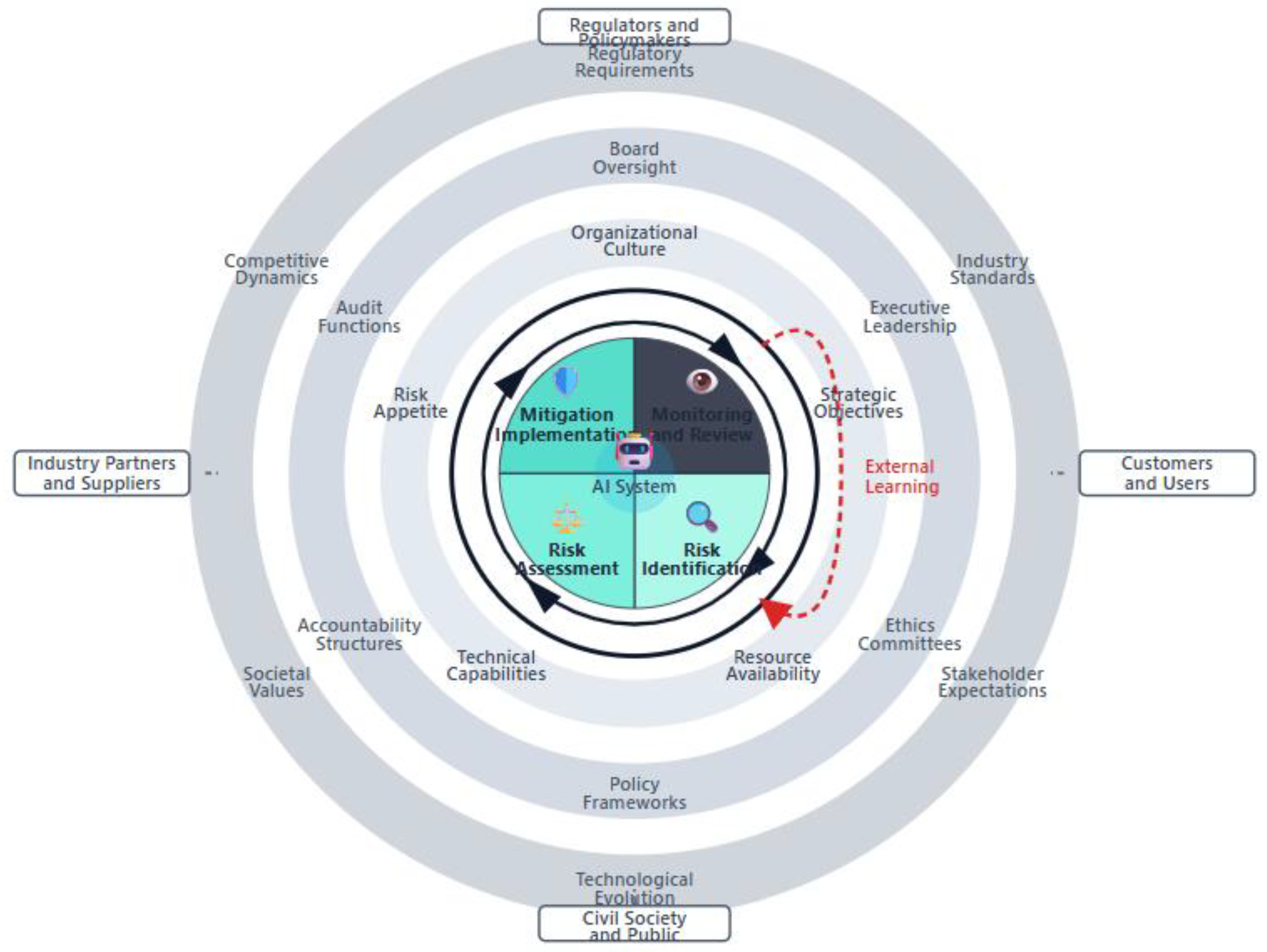
Figure 2.
Hierarchical Taxonomy of AI-Related Risks. Note: This figure presents a visual organization of the three primary risk categories (Technical, Organizational, and Societal), their subcategories, and specific risk types discussed in Section 3. The hierarchical structure illustrates the relationships between broad categories and specific manifestations of AI-related risks.
Figure 2.
Hierarchical Taxonomy of AI-Related Risks. Note: This figure presents a visual organization of the three primary risk categories (Technical, Organizational, and Societal), their subcategories, and specific risk types discussed in Section 3. The hierarchical structure illustrates the relationships between broad categories and specific manifestations of AI-related risks.
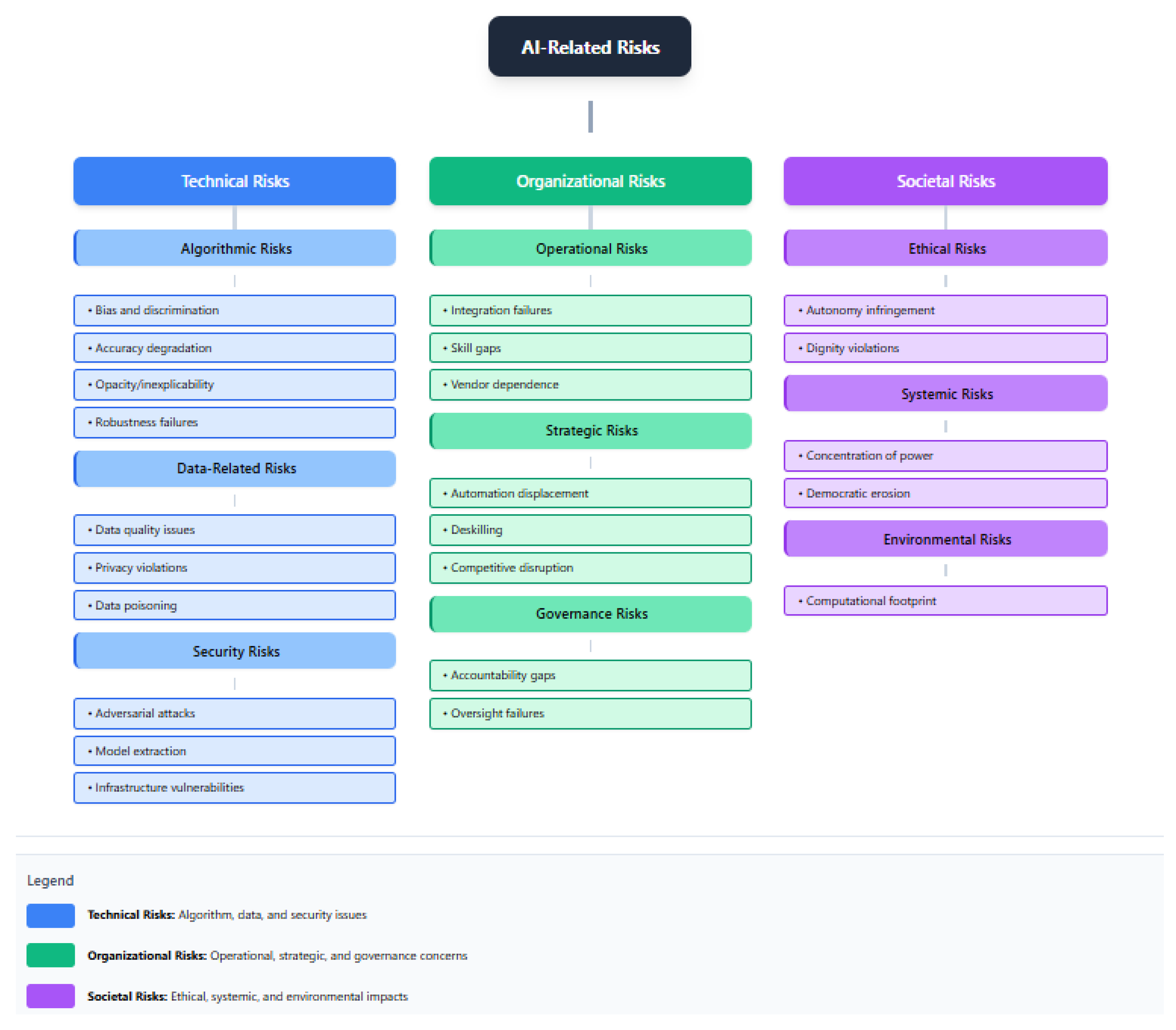
Table 1.
Comparison of AI Governance Frameworks Across Jurisdictions.
| Framework | Region/Scope | Year | Core Principles | Legal Status | Risk Classification Approach | Enforcement Mechanisms | Key Strengths | Notable Limitations |
|---|---|---|---|---|---|---|---|---|
| EU Artificial Intelligence Act | European Union (27 member states) | 2024 | Human oversight, transparency, accountability, non-discrimination, safety, data governance | Binding regulation | Four-tier system: Unacceptable, High, Limited, Minimal risk | Fines up to €35 million or 7% global turnover; national supervisory authorities; EU AI Office | Comprehensive scope; legally binding; harmonized standards; clear prohibitions | Implementation complexity; potential innovation barriers; extraterritorial challenges |
| NIST AI Risk Management Framework | United States | 2023 | Trustworthy AI characteristics: valid, reliable, safe, secure, resilient, accountable, transparent, explainable, privacy-enhanced, fair | Voluntary guidance | Context-dependent; organization-specific assessment | Non-binding; voluntary adoption; no direct penalties | Flexible; sector-adaptable; strong technical guidance; stakeholder input | Lacks enforcement power; inconsistent adoption; limited accountability mechanisms |
| Singapore Model AI Governance Framework | Singapore | 2020 (2nd ed.) | Human-centric AI; explainability; transparency; fairness; human oversight | Voluntary framework | Sector-specific; probability and severity matrix | Industry self-regulation; sectoral guidelines | Practical implementation focus; business-friendly; clear guidance | Limited to voluntary adoption; small jurisdiction scope |
| OECD AI Principles | International (38 member countries + partners) | 2019 | Inclusive growth; sustainable development; human-centered values; transparency; robustness; accountability | Soft law/Recommendation | General principles; context-sensitive | Peer review; national implementation monitoring | Broad international consensus; foundational influence; multi-stakeholder approach | Non-binding; variable national implementation; lacks specificity |
| China New Generation AI Governance Principles | China | 2019/2021 | Harmony, fairness, inclusivity, respect for privacy, safety, shared responsibility | State-guided principles with emerging regulations | Sector-specific regulations emerging | State oversight; algorithmic registry requirements; sectoral enforcement | Large-scale implementation; rapid regulatory development | Limited transparency; state-centric approach; human rights concerns |
| Canada Directive on Automated Decision-Making | Canada (Federal government) | 2019 | Transparency; accountability; legality; procedural fairness | Binding for federal agencies | Four-level impact assessment system | Treasury Board oversight; mandatory compliance for federal bodies | Clear public sector guidance; impact assessment model; transparency requirements | Limited to federal government; private sector gap |
| UK AI Regulation White Paper (Pro-Innovation Approach) | United Kingdom | 2023 | Safety; transparency; fairness; accountability; contestability | Principles-based; sector-specific regulation | Context-dependent; regulator-led assessment | Existing sectoral regulators; no central AI authority | Flexible; innovation-friendly; leverages existing expertise | Regulatory fragmentation risk; potential gaps; coordination challenges |
| Brazil AI Bill (PL 2338/2023) | Brazil | 2023 (pending) | Human dignity; non-discrimination; transparency; accountability; security | Proposed binding legislation | Risk-based tiering similar to EU approach | National AI authority proposed; administrative penalties | Comprehensive scope; rights-based approach | Still under legislative consideration; implementation uncertain |
Note.This table synthesizes information from primary regulatory sources and comparative governance analyses. Legal status and enforcement mechanisms reflect provisions as of 2024 and may evolve with ongoing regulatory developments. Adapted from Smuha (2021); Bradford (2023); OECD (2019); NIST (2023).
Disclaimer/Publisher’s Note: The statements, opinions and data contained in all publications are solely those of the individual author(s) and contributor(s) and not of MDPI and/or the editor(s). MDPI and/or the editor(s) disclaim responsibility for any injury to people or property resulting from any ideas, methods, instructions or products referred to in the content. |
© 2026 by the authors. Licensee MDPI, Basel, Switzerland. This article is an open access article distributed under the terms and conditions of the Creative Commons Attribution (CC BY) license (http://creativecommons.org/licenses/by/4.0/).
Copyright: This open access article is published under a Creative Commons CC BY 4.0 license, which permit the free download, distribution, and reuse, provided that the author and preprint are cited in any reuse.


