

Submitted:
19 February 2026
Posted:
26 February 2026
You are already at the latest version
Abstract
Due to aging societies, Technology Assisted Living (TAL) is gaining relevance. From May to November 2025 we presented a tiny home-based Technology Assisted Living (TAL) in a public roadshow across Bavaria, Germany, accompanied by a post-exposure acceptance survey. The survey yielded N=420$ valid responses, including Healthcare Worker (HCW) (n=122$, 29.1%), informal caregivers (n=67$, 16,0%), care recipients (n=24$, 5.7%) and the general population (n=207$, 49.3%). Nearly 82$ respondents were unfamiliar with one or more of the showcased technologies. Despite low prior awareness, acceptance of the tiny home-based Technology Assisted Living (TAL) was high, with assistive technologies in the bathroom rated as most beneficial. Across all groups, willingness to use the tiny home-based TAL was high (90–92%), including Healthcare Worker (HCW) (91.3%), informal caregivers (89.7%), care recipients (91.7%), and the general population (90.4%). Thereby, leasing was preferred over purchasing by a factor of 1.6–2.3 across groups, although 90.4% did not specify price expectations. Median expectations were €100,000 (purchase) and €1,000 (leasing). Open-ended responses on reasons for non-use (n=63$) were mainly attributed to high acquisition costs (39,7%) and limited space (28,6%), while suggested improvements (n=113$) contain furniture and seating (22,1%), storage (20,4%), and a larger living footprint (20,4%). Our findings call for longitudinal real-world living trials of tiny home-based TAL.
Keywords:
technology assisted living
; aging in place
; AAL
; smart homes
; tiny homes
; assistive technologies
; technology acceptance
; AgeTech
1. Introduction
Germany faces both a rising care-dependent population, with 5.7 million people in need by 2023, and substantial projected workforce shortages [1]. Due to limited capacities and low preferences of care recipients for nursing homes with 8% favor nursing homes [2], care in Germany is largely home-based (86%), with around two million adults relying solely on informal caregivers [1].
While aging in place is widely preferred and remains the dominant model, it faces structural limitations. Informal care capacities are declining due to changing household structures, higher geographic mobility, and dual-earner arrangements, reducing the availability of family-based support [3,4]. At the same time, a major barrier to aging in place is the lack of age-appropriate housing: only 18% of existing living environments are age-friendly, although the vast majority of adults aged 65 and older live in their own homes [2,3]. A representative survey further shows that 73% of individuals aged 50–70 prefer accessible living environments and home-based care arrangements [2,3]. However, necessary home adaptations are frequently hindered by financial, legal, or structural barriers, particularly in rented housing and multi-story buildings [3].
Against this background, upgrading the existing housing stock alone is often insufficient. As care needs are frequently temporary or phase-based and housing markets remain tight, flexible and mobile Technology Assisted Living (TAL) solutions are gaining relevance [4]. Technology Assisted Living (TAL), including smart home health technologies (e.g., fall detection and remote monitoring), assistive technologies such as medication reminders, care lifts, voice assistants, and care-adapted furnishings are increasingly discussed as means to support aging in place and mitigate limitations of both housing and care structures. Reviews highlight their potential to promote autonomy, continuity of care, safety, workload reduction, and timely interventions [5,6].
Nevertheless, the research community largely focuses on isolated technologies or lab-based Technology Assisted Living (TAL) demonstrators in full-size apartments, rarely addressing integrated Technology Assisted Living (TAL) concepts in small-scale or mobile living environments [6]. Despite the strong context-dependency of acceptance, research on integrated Technology Assisted Living (TAL) concepts remains scarce, while older adults often lack practical experience, even though they generally have positive attitudes [2,6].
To address this gap, we developed, in collaboration with a building company, a mobile, modular tiny home concept integrating state-of-the-art Technology Assisted Living (TAL) into a holistic living environment. Through a public roadshow across Bavaria, Germany, from May to November 2025, the concept was made directly accessible to the general population. Visitors experienced the Technology Assisted Living (TAL)-enabled tiny home firsthand and subsequently participated after their visit in an on-site survey assessing perceived usefulness, acceptance, and adoption intentions. This paper addresses the main Research Question (RQ): How do different population groups perceive tiny home-based Technology Assisted Living (TAL), designed to support aging in place?
To provide a more granular analysis, we address the following sub-questions:
- RQ 1:
- How do perceptions of usefulness and acceptance of Technology Assisted Living (TAL) vary?
- RQ 2:
- How does adoption willingness for Technology Assisted Living (TAL) vary across population groups?
- RQ 3:
- Which adoption barriers and improvement potentials can be identified?
- RQ 4:
- What preferred financing models are reported across stakeholders?
Our public tiny-house roadshow provides novel post-exposure insights into integrated Technology Assisted Living (TAL) beyond pre-selected populations. The paper is structured as follows: Section (Sec.) 2 reviews related work, Section 3 describes our Technology Assisted Living (TAL) concept and the study design, Section 4 presents the findings according to the RQs, and Section 5 discusses the results and implications, followed by the conclusion in Section 6.
2. Related Work
Researching tiny home Technology Assisted Living (TAL) is key to aging in place. We use Technology Assisted Living (TAL) to subsume overlapping tech, like Ambient Assisted Living (AAL), Smart Home Health Technology (SHHT), IoT, and Assistive Technologies [6,7]. This section establishes the theoretical framework in acceptance research with current Technology Assisted Living (TAL) concepts.
2.1. Usage and Potential of Technologies to Support Aging in Place:
Technology Assisted Living (TAL) range from established, user-triggered AgeTech (e.g., alarm buttons) and passive ambient sensing (e.g., safety and activity sensors) to advanced systems that continuously analyze in-home behavioral or health data to detect risks and enable timely interventions [7,8]. Table 1 outlines the main applications.
More advanced Technology Assisted Living (TAL) solutions form the basis of intelligent home environments, while rapid advances in Technology Assisted Living (TAL) hardware and software have led to a growing number of market-ready products increasingly targeting aging societies [12,18]. Use scenarios are multidimensional, ranging from support for physical activity and mobility to health monitoring, fall prevention, medication adherence, social interaction, and the management of daily living activities of daily living [8,11]. Beyond individual households, Technology Assisted Living (TAL) can also interface with broader infrastructures, including smart cities and integrated aging communities [18].
Borelli et al. [7] demonstrated, already six years ago, that integrated Technology Assisted Living (TAL) solutions can support older adults in independent living and increase their autonomy. Integrated Technology Assisted Living (TAL) aims to reduce reliance on external support while lowering healthcare costs and improving quality of life by enabling highly distributed architectures that connect heterogeneous devices, e.g. sensors, actuators, appliances, and smartphones, to support data exchange to deliver assistive functions within everyday routines [9,12]. Technology Assisted Living (TAL), even though the technologies are often researched in isolation, offer potential benefits, primarily improving elders’ functioning, medication adherence, and the general standard of living [8]. Regarding the relief of care burden and costs Technology Assisted Living (TAL) can have positive outcomes due to less support needed and avoidance of falls [13]. Integrated Technology Assisted Living (TAL), combining different tech, e.g. fall detection sensors with the home automation and tools like robots to offering a holistic support to elders, remain underutilized [12,13,16].
Positive outcomes of Technology Assisted Living (TAL) include health monitoring, more detailed health information, increased physical activity, reduced frailty, maintained elders’ abilities, and an increased quality of life [12,14]. Technology Assisted Living (TAL) can also support communication with family caregivers and assist with activities of daily living [11,15]. Technology Assisted Living (TAL) can enhance social participation and interaction while reducing feelings of isolation [10,12]. Older adults’ autonomy is promoted by Technology Assisted Living (TAL), in the areas of mobility and their health management [9,19]. Health literacy and self-management are further facilitated through telemonitoring and systems that provide medication reminders, thereby reducing caregiving burden [14]. Several studies demonstrate the safety benefits of Technology Assisted Living (TAL), showing that sensors can detect frailty and enable early interventions to reduce falls and improve health [8,9,14].
2.2. Conditions Influencing the Acceptance of Smart Home Health Technology (SHHT) and Technology Assisted Living (TAL)
User acceptance is a prerequisite for technology adoption [20]. Acceptance models such as the Technology Acceptance Model (TAM) and Unified Theory of Acceptance and Use of Technology (UTAUT) explain use behavior through core determinants including (i) Perceived Ease of Use (PEOU), (ii) Perceived Usefulness (PU) & Performance Expectancy, and (iii) Expected Efforts, alongside (iv) Social Influence, and moderating factors [21]. The extended model, UTAUT2 (second iteration), adds (v) Price Value and (vi) Hedonic Motivation as relevant determinants [22]. The complexity and interdependency are illustrated by studies identifying more than 139 acceptance determinants [23]. Nevertheless most studies confirming the model dimensions (i) - (vi), which offer a structured and simplified explanation approach for the acceptance of AgeTech [24].
Regarding Perceived Ease of Use (PEOU), elders prefer Technology Assisted Living (TAL) that are reliable, intuitive, and easy to use, with minimal malfunction risks [6,11]. (Perceived Usefulness (PU)) (ii) drives acceptance through expected benefits such as supporting health, safety, alongside expectations of increased independence, well-being, and reduced care burdens [6,9,20]. Integrating multiple technologies thereby enhances the usefulness [25]. Acceptance is also shaped by perceived efforts (iii), including required home modifications, learning demands, and personalization efforts [13]. Social influence (iv), esp. from key figures like family members, further affects acceptance [6]. Given the price sensitivity among elders, costs (v) constitute a major barrier for Technology Assisted Living (TAL) adoption [6,26]. Costs and other factors, such as data protection and security, are weighed against perceived benefits to guide adoption [25]. Thereby, the modularity of Technology Assisted Living (TAL) is a benefit, allowing functionalities to be added as needed [24]. Finally, technological support needs to be attractive and appealing to users, as enjoyable technologies (iv) are more likely to be adopted by older adults [9].
2.3. Research Gaps in Technology Assisted Living (TAL)-Enabled Tiny Homes
Research on tiny home (TH) has emerged in contexts beyond aging in place. Primarily in North America, tiny home (TH) were examined as an affordable, low-threshold housing option for mental health support and homelessness [27,28,29]. Complementary evidence from the Netherlands indicates favorable attitudes toward tiny and portable housing, particularly among single-person households [30].
Existing studies mainly address community integration, connections to healthcare and social support, and design aspects, including transitional or supportive housing formats [27,28,29]. Some work examines tiny home (TH) as extensions of emergency care pathways, enabling temporary post-discharge housing for formerly hospitalized homeless people and reducing re-admission and associated costs [28]. Most projects are implemented as village-like demonstrators, while technology, despite its central role in contemporary living environments, remains largely overlooked, and tiny home (TH) are rarely conceptualized as integrated Technology Assisted Living (TAL) [13,29]. We didn’t identify one study that combines tiny home (TH) concepts with the possibilities Technology Assisted Living (TAL) for older adults aiming to age in place. This research gap persists despite the recognized importance of integrated solutions combining technologies with the built environment [3,13]. Nevertheless, existing literature allows the derivation of key success factors for implementing tiny home (TH), which are synthesized as follows:
Studies from the US [27,29], Canada [28], and the Netherlands [30] identify (i) affordability and (ii) regulatory feasibility as prerequisites for tiny home (TH) implementation. Apart from that, (iii) community embedding and public support are important and local stakeholder involvement fosters social integration, reduces potential stigma and ensures long-term tiny home (TH) usage [28]. As shown prior [28], integration within healthcare can be vital. Another determinant, which seems important for tiny home (TH) users, is due to the sensitivity of housing areas, (iv) safety and privacy [29]. tiny home (TH) users prefer e.g., not to share a wall with another tiny home (TH) and the build should be solid, to increase the lifecycle [29]. When it comes to using monitoring in that domain, data privacy and ethics also come into place [13,24].
3. Methodology
To address the RQs, the authors conducted a cross-sectional, multisite post-exposure study between May and November 2025 as part of a public roadshow with a tiny home based Technology Assisted Living (TAL) across Bavaria, Germany. Participants were exposed to the integrated Technology Assisted Living (TAL) concept, the NewCareMobile (NCM), before completing a standardized on-site survey. All participants were recruited onsite during the exhibitions and categorized into four groups based on self-report: (i) the general population, (ii) Healthcare Worker (HCW), (iii) informal caregivers, and (iv) people in need of care.
3.1. NewCareMobil (NCM): Concept and Included Technologies
The NewCareMobile (NCM) is a mobile, modular tiny home concept designed to demonstrate an integrated Technology Assisted Living (TAL) environment. It is a single-level, barrier-free unit for aging in place that is transportable by standard European trucks (measures: 3 m × 12 m).
Figure 1.
Impressions of the NCM, full 3D-Tour: www.th-deg.de/new-care-mobil.
Figure 1.
Impressions of the NCM, full 3D-Tour: www.th-deg.de/new-care-mobil.
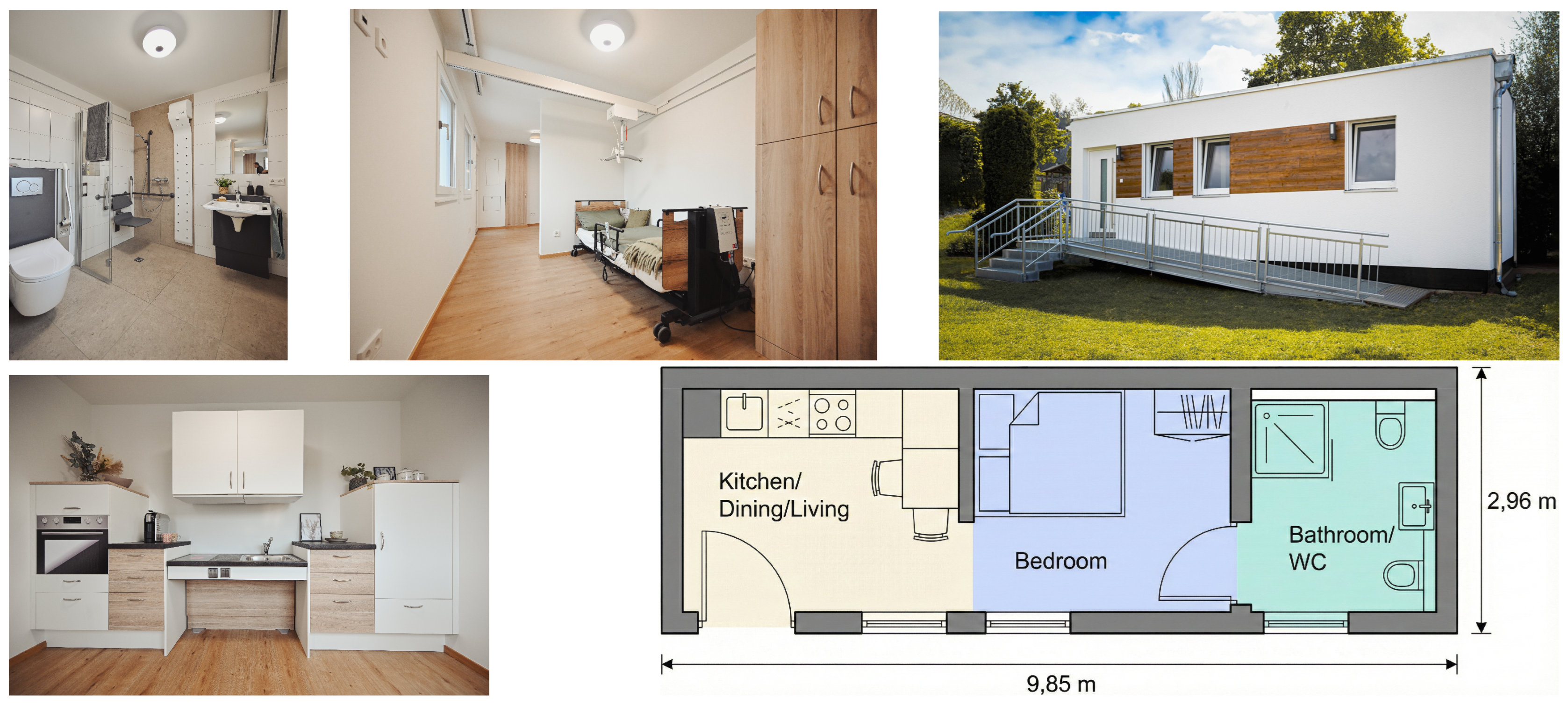
The NewCareMobile (NCM) is built using timber-based prefabrication with a footprint of 29 m2. On a single level, the NewCareMobile (NCM) integrates state-of-the-art Technology Assisted Living (TAL) across three functional areas, including smart-home sensors (e.g., fall detection), monitoring and safety systems, assistive and mobility-supporting elements (e.g., a height-adjustable toilet), and care-adapted fixtures (e.g., a patient transfer lift). The equipment alone costs ∼ €50,000, while the NewCareMobile (NCM) construction costs the same. A detailed list is available upon request. Technology selection followed a criteria catalogue1, covering (i) accessibility, (ii) spatial requirements, (iii) adaptability, (iv) safety, (v) usability, (vi) attractiveness, and (vii) degree of automation.
3.2. Multisite Exposure (Public Roadshow)
As shown in Table 2, the NewCareMobile (NCM) was presented in a roadshow across Bavaria, Germany (May to November 2025) to provide a hands-on experience of Technology Assisted Living (TAL).
3.3. Data Collection and Analysis
To capture first-hand perceptions during the roadshow, an anonymous post-exposure survey was administered on-site, using tablets at the exit and LimeSurvey. Participation required informed consent. All participants were categorized by self-report into (i) the general population, (ii) HCWs, (iii) informal caregivers, and (iv) people in need of care. Our survey comprised sociodemographics, prior tech experience, and assessments of the NewCareMobile (NCM). The survey was informed by the technology acceptance models [21] and included items on usefulness, acceptance, willingness to adopt Technology Assisted Living (TAL)-enabled tiny home (TH), and financial preferences. Quantitative items were complemented by open-ended questions addressing perceived barriers, trust, and improvement suggestions. The survey is available upon request.
Closed-ended responses were analyzed descriptively using IBM SPSS Statistics Ver 24. Inferential statistics were not conducted due to small subgroup sizes. In addition, open-ended responses were analyzed via an inductive template analysis. Coding was cross-checked by two authors. The analysis identified three core dimensions: (i) physical–spatial aspects, (ii) technological aspects, and (iii) experiential factors, capturing perceived barriers and improvement needs.
4. Results
A total of completed the survey, incl. 49.3% general citizens (), 29.1% Healthcare Worker (HCW) (), 16.0% informal caregivers (), and 5.7% care recipients (). The sample covers all genders (66.4% female, 33.4% male, 0.2% mercury) and a broad age range. The largest age group is 60–69 years (24.1%), followed by 50–59 years (13.6%) and 70–79 years (12.6%), across Bavaria, Germany.
4.1. Perceived Usefulness (PU) of the NCM
Most of the showcased technologies (ATs) were unfamiliar, with an overall 81.7% not knowing one or more of the ATs before the roadshow. Limited prior exposure was most pronounced among care recipients (83.3,%, ), followed by informal caregivers (77.6,%, ), while 59.0,% of Healthcare Worker (HCW) () reported that at least one demonstrated ATs was unfamiliar. Despite this limited familiarity, perceived usefulness (Perceived Usefulness (PU)) was high across all groups. Among Healthcare Worker (HCW), 98.3,% reported that the showcased ATs were useful enough to envisage integration into nursing practice. Perceived usefulness was similarly high among informal caregivers and care recipients, who identified as the primary beneficiaries (Table 3).
Nearly all informal caregivers (98.3%, ) indicated that both the showcased tech and the tiny home–based Technology Assisted Living (TAL) would support and relieve them. Either all care recipients () reported that the Technology Assisted Living (TAL) would alleviate their situation while providing a sense of safety and trust. Usefulness was also perceived beyond care-related roles, with 99.4% of the general population identifying more than one showcased tech as helpful, esp. bathroom-related solutions (Table 4).
Qualitative data confirms high Perceived Usefulness (PU). Care recipients emphasized improved ‘autonomy and dignity’ through adaptable features (e.g., ‘having everything height-adjustable’) and associated assistive bathroom technologies with safer, more independent routines. Informal caregivers emphasized reassurance and workload relief, describing monitoring systems as providing ‘the relief of knowing that my loved ones are safe’ and physical aids as ‘brilliant because it saves my back’. Healthcare Worker (HCW) similarly emphasized efficiency gains, characterizing the technologies as ‘meaningful, future-oriented and ‘super practical’ in everyday practice.
4.2. Willingness to Use (WtU) and Reported Barriers
Overall, 90,6% respondents stated a willingness to use the NewCareMobile (NCM) for aging in place. 91,7% of individuals with care needs (), 91,3% of HCW (), 90,4% of general citizens () as well as 89,7% of informal caregivers () can imagine using our tiny home-based Technology Assisted Living (TAL), as shown in Tab. 5.
Open-ended responses support high WtU, praising the NewCareMobile (NCM) as ’beautiful, future-oriented’ and ’meaningful concept’. Nevertheless, participants also identified barriers (). Primary obstacles include high acquisition costs (39.7%), with people noting the NewCareMobile (NCM) is ‘not doable with a pension’, and spatial constraints (28.6%), e.g., the ‘absence of an appropriate plot to place the NewCareMobile (NCM)’.
Improvement suggestions () targeted furniture (22.1%), storage (20.4%), and a larger footprint (20.4%), as participants requested ‘more storage space’ and criticized the layout as ‘too cell-like’ without dedicated living areas.
4.3. Willingness to Pay (WtP)
The WtP indicates a preference for monthly payments (e.g. leasing) over one-time purchasing across all cohorts. Participants indicated, in separate items, whether they could envisage purchasing or leasing the technology (Figure 2), which were used to calculate the specific leasing-to-purchase preference ratios. The widest preference gap (), with 72.0% imagining leasing versus 32.0% for purchasing, was observed among informal caregivers (). The highest absolute acceptance for leasing (76.2% vs. 42.9% purchasing) occurred within the care recipient group (). A similar distribution (71.9% vs. 45.2%) was mirrored by the general population (). Some participants () specified price-points. Median price expectations were €100,000–120,000 (purchase) and €800–1,000 (leasing). Qualitative feedback confirms a preference for "sensible and feasible" monthly models. Purchase barriers were driven by fears of old-age poverty and low pensions, with participants questioning ’who can really afford such care?’. Therefore, participants expressed a strong expectation for institutional support, hoping that ’some of it will be covered by health insurance’.
5. Discussion
Limitations:
Our small sample of limit generalizability. Although 3,665 visitors attended the roadshow, only 11.46% completed the survey, likely reflecting the public exhibition setting and brief visitor engagement, with potential self-selection bias. The on-site demonstrations across multiple locations may have positively influenced post-exposure perceptions; thus, pre-use attitudes may differ from observed acceptance. While the public roadshow enhances external validity relative to laboratory studies by engaging a non-preselected population, it may inflate acceptance estimates. Additionally, combining items from established acceptance models (TAM, UTAUT 2) with study-specific measures limits comparability. Furthermore, price-related findings should be seen as indicative as limited experience with tiny home-based Technology Assisted Living (TAL) likely contributed to high uncertainty, with 90.4% of participants reporting no price expectations.
Contribution:
Despite limitations, we provide novel evidence on the acceptance of integrated tiny home-based Technology Assisted Living (TAL). To our knowledge, we provide the first empirical study on tiny home-based Technology Assisted Living (TAL) post-exposure acceptance in a multisite setting. Overall, our findings align with established acceptance models and prior research [8]. In summary, perceived usefulness and adoption willingness of tiny home-based TAL are high, but spatial and financial framework conditions are determinants for implementation. Specifically, we answer our RQs as follows:
- RQ 1:
- RQ 2:
- Regardless from costs, a robust willingness to use the NewCareMobile (NCM) was observed, with 90–92% of participants across all groups indicating positive intent.
- RQ 3:
- RQ 4:
- The leasing preference in all participants underscores the need for models tailored to pension-based incomes and the temporary TAL-needs [30].
6. Outlook
Our roadshow served as an effective awareness-raising intervention of Technology Assisted Living (TAL) with hands-on exposure. The NewCareMobile (NCM) was broadly accepted, perceived as useful, and prefered to lease. Despite high adoption willingness, significant hurdles remain in regulatory frameworks and funding. Consequently, addressing the needs of aging societies requires transitioning the NewCareMobile (NCM) from pilot phases into real-world settings through longitudinal field trials with populations in need of care. Future research and implementation concepts should also assess the integration of tiny home-based Technology Assisted Living (TAL) into spatial planning, communities, and existing care services.
Supplementary Materials
The following supporting information can be downloaded at the website of this paper posted on Preprints.org.
Institutional Review Board Statement
The study was approved by Joint Ethics Committee of Bavarian Universities (GEHBa), Ethical Self Assessment V3.1, provided by the GEHBa (date of approval 2025-04-30).Informed consent was obtained, anonymity ensured, and compliance verified through an ethical self-assessment.
Informed Consent Statement
Informed consent was obtained from all subjects involved in the study.
Data Availability Statement
Data is available from the authors upon request. Our graphical abstract (poster) is available at https://doi.org/10.6084/m9.figshare.31347049.
Acknowledgments
We thank the Bavarian State Parliament for funding, Stefan Lindner for his support, and Wolf System GmbH for its constructional realization.
Conflicts of Interest
The authors declare no competing interests.
References
- Statistisches Bundesamt. Pflegebedürftige in Deutschland. Press release, 2024. Press Release PD24_478_224, Acc.: 2026-01-16.
- Institut für Demoskopie Allensbach (IfD). Indiv. Strategien zur Bewältigung des Pflegefalls, 2022. Acc.: 2026-02-01.
- BMFSFJ. Living at home longer, 2019. Acc.: 2026-02-01.
- Pfnür, A.; Lachenmayer, F.; Bachtal, Y.; Voll, K. So wohnen wir in Zukunft, 2023.
- Facchinetti, G.; Petrucci, G.; Albanesi, B.; de Marinis, M.G.; Piredda, M. Can Smart Home technologies Help Older Adults Manage Their Chronic Condition? IJERPH 2023, 20. [CrossRef]
- Peek, S.T.M.; Wouters, E.J.M.; van Hoof, J.; Luijkx, K.G.; Boeije, H.R.; Vrijhoef, H.J.M. Factors influencing acceptance of technol. for aging in place: a Syst. Rev. Int. journal of medical informatics 2014, 83, 235–248. [CrossRef]
- Borelli, E.; Paolini, G.; Antoniazzi, F.; Barbiroli, M.; Benassi, F.; Chesani, F.; Chiari, L.; Fantini, M.; Fuschini, F.; Galassi, A.; et al. HABITAT: An IoT Solution for Independent Elderly. Sensors 2019, 19. [CrossRef]
- Wick, J.Y. Aging in Place: Our House Is a Very, Very, Very Fine House. The Consultant Pharmacist 2017, 32, 566–574. [CrossRef]
- Moreno, A.; Scola, M.C.; Sun, H.; Durce, H.; Couve, C.; Acevedo, K.; Gutman, G.M. A Syst. Rev. of gerontechnologies to support aging in place among community-dwelling older adults & their family caregivers. Frontiers in psychology 2023, 14, 18. [CrossRef]
- Shafei, I.; Khadka, J.; Balasubramanian, M. Smart homes: pioneering age-friendly Environ. in China for enhanced health & quality of life. Frontiers in public health 2024, 12, 1346963. [CrossRef]
- Dolman, A.; Kaliappan, S.; Zhou, Y.; Palleti, D.; Marquard, J.; Lee, S.I.; Karkar, R.; Jimison, H.B. A Syst. Rev. of unmet needs of older adults in home settings & their implications for novel technol. solutions. Innovation in aging 2025, 9, 14–23. [CrossRef]
- Tian, Y.J.A.; Felber, N.A.; Pageau, F.; Schwab, D.R.; Wangmo, T. Benefits & barriers associated with the use of smart home health technol. in the care of older persons: a Syst. Rev. BMC geriatrics 2024, 24, 152. [CrossRef]
- Cha, S.M. A Syst. Rev. of Home Modifications for Aging in Place in Older Adults. Healthcare 2025, 13. [CrossRef]
- Dubbeldam, R.; Stemplewski, R.; Pavlova, I.; Cyma-Wejchenig, M.; Lee, S.; Esser, P.; Bentlage, E.; Alcan, V.; Çevik, Ö.S.; Epiphaniou, E.; et al. Technol.-Assisted Physical Activity Interventions for Older People in Their Home-Based Environ.: Scoping Rev. JMIR aging 2025, 8, 25. [CrossRef]
- Moreno, J.A.; Durce, H.; Cifuentes, C.; Múnera, M.; Acevedo-Benítez, K.; Couve, C.; Scola, M.C.; Gutman, G.M. Technol.-assisted home support of community-dwelling older adults living with dementia & their family caregivers: A ten-year Syst. Rev. Gerontechnol. 2024, 24, 1–29. [CrossRef]
- Anghel, I.; Cioara, T.; Moldovan, D.; Antal, M.; Pop, C.D.; Salomie, I.; Pop, C.B.; Chifu, V.R. Smart Environ. & Social Robots for Age-Friendly Integr. Care Services. IJERPH 2020, 17. [CrossRef]
- Engelhardt, S.; Kardas, L.; Kastl, A.; Lüftl, K.; Nick, C.; Rauner, Y. DeinHaus 4.0 Oberbayern. In Digitale Technik für ambulante Pflege & Therapie II; Weber, K.; Haug, S.; Lauer, N.; Mohr, C.; Pfingsten, A.; Raptis, G.; Bahr, G., Eds.; transcript: Bielefeld, 2023; Vol. 3, Regensburger Beiträge zur Digitalisierung des Gesundheitswesens, pp. 29–42. [CrossRef]
- Perez, A.J.; Siddiqui, F.; Zeadally, S.; Lane, D. A Rev. of IoT systems to enable independence for the elderly & disabled individuals. IoT 2023, 21, 100653. [CrossRef]
- Dogra, S.; Dunstan, D.W.; Sugiyama, T.; Stathi, A.; Gardiner, P.A.; Owen, N. Active Aging & Public Health: Evidence, Implications, & Opportunities. Annual Rev. of public health 2022, 43, 439–459. [CrossRef]
- Cahill, J.; McLoughlin, S.; Wetherall, S. The Design of New Technol. Supporting Wellbeing, Independence & Social Participation, for Older Adults Domiciled in Residential Homes &/or Assisted Living Communities. Technologies 2018, 6, 18. [CrossRef]
- Elske, A. Technol. Acceptance Models in Health Informatics. Studies in health technology and informatics 2019, 263, 64–71. [CrossRef]
- Venkatesh, V.; Thong, J.Y.L.; Xu, X. Consumer Acceptance & Use of IT: Extending the UTAUT. MIS Quarterly 2012, 36, 157–178. [CrossRef]
- Alnajim, R.; Alkhalifah, A. Exploring Factors Affecting the Adoption of IoT in Healthcare: A Syst. Lit. Rev. Healthcare 2025, 13. [CrossRef]
- Fakhimi, M.M.; Hughes, A.; Gustavson, A.M. Human-centered design for smart home technol.: a framework for aging & mental health. Frontiers in digital health 2025, 7, 5. [CrossRef]
- Pirzada, P.; Wilde, A.; Doherty, G.H.; Harris-Birtill, D. Ethics & acceptance of smart homes for older adults. Informatics for health & social care 2022, 47, 10–37. [CrossRef]
- Malden, S.; McGill, K.; Guthrie, B.; Frost, H.; Shenkin, S.D.; Ezike, A.; Bareham, B.K.; Mercer, S.W.; Pearce, C.; Wilson, C.; et al. Patient & Carer-Related Facilitators & Barriers to the Adoption of Assistive technol. for the Care of Older Adults: Syst. Rev. JMIR aging 2025, 8, 20. [CrossRef]
- Wilson, A.B.; Villodas, M.L.; Mahadevan, T.; Bosman, E.; Swaine, J.; Gilmore, J.H.; Bowman, L.; Money-Garman, A. Tiny homes-big movement: building a permanent & affordable housing option for people with severe mental illness. Frontiers in public health 2025, 13, 7. [CrossRef]
- Wong, A.; Chen, J.; Dicipulo, R.; Weiss, D.; Sleet, D.A.; Francescutti, L.H. Combatting Homelessness in Canada: Applying Lessons Learned from Six Tiny Villages to the Edmonton Bridge Healing Program. IJERPH 2020, 17. [CrossRef]
- Jackson, A.; Callea, B.; Stampar, N.; Sanders, A.; de Los Rios, A.; Pierce, J. Exploring Tiny Homes as an Affordable Housing Strategy to Ameliorate Homelessness: A Case Study of the Dwellings in Tallahassee, FL. IJERPH 2020, 17. [CrossRef]
- Glumac, B. Tiny portable home: Measuring the rental preferences. Cities 2021, 116, 103279. [CrossRef]
| 1 | Based on prior experiences [17] and accessibility standards (e.g., www.readyhome.de). |
Figure 2.
Bar Chart Regarding Purchase Intentions, Affirmative Responses per Item. Note: MeanM and medianMdnprice; leasing-to-purchase ratio; HCW weren’t asked regarding WtP.
Figure 2.
Bar Chart Regarding Purchase Intentions, Affirmative Responses per Item. Note: MeanM and medianMdnprice; leasing-to-purchase ratio; HCW weren’t asked regarding WtP.
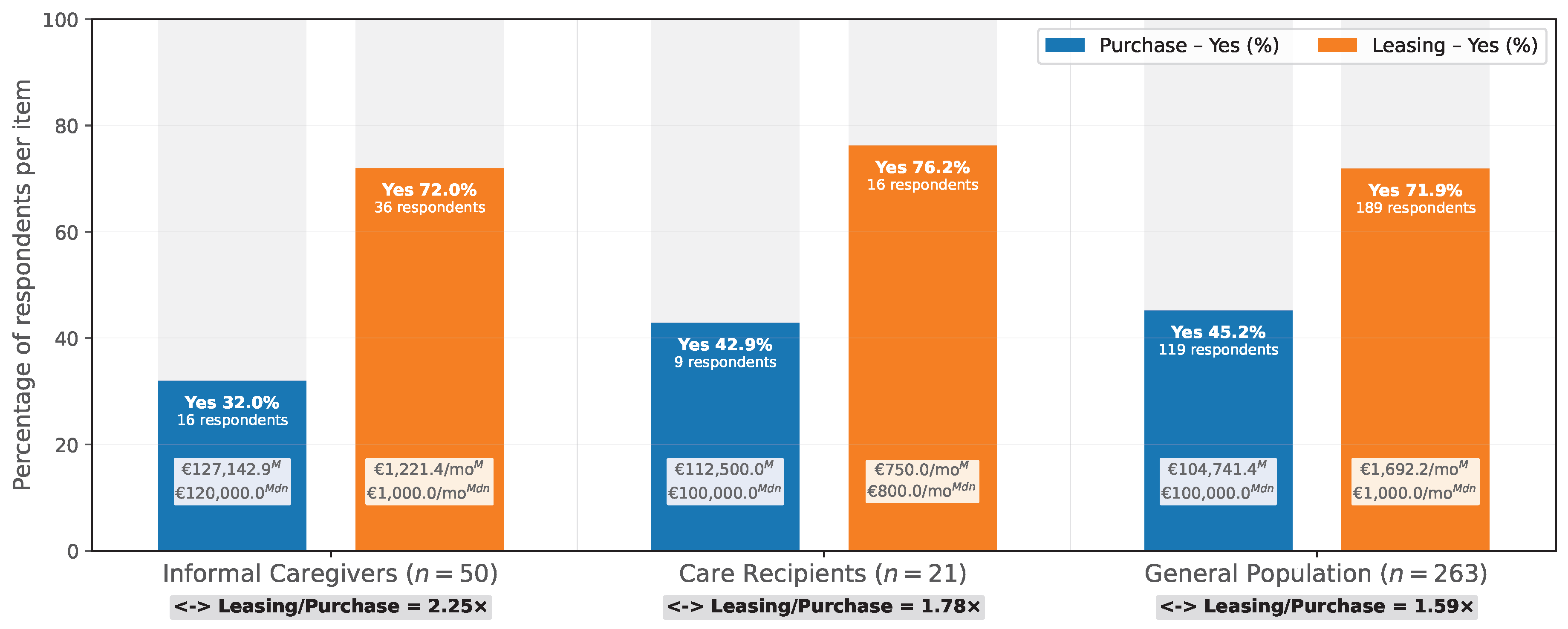

Table 1.
Overview of Technology Categories Relevant to Technology Assisted Living (TAL) and Current Diffusion.
Table 1.
Overview of Technology Categories Relevant to Technology Assisted Living (TAL) and Current Diffusion.
| Category | Representative technologiesi | Diffusionii | Studies |
|---|---|---|---|
| Communication & Social Interaction |
Videocalls, digital companions, voice assistants, social robots, chatbots, games | + | [9,10,11,12] |
| Emergency & safety |
Fall detection, alarm buttons, motion & door sensors, smart lights, stove guard | 0 | [7,8,9,12,13] |
| Health monitoring |
Wearables, Vital sign & Sleep tracking, health data transmission, telemedicine | 0 | [7,9,10,12,13] |
| Information & Documentation |
Medication intake reminders, electronic health records, assistive interfacesiii | + | [9,14] |
| Daily life support | lifting aids, adjustability, service-robots | - | [10,13,15,16] |
| Activity enhancing | fitness & walking aids, activity tracking | o | [14] |
| Integrated Solutions |
Combined Technology Assisted Living (TAL) platforms, IoT-based SHHT, AI-supported environments | - | [7,10,12,13,17] |
Table 2.
Roadshow overview from May to November 2025: venues and visitor numbers.
| Start to End | Exhibition venuei | Length | Pop.ii | Visitorsiii | |
|---|---|---|---|---|---|
| 05th May | – 09th May | D-93444 Bad Kötzting | 5 days | 7,421 | 220 |
| 12th May | – 30th May | D-84307 Eggenfelden | 9 days | 14,277 | 438 |
| 16th Jun | – 18th Jun | D-84095 Furth (Landshut) | 3 days | 3,679 | 159 |
| 21st Jul | – 24th Jul | D-85049 Ingolstadt | 4 days | 140,717 | 258 |
| 29th Sep | – 02nd Oct | D-85399 Hallbergmoos | 4 days | 11,681 | 153 |
| 10th Oct | – 10th Oct | D-94469 Deggendorf | 1 day | 35,044 | 200 |
| 13th Oct | – 17th Oct | D-95652 Waldsassen | 4 days | 6,698 | 118 |
| 19th Oct | – 19th Oct | D-93138 Lappersdorf | 1 day | 13,472 | 449 |
| 20th Oct | – 22nd Oct | D-93059 Regensburg | 3 days | 151,208 | 166 |
| 10th Nov | – 14th Nov | D-91054 Erlangen | 4 days | 120,301 | 1,475 |
| 15th Nov | – 15th Nov | D-94469 Deggendorf | 1 day | 35,044 | 29 |
| Total exhibition length and visitor counts: | 39 days | 3,665 | |||
i Mainly high-traffic public locations, e.g., parking lots, markets, shopping centers, transport hubs; ii Population according to official data (2025); iii Visitors recorded via tally counter manually.
Table 3.
Perceived relief regarding the care situation and everyday life (in %).
| Informal caregivers ()i | Care recipients ()ii | ||
|---|---|---|---|
| Yes, relief trough tech & tiny-home concept i | 98.3% | Yesiii | 100.0% |
| No relief perceived | 1.7% | No | 0.0% |
iRefers to two questions regarding relief provided by ATs and tiny-house-based Technology Assisted Living (TAL).
Table 4.
Helpfulness Perception of the Assistive Technologies (ATs) in the NCMi.
| Technology Helpfulness (), in% | Affected Area (), in% | ||
|---|---|---|---|
| No AT was helpful | 0.6% | Bathroom | 71.0% |
| One AT was helpful | 34.3% | Living & sleeping | 69.2% |
| More than two ATs helpful | 21.3% | Kitchen | 46.7% |
| More than three ATs helpful | 43.8% | ||
i Derived from open-ended data (general population), refers to all showcased tech.
Table 5.
Willingness to Use the NCM, by each Participant Group.
| Question | Group | Yes, n (%) | No, n (%) | Total (N) |
|---|---|---|---|---|
| Can you imagine using the NCM? (dichotomized) |
Care recipients | 22 (91.7%) | 2 (8.3%) | 24 |
| Healthcare workers | 94 (91.3%) | 9 (8.7%) | 103 | |
| General population | 179 (90.4%) | 19 (9.6%) | 198 | |
| Informal caregivers | 52 (89.7%) | 6 (10.3%) | 58 | |
| 347 (90.6%) | 36 (9.4%) | 383 | ||
Disclaimer/Publisher’s Note: The statements, opinions and data contained in all publications are solely those of the individual author(s) and contributor(s) and not of MDPI and/or the editor(s). MDPI and/or the editor(s) disclaim responsibility for any injury to people or property resulting from any ideas, methods, instructions or products referred to in the content. |
© 2026 by the authors. Licensee MDPI, Basel, Switzerland. This article is an open access article distributed under the terms and conditions of the Creative Commons Attribution (CC BY) license (http://creativecommons.org/licenses/by/4.0/).
Copyright: This open access article is published under a Creative Commons CC BY 4.0 license, which permit the free download, distribution, and reuse, provided that the author and preprint are cited in any reuse.


