

Submitted:
20 February 2026
Posted:
27 February 2026
You are already at the latest version
Abstract
Decentralized wastewater treatment systems afford a unique opportunity to implement a One Water paradigm through water reuse and resource recovery. Simultaneously, poorly managed on-site wastewater treatment systems (OWTSs) pose significant threats to human health, although their role in environmental antimicrobial resistance (AMR) is understudied. We deployed culture-based methods adapted from the World Health Organization’s Tricycle Protocol to assess the potential role of OWTSs in discharging third generation cephalosporin-resistant E. coli (3GCR-Ec) and extended-spectrum beta lactamase-producing E. coli (ESBL-Ec). We detected 3GCR-Ec in 74% of ATU effluents (geometric mean of 440 CFU/100 mL) and ESBL-Ec in 19%. E. coli isolates in these effluents were resistant to an average of 4.11 antibiotic compounds. ESBL-Ec were detected in up to 19% of surface water samples from rivers known to be impacted by OWTS discharges. Human sewage marker abundance was significantly higher in samples containing 3GCR-Ec (p = 0.0026) and ESBL-Ec (p = 0.0121) and the proportion of samples positive for 3GCR-Ec was strong correlated with river discharge percentile (r > 0.67, p < 0.0292). Our findings emphasize the unique human-environment interface of decentralized wastewater treatments systems must be carefully considered in both One Health and One Water paradigms to safely and sustainably meet our needs.
Keywords:
extended-spectrum beta-lactamase
; third generation cephalosporin
; on-site wastewater treatment
; aerobic treatment units
; Louisiana
Introduction
The proliferation of antibiotic-resistant bacteria (ARB) is an ever-increasing threat to public health. The United States (U.S.) Centers for Disease Control and Prevention (CDC) has estimated that more than 2.8 million ARB infections occur each year in the U.S., resulting in at least 35,000 deaths2 and costing an estimated $4.1 billion to $5.1 billion in annual healthcare costs.3 Globally in 2019, an estimated 4.95 million deaths were associated with antibiotic resistance, including 1.27 million deaths that were directly attributable to bacterial AMR.4 Despite the harrowing statistics and the declaration of AMR as a top ten global health threat5, a comprehensive “One Health” response is complicated by the interlinked, yet disparate, venues for AMR dissemination, which include humans, animals, and the environment.1,6 The aquatic environment, in particular, is believed to play a crucial role in the propagation of AMR, as horizontal gene transfer (HGT) between bacteria can be induced by high microbial diversity and the presence of selective pressures, such as sub-lethal concentrations of antibiotics and heavy metal concentrations in surface waters and at groundwater/sediment interfaces.7,8 ARB and antibiotic resistance genes (ARGs) can be introduced to environmental waters through fecal contamination from human and animal sources.9 Numerous studies have established that antibiotic compounds and resistant bacteria are ubiquitous in municipal wastewater treatment plant (WWTP) influent10, with treatment often selecting for ARB leading to the discharge of both ARB and ARGs in the final effluent11,12 and enrichment of AMR in receiving waterbodies.13,14 Much less is known about the contribution of non-point source fecal pollution from decentralized wastewater treatment systems to AMR, especially in high-income settings. In the U.S. alone, roughly 25% of households rely on decentralized (i.e., on-site) wastewater treatment systems.15 Such systems are expected to play an increasingly important role in implementing a “One Water” paradigm by enabling water reuse and resource recovery at the site of production.16 Despite their promise for a water-scarce future, on-site wastewater treatment systems (OWTSs), including septic tanks and mechanical units, such as aerobic treatment units (ATUs), can also pose a significant threat to water quality and human health owing to poor maintenance and operation practices17, extended service life18, and utilization at high densities.19
The governance challenges associated with OWTSs strongly suggest they could disproportionally contribute to AMR in downstream waterbodies. Antibiotic compounds have been documented in septic system influent20 and effluent21, and downstream groundwaters22,23 and surface waters.24 ARGs have also been detected in OWTS influent and effluent.25,26 Several studies have found associations between OWTSs and environmental AMR. For example, in a watershed in the state of Georgia, USA, ARG abundance in presumed effluent receiving waters strongly correlated with human fecal marker abundance.27 Similarly, in a Lake Michigan watershed, USA with high septic system density, ARG presence was correlated with human sewage marker concentration.28 A study using culture-based methods in Australia found that the proportion of antibiotic-resistant E. coli isolates from humans increased significantly in surface waters from urbanized areas with high OWTS utilization.29 While each of these studies infers a relationship between OWTS and environmental AMR, direct observations of domestic OWTS effluent (i.e., non-hospital settings) remain scarce, particularly studies using culture-based methods, as is crucial for health risk assessment.30
To further investigate the role of OWTSs in environmental AMR, we deployed three variations of the environmental component of the World Health Organization’s (WHO) Tricycle Protocol31 for screening of extended-spectrum beta-lactamase-producing E. coli (ESBL-Ec) in OWTS effluents and surface waters in coastal Louisiana, USA. ESBL-Ec are among the third-generation cephalosporin-resistant (3GCR) and ESBL-producing Enterobacterales, which the WHO and CDC have identified as a significant threats to public health.32,33 A previous study of recreational surface waters in coastal Louisiana detected E. coli and Enterobacter spp. resistant to some antibiotic compounds, although no isolates were 3GCR and ESBL status was not assessed.34 In coastal Louisiana, decentralized wastewater treatment systems, particularly ATUs, are widely used for onsite treatment of individual household domestic wastewater with prevalent dysfunction reported.35 The Louisiana Department of Environmental Quality (LDEQ) estimates 1.3 million households utilize ATUs with failure rates as high as 50%.36 Notably, most of these ATUs discharge their effluent directly to the surface providing a unique opportunity for sampling. We hypothesized that ESBL-Ec and 3GCR-Ec would be widely detectable in ATU effluents and receiving waterbodies at concentrations relevant to public health and that their level in environmental waters would be associated with human sewage markers.
Materials and Methods
Study Setting and Sample Collection
In the current study, surface water grab samples were collected monthly for 18 months (February 2023 to July 2024) along two OWTS-impacted rivers in Tangipahoa Parish, Louisiana, USA – the Natalbany River (4 sites) and the Yellow Water River (4 sites) (Figure S1). The Natalbany River (NR) is in western Tangipahoa Parish and is 30.7 miles in length with a 50.8 mi2 ex-urban watershed and 99 Louisiana Pollutant Discharge Elimination System (LPDES)-permitted discharges and meets water quality criteria for both primary and secondary contact recreation.37 LPDES-permitted dischargers to NR including two publicly owned treatment works (POTWs) that had a combined average discharge of 0.115 million gallons per day (MGD) over the study period. The average discharge of the Natalbany River in cubic feet per second was calculated each day of the sampling period using data from the Natalbany River at Baptist, LA station (USGS 07376500). The Yellow Water River (YW) is in central southern Tangipahoa Parish draining peri-urban portions of Hammond, Louisiana. The YW River is 12.9 miles long with 120 LPDES-permitted discharges in its 19.5 mi2 watershed and does not meet water quality criteria for primary contact recreation (fecal coliform counts). LPDES-permitted discharges to YW include one POTW with an average flow of 0.380 MGD over the study period. Discharges from individual home ATUs are not LPDES-permitted and therefore the exact number of ATUs discharging to each river is unknown. However, parish level data indicates that Tangipahoa parish had 19,394 OWTSs in 2016, the second highest number of any parish in the state of Louisiana.35 Previous inspection programs found that 48% of ATUs in the region did not have functioning aerators.35 ATU effluent grab samples were collected monthly from two anonymized ATUs in Tangipahoa Parish from February 2023 to July 2024 and January 2025 to December 2025 (n = 30 per ATU). Effluent grab samples were also collected from a convenience sample (i.e., flow from discharge pipe upon visit) of 70 individual ATUs in the region. During each sampling event, one liter of surface water or effluent was collected in a sterile HDPE bottle. After collection, samples were immediately placed on ice and transported to the laboratory at Louisiana State University where they were stored at 4 °C and processed within 24 h.
Generic E. coli by Membrane Filtration
Duplicates of each sample were membrane filtered to enumerate generic E. coli by vacuum filtering 1 to 100 mL of well-mixed sample through a 47 mm diameter, 0.45 µm mixed cellulose ester (MCE) membrane (HAWP04700, MilliporeSigma, Burlington, MA, USA) using a sterile funnel and column. Membrane filters were aseptically transferred onto Chromocult Tryptone Bile Glucuronide (TBX, ISO 16649) (MilliporeSigma, Burlington, MA, USA) agar plates for the selective growth of E. coli. Per the manufacturer’s instructions, each TBX plate was incubated for 24 hours at 44.5 °C and E. coli colony forming units (CFUs) were counted. For ATU effluents sampled from January 2025 to December 2025, membrane filters were cultured on CompactDry (CD) E. coli plates (Hardy Diagnostics, Santa Maria, CA, USA) incubated at 35 °C for 24 h with colonies counted per the manufacturer’s instructions. Plates yielding more than 150 colonies were recorded as too numerous to count (TNTC) and plates yielding no growth were recorded as non-detect (ND). E. coli CFUs per 100 mL of the sample were calculated for each replicate and averaged for each sample.
3. GCR E. coli by Membrane Filtration
Both ceftriaxone (CRO) and cefotaxime (CTX) were used to facilitate a head-to-head comparison for screening environmental samples. From February 2023 to October 2023, aliquots of each sample were membrane filtered and then plated on TBX amended with 4 µg/mL of CRO (TBX-CRO) (C2226, Ceftriaxone Disodium salt, Tokyo Chemical Industry, Co., Tokyo, Japan) with incubation and E. coli enumeration as described previously. From November 2023 to July 2024, aliquots of each sample were membrane filtered in parallel and plated on TBX amended with 4 µg/mL of CTX (TBX-CTX) (C7912, Cefotaxime sodium salt, MilliporeSigma, Burlington, MA, USA) with incubation and E. coli colony enumeration as previously described. For ATU effluents sampled from January 2025 to December 2025, aliquots of each sample were membrane filtered and then plated on CD rehydrated with a sterile water solution containing 4 µg/mL of CTX (CD-CTX) with incubation and enumeration as previously described. To benchmark the performance of CD-CTX relative to TBX-CTX, a serial dilution series of raw influent from a municipal WWTP was tested in parallel by each screening method. E. coli colonies growing on TBX-CRO and TBX-CTX or CD-CTX plates were referred to as CRO-resistant or CTX-resistant, respectively, or collectively as 3GCR-Ec. One randomly selected colony from each antibiotic amended plate yielding growth was used to prepare a 1 mL bacterial suspension in a saline solution (8.5 g NaCl/L) prepared to a 0.5 MacFarland standard. This suspension was then streaked onto a TBX agar plate and incubated as previously described to produce an isolate for ESBL and antibiotic susceptibility testing (AST). Additionally, 50 randomly selected isolates were streaked on 100 mm Blood Agar plates (Hardy Diagnostics, Santa Maria, CA, USA), incubated per the manufacturer’s specification, and subjected to species level confirmation by Matrix-Assisted Laser Desorption/Ionization-Time-of-Flight (MALDI-TOF) mass spectrometry38 performed on a MALDI Biotyper (Bruker, Billerica, MA, USA) via direct transfer identification.
E. coli Isolate ESBL Phenotype Testing
Presumptive ESBL-Ec isolates from TBX-CRO, TBX-CTX, and CD-CTX plates was subjected to confirmatory testing using the combination disk test (CDT) as detailed elsewhere.39 The test was performed on 100 mm Mueller Hinton agar (MH) plates using ceftazidime (CAZ, BD231632, Franklin Lakes, NJ, USA), ceftazidime/clavulanic acid (CAZ/CLA, BD231754), cefotaxime (CTX, BD231606) and cefotaxime/clavulanic acid (CTX/CLA, BD231751) Sensi-Discs (Becton Dickinson, BD; Franklin Lakes, NJ) with 18 h of incubation at 35 °C. The zone of inhibition around each disk was measured to the nearest millimeter and the ESBL status determined per Table 3A “Tests for Extended-Spectrum β-Lactamases in Klebsiella pneumoniae, Klebsiella oxytoca, Escherichia coli, and Proteus mirabilis” of the M100 Performance Standards for Antimicrobial Susceptibility Testing.40 Four American Type Culture Collection (ATCC) strains (Table S1) were used for quality control during testing. Control strain suspensions were prepared to 0.5 MacFarland standard and subjected to the same testing as presumptive ESBL-Ec isolates. In each case the control strains yielded the expected results.
E. coli Isolate Antibiotic Susceptibility Testing
Each presumptive ESBL-Ec isolate was also subjected to AST via Kirby-Bauer Disk Diffusion41 performed with 8 antibiotic compound Sensi-Discs (Table S2): ampicillin (AM-10, BD231264), azithromycin (AZM, BD231682), ciprofloxacin (CIP, BD231658), ceftriaxone (CRO, BD231634), meropenem (MEM, BD231704), sulfamethoxazole with trimethoprim (SXT, BD231539), streptomycin (S10, BD231328), and tetracycline (TE, BD230998). Isolates were streaked onto MH agar plates, Sensi-Discs were applied using an 8-place Sensi-Disc Dispenser (BD260660) and then the plate was incubated at 35 °C for 18 h. Zones of inhibition were measured to the nearest millimeter and isolates were classified as susceptible, intermediate, or resistant per M100 Table 2A, “Zone Diameter and MIC Breakpoints for Enterobacterales”.40
Human Fecal Marker Testing by Digital PCR
Human fecal contamination in surface water samples positive for 3GCR E. coli and/or ESBL-Ec and a matching number of surface water samples negative for both was measured by HF183/BacR287 using a protocol adapted to digital PCR (dPCR) from US EPA Method 1696.1.42 An aliquot of each sample was filtered using a 0.4 µm pore size polycarbonate membrane (HTTP04700, MilliporeSigma, Rockville, MD, USA) and was then aseptically rolled into a 7 mL SK-38 Soil Grinding Lysis Tube (P000936-LYSK0-A, Bertin Technologies, Montigny-le-Bretonneux, France) and stored at -80 °C. Lysis tubes were thawed at room temperature and homogenized using 3 cycles at 10,000 rpm for 15 s with a 10 s pause between each one on a Precellys 24 Homogenizer (Bertin Technologies, Montigny-le-Bretonneux, France) followed by centrifugation at 4,000 rpm for 4 minutes (Eppendorf 5810R, Hamburg, Germany) The supernatant was transferred into a sterile 2 mL microcentrifuge tube and DNA was extracted using a DNeasy PowerWater Kit (Qiagen, Hilden, Germany) following the manufacturer’s instructions with a final elution volume of 100 µL. The purified DNA was stored at -80 °C until assayed by dPCR using the HF183/BacR287 assay and thermal cycling conditions listed in Table S3 (optimized as detailed elsewhere).43 The primers and probe (MGB Eclipse Probe, FAM channel) used in the experiments were purchased from Integrated DNA Technologies (Coralville, IA, USA). All dPCR experiments were performed on a QIAcuity One, 5-plex system (Qiagen) using 26k 24-well Nanoplates (Qiagen). Reaction mixes were prepared with primer and probe concentrations as listed in Table S2, 10 µL of 4x QIAcuity Probe PCR Mastermix (Qiagen), and 5 µL of purified nucleic acid then amended with molecular-grade water to achieve a total volume of 40 µL. Thermal cycling was per the manufacturer’s recommended conditions (Table S2). Each dPCR experiment included two no-template controls (NTCs) with 5 µL of molecular-grade water as template and two positive controls containing 5 µL of level 3 SRM 2917 (NIST, Gaithersburg, MD, USA). Thresholding was performed manually based on the separation between positive and negative partitions in positive and negative control reactions such that all partitions in NTCs were classified as negative for the target using the QIAcuity Software Suite v. 2.1.7.182. All NTCs across all dPCR experiments were negative for the target of interest.
Statistical Analysis
All figures and statistical analyses were prepared using Prism 10 for macOS (Version 10.5.0 (673), GraphPad Software, Boston, MA, USA). Qualitative agreement between ESBL-Ec screening methods and between ESBL confirmation by each method were assessed a Kappa statistic.44 Differences in proportions were assessed using Fisher’s exact test45 with confidence intervals calculated via the Wald interval.46 Quantitative agreement between log10-transformed E. coli enumerations by various methods and associations between river discharge percentiles and the proportion of sample replicates positive for resistant E. coli of various types were assessed using Pearson correlation coefficients and linear regression.47 Associations between antibiotic resistance and human sewage were assessed by comparing HF183 abundance in samples that were positive and negative for various types of resistant E. coli via the Mann-Whitney U test. Differences in the average resistance count between categories of E. coli isolates from two locations were also assessed by Mann-Whitney while differences among multiple locations were assessed by Kruskal-Wallis with Dunn’s correction.48 In the case of highly censored E. coli count data (> 50% of observations), maximum likelihood was used to estimate the best-fit parameters (mean, standard deviation) for a normal distribution fit to the log10-transformed data with the analysis performed in Python 3.10.0 (Python Software Foundation, Beaverton, OR). Significant differences between log-normal models were assessed using likelihood ratio tests (independent means and standard deviations versus common mean and standard deviation) with the p-value estimated via the chi-squared statistic.
Results and Discussion
Method Comparisons for ESBL-Ec Screening from Water and Wastewater
A total of 180 membrane filtration replicates from 90 samples (72 surface water samples, 18 ATU effluent samples) were subjected to ESBL-Ec screening using both TBX-CRO and TBX-CTX. Of these 39 were positive for putative ESBL-Ec by both while 101 were negative by both leading to 77.8% concordance. The Kappa statistic (0.498, 95%CI: 0.365 – 0.631) indicates moderate agreement between the two methods. When stratified by sample type, the two methods demonstrated fair agreement for surface water samples (K = 0.338, 95%CI: 0.169 – 0.601) but almost perfect agreement (K = 0.880, 95%CI: 0.653 – 1.00) for ATU effluent samples. The proportion of samples testing positive for 3GCR-Ec by each method was not significantly different for surface water (p = 0.4422) or ATU effluent (p > 0.9999). Among the samples yielding concordant detections, 3GCR-Ec counts from each method were moderately correlated (r = 0.4996, p = 0.0058). Screening with TBX-CRO resulted in 17 presumptive ESBL-Ec isolates, of which 11 were confirmed, while CTX-CRO yielded 12 ESBL-Ec confirmations among 19 presumptive, indicating no significant difference in the screening efficacy (p > 0.9999). Although CLSI classifies CTX and CRO as “equivalent agents”40 for susceptibility testing of E. coli, the WHO prescribes the use of CTX in the Tricycle protocol.31 While previous studies have used either CTX49 or CRO50 for surface water testing, to our knowledge there has been no head-to-head comparison. Our analysis indicates TBX amended with either CRO or CTX are functionally equivalent yielding similar detection rates for 3GCR-Ec from surface water and ATU effluent, similar counts of 3GCR-Ec in the same, and similar ESBL-Ec confirmation rates.
We also assessed the performance of CD plates amended with CTX for 3GCR-Ec enumeration and ESBL-Ec screening. CD plates provide a field-friendly dehydrated media format that is already in use for water quality testing as part of the WHO/United Nations Children’s Fund (UNICEF) Joint Monitoring Program (JMP) and the UNICEF Multiple Indicators Cluster Surveys (MICS).51 During preliminary testing with an ESBL TEM-10 positive control (ATCC BAA-196), a dilution series of lab grown bacteria plated onto CD-CTX yielded blue colonies as expected with the resulting isolates confirmed as ESBL-Ec by CDT (Table S4). In a second experiment with a dilution series of municipal wastewater (Table S5), CD-CTX yielded CTX-resistant E. coli down to a 1:1,000 dilution compared to a 1:100 dilution for TBX-CTX. Randomly selected isolates from each CD-CTX plate were confirmed as ESBL-Ec by CDT. These observations suggest with a lower sensitivity for TBX compared to CD, which has been observed previously compared to Quanti-Tray and MacConkey agar.52 Given the strong performance of CD-CTX relative to TBX-CTX during the two preliminary experiments, we used CD-CTX to screen ATU effluents for 3GCR-Ec and ESBL-Ec. Two ATUs (ATU 1 and ATU 2) were screened for 18 months using TBX-CTX followed by another 12 months using CD-CTX. Over the first period, TBX-CTX yielded a 3GCR-Ec prevalence of 7/18 samples while over the second period CD-CTX yielded a statistically similar (p = 0.7639) prevalence of 11/22. The ESBL confirmation rate among the isolates resulting from TBX-CTX and CD-CTX when testing effluent from ATU 1 and ATU 2 were not significantly different (p = 0.4893). Previous studies have established the comparability of CD EC plates and TBX for the enumeration of E. coli in food products, including liquids such as pasteurized milk.53 Here, our pilot testing suggest that CD EC plates could provide a field-friendly format for ESBL-Ec screening from environmental samples. Notably, 50 randomly selected presumptive E. coli isolates across all screening methods were all confirmed as E. coli via MALDI-TOF analysis.
3. GCR E. coli and ESBL-Ec in OWTS Effluent
During the study, a total of 70 individual ATUs were tested for 3GCR-Ec and ESBL-Ec in their effluents by three different screening methods (TBX-CRO, TBX-CTX, and CD-CTX). ATU 1 and 2 were tested monthly for 29 months while all others were tested once. As shown in Table S6, 3GRC-Ec detections in ATU 2 effluent samples (range: 55% - 91%) were significantly higher than ATU 1 effluent (range: 9% - 11%) by TBX-CRO (p = 0.0116), TBX-CTX (p = 0.0498), and CD-CTX (p = 0.0003). Nonetheless, the detection rate of ESBL-Ec (range: 5% - 18%) was not significantly different between the two by either screening method (p > 0.9999, p = 0.4762). Log-normal models fit to count data indicate that 3GCR-Ec abundance in ATU 2 effluent was significantly higher than ATU 1 (Table S7), with best-fit geometric means for ATU 1 ranging from 0.03 to 2.3 CFU/100 mL and ATU 2 from 3.5 to 93,000 CFU/100 mL (Figure S2). Among all 70 ATUs, 3GCR-Ec were detected in the effluent from 74.3% (95%CI: 62.9 – 83.2) while ESBL-Ec were detected in the effluent from 18.6% (95%CI: 11.1 – 29.4). A log-normal model fit to the pooled count data from all the ATUs indicates the geometric mean of 3GCR-Ec in effluent is 440 CFU/100 mL (95%CI: 100 – 1,900) (Figure S2).
ESBL-producing Enterobacteriaceae, including ESBL-Ec are known to survive typical secondary54, and even tertiary wastewater treatment55, and are nearly ubiquitous in discharged effluent from municipal wastewater treatment plants (WWTPs) at average concentrations from 200 to 500 CFU/100 mL. 56,57 3GCR-Ec are also prevalent and abundant in typical treated effluent from municipal WWTPs.58 However, in wastewater, the prevalence and abundance of biological analytes is dependent on the carriage rate and shedding among the relevant human population.59 In the case of decentralized wastewater treatment systems, we should expect larger variations in prevalence and abundance from system to system due to the much smaller contributing population (in this study individual households). Effluent from ATU 1 contained 3GCR-Ec less frequently and at lower abundances than ATU 2 and ESBL-Ec at lower frequency. Our field observations (turbidity and suspended solids in effluent) suggest that ATU 2 faces operational challenges compared to ATU 1. Unfortunately, we cannot isolate the effects of system functionality versus household carriage rates, although both could contribute to 3GCR- and ESBL-Ec concentrations in the discharged effluent. Notably, in Louisiana individual households are not required to disinfect their ATU effluent prior to discharge, although chlorination could enrich resistant populations.60 Across the region, ESBL-Ec were detected in 18.6% of ATU effluents. Based on an average household size of 2.6 in Tangipahoa and St. Tammany parishes (U.S. Census data), the ATU effluent detection rate implies an individual carriage rate of roughly 7.6% [ 1 – (1 – 0.186)1/2.6 ], which is slightly higher than carriage rates reported recently for a cohort of health U.S. residents (4.5%).61 Across the same sample of ATUs, 3GCR-Ec were detected in 74% of effluent samples implying a 40% carriage rate among the contributing human population. The 3GCR-Ec geometric mean across all ATU samples suggests that ATU 1 most likely represents a best case while ATU 2 represents the worst. Our findings demonstrate the potential role of decentralized wastewater systems in emitting ESBL-Ec and 3GCR-Ec into environmental waters at densities approaching municipal WWTP effluent. Additionally, water reuse and resource recovery efforts from decentralized wastewater systems in a One Water paradigm16 must carefully consider the unique risks posed by antibiotic resistant bacteria.62,63
3. GCR E. coli and ESBL-Ec in Surface Waters
During the study a total of 144 surface water grab samples were tested for 3GCR-Ec. On the NR, the proportion of samples positive for CRO-resistant, CTX-resistant, and ESBL-Ec increased from upstream to downstream sites (Table S8), although the differences between sites were not significant. For YW, the proportion of samples positive for each resistant E. coli type did not demonstrate any definitive spatial pattern with the lowest positivity rates at the most downstream site, where tidal influence may dilute upland inputs. Overall, the proportion of samples positive for CRO-resistant (p < 0.0001), CTX-resistant (p = 0.0329), and ESBL-Ec (p = 0.0212) were significantly higher on YW than NR. The ESBL-Ec positivity rate on NR was 5.6% (95%CI: 2.3 – 12.0) compared to 19.4% (95%CI: 13.0 – 28.0) on YW. Positivity rates for 3GCR-Ec ranged from 54.2% (CRO-resistant) to 66.7% (CTX-resistant) on YW and 19.4% (CRO) to 38.9% (CTX) on NR.
The prevalence of ESBL-producing and 3GCR-Ec in the environment varies by context as a function of population carriage rate, antibiotic usage, and water and sanitation functionality.64,65 Among studies from 19 countries piloting the WHO Tricycle Protocol66, ESBL-Ec prevalences in surface water have ranged from 100% in Madagascar67 and Indonesia68 to 98% in Ghana.49 Our previous investigations using methods equivalent to the current study found 50% of surface water samples contained ESBL-Ec in Ahmedabad, India while 17% to 100% contained 3GCR-Ec, depending on the waterbody.39 Environmental AMR in high-income countries, especially in the context of non-point sources of fecal contamination, remains less explored. Studies in Raleigh, North Carolina, USA, found 7.2% of surface water samples positive for ESBL-Ec69 and detected 3GCR-Ec in 63% of samples.52 As summarized in Table S9, the overall ESBL-Ec prevalence in surface waters during our study (12.5% to 13.9%) was notably higher than what has been observed in North Carolina. In the case of YW, the positivity rates for ESBL-Ec (19.4%) and 3GCR-Ec (54.2 – 66.7%) approached those observed for some lakes in India.39 While YW is impaired for swimming due to bacteria, NR meets boating and swimming conditions. Even still, NR is not free of ESBL-Ec or 3GCR-Ec, implying some level of exposure risk. The minimal influence of large municipal WWTP discharges relative to decentralized systems in the NR (exurban) and YW (peri-urban) watersheds along with the confirmed presence and abundance of antibiotic-resistant E. coli in ATU effluent strongly implicates the potential role of onsite wastewater systems in emitting the antibiotic-resistant bacteria in these waterbodies. LDEQ acknowledges “on-site treatment systems” as the probable source of contamination for dissolved oxygen depletion in NR and fecal coliform bacteria in YW, so their potential role in ESBL-Ec and 3GCR-Ec contamination is also plausible.
3GCR-Ec counts on NR ranged from 0.5 to 8 CFU/100 mL by TBX-CRO and 0.5 to 24 CFU/100 mL by TBX-CTX while TBX-CRO counts on YW ranged from 0.5 to 78 CFU/100 mL and TBX-CTX ranged from 0.5 to 27.0 CFU/100 mL (Figure S3). The percentage of censored observations was extreme, up to 87% on NR and 56% on YW (Table 1). Normal distributions fit to the log10-transformed counts (Figure S4) suggest the geometric mean for CRO-resistant E. coli on NR is 0.02 CFU/100 mL compared to 0.13 CFU/100 mL for CTX-resistant E. coli. Likelihood ratio tests indicate higher geometric means on YW compared to NR for CRO-resistant E. coli (0.62 CFU/100 mL), CTX-resistant E. coli (0.83 CFU/100 mL) and total E. coli (245 CFU/100 mL). Taking the ratio of the geometric means of 3GCR and generic E. coli for each river indicates that on NR between 1 in 2,000 to 1 in 300 E. coli are 3GCR (0.05% to 0.33%) while on YW between 1 in 400 to 1 in 300 E. coli are 3GCR (0.25% to 0.33%).
A recently published risk assessment suggests that E. coli count data, including ESBL-Ec, are vital for quantifying the risk of environmental transmission of ARBs to humans via recreational contact.70 Here we have produced log-normal probability density functions for 3GCR-Ec counts on two coastal waterbodies with distinct fecal contamination profiles and compliance with recreational use criteria. During the current study the ratio of 3GCR to total E. coli ranged from 0.05% to 0.33%, which is comparable to a study of sediment and surface waters in Raleigh, North Carolina, USA, where the ratio never exceeded 2%.52 Conversely, in highly impacted settings, 3GCR to total E. coli ratios in waterbodies have been measured from 1% to as high as 29% using comparable methods.39 When the average ESBL-Ec confirmation rates among 3GCR isolates from surface water (49% 95%CI: 37 – 61) are applied, the result implies ESBL-Ec to total E. coli ratios between 0.025 to 0.16%, which is in the lower range of ratios observed in waterbodies in Norway (0 to 3.8%)71 and the Netherlands (0.05 to 1.0%)56 and well below what has been reported in a Indonesia (4.2 to 30.2%).68 Compared to data used in the previously mentioned risk assessment, our observed ESBL-Ec fraction (Fe) was roughly an order of magnitude lower while the total E. coli geometric mean on the most impacted river was only 2 times greater, suggesting that the risk of a UTI attributable to ESBL-Ec from recreating in the waterbodies may be quite low.70 However, the reliability of such risk assessments, given the large quantitative uncertainties in the relevant mechanisms, is largely unknown.
Associations between 3GCR E. coli, Human Sewage and, River Discharge
To assess the association between resistant E. coli and human sewage, we also measured human sewage marker HF183 in samples testing positive for resistant E. coli and a randomly selected and equal number of negative samples. As indicated in Figure 1A, HF183 abundance in samples positive for CRO-resistant E. coli was significantly higher than in negative samples (p = 0.0026). HF183 abundance was also significantly higher in surface water samples that were positive for ESBL-Ec (p = 0.0121, Figure 1C). However, for CTX-resistant E. coli (Figure 1B) there was no association between HF183 abundance and positivity for CTX-resistant E. coli, although this could be attributable to a decrease in sample size since (n = 48 samples compared to 78 for CRO). Despite some associations with 3GCR-Ec presence/absence, HF183 abundance was only weakly correlated with the abundance of CRO-resistant E. coli (⍴ = 0.3249, p = 0.0436) by culture and was not correlated with the abundance of CTX-resistant E. coli (⍴ = 0.01686, p = 0.9377) (Figure S5).
We also examined associations between the proportion of surface water samples testing positive for CRO-resistant, CTX-resistant, and ESBL-Ec and the average discharge percentile over the 18-month sampling period. In the absence of a stream gauge for YW and given the adjacency of the NR and YW watersheds (within a few miles on each other), we assumed the discharge on NR was highly likely to correlate with flow conditions on the YW and pooled the total number of replicate samples (n = 16) for each sampling event. The proportions of samples positive for CRO-resistant E. coli (r = 0.6743, p = 0.0021) and CTX-resistant E. coli (r = 0.7185, p = 0.0292) were strongly correlated with river discharge percentile (Figure 1D). On average, a one-percentile increase in discharge increased the CRO-resistant positivity rate by 0.59% (95%CI: 0.25 – 0.93, r2 = 0.4546) and the CTX-resistant positivity rate by 0.56% (95%CI: 0.07 – 1.1, r2 = 0.5162). For ESBL-Ec, on the other hand, there was not a statistically significant correlation between the proportion of samples positive and discharge (r = -0.2587, p = 0.2999).
Decentralized wastewater systems, as non-point fecal pollution sources originating from small human populations, represent a unique human-environment interface in the One Health framework. Studies of large municipal WWTPs have clearly established the role of large point source discharges in increasing the concentrations of antibiotic-resistant bacteria relative to upstream.69 As exemplified by our data, such spatial trends are less clear for waterbodies impacted by non-point sources. Others have noted that the proportions of human-derived ARBs isolated from surface waters increased significantly in urban areas where OWTS use was prevalent72 and correlations between human sewage markers and ARGs in watersheds where septic system density was high28 or where known point-source outfalls could not explain contamination.27 We add to this body of knowledge by establishing the presence of 3GCR-Ec and ESBL-Ec in OWTS effluent, the presence of such E. coli in waterbodies impacted by OWTS, and finally the association between the presence of such bacteria in surface water and human sewage markers. Taken together our data further elucidate the meaningful role of non-point source human fecal pollution in environmental AMR at the watershed scale. We also find evidence of a positive relationship between river discharge and 3GCR-Ec presence in peri-urban and ex-urban surface waters. Previous studies of non-point sources have established positive correlations between E. coli concentration, beta-lactamase gene prevalence and rainfall intensity for urban stormwater runoff73 and beta-lactamase gene concentrations and runoff from agricultural lands.74 In the context of our study, we hypothesize that rainfall events mobilize fecal pollution, including 3GCR and ESBL-Ec, from upland ditches where ATUs discharge into downstream receiving waters. Thus, combined sewer overflows, which have previously been characterized as an urban phenomenon, may in fact be the de facto and continuous mode of operation for open channel stormwater systems receiving effluent from decentralized wastewater treatment systems in ex-urban settings. The link we observe between rainfall and ARBs also implicates the potential role of extreme weather, such as flooding and hurricanes, to amplify the impact of OWTSs on environmental AMR in certain settings.75 Such events in combination with rising ambient temperatures in subtropical climates such as Louisiana may drive increased dissemination of resistance determinants among environmental bacteria and infections among humans.75,76 Recent thinking around One Health strategies for combating AMR emphasizes the need to manage interfaces to reduce AMR.1 Our findings add further evidence that the unique interface between decentralized wastewater systems and the environment cannot be neglected in such efforts.
Antibiotic Susceptibility Among 3GCR and ESBL-Ec Isolates
Over the study period 135 3GCR-Ec isolates were tested against 8 compounds and the total number of compounds to which an individual isolate was resistant, which we refer to as the resistance count, was tabulated. When considering 3GCR-Ec isolates by sampling location (Figure S6), ATU isolates (n = 72) had a significantly higher (p = 0.0338) average resistance count (4.11, 95%CI: 3.65 – 4.57) than isolates from YW (n = 38, 3.11 95%CI: 2.45 – 3.75) but not from NR (n = 7). ESBL-Ec isolates did not have a significantly different resistance count from non-ESBL-Ec isolates overall (p = 0.1497) or when stratified by ATU effluent (p = 0.1070) or surface water (p = 0.1201) (Figure S7). However, when stratified by both sampling location and ESBL status, non-ESBL isolates from ATU effluent had a significantly higher (p = 0.0072) average resistance count (3.93) than non-ESBL isolates from surface water (2.65). As shown in Figure 2, environmental isolates (i.e., from ATUs and surface water) had a higher prevalence of ampicillin and ceftriaxone resistance than clinical E. coli isolates in Louisiana from 2000 to 201677 (p < 0.0001 for each). Surface water isolates exhibited a lower prevalence of ciprofloxacin and higher prevalence of tetracycline resistance compared to clinical isolates (p = 0.0072, p = 0.0035, respectively). Compared to surface water and clinical isolates, ATU isolates exhibited higher prevalence of resistance to azithromycin (p < 0.0001), meropenem (p < 0.0001), and trimethoprim/sulfamethoxazole (p < 0.0100).
Wastewater has been proposed as an opportunity for surveillance of AMR among human populations.78 Such efforts have primarily emphasized sampling influent at large municipal WWTPs.79 ARGs in wastewater from WWTPs in Europe mirrored clinical antibiotic resistance trends across multiple countries.80 In our study, we observed distinct resistance patterns among environmental and clinical E. coli isolates. In the case of the environmental isolates, we applied selective pressure via media amended with third generation cephalosporins, so unsurprisingly, E. coli isolates from our samples exhibited higher frequencies of resistance to ceftriaxone than clinical isolates. These same environmental isolates also exhibited higher rates of ampicillin resistance compared to clinical isolates, although ampicillin resistance was recorded at the highest frequency among E. coli isolates from all three settings. Simultaneously, 3GCR-Ec isolates from surface waters exhibited resistance to ciprofloxacin at lower frequencies than clinical E. coli isolates but to tetracycline at higher frequencies. 3GCR-Ec isolates from ATUs exhibited notably higher frequences of resistance to azithromycin (51%), trimethoprim/sulfamethoxazole (65%), and meropenem (46%) than surface water or clinical isolates. The prevalence of meropenem resistance among 3GCR-Ec form ATU effluent is particularly striking as it is much higher than the 27% observed in municipal wastewater influent in Pakistan81 and more comparable to meropenem resistance rates reported for bacteria in hospital wastewater in Morocco.82 Using the exact same AST procedures, we observed meropenem resistance frequences among surface water isolates (8%) that were comparable with clinical E. coli isolates from Louisiana (10%). High levels of resistance among wastewater isolates compared to surface water isolates has been reported83 and beta-lactamase genes have been implicated in conferring resistance to Cefiderocol, a last-line antibiotic, among environmental isolates.84 Our findings suggest selective pressures in environmental waters may select for the persistence of different phenotypes than are found in decentralized wastewater system effluent. Ultimately, our exclusive use of culture-based methods precludes us from attributing directionality of transmission between ATUs, surface waters, and clinical isolates or examining phylogenetic associations between the three compartments.
Study Limitations
Admittedly, there are many limitations that should be considered when interpreting our findings. We studied two watersheds in coastal Louisiana where decentralized wastewater treatment systems are prevalent, and their effluents have measurable impacts on surface water quality. These watersheds may not be representative of decentralized wastewater use cases at large. The ATUs we studied provide unique access but may not be representative of septic systems where effluents are subject to further biological treatment in drain fields. The convenience sample of ATUs included in the study may not be broadly representative of the population. For example, households with older or younger members at home during the day might be more likely to produce flow during the daytime hours when we were sampling. We only deployed culture-based methods adapted from a harmonized surveillance strategy and cannot assign directionality between the compartments we studied. Instead, we rely on the associations implied by statistical significance. Our lack of phylogenetic or ARG data precludes our ability to definitively link E. coli isolates in the environment to clinical isolates from humans. Despite its limitations, our study adds robust evidence concerning the likely impacts of decentralized wastewater treatment systems on environmental AMR for clinically relevant resistance types, which has been vastly understudied compared to large municipal wastewater systems.
Conclusions
The role of decentralized wastewater treatments systems in environmental AMR has been vastly understudied compared to municipal WWTPs, despite the promise of such systems for water reuse and resource recovery at the point of production and use. In our study, we found antibiotic resistant E. coli, including those producing ESBL, in up to three quarters of on-site wastewater treatment system effluents at mean densities exceeding 100 CFU per 100 mL. These isolates were frequently multi-drug resistant. In surface waters receiving effluent from these systems, ESBL-Ec were present in up to 19% of samples comprising an average of up to 0.16% of total E. coli. The presence of antibiotic-resistant E. coli in these same surface waters was associated with human sewage and increased discharge suggesting that stormwater runoff plays an important role in mobilizing human fecal pollution into these ex-urban waterbodies. Despite their diffuse and non-point source nature, decentralized wastewater treatment systems can be an important source of environmental AMR at watershed scales. Both One Water and One Health paradigms must better incorporate such systems to remediate the risks they pose will simultaneously leveraging their full potential for resource recovery and reuse.
Supplementary Materials
The following supporting information can be downloaded at the website of this paper posted on Preprints.org. Surface water sampling map; control strains; AST compounds; HF183 assay details; CD-TBX results for BAA-196 dilution series; TBX-CTX vs. CD-CTX for wastewater dilution series; 3GCR and ESBL-Ec prevalence for ATU effluent; ATU effluent 3GCR abundance models; ATU effluent log-normal PDFs; 3GCR and ESBL-Ec prevalence for surface waters; Resistant E. coli count data for surface waters; Surface water log-normal PDFs; HF183 vs resistant E. coli count scatterplots; Resistance count histogram for ATU, NR, and YW; resistance count histogram for ESBL versus non-ESBL Ec; ESBL-Ec prevalence in surface waters from different settings.
Acknowledgments
This material is based on work supported by the U.S. Environmental Protection Agency’s Gulf of America program under Assistance Agreement No. MX-02D18122 and the U.S. Geological Survey under Grant/Cooperative Agreement No. G21AP10577. It has not been formally reviewed by the U.S. Environmental Protection Agency or U.S. Geological Survey. The views and conclusions contained in this document are those of the authors and should not be interpreted as representing the opinions or policies of the U.S. Geological Survey or the U.S. Environmental Protection Agency. Mention of trade names or commercial products does not constitute their endorsement by the U.S. Environmental Protection Agency or U.S. Geological Survey.
References
- Keenum, I.; Berendonk, T. U.; Bonnedahl, J.; Cytryn, E.; Dagot, C.; Karkman, A.; Fatta-Kassinos, D.; Hayes, A.; Kirschner, A.; Kreft, J.-U.; Manaia, C. M.; Merlin, C.; Rahman, N.; Tipper, H.; Vass, M.; Zastepa, A. Towards One Health Action for Addressing Antimicrobial Resistance in the Age of Polycrisis. Nat Sustain 2026, 9(1), 24–34. [Google Scholar] [CrossRef]
- U.S. CDC. Antibiotic Resistance Threats in the United States 2019; U.S. Department of Health and Human Services: Atlanta, GA, 2019; p. 150. [Google Scholar] [CrossRef]
- Nelson, R. E.; Hatfield, K. M.; Wolford, H.; Samore, M. H.; Scott, R. D., II; Reddy, S. C.; Olubajo, B.; Paul, P.; Jernigan, J. A.; Baggs, J. National Estimates of Healthcare Costs Associated With Multidrug-Resistant Bacterial Infections Among Hospitalized Patients in the United States. Clin Infect Dis 2021, 72 (Supplement_1), S17–S26. [Google Scholar] [CrossRef]
- Murray, C. J. L.; Ikuta, K. S.; Sharara, F.; Swetschinski, L.; Robles Aguilar, G.; Gray, A.; Han, C.; Bisignano, C.; Rao, P.; Wool, E.; Johnson, S. C.; Browne, A. J.; Chipeta, M. G.; Fell, F.; Hackett, S.; Haines-Woodhouse, G.; Kashef Hamadani, B. H.; Kumaran, E. A. P.; McManigal, B.; Achalapong, S.; Agarwal, R.; Akech, S.; Albertson, S.; Amuasi, J.; Andrews, J.; Aravkin, A.; Ashley, E.; Babin, F.-X.; Bailey, F.; Baker, S.; Basnyat, B.; Bekker, A.; Bender, R.; Berkley, J. A.; Bethou, A.; Bielicki, J.; Boonkasidecha, S.; Bukosia, J.; Carvalheiro, C.; Castañeda-Orjuela, C.; Chansamouth, V.; Chaurasia, S.; Chiurchiù, S.; Chowdhury, F.; Clotaire Donatien, R.; Cook, A. J.; Cooper, B.; Cressey, T. R.; Criollo-Mora, E.; Cunningham, M.; Darboe, S.; Day, N. P. J.; De Luca, M.; Dokova, K.; Dramowski, A.; Dunachie, S. J.; Duong Bich, T.; Eckmanns, T.; Eibach, D.; Emami, A.; Feasey, N.; Fisher-Pearson, N.; Forrest, K.; Garcia, C.; Garrett, D.; Gastmeier, P.; Giref, A. Z.; Greer, R. C.; Gupta, V.; Haller, S.; Haselbeck, A.; Hay, S. I.; Holm, M.; Hopkins, S.; Hsia, Y.; Iregbu, K. C.; Jacobs, J.; Jarovsky, D.; Javanmardi, F.; Jenney, A. W. J.; Khorana, M.; Khusuwan, S.; Kissoon, N.; Kobeissi, E.; Kostyanev, T.; Krapp, F.; Krumkamp, R.; Kumar, A.; Kyu, H. H.; Lim, C.; Lim, K.; Limmathurotsakul, D.; Loftus, M. J.; Lunn, M.; Ma, J.; Manoharan, A.; Marks, F.; May, J.; Mayxay, M.; Mturi, N.; Munera-Huertas, T.; Musicha, P.; Musila, L. A.; Mussi-Pinhata, M. M.; Naidu, R. N.; Nakamura, T.; Nanavati, R.; Nangia, S.; Newton, P.; Ngoun, C.; Novotney, A.; Nwakanma, D.; Obiero, C. W.; Ochoa, T. J.; Olivas-Martinez, A.; Olliaro, P.; Ooko, E.; Ortiz-Brizuela, E.; Ounchanum, P.; Pak, G. D.; Paredes, J. L.; Peleg, A. Y.; Perrone, C.; Phe, T.; Phommasone, K.; Plakkal, N.; Ponce-de-Leon, A.; Raad, M.; Ramdin, T.; Rattanavong, S.; Riddell, A.; Roberts, T.; Robotham, J. V.; Roca, A.; Rosenthal, V. D.; Rudd, K. E.; Russell, N.; Sader, H. S.; Saengchan, W.; Schnall, J.; Scott, J. A. G.; Seekaew, S.; Sharland, M.; Shivamallappa, M.; Sifuentes-Osornio, J.; Simpson, A. J.; Steenkeste, N.; Stewardson, A. J.; Stoeva, T.; Tasak, N.; Thaiprakong, A.; Thwaites, G.; Tigoi, C.; Turner, C.; Turner, P.; van Doorn, H. R.; Velaphi, S.; Vongpradith, A.; Vongsouvath, M.; Vu, H.; Walsh, T.; Walson, J. L.; Waner, S.; Wangrangsimakul, T.; Wannapinij, P.; Wozniak, T.; Young Sharma, T. E. M. W.; Yu, K. C.; Zheng, P.; Sartorius, B.; Lopez, A. D.; Stergachis, A.; Moore, C.; Dolecek, C.; Naghavi, M. Global Burden of Bacterial Antimicrobial Resistance in 2019: A Systematic Analysis. The Lancet 2022, 399 (10325), 629–655.
- WHO. Antimicrobial resistance. Available online: https://www.who.int/news-room/fact-sheets/detail/antimicrobial-resistance (accessed on 2024-08-16).
- Vikesland, P. J.; Pruden, A.; Alvarez, P. J. J.; Aga, D.; Bürgmann, H.; Li, X.; Manaia, C. M.; Nambi, I.; Wigginton, K.; Zhang, T.; Zhu, Y.-G. Toward a Comprehensive Strategy to Mitigate Dissemination of Environmental Sources of Antibiotic Resistance. Environ. Sci. Technol. 2017, 51(22), 13061–13069. [Google Scholar] [CrossRef]
- Martinez, J. L. The Role of Natural Environments in the Evolution of Resistance Traits in Pathogenic Bacteria. Proc Biol Sci 2009, 276(1667), 2521–2530. [Google Scholar] [CrossRef]
- Huijbers, P. M. C.; Blaak, H.; de Jong, M. C. M.; Graat, E. A. M.; Vandenbroucke-Grauls, C. M. J. E.; de Roda Husman, A. M. Role of the Environment in the Transmission of Antimicrobial Resistance to Humans: A Review. Environ. Sci. Technol. 2015, 49(20), 11993–12004. [Google Scholar] [CrossRef] [PubMed]
- Graham, D. W.; Bergeron, G.; Bourassa, M. W.; Dickson, J.; Gomes, F.; Howe, A.; Kahn, L. H.; Morley, P. S.; Scott, H. M.; Simjee, S.; Singer, R. S.; Smith, T. C.; Storrs, C.; Wittum, T. E. Complexities in Understanding Antimicrobial Resistance across Domesticated Animal, Human, and Environmental Systems. Annals of the New York Academy of Sciences 2019, 1441(1), 17–30. [Google Scholar] [CrossRef]
- Wang, J.; Chu, L.; Wojnárovits, L.; Takács, E. Occurrence and Fate of Antibiotics, Antibiotic Resistant Genes (ARGs) and Antibiotic Resistant Bacteria (ARB) in Municipal Wastewater Treatment Plant: An Overview. Science of The Total Environment 2020, 744, 140997. [Google Scholar] [CrossRef]
- Read, D. S.; Gweon, H. S.; Bowes, M. J.; Anjum, M. F.; Crook, D. W.; Chau, K. K.; Shaw, L. P.; Hubbard, A.; AbuOun, M.; Tipper, H. J.; Hoosdally, S. J.; Bailey, M. J.; Walker, A. S.; Stoesser, N. Dissemination and Persistence of Antimicrobial Resistance (AMR) along the Wastewater-River Continuum. Water Research 2024, 264, 122204. [Google Scholar] [CrossRef] [PubMed]
- Sambaza, S. S.; Naicker, N. Contribution of Wastewater to Antimicrobial Resistance: A Review Article. Journal of Global Antimicrobial Resistance 2023, 34, 23–29. [Google Scholar] [CrossRef]
- LaPara, T. M.; Burch, T. R.; McNamara, P. J.; Tan, D. T.; Yan, M.; Eichmiller, J. J. Tertiary-Treated Municipal Wastewater Is a Significant Point Source of Antibiotic Resistance Genes into Duluth-Superior Harbor. Environ. Sci. Technol. 2011, 45(22), 9543–9549. [Google Scholar] [CrossRef]
- Mahaney, A. P.; Franklin, R. B. Persistence of Wastewater-Associated Antibiotic Resistant Bacteria in River Microcosms. Science of The Total Environment 2022, 819, 153099. [Google Scholar] [CrossRef] [PubMed]
- Maxcy-Brown, J.; Elliott, M. A.; Bearden, B. Household Level Wastewater Management and Disposal Data Collection in the U.S.: The History, Shortcomings, and Future Policy Implications. Water Policy 2023, 25(9), 927–947. [Google Scholar] [CrossRef]
- Brooks, B. W.; Callahan, T.; Stanley, J. K.; Holodak, J.; Stroski, K. M.; Cox, A. H.; Groves, T. W.; Jantrania, A.; Moeller, J. C.; Neset, K.; Walker, C.; Zhang, H.; Bakchan, A.; Alley, K. D.; Bell, J.; Blodig, A.; Casey, E.; Cosper, D.; D’Amato, V.; Elliott, M. A.; Graves, G.; Groover, R.; Himschoot, R.; Lusk, M. G.; Maxcy-Brown, J.; Meints, D.; Mejia, R.; Pace, M.; Ryan, B. J.; Scheffe, B.; Schimelfenig, T.; Wolfe, J. E.; Heger, S. F. Identifying Priority Research Questions for Decentralized Wastewater. Environ. Sci. Technol. 2026, 60(1), 49–63. [Google Scholar] [CrossRef] [PubMed]
- Connelly, K. N.; Wenger, S. J.; Gaur, N.; Bateman McDonald, J. M.; Occhipinti, M.; Capps, K. A. Assessing Relationships between Onsite Wastewater Treatment System Maintenance Patterns and System-Level Variables. Science of The Total Environment 2023, 870, 161851. [Google Scholar] [CrossRef] [PubMed]
- Capps, K. A.; Bateman McDonald, J. M.; Gaur, N.; Parsons, R. Assessing the Socio-Environmental Risk of Onsite Wastewater Treatment Systems to Inform Management Decisions. Environ. Sci. Technol. 2020, 54(23), 14843–14853. [Google Scholar] [CrossRef]
- Iverson, G.; Humphrey, C. P.; O’Driscoll, M. A.; Sanderford, C.; Jernigan, J.; Serozi, B. Nutrient Exports from Watersheds with Varying Septic System Densities in the North Carolina Piedmont. Journal of Environmental Management 2018, 211, 206–217. [Google Scholar] [CrossRef]
- Teerlink, J.; Hering, A. S.; Higgins, C. P.; Drewes, J. E. Variability of Trace Organic Chemical Concentrations in Raw Wastewater at Three Distinct Sewershed Scales. Water Research 2012, 46(10), 3261–3271. [Google Scholar] [CrossRef]
- Conn, K. E.; Barber, L. B.; Brown, G. K.; Siegrist, R. L. Occurrence and Fate of Organic Contaminants during Onsite Wastewater Treatment. Environ. Sci. Technol. 2006, 40(23), 7358–7366. [Google Scholar] [CrossRef]
- Carrara, C.; Ptacek, C. J.; Robertson, W. D.; Blowes, D. W.; Moncur, M. C.; Sverko, E.; Backus, S. Fate of Pharmaceutical and Trace Organic Compounds in Three Septic System Plumes, Ontario, Canada. Environ. Sci. Technol. 2008, 42(8), 2805–2811. [Google Scholar] [CrossRef]
- Gao, Q.; Blum, K. M.; Gago-Ferrero, P.; Wiberg, K.; Ahrens, L.; Andersson, P. L. Impact of On-Site Wastewater Infiltration Systems on Organic Contaminants in Groundwater and Recipient Waters. Science of The Total Environment 2019, 651, 1670–1679. [Google Scholar] [CrossRef]
- Subedi, B.; Codru, N.; Dziewulski, D. M.; Wilson, L. R.; Xue, J.; Yun, S.; Braun-Howland, E.; Minihane, C.; Kannan, K. A Pilot Study on the Assessment of Trace Organic Contaminants Including Pharmaceuticals and Personal Care Products from On-Site Wastewater Treatment Systems along Skaneateles Lake in New York State, USA. Water Research 2015, 72, 28–39. [Google Scholar] [CrossRef]
- Tan, L.; Zhang, C.; Liu, F.; Chen, P.; Wei, X.; Li, H.; Yi, G.; Xu, Y.; Zheng, X. Three-Compartment Septic Tanks as Sustainable on-Site Treatment Facilities? Watch out for the Potential Dissemination of Human-Associated Pathogens and Antibiotic Resistance. Journal of Environmental Management 2021, 300, 113709. [Google Scholar] [CrossRef] [PubMed]
- Ma, D.; Chen, H.; Feng, Q.; Zhang, X.; Wu, D.; Feng, J.; Cheng, S.; Wang, D.; Liu, Z.; Zhong, Q.; Wei, J.; Liu, G. Dissemination of Antibiotic Resistance Genes through Fecal Sewage Treatment Facilities to the Ecosystem in Rural Area. Journal of Environmental Management 2023, 333, 117439. [Google Scholar] [CrossRef]
- Damashek, J.; Westrich, J. R.; McDonald, J. M. B.; Teachey, M. E.; Jackson, C. R.; Frye, J. G.; Lipp, E. K.; Capps, K. A.; Ottesen, E. A. Non-Point Source Fecal Contamination from Aging Wastewater Infrastructure Is a Primary Driver of Antibiotic Resistance in Surface Waters. Water Research 2022, 222, 118853. [Google Scholar] [CrossRef] [PubMed]
- Sidhu, A. S.; Mikolajczyk, F. N.; Fisher, J. C. Antimicrobial Resistance Linked to Septic System Contamination in the Indiana Lake Michigan Watershed. Antibiotics (Basel) 2023, 12(3), 569. [Google Scholar] [CrossRef]
- Carroll, S.; Hargreaves, M.; Goonetilleke, A. Sourcing Faecal Pollution from Onsite Wastewater Treatment Systems in Surface Waters Using Antibiotic Resistance Analysis*. J. Appl. Microbiol. 2005, 99(3), 471–482. [Google Scholar] [CrossRef]
- Heida, A.; Hamilton, M. T.; Gambino, J.; Sanderson, K.; Schoen, M. E.; Jahne, M. A.; Garland, J.; Ramirez, L.; Quon, H.; Lopatkin, A. J.; Hamilton, K. A. Population Ecology-Quantitative Microbial Risk Assessment (QMRA) Model for Antibiotic-Resistant and Susceptible E. Coli in Recreational Water. Environ. Sci. Technol. 2025, 59(9), 4266–4281. [Google Scholar] [CrossRef] [PubMed]
- WHO. WHO Integrated Global Surveillance on ESBL-Producing E. Coli Using a “One Health” Approach: Implementation and Opportunities; WHO, 2021; p. 76. Available online: https://apps.who.int/iris/rest/bitstreams/1335472/retrieve.
- WHO. WHO Bacterial Priority Pathogens List, 2024: Bacterial Pathogens of Public Health Importance to Guide Research, Development and Strategies to Prevent and Control Antimicrobial Resistance; WHO: Geneva, 2024; Available online: https://www.who.int/publications/i/item/9789240093461 (accessed on 2024-08-16).
- CDC. Antimicrobial Resistance Threats in the United States. Available online: https://www.cdc.gov/antimicrobial-resistance/data-research/threats/update-2022.html (accessed on 2026-01-07).
- Belding, C.; Boopathy, R. Presence of Antibiotic-Resistant Bacteria and Antibiotic Resistance Genes in Coastal Recreational Waters of Southeast Louisiana, USA. Journal of Water Supply: Research and Technology-Aqua 2018, 67(8), 800–809. [Google Scholar] [CrossRef]
- Irion, K. A Deal with the Devil: How Politics, Expediency and Economics Resulted in the Proliferation of Onsite Wastewater Systems for Subdivisions in Louisiana and the Effect That the Adoption Is Having on Wastewater Treatment; New Orleans, LA, 2016; p 16.
- LDEQ. Bayou Lafourche Watershed Implementation Plan: Upper Bayou Lafourche Watershed Subsegment 020401. 2018. Available online: http://nonpoint.deq.louisiana.gov/wqa/links/watershedplan/Barataria/Bayou%20Lafourche_Final.pdf (accessed on 2026-01-07).
- EPA, U. How’s My Waterway? US EPA. Available online: https://mywaterway.epa.gov (accessed on 2026-01-12).
- Lay, J. O., Jr. MALDI-TOF Mass Spectrometry of Bacteria. Mass Spectrometry Reviews 2001, 20(4), 172–194. [Google Scholar] [CrossRef]
- Bivins, A.; Srivastava, A.; Katara, A.; Weise, K.; Kachhawaha, A. S. Extended-Spectrum Beta Lactamase-Producing E. Coli in Freshwater Lakes along an Anthropogenic Impact Gradient. ACS ES&T Water 2025, 5(3), 1321–1330. [Google Scholar] [CrossRef]
- CLSI. M100 Performance Standards for Antimicrobial Susceptibility Testing, 33rd Edition; CLSI, 2023; p 402. Available online: https://clsi.org/standards/products/microbiology/documents/m100/.
- Hudzicki, J. Kirby-Bauer Disk Diffusion Susceptibility Test Protocol; ASM. 2009. Available online: https://asm.org/getattachment/2594ce26-bd44-47f6-8287-0657aa9185ad/Kirby-Bauer-Disk-Diffusion-Susceptibility-Test-Protocol-pdf.pdf.
- US EPA. Method 1696.1: Characterization of Human Fecal Pollution in Water by HF183/BacR287 TaqMan® Quantitative Polymerase Chain Reaction (qPCR) Assay; EPA 821-R-22-001; Office of Water, 2022; p 56. Available online: https://www.epa.gov/system/files/documents/2022-01/draft_method-1696.1-hf183_01052022_508.pdf.
- Ghosh, S.; Bivins, A. Optimizing Digital PCR Assays for Multiplexed Microbial Source Tracking in Surface Waters. In Digital PCR: Methods and Protocols; Pavlovic, G., Ed.; Springer US: New York, NY, 2026; pp. 61–85. [Google Scholar] [CrossRef]
- Cohen, J. A Coefficient of Agreement for Nominal Scales. Educational and Psychological Measurement 1960, 20(1), 37–46. [Google Scholar] [CrossRef]
- Upton, G. J. G. Fisher’s Exact Test. J R Stat Soc Ser A Stat Soc 1992, 155(3), 395–402. [Google Scholar] [CrossRef]
- Agresti, A.; Coull, B. A. Approximate Is Better than “Exact” for Interval Estimation of Binomial Proportions. The American Statistician 1998, 52(2), 119–126. [Google Scholar] [CrossRef] [PubMed]
- Spearman, C. The Proof and Measurement of Association between Two Things. The American Journal of Psychology 1904, 15(1), 72–101. [Google Scholar] [CrossRef]
- Kruskal, W. H.; Wallis, W. A. Use of Ranks in One-Criterion Variance Analysis. Journal of the American Statistical Association 1952, 47(260), 583–621. [Google Scholar] [CrossRef]
- Banu, R. A.; Alvarez, J. M.; Reid, A. J.; Enbiale, W.; Labi, A.-K.; Ansa, E. D. O.; Annan, E. A.; Akrong, M. O.; Borbor, S.; Adomako, L. A. B.; Ahmed, H.; Mustapha, M. B.; Davtyan, H.; Owiti, P.; Hedidor, G. K.; Quarcoo, G.; Opare, D.; Kikimoto, B.; Osei-Atweneboana, M. Y.; Schmitt, H. Extended Spectrum Beta-Lactamase Escherichia Coli in River Waters Collected from Two Cities in Ghana, 2018–2020. Tropical Medicine and Infectious Disease 2021, 6(2), 105. [Google Scholar] [CrossRef]
- Pek, H. B.; Kadir, S. A.; Arivalan, S.; Osman, S.; Mohamed, R.; Ng, L. C.; Wong, J. C.; Octavia, S. Screening for Extended-Spectrum Beta-Lactamase Escherichia Coli in Recreational Beach Waters in Singapore. Future Microbiology 2023, 18(13), 867–873. [Google Scholar] [CrossRef]
- Water Quality. Available online: https://mics.unicef.org/methodological-work/water-quality (accessed on 2026-02-11).
- Hornsby, G.; Ibitoye, T. D.; Keelara, S.; Harris, A. Validation of a Modified IDEXX Defined-Substrate Assay for Detection of Antimicrobial Resistant E. Coli in Environmental Reservoirs. Environ. Sci.: Processes Impacts 2023, 25(1), 37–43. [Google Scholar] [CrossRef] [PubMed]
- Mizuochi, S.; Nelson, M.; Baylis, C.; Green, B.; Jewell, K.; Monadjemi, F.; Chen, Y.; Salfinger, Y.; Fernandez, M. C. Matrix Extension Study: Validation of the Compact Dry EC Method for Enumeration of Escherichia Coli and Non-E. Coli Coliform Bacteria in Selected Foods. J AOAC Int 2016, 99(2), 451–460. [Google Scholar] [CrossRef]
- Galvin, S.; Boyle, F.; Hickey, P.; Vellinga, A.; Morris, D.; Cormican, M. Enumeration and Characterization of Antimicrobial-Resistant Escherichia Coli Bacteria in Effluent from Municipal, Hospital, and Secondary Treatment Facility Sources. Applied and Environmental Microbiology 2010, 76(14), 4772–4779. [Google Scholar] [CrossRef] [PubMed]
- Korzeniewska, E.; Harnisz, M. Extended-Spectrum Beta-Lactamase (ESBL)-Positive Enterobacteriaceae in Municipal Sewage and Their Emission to the Environment. Journal of Environmental Management 2013, 128, 904–911. [Google Scholar] [CrossRef]
- Blaak, H.; de Kruijf, P.; Hamidjaja, R. A.; van Hoek, A. H. A. M.; de Roda Husman, A. M.; Schets, F. M. Prevalence and Characteristics of ESBL-Producing E. Coli in Dutch Recreational Waters Influenced by Wastewater Treatment Plants. Veterinary Microbiology 2014, 171(3), 448–459. [Google Scholar] [CrossRef] [PubMed]
- van Heijnsbergen, E.; Niebaum, G.; Lämmchen, V.; Borneman, A.; Hernández Leal, L.; Klasmeier, J.; Schmitt, H. (Antibiotic-Resistant) E. Coli in the Dutch–German Vecht Catchment─Monitoring and Modeling. Environ. Sci. Technol. 2022, 56(21), 15064–15073. [Google Scholar] [CrossRef] [PubMed]
- Jäger, T.; Hembach, N.; Elpers, C.; Wieland, A.; Alexander, J.; Hiller, C.; Krauter, G.; Schwartz, T. Reduction of Antibiotic Resistant Bacteria During Conventional and Advanced Wastewater Treatment, and the Disseminated Loads Released to the Environment. Front. Microbiol. 2018, 9. [Google Scholar] [CrossRef]
- Bivins, A.; North, D.; Wu, Z.; Shaffer, M.; Ahmed, W.; Bibby, K. Within-and between-Day Variability of SARS-CoV-2 RNA in Municipal Wastewater during Periods of Varying COVID-19 Prevalence and Positivity. Acs Es&T Water 2021, 1(9), 2097–2108. [Google Scholar]
- Murray, G. E.; Tobin, R. S.; Junkins, B.; Kushner, D. J. Effect of Chlorination on Antibiotic Resistance Profiles of Sewage-Related Bacteria. Applied and Environmental Microbiology 1984, 48(1), 73–77. [Google Scholar] [CrossRef]
- Garcia, C. R.; Norfolk, W. A.; Howard, A. K.; Glatter, A. L.; Beaudry, M. S.; Mallis, N. A.; Welton, M.; Glenn, T. C.; Lipp, E. K.; Ottesen, E. A. Long-Term Gut Colonization with ESBL-Producing Escherichia Coli in Participants without Known Risk Factors from the Southeastern United States. medRxiv 2024, 2024.02.03.24302254. [Google Scholar] [CrossRef]
- Keenum, I.; Calarco, J.; Majeed, H.; Hager-Soto, E. E.; Bott, C.; Garner, E.; Harwood, V. J.; Pruden, A. To What Extent Do Water Reuse Treatments Reduce Antibiotic Resistance Indicators? A Comparison of Two Full-Scale Systems. Water Research 2024, 254, 121425. [Google Scholar] [CrossRef]
- Craddock, H. A.; Chattopadhyay, S.; Rjoub, Y.; Rosen, D.; Greif, J.; Lipchin, C.; Mongodin, E. F.; Sapkota, A. R. Antibiotic-Resistant Escherichia Coli and Klebsiella Spp. in Greywater Reuse Systems and Pond Water Used for Agricultural Irrigation in the West Bank, Palestinian Territories. Environmental Research 2020, 188, 109777. [Google Scholar] [CrossRef]
- Diriba, K.; Awulachew, E.; Gemede, A.; Anja, A. The Magnitude of Extended-Spectrum Beta-Lactamase- Producing Enterobacteriaceae from Clinical Samples in Ethiopia: A Systematic Review and Meta-Analysis. Access Microbiol 2021, 3(3), 000195. [Google Scholar] [CrossRef]
- Woerther, P.-L.; Burdet, C.; Chachaty, E.; Andremont, A. Trends in Human Fecal Carriage of Extended-Spectrum β-Lactamases in the Community: Toward the Globalization of CTX-M. Clinical Microbiology Reviews 2013, 26(4), 744–758. [Google Scholar] [CrossRef]
- Ruppé, E. Lessons from a Global Antimicrobial Resistance Surveillance Network. Bull World Health Organ 2023, 101(10), 672–678. [Google Scholar] [CrossRef]
- Milenkov, M.; Proux, C.; Rasolofoarison, T. L.; Rakotomalala, F. A.; Rasoanandrasana, S.; Rahajamanana, V. L.; Rafalimanana, C.; Ravaoarisaina, Z.; Ramahatafandry, I. T.; Westeel, E.; Petitjean, M.; Berti, V.; Marin, J.; Mullaert, J.; Han, L.; Clermont, O.; Raskine, L.; Endtz, H.; Andremont, A.; Denamur, E.; Komurian-Pradel, F.; Samison, L. H.; Armand-Lefevre, L. Implementation of the WHO Tricycle Protocol for Surveillance of Extended-Spectrum β-Lactamase Producing Escherichia Coli in Humans, Chickens, and the Environment in Madagascar: A Prospective Genomic Epidemiology Study. The Lancet Microbe 2024, 5(8), 100850. [Google Scholar] [CrossRef] [PubMed]
- Puspandari, N.; Sunarno, S.; Febrianti, T.; Febriyana, D.; Saraswati, R. D.; Rooslamiati, I.; Amalia, N.; Nursofiah, S.; Hartoyo, Y.; Herna, H.; Mursinah, M.; Muna, F.; Aini, N.; Risniati, Y.; Dhewantara, P. W.; Allamanda, P.; Wicaksana, D. N.; Sukoco, R.; Efadeswarni; Nelwan, E. J.; Cahyarini; Haryanto, B.; Sihombing, B.; Soares Magalhães, R. J.; Kakkar, M.; Setiawaty, V.; Matheu, J. Extended Spectrum Beta-Lactamase-Producing Escherichia Coli Surveillance in the Human, Food Chain, and Environment Sectors: Tricycle Project (Pilot) in Indonesia. One Health 2021, 13, 100331. [Google Scholar] [CrossRef] [PubMed]
- Appling, K. C.; Sobsey, M. D.; Durso, L. M.; Fisher, M. B. Environmental Monitoring of Antimicrobial Resistant Bacteria in North Carolina Water and Wastewater Using the WHO Tricycle Protocol in Combination with Membrane Filtration and Compartment Bag Test Methods for Detecting and Quantifying ESBL E. Coli. PLOS Water 2023, 2(9), e0000117. [Google Scholar] [CrossRef]
- Heida, A.; Hamilton, M. T.; Gambino, J.; Sanderson, K.; Schoen, M. E.; Jahne, M. A.; Garland, J.; Ramirez, L.; Quon, H.; Lopatkin, A. J.; Hamilton, K. A. Population Ecology-Quantitative Microbial Risk Assessment (QMRA) Model for Antibiotic-Resistant and Susceptible E. Coli in Recreational Water. Environ. Sci. Technol. 2025, 59(9), 4266–4281. [Google Scholar] [CrossRef]
- Jørgensen, S. B.; Søraas, A. V.; Arnesen, L. S.; Leegaard, T. M.; Sundsfjord, A.; Jenum, P. A. A Comparison of Extended Spectrum β-Lactamase Producing Escherichia Coli from Clinical, Recreational Water and Wastewater Samples Associated in Time and Location. PLOS ONE 2017, 12(10), e0186576. [Google Scholar] [CrossRef]
- Carroll, S.; Hargreaves, M.; Goonetilleke, A. Sourcing Faecal Pollution from Onsite Wastewater Treatment Systems in Surface Waters Using Antibiotic Resistance Analysis*. J. Appl. Microbiol. 2005, 99(3), 471–482. [Google Scholar] [CrossRef]
- Lee, S.; Suits, M.; Wituszynski, D.; Winston, R.; Martin, J.; Lee, J. Residential Urban Stormwater Runoff: A Comprehensive Profile of Microbiome and Antibiotic Resistance. Science of The Total Environment 2020, 723, 138033. [Google Scholar] [CrossRef]
- Herrig, I.; Fleischmann, S.; Regnery, J.; Wesp, J.; Reifferscheid, G.; Manz, W. Prevalence and Seasonal Dynamics of blaCTX-M Antibiotic Resistance Genes and Fecal Indicator Organisms in the Lower Lahn River, Germany. PLOS ONE 2020, 15(4), e0232289. [Google Scholar] [CrossRef]
- Kalanxhi, E.; Laxminarayan, R. Climate Change and Antimicrobial Resistance. Nat Rev Microbiol 2026, 1–12. [Google Scholar] [CrossRef]
- MacFadden, D. R.; McGough, S. F.; Fisman, D.; Santillana, M.; Brownstein, J. S. Antibiotic Resistance Increases with Local Temperature. Nature Clim Change 2018, 8(6), 510–514. [Google Scholar] [CrossRef] [PubMed]
- Louisiana Department of Health. The Louisiana Antibiogram: Louisiana Antibiotic Resistance 2016. 2016. Available online: https://ldh.la.gov/assets/oph/Center-PHCH/Center-CH/infectious-epi/AntibioticSensitivity/LAAntibiogram/LouisianaAntibioticResistance2016_FINAL.pdf (accessed on 2025-01-10).
- Pruden, A.; Vikesland, P. J.; Davis, B. C.; de Roda Husman, A. M. Seizing the Moment: Now Is the Time for Integrated Global Surveillance of Antimicrobial Resistance in Wastewater Environments. Current Opinion in Microbiology 2021, 64, 91–99. [Google Scholar] [CrossRef] [PubMed]
- Chau, K. K.; Barker, L.; Budgell, E. P.; Vihta, K. D.; Sims, N.; Kasprzyk-Hordern, B.; Harriss, E.; Crook, D. W.; Read, D. S.; Walker, A. S.; Stoesser, N. Systematic Review of Wastewater Surveillance of Antimicrobial Resistance in Human Populations. Environment International 2022, 162, 107171. [Google Scholar] [CrossRef]
- Pärnänen, K. M. M.; Narciso-da-Rocha, C.; Kneis, D.; Berendonk, T. U.; Cacace, D.; Do, T. T.; Elpers, C.; Fatta-Kassinos, D.; Henriques, I.; Jaeger, T.; Karkman, A.; Martinez, J. L.; Michael, S. G.; Michael-Kordatou, I.; O’Sullivan, K.; Rodriguez-Mozaz, S.; Schwartz, T.; Sheng, H.; Sørum, H.; Stedtfeld, R. D.; Tiedje, J. M.; Giustina, S. V. D.; Walsh, F.; Vaz-Moreira, I.; Virta, M.; Manaia, C. M. Antibiotic Resistance in European Wastewater Treatment Plants Mirrors the Pattern of Clinical Antibiotic Resistance Prevalence. Science Advances 2019, 5(3), eaau9124. [Google Scholar] [CrossRef] [PubMed]
- Yasmin, S.; Karim, A.-M.; Lee, S.-H.; Zahra, R. Temporal Variation of Meropenem Resistance in E. Coli Isolated from Sewage Water in Islamabad, Pakistan. Antibiotics (Basel) 2022, 11(5), 635. [Google Scholar] [CrossRef]
- Loumame, E. hassan; Tounsi, A.; Amir, S.; Soraa, N.; Ouazzani, N. Microbial Resistance to Carbapenems in Effluents from Gynaecological, Paediatric and Surgical Hospital Units. Antibiotics 2022, 11(8). [Google Scholar] [CrossRef] [PubMed]
- Ogura, Y.; Ueda, T.; Nukazawa, K.; Hiroki, H.; Xie, H.; Arimizu, Y.; Hayashi, T.; Suzuki, Y. The Level of Antimicrobial Resistance of Sewage Isolates Is Higher than That of River Isolates in Different Escherichia Coli Lineages. Sci Rep 2020, 10(1), 17880. [Google Scholar] [CrossRef]
- Gschwind, R.; Bonnet, M.; Abramova, A.; Jarquín-Díaz, V. H.; Wenne, M.; Löber, U.; Godron, N.; Kampouris, I. D.; Tskhay, F.; Nahid, F.; Debroucker, C.; Bui-Hai, M.; El Aiba, I.; Klümper, U.; Berendonk, T. U.; Forslund-Startceva, S. K.; Zahra, R.; Bengtsson-Palme, J.; Ruppé, E. Cefiderocol Resistance Genes Identified in Environmental Samples Using Functional Metagenomics. ISME J 2026, 20(1), wrag010. [Google Scholar] [CrossRef]
Figure 1.
HF183/Bac287 abundance in surface water samples positive for CRO-resistant E. coli versus not (A), CTX-resistant E. coli versus not (B), and ESBL-Ec versus not (C). The proportion of sample replicates positive (X/16) for CRO-resistant E. coli, CTX-resistant E. coli, and ESBL-Ec as a function of the average daily discharge percentile on the day of sampling over the sampling period.
Figure 1.
HF183/Bac287 abundance in surface water samples positive for CRO-resistant E. coli versus not (A), CTX-resistant E. coli versus not (B), and ESBL-Ec versus not (C). The proportion of sample replicates positive (X/16) for CRO-resistant E. coli, CTX-resistant E. coli, and ESBL-Ec as a function of the average daily discharge percentile on the day of sampling over the sampling period.
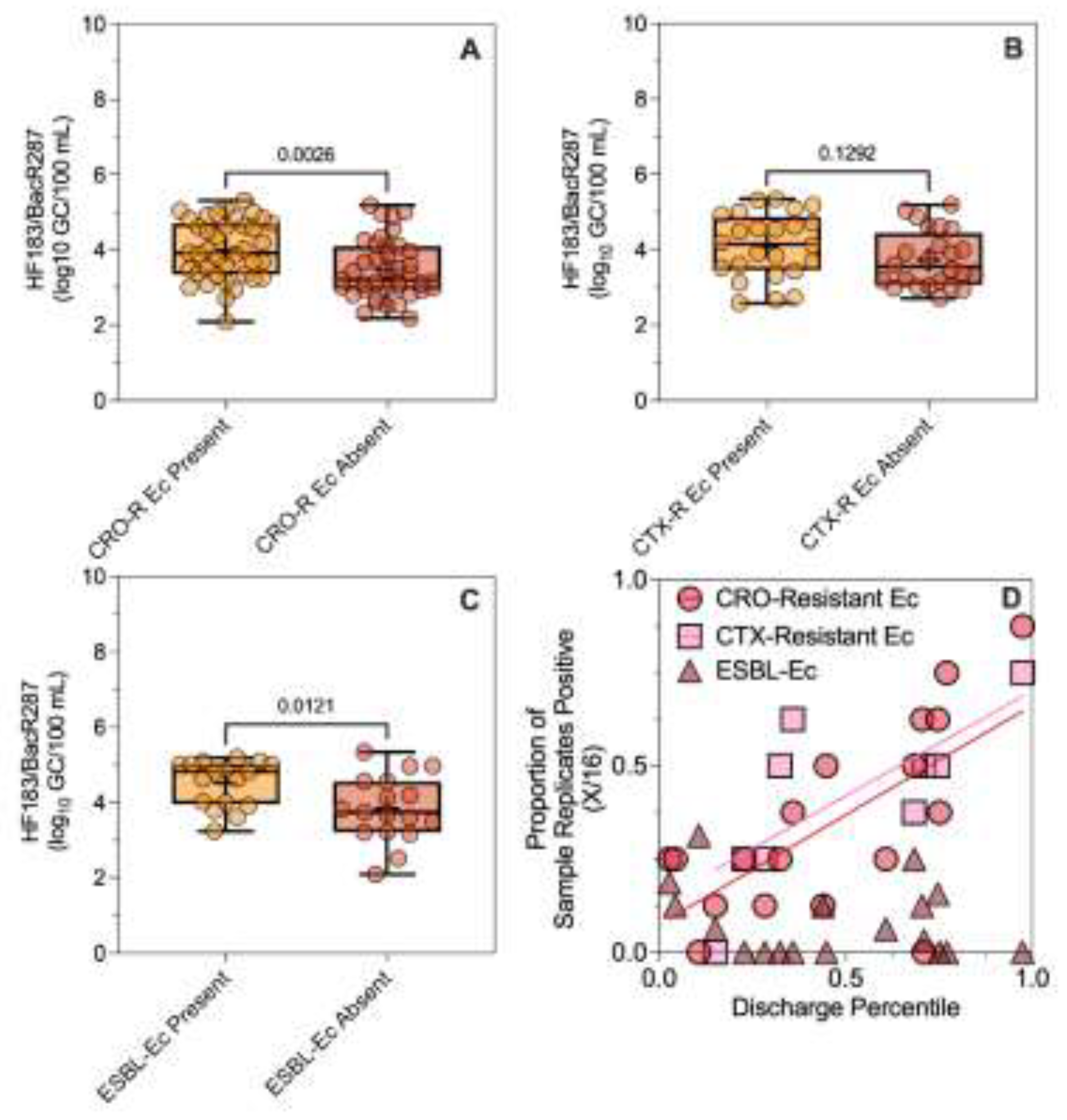
Figure 2.
Prevalence of resistance to eight antibiotic compounds (AM, AZM, CIP, CRO, MEM, S, SXT, TE) among 3GCR E. coli isolates from on-site wastewater treatment system effluent (ATUs), surface waters (NR, YW) and clinical isolates as reported in the 2016 Louisiana Antibiogram.
Figure 2.
Prevalence of resistance to eight antibiotic compounds (AM, AZM, CIP, CRO, MEM, S, SXT, TE) among 3GCR E. coli isolates from on-site wastewater treatment system effluent (ATUs), surface waters (NR, YW) and clinical isolates as reported in the 2016 Louisiana Antibiogram.
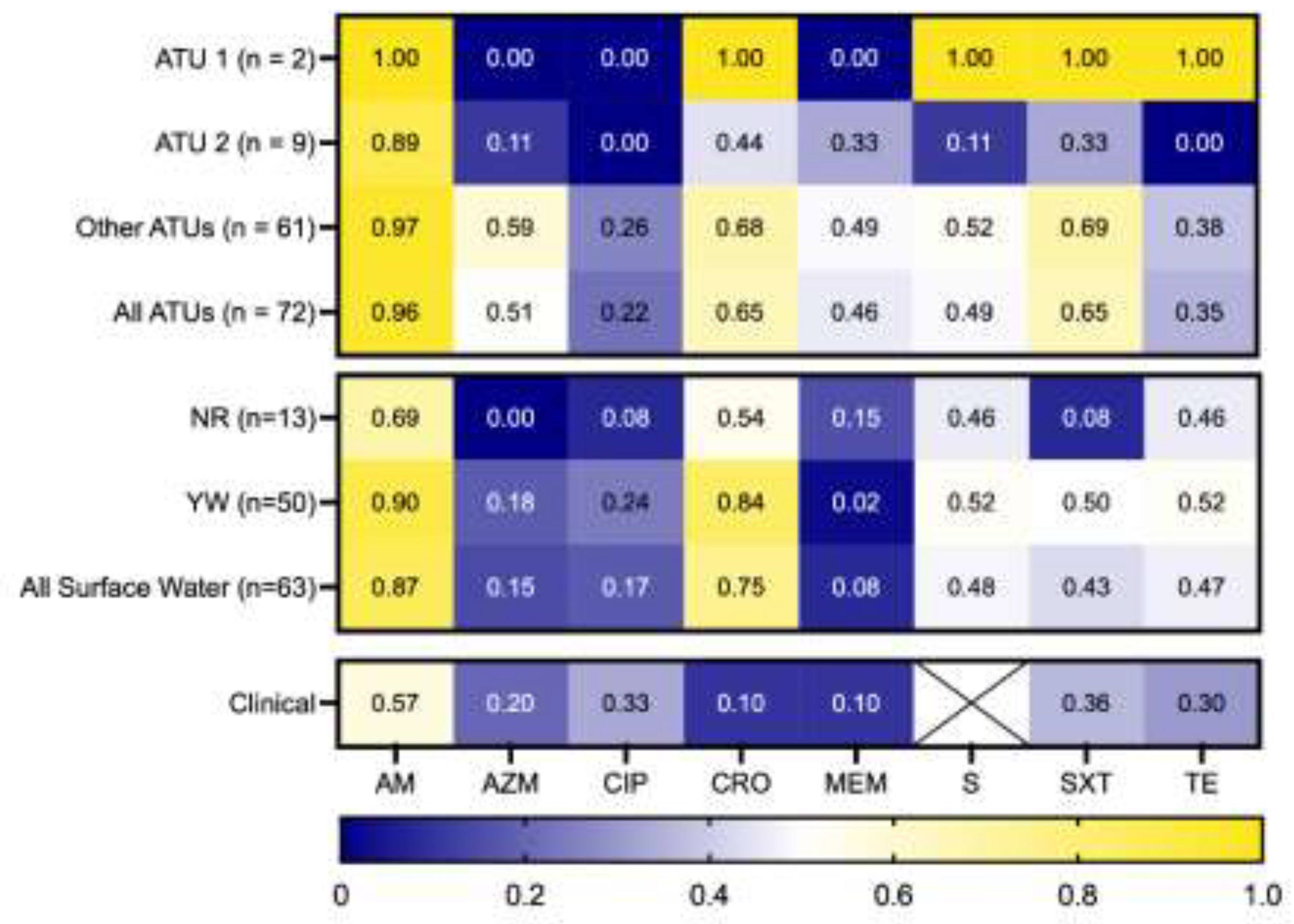

Table 1.
3GCR E. coli abundance in two rivers as estimated by a normal distribution fit to the log10-transformed count data using maximum likelihood estimation including both left and right censored values.
Table 1.
3GCR E. coli abundance in two rivers as estimated by a normal distribution fit to the log10-transformed count data using maximum likelihood estimation including both left and right censored values.
| River |
3GCR E. coli by TBX-CRO (log10 CFU/100 mL) |
3GCR E. coli by TBX-CTX (log10 CFU/100 mL) |
E. coli by TBX (log10 CFU/100 mL) |
| Natalbany (NR) | LC (< 0): 125 RC (> 2.176): 0 UC: 18 µ = -1.77 σ = 1.54 |
LC (< 0): 55 RC (> 2.176): 0 UC: 17 µ = -0.89 σ = 1.24 |
LC (< 0) = 17 RC (> 2.176) = 25 UC: 96 µ = 1.54 σ = 0.98 |
| Yellow Water (YW) | LC (< 0): 80 RC (> 2.176): 0 UC: 62 µ = -0.21 σ = 1.05 |
LC (< 0): 37 RC (> 2.176): 2 UC: 33 µ = -0.08 σ = 1.10 |
LC (< 0): 9 RC (> 2.176): 73 UC: 55 µ = 2.39 σ = 1.14 |
| NR vs. YW | p = 4.85 x 10⁻⁸ | p = 0.0089 | p = 1.91 x 10⁻⁸ |
LC = left-censored (< log10 detection limit); RC = right-censored (> log10 upper limit); UC = uncensored.
Disclaimer/Publisher’s Note: The statements, opinions and data contained in all publications are solely those of the individual author(s) and contributor(s) and not of MDPI and/or the editor(s). MDPI and/or the editor(s) disclaim responsibility for any injury to people or property resulting from any ideas, methods, instructions or products referred to in the content. |
© 2026 by the authors. Licensee MDPI, Basel, Switzerland. This article is an open access article distributed under the terms and conditions of the Creative Commons Attribution (CC BY) license (http://creativecommons.org/licenses/by/4.0/).
Copyright: This open access article is published under a Creative Commons CC BY 4.0 license, which permit the free download, distribution, and reuse, provided that the author and preprint are cited in any reuse.