

Submitted:
19 July 2026
Posted:
20 July 2026
You are already at the latest version
Abstract
Is an ant colony conscious? What about a culture, an AI, or a planet? A conscious moment feels unified in time and space, yet signals take time to travel. Many theories bind an experience's parts within a window of duration θ, but leave other questions about time and space unanswered. Here I give a mathematical tool for answering some of those questions, narrowing down what is conscious under different theories. There are two possibilities, Arpeggio and Chord. Arpeggio says consciousness requires only that each ingredient occur somewhere in-window. Chord is harder to satisfy, requiring ingredients coexist in time and influence one another. This limits the size of conscious unity. For a system of diameter D and signal-speed ceiling v, its exchange architecture sets a factor ε, giving D ≤ εvθ. Primate data constrain θ. Chord can augment the likes of Orch-OR, IIT 4.0 and GWT with size bounds, time constraints and two-way exchange requirements. Within Stack Theory, Chord completes the temporal aspect of the Psychophysical Principle of Causality. Given a theory and parameters Chord can, for example, rule out ant colonies or certain AI, or give latency limits for human–AI hybrids. In contrast, under Arpeggio all theories collapse toward panpsychism.
Keywords:
consciousness
; cognition
; stack theory
; unity
; conscious binding
Introduction
A conscious moment feels unified. An instant of time. Yet brains are spatially extended and coordination across space takes time. This raises the question of how an experienced “instant” works in relation to the objective progression of physical events.
To deal with this, many accounts of consciousness posit a temporal integration window of duration . Within this window the system is allowed to gather and bind ingredient facts such as sense, feeling, and thought, to which one has reportable conscious access [1]. An ingredient is a grounded fact, meaning a property of the underlying state rather than a purely internal label. In the broader Stack Theory, states are points of difference or change relative to other states. For simplicity and intuition here, however, you can think of a state as the full physical state at the resolution where the ingredients live. At the neuronal scale, for example, it could mean the full pattern of spikes, membrane potentials, and synaptic states. This windowing idea is widespread. For example it appears in global workspace accounts [2,3], recurrent processing theories [4], dynamical synchrony [5,6,7], integrated information [8] and stack theoretic proposals [9,10,11,12,13]. The extensional language I use below has a Stack Theory provenance, but the theorem uses only the definitions stated here. In that language, the meaning of a statement is its truth set, which is the set of states that satisfy it. The same timing problem also appears in classic philosophical discussions of subjective timing [14]. Empirically, psychophysics supports integration on the order of tens to hundreds of milliseconds, with task-dependent structure [15,16,17,18]. The physical question is what fixes . For a candidate content ℓ, an admissible window must be long enough to permit the required reciprocal exchange and, when persistence closes the Temporal Gap, short enough that the grounded ingredients still belong to one moment. The lower and upper constraints are derived below.
A window may be necessary, but it is not sufficient for literal co-presence [12]. Each ingredient can occur somewhere inside the window even when there is no instant at which they are all true together in the underlying physical state. I call that mismatch the Temporal Gap. In this paper, Arpeggio means every ingredient becomes true at least once during the window. Chord means there exists an instant during the same window when all ingredients are true together. Chord and Arpeggio are musical terms. A chord is a set of notes played at the same time, while an arpeggio is the notes of a chord but played in sequence. The notes of a musical chord interact to create harmonics and phasing. The notes of an arpeggio do not. In what follows, I treat Chord as the requirement for a unified, integrated subjective moment of experience in the strong sense studied here. Arpeggio is the weaker alternative. It only requires that each ingredient appears at least once somewhere in the window. I then give motivations and falsifiers for Chord (extending a workshop paper [12] on which this paper is to some extent based), map the result onto Orch OR, IIT 4.0, and global workspace architectures, and present case studies for Chord versus Arpeggio in liquid brains [19], human populations, cloud-hosted AI, integrated human–AI hybrids, brain-computer interface hybrids, and the limiting case of Arpeggio applied without constraint [11,20]. The formal distinction appears in Definition 8. Figure 1 gives the musical contrast used throughout the paper.
Scope of the theorem. The diameter theorem is theory neutral in a limited sense. Its proof uses neither the Stack Theory self hierarchy, the Psychophysical Principle of Causality, nor the rule that learning should select the weakest correct constraints. This means the theorem can be applied to other accounts of consciousness like Integrated Information Theory (IIT) [8], Global Workspace Theory (GWT) [21] and Orch-OR [22]. It assumes only a candidate moment with finitely many physically grounded ingredients, a temporal window, and Chord. A functionalist account can supply functional roles as higher-layer ingredients with multiple possible realisers. An enactivist account can include body–world coupling variables in the grounded support rather than restricting support to the brain. A higher-order account can include higher-order representations among the ingredients. Once a realiser, scale, and support have been fixed, the theorem can be applied to determine whether those ingredients can be co-instantiated and exchange influence within one window.
Its role inside Stack Theory is predictably more developed, given it originated there. The Psychophysical Principle of Causality shows that an unforced quality-neutral commitment which removes a viable continuation makes a policy infeasible or increases its free-energy proxy. Under the Stack Theory consciousness interpretation, objects and properties are learned as causal identities grounded in valence [11,23]. Chord determines whether the grounded constituents of such an identity form one present, causally integrated state. A first-order self provides the self-related causal identity needed to attribute that content to one subject. These relations are developed in the Theory Cases section and Supplementary Note 9. They are interpretations and additional premises within Stack Theory, rather than premises of Theorem 1.
- I formalise Arpeggio and Chord, add reciprocal within-window exchange, and derive the diameter, concurrency, and persistence conditions.
- I give falsifiers, stress tests, a mechanistic fragmentation model, and a primate corpus callosum analysis that anchors the lower side of the window.
- I derive mappings for Orch OR, IIT 4.0, and global workspace theories. These separate consequences internal to a source theory from consequences that arise only after adding Chord.
- I connect Chord to Stack Theory’s Psychophysical Principle and first-order self. I prove various cases where serial memory entails an earlier grounding, matches its truth conditions, preserves its statement identity, or cannot instantiate it.
- I apply the results to liquid brains, populations, cloud AI, human–AI hybrids, and brain–computer hybrids.
Where does come from? In this paper is the horizon over which the system’s binding mechanism can keep the relevant ingredients available for mutual influence. It is a physical constraint. In biological brains, candidate mechanisms include recurrent loops, synaptic integration, oscillatory coherence, and ignition-like dynamics [3,4,7]. Each carries an intrinsic timescale, so is expected to lie in a constrained range rather than be arbitrary. Empirically, can be estimated from psychophysics, from neural markers of integration such as phase-locking or ignition, and from task-dependent report latencies. Crucially, enlarging without changing the ingredient set is limited by ingredient stability. If an ingredient typically turns over on timescale , a much longer window either reopens the Temporal Gap or forces a coarser redescription of what the ingredients are. The section on window constraints makes this tradeoff explicit.
Everything that follows is conditional. The diameter bound applies only to theories or applications that accept the Chord postulate and within-window causal exchange. If a theory needs only ingredient-wise occurrence, narrative continuity, functional availability, or some weaker dynamical coordination condition, then the bound does not apply without additional assumptions.
Notation preview. A moment or candidate is a time window . D is the diameter of the grounded support, meaning the largest distance across the physical sites that carry the signals, or “grounded ingredients”. v is an upper bound on causal propagation speed in the relevant substrate. is an architecture factor determined by which sites must exchange messages within one window.
Supplementary Note 0 in the SI is a glossary and figure reading guide for the technical terms and plots. Supplementary Note 1 provides a source-claims audit for the numerical values, modelling constants, extracted datasets, and code paths used in the analyses below. If you are coming from another discipline, start there.
The novelty contribution of my paper is turning the Chord requirements of co-instantiation and within-window exchange into a falsifiable spatial inequality with an explicit architecture factor. In other words, if a moment must be causally knitted together within its own window, then a speed limit on signal transmission can make unity impossible above a certain diameter. Put simply, a conscious mind can only be so big given signal speed.
Results
In Box 1 you’ll find a compressed form of the conditional theorem.
Box 1. Chord requirements and bound
Assume a finite grounded support for a candidate unified moment, meaning a finite set of physical sites whose grounded ingredients participate in that moment:
- Co-instantiation. The candidate unified moment contains at least one instant inside its window where all grounded ingredients are simultaneously true (meaning they are all part of one physical state).
- Within-window exchange. During the same window, grounded ingredients exchange influence by two-way communication along an exchange graph, and signals propagate no faster than v.
Then. If the grounded support has diameter D and window is , then .
Any increase in size given unity must be purchased with time, speed, or architecture.
Windowing Is Weaker Than Simultaneity
I use a minimal extensional language to represent the ingredients of a candidate moment. It is borrowed from Stack Theory [24], but the diameter theorem below does not use the Stack Theory self hierarchy, weakness maximisation, or Bennett’s Razor. It needs only the definitions stated in this section. An abstraction layer is built from an environment and a finite vocabulary . The key modelling choice is extensional semantics. It treats each ingredient as a physically implementable constraint and treats the meaning of a statement as the set of physical states that satisfy that constraint.
Definition 1
(Environment, programs, and vocabularies). An environment is a nonempty set Φ of mutually exclusive states. A program is any set of states . For any set X, write for the set of all subsets of X. Let denote the set of all programs. A program p is true at exactly when . A program true at ϕ is a fact at ϕ. An aspect of the environment is a set x of programs such that
A vocabulary is any set of programs . Unless specified otherwise, vocabularies and aspects are finite.
Definition 2
(Timeline and finite timeline fragment). A timeline is a function
such that
Every tick marks a change from the immediately preceding environmental state. A state may recur after one or more intervening ticks. For and , the finite timeline fragment
is the restriction of the timeline to consecutive ticks. Its consecutive entries differ, while nonconsecutive entries may coincide. A timeline prefix is the special case
Definition 3
(Objective time). For a timeline τ, objective time is the order of its ticks . The transition from to is one objective tick. The condition ensures that every tick is a change. It does not forbid a later return to a state seen before.
Definition 4
(Abstraction layer, statements, and truth sets). An abstraction layer is an environment Φ considered through a finite vocabulary . A finite bundle is any finite , whether or not its truth set is empty. Define the truth set of a finite bundle by
The layer induces the embodied language
Elements are statements. A statement is true at exactly when . Since an aspect is any satisfiable set of programs, the statements are exactly the aspects contained in the vocabulary.
Definition 5
(Completions, extensions, and weakness). A completion of is any with . The extension of x is
For , write
The weakness of x is
Define the weakness proxy by
Thus the proxy ranks y ahead of x when y leaves more compatible refinements open. Weakness does not require one extension to contain another.
Definition 6
(Encoding, tone, layer space, and layer time). Fix a finite vocabulary . For a state , the encoding of ϕ in is
A tone at ϕ is one member of . The layer-space count is
For a finite timeline fragment , the layer-time count is
For a timeline τ, the clock induced at layer is
Objective time advances at every tick of τ. Layer time advances only when the layer’s encoding changes.
Narrative interpretation. In Stack Theory, a state is a change or point of difference. For the spacetime theorem, it is convenient to read a state as one fully specified physical configuration at the tested resolution. This is a physical-realisation claim rather than an identity claim about phenomenal contents and microstates. Once a particular theory of consciousness is chosen and provides one with candidate ingredients, one can apply the theorem to determine whether those ingredients can be jointly realised and causally exchanged within one window. A “program” here declarative, like a literal. It is just a binary true or false value given a state, and its truth conditions are given by the states it contains (a program being a set of states). Declarative and imperative formulations can encode the same construction [25], so it doesn’t matter that we’re dealing only with true or false. The notation means all subsets of . It is the set of all possible programs you could define. A vocabulary is the particular finite menu of programs this system can actually implement. A statement ℓ is a bundle of programs that can all be true together. Because the vocabulary is finite, every statement is automatically a finite bundle. Its truth set is the set of physical states where the whole bundle is true at once. In this paper an ingredient is one program . When the chosen grounding vocabulary is fine enough, an ingredient may be treated as a tone in the sense of [26], meaning one active embodied distinction at a state. I keep the broader word ingredient because one conscious ingredient may be grounded in a pattern of several tones. The vocabulary is finite because an embodied system has finite information capacity [27,28]. The Bekenstein bound is one concrete physics limit of this kind. It upper bounds how much information a finite region can store. You do not need to accept the Bekenstein bound in particular. Any finite physical memory implies a finite menu of physically distinguishable conditions at a chosen resolution. That is why treating vocabularies as finite is a reasonable modelling default. In Stack Theory, the pair plus its induced language is the abstraction layer used in this manuscript. Supplementary Note 2 restates the Stack Theory definitions used here.
Grounding bridge. For the sake of application, I assume that a candidate moment can be represented at some chosen realisation and scale by a statement in this language. This is a modelling bridge. I don’t claim that every theory of consciousness has already been reduced to Stack Theory. A grounded ingredient may implement a functional role, a body-world relation, a higher-order representation, a workspace state, a recurrent state, or any other condition supplied by a target theory. The theorem is applied after those ingredients have been chosen and asks whether their realisation can meet Chord.
Temporal binding is described with a window of duration , during which the ingredients of a candidate subjective moment are integrated. For continuous-time applications, let give the physical state at each time in the window. For the discrete proofs, Definition 2 gives the timeline and its objective ticks. I call a program grounded when it is evaluated directly on the physical state in the base environment , rather than only through an internal label [12].
Definition 7
(Grounded support and exchange). Let be a candidate moment. Its grounded support is the nonempty finite set of physical sites that instantiate the grounded ingredients of ℓ at the scale being tested. Let be the physical distance between sites. The support diameter is
The exchange graph has vertex set . An edge identifies two sites that the tested binding mechanism requires to exchange an outward signal and a reply caused by its receipt. A required edge is completed in a temporal window when both transmissions occur inside that window. The full support has within-window exchange when is connected and every required edge is completed in the tested window.
The concurrency capacity is the largest number of grounded ingredients the architecture can instantiate together at the tested scale. Let be the relevant signal-speed ceiling. If is connected, let be the length in edges of a shortest path from x to y. The hop diameter is
The longest required exchange edge is
The topology-only edge-wise architecture factor is
A disconnected graph fails the within-window exchange condition for the full support.
Definition 8
(Arpeggio and Chord). Let be a finite candidate moment with , let be a timeline, and let be a finite window of objective ticks. Arpeggio holds when
Chord holds when
when , and when the grounded support of ℓ has within-window exchange in the sense of Definition 7.
The Temporal Gap occurs when Arpeggio holds but Chord’s common-instant condition fails.
Proposition 1
(Temporal Gap separation). For every ℓ, τ, and σ, the common-instant condition of Chord implies Arpeggio, but Arpeggio does not imply the common-instant condition.
Proof.
If some tick u satisfies every , choose for every ingredient. Arpeggio follows. For a countermodel, take an environment containing distinct states . Let , , and . Since , the conjunction is satisfiable. Define the timeline by and . Consecutive states differ, while a and b recur after intervening changes. In the window each ingredient occurs, but no tick visits c, the only common witness. Arpeggio holds and the common-instant condition fails. □
Narrative interpretation. The symbol is the finite objective-tick window. In continuous-time discussions below, it corresponds to the interval . Arpeggio dictates each ingredient show up at least once somewhere in the window. Chord adds a common objective tick, sufficient concurrency, and receipt-dependent within-window exchange. Its common-instant condition implies Arpeggio. The Temporal Gap is a situation where Arpeggio holds but Chord doesn’t, illustrated in Figure 2.
If consciousness requires an instant at which the ingredients are all grounded together, then the theory needs a synchrony condition, not just a set of events that happen separately within a shared clock interval.
Time Is Not Memory
Suppose a system computes one ingredient, stores a trace, computes the next, and continues until present traces of the earlier ingredients exist together. Serial processing turns earlier differences into current physical differences only through an embodied recoding. The clock, addresses, memory, and decoder used by that recoding are parts of the same stack.
Proposition 2
(Embodied recoding of temporal distinctions). Fix a finite vocabulary and a finite timeline fragment
The active program-position occurrences are
and the ticks visible through are
Let be a current state and let be a finite vocabulary over Φ. If the current encoding contains a different active program for every member of , meaning there is an injection
then
If the current encoding contains a different active program for every member of , meaning there is an injection
then
Each inequality is equality when the corresponding image is the whole current encoding. If either current count is smaller than the source set, no one-to-one present embodiment of those temporal distinctions exists at that layer.
Proof.
The time index makes the sets disjoint for different t. Hence
An injection from into the current encoding gives the first inequality. By definition, is the number of changes visible through , so an injection from gives the second. Equality holds when the image exhausts the current encoding. If the current encoding has fewer members than either source set, the pigeonhole principle rules out the corresponding injection. □
A present state does not contain its past. It can instantiate present programs produced by earlier changes. Making N earlier distinctions separately available now requires at least N different active programs. With fewer programs, some distinctions have been merged. A compressed present description may classify the fragment using fewer programs, but recovering its separate positions then requires further change or distinctions elsewhere in the stack.
Memory. Memory can also change which content is present. Let be a higher-layer content and let
be its base-layer grounding. Suppose serial processing replaces the grounded ingredients of with a present bundle of traces . The traces may form a Chord at the later state. That Chord entails the original grounding exactly when
The trace-grounded and original statements have the same base-layer truth conditions exactly when
Exact Stack Theory statement identity is stricter. Supplementary Note 9 proves
A non-identical trace may select the same physical states while remaining a different statement in the embodied language. Supplementary Note 9 gives an example where two statements share a truth set but have weakness 2 and 4, so the trace changes the completion structure used by learning and later abstraction. If their truth sets are disjoint, a trace state cannot instantiate the original grounding. In the remaining overlap cases, the trace alone does not decide whether the original content is also present. A serial architecture can therefore create a present Chord of traces without guaranteeing preservation of the quality that generated them. Supplementary Note 9 gives the proof and applies it to valence-grounded contents.
Diameter Bound
Co-instantiation means the ingredients of the moment are true together. There’s really no reason to demand co-instantiation if we’re not also going to require causal exchange. At least, none I could think of. I’ll argue that point in more detail later. For now, this means a unified moment needs the sites from which those ingredients originate to be close enough to exchange influence before the time window closes. Exchange means going from here to there and back again. Figure 3 illustrates the difference between one-way broadcast traditionally employed by the likes of GWT, and the reciprocal exchange needed for Chord.
Theorem 1
(Spacetime diameter bound). Assume Chord for a candidate moment ℓ over a window of duration θ. Assume is connected. If every required edge in supports an outward signal and a reply caused by its receipt inside that same window, and no relevant signal travels faster than v, then
If is disconnected, Chord fails for the full support.
Proof.
If is disconnected, some grounded sites have no exchange path, so within-window exchange fails for the full support. Now assume is connected. For any edge , the reply follows receipt of the outward signal, so there are sequential travel times such that
Since no signal travels faster than v, each one-way trip takes at least . Hence
so the edge length obeys
Thus whenever . Take any two sites , and let
be a shortest path in , so . By the triangle inequality,
Taking the maximum over gives
□
Corollary 1
(Feasible window). Let be the permitted orderings of ingredient arrivals. Suppose persistence is the mechanism used to close the Temporal Gap, is connected, and the design requires Chord for every . If is the shortest relevant persistence timescale of the ingredients of ℓ, then the window must satisfy
where
When , the diameter-only lower bound also follows. For a singleton support, and no division by the zero architecture factor is needed. If is disconnected, no full-support Chordal window exists.
Proof.
The lower bound follows from the preceding receipt-dependent round-trip theorem. For the upper bound, take the permitted ordering with the earliest arrival at the start of the window and the latest arrival at its end. If the window exceeds , the earliest ingredient may disappear before the latest arrives, so Chord is not guaranteed for every . When the window is no longer than , every earlier ingredient remains available when the latest one arrives. □
Narrative interpretation. A complete exchange graph has , hence . Every pair must complete a round trip directly. A hub graph has , hence . Required edge exchanges can be mediated through the hub. Sparse connected graphs permit larger physical diameter only by using relay chains, while still requiring each edge in the chain to complete two-way exchange within the same window. This is the topology-only edge-wise model. Increasing weakens this necessary diameter bound. If the hop diameter can grow without limit, the theorem gives no architecture-independent size ceiling. It does not show that a relay chain completes global end-to-end exchange within one window. The exact local lower bound is set by the longest required edge. In the symmetric hub and all-to-all cases used in the figures, the edge lower bound and the diameter lower bound coincide. If a theory also requires a serial end-to-end sweep across the whole support, that is a different and stricter postulate, and I do not use it here.
Units reminder. D is a distance. v is distance per time. is time. So is a distance and is dimensionless.
Worked example. Suppose and . Then . Under hub exchange, meaning , the bound gives . Under all-to-all exchange, meaning , the bound gives . These are order-of-magnitude numbers, the point being that my time budget becomes a size budget.
In other words, if the window is too short for causal exchange across the support, there is no way to knit the ingredients into one co-instantiated state. See Figure 4 for a basic illustration.
Fragmentation Transition
Theorem 1 is a worst case bound. To see whether the same geometry shows up in a concrete mechanism, I built a minimal message-passing model.
Assume there are N sites arranged in a circle of diameter D. A moment is a window of duration which is how much time we have to integrate the ingredients before they degrade in some manner. Signals propagate at speed at most v, so a one-way message over distance d has baseline travel time . On top of this baseline each directed message receives an independent exponential jitter term with mean . Exponential here means most messages are close to their baseline travel time but a few run very late. It is a simple way to model rare but consequential delays. Here j is dimensionless and can be read as the expected fraction of the window lost to random delays.
I evaluate two exchange graphs. Hub exchange means a star graph. All-to-all exchange means a complete graph. The model declares the moment integrated only if every required edge completes a two-way exchange within the same window. This yields an exact success probability. Success probability is the chance, over the random jitter, that the window meets this integration requirement. The full derivation is given in Supplementary Note 4 [29]. To present results compactly, define the dimensionless size ratio
This ratio is the fraction of the window needed to traverse the diameter at speed v.
Narrative interpretation. x compares best-case time to cross the support once, , with the available time, . Small x leaves exchange slack. Large x means signal travel consumes most of the window. A run of the mechanistic model counts as a success only if every required two-way exchange finishes before the window ends. Figure 5a plots this success probability as a function of x. The curves stay close to 1 for a while and then drop rapidly toward 0. That rapid drop is what I mean by collapse here. It is the point where the window becomes too tight for within-window exchange. Hub exchange drops near . All-to-all exchange drops near .
Figure 5b is a robustness sweep. A sweep means rerunning the same model many times while changing input parameters. Here I vary two nuisance parameters, the number of sites N and the jitter level j. j is the mean random extra delay per message written as a fraction of the window. For each setting I summarise the transition by , the value of x where the success probability is . Across and , with interpreted as the deterministic no-jitter limit, I obtain
The key point is that stays close to the theoretical thresholds. This suggests the transition is not a fragile artifact of one particular choice of N and j.
Primate Scaling Anchor
I wanted to know how this bound might manifest in empirical systems. To get a rough empirical anchor, I used an existing primate dataset. It is already published and required no new experiments.
The corpus callosum is the major fibre tract connecting the two cerebral hemispheres. Any moment that requires causal exchange between hemispheres cannot complete faster than the relevant callosal conduction time.
Phillips et al measured callosal axon diameter distributions across primates and reported implied one-way interhemispheric conduction times for two fibre proxies [30,31]. The corrected Phillips et al. source tabulation contains individual primates across 14 primate species. The scaling fits below are descriptive. They are not a phylogeny-aware comparative analysis that corrects for shared ancestry. One proxy uses the median axon diameter. The other uses the 95th percentile axon diameter as a fast fibre proxy. I use these implied conduction times as reported in the corrected Phillips et al. source tabulation, rather than recomputing them. These one-way delays are floors on any integration window that needs information to cross between hemispheres. Under the stronger two-way exchange postulate used elsewhere in this paper, a round trip constraint would be roughly twice these values. The scaling pattern is unchanged because the factor is constant. This does not claim that callosal delay alone determines consciousness. It only provides a physically grounded timescale that any bilateral moment must at least accommodate. It is an illustration using empirical data. Interhemispheric conduction delay has long been proposed as a constraint on integration and hemispheric specialisation, and it scales with brain size [32,33,34]. Figure 6a plots the one-way interhemispheric delay proxy versus brain mass. On a log-log fit, the median axon proxy scales with exponent 0.224 with bootstrap interval [0.168, 0.282] and 0.844. A bootstrap interval is an uncertainty interval computed by resampling the data. is the usual fraction of variance explained by the fit. Supplementary Note 6 describes the regression and bootstrap procedure used to compute these values. It also explains how to read the primate plots. The fast axon proxy scales with exponent 0.197 with interval [0.113, 0.293] and 0.707. Across the sample, brain mass spans a factor 147.7 while the one-way delay proxies span factors 3.36 and 3.12 for median and fast proxies.
Figure 6b converts the same data into a direct constraint. For any candidate window , it reports the fraction of individuals whose reported conduction time exceeds . For example, 0.267 of median proxy times exceed 25 ms, while 0.667 of fast proxy times exceed 5 ms.
Falsification and Stress Tests
Claims like are only scientifically informative if they can be falsified. Given data, the natural falsification target is the margin
Here is a diameter estimate for the candidate support, is the candidate window duration, and is an estimate of the fastest relevant causal propagation speed. A violation corresponds to .
Testing protocol. To apply this bound to a system and test whether it satisfies:
- Pick a candidate unity marker and a window duration .
- For each window, estimate the support diameter and collect fast-propagation samples to estimate .
- Compute the margin .
- If windows overlap heavily, thin them by keeping every k th window.
- Test whether the mean margin is greater than zero using a one sided t test.
Estimating is the main statistical issue. If you underestimate the true speed ceiling, you can manufacture violations. I treat v as a sampled quantity and estimate using a high quantile, specifically the 95th percentile of the within-window samples. The 95th percentile is the value below which of the samples fall. Call this the q95 rule.
I then test whether the mean margin across windows is positive using a one sided t test. This is about whether the average violation is reliably above zero, given sampling noise. Windows can be statistically dependent so to avoid overstating certainty, I control dependence by thinning. Thinning means keeping only every k th window so that the remaining windows are closer to independent. For example, if you slide a 50 ms window forward in 1 ms steps, then adjacent windows share almost all of their data. Keeping every 50th window removes that overlap. Supplementary Note 5 details all of this, and how to read each stress test plot and so on and so forth. Full pipeline uses Monte Carlo based stress tests. I simulate windowed data where the true ratio is known, run the same falsification procedure, and measure false refutations and power. Power here means the probability of detecting a true violation. Below are three conclusions drawn from the stress tests:
- The false refutation rate is controlled at or below the nominal level when v is conservatively estimated. Under the default q95 rule used here I observe no false refutations at ratio 1.00 in 2500 replications.
- Power rises rapidly once the true ratio exceeds one. In these Monte Carlo tests I set as a units choice, so the x axis should be read as in general. With the conservative default quantile estimator used here and windows, rejection begins near a true ratio of in this setup.
- Naive estimators that underestimate the relevant speed bound, especially low end choices like taking the minimum within-window sample, can manufacture violations and inflate false refutation dramatically.
The simulation driver and generated source tables are included in the source package.
Discussion
The inequality is a conditional claim about what a physically unified moment requires. It follows from two modelling commitments. The first commitment is the Chord requirement [12]. Unity requires not just that ingredients occur somewhere in a window, but that there exists an instant of objective time when the grounded ingredients are jointly true. This rules out the Temporal Gap. The joint truth condition is ordinary extensional semantics: the state must belong to the truth set of the conjunction. The proof uses Stack Theory only for its extensional and temporal machinery [12]. It does not invoke the self hierarchy, the Psychophysical Principle of Causality, or weakness maximisation. This allows the bound to be applied to theories that reject those commitments. Inside Stack Theory, however, the same theorem has a psychophysical role. The principle constrains which valence-grounded causal identities can count as qualitative contents, while Chord determines whether their grounded constituents form one present state and exchange influence within that state. The Theory Cases section and Supplementary Note 9 make this relation explicit. The second commitment is within-window causal exchange. If the ingredients are supposed to be one moment rather than a list, then they must be able to constrain each other by two-way communication within the same window. This turns my time budget into a spatial budget. If either commitment is false for the relevant notion of consciousness, then the bound does not apply as intended.
My mechanistic model shows that even a toy integration mechanism exhibits a rapid fragmentation transition near the theoretical thresholds. The primate reanalysis is an empirical sanity check on scale. By this I mean the callosal conduction time is a concrete example of latency, one that any bilateral moment must at least accommodate. The lower bound scales with brain size, so it remains consistent with the idea that larger brains either integrate more slowly, integrate more locally, or change architecture in a way that increases .
Why Chord and Not Arpeggio?
Chord requires two things of a unified conscious moment. First, the grounded ingredients must be co-instantiated at some instant of objective time within the window. Second, the sites hosting those ingredients must complete within-window causal exchange. Arpeggio requires only that each ingredient occurs somewhere in the window. Neither co-instantiation nor causal exchange is demanded. I prefer Chord, and here I’ll explain why.
I’ll give the motivation for each requirement in turn. The evidence reviewed here is motivational rather than conclusive. It does not entail Chord, and it is compatible with weaker dynamical-coordination views. Chord merely converts those views into a measurable geometry with falsifiers. More detailed formal treatment appears in Supplementary Notes 7 and 8, which integrate the algebraic framework developed in prior work [12].
Motivation for co-instantiation.
The formal motivation is a quantifier-order result [12]. For a finite timeline fragment , Arpeggio asks such that . The common-instant condition asks such that , . One common witness supplies a witness for every ingredient. Separate witnesses need not coincide. For a fragment with more than one tick and a statement with more than one ingredient, Arpeggio can therefore hold while the common-instant condition fails. Supplementary Note 7 gives the direct proof.
In musical terms, this means a system can play every note at different times, without there ever being a moment when all the notes are played together. Should consciousness require the joint truth of its grounded ingredients at some objective instant, then Arpeggio is too weak to guarantee it. Concurrency capacity is a well-defined measure of a system’s capacity to play a chord. The greater the concurrency capacity, the larger the chord it can play. An architecture that can activate at most c contributors at a time can satisfy ingredient-wise occurrence for an n -ingredient conjunction (with ) by cycling through contributors across the window. But it can never co-instantiate all n contributors because no single instant has more than c active (Supplementary Note 8, restating Theorem 5 of [12]). Under Arpeggio, a strictly sequential processor that cycles through features one at a time would count as hosting a unified moment. Under the Chord postulate, it would not.
Neurological evidence would seem to suggest the co-instantiation requirement is worth testing. In masking paradigms, conscious perception correlates with transient long-range gamma phase synchrony across widely separated cortical areas, even when local gamma power is similar for seen and unseen stimuli [35]. What distinguishes conscious from unconscious processing is not the occurrence of local activity for each feature, but the transient episode of large-scale temporal coordination in which distributed areas synchronise together. This is closer to co-instantiation than to ingredient-wise occurrence.
During non-REM sleep, TMS-EEG responses become strong locally but fail to propagate, consistent with a breakdown of effective connectivity when consciousness fades [36]. Each area can still respond in isolation, but they do not respond together. Arpeggio-like ingredient-wise activity persists. What is lost is the coordinated, simultaneous engagement that Chord demands.
More broadly, perturbational complexity measures like PCI track the level of consciousness across waking, sleep, anaesthesia, and disorders of consciousness [37]. These measures quantify the extent to which a perturbation spreads through the brain in a differentiated yet integrated manner. They are sensitive not to whether regions respond at all, but to whether they respond as a coordinated whole. This pattern is consistent with the idea that the system-level regime associated with consciousness is one of temporally coordinated co-engagement, not merely sequential activation of parts.
There is also a persistence argument (Supplementary Note 7). If ingredients, once true, remain true for the rest of the window, then ingredient-wise occurrence automatically entails co-instantiation. Persistence closes the Temporal Gap. Without persistence, the gap can remain open. Whether biological substrates exhibit sufficient within-window persistence for the relevant grounded ingredients is an empirical question, but the formal point is that the gap between Arpeggio and Chord is closed only under a nontrivial dynamical condition that the substrate must actively satisfy.
This of course cannot prove that co-instantiation is necessary for consciousness, and may be explained by weaker coordination requirements. However if conscious level varies with coordinated, simultaneous neural dynamics rather than with mere ingredient-wise activation, then Chord formalises a part of what is required for this.
Motivation for causal exchange.
If co-instantiation is required, then my natural follow up question is why it would be required. Why co-instatiation instead of serialisation? Co-instantiation alone guarantees that the ingredients are jointly true at one instant, but it does not guarantee that they constrain each other or interact in any way. For example, two distant neurons could happen to be in their respective target states at the same time by coincidence, without either one’s state being causally influenced by the other. If such a coincidence counted as a unified moment, then conscious unity would not require physical integration, only temporal alignment. If only temporal alignment were required, how could we justify that claim? Why would two things need to exist at the same time if they don’t interact? Co-instantiation alone seems a pointless and arbitrary requirement unless it is needed for something.
Returning to the musical analogy, think of how the notes of a musical chord interact. They resonate and affect the environment in which they are played, and their interaction produces harmonics. The whole is something very different from the parts, both to the listener’s ear and in the underlying physical consequences.
The causal exchange postulate is an attempt to capture this sort of interaction. It is a possible reason for requiring co-instantiation, and it is why we can derive a size limit from it. It says that the co-instantiated ingredients must also exchange influence within the same window. The sites hosting the ingredients must be able to send and receive signals from each other before the window closes. This is a minimal way to formalise the idea that a moment is causally stitched together rather than merely co-timed.
I would tentatively suggest that recurrent processing theory is a concrete neural precedent. Lamme argues that feed-forward processing alone is insufficient for conscious perception, and that recurrent exchange between areas is needed [4]. Signals must not only arrive at multiple areas within a time window, but return. This is architecturally the same structure as the within-window causal exchange postulate.
Global workspace theory aligns with this idea. The workspace model posits information becomes conscious when broadcast widely and made available to multiple specialised processors simultaneously [2,3]. Broadcasting is a causal process, requiring distributed nodes receive and are influenced by shared information within the relevant time window. Arpeggio would allow the ingredients to activate in sequence without any mutual constraint. Chord with causal exchange captures the workspace intuition that the processors must be simultaneously engaged and mutually informed. I’m just attempting to give some rationale for that with the exchange requirement. Of course, that is moving the goal posts and it leaves questions unanswered, but that is why Chord is a postulate instead of an assertion of fact.
The “communication through coherence hypothesis” is also somewhat relevant [7]. It holds that effective neural communication depends on phase alignment between oscillating neural populations. When populations are phase-aligned, spikes from one population arrive during the excitable phase of another, enabling mutual influence. When they are not aligned, the same signals fail to drive the target population. This is a biologically specific version of within-window causal exchange. The “window” is set by the oscillation period, and “exchange” is the mutual driving that occurs during phase alignment.
In summary, co-instantiation ensures the ingredients are jointly true at one objective instant. Causal exchange ensures they actually constrain each other within the same window. Together they constitute the Chord postulate. Dropping either one allows systems that most theories of consciousness would not recognise as unified. The bound follows from the conjunction of both requirements.
Novelty in Comparison to a Similar Bound
There is conceptual overlap with a persistence condition proposed by Sendall [38]. However the bound I present here differs in three key respects. First, my architecture factor resolves the dependence on exchange topology that Sendall’s effective causal diameter leaves implicit. Second, substituting the substrate-specific signal speed v for the speed of light yields bounds that are actually constraining for biological and engineered systems, not just for exotic spacetimes. Third, the mechanistic fragmentation model, the primate empirical anchoring, and the falsification protocol give the bound testable content. Sendall’s horizon result is a limiting case of the present framework. At a strict one-way boundary, reciprocal exchange across the boundary is unavailable. A support spanning it therefore fails Chord before the diameter inequality is applied.
What Constrains the Window?
The diameter bound can be loosened by increasing , but the mechanism must sustain the larger window. cannot exceed an system’s lifetime. Arpeggio is not constrained by physical proximity, and so becomes a formality. But Chord is, because causal exchange means the ingredients of a conscious moment need to be close enough to affect one another within the time window. Chord, from this perspective, is basically just saying we need any physical justification for including something as an “ingredient”, while Arpeggio amounts to a claim that consciousness is outside physics somehow (because the parts of a conscious experience don’t need to interact to be integrated). is a mechanistic parameter rather than a convention. In most neuroscientific models that use integration windows, the window is set by a process such as recurrent loops, ignition-like thresholding, phase-coherence cycles, synaptic integration, or related dynamical motifs [3,4,7]. Those processes have intrinsic time constants. For example, on the communication-through-coherence picture [7], the window is naturally tied to an oscillation period. Mutual influence is available only during phases when sender and receiver are jointly excitable. Quantum proposals like Orch OR also impose time constraints, namely objective reduction time as a model parameter [22,39]. is an empirical property of a substrate and a task, not something we can ratchet up arbitrarily without changing the underlying mechanism.
Operationally, is an input to be measured before hand. If an advocate of a particular unity marker wants a large , they need to justify corresponding mechanistic premises.
My Chord postulate necessarily lower bounds any candidate window. The local edge budget gives
The diameter theorem gives the topology-only consequence
So the edge bound is a lower budget for the specified exchange graph and embedding, while the diameter bound is what we can give from just D and the hop architecture. In the symmetric hub and complete cases used in the mechanistic model, these two lower bounds agree. One cannot claim a smaller window than a given system’s geometry and signalling allow.
There is also an upper bound, provided by ingredient persistence. If ingredients need to be co-instantiated, then physical limits on persistence can prevent that. For example, the organism’s lifetime would be an obvious upper bound on . In Supplementary Note 7 I prove that if every ingredient of a statement ℓ stays true once it appears within the relevant horizon, then ingredient-wise occurrence collapses into co-instantiation. Chord only requires that co-instantiation happens at least once inside the window, but persistence gives us a stability ceiling for a fixed ingredient set. If the same fine-grained grounded ingredients are supposed to belong to one moment, then the window cannot outrun the timescale over which those ingredients remain continuously well-defined. Let be the permitted orderings of ingredient arrivals, and let denote the shortest relevant persistence timescale among the grounded ingredients. If Chord must be guaranteed for every , then the earliest permitted arrival may occur at the start of the window and the latest at its end. The guarantee therefore requires
This is a guarantee over the permitted orderings. It does not mean every particular Chordal window has to be shorter than the persistence time.
Put together, persistence can guarantee a Chordal moment across every permitted arrival ordering only when there exists a nonempty feasibility interval
with as the weaker diameter-only necessary lower bound. This derives a physically admissible range for . The actual realised window is substrate- and content-relative. Again I just want to say though that I’m not rejecting functionalism outright, just pointing out how function plays out at lower levels of abstraction, and from this perspective a substrate is just a lower level of abstraction like C is a level below Python. For flesh and blood, primate callosal data can provide a lower bound estimate for whole-brain candidates. Ingredient lifetimes constrain the upper side whenever persistence is the mechanism that keeps the ingredients available as one moment.
So to re-iterate, is not an arbitrary parameter. One does not just “pick a window you like”. You must show that your candidate window fits inside the physical interval your own ingredients and architecture permit and if the interval is empty, the moment is impossible.
Theory Cases
For the first case I’ll explore how Chord functions inside Stack Theory. Then for the remaining cases I’ll translate various other theories into this geometry. Proofs are to be found in Supplementary Notes 9 and 10.
I assume familiarity with the theory in question. These cases are only relevant to those already familiar with a particular theory. Re-introducing said theory is out of scope for this paper, by necessity since I’m covering so many.
Stack Theory. Chord was proposed inside Stack Theory to complete its account of valence-grounded content. The diameter theorem uses no psychophysical premise, but its Stack Theory interpretation does. Let be a viability statement (a constraint that says “organism is fit / not dead”). For a policy , define the viable continuation set
and, when , define
The Psychophysical Principle of Causality shows that adding a commitment which excludes a viable continuation makes the policy infeasible or strictly increases , because representational commitments beyond viability impose a floor on free energy [11,13,24]. Under the Stack Theory consciousness interpretation, valence provides the viability distinction and causal identities are learned as revisable classifiers of its causes. The principle constrains how content is learned. Chord merely determines when its grounding is present. Let be one such higher-layer causal identity and let
be its base-layer grounding. Compositional grounding preserves truth conditions, so
If every ingredient of occurs during a window while co-instantiation fails, then no objective tick in that window instantiates . Every constituent may occur while the proposed quality does not.
Subjective experience begins with a first-order self, which amounts to re-reafference. In the same stack, let denote the first-order self of organism and let
When is satisfiable, a current claim that undergoes requires a tick u such that
together with Chordal exchange across the joint support. Separate occurrence of self and content at different ticks does not instantiate the conjunction. For intervention-linked contents, the first-order self is provably, necessarily required to discriminate between self and other [40]. Extending Equation (1) to every passive content requires the Stack Theory premise that the first-order self participates in every phenomenal state.
Merely representing a first order self does not satisfy Stack Theory’s Psychophysical Principle of Causality, which requires that representations be comprised of evaluative signals. However when Chord comes into play, evaluation must coincide with evaluation, which would preclude attaching reward labels after the fact thus would satisfy the Psychophysical Principle of Causality. Let be the number of grounded contributors that must be active at one tick, let be the concurrency capacity, and let be the diameter of the joint support. A Chordal subject–content instance requires
and a connected exchange graph. Thus the representation precondition establishes expressibility, while Chord adds simultaneous physical availability and within-window exchange.
To understand this, consider what memory is in relation to a first order self. Memory is a kind of “trace”. In Stack Theory terms, a later trace statement entails the original grounding exactly when
It has the same base-layer truth conditions exactly when the truth sets are equal. It preserves exact Stack Theory statement identity exactly when . A non-identical trace can appear to match truth conditions at a higher level of abstraction without being the original statement at the lowest levels of abstraction. If the truth sets are disjoint, the trace state cannot instantiate the original grounding. In the remaining cases, trace presence alone is inconclusive. When the trace co-instantiates with the first-order self, the current joint statement is . It entails the original subject–content claim exactly when
A self-bound memory can therefore be present while the original quality is absent. A record of a first order self is not a first order self. Definitions and proofs can be found in Supplementary Note 9.
Orch OR. Orchestrated objective reduction (Orch OR) links conscious moments to coherent quantum processes in neuronal microtubules that terminate by objective reduction [22,41]. Let be the gravitational self-energy of the difference between the superposed mass distributions. I’ll write the proposed reduction time as
where ℏ is the reduced Planck constant and is a dimensionless convention factor [39]. Let be the coherence lifetime of the proposed state. Let G be its exchange graph, with support diameter D, longest required edge , architecture factor , and signal-speed ceiling v. Just to get the usual objections out of the way, yes I know published coherence-time estimates differ by orders of magnitude [42,43], and yes separate biological analyses dispute whether the required tubulin dynamics and sustained coherence are feasible [44].
That said, if orchestration requires reciprocal exchange along G before reduction, then Chord requires
The second inequality follows by substituting the Orch OR time into Theorem 1. It states an energy–diameter tradeoff. Under the model, increasing shortens the event and lowers the maximum Chordal diameter. If and , where N is the number of participating contributions and is a lower bound on each contribution, then
Objective-reduction timing alone cannot establish unity, because the pair contains no exchange graph. Two models can share those scalars while one graph is connected and the other is disconnected, but the disconnected model fails to satisfy Chord. Entanglement does not necessarily replace the exchange term. For every unconditioned local trace-preserving quantum operation on subsystem A, the reduced state of a separated subsystem B is unchanged, so controllable influence still requires a physical signal [45]. A Chordal Orch OR subject must therefore be a connected coherent support satisfying Equation (2). A disconnected support can contain separate candidates but cannot form one Chordal subject.
Consequence. Chord is a nice complementary module for Orch-OR. The reduction clock can be interpreted as a deadline for orchestration, and a model might satisfy the Penrose timing rule while failing to form one Chordal subject. I’m just adding an additional constraint. Chordal failure occurs when reciprocal exchange takes longer than , coherence ends before reduction, the graph is disconnected, or . A test therefore needs , , D, , v, and G. Passing these conditions leaves the implementation admissible under Orch OR plus Chord.
IIT 4.0. Integrated information theory 4.0 evaluates a candidate substrate S in its current state and assigns system integrated information from its cause and effect power under directional partitions. A complex is a subset that is maximal under this quantity [46,47]. Let be the directed interventional graph at the chosen spatial and temporal grain. IIT 4.0 gives the graph criterion [47]
A finite directed acyclic graph with more than one vertex is not strongly connected. Every strict multi-unit feed-forward network therefore has and cannot be one IIT complex. A disconnected union also has zero as a union, though a component may contain a complex.
The current substrate state in IIT is co-instantiated at the selected grain, but strong connectivity alone does not complete Chord’s within-window exchange condition. If one IIT update of duration is also claimed to be one Chordal moment, and H is the physical exchange graph required during that update, then
Failure of Equation (4) leaves IIT’s own calculation untouched, but defeats the combined IIT–Chord claim. A macrostate built from a sequence can also be co-instantiated at the macrograin while its ingredients never co-instantiate at the base grain. The claimed subject grain must therefore be stated.
Consequence. The feed-forward exclusion follows from IIT 4.0 anyway. Chord merely adds a spacetime test after IIT identifies a candidate complex. Under a fixed interventional graph, strongly connected components can be used as a first filter because no positive- candidate can span components. The implementation must report the interventional graph and its spatial and temporal grain. A software block diagram determines the result only when it matches that graph. A candidate can therefore satisfy IIT while failing the combined IIT–Chord criterion. So, once again Chord serves as a nice little complementary module with which to rule out systems as conscious.
Global workspace. Global workspace theories make broadcast a central mechanism [2,3,48], which fits in beautifully with Chord. Let c be a workspace hub and define its physical radius by
If broadcast and acknowledgement between c and every module must finish within , then
This is the hub case . A one-way broadcast yields only and does not satisfy the reciprocal exchange postulate. A workspace is a Chordal candidate only when its ingredients co-instantiate and feedback returns within the same window.
Consequence. Broadcast availability and reciprocal integration impose different tests. A Chordal workspace must be evaluated with worst-case round-trip latency rather than one-way or mean latency. At a given window, the candidate subject contains only the hub and modules whose broadcast and acknowledgement finish before . Modules that miss the window can contribute to later moments or form separate candidates. Again, I’d suggest GWT stans consider Chord to be an additional criteria one might add to GWT. A complementary module.
Combined consequence. Orch OR specifies an event time, IIT evaluates causal irreducibility and GWT requires broadcast availability. None of those entail or contradict co-instantiated reciprocal unity. In fact, they say nothing about it at all. So, they are complementary. Given a theory choice, chord allows us to eliminate some systems from consideration as conscious entities. This can be done based on grounding grain, connectivity, coherence where relevant, and latency. Failure at the source-theory stage can reject the candidate within that theory, but then failure at the Chord stage can narrow things down further. Failure only at the Chord stage rejects any combined claims regardless of theory. In the case of Stack Theory the Psychophysical Principle of Causality, Chord, and the first-order self divide the problem into content, present instantiation, and the self-related grounding used for subject attribution.
On the matter of proofs. Nothing I’ve said here here empirically confirms a theory of consciousness. I’m just ruling them out. I’m saying what can’t be conscious under certain assumptions. A necessity claim, not a sufficiency claim. Empirical support for Chord would require the predicted loss or fragmentation of unity when co-instantiation, concurrency, or latency bounds are violated. It would come down to theory specific evidence that integrates Chord.
Implications for Populations and Human–AI Hybrids
Human–AI hybrids need a taxonomy before the spacetime bound can do much. Not every coupling between a human and an AI asks for the same verdict, and I use three categories from my cognition-spaces work with Solé et. al. [20]. In that frame, there are three types of hybrid.
- A prosthetic or instrumental hybrid is a passive tool. It extends a human operator’s agency, but the human remains the locus of perception, control, and decision-making.
- A cooperative hybrid permits the AI to act with some independence. The human and AI are then collaborating agents whose goals overlap, with alignment living in that overlap [24].
- An integrated hybrid is basically a science fiction cyborg. In an integrated hybrid, perception, control, and decision-making are extended through the AI system, distributed across both sides, and the composite begins to behave like one cognitive system.
If one wanted to engineer a human–machine bridge toward consciousness or AGI, integration would be the obvious path. Figure 7 summarises the three hybrid regimes. My spacetime bound applies only to this last, strongest category of hybrid. If the hybrid must co-instantiate grounded ingredients and complete within-window causal exchange, then the full hybrid support must fit inside the same latency budget. If any critical part of the loop sits behind a slow channel, the system fragments into two systems taking turns across moments. In this sense, integrated hybrids have an integration radius. However beyond that radius you do not get a bigger mind, but a bigger committee or market.
Integration also has failure modes worth considering [20]. In a regulated integrated hybrid, human feedback control remains strong enough to monitor and correct the loop. In a dysregulated integrated hybrid, the humanbot case, coupling is tight but stabilising control is weak. The same low-latency feedback that could have yielded a powerful composite can instead amplify dependence, obsession, or delusion. Tight coupling therefore increases both capability and failure intensity. Figure 8 illustrates such a failure. To preempt such failures one must consider the constraint architecture of the composite hybrid [24].
I’ll now consider five concrete cases, the first four of which explore Chord’s implications, while the fifth considers what remains if one drops Chord for Arpeggio, and the bound is no longer a discriminant.
Case 1: Ant colonies and liquid brains.
Ant colonies are canonical liquid brains [19], which compute by re-arranging their physical structure. Individual ants communicate through pheromone trails, physical contact, and movement, and there is no persistent high-bandwidth wiring. Effective signal speeds are low, supports are large, and the burden of grounding is severe. In Figure 9 I illustrate how this liquid-brain case compares to a bounded solid-brain support.
Under Chord, a colony-scale moment would require all grounded ingredients to be co-instantiated and causally exchanged within a window . If the ingredients are neural-scale properties of individual ants, take , , and . Then , above what might be considered a plausible architecture factor. The diameter-only lower window is . At fine, fast grounding scales, the feasible interval is empty by many orders of magnitude.
One might try to steel-man colony consciousness by zooming out to a coarser grained level of abstraction at which integration windows are plausibly long, such as pheromone gradients, task allocation ratios, or colony-scale statistical properties. That may reopen the diameter side of the feasibility interval. But the burden then shifts to grounding, concurrency, and self-structure [12,40]. Zooming out to a coarse grain might just make it look like two things are co-instantiated, when at a finer grain they are not. Under Chord, ant colonies and other liquid brains can be ruled out by signal speed and support size, and remain heavily burdened at coarse scales by grounding and concurrency. Frankly, it seems unlikely any naturally occurring liquid brain would satisfy both co-instantiation and causal exchange, and that is before the finer details of any particular theory of consciousness are considered.
Under Arpeggio, it suffices that each ingredient occurs somewhere during the window. Because ants eventually relay information across the colony, a sufficiently long window could satisfy ingredient-wise occurrence. That is not a victory so much as a warning about Arpeggio’s permissiveness. It is possible only by moving the claim to coarser ingredients and longer windows. Figure 10 shows that this move changes the level of description rather than removing the burden.
This does not mean individual ants cannot be conscious. An individual ant has a solid brain with persistent wiring. The bound applies to the spatial scale at which consciousness is claimed. It rules out a single Chordal moment spanning the whole colony under ordinary fine-grained grounding assumptions, not consciousness at the scale of individual members.
Case 2: Human populations.
A group of humans is also a liquid brain in the relevant sense. It can coordinate, remember, deliberate, and act across distributed members. That makes it an intelligent collective, but not automatically one conscious subject.
Speech and turn taking are far too slow for human-scale conscious windows. Language production and comprehension operate on hundreds of milliseconds to seconds, while individual neural integration is usually discussed in tens to hundreds of milliseconds. Organising people to signal in a pattern that mimics a computer or a brain would at most produce a larger committee. Under Chord, and with current technology, a population of humans is not one conscious entity. Each human has their own conscious moments, while the population coordinates across moments. However hybridisation creates new possibilities. A human-AI hybrid population could be a persistently structured support capable of satisfying Chord.
Under Arpeggio, one could in principle argue for population-scale consciousness, since each person’s contribution eventually occurs within a long enough window. That again illustrates the price of dropping co-instantiation and exchange. The claim becomes much easier to satisfy, but much harder to keep discriminating.
Case 3: Cloud-hosted AI.
Cloud-hosted AI is a direct engineering test case. A data centre can satisfy the diameter budget with ease compared to biological and social systems. Electrical and optical signalling are fast, cluster diameters are finite, and high-speed interconnects can make the raw propagation term tiny for biologically plausible . Sheer distance is therefore not the main obstacle.
The hard part is co-instantiation and two-way exchange. Contemporary architectures serialise updates, move representations into inert memory, and remain overwhelmingly top-down. A standard forward pass is a directed acyclic computation. Information flows from embedding to later layers, and under causal masking influence inside a layer also runs one way. The physical hardware could send signals both ways quickly, but the computation being run does not instantiate the connected two-way exchange graph required by Definition 7.
The cloud case instead maps what would have to change. The problem is less distance than the absence of a grounded, bottom-up tapestry of valence with enough concurrency to exist as one moment. It is latency-critical embedded systems programming with stronger constraints than ordinary distributed computing. Signals must be synchronised and latency compensated even across short distances. Current hardware was not designed for Chordal consciousness. Imposing these conditions top-down is a daunting task. It may be easier to redesign hardware so that it self-organises bottom-up. Figure 11 sketches the architectural shift at issue.
Again, I really must emphasise this is not a rejection of functionalism, but a clarification of it. I’m saying function key, and function at lower levels of abstraction is still function. Just because software produces the same output and is functionally identical to another piece of software, does not mean it is functionally identical at the lower levels of abstraction. Chord is just a means of quantifying one such difference.
Under Arpeggio, all that ceases to matter. A forward pass of a neural net can make each ingredient occur somewhere in a window, while memory can leave present traces caused by earlier ingredients.
Case 4: Brain-computer-interface and integrated hybrids.
Human-AI hybridisation using brain-computer-interfaces may, conceivably, facilitate full integration. If a human and a machine exchange influence with sufficiently low round-trip latency, and if the shared ingredients can actually be grounded and co-instantiated, then Chord does not rule out a temporarily enlarged conscious system [12]. Suppose an intracortical BCI operates at an effective round trip latency of and the candidate human window is 20–. There would then be room for a round trip within the window. Under hub-like exchange, such a bound could be satisfied with a modest margin.
However if the link were too slow, the verdict would change. A remote processor, a congested network path, or slow transduction can push the round trip above . The system would splinter into two minds taking turns. A multi-person hive mind would have the same limitations. Take several minds, plug them in, make them tightly connected, and identity of each participant may become unstable. Conversely if such a mind were divided across components, would the parts remain minds after separation? These questions are highly speculative, but I find them interesting.
The engineering considerations are things like latency failure. Tight coupling might amplify capability, but also dependence, identity loss, domination, or pathological feedback. My theorem certainly does not rule out a Chordal hive mind. The engineering and ethical burden if or when this happens is extreme.
Now under Arpeggio, there would no comparable latency ceiling. Effectively we’d already be parts of a hive mind under some theories of consciousness. It’d amount to panpsychism. Any delay can be tolerated as long as the ingredients eventually occur. That permissiveness is why Arpeggio gives less compelling discriminator between a unified hybrid subject and two agents communicating over time.
Case 5: What is conscious under Arpeggio?
Arpeggio requires only that each ingredient occurs at least once somewhere inside the integration window. It imposes no constraint on co-instantiation, causal exchange, diameter, or concurrency. Without further constraints on ingredient choice and on what sets , nearly any physical system can be made to satisfy Arpeggio for some reading of what the ingredients are and over some timescale. A river, a weather system, a galaxy, or a sufficiently old rock might be conscious. Over a long enough window, each candidate ingredient will be instantiated somewhere at some time. In Supplementary Note 7.5 I take a constructive approach to this. Whenever a window visits at least two distinct states while missing some possible state, there is a candidate content whose ingredients each occur somewhere yet never hold together at one instant, so ingredient-wise occurrence can be met by almost any finite timeline fragment containing change [11]. In the absence of further constraints, Arpeggio drifts toward panpsychism [49]. Panpsychism is a coherent philosophical position, but it does not by itself distinguish conscious from non-conscious systems, which limits its use as a scientific criterion.
Now even under Arpeggio we can still rule out something using a given theory. For the sake of example I’ll use Stack Theory. The full Stack Theory account gives Arpeggio additional content and subject constraints. The Psychophysical Principle of Causality requires quality-neutral objects and properties to be learned as causal identities grounded in valence [11]. A conscious subject must also support at least a first-order self, a causal identity that separates self-generated interventions from matched observations [9]. In Supplementary Note 9 I prove that in a generic unstructured vocabulary, the probability of an atomic or bounded-size first-order causal-identity candidate falls exponentially across visited intervention and observation states. I also prove that a valence-grounded content fails to occur when its grounding falls into the Temporal Gap. These psychophysical and self conditions are absent from the proof of the spacetime theorem, but they are linked to Chord inside Stack Theory. The Psychophysical Principle of Causality constrains content, Chord determines present instantiation, and the first-order self contributes the self-related grounding used for subject attribution. No evidence presented here shows that a river or rock satisfies this construction.
That said, we can always change the granularity at which we measure things, and then almost anything would become part of a conscious system even with these additional constraints. Arpeggio has a drift regardless of whatever else we attach to it. A first-order-self requirement may block the claim that any arbitrary changing thing is itself a subject, but it does not by itself block claims that an arbitrary subsystem can be swept into the support of a larger self-bearing Arpeggiated moment. In Supplementary Note 9.3 I formalise this as inclusion drift. Chord prevents this by stipulating the added subsystem must be co-instantiated with the rest of the candidate moment, fit the concurrency capacity of the architecture, and satisfy the exchange bound .
Another example we might consider instead of Stack Theory is the Conscious Turing Machine (CTM) proposed by Blum and Blum. It integrates global workspace theory with artificial intelligence [48,50]. Under Chord, broadcast and feedback must return within the same window, so one-way broadcast is insufficient. Under Arpeggio, the same ingredients may occur at different times. In other words, under Arpeggio the CTM can be considered conscious as is. Under Chord however we need to look at the lower levels of abstraction and ensure co-instantiation and causal exchange. Hence Chord would be a complementary, additional criteria which CTM implementations could adopt and account for.
All of these varied and various cases share a common logic. For the first four, one can estimate D, v, and a plausible at the grounding resolution where the ingredients are meant to live. Then one might ask whether the ingredients be co-instantiated at that grounding resolution. Then, can the exchange budget be met using the edge bound and the diameter diagnostic ? If either answer to either of those is no, the candidate unified moment fragments. In case 5 I explore the opposite extreme. Once Chordal constraints are relaxed, Arpeggio becomes so permissive that it approaches panpsychism.
Persistence, Robustness, and Substrate Tradeoffs
If is treated as a feasibility interval rather than a free constant, persistence becomes just one constraint among many. Grounding, concurrency, and any additional theory requirements such as self-structure must be considered. Again, this is about elminating systems as conscious under a theory. I say nothing of sufficiency.
In Supplementary Note 7 I prove that if every ingredient of a statement ℓ is persistent within a window of horizon 1, then ingredient-wise occurrence automatically implies co-instantiation. Persistence therefore closes the Temporal Gap only for those windows that fit inside the relevant persistence horizon. This is why the corollary
is best read as a ceiling on persistence-supported Chord moments, not as a derivation of one universal exact window.
Persistence and robustness.
Different substrates have very different persistence timescales.
Consider a squishy human brain. Neural integration windows are often estimated to be on the order of 10– [15,16]. Taking as illustrative and as a callosal conduction scale [34], I get . Under hub exchange, that exceeds a human brain diameter of roughly .
Removing tissue could delete contributors required by a fine-grained neural statement. The surviving support might instantiate other content while the original conjunction fails. In contrast, colony-scale statistics can be more resilient, which is an inherent advantage of liquid brains. Removing agents need not erase a pheromone gradient or task-allocation ratio when surviving agents maintain it. In any case, self-repair can extend the persistence horizon of coarse-grained ingredients [11,19,51,52,53]. Such comparison concerns the chosen grounding rather than a general ranking of biological systems. An ant has a solid brain, and it is part of a liquid brain.
Examples with derived bounds.
- Human brain (fine-grained neural ingredients). , . Derived diagnostic: . Human brain diameter . Compatible with Chord under both hub exchange () and all-to-all (). Consistent with consciousness at the whole-brain scale.
- Ant colony (coarse-grained colony-scale ingredients). , (hours, for colony-scale statistical properties). Derived diagnostic: . A small colony () can satisfy the diameter budget under hub exchange. Whether Chord is satisfied still depends on co-instantiation and concurrency at the relevant grounding resolution, not just on diameter.
The derived bound gives a tradeoff between speed and persistence. The product determines spatial reach of a persistence-supported moment. Complete feasibility test also includes , , grounding resolution, concurrency capacity, and any theory-specific conditions. Increasing usually requires coarser or longer-lived ingredients and therefore changes the proposed content.
Under Arpeggio, persistence advantage actually becomes more consequential. If no co-instantiation is needed, then slow but persistent systems like ant colonies or oceanic current systems become candidate conscious systems, operating on timescales from hours to geological epochs.
Predictions and Falsifiers
Here I’ll enumerate a few falsifiers, each of which targets a different modelling commitment.
- Temporal Gap falsifier. Take any high time resolution recording where you can define a set of grounded ingredients ℓ and a candidate unity marker over windows of duration . A unity marker is any measurable variable that is supposed to indicate that one unified moment occurred, such as a phase synchrony measure or a behavioural report. For each window , test the same ℓ for both conditions. First ask whether every ingredient is true at least once somewhere in the window. Then ask whether one instant satisfies . Focus on windows where the first condition holds and the second fails. If the unity marker still behaves as if a single moment occurred in those windows, then the Chord requirement is wrong for that marker.
- Latency budget violation. Pick any substrate where you can estimate a support diameter and a propagation ceiling for the same candidate unity marker. Write for a conservative lower bound on diameter, and write and for conservative upper bounds on speed and window duration. Compute the conservative margin . If is significantly positive across windows under the protocol in Supplementary Note 5, then either the within-window exchange postulate is false or the marker is not a unified moment.
- Architecture factor shift. Hold the same nodes, geometry, signal speed, and window definition. For the hub and all-to-all mechanisms tested here, change only the exchange graph. The transition diameter should move from the hub budget toward the complete-graph budget . Failure of that shift rejects the mechanism-specific architecture model. A sparse relay graph needs an additional end-to-end timing rule before its hop diameter can predict a global transition.
These tests use timestamps, distances, and the required exchange graph. A unified moment under the tested model is a set of sites whose required edges complete reciprocal causal exchange within a window of duration . Its spatial diameter cannot exceed . A larger subjective moment requires more integration time, faster propagation, or a different exchange architecture.
Conclusion
I’ve provided a tool to narrow down which systems might be conscious under various well defined assumptions and established theories. My theorem leaves the choice of theory of consciousness open and enumerates physical assumptions and commitments implied by any claims of unified, physically instantiated conscious subject. Chord requires one grounded conjunction and reciprocal exchange in one window. Arpeggio does not.
The implications vary with the theory of consciousness to which one applies the bound. The Orch OR and workspace mappings are augmented by Chord in addition to their source criteria, while Chord lends IIT 4.0 additional support for its rejection of conscious feed forward neural networks. Within Stack Theory, the Psychophysical Principle already constrains us to valence-grounded content. Chord reinforces the idea of representations constructed of valence by limiting us to a single objective moment, which in and of itself precludes representing data and then at a separate time evaluating it. They must coincide, at the least. Yes, serial memory can preserve identity, report, or control while grounding a different current content. Such things might establish consciousness under Arpeggio, but not under Chord. Chord provides a well defined mathematical, physical reason to reject naive functionalism. However it is not a rejection of functionalism in general. It merely points out how function at a lower level of abstraction (objective time) might affect consciousness, regardless of how behaviour appears at a higher level of abstraction (a naive take on functionalism).
Methods
Stack Theory Objects and Temporal Recoding
Definitions 1–6, 7, and 8 give the formal objects used in the Results. I repeat the core pieces here for convenience.
An environment is a nonempty set of mutually exclusive states. A program is a set . A finite vocabulary is the set of programs a system can implement. The induced embodied language is
For , the truth set is , with .
A timeline has different consecutive states, while a state may recur after intervening changes. Arpeggio and Chord are the quantified conditions in Definition 8. Supplementary Note 7 proves the same separation directly from the quantifier order and gives the embodied recoding bound for any present implementation of earlier temporal distinctions. In continuous-time applications, plays the corresponding role. Grounded means that the programs are evaluated directly on the physical state in the base environment.
Architecture Factor and Proof Idea
Supplementary Note 3 defines where is the hop diameter of an exchange graph G on the grounded support. In other words, counts the worst case number of message handoffs needed to connect the two most separated sites, given the required exchange edges.
Theorem 1 follows from one inequality. Assume each edge can complete a two-way exchange within the window, so . Because signals propagate no faster than v, each direction must satisfy and . Hence , so .
Any pair of sites is connected by a path of at most hops. The triangle inequality says the direct distance between two sites is at most the sum of distances along any path between them. So their separation is at most .
Mechanistic Integration Model
My little mechanistic model places N contributor sites uniformly on a circle of diameter D. For all-to-all exchange I require a completed round trip for every unordered pair of sites, using the Euclidean chord distance on the circle. Chord distance is straight line distance between two points on the circle. For hub exchange I model a central mediator at the circle centre, so each contributor must complete a round trip via the hub.
A directed message time is , where d is the one-way Euclidean distance and is exponential jitter with mean . Round trip time is subsequently . Under independence assumptions, overall success probability factorises over required exchanges.
Because is a sum of two independent exponential random variables, it has a Gamma distribution. Hence I evaluate success probability using closed form Gamma cumulative distribution function. In other words, this is just the probability that random delay stays below remaining time budget.
Primate Literature Extraction
Primate dataset was taken from the Phillips et al. callosal dataset and its published correction [30,31]. The corrected Phillips et al. source tabulation contains individuals across 14 species. I include the extracted values in prim.csv. I treat the reported interhemispheric conduction times as one-way lower-bound anchors for moments requiring bilateral exchange. The stronger round-trip Chord budget is roughly twice these anchors.
Monte Carlo Stress Tests
I simulate a measurement pipeline where D, , and v are observed with noise. For each simulated run I form the margin across windows and test whether its mean is positive with a one sided t test. In other words, this asks whether the average margin is reliably above zero given sampling noise.
I treat v as a sampled quantity and compare estimators. I also simulate dependence across windows with an AR(1) model. AR(1) means a first order autoregressive process, where each window is correlated with the previous one. I show that thinning controls false refutations. Thinning means keeping only every k th window so that the remaining windows are closer to independent. For example, if you slide a 50 ms window forward in 1 ms steps, then adjacent windows share almost all of their data. Keeping every 50th window removes that overlap.
Scope
There’s a caveat with regards to , namely that if Chord requires only direct exchange between neighbouring sites, then can grow with the hop diameter of the exchange graph. A relay chain can be arbitrarily long while every neighbouring pair exchanges within one window. There is no architecture-independent size limit under local exchange alone. Independent signals in both directions give ; a response that must return to its source gives . More generally, is testable only when D, , v and are fixed or bounded independently.
These distinctions strengthen the comparisons between theories. IIT’s feed-forward exclusion is internal to IIT at a fixed grain and transition model. Chord merely adds physical co-instantiation and weighted latency. A hub-based global workspace needs a return path within the moment, rather than broadcast alone. Orch OR comes with a proposed reduction time, but reduction time and gravitational self-energy do not entirely determine a connected subject under Chord; the exchange and coherence conditions remain separate. In Stack Theory, the Psychophysical Principle stipulates representations are composed of evaluations, Chord further ensures representation and evaluation take place at the same time, and the first-order self is the identity to whom such content is applies. A trace memory might encode earlier content without reinstating its grounding, and so memory does not extend the earlier experience through time.
Supplementary Materials
The following supporting information can be downloaded at the website of this paper posted on Preprints.org.
Author Contributions
Michael Timothy Bennett: Conceptualization, Formal analysis, Investigation, Methodology, Software, Visualization, Writing – original draft, Writing – review & editing.
Funding
No external funding was received for this work.
Data Availability Statement
All simulation outputs and source tables are generated by sim.py and written into the data directory. The primate dataset extracted from published literature is included as prim.csv. Source data are provided with this paper.
Acknowledgments
The author thanks colleagues and early readers for feedback that improved the manuscript.
Conflicts of Interest
The author declares no competing interests.
Code Availability
All code required to reproduce the analytic figures and tables is provided in sim.py. Running python sim.py regenerates the figure PDFs, LaTeX macro files, and source tables used by the quantitative analyses. The same run writes prov.json, a machine-readable record of the literature-derived numeric inputs and modelling constants. The file check.md records the reproduction steps and expected outputs.
References
- Ned Block. On a confusion about a function of consciousness. Behavioral and Brain Sciences, 18(2):227–247, 1995. [CrossRef]
- Bernard J. Baars. A Cognitive Theory of Consciousness. Cambridge University Press, Cambridge, 1988.
- Stanislas Dehaene and Lionel Naccache. Towards a cognitive neuroscience of consciousness: basic evidence and a workspace framework. Cognition, 79(1-2):1–37, 2001. [CrossRef]
- Victor Lamme. Towards a true neural stance on consciousness. Trends in cognitive sciences, 10(11):494–501, 2006. [CrossRef]
- Francisco J. Varela, Jean-Philippe Lachaux, Eugenio Rodriguez, and Jacques Martinerie. The brainweb: phase synchronization and large-scale integration. Nature Reviews Neuroscience, 2(4):229–239, 2001. [CrossRef]
- Wolf Singer and Charles M. Gray. Visual feature integration and the temporal correlation hypothesis. Annual Review of Neuroscience, 18:555–586, 1995. [CrossRef]
- Pascal Fries. A mechanism for cognitive dynamics: neuronal communication through neuronal coherence. Trends in Cognitive Sciences, 9(10):474–480, 2005. [CrossRef]
- Giulio Tononi. An information integration theory of consciousness. BMC Neuroscience, 5(1):42, 2004. [CrossRef]
- Michael Timothy Bennett. Emergent causality and the foundation of consciousness. In 16th International Conference on Artificial General Intelligence, Lecture Notes in Computer Science, pages 52–61. Springer, 2023. OUCI metadata page: https://ouci.dntb.gov.ua/en/works/7BoXJMW4/. [CrossRef]
- Michael Bennett and Sean Welsh. The phenomenal is functional: A unified theory of consciousness and computation, 12 2023. URL: https://www.researchgate.net/publication/376182163_The_Phenomenal_Is_Functional_A_Unified_Theory_of_Consciousness_and_Computation. [CrossRef]
- Michael Timothy Bennett. How To Build Conscious Machines. PhD thesis, The Australian National University, 2025. URL: https://hdl.handle.net/1885/733782452. [CrossRef]
- Michael Timothy Bennett. A mind cannot be smeared across time. Proceedings of the AAAI Symposium Series, 8(1):213–219, May 2026. URL: https://ojs.aaai.org/index.php/AAAI-SS/article/view/42545. [CrossRef]
- Michael Timothy Bennett. How to Build Conscious Machines: Deriving Intelligence, Life and Mind from Time. Palgrave Macmillan, 2027. Forthcoming.
- Daniel C. Dennett and Marcel Kinsbourne. Time and the observer: the where and when of consciousness in the brain. Behavioral and Brain Sciences, 15(2):183–201, 1992. [CrossRef]
- David M. Eagleman and Terrence J. Sejnowski. Motion integration and postdiction in visual awareness. Science, 287(5460):2036–2038, 2000. [CrossRef]
- Ernst Pöppel. A hierarchical model of temporal perception. Trends in Cognitive Sciences, 1(2):56–61, 1997. [CrossRef]
- Jean Vroomen and Mirjam Keetels. Perception of intersensory synchrony: a tutorial review. Attention, Perception, & Psychophysics, 72(4):871–884, 2010. [CrossRef]
- Mark T. Wallace and Ryan A. Stevenson. The construct of the multisensory temporal binding window and its dysregulation in developmental disabilities. Neuropsychologia, 64:105–123, 2014. [CrossRef]
- Ricard Solé, Melanie Moses, and Stephanie Forrest. Liquid brains, solid brains. Philosophical Transactions of the Royal Society B: Biological Sciences, 374(1774):20190040, 2019. URL: https://royalsocietypublishing.org/doi/abs/10.1098/rstb.2019.0040, arXiv:https://royalsocietypublishing.org/doi/pdf/10.1098/rstb.2019.0040. [CrossRef]
- Ricard Solé, Luis F. Seoane, Jordi Pla-Mauri, Michael Timothy Bennett, Michael E. Hochberg, and Michael Levin. Cognition spaces: natural, artificial, and hybrid, 2026. URL: https://arxiv.org/abs/2601.12837, arXiv:2601.12837. [CrossRef]
- Bernard Baars. In the Theater of Consciousness: The Workspace of the Mind. Oxford University Press, New York, NY, 1997.
- Stuart Hameroff and Roger Penrose. Consciousness in the universe: A review of the ‘orch or’ theory. Physics of Life Reviews, 11(1):39–78, 2014. URL: https://www.sciencedirect.com/science/article/pii/S1571064513001188. [CrossRef]
- Michael Timothy Bennett, Sean Welsh, and Anna Ciaunica. Why is anything conscious?, 2024. Originally preprinted in 2023 under the name The Phenomenal Is Functional: A Unified Theory of Consciousness and Computation, by Bennett and Welsh. URL: https://arxiv.org/abs/2409.14545, arXiv:2409.14545. [CrossRef]
- Michael Timothy Bennett. Are biological systems more intelligent than artificial intelligence?, 2024. In press, Philosophical Transactions of the Royal Society B: Biological Sciences. Special issue on Hybrid agencies: crossing borders between biological and artificial worlds. URL: https://arxiv.org/abs/2405.02325, arXiv:2405.02325. [CrossRef]
- William A. Howard. The Formulae-as-Types Notion of Construction. In J.P. Seldin and J.R. Hindley, editors, To H.B. Curry: Essays on Combinatory Logic, Lambda Calculus and Formalism, pages 479–490. Academic Press, Cambrdige MA, 1980.
- Michael Timothy Bennett. Time is space, 2026.
- Jacob D. Bekenstein. Universal upper bound on the entropy-to-energy ratio for bounded systems. Physical Review D, 23(2):287–298, 1981. [CrossRef]
- Michael Timothy Bennett. Is complexity an illusion? In 17th International Conference on Artificial General Intelligence, Lecture Notes in Computer Science. Springer, 2024. URL: https://doi.org/10.1007/978-3-031-65572-2_2.
- Michael Timothy Bennett. Technical appendices, 2025. Archived release on Zenodo. Source repository: https://github.com/ViscousLemming/Technical-Appendices. [CrossRef]
- Kimberley A. Phillips, Cheryl D. Stimpson, Jeroen B. Smaers, Mary Ann Raghanti, Bob Jacobs, Aleksandar Popratiloff, Patrick R. Hof, and Chet C. Sherwood. The corpus callosum in primates: processing speed of axons and the evolution of hemispheric asymmetry. Proceedings of the Royal Society B: Biological Sciences, 282(1818):20151535, 2015. [CrossRef]
- Kimberley A. Phillips, Cheryl D. Stimpson, Jeroen B. Smaers, Mary Ann Raghanti, Bob Jacobs, Aleksandar Popratiloff, Patrick R. Hof, and Chet C. Sherwood. Correction to The corpus callosum in primates: processing speed of axons and the evolution of hemispheric asymmetry. Proceedings of the Royal Society B: Biological Sciences, 282(1819):20152620, 2015. [CrossRef]
- John L. Ringo, Richard W. Doty, Steven Demeter, and Pierre Y. Simard. Time is of the essence: a conjecture that hemispheric specialization arises from interhemispheric conduction delay. Cerebral Cortex, 4(4):331–343, 1994. [CrossRef]
- Roberto Caminiti, Houda Ghaziri, Ralf A. W. Galuske, Patrick R. Hof, and Giorgio M. Innocenti. Evolution amplified processing with temporally dispersed slow neuronal connectivity in primates. Proceedings of the National Academy of Sciences of the United States of America, 106(46):19551–19556, 2009. [CrossRef]
- Giorgio M. Innocenti, Ingo Vahlsing, and Roberto Caminiti. The functional characterization of callosal connections. Progress in Neurobiology, 208:102186, 2022. [CrossRef]
- Lucia Melloni, Carlos Molina, Miguel Pena, David Torres, Wolf Singer, and Eugenio Rodriguez. Synchronization of neural activity across cortical areas correlates with conscious perception. Journal of Neuroscience, 27(11):2858–2865, 2007. [CrossRef]
- Marcello Massimini, Fabio Ferrarelli, Reto Huber, Steven K. Esser, Harminder Singh, and Giulio Tononi. Breakdown of cortical effective connectivity during sleep. Science, 309(5744):2228–2232, 2005. [CrossRef]
- Adenauer G. Casali, Olivia Gosseries, Mario Rosanova, M’elanie Boly, Simone Sarasso, Karina R. Casali, Silvia Casarotto, Marie-Aur’elie Bruno, Steven Laureys, Giulio Tononi, and Marcello Massimini. A theoretically based index of consciousness independent of sensory processing and behavior. Science Translational Medicine, 5(198):198ra105, 2013. [CrossRef]
- Jonathon Sendall. Event horizons, spacetime geometry, and the limits of integrated consciousness, 2026. URL: https://arxiv.org/abs/2512.23105, arXiv:2512.23105.
- Roger Penrose. On gravity’s role in quantum state reduction. General Relativity and Gravitation, 28(5):581–600, 1996. [CrossRef]
- Michael Timothy Bennett. No selves, no consciousness. Proceedings of the AAAI Symposium Series, 8(1):220–226, May 2026. URL: https://ojs.aaai.org/index.php/AAAI-SS/article/view/42546. [CrossRef]
- Stuart Hameroff and Roger Penrose. Orchestrated reduction of quantum coherence in brain microtubules: A model for consciousness. Mathematics and Computers in Simulation, 40(3–4):453–480, 1996. [CrossRef]
- Max Tegmark. Importance of quantum decoherence in brain processes. Physical Review E, 61(4):4194–4206, 2000. arXiv:quant-ph/9907009. [CrossRef]
- S. Hagan, S. R. Hameroff, and J. A. Tuszyński. Quantum computation in brain microtubules: Decoherence and biological feasibility. Physical Review E, 65(6):061901, 2002. arXiv:quant-ph/0005025. [CrossRef]
- Laura K. McKemmish, Jeffrey R. Reimers, Ross H. McKenzie, Alan E. Mark, and Noel S. Hush. Penrose–hameroff orchestrated objective-reduction proposal for human consciousness is not biologically feasible. Physical Review E, 80(2):021912, 2009. [CrossRef]
- Michael A. Nielsen and Isaac L. Chuang. Quantum Computation and Quantum Information. Cambridge University Press, 10th anniversary edition, 2010. [CrossRef]
- William Marshall, Matteo Grasso, William G. P. Mayner, Alireza Zaeemzadeh, Leonardo S. Barbosa, Erick Chastain, Graham Findlay, Shuntaro Sasai, Larissa Albantakis, and Giulio Tononi. System integrated information. Entropy, 25(2):334, 2023. [CrossRef]
- Larissa Albantakis, Leonardo Barbosa, Graham Findlay, Matteo Grasso, Andrew M. Haun, William Marshall, William G. P. Mayner, Alireza Zaeemzadeh, Melanie Boly, Bjørn E. Juel, Shuntaro Sasai, Keiko Fujii, Isaac David, Jeremiah Hendren, Jonathan P. Lang, and Giulio Tononi. Integrated information theory (IIT) 4.0: Formulating the properties of phenomenal existence in physical terms. PLOS Computational Biology, 19(10):e1011465, 2023. [CrossRef]
- Lenore Blum and Manuel Blum. A theory of consciousness from a theoretical computer science perspective: Insights from the conscious turing machine. Proceedings of the National Academy of Sciences, 119(21):e2115934119, 2022. URL: https://www.pnas.org/doi/abs/10.1073/pnas.2115934119, arXiv:https://www.pnas.org/doi/pdf/10.1073/pnas.2115934119. [CrossRef]
- Galen Strawson. Realistic monism - why physicalism entails panpsychism. Journal of Consciousness Studies, 13(10-11):3–31, 2006.
- Manuel Blum and Lenore Blum. A theoretical computer science perspective on consciousness. J. Artif. Intell. Conscious., 8:1–42, 2020.
- Michael Timothy Bennett. Why does life exist?, 2026. Preprint, version 2, posted 12 March 2026. URL: https://www.preprints.org/manuscript/202603.0203. [CrossRef]
- Ricard Solé, Christopher P Kempes, Bernat Corominas-Murtra, Manlio De Domenico, Artemy Kolchinsky, Michael Lachmann, Eric Libby, Serguei Saavedra, Eric Smith, and David Wolpert. Fundamental constraints to the logic of living systems. Interface Focus, 14(5):20240010, October 2024. [CrossRef]
- Ricard Solé and Luís F Seoane. Evolution of brains and computers: The roads not taken. Entropy, 24(5):665, 2022. [CrossRef]
| 1 | Meaning that once an ingredient becomes true it stays true until the window ends. |
Figure 1.
Chord requires co-instantiation, while Arpeggio does not. If something satisfies Chord, it satisfies Arpeggio, but not conversely. This is a relaxation of the musical arpeggio definition.
Figure 1.
Chord requires co-instantiation, while Arpeggio does not. If something satisfies Chord, it satisfies Arpeggio, but not conversely. This is a relaxation of the musical arpeggio definition.
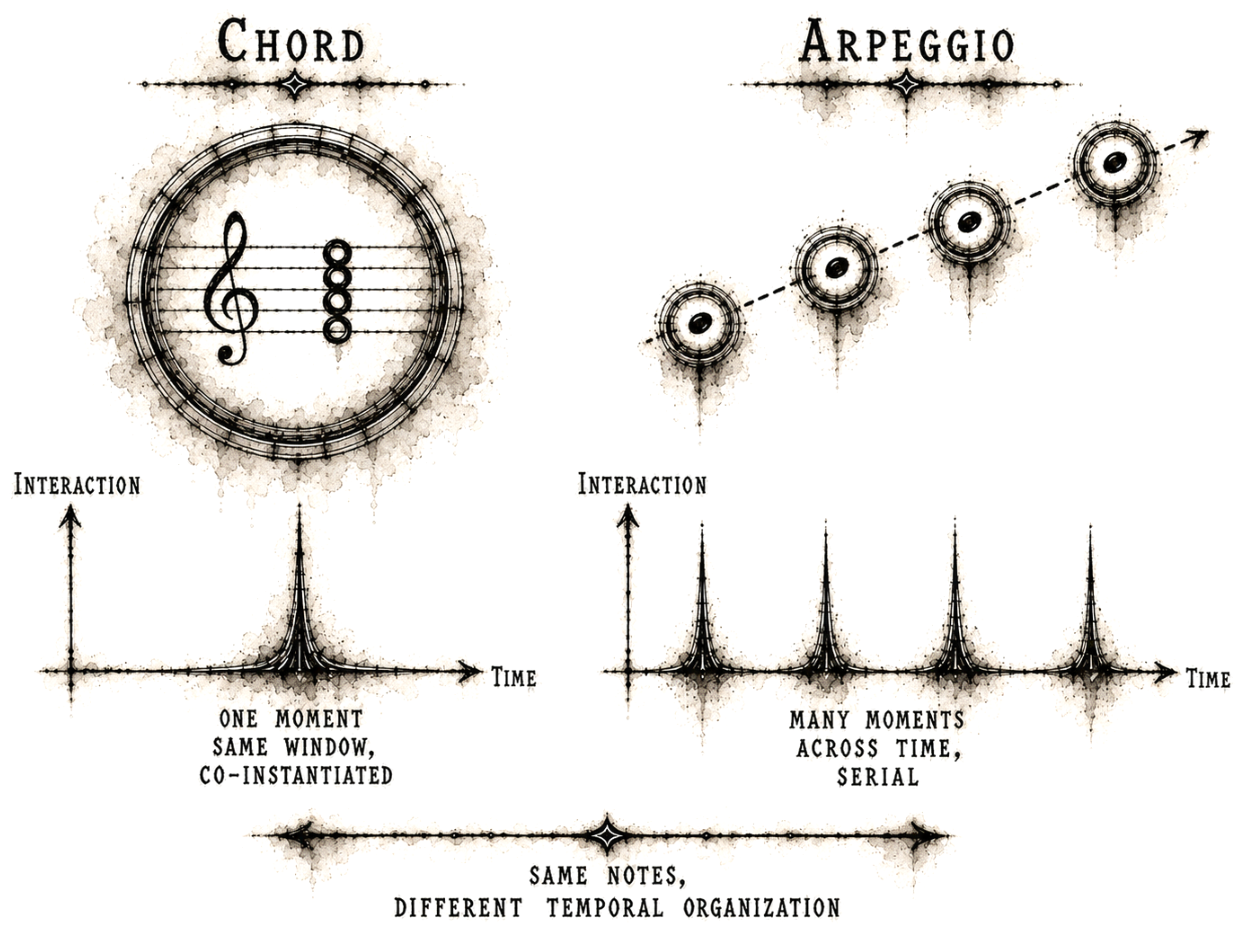
Figure 2.
Both occur in the window, but never at the same instant. This is the Temporal Gap. Arpeggio can hold without co-instantiation.
Figure 2.
Both occur in the window, but never at the same instant. This is the Temporal Gap. Arpeggio can hold without co-instantiation.

Figure 3.
One-way broadcast versus two-way exchange. Chord requires reciprocal within-window exchange rather than mere one-way dissemination.
Figure 3.
One-way broadcast versus two-way exchange. Chord requires reciprocal within-window exchange rather than mere one-way dissemination.
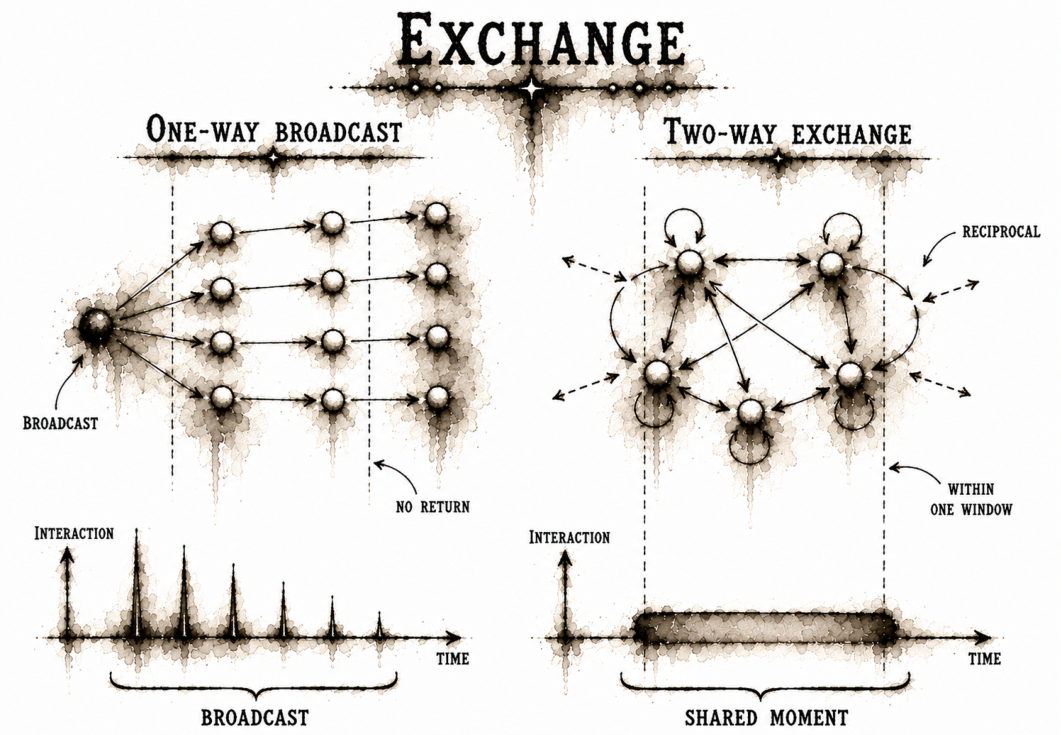
Figure 4.
Geometry underlying the bound, worst case. In a symmetric star architecture, the farthest pair of contributors communicates in two hops via the hub, so each hub-to-leaf edge must fit inside half the window and the overall diameter budget is . In a complete architecture, the farthest pair must complete a round trip over distance D within the window, giving the tighter budget .
Figure 4.
Geometry underlying the bound, worst case. In a symmetric star architecture, the farthest pair of contributors communicates in two hops via the hub, so each hub-to-leaf edge must fit inside half the window and the overall diameter budget is . In a complete architecture, the farthest pair must complete a round trip over distance D within the window, giving the tighter budget .
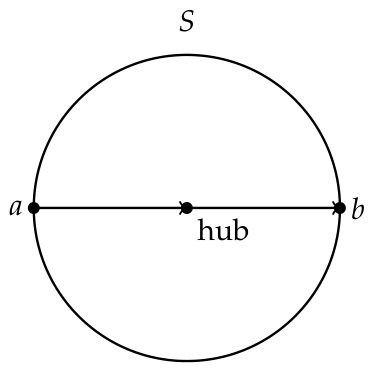
Figure 5.
Mechanistic integration model. Panel (a) shows the probability that a window is successful, meaning every required two-way exchange finishes before the window ends. The horizontal axis is , the ratio of best-case diameter-crossing time to the available window. Panel (b) is a robustness sweep. It repeats the same calculation while varying the number of sites N and the jitter level j. Here j is the mean random extra delay per message as a fraction of the window. It reports , the value of x where success probability is . Reference lines mark the theoretical thresholds for hub exchange and for all-to-all exchange.
Figure 5.
Mechanistic integration model. Panel (a) shows the probability that a window is successful, meaning every required two-way exchange finishes before the window ends. The horizontal axis is , the ratio of best-case diameter-crossing time to the available window. Panel (b) is a robustness sweep. It repeats the same calculation while varying the number of sites N and the jitter level j. Here j is the mean random extra delay per message as a fraction of the window. It reports , the value of x where success probability is . Reference lines mark the theoretical thresholds for hub exchange and for all-to-all exchange.
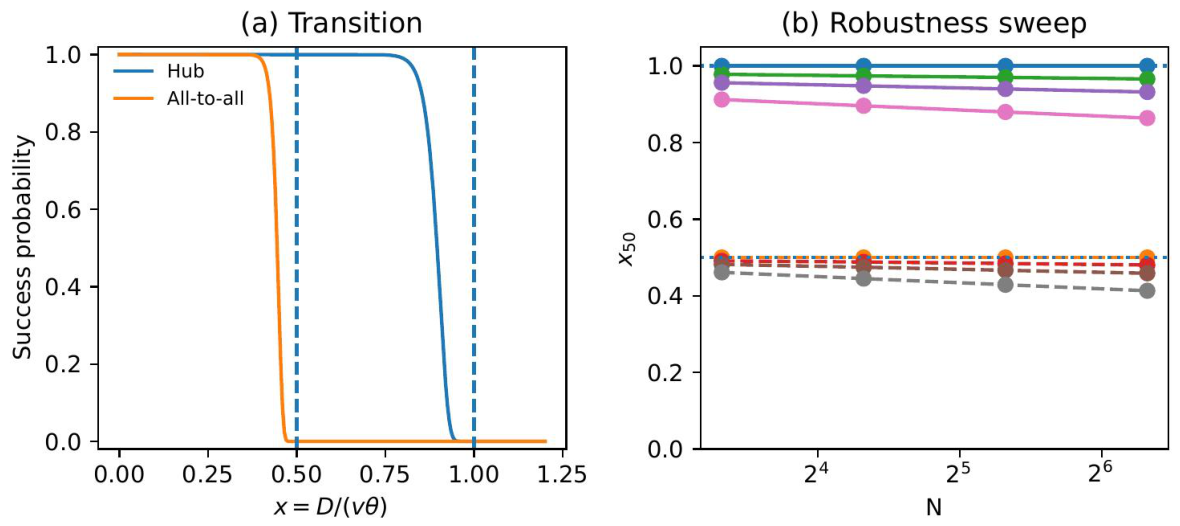
Figure 6.
Primate literature anchor. Dataset contains individuals from the corrected Phillips et al. source tabulation [31]. Panel a shows the one-way interhemispheric conduction delay proxies (median and fast fibres) versus brain mass. Panel b shows, for a candidate window , the fraction of individuals whose reported conduction time would exceed that window.
Figure 6.
Primate literature anchor. Dataset contains individuals from the corrected Phillips et al. source tabulation [31]. Panel a shows the one-way interhemispheric conduction delay proxies (median and fast fibres) versus brain mass. Panel b shows, for a candidate window , the fraction of individuals whose reported conduction time would exceed that window.
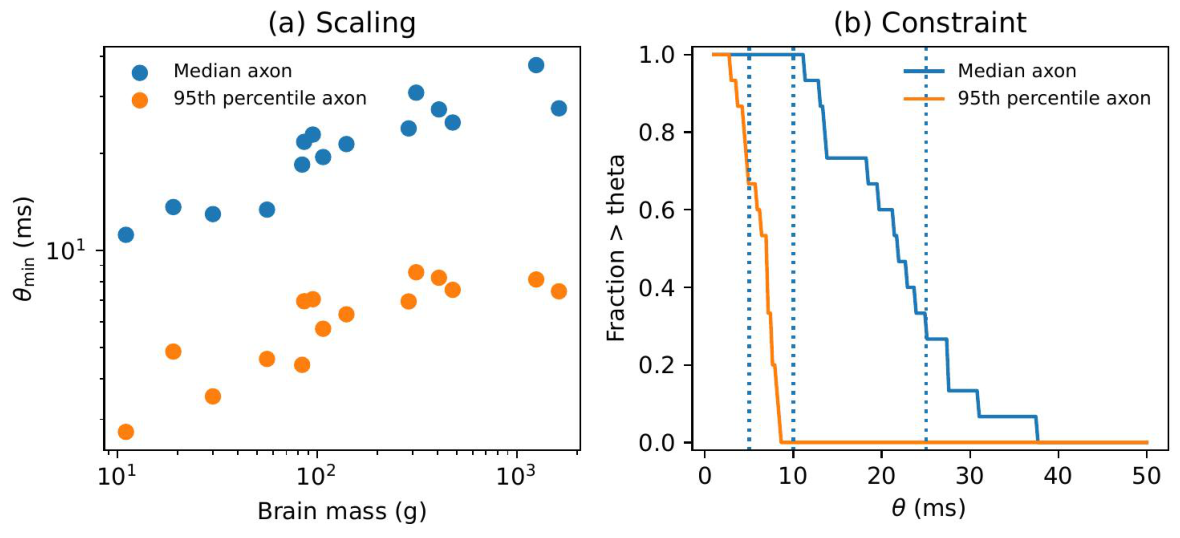
Figure 7.
Three kinds of human–AI hybrid. Prosthetic hybrids are tools under direct human control. Cooperative hybrids involve overlapping goals across distinct agents. Integrated hybrids aim at one low-latency cognitive loop.
Figure 7.
Three kinds of human–AI hybrid. Prosthetic hybrids are tools under direct human control. Cooperative hybrids involve overlapping goals across distinct agents. Integrated hybrids aim at one low-latency cognitive loop.
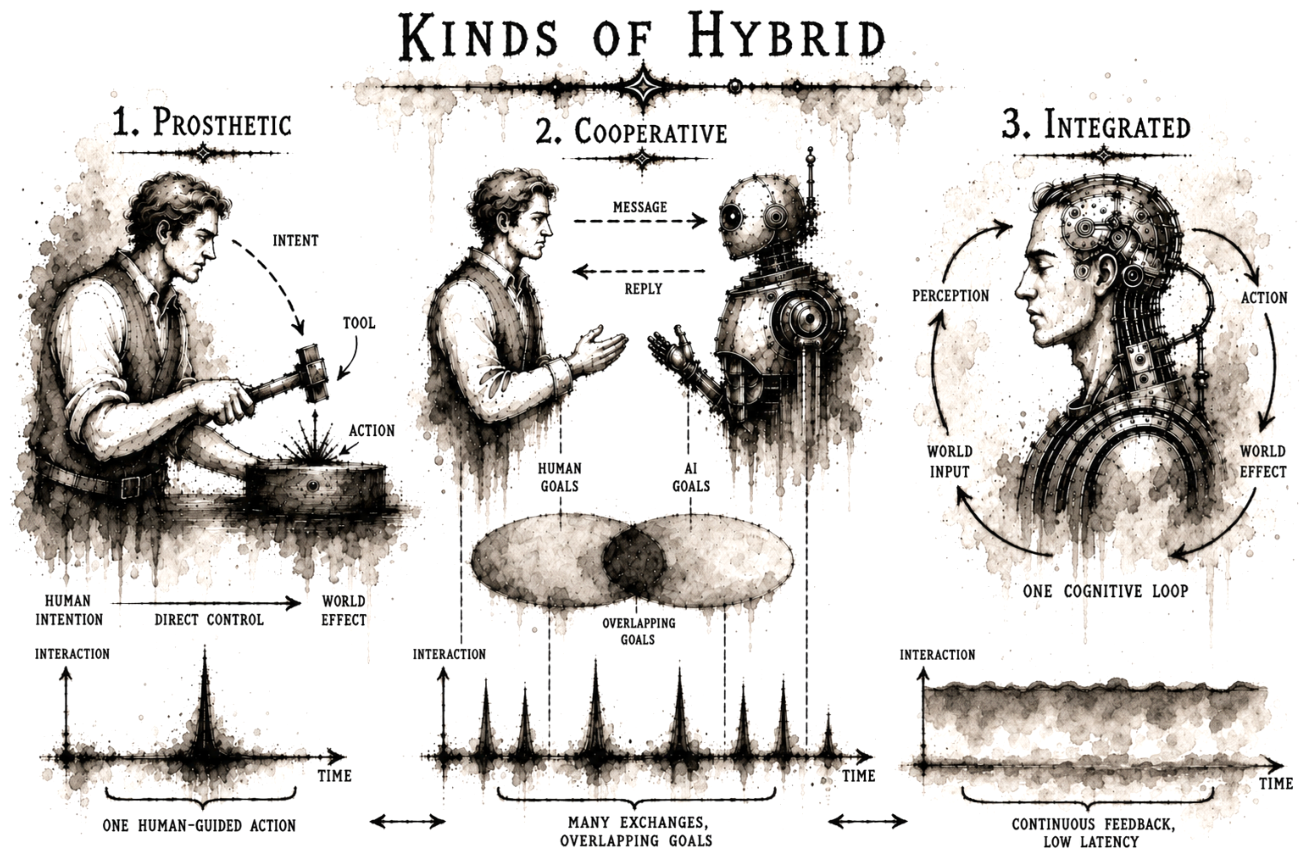
Figure 8.
Integrated hybrids can be regulated or dysregulated. Tight low-latency coupling can either support stable feedback control or amplify failure.
Figure 8.
Integrated hybrids can be regulated or dysregulated. Tight low-latency coupling can either support stable feedback control or amplify failure.
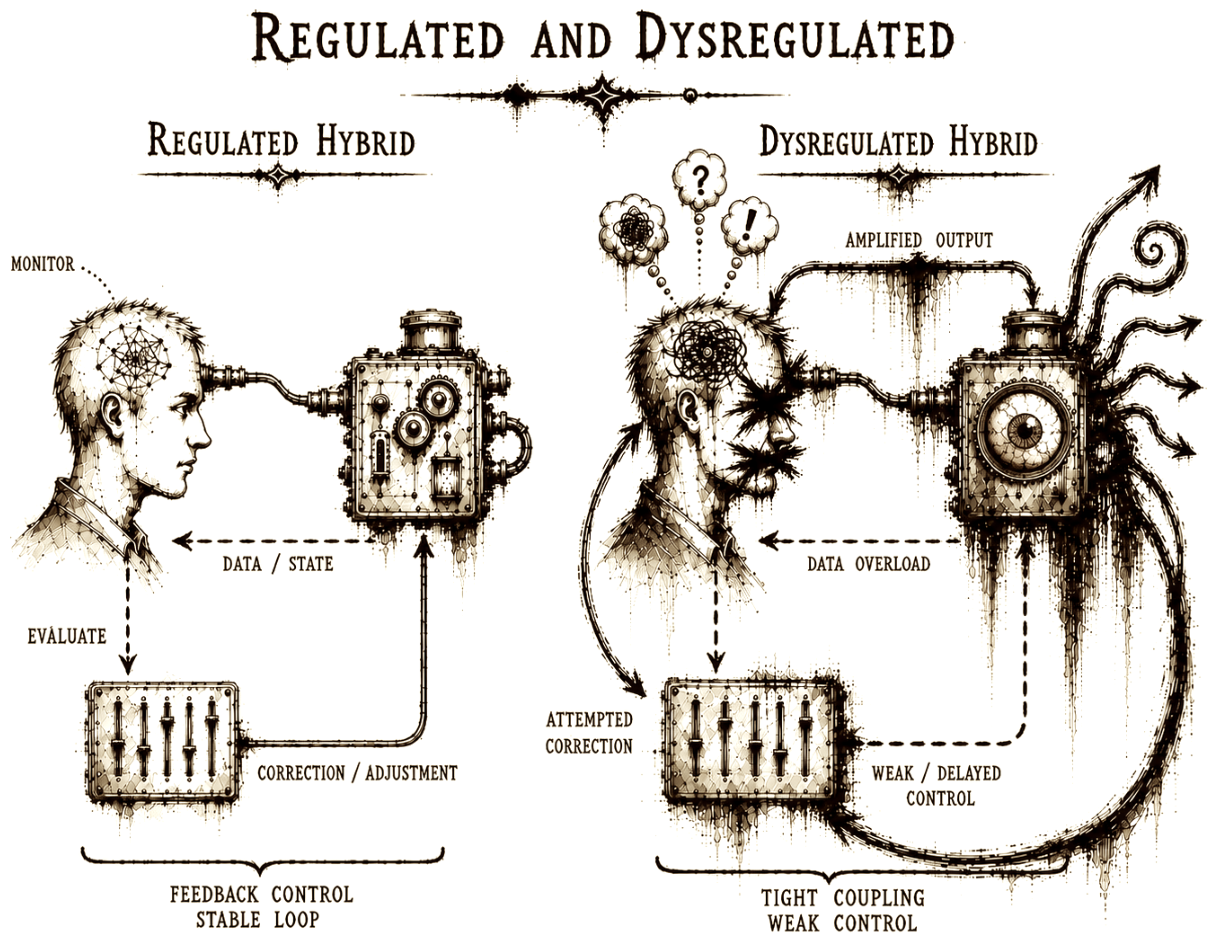
Figure 9.
Solid and liquid brains. Dense local exchange in a bounded support contrasts with moving agents on a large support. Under Chord, the architecture and support determine whether one moment can be unified.
Figure 9.
Solid and liquid brains. Dense local exchange in a bounded support contrasts with moving agents on a large support. Under Chord, the architecture and support determine whether one moment can be unified.
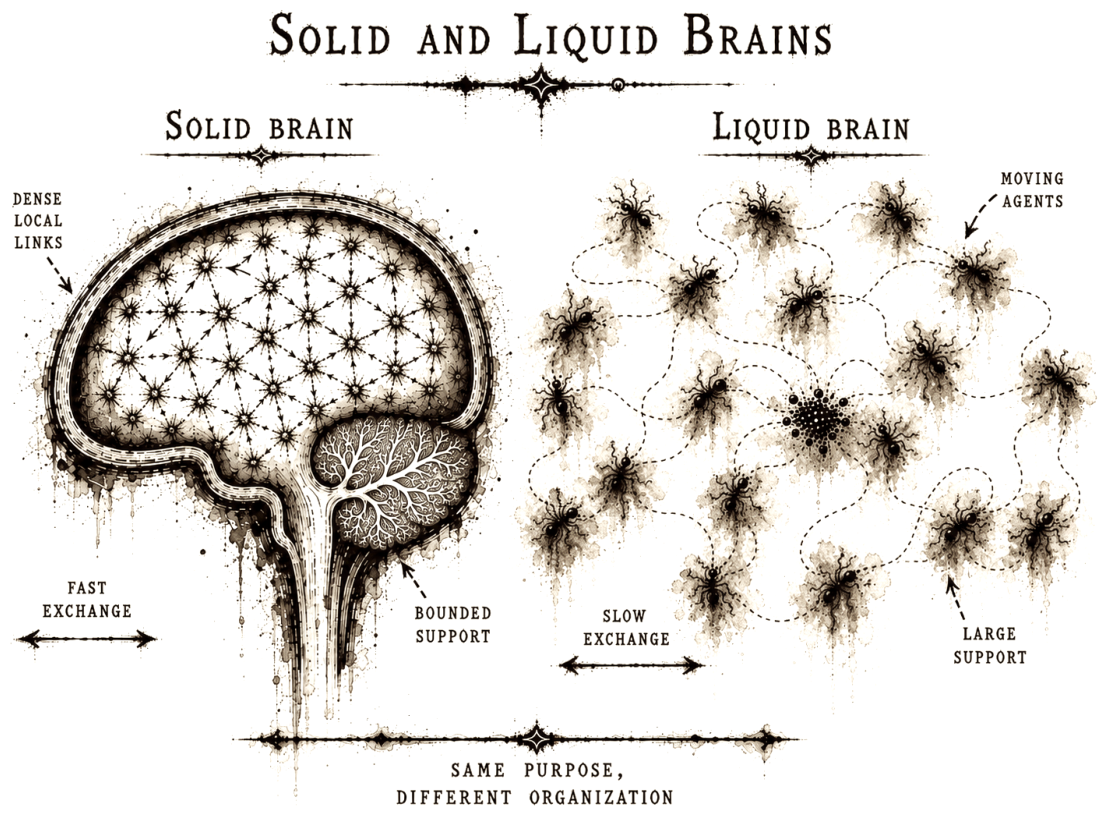
Figure 10.
Ant colonies at fine and coarse scales. Coarser descriptions may relax the diameter budget, but the burden then shifts to grounding, concurrency, and additional constraints like self-structure.
Figure 10.
Ant colonies at fine and coarse scales. Coarser descriptions may relax the diameter budget, but the burden then shifts to grounding, concurrency, and additional constraints like self-structure.
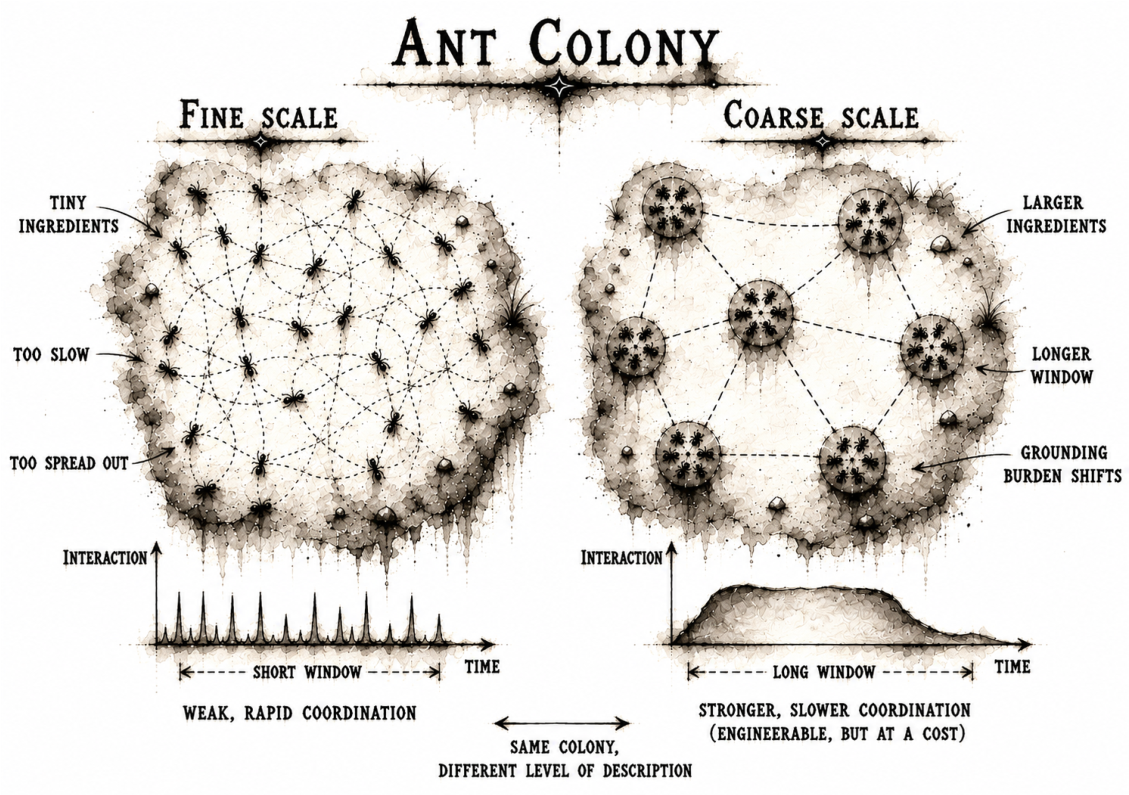
Figure 11.
Current cloud AI versus a hypothetical Chordal cloud. Distance may be manageable in data centres, but present architectures remain serial, memory-shuttling, and top-down rather than co-instantiated and reciprocal.
Figure 11.
Current cloud AI versus a hypothetical Chordal cloud. Distance may be manageable in data centres, but present architectures remain serial, memory-shuttling, and top-down rather than co-instantiated and reciprocal.
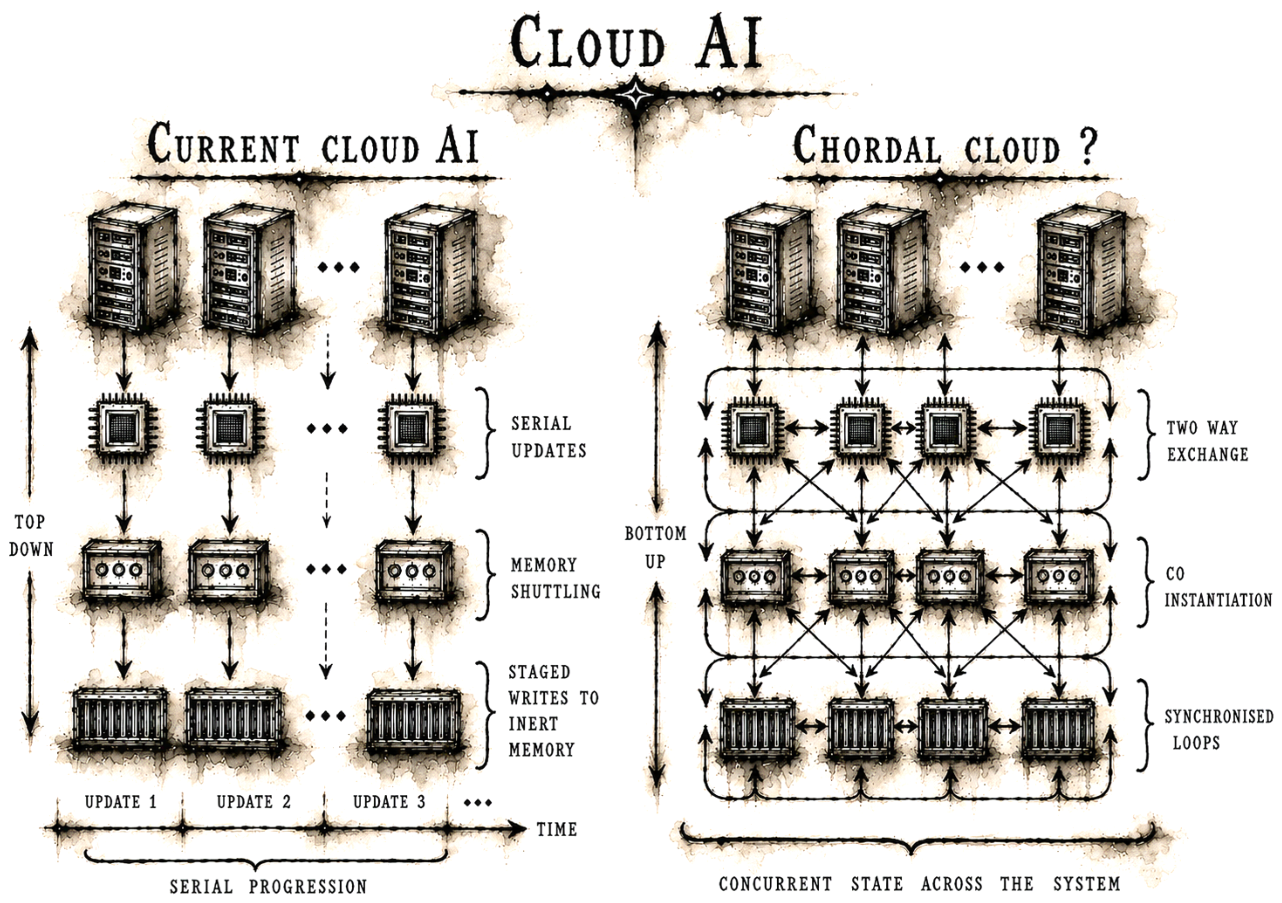
Disclaimer/Publisher’s Note: The statements, opinions and data contained in all publications are solely those of the individual author(s) and contributor(s) and not of MDPI and/or the editor(s). MDPI and/or the editor(s) disclaim responsibility for any injury to people or property resulting from any ideas, methods, instructions or products referred to in the content. |
© 2026 by the author. Licensee MDPI, Basel, Switzerland. This article is an open access article distributed under the terms and conditions of the Creative Commons Attribution (CC BY) license (http://creativecommons.org/licenses/by/4.0/).
Copyright: This open access article is published under a Creative Commons CC BY 4.0 license, which permit the free download, distribution, and reuse, provided that the author and preprint are cited in any reuse.