
Submitted:
24 February 2026
Posted:
26 February 2026
You are already at the latest version
Abstract
This study examines the determinants of liquidity in blockchain-based Voluntary Carbon Markets (VCMs) using three tokenized carbon assets: $KLIMA, BCT, and MCO2. Liquidity is measured by dollar volume, bid-ask spread, and return volatility. Using 1,075 daily on-chain observations from 20 November 2021 to 29 October 2024, we analyze the effects of total supply, transaction activity, market capitalization, transaction frequency, and active wallets. The empirical results reveal substantial heterogeneity across tokens. Dollar volume is jointly driven by token supply, on-chain trading activity, and network participation, particularly for BCT, while $KLIMA and MCO2 liquidity are more sensitive to token supply. Transfer amount and supply dispersion are found to widen bid-ask spreads for BCT. While market capitalization is the main determinant for $KLIMA and MCO2, indicating elevated transaction costs under fragmented and speculative trading conditions. Return volatility is primarily influenced by transfer amount for $KLIMA and market capitalization for BCT and MCO2, highlighting distinct volatility transmission mechanisms. The variables of shared volume, transaction value, and market capitalization on firm value could be moderated by the regulation index, which is referred to as pure moderation. For the variables of total supply, transfer amount, and active wallet, none of them could be moderated by the regulation index. This study contributes a unique integrative approach to measuring liquidity and market microstructure in VCMs, as no standardized global model or index currently captures both dimensions in tokenized carbon markets while incorporating regulatory conditions.
Keywords:
Tokenized carbon assets
; moderation
; regulation
; microstructure
; liquidity
; Voluntary Carbon Markets
1. Introduction
Climate change has become one of the greatest global catastrophes of the 21st century (Nyberg & Wright, 2022), characterized by rising global temperatures, sea-level rise, and extreme weather events caused by increasing concentrations of greenhouse gases (GHGs) in the atmosphere, including carbon dioxide (CO₂), methane (CH₄), nitrous oxide (N₂O), nitrogen trifluoride (NF₃), hydrofluorocarbons (HFCs), perfluorocarbons (PFCs), and sulfur hexafluoride (SF₆) (Filonchyk et al., 2024; UNEP, 2023). According to Carbon Direct (2024), since 1750 humanity has contributed approximately 1.6 trillion tons of CO₂ emissions into the atmosphere and oceans, equivalent to around 40 billion tons of CO₂ annually. Reports by the IPCC (2021), IEA (2023), and the BP Statistical Review of World Energy (2023) indicate that more than 60% of global warming is driven by carbon emissions from fossil-fuel-based energy production and consumption in the industrial, energy, and transportation sectors, including coal, oil, and natural gas. Furthermore, the Global Carbon Budget (2024) projects a 0.8% increase in CO₂ emissions from fossil fuels, reaching a record high of 37.4 billion tons.
To address climate change and limit global warming below 2°C, with a focus on achieving the 1.5°C target (IPCC, 2023; Mooney et al., 2021; UNFCCC, 2015), numerous studies emphasize the need for climate governance through innovative and collaborative instruments. One such instrument is carbon pricing, which assigns a monetary value to one metric ton of CO₂ equivalent (mtCO₂e) (Pearse & Böhm, 2014; PwC Indonesia, 2024), supported by blockchain technology and carbon offset mechanisms (Bakarich et al., 2020; Glavanits, 2020; Mora et al., 2021). The concept of carbon offset originates from economist John Harkness Dales (1986), who proposed tradable permits as a pollution control mechanism. Since then, many countries have implemented emissions trading schemes, positioning carbon markets at the center of global climate mitigation efforts. The transition from natural gas to renewable energy is projected to reduce global CO₂ emissions by 1-5% by 2030 (IEA, 2022). The World Bank (2023) estimates that carbon pricing instruments, including carbon taxes and emissions trading systems (ETS), now cover approximately 23% of global emissions, up from 16% in 2019. The IPCC (2018) estimates that carbon prices required to maintain a 50-66% probability of keeping global temperature rise below 1.5°C range from USD 135-6,050 per tCO₂e in 2030, USD 245-14,300 in 2050, USD 420-19,300 in 2070, and USD 690-30,100 in 2100 (undiscounted values). These ranges represent marginal abatement cost estimates, encompassing both explicit carbon pricing policies and implicit mitigation costs.
In response to the Kyoto Protocol and Articles 6.2 and 6.4 of the Paris Agreement, governments are encouraged to engage in bilateral or multilateral emissions trading through compliance carbon markets (CCMs). Meanwhile, Voluntary Carbon Markets (VCMs) have emerged as alternative institutional mechanisms managed by private organizations to regulate carbon flows outside government mandates. In VCMs, companies and individuals choose to purchase carbon offsets to compensate for their GHGs (Haites, 2018). These offsets typically come from projects such as reforestation, renewable energy, or avoided deforestation, and the purchase is not mandated by law but driven by corporate sustainability goals, reputational considerations, or personal environmental commitments. These mechanisms aim to promote sustainable development and environmental stewardship while ensuring that emission reductions are counted only once toward national targets or Nationally Determined Contributions (NDCs). As of 2023, 130 countries have begun integrating emission mitigation or Carbon Dioxide Removal (CDR) policies to reduce 43% of global emissions by 2030 and achieve net-zero emissions by 2050. This includes the implementation of compliance carbon markets through instruments such as the Clean Development Mechanism (CDM), Emissions Trading Systems (ETS), and Joint Implementation (JI), with total market capitalization reaching approximately USD 20 trillion (European Environment Agency, 2023; IPCC, 2022; Pisu et al., 2023).
Despite their decades-long existence (introduced in 2012), VCMs have not fully matured into the effective mechanism envisioned and has fluctuated in recent years (Clifford Chance, 2024; Boys et al., 2025). According to Forest Trends’ Ecosystem Marketplace (2021) and the World Bank (2022), both trading volume (MtCO₂e) and market value (USD) in VCMs grew exponentially, surpassing USD 1 billion in 2022. Through emissions trading and carbon offset schemes, companies and individuals can compensate for emissions by purchasing credits from environmentally beneficial projects such as reforestation, renewable energy, and peatland conservation (Trouwloon et al., 2023), reflecting increased climate awareness to accelerate global climate action and decarbonization urgency (Stanley et al., 2014; Forest Trends’ Ecosystem Marketplace, 2023; Kossov, 2022; Gillingham et al., 2018).
The rapid development of blockchain technology and cryptocurrencies has significantly influenced the financial industry by fostering the emergence of a new crypto-economy. Within VCMs Blockchain-enabled tokenization converts carbon credits into tradable digital assets as token crypto carbon or green crypto, enabling on-chain trading, settlement, retirement, and swapping through smart contracts (World Bank, 2023). Tokenization improves liquidity, reduces transaction costs, and expands access through decentralized finance (DeFi) mechanisms and fractional ownership (WEF, 2023). However, challenges persist, including interoperability issues and environmental concerns associated with Proof-of-Work (PoW) blockchains as Layer 1, which consume significant energy and produce carbon emission. The transition to Proof-of-Stake (PoS) as side-chains Layer 2, exemplified by Ethereum’s 2022 upgrade, reduced energy consumption by approximately 99.98% (Ethereum Foundation, 2022). Polygon and other PoS-based networks have achieved carbon neutrality through credit retirement initiatives (Polygon Labs, 2023). Platforms such as KlimaDAO, Toucan Protocol, leverage Polygon and Moss.Earth within Ethereum infrastructure to tokenized carbon credits more transparently and efficiently. KlimaDAO has facilitated the retirement of over 17 million tons of digital carbon credits, while Toucan Protocol’s Base Carbon Tonne (BCT) represents one metric ton of tokenized carbon credit through bridging mechanism. Moss.Earth with MCO2 token represents verified rainforest conservation carbon credits of Amazon Tropical Forest Forever Facility (TFFF). Together, these platforms form an interoperable on-chain ecosystem that enhances auditability, liquidity, and inclusivity in digital carbon markets.
Despite significant fluctuations, the long-term prospects of VCMs remain positive, driven by increasing pressure from investors and regulators to meet climate neutrality targets, provided that credibility, transparency and permanence of carbon offsets issues can be effectively addressed (Ahonen et al., 2022; Allen et al., 2022; BloombergNEF, 2023; Forest Trends, 2023; Lou et al., 2023; Reuters, 2023; West et al., 2023). This pressure has encouraged a shift in market preferences from a primary focus on transaction volume toward the quality of carbon credits, particularly those meeting high-integrity standards such as the Core Carbon Principles (CCP) of the Integrity Council for the Voluntary Carbon Market (IC-VCM) and the Carbon Offsetting and Reduction Scheme for International Aviation (CORSIA) developed by ICAO. Carbon credit prices are shaped by quality factors, including the type of project, underlying economics, issuance year (vintage), and geographic (Bravo et al., 2023; Ecosystem Marketplace, 2024). These frameworks impose strict criteria for project selection and crediting methodologies (Kaplan et al., 2023; Roston et al., 2023) to ensure that carbon offsets genuinely contribute to climate change mitigation.
According to Mannion et al. (2023), the carbon dioxide removal (CDR) industry is projected to deliver gigaton-scale emission removals to support net-zero targets, with an estimated market value of up to USD 1.2 trillion by 2050. In line with this outlook, Parry et al. (2024) project that demand for durable CO₂ removal credits through technologies such as Direct Air Carbon Capture and Storage (DACCS) and Bioenergy with Carbon Capture and Storage (BECCS) will reach approximately 100 million tons of CO₂ (MtCO₂) by 2030, while current supply remains limited to around 50 million tons. Furthermore, McKinsey (2024) and Blaufelder et al. (2021) estimate that although the global value of VCMs remained relatively small at around USD 300 million in 2022, it is expected to expand fifteenfold by 2030 (Institute of International Finance, 2021) and potentially grow one hundredfold by 2050, with total trading volumes reaching up to USD 500 billion.
In addition, significant differences in consumer preferences between nature-based credits and technological carbon removal solutions reflect a willingness to pay higher prices for high-credibility carbon credits (MacDonagh & Williams, 2024). According to Abatable’s report by Brun et al. (2025), the share of retired credits aligned with CCP or CORSIA quality standards increased from 29% in 2021 to nearly 50% in 2024. Buyers exhibit a strong preference for premium-priced credits, with premiums reaching up to USD 10 per ton for CCP-labeled credits. This is supported by De Canio (2023), Frey et al. (2023), Gomez et al. (2023), and Rogers et al. (2023) who find that consumers are willing to pay up to 27% above baseline prices for environmentally friendly products and packaging. While 68% consumer willing to reduce their consumption to avoid environmental damage and climate change (Sustainable Brands, 2022). Meanwhile, BeZero Carbon (2024) reports that high-quality nature-based carbon credits command larger price premiums in VCMs, with an average one-notch upgrade in BeZero’s rating scale corresponding to a 20% price increase. Certain projects, such as high-rated Improved Forest Management (IFM), have even achieved exceptional price premiums of up to 400%. Moreover, BeZero Carbon represents the only tropical forest REDD+ project certified by Verra and rated ‘A’, reflecting limited project-specific risks, low over-crediting risk, and reduced non-permanence risk (BRCarbon, n.d).
Although total credit issuances have slowed since 2022, retirement volumes have remained stable at approximately 140 million tons per year, indicating sustained demand for high-quality carbon credits. In addition, the annual surplus declined from its peak of 286 million tons in 2021 to 160 million tons in 2024, alongside slower issuance and increasing accumulation of removal credits amounting to 72 million tons, or 5.7% of the cumulative surplus of 1.2 Gt by the end of 2024. This trend suggests that the market is becoming more selective, favoring projects that deliver tangible emission reductions and removals rather than mere avoidance.
This paper examines the liquidity of VCMs in the context of tokenized carbon assets on-chain trading in financial market. There are at least two key reasons why liquidity is crucial. First, liquidity reduces transaction costs and risk premiums, making carbon markets more attractive as a financial instrument. Without liquidity, tokenized carbon assets risk becoming illiquid niche products rather than mainstream tools for climate finance. Second, liquidity allows broader participation by institutional and retail investors, making carbon assets more accessible It supports the scalability of on-chain trading, ensuring that large volumes of carbon credits can be transacted without bottlenecks. Nevertheless, achieving liquidity and scalability in crypto carbon-based VCMs requires harmonized global standards and robust regulatory frameworks. The EU’s Deforestation Regulation (EUDR) exemplifies supply-chain transparency enforcement, imposing strict due diligence and traceability requirements. For carbon-rich countries such as Indonesia, liquidity in tokenized carbon markets must be paired with credible verification systems. Otherwise, environmental degradation (deforestation) that allegedly for palm oil plantations that massive landslides and flooding at the end of 2025, not only erodes ecological integrity but also jeopardizes market access, turning potential climate finance tools into illiquid, niche products. This has raised doubts about the credibility of certain offset initiatives, as overstated emissions reduction claims and weak validation undermine their effectiveness in preventing deforestation (Greenfield, 2023). Thus, transparent tokenization and digital MRV systems are increasingly critical. In conclusion, tokenized carbon asset on-chain trading based on green crypto holds significant academic and practical relevance. By enhancing transparency, accessibility, and public participation, it has the potential to increase liquidity in voluntary carbon markets. However, its success depends on coordinated governance, regulatory standardization, and cross-sector collaboration to ensure that blockchain-based carbon markets genuinely contribute to net-zero emissions and a sustainable low-carbon economy.
2. Literature Review
2.1. Markets Microstructure Theory
According to the National Bureau of Economic Research (NBER), market microstructure is a branch of economics and finance that studies intermediation and asset exchange institutions (Spulber, 1996). It examines how securities trading mechanisms, where asset exchange processes are explicitly governed by trading regulations (Easley & O’Hara, 1995), market structure, and the behavior of market participants affect transaction costs, prices, trading volume, and trading activity (Doostian & Touski, 2024), as well as the liquidity and volatility of financial assets (Hansen & Lunde, 2006; Sewell, 2007). Furthermore, according to Biais et al. (2005) and O’Hara (1995), market microstructure influences the process of price discovery, which occurs through the interaction of buy and sell orders (Madhavan, 2000), whether facilitated by intermediaries such as order clerks or brokers, centralized trading systems such as exchanges, or electronic and digital trading platforms.
Trading mechanisms refer to the specific ways in which securities are traded based on market type, price formation method, order forms, and levels of transparency. While, market structure is a fundamental element that determines how transactions are executed, classified, and how liquidity is formed, through mechanisms such as decentralized exchanges (DEXs) and automated market makers (AMMs). The absence of centralized authorities and intermediaries means that liquidity depends entirely on market mechanisms and user participation, with limited market maker intervention, and that buyer-seller matching is conducted digitally through trading algorithms (Kissell, 2014). Investors can submit orders online; these orders are automatically routed to trading venues, matched against existing orders, and forwarded directly to clearing and settlement processes (Stoll, 2003). Consequently, technology has reshaped the relationships among investors, brokers, dealers, and the market infrastructures that facilitate their interaction.
In the other hand, transparency allows all transactions to be publicly observable, although the economic identities of market participants remain pseudonymous or anonymity. Transparency itself also refers to the extent to which market participants have access to information about the trading process (Hasbrouck, 2007) to improve decision-making (O’hara, 1987). Market participants classify based on their information sets: informed and uninformed traders (Grossman, 1976). Informed traders possess superior information about an asset that other traders do not have and exploit this advantage in trading. Uninformed investors trade referred to as noise traders, as their decisions are driven by beliefs or sentiment rather than fundamental information. Information becomes reflected in market prices through the trading activities of informed participants (O’Hara, 2003). Informed traders can influence price and liquidity, while less-informed traders bear adverse selection risk. This asymmetry information may widen bid–ask spreads and increase carbon token return volatility. Bossaerts and Hillion (1991) show that the presence of informed traders increases bid-ask spreads, particularly when information about government intervention is unevenly distributed. Similarly, Morse and Ushman (1983) find that bid-ask spreads do not react significantly to public information announcements but rise sharply during periods of large price changes, indicating heightened market concern about superior informed traders.
2.1.1. Price Discovery
Price formation (asset pricing) refers to the process through which the price of an asset is established and determined (Kissell, 2014; O’Hara, 2003). This price incorporates liquidity-related transaction costs and risks arising from the price discovery process, including order processing costs, adverse selection costs, inventory holding costs, and monopoly power. According to O’Hara (2003), markets serve two primary functions: providing liquidity and facilitating price discovery. Asset prices evolve within the market and are influenced by trader characteristics and the prevailing trading system (O’Hara & Oldfield, 1986). The price discovery process describes how new information becomes reflected in asset prices through trading activity. Within the market microstructure framework, market efficiency depends on how quickly and accurately information is absorbed into prices. In the context of tokenized carbon assets, prices reflect not only expectations about the economic value of carbon credits but are also influenced by crypto speculation, DeFi arbitrage, and other non-fundamental trading activities. These dynamics may generate noise trading, meaning that carbon token prices may not fully or efficiently reflect fundamental information. When information asymmetry costs are considered, trading affects informed and uninformed traders differently (Aigbovo & Isibor, 2017). Bollen et al. (2004) show that when transactions are initiated by uninformed traders, the compensation required by dealers is equivalent to the value of a slightly out-of-the-money (OTM) call option, with a strike price equal to the ask price. Conversely, when the investor is informed and knows that the true asset value exceeds the ask price, the compensation received by the market maker is equivalent to the value of a slightly OTM call option.
Glosten and Milgrom (1985) develop a trader-based market model demonstrating that information differences generate information costs, which are embedded in the bid-ask spread as compensation for adverse selection risk. Information costs differ from execution costs that represent the highest price a buyer is willing to pay and the lowest price a seller is willing to accept (Chang et al., 1999). Information costs, are the costs borne by market makers when buying and selling assets beyond the asset’s quoted price. Transaction costs depend heavily on the distribution of information among traders. Market makers risk selling assets too cheaply to informed buyers or purchasing them too expensively from informed sellers. Allen and Gorton (1992) argue that buyers tend to avoid trading against informed investors, retain flexibility in timing their trades, and often trade in clusters. When liquidity buyers do not cluster, purchase transactions are more likely to be initiated by informed traders than sales, resulting in larger price impacts from buy orders than from sell orders. Merton (1987) shows that incomplete information in capital markets can create opportunities for manipulation, as uninformed traders are disadvantaged in markets with unequal information distribution. Investors without equal access to information face higher relative risks and potential losses because they cannot properly evaluate securities or distinguish among securities with different information sets, leading to market segmentation. Asset valuation depends on the information available to investors, so informational inconsistency complicates accurate pricing (Cochrane, 2000). Even when market participants agree on a price, trades may occur at incorrect prices if investors lack accurate information (Fama, 1970). Securities with lower levels of available information tend to exhibit lower liquidity and higher transaction costs due to the presence of an information premium that pushes equilibrium prices away from the idealized perfect-market model. Information costs and limited information dissemination create inequality between informed and uninformed traders, thereby reducing overall market efficiency.
2.1.2. Market Liquidity
A liquid market is generally understood as one that can accommodate transactions with minimal price impact, thereby benefiting investors. By providing liquidity, markets facilitate asset exchange among traders, reduce the cost, and ensure that prices formed in the market are more informationally efficient (Chordia et al., 2004). Liquidity is a central concept in market microstructure and reflects an asset’s ability to be traded quickly without causing significant price changes (Kluger & Miller, 1990; O’Hara, 2004). It has several key dimensions: breadth, tightness (bid-ask spread), depth, immediacy, and resiliency (Sarr and Lybek, 2002). Breadth refers to the presence of large order volumes in the market. Tightness, typically measured by the bid-ask spread, reflects to the amount of transaction costs or the compensation required by liquidity providers for offering immediacy in executing buy and sell orders. A narrower spread indicates lower execution costs and a more efficient trading mechanism, implying greater market liquidity. If prices vary according to transaction size, spreads for large transactions may be significantly wider than those for smaller trades. Depth refers to the existence of buy and sell orders around the current equilibrium price. Resiliency reflects the market’s ability to recover from temporary order imbalances and restore prices to equilibrium. A market is considered non-resilient if order flow cannot quickly correct errors in the price discovery process (Madhavan, 2000).
Liquidity can also be modeled as the outcome of interactions between the demand for and supply of immediacy. It represents the price of immediacy, which means traders willing to delay transactions typically obtain better prices than those demanding immediate execution (Grossman & Miller, 1988). Limit order traders may achieve more favorable prices by waiting, whereas market order traders accept less favorable prices as compensation for immediate execution. When traders insist on immediate execution rather than postponing trades (holding behavior), price effects may arise. This time dimension suggests that intertemporal price movements are a fundamental measure of liquidity. In market microstructure literature, the bid-ask spread is viewed as compensation paid by traders for the ability to transact quickly (Glosten & Milgrom, 1985; Stoll, 2000). However, the presence of informed traders increases risk for liquidity providers, prompting them to widen spreads or reduce market depth. Therefore, liquidity is not determined solely by trading volume but also by the design of trading mechanisms, market transparency, and the distribution of information which jointly influence price efficiency and market stability (O’Hara, 1995; Hasbrouck, 2007).
2.2. Carbon Credit
A carbon credit, or carbon offset, is a certificate that represents and grants the right to one metric ton of carbon dioxide equivalent (tCO₂e) (Pei et al., 2013; Saraji et al., 2021) that has been successfully avoided or removed from the atmosphere, measured against a defined baseline scenario (CSIS, 2023; Favasuli et al., 2021; ISDA, 2021b). It functions as a permit that allows a company or individual to emit a certain amount of carbon dioxide or other greenhouse gases (GHGs), while simultaneously creating a financial incentive to reduce emissions or offset a carbon footprint as a form of private investment by corporations or organizations (Dugbartey & Kehinde, 2025). It may also be classified as Virtual Digital Assets (VDAs), representing digitalized forms of carbon emission reductions issued by independent registry bodies (Sharma et al., 2022). They can be traded via blockchain technology or transferred digitally, and in certain structures may be used for payment or investment purposes, similar to cryptocurrencies, decentralized finance (DeFi) instruments, or non-fungible tokens (NFTs) (Chevet, 2018). From a legal perspective, carbon credits are generally not contractual claims or securities issued by a legal entity or collective investment scheme that grant ownership or capital access rights (Banque de France, 2024). Rather, they are considered intangible property rights (Ben McQuahe & Co., 2023) that are fungible and may be created, purchased, sold (Looney, 2009), retired (permanently transferred) (Clifford Chance, 2022; UNCITRAL & UNIDROIT, 2024), pledged as security or used as collateral (McMillan, 2010), and treated under specific legal regimes in cases of insolvency, including close-out netting arrangements (UNIDROIT, 2025; ISDA, 2021b).
2.3. Tokenized Carbon Assets
Carbon credit tokenization is the process of converting ownership rights over an asset (Burgoyne et al., 2025) or digitally representing real-world assets (Moncada et al., 2024; Ballesteros-Rodriguez et al., 2024; Swinkels, 2023) or intangible assets (Ali et al., 2023), such as carbon credits (Saraji et al., 2021; Swinkels, 2024), into crypto tokens (Carapella, 2023; Zheng & Sandner., 2022) using blockchain technology and smart contracts (Takanashi et al., 2020). These tokens are stored in an encrypted, transparent, and verifiable form (Dowling, 2022; Popescu, 2021). Blockchain-based asset tokenization transforms traditional financial models by improving transaction efficiency, reshaping value creation mechanisms, and redistributing risk among market participants (Tanveer, 2025). Owing to the speed and scalability of token issuance and dissemination, tokenization has emerged as one of the core applications of blockchain networks (Franke et al., 2020; Scheltz et al., 2020; Voshmgir, 2020), facilitating coordination among participants within regulated environments to support structured incentive systems (Freni et al., 2022). Carbon credit tokenization is a central element of Regenerative Finance (ReFi), a subset of Decentralized Finance (DeFi), which focuses on climate change mitigation through various types of digital assets (Fullerton, 2015; Gibbons, 2020; Díaz-Valdivia et al., 2022).
Tokenized carbon credit assets are blockchain-based digital representations of certified voluntary carbon credits, which can be acquired, traded, and settled using carbon-backed crypto tokens. Through tokenization, carbon credit certificates are issued in the form of tokens (Zhang et al., 2024a), enabling token holders to possess legally valid ownership claims (Aldasoro et al., 2023). These digital certificates function as transferable proof of offset achievements, allowing entities to participate in Compliance Carbon Markets (CCMs) and Voluntary Carbon Markets (VCMs). Once tokenized, carbon credits can be traded on decentralized exchanges (DEXs), transferred across wallets and networks, or retired for carbon offset claims, and can be integrated with various decentralized finance (DeFi) protocols such as yield farming, staking, derivatives, and carbon-backed stablecoins. Tokenization enables carbon credit prices to be transparently represented in line with their underlying real-asset value and to be verifiable (Catalini & Gans, 2020; World Bank, 2023).
Carbon credit tokenization is implemented either through verification and certification methodologies by standards such as Verra or Gold Standard, with credits secured and recorded on distributed ledger technology (DLT) (Nowak, 2022), or via native minting directly on blockchain using machine learning and satellite data (Sorensen, 2023). Tokenized credits originating from legacy registries apply specific criteria to determine the volume and type of credits to be tokenized. In contrast, blockchain-native carbon tokens that issued on platforms such as Ethereum and Polygon, adhere to ERC-20 and ERC-721 standards for fungible and non-fungible tokens, respectively. Each token unit represents one metric ton of CO₂ equivalent either sequestered or emissions avoided, and is aligned with the incentive mechanisms governing token issuance, trading, and distribution.
2.4. Blockchain Technology
According to Glavanits (2020), Mora et al. (2021), and Parmentola et al. (2021), blockchain technology has the potential to serve as a digital solution that supports the Sustainable Development Goals (SDGs) and the circular economy by strengthening resource rights, enabling product origin traceability, and incentivizing behavioral change (Herweijer et al., 2018; Hughes et al., 2019; Mulligan et al., 2024). Kud (2023) further argues that distributed ledger technology (DLT) within blockchain’s digital infrastructure can replace certain functions of traditional markets and revolutionize the green finance industry and technology through the automation of digital assets, thereby improving efficiency, transparency, and access to financing for environmental projects or international climate action initiatives (Corbet et al., 2019; De Vries, 2018; Tian et al., 2020). Empirically, digital infrastructure also contributes to carbon emission reductions, particularly when supported by fiscal policies that promote sustainable digital transformation (Abbas et al., 2024), and facilitates new forms of green production through the development of green supply chains (Bai & Sarkis, 2019; Saberi et al., 2019). Blockchain’s energy demands remain unresolved, with proof-of-work in particular criticized for its environmental footprint (Plat et al., 2021). To mitigate this contradiction with sustainability goals, transitions toward proof-of-stake and other greener architectures are being pursued.In addition, blockchain significantly impacts financial flows by supporting the operation of illiquid assets and increasing carbon trading volumes, thereby enhancing market accessibility (Zhao et al., 2022).
Blockchain provides digital infrastructure as a database or transaction recording system (issuance, transfer, and retirement of carbon credits) within distributed ledger technology (DLT) (Alt et al., 2025; Hughes et al., 2019; Garg, 2023; ISDA, 2020; Li et al., 2018b; Rauchs et al., 2018; Zafar, 2025; Zwitter et al., 2020) or a digital block network (Moll et al., 2019) that relies on the internet and TCP/IP protocols (Anthony, 2023). It is pseudonymous and uses cryptographic technology to ensure network security and the integrity of recorded data, making it tamper-proof (Thilakavathy et al., 2023; Denter et al., 2023; Josenhans, 2024; Lee, 2024). Blockchain technology has transformed the way assets are represented, transferred, and traded (Nguyen et al., 2021; Wankmüller et al., 2023). The main characteristics of blockchain include system stability and security (Shi et al., 2025), independent (public) verification (Dai et al., 2017), permanence through an immutable audit trail, fraud detection (manipulation detection) that prevents alteration of historical data via tamper-evident records (Iansiti et al., 2017; Jaffer et al., 2024; Rodriguez, 2025), and transparency that allows all parties to openly access transaction histories (Government Office for Science, 2016). DLT in blockchain also ensures transparency, traceability, and system security (Saberi et al., 2019).
Aligned with the principles of accountability and transparency in environmental governance (Wong et al., 2021; Ciplet et al., 2018; Kollmus, 2015), blockchain functions to strengthen accountability (Van Pelt et al., 2021) and enable real-time audit mechanisms (Catalini et al., 2020; Dong et al., 2023) to reduce the risk of double counting and fake credits (Baruch et al., 2022; Dorfleitner et al., 2021; Zhang et al., 2019). Blockchain technology can provide a trusted means of ensuring the veracity of compliance data, reduce the role of intermediaries, and improve time efficiency (Carlson, 2018; Xiao & Zheng, 2022; Kim, 2022; Rauchs et al., 2018). It also lowers transaction costs through tokenization and smart contracts as algorithm- or code-based trust systems (nodes) that form peer-to-peer networks by matching buyers and sellers based on preferences such as geographic origin, project type (reforestation or renewable energy), and price tolerance, thereby accelerating and strengthening the synchronization and distribution of (carbon) trading transactions (Beck et al., 2018; Berg et al., 2019; Clack & McGonagle, 2019; Davidson et al., 2016; De Filippi & Loveluck, 2016; Hussein et al., 2023; Nguyen et al., 2023; Sanderson, 2018; Tapscott & Tapscott, 2016; Teplý et al., 2021; Yaga et al., 2019). According to Cong et al. (2018) and Karamitsos et al. (2018), smart contracts are digital contracts that enable the execution of terms based on decentralized consensus or compliance criteria; they are resistant to manipulation and can automatically enforce agreements through programmed execution (Dencer-Brown et al., 2022; Galenovich et al., 2022). In Voluntary Carbon Markets (VCMs), smart contracts regulate the token lifecycle, including issuance, retirement (permanent removal from circulation), and transfer of ownership. Automation ensures that once a token is retired, indicating that an emission offset has occurred, it cannot re-enter circulation for trading. The use of smart contracts enables tracking of ownership changes and retirement status, thereby safeguarding integrity in carbon offset initiatives and supporting robust climate accounting frameworks across jurisdictions.
2.5. Voluntary Carbon Markets (VCMs)
Voluntary Carbon Markets (VCMs) are decentralized and still-developing (nascent) financial markets with regulatory systems and independent certification bodies that allow private entities, governments, or individuals to voluntarily buy, sell, and trade carbon credits to offset emissions beyond mandatory mitigation targets (Ahonen et al., 2022; Bassi et al., 2025; ISDA, 2021b; World Bank, 2022). In contrast Compliance Carbon Markets (CCMs), which are strictly regulated by government authorities with cap-and-trade system (Franki, 2022; Sim et al., 2024), and govern mandatory carbon trading, commonly referred to as Emissions Trading Systems (ETS), also create financial incentives to reduce emissions by allowing companies to trade carbon credits within a regulated market framework (Dugbartey & Kehinde., 2025). VCMs are not under the direct supervision of any single governmental authority and therefore lack a standardized legal framework (Kreibich et al., 2021). VCMs contribute to climate change mitigation by enabling organizations to finance carbon reduction or removal projects beyond regulatory obligations (Betz et al., 2022; Passero, 2009).
Albeit these markets encourage innovation and investment, they face legacy governance, taxation, and structural challenges that may hinder their effectiveness and scalability (WEF, 2023). As part of a baseline-and-credit system aimed at reducing greenhouse gas (GHG) emissions and complementing cap-and-trade systems in regulating emission allocations (Bassi et al., 2025), VCMs support the permanent removal of carbon emissions from the atmosphere. Through a “reduce first, mitigate second” strategy, companies can pursue net-zero targets in a cost-efficient manner (ISDA, 2021b). However, purchasing carbon credits through VCMs does not always result in actual emission reductions (Calel et al., 2021; Carter et al., 2022).
The integration of derivative instruments into VCMs has also emerged as a means to enhance liquidity, manage price volatility, and attract institutional participation (Spilker et al., 2023), similar to developments in CCMs (Swinkels et al., 2023). Additionally, various global initiatives have been developed to improve standardization and transparency in VCMs activities (Dawes et al., 2023). Voluntary carbon markets offer greater flexibility, nevertheless it concerns remain regarding market failures, including lack robust verification systems (Battocletti et al., 2023; Stek et al., 2025; Trencher et al., 2024), inconsistent credit quality and limited accountability, highlighting the need for stronger policy frameworks to ensure the environmental integrity of these markets (Battocletti et al., 2023).
2.6. Liquidity of VCMs
2.6.1. Return Volatility (RV)
The price volatility considered in this study refers to the variance of returns or the risk associated with carbon credit tokens. In finance, volatility denotes the degree of fluctuation or variation in the prices of securities or commodities (including carbon credit tokens) over time and is commonly used as a measure of market risk as well as a key input in the pricing and valuation of derivative instruments (Black et al., 2012; Sutrisno, 2020; Yang et al., 2020). Higher volatility implies greater uncertainty in returns, while simultaneously creating opportunities for trading profits through price differentials between the opening and closing prices during transactions.
According to Markowitz’s (1952) portfolio theory, higher expected returns are associated with lower risk through diversification, which contrasts with the Capital Asset Pricing Model (CAPM) (Sharpe, 1964). CAPM posits that higher systematic risk should be compensated by higher expected returns (Leirvik, 2021). Furthermore, high volatility is often associated with lower market activity or illiquidity (Amihud et al., 1986) and elevated levels of information asymmetry (Biais et al., 2019). The closing price series of each token, which represents the final market valuation at the end of each trading day, is transformed using a logarithmic transformation into daily returns based on the following formula:

Where is the daily returns series of period t, is the prices observed in period t (the current day), and is the prices observed in period (the previous day). Meanwhile, carbon token price volatility is measured by calculating the sample standard deviation (STDEV.S) of daily returns over the observation period (Sukamulya, 2017).
Where denotes the carbon token return of asset i on day t, represents the average return of carbon token asset i over the observation period, and n indicates the total number of observation periods used in the volatility estimation.
2.6.2. Bid-ask Spread (BS)
The bid-ask spread (BS) is a key measure of market illiquidity, reflecting the cost of trading assets that cannot be easily or quickly converted into cash without significant value loss (Korajczyk et al., 2008). It is widely used as a proxy for liquidity conditions in carbon token markets, particularly for investors seeking rapid capital gains (Dharma et al., 2022; Hagströmer, 2021; Utami et al., 2020). BS represents the cost of immediacy, defined as the difference between the bid price (the highest price a buyer is willing to pay) and the ask price (the lowest price a seller is willing to accept), serving as compensation for liquidity provision (Madhavan, 2000; Eraker et al., 2023). A wider spread indicates higher transaction costs, weaker liquidity, and lower trading activity, particularly during periods of elevated price volatility when market makers hedge against adverse price movements (Pan et al., 2021). Conversely, a narrower spread signals a more liquid and efficient market, reducing trading costs and encouraging trading activity (Ardia et al., 2021). Persistent spread widening after volatile periods suggests that market participants anticipate continued price uncertainty (Ryder, 2023).
The Corwin and Schultz (2012) method is an empirical statistical approach widely used in the financial literature to estimate the bid-ask spread based on daily high and low prices. This method adjusts for volatility and utilizes price data from two consecutive trading days as an indirect (implied) measure to obtain a more accurate estimation of transaction costs and market liquidity (Abdi & Ranaldo, 2017; Lin, 2014; Nieto, 2018). The data employed consist of observations of intraday high prices and intraday low prices . From these data, the highest and lowest prices over a two-day period can be calculated as follows:
where represents the highest price over two days (day and day ), and represents the lowest price over the same two-day period. The first step is to compute the parameter γ, which captures the variation between the maximum and minimum prices over two trading days, expressed as:
Next, daily price volatility is measured using the parameter β, which is estimated from the intraday high and low prices for each day and . The estimator for β is given by:
This expression can be rewritten in a simpler form as:
After obtaining γ and , the Corwin-Schultz estimator constructs the parameter α, which serves as an intermediary measure linking volatility and the two-day price range. The value of α is calculated as follows:
The bid–ask spread estimate is derived from α and can be computed using the following equation:
Conceptually, the parameter γ captures price fluctuations over a two-day period, while β reflects daily price volatility. The parameter α integrates these two components to generate a volatility-adjusted spread measure. The term represents the exponential of α (Euler’s number symbolize as e raised to the power of α), which transforms α into a proportional scale suitable for estimating the bid-ask spread (). A higher value of ( indicates a wider estimated bid–ask spread, reflecting lower market liquidity and higher transaction costs. Conversely, a smaller value indicates a more liquid and efficient market.
2.6.3. Dollar Volume (DV)
In capital markets, dollar volume ($Volume) is defined as the total monetary value (in dollars) of transactions or trades that occur within a specific period (Chordia et al., 2001; Chutka & Rebertak, 2021), particularly in decentralized exchanges (DEX). This indicator reflects the magnitude of capital inflows and outflows through an asset, thereby assisting investors in assessing market activity and potential price movements. Dollar volume is widely used to evaluate liquidity, the level of market activity or reaction (Bianchi et al., 2022), and investor interest in an asset (Zhang et al., 2023a; Boonvorachote et al., 2016). Higher dollar volume indicates greater ease of executing buy and sell transactions (entry and exit) for market participants. When the total value of traded shares exceeds the number of shares outstanding, the market is considered more liquid, leading to increased trading volume and market activity (Kusumastuti et al., 2015).
2.7. Tokenized Carbon Assets On-chain Trading
2.7.1. Total Supply (TS)
Token supply (TS) refers to the number of tokens that have been minted and are available on a blockchain network. In cryptocurrency markets, particularly for tokenized carbon credits, there are three main types of token supply (Alzahrani & Daim, 2019). Maximum supply denotes the maximum number of tokens that can ever be created over the lifetime of a crypto asset. Total supply represents the total number of tokens currently in existence, including tokens that are locked, reserved, lost, or otherwise unavailable for trading in public markets. Circulating supply refers to the number of tokens actively circulating in the market that are tradable and accessible to the public, and it is the basis for calculating market capitalization.
The availability of digital assets in the market plays a crucial role in shaping scarcity and potential inflationary pressure on token values (Bihani et al., 2025). Total supply and token distribution exert a significant influence on the accessibility and liquidity of digital assets within the blockchain ecosystem. The use of adaptive controls or burning policies (token destruction) and on-chain treasury mechanisms, including token buybacks or the imposition of holding taxes during periods of inflation caused by token oversupply, as well as the minting of new tokens when platform activity increases and markets experience stagnation, reflects a blockchain-based monetary approach aimed at preserving value amid token price volatility and ensuring long-term liquidity (Kiayias et al., 2023; Liu et al., 2022; Tang & Chow, 2023). Tokens with a fixed supply and broad distribution tend to exhibit higher liquidity (Sareen, 2023), particularly when token holders can access rankings and ownership percentages relative to total token supply on DEXs, which facilitates the formation of liquidity pools (Bhoyar, 2025).
2.7.2. Shared Volume (SV)
Shared volume (SV) or volume of transactions is an instrument used to evaluate the level of activity and liquidity of an asset, reflecting investor confidence and market interest. In the context of carbon tokens, it refers to number of shared trade or token units that change hands or are successfully traded within a given period on on-chain platforms or all DEX (Antulov-Fantulin et al., 2018; Chordia & Miao, 2020; Surya, 2016) operating on blockchain networks, where one token is equivalent to one metric ton of carbon dioxide (1 token = 1 tCO₂). Transaction volume can be used as an indicator of market value, such as in determining crypto-asset valuation (Hafner & Majeri, 2022; Zheng et al., 2021) and crypto price modeling (Kumar, 2018), and it exhibits Granger-causal relationships with returns (Ghabri et al., 2023; Khaknejad, 2019). On-chain SV contains information recorded in the blockchain ledger, including transaction details (sender and receiver wallet addresses, token amounts, and transaction fees), as well as block size and mining difficulty (Jagannath et al., 2021; Kim et al., 2022). Consequently, on-chain markets do not involve hidden volumes such as iceberg orders or dark pools, that effects on price discovery (the efficiency of prices on stock exchanges to aggregate asset’s fundamental) (Ye, 2016), opens illiquid market (Buti et al., 2017) and increases regulatory concerns (Mizuta et al., 2015). Shared volume is influenced by various factors such as changes in market policy, asset prices, corporate announcements, and external events. Trading volume tends to be higher during price increases (upticks) than during price declines (downticks), indicating asymmetry in market behavior in response to price fluctuations (Epps, 1997).
2.7.3. Transaction Value (VT)
transaction value (realized) is the actual price (executed trade price) paid or payable for a unit or lot of an asset (trade size or quantity) (ECFR: 19 CFR 152.103 – Transaction Value; U.S. Customs and Border Protection, 2007; Lee & Ready, 1991; Makarov & Schoar, 2020), such as stocks, bonds, cryptocurrencies, futures contracts, or derivative financial instruments including carbon tokens (Yamani, 2023). Transaction value is calculated by multiplying the total number of units traded by the asset price over a given period. This metric is used to reveal how much capital flows through an asset and to analyze the health, viability, and sustainability of a market or security, thereby helping investors assess activity levels and potential price movements. A high transaction value does not necessarily indicate high liquidity; instead, it may reflect increased interest driven by large trades by institutional investors, major events or news, or manipulative trading practices. Such conditions can generate false signals and misinterpretations of market sentiment due to elevated noise trading, leading to higher volatility and increased investment risk (Gudmundsdottir, 2012).
2.7.4. Transfer Amount (TA)
Transfer amount (TA) or the frequency of trading or transactions refers to number of milliseconds each trading day (Chordia & Miao, 2020; Jones et al., 1994) on a blockchain network, and it is revealed at the end of trade (Doostian & Farhadtouski, 2024). According to Sidanti et al. (2021), trading frequency represents an indicator of how many buy-sell transaction events (in this case, carbon credit tokens) occur within a given period, thereby providing information on both the quantity of tokens traded and the monetary value of the transactions executed. In addition, trading frequency also serves as an indicator of market reactions to capital market news (El Fanani & Putri, 2023). Therefore, it can be used as an indicator of market quality and as a quantitative representation of user participation and asset liquidity within the network. High trading frequency reflects transaction intensity and investor interest in a given asset, which is both theoretically and empirically associated with improved market liquidity. The more frequently a token is traded within a blockchain network, the higher the level of market engagement, reflecting greater trust in and utilization of the token within the digital ecosystem.
2.7.5. Market Capitalization (MC)
Market capitalization is one of the key indicators in cryptocurrencies (Ani et al., 2024). This metric is used to assess relative size, market liquidity, and the level of investor confidence in an asset, including carbon tokens in digital carbon trading. Market capitalization is an important measure in financial markets because it provides a quick summary of a firm’s size (Dang et al., 2018; Kumar & Kumara, 2021; Ross et al., 2022) and the overall value attributed to it by shareholders (Brealey et al., 2020). The key point about market capitalization is that a higher total dollar value, determined by multiplying the share price by the number of outstanding shares, indicates greater investment stability and stronger long-term adoption prospects (Thomsett, 2015), lower risk for shareholders also tend to exhibit lower volatility compared to small-cap firms (Bodie et al., 2021).Wu et al. (2018) show that market capitalization in digital assets such as coins and tokens follows a power-law distribution, in which a small number of assets account for disproportionately large market capitalizations. In the context of digital assets such as cryptocurrencies and NFTs, market capitalization not only reflects the total value of tokens that have been mined or are currently in circulation based on prevailing market perceptions, but also serves as an indicator of market dominance and popularity within the crypto ecosystem (Ani, 2024).
2.7.6. Active Wallet (AC)
A crypto wallet is a fundamental component of the blockchain ecosystem, functioning as the interface between users and the blockchain network in managing digital assets. Unlike conventional wallets that store physical money, a crypto wallet does not store assets directly, instead, it stores cryptographic credentials in the form of public and private keys that enable users to access and control ownership of assets recorded on the blockchain (Kumari & Nagarjan, 2022). Active Wallet Addresses refer to the number of blockchain wallets or active users participating in the NFT market (as sellers or buyers) and are commonly used as indicators of adoption and user engagement within the digital asset ecosystem (Ante, 2021), as well as for proving asset ownership via blockchain technology (Alizadeh et al., 2023; Çamalan et al., 2024; Westland, 2023). A higher number of wallets involved in transactions indicates broader distribution and greater adoption of a token on the blockchain.
This perspective is consistent with Article 94 of the General Data Protection Regulation (GDPR), which emphasizes that decentralization in blockchain systems aims to replace a single centralized actor with many participants. Token holders can trade their assets transparently yet pseudonymously using alphanumeric public addresses (e.g., 0x872…) (Michalski, 2020; Baruch et al., 2022) by transferring tokens between different wallet addresses on a public blockchain. Each fungible token transaction conducted under the ERC-20 standard triggers events embedded in smart contracts (Loporchio et al., 2024). These events generate historical transaction records that allow public and transparent tracking of token transfers through on-chain data exploration. Each token transaction records information on the sender, receiver, and transaction amount, enabling the measurement of transaction volume and frequency. These metrics are widely used to assess adoption levels and market activity, construct transaction (transfer) graphs, detect user adoption behavior, and analyze token liquidity in the market (Chen et al., 2020; Josenhans et al., 2025). Once payment is successfully completed and the offering memorandum is digitally signed, investors automatically receive tokens in their wallets via smart contracts (Kreppmeier, 2023). While, anonymity in blockchain systems is more accurately described as pseudonymity, meaning that while all transaction histories are publicly recorded and observable, the real identities of senders and recipients are concealed or obfuscated (Gardhouse, 2024; Sankar et al., 2017; Xu et al., 2016) through wallet addresses represented as digital identifiers. As a result, the identities behind transactions remain unknown unless explicitly disclosed or linked through transaction claims.
2.8. Regulation of Carbon Offset Market (Regulation Index, RI)
Regulatory frameworks constitute structural governance architectures that translate sustainability objectives and the Sustainable Development Goals into enforceable market mandates, shaping incentives, liquidity, and participation in tokenized carbon markets (Wan et al., 2023). Regulatory approval remains a significant obstacle, as many jurisdictions still lack established legal frameworks for tokenized carbon trading (Chen & Lloyd, 2024; Gupta et al., 2024). Cross-jurisdictional heterogeneity in the legal recognition of digital emission-reduction certificates and the classification of crypto-based financial instruments affects liquidity and may impede decarbonization, while centralized regulatory regimes remain prone to enforcement frictions and institutional inefficiencies (Chen et al., 2022a; Gupta et al., 2024; Harish et al., 2023). Blockchain-based carbon trading introduces decentralized and automated governance through smart contracts, yet fragmented MRV standards, ambiguous legal recognition, and regulatory heterogeneity heighten exposure to fraud, security risks, and regulatory arbitrage (Zhang et al., 2018; Kreibich& Hermwhile, 2021; Sipthorpe et al., 2022; Hickey et al., 2023; Lu et al., 2024; Murray et al., 2021). Regulatory technology and digital governance translate legal requirements into automated, real-time compliance protocols that preserve efficiency, consistent with international standards such as ISO 14097, meta-regulation and hybrid governance frameworks in which blockchain and smart contracts act as co-regulators within transnational systems emphasizing transparency and participation (Gozman et al., 2020; Hanisch et al., 2023; Ostrom, 2010; Kingsbury et al., 2005; ISO, 2021). Recent policy guidance underscores the need for global regulatory harmonization for effectiveness matters to enhance trust and liquidity, as regulatory clarity strengthens market participation while excessive rigidity may constrain innovation in nascent voluntary carbon markets (OECD, 2025a,b; Bassi et al., 2025). Regulatory convergence is an incremental alignment of regulatory requirements among jurisdictions, achieved through the harmonized adoption of internationally recognized standards, technical guidance, scientific norms, and regulatory practices (Car et al., 2025).
- Taxonomy of Carbon Credit Tokens
Blockchain tokens function as digital bearer instruments whose ownership is determined by on-chain records, yet carbon credit tokens lack a unified legal classification across jurisdictions, being variably treated as commodities, securities, financial instruments, or non-security digital assets depending on regulatory intent and use (Tasca et al., 2019; Blandin et al., 2018; ISDA, 2021b; Sim et al., 2024). This legal ambiguity generates regulatory arbitrage and uncertainty over enforceability of ownership and trust arrangements, underscoring the need for authoritative legal taxonomies and harmonized cross-jurisdictional guidance to support market integrity and liquidity in voluntary carbon markets (Bernstein, 2011; Chawla et al., 2023; Christophorou et al., 2025). Oliveira et al. (2018) and Mougayar (2017) develop comprehensive token classification frameworks, including a three-dimensional model that emphasizes token roles, features, and purposes within business models. In contrast, Euler (2018) categorizes tokens based on legal, technological, and functional dimensions, while Lo and Medda (2020) classify tokens according to their functions (as a payment, utility, asset, and yield), features (encouraging users to retain and lock their assets for profit, or enabling transactions and promoting active participation in the network), and distribution mechanisms (for insiders and firms or miners and providers).
- 2.
- Regulatory Sandboxes
Regulatory sandboxes provide controlled experimental environments that enable regulators and market participants to test blockchain-based carbon tokenization models while mitigating legal uncertainty, compliance risk, and systemic exposure (Boys et al., 2025; Gromova, 2020; Yeoh, 2016; Papantoniou, 2022; Mulligan et al., 2024; Zhou & Deng, 2023; Zreik et al., 2025). By operationalizing adaptive regulation and experimental legal regimes, sandboxes facilitate interoperability, risk identification, and innovation in digital carbon markets, while supporting the transition of successful tokenization models toward fully regulated financial products (Buckley et al., 2019; Arner et al., 2017; Sustainability Directory, 2025b).
- 3.
- Consumer Protection
In many jurisdictions, digital assets are increasingly recognized as legally protected property, yet blockchain-based carbon tokenization raises consumer protection challenges related to data privacy, cybersecurity, fraud, and immutable transaction records (Blitzer, 2023; Smith, 2023; Bandi, 2025; Wyczik, 2024). The combination of privacy-enhancing data de-identification framework - ISO/IEC 27559:2022(E) to do privacy impact assessment (PIA) dan threat modeling, cybersecurity standards, and clear liability and sanction frameworks is therefore essential to safeguard investor rights, ensure GDPR-compliant data governance, and maintain trust in digital carbon markets (Moser et al., 2017; ISO, 2022; Finck et al., 2020).
- 4.
- Legal Status of VCMs
While VCMs complement compliance carbon markets by mobilizing private finance for climate mitigation, their legal status under the Paris Agreement remains ambiguous due to concerns over additionality, double counting, and alignment with Nationally Determined Contributions (Hermwille et al., 2016; Michaelowa et al., 2019; Nowak, 2022; Sim et al., 2024). The absence of a centralized legal framework has elevated private certification bodies such as Verra and Gold Standard as de facto regulators, reinforcing the need for standardized legal recognition and transnational governance mechanisms to preserve environmental integrity and market credibility (Green, 2016; Kreibich et al., 2021; ISDA, 2021b,c). Christiansen (2024) highlights a legitimacy crisis driven by public pressure and legal challenges against non-credible offset practices, which has compelled regulatory reforms within VCMs. This dynamic was evident when a substantial number of Verra-issued credits were criticized for lacking validity, prompting the adoption of digital MRV solutions to strengthen market integrity (Ahonen et al., 2022; Mehling, 2019; Verra, 2021). Consequently, supervisory authority has become increasingly dispersed, as regulatory oversight is fragmented across multiple federal bodies and general legal frameworks that may conflict across cases, courts, and jurisdictions (Franki, 2022; Moromoke et al., 2024). This development underscores the growing dominance and influence of independent standard-setting and verification institutions in shaping the legal and operational architecture of the market.
- 5.
- Carbon Credit Tokens in the ESG Landscape
The integration of carbon tokenization into ESG-driven finance reflects a broader shift in which financial institutions, fiscal incentives, and sustainability standards jointly shape investment behavior and capital allocation toward low-carbon technologies (Jain et al., 2019; Mandas et al., 2023; Efthymiou et al., 2023). Banks increasingly act as sustainability intermediaries by structuring ESG-linked financial products and facilitating carbon markets, while fiscal incentives and tax mechanisms reinforce ESG performance and legitimacy, positioning carbon tokens as hybrid financial–environmental assets within global sustainable finance architectures (PwC, 2024a,b; Lagodiyenko et al., 2024; ISDA, 2021a). Kumari (2025) and Huang et al. (2024) emphasize that the implementation of government financial incentives, such as green tax incentives and tax reforms (including tax reductions, exemptions, or tax credits) (Wen et al., 2025), as well as investments in corporate social responsibility (CSR) programs (Indriastuti et al., 2021; Singal, 2014), have a significant impact on improving corporate ESG performance and responsibility (Huang et al., 2024; Schramade, 2016; Zhang et al., 2024). Tax credits and feed-in tariffs (FITs) are widely recognized as effective instruments for promoting the development of renewable energy (Elliot, 2024).
There is still limited research on how blockchain-based VCMs systems affect market behavior, price discovery, liquidity and transaction efficiency remains scarce. The findings of this study aim to provide insights for investors, analysts, and regulators seeking to enhance governance, transparency, and the microstructure of digital carbon markets.
3. Materials and Methods
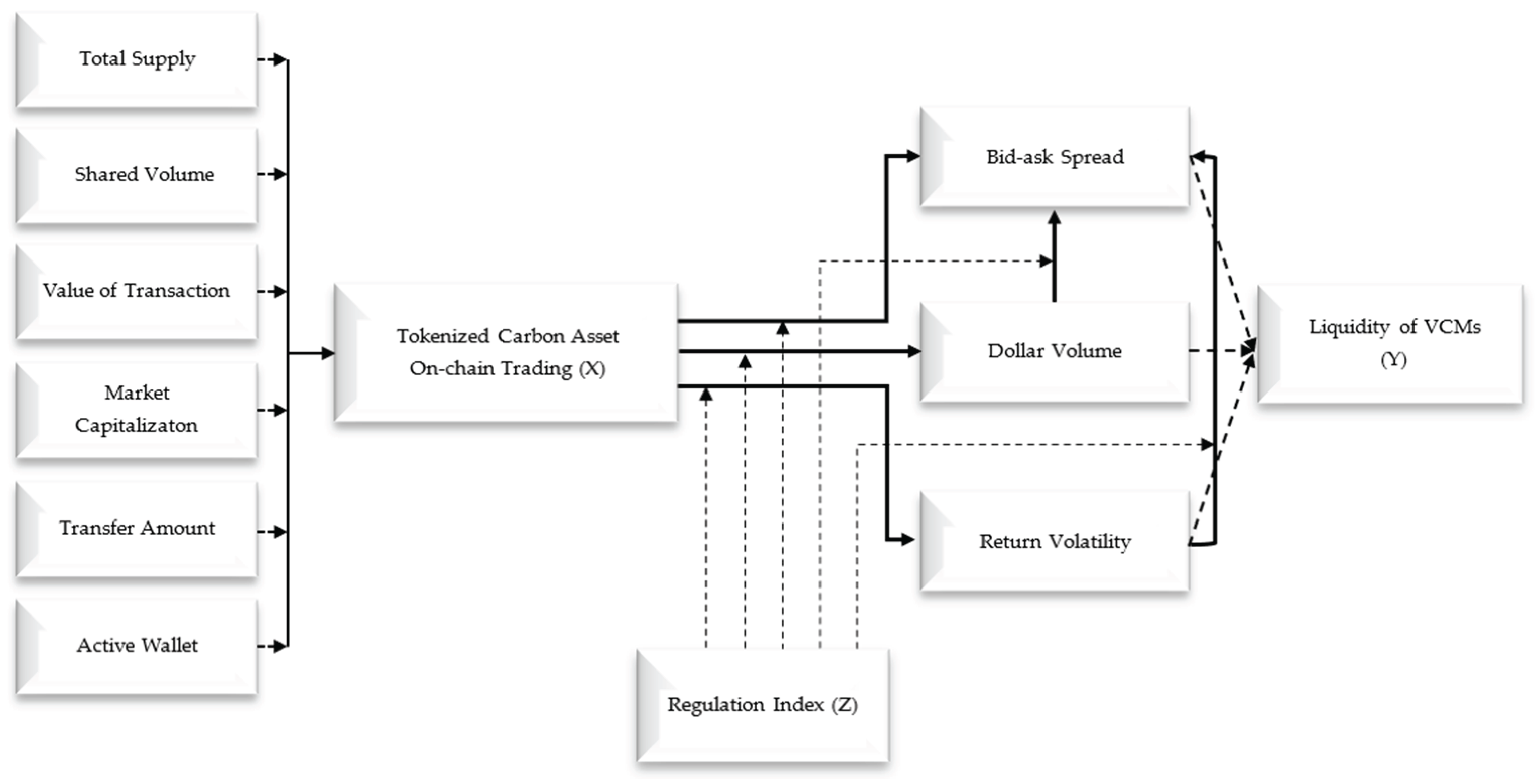
The data used in the study are the daily on-chain trading activity in blockchain-based VCMs, including $KLIMA, BCT and MCO2 token over the period extending from 20 October 2021 to 29 Oktober 2024. The data are obtained from blockchain explorer (Etherscan and Polygonscan), and data agregator (CoinGecko and CoinMarketCap), using puposive sampling. Exploratory data analysis is conducted by examining descriptive statistics of the return series and presenting graphical visualizations using scatter plots to identify potential outliers. The empirical analysis employs a moderating regression model with mixed-frequency variables, consistent with the Worldwide Governance Indicators (WGI) developed by the World Bank (2025), particularly the Regulatory Quality (RQ) index. Given the high-frequency (daily) nature of the trading data, regulatory indicators are assumed to be constant within each year (Kaufmann et al., 2010), following the temporal disaggregation framework of Chow and Lin (1971) and the mixed data sampling (MIDAS) approach for high-frequency econometric analysis (Ghysels et al., 2006).
Figure 1.
Research design flowchart.
3.1. Data Transformation
A logarithmic transformation applied to the data series (Table 1), except moderator, to stabilize variance and reduce sensitivity to extreme movements. This ensures numerical robustness, allows for zero-sampling, and retains proportional changes in the dataset.
Regulation Index (RI) is classified into five indicators adapted from Arner et al. (2019), Zetzsche et al. (2017), OECD (2021), and IOSCO (2022b) (Table 2). RI is measured on a numerical scale ranging from 0 to 10, constructed as the aggregate of five indicators. Each indicator is scored as follows: 0 denotes the absence of relevant regulation; 1 indicates partial or nascent regulation, including pilot or co-pilot stages; and 2 reflects fully established, operational regulation aligned with international standards. It computed by appplying Simple Moving Average (SMA). The use of an ordinal 0-2 scale for the regulatory index is derived from simplified binary and document-based scoring frameworks employed in OECD policy evaluations (OECD, 2021), the Regulatory Indicators for Sustainable Energy (RISE) as a global policy scorecard (Banerjee et al., 2017), the readiness measurement methodology of the Climate Investment Readiness Index (CIRI) (Mani, 2012; World Bank, 2012), and evolutionary fintech regulatory frameworks (Arner et al., 2019). This approach enables parsimonious weighting that captures progressive levels of regulatory readiness across jurisdictions and allows systematic aggregation into a composite index with a maximum score of 10.
3.2. ADF Test: Unit Root Test
The Augmented Dickey-Fuller (ADF) test is employed to examine the presence of a unit root in the time series and to determine whether the series is stationary. By augmenting the standard Dickey-Fuller regression with lagged difference terms, the ADF test controls for serial correlation in the residuals and provides a more reliable assessment of the stochastic properties of the data series and helps determine its suitability for further econometric analysis. The null hypothesis of the test states that the series contains a unit root, while the alternative hypothesis indicates stationarity. The ADF test is given by:
The value of Se(δ) represents the standard error of the coefficient of , or equivalently, the standard error of δ. Decision-making in the ADF test is conducted by comparing the ADF test statistic with the MacKinnon critical values at the 1%, 5%, and 10% significance levels (MacKinnon, 1996).
3.3. Jarque-Bera (Normality) test
The goodness-of-fit test used to assess whether the skewness and kurtosis of the sample data are consistent with those of a normal distribution. The Jarque-Bera (JB) test statistic is defined as:
T denotes the sample size, S represents the skewness coefficient, which measures the degree of asymmetry in the data distribution, and k denotes kurtosis, which captures the peakedness or tailedness of the distribution relative to the normal distribution. When the JB statistic exceeds the critical values at the 1%, 5%, and 10% significance levels, the residuals of the model are considered to be normal distribution.
3.4. Ljung Box (Autocorrelation) Test
The Ljung-Box (LB) test is employed to examine whether autocorrelation is present in the return series. Autocorrelation reflects the model’s ability to capture time-dependent dynamics in the data, indicating the extent to which current values are influenced by past observations. The LB statistic is calculated based on the sample size and a sequence of residual autocorrelations over multiple lags, and is subsequently evaluated against the chi-square distribution. The LB test is calculated as follows:
where denotes the residual autocorrelation at lag i, k represents the number of lags tested, and T is the sample size. Larger values of across multiple lags lead to higher values of the (k) statistic, indicating the presence of potential autocorrelation not fully captured by the model. The resulting test statistic is then compared with the chi-square distribution to assess its statistical significance. If the p-value is below the 1%, 5%, or 10% significance levels, autocorrelation is considered present.
3.5. White (Heteroscedasticity) test
Heteroskedasticity arises when the variance of the error terms () in a regression model is not constant across observations, which states:
The dispersion of the residuals varies with changes in the explanatory variables, violating the assumption of homoskedasticity. The hypotheses for heteroskedasticity testing are formulated as follows.
The null hypothesis (H0) assumes homoscedasticity.
While, the alternative hypothesis (H1) determines the presence of heteroskedasticity.
Heteroskedasticity is assessed using the White test, which allows for both linear and nonlinear variance structures. The White test provides a more general approach, as it does not require prior specification of the functional form of heteroskedasticity and is capable of detecting both linear and nonlinear variance patterns (White, 1980). The White test is based on the estimation of:
The White test for heteroskedasticity is based on the Lagrange Multiplier (LM) statistic, which tests the joint null hypothesis that all slope coefficients , except for the intercept, are equal to zero.
3.6. Variance Inflation Factor (Multicollinearity) test
Variance inflation factors (VIF) applied to assess the presence and severity of multicollinearity in the regression model. Multicollinearity arises when two or more independent variables or predictors in a multiple regression model are highly correlated with each other and simultaneously related to the dependent variable. The VIF is calculated based on the following equation:
where is the multiple correlation coefficient of the variable obtained by regressing the ith variable on the remaining predictors in the model. If equals zero, the corresponding VIF equals one, indicating the absence of multicollinearity. VIF values exceeding 10 indicate a high level of the multicollinearity, corresponding to an greater than 0.90.
3.7. Mean-Centered Moderated Multiple Regression Models (MMRMs)
Moderation is tested by estimating a moderated regression model that includes an interaction term (that affects the direction or strength of the relationship) between the determinant predictor and the moderator variable (Cohen et al., 2003; Cronbach, 1987; Hayes, 2013; MacKinnon, 2008; Park & Yi, 2024; Sharma et al., 1981). The moderated regression model allows for an assessment of whether regulatory conditions strengthen or weaken the impact of tokenized carbon asset on-chain trading on market liquidity of VCMs. A statistically significant coefficient on the interaction term indicates the presence of a moderation effect. The moderation effect is evaluated using Moderated Multiple Regression Models (MMRMs) (Aiken & West, 1991), researchers frequently mean-center predictor variables. Two primary reasons are often cited: first, is supported by Irwin and McClelland (2001), mean-centering facilitates interpretation of the regression equation when interaction terms are present. Second, mean-centering is applied to reduce multicollinearity, because the interaction term () is inherently highly correlated with both independent variable ) and the moderator () in Model 3. Hayes (2022) emphasizes that although mean-centering does not resolve multicollinearity, it provides interpretive advantages for direct effect and does not affect the interaction term. Within a mean-centered model, the direct effect indicates the influence of a determinant when the other determinant(s) are held at their mean. The mean-centered is given as:
This study employs a stepwise moderated regression framework consisting of three models. Model 1 estimates the baseline effect of the independent variable on VCMs’ liquidity without considering regulatory influences (direct effect). Model 2 extends the baseline specification by incorporating the regulatory index as a moderation variable to account for the direct effect of regulatory quality. Model 3 introduces an interaction term between the independent variable and the regulatory index to capture the moderating effect of regulation (indirect effect).
Model 1
Model 2
Model 3
Model - mean centering (21) gives the following (Echambadi & Hess, 2007):
for
where Yit denotes VCMs’ liquidity for token i on day t, while Xnit represents indicators of tokenized carbon asset on-chain trading. Zt is a slow-moving annual regulatory index representing carbon market regulatory quality and εit is error term, capturing unobserved influences. is predictor variable X and is predictor variable moderator (Z) that have been mean-centered. While , , , and (Park & Yi, 2024).
3.8. Heterocedasticity and Autocorrelation Consistent (HAC)
The Ordinary Least Square (OLS) estimator provides unbiased parameter estimates under the classical assumptions of homoskedasticity and no autocorrelation. The OLS estimator is computed as:
When estimation is conducted using Ordinary Least Squares (OLS), neglecting violations of homoscedasticity and normality assumptions can undermine the accuracy of hypothesis testing in moderation effect model (Alexander & DeShon, 1994; Aguinis & Pierce, 1998). To correct for potential heteroskedasticity and autocorrelation in the residuals (), the covariance matrix of the OLS estimator is estimated using the Heteroskedasticity and Autocorrelation Consistent (HAC) covariance estimator proposed by Newey and West (1987, 1994). The HAC corrections is formulated as follows:
where is the residual from the OLS regression for data in a sample of size , and q denotes the lag truncation parameter that establish the maximum lag used to correct for serial correlation. The optimal lag selection was determined automatically based on the sample size, or depends on the selection of the lag length q, beyond which the autocorrelation of and is assumed to be zero (Newey & West, 1987, 1994). Following Newey and West (1994), the optimal bandwidth parameter is determined automatically or can be approximated using the rule of thumb for the selection of the lag length , and computed as:
This correction ensures consistent standard errors in the presence of serially correlated and heteroskedastic disturbances. The moderation analysis is conducted by first estimating the baseline regression model and subsequently introducing the interaction term between the independent variable and the moderating variable, resulting in several possible outcomes based on the established classification of moderation effects (Table 3).
4. Results
This study employs daily data for three tokenized carbon assets, including $KLIMA, Base Carbon Tonne (BCT), and Moss Carbon Credit (MCO2), covering the period from 20 October 2021 to 20 October 2024. The selection of both the assets and the observation period is motivated by several considerations. First, $KLIMA, BCT, and MCO2 are among the most actively traded and widely adopted tokenized carbon assets, making them representative of the broader blockchain-based voluntary carbon markets (Carbon Credits, 2024). Second, the data are publicly available and directly accessible through blockchain, particularly PolygonScan for $KLIMA and BCT, from the initial launch of each token, ensuring transparency and data reliability.
4.1. Data
Before conducting the Augmented Dickey-Fuller (ADF) test, all the data series transformed using the natural logarithm to address the presence of zero-sampling observations. This transformation was applied because variables in tokenized carbon assets on-chain trading, including trading volume, transaction value, market capitalization, transaction frequency, and active wallets, tend to exhibit strong right-skewness, high volatility, and large dispersion, as observed in the scatter plots (Figure 2, Figure 3, Figure 4, Figure 5, Figure 6, Figure 7, Figure 8, Figure 9, Figure 10). The logarithmic transformation helps reduce skewness, stabilize variance, and dampen the influence of extreme values, thereby making the time series more suitable for unit root testing.
Figure 2 shows the daily dollar trading volume of the three tokens, revealing substantial heterogeneity and volatility clustering over time, particularly during periods of heightened market activity. $KLIMA and BCT exhibit pronounced fluctuations and episodic surges, while MCO2 displays a relatively smoother but declining volume trajectory toward the end of the sample. Figure 3 illustrates the daily bid-ask spread, where all three series fluctuate narrowly around a constant mean with no visible trend or persistence. This pattern suggests that the bid-ask spread behaves as a white noise process, reflecting short-term liquidity conditions rather than long-run dynamics. Consequently, unlike other variables, the bid–ask spread does not exhibit strong trending behavior or volatility clustering. Figure 4 presents the daily return volatility, which shows clear evidence of volatility clustering across all tokens, with elevated volatility during the early periods followed by calmer phases and intermittent spikes. This behavior is consistent with stylized facts of financial time series and supports the use of conditional heteroskedasticity models in subsequent analysis. Figure 5 depicts the evolution of total token supply, where $KLIMA and BCT show increasing or stepwise expansion patterns, while MCO2 exhibits a relatively stable or mildly declining supply, reflecting differences in token issuance and retirement mechanisms. Figure 6 and Figure 7 report the daily shared volume and transaction value, respectively. Both variables exhibit strong dispersion and nonlinear dynamics, with observable shifts in activity intensity over time. These patterns indicate changing levels of market participation and transaction size, reinforcing the presence of non-stationarity prior to transformation. Figure 8 shows the daily market capitalization, which generally follows a downward or cyclical trend, mirroring broader market conditions and price movements in carbon token markets. Figure 9 and Figure 10 display the daily transfer amount and the number of active wallets, both of which demonstrate declining trends accompanied by sporadic spikes, suggesting periods of concentrated network activity followed by sustained contractions.
4.2. Descriptive Statistic

Table 4.
Summary of Descriptive Statistics.
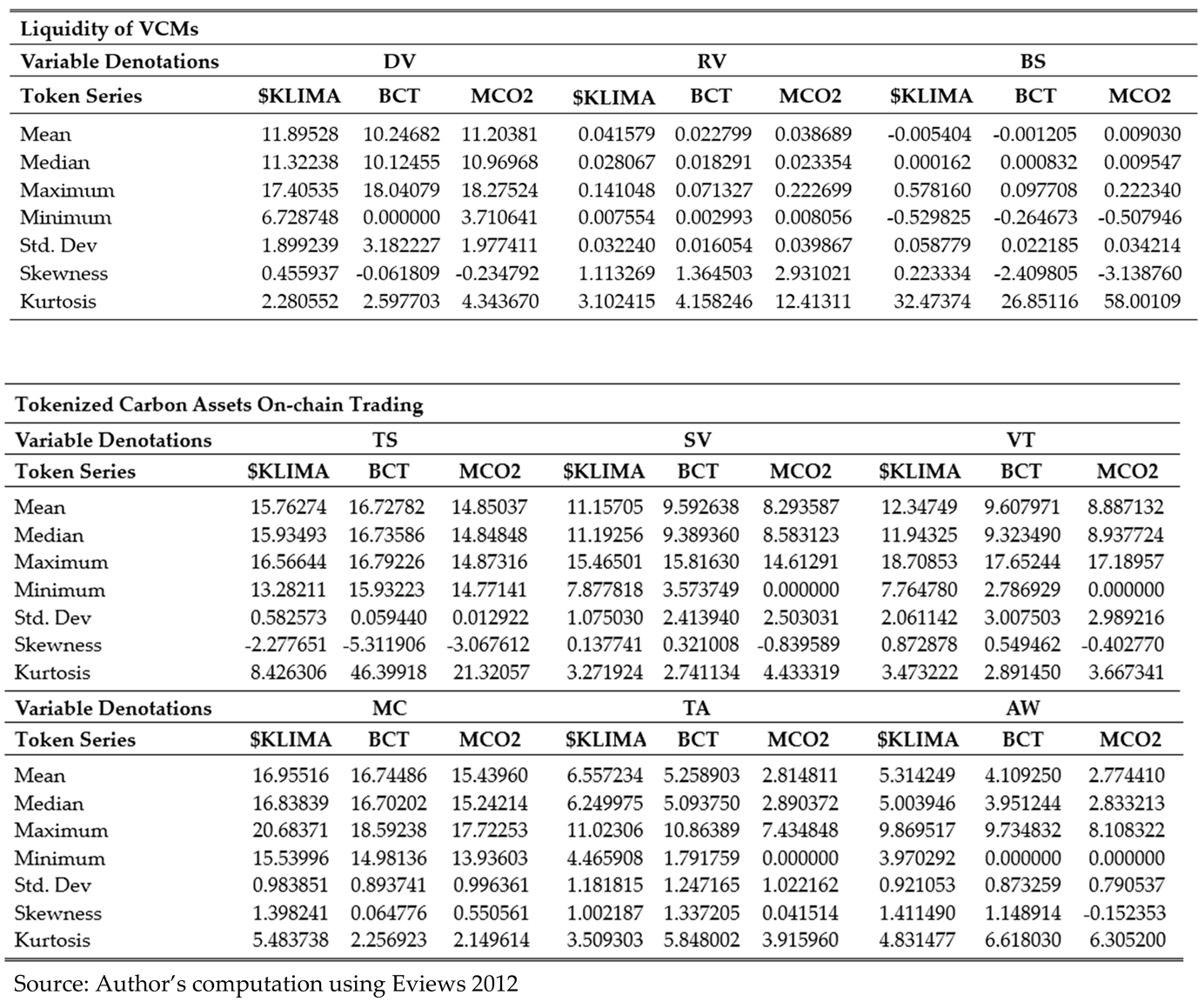
The descriptive statistics (Table 4) indicate that the empirical distributions of liquidity and on-chain trading variables deviate substantially from normality. Skewness coefficients reveal pronounced asymmetry across series, with both positive and negative values, indicating unequal probabilities of extreme upward and downward realizations. Variables related to trading activity and token supply exhibit predominantly negative skewness, suggesting that contractions in market activity occur more frequently or with greater magnitude than expansions. In contrast, variables displaying positive skewness are characterized by a longer right tail, indicating that extreme surges in return volatility, transfer amount and market capitalization occur less frequently but with relatively larger magnitudes compared to negative realizations. Kurtosis estimates for most variables exceed the normal benchmark of three types of tokens, implying leptokurtic distributions characterized by high peak and fat-tailed.
The data series in this distribution has more outliers and extreme values. This feature is particularly pronounced in return volatility and bid-ask spread series, where extremely high kurtosis reflects the coexistence of frequent small variations and infrequent but large shocks. However, a small number of series exhibit kurtosis values below three, suggesting platykurtic distributions with relatively flatter peaks and thin-tailed or spread-out shape compared to a normal distribution. There are fewer extreme weight values than expected in a normal distribution. This heterogeneity in tail behavior reflects differences in trading intensity, liquidity conditions, and on-chain activity across tokens and variables. Mean values close to zero for return volatility and bid-ask spreads indicate the absence of systematic directional bias, while the series mean value is exceeding zero indicates that the series may be not stationary. The wide range between minimum and maximum values, alongside elevated of standard deviations, confirms substantial dispersion and the presence of extreme observations (outlier). These distributional characteristics provide strong evidence of non-normality and fat-tailed behavior in tokenized carbon asset markets, supporting the use of logarithmic transformation and econometric methods robust to heteroskedasticity and tail risk.
4.3. Unit Root - ADF test
Table 5.
The ADF test Statistics at Level I(0) and First Difference I(1).
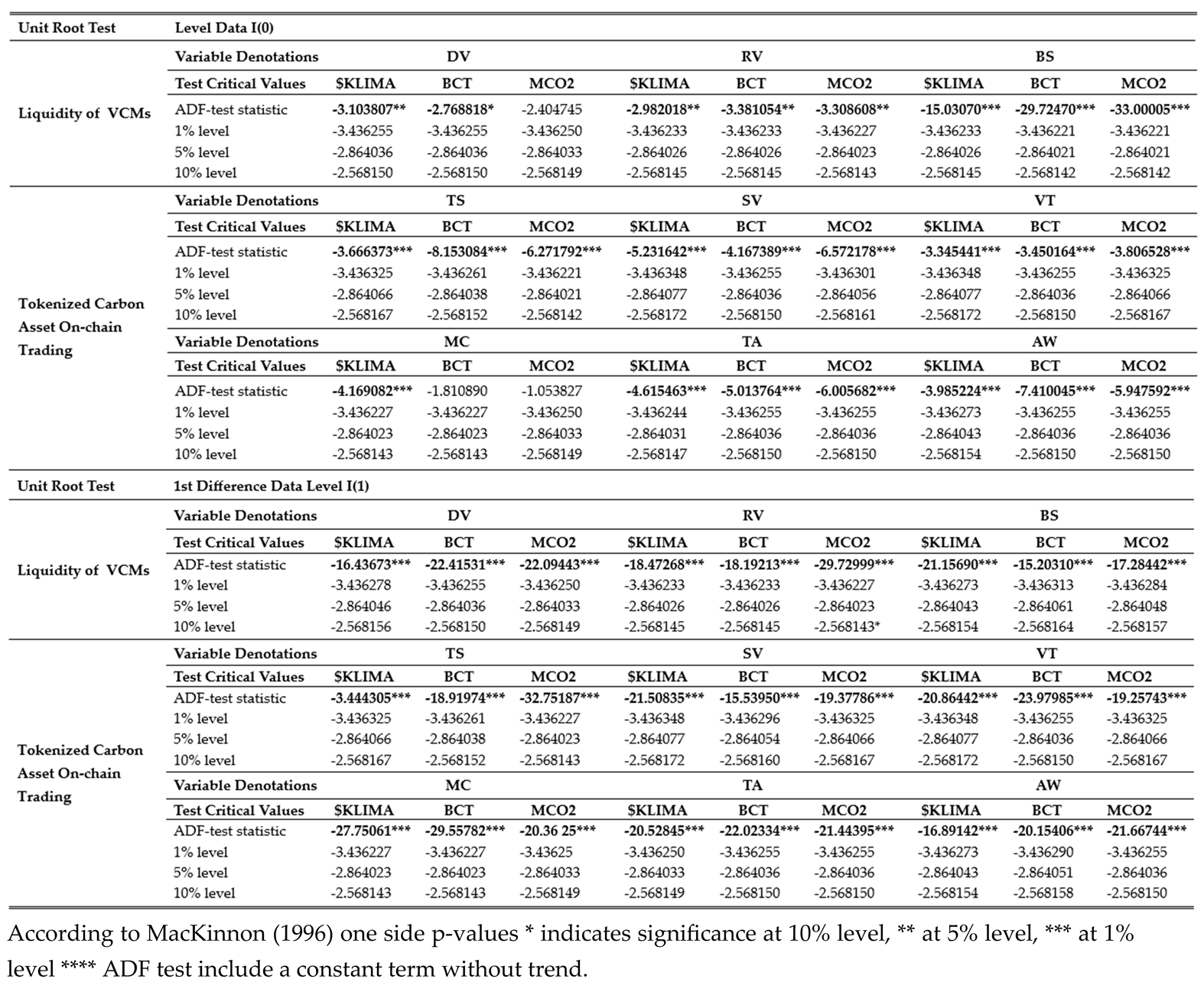
The unit root test (Table 5) employs critical values at the 99%, 95%, and 90% confidence levels. Table 3 shows that the variables in this study exhibit mixed orders of integration. Justifiably, most variables are stationary at level I(0). However, the dollar volume of MCO2 and the market capitalization of BCT and MCO2 are not stationary. After applying first differencing, that is at I(1), all variables become stationary.
4.4. Moderated Regression Analysis
We use multivariate regressions to capture the direct and moderation effect using ordinary least squared (OLS) (compares with ). After estimating the moderated regression models using OLS, which is diagnostic tests indicated the presence of autocorrelation and heteroskedasticity in the residuals () (see Appendixes B3-B4). We estimated Models 1, Model 2 and Model with Newey-West Heteroscedasticity and Autocorrelation Consistent (HAC) covariance estimator to obtain robust standard errors, following the approach adopted by Muller (2014) and Guzmán et al. (2021). Model , estimated using mean-centered data corresponding to the simulated data used in Model 3, exhibited VIFs less than 2, indicating a reduction in multicollinearity for the specific variables (see Appendix B1).
Table 6.
Moderation Effect of Tokenized Carbon On-chain Trading and Dollar Volume.
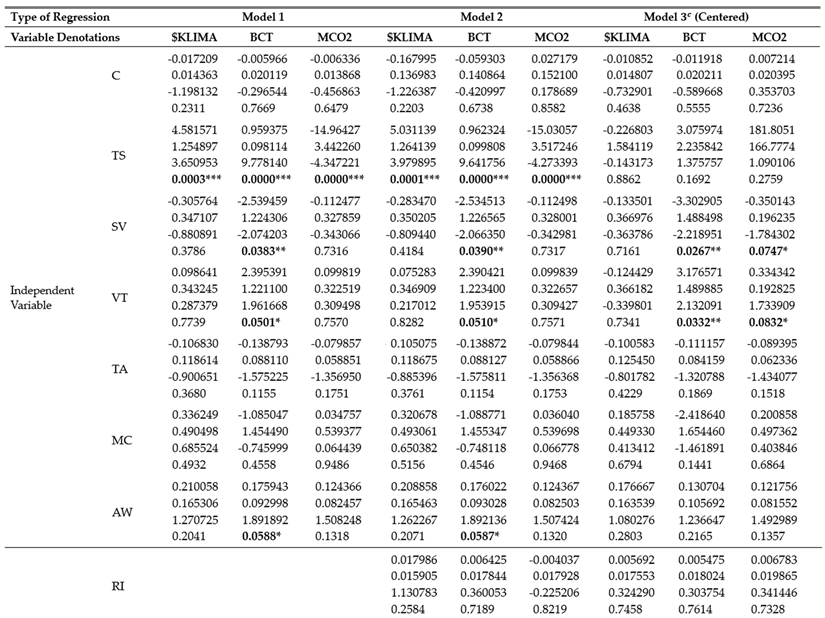
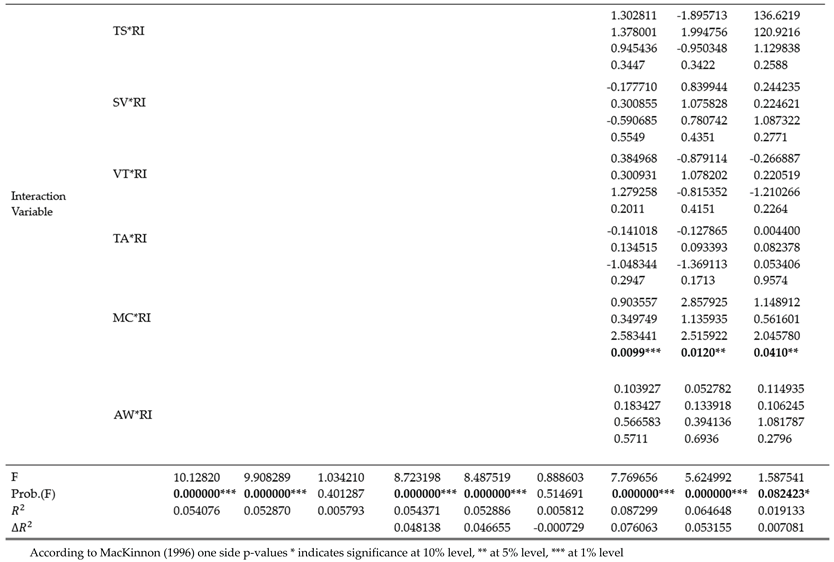
- 1.
-
Model 1DV1K = -0.017209 + 4.581571*TS - 0.305763*SV + 0.098641*VT - 0.106829*TA + 0.336248*MC + 0.210058*AWDV1B = -0.005966 + 0.959375*TS - 2.539459*SV + 2.395391*VT - 0.138792*TA - 1.0850473*MC + 0.1759425*AWDV1M = -0.006335 - 14.964266*TS - 0.112477*SV + 0.099818*VT - 0.079857*TA + 0.034757*MC + 0.124366*AW
Table 4 shows that Model 1 for the $KLIMA and BCT tokens has F-statistics of 10.12820 and 9.908289, respectively, which are positive and significant at the 1% level. The adjusted R² values are 5.40% for $KLIMA and 5.287% for BCT, indicating moderate explanatory power in explaining variations in dollar volume. In contrast, the F-statistic for MCO2 is not significant, suggesting that the regression model does not simultaneously affect dollar volume. The partial test results for $KLIMA indicate that only total supply is positively and significantly correlated with dollar volume (t-statistic = 4.581571) significant at the 1% level. For MCO2, total supply (t-statistic = -14.96427) shows a negative correlation with dollar volume. Meanwhile, for BCT, total supply (t-statistic = 0.959375), transaction value (t-statistic = 2.395391), and active wallets (t-statistic = 0.175943) exhibit positive correlation with dollar volume, whereas share volume (2.539459) has a negative effect or associated with a decline in dollar volume.
- 2.
- Model 2
| DV2 | = | *RI |
| DV2K | = | -0.167994 + 5.031138*TS - 0.283469*SV + 0.075283*VT - 0.105074*TA + 0.320678*MC + 0.208858*AW + 0.017985*RI |
| DV2B | = | -0.059303 + 0.962323*TS - 2.534512*SV + 2.390420*VT - 0.138872*TA - 1.088771*MC + 0.176022*AW + 0.006424*RI |
| DV2M | = | 0.027178 - 15.030573*TS - 0.112498*SV + 0.099838*VT - 0.079843*TA + 0.036040*MC + 0.124366*AW - 0.004037*RI |
Model 2 extends the baseline specification by adding regulatory variables without interaction terms in the regression model. Nevertheless, none of the regulatory indicators are statistically significant, and the overall estimation results remain largely consistent with Model 1, differing only in coefficient magnitudes. This suggests that regulation, when included independently, does not provide additional explanatory power for dollar volume. The results of F-statistic for $KLIMA of 8.723198 and BCT of 8.487519 remain positive and statistically significant, indicating that the regression model continues to be valid after the inclusion of regulatory variables. The R² values of 0.054371 for $KLIMA and 0.052886 for BCT indicate that the model explains approximately 5.44% and 5.29% of the variation in dollar volume, respectively. Although all regulatory indicators are individually insignificant, their inclusion leads to an improvement in the model’s explanatory power, with an increase in adjusted R² of less than 1%. The partial regression results for $KLIMA indicate that only total supply is positively and significantly correlated with dollar volume (t-statistic = 5.031139) significant at the 1% level. For MCO2, total supply (t-statistic = -15.03057) shows a negative correlation with dollar volume. Meanwhile, for BCT, total supply (t-statistic = 0.962324), transaction value (t-statistic = 2.390421), and active wallets (t-statistic = 0.176022) exhibit positive correlation with dollar volume, whereas shared volume (2.534513) shows a negative correlation, indicating a potential reduction in dollar volume.
- 3.
- Model 3
| DV_C3 | = | **AWRI_C |
| DV_C3K | = | -0.010851 - 0.226803*TS_C - 0.133500*SV_C - 0.124428*VT_C - 0.100583*TA_C + 0.185758*MC_C + 0.176666*AW_C + 0.005692*RI_C + 1.302811*TSRI_C - 0.177710*SVRI_C + 0.384968*VTRI_C - 0.141018*TARI_C + 0.903556*MCRI_C + 0.103926*AWRI_C |
| DV_C3B | = | -0.011918 + 3.075974*TS_C - 3.302904*SV_C + 3.176571*VT_C - 0.111156*TA_C - 2.418640*MC_C + 0.130703*AW_C + 0.0054749*RI_C - 1.895713*TSRI_C + 0.839944*SVRI_C - 0.879113*VTRI_C - 0.127865*TARI_C + 2.857925*MCRI_C + 0.0527820*AWRI_C |
| DV_C3M | = | 0.007213 + 181.805063*TS_C - 0.350142*SV_C + 0.334341*VT_C - 0.089395*TA_C + 0.200857*MC_C + 0.121755*AW_C + 0.006782*RI_C + 136.621861*TSRI_C + 0.244234*SVRI_C - 0.2668866*VTRI_C + 0.004399*TARI_C + 1.148911*MCRI_C + 0.114934*AWRI_C |
Model Model is estimated using mean-centered Moderated Multiple Regression Models (MMRMs) and shows that the F-statistics for all carbon tokens are positive and statistically significant, with values of 7.769656 for $KLIMA, 5.624992 for BCT, and 1.587541 for MCO2. The inclusion of interaction terms improves the model’s explanatory power, as reflected by increases in adjusted R² of more than 1%, reaching 8.70% for $KLIMA, 6.46% for BCT, and 1.91% for MCO2. The partial regression results indicate that none of the main predictor has a significant effect on dollar volume for $KLIMA. In contrast, for BCT and MCO2, share volume is negatively and significantly correlated with dollar volume, with t-statistics of 3.302905 and 0.350143, respectively. Meanwhile, transaction value shows a positive and significant relationship with dollar volume for both tokens, with t-statistics of 3.176571 for BCT and 0.334342 for MCO2. These findings suggest that the greater volume of tokens traded may reduce dollar volume, whereas higher transaction prices contribute to increasing dollar volume. Regarding the interaction terms, only the interaction between market capitalization and regulation is positively and significantly correlated with dollar volume across all tokens $KLIMA, BCT, and MCO2, with t-statistics of 0.903557, 2.8557925, and 1.148912. The regulatory factors play an important moderating role in influencing trading activity, particularly through their interaction with market capitalization, thereby reinforcing the relevance of regulatory in carbon token markets.
Table 7.
Moderation Effect of Tokenized Carbon On-chain Trading and Bid-ask Spread.
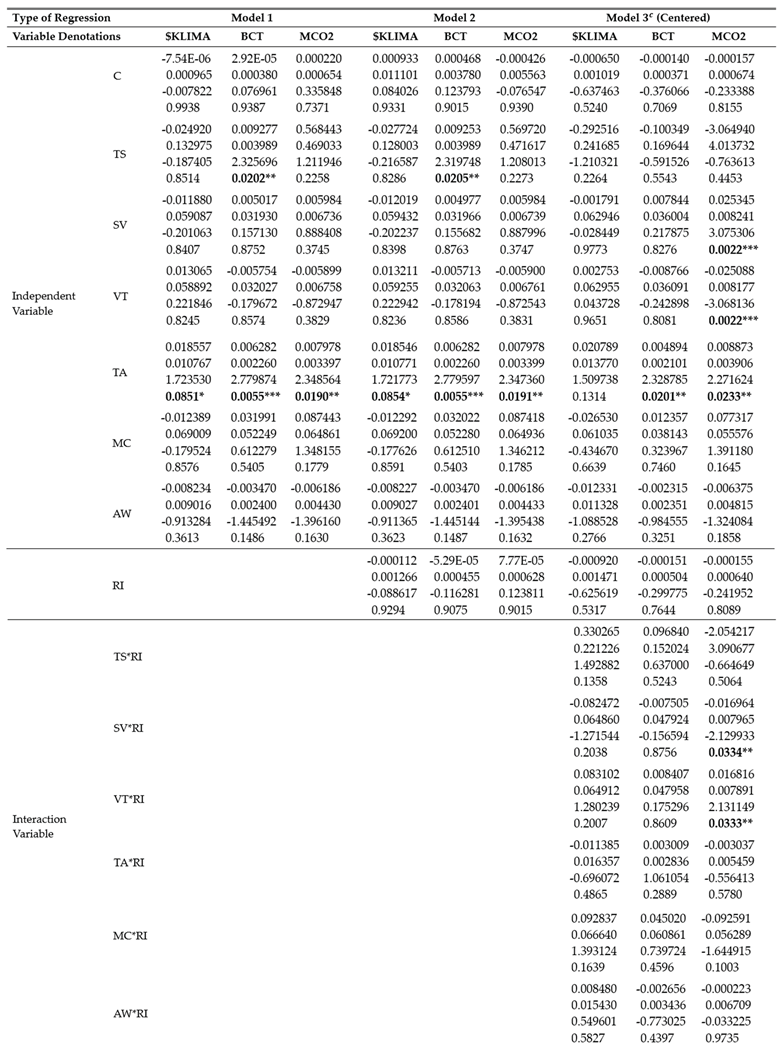

- Model 1
| BS1 | = | *AW |
| BS1K | = | -7.544500 - 0.024920*TS - 0.011880*SV + 0.013064*VT + 0.018556*TA - 0.012388*MC - 0.008234*AW |
| BS1B | = | 2.922749 + 0.009277*TS + 0.005017*SV - 0.005754*VT + 0.006281*TA + 0.031991*MC - 0.003469*AW |
| BS1M | = | 0.000219 + 0.568442*TS + 0.005984*SV - 0.005899*VT + 0.007978*TA + 0.087442*MC - 0.006185*AW |
Table 7 shows the F-statistic in Model 1 for $KLIMA is not statistically significant, and at the partial level, only the transfer amount variable is significant at the 10% level. In contrast, the F- statistic results for the other two tokens are statistically significant, with values of 2.612653 for BCT and 5.112551 for MCO₂, indicating that the predictors are jointly and positively associated with bid-ask spread. However, the corresponding R² values are relatively low, 0.014506 for BCT and 0.027997 for MCO2, suggesting that the regression models have weak explanatory power in explaining variations in dollar volume. At the partial level, total supply and transfer amount are positively correlated with bid-ask spread for BCT, whereas for MCO2, transfer amount emerges as the primary predictor. This finding indicates that the number or daily frequency of carbon token transactions serves as a key determinant in increasing bid-ask spread.
- 2.
- Model 2
| BS2 | = | *RI |
| BS2K | = | 0.000932 - 0.027723*TS - 0.012019*SV + 0.013210*VT + 0.018545*TA - 0.012291*MC - 0.008226*AW - 0.000112*RI |
| BS2B | = | 0.000467 + 0.009252*TS + 0.004976*SV - 0.005713*VT + 0.006282*TA + 0.032021*MC - 0.003470*AW - 5.285022*RI |
| BS2M | = | -0.000425 + 0.569719*TS + 0.005984*SV - 0.005899*VT + 0.007978*TA + 0.087417*MC - 0.006185*AW + 7.774379*RI |
The results remain consistent in Model 2, where the inclusion of the regulatory moderation variable without interaction terms does not yield statistically significant effects. The F-statistic for $KLIMA (1.277560) exceed their 10% critical value, and at the partial level, only the transfer amount (t test = 0.018557) is positively correlated with bid-ask spread. For the BCT token, the F-statistic value of 2.237685 is statistically significant positive, and the regression model explains 1.45% of the variation in bid-ask spread, representing a slight increase relative to Model 1, although the improvement is not statistically significant (less than 1%). At the partial level, total supply (t-statistic = 0.09253) and transfer amount (t-statistic = 0.006282) remain statistically significant and positively correlated with bid-ask spread. For MCO2, the F-statistic value is 4.37685, with the regression model explaining 2.79% of the variation in bid-ask spread. The t-statistic result for transfer amount (0.007978) is significant at the 5% level, indicating a positive correlation with bid-ask spread. These results indicate that the daily frequency of transactions is the main predictor to spread size.
- 3.
- Model 3c
| BS3 | = | **AWRI_C |
| BS3K | = | -0.000649 - 0.292515*TS_C - 0.001790*SV_C + 0.002752*VT_C + 0.020789*TA_C - 0.026530*MC_C - 0.012330*AW_C - 0.000920*RI_C + 0.330264*TSRI_C - 0.082472*SVRI_C + 0.083102*VTRI_C - 0.011385*TARI_C + 0.092837*MCRI_C + 0.008480*AWRI_C |
| BS3B | = | -0.000139 - 0.1003491*TS_C + 0.007844*SV_C - 0.008766*VT_C + 0.004893*TA_C + 0.012357*MC_C - 0.002314*AW_C - 0.000151*RI_C + 0.096839*TSRI_C - 0.007504*SVRI_C + 0.008406*VTRI_C + 0.003008*TARI_C + 0.045020*MCRI_C - 0.002656*AWRI_C |
| BS3M | = | -0.000157 - 3.064939*TS_C + 0.025344*SV_C - 0.025087*VT_C + 0.008872*TA_C + 0.077316*MC_C - 0.006375*AW_C - 0.000154*RI_C - 2.054216*TSRI_C - 0.016964*SVRI_C + 0.016816*VTRI_C - 0.003037*TARI_C - 0.092590*MCRI_C - 0.000222*AWRI_C |
Table 7 shows that for carbon tokens KLIMA, BCT, and MCO₂, the Model F-statistics (1.760903, 2.108358, and 3.412527) are significant at the 5% level, indicating that the regression models simultaneously explain variations in the bid-ask spread. The corresponding explanatory power of the models is relatively modest, with adjusted R² values of 2.12%, 2.52%, and 4.02%, respectively. At the partial level, none of the main predictors, the regulatory moderation variable, nor their interaction terms are statistically significant for $KLIMA token, as all exceed the 10% significance level. For BCT, only the transfer amount variable (t-statistic = 0.04894) is significant at the 5% level and is positively associated with the bid-ask spread. For MCO2, the share volume (t-statistic = 0.022534) and transfer amount (t-statistic = 0.0008873) exhibit positive correlations with the bid-ask spread, while the transaction value variable (t-statistic = -0.025088) is negatively correlations with the bid-ask spread. In addition, the interaction terms between share volume with regulation (t-statistic = -0.016964) and transaction value with regulation (t-statistic = 0.01681) are significant at the 5% level, indicating that regulatory conditions moderate the relationship between on-chain trading activity and bid-ask spread.
Table 8.
Moderation Effect of Tokenized Carbon On-chain Trading and Return Volatility.
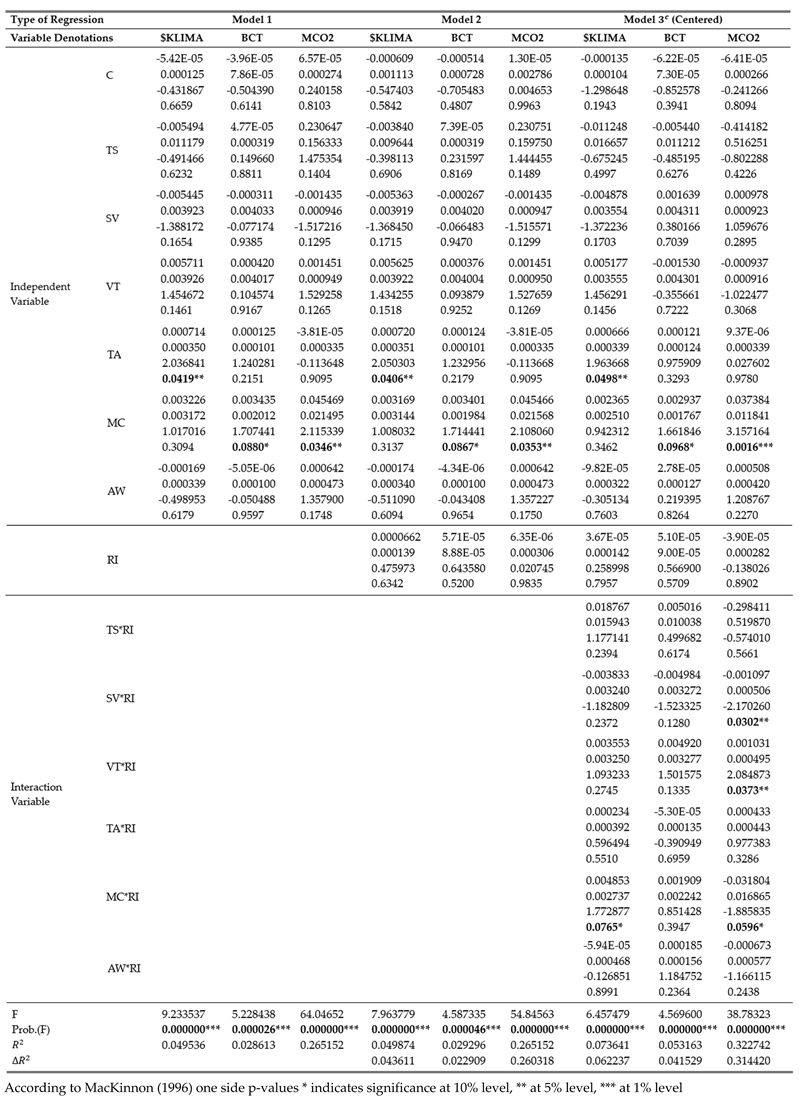
- Model 1
| RV1 | = | *AW |
| RV1K | = | -5.419867 - 0.005494*TS - 0.005445*SV + 0.005710*VT + 0.000713*TA + 0.003226*MC - 0.000169*AW |
| RV1B | = | -3.964639 + 4.771084*TS - 0.000311*SV + 0.000420*VT + 0.0001250*TA + 0.003434*MC - 5.054299*AW |
| RV1M | = | 6.569369 + 0.230647*TS - 0.001434*SV + 0.001450*VT - 3.808776*TA + 0.045468*MC + 0.000642*AW |
Table 8 shows that for carbon tokens $KLIMA, BCT, and MCO2, F-statistics of the Model 1 (9.233537, 5.228438, and 64.04652) are statistically significant at the 1% level, indicating that the regression models jointly explain variations in return volatility. The adjusted R² values indicate heterogeneous explanatory power across tokens, amounting to 4.95% for $KLIMA, 2.86% for BCT, and a substantially higher 26.51% for MCO2. This suggests that the regression model captures return volatility dynamics more effectively for MCO2 compared to the other carbon tokens. At the partial level, only the total amount variable (0.000714) exhibits a positive and statistically significant relationship with return volatility for $KLIMA at the 5% significance level. In contrast, for both BCT and MCO2, market capitalization emerges as the primary determinant of return volatility, with statistically significant t-values of 0.003435 and 0.045469, respectively. These findings indicate that while transactional activity drives volatility in $KLIMA, size-related market factors play a more dominant role in explaining return volatility for BCT and MCO2.
- 2.
- Model 2
| RV2 | = | *RI |
| RV2K | = | -0.000609 - 0.003839*TS - 0.005363*SV + 0.005624*VT + 0.000720*TA + 0.003168*MC - 0.000173*AW + 6.620261*RI |
| RV2B | = | -0.000513 + 7.3925383*TS - 0.000267*SV + 0.000375*VT + 0.000124*TA + 0.003401*MC - 4.344180*AW + 5.712846*RI |
| RV2M | = | 1.296245 + 0.2307513*TS - 0.0014349*SV + 0.001450*VT - 3.810951*TA + 0.045466*MC + 0.000642*AW + 6.352417*RI |
In Model 2, the F-statistics for all carbon tokens decline but remain positive and statistically significant (7.963779 for $KLIMA, 4.2587335 for BCT, and 54.84563 for MCO2). This significance indicates that return volatility remains predictable using the regression framework. However, the explanatory power of the models improves only marginally, with increases in adjusted R² of less than 1%, suggesting that the additional explanatory variables contribute limited incremental information. At the partial level, total amount remains the main determinant of return volatility for $KLIMA, exhibiting a weak but positive association (t-statistic = 0.000720). In contrast, market capitalization for both BCT and MCO2 continues to exert a significant influence on increasing return uncertainty, with statistically significant t-statistic of 0.003435 and 0.045469, respectively. These findings indicate that while transactional activity drives volatility in $KLIMA, size-related market factors play a more dominant role in explaining return volatility for BCT and MCO2. Furthermore, the regulatory moderation variable remains statistically insignificant across all tokens, indicating that regulation does not exert a direct effect on return volatility in the absence of interaction terms.
- 3.
- Model 3c
| RV3 | = | **AWRI_C |
| RV3K | = | -0.000134 - 0.011247*TS_C - 0.004877*SV_C + 0.005177*VT_C + 0.000666*TA_C + 0.002365*MC_C - 9.816520*AW_C + 3.673547*RI_C + 0.018766*TSRI_C - 0.003832*SVRI_C + 0.003553*VTRI_C + 0.000233*TARI_C + 0.004852*MCRI_C - 5.938385*AWRI_C |
| RV3B | = | -6.224002 - 0.005440*TS_C + 0.001638*SV_C - 0.001529*VT_C + 0.000121*TA_C + 0.002937*MC_C + 2.778274*AW_C + 5.099333*RI_C + 0.005015*TSRI_C - 0.004984*SVRI_C + 0.004920*VTRI_C - 5.295257*TARI_C + 0.001908*MCRI_C + 0.000184*AWRI_C |
| RV3M | = | -6.413245 - 0.414182*TS_C + 0.000977*SV_C - 0.000936*VT_C + 9.365213*TA_C + 0.037383*MC_C + 0.000508*AW_C - 3.897271*RI_C - 0.298410*TSRI_C - 0.001097*SVRI_C + 0.001031*VTRI_C + 0.000432*TARI_C - 0.031803*MCRI_C - 0.000673*AWRI_C |
The results of the moderation effect analysis indicate that the F-statistics of 6.457479 for $KLIMA, 4.569600 for BCT, and 38.78323 for MCO2 are positive and significant at the 1% level. These findings suggest that regression model , estimated using mean-centered Moderated Multiple Regression Models (MMRMs), effectively explains variations in return volatility. Furthermore, the adjusted R² values exhibit notable improvements of 7.36% for $KLIMA, 5.32% for BCT, and 32.2% for MCO2, indicating a substantial enhancement in the explanatory power of the model, particularly well fitted to explain return volatility for MCO2. The partial regression results, for $KLIMA, reveal that the transfer amount (t-statistic = 0.000666) is significant at the 5% level, while the interaction between market capitalization and regulation (t-statistic = 0.004853) is significant at the 10% level. They demonstrate a positive correlation with return volatility. For the BCT token, market capitalization (t-statistic = 0.002937) is the only variable that exhibits a positive and statistically significant correlation with return volatility. In other hand, MCO2 presents that market capitalization (t-statistic = 0.037384) has a positive correlation with return volatility. However, within the MMRM framework, the t-statistic of the interactions between total supply and regulation is (0.001097) and between market capitalization and regulation is (0.031804), both are significant negatively correlated to return volatility at 5% critical level. These results indicate that larger market size and higher frequency transaction may contribute to reducing volatility under regulatory influence. Conversely, the interaction between share volume and regulation exhibits a positive effect on return volatility (t-statistic = 0.001031), suggesting that regulatory conditions may amplify volatility in high-volume trading environments.
4.4.1. The Effect of Trading Volume and Return Volatility in Liquidity Series
- Model 1
| BS_C1 | = | *RV |
| BS_C1K | = | 0.000142 + 0.001612*DV + 1.902649*RV |
| BS_C1B | = | -4.004023 + 0.000109*DV + 0.012012*RV |
| BS_C1M | = | 5.129239 - 0.000823*DV + 0.856416*RV |
Table 9 shows that the return volatility of carbon tokens measured by bid-ask spreads exhibits a strong positive relationship for $KLIMA, with a positive correlation of 1.902649, while no significant correlation is observed between dollar volume and the bid-ask spread. In contrast, for the BCT and MCO2 tokens, no significant correlation is found between examined variable and the bid-ask spread. However, the F-statistic results for $KLIMA (3.055399) and MCO2 (0.016160) are statistically significant, indicating that the predictors jointly contribute to a widening of the spread size. For the $KLIMA token, the adjusted value of 0.047515 indicates that 4.75% of the variation in the bid-ask spread is explained by dollar volume and return volatility. For the MCO2 token, the value of 0.014323 suggests that only 1.43% of the variation in the bid-ask spread is explained by the model, while the remaining 98.57% is attributable to factors outside the scope of this study.
Table 9.
Moderation Effect in Liquidity Series.
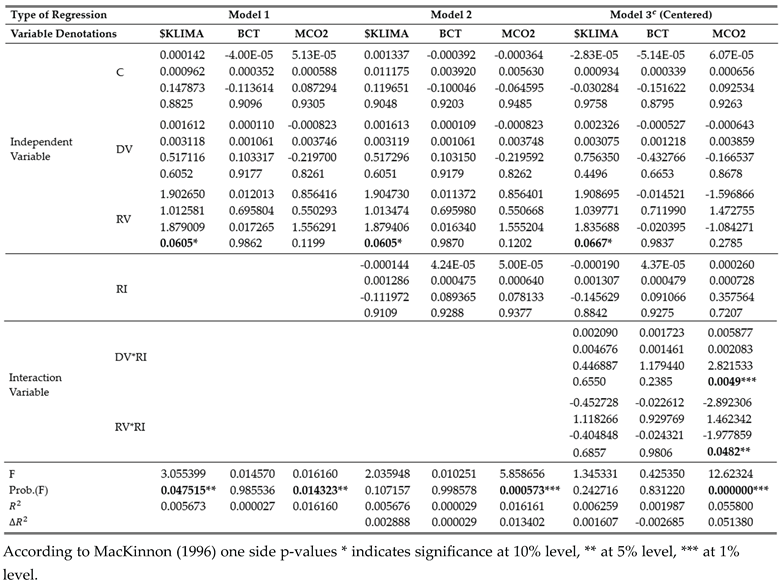
- 2.
- Model 2
| BS2 | = | *DV_C + *RV_C + *RI |
| BS2K | = | 0.001337 + 0.001613*DV + 1.904729*RV - 0.000143*RI |
| BS2B | = | -0.000392 + 0.000109*DV + 0.011372*RV + 4.242493*RI |
| BS2M | = | -0.000363 - 0.000822*DV + 0.856401*RV + 4.999821*RI |
The inclusion of the regulatory moderation variable is not statistically significant across the three tokens. The F-statistic results indicate that the moderation effect is not significant for the KLIMA and BCT tokens, while it is statistically significant for MCO2. Meanwhile, the relationship between return volatility and the bid-ask spread for KLIMA remains statistically significant based on the t-statistic, with a positive correlation of 1.904730. In contrast, for the MCO2 and BCT tokens, the t-statistic results indicate no statistically significant relationship. Only the predictors in the MCO2 model are statistically significant in explaining the widening of the bid-ask spread, as indicated by an F-statistic value of 5.858656.
- 3.
- Model
| BS_C3 | = | *RVRI_C |
| BS_C3K | = | -2.827475+ 0.002325*DV_C + 1.908694*RV_C - 0.000190*RI_C + 0.002089*DVRI_C - 0.452727*RVRI_C |
| BS_C3B | = | -5.138143 - 0.000527*DV_C - 0.014520*RV_C + 4.366087*RI_C + 0.001723*DVRI_C - 0.022612*RVRI_C |
| BS_C3M | = | 6.070109 - 0.000642*DV_C - 1.596865*RV_C + 0.000260*RI_C + 0.005876*DVRI_C - 2.892305*RVRI_C |
In the Model , the F-statistic for the MCO2 token indicates a statistically significant result with a positive correlation of 12.62324, suggesting that 5.58% of the variation in the bid-ask spread can be explained by the regression model. Accordingly, dollar volume, return volatility, the regulatory moderation variable, and their interaction terms jointly exert a significant effect on the widening of the bid-ask spread. Partial test results show that the interaction between dollar volume and regulation has the potential to widen the spread, as indicated by the t-statistic (0.005877). In contrast, the interaction between return volatility and regulation reduces the bid-ask spread, as reflected by a negative t-statistic (-2.892306). For the $KLIMA token, only return volatility (t-statistic = 1.908694) exhibits the potential to increase the bid-ask spread. Meanwhile, for the BCT token, neither the partial nor the simultaneous tests are statistically significant, indicating that regulation does not function as a moderating variable in the regression model.
4.5. Diagnostic Checking of Residuals
4.5.1. Jarque-Bera test
The Jarque-Bera test (see Appendix B3) performs statistically significant results across all models. Nevertheless, in accordance with the Law of Large Numbers (LLNs) and the Central Limit Theorem (CLT), the distribution of sample means will approach the normal distribution as the sample size increases (Hernandez, 2019), mostly defined as an n ≥ 30 (Mascha & Vetter, 2018). Consequently, increasing the sample size reduces the random sampling error, thereby enhancing the stability and reliability of statistical inference (Islam, 2018).
4.5.2. Ljung-Box Test
The Ljung-Box autocorrelation test (see Appendix B4) provides strong evidence to reject the null hypothesis at the 1% significance level up to 10 lags, indicating that the residuals are not independently distributed and exhibit serial correlation. The result remains robust after HAC correction.
4.5.3. White Test
The White test results (see Appendix B2), for $KLIMA token, fails to reject the null hypothesis of homoskedasticity for Model 1 and Model , estimated using mean-centered MMRMs, with p-values exceeding the 10% significance level when dollar volume is used as the dependent variable. However, for BCT and MCO2 remains statistically significant at the 1% and 5% levels across all model. It was deduced that the null hypothesis of homoscedasticity was rejected for all regression model. This is because the probability value of the chi-square was less than 1% levels of significance. This implies that the residual of the model was still heteroscedastic. The continued presence of heteroskedasticity for BCT and MCO2, even after HAC correction, points to structural variance instability, potentially driven by differences in liquidity, trading intensity, and market microstructure characteristics. These findings suggest that mean-centered MMRMs reduces multicollinearity only for specific tokens and regression model. Therefore, HAC robustness corrections were applied to ensure the reliability of the estimation results.
4.5.4. VIF Test
Variance inflation factors (VIFs) are computed based on OLS estimator before and after mean-centering to assess multicollinearity. The VIF test indicate the presence of multicollinearity for total supply, shared volume, and transaction value across all models (see Appendix B1). Switching model to the mean-centered MMRMs in Model reduces VIF values, although multicollinearity remains present. While market capitalization, transfer amount, and active wallets exhibit VIF values below a numerical rule-of-thumb threshold 10, indicating no multicollinearity. The VIF result shows that the model is not free from multicollinearity problems. Hence, the study concludes that the study variables are feasible for parametric analysis, even though some of their VIF values were up to 10. Following O’Brien (2007), high VIF values do not necessarily imply inflated estimated variances, as factors such as large sample sizes, particularly in time-series data, can offset multicollinearity effects and preserve reliable statistical inference. even after the application of HAC robustness corrections.
4.6. Moderation Effect
Table 10 reports the estimation results of interaction terms between tokenized carbon asset on-chain trading variables and regulatory index (RI) across $KLIMA, BCT, and MCO2, with dollar volume (DV), bid-ask spread (BS), and return volatility (RV) as dependent variables. The classification of moderation effects follows the distinction between homologizer moderators and pure moderators, based on the statistical significance of the interaction coefficients.
Table 10.
Moderation Effect Classification.
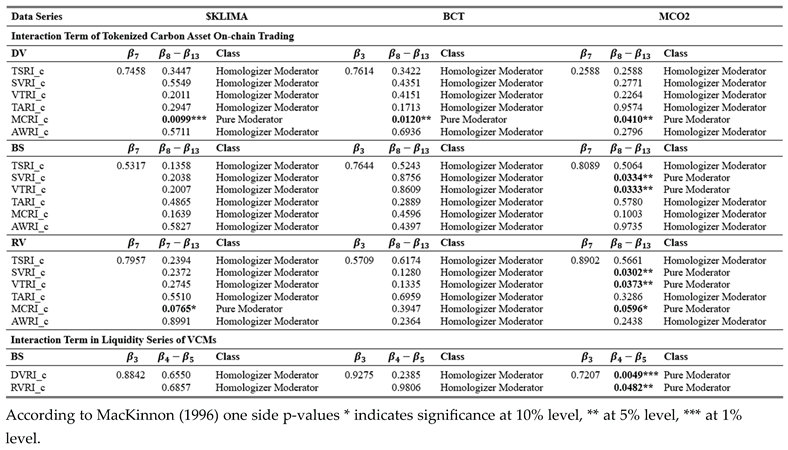
In the DV regressions, most interaction terms, including as TSRI_c, SVRI_c, VTRI_c, TARI_c, and AWRI_c, are statistically insignificant and therefore classified as homologizer moderators across all three tokens. This indicates that regulatory intensity reinforces the existing relationship between on-chain trading activity and dollar volume without fundamentally altering its direction or significance. In contrast, the interaction between market capitalization and regulatory intensity (MCRI_c) is statistically significant for all tokens, with coefficients significant at the 1% level for KLIMA ( = 0.0099), the 5% level for BCT ( = 0.0120), and the 5% level for MCO2 ( = 0.0410). These results classify MCRI_c as a pure moderator, indicating that regulatory index exerts an independent moderating effect on the relationship between market capitalization and dollar volume, thereby strengthening the role of market size in driving dollar volume under tighter regulatory conditions.
For BS, interaction effects for $KLIMA and BCT are largely insignificant and thus categorized as homologizer moderators. However, for MCO2, both SVRI_c and VTRI_c exhibit statistically significant interaction effects at the 5% level ( = 0.0334 and = 0.0333), classifying them as pure moderators. This suggests that regulatory intensity directly affects liquidity costs in the MCO2 market by altering the impact of on-chain trading activity variables on bid-ask spreads.
For RV regressions, most interaction terms again function as homologizer moderators, reflecting that regulatory intensity generally conditions, rather than restructures. Nonetheless, MCRI_c is statistically significant at the 10% level for $KLIMA(0.0765) and MCO2 ( = 0.0596) acts as a pure moderator, indicating a pure moderating role of regulatory index in shaping the capitalization-volatility relationship in these markets. In addition, SVRI_c ( = 0.0302) and VTRI_c ( = 0.0373) emerge as pure moderators for MCO2 only, both are statistically significant at the 5% level, further supporting the presence of pure moderation effects in volatility dynamics for this token. These results suggest that regulatory intensity has a stronger and more direct volatility-moderating role in less liquid or more concentrated token markets.
The interaction models where liquidity variables are conditioned on regulatory index, pure moderation effects are again concentrated in MCO2. The interaction DVRI_c is highly significant at the 1% level ( = 0.0049), while RVRI_c is significant at the 5% level ( = 0.0482). These results suggest that regulatory intensity plays a decisive and independent role in shaping liquidity dynamics in the MCO2 market. No corresponding pure moderator effects are found for KLIMA or BCT.
The evidence indicates that regulatory intensity predominantly acts as a homologizer moderator across tokenized carbon on-chain markets. However, statistically significant pure moderator effects are sparse and highly asymmetric across tokens, occurring predominantly in the MCO2 market and primarily through market capitalization, shared volume and transaction value. In contrast, the majority of interaction terms across $KLIMA and BCT operate as homologizer moderators, indicating that regulatory intensity generally reinforces existing market relationships rather than fundamentally restructuring them.
5. Discussion
5.1. Direct Effect
$KLIMA is a treasury-backed token with highly concentrated supply distribution, staking mechanisms, and demand structure, while BCT has a large free float and functions as a base carbon asset, causing its liquidity dynamics to be more strongly influenced by bridging mechanisms, token pools, and cross-DEX arbitrage strategies. Moreover, MCO2 exhibits a relatively narrow market structure characterized by a single type of carbon project, limited diversification, and high token holder concentration.
Based on the computation, total supply exhibits a positive effect on dollar volume for $KLIMA and BCT, but a negative effect for MCO2, indicating heterogeneity in how token issuance translates into trading activity across tokenized carbon markets. Simultaneously, all six predictors exert a positive and significant effect on dollar volume for $KLIMA and BCT, suggesting that trading value in these markets is jointly driven by supply availability, transaction intensity, and on-chain participation. These results are consistent with evidence that transaction value and transfer activity enhance liquidity and trading volume (Ante, 2020; Liu et al., 2023), and with studies showing that transaction value is a key determinant of trading volume through price formation and legal certainty channels (Bhaduri, 2000). Related work in commodity transaction management further emphasizes that lot size and transaction value are central in shaping realized trading volume and improving volume predictability (Shaju et al., 2023), while historical and contemporaneous transaction volumes anchor feasible price ranges and market depth (Chitaley et al., 2010). Prior evidence also documents that supply, transaction value, and asset distribution influence trading volume by determining instrument availability for investors (Lee et al., 2025; Liu et al., 2010). More broadly, volume and transaction value are consistently linked to price fluctuations, abnormal returns, and index movements (Bhattacharya et al., 2016; George et al., 1994; Najiatun et al., 2022; Salim et al., 2022), reflecting their role as proxies for information intensity in markets, which in turn amplifies volatility and trading activity (Shi, 2005, 2006; Takaishi et al., 2016).
Beyond supply, shared volume is negatively correlated with dollar volume, while transaction value and active wallets exert positive effects only for BCT, indicating that trading value in BCT is more strongly driven by transaction size and participant activity than by sheer turnover frequency. Nevertheless, high transaction volume tends to originate from noise trading activities rather than from informed traders or whales (big holder) with superior information, and therefore does not explicitly reflect the intensity of information entering the market, because the traders are investors make investment decisions without relying on financial fundamentals, but instead base their actions on sentiment or misleading temporary information. This can lead to false signals and misinterpretation of market sentiment due to high trading volume driven by noise trading, which results in elevated volatility and increased investment risk. The positive role of active wallets is consistent with capital market evidence that a larger number of market participants increases trading value (Jamali et al., 2012), and with findings from China showing that large-scale and institutional participation amplifies total trading value (Bi et al., 2022). In crypto markets, wallets constitute the primary gateway for participation in trading and exchange activities (Albayati et al., 2021; Zhao, 2018), with adoption driven by trust and user experience. Higher wallet activity therefore reflects increased speculative demand and information-seeking behavior, which intensifies market activity. This mechanism is consistent with evidence that surges in individual investor participation raise trading volume in Bitcoin markets (Guzmán et al., 2021), although prior studies also caution that such participation may deteriorate market quality while increasing trading intensity (Ozik et al., 2021; Pagano et al., 2021). Elevated trading volume has been associated with higher volatility and weaker returns (Chiah et al., 2020; Harjoto, 2021), and in crypto markets, is often linked to speculative or gambling-driven behavior (Baek et al., 2015; Baure et al., 2018; Flack & Morri, 2017; Gao et al., 2015; Tan et al., 2020). As emphasized by Harris (2002), speculative trading can be amplified by rumor-mongering and price manipulation, a concern that is particularly relevant in fragmented crypto ecosystems. Consistent with Sukhomlyn (2024), the rapid expansion of crypto tokens, platforms, exchanges, and wallets has elevated aggregate trading volumes to levels comparable with major traditional stock exchanges, underscoring both the scale and the fragility of liquidity formation in tokenized carbon markets.
Simultaneously, all six predictors exert a positive and significant effect on dollar trading volume for BCT and MCO2, indicating that liquidity in these tokenized carbon markets is jointly driven by supply availability, transaction intensity, and network participation. In contrast, only transfer amount has a positive and significant effect on bid-ask spreads for $KLIMA and MCO2, suggesting that higher trading frequency is associated with wider spreads in these markets. Trading frequency influences bid-ask spreads by shaping investor perceptions of market interest and activity (Patoni & Lasmana, 2018), and a positive relationship between trading frequency and spreads has been documented in equity markets where higher turnover may reflect speculative trading rather than depth-enhancing liquidity (Khoirayanti et al., 2020). While numerous studies report a negative relationship, implying narrower spreads under higher shared volume due to improved liquidity and information efficiency (Frieder et al., 2006; Hamidah et al., 2018; Giouvris et al., 2008; Heflin et al., 2000), our findings indicate that frequency-based activity in decentralized carbon token markets may instead amplify inventory risk and adverse selection concerns. This divergence is consistent with evidence from Bessembinder (2003), who finds a negative frequency-spread relationship in U.S. corporate bond markets, and with Husni et al. (2024), who show that trading frequency is insignificant while price volatility plays a more dominant role. Moreover, the high-low spread estimator of Corwin and Schultz (2012) suggests that effective transaction costs may be underestimated in markets with low transaction frequency or thin liquidity, implicitly indicating that spreads tend to widen in less active markets. Evidence from crypto markets further supports this interpretation, as market efficiency and liquidity are shown to be state-dependent, improving during bullish periods and deteriorating during bearish phases (Zhang et al., 2020).
For BCT, total supply and transfer amount both exhibit positive effects on bid-ask spreads, consistent with market microstructure theory (O’Hara, 1995), which emphasizes the role of trading frequency and supply distribution in determining market depth and price stability. Total supply reflects that token circulation is driven by minting, burning, swapping, pooling, and staking, contribute to price uncertainty, which in turn impacts the spread size. The large of token availability in the on-chain markets does not automatically lead to narrower spread and BCT’s liquidity is highly sensitive to supply demand order. Changes in supply affect bid-ask spreads, as the limited supply of BCT increases adverse selection risk and raises transaction costs. This finding reinforces the argument that markets with low depth tend to experience widening spreads when supply fluctuates or when trading activity increases. Furthermore, transaction frequency has a direct impact on bid-ask spreads through the pressure of order flow and market responses to information. Empirical evidence across crypto, equity, and commodity markets similarly shows that supply structure and transaction dispersion affect spreads through inventory costs and liquidity fragmentation (Baur & Dimpfl, 2017; Katsiampa, 2017; Corbet et al., 2019). Studies of intraday spreads in Chilean equities (Fuente-Mella et al., 2017) and government bond markets (Nath et al., 2017) confirm that supplied quantity, order imbalance, execution risk, and volatility are key determinants of spreads. When asset supply is limited or trading is fragmented across venues, inventory costs and adverse selection risks rise, leading to wider spreads (Hagströmer et al., 2016). Even in the presence of large supply, persistent information asymmetry compels market makers to widen spreads as protection against informed trading (Copeland et al., 1983; Riedl & Serafeim., 2011). Overall, these findings suggest that in tokenized carbon markets, higher transaction frequency and dispersed supply do not necessarily enhance liquidity, but may instead reflect speculative trading and fragmented order flow that elevate transaction costs.
Our results also show that for $KLIMA, only transfer amount a positive and significant impact on return volatility. While transfer amount exacerbates price fluctuations due to increased new information, order flow, and potential noise trading. It drives return volatility by accelerating the transmission of information volume and short-term speculation into prices. This finding aligns with Brauneis et al. (2021), who document a strong positive association between trading volume, transaction counts, and benchmark liquidity measures across both high- and low-volatility regimes. Consistent evidence from bond markets further supports this channel: transaction frequency is positively related to price volatility, while average transaction size is negatively related (Downing et al., 2004), and both trading volume and frequency are positively associated with bond volatility in illiquid environments (Puspaputri et al., 2017). Marshall et al. (2012) similarly argue that heightened market activity increases execution costs, implying that volatility and liquidity may rise simultaneously under information-driven trading.
In contrast, market capitalization (size effect) exerts a positive effect on return volatility for BCT and MCO2, and when considered jointly, all six predictors significantly increase volatility, indicating that volatility in tokenized carbon markets is shaped by both market size and on-chain activity. High market capitalization reveals that token prices are highly responsive to aggregate market value changes, reflecting the market’s sensitivity to shifts in demand for carbon credit tokens. This is consistent with the broader cryptocurrency literature, which shows that volatility is driven by capitalization, active wallets, and transaction frequency, particularly during periods of elevated trading intensity (Mikhaylov et al., 2021). The larger market capitalization is often associated with lower volatility as crypto assets mature (Pessa et al., 2023), empirical evidence remains mixed. While Fama et al. (1993, 1996), show that size systematically affects risk and return, with smaller assets exhibiting higher volatility. Studies in traditional finance show that smaller firms are more exposed to macroeconomic shocks and information asymmetry, resulting in higher idiosyncratic volatility (Bekaert et al., 1997; Bali et al., 2005; Atsiwo et al., 2024), whereas large-cap assets tend to dampen volatility during stress periods (Norberg et al., 2024). Spillover analyses further indicate that capitalization plays a systemic role: large-cap assets transmit volatility shocks, while smaller assets primarily absorb them (Yi et al., 2018). In crypto markets, Bitcoin exhibits similar dynamics, exerting long-run volatility spillovers on other asset classes (Symitsi et al., 2018). Moreover, token-specific structural features, including vesting schedules, token allocation, and distribution mechanisms, also affect volatility outcomes (Sareen, 2023). These findings suggest that in tokenized carbon markets, transfer amount is the dominant volatility determinant for smaller or thinner markets such as $KLIMA, whereas market capitalization and joint on-chain activity play a stronger role for BCT and MCO2, highlighting heterogeneous volatility mechanisms across token structures.
The simultaneous significance of dollar volume, return volatility, and bid-ask spread for $KLIMA and MCO2 indicates that liquidity in tokenized carbon markets is jointly determined by trading activity, price uncertainty, and transaction costs, consistent with the joint determination framework documented by Wang and Yau (2000) in futures markets and Hussain (2011) using high frequency 5-minute aggregate data on DAX30. Our empirical findings suggest a contemporaneous and positive relationship between return volatility and bid-ask spread, indicates that higher price volatility is associated with wider spreads. This result aligns with Bogousslavsky et al. (2019), and evidence from NYSE and Nasdaq-listed stocks (Bessembinder & Kaufman, 1997; Bessembinder, 1999), livestock markets (Frank, 2011) and foreign exchange option markets (Wei, 1994), where higher perceived price risk widens spreads as market makers demand compensation for increased inventory and adverse selection risk. Consistent with Liu et al. (2016), bid-ask spreads increase with volatility but decline with dollar volume. The insignificance of dollar volume suggests that notional trading value alone does not sufficiently capture liquidity provision in decentralized carbon token markets. The result shows that dollar volume measure is not a proxy for spreads size. In line with Worthington et al. (2003) show that spreads play a more dominant role than volume in transmitting information shocks into return volatility in Australian stock market. Chakrabarty et al. (2005) similarly confirm a negative spread-volume relation and a positive volatility-spread relation, reinforcing the interpretation that volatility is the primary driver of liquidity costs based on stocks listed on the NSE.
5.2. Moderation Effect
Based on the moderation regression model, the findings indicate that the regulation index operates as a pure moderator. However, these moderating effects were limited to specific predictor-criterion relationships, particularly in the relationship between market capitalization and dollar volume for $KLIMA, BCT, and MCO2. It also moderates the relationships between shared volume and transaction value with bid-ask spread for MCO2, as well as between market capitalization and return volatility for $KLIMA and MCO2. This indicates that increased transaction activity, under strong conditional regulatory, raises inventory risk for liquidity providers, leading to wider bid-ask spreads as compensation for this risk. Legal certainty and regulatory support in blockchain-based carbon markets, along with increased trading activity, result in slower price adjustments, causing bid–ask spreads to remain wide despite higher BCT token trading. In other hand, that when market capitalization increases, trading volume tends to decline for MCO2, which can be explained by market participants’ tendency to hold their assets as market values rise (holding behavior). While $KLIMA’s holder willing to sell the assets, because in a clearer and more stable regulatory environment, increases in market capitalization tend to stimulate trading activity, as regulatory clarity in digital carbon markets provides protection and creates a sense of security for investors to engage in transactions. Moreover, RI moderates the relationship between transaction activity and return volatility for MCO2, and between return volatility and dollar volume with bid-ask spread. According to Sharma et al. (1981), pure moderators interact with predictor variables and alter the functional form of predictor-criterion relationships. This indicates an active regulatory role in shaping market mechanisms. The significant interaction effects observed in this study support this classification. These results are consistent with previous studies identifying pure moderation effects, including Sharma (2003), Roni et al. (2017), Rahmawati et al. (2025), and Santoso et al. (2023).
In contrast, the regulation index does not function as a significant interaction-based moderator in the relationships between total supply, active wallets, and transfer amount with dollar volume, bid-ask spread, and return volatility. This indicates that regulatory factors have not yet effectively governed user behavior in stimulating trading activity, likely due to policy implementation that remains general in nature and does not sufficiently regulate individual transaction behavior. Low user engagement, characterized by passive holding rather than active trading, contributes minimal effect to liquidity. Thus, it can be concluded that regulation is more effective at the macro-market level, through strengthening confidence in market capitalization, than at the micro level related to user activity, token availability and token transaction count.
Instead, the regulation index operates as a homologizer moderator, as identified through a regression-based approach to detect continuous moderation (Allison et al., 1992). A homologizer moderator emerges when the regulation index does not exhibit significant interaction effects but influences the strength and stability of relationships, functioning primarily as a stabilizing factor. This finding implies that regulatory conditions stabilize market dynamics but do not condition the underlying liquidity relationships across these tokens. Moreover, this conclusion is consistent with Betri and Hafiz (2024) that found if Big Data does not moderate the effects of auditor religiosity and task-specific knowledge on fraud detection, classifying it as a homologizer moderator. Sahertian and Jawas (2021) found that ethnic group identity (indigenous vs. non-indigenous leaders) does not moderate the effect of environmental influence on leadership excellence. This dual moderating role is consistent with the framework proposed by Park and Yi (2023), who emphasize that moderation may operate through differences in the strength of relationships across heterogeneous segments rather than through direct interaction effects. The regulation index simultaneously functions as a structural stabilizer in some market relationships and as an active conditioning factor in others, reflecting the complex and multifaceted nature of regulatory influence in blockchain-based carbon markets.
5.3. Market Microstructure, Price Discovery and Liquidity
The empirical results can be systematically interpreted through the lens of market microstructure theory, which emphasizes that liquidity, volatility, transaction costs, and price discovery outcomes are jointly determined by trading mechanisms, market structure, and the behavior of market participants (Spulber, 1996; Biais et al., 2005; Easley & O’Hara, 1995; O’Hara, 1995). The tokenized carbon markets examined in this study operate through DEXs, implying that liquidity provision is endogenously generated by user participation rather than centralized intermediaries. Trading activity does not automatically translate into improved liquidity, but may instead amplify microstructural frictions.
From a trading mechanism perspective, the observed relationships between transaction frequency, bid-ask spreads, and return volatility are consistent with microstructure models emphasizing order flow, information asymmetry and adverse selection risk. According to Madhavan (2000), price formation arises through the interaction of buy and sell orders, where order flow conveys information about traders’ beliefs and private signals. In tokenized carbon markets, higher transaction frequency does not necessarily reflect informed trading but often captures noise trading driven by sentiment, speculation, and short-term arbitrage rather than informed trading based on carbon fundamentals. As Grossman (1976) and O’Hara (2003) argue, uninformed traders trade on beliefs rather than fundamentals, increasing adverse selection risk for liquidity providers. This aligns with Bossaerts and Hillion (1991) and Morse and Ushman (1983), who show that higher trading frequency under asymmetric information is associated with wider bid-ask spreads for $KLIMA and MCO2, as liquidity providers demand compensation or protection for the increased probability of trading against informed traders. While the adverse selection component reflects the revision in liquidity providers’ expectations about the underlying carbon token value conditional on observed order flow, reflecting the probability that incoming orders are information-driven rather than liquidity-motivated.
The price discovery process further reflects the dominance of microstructure frictions in decentralized carbon markets. According to O’Hara (2003), markets simultaneously provide liquidity and facilitate price discovery by embedding information into prices through trading activity. However, the findings indicate that price discovery in tokenized carbon assets is noisy and incomplete. Prices reflect not only expectations about the economic value of carbon credits but also speculative forces originating from crypto-native dynamics such as DeFi arbitrage and protocol-specific incentives. This aligns with Glosten and Milgrom’s (1985) trader-based model, where information asymmetry generates information costs that are embedded in bid–ask spreads. In this setting, spreads widen not because of execution costs alone, but because liquidity providers must protect themselves against trading with informed investors who possess superior information about true asset values.
Moreover, the significant positive relationship between return volatility and bid-ask spreads supports the view that volatility is endogenously determined within the market microstructure. Microstructure theory posits that informed trading simultaneously affects price volatility and bid-ask spreads (Admati & Pfleiderer, 1988). As emphasized by Stoll (2000) and O’Hara (2004), bid-ask spreads compensate liquidity providers for order processing costs, inventory holding risks, and adverse selection. In the Glosten–Milgrom (1985) framework, market makers widen spreads to protect against adverse selection when order flow is more likely to be information-driven. Higher return volatility increases uncertainty about the fundamental value of the carbon token, raising both inventory holding costs and the probability of trading against informed traders. As a result, liquidity providers demand higher compensation, leading to wider bid-ask spreads. This mechanism explains the observed positive volatility-spread relationship for $KLIMA and MCO2 and is consistent with empirical evidence from commodity, equity and foreign exchange option markets (Harris, 1994; Bessembinder & Kaufman, 1997; Bessembinder, 1999; Frank, 2011; Wei, 1994). In decentralized markets characterized by fragmented liquidity pools and limited market depth, volatility amplifies inventory risk and increases the cost of immediacy. Madhavan (2000) further argues that markets with low resiliency struggle to absorb temporary order imbalances, causing price deviations to persist and volatility to remain elevated. The evidence that volatility and spreads move jointly therefore reflects weak market resiliency and imperfect information aggregation in tokenized carbon markets.
From a liquidity theory perspective, the results reinforce the multidimensional nature of liquidity as articulated by Sarr and Lybek (2002). While increased dollar volume and transaction activity enhance market breadth, they do not necessarily improve tightness or depth. The persistent significance of bid-ask spreads despite higher trading activity indicates that immediacy remains costly. As Grossman and Miller (1988) argue, liquidity represents the price of immediacy: traders who demand immediate execution impose costs on liquidity providers, who respond by widening spreads. In the presence of informed trading, this effect is exacerbated, as liquidity providers face higher adverse selection risk and reduce depth or increase transaction costs accordingly.
The moderation results further complement the microstructure interpretation by highlighting the role of institutional conditions in shaping liquidity dynamics. Regulation appears to operate primarily as a stabilizing force at the macro-market level, influencing capitalization-driven liquidity and volatility relationships, while remaining largely ineffective in disciplining transaction-level behavior such as wallet activity and transfer frequency. From a microstructure standpoint, regulation reduces uncertainty surrounding asset legitimacy and future market access, thereby affecting investors’ valuation and holding behavior. However, as Allen and Gorton (1992) and Merton (1987) suggest, incomplete information and heterogeneous access to information persist even under regulatory clarity, limiting the effectiveness of regulation in correcting noise trading and adverse selection at the micro level.
These findings underscore that liquidity and price discovery in tokenized carbon markets are governed by microstructure forces rather than by trading volume alone. The interaction between trading mechanisms, information asymmetry, and participant heterogeneity determines whether trading activity enhances market quality or exacerbates transaction costs and volatility. In line with market microstructure theory, improving liquidity and price efficiency in tokenized carbon markets requires not only higher participation but also structural interventions that enhance transparency, reduce information asymmetry, and strengthen market resiliency. These cross-token differences underscore that the market structures of individual carbon tokens are not homogeneous. MCO2 operates as a Layer 1 token on the Ethereum network with a smaller user base but a more mature DeFi ecosystem and highly competitive trading, resulting in liquidity that is largely determined by on-chain microstructure variables. In contrast, $KLIMA and BCT function on the Polygon sidechain Layer 2 with strong integration through bonding and retirement flow mechanisms and are supported by larger treasury reserves, making them more influenced by off-chain or institutional structural factors such as treasury strategies, ownership concentration, and protocol designs that stabilize prices.
6. Conclusions
This study examines the heterogeneous determinants of liquidity and market quality in tokenized carbon assets within blockchain-based VCMs, where liquidity is proxied by dollar trading volume, bid-ask spread, and return volatility. Using daily on-chain data for three carbon tokens, including $KLIMA, BCT, and MCO2, from 2021 to 2024, the analysis incorporates multiple indicators of tokenized carbon assets on-chain trading activity, including total supply, shared volume, transaction value, market capitalization, transfer amount, and active wallets. Moderated regression analysis used for identifying moderator effects of the regulation of carbon offset markets (regulation index). Its main advantage lies in its ability to detect a moderator even when the relationship is theoretically ambiguous or a priori indistinct. This paper demonstrates how moderator effects can be systematically identified using multiple hierarchical regression, allowing researchers to distinguish interaction-based and strength-based moderation in empirical data. The findings reveal substantial heterogeneity in liquidity formation across blockchain-based VCMs. Total supply, shared volume, transaction value, and active wallet jointly influence dollar volume and bid-ask spreads, although their effects differ across $KLIMA, BCT, and MCO2. While transfer amount and active wallet play a central role in BCT, liquidity in $KLIMA is more strongly driven by transfer activity, and market capitalization is more influential in MCO2. Moreover, higher transfer amount and dispersed supply do not necessarily enhance market depth, but may instead reflect speculative behavior and fragmented order flow that widens bid-ask spreads. The regulation index exhibits a dual moderating role in liquidity relationships, functioning as a pure moderator in some contexts and as a homologizer moderator in others. These results highlight the importance of market-specific regulatory design to strengthen liquidity resilience and support the sustainable development of blockchain-based VCMs. This evidence confirms that carbon tokenization does not create uniform markets and that price discovery and liquidity formation are strongly shaped by technological integration (blockchain-based markets), on-chain trading activity, size markets, and participant behavior within each network under specific regulatory conditions.
Acknowledgments
Artificial intelligence tools, including Microsoft Copilot and ChatGPT, were utilized during the development and editing of this manuscript. These technologies supported tasks such as language refinement, grammar correction, and structural suggestions. All intellectual content, analysis, and conclusions are the sole work of the authors. The original text of this article was written in Bahasa Indonesia as part of the Thesis.
Conflicts of Interest
The authors declare no conflicts of interest.
Abbreviations
The following abbreviations are used in this manuscript:
| IEA | International Energy Agency |
| IETA | International Emissions Trading Association |
| IOSCO | International Organization of Securities Commissions |
| IPCC | Intergovernmental Panel on Climate Change |
| ISDA | International Swaps and Derivatives Association |
| ISO | International Organization for Standardization |
| CSIS | Center for Strategic & International Studies |
| OECD | Organization for Economic Co-operation and Development |
| UNEP | United Nations Environment Programme |
| UNFCCC | United Nations Framework Convention on Climate Change |
| UNCITRAL | United Nations Commission on International Trade Law |
| UNIDROIT | International Institute for the Unification of Private Law |
| WEF | World Economic Forum |
Appendix A
Appendix A.1
The moderation effect of tokenized carbon on-chain trading and dollar volume is evaluated using OLS, conducted in both uncentered and mean-centered. The mean-centering procedure enhances numerical stability and interpretability of the interaction term while preserving the structural inference of the moderation relationship.
Table A1.
Moderation Effect of Tokenized Carbon On-chain Trading and Dollar Volume.
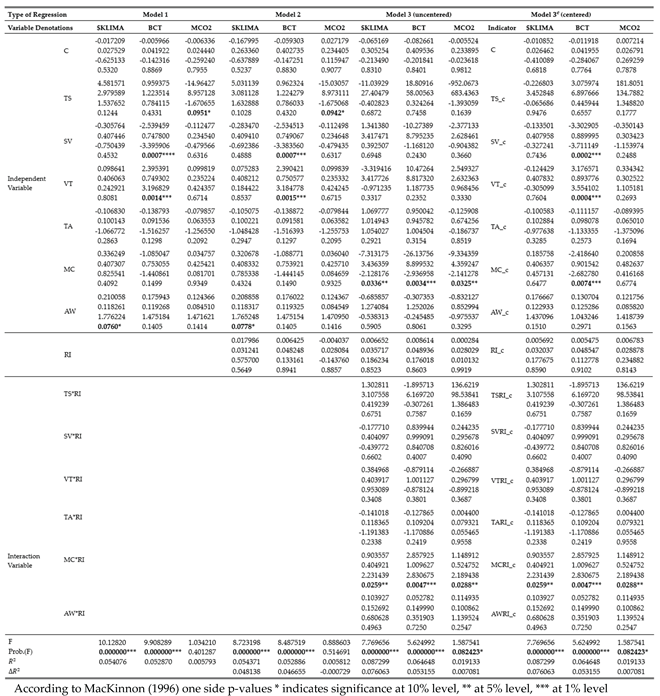
Appendix A.2
The interaction between tokenized carbon on-chain trading and the bid–ask spread is analyzed within an OLS, estimated under uncentered and mean-centered models. The mean-centering transformation mitigates potential multicollinearity in the interaction term and supports clearer coefficient interpretation without affecting the underlying moderation inference.
Table A2.
Moderation Effect of Tokenized Carbon On-chain Trading and Bid-ask Spread.
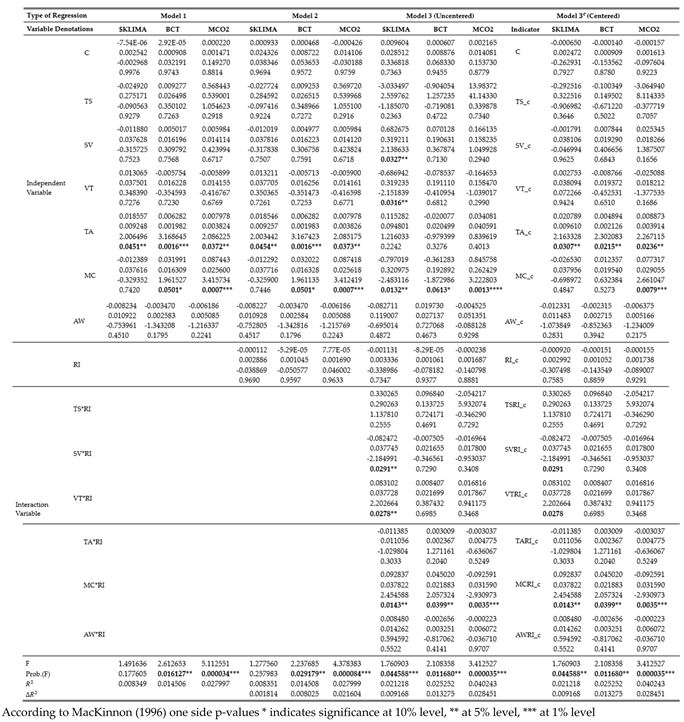
Appendix A.3
The moderating role of tokenized carbon on-chain trading in the relationship with return volatility is evaluated through an OLS model, comparing results before and after variable centering. This centering adjustment reduces scale-related distortions in the interaction term and aids interpretative precision.
Table A3.
Moderation Effect of Tokenized Carbon On-chain Trading and Return Volatility.
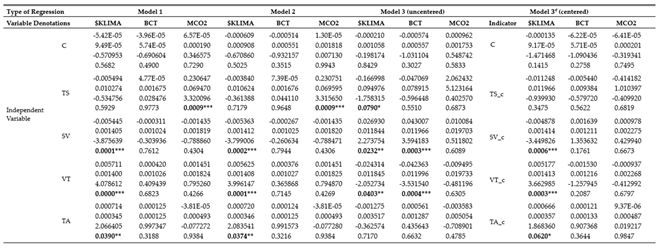
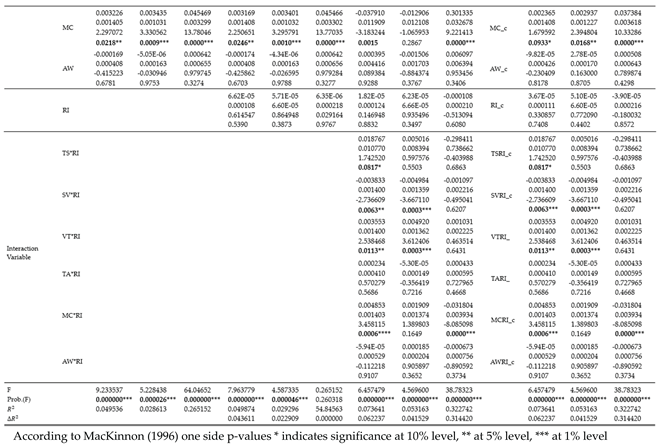
Appendix A.3
The moderation role within the liquidity series (the effects of dollar volume and return volatility on the bid–ask spread) are examined using OLS, to enable comparison between uncentered and mean-centered models.
Table A4.
Moderation Effect in Liquidity Series.
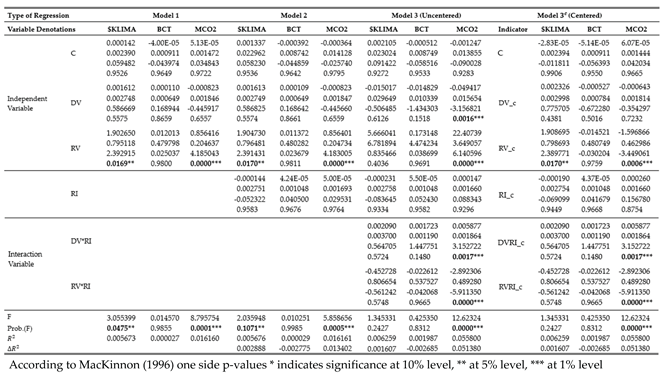
Appendix B
Appendix B.1
The OLS moderation results for tokenized carbon assets on-chain trading using uncentered and mean-centered models. The mean-centered models exhibit a pronounced decline in Variance Inflation Factors (VIFs), confirming a substantial reduction in multicollinearity associated with interaction terms. coefficient signs and statistical inferences remain stable after centering, indicating that mean-centering enhances econometric stability and interpretability without affecting the substantive moderation conclusions.
Table 1.
The Summary of VIF test.
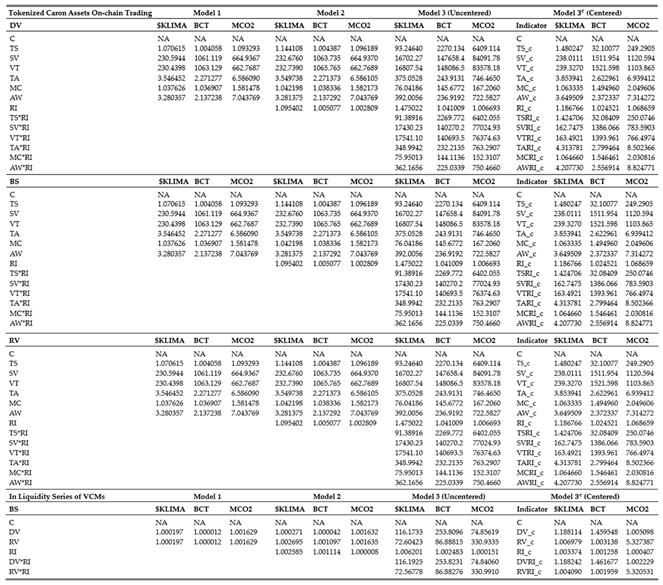
Appendix B.2
The White test results show widespread statistical significance across model specifications, indicating the presence of heteroskedasticity in the regression residuals. This violation of the homoskedasticity assumption suggests that conventional OLS standard errors may be biased and unreliable for statistical inference.
Table 2.
The Summary of White test.
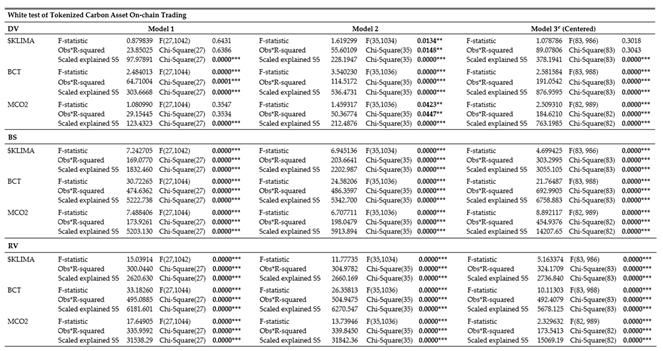
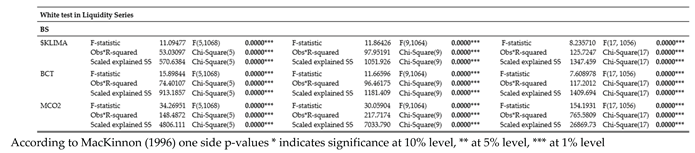
Appendix B.3
The Jaque-Bera statistics are significant, implying non-normality of the residual distribution. However, given the time-series nature of the data and the large sample size, these deviations are considered economically and statistically tolerable, allowing the residuals to be treated as approximately normally distributed for inference purposes.
Table B3.
The Summary of Jarque-Bera test
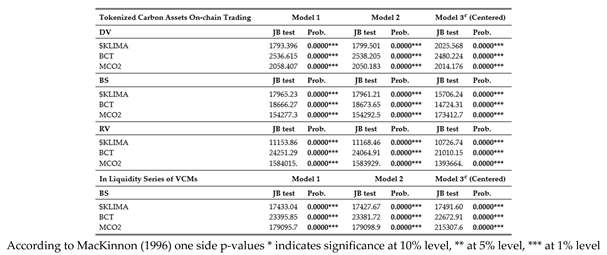
Appendix B.4
The Ljung-Box statistics are also largely significant, providing evidence of serial correlation in the residuals. Given the combined presence of heteroskedasticity and autocorrelation, the analysis replaces standard OLS inference with HAC corrections to obtain robust standard errors while preserving the consistency of the estimated coefficients and moderation effects.
Table B4.
The Summary of Ljung-box test
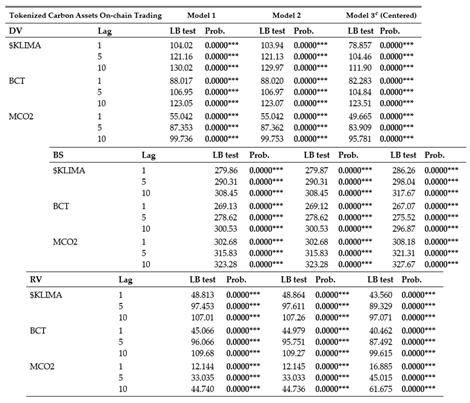
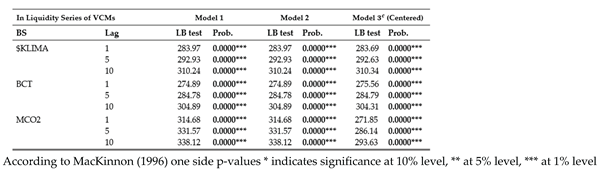
References
- Abbas, Q.; Yao, H.; Ramzan, M.; Fatima, S. Achieving carbon neutrality through digital infrastructure and public debt. In Clean Technologies and Environmental Policy; 2024. [Google Scholar] [CrossRef]
- Abdi, F.; Ranaldo, A. A Simple Estimation of Bid-Ask Spreads from Daily Close, High, and Low Prices. In University of St.Gallen School of Finance Research Paper Series; 2017. [Google Scholar] [CrossRef]
- Admati, A. R.; Pfleiderer, P. A Theory of Intraday Patterns: Volume and Price Variability. The Review of Financial Studies 1988, 1(1), 3–40. Available online: http://www.jstor.org/stable/2962125. [CrossRef]
- Aguinis, H.; Pierce, C. A. Heterogeneity of error variance and the assessment of moderating effects of categorical variables: a conceptual review. Organ. Res. Methods 1998, 1, 296–314. [Google Scholar] [CrossRef]
- Ahonen, H.-M.; Kessler, J.; Michaelowa, A.; Espelage, A.; Hoch, S. Governance of Fragmented Compliance and Voluntary Carbon Markets Under the Paris Agreement. Politics and Governance 2022, 10(1), 235–245. [Google Scholar] [CrossRef]
- Aigbovo, O.; Isibor, B. Market Microstructure: A Review of Literature. Research Journal of Financial Sustainable Reporting 2017, 2(2), 116–143. [Google Scholar]
- Aiken, L. S.; West, S. G. Multiple Regression: Testing and Interpreting Interactions; Sage Publications: Newbury Park, CA, 1991. [Google Scholar]
- Albayati, H.; Kim, S. K.; Rho, J. J. A study on the use of cryptocurrency wallets from a user experience perspective. Human Behavior and Emerging Technologies 2021, 3(4), 720–738. [Google Scholar] [CrossRef]
- Aldasoro, I.; Doerr, S.; Gambacorta, L.; Garratt, R.; Wilkens, P. K. The tokenisation continuum; Bank for International Settlements, 11 April 2023; Available online: https://www.bis.org/publ/bisbull72.pdf.
- Alexander, R. A.; DeShon, R. P. Effect of error variance heterogeneity on the power of tests for regression slope differences. Psychol. Bull. 1994, 115, 308–314. [Google Scholar] [CrossRef]
- Alizadeh, S.; Setayesh, A.; Mohamadpour, A.; Bahrak, B. A network analysis of the non-fungible token (NFT) market: structural characteristics, evolution, and interactions. Applied Network Science 2023, 11 8(38). [Google Scholar] [CrossRef]
- Allen, Frankiln.; Gorton, Gary. Stock Price Manipulation, Market Microstructure and Asymmetric Information. European Economic Review 1992, 36, pp 624–630. [Google Scholar] [CrossRef]
- Allen, M. R.; Friedlingstein, P.; Girardin, C. A. J.; Jenkins, S.; Malhi, Y.; Mitchell-Larson, E.; Peters, G. P.; Rajamani, L. Net Zero: Science, Origins, and Implications. Annual Review of Environment and Resources 2022, 47(1), 849–887. [Google Scholar] [CrossRef]
- Alt, R.; Gräser, M. Distributed ledger technology. Electronic Markets 2025, 35, 53. [Google Scholar] [CrossRef]
- Alzahrani, S.; Daim, T. Analysis of the Cryptocurrency Adoption Decision: Literature Review. 2019 Portland International Conference on Management of Engineering and Technology (PICMET), 2019; pp. 1–11. [Google Scholar] [CrossRef]
- Amihud, Y. Illiquidity and stock returns: Cross-section and time-serieseffects. Journal of Financial Markets 2002, 5(1), 31–56. [Google Scholar] [CrossRef]
- Amihud, Y.; Mendelson, H. Asset pricing and the bid-ask spread. Journal of Financial Economics 1986, 17(2), 223–249. [Google Scholar] [CrossRef]
- Ani, C.; Mashood, L.; Anche, J.; Adikwu, S.; Aderupatan, D.; Bart, M. Crypto Assets Indicators and their Effect on the Market Capitalization: A Panel Data Analysis. Kasu Journal of Computer Science 2024. [Google Scholar] [CrossRef]
- Ante, L. Bitcoin Transactions, Information Asymmetry and Trading Volume. In Emerging Markets: Finance eJournal; 2020. [Google Scholar] [CrossRef]
- Ante, L. The non-fungible token (NFT) market and its relationship with Bitcoin and Ethereum. SSRN Electronic Journal 2021. [Google Scholar] [CrossRef]
- Anthony Jnr, B. Distributed ledger and decentralized technology adoption for smart digital transition in collaborative enterprise. Enterprise Information Systems 2023, 17(4), 1989494. [Google Scholar] [CrossRef]
- Antulov-Fantulin, N.; Tolic, D.; Piskorec, M.; Ce, Z.; Vodenska, I. Inferring short-term volatility indicators from Bitcoin blockchain. In ArXiv; 2018. [Google Scholar] [CrossRef]
- Ardia, D.; Guidotti, E.; Kroencke, T. Efficient Estimation of Bid-Ask Spreads from Open, High, Low, and Close Prices. In Capital Markets: Market Efficiency eJournal; 2021. [Google Scholar] [CrossRef]
- Arner, D. W.; Barberis, J.; Buckley, R. P. FinTech, RegTech, and the Reconceptualization of Financial Regulation. Northwestern Journal of International Law & Business. 2017. Available online: http://scholarlycommons.law.northwestern.edu/njilb/vol37/iss3/2.
- Arner, D. W.; Barberis, J.; Buckley, R. P. The Evolution of Fintech: A New Post-Crisis Paradigm? Georgetown Journal of International Law 2019, 47, 1271–1319. [Google Scholar] [CrossRef]
- Athey, S.; Parashkevov, I.; Sarukkai, V.; Xia, J. Bitcoin Pricing, Adoption, and Usage: Theory and Evidence. Stanford Graduate School of Business Research Paper. 2016, pp. No.16–42. Available online: https://papers.ssrn.com/sol3/papers.cfm?abstract_id=2826674.
- Atsiwo, A.; Sarantsev, A. Capital Asset Pricing Model with Size Factor and Normalizing by Volatility Index. arXiv [q-fin.MF. 2024, arXiv:2411.19444. [Google Scholar] [CrossRef]
- Avgouleas, E.; Marjosola, H. Digital Finance in Europe: Law, Regulation, and Governance; De Gruyter: Berlin, Boston, 2022. [Google Scholar] [CrossRef]
- Baek, C.; Elbeck, M. Bitcoins as an investment or speculative vehicle? A first look. Appl. Econ. Lett. 2015, 22, 30–34. [Google Scholar] [CrossRef]
- Bai, C.; Sarkis, J. Green supplier development: A review and analysis. In Handbook on the sustainable supply chain; Edward Elgar Publishing, 2019. [Google Scholar] [CrossRef]
- Bakarich, K. M.; Castonguay, J. J.; O’Brien, P. E. The use of blockchains to enhance sustainability reporting and assurance. Accounting Perspectives 2020, 19(4), 389–412. [Google Scholar] [CrossRef]
- Bali, T. G.; Cakici, N.; Zhang, Z. Does Idiosyncratic Risk Really Matter? The Journal of Finance 2005, 60(2), 905–929. [Google Scholar] [CrossRef]
- Ballesteros-Rodríguez, A.; De-Lucio, J.; Sicilia, M.-Á. Tokenized carbon credits in voluntary carbon markets: The case of KlimaDAO. Frontiers in Blockchain 2024, 7, 1474540. [Google Scholar] [CrossRef]
- Bandi, G. An Investment Perspective on Tokenization—Part II Policy and Regulatory Implications. CFA Institute Research and Policy Center. 2025. Available online: https://rpc.cfainstitute.org/sites/default/files/docs/research-reports/bandi_tokenization_partii_online.pdf.
- Banerjee, S. G.; Moreno, A.; Sinton, J.; Primiani, T.; Seong, J. Regulatory Indicators for Sustainable Energy: A Global Scorecard for Policy Makers (RISE 2016). In International Bank for Reconstruction and Development / The World Bank; 2017; Available online: https://documents1.worldbank.org/curated/en/538181487106403375/pdf/112828-REVISED-PUBLIC-RISE-2016-Report.pdf.
- Banque de France. Report in The Legal and Regulatory Aspects of Voluntary Carbon Credits of the Legal High Committee for Financial Markets of Paris. 2024. Available online: https://www.banque-france.fr/system/files/2024-11/Rapport_66_A.pdf.
- Baruch, S.; Leraul, J.; Sudaric, S. Scaling voluntary carbon markets through open blockchain platforms. SSRN 2022. [Google Scholar] [CrossRef]
- Bassi, E.; Lustenberger, M.; Letina, S. Blockchain-based voluntary carbon market: Strategic insights into network structure. Frontiers in Blockchain 2025, 8, 1603695. [Google Scholar] [CrossRef]
- Battocletti, V.; Enriques, L.; Romano, A. The Voluntary Carbon Market: Market Failures and Policy Implications. SSRN Electronic Journal 2023. [Google Scholar] [CrossRef]
- Baur, D. G.; Dimpfl, T. Realized Bitcoin volatility. SSRN Electronic Journal 2017. [Google Scholar] [CrossRef]
- Beck, R.; Müller-Bloch, C.; King, J. L. Governance in the blockchain economy: A framework and research agenda. Journal of the Association for Information Systems 2018. [Google Scholar] [CrossRef]
- Bekaert, G.; Wu, G. Asymmetric volatility and risk in equity markets (Working Paper No. 1433); Stanford Graduate School of Business, 1997; Available online: https://www.gsb.stanford.edu/faculty-research/working-papers/asymmetric-volatility-risk-equity-markets.
- Ben McQuahe; Co. The Legal Nature of Carbon Credits. 2023. Available online: https://bmcquhae.com/en/2023/03/15/the-legal-nature-of-carbon-credits/.
- Berg, C.; Davidson, S.; Potts, J. Understanding the blockchain economy: An introduction to institutional cryptoeconomics; Edward Elgar Publishing, 2019. [Google Scholar] [CrossRef]
- Bernstein, S. Legitimacy in intergovernmental and non-state global governance. International Polit ical Economy 2011, 18(1), 17–51. [Google Scholar] [CrossRef]
- Bessembinder, H. Bid-ask spreads in the interbank foreign exchange markets. Journal of Financial Economics 1994, 35(3), 317–348. [Google Scholar] [CrossRef]
- Bessembinder, H. Trade Execution Costs and Market Quality after Decimalization on JSTOR. The Journal of Financial and Quantitative Analysis 2003, 747. [Google Scholar] [CrossRef]
- Bessembinder, H. Trade execution costs on Nasdaq and the NYSE: A post-reform comparison. Journal of Financial and Quantitative Analysis 1999, 34(3), 387–407. [Google Scholar] [CrossRef]
- Bessembinder, H; Kaufman, H. M. A comparison of trade execution costs for NYSE and Nasdaq-listed stocks. Journal of Financial and Quantitative Analysis 1997, 32. [Google Scholar] [CrossRef]
- Bessembinder, H.; Kaufman, H. M. A cross-exchange comparison of execution costs and information flow for NYSE-listed stocks. Journal of Financial Economics 1997, 46(3), 293–319. [Google Scholar] [CrossRef]
- Betz, R.; Michaelowa, A.; Castro, P.; Kotsch, R.; Mehling, M.; Michaelowa, K.; et al. The carbon market challenge: preventing abuse through effective governance, 1st ed; Cambridge University Press: Cambridge, 2022. [Google Scholar] [CrossRef]
- Carbon, BeZero. BeZero finds that better quality nature-based credits are commanding a 20% price premium. 2024. Available online: https://bezerocarbon.com/insights/bezero-finds-that-better-quality-nature-based-credits-are-commanding-a-20-percent-price-premium.
- Bhaduri, A. Legal and Illegal Production and Trade Under Monopoly with Transaction Cost. Metroeconomica 2000, 51, 304–307. [Google Scholar] [CrossRef]
- Bhattacharya, N.; Zavar, G. Dynamic Relationship between Stock Market Returns and Trading Volume: Evidence from Indian Stock Market. Journal of Global Economy 2016, 12, 123–136. [Google Scholar] [CrossRef]
- Bhoyar, S. Evaluating Crypto Holder Accessibility, Liquidity, and Participation in the Decentralized Ecosystem. Scientific Journal of Metaverse and Blockchain Technologies 2025. [Google Scholar] [CrossRef]
- Bi, G.; Gui, Y. Large transactions and the MAX effect: Evidence from China. SSRN Electronic Journal 2022. [Google Scholar] [CrossRef]
- Biais, B.; Glosten, L.; Spatt, C. Market microstructure: A survey of microfoundations, empirical results, and policy implications. Journal of Financial Markets 2005, 8(2), 217–264. [Google Scholar] [CrossRef]
- Biais, B. F. T.; Glosten, L.; Spatt, C. Market microstructure: A survey of microfoundations, empirical results, and policy implications. Journal of Financial Markets 42 2019, 100–124. [Google Scholar] [CrossRef]
- Bianchi, D.; Babiak, M.; Dickerson, A. Trading volume and liquidity provision in cryptocurrency markets. Journal of Banking & Finance 2022. [Google Scholar] [CrossRef]
- Bihani, D.; Ubamadu, B.; Daraojimba, A. Tokenomics in Web3: A Strategic Framework for Sustainable and Scalable Blockchain Ecosystems. International Journal of Scientific Research in Computer Science, Engineering and Information Technology 2025. [Google Scholar] [CrossRef]
- Black, J.; Hashimzade, N.; Myles, G. A dictionary of economics, 5th ed.; Oxford University Press, 2012. [Google Scholar]
- Blandin, A.S.; Cloots, H.; Hussain; Rauchs, M.; Saleuddin, R.; Allen, J.G.; Zhang, B.; Cloud, K. Global Cryptoasset Regulatory Landscape Study. In Cambridge Centre for Alternative Finance, University of Cambridge; Judge Business School, 2018. [Google Scholar]
- Blaufelder, C.; Levy, C.; Mannion, P.; Pinner, D. A blueprint for scaling voluntary carbon markets to meet the climate challenge. McKinsey & Company, 2021. Available online: https://www.mckinsey.com/capabilities/sustainability/our44-insights/a-blueprint-for-scaling-voluntary-carbon-markets-to-meet-the-climate-challenge.
- BloombergNEF. Carbon Offset Market Could Reach $1 Trillion With Right Rules. 2023. Available online: https://about.bnef.com/insights/finance/carbon-offset-market-could-reach-1-trillion-with-right-rules/.
- Blitzer, T. China’s Judiciary Supports Virtual Assets as Legal Property. Herald Sheets. 2023. Available online: https://heraldsheets.com/chinas-judiciary-supports-virtual-assets-as-legal-property/.
- Brealey, R. A.; Myers, S. C.; Allen, F. Principles of Corporate Finance, 13th ed.; McGraw-Hill, 2020. [Google Scholar]
- Bodie, Z.; Kane, A.; Marcus, A. J. Investments, 10th ed.; McGraw-Hill, 2014. [Google Scholar]
- Bogousslavsky, V.; Collin-Dufresne, P. Liquidity, Volume, and Volatility. SSRN Electronic Journal 2019. [Google Scholar] [CrossRef]
- Bollen, N. P. B.; Smith, T.; Whaley, R. E. Modeling the bid/ask spread: Measuring the inventory-holding premium. Journal of Financial Economics 2004, 72(1), 97–141. [Google Scholar] [CrossRef]
- Boonvorachote, T.; Lakmas, K. Price volatility, trading volume, and market depth in Asian commodity futures exchanges. The Kasetsart Journal Social Sciences 2016, 37, 53–58. [Google Scholar] [CrossRef]
- Bossaerts, P.; Hillion, P. Market Microstructure Effects of Government Intervention in the Foreign Exchange Market. The Review of Financial Studies 1991, 4(3), 513–541. Available online: http://www.jstor.org/stable/2961970. [CrossRef]
- Boys, M.; Julier, E.; Peter, A.; Reitman, D.; Tinnelly, B.; Widdup, B. Tokenization for net zero: The opportunities and challenges of digitalizing voluntary carbon markets. Global Digital Finance (GDF). 2025. Available online: https://www.gdf.io/wp-content/uploads/2020/12/GDF-Report-Tokenization-For-Net-Zero-070525.pdf.
- BP. Statistical Review of World Energy 2023. 2023. Available online: https://www.bp.com/en/global/corporate/energy-economics/statistical-review-of-world-energy.html.
- BRCarbon. Brazilian Amazon Grouped Project – REDD+ APD. n.d. Available online: https://brcarbon.com.br/en/brazilian-amazon-grouped-project/.
- Brauneis, A.; Mestel, R.; Riordan, R.; Theissen, E. How to measure the liquidity of cryptocurrency markets? Journal of Banking & Finance 2021, 124. [Google Scholar]
- Bravo, F.; Darragh, C.; Mongendre, L.; Nuñez, P.; Sepúlveda, L. C.; Vetter, T. The Voluntary Carbon Market Explained. VCM Primer. 2023. Available online: https://vcmprimer.org/wp-content/uploads/2023/12/vcm-explained-full-report.pdf.
- Breusch, T. S.; Pagan, A. R. A Simple Test for Heteroscedasticity and Random Coefficient Variation. Econometrica 1979, 47(5), 1287–1294. [Google Scholar] [CrossRef]
- Brun, J. C. A.; Portillo, A. L.; Nicholson, H.; Wang, S. Decoding the VCM in 2024 and beyond. Abatable. 2025. Available online: mhttps://app.abatable.com/knowledge-hub/reports/decoding-the-vcm-2024?utm_source=website&utm_medium=button&utm_campaign=decoding-VCM.
- Buckley, R. P.; Arner, D. W.; Veidt, R.; Zetzsche, D. A. Building fintech ecosystems: Regulatory sandboxes, innovation hubs and beyond. UNSW Law Research Series. 2019, 72. Available online: https://www5.austlii.edu.au/au/journals/UNSWLRS/2019/72.pdf.
- Burgoyne, M. T.; Olexiuk, P. Tokenized carbon credits: How blockchain is revolutionizing carbon markets. Osler. 2025. Available online: https://www.osler.com/en/insights/updates/tokenized-carbon-credits-blockchain-revolutionizing-markets/?pdf=1.
- Buti, S.; Rindi, B.; Werner, I. M. Dark pool trading strategies, market quality and welfare. Journal of Financial Economics 2017, 124(2), 244–265. [Google Scholar] [CrossRef]
- Calel, R.; Colmer, J.; Dechezleprˆetre, A.; Glachant, M. Do carbon offsets offset carbon? SSRN working paper 3950103. 2021. [Google Scholar]
- Çamalan, Ö.; Gökmen, Ş.; Atan, S. Using Advanced Machine Learning Techniques to Predict the Sales Volume of Non-Fungible Tokens. World Journal of Applied Economics 2024. [Google Scholar] [CrossRef]
- Car, E.; Barbier, L.; Huys, I.; Simoens, S.; Vulto, A. G. Evolving global regulatory landscape for approval of biosimilars: current challenges and opportunities for convergence. Expert Opinion on Biological Therapy 2025, 25(6), 649–668. [Google Scholar] [CrossRef]
- Carapella, F.; Chuan, G.; Gerszten, J.; Hunter, C.; Swem, N. Tokenization: Overview and Financial Stability Implications. In Finance and Economics Discussion Series; 2023. [Google Scholar] [CrossRef]
- Carbon Direct. Science-backed carbon management solutions. Carbon Direct. 2024. Available online: https://www.carbon-direct.com.
- Carlson, K. The Nakamoto Blockchain. 2018. [Google Scholar] [CrossRef]
- Carter, P.; Van de Sijpe, N.; Calel, R. The elusive quest for additionality. World Dev. 2021, 141, Article 105393. [Google Scholar] [CrossRef]
- Catalini, C.; Gans, J. S. Some simple economics of the blockchain. In MIT Sloan Research Paper; 2020; Volume No. pp. 5191–16. [Google Scholar] [CrossRef]
- Chakrabarty, B. K.; Jain, P. Understanding the microstructure of Indian markets; National Stock Exchange of India, Research Paper Series, NSE, Final Paper No. 128; 2005. [Google Scholar]
- Chan, K. C.; Christie, W.G.; Schultz, P.H. Market structure and theintraday pattern of bid-ask spreads for Nasdaq securities. The Journal ofBusiness 1995, 68(1), 35–60. [Google Scholar]
- Chang, R. P.; Hsu, S.-T.; Huang, N.-K.; Rhee, S. G. The effects of trading methods on volatility and liquidity: Evidence from the Taiwan stock exchange. Journal of Business Finance & Accounting 1999, 2(1-2), 137–170. [Google Scholar] [CrossRef]
- Chawla, V.; Dethuraman, D.; Ashok, T.; Kitts, J. The Role of the Voluntary Carbon Market in Scaling Impact Globally – An Analysis of Recent Trends. National Law School Business Law Review 2023, 9(2). [Google Scholar] [CrossRef]
- Chen, J.; Lin, D.; Han, C. Volatility effect on the adoption and valuation of tokenomics. In Proceedings of the 35th Annual ACM Symposium on Applied Computing, 2020. [Google Scholar]
- Chevet, S. Blockchain Technology and Non-Fungible Tokens: Reshaping Value Chains in Creative Industries. 2018. Available online: https://ssrn.com/abstract=3212662.
- Chen, W.; Botchie, D.; Braganza, A.; Han, H. A transaction cost perspective on blockchain governance in global value chains. Strateg. Change 2022a, 31(1), 75–87. [Google Scholar] [CrossRef]
- Chen, X.; Lloyd, A. D. Understanding the challenges of blockchain technology adoption: Evidence from China’s developing carbon markets. In Information Technology & People; Advance online publication, 2024. [Google Scholar] [CrossRef]
- Chiah, M.; Zhong, A. Trading from home: The impact of COVID-19 on trading volume around the world. Financ. Res. Lett. 2020, 37, 101784. [Google Scholar] [CrossRef]
- Chitaley, A. D.; Delisle, A.; Gorur, A. S. Predicting a future price range for a desired volume. U.S. Patent; United States Patent and Trademark Office, 2010. Available online: https://patentimages.storage.googleapis.com/fe/35/f3/c5f42.
- Chordia, T.; Roll, R.; Subrahmanyam, A. Market Liquidity and Trading Activity. The Journal of Finance 2001, 56(2), 501–530. Available online: https://www.anderson.ucla.edu/documents/areas/fac/finance/Roll_69.pdf. [CrossRef]
- Chordia, T.; Roll, R.; Subrahmanyam, A. Order imbalance, liquidity, andmarket returns. Journal of Financial Economics 2002, 65(1), 111–130. [Google Scholar] [CrossRef]
- Chordia, T.; Subrahmanyam, A. Order imbalance and individual stock returns: Theory and evidence. Journal of Financial Economics 2004, 72(3), 485–518. [Google Scholar] [CrossRef]
- Chordia, T.; Miao, B. Market efficiency in real time: Evidence from low latency activity around earnings announcements. Journal of Accounting and Economics 2020, 70(2-3), 101335. [Google Scholar] [CrossRef]
- Chow, G. C.; Lin, A. Best Linear Unbiased Interpolation, Distribution, and Extrapolation of Time Series by Related Series. The Review of Economics and Statistics 1971, 53(4), 372. [Google Scholar] [CrossRef]
- Christiansen, K. L. Relegitimising the voluntary carbon market: Visions of digital monitoring, reporting and verification. Environment and Planning A: Economy and Space 2024, 0(0). [Google Scholar] [CrossRef]
- Christophorou, P. L.; Hartman, S.; Martin, E. E.; Patel, R.; Patel, R. K.; Schwartz, R. A.; Zerega, T. P.; Alicea, S. A.; Flynn, S.; Healy, J. S. SEC Roundtable on Tokenization: Technology Meets Regulation in the Evolution of Capital Markets. Morgan Lewis. 2025. Available online: https://www.morganlewis.com/pubs/2025/05/sec-roundtable-on-tokenization-technology-meets-regulation-in-the-evolution-of-capital-markets.
- Chutka, J.; Rebetak, F. Analysis of trading volume and its use in prediction future price movements in the process of maximizing trading earnings. SHS Web of Conferences 2021. [Google Scholar] [CrossRef]
- Ciplet, D.; Adams, K.M.; Weikmans, R.; Roberts, J.T. The Transformative Capability of Transparency in Global Environmental Governance. Global Environmental Politics (2018) 2018, 18(3), 130–150. [Google Scholar] [CrossRef]
- Clack, C. D.; McGonagle, C. Smart Derivatives Contracts: the ISDA Master Agreement and the automation of payments and deliveries. 2019. Available online: https://arxiv.org/pdf/1904.01461.
- Chance, Clifford. ISDA releases new documentation for the secondary market trading of voluntary carbon credits. Clifford Chance. 2022. Available online: https://www.cliffordchance.com/content/dam/cliffordchance/briefings/2022/12/isda-releases-new-documentation-for-the-secondary-market-trading-of-voluntary-carbon-credits.pdf.
- Chance, Clifford. Carbon trading in China: Relaunch of the Certified Emission Reduction Scheme. 2024. Available online: https://www.cliffordchance.com/content/dam/cliffordchance/briefings/2024/04/Carbon%20Trading%20in%20China%20Relaunch%20of%20the%20Certified%20Emission%20Reduction%20Scheme.pdf.
- Cohen, J.; Cohen, P.; West, S. G.; Aiken, L. S. Applied multiple regression/correlation analyses for the behavioral sciences, 3rd edn; Lawrence Erlbaum: Mahwah, NJ, 2003. [Google Scholar]
- Cong, W. L.; He, Z. Blockchain disruption and smart contracts. The Review of Financial Studies 2018, 32, 17541797. Available online: https://www.nber.org/system/files/working_papers/w24399/w24399.pdf.
- Copeland, T.; Galai, D. Information Effects on the Bid-Ask Spread. Journal of Finance 1983, 38, 1457–1469. [Google Scholar] [CrossRef]
- Corbet, S.; Lucey, B.; Urquhart, A.; Yarovaya, L. Cryptocurrencies as a financial asset: A systematic analysis. International Review of Financial Analysis 2019, 62, 182–199. [Google Scholar] [CrossRef]
- Cornillie, J.; Delbeke, J.; Runge-Metzger, A.; Vis, P.; Watt, R. What future for voluntary carbon markets? In STG Policy Paper No 8; European University Institute, 2021. [Google Scholar] [CrossRef]
- Corwin, S. A.; Schultz, P. A simple way to estimate bid-ask spreads from daily high and low prices. The Journal of Finance 2012, 67(2), 719–760. [Google Scholar] [CrossRef]
- Cronbach, L. J. Statistical Tests for Moderator Variables: Flaws in Analyses Recently Proposed. Psychological Bulletin 1987, 102(3), 414–417. [Google Scholar] [CrossRef]
- Cochrane, J. H.; Voluntary Carbon Markets: A Review of Global Initiatives and Evolving Models; CSIS. Asset pricing; Graduate School of Business, University of Chicago: Chicago, IL, 2023; Available online: https://www.csis.org/analysis/voluntary-carbon-markets-review-global-initiatives-and-evolving-models.
- Dai, J.; Vasarhelyi, M. A. Toward blockchain-based accounting and assurance. Journal of Information Systems 2017, 31(3), 5–21. [Google Scholar] [CrossRef]
- Dales, J. H. Land, Water, and Ownership on JSTOR. The Canadian Journal of Economics / Revue Canadienne D’Economique 1968, 791. [Google Scholar] [CrossRef]
- Dang, C.; (Frank) Li, Z.; Yang, C. Measuring firm size in empirical corporate finance. Journal of Banking & Finance 2018, 86, 159–176. [Google Scholar] [CrossRef]
- Davidson, S.; Filippi, P.D.; Potts, J. Blockchains and the Economic Institutions of Capitalism. Journal of Institutional Economics 2018, Vol. 14(Issue 4). Available online: https://papers.ssrn.com/sol3/papers.cfm?abstract_id=3221527. [CrossRef]
- Dawes, A.; McGeady, C.; Majkut, J. Voluntary Carbon Markets A Review of Global Initiatives and Evolving Models. Center for Strategic & International Studies. 2023. Available online: https://csis-website-prod.s3.amazonaws.com/s3fs-public/2023-05/230531_Dawes_Voluntary_CarbonMarkets.pdf?VersionId=Ji7fxv9DiPwRUJekj.0SJ14GCdstvZh8.
- De Canio, F. Consumer willingness to pay more for pro-environmental packages: The moderating role of familiarity. Journal of Environmental Management 2023, 339, 117828. [Google Scholar] [CrossRef] [PubMed]
- Denter, N. M.; Seeger, F.; Moehrle, M.G. How can Blockchain technology support patent management? A systematic literature review. International Journal of Information Management 2023, 68, 102506. [Google Scholar] [CrossRef]
- De Filippi, P.; Loveluck, B. The invisible politics of Bitcoin: Governance crisis of a decentralized infrastructure. Internet Policy Review 2016, 5(3). [Google Scholar] [CrossRef]
- Dencer-Brown, AM; Shilland, R; Friess, D; Herr, D; Benson, L; Berry, NJ; et al. Integrating blue: How do we make nationally determined contributions work for both blue carbon and local coastal communities? Ambio 2022, 51, 1978–93. [Google Scholar] [CrossRef]
- De Vries,, A.; Poblet, C. A. (2018). Bitcoin’s Growing Energy Problem. Joule, 2(5), 801-805. https://doi.org/10.1016/j.joule.2018.04.016Diaz-Valdivia, C. A., Poblet, M. B. (2022). Governance of ReFi Ecosystem and the Integrity of Voluntary Carbon Markets as a Common Resource. 2022, 2(5), 801–805. [Google Scholar] [CrossRef]
- Dharma, B.; Cici, W.A.; Amanda, D.N. Mengapa PBV ( Price Book Value ) Penting Dalam Penilaian Saham (Perusahaan Farmasi Yang Terdaftar di BEI periode 2021). Jurnal Manajemen Dan Ekonomi Kreatif 2022, 1(1), 80–89. [Google Scholar] [CrossRef]
- Diaz-Valdivia, C. A.; Poblet, M. B. Governance of ReFi Ecosystem and the Integrity of Voluntary Carbon Markets as a Common Resource. SSRN Electronic Journal 2022. [Google Scholar] [CrossRef]
- Dong, S.; Abbas, K.; Li, M.; et al. Blockchain technology and application: an overview. In PeerJ Comput Sci.; 2023. [Google Scholar]
- Doostian, R.; Touski, O. F. Market microstructure: A review of models. International Journal of Finance and Managerial Accounting 2024, 9(35), 143–156. [Google Scholar] [CrossRef]
- Dorfleitner, G.; Muck, F.; Scheckenbach, I. Blockchain applications for climate protection: A global empirical investigation. Renewable and Sustainable Energy Reviews 2021, 149, 111378. [Google Scholar] [CrossRef]
- Doostian, R.; Farhadtouski, O. Market microstructure: A review of models. International Journal of Finance and Managerial Accounting 2024, 9(35), Autumn, 1–20. [Google Scholar]
- Dowling, M. Is non-fungible token pricing driven by cryptocurrencies? Finance Research Letters 2022, 44, 102097. [Google Scholar] [CrossRef]
- Downing, C.; Zhang, F. Aktivitas perdagangan dan volatilitas harga di pasar obligasi kota; Dewan Gubernur: Seri Diskusi Keuangan & Ekonomi (Topik), 2004. [Google Scholar] [CrossRef]
- Dugbartey, A. N.; Kehinde, O. Optimizing project delivery through agile methodologies: Balancing speed, collaboration and stakeholder engagement. World Journal of Advanced Research and Reviews Available from. 2025, 25(1), 1237–1257. [Google Scholar] [CrossRef]
- Easley, D.; O’Hara, M. Market microstructure. In Handbooks in Operations Research and Management Science: Finance; Jarrow, R. A., Maksimovic, V., Ziemba, W. T., Eds.; 1995; Vol. 9, pp. 357–383. [Google Scholar]
- Echambadi, R.; Hess, J. D. Mean-centering Does Not Alleviate Collinearity Problems in Moderated Multiple Regression Models. Marketing Science 2007, 26(3), 438–445. [Google Scholar] [CrossRef]
- Ecosystem Marketplace. State of the Voluntary Carbon Market 2024. Ecosystem Marketplace. 2024. Available online: https://www.ecosystemmarketplace.com/publications/2024-state-of-the-voluntary-carbon-markets-sovcm/.
- Efthymiou, L.; Kulshrestha, A.; Kulshrestha, S. A Study on Sustainability and ESG in the Service Sector in India: Benefits, Challenges, and Future Implications. Administrative Sciences 2023, 13(7), 165. [Google Scholar] [CrossRef]
- El Fanani, Z. A.; Putri, R. N. A. The effect of stock price, trade volume, trade frequency and market value on the determinants of share liquidity of Sharia bank listed on the Indonesian Stock Exchange during the Covid-19 pandemic. Jurnal Ekonomi Syariah Teori dan Terapan 2023, 10(1), 69–81. [Google Scholar] [CrossRef]
- Elliott, C. M. Hedging the Planet: The Demand for Global Governance in Sustainable Finance. Doctoral dissertation, 2024. [Google Scholar]
- Epps, T. W. Security Price Changes and Transaction Volumes: Some Additional Evidence. Journal of Financial and Quantitative Analysis 1977, 12(1), 141–146. [Google Scholar] [CrossRef]
- Eraker, B.; Osterrieder, D. Market Maker Inventory, Bid–Ask Spreads, and the Computation of Option Implied Risk Measures Ethereum blockchain explorer. Journal of Financial Econometrics 2023, 21(5), 1820–1851. Available online: https://www.etherscan.io. [CrossRef]
- Ethereum Foundation. Ethereum Foundation Report. 2022. Available online: https://blog.ethereum.org/2022/04/18/ef-report-april-2022.
- European Environment Agency. Environmental Statement 2023. (EEA Report No. 10/2024). 2024. Available online: https://www.eea.europa.eu/en/analysis/publications/environmental-statement-2023.
- Fama, E. F. Efficient capital markets: A review of theory and empirical work. The Journal of Finance 1970, 25(2), 383–417. [Google Scholar] [CrossRef]
- Favasuli, S.; Sebastian, V. Voluntary carbon markets: how they work, how they’re priced and who’s involved. S & P Global Commodity Insights. 2021. Available online: https://insight.spglobal.com/story/voluntary-carbon-markets-how-they-work-how-theyre-priced-and-whos-involved/page/1.
- Filonchyk, M.; Peterson, M. P.; Zhang, L.; Hurynovich, V.; He, Y. Greenhouse gases emissions and global climate change: Examining the influence of CO2, CH4, and N2O. Science of The Total Environment 2024, 935, 173359. [Google Scholar] [CrossRef]
- Finck, M.; Pallas, F. They who must not be identified—distinguishing personal from non-personal data under the GDPR. International Data Privacy Law 2020, 10(1), 11–36. [Google Scholar] [CrossRef]
- Flack, M.; Morri, M. Gambling-related beliefs and gambling behaviour: Explaining gambling problems with the theory of planned behaviour. International Journal of Mental Health and Addiction 2017, 15(1), 130–142. [Google Scholar] [CrossRef]
- Fleming, M. J. Measuring Treasury market liquidity. In Economic Policy Review; Federal Reserve Bank of New York, 2003; Volume 9, 3, pp. 83–108. Available online: https://www.newyorkfed.org/research/epr/03v09n3/0309flem.html.
- Forest Trends’ Ecosystem Marketplace. Market in motion: State of voluntary carbon markets 2021, installment 1. Forest Trends Association. 2021. Available online: https://www.ecosystemmarketplace.com/publications/state-of-the-voluntary-carbon-markets-2021/.
- Forest Trends’ Ecosystem Marketplace. All in on climate: The role of carbon credits in corporate climate strategies. Forest Trends Association. 2023. Available online: https://3298623.fs1.hubspotusercontent-na1.net/hubfs/3298623/2023-Ecosystem%20Marketplace-All%20in%20on%20Climate.pdf.
- Forest Trends’ Ecosystem Marketplace. State of the Voluntary Carbon Market 2024. Forest Trends Association: Washington DC, 2024; Available online: https://3298623.fs1.hubspotusercontent-na1.net/hubfs/3298623/SOVCM%202024/State_of_the_Voluntary_Carbon_Markets_20240529%201.pdf.
- Foster, F.D.; Viswanathan, S. Variations in trading volume, returnvolatility, and trading costs: Evidence on recent price formation models. Journal of Finance 1993, 48(1), 187–211. [Google Scholar] [CrossRef]
- Frank, R. Bid-ask spreads, volume, and volatility: Evidence from futures markets. Journal of Futures Markets. 2011. [Google Scholar]
- Franki, N. Regulation of the Voluntary Carbon Offset Market. Columbia Journal of Environmental Law 2022. [Google Scholar] [CrossRef]
- Franke, L.; Schletz, M.; Salomo, S. Designing a Blockchain Model for the Paris Agreement’s Carbon Market Mechanism. Sustainability 2020, 12(3), 1068. [Google Scholar] [CrossRef]
- Franki, N. Regulation of the Voluntary Carbon Offset Market. Columbia Journal of Environmental Law 2022. [Google Scholar] [CrossRef]
- Freni, Pierluigi; Ferro, Enrico; Moncada, Roberto. Tokenomics and blockchain tokens: A design-oriented morphological framework. Blockchain: Research and Applications 2022, 3, 100069. [Google Scholar] [CrossRef]
- Frey, S.; Bar Am, J.; Doshi, V.; Malik, A.; Noble, S. Consumers care about sustainability—and back it up with their wallets; McKinsey & Company, n.d.; Available online: https://www.mckinsey.com/industries/consumer-packaged-goods/our-insights/consumers-care-about-sustainability-and-back-it-up-with-their-wallets.
- Martell, Frieder. Laura. And Rodolfo. On Capital Structure and The Liquidity of a Firm’s Stock. Working paper, 2006. [Google Scholar]
- Fuente-Mella, H.; Campos-Espinoza, R.; Farias, G. Econometric Modeling of Time Series Bid-Ask (Spread) for a Sample of Chilean Companies. Revista de Métodos Cuantitativos para la Economía y la Empresa 2017, 241–246. [Google Scholar] [CrossRef]
- Fullerton, J. Regenerative capitalism: How universal principles and patterns will shape our new economy; Capital Institute: Greenwich, CT, 2015; Available online: https://capitalinstitute.org/wp-content/uploads/2015/04/2015-Regenerative-Capitalism-4-20-15-final.pdf.
- Galenovich, A.; Lonshakov, S.; Shadrin, A. Blockchain ecosystem for carbon markets, environmental assets, rights, and liabilities: Concept design and implementation. In Transforming Climate Finance and Green Investment with Blockchains; Academic Press/Elsevier, 2022; pp. 229–242. [Google Scholar] [CrossRef]
- Gardhouse, K. Tokenization and Its Benefits for Data Protection. Private AI. 2024. Available online: https://www.private-ai.com/en/blog/tokenization-and-its-benefits-for-data-protection.
- Garg, R. Distributed Ledger Technology. In Blockchain for Real World Applications; Doi; Wiley, 2023; pp. 11–22. [Google Scholar] [CrossRef]
- George, T.; Kaul, G.; Nimalendran, M. Trading Volume and Transaction Costs in Specialist Markets. Journal of Finance 1994, 49, 1489–1505. [Google Scholar] [CrossRef]
- Ghabri, Y.; Gana, M. On the dynamic relationship between transaction volume and returns: evidence from the cryptocurrency market. Journal of Economic and Administrative Sciences 2023. [Google Scholar] [CrossRef]
- Gibbons, L. V. Regenerative—The New Sustainable? Sustainability 2020, 12, 13 5483. [Google Scholar] [CrossRef]
- Gillingham, K; Stock, J. H. The Cost of Reducing Greenhouse Gas Emissions. Journal of Economic Perspectives 2018, 32(4), 53–72. [Google Scholar] [CrossRef]
- Giouvris, E.; Philippatos, G. Determinants of the components of the bid-ask spreads on the London stock exchange: The case of changes in trading regimes. Journal of Money, Investment and Banking 2008, 1(1), 49–61. [Google Scholar]
- Glavanits, J. Sustainable public spending through blockchain. European Journal of Sustainable Development 2020, 9(4), 317–327. [Google Scholar] [CrossRef]
- Global Carbon Project. Fossil fuel CO₂ emissions increase again in 2024. Global Carbon Budget. 13 November 2024. Available online: https://globalcarbonbudget.org/fossil-fuel-co2-emissions-increase-again-in-2024/.
- Global Digital Finance. Tokenization for net zero: The opportunities and challenges of digitalizing voluntary carbon markets. Global Digital Finance. 2025. Available online: https://www.gdf.io/wp-content/uploads/2020/12/GDF-Report-Tokenization-For-Net-Zero-070525.pdf.
- Glosten, L. R.; Milgrom, P. R. Bid, ask and transaction prices in a specialist market with heterogeneously informed traders. Journal of financial economics 1985, 14(1), 71–100. [Google Scholar] [CrossRef]
- Gomes, S.; Lopes, J. M.; Nogueira, S. Willingness to pay more for green products: A critical challenge for Gen Z. Journal of Cleaner Production 2023, 136092. [Google Scholar] [CrossRef]
- Government Office for Science. Distributed Ledger Technology: Beyond block chain. A Report by the UK Government Chief Scientific Adviser. 2016. Available online: https://www.gov.uk/government/news/distributed-ledger-technology-beyond-block-chain.
- Gozman, D.; Liebenau, J.; Aste, T. A Case Study of Using Blockchain Technology in Regulatory Technology. MIS Quarterly Executive 2020, 19(1), 19–37. [Google Scholar] [CrossRef]
- Green, J. Blurred lines: Public-private interactions in carbon regulations. International interactions 2016, 43(1), 103–128. [Google Scholar] [CrossRef]
- Gromova, E.; Ivanc, T. Regulatory sandboxes (experimental legal regimes) for digital innovations in BRICS. BRICS Law Journal 2020, 7(2), 10–36. [Google Scholar] [CrossRef]
- Grossman, S. On the efficiency of competitive stock markets where trades have diverse information. The Journal of Finance 1976, 31(2), 573–585. [Google Scholar] [CrossRef]
- Grossman, S. J.; Miller, M. H. Liquidity and market structure. Journal of Finance 1988, 43(3), 617–633. [Google Scholar] [CrossRef]
- Gudmundsdottir, E.; Gujarati, N.D.; Porter, D.C.; Volume of Trading and Stock Volatility in the Swedish Market. Basic Econometrics. International Edition McGraw-Hill/Irwin, A Business Unit of The McGraw-Hill Companies, Inc., New York. 2012. Available online: https://archive.org/details/basic-econometric-by-damodar-n.-gujarati-and-dawn-c.-porter/mode/2up.
- Guo, Y.; Huang, Y.; Zhong, Q.; Luo, Z.; Zhu, H. Research on the impact of green finance on the construction of enterprise carbon credit system—Regulation effect based on media supervision. BCP Business & Management 2023, 46, 214–225. [Google Scholar] [CrossRef]
- Gupta, K. Carbon Credits and Offsetting: Navigating Legal Frameworks, Innovative Solutions, and Controversies. International Journal for Multidisciplinary Research 2024, 6(2). Available online: www.ijfmr.com.
- Gupta, A.; Singh, R. K.; Kamal, M. M. Blockchain technology adoption for secured and carbon neutral logistics operations: Barrier intensity index framework. In Annals of Operations Research. Advance online publication; 2024. [Google Scholar] [CrossRef]
- Guzmán, A.; Pinto-Gutiérrez, C.; Trujillo, M. Trading Cryptocurrencies as a Pandemic Pastime: COVID-19 Lockdowns and Bitcoin Volume. Mathematics 2021, 9(15), 1771. [Google Scholar] [CrossRef]
- Ghysels, E.; Santa-Clara, P.; Valkanov, R. Predicting volatility: getting the most out of return data sampled at different frequencies. Journal of Econometrics 2006, 131(1–2), 59–95. [Google Scholar] [CrossRef]
- Greenfield, P. Revealed: More than 90% of rainforest carbon offsets by biggest certifier are worthless, analysis shows. The Guardian, 2023. Available online: https://www.theguardian.com/environment/2023/jan/18/revealed-forest-carbon-offsets-biggest-provider-worthless-verra-aoe.
- Hafner, C.; Majeri, S. Analysis of cryptocurrency connectedness based on network to transaction volume ratios. Digital Finance 2022, 4, 187–216. [Google Scholar] [CrossRef]
- Hagströmer, B. Bias in the effective bid-ask spread. Journal of Financial Economics 2021, 142(1), 314–337. [Google Scholar] [CrossRef]
- Hagströmer, B.; Henricsson, R.; Norden, L. Components of the Bid–Ask Spread and Variance: A Unified Approach. Journal of Futures Markets 2016, 36, 545–563. [Google Scholar] [CrossRef]
- Haites, E. Carbon taxes and greenhouse gas emissions trading systems: What have we learned? Climate Policy 2018, 18(8), 955–966. [Google Scholar] [CrossRef]
- Hamidah, H.; Maryadi, S.; Ahmad, G. N. Pengaruh harga saham, volatilitas harga saham, dan volume perdagangan saham terhadap bid-ask spread saham pada perusahaan sektor pertambangan yang terdaftar di (ISSI) periode Juni 2016−Juni 2017. JRMSI - Jurnal Riset Manajemen Sains Indonesia 2018, 9(1), 145–167. [Google Scholar] [CrossRef]
- Hanisch; Goldbsy, M.; Fabian, C.M.; Oehmichen, N. E. Digital governance: A conceptual framework and research agenda. Journal of Business Research 2023, 162, 113777. [Google Scholar] [CrossRef]
- Hansen, P. R.; Lunde, A. Realized variance and market microstructure noise. Journal of Business & Economic Statistics 2006, 24(2), 127–161. [Google Scholar] [CrossRef]
- Harish, A.R.; Wu, W.; Li, M.; Huang, G. Q. Blockchain-enabled digital asset tokenization for crowdsensing in environmental, social, and governance disclosure. Comput. Ind. Eng. 2023, 185, 109664. [Google Scholar] [CrossRef]
- Harjoto, M.A.; Rossi, F.; Lee, R.; Sergic, B.S. How do equity markets react to COVID-19? Evidence from emerging and developed countries. J. Econ. Bus. 2021, 115, 105966. [Google Scholar] [CrossRef] [PubMed]
- Harris, L. Minimum price variations, discrete bid-ask spreads, and quotation sizes. Review of Financial Studies 1994, 7 (Spring), 149–78. [Google Scholar] [CrossRef]
- Harris, L. Trading and Exchanges: Market Microstructure for Practitioners; Oxford University Press, 2002. [Google Scholar]
- Hasbrouck, J. Empirical market microstructure: The institutions, economics, and econometrics of securities trading; Oxford University Press, 2007. [Google Scholar] [CrossRef]
- Hayes, A. F. An introduction to mediation, moderation, and conditional process analysis: a regression-based approach; Guilford: New York, NY, 2013. [Google Scholar]
- Hayes, A. F. Introduction to Mediation, Moderation, and Conditional Process Analysis: A Regression-based Approach; The Guilford Press: New York, 2022. [Google Scholar]
- Hermwille, L. Offsetting for international aviation: The wrong approach at the wrong time. Carbon Mechanisms Review 2016, 3(2), 29–35. [Google Scholar]
- Hickey, C.; Fankhauser, S.; Smith, S. M.; Allen, M. A review of commercialisation mechanisms for carbon dioxide removal. Front. Clim. 2023, 4, 1101525. [Google Scholar] [CrossRef]
- Heflin, F.; Shaw, K. W. Blockholder ownership and market liquidity. Journal of Financial and Quantitative Analysis 2000, 35(4), 621–633. [Google Scholar] [CrossRef]
- Hernandez, H. Sums and Averages of Large Samples Using StandardTransformations: The Central Limit Theorem and the Law of Large Numbers. ForsChemResearch Reports 2019, 4, 2019–01. [Google Scholar] [CrossRef]
- Herweijer, C.; Waughray, D.; Warren, S. Building block(chain)s for a better planet. World Economic Forum. 2018. Available online: http://www3.weforum.org/docs/WEF_Building-Blockchains.pdf.
- Hong, A.; Keane, S.; Macfarlane, M.; Cabiyo, B.; Butsic, V.; Potts, M.; Roch, E. State of the Voluntary Carbon Market. Carbon Direct. 2023. Available online: https://www.carbon-direct.com/research-and-reports/state-of-the-voluntary-carbon-market.
- Huang, C.; Zhou, H.; Wan Ahmad, W. N.; Saad, R. A. J.; Zhang, X. Tax incentives, common institutional ownership, and corporate ESG performance. Managerial and Decision Economics 2024b, 45(4), 2516–2528. [Google Scholar] [CrossRef]
- Hughes, L.; Dwivedi, Y. K.; Misra, S. K.; Rana, N. P.; Raghavan, V.; Akella, V. Blockchain research, practice and policy: Applications, benefits, limitations, emerging research themes and research agenda. International Journal of Information Management 2019, 49, 114–129. [Google Scholar] [CrossRef]
- Husni, M.; Anggriawan, M.A.; Wahyuni, N. Pengaruh Volatilitas Harga Saham, Frekuensi Perdagangan dan Return Saham Terhadap Bid-ask Spread pada Perusahaan yang Terdaftar di Indeks LQ45 Periode 2019 – 2022. Journal of Management: Small and Medium Enterprises (SMEs) 2024, 17(2), 341–354. [Google Scholar] [CrossRef]
- Hussain, S. M. The intraday behaviour of bid-ask spreads, trading volume and return volatility: Evidence from DAX30. International Journal of Economics and Finance 2011, 3(1), 23–34. [Google Scholar] [CrossRef]
- Hussein, Z.; Salama, M. A.; El-Rahman, S. A. Evolution of blockchain consensus algorithms: A review on the latest milestones of blockchain consensus algorithms. Cybersecurity 2023, 6, 30. [Google Scholar] [CrossRef]
- Iansiti, M; Lakhani, K R. The truth about blockchain. Harvard Business Review 2017, 95(1), 118–127. Available online: https://www.researchgate.net/publication/341913793_The_Truth_About_Blockchain.
- IEA. World Energy Outlook- WEO2022. International Energy Agency. 2022. Available online: https://iea.blob.core.windows.net/assets/830fe099-5530-48f2-a7c1-11f35d510983/WorldEnergyOutlook2022.pdf.
- IEA. Global Energy Review: CO₂ Emissions in 2022. 2023. Available online: https://www.iea.org/reports/global-energy-review-co2-emissions-in-2022.
- IEA. Tracking clean energy progress. 2023. Available online: https://www.iea.org.
- IETA; EY. The rise of carbon market standards: Navigating VCM developments. In International Emissions Trading Association & Ernst & Young; 2022; Available online: https://www.ieta.org/resources/Resources/VCM/IETA_EY_CarbonMarketsReport2022.pdf.
- Indriastuti, M.; Chariri, A.; McMillan, D. The role of green investment and corporate social responsibility investment on sustainable performance. 2021, 2(1), 57–80. [Google Scholar] [CrossRef]
- IOSCO. Crypto-asset roadmap 2022–2023. International Organization of Securities Commissions. 2022a. Available online: https://www.iosco.org/library/pubdocs/pdf/IOSCOPD712.pdf.
- IOSCO. Voluntary Carbon Markets Discussion Paper. 2022b. Available online: https://www.iosco.org/library/pubdocs/pdf/IOSCOPD718.pdf.
- IOSCO. IOSCO Decentralized Finance Report. 2022c. Available online: https://www.iosco.org/library/pubdocs/pdf/IOSCOPD699.pdf.
- IPCC. Special Report: Global Warming of 1.5ºC: Summary for Policymakers. 2018. Available online: https://www.ipcc.ch/site/assets/uploads/sites/2/2022/06/SPM_version_report_LR.pdf.
- IPCC. Climate Change 2021 The Physical Science Basis Summary for Policymakers. 2021. Available online: https://www.ipcc.ch/report/ar6/wg1/downloads/report/IPCC_AR6_WGI_SPM_final.pdf.
- IPCC. Climate Change 2022: Mitigation of Climate Change. 2022. Available online: https://www.ipcc.ch/report/ar6/wg3/downloads/report/IPCC_AR6_WGIII_SummaryForPolicymakers.pdf.
- IPCC. Intergovernmental Panel on Climate Change Sixth Assessment Report Cycle. 2023. Available online: https://www.ipcc.ch/report/sixth-assessment-.
- Irwin, J. R.; McClelland, G. H. Misleading heuristics and moderated multiple regression models. Journal of Marketing Research 2001, 38, 100–109. [Google Scholar] [CrossRef]
- ISDA. Private International Law Aspects of Smart Derivatives Contracts Utilizing Distributed Ledger Technology. 2020. Available online: https://www.isda.org/a/4RJTE/Private-International-Law-Aspects-of-Smart-Derivatives-Contracts-Utilizing-DLT.pdf.
- ISDA. Role of Derivatives in Carbon Markets. 2021a. Available online: https://www.isda.org/a/soigE/Role-of-Derivatives-in-Carbon-Markets.pdf.
- ISDA. Legal Implications of Voluntary Carbon Credits. 2021b. Available online: https://www.isda.org/a/38ngE/Legal-Implications-of-Voluntary-Carbon-Credits.pdf.
- ISDA. Implications of the FRTB for Carbon Certificates. 2021c. Available online: https://www.isda.org/a/i6MgE/Implications-of-the-FRTB-for-Carbon-Certificates.pdf.
- Islam, M. R. Sample size and its role in Central Limit Theorem (CLT). International Journal of Physics and Mathematics 2018, 1(1), 37–47. [Google Scholar] [CrossRef]
- ISO. ISO 14097:2021 – Greenhouse gas management and related activities – Framework including principles and requirements for assessing and reporting investments and financing activities related to climate change. 2021. Available online: https://www.iso.org/obp/ui/en/#iso:std:iso:14097:ed-1:v1:en.
- ISO. 2022. Available online: https://www.iso.org/obp/ui/en/#iso:std:iso-iec:27559:ed-1:v1:en.
- Jaffer, S.; Dales, M.; Ferris, P.; Swinfield, T.; Sorensen, D.; Message, R.; Keshav, S.; Madhavapeddy, A. Global, robust and comparable digital carbon assets. ArXiv. 2024. Available online: https://arxiv.org/abs/2403.14581.
- Jagannath, N.; Barbulescu, T.; Sallam, K.M.; Elgendi, I.; McGrath, B.; Ja malipour, A.; Abdel-Basset, M.; Munasinghe, K. An on-chain analysis-based approach to predict ethereum prices. IEEE Access 2021, 9, 167972–167989. [Google Scholar] [CrossRef]
- Jain, M.; Sharma, G. D.; Srivastava, M. Can Sustainable Investment Yield Better Financial Returns: A Comparative Study of ESG Indices and MSCI Indices. Risks 2019, 7(1), 15. [Google Scholar] [CrossRef]
- Jamali, A.; Asadi, A.; Asnavandi, M. The study of improvement of the level of access to capital market on efficiency of Tehran stock exchange. International Journal of Asian Social Science 2012, 2(8), 1193–1202. Available online: https://archive.aessweb.com/index.php/5007/article/view/2298/3553.
- Josenhans, C.; Kuehlkamp, A.; Nabrzyski, J. Characterizing Transfer Graphs of Suspicious ERC-20 Tokens. ArXiv 2024, abs/2501.11668. [Google Scholar] [CrossRef]
- Kaplan, R. S.; Ramanna, K.; Roston, M. Accounting for carbon offsets—Establishing the foun dation for carbon-trading markets. Harvard Business School Working Paper 23–050. 2023. Available online: https://www.hbs.edu/ris/Publication%20Files/23-050_e4e69ddc-0291-4455-906c-f32bec0f47bf.pdf.
- Karakostas, I.; Pantelidis, K. DAO Dynamics: Treasury and Market Cap Interaction. Journal of Risk and Financial Management 2024, Vol. 17(Page 179, 17(5)), 179. [Google Scholar] [CrossRef]
- Karamitsos, I.; Papadaki, M.; Al Barghuthi, N. B. Design of the blockchain smart contract: a use case for real estate. J. Inf. Secur. 2018, 9, 177–190. [Google Scholar] [CrossRef]
- Katsiampa, P. Volatility estimation for Bitcoin: A comparison of GARCH models. Economics Letters 2017, 158, 3–6. [Google Scholar] [CrossRef]
- Kaufmann, D.; Kraay, A.; Mastruzzi, M. The Worldwide Governance Indicators: Methodology and Analytical Issues. Hague Journal on the Rule of Law 2010, 3, 220–246. [Google Scholar] [CrossRef]
- Kiayias, A.; Lazos, P. Would Friedman Burn your Tokens? 231-247. https://doi.org/10.48550/arXiv.2306.17025 Kissell, R. (2014). Market microstructure. In The science of algorithmic trading and portfolio management (pp. 47–85). Elsevier, 2023. [Google Scholar] [CrossRef]
- Khaknejad, M. B. Two Essays on Bitcoin Price and Volume; Old Dominion University, 2019. [Google Scholar] [CrossRef]
- Khoirayanti, R. N. Pengaruh Harga Saham, Volume Perdagangan dan Frekuensi Perdagangan terhadap Bid-assk Spread. Jurnal Ilmiah Akuntansi Fakultas Ekonomi (JIAFE) ) 2020, 6(2), 231–240. Available online: https://journal.unpak.ac.id/index.php/jiafe. [CrossRef]
- Kim, C. Innovative New Market Mechanisms from Project to Mitigation Activities in the Urban Context: A New Paradigm. In Plan. Clim. Smart Wise Cities; 2022. [Google Scholar]
- Kim, K. G.; Choi, H. S. Innovative new market mechanisms from project to mitigation activities in the urban context: A new paradigm. In Planning climate smart and wise cities; The Urban Book Series; Kim, K. G., Thioye, M., Eds.; Springer: Cham, 2022; pp. 123–140. [Google Scholar] [CrossRef]
- Kingsbury, B.; Krisch, N.; Stewart, R. B.; Wiener, J. B. The emergence of global administrative law. Law and Contemporary Problems 2005, 68(3/4), 15–61. Available online: https://www.jstor.org/stable/27592094. [CrossRef]
- Kluger, B. D.; Miller, N. G. Measuring Residential Real Estate Liquidity. Real Estate Economics 1990, 18(2), 145–159. [Google Scholar] [CrossRef]
- Kollmuss, A.; Zink, H.; Polycarp, C. Making sense of the voluntary carbon market: A comparison of carbon offset standards. Stockholm Environment Institute. 2015. Available online: https://www.sei.org/publications/voluntary-carbon-market-standards/.
- Korajczyk, R. A.; Sadka, R. Pricing the commonality across alternative measures of liquidity. Journal of Financial Economics 2008, 87, 45–72. [Google Scholar] [CrossRef]
- Kossov, P.; Ivanov, A.; Petrov, D. Market-Based Instruments for Carbon Emissions Reduction: A Global Perspective. Environmental Economics Review 2022, 14(2), 115–132. [Google Scholar]
- Kreibich, N; Hermwille, L. Caught in between: credibility and feasibility of the voluntary carbon market post-2020. Climate Policy 2021, 21(7), 939–57. [Google Scholar] [CrossRef]
- Kreppmeier, J.; Laschinger, R.; Steininger, B.; Dorfleitner, G. Real Estate Security Token Offerings and the Secondary Market: Driven by Crypto Hype or Fundamentals? SSRN Electronic Journal 2023. [Google Scholar] [CrossRef]
- Kriechel, B.; Ziesemer, T. The environmental Porter hypothesis: theory, evidence, and a model of timing of adoption. Economics of Innovation and New Technology 2009, 18(3), 267–294. [Google Scholar] [CrossRef]
- Kud, A. Understanding the future market infrastructure development through the use of tokenized assets. Economic Analysis 2023. [Google Scholar] [CrossRef]
- Kumar, M. P.; Kumara, N. V. M. Market capitalization: Pre and post COVID-19 analysis. Materials Today: Proceedings 2021, 37, 2553–2557. [Google Scholar] [CrossRef] [PubMed]
- Kumari, S. Impact of Green Tax Incentives on Corporate ESG Performance. International Scientific Journal of Engineering and Management 2025. [Google Scholar] [CrossRef]
- Kumari, A.; Nagarajan, C. The impact of FinTech and blockchain technologies on banking and financial services. Technology Innovation Management Review 2022, 12(1/2), 48–56. [Google Scholar] [CrossRef]
- Kusumastuti, N.; Arfianto, E. D. The simultaneity between trading volume and order imbalance (Case studies of LQ 45). Diponegoro Journal of Management 2015, 4(3), 1–10. Available online: http://ejournal-s1.undip.ac.id/index.php/dbr.
- Lagodiyenko, O.; Uzhva, A.; Khakhaliev, D. FISCAL ASPECTS OF ESG BUSINESS DEVELOPMENT CONCEPTS. Baltic Journal of Economic Studies 2024. [Google Scholar] [CrossRef]
- Lee, C. M. C.; Ready, M. J. Inferring trade direction from intraday data. The Journal of Finance 1991, 46(2), 733–746. [Google Scholar] [CrossRef]
- Lee, S.; Shin, S.; Lee, Y. Supply decision of existing apartment: Case study of apartment transactions in Gangdong district, Seoul, Korea. International Journal of Strategic Property Management 2025. [Google Scholar] [CrossRef]
- Lee, S. Y. A blockchain-driven framework for auditable and tamper-proof PHR data management. Journal of Logistics, Informatics and Service Science 2024a, 11(2), 346–356. [Google Scholar] [CrossRef]
- Leirvik, T. Cryptocurrency returns and the volatility of liquidity. Finance Research Letters 2021, 102031. [Google Scholar] [CrossRef]
- Li, Z.; Barenji, A.V.; Huang, G.Q. Toward a blockchain cloud manufacturing system as a peer to peer distributed network platform. Robot. Comput. Integr. Manuf. 2018b, 54, 133–144. [Google Scholar] [CrossRef]
- Lin, C.-C. Estimation accuracy of high–low spread estimator. Finance Research Letters 2014, 11(1), 54–62. [Google Scholar] [CrossRef]
- Liu, H.; Wang, X.; Wang, B.; Zheng, H.; Liu, X. TMI: tokenomics made easy for web3 applications. In Proceedings of the 25th International Conference on Model Driven Engineering Languages and Systems: Companion Proceedings, 2022. [Google Scholar] [CrossRef]
- Liu, C.; Li, K.; Liang, S.; Han, S. Research on the Analysis and Forecast of “Digital Economy” Sector Index Trading Volume Based on Arim (p, q) Model. Financial Engineering and Risk Management 6(1) 2023a. [Google Scholar] [CrossRef]
- Looney, S.R. Legal and Tax Issues of Carbon Credit Trading; Dean Mead, 2009; Available online: https://www.deanmead.com/legal-and-tax-issues-of-carbon-credit-trading/.
- Loporchio, M.; Maesa, D.; Bernasconi, A.; Ricci, L. Comparing Ethereum fungible and non-fungible tokens: an analysis of transfer networks. Appl. Netw. Sci. 2024, 9, 72. [Google Scholar] [CrossRef]
- Lou, J.; Hultman, N.; Patwardhan, A.; Mintzer, I. Corporate motivations and co benefit valuation in private climate finance investments through voluntary carbon markets. Npj Climate Action 2023, 2(1), 1–32. [Google Scholar] [CrossRef]
- Lu, W.; Wu, L. A blockchain-based deployment framework for protecting building design intellectual property rights in collaborative digital environments. Comput. Ind. 2024, 159, 104098. [Google Scholar] [CrossRef]
- Madhavan, A. Market microstructure: A survey. Journal of Financial Markets 2000, 3(3), 205–258. [Google Scholar] [CrossRef]
- Makarov, I.; Schoar, A. Trading and arbitrage in cryptocurrency markets. Journal of Financial Economics 2020, 135(2), 293–319. [Google Scholar] [CrossRef]
- Mandas, M.; Lahmar, O.; Piras, L.; De Lisa, R. ESG in the financial industry: What matters for rating analysts? Research in International Business and Finance. Advance online publication 2023, 1(1), 56–78. [Google Scholar] [CrossRef]
- Mani, M. Assessing the investment climate for climate investments: A comparative framework for clean energy investments in South Asia in a global context (World Bank Working Paper No. 149). In The World Bank; 2012; Available online: https://www.uncclearn.org/wp-content/uploads/library/wb149.pdf.
- Markowitz, H. Portfolio Selection. The Journal of Finance 1952, 7(1), 77–91. Available online: https://www.math.hkust.edu.hk/~maykwok/courses/ma362/07F/markowitz_JF.pdf.
- MacDonagh, J.; Williams, A. Investigations into voluntary carbon credit quality have prompted increased focus on high-integrity credits, from both buyers and providers; PitchBook, 2024. [Google Scholar]
- MacKinnon, J.G. Numerical Distribution Functions for Unit Root and Cointegration Tests. Journal of Applied Econometrics 1996, 11, 601–618. [Google Scholar] [CrossRef]
- MacKinnon, D. P. Introduction to statistical mediation analysis; Taylor & Francis Group: Mahwah, NJ, 2008. [Google Scholar]
- Mannion, p; Parry, e.; Patel, M.; Ringvold, E.; Scott, J. Carbon removals: How to scale a new gigaton industry; McKinsey & Company, 2023; Available online: https://www.mckinsey.com/capabilities/sustainability/our-insights/carbon-removals-how-to-scale-a-new-gigaton-industry.
- Marshall, B.; Nguyen, N.; Visaltanachoti, N. Commodity Liquidity Measurement and Transaction Costs. Review of Financial Studies 2012, 25, 599–638. [Google Scholar] [CrossRef]
- Mascha, E. J.; Vetter, T. R. Significance, errors, power, and sample size: The blocking and tackling of statistics. Anesthesia & Analgesia 2018, 126(2), 691–698. [Google Scholar] [CrossRef]
- McMillan, L.L.P. Carbon credits as collateral. Lexology. 2010. Available online: https://www.lexology.com/library/detail.aspx?g=4fc874d8-a2ee-41d3-b694-740a13893dd3.
- McKinsey; Company. What is decarbonization? 2024. Available online: https://www.mckinsey.com/featurBravo.
- Mehling, M. Governing cooperative approaches under the Paris Agreement. Ecology Law Quarterly 2019, 46(3), 765–828. [Google Scholar]
- Merton, R. C. A simple model of capital market equilibrium with incomplete information. Journal of Finance 1987, 42(3), 483–510. [Google Scholar] [CrossRef]
- Michaelowa, A.; Hermwille, L.; Obergassel, W.; Butzengeiger, S. Additionality revisited: Guarding the integrity of marketmechanisms under the Paris Agreement. Climate Policy 2019a, 19(10), 1211–1224. [Google Scholar] [CrossRef]
- Michalski, R. Analysing and Predicting the Adoption of Anonymous Transactions in Cryptocurrencies; 2020; pp. 132–144. [Google Scholar] [CrossRef]
- Mikhaylov, Alexey; Danish, Mir Sayed Shah; Senjyu, Tomonobu. A new stage in the evolution of cryptocurrency markets: Analysis by hurst method. In Strategic Outlook in Business and Finance Innovation: Multidimensional Policies for Emerging Economies; Emerald Publishing Limited: Bingley, 2021; pp. 35–45. [Google Scholar]
- Mizuta, T.; Kosugi, S.; Kusumoto, T.; Izumi, K.; others. Effects of dark pools on financial markets’ efficiency and price discovery function: An investigation by multi-agent simulations. Evolutionary and Institutional Economics Review 2015, 12(2), 229–242. [Google Scholar] [CrossRef]
- Moll, J.; Yigitbasioglu, O. The role of internet-related technolo gies in shaping the work of accountants: New directions for account ing research. The British Accounting Review 2019, 51(6), 100833. [Google Scholar] [CrossRef]
- Moncada, R.; Ferro, E.; Fiaschetti, M.; Medda, F. Blockchain Tokens, Price Volatility, and Active User Base: An Empirical Analysis Based on Tokenomics. International Journal of Financial Studies 2024, Vol. 12(Page 107, 12(4)), 107. [Google Scholar] [CrossRef]
- Mooney, C.; Eilperin, J.; Butler, D.; Muyskens, J.; Narayanswamy, A.; Ahmed, N. Countries’ climate pledges built on flawed data. Retrieved from. Post investigation finds. 2021. Available online: https://www.washingtonpost.com/climate-environment/interactive/2021/greenhouse-gas-emissions-pledges-data/.
- Mora, H.; Mendoza-Tello, J. C.; Varela-Guzmán, E. G.; Szymanski, J. Blockchain technologies to address smart city and society chal lenges. Computers in Human Behavior 2021, 122, 106854. [Google Scholar] [CrossRef]
- Moromoke, O; Aro, O; Adepetun, A; Iwalehin, O. Navigating regulatory challenges in digital finance: A strategic approach. International Research Journal of Modernization in Engineering Technology and Science 2024, 6(10). [Google Scholar] [CrossRef]
- Morris, B. C. L.; Larsen, J. E.; Egginton, J. F. Financial market liquidity: A review of contributions to the literature. Journal of Economic Surveys 2018, 32(5), 1340–1356. [Google Scholar] [CrossRef]
- Morse, D.; Ushman, N. The effect of information announcements on the market microstructure. The Accounting Review 1983, 58(2), 247–258. [Google Scholar]
- Moser, M.; Bohme, R. The price of anonymity: empirical evidence from a market for bitcoin anonymization. Journal of Cybersecurity 2017, 3, 127–135. [Google Scholar] [CrossRef]
- Müller, U. K. HAC Corrections for Strongly Autocorrelated Time Series. Journal of Business & Economic Statistics 2014, 32(3), 311–322. [Google Scholar] [CrossRef]
- Mulligan, C.; Morsfield, S.; Cheikosman, E.; https://doiNowak, E.; Blockchain for sustainability: A systematic literature review for policy impact. Voluntary Carbon Markets. Telecommunications Policy;SSRN 2024, 48(2), 102676. Available online: https://ssrn.com/abstr. [CrossRef]
- Murray, A.; Kuban, S.; Josefy, M.; Anderson, J. Contracting in the Smart Era: The Implications of Blockchain and Decentralized Autonomous Organizations for Contracting and Corporate Governance. Academy of Management Perspectives 2021, 35(4), 622–641. [Google Scholar] [CrossRef]
- Najiatun; Adil, M.; Sanusi, M. The Influence Money Supply, Inflation and Transaction Volume on Consumer Goods Index. In SHS Web of Conferences; 2022. [Google Scholar] [CrossRef]
- Nath, G. C.; Rajaram, S.; Shiraly, P.; Dalvi, M. Determinants of bid-ask spread in the Indian gov ernment securities market. Money, Banking and Finance 2017, 52(12), 25. Available online: https://www.epw.in/journal/2017/12/money-banking-and-finance/determinants-.
- Newey, W. K.; West, K. D. A Simple, Positive Semi-Definite, Heteroskedasticity and Autocorrelation Consistent Covariance Matrix on JSTOR. Econometrica 1987, 703. [Google Scholar] [CrossRef]
- Nguyen, L. T. Q.; Hoang, T. G.; Do, L. H.; Ngo, X. T.; Nguyen, P. H. T.; Nguyen, G. D. L.; Nguyen, G. N. T. The role of blockchain technology-based social crowdfunding in advancing social value creation. Technological Forecasting and Social Change 2021, 170, 120898. [Google Scholar] [CrossRef]
- Nguyen, L.T.; Nguyen, L.D.; Hoang, T.; et al. Blockchain-empowered trustworthy data sharing: fundamentals, applications, and challenges. arXiv. 2023. Available online: https://arxiv.org/abs/2303.06546.
- Nieto, B. Bid–ask spread estimator from high and low daily prices: Practical implementation for corporate bonds. Journal of Empirical Finance 2018, 48, 36–57. [Google Scholar] [CrossRef]
- Norberg, O.; Boukov, V. The relationship between trading volume, market capitalization, and volatility: Normal versus abnormal market conditions. Bachelor’s thesis;Linnaeus University DiVA Portal, Linnaeus University, 2024. Available online: https://lnu.diva-portal.org/smash/get/diva2:1867641/FULLTEXT01.pdf.
- Nyberg, D.; Wright, C. Climate-proofing management research. Academy of ManagementPerspectives 2022, 36(2), 713–728. [Google Scholar] [CrossRef]
- O’Brien, R. M. A caution regarding rules of thumb for variance inflation factors. Quality & Quantity 2007, 41(5), 673–690. [Google Scholar] [CrossRef]
- Oduro, D.A.; Okoli, C.; Serifat, O.A. RegTech and Blockchain Integration in AML Compliance: Financial and Operational Impacts. Asian Journal of Advanced Research and Reports 2025, Volume 19(Issue 5), 263–277. [Google Scholar] [CrossRef]
- OECD. Scaling up Nature-based Solutions to Tackle Water-related Climate Risks: Insights from Mexico and the United Kingdom; OECD Publishing: Paris, 2021. [Google Scholar] [CrossRef]
- OECD. Tokenisation of Assets and Distributed Ledger Technologies in Financial Markets: Potential Impediments to Market Development and Policy Implications. OECD Business and Finance Policy Paper. 2025a. Available online: www.oecd.org/en/publications\tokenisation-of-assets-and-distributed-ledgertechnologies-in-financial-markets40e7f217-en.html.
- OECD. OECD Regulatory Policy Outlook 2025; OECD Publishing: Paris, 2025b. [Google Scholar] [CrossRef]
- O'Hara, M.; Oldfield, G. S. The microeconomics of market making. Journal of Financial and Quantitative Analysis 1986, 21(4), 361–376. [Google Scholar] [CrossRef]
- O’Hara, M. Market microstructure theory; Blackwell Publishers: Cambridge, MA, 1995. [Google Scholar]
- O'Hara, M. Trading mechanisms and stock returns: an empirical investigation. The Journal of Finance 1987, 42(3), 554–555. [Google Scholar] [CrossRef]
- O’Hara, M. Presidential address: Liquidity and price discovery. Journal of Finance 2003, 58(4), 1335–1354. [Google Scholar] [CrossRef]
- O'Hara, M. Liquidity and Financial Market Stability (NBB Working Paper, No. 55). 2004. Available online: http://hdl.handle.net/10419/144269.
- Ostrom, E. Beyond markets and states: Polycentric governance of complex economic systems. American Economic Review 2010, 100(3), 641–672. [Google Scholar] [CrossRef]
- Ozik, G.; Sadka, R.; Shen, S. Flattening the illiquidity curve: Retail trading during the COVID-19 lockdown. In J. Financ. Quant. Anal.; Forthcoming, 2021. [Google Scholar]
- Pagano, M.; Sedunov, J.; Velthuis, R. How did retail investors respond to the COVID-19 pandemic? The effect of Robinhood brokerage customers on market quality. Financ. Res. Lett. 2021, 101946. [Google Scholar] [CrossRef]
- Pan, A.; Misra, A. K. A comprehensive study on bid-ask spread and its determinants in India. Cogent Economics & Finance 2021, 9(1). [Google Scholar] [CrossRef]
- Papantoniou, AA. Regtech: steering the regulatory spaceship in the right direction? J Bank Financ Technol. 2022, 6(1), 1–16. [Google Scholar] [CrossRef]
- Parino, F.; Beiró, M. G.; Gauvin, L. Analysis of the Bitcoin blockchain: Socio-economic factors behind the adoption. EPJ Data Science 2018, 7, 38. [Google Scholar] [CrossRef]
- Park, S.-J.; Yi, Y. Mean-centered moderated regression models: A reassessment of their role in moderation analysis. Seoul Journal of Business 2024, 30(2), 25–45. [Google Scholar] [CrossRef]
- Parry, E.; Patel, M.; Gerasimova, E.; Ringvold, E. Matching durable carbon removals supply and demand by 2030. McKinsey & Company, 2024. Available online: https://www.mckinsey.com/capabilities/sustainability/our-insights/sustainability-blog/matching-durable-carbon-removals-supply-and-demand-by-2030.
- Passero, M. The voluntary carbon market: Its contributions and potential legal and policy issues. In Legal aspects of carbon trading: Kyoto, Copenhagen, and beyond; Freestone, D., Streck, C., Eds.; Oxford University Press, 2009; pp. 423–446. [Google Scholar] [CrossRef]
- Patoni, A.; Lasmana, A. Pengaruh Harga Saham dan Frekuensi Perdagangan Saham terhadap Bid-Ask Spread (Studi Empiris Pada Perusahaan Manufaktur Yang Melakukan Stock Split Di Bursa Efek Indonesia Selama Periode 2009-2014. Jurnal Akunida 2018, 1(2), 1–12. [Google Scholar]
- Pearse, R.; Böhm, S. Ten reasons why carbon markets will not bring about radical emissions reduction. Carbon Management 2014, 5(4), 325–337. [Google Scholar] [CrossRef]
- Pei, Q.; Liu, L.; Zhang, D. Carbon emission right as a new property right: Rescue CDM devel opers in China from 2012. International Environmental Agreements: Politics, Law and Economics 2013, 13, 307–320. [Google Scholar] [CrossRef]
- Pessa, A. A.; Perc, M.; Ribeiro, H. V. Age and market capitalization drive large price variations of cryptocurrencies. In ArXiv; 2023. [Google Scholar] [CrossRef]
- Peters-Stanley, M.; Gonzalez, G. Sharing the stage: State of the voluntary carbon markets 2014 (Executive Summary). Forest Trends’ Ecosystem Marketplace. 2014. Available online: https://www.forest-trends.org/wp-content/uploads/imported/doc_4501.pdf.pdf.
- Pisu, M.; D’Arcangelo, F. M.; Elgouacem, A.; Hemmerlé, Y.; Kruse, T. Options for assessing and comparing climate change mitigation policies across countries (OECD Economics Department Working Papers No. 1749); Organisation for Economic Co-operation and Development, 2023; Available online: https://one.oecd.org/document/ECO/WKP%282023%292/en/pdf.
- Platt, M.; Sedlmeir, J.; Platt, D.; Tasca, P.; Xu, J.; Vadgama, N.; et al. The energy footprint of blockchain consensus mechanisms beyond proof-of-work. arXiv 2021. [Google Scholar] [CrossRef]
- Popescu, A.-D. Non-fungible tokens (NFT) – Innovation beyond the craze. In Proceedings of the 5th International Conference on Innovation in Business, Economics & Marketing Research (IBEM-2021), Proceedings of Engineering & Technology, 2021; Vol. 66, pp. 26–30. [Google Scholar]
- Polygon Labs. Polygon Labs launches sustainability dashboard to track environmental impact. 2023. Available online: https://green.polygon.technology/.
- Puspaputri, S.; Wibowo, S. Corporate bond trading in Indonesia: an empirical study of the role of volume and volatility. 2017, 3, 204–222. [Google Scholar] [CrossRef]
- PwC. IFRS Financial reporting considerations for entities participating in the voluntary carbon market. 2023. Available online: https://viewpoint.pwc.com/dt/gx/en/pwc/in_depths/in_depths_INT/in_depths_INT/ifrs-financial-reporting-considerations.html.
- PwC. Carbon credit tokenization: Pioneering a sustainable future. 2024a. Available online: https://www.pwc.com/m1/en/publications/carbon-credit-tokenization.html.
- PwC Indonesia. Indonesia Carbon Market White Paper. (White Paper). PwC Indonesia. 2024b. Available online: https://www.pwc.com/id/en/publications/esg/indonesia-carbon-market-white-paper.pdf.
- Rahmawati, I. Y.; Adawiyah, W. R.; Jati, D. P.; Hartikasari, A. I. Good corporate governance as a strategic moderator of financial sustainability: A study of Indonesian corporations. Proceedings of the International Conference on Sustainable Economics, Management, and Accounting (ICSEMA 2025) 2025, Vol. 1(No. 1), 3130–3145. [Google Scholar] [CrossRef]
- Rauchs, M.; Glidden, A.; Gordon, B.; Pieters, G.; Recanatini, M.; Rostand, F.; Vagneur, K.; Zhang, B. Distributed ledger technology systems: A conceptual framework. Cambridge Centre for Alternative Finance, University of Cambridge. 2018. Available online: https://www.jbs.cam.ac.uk/wp-content/uploads/2020/08/2018-10-26-conceptualising-dlt-systems.pdf.
- Reuters. Voluntary carbon markets set to become at least five times bigger by 2030-Shell. 2023. Available online: https://www.reuters.com/markets/carbon/voluntary-carbon-markets-set-become-least-five-times-bigger-by-2030-shell-2023-01-19/.
- Riedl, E.; Serafeim, G. Information Risk and Fair Values: An Examination of Equity Betas. Journal of Accounting Research 2011, 49(4), 1083–1122. Available online: http://www.jstor.org/stable/20869901. [CrossRef]
- Rodriguez, F. Prove the authenticity of your record keeping with Connecting Software’s Truth Enforcer. Connecting Software. 2025. Available online: https://www.connecting-software.com/blog/prove-authenticity-of-your-record-keeping-ccpa/#:~:text=Obtain%20unmatched%20proof%20of%20authenticity%20through%20manipulation%20detection,uses%20transparency%20to%20tackle%20compliance%20and%20uphold%20reputation.
- Roni, S. M.; Djajadikerta, H. G.; Trireksani, T. Moderators in an equation: How organisational culture and information system complexity add moderating effects in theory of planned behaviour. In Proceedings of the 9th International Conference on Business, Management, Law and Education (BMLE-17); Kuala Lumpur, Malaysia, 14-15 December 2017; pp. 1–15. ISBN 978-93-86878-06-9. [Google Scholar]
- Ross, S. A.; Westerfield, R.; Jaffe, J. Corporate Finance, 13th ed.; McGraw-Hill, 2022. [Google Scholar]
- Roston, M.; Seiger, A.; Heller, T. What’s next after carbon accounting? Emissions liability man agement. Oxford Open Climate Change, Volume 2023, Volume 3(Issue 1), kgad006. [Google Scholar] [CrossRef]
- Ruiz, A. 52 huge environmentally conscious consumer statistics. The Roundup. 21 January 2026. Available online: https://theroundup.org/environmentally-conscious-consumer-statistics/.
- Ryder, C. A Cheatsheet for Bid-Ask Spreads. Kaiko Research. 1 June 2023. Available online: https://research.kaiko.com/insights/a-cheatsheet-for-bid-ask-spreads.
- Saberi, S.; Kouhizadeh, M.; Sarkis, J. Blockchain technology: A panacea or pariah for resources conservation and recycling? Resources, Conservation and Recycling 2018, 130, 80–81. [Google Scholar] [CrossRef]
- Sahertian, P.; Jawas, U. Culture and excellent leaders: Case of indigenous and non-indigenous Indonesian leaders. Heliyon 2021, 7(11), e08288. [Google Scholar] [CrossRef] [PubMed]
- Salim, M.; Siregar, J. Analysis of Determinants of Stock Transaction Volume and its Effect on the IDX Composite in IDX 2010-2020 Period. Dinasti International Journal of Economics, Finance & Accounting 2022. [Google Scholar] [CrossRef]
- Sanderson, O. How to trust green bonds: Blockchain, climate, and the institutional bond markets. In Transforming climate finance and green investment with blockchains; Lyons, T., Courtois, L., Eds.; Academic Press/Elsevier, 2018; pp. 273–288. [Google Scholar] [CrossRef]
- Sankar, L.S.; Sindhu, M.; Sethumadhavan, M. Survey of consensus protocols on blockchain applications. The 4th International Conference on Advanced Computing And Communication Systems, 2017; pp. 1–5. [Google Scholar]
- Santoso, A.; Muslim, M.; Sulistyawati, A. I.; Hertina, D.; Alfiana, A. Determinant factors of leverage–based firm value, with management ownership role as a moderation. Jurnal Manajemen Bisnis 2023, 10(2), 434–443. [Google Scholar] [CrossRef]
- Saraji, S.; Borowczak, M. A Blockchain-based Carbon Credit Ecosystem. In ArXiv; 2021. [Google Scholar] [CrossRef]
- Sareen, S. Blockchain Games: What On and Off-chain factors affect the volatility, returns, and liquidity of Gaming Crypto Tokens. 2023. Available online: https://scholarship.claremont.edu/cmc_theses/3192/.
- Sarr, A.; Lybek, T. IMF Working Paper No. 02/232; Measuring liquidity in financial markets. International Monetary Fund, 2002. [CrossRef]
- Schletz, M.; Franke, L. A.; Salomo, S. Blockchain Application for the Paris Agreement Carbon Market Mechanism—A Decision Framework and Architecture. Sustainability 2019, 12(12), 5069. [Google Scholar] [CrossRef]
- Schramade, W. Bridging sustainability and finance: The value driver adjustment approach. Journal of Applied Corporate Finance 2016, 28(2), 39–46. [Google Scholar] [CrossRef]
- Sewell, M. Market microstructure. Department of Computer Science, University College London. 2007. Available online: https://www.academia.edu/2813376/Market_Microstructure.
- Shaju, B.; Valliammal, N. Enhancement of Transaction Management Strategies for Volume Forecasting in Commodity Trading Based on Integrated Neural Prophet and Anomaly Detection. Journal of System and Management Sciences 2023, 13(5), 585–601. [Google Scholar] [CrossRef]
- Sharma, N. The role of pure and quasi-moderators in services: An empirical investigation of ongoing customer–service-provider relationships. Journal of Retailing and Consumer Services 2003, 10(4), 253–262. [Google Scholar] [CrossRef]
- Sharma, S.; Durand, R. M.; Gur-Arie, O. Identification and Analysis of Moderator Variables on JSTOR. Journal of Marketing Research 1981, 291. [Google Scholar] [CrossRef]
- Sharma, N.; Rawat, S.; Kaur, A. Investment in Virtual Digital Assets I Equity Stock and Commodity: A Post-Covid Volatility Analysis. Virtual Economics 2022. [Google Scholar] [CrossRef] [PubMed]
- Sharpe, W. F. Capital asset prices: A theory of market equilibrium under conditions of risk. The Journal of Finance 1964, 19(3), 425–442. [Google Scholar] [CrossRef]
- Shi, L. Trading Price and Volume Probability Wave. 2005 International Conference on Neural Networks and Brain 2005, 3, 1676–1681. [Google Scholar] [CrossRef]
- Shi, L. Does security transaction volume–price behavior resemble a probability wave? Physica A: Statistical Mechanics and its Applications 2006, 366, 419–436. [Google Scholar] [CrossRef]
- Shi, J.; Wang, Y. (2025). Academic exploration of blockchain and AI in financial services. Journal of Electronic Business Digital Economics, 4(2), 270–282. https://doi.org/10.1108/JEBDE-08-2024-0023Sorensen, D. (2023a). Tokenized Carbon Credits. Ledger. [CrossRef]
- Shoaib, B. The immutable blockchain confronts the unstoppable GDPR. Seattle J. Tech. Env’t & Innovation L. 2023, 14, 1. [Google Scholar]
- Sidanti, H.; Istikhomah, A. The effect of stock price, share return, share trading volume, and return variant on bid-ask spread on textile and garment companies listed on the Indonesia stock exchange, 2019-2020. International Journal of Science, Technology & Management 2021, 2(4), 1357–1366. [Google Scholar] [CrossRef]
- Sim, T.; Ang, A.; Tay, Y.S. The Legal Character of Voluntary Carbon Credits: A Way Forward. Allen & Gledhill LLP. 2024. Available online: https://www.allenandgledhill.com/media/12891/the-legal-character-of-voluntary-carbon-credits_a-way-forward.pdf.
- Singal, M. The link between firm financial performance and investment in sustainability initiatives. Cornell Hospitality Quarterly 2014, 55(1), 19–30. [Google Scholar] [CrossRef]
- Sipthorpe, A.; Brink, S.; Leeuwen, T.; Staffell, I. Blockchain solutions for carbon markets are nearing maturity One Earth. 2022, 5, 779–791. [Google Scholar] [CrossRef]
- Smith, R. Dubai Introduces New Virtual Asset Regulatory Framework. 2023. Available online: www.reedsmith.com/en/perspectives/2023/02/dubai-introduces-new-virtual-asset-regulatory-framework.
- Sorensen, D. Tokenized Carbon Credits. In Ledger.; 2023a. [Google Scholar] [CrossRef]
- Sorensen, D. Structured Pools for Tokenized Carbon Credits. IEEE 1-6. Doi. 2023b. [CrossRef]
- Spilker, G.; Nugent, N. Voluntary carbon market derivatives: Growth, innovation & usage. Borsa Istanbul Review 2022, 22(2), S109–S118. [Google Scholar] [CrossRef]
- Spulber, D. F. Market microstructure and intermediation. Journal of Economic perspectives 1996, 10(3), 135–152. [Google Scholar] [CrossRef]
- Stek, P. E.; Lima-de-Oliveira, R.; Vasudhevan, T. The development of carbon markets in upper-middle-income countries. In Regulation & Governance; Advance online publication, 2025. [Google Scholar] [CrossRef]
- Stoll, H. R. Friction. The Journal of Finance 2000, 55(4), 1479–1514. [Google Scholar] [CrossRef]
- Stoll, H. R. Market microstructure. In Handbook of the economics of finance; Constantinides, G. M., Harris, M., Stulz, R. M., Eds.; Elsevier, 2003; Volume 1, pp. 553–604. [Google Scholar] [CrossRef]
- Sukamulja, S. Pengantar pemodelan keuangan dan analisis pasar modal. In Yogyakarta: Andi Offset; 2017. [Google Scholar]
- Sukhomlyn, V. CRYPTOCURRENCY AS A FINANCIAL MARKET INSTRUMENT. In Bulletin of the National Technical University “Kharkiv Polytechnic Institute” (economic sciences); 2024. [Google Scholar] [CrossRef]
- Surya, K. Pengaruh harga saham, volume perdagangan, market value dan varian return terhadap bid-ask spread saham syariah. Skripsi, Universitas Muhammadiyah Yogyakarta. 2016. Available online: http://repository.umy.ac.id/handle/123456789/6390.
- Brands, Sustainable. 2 in 3 people may be willing to halve their consumption to help save the planet. Sustainable Brands. 2022. Available online: https://sustainablebrands.com/read/two-in-three-people-may-be-willing-to-halve-their-consumption-to-help-save-the-planet.
- Sutrisno, B. The Determinants of Stock Price Volatility in Indonesia. Economics and Accounting Journal 2020, 3(1), 73. [Google Scholar] [CrossRef]
- Swinkels, L. Empirical evidence on the ownership and liquidity of real estate tokens. Financ. Innov. 2023, 9, 45. [Google Scholar] [CrossRef]
- Swinkels, L. Trading Carbon Credit Tokens on the Blockchain. International Review of Economics & Finance. 2024. [Google Scholar] [CrossRef]
- Swinkels, L.; Yang, J. Investing in carbon credits. J. Altern. Investm. 2023, 26(2), 28–59. [Google Scholar] [CrossRef]
- Symitsi, E.; Chalvatzis, K. J. Return, volatility and shock spillovers of Bitcoin with energy and technology companies. Economics Letters 2018, 170, 127–130. [Google Scholar] [CrossRef]
- Takaishi, T.; Chen, T. The relationship between trading volumes, number of transactions, and stock volatility in GARCH models. Journal of Physics: Conference Series 2016, 738. [Google Scholar] [CrossRef]
- Takanashi, Y.; Matsuo, S.; Jacobs, J.; Burger, E.; Sullivan, C.; Angel, J.; Saito, T.; Hashirisaka, T.; Sato, H. Consideration On Better Tokenization Practices And Regulations Concerning Investor Protection. Journal of financial transformation 2020, 51, 44–54. Available online: https://www.capco.com/Capco-Institute/Journal-51-Wealth-and-Asset-Management/Consideration-On-Better-Tokenization-Practices-And-Regulations-Concerning-Investor-Protection.
- Tan, S. K.; Chan, J.S.K.; Ng, K.H. (2020). On the speculative nature of cryptocurrencies: A study on Garman and Klass volatility measure. Financ. Res. Lett. 32, 101075. https://doi.org/10.1016/j.frl.2018.12.023 Tang, S., Chow, S. (2023). Towards Decentralized Adaptive Control of Cryptocurrency Liquidity via Auction. 2023 IEEE 43rd International Conference on Distributed Computing Systems (ICDCS), 910-919. [CrossRef]
- Tanveer, U.; Ishaq, S.; Hoang, T. G. Tokenized assets in a decentralized economy: Balancing efficiency, value, and risks. International Journal of Production Economics 2025, 282, 109554. [Google Scholar] [CrossRef]
- Tapscott, D.; Tapscott, A. Blockchain Revolution: How the Technology Behind Bitcoin Is Changing Money, Business, and the World.; Penguin, 2016. [Google Scholar]
- Tasca, P.; Tessone, C. J. A Taxonomy of Blockchain Technologies: Principles of Identification and Classification. Ledger Retrieved from. 2019, vol. 4. [Google Scholar] [CrossRef]
- Teplý, P.; Roshwalb, Y.; Polena, M. Financial Disintermediation: The Case of Peer-to-Peer Lending. In The Palgrave Handbook of FinTech and Blockchain; Pompella, M., Matousek, R., Eds.; Palgrave Macmillan: Cham, 2021. [Google Scholar] [CrossRef]
- Thilakavathy, P.; Jayachitra, S.; Aeron, A.; Kumar, N. S.; Ali, S.; Malathy, M. Investigating Blockchain Security Mechanisms for Tamper-Proof Data Storage 2023 International Conference on Communication, Security and Artificial Intelligence (ICCSAI). Greater Noida, India, 2023; pp. 926–930. [Google Scholar] [CrossRef]
- Thomsett, M. C. Getting started in stock analysis: Illustrated edition; Wiley & Sons Singapore Pte. Ltd, 2015. [Google Scholar]
- Tlili, H. Blockchain and tokenized carbon markets: Empirical evidence on market efficiency and transaction dynamics. Sustainable Futures 10 2025, 101109. [Google Scholar] [CrossRef]
- Trouwloon, D; Streck, C; Chagas, T; Martinus, G. Understanding the use of carbon credits by companies: a review of the defining elements of corporate climate claims. Global Chall 2023, 7(4), 2200158. [Google Scholar] [CrossRef]
- Trencher, G.; Nick, S.; Carlson, J.; Johnson, M. Demand for low-quality offsets by major companies undermines climate integrity of the voluntary carbon market. Nature Communications 2024, 15, 6863. [Google Scholar] [CrossRef] [PubMed]
- UNCITRAL; UNIDROIT. UNCITRAL/UNIDROIT study on the legal nature of verified carbon credits issued by independent carbon standard setters (Advance copy, A/CN.9/1191). United Nations, 2024. Available online: https://uncitral.un.org/sites/uncitral.un.org/files/1191_advance_copy_1.pdf.
- UNEP. Emissions Gap Report 2023. 2023. Available online: https://www.unep.org/resources/emissions-gap-report-2023.
- UNFCCC. Paris Agreement. Article 6. 2015. Available online: https://unfccc.int/sites/default/files/english_paris_agreement.pdf.
- UNIDROIT. Study LXXXVI – Working Group on Carbon Credits: Issues paper; (Study LXXXVI – W.G.4 – Doc. 2 rev.). UNIDROIT, 2025; Available online: https://www.unidroit.org/wp-content/uploads/B2025/01/Study-LXXXVI-W.G.4-Doc.-2-rev.-Issues-Paper.pdf.
- U.S. Customs and Border Protection. What Every Member of the Trade Community Should Know About: Determining the Acceptability of Transaction Value for Related Party Transactions. U.S. Department of Homeland Security. 2007. Available online: https://www.cbp.gov/sites/default/files/documents/icp089_3.pdf.
- Utami, F.; Sadalia, I.; Muda, I. Determinant of Bid – Ask Spread Share on LQ45 Index Emitents in Indonesia. International Journal of Research 2020, 7, 143–151. Available online: https://www.academia.edu/download/63806784/IJRR001920200702-79921-1w9neo0.pdf.
- van Leeuwen, G.; Mohnen, P. Revisiting the Porter hypothesis: An empirical analysis of Green innovation for the Netherlands. Economics of Innovation and New Technology 2017, 26(1-2), 63–77. [Google Scholar] [CrossRef]
- van Pelt, R.; Jansen, S.; Baars, D.; Overbeek, S. Defining Blockchain Governance: A Framework for Analysis and Comparison. Information Systems Management 2021, 38(1), 21–41. [Google Scholar] [CrossRef]
- Verra. The future of the voluntary carbon market: For stakeholders. 2021. Available online: https://verra.org/the-future.
- Voshmgir, S. Token economy: How the Web3 reinvents the Internet; BlockchainHub: Berlin, 2020. [Google Scholar]
- Wan, L.; Dawod, A. Y.; Chanaim, S.; Ramasamy, S. S. Hotspots and trends of environmental, social and governance (ESG) research: A bibliometric analysis. Data Science and Management 2023, 6(2), 65–75. [Google Scholar] [CrossRef]
- Wang, G.H.K.; Yau, J. Trading volume, bid-ask spread and price volatility in futures markets. Journal of Futures Markets 2000, 20, 943–970. [Google Scholar] [CrossRef]
- Wang, L.; Long, Y.; Li, C. Research on the impact mechanism of heterogeneous environmental regulation on enterprise green technology innovation. Journal of Environmental Management 2022, 322, 116127. [Google Scholar] [CrossRef]
- Wankmüller, C.; Pulsfort, J.; Kunovjanek, M.; Polt, R.; Craß, S.; Reiner, G. Blockchain-based tokenization and its impact on plastic bottle supply chains. Int. J. Prod. Econ. 2023, 257, 108776. [Google Scholar] [CrossRef]
- WEF. Blockchain for Scaling Climate Action (White Paper). 2023. Available online: https://www3.weforum.org/docs/WEF_Blockchain_for_Scaling_Climate_Action_2023.pdf.
- WEF. Scaling voluntary carbon markets: A playbook for corporate action [White paper]. World Economic Forum. 2023. Available online: https://www3.weforum.org/docs/WEF_Scaling_Voluntary_Carbon_Markets_2023.pdf.
- Wei, S. (1994). Anticipations of Foreign Exchange Volatility and Bid-Ask Spreads. Capital Markets: Market Microstructure eJournal. https://doi.org/10.17016/IFDP.1991.409. Wen, J., Ji, X., Wu, X. (2025). The Impact of Water Resources Tax Reform on Corporate ESG Performance: Patent Evidence from China. Water, 17(7), 959. [CrossRef]
- West, T. A. P.; Wunder, S.; Sills, E. O.; Börner, J.; Rifai, S. W.; Neidermeier, A. N.; Kontoleon, A. Action needed to make carbon offsets from tropical forest conservation work for climate change mitigation. Science 2023, 381, 873–877. [Google Scholar] [CrossRef] [PubMed]
- Westland, J. Periodicity and Influences in the NFT Market. SSRN Electronic Journal 2023. [Google Scholar] [CrossRef]
- White, H. A Heteroskedasticity-Consistent Covariance Matrix Estimator and a Direct Test for Heteroskedasticity. Econometrica 1980, 48(4), 817–838. [Google Scholar] [CrossRef]
- Wong, C. W.; Wong, C. Y.; Tang, A. K. Strategies for Building Environmental Transparency and Accountability. Sustainability 2020, 13(16), 9116. [Google Scholar] [CrossRef]
- World Bank. Assessing the investment climate for climate investments: A comparative clean energy framework for South Asia in a global context. In The International Bank for Reconstruction and Development/The World Bank; 2012; Available online: https://www.uncclearn.org/wp-content/uploads/library/wb149.pdf.
- World Bank. State and Trends of Carbon Pricing 2022. 2022. Available online: http://hdl.handle.net/10986/37455.
- World Bank. State and Trends of Carbon Pricing 2023. 2023. Available online: https://hdl.handle.net/10986/39796.
- World Bank. Worldwide governance indicators: 2025 revision. World Bank Group: Washington, DC, 2025; Available online: https://www.worldbank.org/en/publication/worldwide-governance-indicators.
- Worthington, A.C.; Higgs, H. Modelling the intraday return volatility process in the Australian equity market: An examination of the role of information arrival in S&P / ASX 50 stocks. School of Economics and Finance, Queensland university of technology, Australia, 2003; Discussion paper no. 150. [Google Scholar]
- Wu, K.; Wheatley, S.; Sornette, D. Classification of cryptocurrency coins and tokens by the dynamics of their market capitalizations. Royal Society Open Science 2018, 5(9). [Google Scholar] [CrossRef] [PubMed]
- Wyczik, J. Ownership in the 21st century: property law of digital assets. Information & Communications Technology Law 2024, 34(2), 187–206. [Google Scholar] [CrossRef]
- Xiao, X.; Zheng, Z. New power systems dominated by renewable energy towards the goal of emission peak & carbon neutrality: Contribution, key techniques, and challenges [双碳目标下新能源为主体的新型电力系统: 贡献、关键技术与挑战]. Advanced Engineering Sciences 2022, 54(1), 47–59. [Google Scholar] [CrossRef]
- Xu, X.; Pautasso, C.; Zhu, L.; Gramoli, V.; Ponomarev, A.; Tran, A.B.; Chen, S. The blockchain as a software connector. The 13th Working IEEE/IFIP Conference on Software Architecture, 2016; pp. 182–191. [Google Scholar]
- Yaga, D.; Mell, P.; Roby, N.; Scarfone, K. Blockchain technology overview. arXiv 2019, arXiv:1906.11078. [Google Scholar] [CrossRef]
- Yamani, E. A.T. Return–Volume Nexus in Financial Markets: A Survey of Research. SSRN Electronic Journal 2023. [Google Scholar] [CrossRef]
- Yang, L.; Ng, T. L. J.; Smyth, B.; Dong, R. HTML: Hierarchical transformer-based multi-task learning for volatility prediction. In Proceedings of The Web Conference 2020; Association for Computing Machinery, 2020; pp. 441–451. [Google Scholar] [CrossRef]
- Ye, L. Understanding the impacts of dark pools on price discovery. arXiv. 2016. Available online: https://arxiv.org/abs/1612.08486.
- Yeoh, P. Innovations infinancial services: Regulatoryimplications. Business LawReview 2016, 37(5), 190–196. [Google Scholar]
- Yi, S.; Xu, Z.; Wang, G. Volatility connectedness in the cryptocurrency market: Is Bitcoin a dominant cryptocurrency? International Review of Financial Analysis 2018, 60, 98–114. [Google Scholar] [CrossRef]
- Zafar, A. Reconciling blockchain technology and data protection laws: regulatory challenges, technical solutions, and practical pathways. Journal of Cybersecurity 2025, 11(1). [Google Scholar] [CrossRef]
- Zetzsche, D. A.; Buckley, R. P.; Arner, D. W.; Barberis, J. N. From FinTech to TechFin: The regulatory challenges of data-driven finance. New York University Journal of Law & Business 2017, 16(1), 127–207. [Google Scholar] [CrossRef]
- Zhang, X; Aranguiz, M; Xu, D; Zhang, X; Xu, X. Utilising Blockchain for Better Enforcement of Green Blockchains. In Clim. Financ. Green Invest. With; Marke, A. E., Ed.; Academic Press: Cambridge, MA, USA, 2018; p. 268. [Google Scholar]
- Zhang, R.; Xue, R.; Liu, L. Security and Privacy on Blockchain. In ArXiv; 2019; Available online: https://arxiv.org/abs/1903.07602.
- Zhang, Y; Chan, S; Chu, J; Sulieman, H. On the market efficiency and liquidity of high-frequency cryptocurrencies in a bull and bear market. J Risk Financ Manag 2020, 13(1), 8. [Google Scholar] [CrossRef]
- Zhang, Y.; Gong, B.; Zhou, P. Centralized use of decentralized technology Tokenization of currencies and assets. Structural Change and Economic Dynamics Volume 2024a, Volume 71, Pages 15–25. [Google Scholar] [CrossRef]
- Zhang, D.; Lyle, M.; Nault, B. Trading volume and open interest from options markets as measures of the effect of IT announcements. Inf. Technol. Manag. 2023a, 25, 113–123. [Google Scholar] [CrossRef]
- Zhao, J.; Fang, S.; Jin, P. Modeling and quantifying user acceptance of personalized business modes based on TAM, trust and attitude. Sustainability 2018, 10(2), 356. [Google Scholar] [CrossRef]
- Zheng, M.; Sandner, P. Asset tokenization of real estate in Europe. In Blockchains and the Token Economy: Theory and Practice; Springer International Publishing: Cham, 2022; pp. 179–211. [Google Scholar]
- Zheng, P.; Zheng, Z.; Wu, J.; Dai, H.N. On-chain and off-chain blockchain data collection, in: Blockchain Intelligence; Springer, 2021; pp. 15–39. [Google Scholar]
- Zhao, C.; Sun, J.; Gong, Y.; Li, Z.; Zhou, P. Research on the Blue Carbon Trading Market System under Blockchain Technology. In Energies.; 2022. [Google Scholar] [CrossRef]
- Zhou, Y.J.; Deng, R.H. Blockchain Applied to Carbon Trading:Application Advantages, Potential Challenges and Institutional Responses. Southwest Finance 2023, 3, 3–15. [Google Scholar]
- Zreik, M; Iqbal, BA. Navigating the Global Fintech Regulatory Landscape: Balancing Innovation and Protection. In InExamining Global Regulations During the Rise of Fintech; IGI Global, 2025; pp. 71–102. [Google Scholar]
- Zwitter, A; Hazenberg, J; 464. Decentralized Network Governance: Blockchain Technology and the Future of Regulation. Front. Blockchain 2020, 3, 12. [Google Scholar] [CrossRef]
- U.S. Customs and Border Protection, Department of Homeland Security. n.d. Available online: https://www.ecfr.gov/current/title-19/part-152/section-152.103.
Figure 2.
Plot of Daily Dollar Volume of Tokens $KLIMA, BCT, and MCO2.
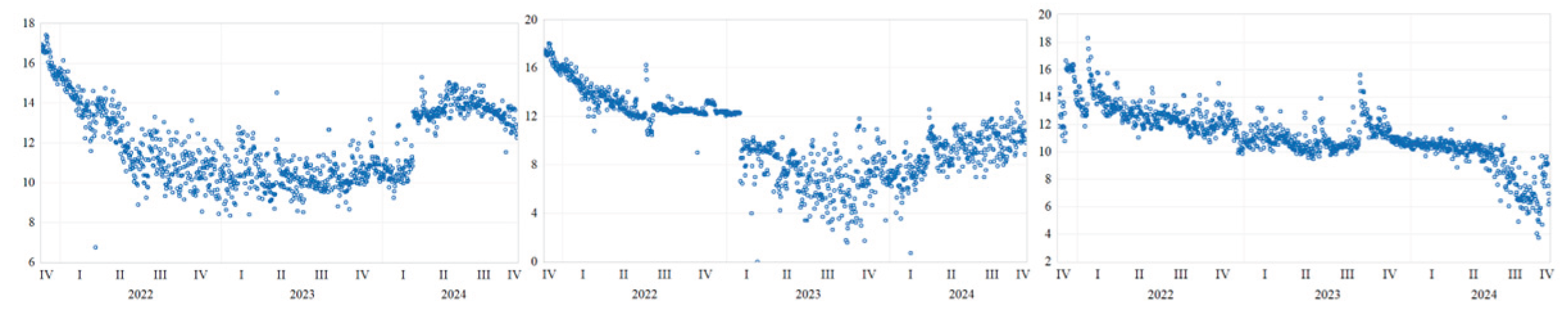
Figure 3.
Plot of Daily Bid-ask Spread of Tokens $KLIMA, BCT, and MCO2.
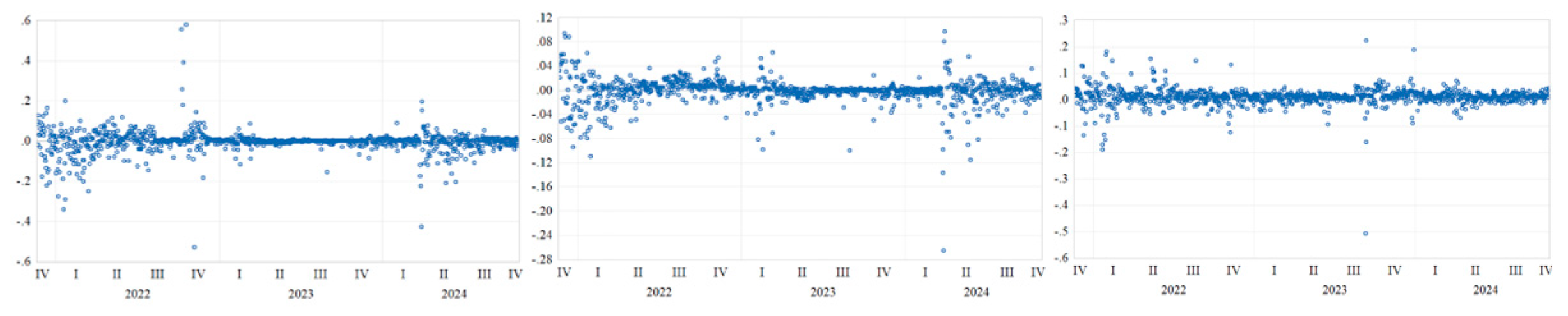
Figure 4.
Plot of Daily Return Volatility of Tokens $KLIMA, BCT, and MCO2.

Figure 5.
Plot of Daily Total Supply of Tokens $KLIMA, BCT, and MCO2.

Figure 6.
Plot of Daily Shared Volume of Tokens $KLIMA, BCT, and MCO2.

Figure 7.
Plot of Daily Transaction Value of Tokens $KLIMA, BCT, and MCO2.

Figure 8.
Plot of Daily Market Capitalization of Tokens $KLIMA, BCT, and MCO2.

Figure 9.
Plot of Daily Transfer Amounts of Tokens $KLIMA, BCT, and MCO2.
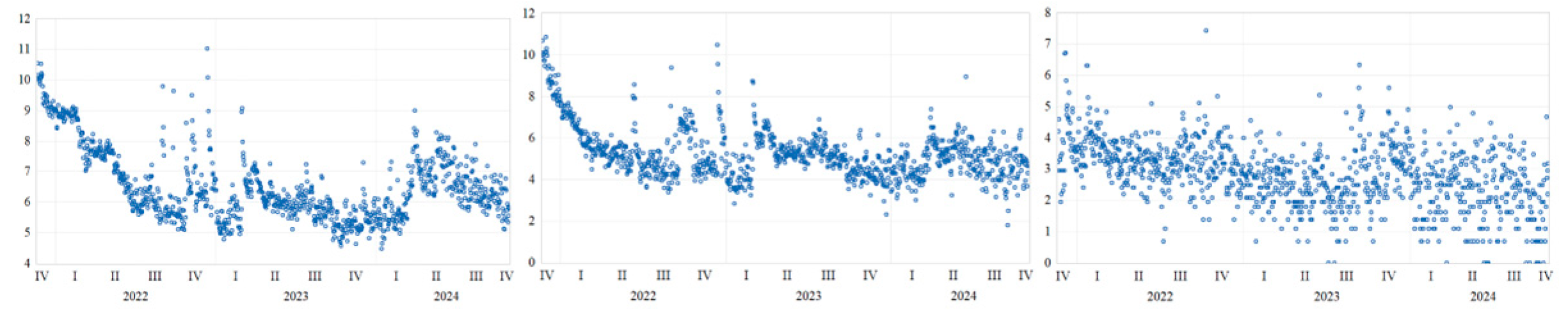
Figure 10.
Plot of Daily Active Wallet of Tokens $KLIMA, BCT, and MCO2.

Table 1.
Variable Operational.
| Independent Variable | Tokenized Carbon Asset On-chain Trading | |||
| Variable Denotations | Description | Source | Reference | |
| TS | Total Supply |
Number of circulating carbon tokens available on-chain |
PolygonScan, EtherumScan |
(Athey et al, 2016; Ballesteros-Rodríguez et al., 2024; Swinkels, 2024) |
| SV | Shared Volume |
Aggregate quantity of carbon tokens traded on-chain within VCMs |
PolygonScan, EtherumScan |
(Antulov-Fantulin et al., 2018; Athey et al, 2016; Ballesteros-Rodríguez et al., 2024; Baruch et al., 2022; Swinkels, 2024) |
| VT | Transaction Value | Total USD of on-chain carbon token transactions |
PolygonScan, EtherumScan |
(Ballesteros-Rodríguez et al., 2024; Baruch et al., 2022; Swinkels, 2024) |
| MC | Market Capitalization |
Market valuation of tokenized carbon assets |
CoinGecko |
(Ballesteros-Rodríguez et al., 2024; Baruch et al., 2022; Karakostas et al, 2024; Pan & Misra, 2021; Wu et al, 2018) |
| TA | Transfer Amount | Frequency of transactions | PolygonScan, EtherumScan |
(Moncada et al., 2024; Pan & Misra, 2021; Swinkels, 2024) |
| AW | Active Wallet |
Daily count of unique wallet addresses |
PolygonScan EtherumScan |
(Albayati, 2021; Athey et al, 2016; Moncada et al, 2024; Parino et al., 2018; Swinkels, 2024; Verma et al, 2024) |
| Dependent Variable | Liquidity of VCMs | |||
| Variable Denotations | Description | Source | Reference | |
| BS | Bid-Ask Spread | High-low price spread of carbon tokens |
CoinMarketCap | (Chordia et al., 2002; Foster & Viswanathan, 1993; Morris et al., 2018; Pan & Misra, 2021;Sarr & Lybeck, 2002) |
| DV | Dollar Volume | Aggregate traded value across DEXs |
CoinGecko | (Amihud, 2002; Foster & Viswanathan, 1993; Morris et al., 2018; Pan & Misra, 2021; Sarr & Lybeck, 2002; Tlili, 2025) |
| RV | Return Volatility | Variability of daily token returns |
CoinGecko | (Chan et al., 1995; Foster & Viswanathan, 1993; Morris et al, 2018; Pan & Misra, 2021; Sarr & Lybeck, 2002) |
| Moderation Variable | ||||
| Variable Denotations | Description | Source | Reference | |
| RI | Regulation Index | Regulatory policy governing carbon token trading |
National policy, publication and reports |
(Baruch et al., 2022; Guo et al., 2023; Verma et al, 2024) |
Source: Authors (2026)
Table 2.
Regulation Index
| Indicator | Description | Score |
| Regulatory Clarity on Blockchain and Digital Assets |
Captures the existence and coherence of legal frameworks governing blockchain use in carbon trading and the classification of carbon tokens as digital assets, commodities, or securities, drawing on cross-jurisdictional fintech and digital-asset regulation (Zetzsche et al., 2017; Arner et al., 2017, 2019; OECD, 2021; Diaz-Valdivia et al., 2022; Oduro et al., 2025). | 2 |
| VCMs-Specific Policy Framework |
Assesses whether voluntary carbon markets (VCMs) are explicitly recognized and regulated, including alignment with international standards such as Verra and Gold Standard (Franki, 2022; World Bank, 2023; IETA & EY, 2022). | 2 |
| Consumer Protection and Enforcement |
Measures the availability of investor-protection mechanisms and the effectiveness of enforcement against fraud and market manipulation in carbon token trading, based on established market-integrity and sanctions frameworks (Avgouleas, 2021; IOSCO, 2022a,b,c; OECD, 2021). | 2 |
| Technological Infrastructure and Regulatory Sandboxes |
Reflects governmental support for innovation through digital infrastructure and the implementation of regulatory sandboxes or pilot regimes for carbon tokenization (Allen & Overy, 2017; Arner et al., 2017; OECD, 2021; Diaz-Valdivia et al., 2022). | 2 |
| ESG Integration and Financial Sector Engagement |
Evaluates the financial-institution participation and fiscal incentives supporting ESG-linked carbon-token projects and their integration into sustainable finance systems (Zetzsche et al., 2020; IOSCO, 2022b; IETA & EY, 2022; Kriechel & Ziesemer, 2009; van Leeuwen & Mohnen, 2017; Wang et al., 2022). | 2 |
Source : Authors (2026)
Table 3.
Categorization of MMRMs.
| Results | Class | Description |
| β2 insignifant; β3 significant |
Pure Moderator |
The moderator has no direct effect on the dependent variable but moderates the relationship between the independent and dependent variables. |
|
β2 significant; β3 significant |
Quasi Moderator | The moderator has a direct effect on the dependent variable and also moderates the relationship between the independent and dependent variables. |
|
β2signifant; β3 insignifant |
Predictor Moderator | The moderator directly affects the dependent variable but does not moderate the relationship between the independent and dependent variables. |
|
β2insignifant; β3 insignifant |
Homologizer Moderator | The moderator has neither a direct effect nor a moderating effect on the relationship between the independent and dependent variables. |
Source : Adapted from Solimun, Fernandes, & Nurjannah, 2017
Disclaimer/Publisher’s Note: The statements, opinions and data contained in all publications are solely those of the individual author(s) and contributor(s) and not of MDPI and/or the editor(s). MDPI and/or the editor(s) disclaim responsibility for any injury to people or property resulting from any ideas, methods, instructions or products referred to in the content. |
© 2026 by the authors. Licensee MDPI, Basel, Switzerland. This article is an open access article distributed under the terms and conditions of the Creative Commons Attribution (CC BY) license (http://creativecommons.org/licenses/by/4.0/).
Copyright: This open access article is published under a Creative Commons CC BY 4.0 license, which permit the free download, distribution, and reuse, provided that the author and preprint are cited in any reuse.


