

Submitted:
23 February 2026
Posted:
25 February 2026
You are already at the latest version
Abstract
Wireless communications face both opportunities and challenges due to the coexistence of 5G New Radio (NR) high-band, 5G mid-band, and 5G low-band technologies. Each technology uses both licensed and unlicensed spectrum to operate in separate frequency bands. For example, 5G NR uses the high-band of 24+ GHz, the mid-band of 2-6 GHz, or the low-band of less than 2 GHz, including the 5 GHz band via Licensed-Assisted Access (LAA). With the use of sophisticated coexistence mechanisms and optimization techniques, this 5G coexistence scenario in shared spectrum can be effectively managed. These strategies are essential for boosting network capacity, reducing latency, and ensuring fair spectrum use across different wireless technologies. This work provides a comprehensive system-level evaluation of multi-band coexistence and offloading strategies under realistic deployment assumptions. The simulation results confirm the effectiveness of the proposed model, showing that spectrum sharing and coexistence among these technologies deliver scalable and robust performance in heterogeneous service environments. This approach enables efficient load balancing across the entire network and highlights the need for additional features to achieve further performance gains.
Keywords:
5G-NR
; performance evaluation
; high-band technology
; mid-band technology
; low-band technology
; coexistence
1. Introduction
The growing demand for high-speed wireless communications has prompted the development and implementation of 5G New Radio (NR), Wi-Fi 6E, and LTE technologies. These technologies frequently use overlapping frequency bands, demanding appropriate coexistence solutions to reduce interference and improve performance. This article compares the coexistence methods and performance of 5G NR, Wi-Fi 6E, and LTE in shared spectrum situations.
5G New Radio (NR) achieves the best performance and coverage by utilizing a wide range of frequency bands, including low, mid, and high bands. The coexistence of these bands is critical for realizing the full promise of 5G services such as enhanced mobile broadband (eMBB), ultra-reliable low latency communication (URLLC), and massive machine-type communication (mMTC) [1].
Here’s an overview of 5G bands and their coexistence considerations [2]:
1. Low-band (sub-1 GHz):
• Characteristics: Provides strong coverage and longer transmission ranges, making it ideal for reaching large areas and rural places.
• Coexistence challenges: Dynamic spectrum sharing is necessary for coexistence with existing 4G LTE networks.
2. Mid-band (1 GHz to 6 GHz):
• Characteristics: Offers optimal coverage and capacity, making it a desirable location for 5G.
• Coexistence challenges: Requires careful planning to avoid interference with existing services, such as radio altimeters in flight.
• Examples: 3.3-3.8 GHz is a popular mid-band range.
3. High-band (mmWave, 24 GHz or higher):
• Characteristics include high bandwidth and low latency, but lower transmission distances and sensitivity to impediments.
• Coexistence challenges: Requires dense deployment of small cells and careful consideration of interference with other services, such as satellite communications and fixed wireless access.
• General coexistence strategies:
-Dynamic Spectrum Sharing (DSS) enables 4G and 5G to share frequency bands, increasing spectrum utilization.
-Guard Bands: Dedicated frequency ranges between services to prevent interference.
-Techniques for reducing interference between 5G and other systems include alignment and power regulation.
-Harmonizing spectrum allocations across areas to support global 5G deployments and prevent interference.
Careful network planning involves optimizing cell site placements and power levels to reduce interference and improve coverage. In summary, the coexistence of low, mid, and high bands in 5G NR involves a complex interaction of technological and legal factors. By combining techniques, 5G networks may effectively use the different spectrum resources while minimizing interference and maximizing user advantages.
5G NR operates across a wide range of spectrum bands, including sub-6 GHz and millimeter-wave bands, whereas Wi-Fi 6E uses the 2.4 GHz, 5 GHz, and newly available 6 GHz unlicensed bands [3]. The coexistence of 5G NR and Wi-Fi 6E may cause interference, which can be mitigated by using advanced techniques such as Multi-Task Learning (MTL) and Convolutional Neural Networks (CNN) to improve packet identification and classification [3]. Furthermore, the coexistence of 5G NR-U and Wi-Fi in the 6 GHz band can be improved by utilizing physical layer upgrades and flexible numerologies, which aid in fair and effective spectrum sharing [4].
Listen Before Talk (LBT) and adaptive exponential backoff systems have been proposed to improve LTE and Wi-Fi coexistence performance in the 5 GHz band by dynamically changing contention window sizes and transmission opportunities [5,6]. Simulation findings show that these strategies can improve throughput and reduce latency, resulting in a balanced performance of LTE and Wi-Fi networks [5,7]. Furthermore, spectrum sharing between LTE and 5G NR yields minimal capacity benefits when compared to exclusive spectrum access, emphasizing the necessity for additional technologies like carrier aggregation and higher-order MIMO to achieve considerable performance gains [8]. Coexistence of these technologies in crowded urban areas necessitates careful consideration of interference control and resource allocation strategies to ensure optimal network performance [8]. Therefore, the following key points should be considered to ensure smooth integration between all technologies:
- Interference Mitigation: Advanced techniques like MTL-CNN improve packet identification and classification, enhancing coexistence between 5G NR and Wi-Fi 6E [3].
- Spectrum Sharing: Physical layer enhancements and flexible numerologies in 5G NR-U facilitate fair coexistence with Wi-Fi in the 6 GHz band [4].
- Urban Deployment: Effective interference management and resource allocation are essential for maintaining performance in dense urban environments [9].
The following key points show the novelty and the differentiation from existing literature:
- Coexistence framework for integrated multi-band 5G: a unified system-level model that simultaneously takes into account 5G NR high-, mid-, and low-frequency bands operating over both licensed and unlicensed spectrum is proposed in this work. On the other hand, the majority of current research in the literature concentrates on single coexistence mechanisms or isolated frequency bands.
- Realistic deployment and heterogeneous service modelling: the suggested model takes into consideration realistic deployment assumptions, heterogeneous traffic profiles, and a variety of quality-of-service requirements, in line with realistic next-generation network scenarios, in contrast to analytical or simplified simulation approaches that are frequently reported.
- Joint spectrum sharing and offloading strategy: Unlike band-specific or localized optimization solutions, dynamic network-wide load balancing is made possible by the coordinated integration of spectrum sharing and traffic unloading across several bands.
- Comprehensive performance evaluation: the study evaluates multiple key performance indicators, including admission rate, throughput, scalability, and load balancing efficiency, providing a more holistic assessment compared to prior work that typically emphasize a limited set of metrics.
- Scalability under high traffic density: simulation results demonstrate that the proposed framework maintains robust and scalable performance under increasing user density and traffic demand, highlighting its suitability for dense and heterogeneous service environments.
- Beyond performance improvements, the findings identify current limitations of shared-spectrum operation and outline directions for future enhancement through learning-based resource allocation, advanced interference management, and a new mobility model can be proposed in a network-level scenario to enhance the effectiveness of the system under study.
2. Literature Review
The coexistence of 5G NR technologies across high, mid, and low bands involves addressing significant challenges related to spectrum allocation, interference management, and technological integration. Advanced antenna designs, full-duplex communication techniques, and careful system-level planning are essential to ensure harmonious operation and optimal performance across these diverse frequency bands. As the industry moves towards 6G [10], these challenges will become even more pronounced, necessitating innovative solutions and continued research.
The study in [11] focuses on the upper 6 GHz band (6425-7125 MHz) for 5G NR, highlighting its potential for balancing capacity and coverage. The research includes a comprehensive measurement campaign in an urban environment, demonstrating high channel capacity even in challenging scenarios. In [12] the authors discussed the use of DSS technology to allow 5G NR and LTE to coexist in the same frequency band. It includes a field trial showing that LTE signals have a significant impact on DSS cells due to always-on signals and provides suggestions for mobile operators on DSS deployment. The coexistence in the 6 GHz Band is discussed in [13] concerning the coexistence of Wi-Fi and 5G services within the 6 GHz band, identifying challenges and potential solutions for harmonious operation without harmful interference to incumbent services. Similarly, authors in [14] proposed a coexistence model integrating LTE/Wi-Fi to enhance network performance and capacity by utilizing two virtual zones. Based on service priority levels, most traffic is initially directed to the primary LTE zone. However, to achieve load balance across the network, lower-priority traffic is offloaded from the LTE zone to the Wi-Fi zone. In other papers [15], the authors explore the coexistence mechanisms of integrated satellite-terrestrial networks, focusing on RF emission performance and discrepancies between test results and standards. The paper also outlines limitations and future research directions.
The coexistence of 5G NR and 4G LTE in the 2.1 GHz band using theoretical analysis and Monte Carlo simulations is examined in [16]. The authors concluded the work emphasizing the feasibility of coexistence and the necessary adjacent channel interference ratio (ACIR) [5]. The article [17] reviews efforts to enable 5G connectivity in the 70 GHz and 80 GHz bands, focusing on interference management techniques and validating coexistence through network simulations and experimental prototypes. [18] provides an overview of 5G NR-U, which extends 5G NR to unlicensed bands. It discusses coexistence with Wi-Fi, showing that NR-U achieves higher throughput and lower delay, and compares it with LTE-LAA. The work in [19] presents coexistence studies between incumbent systems and 5G networks in the 700 MHz, 3.5 GHz, and 26 GHz bands, using the Minimum Coupling Loss (MCL) methodology to show that coexistence is possible with adequate separation. On the other hand, the work in [20] reports on experimental results showing peaceful coexistence between 4G LTE-A, NB-IoT, and 5G services in the 700 MHz band, demonstrating unified network operation.
The study in [21] analyzes the coexistence of 5G Massive MIMO systems with fixed receive-only satellite earth stations in the 3.7-4.2 GHz band, proposing interference mitigation techniques to ensure harmonious operation. A Multi-Task Learning (MTL) approach using Convolutional Neural Networks (CNN) is introduced in [22] to improve coexistence between 5G NR sub-6 GHz and Wi-Fi 6E networks by accurately identifying and classifying packets. Other work presents a CPW-fed ultra-wideband MIMO antenna design for 5G and future 6G systems, achieving high isolation and wide bandwidth, suitable for integration into various ultra-wideband systems [23]. Whereas the study in [24] proposed an autoencoder-based method to mitigate RFI from terrestrial 5G base stations in the 1400-1427 MHz band, preserving valuable information and preventing data loss.
The work in [25] proposed an infrastructure-agnostic handover framework to optimize handover performance and improve QoS and QoE in 5G, 5G-Advanced, and 6G networks, addressing challenges in mobility management. Other research work analyzes the use of millimeter wave bands for high-speed railway networks, proposing a network architecture integrating sub-6 GHz and millimeter wave bands to enhance coverage and transmission capacity [26]. The article in [27] proposed an antenna design integrating sub-6 GHz and millimeter wave bands with existing 3G/4G bands, focusing on compact size and improved impedance bandwidth for future mobile handsets. The design and performance of 5G sub-6 GHz and millimeter wave SBS antennas, highlighting advanced technologies like reconfigurable antennas and massive MIMO for enhanced network performance is discussed in [28]. The authors in [29] discussed the challenges in commercializing 5G mmWave technology, focusing on coverage and reliability enhancement techniques to fully realize its potential. [30] explores the design considerations for compact antennas in sub-6 GHz and millimeter wave bands for vehicular applications, addressing challenges in material selection, fabrication, and performance parameters.
Unlike existing studies that primarily address single-band operation or isolated coexistence scenarios, this work presents a comprehensive system-level framework for the coordinated coexistence of 5G NR high-, mid-, and low-band technologies across licensed and unlicensed spectrum. The proposed model integrates spectrum sharing and traffic offloading under realistic deployment assumptions and heterogeneous service requirements. Simulation results demonstrate scalable and robust performance in dense traffic conditions, with notable improvements in admission rates, throughput, and network-wide load balancing. These contributions provide practical insights into multi-band coordination and highlight promising directions for future enhancements in next-generation and beyond-5G wireless systems. Beyond performance improvements, the findings identify current limitations of shared-spectrum operation and outline directions for future enhancement through learning-based resource allocation, advanced interference management, and a new mobility model can be proposed in a network-level scenario to enhance the effectiveness of the system under study.
3. Modelling
3.1. The Proposed Model
The proposed model is given in Figure 1. The proposed scenario is to obtain a hotspot/Dense urban zone with high-band for both licensed and unlicensed spectrum utilized by 5G NR surrounded by an urban zone with also licensed and unlicensed spectrum utilized by WiFi-6E, whereas the only licensed spectrum is utilized by the LTE zone, which represents a suburban zone. Given the preceding assumptions, the following situation works: Allocating the best effort traffic, VR/AR applications by 5G NR and Wi-Fi zones and QoS-sensitive traffic via the LTE zone increases user participation in both traffic classes by monitoring the huge bandwidth available on 5G/Wi-Fi zones and freeing up resources on the LTE link.
3.2. Benefits of Coexistence
The coexistence of 5G-NR high-band, mid-band, and low-band technologies is achieved through integrated deployment strategies, spectrum sharing, and advanced radio technologies, enabling 5G to deliver on its promises of high speed, low latency, and massive connectivity across diverse environments. Following are the main benefits of this deployment for operators:
Performance Synergy: The combination of all three bands allows 5G NR to meet diverse requirements, from massive IoT to ultra-fast broadband [31,32,33,34,35].
Deployment Strategy: Most operators start with mid-band for a balance of performance and coverage, then densify with high-band in urban areas and supplement with low-band for rural and deep indoor coverage [31,32,33,34].
Technological Advances: High-band 5G leverages advanced antenna arrays and MIMO for up to 10x performance improvement over 4G [35].
3.3. Network Setup
We consider a three-tier heterogeneous 5G network composed of Low-band, mid-band and high-band zones, each operating at different carrier frequencies and coverage radii. Each band is characterized by a: carrier frequency , system bandwidth , transmit and receive antenna gains , cell radius and path-loss model where is the distance between the user and the serving cell.
A total number of users are uniformly and independently placed within the coverage area, with an equal number of users per band. Each user requests one service from the service set . A user selects a service with probability such that . Each service is associated with a minimum rate requirement .
We focus on DL data transmissions where admitted users continuously request their chosen service and require at least the minimum rate Given the zone bandwidth and the noise spectral density , the Signal-to-Noise Ratio (SNR) of user is computed as:
where the received power is:
and correspond to the transmit and receive antenna gains, respectively.
The path loss depends on the band from which the user is served. Following 3GPP TR 38.901 in [37], we adopt three path loss models: UMi (Urban Micro) street canyon, UMa (Urban Macro) and RMa (Rural Macro) corresponding to the high-band, mid-band and low-band, respectively.
- -
- UMi (Urban Micro) street canyon LOS PL:
- -
- UMa (Urban Macro) LOS PL:
Where,
- -
- RMa (Rural Macro) street canyon LOS PL:
We measure the downlink transmission quality between the service base station and a user based on the Signal-to-Noise Ratio (SNR) as follows:
where is the transmitted power of the antenna in dBm, are the transmit and receive gain of the antennas, is the path loss and is the noise power.
Finally, the downlink rate of user is calculated as follows:
where is the number of users served in band .
Initially, each user connects to the band corresponding to the zone in which they are located. However, if the achievable rate in this band is below the required threshold , the user cannot be admitted. In this case, the user attempts to offload to the next higher band (e.g., Low → Mid, Mid → High). If in the higher band the user meets the minimum rate requirement, it is admitted; otherwise, if the requirement cannot be satisfied even after offloading, the user is ultimately rejected.
3.4. Simulation Parameters and Traffic Distribution
To evaluate the performance of spectrum sharing across heterogeneous wireless technologies, we consider a single base station operating over three distinct frequency bands, each corresponding to a specific deployment environment. The high-band, dedicated to the dense urban zone, operates at a carrier frequency of 28 GHz, with a total system bandwidth of 400 MHz and a coverage radius of 200 meters. The mid-band, representing the urban zone, is characterized by a carrier frequency of 3.5 GHz, a total bandwidth of 100 MHz and a coverage radius of 1000 meters. The low-band, associated with the suburban zone, operates at a carrier frequency of 0.7 GHz, with a total bandwidth of 20 MHz and a coverage radius of 3000 meters. These parameter values are selected to reflect realistic 5G NR deployment scenarios and are consistent with 3GPP TR 38.901 in [37].
We consider that users are randomly and uniformly generated in each zone such that the number of users is the same across the three zones. Each user randomly requests a service from the list of services S = {Vo5G, } with probabilities of 0.2, 0.4 and 0.4, respectively. We further assume that each service has a minimum throughput requirement as depicted in Table 1. A user is admitted and served by the network if its achieved throughput is above the service required throughput. Otherwise, the user is dropped from the network. For performance evaluation, 100 independent random network realizations are generated. During each random instance, we vary the number of users between 10 and 300 in each zone. Table 1 summarizes the assumptions and parameters used in our simulations.
3.5. Assumed Service Categories and Performance Measures
The following service categories are considered in the analysis [1]:
(1) Web browsing using a new radio (WBo5G): This service enables users to search, browse, and download web content at speeds exceeding one Gbps. Web browsing accounts for 40% of the services offered because it is the most common activity on the internet.
(2) Video Streaming-over-5G (STRo5G): This service offers virtual and augmented reality video experiences, real-time video streaming, and video on demand (VoD). 40% of all multimedia services are set aside for this kind of service in order to guarantee low latency. This type of service is also most used among young people through social media, YouTube and other applications.
(3) Voice-over-5G (Vo5G): Also referred to as voice over new radio, this technology offers smartphones high-definition (HD) voice communication. It makes up the remaining 20% of all services accessible because it is rarely used and primarily saved for emergency calls.
-The following performance measures are studied and discussed through the numerical results:
• Throughput: refers to the achievable downlink data rate experienced by an admitted user when served by a given frequency band (low, mid, or high). In this work, the user rate is derived from the Shannon capacity expression and depends on the available bandwidth, propagation conditions, transmit power, and the number of users sharing the band.
• Offload: is the mechanism by which a user is reassigned from its original serving band to a higher-capacity band when its rate requirement cannot be satisfied locally. A user is successfully offloaded if the target band can provide a rate meeting the service requirement; otherwise, the user is rejected.
• Admission rate: quantifies the network’s ability to accept user requests while respecting service rate requirements. A user is considered admitted if It achieves the minimum required rate in its original band, or it successfully meets the requirement after offloading to a higher band.
4. Simulation Results and Discussions
This section presents and analyzes the performance of the proposed system under varying user loads, frequency bands, service categories, and offloading conditions. The proposed system is modelled using Python programming with the simulation parameters given in Table 1. The evaluation focuses on three key performance metrics: admission rate, offloading behavior, and system throughput. Results are illustrated in Figure 2, Figure 3, Figure 4, Figure 5, Figure 6, Figure 7, Figure 8, Figure 9, Figure 10, Figure 11, Figure 12 and Figure 13.
4.1. Admission Rate Performance Across Frequency Bands (Overall)
Figure 2, Figure 3 and Figure 4 illustrate the overall admission rate as a function of the total number of users for the high-band, low-band, and mid-band scenarios, respectively, with and without offloading.
In the high-band case (Figure 2), the admission rate remains close to unity when the number of users is low, reflecting the availability of large bandwidth and the resulting high per-user capacity. As the number of users increases, the admission rate gradually decreases due to increased contention for time–frequency resources and the progressive exhaustion of available bandwidth. Nevertheless, the degradation remains moderate, with the admission rate still around 75% for 800 users, highlighting the suitability of high-band operation for dense traffic conditions. Congestion effects become noticeable when the number of active users exceeds approximately 600, beyond which resource sharing limits the ability to satisfy all service rate requirements. As offloading is only allowed from low- and mid-band users toward higher bands, no offloading can be triggered for high-band users, resulting in overlapping admission-rate curves in Figure 2.
In contrast, the low-band scenario (Figure 3) exhibits a much steeper decline in admission rate as user density increases. Although low-band frequencies offer superior coverage and favorable propagation characteristics, the limited available bandwidth significantly restricts the number of users that can be simultaneously supported. As a result, contention increases rapidly, leading to early congestion and a sharp reduction in admission rate at relatively low user densities (around 180 users). This behavior highlights the fundamental capacity limitations of low-band systems when serving heterogeneous services under high load. With offloading enabled, a substantial portion of users that would otherwise be rejected are transferred to mid- or high-band resources, significantly delaying congestion and yielding a pronounced improvement in admission rate. Consequently, the performance gap between the offloading and no-offloading cases is largest in the low-band scenario.
The mid-band results shown in Figure 4 demonstrate a balanced performance trend between the two extremes. The admission rate remains high at low to moderate user densities and then decreases steadily as the load increases. This confirms that mid-band operation offers an effective compromise between coverage and capacity, enabling improved scalability compared to low-band systems while maintaining more stable performance than high-band systems under heavy load. Notably, beyond approximately 500 users, the admission rate stabilizes even as the total number of users approaches 800, indicating that the system reaches a saturation regime where additional users have a limited marginal impact on admission performance. Offloading plays a key role in this stabilization by redistributing excess load to higher-capacity bands, preventing further degradation of admission rate and enhancing robustness under high traffic demand.
In summary, the results show that admission performance in multi-band 5G networks is primarily driven by bandwidth availability and effective load redistribution. While high-band operation remains robust under dense traffic, low-band systems quickly saturate and rely heavily on offloading to maintain acceptable admission rates. Mid-band deployment, when combined with upward offloading, offers the most balanced and scalable solution for supporting heterogeneous services under increasing user demand.
4.2. Impact of Service Categories Without Offloading
Figure 5, Figure 6 and Figure 7 depict the admission rate for different service categories in the high-band, low-band, and mid-band scenarios, respectively, when offloading is not employed.
In the high-band without offloading scenario (Figure 5), service categories with lower minimum rate requirements, such as WBo5G and Vo5G, achieve higher admission rates, particularly under low to moderate traffic loads. In contrast, STRo5G, which has the highest rate requirement, experiences earlier degradation as the number of users increases. When the system becomes heavily loaded (beyond approximately 600 users), admission rates for all services decline due to increased contention and limited resource sharing. The relatively better performance of WBo5G and Vo5G reflects their lower bandwidth demands, which are easier to satisfy in a shared high-band environment even under congestion.
The low-band without offloading scenario (Figure 6) represents the most resource-constrained condition. Due to the limited available bandwidth, admission rates decrease sharply with increasing user density, and service differentiation becomes more pronounced. High-rate services such as STRo5G are rejected at relatively low loads, while low-rate services such as Vo5G maintain higher admission probabilities for a longer range of user densities. This behavior highlights the inability of low-band systems to support heterogeneous service requirements under high load without additional load-relief mechanisms.
In the mid-band without offloading case (Figure 7), admission rates decrease more gradually than in the low-band scenario. The mid-band’s larger bandwidth allows it to accommodate a wider range of service categories before congestion becomes dominant. While high-rate services still experience earlier rejection compared to low-rate services, the overall admission performance remains more balanced, confirming that mid-band operation provides improved support for heterogeneous services compared to low-band deployment in the absence of offloading.
Overall, these results indicate that in the absence of offloading, admission performance across service categories is primarily governed by service rate requirements and available bandwidth. High-rate services such as STRo5G are rejected earliest as user density increases, particularly in bandwidth-limited bands, whereas lower-rate services such as WBo5G and Vo5G maintain higher admission probabilities over a wider range of loads. This behavior underscores the limited ability of standalone band operation to simultaneously support heterogeneous service requirements under heavy traffic conditions.
4.3. Impact of Service Categories with Offloading
Figure 8, Figure 9 and Figure 10 present the admission rate results for different service categories in the high-band, low-band, and mid-band scenarios, respectively, when offloading is enabled.
Figure 5 and Figure 8 exhibit identical admission-rate behavior because in the proposed model offloading is only permitted from low- and mid-band users toward higher bands. As a result, high-band users cannot benefit from offloading, and enabling the offloading mechanism does not alter the admission performance in the high-band scenario.
In the low-band with offloading case (Figure 9), the benefits of offloading are particularly obvious. Compared to the no-offloading scenario, admission rates are substantially improved across all service categories, especially under medium-to-high traffic loads. Offloading enables users that cannot be supported locally due to bandwidth limitations to be reassigned to mid- or high-band resources, significantly reducing blocking. As user density increases, a larger proportion of admitted users corresponds to low-rate services such as Vo5G, which are easier to accommodate under constrained capacity conditions.
Similarly, the mid-band with offloading results shown in Figure 10 demonstrate enhanced scalability and improved fairness among service categories. The availability of higher-band resources allows the system to absorb excess demand when the mid-band becomes saturated, resulting in sustained admission performance for low- and medium-rate services such as Vo5G and WBo5G. In contrast, high-rate services such as STRo5G experience earlier admission degradation, with fewer than 300 users being accommodated, reflecting their stringent rate requirements even under offloading-enabled operation.
Overall, these results show that offloading significantly improves service admission in bandwidth-limited bands, while admission performance remains primarily constrained by service rate requirements in higher-capacity bands.
4.4. Offloading Behavior Analysis
Figure 11 illustrates the number of offloaded users as a function of the total system load. At low user densities, offloading activity remains limited, and most requests are served locally, resulting in only a small number of offloaded users, primarily from the low-band to the mid-band. As the user load increases, current band resources become saturated and the number of offloaded users grows rapidly, indicating that the system increasingly relies on offloading to accommodate excess demand. This behavior confirms that the offloading mechanism dynamically redistributes traffic toward higher-capacity bands, effectively mitigating congestion and supporting service continuity under high load.
4.5. Throughput Performance
Figure 12 and Figure 13 compare the system throughput without and with offloading, respectively. In the absence of offloading (Figure 12), system throughput initially increases with the number of users as aggregate traffic demand grows. However, as user density continues to rise, throughput saturates and may slightly degrade under heavy load due to increased contention, inefficient bandwidth sharing, and the resulting reduction in per-user data rates. The stricter admission control in this case leads to fewer admitted users, which can result in marginally higher per-user throughput at the expense of increased blocking.
When offloading is enabled (Figure 13), throughput performance improves primarily in the mid-band scenario. Offloading redistributes users from bandwidth-limited bands to higher-capacity bands, reducing congestion and improving resource utilization in the mid-band. As a result, the system sustains higher throughput levels under high user densities compared to the no-offloading case, despite admitting a larger number of users. In contrast, low-band throughput remains constrained by limited bandwidth, while high-band throughput is primarily limited by propagation conditions and therefore benefits less from offloading. These results demonstrate that offloading improves overall network efficiency by trading slight reductions in per-user throughput for significantly enhanced admission capacity and scalability.
4.6. Summary of Key Observations
The following key observations are drawn from the results:
1. Across all frequency bands, the admission rate decreases as user density increases, with the rate of degradation being strongly dependent on the available bandwidth.
2. Low-band systems are more susceptible to early congestion due to limited capacity, whereas high-band systems provide greater robustness under dense traffic conditions.
3. Offloading consistently improves admission performance and service fairness, while enabling more efficient utilization of network resources under high load.
4. The benefits of offloading are most pronounced in low-band and high-density scenarios, where capacity constraints are most severe.
5. Combining offloading with mid- and high-band operation offers the most scalable and reliable solution for supporting heterogeneous services under increasing traffic demand.
5. Conclusions and Future Directions
The coexistence of 5G New Radio technologies running in both licensed and unlicensed spectrum across high-, mid-, and low-frequency bands was examined in this research. The study offered a thorough system-level assessment of multi-band spectrum sharing and offloading options by taking into account varied service requirements and actual deployment situations. The findings show that these various 5G bands can coexist peacefully thanks to efficient coexistence techniques, which reduce interference and boost network performance. The suggested system achieves scalable and robust performance under rising user density and traffic demand, according to simulation results. Specifically, it has been demonstrated that intelligent spectrum sharing and offloading greatly improve admission rates, throughput, and load balancing throughout the network, supporting a variety of service categories with different quality-of-service needs. These findings highlight the critical role of coordinated multi-band operation in addressing capacity and latency challenges in next-generation wireless systems.
Despite the observed performance gains, the results also indicate that further enhancements are necessary to fully exploit the potential of shared-spectrum operation. Future work may incorporate advanced interference management techniques, adaptive learning-based resource allocation, and tighter integration with emerging 6G paradigms to achieve additional improvements. Overall, this study highlights the importance of multi-band coexistence and offloading as key enablers for efficient, flexible, and sustainable wireless networks. To have a more realistic model operating on a network-level scenario, room is also available for proposing a new mobility model in a future version of this work.
Author Contributions
A.I.Z. and J.A. were involved in the whole process of producing this paper, including conceptualization, methodology, modeling, validation, visualization, and manuscript preparation. All authors have read and agreed to the published version of this manuscript.
Funding
This research received no external funding.
Institutional Review Board Statement
Not Applicable.
Informed Consent Statement
Not Applicable.
Data Availability Statement
The original contributions presented in this study are included in the article. Further inquiries can be directed to the corresponding author(s).
Conflicts of Interest
The authors declare no conflicts of interest.
References
- A.I. Zreikat, H. Kang, Performance Analysis of Downlink 5G Networks in Realistic Environments. Appl. Sci. 2025, 15, 4526. [CrossRef]
- A 5G Americas White paper. https://www.5gamericas.org/wpcontent/uploads/2021/07/Mid-Band-Spectrum-and-the-Co-Existence-with-Radio-Altimeters.pdf. (Accessed: 05 Jan. 2026).
- D. I. Putra and S. Ekariani, “Enhancing the Coexistence of 802.11 WLAN and 5G Networks using a Multi-Task Learning with Convolutional Neural Network Model,” 2024 2nd International Symposium on Information Technology and Digital Innovation (ISITDI), Bukittinggi, Indonesia, 2024, pp. 167-172. [CrossRef]
- J. Peng, Y. Gao, X. Sun, W. Zhan and Z. Guo, “3GPP Fairness Constrained Throughput Optimization for 5G NR-U and WiFi Coexistence in the Unlicensed Spectrum,” 2022 IEEE Wireless Communications and Networking Conference (WCNC), Austin, TX, USA, 2022, pp. 1779-1784. [CrossRef]
- S. Saadat, W. Ejaz, S. Hassan, I. Bari, T. Hussain. Enhanced network sensitive access control scheme for LTE–LAA/WiFi coexistence: Modeling and performance analysis, Computer Communications, Vol.172, 2021, pp. 45-53. [CrossRef]
- M. Haghshenas and M. Magarini, “NR-U and Wi-Fi Coexistence Enhancement Exploiting Multiple Bandwidth Parts Assignment,” 2022 IEEE 19th Annual Consumer Communications & Networking Conference (CCNC), Las Vegas, NV, USA, 2022, pp. 260-263. [CrossRef]
- Ibrahim, M.M., Azzuhri, S.R. (2024). Coexistence of Wi-Fi 6E with LTE-U/LAA in the 5 GHz Frequency Band. In: Yang, XS., Sherratt, R.S., Dey, N., Joshi, A. (eds) Proceedings of Eighth International Congress on Information and Communication Technology. ICICT 2023. Lecture Notes in Networks and Systems, Vol. 696. Springer, Singapore. [CrossRef]
- Busari, S.A., Correia, N., Saghezchi, F.B. et al. Spectrum sharing for LTE and 5G-NR coexistence. Telecommun Syst 85, 649–664 (2024). [CrossRef]
- H. Li, X. Zhang, L. Cao, X. Hu and D. Yang, “Performance Evaluation of Interference Coexistence in Dense Urban Scenario for 5G NR System,” 2018 IEEE 4th International Conference on Computer and Communications (ICCC), Chengdu, China, 2018, pp. 823-828. [CrossRef]
- Mackay, M., “Moving Towards 6G Wireless Technologies”. MDPI-Multidisciplinary Digital Publishing Institute, 2024.
- Morini, M., Moro, E., Filippini, I., Capone, A. Will the Upper 6 GHz Bands Work for 5G NR? A Urban Field Trial. In Proceedings of the 17th ACM Workshop on Wireless Network Testbeds, Experimental evaluation & Characterization (WiNTECH ‘23). Association for Computing Machinery, New York, NY, USA, 49–55. [CrossRef]
- Cai, B., Xie, W., Guo, H.”Analysis and Field Trial on Interference Coexistence of 5G NR and 4G LTE Dynamic Spectrum Sharing,” 2021 International Wireless Communications and Mobile Computing (IWCMC), Harbin City, China, 2021, pp. 1281-1285. [CrossRef]
- Pasaribu, F.M., Situmorang, A.C., Suryanegara, M., Gunawan, D. Exploring Potential Synergy: Examining the Coexistence of Diverse Technologies within the 6 GHz Frequency Band. 3rd International Conference on Electronic and Electrical Engineering and Intelligent System, ICE3IS 2023 - Hybrid, Yogyakarta, Indonesia, 9 -10 Aug 2023.
- Zreikat A. I., Samer Al-abed (2022). “Performance Modelling and Analysis of LTE/Wi-Fi Coexistence”, Electronics, MDPI, Vol. 11, issue 7, 25 March 2022. [CrossRef]
- Sun, X., Zhou, Y., Sun, S., Liu, Y. Emissions Performance Analysis of Non-Terrestrial Network Terminals,” 2024 IEEE 12th Asia-Pacific Conference on Antennas and Propagation (APCAP), Nanjing, China, 2024, pp. 1-2. [CrossRef]
- An, N., Wang, C., Wang, W. “Interference Coexistence of 5G NR and LTE System Based on 2.1GHz,” 2020 12th International Conference on Communication Software and Networks (ICCSN), Chongqing, China, 2020, pp. 90-94. [CrossRef]
- Hattab, G., Visotsky, E., Cudak, M., Ghosh, A. “Toward the Coexistence of 5G MmWave Networks with Incumbent Systems beyond 70 GHz,” in IEEE Wireless Communications, vol. 25, no. 4, pp. 18-24, AUGUST 2018. [CrossRef]
- Hirzallah, M., Krunz, M., Kecicioglu, B., Hamzeh, B. “5G New Radio Unlicensed: Challenges and Evaluation,” in IEEE Transactions on Cognitive Communications and Networking, vol. 7, no. 3, pp. 689-701, Sept. 2021. [CrossRef]
- Carciofi, C., Grazioso, P., Petrini, V., Matera, F. “Study of coexistence between different services in novel 5G Frequency Bands,” 2019 European Conference on Networks and Communications (EuCNC), Valencia, Spain, 2019, pp. 347-352. [CrossRef]
- Alexandre, L.C., Arismar Cerqueira, S. “Contribution for the Coexistence Analysis between 5G and 4G in the sub-1GHz Band,” 2019 SBMO/IEEE MTT-S International Microwave and Optoelectronics Conference (IMOC), Aveiro, Portugal, 2019, pp. 1-3. [CrossRef]
- Hattab, G., Moorut, P., Visotsky, E., (...), Ghosh, A. “Interference Analysis of the Coexistence of 5G Cellular Networks with Satellite Earth Stations in 3.7-4.2GHz,” 2018 IEEE International Conference on Communications Workshops (ICC Workshops), Kansas City, MO, USA, 2018, pp. 1-6. [CrossRef]
- Putra, D.I., Ekariani, S. “Enhancing the Coexistence of 802.11 WLAN and 5G Networks using a Multi-Task Learning with Convolutional Neural Network Model,” 2024 2nd International Symposium on Information Technology and Digital Innovation (ISITDI), Bukittinggi, Indonesia, 2024, pp. 167-172. [CrossRef]
- Wang, Z., Yang, F., Du, C., Wei, S. Design of Ultra-Wideband Multiple-Input Multiple-Output Antenna for 5G Applications, Yadian Yu Shengguang/Piezoelectrics and Acoustooptics, 2025, 47 (1), pp. 45 – 51. [CrossRef]
- Owfi, A., Afghah, F. “Autoencoder-Based Radio Frequency Interference Mitigation for SMAP Passive Radiometer,” IGARSS 2023 - 2023 IEEE International Geoscience and Remote Sensing Symposium, Pasadena, CA, USA, 2023, pp. 6783-6786. [CrossRef]
- Mbulwa, A.I., Tung Yew, H., Chekima, A., Dargham, J.A. “Handover Optimization Framework for Next-Generation Wireless Networks: 5G, 5G−Advanced and 6G,” 2024 IEEE International Conference on Automatic Control and Intelligent Systems (I2CACIS), Shah Alam, Malaysia, 2024, pp. 409-414. [CrossRef]
- Yan, L., Fang, X., Li, Y., Xue, Q. Overview on Intelligent Wireless Resource Management of Millimeter Wave Communications under High-speed Railway[J]. Journal of Electronics & Information Technology, 2023, 45(8): 2806-2817. [CrossRef]
- Sultan, K., Ikram, M., Nguyen-Trong, N. Integrated large-frequency-ratio dual-band tapered slot with monopole antenna for 4G/5G/B5G. Microw Opt Technol Lett. 2024; 66:e33499. [CrossRef]
- Praveen Kumar, B., Kommuri, U.K. “Review on 5G Small Cell Base Station Antennas: Design Challenges and Technologies,” in IEEE Access, vol. 12, pp. 85899-85928, 2024. [CrossRef]
- Sambhwani, S., Chae, H., Chiu, S.-E., (...), Zhu, X. “Extending mmWave Deployment in the Next-Generation Network: Coverage and Reliability Enhancements,” in IEEE Wireless Communications, vol. 32, no. 1, pp. 83-89, February 2025. [CrossRef]
- Kumar, A., Aljaidi, M., Singh, M., (...), Alenezi, S.M., “Recent Trends in Compact Planar Antennas at 5G Sub-6 GHz and mmWave Frequency Bands for Automotive Wireless Applications: A Review,” Progress In Electromagnetics Research C, Vol. 143, 169-180, 2024.
- Martian A., Trifan R., Stoian T., Vochin M., Li F. (2025). Towards Open RAN in beyond 5G networks: Evolution, architectures, deployments, spectrum, prototypes, and performance assessment. Computer Networks, 259. [CrossRef]
- Chelliah P., Soundarabai P. (2025). Demystifying the 5G-Advanced communication paradigm. Advances in Computers, 139. [CrossRef]
- Larsson C. (2025). 5G concepts and technologies. 5G/5G-Advanced Networks. [CrossRef]
- Morgado A., Huq K., Mumtaz S., Rodriguez J. (2018). A survey of 5G technologies: regulatory, standardization and industrial perspectives. Digital Communications and Networks, 4. [CrossRef]
- Lin J. (2023). Incongruities in recently revised radiofrequency exposure guidelines and standards. Environmental Research, 222. [CrossRef]
- Routray P., Ghosh D. (2025). Wide-band metamaterial absorber for sub-6 GHz 5G applications: Reducing specific absorption rate. AEU - International Journal of Electronics and Communications, 193. [CrossRef]
- 3GPP, “TR 38.901 V19.1.0: Study on channel model for frequencies from 0.5 to 100 GHz,” 3rd Generation Partnership Project, Tech. Rep., Sep. 2025.
Figure 1.
Model of coexistence of 5G/WIFI-6E/LTE technologies.
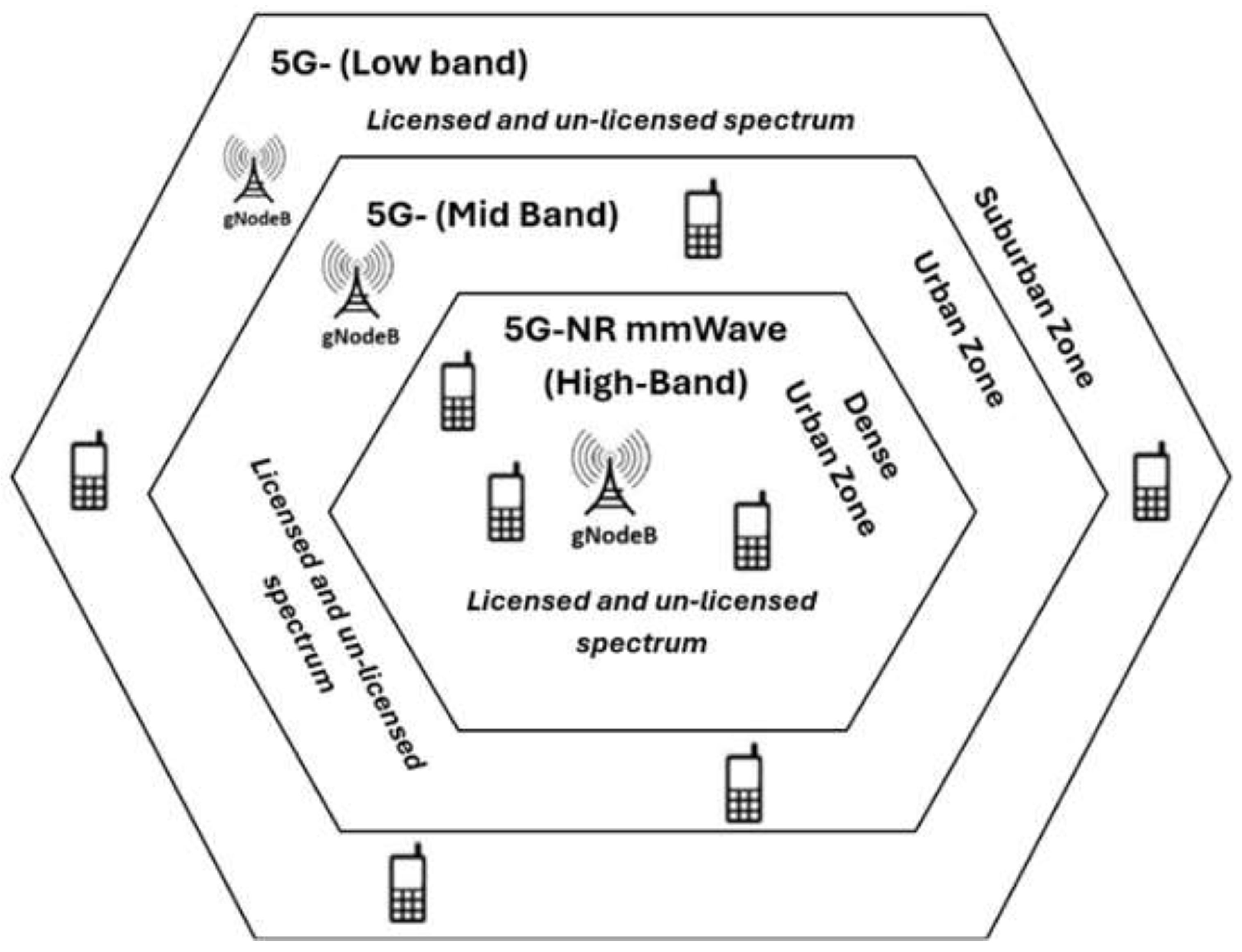
Figure 2.
Admission rate against total number of users (high-band overall).
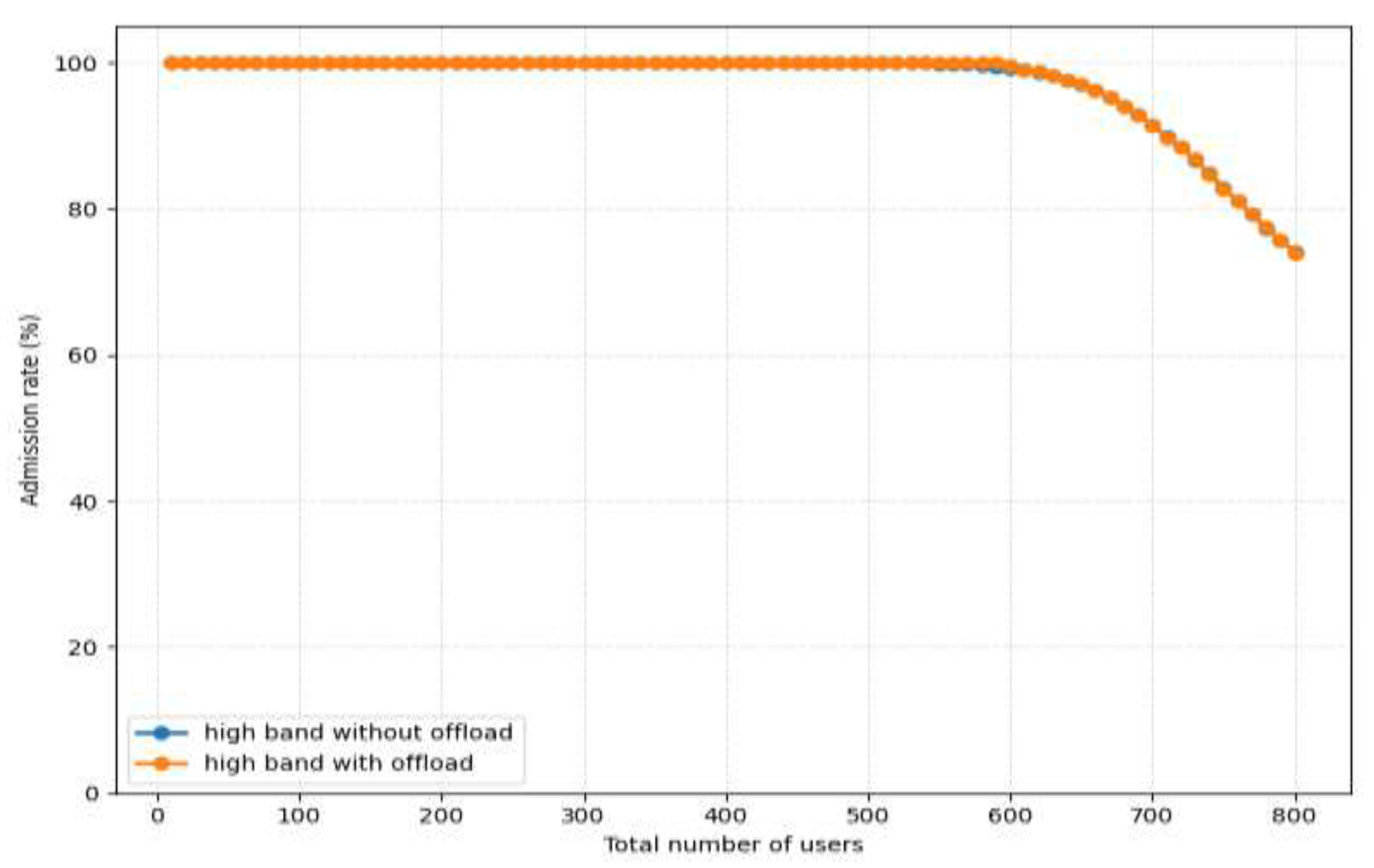
Figure 3.
Admission rate against total number of users (low-band overall).
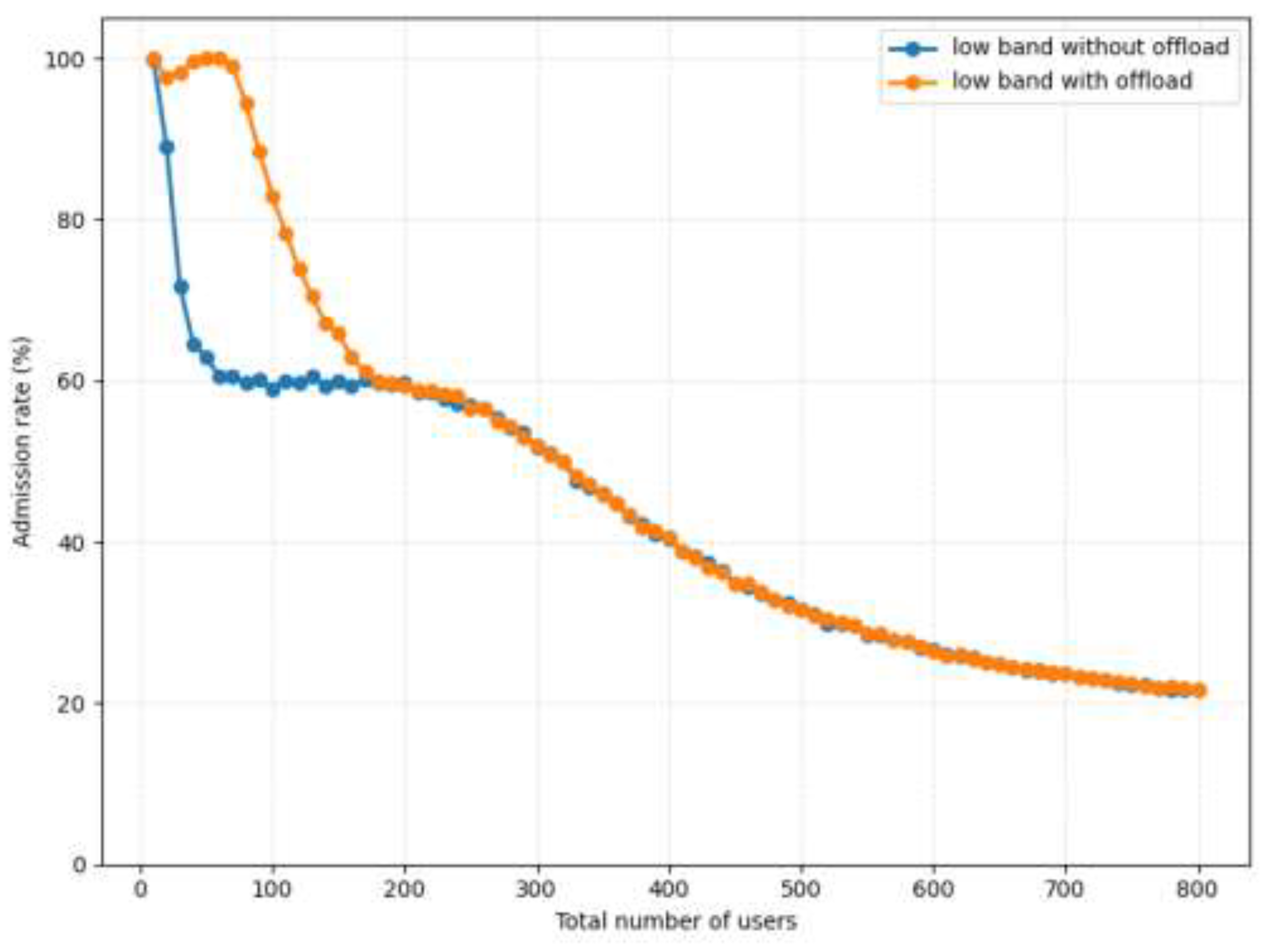
Figure 4.
Admission rate against total number of users (mid-band overall).
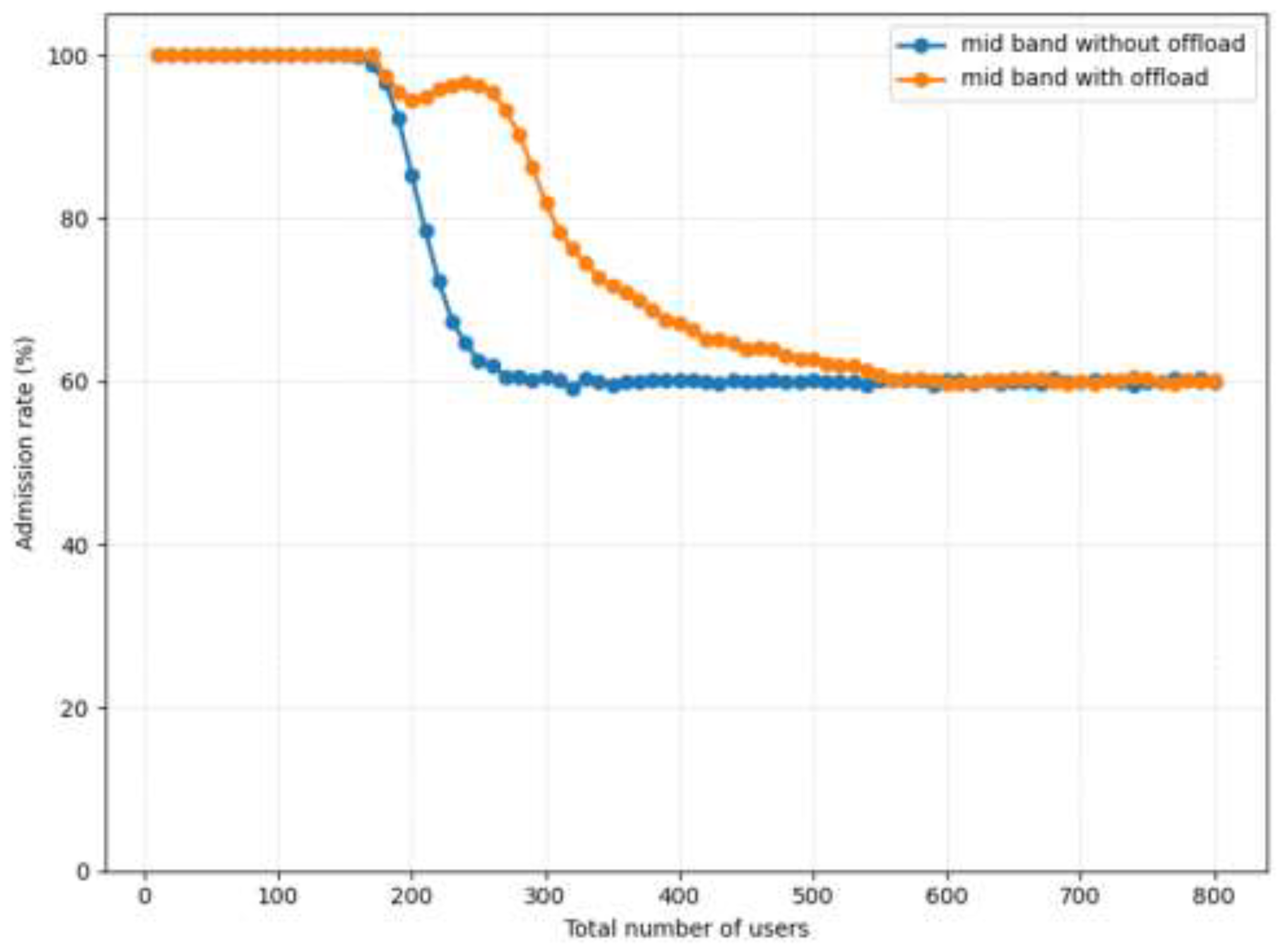
Figure 5.
Admission rate against total number of users for different service categories (high-band no offloading).
Figure 5.
Admission rate against total number of users for different service categories (high-band no offloading).
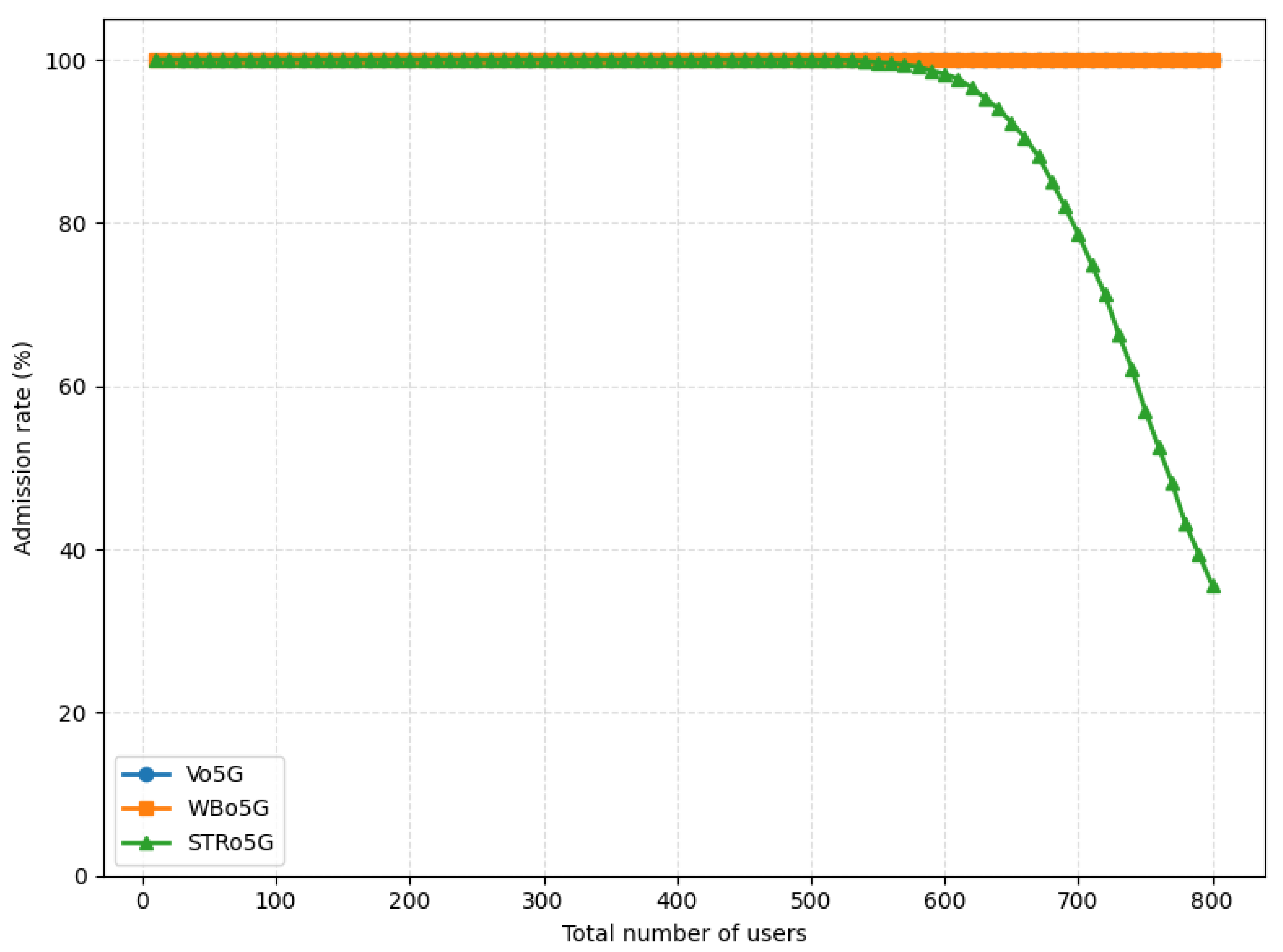
Figure 6.
Admission rate against total number of users for different service categories (low-band no offloading).
Figure 6.
Admission rate against total number of users for different service categories (low-band no offloading).
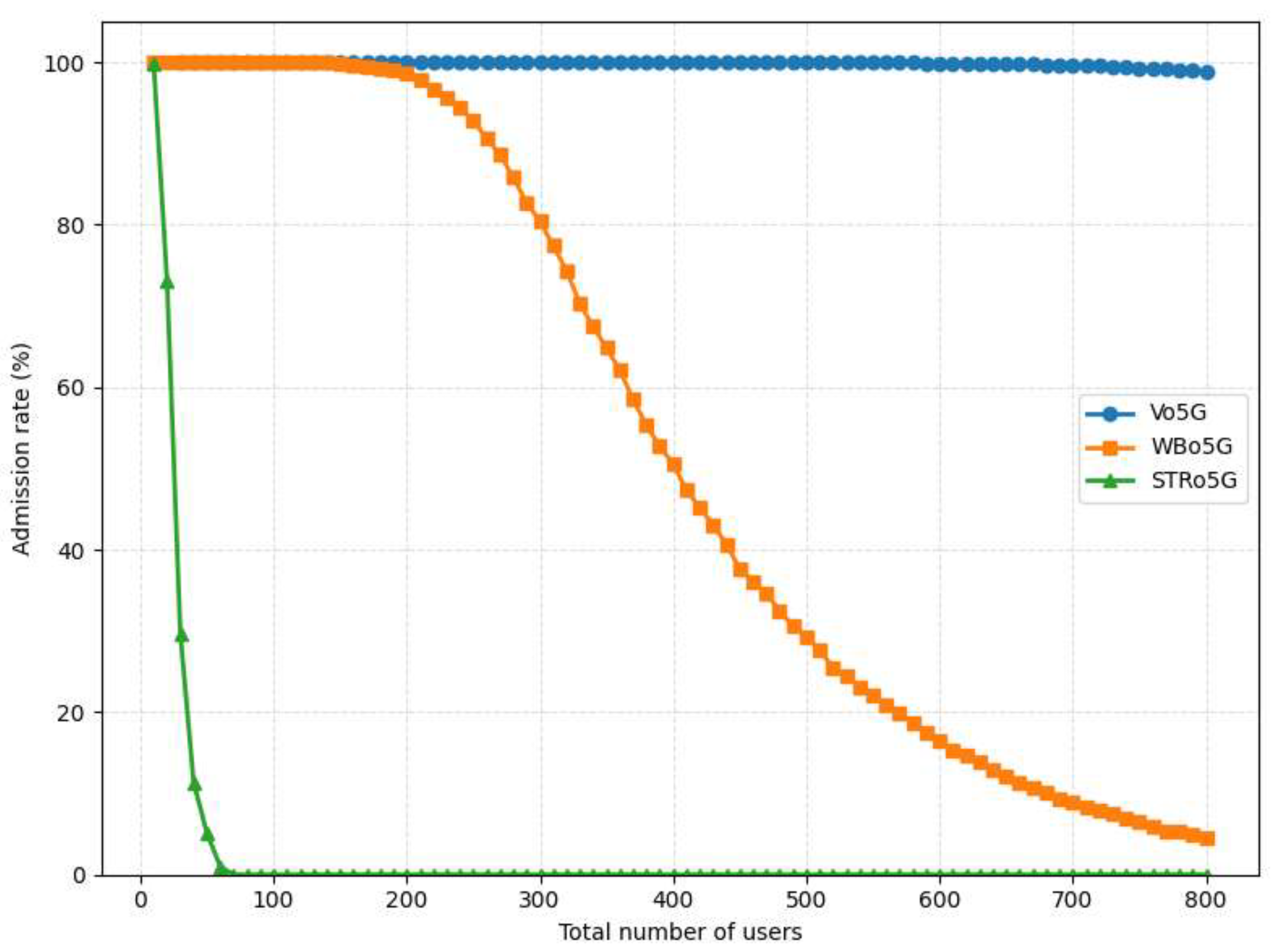
Figure 7.
Admission rate against total number of users for different service categories (mid-band no offloading).
Figure 7.
Admission rate against total number of users for different service categories (mid-band no offloading).
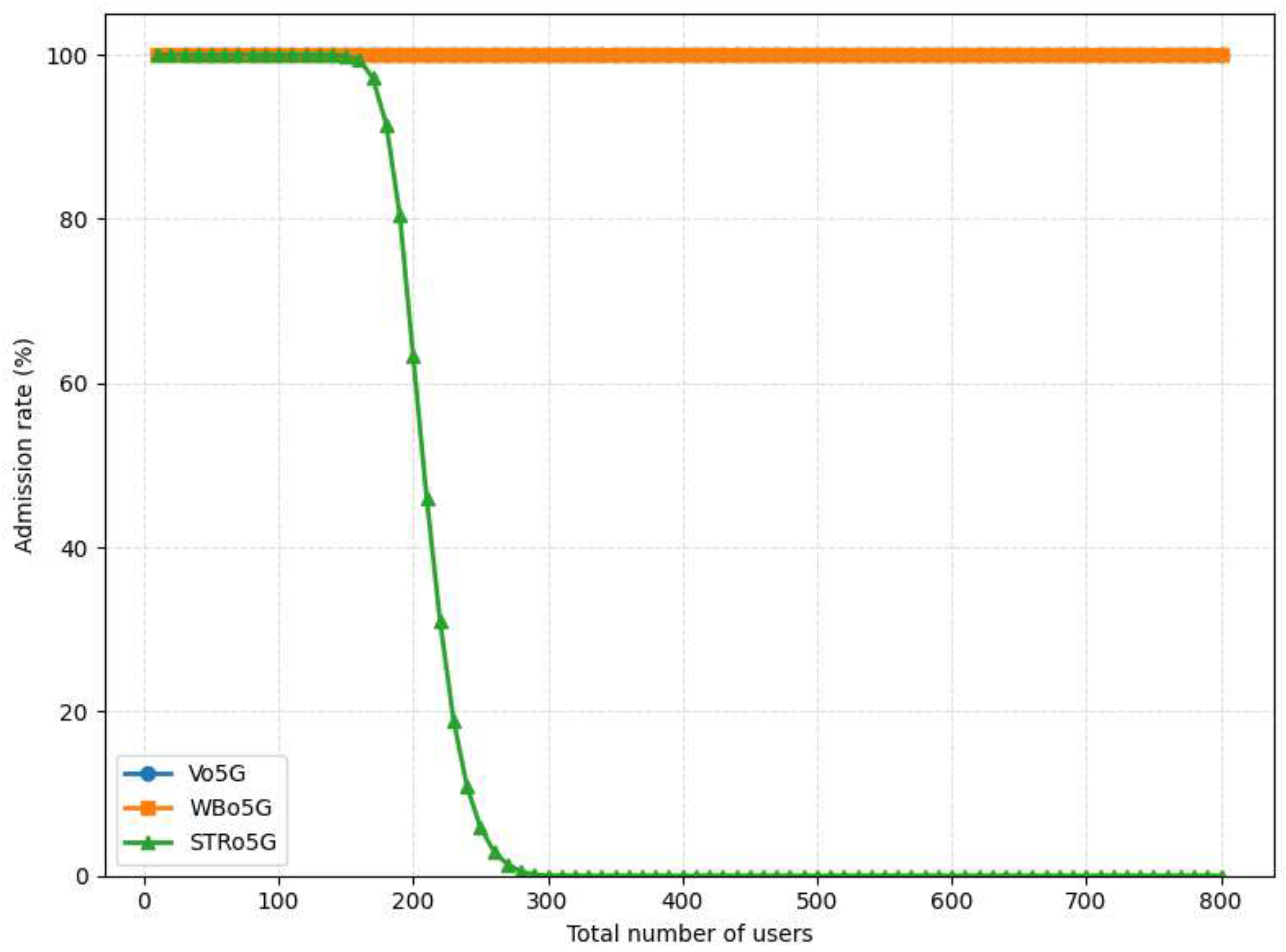
Figure 8.
Admission rate against total number of users for different service categories (high-band with offloading).
Figure 8.
Admission rate against total number of users for different service categories (high-band with offloading).
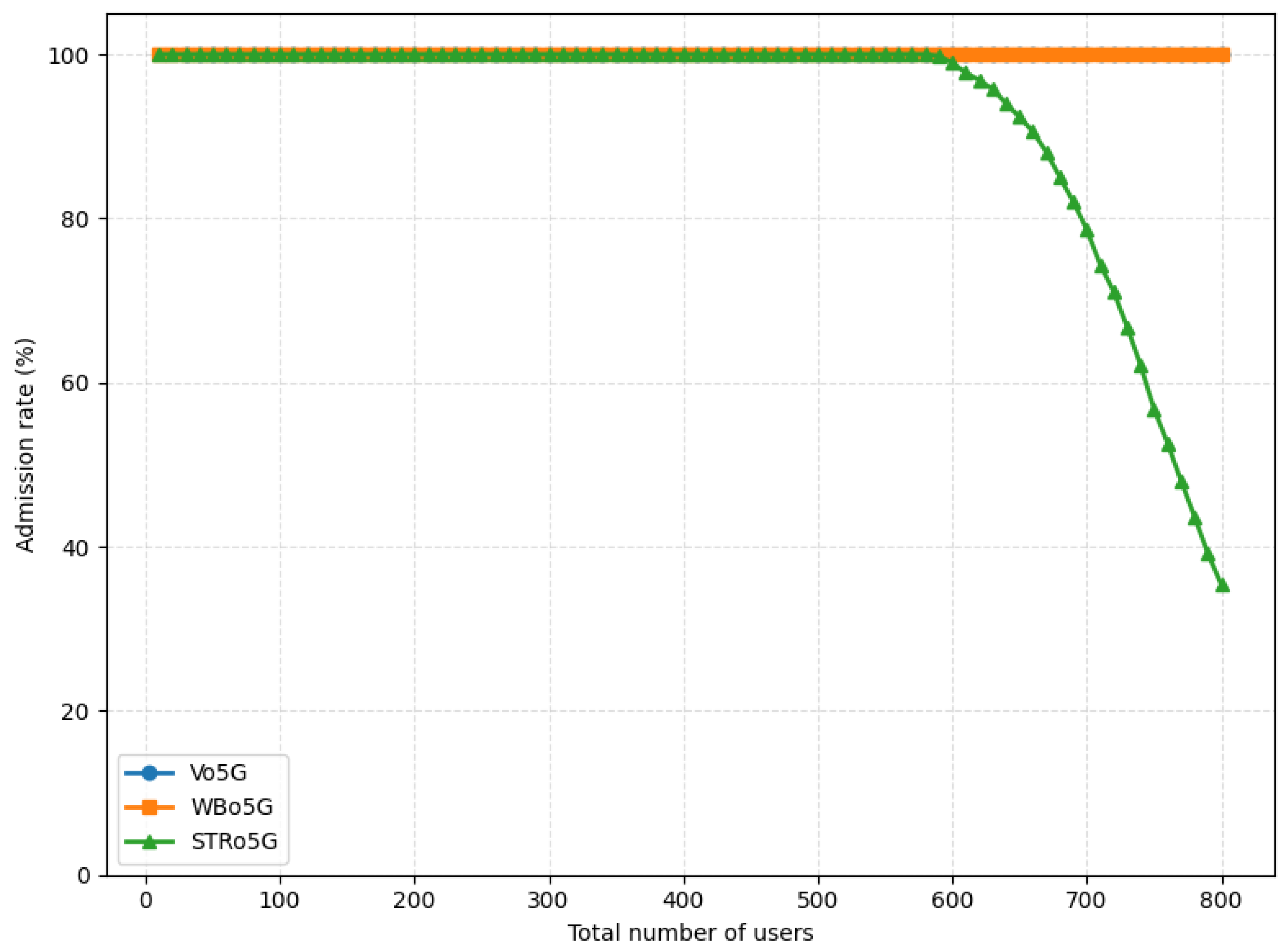
Figure 9.
Admission rate against total number of users for different service categories (low-band with offloading).
Figure 9.
Admission rate against total number of users for different service categories (low-band with offloading).
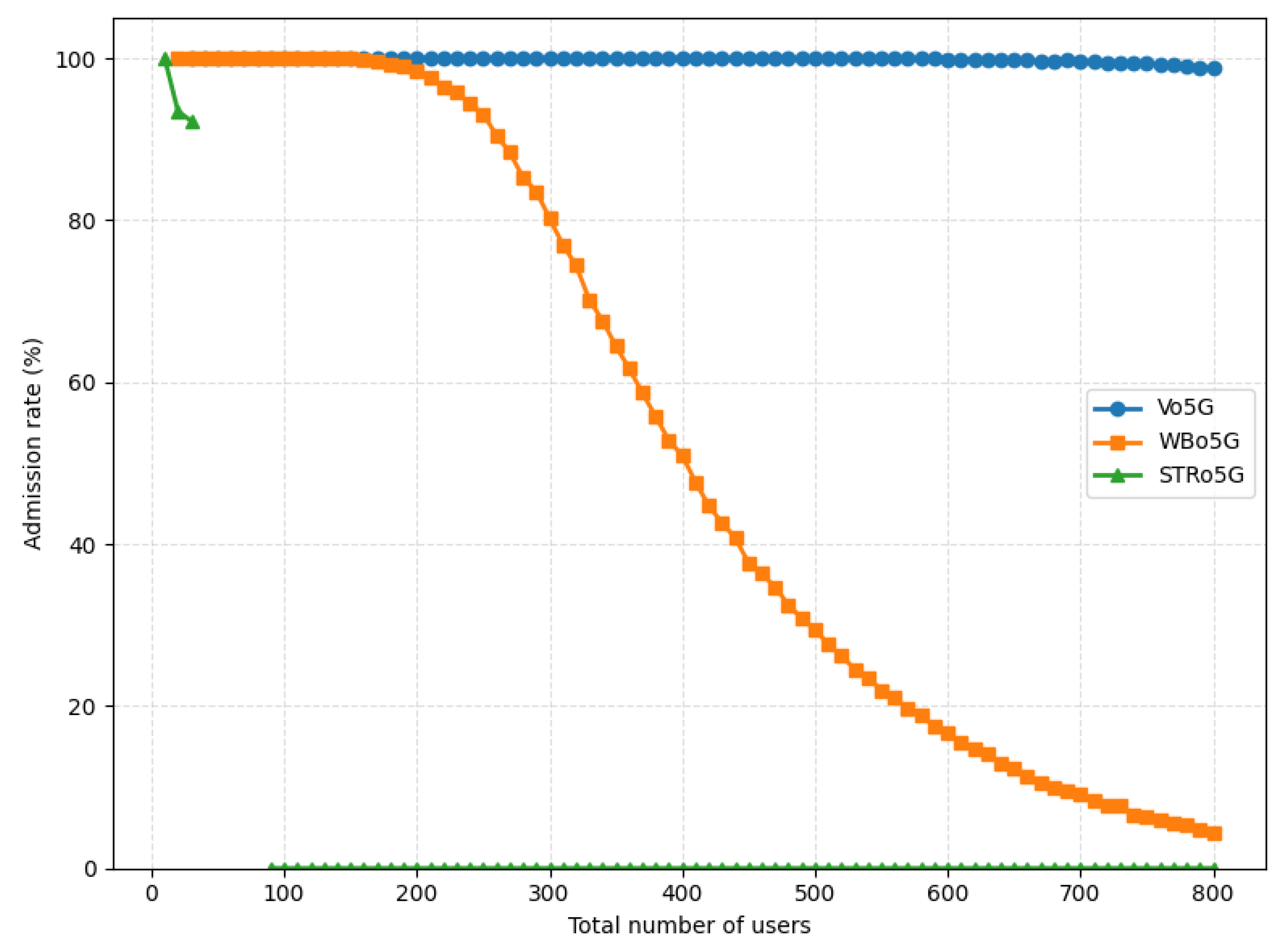
Figure 10.
Admission rate against total number of users for different service categories (mid-band with offloading).
Figure 10.
Admission rate against total number of users for different service categories (mid-band with offloading).
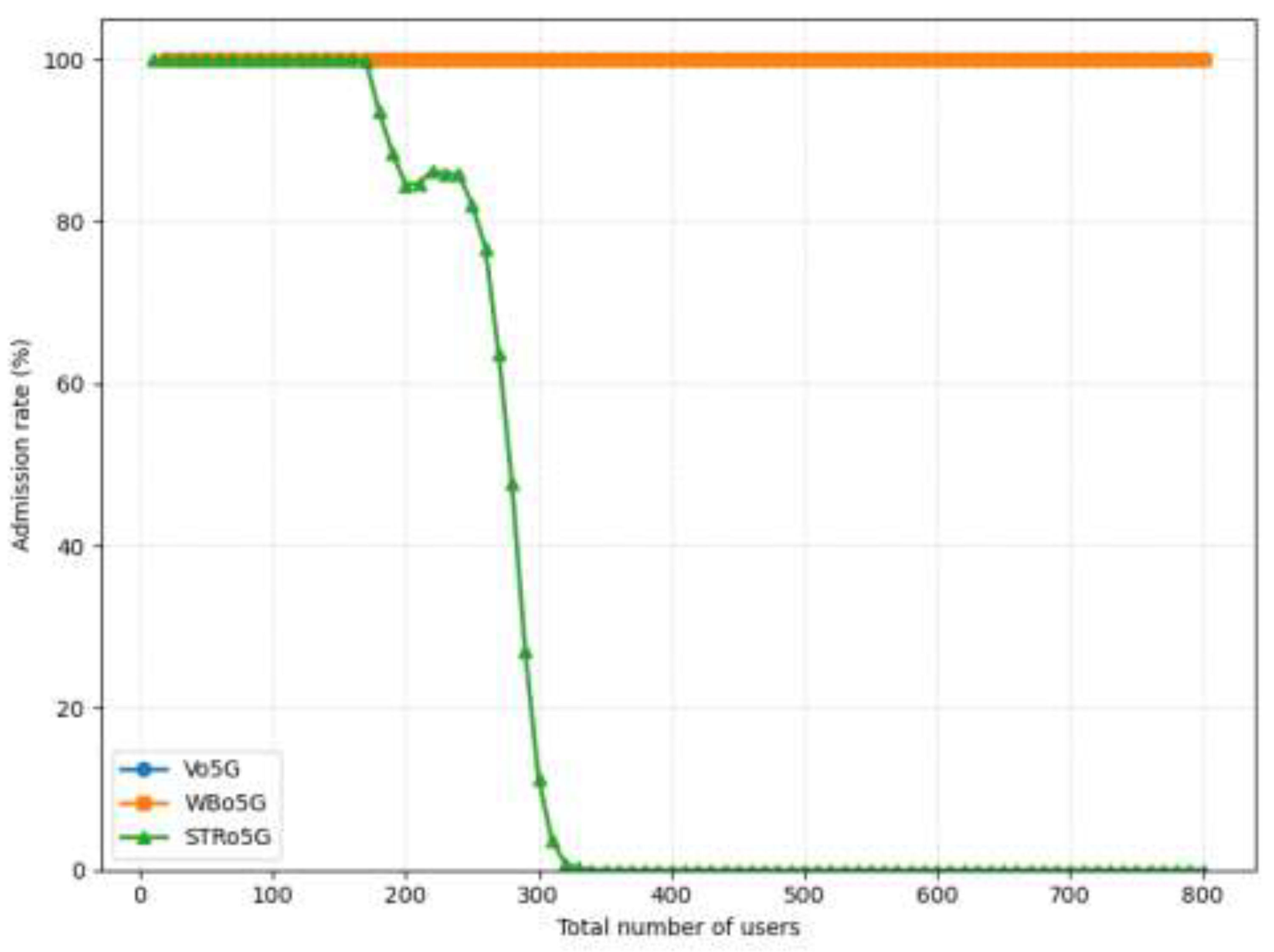
Figure 11.
Offloaded users.
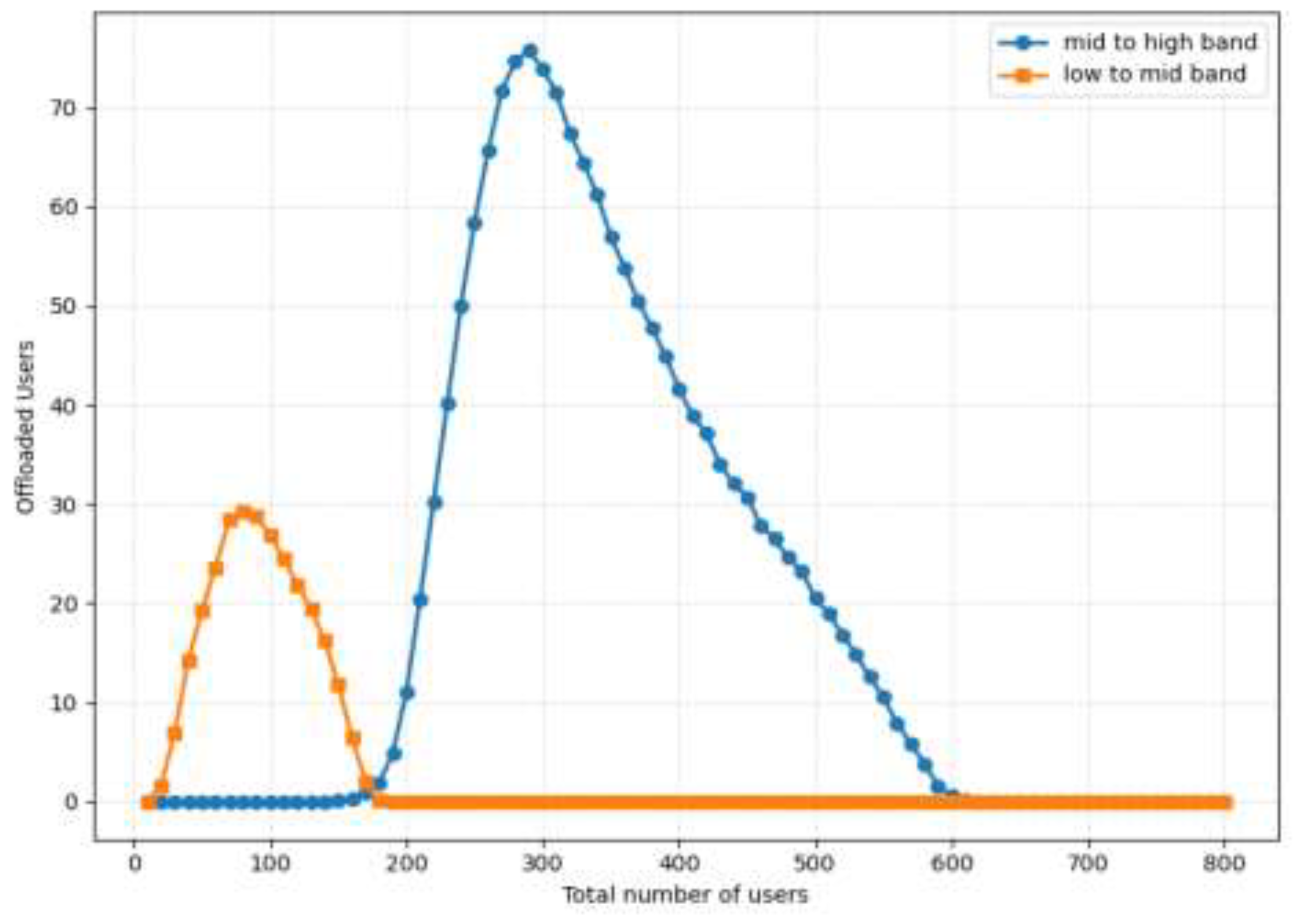
Figure 12.
Throughput (no offloading).
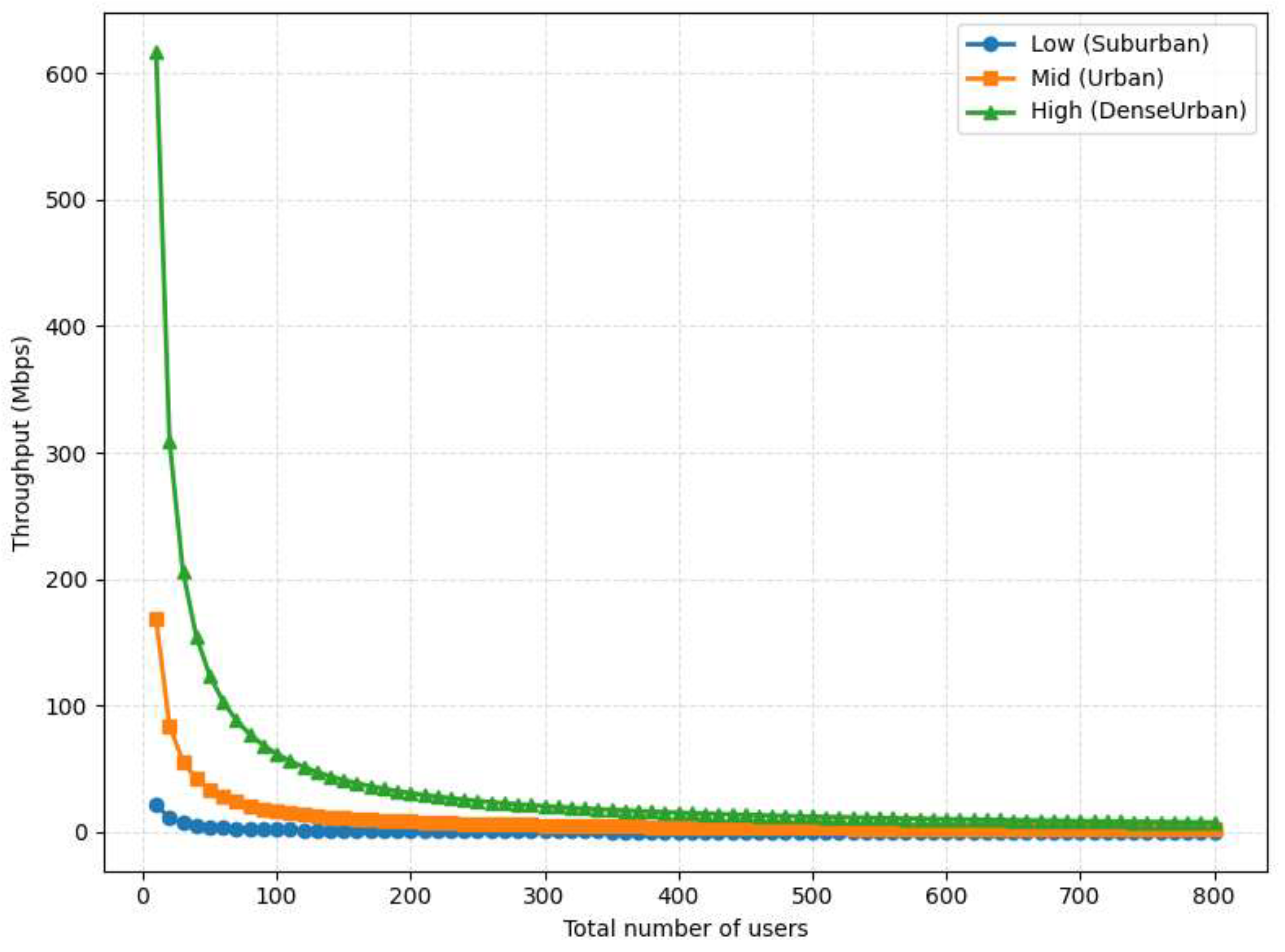
Figure 13.
Throughput (with offloading).
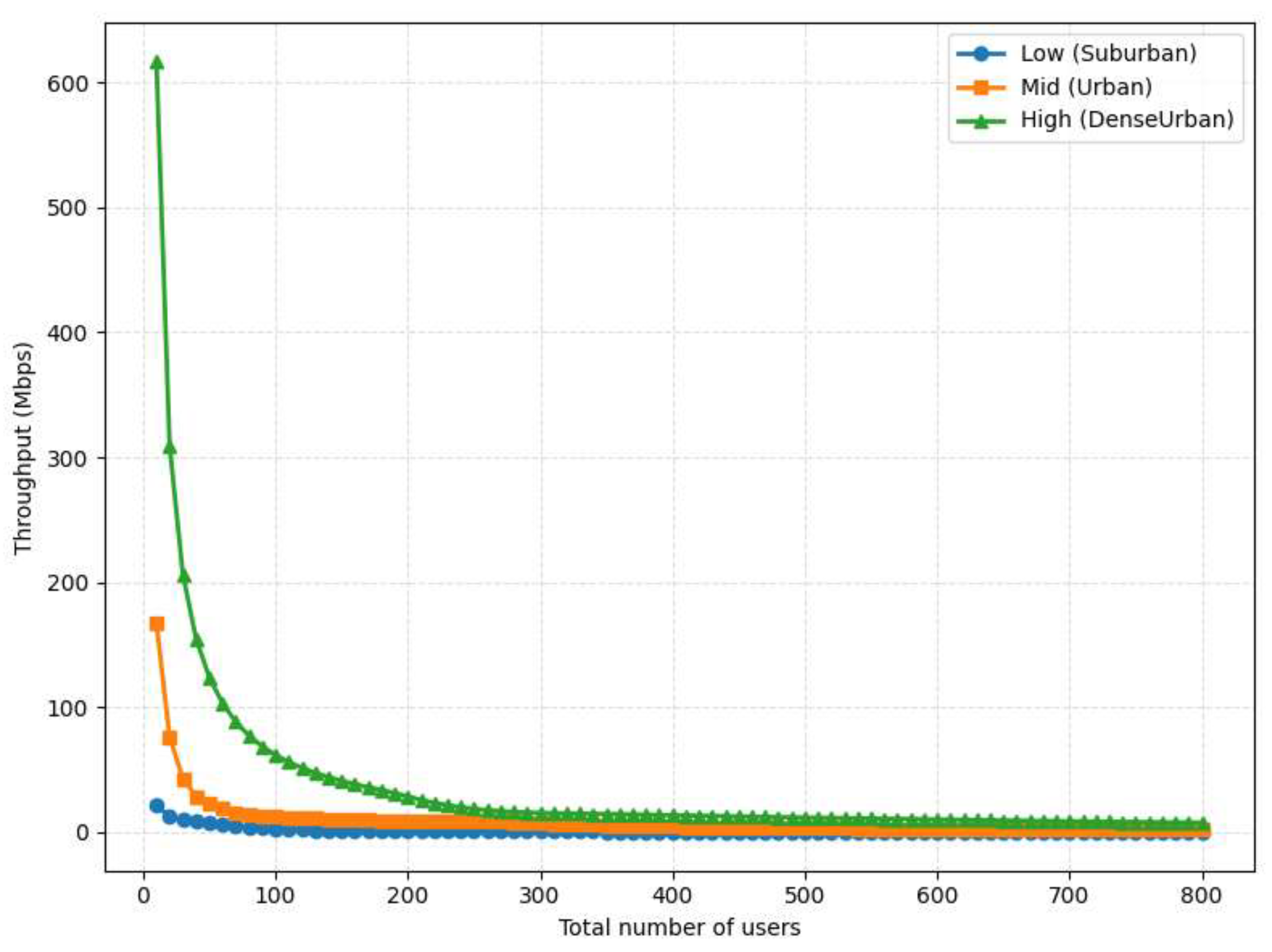

Table 1.
Simulation Parameters.
| Parameters | Value | |||
| Dense Urban Zone | Urban Zone | Suburban Zone | ||
| Antenna height ( | 10 meters | 25 meters | 35 meters | |
| Transmit power ( | 30 dBm | 40 dBm | 46 dBm | |
| Transmit gain ) | 30 dB | 20 dB | 14 dB | 14 dB |
| Receive gain | 10 dB | 3 dB | 0 dB | |
| Carrier frequency ( | 28 GHz | 3.5 GHz | 0.7 GHz | 0.7 GHz |
| Bandwidth ( | 400 MHz | 100 MHz | 20 MHz | |
| Radius | 200 meters | 1000 meters | 3000 meters | |
| User terminal antenna height | 1.5 meters | |||
| Noise power () | -174 dBm/Hz | |||
| VoIP: Rate requirement | 0.12 Mbps | |||
| Web: Rate requirement | 0.50 Mbps | |||
| Video: Rate requirement | 8 Mbps | |||
Disclaimer/Publisher’s Note: The statements, opinions and data contained in all publications are solely those of the individual author(s) and contributor(s) and not of MDPI and/or the editor(s). MDPI and/or the editor(s) disclaim responsibility for any injury to people or property resulting from any ideas, methods, instructions or products referred to in the content. |
© 2026 by the authors. Licensee MDPI, Basel, Switzerland. This article is an open access article distributed under the terms and conditions of the Creative Commons Attribution (CC BY) license (http://creativecommons.org/licenses/by/4.0/).
Copyright: This open access article is published under a Creative Commons CC BY 4.0 license, which permit the free download, distribution, and reuse, provided that the author and preprint are cited in any reuse.


