Preprint
Article

This version is not peer-reviewed.

A Bioactive Benzyl Terpene from Acridocarpus smeathmannii Inhibits Human Prostate Smooth Muscle Contractility

A peer-reviewed version of this preprint was published in:
Molecules 2026, 31(9), 1380. https://doi.org/10.3390/molecules31091380

Submitted:

17 February 2026

Posted:

27 February 2026

You are already at the latest version

Abstract

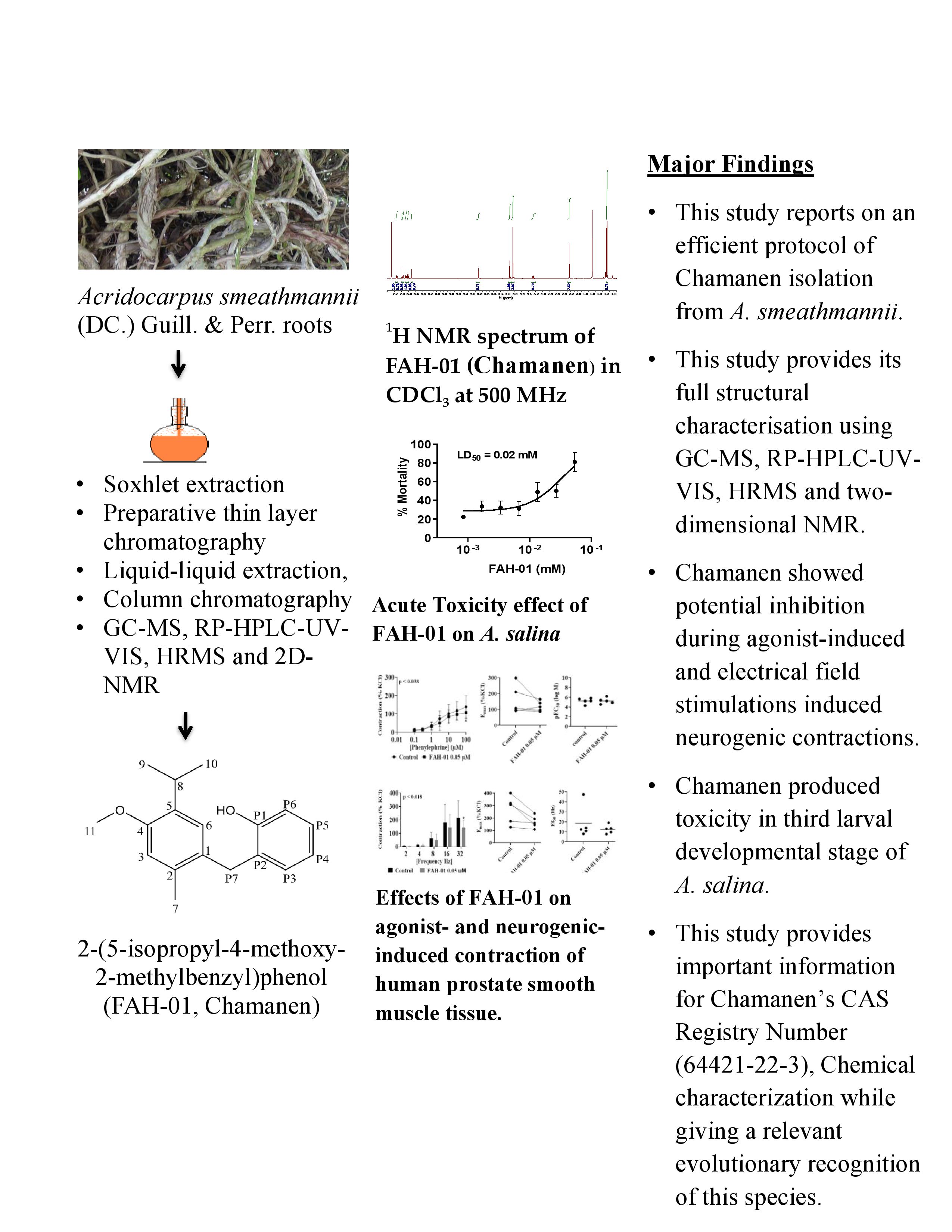
The roots of Acridocarpus smeathmannii were identified as a natural source of the benzyl-terpene 2-(5-isopropyl-4-methoxy-2-methylbenzyl)phenol (FAH-01, chamanen), which was isolated and structurally characterized by chromatographic and spectroscopic methods, including two-dimensional NMR analysis. Functionally, FAH-01 exerted pronounced inhibitory effects on human prostate smooth muscle contractility. In organ bath experiments, FAH-01 reduced noradrenaline-induced contractions by up to 72% and phenylephrine-induced contractions by up to 63%, without affecting agonist potency (pEC50). During electrical field stimulation (2 - 32 Hz), FAH-01 significantly suppressed neurogenic contractile responses, indicating interference with adrenergic and nerve-mediated signaling pathways. Beyond smooth muscle modulation, FAH-01 showed antioxidant activity in the DPPH radical-scavenging assay and produced toxicity in the Artemia salina cysts. Collectively, these findings identify FAH-01 as a bioactive natural product with potent inhibitory effects on adrenergic and neurogenic contraction in human prostate smooth muscle, supporting its therapeutic potential in conditions associated with increased smooth muscle tone. Further preclinical studies to elucidate its mechanisms of action, safety profile, and in vivo efficacy are essential.
Keywords: 
;  ;  ;  ;  ;  ;  

1. Introduction

Recent advances in phytotherapy and natural product research highlight the importance of isolating and purifying plant-derived metabolites to elucidate their biological activities and assess their potential in drug discovery and development [1]. Despite substantial progress in analytical, physical, and applied chemistry, the comprehensive structural characterization of plant secondary metabolites and the biosynthetic diversity inherent to medicinal plants remain insufficiently explored [2]. Addressing this gap is critical for linking chemical structure to biological function.
Acridocarpus smeathmannii (DC.) Guill. & Perr. is a plant species whose roots have been documented in ethnobotanical surveys [3]. Although its ethnopharmacological use is relatively limited, A. smeathmannii has been employed in traditional African medicine, particularly in the management of male reproductive and related disorders. Previous studies have reported bioactivity in root extracts and suggested pharmacological potential [4], underscoring the need for systematic characterization of individual constituents responsible for these effects.
The discovery of novel bioactive compounds increasingly relies on integrated approaches combining preparative chromatographic separation with advanced spectroscopic analyses. Our group recently identified benzyl benzoate as the most abundant constituent in A. smeathmannii roots, a compound known for its vasodilatory properties [5]. Building on this work, we isolated, purified, and characterized 2-(5-isopropyl-4-methoxy-2-methylbenzyl)phenol (FAH-01), a benzyl terpene, using preparative thin-layer chromatography, repeated column chromatography, reverse-phase high-performance liquid chromatography, gas chromatography–mass spectrometry, and comprehensive one- and two-dimensional NMR spectroscopy, with confirmation of the molecular formula by high-resolution mass spectrometry.
Structurally, FAH-01 represents a covalently linked benzyl terpene hybrid, in which an aryl-methylene (benzyl) moiety is directly fused to a terpene scaffold. The compound was first isolated from the root bark of the plant Uvaria chamae and named chamanen [6]. Later, the same compound was isolated from the roots of Xylopia african a [7]. The hybrid architecture of FAH-01 integrates two complementary pharmacophoric motifs within a single molecule. Terpene scaffolds are recognized for their structural diversity, lipophilicity, ability to interact with biological targets through defined three-dimensional conformations [8,9]. In parallel, benzyl and aromatic moieties confer π-π stacking potential and hydrogen-bonding interactions that can enhance molecular recognition and receptor binding [10,11]. The convergence of these features puts FAH-01 within a distinct region of chemical space with potentially improved drug-like properties relative to its individual structural components.
Hybrid molecules incorporating multiple bioactive scaffolds have increasingly been recognized for their capacity to elicit dual or enhanced pharmacological effects [12,13]. This concept is particularly relevant for FAH-01, as terpenes are widely associated with diverse biological activities, while benzyl-derived structures are valued for their chemical stability and interaction potential with biological targets [14]. The integration of these motifs within a single molecular framework may confer synergistic advantages in biological performance.
Despite these considerations, detailed structural and pharmacological investigations of FAH-01 remained scarce. Therefore, the present study provided the full structural characterization of FAH-01 and investigated its effects on smooth muscle contractility in agonist-induced contractions of human prostate tissue obtained following prostatectomy. Additionally, the acute toxicity profile of FAH-01 using Artemia salina bioassays and in vitro antioxidant capacity were assessed.

2. Results

2.1. Structural Analysis of 2-(5-Isopropyl-4-methoxy-2-methylbenzyl)phenol (FAH-01, chamanen)

The liquid-liquid fractionation of the n-hexane extract was performed using a dichloromethane-water system (3:5, v/v) with distilled water. The aqueous phase (part A) was collected and dried under reduced pressure at 40 ± 1 °C and 72 mbar. Part A was subsequently dissolved in ethyl acetate (EtOAc) and washed three times with distilled water (1:1.5, v/v).
Combined fractions from Part A were initially screened using an n-hexane-ethyl acetate (9:1, v/v) solvent system. For preparative separation, fractions 33 - 39 were subjected to column chromatography using a 20 cm × 5 cm glass column packed with silica gel 60. Elution was performed isocratically with n-hexane - ethyl acetate (9:1, v/v) at a flow rate of 2.5 mL/min. A total of 119 fractions (4 mL each) were collected and monitored by preparative TLC using the same solvent system.
Fractions exhibiting identical Rf values were pooled and concentrated under reduced pressure using a rotary evaporator. Further purification was achieved by repeated column chromatography, yielding compound FAH-01 as a benzyl-terpenoid fraction (fractions 106 - 119; 20 mg). FAH-01 was obtained as a golden liquid that crystallized upon standing, with an Rf value of 0.27 on preparative TLC (n-hexane - ethyl acetate, 9:1, v/v).
Reversed-phase HPLC analysis of the FAH-01 fraction showed a single peak with a retention volume of 28.47 mL (Figure S3). Gas chromatographic analysis of FAH-01 also revealed a single peak with a retention time of 22.64 min (Figure 1), indicating high purity. The corresponding mass spectrum exhibited a molecular ion peak [M]⁺ at m/z 270.16, consistent with the proposed molecular formula C18H22O2, and a base peak at m/z 107. A similarity search against the NIST mass spectral library yielded no positive match. GC-MS results and suggested fragmentations are shown in Figure S1 and S2. High resolution mass spectrometry resulted in an exact molecular mass of 270.1614, further supporting the molecular formula of C18H22O2.
Detailed structural elucidation was achieved by NMR spectroscopy. The 1H NMR spectrum (500 MHz, CDCl3; Figure S4, Table 1) displayed characteristic proton resonances between δ 6.93 and 7.11 ppm, appearing as doublets and triplets with a coupling constant of 7.7 Hz, indicative of a substituted aromatic ring system. The methyl doublet at δ 1.15 ppm (J = 6.5 Hz, relative intagral of 6) was consistent with the methyl groups of an isopropyl substituent. Additional singlet resonances were observed at δ 3.91 (2H), 6.68 (1H), 6.96 (1H), 2.22 (3H), and 3.81 ppm (3H), corresponding to methylene, aromatic, methyl, and methoxy protons, respectively, as confirmed by 13C NMR data (Figure S5). A hydroxyl proton resonance was detected at δ 4.81 ppm.
Two-dimensional HSQC-DEPT experiments assigned the methylene signal at δ 3.91 ppm to an O-CH2 group (Figure S6). Upon normalization of this signal to an integral value of two, the total proton count derived from the 1H NMR spectrum corresponded to 22 hydrogen atoms, in agreement with the molecular formula. Combined NMR (1H, 13C, COSY, NOESY, HSQC, and HMBC) and HRMS data unambiguously confirmed the presence of a benzyl moiety linked to a terpene framework via an alkyl bridge. Key long-range and through-space correlations (Table 1) observed in the HMBC spectrum (Figure S7) and NOESY spectrum (Figure S8) substantiated this benzyl–terpene connectivity. Notably, all NMR signals of FAH-01 were assigned and confirmed an earlier proposed structure (Lasswell and Hufford, 1977; Anam et al., 1994) as 2-(5-isopropyl-4-methoxy-2-methylbenzyl)phenol.
No additional high-intensity signals were detected in the 1H NMR spectrum (see Figure S1), and TLC, GC, HPLC, and HRMS analyses consistently showed a single component, confirming the chemical purity of our isolate which was subsequently used for the assays described below.

2.2. Anti-Contractility Effects of FAH-01 on Noradrenaline- and Phenylephrine-Induced Contractions of Human Prostate Tissues

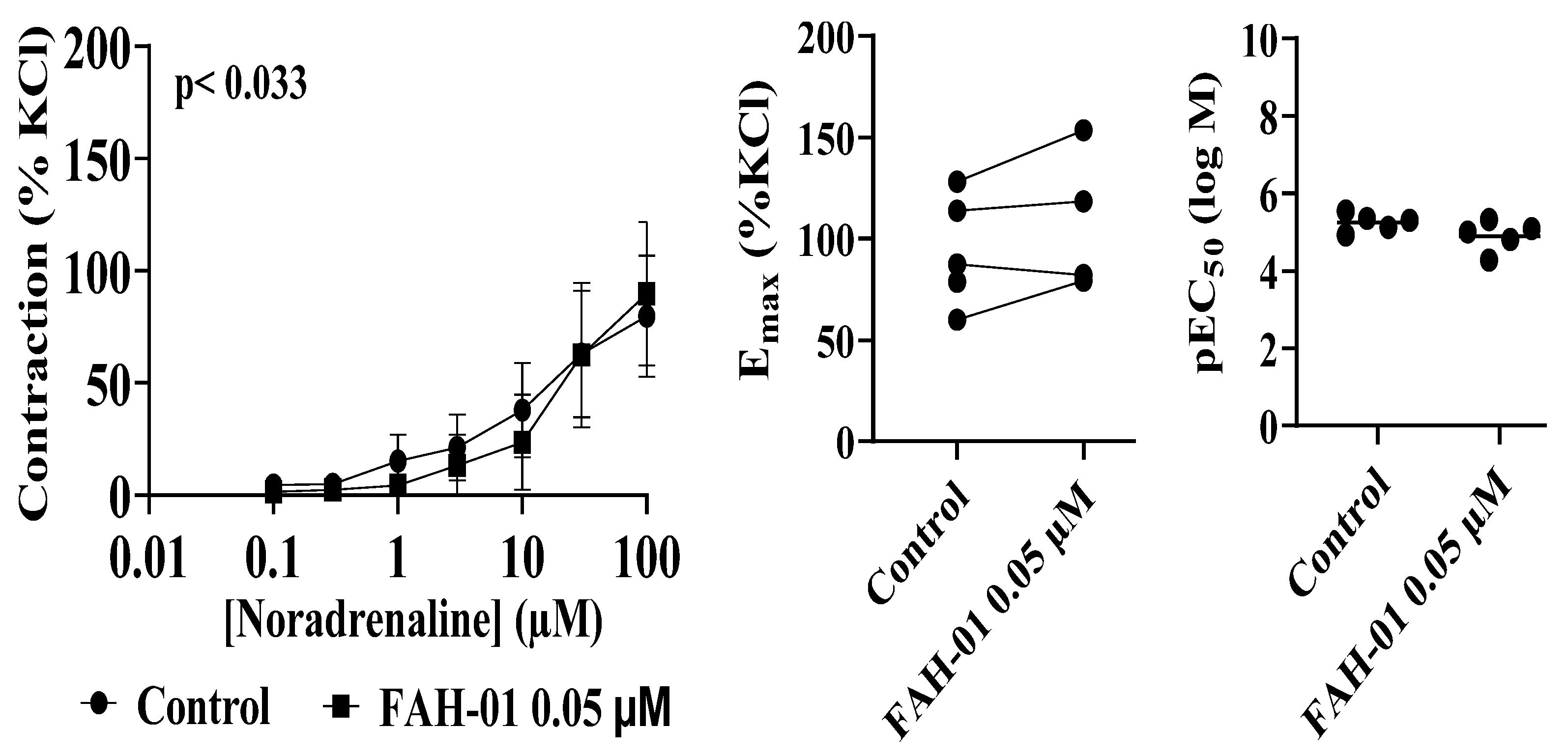
FAH-01 produced a significant, concentration-dependent inhibition of noradrenaline (NA)-induced contractions in human prostate smooth muscle (p = 0.0332) across the tested NA concentrations (0.1 - 10 µM; Figure 2). In the presence of 0.05 µM FAH-01, NA concentration-response curves were markedly attenuated, with maximal inhibition of up to 72% observed at 1 µM NA. Specifically, contractile responses were reduced by approximately 65% at 0.1 µM NA, 51% at 0.3 µM NA, 72% at 1 µM NA, 37% at 3 µM NA, and 37% at 10 µM NA, relative to KCl-induced reference contractions. At the highest NA concentration tested (10 µM), a modest increase in contractile response (+13%) was observed in the presence of FAH-01.
Analysis of agonist potency revealed a reduction in pEC50 values in the presence of 0.05 µM FAH-01. For example, pEC50 values decreased from 5.354 (95% CI: 5.510 - 5.194) to 5.001 (5.151 - 4.840), from 5.118 (5.332 - 4.889) to 4.281 (4.734 - 3.828), from 4.924 (5.374 - 4.298) to 4.809 (5.413 - 4.205), and from 5.543 (5.839 - 5.242) to 5.324 (5.665 - 4.963), indicating a rightward shift of the NA concentration-response curves.
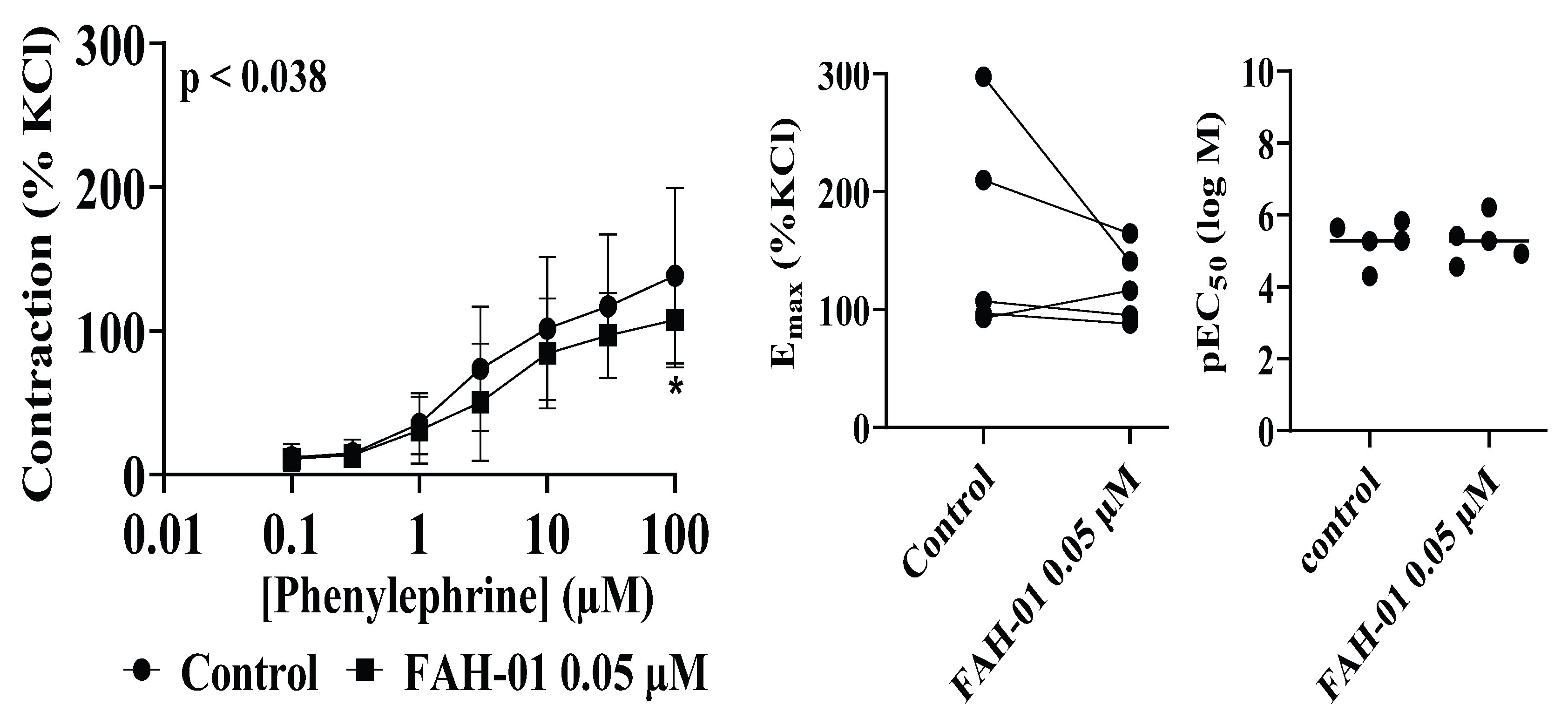
Similarly, FAH-01 (0.05 µM) significantly inhibited phenylephrine (PHE)-induced contractions in human prostate tissues (p = 0.0375) (Figure 3). Inhibition of contractile responses reached up to 63% at 0.3 µM PHE and remained substantial across higher concentrations. Specifically, contractile inhibition of approximately 50%, 45%, 38%, 37%, 38%, and 29% was observed at 1, 3, 10, 30, and 100 µM PHE, respectively, relative to KCl-induced contractions. In contrast to NA, pEC50 values for PHE were not significantly altered by FAH-01, indicating suppression of maximal contractile responses without a change in agonist potency.

2.3. Anti-Contractility Effects of FAH-01 on Electrical Field Stimulation-Induced Contraction of Human Prostate Tissues

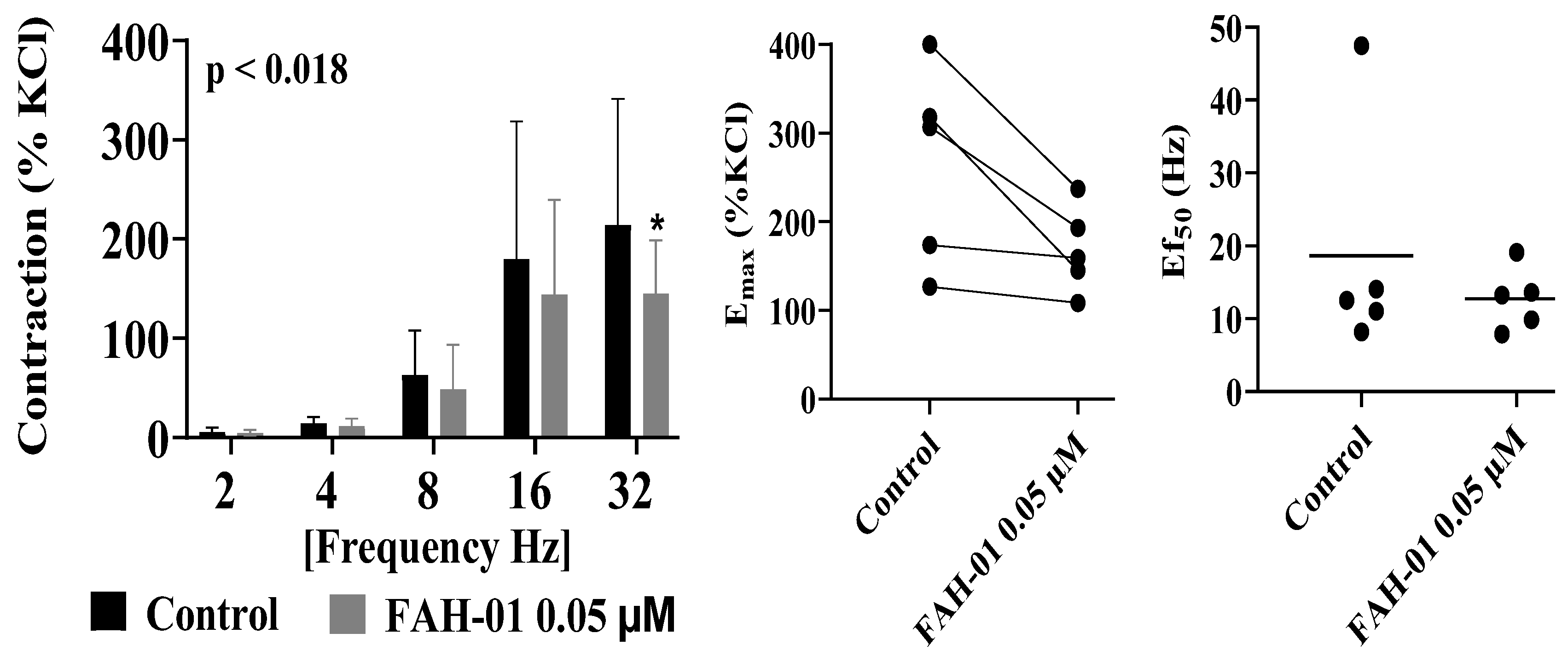
The addition of FAH-01 (0.05 µM) modulated electrical field stimulation (EFS)-induced contractile responses in human prostate smooth muscle across stimulation frequencies ranging from 2 to 32 Hz (Figure 4). At lower stimulation frequencies, FAH-01 produced inhibitory effects, with contractile responses reduced by approximately 21% at 2 Hz, 21% at 4 Hz, 23% at 8 Hz, 23% at 16 Hz, 20% at 24 Hz, and 20% at 32 Hz, relative to KCl-induced reference contractions.
In contrast, at higher stimulation frequencies (8 - 32 Hz), FAH-01 was associated with modest increases in EFS-induced contractions, reaching approximately 22% at 8 Hz, 16% at 16 Hz, and 10% at 32 Hz. These bidirectional effects suggest frequency-dependent modulation of neurogenic contractility.
Analysis of effective stimulation frequency (EF50) values revealed alterations in the presence of FAH-01. At 2 Hz, EF50 values shifted from 1.042 (95% CI: 0.972 - 1.113) under control conditions to 0.994 (0.989 - 1.321) with FAH-01. At 4 Hz, EF50 values changed from 0.912 (0.998 - 1.422) to 0.898 (0.861 - 0.935). At higher frequencies, EF50 values decreased from 1.677 (1.412 - 1.942) to 1.281 (1.134 - 1.428) at 16 Hz and from 1.148 (1.133 - 1.163) to 1.134 (1.106 - 1.162) at 32 Hz in the presence of FAH-01.
Collectively, these findings indicate that FAH-01 modulates neurogenic contractile responses in human prostate smooth muscle in a frequency-dependent manner.

2.4. Acute Toxicity in Artemia salina

Administration of FAH-01 to third-instar larvae of A. salina resulted in an estimated median lethal concentration (LC50) of 19.85 µM after 24 h of exposure across the tested concentration range (1 - 50 µM). In contrast, the negative controls-aqueous NaCl (6%, w/v) and ethanol (1%) - produced mortality rates of 0% and 1.67%, respectively, whereas the positive control, potassium dichromate (K2Cr2O7, 1%), induced 100% mortality (Figure S9).

2.5. In Vitro Antioxidant Assay

FAH-01 has an IC50 of 0.546 µg/ml (95% CI: 0.341 - 0.7351 µg/ml) versus 0.342 µg/ml (95% CI: 0.3081 - 0.373 µg/ml) in the garlic acid standard agent against the DPPH radical-scavenging assay (Figure S10).

3. Discussion

This study reports the isolation, structural characterization, and biological evaluation of 2-(5-isopropyl-4-methoxy-2-methylbenzyl)phenol (FAH-01; chamanen), a benzyl-terpene hybrid compound obtained from the roots of Acridocarpus smeathmannii. FAH-01 was purified using repeated preparative chromatographic techniques and its structure was unambiguously established by comprehensive spectroscopic analysis, including two-dimensional NMR, RP-HPLC, and GC–HRMS. Given that FAH-01 has been only sparsely documented in the literature [6,7], the present study solidifies existing knowledge by confirming its structure using modern analytical techniques. It expands our knowledge about its natural occurrence in A. smeathmanii.
Structurally, FAH-01 represents a covalently linked benzyl-terpene hybrid, integrating two pharmacologically relevant motifs within a single molecular framework. Terpene scaffolds are well known for their ability to interact with biological membranes, enzymes, and receptors, often conferring favorable lipophilicity and three-dimensional conformational properties that enhance target selectivity [8,9]. In parallel, benzyl moieties contribute hydrophobic interactions, π–π stacking capability, and chemical stability, while also permitting synthetic derivatization for medicinal chemistry optimization [11]. The coexistence of these features in FAH-01 may underlie its observed bioactivity and supports the concept that hybrid molecules can display enhanced structure-activity relationships compared with their individual components [9,21].
In functional assays, FAH-01 demonstrated pronounced inhibitory effects on adrenergic- and neurogenic-mediated contractions in human prostate smooth muscle. The compound attenuated noradrenaline- and phenylephrine-induced contractions and modulated electrical field stimulation-evoked neurogenic responses, indicating interference with both receptor-dependent and nerve-mediated contractile mechanisms. As prostatic smooth muscle tone is primarily regulated by sympathetic adrenergic signaling [22], these findings position FAH-01 as a potential modulator of pathological smooth muscle hypercontractility. The dual inhibition of adrenergic agonist responses and neurogenic output suggests a multimodal mechanism of action, which may be advantageous in conditions such as benign prostatic hyperplasia and lower urinary tract symptoms, where treatment resistance remains a clinical [23].
FAH-01 also demonstrated antioxidant activity in the DPPH radical-scavenging assay, consistent with reports that benzylated phenolics and oxygenated terpenes can modulate oxidative stress10. While this assay provides only a preliminary indication of antioxidant capacity, the results align with the compound’s predicted interactions with oxidative and inflammatory regulators and support its potential relevance in oxidative stress-related pathologies.
Acute toxicity assessment using Artemia salina larvae revealed moderate toxicity at micromolar concentrations, providing an initial safety profile for FAH-01. Aquatic bioassays are widely employed as early indicators of general toxicity and developmental interference prior to vertebrate studies [24]. Although such assays do not directly predict mammalian toxicity, they offer valuable guidance for subsequent preclinical evaluations and dose selection.
This study has limitations. The precise molecular mechanisms underlying the anti-contractile effects of FAH-01 were not elucidated. Furthermore, the biological activities were evaluated primarily in vitro, necessitating confirmation in relevant in vivo models.
Conclusively, Chamanen emerges as a bioactive benzyl-terpene hybrid with potent inhibitory effects on adrenergic and neurogenic contraction in human prostate smooth muscle, supporting its therapeutic potential in conditions associated with increased smooth muscle tone. Preclinical studies aimed to elucidate its mechanisms of action, safety profile, and in vivo efficacy are essential.

4. Materials and Methods

4.1. Chemicals

Adrenergic agonists, noradrenaline and phenylephrine, were purchased from Sigma-Aldrich (Munich, Germany). n-Hexane and deuterated chloroform (CDCl3) were also obtained from Sigma-Aldrich (Munich, Germany). All other solvents and reagents used were of analytical grade.

4.2. Plant Collection and Authentication

Details of plant collection, voucher specimen deposition (FHI 113685), research approval for the use of Acridocarpus smeathmannii roots, and processing into powdered material have been reported previously [15]. In addition, a phytosanitary certificate (No. 0124876) was issued by the Nigerian Agricultural Quarantine Service, Plant Health Division.

4.3. Extraction and Liquid-Liquid Fractionations

Briefly, powdered roots of Acridocarpus smeathmannii (200 g per extraction; 11 batches) were extracted with n-hexane (EMPLURA®®) using a Soxhlet apparatus for 4 h. The solvent was removed under reduced pressure using a rotary evaporator (IKA®® RV 10D S93) coupled to a Vacuubrand CVC 3000 vacuum controller at 40 ± 1 °C and 120 mbar. The resulting light-yellow extract (yield: 6.36%) was reconstituted, stored at 4 °C, and aliquoted for subsequent purification and in vitro biological assays.

4.4. Chromatography Studies

Preparative thin-layer chromatography (TLC) was performed on pre-coated silica gel 60 F254 and cellulose plates (Merck, Germany). Plate visualization was carried out under UV light at 365 nm (Jeulin®® Enceinte, model 701435).
For preparative separation, column chromatography of 20 cm × 5 cm glass column was packed with silica gel 60 (35 - 75 µm particle size; CAS No. 7631-89-9, Merck KGaA, Germany). The column was sealed and overlaid with a 3 mm layer of sea sand (Cat. No. 1313710000, Grüssing GmbH) to protect the stationary phase.
Comprehensive structural elucidation of FAH-01 was accomplished using serial TLC, two-dimensional NMR spectroscopy, high-performance liquid chromatography (HPLC), gas chromatography-mass spectrometry (GC-MS), and high-resolution mass spectrometry (HRMS).

4.5. Gas Chromatography-Mass Spectrometry (GC-MS) and High Resolution Mass Spectrometry Analysis (HR-MS)

Gas chromatography-mass spectrometry (GC-MS) analysis was performed as previously reported [4]. Briefly, a solution of FAH-01 (30 µg in 500 µl chloroform) was prepared. A fraction of 1 µl was injected in 1:5 split mode at an injector and interface temperature of 260 °C. A temperature gradient (50 °C for 3 min and 50- 310 °C with 10 °C/min) was applied with a helium inlet pressure of 70 kPa at the beginning. Data were collected in scan mode using “LabSolution” software (Shimadzu®®; Kyoto, Japan).
Additionally, high resolution mass spectrometry was done using a Trace GC Ultra (Thermo Scientific) with a direct inlet system and EI ionization.

4.6. Nuclear Magnetic Resonance Analysis

Nuclear magnetic resonance (NMR) spectroscopy was performed using 5 mg of FAH-01 dissolved in 500 µL of deuterated chloroform (CDCl3). 1H NMR spectra were acquired at 27 °C on a Bruker Avance III 500 MHz spectrometer (Bruker, Ettlingen, Germany) equipped with a 5 mm SEI inverse probe (1H/13C, Z-gradient). Two-dimensional NMR experiments, including COSY, HSQC, HMBC, and NOESY, were recorded using standard Bruker pulse sequences with TOPSPIN software (version 3.5). Spectral processing and analysis were conducted using MNova software (version 15.0.1).

4.7. Reverse-Phase High-Performance Column Chromatography (RP-HPLC)

High-performance liquid chromatography (HPLC) was performed on a Shimadzu system (Shimadzu®® Europa GmbH, Duisburg, Germany) equipped with an LC-10AS pump, SIL-20A HT autosampler, and SPD-10AV UV-Vis detector. Separations were carried out on a LiChrospher®® RP-18 column (5 µm particle size, 160 mm × 4.6 mm). FAH-01 aliquots (5 µL) were diluted in methanol to a final volume of 1.5 mL, transferred to glass vials, and injected into the HPLC system.
The column was operated under isocratic conditions using 60% aqueous methanol as the mobile phase at a flow rate of 0.5 mL/min. Elution was monitored by UV detection at 280 nm.

4.8. Biological Actions of Isolate on Human Prostate Tissue Contraction

Organ bath experiments were performed using periurethral prostate tissue obtained from patients undergoing radical prostatectomy (rPx) for prostate cancer, as previously described [4,5,16]. Tissue samples were processed, and experiments initiated within 1 h of surgical removal. Preparations were mounted in organ baths and stretched to an initial resting tension of approximately 4.9 mN, followed by a 45 min equilibration period. During equilibration, spontaneous decreases in tone were observed; therefore, tension was readjusted up to three times until a stable resting tone of 4.9 mN was achieved.
After equilibration, maximal contractile capacity was assessed by stimulation with 80 mM KCl. Tissues were then washed three times with Krebs-Henseleit (KH) solution, after which FAH-01 or vehicle (ethanol, control) was added. Cumulative concentration-response curves for noradrenaline (NA) and phenylephrine (PHE) were generated 30 min after the addition of FAH-01 or ethanol. From each patient, tissue samples were divided into control and FAH-01 groups (two preparations per group) and analyzed as paired samples within the same experiment. Different patient samples were used for each agonist-induced contraction series; thus, group sizes were identical within each experimental series.
Agonist-induced contractions were expressed as percentages of the maximal contraction elicited by 80 mM KCl (phasic peak), to account for inter-individual variability in stromal/epithelial composition, smooth muscle content, degree of benign prostatic hyperplasia, and other tissue heterogeneities (Kale et al., 2025a). A final concentration of 0.05 µM FAH-01 was achieved in a 10 mL organ bath and compared with the ethanol control group.
Maximum contractile responses (Emax), concentrations producing 50% of the maximal agonist-induced contraction (EC50), and frequencies producing 50% of the maximal electrically evoked contraction (Ef50) were calculated for each individual experiment by nonlinear curve fitting using GraphPad Prism (GraphPad Software Inc., San Diego, CA, USA). EC₅₀ values were expressed as negative logarithms of the molar concentration (pEC50) to quantify agonist potency [4].
All experiments involving human prostate tissue were conducted in accordance with the Declaration of Helsinki and approved by the Ethics Committee of Ludwig-Maximilians-Universität (LMU) Munich, Germany (approval number: LMU/MH060922). Written informed consent was obtained from all patients by LMU Klinikum Munich.

4.9. Effects of Isolates on the Prostate Smooth Muscle Contractile Activity

The modulatory effects of an equimolar concentration of FAH-01 on human prostate tissue contractility were evaluated and compared with vehicle-treated controls. Contractile responses were elicited using the non-selective adrenergic agonist noradrenaline (NA; 0.1 - 100 µM) and the α₁-adrenoceptor - selective agonist phenylephrine (PHE; 0.1 - 100 µM). The anti-contractile effects of FAH-01 were expressed as positive percentage changes relative to the contractile response induced by each agonist alone, normalized to the maximal contraction produced by 80 mM KCl, as previously described [4].

4.10. Electrical Field Stimulation

Electrical field stimulation (EFS) was applied to generate frequency-response curves of neurogenically induced contractions 30 min after the addition of FAH-01 or vehicle control (1% ethanol) [4]. EFS evokes action potentials leading to the release of endogenous neurotransmitters, including noradrenaline and acetylcholine. Tissue strips were mounted between two parallel platinum electrodes connected to a CS4 stimulator (Danish Myotechnology). Square-wave pulses (monophasic) with a pulse width of 1 ms and an amplitude of 20 V were delivered in stimulation trains. Contractile responses were recorded at stimulation frequencies of 2, 4, 8, 16, and 32 Hz, with a 60 s interval between successive stimulations. Only one frequency-response curve was obtained per tissue sample. EFS-induced contractions were quantified by measuring peak contraction amplitudes and expressed as percentages of the maximal phasic contraction elicited by 80 mM KCl. Maximum responses (Emax) and frequencies inducing 50% of the maximal EFS response (Ef50) were determined by nonlinear curve fitting using GraphPad Prism.

4.11. In Vitro Antioxidant Assay

The antioxidant activity of FAH-01 was assessed using the 2,2-diphenyl-1-picrylhydrazyl (DPPH) radical-scavenging assay, as previously described [17]. Briefly, a 0.1 mM DPPH solution was prepared in methanol and protected from light. FAH-01, the reference standard gallic acid, and the control were dissolved in methanol at the required concentrations. Aliquots (1.5 mL) of each sample or gallic acid standard were mixed with 1.5 mL of the DPPH solution and incubated for 30 min at room temperature in the dark. Absorbance was subsequently measured at 517 nm.

4.12. Acute Toxicity Potential in Artemia salina

A. salina (brine shrimp) cysts were obtained from JBL GmbH & Co. KG (Germany) and decapsulated in aqueous NaCl solution (6%, w/v). Approximately 1.5 g of cysts were incubated in 1 L of aerated saline in a transparent glass hatching vessel at 29 ± 1 °C under continuous illumination (1200 lx) to promote larval development [18]. Strong aeration was maintained throughout incubation. After 48 h, larvae were collected and separated to obtain third-instar (instar III) larvae (0.45 - 0.8 mm in length) [19].
For the acute toxicity assay, 30 instar III larvae were transferred into each well of 48-well plates (in triplicate), containing 1 mL of FAH-01 at concentrations ranging from 0.1 to 50 µM. Control groups included saline water, ethanol (1%), and potassium dichromate (K2Cr2O7, 1%). Plates were incubated at room temperature with gentle shaking under an 18:10 h light/dark cycle, and larvae were not fed during the exposure period. After 24 h, mortality was assessed by counting larvae that showed no movement upon observation using a VHX digital microscope (KEYENCE HX-970F; Keyence Corporation, Osaka, Japan).

4.13. Data and Statistical Analyses

Results from concentration-response and frequency-response curves, as well as zones of inhibition, are presented as mean ± standard deviation (SD). For the organ bath experiments, post hoc multiple comparisons at individual agonist concentrations or stimulation frequencies were performed using two-way ANOVA with appropriate multiple-comparison corrections. Each experimental series comprised n = 5 independent experiments, including paired samples analyzed within each experiment. Statistical analyses were conducted using GraphPad Prism version 9.5.0 (GraphPad Software Inc., San Diego, CA, USA).
Maximum contractile responses (Emax), agonist potencies (pEC50), and frequencies producing 50% of the maximal EFS-induced contraction (Ef50) were calculated as mean values for each experimental series and compared between groups using paired t-tests, as previously described [20]. Changes in concentration- and frequency-response relationships are reported as percentage differences relative to control values (mean difference [MD] with 95% confidence intervals, normalized to KCl-induced contractions).
In acute toxicity experiments, median lethal doses (LD50) were estimated by probit analysis using log-dose response curves constructed in GraphPad Prism. LD50 values were calculated from triplicate measurements at each concentration.

Author Contributions

Conceptualization, O. E. K, M. H., W. E., Methodology, O. E. K, C. H., A. T., M. H., W. E., Software, O. E. K, C. H., A. T., M. H., W. E., Validation, O. E. K, C. H., A. T., M. H., W. E., Formal analysis, O. E. K, C. H., D.S., W. E., M. H.; Investigation, O. E. K, C. H., D.S., M. H., W. E., Resources, O. E. K, C. H., M. H., W. E., Data curation, O. E. K, C. H., D.S., A. T., M. H., W. E. Writing - Original draft preparation - O. E. K, C. H., M. H., W. E., Writing-review and editing O. E. K, C. H., D.S., A. T., M. H., W. E., Visualization, O O. E. K, C. H., D.S., A. T., M. H., W. E., Supervision, O. E. K, C. H., A. T., M. H., W. E. Project administration, O. E. K, C. H., M. H., W. E., All authors have read and agreed to the published version of the manuscript.

Funding

This work was carried out with the Fellowship support of the Alexander Von Humboldt Stiftung Foundation Germany by Dr. Oluwafemi Ezekiel Kale (Grant Identity: 1232056).

Data Availability Statement

Data is contained within the article.

Acknowledgments

The technical assistance of Dr. Odewo A. Samuel of the Herbarium Unit, Forest Research Institute of Nigeria (FRIN), Oyo, Nigeria, is gratefully acknowledged. We also acknowledge the technical assistance Mr. Adeoti O. A., Pharmacognosy Department, Olabisi Onabanjo University Nigeria. The 2023 Award Fellowship support of the Alexander Von Humboldt Stiftung Foundation is gratefully acknowledged. Authors would like to acknowledge Anja Osterauer for her technical support with the HRMS analysis and Tasnim Hajri and Omaima Ardhaoui for help during Artemia bioassays.

Conflicts of Interest

The authors declare no conflicts of interest.

Abbreviations

DEPT Distortionless Enhancement by Polarization Transfer
GC-MS Gas-Chromatography Mass Spectrometry
HMBC Heteronuclear Multiple Bond Correlation
HSQC Heteronuclear single quantum coherence
HRMS High-resolution mass spectrometry
COSY Homonuclear correlation spectroscopy
pEC50 Negative logarithms of the molar concentration for agonists
NA Noradrenaline
NMR Nuclear magnetic resonance
NOESY Nuclear Overhauser Effect Spectroscopy
PHE Phenylephrine
rPx Radical prostatectomy
Rf Retention factor
TLC Thin layer chromatography

References

  1. Narayanankutty, A.; Famurewa, A. C.; Oprea, E. Natural bioactive compounds and human health. Molecules 2024, 29, 3372. [Google Scholar] [CrossRef]
  2. Singh, K.; Gupta, J. K.; Chanchal, D. K.; Shinde, M. G.; Kumar, S.; Jain, D.; Almarhoon, Z.M.; Alshahrani, A.M.; Calina, D.; Sharifi-Rad, J.; Tripathi, A. Natural products as drug leads: Exploring their potential in drug discovery and development. Naunyn-Schmiedeberg’s Archives of Pharmacology 2025, 398, 4673–4687. [Google Scholar] [CrossRef]
  3. Catarino, L.; Havik, P. J.; Romeiras, M. M. Medicinal plants of Guinea-Bissau: Therapeutic applications, ethnic diversity and knowledge transfer. Journal of Ethnopharmacology 2016, 183, 71–94. [Google Scholar] [CrossRef]
  4. Kale, O. E.; Hu, S.; Huber, C.; Schierholz, F.; Ciotkowska, A.; Tamalunas, A.; Stief, C.G.; Eisenreich, W.; Hennenberg, M. Acridocarpus smeathmannii root extracts inhibit human prostate and bladder smooth muscle contraction, porcine arterial vasoconstriction, and cytotoxicity of prostate stromal cells. Frontiers in Pharmacology 2025, 16, 1621346. [Google Scholar] [CrossRef] [PubMed]
  5. Kale, O. E.; Rauanov, I.; Huber, C.; Tamalunas, A.; Stief, C. G.; Eisenreich, W.; Hennenberg, M. Benzyl Benzoate Isolation from Acridocarpus smeathmannii (DC.) Guill. & Perr Roots and Its Bioactivity on Human Prostate Smooth Muscle Contractions. Pharmaceuticals 2025, 18, 687. [Google Scholar] [CrossRef]
  6. Lasswell, WL, Jr.; Hufford, Charles D. “Aromatic constituents from Uvaria chamae.”. Phytochemistry 1977, 16, 1439–1441. [Google Scholar] [CrossRef]
  7. Anam, E. M.; Ekpa, O. D.; Gariboldi, P. V. 3-Isoproyl-9α-methyl-1, 2, 4a, 9a tetrahydroxanthene, benzyl benzoates and chamanen from. Xylopia africana 1994, 179–181. [Google Scholar]
  8. Christianson, D. W. Structural and chemical biology of terpenoid cyclases. Chemical Reviews 2017, 117, 11570–11648. [Google Scholar] [CrossRef]
  9. Zhang, H.; Guo, J.; Hu, J.; Zhou, M. Terpenoid-based supramolecular materials: fabrications, performances, applications. Supramolecular Chemistry 2023, 34, 105–131. [Google Scholar] [CrossRef]
  10. Cardoso-Teixeira, A. C.; Ferreira-da-Silva, F. W.; Peixoto-Neves, D.; Oliveira-Abreu, K.; Pereira-Gonçalves, Á.; Coelho-de-Souza, A. N.; Leal-Cardoso, J. H. Hydroxyl group and vasorelaxant effects of perillyl alcohol, carveol, limonene on aorta smooth muscle of rats. Molecules 2018, 23, 1430. [Google Scholar] [CrossRef]
  11. Kanhed, A. M.; Patel, D. V.; Patel, N. R.; Sinha, A.; Thakor, P. S.; Patel, K. B.; Prajapati, N.K.; Patel, K.V.; Yadav, M. R. Indoloquinoxaline derivatives as promising multi-functional anti-Alzheimer agents. Journal of Biomolecular Structure and Dynamics 2022, 40, 2498–2515. [Google Scholar] [CrossRef]
  12. Bonifazi, A.; Newman, A. H.; Keck, T. M.; Gervasoni, S.; Vistoli, G.; Del Bello, F.; Giorgioni, G.; Pavletić, P.; Quaglia, W.; Piergentili, A. Scaffold hybridization strategy leads to the discovery of dopamine D3 receptor-selective or multitarget bitopic ligands potentially useful for central nervous system disorders. ACS Chemical NNeuroscience 2021, 12, 3638–3649. [Google Scholar] [CrossRef]
  13. Câmara, J. S.; Perestrelo, R.; Ferreira, R.; Berenguer, C. V.; Pereira, J. A.; Castilho, P. C. Plant-derived terpenoids: A plethora of bioactive compounds with several health functions and industrial applications-A comprehensive overview. Molecules 2024, 29, 3861. [Google Scholar] [CrossRef]
  14. Kamal El-sagheir, A. M.; Abdelmesseh Nekhala, I.; Abd El-Gaber, M. K.; Aboraia, A. S.; Persson, J.; Schäfer, A. B.; Omar, F. A. N4-substituted piperazinyl norfloxacin derivatives with broad-spectrum activity and multiple mechanisms on gyrase, topoisomerase IV, and bacterial cell wall synthesis. ACS bio & med chem Au 2023, 3, 494–506. [Google Scholar]
  15. Kale, O. E.; Onyeka, O. C.; Oluwatobunmi, A. A.; Victoria, F. O.; Opeyemi, A. A.; Tamalunas, A.; Hennenberg, M.; Akindele, A.J.; Awodele, O. Ameliorative potential of Acridocarpus smeathmannii extracts on testosterone propionate and sleep deprivation-induced benign prostate hyperplasia rats. Clinical Traditional Medicine and Pharmacology 2025, 200231. [CrossRef]
  16. Hu, S.; Xu, Y.; Brandstetter, M.; Tamalunas, A.; Kale, O. E.; Keller, P.; Stadelmeier, L.F.; Weinhold, P.; Stief, C.G.; Hennenberg, M. Target and off-target effects of vibegron on smooth muscle contraction of human detrusor and prostate tissues. Naunyn-Schmiedeberg’s Archives of Pharmacology 2025, 1–19. [Google Scholar] [CrossRef]
  17. Baliyan, S.; Mukherjee, R.; Priyadarshini, A.; Vibhuti, A.; Gupta, A.; Pandey, R. P.; Chang, C. M. Determination of antioxidants by DPPH radical scavenging activity and quantitative phytochemical analysis of Ficus religiosa. Molecules 2022, 27, 1326. [Google Scholar] [CrossRef]
  18. Okumu, M. O.; Mbaria, J. M.; Gikunju, J. K.; Mbuthia, P. G.; Madadi, V. O.; Ochola, F. O.; Jepkorir, M. S. Artemia salina as an animal model for the preliminary evaluation of snake venom-induced toxicity. Toxicon X 2021, 12, 100082. [Google Scholar] [CrossRef] [PubMed]
  19. Wang, C.; Jia, H.; Zhu, L.; Zhang, H.; Wang, Y. Toxicity of α-Fe2O3 nanoparticles to Artemia salina cysts and three stages of larvae. Science of the Total Environment 2017, 598, 847–855. [Google Scholar] [CrossRef] [PubMed]
  20. Michel, M. C.; Murphy, T. J.; Motulsky, H. J. New author guidelines for displaying data and reporting data analysis and statistical methods in experimental biology. Mol. Pharmacol. 2020, 97, 49–60. [Google Scholar] [CrossRef]
  21. Kumar, M.; Ahmad, A.; Aguiar, A. C. C.; Maluf, S. E. C.; Shamim, A.; Ferrer, M.; Dias, L. C. Indole-2-carboxamides Optimization for Antiplasmodial Activity. ACS Bio & Med Chem Au 2025, 5, 821–839. [Google Scholar] [CrossRef] [PubMed]
  22. Hu, S.; Liu, G.; Kale, O.; Zhu, W.; Xu, Y.; Keller, P.; Weinhold, P.; Tamalunas, A.; Stief, C.G; Hennenberg, M. Antagonism of prostate α1A-adrenoceptors by verapamil in human prostate smooth muscle contraction. The Journal of Pharmacology and Experimental Therapeutics 2025, 103603. [Google Scholar] [CrossRef] [PubMed]
  23. Hennenberg, M.; Michel, M. C. Adrenoceptors in the lower urinary tract. Adrenoceptors 2023, 333–367. [Google Scholar]
  24. Lemly, A. D. Teratogenic effects and monetary cost of selenium poisoning of fish in Lake Sutton, North Carolina. Ecotoxicology and Environmental Safety 2014, 104, 160–167. [Google Scholar] [CrossRef]
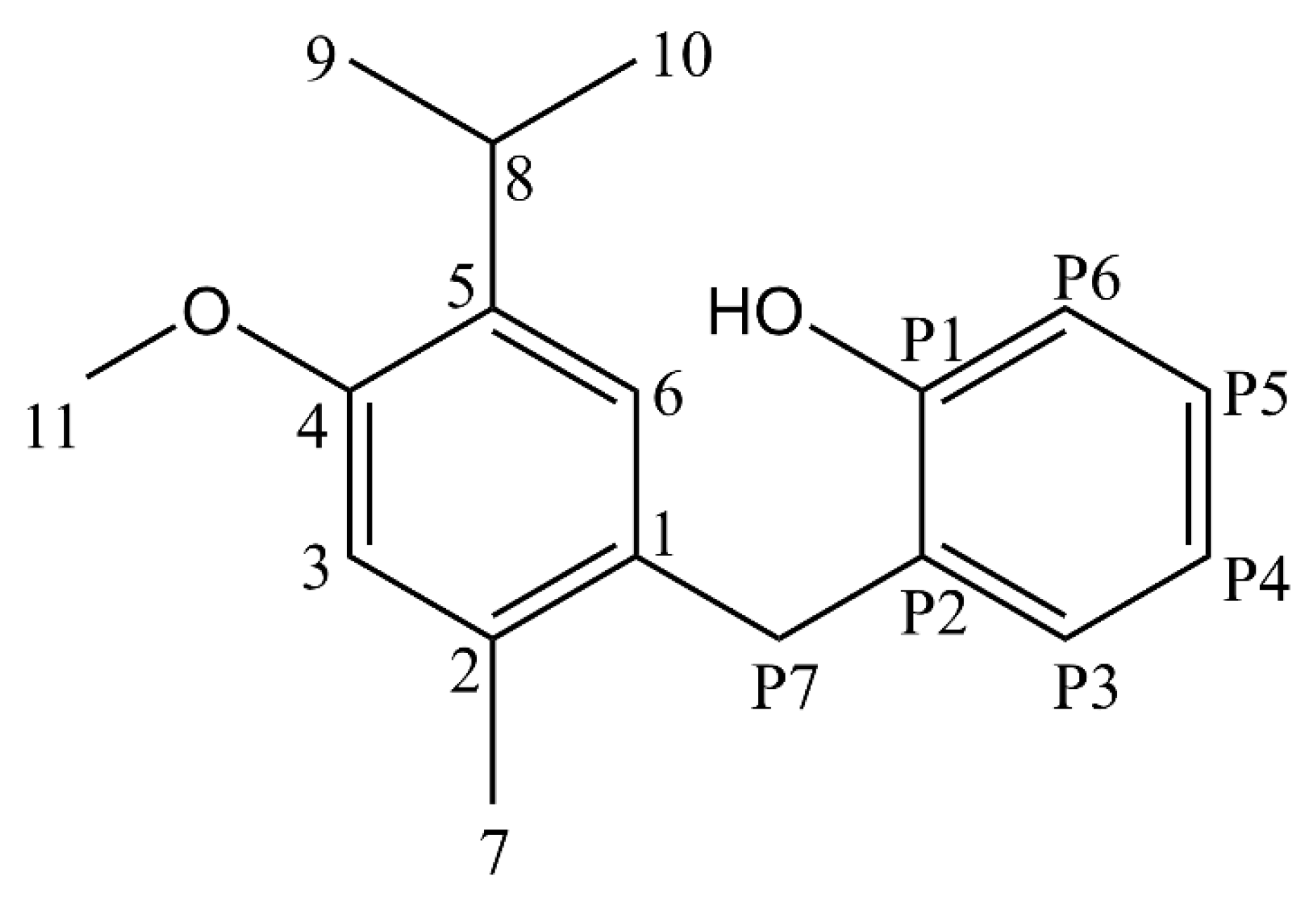
Figure 1. Chemical structure of 2-(5-isopropyl-4-methoxy-2-methylbenzyl)phenol (FAH-01, chamanen) with carbon atoms positions as assigned in Table 1.
Preprints 199407 g001
Figure 2. Effects of FAH-01 from A. smeathmannii extract on noradrenaline-induced contraction of human prostate smooth muscle tissue. Results are expressed as means ± SD (n = 5 patients per series, with tissue from each patient split between the FAH-01 and control groups). Tensions have been expressed as % of high molar KCl-induced contraction assessed prior to application of the control and FAH-01. Emax and pEC50 were calculated by curve fitting for each experiment.
Preprints 199407 g002
Figure 3. Effects of FAH-01 from A. smeathmannii extract on phenylephrine-induced contraction of human prostate smooth muscle tissue. Results are expressed as means ± SD (n = 5 patients per series, with tissue from each patient split between the FAH-01 and control groups). Tensions have been expressed as % of high molar KCl-induced contraction assessed prior to application of the control and FAH-01. Emax and pEC50 were calculated by curve fitting for each experiment.
Preprints 199407 g003
Figure 4. Effects of FAH-01 from A. smeathmannii extract on EFS-induced prostate smooth muscle contraction. . Results are expressed as means ± SD (n = 5 patients per series, with tissue from each patient split between the FAH-01 and control groups). Tensions have been expressed as % of high molar KCl-induced contraction assessed prior to application of the control ethanol and FAH-01. Emax and Ef50 were calculated by curve fitting for each experiment.
Preprints 199407 g004
Table 1. 1H and 13C NMR data of 2-(5-isopropyl-4-methoxy-2-methylbenzyl)phenol in CDCl3.
Atom Position 13C Chemical Shift in ppm Predicted 13C chemical shift in ppm CH3, CH2, CH, or C 1H Chemical Shift in ppm HH Coupling Constant in Hz 1H Signal Integral HH COSY Correlation to H# HH NOESY Correlation to H# HMBC Correlation from indexed C to H#
P1 153.85 155.3 C P5, P3, P6
P2 126.71 128.2 C P4, P6, OH, P7
P3 130.25 130.7 CH 6.93 (d) 7.7 1 P7 (w) 6 P5, P7
P4 120.72 121.8 CH 6.84 (t) 7.7 1 P5 P6
P5 127.44 127.6 CH 7.12 (t) 7.7 1 P4 P3
P6 115.49 116.4 CH 6.79 (d) 7.7 1 P4, OH
P7 33.59 32.9 CH2 3.91 (s) 2 6 (w), P3 (w) 6, OH, 7 6
1 135.22 131.0 C 6, P7, 7
2 128.81 134.2 C 3, P7, 7
3 112.98 113.3 CH 6.68 (s) 1 11, 7 7
4 155.48 155.4 C 3, 6, 11, 8
5 134.70 135.2 C 3, 8, 9, 10
6 127.44 128.1 CH 6.96 (s) 1 P7 (w), 7 (w) P7, P3, 9, 10 P7, 8, 7
7 19.56 19.4 CH3 2.22 (s) 3 6 (w) 3, P7 3, 6
8 26.56 27.6 CH 3.24 (sep) 6.9 1 9, 10 9, 10 6, 9, 10
9 22.70 23.6 CH3 1.15 (d) 6.5 3 8 6, 8 8
10 22.70 23.6 CH3 1.15 (d) 6.5 3 8 6, 8 8
11 55.43 56.1 CH3 3.81 (s) 3 3
OH 4.81 1 P7
Disclaimer/Publisher’s Note: The statements, opinions and data contained in all publications are solely those of the individual author(s) and contributor(s) and not of MDPI and/or the editor(s). MDPI and/or the editor(s) disclaim responsibility for any injury to people or property resulting from any ideas, methods, instructions or products referred to in the content.
Copyright: This open access article is published under a Creative Commons CC BY 4.0 license, which permit the free download, distribution, and reuse, provided that the author and preprint are cited in any reuse.
Prerpints.org logo

Preprints.org is a free preprint server supported by MDPI in Basel, Switzerland.

Subscribe

Disclaimer

Terms of Use

Privacy Policy

Privacy Settings

© 2026 MDPI (Basel, Switzerland) unless otherwise stated