

Submitted:
17 February 2026
Posted:
27 February 2026
You are already at the latest version
Abstract
Background: Accurate prediction of lip prominence changes following orthodontic treatment remains challenging because traditional profile analyses rely on isolated reference lines that do not account for combined nasal and chin morphology. The aesthetic triangle framework integrates these structures and may provide a more comprehensive evaluation of lip position. Methods: This correlative clinical study evaluated 82 orthodontic patients undergoing bimaxillary incisor repositioning. Lateral cephalograms and standardized profile photographs were obtained before and after treatment. Lip position was assessed relative to the aesthetic triangle boundaries, and dentoalveolar changes were quantified using standard incisor measurements. Lip thickness was analyzed as a potential modulating factor. Results: Orthodontic treatment produced significant incisor proclination and sagittal advancement. Within the aesthetic triangle framework, the lower lip demonstrated consistent anterior migration toward the central compartment following mandibular incisor advancement. In contrast, the upper lip showed minimal displacement despite substantial maxillary incisor movement. Mandibular incisor inclination significantly predicted lower lip migration, while maxillary incisor variables showed limited predictive value. Thinner lips exhibited greater positional responsiveness. Conclusions: The aesthetic triangle provides a clinically meaningful framework for interpreting orthodontic soft tissue changes as spatial migration rather than isolated linear measurements. Lower lip prominence responds predictably to dentoalveolar mechanics, whereas upper lip position is more constrained by soft tissue morphology.
Keywords:
aesthetic triangle
; lip prominence
; orthodontics
; incisor inclination
; facial aesthetics
; soft tissue response
; profile analysis
1. Introduction
Facial aesthetics play a central role in social perception, self-esteem, and the demand for orthodontic and facial aesthetic treatment. Among facial components, the lips represent one of the most influential aesthetic units due to their prominence, dynamic function, and close anatomical relationship with underlying dentoalveolar and skeletal structures [1,2,3,4,5]. Their position contributes substantially to profile harmony and is strongly associated with perceived facial attractiveness and balance [3,4,5]. Consequently, accurate evaluation of lip prominence remains a critical component of orthodontic diagnosis and treatment planning.
Comprehensive lip assessment encompasses multiple interrelated factors, including morphology, functional activity, posture at rest, and degree of sagittal prominence [5,6,7]. The etiology of lip prominence is multifactorial, involving soft-tissue characteristics, skeletal relationships, and dentoalveolar support. Soft-tissue variables such as lip thickness, volume, tonicity, and elasticity significantly influence lip projection independent of skeletal position [1,3,5,8]. Additionally, variations in craniofacial morphology, particularly vertical growth patterns and lower anterior facial height, may modify lip posture by altering perioral soft-tissue tension and spatial relationships [3,9]. These complex interactions underscore the importance of integrated assessment approaches capable of capturing the combined influence of structural and functional determinants.
Dentoalveolar variables constitute a primary mechanical determinant of lip position. The sagittal position and inclination of the incisors provide direct support to the lips and substantially influence the soft-tissue profile [10,11]. Proclination and protrusion of the incisors generally increase lip prominence, whereas excessive retroclination may contribute to lip retrusion and flattening of the lower facial profile [10,11]. However, the magnitude of soft-tissue response to dentoalveolar repositioning varies considerably among individuals, reflecting the modulating role of lip morphology and biomechanical properties [5,6].
To accurately quantify dentoalveolar changes influencing lip support, standardized cephalometric parameters are commonly used to evaluate incisor position and inclination. Measurements such as U1–NA distance and U1–SN angulation assess maxillary incisor protrusion and axial inclination relative to cranial reference structures, while L1–NB distance and IMPA evaluate mandibular incisor sagittal position and inclination relative to the mandibular plane [10,11,13]. These variables were selected because they directly reflect the mechanical relationship between incisors and labial soft tissues and have been consistently demonstrated to correlate with changes in lip prominence following orthodontic treatment [10,11,14]. Their inclusion allows objective quantification of dentoalveolar support and facilitates analysis of its influence on lip migration within the aesthetic triangle framework.
To quantify lip prominence, several cephalometric reference lines have been proposed, including the Esthetic line (E-line), Steiner’s S-line, and the subnasale–soft tissue pogonion (Sn–Pog’) line [8,12,13,14]. These analyses relate lip position to key facial landmarks and provide normative reference values widely used in clinical practice. Nevertheless, the diagnostic reliability of isolated reference lines is influenced by numerous variables, including nasal projection, chin prominence, growth pattern, sex, and ethnicity [15,16]. Consequently, reliance on a single linear reference may lead to inconsistent interpretation of lip prominence across different facial morphologies.
To address these limitations, the aesthetic triangle concept was introduced as a composite diagnostic framework integrating the E-line and the Sn–Pog’ line into a bounded spatial zone for evaluating lip prominence [17]. Rather than defining lip position relative to a single reference line, this framework considers the spatial relationship of the lips to both the nasal and chin structures simultaneously. Lips positioned within the triangle are generally regarded as balanced relative to the facial profile, whereas those located anterior or posterior to its boundaries may be perceived as protrusive or retrusive, respectively [17]. Importantly, this approach allows lip position to be interpreted as placement within an aesthetic zone rather than as an isolated linear measurement.
Despite its conceptual advantages and clinical appeal, the aesthetic triangle has been applied primarily as a descriptive diagnostic tool. Empirical evidence remains limited regarding how orthodontic dentoalveolar changes influence lip position within this framework. In particular, little is known about whether incisor inclination and sagittal repositioning result in predictable migration of the lips between aesthetic triangle compartments, or whether upper and lower lips respond differently to dentoalveolar mechanics when evaluated within this integrated aesthetic context.
Improved understanding of these relationships is essential for enhancing diagnostic accuracy and predicting soft-tissue outcomes in orthodontic treatment [1,2,3,4,5,6,7,8]. Such knowledge may assist clinicians in distinguishing cases in which dentoalveolar correction alone can meaningfully influence lip prominence from those in which soft-tissue morphology limits aesthetic improvement.
Therefore, the present study aimed to evaluate changes in upper and lower lip prominence within the compartments of the aesthetic triangle and to determine their relationship with maxillary and mandibular incisor inclination and sagittal position following orthodontic treatment.
2. Materials and Methods
2.1. Study Design and Sample
This correlative clinical study was conducted on a sample of 84 orthodontic patients undergoing treatment involving controlled bimaxillary incisor repositioning. The study design aimed to evaluate the relationship between dentoalveolar incisor movement and changes in lip prominence within the aesthetic triangle framework.
Ethical approval was obtained from the University “George Emil Palade” Ethic Committee (Approval No. 2709/27.12.2023), before data collection, and written informed consent was secured from all participants. Patients were selected to minimize the influence of active craniofacial growth on soft tissue measurements.
Inclusion criteria comprised patients aged between 16 and 30 years with complete permanent dentition up to the second molars and no history of orthodontic treatment.
Exclusion criteria included previous orthognathic surgery, craniofacial syndromes, significant facial asymmetry, facial trauma, or soft tissue pathology affecting the lips.
2.2. Clinical Records
Standardized lateral cephalometric radiographs and profile photographs were obtained for each patient before and after orthodontic treatment. All records were acquired with the patient in natural head position (NHP), the mandible in rest position, and the lips in repose, to ensure consistency in soft tissue evaluation.
Cephalograms were taken with teeth in maximum intercuspation using the same radiographic equipment and settings for all patients. Profile photographs were captured under standardized lighting conditions with the patient standing upright and focusing on a distant point to maintain reproducible head posture.
All records were digitized and analyzed using calibrated orthodontic cephalometric software (Open-Ortho).
2.3. Aesthetic Triangle Construction and Lip Classification
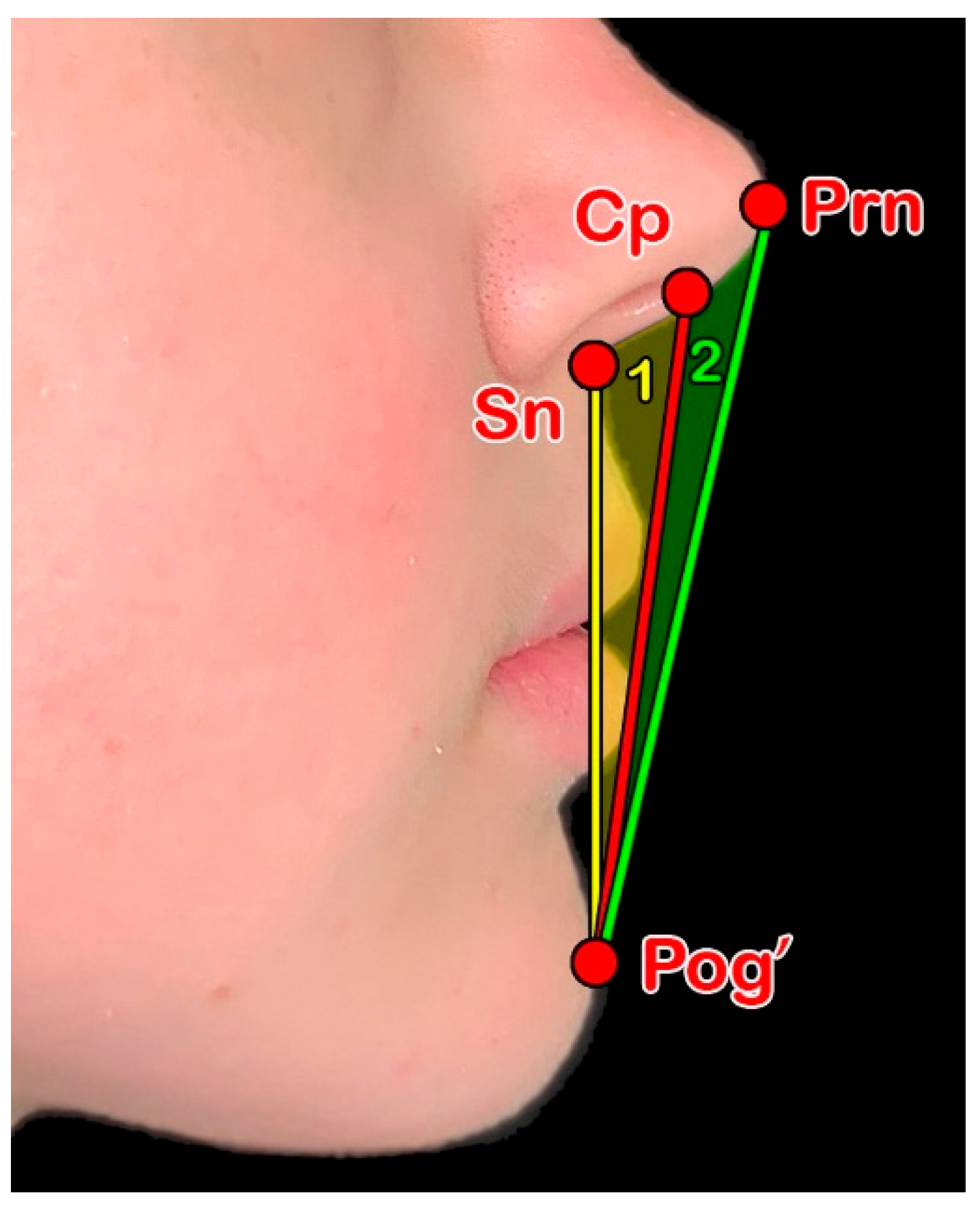
Lip prominence was evaluated using the aesthetic triangle concept as a composite diagnostic framework integrating two profile reference lines.
The anterior boundary of the aesthetic triangle was defined by the Esthetic line (E-line), constructed by joining the pronasale (Prn) to soft tissue pogonion (Pog’) [8,12].
The posterior boundary of the aesthetic triangle was defined by the subnasale–soft tissue pogonion (Sn–Pog’) line, thereby excluding nasal projection from posterior lip assessment [14].
Upper and lower lip positions were assessed relative to the anterior and posterior boundaries of the aesthetic triangle and classified into one of three triangle compartments.
Posterior to the aesthetic triangle, when the lip was positioned posterior to the Sn–Pog’ line
Within the aesthetic triangle, when the lip was positioned between the Sn–Pog’ line and the E-line
Anterior to the aesthetic triangle, when the lip was positioned anterior to the E-line
The esthetic triangle is divided by the Cp–Pog’ line into posterior (1) and anterior (2) compartments, with the posterior zone generally considered the most aesthetically favorable.
Pre-treatment to post-treatment changes were interpreted as anterior or posterior migration of the lips between aesthetic triangle compartments, allowing assessment of the direction and magnitude of soft tissue response to dentoalveolar incisor movement.
This classification enabled evaluation of lip prominence as a spatial relationship within an aesthetic zone rather than as an isolated linear measurement.
2.4. Dentoalveolar Measurements
Dentoalveolar incisor position and inclination were assessed on lateral cephalograms using standardized angular and linear measurements.
Maxillary incisor position and inclination were evaluated using:
U1–NA distance (mm) to assess sagittal protrusion
U1–SN angle (degrees) to assess incisor inclination relative to the cranial base
Mandibular incisor position and inclination were evaluated using:
L1–NB distance (mm) to assess sagittal protrusion
IMPA (degrees) to assess incisor inclination relative to the mandibular plane
These variables were selected because they represent standardized orthodontic indicators of incisor support for the lips and are routinely used to evaluate dentoalveolar protrusion.
2.5. Soft Tissue Thickness Assessment
Upper and lower lip thickness were measured to evaluate their potential modulating effect on soft tissue response to dentoalveolar movement. Lip thickness was defined as the linear distance between the external lip surface and the corresponding labial surface of the incisors at the level of greatest prominence [6,8].
These measurements were included to account for individual variation in soft tissue morphology, which may influence the degree of lip migration within the aesthetic triangle.
2.6. Statistical Analysis
Descriptive statistics, including means and standard deviations, were calculated for all dentoalveolar and soft tissue variables.
Pearson correlation coefficients were used to assess associations between incisor inclination and sagittal position and changes in lip position relative to the aesthetic triangle boundaries.
Paired comparisons were performed to evaluate pre-treatment and post-treatment changes in dentoalveolar and soft tissue measurements.
Multiple linear regression analysis was conducted to identify predictors of lip migration within the aesthetic triangle, with incisor inclination, sagittal position, and lip thickness entered as independent variables.
Statistical significance was set at p < 0.05.
2.7. Methodological Rationale
The aesthetic triangle was selected as the primary evaluative framework because it integrates nasal and chin reference structures into a bounded spatial zone, allowing lip prominence to be interpreted as a positional relationship rather than an isolated linear measurement. This approach reduces dependence on single reference lines that may be distorted by individual variation in nasal projection or chin prominence. By classifying lip position into posterior, central, and anterior triangle compartments, treatment-related soft tissue changes can be assessed as directional migration within an aesthetic zone, thereby enhancing clinical interpretability and relevance to orthodontic treatment planning.
3. Results
3.1. Dentoalveolar Changes Relevant to Aesthetic Triangle Assessment
Orthodontic treatment resulted in significant dentoalveolar modifications affecting maxillary and mandibular incisor position and inclination. Maxillary incisors demonstrated an increase in sagittal prominence and proclination, as reflected by increased U1–NA distance and U1–SN angulation. Similarly, mandibular incisors exhibited increased protrusion and inclination, evidenced by increased L1–NB distance and IMPA values. These changes were accompanied by a marked reduction in interincisal angulation, indicating coordinated bimaxillary incisor repositioning.
These dentoalveolar changes established the mechanical basis for subsequent soft tissue adaptation and were therefore analyzed in relation to lip position within the aesthetic triangle framework.

Table 1.
Dentoalveolar changes associated with aesthetic triangle assessment following orthodontic treatment (n = 82).
Table 1.
Dentoalveolar changes associated with aesthetic triangle assessment following orthodontic treatment (n = 82).
| Parameter | Initial Mean ± SD | Final Mean ± SD | Direction of Change |
| Maxillary incisor protrusion (U1–NA, mm) | 0.66 ± 2.40 | 3.10 ± 2.25 | Forward |
| Maxillary incisor inclination (U1–SN, °) | 89.91 ± 6.99 | 104.02 ± 4.52 | Proclination |
| Mandibular incisor protrusion (L1–NB, mm) | 2.29 ± 2.40 | 4.83 ± 2.05 | Forward |
| Mandibular incisor inclination (IMPA, °) | 89.85 ± 6.90 | 102.00 ± 8.05 | Proclination |
| Interincisal angle (°) | 149.00 ± 11.81 | 122.30 ± 9.44 | Decrease |
Lip position was interpreted within the aesthetic triangle framework (Figure 1).
3.2. Distribution of Lip Position within Aesthetic Triangle Compartments
When lip position was interpreted within the aesthetic triangle framework, the Esthetic line (E-line) represented the anterior boundary of the triangle, while the subnasale–pogonion (Sn–Pog’) line defined its posterior boundary.
At baseline, both upper and lower lips were predominantly positioned within the posterior region of the aesthetic triangle, indicating a tendency toward relative lip retrusion. Following orthodontic treatment, changes in lip position relative to the anterior boundary of the triangle were observed.
The upper lip demonstrated minimal sagittal change relative to the E-line, remaining largely within the posterior compartment of the aesthetic triangle. Mean upper lip position relative to the E-line showed no clinically relevant anterior displacement, indicating limited migration within the triangle despite dentoalveolar incisor advancement.
In contrast, the lower lip exhibited a consistent anterior shift relative to the E-line following treatment. This movement reflected a migration from a more posterior triangle position toward the central compartment of the aesthetic triangle. Although the lower lip remained, on average, posterior to the E-line, its position moved closer to the anterior boundary of the triangle, indicating an increase in perceived prominence within the aesthetic zone.
These findings demonstrate differential soft tissue response of the upper and lower lips within the aesthetic triangle following dentoalveolar incisor repositioning.
Table 2.
Upper and lower lip position relative to the anterior boundary of the aesthetic triangle (Esthetic line) before and after treatment (n = 82).
Table 2.
Upper and lower lip position relative to the anterior boundary of the aesthetic triangle (Esthetic line) before and after treatment (n = 82).
| Parameter | Initial Mean ± SD (mm) | Final Mean ± SD (mm) | Triangle-Based Interpretation |
| Upper lip to E-line | −5.63 ± 2.93 | −5.69 ± 2.32 | Stable within the posterior compartment |
| Lower lip to E-line | −3.81 ± 2.83 | −3.17 ± 2.84 | Anterior migration toward the central compartment |
3.3. Incisor Inclination as a Predictor of Aesthetic Triangle Compartment Migration
Correlation analysis revealed a significant association between changes in incisor inclination and sagittal lip movement within the aesthetic triangle.
Increases in mandibular incisor inclination (IMPA) and protrusion (L1–NB) were positively correlated with anterior migration of the lower lip toward the central compartment of the triangle. This relationship suggests that dentoalveolar advancement of the mandibular incisors contributes to increased lower lip prominence within the aesthetic triangle framework.
Maxillary incisor inclination (U1–SN) demonstrated a weaker and less consistent relationship with upper lip position relative to the triangle boundaries. Despite measurable dentoalveolar advancement, the upper lip exhibited limited anterior migration within the triangle, indicating that upper lip position is less directly influenced by incisor inclination alone.
Regression analysis identified mandibular incisor inclination as a significant predictor of lower lip migration within the aesthetic triangle, whereas maxillary incisor variables showed limited predictive value for upper lip compartment change.
3.4. Modulating Effect of Lip Thickness on Triangle-Based Lip Response
Upper and lower lip thickness measurements were evaluated to assess their influence on soft tissue response to dentoalveolar movement within the aesthetic triangle.
The upper lip demonstrated relatively stable thickness values before and after treatment, which may partially explain the limited sagittal migration observed despite changes in maxillary incisor position. In contrast, a modest reduction in lower lip thickness was observed following treatment, coinciding with increased lower lip prominence within the triangle.
Correlation analysis indicated that thinner lips exhibited greater anterior migration within the aesthetic triangle for a given amount of dentoalveolar incisor movement, whereas thicker lips demonstrated a dampened response. This effect was more pronounced in the lower lip than in the upper lip.
These findings suggest that lip thickness acts as a modulating factor influencing the magnitude of triangle-based lip migration in response to orthodontic incisor repositioning.
Table 3.
Changes in lip thickness as a modulating factor of aesthetic triangle response (n = 82).
| Parameter | Initial Mean ± SD (mm) | Final Mean ± SD (mm) | Observed Effect |
| Upper lip thickness | 12.67 ± 2.51 | 12.00 ± 2.39 | Minimal change |
| Lower lip thickness | 13.81 ± 2.48 | 12.56 ± 2.09 | Decrease |
3.5. Summary of Aesthetic Triangle Outcomes
Overall, orthodontic treatment involving bimaxillary incisor repositioning resulted in measurable changes in lip position when interpreted within the aesthetic triangle framework. While maxillary incisor advancement produced limited upper lip migration within the triangle, mandibular incisor repositioning was associated with consistent anterior migration of the lower lip toward the central aesthetic compartment.
The aesthetic triangle approach allowed these changes to be interpreted as directional movement within a defined aesthetic zone, rather than as isolated linear measurements, thereby enhancing the clinical relevance of the observed soft tissue responses.
4. Discussion
The present study evaluated lip prominence within the aesthetic triangle framework and investigated its relationship with dentoalveolar incisor repositioning following orthodontic treatment. The findings demonstrate that orthodontic incisor proclination produces differential soft-tissue responses between the upper and lower lips when interpreted within a bounded aesthetic zone rather than relative to isolated reference lines. Specifically, mandibular incisor advancement was consistently associated with anterior migration of the lower lip toward the central compartment of the aesthetic triangle, whereas maxillary incisor proclination produced minimal upper lip displacement despite substantial dentoalveolar change.
4.1. Dentoalveolar Changes as the Mechanical Basis for Soft-Tissue Adaptation
The dentoalveolar changes observed in this study confirmed significant bimaxillary incisor proclination and sagittal advancement, creating the biomechanical conditions necessary for soft-tissue adaptation. Coordinated increases in U1–NA distance, U1–SN angulation, L1–NB distance, and IMPA were accompanied by a reduction in interincisal angulation, reflecting controlled dentoalveolar repositioning.
These findings are consistent with established orthodontic principles recognizing the incisors as primary determinants of labial support and soft-tissue profile [10,11]. Previous studies have demonstrated that changes in incisor inclination are closely associated with alterations in lip position, although the magnitude of response varies considerably among individuals due to differences in soft-tissue morphology and biomechanical properties [5,10]. Such variability highlights the importance of assessment frameworks capable of contextualizing dentoalveolar effects within broader facial structures [18].
4.2. Interpretation of Lip Prominence within the Aesthetic Triangle
When lip position was evaluated within the aesthetic triangle framework, distinct patterns of soft-tissue adaptation became evident. The lower lip demonstrated consistent anterior migration toward the central triangle compartment, whereas the upper lip remained predominantly within the posterior compartment despite comparable incisor advancement.
This asymmetric response reflects fundamental anatomical and biomechanical differences between the upper and lower lips [19,20]. The lower lip exhibits closer structural coupling with mandibular incisors and is less constrained by adjacent facial structures, facilitating greater sagittal adaptation following dentoalveolar repositioning. In contrast, the upper lip is influenced by a more complex interaction between incisor support, nasal morphology, and perioral musculature, which may limit its responsiveness to incisor movement alone [3,5,8,19,20].
Previous investigations have similarly reported that the lower lip demonstrates greater positional responsiveness to orthodontic mechanics than the upper lip [10,11]. Furthermore, studies evaluating facial soft-tissue morphology have shown that lip projection is strongly influenced by the spatial relationship between nasal and chin structures, supporting the rationale for integrated assessment approaches [15,16]. Within this context, the aesthetic triangle provides a framework that incorporates these anatomical relationships and allows lip position to be interpreted relative to both facial boundaries simultaneously [17].
4.3. Clinical Value of the Aesthetic Triangle Framework
A major strength of the present study lies in the application of the aesthetic triangle as an interpretive framework for evaluating orthodontic soft-tissue changes. Traditional analyses based on single reference lines, such as the E-line, may overemphasize numerical measurements without adequately contextualizing their aesthetic significance [16]. Because these reference lines are influenced by nasal projection and chin prominence, their isolated use may lead to inconsistent interpretation across different facial morphologies [15,16].
In contrast, the aesthetic triangle enables lip prominence to be assessed as spatial placement within a defined aesthetic zone bounded by nasal and chin landmarks [17]. Within this framework, anterior migration of the lower lip toward the central triangle compartment may be interpreted as movement toward improved profile balance rather than simply as numerical proximity to a reference line. This spatial perspective enhances clinical interpretability and facilitates more meaningful evaluation of treatment outcomes.
4.4. Modulating Role of Soft-Tissue Morphology and Lip Thickness
The present findings further demonstrate the modulating influence of lip thickness on soft-tissue response to dentoalveolar movement. Thinner lips exhibited greater anterior migration within the aesthetic triangle for a given degree of incisor advancement, whereas thicker lips showed a dampened positional response.
These observations are consistent with previous studies indicating that lip thickness and biomechanical properties influence the extent to which incisor movement is translated into profile change [5,6,11]. Thicker or less elastic soft tissues may absorb dentoalveolar displacement without substantial alteration in sagittal position, while thinner tissues tend to follow incisor movement more closely. This modulating effect was particularly evident in the lower lip, further supporting the concept that upper and lower lips should not be assumed to respond uniformly to orthodontic mechanics [21].
4.5. Clinical Implications
From a clinical perspective, the present findings highlight the importance of comprehensive soft-tissue diagnosis in orthodontic treatment planning. Evaluation within the aesthetic triangle allows clinicians to determine not only whether lip position changes following treatment but also whether those changes occur within an aesthetically meaningful zone [22,23].
For patients presenting with lower lip retrusion within the posterior triangle compartment, mandibular incisor advancement may contribute significantly to improved lip prominence and profile balance. Conversely, in patients with posteriorly positioned upper lips and thick or tonically resistant soft tissues, expectations regarding aesthetic improvement through incisor proclination alone should be moderated. In such cases, adjunctive treatment approaches, including orthognathic or soft-tissue procedures, may be required to achieve optimal aesthetic outcomes [24,25].
4.6. Limitations and Future Directions
Certain limitations should be acknowledged. The present study was limited to two-dimensional profile analysis, which does not fully capture three-dimensional soft-tissue morphology or volumetric changes. Three-dimensional imaging modalities may provide additional insight into the spatial dynamics of lip adaptation [26]. Furthermore, the analysis focused primarily on sagittal lip prominence, without addressing vertical or dynamic aspects of lip function [27,28].
Future research incorporating three-dimensional assessment, longitudinal follow-up, and patient-reported aesthetic outcomes may further validate the clinical applicability of the aesthetic triangle framework. Additionally, evaluation across diverse ethnic groups and facial morphologies would enhance generalizability and refine normative reference ranges.
5. Conclusions
Orthodontic incisor repositioning produces differential effects on lip prominence when evaluated within the aesthetic triangle framework. Mandibular incisor advancement was consistently associated with anterior migration of the lower lip toward the aesthetic compartment, whereas maxillary incisor proclination resulted in minimal upper lip displacement despite substantial dentoalveolar change.
Interpretation of lip position within the aesthetic triangle allows soft tissue response to be assessed as directional migration within a bounded aesthetic zone rather than as isolated linear measurements. This approach enhances clinical understanding of the relationship between dentoalveolar mechanics and facial aesthetics and supports more accurate prediction of soft tissue outcomes in orthodontic treatment planning.
References
- Cenzato, N.; Farronato, M.; Tartaglia, F.C.; Giannini, L.; Inchingolo, A.M.; Dipalma, G.; Maspero, C.; Inchingolo, F. Soft Tissue Facial Morphology in Growing Patients with Different Occlusal Classes. J. Pers. Med. 2024, 14, 1042. [CrossRef]
- Koay Quan Hong, A.; Joe, N.; Mohd Hadi Pritam, H.; Mohamed Khan, K.A.; Rajandram, R.K.; Marizan Nor, M. Geometric Morphometric Analysis of Hard and Soft Tissue in Class III Malocclusion Before and Near-End Orthodontic Treatment. J. Clin. Med. 2026, 15, 639. [CrossRef]
- Yan, X.; Zhang, X.; Chen, Y.; Long, H.; Lai, W. Association of Upper Lip Morphology Characteristics with Sagittal and Vertical Skeletal Patterns: A Cross Sectional Study. Diagnostics 2021, 11, 1713. [CrossRef] [PubMed]
- Houlton, T.M.R.; Jooste, N.; Steyn, M.; Hemingway, J. Visualising trends in dentition to lip mouth morphology using geometric morphometrics. PLoS ONE 2022, 17, e0274127. [CrossRef] [PubMed]
- Nguyen, K.T.; Farella, M.; Bennani, V.; Mei, L. Effect of biomechanical properties of perioral soft tissues on lip response to simulated protraction of upper front teeth. J. Oral Rehabil. 2025, 52, 632–640. [CrossRef]
- Han, M.; Huo, Z.; Ren, J.; Zhu, H.; Li, H.; Li, J.; Mei, L. Automated landmark detection and lip thickness classification using a convolutional neural network in lateral cephalometric radiographs. Diagnostics 2025, 15, 1468. [CrossRef]
- Ambrosio, A.R.; Trevilatto, P.C.; Sakima, T.; Ignácio, S.A.; Shimizu, R.H. Correlation between morphology and function of the upper lip: A longitudinal evaluation. Eur. J. Orthod. 2009, 31, 306–313. [CrossRef] [PubMed]
- Naini, F.B.; Cobourne, M.T.; McDonald, F.; Garagiola, U.; Wertheim, D. Quantitative investigation of the esthetic impact of lip prominence in relation to the esthetic line. Am. J. Orthod. Dentofacial Orthop. 2021, 159, 574–581. [CrossRef]
- Knigge, R.P.; McNulty, K.P.; Oh, H.; Hardin, A.M.; Leary, E.V.; Duren, D.L.; Valiathan, M.; Sherwood, R.J. Geometric morphometric analysis of growth patterns among facial types. Am. J. Orthod. Dentofacial Orthop. 2021, 160, 430–441. [CrossRef]
- Elias, M.; Kadkhodayan, S.; Pacheco-Pereira, C.; Vich, M.L. Incisors inclination in relation to lip parameters: A CBCT study. Dent. Press J. Orthod. 2024, 29, e2424130. [CrossRef]
- Maddalone, M.; Losi, F.; Rota, E.; Baldoni, M.G. Relationship between the position of the incisors and the thickness of the soft tissues in the upper jaw: Cephalometric evaluation. Int. J. Clin. Pediatr. Dent. 2019, 12, 391–397. [CrossRef] [PubMed]
- Zhang, X.; Ai-Gumaei, W.; Xing, L.; et al. A cross-sectional study of age-related changes in the position of upper and lower lips relative to the esthetic plane. Sci. Rep. 2025, 15, 13833.
- Saxby, P.J.; Freer, T.J. Dentoskeletal determinants of soft tissue morphology. Angle Orthod. 1985, 55, 147–154. [CrossRef]
- Siangloy, T.; Charoemratrote, C. Incisor and soft tissue characteristics of adult bimaxillary protrusion patients among different skeletal anteroposterior classifications. Diagnostics 2024, 14, 1031. [CrossRef]
- Siddiqui, T.A.; Sukhia, R.H.; Irfan, S.; Hasan, A.; Fida, M. A cross-sectional study to correlate nasal profile and chin position with cephalometric lip profile. J. Orthod. Sci. 2024, 13, 39. [CrossRef]
- Ng, J.H.H.; Singh, P.; Wang, Z.; Yang, Y.; Khambay, B.S.; Gu, M. The reliability of analytical reference lines for determining esthetically pleasing lip position: An assessment of consistency, sensitivity, and specificity. Am. J. Orthod. Dentofacial Orthop. 2023, 164, e14–e26. [CrossRef]
- Naini, F.B. The aesthetic triangle: Analysis of lip prominence and clinical implications. PMFA News 2025, 3 October. Available online: https://www.thepmfajournal.com/features/features/post/the-aesthetic-triangle-analysis-of-lip-prominence-and-clinical-implications (accessed on 11 February 2025).
- Siécola, G.S.; Capelozza, L., Filho; Lorenzoni, D.C.; Janson, G.; Henriques, J.F.C. Subjective facial analysis and its correlation with dental relationships. Dent. Press J. Orthod. 2017, 22, 87–94. [CrossRef]
- Hodgkinson, D.; Prasad, S.; Antoun, J.S.; Mei, L.; Farella, M. Biomechanical properties of the lips in a pre-orthodontic sample of adolescents and young adults. Eur. J. Orthod. 2022, 44, 232–239. [CrossRef] [PubMed]
- Wu, J.; Liu, Y.; Zhang, J.; Peng, W.; Jiang, X. Biomechanical investigation of orthodontic treatment planning based on orthodontic force measurement and finite element method before implementation: A case study. Technol. Health Care 2018, 26, 347–359. [CrossRef] [PubMed]
- Shirvani, A.; Sadeghian, S.; Abbasi, S. Prediction of lip response to orthodontic treatment using a multivariable regression model. Dent. Res. J. 2016, 13, 38–45. [CrossRef]
- Peng, J.; Zhang, Y.; Zheng, M.; et al. Predicting changes of incisor and facial profile following orthodontic treatment: A machine learning approach. Head Face Med. 2025, 21, 22. [CrossRef]
- Liu, C.; Du, S.; Wang, Z.; et al. Impact of orthodontic-induced facial morphology changes on aesthetic evaluation: A retrospective study. BMC Oral Health 2024, 24, 24. [CrossRef]
- Srikanth, A.; Somasundaram, S.; Raja, K. Evaluation of soft tissue changes following orthognathic surgery using virtual surgical planning software. Cureus 2024, 16, e63495. [CrossRef]
- Ho, C.T.; Huang, T.H.; Deo, D.; Yuan Ho, A.Y.; Ismaniati Noerhadi, N.A.; Kao, C.T. Comparison of aesthetic outcomes of maxilla-only, mandible-only, and bimaxillary orthognathic surgeries: A retrospective analysis. J. Dent. Sci. 2025, 20, 1118–1128. [CrossRef] [PubMed]
- Glöggler, J.C.; Pham, T.M.; Schmidt, F.; Repky, S.; Lapatki, B.G. Three-dimensional soft tissue changes after simulated protrusion of upper and lower incisors in young adults: An experimental study. Head Face Med. 2025, 22, 8. [CrossRef] [PubMed]
- Bakeman, E.M.; Kois, J.C. Maxillary lip dynamics and gingival display revisited: Utilizing standardized metrics. J. Esthet. Restor. Dent. 2023, 35, 727–734. [CrossRef] [PubMed]
- Chou, J.C.; Thompson, G.A.; Aggarwal, H.A.; Bosio, J.A.; Irelan, J.P. Effect of occlusal vertical dimension on lip positions at smile. J. Prosthet. Dent. 2014, 112, 533–539. [CrossRef]
Figure 1.
In natural head position, lip projection is evaluated relative to an aesthetic triangle formed by the Sn–Pog’ line and the Prn–Pog’ (E-line). Lips positioned posterior to the triangle appear retrusive, while those anterior to it appear protrusive. The Cp–Pog’ line divides the triangle into posterior (1) and anterior (2) compartments, with the posterior zone generally considered the most aesthetically favorable. Abbreviations: Sn = subnasale; Cp = columella point; Prn = pronasale; Pog’ = soft-tissue pogonion.
Figure 1.
In natural head position, lip projection is evaluated relative to an aesthetic triangle formed by the Sn–Pog’ line and the Prn–Pog’ (E-line). Lips positioned posterior to the triangle appear retrusive, while those anterior to it appear protrusive. The Cp–Pog’ line divides the triangle into posterior (1) and anterior (2) compartments, with the posterior zone generally considered the most aesthetically favorable. Abbreviations: Sn = subnasale; Cp = columella point; Prn = pronasale; Pog’ = soft-tissue pogonion.
Disclaimer/Publisher’s Note: The statements, opinions and data contained in all publications are solely those of the individual author(s) and contributor(s) and not of MDPI and/or the editor(s). MDPI and/or the editor(s) disclaim responsibility for any injury to people or property resulting from any ideas, methods, instructions or products referred to in the content. |
© 2026 by the authors. Licensee MDPI, Basel, Switzerland. This article is an open access article distributed under the terms and conditions of the Creative Commons Attribution (CC BY) license (http://creativecommons.org/licenses/by/4.0/).
Copyright: This open access article is published under a Creative Commons CC BY 4.0 license, which permit the free download, distribution, and reuse, provided that the author and preprint are cited in any reuse.


