

Submitted:
20 February 2026
Posted:
25 February 2026
You are already at the latest version
Abstract
Background: Social anxiety in adolescence is a prevalent mental health concern characterized by intense fear of negative evaluation in social situations. The Social Anxiety Questionnaire for Adolescents (CASO-N24) is a Spanish-language instrument requiring validation in Peruvian populations. Objective: This study aimed to validate the CASO-N24 in Peruvian adolescents aged 12–17 years, extending its application beyond the original 9–15-year range, and examine its psychometric properties including factorial structure, measurement invariance, convergent validity, and internal consistency. Methods: A stratified probability sample of 710 adolescents (352 males, 358 females; M=14.82 years, SD=1.45) from four northern Peruvian educational centers completed the CASO-N24 and ASQ-14. Exploratory and confirmatory factor analyses, multigroup invariance testing by age and gender, convergent validity assessment, and reliability estimation (Cronbach’s α and McDonald’s ω) were conducted using polychoric correlations and robust estimation methods. Results: The six-factor structure was replicated, explaining 47.13% of variance with factor loadings ranging .48–.78. Model fit indices were excellent (GFI=.981, AGFI=.976, NFI=.971, SRMR=.046). Complete measurement invariance was achieved across age groups (12–15 vs. 16–17 years). Partial invariance by gender was observed, with differential item functioning identified in item 17. Convergent validity was confirmed through moderate-to-high correlations with ASQ-14 (males: r=.622; females: r=.604). Internal consistency was adequate (total scale ω=.95; subscales ω=.69–.82). Conclusion: The CASO-N24 demonstrated robust psychometric properties for assessing social anxiety in Peruvian adolescents aged 12–17 years, supporting its multidimensional structure and utility for early detection in school settings while highlighting gender-specific response patterns warranting clinical consideration.
Keywords:
anxiety
; adolescents
; mental health
; psychological assessment
; psychometrics
1. Introduction
Social anxiety in adolescence is a widespread mental health problem, characterized by intense and persistent negative emotions in social situations, with a marked apprehensive anticipation of possible evaluations by others, generating significant distress and functional impairment in daily life, affecting their emotional well-being and performance in habitual activities [1,2,3]. This stage is critical as demands for social interaction increase; high sensitivity to evaluation by peers and adults favors the appearance of social anxiety symptoms in some young people [4,5,6]. For this reason, many typical social fears tend to be transitory; but in certain cases, the fear of interaction becomes excessive, limiting normal social coexistence, triggering strong anxiety reactions and avoidance behaviors that interfere with their social development.
Rates close to 20% of adolescents with anxiety symptoms have been reported in North America and 17% in Europe [7,8], trends that may have worsened after the COVID-19 pandemic [9,10]. Social anxiety affects approximately 8% of adolescents globally [11]. In Peru, epidemiological evidence is limited; in Lima, a study with schoolchildren aged 13 to 17 years found that 25.9% were at a severe level of social anxiety [12]. Therefore, it is considered a public health problem given its high prevalence and its adverse impact on the school, social, and emotional adaptation of young people [1,3,13].
The manifestations of social anxiety can lead to persistent patterns of avoidance of interactions, difficulties in emotional regulation, and problems establishing healthy interpersonal bonds [14,15,16]. Studies have shown that adolescents tend to experience intense fear of negative evaluation and show cognitive biases toward threat perception in social situations, which significantly deteriorates their well-being and daily performance [17,18], increasing the risk of depression, social isolation, or other problems if not addressed in time. Detection and intervention are fundamental; therefore, it is necessary to have psychometrically robust assessment instruments to identify adolescents at risk before symptoms worsen or comorbidities develop [19,20].
The structured evaluation of this construct provides empirical information to guide prevention and treatment programs, particularly in the school context, where intervention strategies based on objective results can be implemented [9,10,21,22,23,24,25].
Given the need to specifically assess social anxiety in the youth population, Caballo and collaborators developed the Social Anxiety Questionnaire for adults (CASO-A30), and subsequently an adapted version for the child and adolescent population. The Social Anxiety Questionnaire for Adolescents (CASO-N24) is the adaptation of this instrument aimed at adolescents and children, originally formulated in Peninsular Spanish [28]. The CASO-N24 emerges from the adult instrument already validated in various Spanish-speaking countries [26,27], preserving the essence of evaluating fear in typical social situations of the Ibero-American context. The version for younger populations consists of 24 items and almost completely reproduces the factorial structure of the adult questionnaire, adapting some contents to the adolescent environment. Previous studies in different Latin American countries have confirmed that the CASO, in its different versions, presents solid psychometric properties, finding consistency and stability in its multifactorial structure, as well as high coefficients of internal consistency, and evidence of convergent validity with other measures of social phobia [1,2,29]. Being an instrument originally constructed in Spanish, the CASO minimizes translation biases present in scales imported from other languages and is culturally more pertinent for Spanish-speaking populations [2,29]. These characteristics have positioned the CASO-N24 as a valuable tool for clinical and psychoeducational evaluation of social anxiety in adolescents, allowing for precise case detection and guiding intervention strategies.
The CASO-N24 is based on the cognitive-behavioral model of social phobia by Clark and Wells [30] and Rapee and Heimberg [31], according to which people with social anxiety interpret social situations as potentially threatening, focus their attention on possible signs of negative evaluation, and resort to avoidance, thus maintaining the problem. Caballo [28] extended this model to the adolescent context, incorporating developmental and social learning variables specific to this stage. The CASO-N24 assumes a multidimensional nature of social anxiety, evaluating fears across six situational domains typical of adolescence. Its items cover: (1) performance in public and interaction with authority figures (e.g., speaking in class or addressing a teacher), where fear of evaluation by high-status persons prevails [32]; (2) interaction with people of the opposite sex, associated with relational insecurity and sensitivity to romantic rejection [33]; (3) contact with strangers, linked to beliefs of possible social incompetence in new contexts [34]; (4) everyday social situations (gatherings, parties, etc.), which can generate progressive avoidance in the face of possible social judgment [35]; (5) assertive expression of annoyance or disagreement, that is, the fear of confronting or setting limits due to fear of disapproval by the other; and (6) fear of being observed or ridiculed in public, considered a central core of social anxiety, often accompanied by self-referential cognitive biases [36].
Despite the widespread use of the CASO-N24 in Hispanic contexts, there is no validated adaptation for the Peruvian adolescent population to date. This absence represents an important gap, given that sociocultural differences could influence the manifestation of social anxiety and the psychometric functioning of the instrument. It is necessary to examine whether the factorial structure and properties of the CASO-N24 are replicated in Peruvian adolescents, thus ensuring construct validity in our setting. Previous studies of the CASO-N24 have focused mainly on children and adolescents in general, so its specific behavior in adolescents aged 16-17 years, an age range corresponding to late adolescence, is unknown. This stage involves particular contexts—such as the completion of the school stage and the transition to higher education or young adult life—that could nuance both social anxiety levels and the interpretation of certain questionnaire items.
The main objective of this study was to psychometrically validate the CASO-N24 in Peruvian adolescents. In particular, the following specific objectives were proposed: (1) to detect the factorial structure of the CASO-N24 through exploratory and confirmatory factor analysis, (2) to evaluate the factorial invariance of the instrument according to age group and gender, (3) to gather evidence of convergent validity by examining the correlation between the CASO-N24 and another related measure (the ASQ-14, abbreviated stress questionnaire for adolescents), and (4) to estimate the internal reliability of the instrument through Cronbach’s alpha and omega coefficients.
Based on previous findings, it was hypothesized that the CASO-N24 would present a multidimensional factorial structure consistent with Caballo’s original proposal.
2. Materials and Methods
2.1. Design
2.2. Participants
A stratified probability sampling was conducted in four educational centers in northern Peru, achieving a participation of 710 adolescents (males = 352; females = 358) with ages ranging from 12 to 17 years (M = 14.82, SD = 1.45).
The stratification was segmented by gender, academic grade, and center of origin. Prior to statistical treatment, a data cleaning phase was executed to detect inconsistencies. Protocols with monotonous response patterns or with an omission percentage greater than 5% were identified and excluded; for cases with minimal missing values, listwise deletion was applied, a procedure that guarantees the integrity and precision of correlation matrices in the presence of random losses [40].
2.3. Instruments
Sociodemographic form. An ad hoc questionnaire was designed for sample characterization, which allowed collecting information regarding age, sex, and educational level. Additionally, family environment variables were collected, such as cohabitation with both parents and number of siblings, as well as the participants’ place of origin.
The CASO-N24 instrument is designed to assess social anxiety in adolescents through 24 items distributed across six dimensions, which are answered on a 5-point Likert scale, where participants indicate the degree of anxiety they experience in each situation (from 1 = Never to 5 = Always). The subscales include: Speaking in public or interacting with adults (6 items), Interaction with people of the opposite sex (4 items), Being ridiculed (4 items), Assertive expression of annoyance (4 items), Interaction with strangers (4 items), and Acting in public (4 items). The CASO-N24 in its original version was administered to a sample of 1067 adolescents aged 9 to 15 years and yielded an internal consistency coefficient (Cronbach’s α) for the total scale of 0.93, with subscales whose values ranged between 0.88 and 0.91, evidencing excellent reliability [28]. Factor analysis revealed a six-factor structure, with factor loadings greater than 0.50 and cumulative explained variance greater than 60%, which supports the soundness of the internal structure. In terms of validity, a significant correlation was found between the total instrument score and external measures of social anxiety (r ≈ 0.62), confirming convergent validity, while the low correlation between subscales (r < 0.45) supports its discriminant validity. The original Spanish version was used, eliminating the risk of translation or cultural adaptation biases. For the present study, the age extension was performed with respect to the original model.
Convergent validity was assessed with the Adolescent Stress Questionnaire, abbreviated version (ASQ-14). Composed of 14 items, on a 5-point Likert scale ranging from 1 (“not at all stressful”) to 5 (“very stressful”). Unidimensional scale. Regarding reliability, the original study reported adequate internal consistency for the total score (α ≈ .85) and satisfactory temporal stability through test-retest at 4 weeks (r ≈ .81) [41]. Regarding validity, evidence was provided based on (a) internal structure (unidimensional model fit and invariance by age/stage) and (b) relationship with other variables, with positive associations observed with manifestations of stress, anxiety, depression, and emotional/behavioral problems, and negative associations with life satisfaction, in the theoretically expected direction for a perceived stress indicator. It is linked to the theoretical support of accumulated psychological and behavioral distress throughout life.
The substantive contribution of this study lies in the age extension of the instrument; while the original model focused on ages 9 to 15 years, this research expands its application and validation to the 12 to 17 years range. It should be noted that no linguistic modifications or cultural adaptations were made, given that the original Spanish version showed optimal intelligibility for the target population.
2.4. Procedure
The application was in-person and directed by professional psychologists during school hours, within tutoring hours, with a duration of approximately thirty minutes. Additionally, detailed and thorough information was provided about the objectives and procedures of the study, as well as specifying the potential risks and benefits. Finally, operational measures were implemented to guarantee privacy and responsible treatment of the collected data.
2.5. Data Analysis
Statistical treatment was executed in RStudio (v.2023.06.0) and Jamovi (v.2.4) environments. Regarding data treatment, missing values were identified in less than 5% of the sample; being minimal and random, listwise deletion was proceeded with. Due to the ordinal nature of the data and the absence of multivariate normality, confirmed by the Mardia coefficient, polychoric correlation matrices were used [44]. Previously, the absence of extreme multicollinearity was evaluated using the determinant of the correlation matrix. Likewise, content validity was determined through Aiken’s V with the judgment of nine experts [43].
To examine the internal structure, an Exploratory Factor Analysis (EFA) was initiated using the Principal Axis Factoring method with oblique Promax rotation. Factor retention was based on Horn’s Parallel Analysis, a technique that mitigates overextraction by comparing empirical eigenvalues with random simulations [45]. Subsequently, dimensionality was ratified through a Confirmatory Factor Analysis (CFA) with the Unweighted Least Squares (ULS) estimator, reporting GFI, AGFI, NFI, RFI, and SRMR indices, excluding RMSEA due to the nature of ULS fit [46,47]. During the CFA, residuals and modification indices were inspected to ensure model parsimony.
The stability of the instrument was evaluated through a multigroup measurement invariance analysis (sex and age), comparing configural, metric, and scalar models. For the equivalence decision, variations in the comparative fit index (ΔCFI) and Tucker-Lewis index (ΔTLI) were used, following Chen’s [48] criterion. Given the finding of discrepancies in intercepts, partial invariance was explored to identify differential item functioning [49]. Discriminant validity was verified with the Heterotrait-Monotrait ratio (HTMT < .85) [50].
Finally, convergent and nomological validity were evaluated by analyzing the association of CASO-N24 with perceived stress (ASQ-14), previously verifying bivariate normality with the Henze-Zirkler test [51]. Internal consistency was estimated using McDonald’s Omega coefficient (ω), supplemented with 95% confidence intervals [52].
2.6. Ethical Considerations
The study strictly adhered to the ethical principles of the Declaration of Helsinki [53] and the guidelines for research with minors [54]. Anonymity and confidentiality were guaranteed through informed consents and assents. The research protocol was reviewed and approved by the Ethics Committee of Universidad César Vallejo, ensuring compliance with standards of integrity and protection of participants.
3. Results
3.1. Exploratory Factor Analysis
The identification of the latent structure of the instrument was performed through an exploratory factor analysis (EFA) using the principal axis factoring method with oblique Promax rotation. Previously, the adequacy of the correlation matrix was validated with a KMO index of .909, and a statistically significant Bartlett’s sphericity test, χ2(276) = 6130.82, p < .001, confirming the appropriateness of proceeding with factor extraction [55,56]. The determinant of the matrix close to zero ratified the absence of extreme multicollinearity.
The determination of the number of dimensions to retain was based on Horn’s [57] Parallel Analysis (PA), a technique that mitigates the risk of overextraction by comparing empirical eigenvalues with those derived from random simulations [45]. The PA suggested a six-factor solution that explained 47.13% of the total cumulative variance. As detailed in Table 1, all main factor loadings ranged between .44 and .83, with no problematic cross-loadings that would compromise the parsimony of the factorial structure [58,59].
3.2. Confirmatory Factor Analysis
Dimensionality ratification was proceeded with through a confirmatory factor analysis (CFA). Given the ordinal nature of the items and the absence of multivariate normality, evidenced by the critical ratio value of multivariate kurtosis (29.13 > 5), indicating a significant deviation from normality (p < .01), the Unweighted Least Squares (ULS) estimator was selected, recognized for its asymptotic consistency and robustness against non-normal distributions [60,61].
Figure 1.
Path diagram of the confirmed factorial model with standardized loadings.
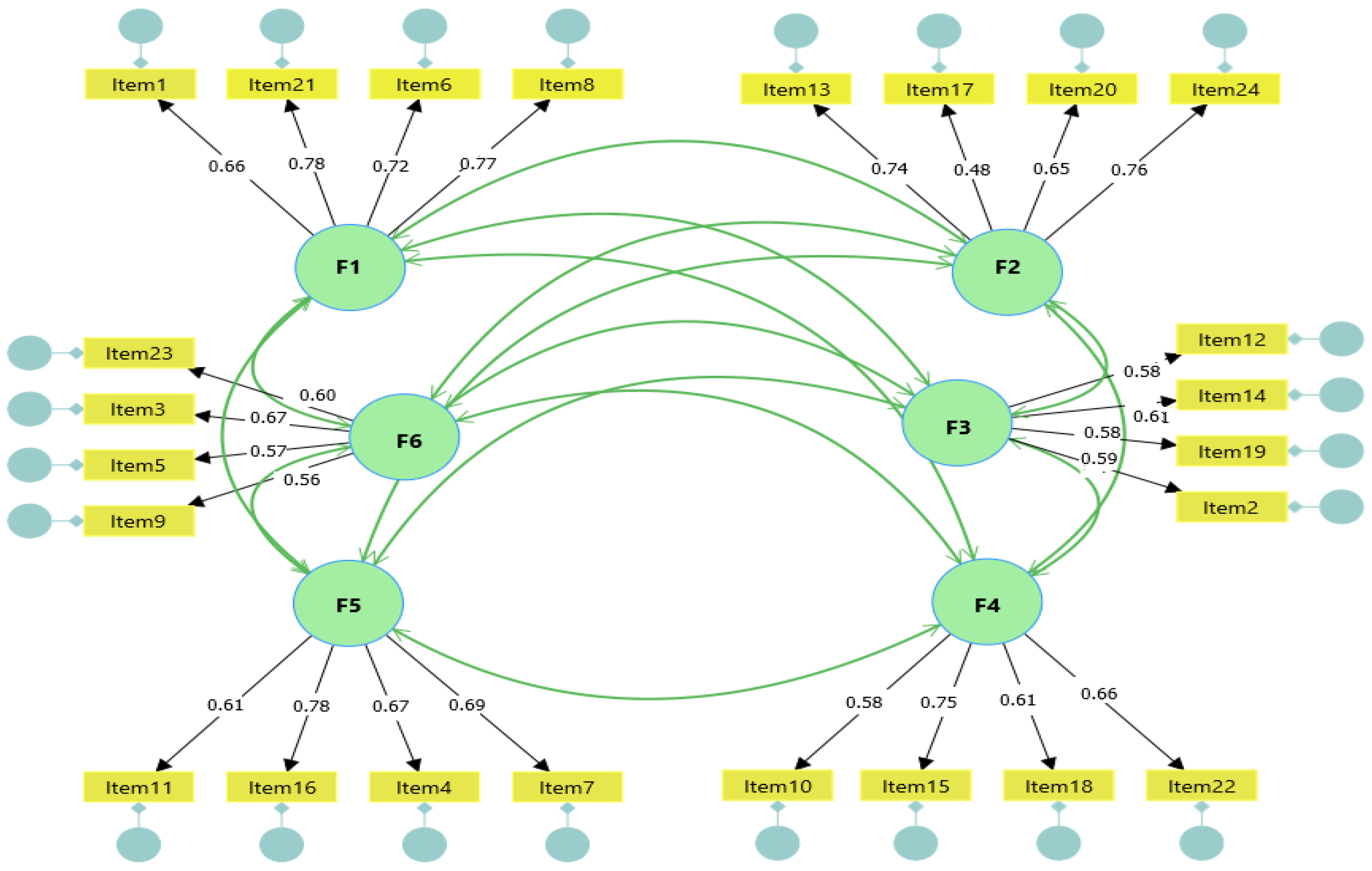
Factor weights (Table 2) ranged between .48 and .78, meeting the minimum criterion of .40 proposed by Hair et al. [62] for adequate representation of constructs. Global fit was evaluated using indices compatible with the ULS estimator in AMOS; it should be noted that RMSEA is not reported because the ULS fit function lacks a probabilistic likelihood basis, which makes the mathematical derivation of the non-centrality parameter impossible [63].
Upon verifying the findings in Table 3, the empirical adequacy of the structural solution is evident. The normed chi-square ratio (CMIN/df = 1.550) satisfies the parsimony criterion by falling well below 3.0 [47]. This support is consolidated with a GFI of .981 and an AGFI of .976; both records exceed the .95 threshold, indicating that the model successfully captures the variance and covariance of the sample [47,62]. Similarly, the incremental indices NFI (.971) and RFI (.966) validate the soundness of the proposed structure compared to independence models [47,62]. Regarding residuals, the SRMR of .046, below the .05 limit, confirms that the average discrepancy between the observed and implied matrices is marginal, lending rigor to the applied ULS estimation [47,62].
Discriminant validity of latent constructs was confirmed through the Heterotrait-Monotrait (HTMT) index. The obtained values, all below .85, support adequate theoretical differentiation between factors [50]. This result coincides with the interfactorial correlations shown in Table 4, which reflect appropriate levels of statistical independence between dimensions.
Correlations between the factors under study range from 0.43 to 0.69, suggesting the absence of redundant overlaps between dimensions (See Table 4).
3.3. Multigroup Measurement Invariance
Measurement equivalence was analyzed through a hierarchical multigroup analysis following the guidelines of Cheung and Rensvold [64] and Chen [48], where changes in the comparative fit index (ΔCFI) and Tucker-Lewis index (ΔTLI) less than or equal to .010 support the maintenance of invariance [65].
3.3.1. Invariance by Age Group (12-15 vs. 16-17 years)
The evaluation of measurement equivalence between age groups was performed using hierarchical models. In this sample, evidence of satisfactory metric invariance was obtained; although the chi-square difference was significant (χ2 = 24.65; df = 18; p = .002), the ΔIFI (.002) and ΔTLI (.001) values did not exceed the critical threshold of .010 [64]. When verifying whether the behavior of the scale was consistent across ages, the results were stable at all evaluated levels, from the configural to the residual model. This suggests that the questionnaire functions similarly in both ranges, so it was not necessary to segment the subsequent analysis by age. The stability of parameters indicates that the intersections between items remain stable across groups [66], and measurement errors do not vary significantly between developmental stages (Table 5 and Table 6).
3.3.2. Invariance by Gender
In this sample, the questionnaire demonstrated satisfactory equivalence between groups both in its factorial structure and in the strength of the relationship between items and their latent dimensions, corresponding to configural and metric levels. Although the chi-square difference between models was significant, χ2 = 99.58, df = 18, p < .001, the ΔIFI (.009) and ΔTLI (.008) values fell within acceptable tolerance ranges [48,64].
However, when evaluating scalar invariance compared to the metric model, the ΔIFI (.059) and ΔTLI (.062) values exceeded the established thresholds (Table 7 and Table 8). Manual inspection of intercepts revealed that item 17 of the questionnaire presented the greatest discrepancy; the identified difference for this item corresponds to the absolute numerical discrepancy between the unstandardized intercepts (τ) estimated for males and females, suggesting the presence of differential item functioning (DIF) by gender [49]. A similar pattern was observed when evaluating residual invariance, where differences were also notably significant.
This finding allows documenting the response specificity associated with that symptom as a substantive research result, validating that, although direct comparison of means between males and females should be performed under a partial invariance approach, the structure of the instrument remains stable between the evaluated groups [67,68,69].
3.4. Comparison of Factor Loadings and Factorial Correlations by Gender
In order to detect possible divergences between males and females, factor loadings and interdimensional correlations were reviewed. This analysis was feasible because the multigroup analysis demonstrated that the relationships between items and their respective dimensions remain consistent in both genders, meeting the metric invariance criterion.
As shown in Table 9, although some factor loadings present slightly higher values in the female group, the items are associated with their respective dimensions analogously in both groups. This stability in the relationship pattern supports the structural consistency of the model by gender. Likewise, Figure 2 presents correlations by gender, showing direct associations in both groups. In the case of males, relationships of greater magnitude are observed between F1 ↔ F6 (r = .76) and F3 ↔ F6 (r = .76), while in females some associations, such as F2 ↔ F6 (r = .50), show lower values. This explains that the strength of relationships between dimensions varies by gender.
3.5. Content Validity
Nine experts evaluated content adequacy. Consensus was quantified using Aiken’s V [70], obtaining a general average of .930 (95% CI [.715, .998]), with specific values for clarity (.924; 95% CI [.709, .996]), coherence (.935; 95% CI [.723, 1.000]), and relevance (.929; 95% CI [.715, .998]). Additionally, 95% confidence intervals (CI) were estimated using the score method [71], whose lower limits were above .70, which ratifies content validity [43].
3.6. Convergent Validity and Nomological Validity
As a preliminary step to the association analysis, the assumption of bivariate normality between the total scores of the CASO-N24 and ASQ-14 was evaluated using the Henze-Zirkler (HZ) test. Results showed adequate fit to the multivariate normal distribution in both the male group (HZ = .54, p = .915) and the female group (HZ = .66, p = .487). This finding technically justified the use of Pearson’s correlation coefficient (r) to evaluate convergence between constructs [51].
The analysis revealed a direct and statistically significant relationship in both males (r = .622, p < .001) and females (r = .604, p < .001). According to Blanca et al. [41] and Byrne et al. [72], these magnitudes ratify convergent validity, by linking coherently with a theoretically related measure of adolescent stress [73].
3.7. Internal Consistency of the Instrument
Internal consistency was determined using McDonald’s omega (ω) coefficient and Cronbach’s alpha (α). Following current recommendations [52,74], ω was reported as the main estimator, accompanied by its 95% confidence interval, calculated using the bootstrap method [75]. Global reliability (ω = .95) indicates excellent internal consistency [76,77]. Additionally, composite reliability (CR), calculated from standardized factor loadings, showed values between .69 and .82, considered adequate and, mostly, above the recommended threshold of .70 for confirmatory studies [47,62].
As shown in Table 10, the dimensions of speaking in public and interaction with teachers (ω = .82), interaction with the opposite sex (ω = .76), assertive expression (ω = .76), interaction with strangers (ω = .79), and acting in public (ω = .70) reported satisfactory reliability levels. The being ridiculed subscale (ω = .69) presents an acceptable value, considering the brevity of the scale (4 items) and the initial nature of the validation process [41,77]. Likewise, all confidence intervals exclude the value zero, which supports the stability of estimates [75].
4. Discussion
The results obtained show that the CASO-N24 questionnaire is a robust, multidimensional, and generally invariant tool, useful for assessing social anxiety in Peruvian adolescents; the results of the original theoretical structure of the instrument are replicated, and its applicability is also extended.
The contributions of the research lie in empirical validation, consistent with the original proposal [28]. Both exploratory and confirmatory factor analyses evidence the robust multidimensional structure, evidenced in the findings of adequate factor loadings and absence of problematic overlaps between factors. The results support the original theoretical model, despite social anxiety constituting a construct sensitive to cultural and contextual factors, which cause adolescents to modify how they interpret and respond to the evaluation of social situations.
The existence of six dimensions corroborates current contemporary models that consider social anxiety as a heterogeneous and localized construct [34,35]. Recent findings in European and Asian contexts have warned that unidimensional measures tend to underestimate the complexity of this construct, while multidimensional approaches allow for a more precise and reliable assessment of the symptomatic profile [1,2].
The results obtained serve to strengthen the construct validity of the CASO-N24 and make clear that the social situations included in the instrument are valid and representative for Peruvian adolescents. The cumulative explained variance and factor loading indices approximate and even exceed in some cases the results reported in previous validations in other Spanish-speaking countries [29], which constitutes an indication in favor of the structural stability of the model.
The results of confirmatory factor analysis provided suitable fit indices [47,62]. The normed chi-square ratio, both absolute and incremental fit indices, and the low level of standardized residuals indicate that the theoretical model adequately reproduces the observed covariance matrix. These results are relevant, given the ordinal condition of the variables and estimator indices from robust latent variables, which contributes to adequate methodological validity of the results.
Discriminant validity tests based on the HTMT criterion with moderate interfactorial correlations suggest that the evaluated dimensions are interdependent, with distinct facets of social anxiety, consistent with more recent studies that reveal that various social fears have a common basis but are expressed specifically, depending on the type of interaction and evaluative context [14,36].
Complete factorial invariance between the age groups 12-15 and 16-17 years was consolidated. Stability in configural, metric, scalar, and residual models would suggest that the CASO-N24 manages to measure the social anxiety construct comparably across different stages of adolescence. This result finds support in longitudinal research showing that, although social anxiety levels may change with age, the psychological structure of the construct appears to remain stable throughout adolescence [13,19].
From an applied perspective, this measurement equivalence allows for valid comparison of results obtained between adolescents of different age ranges without risk of introducing instrument-related biases. The findings support the age range extension of the CASO-N24, expanding its applicability beyond the age ranges originally proposed by Caballo et al. [28] and strengthening its utility for assessing social anxiety throughout adolescence.
In contrast to age invariance, multigroup analyses by gender found configural and metric invariance but not scalar or residual. That is, the factorial structure and functioning of items are equivalent in males and females, but differences are concentrated in that the intercepts of at least one item are different (item 17) and point to a possible indication of differential item functioning (DIF) by gender, a phenomenon extensively studied in social anxiety assessment.
Adolescent females tend to have higher levels of anxiety associated with social interaction [8,11], which could influence how certain items are interpreted. In this sense, recent literature shows how fears related to social interaction and interpersonal judgment are associated with gender bias in adolescent age, such as social norms, socialization styles, and even cultural expectations [10,18].
This result shows the sensitivity of the instrument in evaluating social anxiety experiences. Direct comparisons of means between males and females should be performed under a partial invariance approach [6,49,69].
The convergent validity of the CASO-N24 instrument was supported by moderate-high correlations with the ASQ-14, in both males and females. These associations are consistent with theory, which argues that social anxiety constitutes a central core of general psychological distress during adolescence, closely linked to perceived stress, emotional overload, and social demands [15,24].
The intensity of the obtained correlations is supported by previous studies that observed the relationship of social anxiety with stress and other emotional adjustment variables [19,41], corroborating convergent validity, and nomological validity with which it is coherently linked with other variables of the same construct in a theoretical network of psychological variable relationships.
Regarding reliability, the omega and alpha coefficients obtained indicate adequate internal consistency for the total scale and all subscales. The omega coefficient used as the main estimator responds to contemporary criteria in psychometrics, used in ordinal scales and factorial models [52,75].
The being ridiculed subscale obtained lower coefficients compared to other dimensions, however, it obtained an adequate coefficient. A study has also presented deficits in subscales with few items, although this does not necessarily imply that they have low clinical or research utility [77].
In conclusion, the results of this work support that the CASO-N24 is an instrument with adequate psychometric properties for measuring social anxiety in Peruvian adolescents. Theory reinforces the multidimensional understanding of the construct, presents cross-cultural evidence, which adds value to Caballo’s model. From an applied standpoint, the instrument constitutes a valid and reliable tool for detecting social anxiety in school settings, which would allow the implementation of prevention and mental health promotion programs [22,25]. In this sense, the CASO-N24 can be considered a culturally pertinent alternative to imported scales that reduces possible measurement biases and improves diagnostic accuracy.
The study has certain limitations that must be taken into account, although it also presents strengths. The study sample consisted only of adolescents from private educational institutions in northern Peru, which in some way prevents generalizing the results obtained to other educational contexts and regions of the country. It would be suggested that future research includes different samples that contemplate public educational institutions and include rural areas, as well as a longitudinal approach that assesses the stability of the instrument over time.
It would be interesting to continue investigating the predictive validity of the CASO-N24 and its sensitivity to change in the context of psychological interventions, for greater potential clinical application; finally, conducting a more exhaustive exploration of the differential functioning of items by gender could facilitate the refinement of the instrument and, in turn, offer a more adjusted interpretation regarding differences in how social anxiety is expressed in adolescence.
5. Conclusions
This study provides solid empirical evidence on the validity and reliability of the Social Anxiety Questionnaire for Adolescents (CASO-N24) in Peruvian school population aged 12 to 17 years. Exploratory and confirmatory factor analyses replicated the six-factor multidimensional structure originally proposed by Caballo, with factor loadings ranging between .48 and .78 and cumulative explained variance of 47.13%. The goodness-of-fit indices of the confirmatory model (GFI = .981; AGFI = .976; NFI = .971; RFI = .966; SRMR = .046) exceeded the reference thresholds established in the literature, supporting the empirical adequacy of the structural solution. Likewise, discriminant validity, evaluated through the HTMT criterion, confirmed the theoretical differentiation between the instrument’s dimensions.
Factorial invariance analyses revealed complete equivalence between age groups of 12-15 and 16-17 years at all evaluated levels (configural, metric, scalar, and residual), which supports the extension of the application range of the CASO-N24 beyond the originally validated ages. In contrast, gender invariance was achieved at configural and metric levels, but not at the scalar level, with differential functioning of item 17 being identified, a finding that suggests response specificities associated with gender in certain manifestations of social anxiety. Convergent validity was supported by moderate-high correlations with the ASQ-14 in both males (r = .622) and females (r = .604), confirming the theoretical coherence of the evaluated construct with perceived stress in adolescence.
Regarding reliability, omega and alpha coefficients evidenced adequate internal consistency for the total scale (ω = .95) and for the six subscales, whose values ranged between .69 and .82. These results position the CASO-N24 as a psychometrically robust tool for identifying social anxiety in Peruvian adolescents, contributing to the cross-cultural understanding of the construct and reinforcing the multidimensional theoretical model. From an applied perspective, the instrument constitutes a culturally pertinent alternative for early detection in school settings, facilitating the design of prevention and intervention programs in mental health aimed at this population.
Author Contributions
Conceptualization, H.M.A.A. and H.M.N.G.; methodology, H.M.A.A. and M.d.C.Q.V.; software, M.A.A.B.; validation, M.A.A.B. and H.M.N.G.; formal analysis, H.M.N.G.; investigation, H.M.A.A. and M.d.C.Q.V.; resources, V.G.V.C..; data curation, M.A.A.B.; writing—original draft preparation, V.G.V.C. and M.d.C.Q.V.; writing—review and editing, L.A.Y.A.; visualization, L.A.Y.A.; supervision, V.G.V.C.; project administration, L.A.Y.A.. All authors have read and agreed to the published version of the manuscript.
Funding
This research received no external funding.
Institutional Review Board Statement
Not applicable.
Informed Consent Statement
Not applicable.
Data Availability Statement
The original contributions presented in this study are included in the article. Further inquiries can be directed to the corresponding author.
Conflicts of Interest
The authors declare no conflict of interest.
References
- X. Tao and C. B. Fisher, “Exposure to social media racial discrimination and mental health among adolescents of color,” J. Youth Adolesc., vol. 51, no. 1, pp. 30–44, 2022. [CrossRef]
- R. Urbán, M. F. Olivas, B. A. Zsembik, and B. L. Zamboanga, “Social anxiety in Spanish and U.S. college students: Psychological correlates,” J. Adolesc., vol. 97, pp. 103–110, 2022.
- J. Wei, X. Zhang, and X. Liu, “Cross-cultural network analysis of anxiety symptoms among adolescents in China and the United States,” J. Affect. Disord., vol. 316, pp. 282–290, 2024. [CrossRef]
- O. Gómez-Ortiz et al., “Emotional and behavioral problems: Validity evidence of the System of Evaluation of Children and Adolescents (SENA),” Child Adolesc. Psychiatry Ment. Health, vol. 10, p. 37, 2016.
- A. Giménez-Miralles et al., “Adaptación al español del Inventario de Ansiedad Social de Liebowitz (LSAS-clínico): Propiedades psicométricas,” Int. J. Clin. Health Psychol., vol. 22, no. 2, p. 100265, 2022.
- B. Delgado, C. J. Inglés, J. M. García-Fernández, and M. C. Martínez-Monteagudo, “Ansiedad social en la adolescencia: un estudio desde la perspectiva de género,” Rev. Psicodidáctica, vol. 24, no. 2, pp. 88–94, 2019. [CrossRef]
- C. D. Barker, E. F. Aguirre, B. K. Barber, and S. Y. Rueger, “Social and cultural facets of adolescent social anxiety: Psychosocial and cultural neuroscience perspectives,” Neurosci. Biobehav. Rev., vol. 123, pp. 132–149, 2021. [CrossRef]
- P. Jefferies and M. Ungar, “Social anxiety in young people: A prevalence study across socio-cultural contexts,” J. Res. Adolesc., vol. 30, no. S2, pp. 447–464, 2020. [CrossRef]
- S. Coyle, C. K. Malecki, and T. Heffer, “The impact of COVID-19 on adolescent social anxiety and associated symptoms: A U.S. school-based study,” J. Adolesc. Health, vol. 71, no. 5, pp. 477–483, 2022. [CrossRef]
- N. Racine, B. A. McArthur, J. E. Cooke et al., “Global prevalence of depressive and anxiety symptoms in children and adolescents during COVID-19: A meta-analysis,” JAMA Pediatr., vol. 175, no. 11, pp. 1142–1150, 2021. [CrossRef]
- N. Salari, A. Hosseinian-Far, R. Jalali et al., “Changes in anxiety and social behaviors in adolescents during the COVID-19 pandemic: A systematic review and meta-analysis,” J. Affect. Disord., vol. 316, pp. 300–312, 2024. [CrossRef]
- M. Pampamallco and M. Matalinares, “Ansiedad según género, edad y grado de estudios en adolescentes de San Martín de Porres, Lima,” Socialium. Rev. Cient. Cienc. Soc., vol. 6, no. 1, pp. 48–64, 2022.
- J. M. De Lijster, G. C. Dieleman, B. Dierckx et al., “The age of onset of anxiety disorders: A meta-analysis,” J. Anxiety Disord., vol. 47, pp. 87–94, 2017. [CrossRef]
- B. M. Coley, R. Elkins, and J. Šimic, “Chronic adolescent social withdrawal and later relationship outcomes,” J. Youth Adolesc., vol. 52, no. 4, pp. 742–756, 2023.
- J. Lavoie, B. Kröner-Herwig, and P. Muris, “Cognitive biases and social anxiety in adolescence: Testing an exposure-based intervention,” J. Exp. Child Psychol., vol. 217, p. 105424, 2022.
- E. Park, E. Lee, Y. Ju, C. Shin, and G. Hong, “Fear of negative evaluation and social anxiety among adolescents: A cross-sectional study,” J. Adolesc., vol. 89, pp. 71–80, 2021.
- D. H. Klemanski and J. Curtiss, “Developmental trajectories of social anxiety from adolescence to adulthood,” J. Abnorm. Child Psychol., vol. 48, no. 2, pp. 271–284, 2020.
- X. Zhang, R. C. Ho, and P. Lo, “The interplay of emotion regulation and social anxiety in Chinese adolescents,” J. Child Fam. Stud., vol. 30, no. 5, pp. 1349–1360, 2021.
- X. Luo, L. Mou, H. Alwafi, and N. Patterson, “Network analysis of comorbid anxiety and depression symptoms among Chinese adolescents,” Curr. Psychol., vol. 42, pp. 1863–1875, 2023.
- X. Zhao, Y. Wang, and C. Huang, “Anxiety symptom network analysis among Chinese adolescents,” J. Affect. Disord., vol. 291, pp. 204–213, 2022. [CrossRef]
- S. Alkhudair, S. Albasil, and A. Alshaqsi, “Using structural evaluation for targeted intervention in adolescent social anxiety,” J. Child Adolesc. Psychopharmacol., vol. 31, no. 4, pp. 512–524, 2021.
- R. F. Krueger and K. E. Markon, “Revealing the structure of psychopathology: Toward an integrative understanding of disorders of impulse control and social anxiety,” Annu. Rev. Clin. Psychol., vol. 19, pp. 473–507, 2023.
- Y. Besen-Cassino, M. Gurrola, and G. Gurrola, “Global trends and gendered experiences of adolescent social anxiety,” J. Youth Adolesc., vol. 51, no. 3, pp. 610–622, 2022.
- I. Romano, B. J. van Rensburg, and T. Tse, “Transitioning to adulthood with social anxiety: Long-term outcomes,” J. Affect. Disord., vol. 316, pp. 278–285, 2024. [CrossRef]
- E. Lee, J. Robinson, and K. Kamper-deMarco, “Social media use and adolescent social anxiety: A longitudinal study,” J. Adolesc., vol. 97, pp. 59–68, 2023.
- V. E. Caballo, B. Arias, M. Calderero, I. C. Salazar, M. J. Irurtia, and T. H. Ollendick, “Adaptación del Cuestionario de Ansiedad Social (CASO) en población hispanohablante: Propiedades psicométricas,” Psicol. Conduct., vol. 19, no. 3, pp. 485–504, 2011.
- V. E. Caballo, I. C. Salazar, M. J. Irurtia, B. Arias, and S. G. Hofmann, “Measuring social anxiety in 11 countries: Development and validation of the Social Anxiety Questionnaire for Adults (SAQ-A30),” Eur. J. Psychol. Assess., vol. 26, no. 2, pp. 95–107, 2010. [CrossRef]
- V. E. Caballo, “Ansiedad social en adolescentes: Modelo integrador y bases del CASO-N24,” in Manual para la evaluación clínica de los trastornos psicológicos, vol. II, V. E. Caballo, Ed. Madrid, Spain: Pirámide, 2015, pp. 35–54.
- V. E. Caballo, F. Zaldívar, B. Arias, and I. C. Salazar, “Propiedades psicométricas del Cuestionario de Ansiedad Social (CASO) en jóvenes españoles,” Rev. Eval. Psicol., vol. 41, no. 2, pp. 155–163, 2021.
- D. M. Clark and A. Wells, “A cognitive model of social phobia,” in Social Phobia: Diagnosis, Assessment, and Treatment, R. G. Heimberg, M. Liebowitz, D. A. Hope, and F. R. Schneier, Eds. New York, NY, USA: Guilford Press, 1995, pp. 69–93.
- R. M. Rapee and R. G. Heimberg, “A cognitive-behavioral model of anxiety in social phobia,” Behav. Res. Ther., vol. 35, no. 8, pp. 741–756, 1997. [CrossRef]
- K. J. Hancock, S. R. Zubrick, and D. Lawrence, “Social anxiety in adolescence: Prevalence and predictors in the Australian population,” J. Youth Adolesc., vol. 51, no. 9, pp. 1819–1833, 2022.
- W. Zhang, R. Zhou, and R. Wang, “Metacognition, mindfulness, and social anxiety in adolescents,” J. Adolesc., vol. 83, pp. 7–16, 2020. [CrossRef]
- R. G. Heimberg, F. Brozovich, and R. M. Rapee, “A cognitive-behavioral model of social anxiety disorder,” in Social Anxiety: Clinical, Developmental, and Social Perspectives, J. G. Beck, Ed. 2010, pp. 395–422. [CrossRef]
- A. N. Kaczkurkin, K. D. Fitzgerald, and M. P. Paulus, “Social anxiety in adolescence: Emerging challenges and neurobiological insights,” Nat. Rev. Psychol., vol. 1, pp. 262–274, 2022.
- A. R. Schry and S. W. White, “Understanding social anxiety in youth: A systematic literature review,” Clin. Child Fam. Psychol. Rev., vol. 24, no. 3, pp. 472–492, 2021.
- V. B. Arias and S. G. Sireci, “Validez y validación para pruebas educativas y psicológicas: Teoría y recomendaciones,” Rev. Iberoam. Psicol., vol. 14, no. 1, pp. 11–22, 2021. [CrossRef]
- P. Cruchinho et al., “Translation, cross-cultural adaptation, and validation of measurement instruments: A practical guideline for novice researchers,” J. Multidiscip. Healthc., vol. 17, pp. 2701–2728, 2024. [CrossRef]
- J. Muñiz, P. Elosua, and R. K. Hambleton, “Directrices para la traducción y adaptación de pruebas,” Psicothema, vol. 25, no. 2, pp. 151–157, 2013. [CrossRef]
- D. A. Newman, “Missing data: Best practices for statistics, data analysis, and reporting,” Annu. Rev. Organ. Psychol. Organ. Behav., vol. 8, pp. 511–540, 2021.
- M. J. Blanca, M. Escobar, J. F. Lima, D. Byrne, and R. Alarcón, “Psychometric properties of a short form of the Adolescent Stress Questionnaire (ASQ-14),” Psicothema, vol. 32, no. 2, pp. 261–267, 2020. [CrossRef]
- M. J. Blanca, L. S. Moreira-Lucha, R. Alarcón, and M. V. Trianes, “The Adolescent Stress Questionnaire (ASQ-14): Psychometric properties in Spanish adolescents,” Int. J. Clin. Health Psychol., vol. 20, no. 2, pp. 154–161, 2020. [CrossRef]
- J. Ventura-León, “Back to content-based validity,” Adicciones, vol. 34, no. 4, pp. 323–326, 2022. [CrossRef]
- P. J. Ferrando and U. Lorenzo-Seva, “Assessing the quality of factor solutions based on polychoric correlations: A practical guide,” Psicothema, vol. 34, no. 1, pp. 143–151, 2022. [CrossRef]
- J. C. Hayton, D. G. Allen, and V. Scarpello, “Factor retention decisions in exploratory factor analysis: A tutorial on parallel analysis,” Organ. Res. Methods, vol. 7, no. 2, pp. 191–205, 2004. [CrossRef]
- C. DiStefano, D. Shi, and G. B. Morgan, “Assessing the WLS estimator with categorical data: A comparison of estimators and fit indices,” Struct. Equ. Model., vol. 28, no. 5, pp. 701–714, 2021.
- R. B. Kline, Principles and Practice of Structural Equation Modeling, 5th ed. New York, NY, USA: Guilford Publications, 2023.
- F. F. Chen, “Sensitivity of goodness-of-fit indexes to lack of measurement invariance,” Struct. Equ. Model., vol. 14, no. 3, pp. 464–504, 2007. [CrossRef]
- B. M. Byrne, Structural Equation Modeling with AMOS: Basic Concepts, Applications, and Programming, 3rd ed. New York, NY, USA: Routledge, 2016.
- J. Henseler, C. M. Ringle, and M. Sarstedt, “A new criterion for assessing discriminant validity in variance-based structural equation modeling,” J. Acad. Mark. Sci., vol. 43, no. 1, pp. 115–135, 2015. [CrossRef]
- J. N. Henze and B. Zirkler, “A class of invariant consistent tests for multivariate normality,” Commun. Stat. Theory Methods, vol. 19, no. 10, pp. 3595–3617, 1990. [CrossRef]
- M. T. Kalkbrenner, “Alpha, omega, and internal consistency: A tutorial for psychometric reliability analysis in counseling research,” Meas. Eval. Couns. Dev., vol. 56, no. 2, pp. 154–167, 2023.
- World Medical Association, “WMA Declaration of Helsinki – Ethical principles for medical research involving human subjects,” 2022. [Online]. Available: https://www.wma.net/policies-post/wma-declaration-of-helsinki-ethical-principles-for-medical-research-involving-human-subjects/.
- American Psychological Association, “Ethical principles of psychologists and code of conduct,” 2017. [Online]. Available: https://www.apa.org/ethics/code.
- R. L. Gorsuch, “Factor analysis,” in Handbook of Psychology: Vol. 2, Research Methods in Psychology, J. A. Schinka and W. F. Velicer, Eds. Hoboken, NJ, USA: John Wiley & Sons, 2003, pp. 143–164.
- R. C. MacCallum, K. F. Widaman, S. Zhang, and S. Hong, “Sample size in factor analysis,” Psychol. Methods, vol. 4, no. 1, pp. 84–99, 1999. [CrossRef]
- J. L. Horn, “A rationale and test for the number of factors in factor analysis,” Psychometrika, vol. 30, no. 2, pp. 179–185, 1965. [CrossRef]
- K. Y. Hogarty, C. V. Hines, J. D. Kromrey, J. M. Ferron, and K. R. Mumford, “The quality of factor solutions in exploratory factor analysis,” Educ. Psychol. Meas., vol. 65, no. 2, pp. 202–226, 2005. [CrossRef]
- M. G. Courtney, “Determining the number of factors to retain in exploratory factor analysis: Appropriate methods and a SAS-based tutorial,” Quant. Methods Psychol., vol. 9, no. 2, pp. 79–94, 2013.
- S. J. Finney and C. DiStefano, “Nonnormal and categorical data in structural equation modeling,” in Structural Equation Modeling: A Second Course, 2nd ed., G. R. Hancock and R. O. Mueller, Eds. Charlotte, NC, USA: Information Age Publishing, 2013, pp. 439–492.
- A. Afthanorhan, Structural Equation Modeling: From the Fundamental to Advance Topics. Sultan Zainal Abidin University Press, 2024.
- J. F. Hair, W. C. Black, B. J. Babin, and R. E. Anderson, Multivariate Data Analysis, 8th ed. Boston, MA, USA: Cengage Learning, 2019.
- K. Schermelleh-Engel, H. Moosbrugger, and H. Müller, “Evaluating the fit of structural equation models: Tests of significance and descriptive goodness-of-fit measures,” Methods Psychol. Res. Online, vol. 8, no. 2, pp. 23–74, 2003. [CrossRef]
- G. W. Cheung and R. B. Rensvold, “Evaluating goodness-of-fit indexes for testing measurement invariance,” Struct. Equ. Model., vol. 9, no. 2, pp. 233–255, 2002. [CrossRef]
- I. T. Maassen, D. Sterner, F. Pargent, M. Rudnev, and D. Goretzko, “Don’t let MI be misunderstood: Measurement invariance is more than a statistical assumption,” Psychol. Methods, Advance online publication, 2024. [CrossRef]
- D. L. Putnick and M. H. Bornstein, “Measurement invariance conventions and reporting: The state of the field,” Int. J. Behav. Dev., vol. 40, no. 2, pp. 116–124, 2016.
- B. M. Byrne, R. J. Shavelson, and B. Muthén, “Testing for the equivalence of factor covariance and mean structures: The issue of partial measurement invariance,” Psychol. Bull., vol. 105, no. 3, pp. 456–466, 1989. [CrossRef]
- F. Falkenström, N. Solomonov, and J. Rubel, “To detrend, or not to detrend, that is the question? The effects of detrending on cross-lagged effects in panel models,” Psychol. Methods, Advance online publication, 2023. [CrossRef]
- D. McNeish and M. G. Wolf, “Dynamic fit index cutoffs for confirmatory factor analysis models,” Psychol. Methods, vol. 28, no. 1, pp. 61–88, 2023. [CrossRef]
- L. R. Aiken, “Three coefficients for analyzing the reliability and validity of ratings,” Educ. Psychol. Meas., vol. 45, no. 1, pp. 131–142, 1985. [CrossRef]
- R. D. Penfield and P. R. Giacobbi Jr., “Applying a score confidence interval to Aiken’s index,” Meas. Phys. Educ. Exerc. Sci., vol. 8, no. 4, pp. 213–225, 2004. [CrossRef]
- B. M. Byrne, C. P. Davenport, and J. Mazanov, “Profiles of adolescent stress: The Adolescent Stress Questionnaire (ASQ) revisited,” J. Adolesc. Res., vol. 22, no. 4, pp. 393–416, 2007.
- J. A. Luján-Tangarife and J. A. Cardona-Arias, “Construcción y validación de escalas de medición en salud: Revisión de propiedades psicométricas,” Arch. Med., vol. 11, no. 3, pp. 1–10, 2015.
- T. J. Dunn, T. Baguley, and V. Brunsden, “From alpha to omega: A practical solution to the pervasive problem of internal consistency estimation,” Br. J. Psychol., vol. 105, no. 3, pp. 399–412, 2014. [CrossRef]
- A. F. Hayes and J. J. Coutts, “Use of Cronbach’s alpha, McDonald’s omega, and the H coefficient for estimating internal consistency reliability,” Commun. Methods Meas., vol. 14, no. 3, pp. 202–215, 2020. [CrossRef]
- D. George and P. Mallery, SPSS for Windows Step by Step: A Simple Guide and Reference. 11.0 Update, 4th ed. Boston, MA, USA: Allyn & Bacon, 2003.
- C. Viladrich, A. Angulo-Brunet, and E. Doval, “A journey around alpha and omega to estimate internal consistency reliability,” An. Psicol., vol. 33, no. 3, pp. 755–782, 2017. [CrossRef]
- A. Delgado, J. Márquez, J. Limonero, and M. Fernández, “Ansiedad social y enseñanza remota: Un estudio en docentes peruanos,” An. Psicol., vol. 35, no. 3, pp. 514–525, 2019.
- S. H. Abu-Bader and T. V. Jones, Structural Equation Modeling in Social and Behavioral Sciences: Applications and Interpretation. Thousand Oaks, CA, USA: Sage Publications, 2025.
- L. T. Hu and P. M. Bentler, “Cutoff criteria for fit indexes in covariance structure analysis: Conventional criteria versus new alternatives,” Struct. Equ. Model., vol. 6, no. 1, pp. 1–55, 1999. [CrossRef]
- K. Stensen and S. Lydersen, “Internal consistency: From alpha to omega?,” Tidsskr. Nor. Laegeforen., vol. 142, no. 11, 2022.
- R. Vivar, Manual del Cuestionario de Ansiedad Social (CASO). Madrid, Spain: TEA Ediciones, 2010.
Figure 2.
Comparison of correlations between dimensions of the anxiety questionnaire.
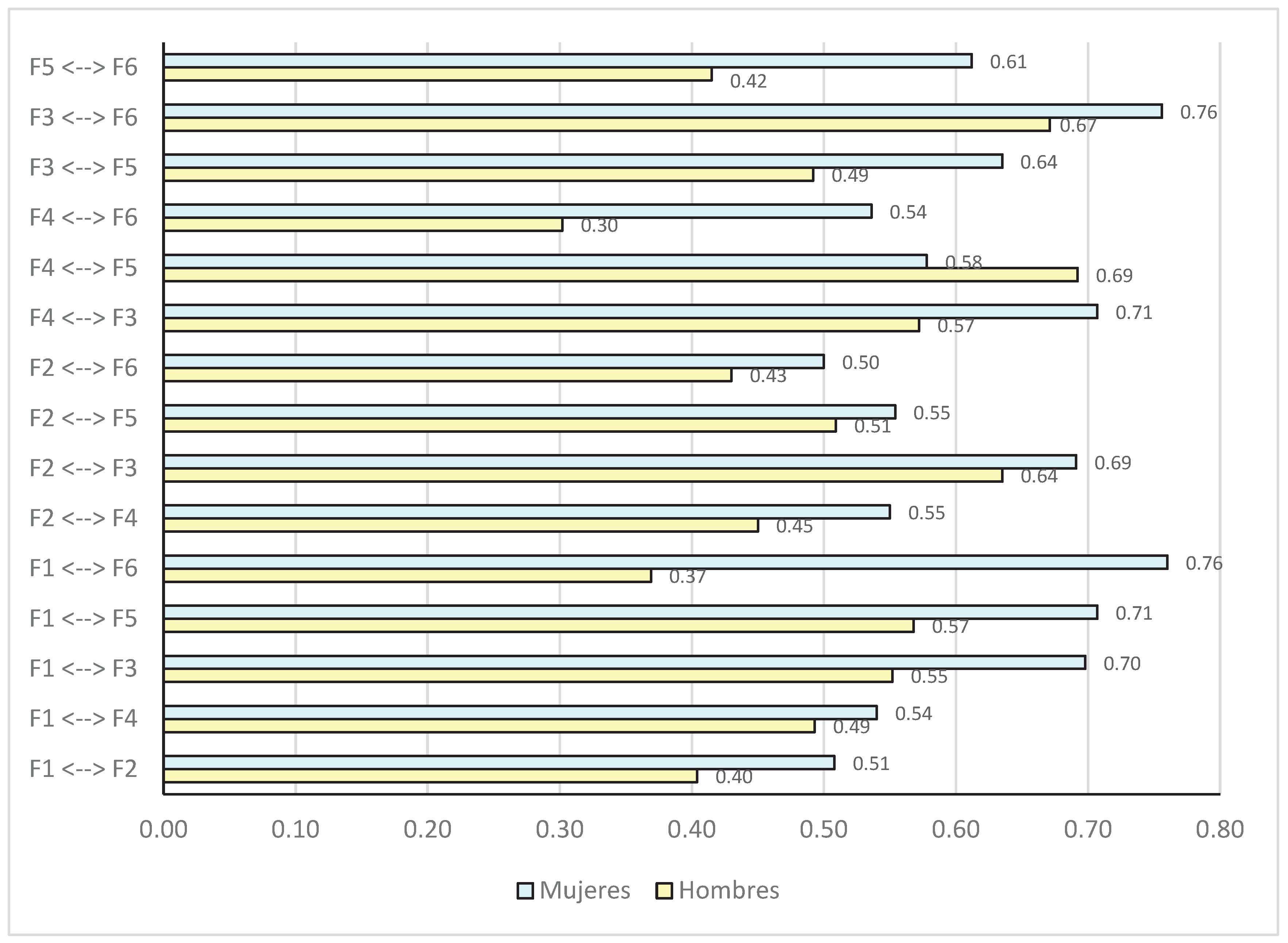

Table 1.
Configuration matrix of the exploratory factor analysis.
| Item | F1 | F2 | F3 | F4 | F5 | F6 |
|---|---|---|---|---|---|---|
| Item 1 | 0.55 | |||||
| Item 6 | 0.80 | |||||
| Item 8 | 0.74 | |||||
| Item 21 | 0.82 | |||||
| Item 13 | 0.65 | |||||
| Item 17 | 0.49 | |||||
| Item 20 | 0.68 | |||||
| Item 24 | 0.83 | |||||
| Item 2 | 0.61 | |||||
| Item 12 | 0.55 | |||||
| Item 14 | 0.70 | |||||
| Item 19 | 0.52 | |||||
| Item 10 | 0.69 | |||||
| Item 15 | 0.65 | |||||
| Item 18 | 0.79 | |||||
| Item 22 | 0.56 | |||||
| Item 4 | 0.73 | |||||
| Item 7 | 0.76 | |||||
| Item 11 | 0.51 | |||||
| Item 16 | 0.79 | |||||
| Item 3 | 0.73 | |||||
| Item 5 | 0.62 | |||||
| Item 9 | 0.65 | |||||
| Item 23 | 0.44 |
Note. Main factor loadings are reported.
Table 2.
Standardized factor loadings by item in the general model.
| Item | F1 | F2 | F3 | F4 | F5 | F6 |
|---|---|---|---|---|---|---|
| Item1 | .66 | |||||
| Item6 | .73 | |||||
| Item8 | .78 | |||||
| Item21 | .78 | |||||
| Item13 | .74 | |||||
| Item17 | .48 | |||||
| Item20 | .66 | |||||
| Item24 | .76 | |||||
| Item2 | .61 | |||||
| Item12 | .60 | |||||
| Item14 | .61 | |||||
| Item19 | .59 | |||||
| Item10 | .59 | |||||
| Item15 | .75 | |||||
| Item18 | .62 | |||||
| Item22 | .66 | |||||
| Item4 | .68 | |||||
| Item7 | .70 | |||||
| Item11 | .61 | |||||
| Item16 | .79 | |||||
| Item3 | .68 | |||||
| Item5 | .58 | |||||
| Item9 | .56 | |||||
| Item23 | .61 |
Note.
| F1: Speaking in public and interaction with teachers | F4: Assertive expression of annoyance or anger |
| F2: Interaction with the opposite sex | F5: Interaction with strangers |
| F3: Being exposed or ridiculed | F6: Acting in public |
Table 3.
Evaluation of goodness-of-fit indices of the CFA model.
| Index | Abbreviation | Value | Criterion | Met |
|---|---|---|---|---|
| Chi-squared | CMIN/df | 1.550 | ≤ 3.0 [47] | Yes |
| Goodness of Fit Index | GFI | 0.981 | ≥ .95 [47,62] | Yes |
| Adjusted GFI | AGFI | 0.976 | ≥ .90 [47] | Yes |
| Normed Fit Index | NFI | 0.971 | ≥ .90 [47] | Yes |
| Relative Fit Index | RFI | 0.966 | ≥ .90 [62] | Yes |
| Standardized Root Mean Square Residual | SRMR | 0.046 | < .05 [47,62] | Yes |
| Parsimony Normed Fit Index | PNFI | 0.834 | ≥ 0.50 [47,62] | Yes |
Table 4.
Correlations between dimensions of the confirmed factorial model.
| Factors | Correlation (r) | Factors | Correlation (r) |
|---|---|---|---|
| F4 ↔ F3 | 0.69 | F1 ↔ F4 | 0.57 |
| F1 ↔ F3 | 0.68 | F2 ↔ F5 | 0.54 |
| F3 ↔ F6 | 0.68 | F5 ↔ F6 | 0.52 |
| F1 ↔ F5 | 0.67 | F2 ↔ F4 | 0.52 |
| F2 ↔ F3 | 0.67 | F1 ↔ F2 | 0.49 |
| F4 ↔ F5 | 0.63 | F2 ↔ F6 | 0.47 |
| F3 ↔ F5 | 0.60 | F4 ↔ F6 | 0.43 |
| F1 ↔ F6 | 0.58 |
Table 5.
Multigroup comparison by age group.
| Compared Model | CMIN | df | RMR | GFI | AGFI | NFI | RFI | PNFI |
|---|---|---|---|---|---|---|---|---|
| Configural | 479.45 | 126 | .051 | .976 | .969 | .963 | .957 | .827 |
| Metric | 504.10 | 108 | .052 | .974 | .969 | .961 | .956 | .856 |
| Scalar | 564.34 | 87 | .055 | .971 | .967 | .956 | .953 | .889 |
| Residual | 572.89 | 63 | .056 | .971 | .968 | .955 | .954 | .930 |
Table 6.
Comparison of nested models by age group: 12-15 vs. 16-17 years.
| Comparison | Δdf | Δχ2 | p | ΔIFI | ΔTLI | Invariance |
|---|---|---|---|---|---|---|
| Metric vs. Configural | 18 | 24.65 | .002 | .001 | .001 | Achieved |
| Scalar vs. Metric | 21 | 60.24 | .005 | .005 | .003 | Achieved |
| Residual vs. Scalar | 24 | 8.55 | .001 | .001 | -.001 | Achieved |
Table 7.
Multigroup comparison between males and females.
| Compared Model | CMIN | df | RMR | GFI | AGFI | NFI | RFI | PNFI |
|---|---|---|---|---|---|---|---|---|
| Configural | 466.12 | 126 | .047 | .974 | .967 | .959 | .953 | .824 |
| Metric | 565.70 | 108 | .052 | .968 | .962 | .951 | .945 | .847 |
| Scalar | 1214.01 | 87 | .076 | .932 | .921 | .894 | .886 | .831 |
| Residual | 1343.91 | 63 | .083 | .925 | .916 | .883 | .879 | .859 |
Table 8.
Comparison of nested models between males and females.
| Comparison | Δdf | Δχ2 | p | ΔIFI | ΔTLI | Invariance |
|---|---|---|---|---|---|---|
| Metric vs. Configural | 18 | 99.58 | < .001 | .009 | .008 | Achieved |
| Scalar vs. Metric | 21 | 747.95 | < .001 | .065 | .070 | Not achieved |
Table 9.
Standardized factor loadings by item and gender.
| Item | Factor | Males | Females |
|---|---|---|---|
| Item1 | F1 | 0.618 | 0.698 |
| Item6 | F1 | 0.655 | 0.749 |
| Item8 | F1 | 0.657 | 0.825 |
| Item21 | F1 | 0.763 | 0.766 |
| Item13 | F2 | 0.632 | 0.780 |
| Item17 | F2 | 0.640 | 0.518 |
| Item20 | F2 | 0.652 | 0.621 |
| Item24 | F2 | 0.788 | 0.695 |
| Item2 | F4 | 0.450 | 0.620 |
| Item12 | F4 | 0.616 | 0.786 |
| Item14 | F4 | 0.536 | 0.642 |
| Item19 | F4 | 0.595 | 0.661 |
| Item10 | F3 | 0.571 | 0.570 |
| Item15 | F3 | 0.616 | 0.573 |
| Item18 | F3 | 0.554 | 0.586 |
| Item22 | F3 | 0.528 | 0.564 |
| Item4 | F5 | 0.684 | 0.670 |
| Item7 | F5 | 0.646 | 0.697 |
| Item11 | F5 | 0.585 | 0.652 |
| Item16 | F5 | 0.768 | 0.796 |
| Item3 | F6 | 0.718 | 0.632 |
| Item5 | F6 | 0.643 | 0.511 |
| Item9 | F6 | 0.656 | 0.654 |
| Item23 | F6 | 0.492 | 0.595 |
Table 10.
Reliability coefficients by questionnaire dimensions.
| Dimensions | No. items | α | ω | IC 95% Li | Ls |
|---|---|---|---|---|---|
| Total test | 24 | 0.90 | 0.95 | 0.94 | 0.96 |
| Speaking in public and interaction with teachers | 4 | 0.82 | 0.82 | 0.80 | 0.84 |
| Interaction with the opposite sex | 4 | 0.75 | 0.76 | 0.73 | 0.79 |
| Being exposed or ridiculed | 4 | 0.69 | 0.69 | 0.65 | 0.72 |
| Assertive expression of annoyance or anger | 4 | 0.76 | 0.77 | 0.74 | 0.80 |
| Interaction with strangers | 4 | 0.79 | 0.80 | 0.77 | 0.82 |
| Acting in public | 4 | 0.70 | 0.70 | 0.66 | 0.74 |
Note. α = Cronbach’s Alpha; ω = McDonald’s Omega, recommended for ordinal scales according to Hayes and Coutts [75]. 95% CI = 95% confidence interval of omega coefficients.
Disclaimer/Publisher’s Note: The statements, opinions and data contained in all publications are solely those of the individual author(s) and contributor(s) and not of MDPI and/or the editor(s). MDPI and/or the editor(s) disclaim responsibility for any injury to people or property resulting from any ideas, methods, instructions or products referred to in the content. |
© 2026 by the authors. Licensee MDPI, Basel, Switzerland. This article is an open access article distributed under the terms and conditions of the Creative Commons Attribution (CC BY) license (http://creativecommons.org/licenses/by/4.0/).
Copyright: This open access article is published under a Creative Commons CC BY 4.0 license, which permit the free download, distribution, and reuse, provided that the author and preprint are cited in any reuse.


