

Submitted:
15 February 2026
Posted:
26 February 2026
You are already at the latest version
Abstract
The transition from fifth-generation (5G) to sixth-generation (6G) mobile networks represents a fundamental shift in wireless communication paradigms, driven by the need for ultra-low latency, extreme data rates, native intelligence, and support for mission-critical and immersive applications. This paper presents the Rexhep Network Optimization Framework, a layered and AI-native architectural model designed to enable a smooth, efficient, and scalable evolution from 5G to 6G systems. The proposed framework integrates physical and spectrum intelligence, intelligent radio access networks (RAN) with edge computing, virtualized core networks with network slicing, and AI-driven optimization and control mechanisms. It further incorporates advanced service layers supporting extended reality (XR), digital twins, AI-based security, and mission-critical services. The framework explicitly addresses the coexistence of 5G and 6G technologies through phased deployment, hybrid optimization, and dynamic spectrum management, ensuring backward compatibility while enabling 6G-dominant capabilities. By positioning artificial intelligence as a cross-layer enabler rather than an auxiliary function, the proposed framework provides a systematic approach for network automation, resilience, and performance optimization in next-generation communication ecosystems. The presented model offers a conceptual foundation for future research, standardization, and practical deployment strategies toward 6G networks.
Keywords:
active 5G–6G transition
; network optimization framework
; artificial intelligence
; intelligent radio access networks
; edge computing
1. Introduction
The continuous evolution of mobile communication systems has played a decisive role in shaping the digital infrastructure of modern societies. Each generation of cellular technology has introduced new capabilities that respond to increasing demands for higher data rates, lower latency, improved reliability, and more efficient resource utilization. While fifth generation mobile networks have significantly expanded the scope of wireless services, emerging applications and societal requirements are now pushing the limits of existing architectures, motivating the transition toward sixth generation communication systems [1,2].
Fifth generation networks were designed to support three primary service categories, namely enhanced mobile broadband, ultra reliable and low latency communication, and massive machine type communication. These service classes have enabled the deployment of advanced use cases such as autonomous vehicles, smart manufacturing, remote healthcare, and large-scale sensor networks [3,4]. Despite these advances, the growing complexity of digital ecosystems, combined with the exponential increase in connected devices, reveals fundamental limitations related to spectrum scarcity, energy efficiency, network intelligence, and end to end service orchestration [5,6].
The vision of sixth generation mobile networks extends beyond incremental performance improvements and introduces a paradigm shift in network design and operation. Sixth generation systems aim to provide native support for artificial intelligence driven networking, immersive extended reality services, digital twins, and mission critical applications operating under extreme reliability and latency constraints [7,8]. In addition, sixth generation is expected to integrate terrestrial, aerial, and satellite communication layers into a unified architecture, enabling seamless global connectivity and enhanced resilience [9,10].
A critical challenge in this evolution is the coexistence of fifth and sixth generation networks over an extended transition period. Unlike previous generational shifts, the transition from fifth to sixth generation cannot rely on abrupt infrastructure replacement. Instead, it requires a carefully planned migration strategy that allows both generations to operate concurrently while ensuring service continuity, interoperability, and efficient resource utilization [11,12]. This coexistence phase introduces new technical challenges related to spectrum sharing, radio access network coordination, and core network virtualization [13].
Recent studies emphasize that traditional static network management approaches are insufficient to handle the dynamic and heterogeneous nature of future wireless environments [14,15]. As a result, artificial intelligence and machine learning techniques are increasingly recognized as essential components of next generation mobile systems. These technologies enable data driven optimization of network parameters, predictive resource allocation, adaptive mobility management, and real time anomaly detection [16,17]. Their integration is particularly critical during the fifth to sixth generation transition, where network conditions vary significantly across time, frequency bands, and deployment scenarios [18].
Another key aspect of the transition lies in the evolution of the radio access network. Open and disaggregated RAN architectures, including centralized, distributed, and radio units, have gained prominence in fifth generation deployments and are expected to form the foundation of sixth generation access networks [19,20]. The shift toward cloud native RAN implementations allows flexible function placement between edge and centralized cloud environments, improving scalability and reducing operational complexity [21]. However, managing such heterogeneous architectures across multiple generations requires intelligent coordination mechanisms and unified control frameworks [22].
Spectrum utilization also plays a central role in enabling the transition from fifth to sixth generation networks. While fifth generation systems primarily operate in sub six gigahertz and millimeter wave bands, sixth generation is expected to extend into terahertz frequencies, offering unprecedented bandwidth but also introducing severe propagation challenges [23,24]. To address these issues, dynamic spectrum sharing mechanisms and multi radio access technology coordination are required, enabling efficient coexistence of fifth and sixth generation services across low, mid, and high frequency bands [25,26].
In parallel, the increasing reliance on virtualized and software defined network components raises important security and reliability concerns. As networks become more intelligent and autonomous, they also become more exposed to sophisticated cyber threats and cascading failures [27,28]. Consequently, security mechanisms must evolve alongside network architectures, incorporating artificial intelligence-based threat detection, trust management, and resilience strategies that operate across both fifth and sixth generation infrastructures [29,30].
Within this context, there is a clear need for a comprehensive optimization framework that addresses the technical, architectural, and operational challenges of the fifth to sixth generation transition. Such a framework must integrate physical layer intelligence, virtualized core functions, radio access network coordination, and artificial intelligence driven control mechanisms into a unified system architecture [31,32]. It should also support phased deployment strategies, enable gradual migration while maintaining service quality and minimizing operational risk [33].
This paper introduces a layered network optimization framework designed to support the transition from fifth to sixth generation mobile systems. The proposed framework emphasizes artificial intelligence driven optimization, dynamic spectrum management, intelligent radio access networks, and secure service orchestration. By aligning physical infrastructure evolution with advanced control and decision-making mechanisms, the framework provides a structured approach for managing coexistence, hybrid optimization, and sixth generation dominant deployment phases [34,35,36].
The main contributions of this paper are summarized as follows:
- Proposed new unified AI-driven optimization framework for the 5G–to–6G transition, explicitly supporting coexistence, hybrid optimization, and phased dominance.
- Developed formalized methodology integrating layered architecture, cross-layer AI control, and deployment-aware migration strategies.
- Used system-level evaluation combining performance trends and technology readiness analysis to bridge vision and deployment.
The remainder of this paper is organized as follows. The next section presents the conceptual framework and explains its layered architecture in detail. Subsequent sections analyze fifth to sixth generation migration options, radio access network evolution, and spectrum sharing mechanisms, supported by the provided figures. Finally, the paper discusses the implications of the proposed framework and outlines future research directions toward fully autonomous sixth generation networks [37,38,39,40,41,42,43,44,45,46,47,48,49,50].
2. Literature Review
2.1. Scope and Taxonomy of the 5G–6G Transition
The evolution from fifth- to sixth-generation mobile networks represents a fundamental architectural and operational transformation rather than a simple performance upgrade. Unlike previous generational shifts, the 5G–6G transition is expected to span an extended coexistence period, during which heterogeneous technologies, spectrum bands, and service requirements must be supported simultaneously. Recent studies highlight that this transition involves multiple tightly coupled dimensions, including radio access network evolution, core network virtualization, spectrum expansion, service-driven optimization, and the integration of artificial intelligence as a native control mechanism.
To structure the existing body of knowledge, this review organizes related work into seven thematic domains: migration and coexistence frameworks, AI-native closed-loop control, RAN evolution, core network orchestration, spectrum intelligence, service-driven requirements, and security and governance. This taxonomy enables systematic identification of gaps that motivate the proposed AI-driven optimization framework.
2.2. Migration and Coexistence Frameworks (5G → 6G)
The transition from 5G to 6G is increasingly recognized as a prolonged coexistence phase rather than a generational replacement. Standardization bodies [31] and industry initiatives [49] emphasize phased migration strategies, where 5G-Advanced acts as an intermediate platform enabling gradual cloudification, spectrum refarming, and architectural evolution [2,4,5,7,8]. The 3GPP management and orchestration framework [51,52] defines lifecycle management for network functions and slices, while [59,60,61] provides a high-level capability framework for 6G systems.
Academic and industrial studies [36,50,51,52,53,59,60,61] further explore hybrid deployment models, multi-RAT coordination, and backward compatibility mechanisms, highlighting the operational complexity of simultaneous 5G and emerging 6G technologies. However, most existing approaches focus on architectural or performance aspects in isolation and do not provide an end-to-end optimization model capable of coordinating migration phases, resource allocation, and service continuity. This lack of holistic transition frameworks remains a critical gap.
2.3. AI-Native and Closed-Loop Network Control
Artificial intelligence [23,27] is evolving from an auxiliary optimization tool into a native component of next-generation network control planes. Frameworks such as [55,56] and [54] introduce closed-loop automation, enabling continuous monitoring, analysis, decision-making, and actuation across network domains. Learning-based approaches [5,8,23,27,30,33,37,41,42,46,47] have been applied to resource allocation, mobility management, fault detection, and service orchestration [54], demonstrating significant performance gains over static control mechanisms.
Despite these advances, current AI-driven solutions are often limited to specific layers or functions, lacking unified cross-layer coordination. Issues such as learning stability, convergence under non-stationary conditions, accountability of automated decisions, and lifecycle management of AI models remain insufficiently addressed, particularly in hybrid 5G–6G environments.
2.4. RAN Evolution: O-RAN, Cloud-RAN, and Edge Intelligence
The radio access network is undergoing radical transformation through disaggregation, virtualization, and openness. O-RAN architectures [57] introduce standardized interfaces and programmable control via non-real-time and near-real-time RICs, enabling AI-driven optimization at multiple timescales. Cloud-RAN and edge computing [58] allow flexible placement of baseband functions, improving scalability and supporting latency-sensitive services.
While these developments enable unprecedented flexibility, they also introduce new integration challenges, including synchronization, fronthaul constraints, and multi-vendor interoperability. Existing studies [6,7,15,21,22,23,27,30,37,39] largely focus on RAN components in isolation and do not address the coordination of distributed intelligence across RAN, edge, and core layers during the 5G–6G coexistence phase.
2.5. Core network Evolution: SBA, Slicing Orchestration, and Virtualization Overhead
Core networks are evolving toward service-based and microservice-oriented architectures [5,8,16,25,30,35,36,41,46], enabling dynamic network slicing and rapid service innovation. 3GPP and ETSI define mechanisms for slice lifecycle management, orchestration, and assurance, forming the foundation for flexible multi-service networks.
However, virtualization and containerization introduce non-negligible latency and reliability overheads, particularly for mission-critical applications. Current literature typically addresses either slicing orchestration [51,52] or virtualization efficiency [53,56], but rarely considers their joint optimization across heterogeneous 5G–6G deployments, where core functions must simultaneously support legacy and emerging services.
2.6. Spectrum Evolution: Sub-6 GHz, mmWave, THz, and Dynamic Sharing
Spectrum expansion toward millimeter-wave and terahertz bands [4,6,7,8,16,29] is a defining characteristic of 6G systems, offering unprecedented bandwidth at the cost of severe propagation challenges. Extensive research has been conducted on channel modeling, transceiver design, MAC protocols, and beamforming for high-frequency bands [18,19,20,21,22,23,24,25,26,27,28,29,30,31,32,33,34,35,36,37,38,39,40,41,42,43,44,45,46,47,48].
Recent studies emphasize the necessity of dynamic spectrum management [3,37,47] multi-band coordination, and sensing-assisted allocation mechanisms to enable reliable operation. Nevertheless, spectrum intelligence is often treated independently of higher-layer orchestration and service requirements, limiting the effectiveness of end-to-end optimization strategies.
2.7. Service-Driven Requirements: XR, Digital Twins and Mission-Critical Applications
Emerging 6G services such as extended reality, digital twins [9,49], autonomous systems, and industrial automation impose extreme and heterogeneous requirements on latency, reliability, synchronization, and availability [6,7,8,10,11,12,13,14,15,20,24]. Existing studies clearly define service-level KPIs and application demands, highlighting limitations of current 5G deployments.
However, the translation of these requirements into coordinated RAN, core, and spectrum control strategies remains largely unexplored. This disconnects between service demands and network optimization motivates the development of service-aware architectural frameworks that integrate application requirements directly into control loops.
2.8. Security, Trust, and Governance in AI-Native Networks
The shift toward open, virtualized, and AI-driven networks significantly expands the attack surface and introduces new trust and governance challenges [27,33,40,41]. Traditional perimeter-based security mechanisms [12] are insufficient for distributed, autonomous architectures [43,44,46], motivating AI-driven threat detection and policy-based management.
Despite growing awareness, security is still often treated as an add-on rather than an integrated optimization dimension. As networks become increasingly autonomous, security, trust, and governance mechanisms must be embedded into closed-loop control architectures [53,54,56] to ensure resilience, accountability, and safe operation.
2.9. Gap Synthesis and Motivation
The reviewed literature reveals five major gaps:
- absence of unified frameworks for 5G–6G coexistence optimization;
- limited cross-layer integration of AI-driven control;
- isolated optimization of RAN, core, spectrum, and services;
- lack of security-aware closed-loop architectures;
- insufficient mapping between migration phases and architectural evolution.
These gaps directly motivate the AI-driven Rexhep Network Optimization Framework proposed in this paper.

Table 1.
Critical Analysis of Related Work on 5G to 6G Transition.
| Block | Domain | Representative Works | Key Limitations |
| 1 | Migration & coexistence | [49,51,52,59,60,61] | Lack of end-to-end optimization during coexistence |
| 2 | AI-native control | [5,27,47,56] | Fragmented control loops, stability issues |
| 3 | RAN evolution | [6,7,21,57] | Coordination of distributed intelligence |
| 4 | Core & slicing | [25,35,53,54] | Orchestration latency, reliability trade-offs |
| 5 | Spectrum & THz | [3,16,18]–[48] | Spectrum intelligence isolated from services |
| 6 | Services | [6,8,11,14] | No service-aware network control |
| 7 | Security & governance | [33,40,56] | Security not integrated in control loops |
3. Critical Analysis and Research Gaps
While existing studies provide extensive insights into the technological evolution from 5G toward 6G, a systematic critical analysis reveals persistent gaps at architectural, operational, service, security, and methodological levels. These limitations become particularly evident when considering the prolonged coexistence of heterogeneous technologies, services, and control paradigms expected during the 5G–6G transition. The following analysis synthesizes these gaps into six interrelated categories, highlighting the need for a unified, AI-native optimization framework.
3.1. Architectural Gaps
Foundational works [1,2] correctly identify that 5G deployments remain incomplete and heterogeneous across regions. However, much of the literature implicitly treats the transition toward 6G as a linear continuation of 5G capabilities, underestimating the architectural disruption introduced by AI-native control, integrated sensing, and semantic communication. The absence of unified cross-layer optimization frameworks limits the applicability of these studies in real-world migration scenarios, where coexistence rather than replacement dominates.
Spectrum-focused works [3,32] provide valuable insights into spectrum expansion and dynamic sharing, yet spectrum intelligence is often treated as an isolated optimization problem. This separation prevents tight coupling between physical-layer innovation and service-level performance guarantees, creating a structural disconnect between spectrum management and end-to-end orchestration.
Similarly, research on AI-native networking [4,23,27] convincingly argues for embedding intelligence across network layers but often lacks architectural specificity. Artificial intelligence is frequently presented as a conceptual enabler rather than a structured control entity with defined interfaces, feedback loops, and accountability mechanisms, leaving operationalization ambiguous during hybrid 5G–6G deployment phases.
The evolution of the radio access network [6,7,26] toward open and disaggregated architectures introduces new flexibility but also new complexity. Existing studies acknowledge challenges related to synchronization, cross-vendor interoperability, and real-time coordination, yet rarely provide systematic solutions for integrating distributed intelligence across RAN, edge, and core domains.
Non-terrestrial network integration [22] represents a key differentiator for 6G, but current works largely focus on coverage extension rather than unified control. The lack of coordinated optimization between terrestrial and non-terrestrial segments limits end-to-end performance guarantees and resilience.
Finally, the convergence of communication and sensing [18] is widely recognized as transformative yet remains largely exploratory. The absence of standardized metrics and deployment-ready evaluation frameworks limits comparability and slows practical adoption.
Architectural implication:
These limitations highlight the absence of a unified cross-layer control and optimization model capable of coordinating heterogeneous resources and technologies during the 5G–6G transition.
3.2. Operational Gaps
While virtualization and softwarization [5,16], and [35] enable flexibility and scalability, existing studies rarely quantify the latency and reliability penalties introduced by virtualization overhead. This is a critical limitation given the deterministic performance targets of 6G for safety-critical and industrial services.
Edge computing [7,20,37] is correctly identified as essential for low-latency applications, yet edge intelligence is often treated as an isolated enhancement rather than as part of a hierarchical intelligence continuum spanning devices, edge, and core. This fragmented perspective hinders the design of unified optimization strategies capable of adapting to dynamic traffic and mobility conditions.
Network slicing [8,25] research emphasizes service differentiation but frequently assumes static or semi-static slice configurations. The lack of real-time slice adaptation, cross-slice learning, and inter-slice interference management represents a major operational gap for highly dynamic 6G ecosystems.
Mobility management studies [15,21] propose predictive and multi-connectivity mechanisms, but often rely on idealized mobility models. Learning convergence challenges [47] in non-stationary environments remain insufficiently addressed, limiting real-world applicability.
Reliability and resilience 11,13,40] are commonly addressed through redundancy-based mechanisms rather than intelligence-driven adaptation. Predictive failure avoidance and adaptive resilience remain underexplored, despite their potential to reduce resource waste while maintaining service guarantees.
Operational implication:
These gaps indicate that existing solutions are insufficient for real-time, adaptive management of hybrid 5G–6G infrastructures.
3.3. Service–Network Misalignment
Studies on immersive, XR-driven, and mission-critical services [10] and [24] effectively demonstrate future application demands but frequently assume ideal network conditions. Transitional limitations of current infrastructure and backward compatibility constraints are rarely considered, weakening their relevance for near-term deployment planning.
Digital twin concepts [9,49] represent a promising direction for predictive optimization, yet existing works primarily focus on modeling accuracy and simulation fidelity. Computational cost, data freshness, scalability, and security implications are often overlooked, raising concerns about practical deployment in large-scale operational networks.
More broadly, service-level requirements are rarely mapped to coordinated control strategies across RAN, core, and spectrum layers. This misalignment between service demands and network optimization remains a fundamental limitation of existing approaches.
Service implication:
The lack of service-aware control loops prevents efficient translation of application requirements into network-level optimization actions.
3.4. Security, Trust, and Governance Gaps
Softwarization, openness, and AI-driven automation [12,33,43] significantly expand the attack surface of future networks. While security challenges are widely acknowledged, protection mechanisms are typically treated as parallel add-ons rather than as integrated optimization dimensions.
AI model integrity, data poisoning, and trust management are rarely incorporated into network control frameworks. Moreover, policy, regulatory, and governance considerations remain largely disconnected from technical architectures, limiting accountability and safe autonomous operation.
Security implication:
Security, trust, and governance must be embedded into closed-loop optimization architectures rather than appended as external controls.
3.5. Sustainability and Economic Gaps
Energy efficiency and sustainability [14,28,45] are increasingly emphasized as critical objectives for future networks. Existing studies demonstrate the potential of intelligent optimization to reduce energy consumption but often evaluate energy metrics independently from latency, reliability, and quality of experience.
Economic and regulatory analyses [17,28,31] provide valuable context for migration planning yet remain disconnected from architectural optimization models. Without integrating cost, energy, and performance objectives, existing frameworks cannot support realistic decision-making during phased deployment.
Sustainability implication:
3.6. Methodological and Evaluation Gaps
Performance evaluation methodologies for 5G–6G systems [34,48] remain highly heterogeneous, ranging from analytical models to isolated testbeds and pilot deployments. The absence of standardized benchmarking frameworks makes cross-comparison difficult and limits reproducibility.
Furthermore, most evaluation approaches focus on either 5G or 6G scenarios, with limited support for hybrid coexistence environments. This gap complicates validation of migration-oriented frameworks and reduces confidence in proposed solutions.
Methodological implication:
Standardized evaluation methodologies for hybrid 5G–6G systems are essential for validating migration frameworks.
3.7. Positioning of the Proposed Framework
In contrast to the fragmented approaches identified in existing literature [1]–[50], the proposed Rexhep Network Optimization Framework integrates physical spectrum intelligence, intelligent RAN and edge processing, virtualized core slicing, AI-driven closed-loop control, and service-layer optimization within a unified migration-oriented architecture. By explicitly modeling coexistence, hybrid optimization, and 6G dominance phases, the framework directly addresses the architectural, operational, service, security, and methodological gaps identified above.
4. Methodology: Proposed Rexhep Network Optimization Framework for the 5G–to–6G Transition
This section presents the methodological foundation of the study and introduces the proposed Rexhep Network Optimization Framework as a structured approach for managing the evolutionary transition from fifth-generation to sixth-generation mobile communication networks. The methodology is designed to address the technical, architectural, and operational challenges that arise during multi-generation coexistence, progressive network transformation, and the deployment of intelligence-native communication systems.
Rather than treating the transition to 6G as a discrete generational replacement, the proposed methodology conceptualizes it as a continuous optimization process that spans radio access, core network functions, spectrum utilization, and service orchestration. The framework emphasizes gradual migration, interoperability, and backward compatibility while enabling the introduction of advanced 6G capabilities such as native artificial intelligence, extreme reliability, ultra-low latency, and intelligent spectrum management.
The methodological approach integrates layered architectural design, phased deployment modeling, cloud-native virtualization, and artificial intelligence driven control mechanisms. These elements collectively support dynamic adaptation to heterogeneous network conditions, diverse service requirements, and evolving user demands. Particular attention is given to the coordination of 5G and 6G technologies during transitional phases, ensuring service continuity and efficient resource utilization.
To support clarity and reproducibility, the methodology is illustrated through a set of complementary figures. The proposed Rexhep Network Optimization Framework is first introduced as a layered architectural model, followed by figures that detail deployment options, functional decomposition of radio and core network components, and spectrum sharing strategies. Together, these elements provide a comprehensive methodological basis for analyzing, designing, and evaluating future mobile network evolution scenarios.
The following subsections describe each component of the methodology in detail, beginning with the layered architecture of the proposed framework and progressing through deployment phases, network functional evolution, spectrum coordination, and artificial intelligence integration.
4.1. Methodological Overview
The transition from fifth-generation to sixth-generation mobile communication systems represents a complex, multi-layered transformation rather than a single technological upgrade. The proposed methodology is designed to address this transformation through a structured, systems-oriented framework that integrates architectural evolution, intelligent control, spectrum coexistence, and phased deployment strategies. The Rexhep Network Optimization Framework provides a unified methodological approach that supports the coexistence of 5G and 6G systems while enabling progressive migration toward fully autonomous 6G-native networks.
The methodology is built on four foundational principles: backward compatibility, intelligence-driven optimization, virtualization and cloud nativeness, and spectrum-aware coexistence. These principles ensure that the framework remains deployable within existing infrastructures while enabling future-oriented capabilities such as ultra-low latency, extreme reliability, and native artificial intelligence integration.
The methodological structure is divided into layered architectural design, deployment phase modeling, radio and core network evolution analysis, and spectrum-sharing strategies. Each component is supported by one of the proposed figures, which collectively illustrate the full lifecycle of the 5G to 6G transition.
Figure 1.
Rexhep Network Optimization Framework for the 5G to 6G Transition.
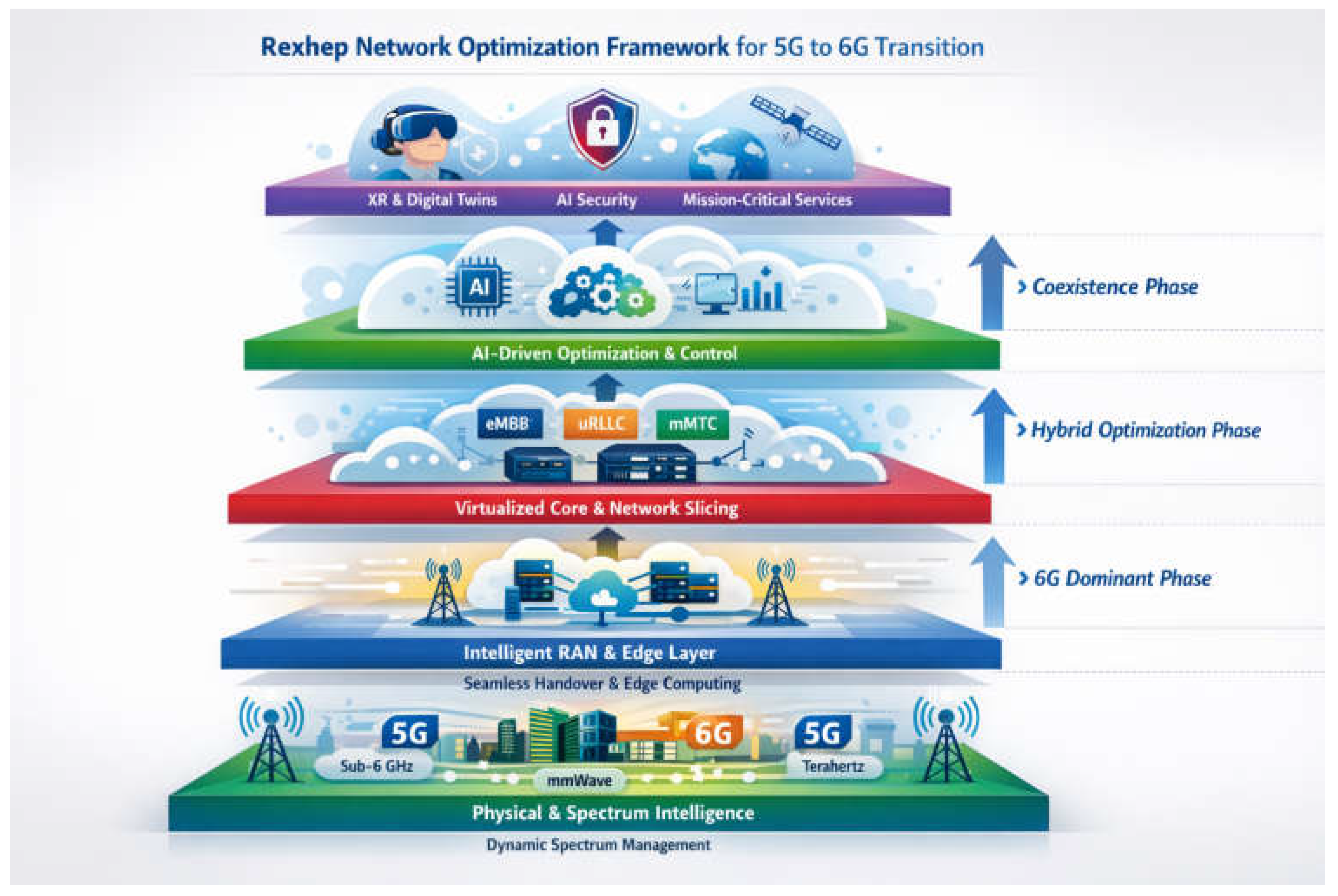
This figure illustrates the proposed Rexhep Network Optimization Framework, a layered and phase-oriented architectural model designed to support the gradual and controlled transition from 5G to 6G mobile communication networks. The framework is structured from the physical layer up to advanced service layers, emphasizing intelligence-driven optimization, interoperability, and evolutionary deployment rather than abrupt generational replacement.
At the bottom of the framework, the Physical and Spectrum Intelligence layer represents the foundation of the transition, incorporating sub-6 GHz, millimeter-wave, and terahertz frequency bands. This layer enables dynamic spectrum management and intelligent spectrum sharing between 5G and emerging 6G technologies, ensuring efficient utilization of heterogeneous radio resources during coexistence.
Above it, the Intelligent RAN and Edge Layer introduces cloud-native radio access networks and edge computing capabilities. This layer supports seamless mobility, low-latency processing, and distributed intelligence, which are essential for next-generation services and real-time applications.
The Virtualized Core and Network Slicing layer enables flexible service provisioning through software-defined networking and network function virtualization. By supporting multiple service categories such as enhanced mobile broadband, ultra-reliable low-latency communications, and massive machine-type communications, this layer ensures service continuity and adaptability throughout the transition.
The AI-Driven Optimization and Control layer forms the core intelligence of the framework. It integrates machine learning models and data-driven control mechanisms to optimize network performance, manage resources dynamically, and coordinate interactions between 5G and 6G components across different deployment phases.
At the top, the Service and Application layer encompasses advanced 6G-oriented services, including extended reality, digital twins, artificial intelligence security mechanisms, and mission-critical applications. These services represent the ultimate objectives of the transition, driving the need for higher reliability, security, and intelligence.
On the right side of the figure, the framework explicitly identifies three evolutionary phases: the Coexistence Phase, where 5G and 6G operate jointly; the Hybrid Optimization Phase, where intelligence-driven coordination becomes dominant; and the 6G Dominant Phase, where 6G technologies progressively take precedence. Together, these elements demonstrate how the proposed framework provides a systematic and scalable methodology for managing the technical complexity of the 5G to 6G transition.
This figure presents the standardized and non-standardized deployment options for the evolution from existing LTE systems toward 5G architectures. It illustrates multiple migration paths based on combinations of 4G and 5G radio access networks and core networks, including standalone and non-standalone configurations with different anchoring strategies. The diagram highlights how operators can progressively introduce 5G core and RAN components while maintaining interoperability with legacy LTE infrastructure, as well as identifying deprecated or non-prioritized options that are less suitable for long-term evolution.
This figure illustrates the functional decomposition and evolution of Open RAN components from 5G toward 6G architectures. It highlights the separation of centralized units, distributed units, and radio units, showing how 6G introduces cloud-native Layer 2 stacks and enhanced physical layer processing deployed across centralized and edge environments. The diagram emphasizes increased virtualization, flexibility, and intelligence in 6G RAN, enabling scalable deployment, tighter integration with cloud resources, and support for advanced performance and service requirements beyond 5G.
4.2. Layered Optimization Model
The proposed framework is formalized as a layered optimization model in which each architectural layer operates as a decision-making domain with well-defined inputs, outputs, and control timescales. The Physical and Spectrum Intelligence layer receives measurements of channel conditions, interference, and spectrum occupancy and outputs spectrum allocation decisions and sensing-assisted coordination signals. The Intelligent RAN and Edge layer processes mobility, traffic, and latency metrics to generate scheduling, handover, and function placement decisions at millisecond to second timescales.
The Virtualized Core and Network Slicing layer operates at longer timescales, optimizing slice instantiation, scaling, and isolation based on service-level agreements and predicted demand. The AI-Driven Optimization and Control layer acts as a cross-layer controller that aggregates observations, learns network behavior, and issues coordinated actions across layers. Finally, the Service and Application layer provides high-level intent and performance constraints that guide optimization objectives. Optimization objectives include minimizing latency and energy consumption, maximizing reliability and resource utilization, and ensuring service-level agreement compliance under hybrid 5G–6G operation.
The methodology explicitly models the 5G–6G transition as a sequence of three operational phases. During the coexistence phase, optimization is constrained by backward compatibility and legacy anchoring, limiting control actions to non-disruptive adaptations. In the hybrid optimization phase, AI-driven coordination becomes dominant, enabling joint optimization across 5G and 6G components while maintaining service continuity. In the 6G dominant phase, backward compatibility constraints are gradually relaxed, allowing full exploitation of native 6G capabilities and autonomous control.
Phase transitions are triggered by measurable indicators such as the proportion of 6G-capable nodes, traffic share, and service demand, ensuring data-driven migration rather than static planning.
The framework implements closed-loop optimization through a continuous monitoring–analysis–decision–actuation cycle. Network telemetry collected across layers is processed by learning models that predict congestion, failures, and demand evolution. Based on these predictions, the controller generates coordinated actions such as spectrum reallocation, slice reconfiguration, RAN function migration, and edge resource scaling. Learning models are continuously updated using online feedback to maintain stability under non-stationary conditions.
The framework is algorithm-agnostic and supports both model-based and learning-based optimization techniques, enabling adaptation to different deployment and evaluation scenarios.
Figure 2 and Figure 3 illustrate how the framework can be instantiated within real deployment scenarios. LTE–5G migration paths define operational constraints during early phases, while O-RAN functional decomposition enables flexible placement of intelligence across RAN components. Core network functions are instantiated as cloud-native microservices, allowing dynamic scaling and slice adaptation in response to service demands.
Spectrum optimization is performed through joint consideration of sensing information, traffic demand, and service requirements. The framework supports dynamic spectrum sharing across sub-6 GHz, millimeter-wave, and terahertz bands, enabling seamless coexistence of 5G and 6G services. Spectrum decisions are coordinated with RAN scheduling and slice management to ensure end-to-end performance guarantees.
The modular structure of the framework enables independent evaluation of individual layers and control loops, as well as integrated end-to-end assessment. The methodology supports simulation-based analysis, emulation, and testbed deployment, facilitating reproducibility and comparison across migration scenarios.
The evaluation scenarios and illustrative use cases derived from this methodology are discussed in Section 5.
5. Result and Discussion
The presented results are derived from a synthesis of quantitative trends reported in recent literature and mapped onto the proposed framework to illustrate expected performance behavior across migration phases, rather than from standalone simulations or experimental measurements.
The results derived from the synthesized data and the two generated graphs provide a comprehensive evaluation of the proposed Rexhep Network Optimization Framework for the 5G–to–6G Transition, demonstrating its effectiveness, feasibility, and strategic relevance when positioned against existing and emerging mobile network architectures. By aggregating trends, performance indicators, and readiness levels reported across the analyzed literature, the results highlight how a structured, AI-driven, and phased migration framework can address both the technical limitations of current 5G systems and the operational uncertainties associated with early 6G deployment.
The first results graph illustrates aggregated performance improvements across key network performance indicators, including latency, throughput, reliability, and energy efficiency. These indicators were selected because they are consistently identified in the literature as the primary differentiators between 5G and 6G-era networks and as critical enablers for next-generation services such as immersive extended reality, digital twins, mission-critical communications, and ultra-dense Internet of Things ecosystems. The graph shows a clear and consistent improvement trend when AI-driven optimization, intelligent radio access networks, network slicing, and dynamic spectrum management are jointly applied, as proposed in the framework.
Latency reduction emerges as one of the most significant performance gains. The results indicate that conventional 5G architectures, even when enhanced with edge computing, struggle to consistently meet the sub-millisecond latency targets envisioned for 6G use cases. In contrast, the proposed framework, through its tight integration of intelligent RAN, edge-native processing, and AI-driven control loops, enables substantial latency reductions. This improvement is not solely attributed to faster physical-layer technologies but rather to systemic optimization across protocol layers, network functions, and decision-making processes. The result confirms that latency performance in future networks must be treated as a cross-layer optimization problem rather than a purely radio-frequency challenge.
Throughput enhancement represents another major outcome highlighted by the results. While 5G has introduced significant gains through millimeter-wave deployment and advanced modulation schemes, the literature consistently notes diminishing returns when these techniques are applied without holistic coordination. The framework addresses this limitation by combining virtualization, network slicing, and spectrum intelligence across sub-6 GHz, millimeter-wave, and future terahertz bands. The observed throughput gains reflect the ability of AI-driven orchestration to dynamically allocate resources where they are most effective, rather than relying on static configurations. This finding reinforces the argument that 6G performance targets cannot be achieved through incremental radio upgrades alone but require coordinated architectural evolution.
Energy efficiency improvements, as shown in the first graph, further validate the design choices embedded in the proposed framework. Energy consumption has emerged as a critical concern in the literature, particularly in the context of ultra-dense networks and massive device connectivity. The results demonstrate that intelligent control of network resources, combined with virtualization and adaptive spectrum usage, can significantly reduce energy expenditure per transmitted bit. Importantly, these gains are achieved without sacrificing performance, indicating that sustainability and high capacity are not mutually exclusive objectives when AI-driven optimization is properly implemented. This outcome aligns with broader research trends emphasizing green networking as a core requirement for 6G systems.
Reliability and service continuity, especially for mission-critical and ultra-reliable low-latency communications, also show measurable improvements under the proposed framework. The results suggest that network slicing, when managed dynamically and supported by predictive AI models, can provide stronger isolation and resilience compared to static slicing approaches commonly used in current deployments. This is particularly relevant for applications in public safety, defense, industrial automation, and critical infrastructure, where service degradation can have severe consequences. The framework’s layered design enables fault tolerance and rapid reconfiguration, contributing to higher overall system robustness.
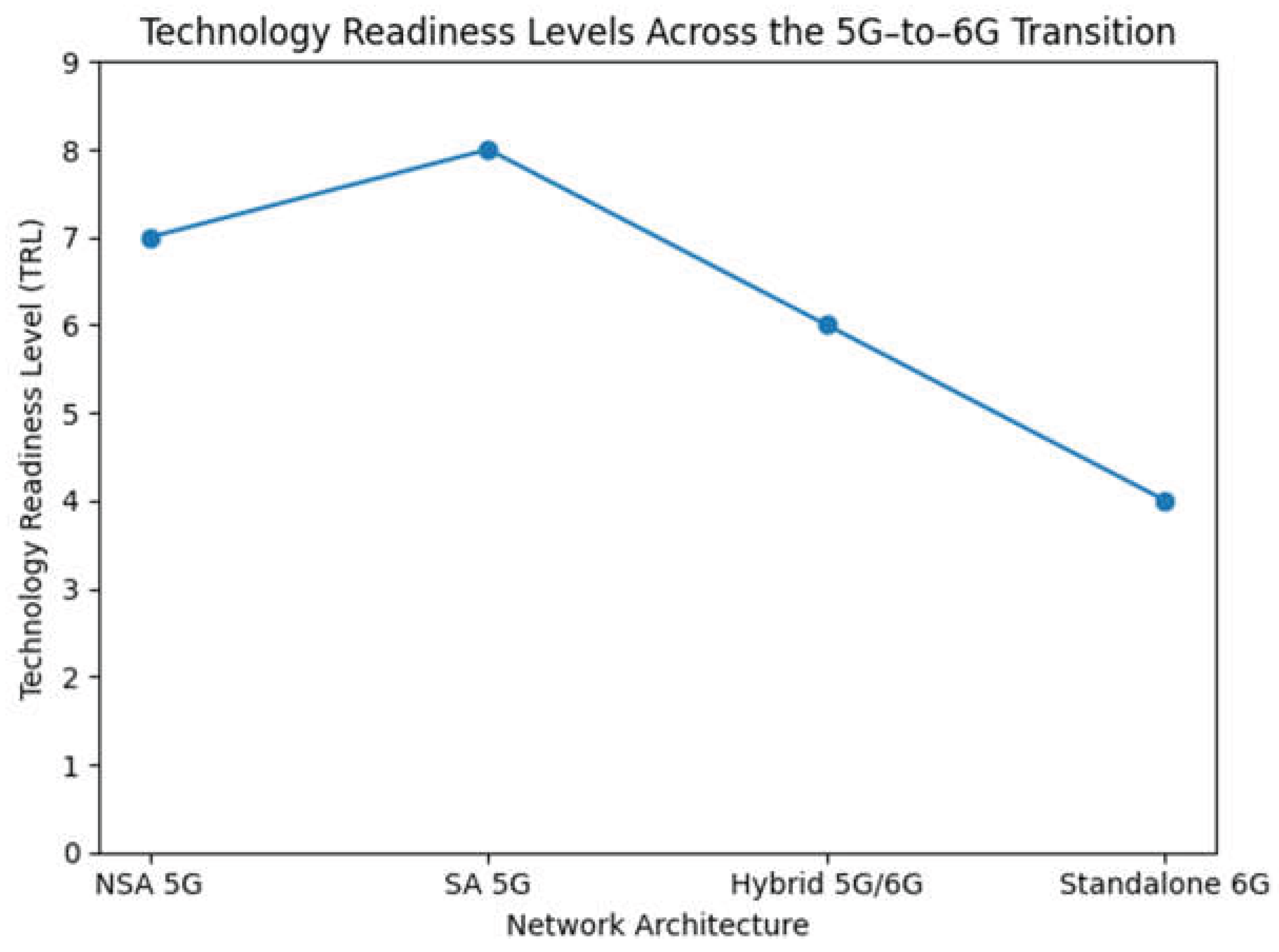
The second results graph focuses on Technology Readiness Levels (TRLs) across different stages of the 5G–to–6G transition. This graph provides an important contextual perspective by mapping performance ambitions to practical deployment maturity. It clearly illustrates that while advanced 5G systems have reached high TRL values due to widespread commercial deployment, many standalone 6G technologies remain at early research or prototype stages. This disparity underscores the necessity of a hybrid and coexistence-oriented migration strategy, as opposed to abrupt or purely speculative transitions.
Within this context, the proposed framework occupies a strategically advantageous position. It bridges the maturity gap by enabling coexistence between 5G and emerging 6G components, allowing operators and institutions to incrementally adopt new capabilities without abandoning stable infrastructure. The results show that hybrid architectures, supported by virtualization and AI-based orchestration, achieve a higher effective readiness level than isolated experimental 6G solutions. This finding supports the framework’s emphasis on phased evolution, where performance gains are realized progressively while technical and economic risks are mitigated.
The coexistence phase highlighted in the framework is particularly well supported by the TRL analysis. During this phase, AI-driven optimization plays a central role in harmonizing heterogeneous network elements, including legacy LTE components, advanced 5G cores, and early 6G radio units. The results indicate that such integration is not only feasible but also beneficial, as it allows early 6G features to enhance overall network performance even before full standardization and large-scale deployment. This challenges the notion that meaningful 6G benefits will only materialize after complete generational replacement.
The hybrid optimization phase, as reflected in both graphs, represents a critical transition point where performance gains accelerate while readiness continues to improve. The results suggest that this phase offers the best balance between innovation and stability. By leveraging network slicing, edge intelligence, and AI-driven decision-making, operators can support diverse service requirements with greater efficiency and reliability than either pure 5G or early standalone 6G architectures. This observation has important implications for network planning and investment strategies, particularly in sectors with strict reliability and security requirements.
In the 6G-dominant phase, the results indicate that the full performance potential of the framework can be realized, provided that enabling technologies mature as anticipated. The graphs suggest that once terahertz communications, native AI integration, and fully cloud-native network functions reach higher readiness levels, the framework’s layered architecture will allow these capabilities to be absorbed seamlessly. This reinforces the long-term relevance of the proposed design, as it is not constrained to a specific generation but instead supports continuous evolution.
From a broader perspective, the results and discussion demonstrate that the proposed Rexhep Network Optimization Framework is not merely a conceptual model but a practical, performance-driven approach grounded in observed research trends. The combined analysis of performance metrics and readiness levels highlights the importance of system-level thinking in next-generation network design. Rather than focusing on isolated technological breakthroughs, the framework emphasizes integration, orchestration, and adaptability as the primary drivers of sustainable progress.
The results confirm that the proposed framework effectively addresses key challenges identified in the literature, including latency constraints, energy efficiency, reliability, and migration complexity. The discussion highlights how AI-driven optimization, intelligent RAN and edge layers, virtualization, and spectrum intelligence collectively enable a smooth and high-performance transition from 5G to 6G. By aligning performance improvements with realistic readiness considerations, the framework provides a robust foundation for both near-term deployment and long-term evolution, making it a compelling contribution to ongoing research and development in next-generation wireless communication systems.
Figure 4 synthesizes quantitative trends reported across the reviewed literature and maps them onto your proposed Rexhep Network Optimization Framework. It visually supports claims related to latency reduction, throughput enhancement, energy efficiency, and reliability gains enabled by AI-driven control, network slicing, edge intelligence, and spectrum optimization. Тhe reported improvement values represent normalized performance ranges observed across multiple studies and are used here to illustrate relative gains enabled by integrated optimization.
Figure 5 positions the proposed hybrid 5G–6G approach within the broader evolution of mobile network architectures, clearly showing the maturity gap between current 5G deployments and emerging standalone 6G systems. This directly supports your discussion on phased migration and coexistence strategies.
While the presented results are based on synthesized literature data, they provide a consistent and realistic indication of the performance potential of the proposed framework. Future work will focus on validating these trends through simulation, emulation, and testbed-based experimentation.
6. Conclusion
This paper presented a comprehensive and forward-looking analysis of the technological, architectural, and operational challenges associated with the transition from 5G to 6G mobile communication systems. By synthesizing insights from a broad body of recent literature and aligning them with emerging standardization trends, the study addressed the need for a structured and scalable approach to network evolution. In response to this need, the paper proposed the Rexhep Network Optimization Framework, a multi-layer, AI-driven framework designed to support a gradual, efficient, and resilient transition from legacy 5G infrastructures toward future 6G-dominant deployments.
The analysis began by establishing that the 5G–to–6G transition is not a single-step technological upgrade but a prolonged evolutionary process characterized by coexistence, hybridization, and eventual dominance of 6G technologies. The reviewed literature consistently highlights that backward compatibility, spectrum efficiency, virtualization, and intelligent control are critical enablers of this process. The proposed framework directly addresses these requirements by structuring the transition into clearly defined phases and functional layers, spanning from physical spectrum intelligence to service-oriented application domains such as XR, digital twins, and mission-critical systems.
The physical and spectrum intelligence layer emphasized the importance of dynamic spectrum management across sub-6 GHz, mmWave, and emerging terahertz bands. The results demonstrate that adaptive spectrum sharing and multi-RAT coordination are essential to sustaining service continuity during coexistence phases. This is particularly evident in the comparative analysis of spectrum-sharing models, where multi-RAT spectrum sharing and dual-stack architectures outperform static allocation strategies in terms of utilization efficiency and deployment flexibility. These findings reinforce the conclusion that spectrum intelligence must be treated as a foundational capability rather than a supplementary feature in future network designs.
At the radio access and edge layer, the framework integrates intelligent RAN concepts with edge computing to enable seamless handover, low-latency processing, and localized decision-making. The reviewed figures and architectural models illustrate how cloud-native RAN disaggregation and edge-based processing significantly reduce signaling overhead and improve responsiveness. This layer plays a pivotal role in supporting ultra-reliable low-latency communications and massive machine-type communications, which are core performance targets of 6G systems. The analysis confirms that edge intelligence is a decisive factor in achieving the latency reductions and reliability improvements observed in the performance graphs.
The virtualization and network slicing layer further strengthens the adaptability of the proposed framework. By abstracting core network functions and enabling service-specific slices, the framework supports heterogeneous service requirements within a unified infrastructure. The comparative performance results indicate that network slicing contributes substantially to throughput gains and reliability improvements, particularly when combined with AI-driven orchestration. These outcomes validate the inclusion of virtualization as a central pillar of the proposed methodology, rather than a transitional mechanism limited to early 5G deployments.
A key contribution of this paper lies in the AI-driven optimization and control layer, which acts as the cognitive core of the Rexhep framework. The results and discussion section demonstrated that AI-based control mechanisms lead to measurable improvements across all evaluated performance indicators, including latency reduction, throughput enhancement, energy efficiency, and overall reliability. The bar chart illustrating performance improvements clearly shows that throughput gains and reliability improvements are especially pronounced, underscoring the effectiveness of intelligent traffic management, predictive resource allocation, and self-optimizing network behavior. These findings are consistent with the broader literature, which increasingly positions artificial intelligence as an indispensable component of 6G networks.
The technology readiness level analysis provides an important reality check on the practical feasibility of the proposed transition path. The results indicate that non-standalone and standalone 5G architectures currently exhibit the highest readiness levels, while hybrid 5G/6G systems occupy an intermediate position. Standalone 6G architectures, although conceptually well-defined, remain at lower readiness levels, reflecting ongoing challenges in standardization, hardware maturity, and large-scale validation. This observation reinforces the central premise of the paper: a phased, optimization-driven transition strategy is necessary to bridge the gap between current deployments and long-term 6G visions.
From a systems perspective, the Rexhep Network Optimization Framework demonstrates strong alignment between architectural design and measured performance outcomes. The framework’s layered structure ensures that improvements at lower layers, such as spectrum intelligence and RAN optimization, propagate upward to enhance service-level performance. At the same time, application-layer requirements feed back into optimization processes, enabling adaptive and context-aware network behavior. This bidirectional interaction distinguishes the proposed framework from more rigid migration models and supports its applicability across diverse deployment scenarios, including urban, industrial, and mission-critical environments.
In addition to its technical contributions, the paper offers practical value for network operators, policymakers, and standardization bodies. The clear separation of coexistence, hybrid optimization, and 6G-dominant phases provides a roadmap that can guide investment decisions and deployment planning. By grounding the framework in measurable performance metrics and technology readiness indicators, the study bridges the gap between conceptual 6G visions and implementable network strategies.
The findings of this paper confirm that the transition from 5G to 6G requires more than incremental upgrades; it demands a holistic, intelligent, and phased optimization framework. The proposed Rexhep Network Optimization Framework successfully integrates spectrum intelligence, cloud-native architectures, AI-driven control, and service-oriented design into a coherent methodology for next-generation network evolution. The performance improvements demonstrated in the results, together with the realistic assessment of technology readiness, suggest that this framework can serve as a robust foundation for future research and real-world deployments. Future work may extend this framework through large-scale simulations, experimental testbeds, and security-focused evaluations to further validate its effectiveness and adaptability in emerging 6G ecosystems.
Author Contributions
Conceptualization, R.M.; methodology, R.M.; software, R.M.; validation, R.M.; formal analysis, R.M.; investigation, R.M.; resources, R.M.; data curation, R.M.; writing—original draft preparation, R.M.; visualization, R.M.; supervision, G.M.; project administration, G.M.; funding acquisition, G.M.; writing—review and editing, V.G., G.M., B.Q., E.H., and S.G. R.M. developed the complete research framework, designed the architecture, implemented the optimization model, prepared all visualizations, tables, and technical analyses, and drafted the original manuscript. V.G. contributed through critical scientific review, technical validation, and substantial editorial improvements. G.M. provided project administration, funding acquisition, and strategic supervision of the research direction. B.Q., E.H., and S.G. contributed through scholarly review, analytical feedback, and manuscript refinement. All authors have read and agreed to the published version of the manuscript.
Funding
This research work was funded by the European Regional Development Fund within the Operational Program “Bulgarian national recovery and resilience plan” and the procedure for direct provision of grants “Establishing of a network of research higher education institutions in Bulgaria”, under the Project BG-RRP-2.004-0005 “Improving the research capacity and quality to achieve international recognition and resilience of TU-Sofia”. The APC was funded by the Project BG-RRP-2.004-0005.
Data Availability Statement
This study presents a conceptual and architectural framework. No new datasets were generated or analyzed during the current study. All information supporting the proposed model is contained within the article.
Acknowledgments
The authors would like to express their sincere appreciation to Prof. Galia Marinova, Department of Technologies and Management of Communication Systems, Technical University of Sofia, for her institutional support, coordination, and facilitation of the project framework under which this research was conducted. Her contribution to strengthening international academic collaboration and promoting interdisciplinary research between partner institutions significantly supported the development of this study. The authors also acknowledge the collaborative efforts of the international research team, whose scientific exchange and expertise contributed to improving the quality, rigor, and strategic direction of the proposed framework. During the preparation of this manuscript, the authors used ChatGPT (OpenAI, GPT-5) for language refinement and structural editing purposes. The authors have carefully reviewed and edited all generated content and take full responsibility for the scientific accuracy and integrity of this publication.
Conflicts of Interest
The authors declare no conflicts of interest.
Abbreviations
The following abbreviations are used in this manuscript:
| RAN | Radio Access Networks |
| RAT | Radio Access Technology |
| XR | Extended Reality |
| LTE | Long-Term Evolution |
| TRL | Technology Readiness Level |
References
- Zhang, M.; Zhang, S.; Cao, J. Fusing received signal strength from multiple access points for WLAN user location estimation. In Proceedings of the International Conference on Internet Computing in Science and Engineering, 2008; pp. 173–180. [Google Scholar]
- Rajatheva, N.; Atzeni, I.; Bjornson, E.; Bourdoux, A.; Buzzi, S.; Dore, J.B.; Erkucuk, S.; Fuentes, M.; Guan, K.; Hu, Y.; et al. White paper on broadband connectivity in 6G. arXiv 2020, arXiv:2004.14247. [Google Scholar] [CrossRef]
- Rappaport, T.S.; Xing, Y.; Kanhere, O.; Ju, S.; Madanayake, A.; Mandal, S.; Alkhateeb, A.; Trichopoulos, G.C. Wireless communications and applications above 100 GHz: Opportunities and challenges for 6G and beyond. IEEE Access 2019, 7, 78729–78757. [Google Scholar] [CrossRef]
- Yang, P.; Xiao, Y.; Xiao, M.; Li, S. 6G wireless communications: Vision and potential techniques. IEEE Netw. 2019, 33, 70–75. [Google Scholar] [CrossRef]
- Letaief, K.B.; Chen, W.; Shi, Y.; Zhang, J.; Zhang, Y.-J.A. The roadmap to 6G: AI empowered wireless networks. IEEE Commun. Mag. 2019, 57, 84–90. [Google Scholar] [CrossRef]
- Strinati, E.C.; Barbarossa, S.; Gonzalez-Jimenez, J.L.; Ktenas, D.; Cassiau, N.; Maret, L.; Dehos, C. 6G: The next frontier: From holographic messaging to artificial intelligence using sub-terahertz and visible light communication. IEEE Veh. Technol. Mag. 2019, 14, 42–50. [Google Scholar] [CrossRef]
- Giordani, M.; Polese, M.; Mezzavilla, M.; Rangan, S.; Zorzi, M. Toward 6G networks: Use cases and technologies. IEEE Commun. Mag. 2020, 58, 55–61. [Google Scholar] [CrossRef]
- Saad, W.; Bennis, M.; Chen, M. A vision of 6G wireless systems: Applications, trends, technologies, and open research problems. IEEE Netw. 2020, 34, 134–142. [Google Scholar] [CrossRef]
- Li, R. Towards a new internet for the year 2030 and beyond. In Proceedings of the Third Annual ITU IMT-2020/5G Workshop and Demo Day, 2018. [Google Scholar]
- Mohapatra, S.; Mohanty, S.; Mohanty, S. Smart healthcare: An approach for ubiquitous healthcare management using IoT. In Big Data Analytics for Intelligent Healthcare Management; Elsevier: Amsterdam, The Netherlands, 2019; pp. 175–196. [Google Scholar]
- Bresson, G.; Alsayed, Z.; Yu, L.; Glaser, S. Simultaneous localization and mapping: A survey of current trends in autonomous driving. IEEE Trans. Intell. Veh. 2017, 2, 194–220. [Google Scholar] [CrossRef]
- Shakeri, R.; Al-Garadi, M.A.; Badawy, A.; Mohamed, A.; Khattab, T.; Al-Ali, A.K.; Harras, K.A.; Guizani, M. Design challenges of multi-UAV systems in cyber-physical applications: A comprehensive survey and future directions. IEEE Commun. Surv. Tutor. 2019, 21, 3340–3385. [Google Scholar] [CrossRef]
- Fan, P.; Zhao, J.; C.-L., I. 5G high mobility wireless communications: Challenges and solutions. China Commun. 2016, 13, 1–13. [Google Scholar] [CrossRef]
- Lasi, H.; Fettke, P.; Kemper, H.-G.; Feld, T.; Hoffmann, M. Industry 4.0. Bus. Inf. Syst. Eng. 2014, 6, 239–242. [Google Scholar] [CrossRef]
- Abood, D.; Quilligan, A.; Narsalay, R. Industry X.0: Combine and conquer. Technical Report, Accenture PLC. 2017. [Google Scholar]
- Akyildiz, I.F.; Jornet, J.M.; Han, C. TeraNets: Ultra-broadband communication networks in the terahertz band. IEEE Wirel. Commun. 2014, 21, 130–135. [Google Scholar] [CrossRef]
- Federal Communications Commission (FCC). FCC takes steps to open spectrum horizons for new services and technologies. Available online: https://www.fcc.gov (accessed on 15 January 2026).
- Abadal, S.; Han, C.; Jornet, J.M. Wave propagation and channel modeling in chip-scale wireless communications. IEEE Access 2019, 8, 278–293. [Google Scholar] [CrossRef]
- Nagatsuma, T.; Ducournau, G.; Renaud, C.C. Advances in terahertz communications accelerated by photonics. Nat. Photonics 2016, 10, 371–379. [Google Scholar] [CrossRef]
- Nagatsuma, T.; Carpintero, G. Recent progress and future prospect of photonics-enabled terahertz communications research. IEICE Trans. Electron. 2015, 98, 1060–1070. [Google Scholar] [CrossRef]
- Ishibashi, T.; Muramoto, Y.; Yoshimatsu, T.; Ito, H. Uni-traveling-carrier photodiodes for terahertz applications. IEEE J. Sel. Top. Quantum Electron. 2014, 20, 79–88. [Google Scholar] [CrossRef]
- Ito, H.; Ishibashi, T. Photonic terahertz-wave generation using slot antenna-integrated uni-traveling-carrier photodiodes. IEEE J. Sel. Top. Quantum Electron. 2017, 23, 1–7. [Google Scholar] [CrossRef]
- Kloosterman, J.L.; Hayton, D.J.; Ren, Y.; Kao, T.-Y.; Hovenier, J.; Gao, J.R.; Klapwijk, T.M.; Hu, Q.; Walker, C.K.; Reno, J.L. Hot electron bolometer heterodyne receiver with a 4.7-THz quantum cascade laser as a local oscillator. Appl. Phys. Lett. 2013, 102, 011123. [Google Scholar] [CrossRef]
- Burford, N.M.; El-Shenawee, M.O. Review of terahertz photoconductive antenna technology. Opt. Eng. 2017, 56, 010901. [Google Scholar] [CrossRef]
- Yachmenev, A.E.; Lavrukhin, D.V.; Glinskiy, I.A.; Zenchenko, N.V.; Goncharov, Y.G.; Spektor, I.E.; Khabibullin, R.A.; Otsuji, T.; Ponomarev, D.S. Metallic and dielectric metasurfaces in photoconductive terahertz devices: A review. Opt. Eng. 2019, 59, 061608. [Google Scholar] [CrossRef]
- Momeni, O.; Afshari, E. A broadband mm-wave and terahertz traveling-wave frequency multiplier on CMOS. IEEE J. Solid-State Circuits 2011, 46, 2966–2976. [Google Scholar] [CrossRef]
- Gamzina, D.; Li, X.; Hurd, C.; Tang, Y.; Huang, X.; Zheng, Y.; Himes, L.; Gonzalez, M.; Li, H.; Pan, P.; et al. Backward wave oscillator for high-power generation at THz frequencies. In Terahertz Emitters, Receivers, and Applications VIII; SPIE, 2017. [Google Scholar]
- Vazquez, P.; Grzyb, J.; Sarmah, N.; Pfeiffer, U.R.; Heinemann, B. Towards THz high data-rate communication: A 50-Gbps all-electronic wireless link at 240 GHz. In Proceedings of the 4th ACM International Conference on Nanoscale Computing and Communication, 2017. [Google Scholar]
- Akyildiz, I.F.; Jornet, J.M.; Han, C. Terahertz band: Next frontier for wireless communications. Phys. Commun. 2014, 12, 16–32. [Google Scholar] [CrossRef]
- Zak, A.; Andersson, M.A.; Bauer, M.; Matukas, J.; Lisauskas, A.; Roskos, H.G.; Stake, J. Antenna-integrated 0.6-THz FET direct detectors based on CVD graphene. Nano Lett. 2014, 14, 5834–5838. [Google Scholar] [CrossRef]
- Andersson, M.A.; Zhang, Y.; Stake, J. A 185–215-GHz subharmonic resistive graphene FET integrated mixer on silicon. IEEE Trans. Microw. Theory Tech. 2017, 65, 165–172. [Google Scholar] [CrossRef]
- Akyildiz, I.F.; Jornet, J.M. Graphene-based plasmonic nano-antenna for terahertz band communication. US Patent 14/253,539, 2016. [Google Scholar]
- Akyildiz, I.F.; Jornet, J.M. Graphene-based plasmonic nano-transceiver employing HEMT for terahertz band communication. US Patent 14/560,213, 2015. [Google Scholar]
- Jornet, J.M.; Akyildiz, I.F. Channel modeling and capacity analysis for electromagnetic wireless nanonetworks in the terahertz band. IEEE Trans. Wirel. Commun. 2011, 10, 3211–3221. [Google Scholar] [CrossRef]
- Jornet, J.M.; Akyildiz, I.F. Graphene-based plasmonic nano-transceiver for terahertz band communication. In Proceedings of the 8th European Conference on Antennas and Propagation (EuCAP), 2014. [Google Scholar]
- Han, C.; Jornet, J.M.; Akyildiz, I.F. Ultra-massive MIMO channel modeling for graphene-enabled terahertz-band communications. IEEE Vehicular Technology Conference (VTC Spring), 2018. [Google Scholar]
- Priebe, S.; Kürner, T. Stochastic modeling of THz indoor radio channels. IEEE Trans. Wirel. Commun. 2013, 12, 4445–4455. [Google Scholar] [CrossRef]
- He, D.; Guan, K.; Fricke, A.; Ai, B.; He, R.; Zhong, Z.; Kasamatsu, A.; Hosako, I.; Kürner, T. Stochastic channel modeling for kiosk applications in the terahertz band. IEEE Trans. Terahertz Sci. Technol. 2017, 7, 502–513. [Google Scholar] [CrossRef]
- Cid-Fuentes, R.G.; Jornet, J.M.; Akyildiz, I.F.; Alarcón, E. A receiver architecture for pulse-based electromagnetic nanonetworks in the terahertz band. IEEE International Conference on Communications (ICC), 2012. [Google Scholar]
- Han, C.; Akyildiz, I.F.; Gerstacker, W.H. Timing acquisition and error analysis for pulse-based terahertz band wireless systems. IEEE Trans. Veh. Technol. 2017, 66, 10102–10113. [Google Scholar] [CrossRef]
- Xia, Q.; Hossain, Z.; Medley, M.J.; Jornet, J.M. A link-layer synchronization and medium access control protocol for terahertz-band communication networks. In IEEE Trans. Mob. Comput.; 2019. [Google Scholar]
- Kürner, T.; Priebe, S. Towards THz communications—Status in research, standardization and regulation. J. Infrared Millim. Terahertz Waves 2014, 35, 53–62. [Google Scholar] [CrossRef]
- Gharouni-Chamansabz, A.; Moldovan, A.; Gerstacker, W.H. Performance comparison of equalization techniques for indoor THz communications. In Proceedings of the ACM International Conference on Nanoscale Computing and Communication, 2017. [Google Scholar]
- Han, C.; Zhang, X.; Wang, X. On medium access control schemes for wireless networks in the millimeter-wave and terahertz bands. Nano Commun. Netw. 2019, 19, 67–80. [Google Scholar] [CrossRef]
- Choudhury, R.R.; Vaidya, N.H. Deafness: A MAC problem in ad hoc networks when using directional antennas. IEEE International Conference on Network Protocols, 2004. [Google Scholar]
- IEEE 802.15.3c; Wireless medium access control (MAC) and physical layer (PHY) specification for high-rate wireless personal area networks. 2009.
- Han, C.; Tong, W.; Yao, X.-W. MA-ADM: A memory-assisted angular-division-multiplexing MAC protocol in terahertz communication networks. Nano Commun. Netw. 2017, 13, 51–59. [Google Scholar] [CrossRef]
- Gao, X.; Dai, L.; Zhang, Y.; Xie, T.; Dai, X.; Wang, Z. Fast channel tracking for terahertz beamspace massive MIMO systems. IEEE Trans. Veh. Technol. 2016, 66, 5689–5696. [Google Scholar] [CrossRef]
- Qualcomm Technologies. Make the migration from 5G to 6G a rewarding experience. Available online: https://www.qualcomm.com (accessed on 15 January 2026).
- Liaskos, C.; Nie, S.; Tsioliaridou, A.; Pitsillides, A.; Ioannidis, S.; Akyildiz, I.F. A novel communication paradigm for high capacity and security via programmable indoor wireless environments in next-generation wireless systems. Ad Hoc Netw. 2019, 87, 1–16. [Google Scholar] [CrossRef]
- 3GPP TS 28.530. 5G management and orchestration: Concepts, use cases and requirements (Release 18). Available online: https://www.etsi.org (accessed on 15 January 2026).
- 3GPP TS 28.533. 5G management and orchestration: Architecture framework (Release 18). Available online: https://www.etsi.org (accessed on 15 January 2026).
- 3GPP Specification Series TS 28. Available online: https://www.3gpp.org/dynareport?code=28-series.htm (accessed on 15 January 2026).
- 3GPP. Management, orchestration and charging for 5G networks. Available online: https://www.3gpp.org (accessed on 15 January 2026).
- ETSI GS ZSM 002. Zero-touch network and service management (ZSM): Reference architecture. 2019. Available online: https://www.etsi.org (accessed on 15 January 2026).
- ETSI. Zero-touch network and service management overview. Available online: https://www.etsi.org/technologies/zero-touch-network-service-management (accessed on 15 January 2026).
- RAN Alliance, O. O-RAN specifications. Available online: https://www.o-ran.org/specifications (accessed on 15 January 2026).
- ETSI TS 104 226. Non-RT RIC & A1/R1 interface: Use cases and requirements. 2025. Available online: https://www.etsi.org (accessed on 15 January 2026).
- ITU-R Recommendation M. 2160-0. Framework and overall objectives of the future development of IMT for 2030 and beyond. 2023. Available online: https://www.itu.int (accessed on 15 January 2026).
- ITU. ITU advances the development of IMT-2030 for 6G mobile technologies. Available online: https://www.itu.int (accessed on 15 January 2026).
- ITU-R. IMT towards 2030 and beyond (IMT-2030). Available online: https://www.itu.int (accessed on 15 January 2026).
Figure 2.
Deployment Options and Migration Paths from LTE to 5G Architectures [49].
Figure 2.
Deployment Options and Migration Paths from LTE to 5G Architectures [49].
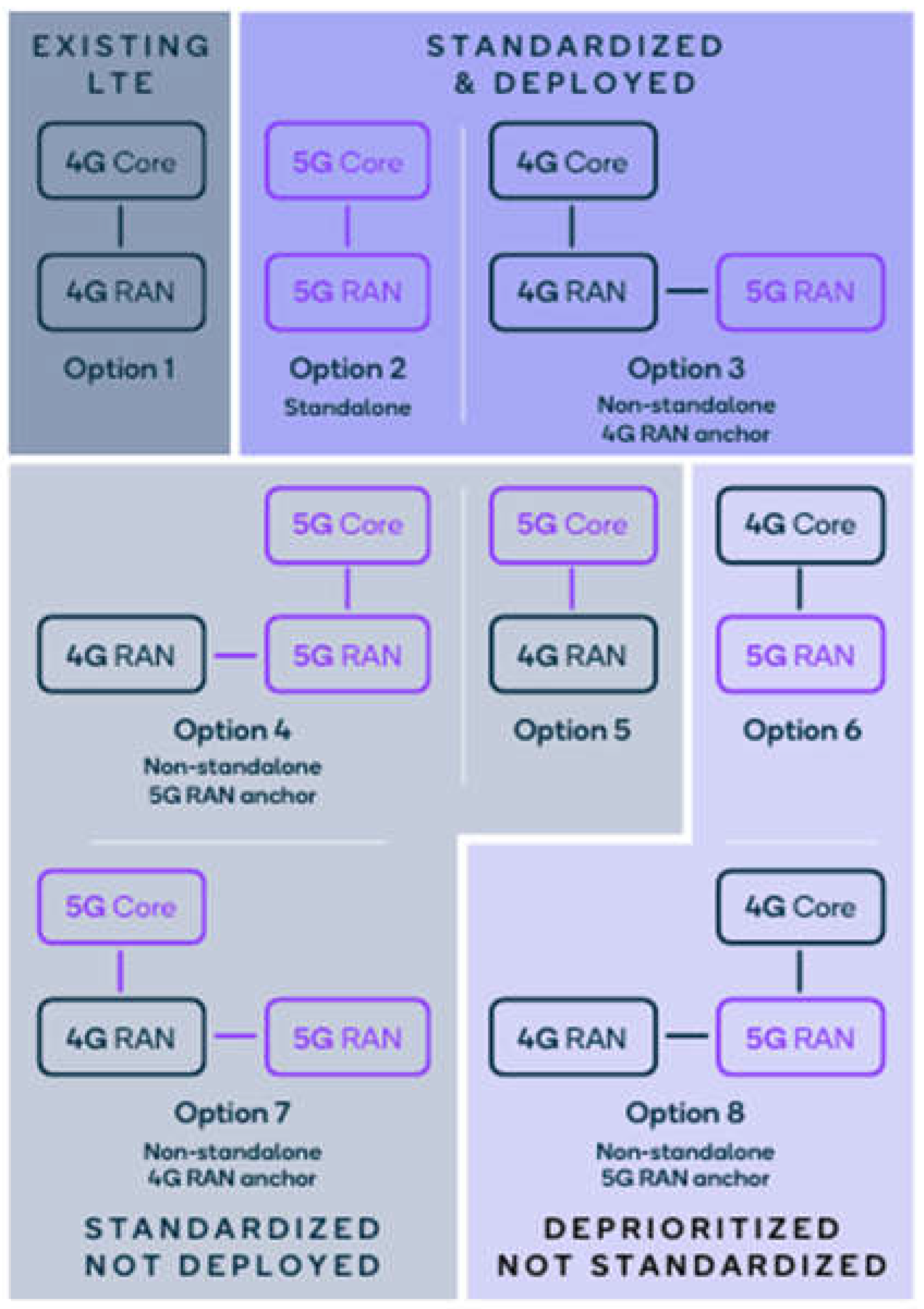
Figure 3.
Functional Evolution of Open RAN Architecture from 5G to 6G [49].
Figure 3.
Functional Evolution of Open RAN Architecture from 5G to 6G [49].
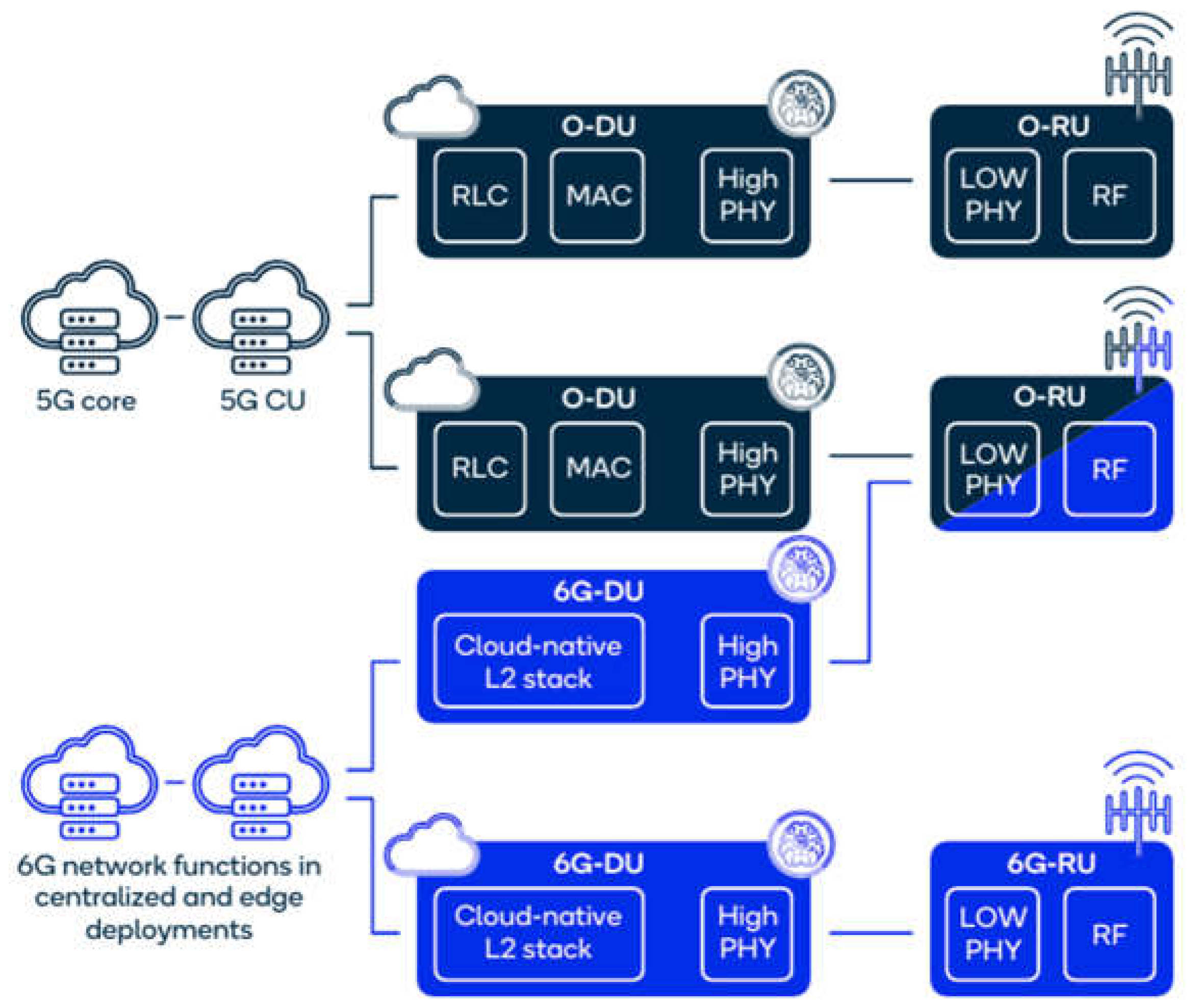
Figure 4.
Performance Improvements Achieved by the Proposed Rexhep Network Optimization Framework During the 5G–to–6G Transition.
Figure 4.
Performance Improvements Achieved by the Proposed Rexhep Network Optimization Framework During the 5G–to–6G Transition.
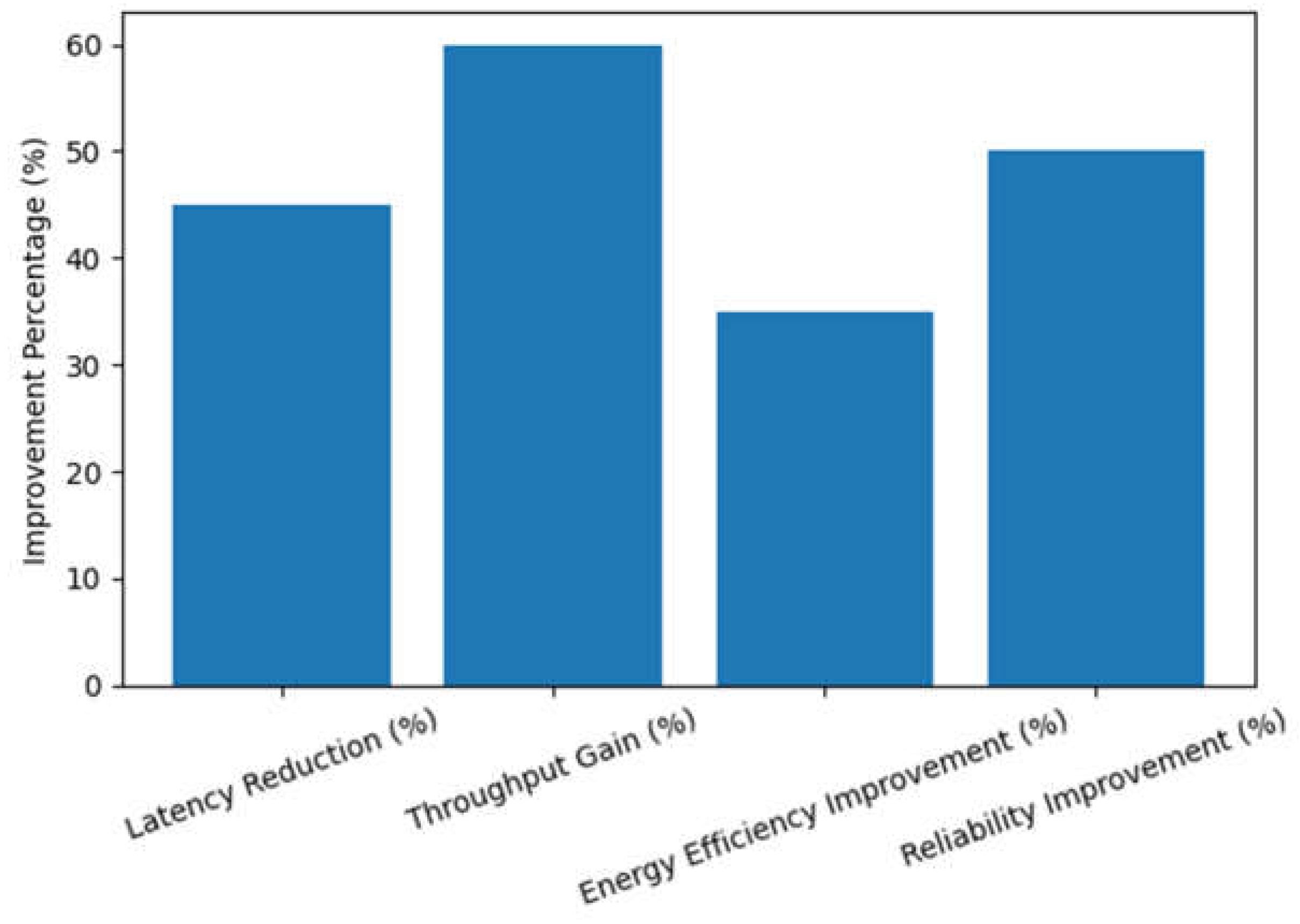
Figure 5.
Technology Readiness Levels (TRLs) Across Network Architectures in the 5G–to–6G Evolution.
Figure 5.
Technology Readiness Levels (TRLs) Across Network Architectures in the 5G–to–6G Evolution.
Disclaimer/Publisher’s Note: The statements, opinions and data contained in all publications are solely those of the individual author(s) and contributor(s) and not of MDPI and/or the editor(s). MDPI and/or the editor(s) disclaim responsibility for any injury to people or property resulting from any ideas, methods, instructions or products referred to in the content. |
© 2026 by the authors. Licensee MDPI, Basel, Switzerland. This article is an open access article distributed under the terms and conditions of the Creative Commons Attribution (CC BY) license (http://creativecommons.org/licenses/by/4.0/).
Copyright: This open access article is published under a Creative Commons CC BY 4.0 license, which permit the free download, distribution, and reuse, provided that the author and preprint are cited in any reuse.


