
Submitted:
15 February 2026
Posted:
26 February 2026
You are already at the latest version
Abstract
Introduction: Environment and behavior are major determinants of public health. According to H.L. Blum’s concept, these two factors contribute more than 75% to overall health status. Rote Ndao Regency, as an island region with a dry climate, continues to face environmental sanitation challenges that have the potential to increase the burden of environmentally related diseases. Objective: This study aims to analyze the impact of the Environmental Health Index (EHI) on the incidence of environmentally related diseases in Matasio and Keoen Villages, Rote Ndao Regency. Methods: This study employed a cross-sectional design with statistical analyses using the Independent t-test and Paired Sample t-test to examine differences among variables influencing environmental health conditions in the two villages. The variables assessed included access to clean water, latrine ownership, wastewater management systems (SPAL), food management practices, solid waste management, vector presence, and indoor air sanitation. Results: The analysis indicated that access to clean water (p < 0.001), latrine ownership (p < 0.001), and wastewater management systems (SPAL) (p = 0.004) had a statistically significant effect on environmental health conditions. Matasio Village showed higher scores than Keoen Village across all three variables. In contrast, food management (p = 0.288), solid waste management (p = 0.129), vector presence (p = 0.914), and indoor air sanitation (p = 0.079) were not significantly associated with environmental health conditions. Conclusion: The Environmental Health Index did not show a significant association with environmentally related diseases in Matasio and Keoen Villages, except for access to clean water. Despite variations in sanitation and water facilities, low community awareness and inconsistent sanitation practices remained key contributors to disease risk. Sustainable sanitation improvement requires not only adequate infrastructure but also systematic, theory-based health promotion strategies to foster sustainable sanitation behaviors. Keywords: environmental health index; health promotion strategies; sustainable sanitation behavior.
Keywords:
environmental health index
; health promotion strategies
; sustainable sanitation behavior
1. Introduction
The environment plays a critical role in shaping population health. According to H.L. Blum’s health field concept, four major factors influence public health outcomes: the environment, behavior, health services, and heredity. Among these, environmental and behavioral factors account for more than 75% of overall health status (Nina Anggraeni Noviasari, 2021). Lawrence Green’s behavioral theory further highlights the environment as a key determinant of behavior change, functioning as an enabling factor alongside predisposing and reinforcing factors (Edberg, 2010). When viewed holistically within the framework of human ecology, the role of the environment becomes increasingly evident (Junias, Marylin Susanti, Mukono, Jojok, & Purnomo, 2016). Therefore, effective strategies to address environmental health problems are essential, particularly those that recognize the environment as both a determinant of health and a driver of sustainable behavior change.
The environment is a critical element that exerts a significant influence on human life, particularly on health outcomes. From an ecological perspective, three interrelated factors are recognized as causes of disease, disability, and death, known as the Ecological (or Epidemiological) Triad: the disease agent, the human host, and the environment. According to John Gordon’s theory, a state of health exists when there is a balance among these three components. Disruption of one component—such as environmental conditions beyond a certain threshold—can facilitate the entry of disease agents into the human body, resulting in illness. The Environmental Health Index (EHI), as an enabling factor within the PRECEDE–PROCEED model developed by Green and Kreuter (Edberg, 2010), serves as an indicator of environmental health components that contribute to improving community health status (Anggina May, Deviar, & Budiyono, 2016). Behavioral change is expected to occur through increased awareness of the importance of clean water access, the use of improved sanitation facilities, and the availability of household wastewater management systems (SPAL) as enabling factors. Reinforcing factors include social and community support, such as involvement from village authorities, health cadres, traditional leaders, and Community-Based Total Sanitation (STBM) programs.
Rote Ndao Regency is a dry-climate region influenced by monsoon winds, with a short rainy season occurring from December to April. These conditions support the growth of flora such as grasslands, lontar palms, pine trees, and gewang palms. According to the 2022 Rote Ndao Regency Profile, the region’s natural potential—developed based on its ecological uniqueness—includes agriculture, livestock, fisheries, forestry, plantations, coastal tourism, cultural and natural tourism, maritime resources, handicrafts, and industry. This ecological uniqueness can contribute to improving the health status of the population in Rote Ndao by optimizing the use of natural resources, particularly food products, to support stunting prevention efforts through adequate nutrition derived from agriculture, plantations, and fisheries, as well as by enhancing the local economy through handicrafts and industries based on local resources (Lona, 2023).
Environmental sanitation conditions in this region remain inadequate. The number of households with access to improved sanitation facilities (healthy latrines) was recorded at 27,663 households (79.66%). A total of 119 villages have implemented the Community-Based Total Sanitation (STBM) program; however, only 27.73% of villages have achieved Open Defecation Free (ODF) status. Coverage of healthy latrines stands at 67.26%, with only 33 villages (27.73%) meeting the Ministry of Health’s 2022 target for stopping open defecation (BABS), which was set at 60%. The number of households with access to improved sanitation services was 31,199 (87.4%).
Regarding access to clean water, there are 43 water supply facilities (KPSAM PAMSIMAS and PDAM); however, only 9 facilities (21%) have had their water quality monitored or tested according to established standards, while 34 facilities (79%) have not. This condition is primarily attributed to the limited availability of reagents for bacteriological testing, including Escherichia coli and total coliform parameters (BPS Rote Ndao Regency, 2024).
Rote Ndao Regency consists of 12 subdistricts reporting cases of severe malnutrition, with the highest numbers found in Pantai Baru (26 children), Northwest Rote (19 children), South Rote (16 children), Lobalain (14 children), Central Rote (9 children), Loaholu (8 children), East Rote and Landu Leko (7 children each), Ndao Nuse (4 children), Southwest Rote (3 children), and West Rote (1 child). The total number of severe malnutrition cases in 2022 reached 114 children (BPS Rote Ndao Regency, 2023).
Across 12 primary health centers (puskesmas), the prevalence of stunting was reported as follows: Batutua Health Center (25.59%), Busalangga (26.46%), Oelaba (40.02%), Baa (14.75%), Feapopi (20.00%), Oele (20.31%), Korbafo (17.25%), Sonimanu (25.71%), Eahun (20.30%), Sotimori (35.89%), Delha (13.77%), and Ndao (24.16%) (Rote Ndao Regency Health Office, 2021; Atarini A. Lona & Marylin, 2023). Given the high prevalence of stunting across all health centers, it can be concluded that multiple environmental factors contribute significantly to the occurrence of stunting.
In 2024, approximately 52–53 out of every 100 residents in Rote Ndao were children, while 11–12 were elderly (aged 65 years and above). These statistics indicate that 52.24% of the population consists of children (BPS Rote, 2024), and children in their growth phase are closely influenced by environmental conditions. Overall, the 2024 Rote Ndao Public Health Indicators reported that 28.46% of the population experienced health complaints. According to the 2022 Rote Ndao Regency report, three of the ten most prevalent diseases were Acute Respiratory Infections (ARI) with 5,423 cases (30.04%), Fever Observation (FO) with 2,314 cases (12.82%), and Myalgia with 1,780 cases (9.86%) (BPS Rote Ndao, 2023).
Acute Respiratory Infection (ARI) is a communicable disease affecting one or more parts of the respiratory tract and may be caused by bacteria, viruses, fungi, air pollution, or allergic reactions to certain substances. ARI is particularly common among children due to their immature immune systems, although adults may also be affected. Many parents are unaware of the early symptoms and appropriate initial responses when children develop ARI. The most common type of ARI in children is the common cold. Parents often seek medical care only when the child’s condition becomes severe, which contributes to high ARI-related mortality among children (Nurhuda, Aisyah, Zulkarnain, & Hutagalung, 2025). The negative impact of declining air quality is especially evident in urban areas, where the risk of ARI is higher due to air pollution. ARI transmission may occur through contact with respiratory droplets from infected individuals, airborne transmission, or contact with contaminated surfaces.
Fever Observation (FO) refers to an undiagnosed febrile condition that involves monitoring fever symptoms to identify an underlying disease (Carpenito, 2009). In this context, FO represents fever surveillance aimed at understanding disease progression and determining appropriate interventions. Myalgia is a medical term for muscle pain, typically affecting specific muscle groups such as the arms, neck, back, or legs. These three diseases are closely associated with environmental conditions, highlighting the importance of environmental health index studies.
These findings demonstrate that environmental factors continue to play a crucial role in disease occurrence. Disease remains a major public health concern that requires immediate attention to prevent disability or mortality. One of the most common categories of illness is environmentally based disease. Based on the evidence presented, addressing environmental health problems should therefore be a priority.
Awa Ramdhani (2020) explained that stunting has significant short- and long-term impacts on public health. Stunting must be prevented and addressed as early as possible because it leads to long-term consequences such as growth failure, delayed cognitive and motor development, impaired brain development and educational achievement, suboptimal physical growth, and metabolic disorders. If left untreated, stunting can impair intellectual capacity, disrupt neural structure and brain cell function, permanently reduce learning ability, and result in lower productivity in adulthood, ultimately affecting the quality of future human resources (Lona, 2023). The success of stunting prevention and control is closely linked to various factors, including the physical and socio-cultural environment, such as sanitation conditions, maternal caregiving practices, dietary restrictions during pregnancy, and community awareness of stunting and its prevention. Considering these factors, research focusing on the environmental health conditions of Rote Ndao Regency an area characterized by an archipelagic ecosystem and tourism potential is critically important.
2. Methods
This study employed an analytical survey with a cross-sectional study design, in which data on both dependent and independent variables were collected simultaneously. The research was conducted in Rote Ndao Regency over a six-month period, from March to August 2025. Field data collection was carried out specifically for two months, from April to May 2025. The population refers to all subjects or objects with specific characteristics relevant to the study. This research targeted the entire population of household heads in Pantai Baru Subdistrict. The site was selected because it has the highest number of low birth weight (LBW) infants in Rote Ndao Regency (nine cases) as well as the highest number of severe malnutrition cases, totaling 26 children under five years old (BPS Rote Ndao Regency, 2023). The selected villages were Keoen Village and Matasio Village, chosen due to their close proximity and similar community characteristics, despite having different environmental conditions. The number of households in Keoen Village was 401, while Matasio Village had 275 households (BPS Kupang Regency, 2023). The sample size was calculated using the Slovin formula, resulting in 87 households per village, selected proportionally. Sampling was conducted using an accidental (convenience) sampling technique, taking into account the study objectives, field accessibility, and approaches to respondents. To minimize potential bias, the sample size was increased by 20% of the total sample, resulting in 88 + 20% (18) = 106 households. Data collection instruments included questionnaires, checklists, field notes based on interview results, and direct observations. Ethical clearance for this study was obtained from the Health Research Ethics Committee of the Faculty of Public Health, University of Nusa Cendana (KEPK FKM UNDANA), with approval number 002352/KEPK FKM UNDANA/2025.
3. Results
1. Clean Water Supply (CWS)
According to the World Health Organization (WHO), clean water plays a crucial role in supporting human life, particularly for daily domestic needs such as drinking, cooking, and household activities (Rolia et al., 2023). Expanding access to clean water requires not only adequate infrastructure but also sustainable management systems (Wandari et al., 2023). The findings of this study indicate a significant difference in access to clean water between Matasio Village (83.00) and Keoen Village (72.35). In East Rote Subdistrict, several areas have established piped water distribution systems, including Londalusi Village, which is managed by the Regional Water Supply Company (PDAM). In contrast, other villages such as Mukekuku and Lakamola continue to rely on community-based water management systems (East Rote Subdistrict, 2022).
Field observations revealed that areas with sufficient groundwater availability tend to have more vegetation and a cooler, more comfortable living environment. Stable water availability also influences the condition and utilization of household sanitation facilities. This was evident in Matasio Village, where residents reported consistent and adequate water supply. Conversely, different conditions were observed in Keoen Village, Pantai Baru Subdistrict. Although vegetation is present, the surrounding land remains dry, and residents continue to experience limited access to clean water. Existing reservoir systems support water distribution; however, challenges persist due to limited community participation and inadequate maintenance of distribution networks. As a result, water availability is not sustainable, and signs of environmental drought are clearly evident.
Previous studies by Zahra (2023) and Jahura (2024) highlighted that reduced water discharge during the dry season often leads to decreased vegetation cover and increased community complaints regarding water scarcity. Such conditions may negatively affect hygiene practices and increase the risk of water-related diseases. These findings underscore the importance of strengthening community awareness and engagement in maintaining water supply facilities and conserving water sources. Sustainable collaboration between village governments and local water management institutions is essential to ensure stable water quantity and quality through collective maintenance and long-term management initiatives.
Damar Irza (2023) analyzed several villages and study sites and found that household income and overall welfare are closely associated with the availability of household sanitation facilities, including clean water and latrines. In other words, economic disparities between villages often explain why certain villages have better access to clean water supply, latrines, and wastewater disposal systems compared to others (Damar Irza; Laili Rahayuwati, Witdiawati, & Raini Diah Susanti, 2023). Furthermore, Nasrulah (2024) and Tyias (2024) reported significant associations between clean water sources, wastewater disposal facilities (SPAL), and latrine availability with the incidence of diarrhea. These findings indicate that differences in sanitation conditions across locations within a subdistrict—particularly related to wastewater disposal systems and clean water sources—have a substantial impact on environmental health conditions (Nasrulah et al., 2024; Tyias et al., 2024).
2. Latrine Ownership
A latrine functions as a facility for the collection and disposal of human excreta in a manner that prevents disease transmission and environmental contamination (Amelia et al., 2021). Household latrine ownership is strongly influenced by the participation of all family members, particularly the head of the household (Irawati & Siagian, 2022). The study findings revealed a statistically significant difference (p = 0.000), with Matasio Village obtaining a higher score (65.00) compared to Keoen Village (56.83). Sustained water availability in household latrines contributes to improved sanitation behaviors. Most of the observed latrines appeared moist and regularly used, indicating active utilization by residents. Several households without private latrines shared facilities with neighboring households. In Keoen Village, although many residents already own latrines, irregular water supply remains a major challenge. Community members often need to collect water from external storage containers before using the facilities.
Efforts to maintain sanitation improvements require strengthening community knowledge through education and initiatives such as the “toilet savings program,” a community-based approach designed to assist households that do not yet have private latrines. Achieving Open Defecation Free (ODF) status does not depend solely on latrine ownership but also on consistent use, access to clean water, and proper maintenance of sanitation conditions (Hartatik, Rondhianto, & Heliantik, 2024). Economic constraints further influence the availability and condition of household latrines. Fitriana (2019) highlighted community participation through collective savings groups as an effective strategy for eliminating open defecation. This strategy can also be applied in both study villages to ensure that every household eventually has access to a private latrine.
More recent studies support this perspective, noting that access to adequate sanitation facilities is a key driver of behavioral change toward improved hygiene and sustainable sanitation practices (Hartatik, Rondhianto, & Heliantik, 2024). Nurhidayanti et al. (2022) demonstrated correlations between the quality of water sources, household sanitation, and health indicators such as stunting and diarrhea. Differences in access across regions and communities emphasize unequal access to clean water supply as a major determinant of environmental health disparities (Nurhidayanti & Riyadi, 2022).
Furthermore, Nastiti et al. (2025) applied the RANAS model along with 15 contextual factors to explain variations in household sanitation behavior. Their findings indicate that differences in infrastructure access—such as clean water supply, latrine and wastewater disposal facilities—socioeconomic conditions, and psychosocial factors (e.g., norms and attitudes) contribute to disparities in sanitation infrastructure and behaviors (Nastiti et al., 2025). Kornotan et al. (2025) also emphasized that variations in knowledge, attitudes, and limited sanitation education are significantly associated with latrine ownership, with villages implementing stronger education and advocacy programs demonstrating higher levels of latrine ownership (Kornotan et al., 2025).
3. Wastewater Management
Wastewater refers to all liquid waste generated from various household activities, including bathroom, kitchen, and laundry activities. Domestic wastewater, as well as clinical liquid waste, often contains high levels of organic pollutants that can be treated through biological processes; however, the presence of heavy metals may interfere with these treatment processes (Sucipto, 2019). The study results showed a statistically significant difference (p = 0.004) in wastewater management conditions between the two villages, with Matasio Village obtaining a higher score (30.33) compared to Keoen Village (25.15). The higher score in Matasio reflects relatively better environmental and sanitation conditions, influenced by factors such as education level, knowledge, age, experience, and community awareness regarding household wastewater management.
Field observations provided further insights. Of the 106 respondents, 15 environments (14%) had no wastewater management system, resulting in stagnant domestic wastewater; 43 environments (41%) had open systems where wastewater accumulated and generated unpleasant odors; while 48 environments (45%) lacked formal systems but allowed domestic wastewater to infiltrate directly into the soil. The dry and rocky soil conditions in the area facilitate rapid infiltration, which partly explains why, despite awareness of environmental sanitation, most households do not have appropriate household wastewater management systems (SPAL).
Most existing SPAL facilities primarily manage bathroom wastewater or serve communal sanitation facilities. Household SPAL systems generally channel wastewater into storage tanks or municipal drainage systems. Domestic wastewater originates from toilets, dishwashing, laundry, sinks, and household gardens. Proper toilet facilities are typically equipped with SPAL, which is essential for maintaining household environmental health. Studies indicate that ownership and use of basic sanitation facilities are closely associated with household environmental conditions in both urban and rural settings (Aulia et al., 2023). Knowledge and habitual practices also influence latrine ownership and proper sanitation use (Fathonah et al., 2023).
Further research has demonstrated that high-quality latrines reduce the risk of diarrheal diseases (Sutomo, Rokayah, & Wasludin, 2024; Hartatik, Rondhianto, & Heliantik, 2024). Ideally, toilet wastewater should be conveyed through SPAL to prevent water stagnation, which can serve as breeding sites for disease vectors. Villages with more advanced sanitation infrastructure generally maintain better environmental quality, as reflected by higher environmental health indicators.
Sustainability in wastewater management involves maintaining environmental quality through the development and proper maintenance of SPAL to prevent standing water and odors; increasing community awareness and participation through collective activities such as community clean-up campaigns and the construction of biopore infiltration holes to enhance water absorption; and institutional support from village governments, including the provision of construction materials or training in effective wastewater management, to ensure the long-term functionality of sanitation facilities.
4. Food Management
Food management encompasses all activities from food procurement to final food preparation and serving, involving five key elements: place, people, equipment, food, and processing methods. According to the Indonesian Food Law No. 7/1996, food safety includes the prevention of contamination by biological agents, chemical substances, or other hazardous materials that may pose risks to human health (Sucipto, 2019).
The study findings indicated no statistically significant difference between villages (p = 0.288), with Keoen Village obtaining a slightly higher score (72.98) compared to Matasio Village (71.67). This similarity suggests that basic food-handling practices are largely comparable, likely due to shared cultural backgrounds and traditions. Despite environmental differences—where Keoen is relatively drier and Matasio more vegetated household food preparation practices, such as washing raw ingredients, cooking methods, and food serving, appeared consistent across both villages.
Previous studies have highlighted that when knowledge levels are similar, practical food-handling outcomes also tend to align (Palupi, 2024). Community-based sanitation regulations (Ministry of Health Regulation No. 3/2014) emphasize the interaction of five elements in food hygiene: people, place, equipment, materials, and processes (Ministry of Health of the Republic of Indonesia, 2014). Clean equipment alone does not guarantee food safety if personal hygiene is poor, while good hygienic practices can partially compensate for infrastructural limitations. This may explain why both villages achieved nearly equivalent scores, as food safety practices are shaped by a combination of infrastructure and behavior (Noviasari, 2021).
Food management assessments also consider supporting facilities such as handwashing stations, storage areas, and protective containers. Although Keoen Village has more vegetation around households, its food-handling facilities including water access, clean storage areas, and covered containers were comparable to those in Matasio Village. Research indicates that well-maintained food preparation areas reduce the risk of contamination (Md. Nazrul Islam et al., 2023). Even in settings with limited infrastructure, consistent hygienic behaviors such as handwashing, proper cooking, and covering food can significantly improve food safety outcomes.
Household-based educational interventions are recommended to enhance hygiene practices where needed, while improvements in facilities such as ensuring access to clean water, easily cleanable preparation areas, and enclosed storage can strengthen long term food safety. Sustainability in food management depends on consistent hygienic practices and ongoing education to safeguard food safety and public health (Manafe, Gordon, & Ncube, 2023).
5. Solid Waste Management
Solid waste is generated from a wide range of human activities, including households, markets, offices, hotels, restaurants, industries, construction debris, and scrap materials. Effective solid waste management requires an integrated approach across all stages, from source generation to final disposal. At the source level, households, hotels, and restaurants play a critical role, beginning with waste segregation by type (Sucipto, 2019). The study findings indicated no statistically significant difference (p = 0.129) in solid waste management practices between Matasio Village (40.89) and Keoen Village (36.92), suggesting broadly similar patterns. The environment in Matasio appears greener and more shaded, whereas Keoen tends to be more open and dry. Both villages face similar challenges, particularly in managing organic waste such as fallen leaves from extensive home gardens. Community activities related to farming or yard maintenance contribute to irregular waste accumulation, with most final disposal conducted through open burning.
This practice remains common in rural areas due to limited centralized waste management facilities and low awareness of environmental impacts (Wulandari, 2023). Studies have also noted that household waste management in rural settings is often ineffective because of limited source segregation and the absence of integrated composting systems (Nuraini & Hidayat, 2022). High volumes of organic waste are associated with dense vegetation and infrequent yard cleaning in tropical rural environments (Rahman, 2024).
Lifestyle and consumption patterns strongly influence the type and volume of waste generated. Although both villages share similar rural characteristics, improved access to markets and urban centers has increased the amount of inorganic household waste, such as plastics, food packaging, diapers, bottles, and cans. Observations showed that most households lack adequate waste management systems, often disposing of waste indiscriminately or in pits behind their homes, followed by open burning or burial once the pits are full. These practices reflect limited implementation of the 3R principles (reduce, reuse, recycle) and composting.
Open burning and burial are often perceived as the most practical solutions due to infrastructural constraints and low awareness of long-term environmental impacts (Lestari & Handayani, 2022; Putri & Yuliani, 2023). The successful implementation of 3R practices and composting is highly dependent on community guidance and institutional support (Nugraha et al., 2024). Sustainable solid waste management can be achieved through the consistent application of the 3R principles and by converting organic waste such as fallen leaves into compost or natural fertilizer. Active community participation and awareness are key to sustaining these practices.
Continuous environmental education—through household waste management training or collective community clean-up activities can help instill environmentally friendly behaviors. In addition, local governments and relevant institutions should support community based waste management systems, such as waste banks, temporary waste collection points, or incentive schemes for households practicing recycling. Such institutional support strengthens sustainable systems while promoting community self-reliance in maintaining environmental cleanliness.
6. Vector Presence
Insects account for approximately one quarter of all animal species on Earth, with more than 750,000 species identified and named. Each year, hundreds of millions of cases of vector-borne diseases caused by insects, snails, and animals particularly rodents pose major global public health challenges. Vector-borne diseases contribute to approximately 17% of all infectious diseases worldwide, including dengue fever, filariasis, Japanese encephalitis, malaria, onchocerciasis, schistosomiasis, and trypanosomiasis.
The study findings indicated no statistically significant difference (p = 0.914) in vector presence between Matasio Village (19.44) and Keoen Village (19.62), suggesting similar environmental conditions and community behaviors in both areas. Despite administrative differences Matasio being located in East Rote Subdistrict and Keoen in Pantai Baru Subdistrict both villages share comparable microclimatic conditions (temperature, humidity, and rainfall) and vector habitats, such as stagnant water, poorly maintained drainage systems, and uncovered water storage containers. These environmental similarities resulted in relatively uniform data, rendering minor inter-village differences statistically insignificant (Sugiyono, 2017). The World Health Organization (WHO, 2020) emphasizes that physical and climatic factors are primary determinants of vector populations.
Local health center data from Ba’a and Eahun indicate that malaria and dengue remain prevalent. Although the Annual Parasite Incidence (API) in Rote Ndao declined to below 1 per 1,000 population in 2020, it increased to 1.7 per 1,000 in 2021–2022 due to population migration from Alor Regency. The API subsequently decreased to 0.32 in 2023, before slightly increasing again to 0.35 in 2024 (Rote Ndao Regency Health Office, 2024).
Community behaviors also contribute to vector conditions. Both villages demonstrated similar practices in environmental hygiene, waste management, and water storage. Most household waste consisted of leaves, which were either burned or allowed to decompose into compost. Although open burning causes temporary air pollution, the rural setting—with widely spaced houses reduces its immediate impact. Inadequate attention to environmental sanitation is known to increase vector risk regardless of geographic location (Ministry of Health of the Republic of Indonesia, 2017).
Health interventions, such as mosquito control campaigns and community health education, were implemented similarly in both villages, contributing to the observed uniformity in vector presence. Studies have shown that consistent intervention programs across regions result in relatively homogeneous vector distribution patterns (Suryani & Putra, 2019).
Sustainable vector control can be achieved through environmentally friendly waste management, promotion of clean and healthy lifestyles, and continuous environmental health programs. Encouraging leaf composting rather than open burning reduces air pollution while providing natural fertilizer. Support from local governments and environmental health officers through education, routine guidance, mosquito control programs, and integrated waste management training is essential to maintaining environmental sustainability and protecting public health.
7. Indoor Air Quality
Air is a fundamental environmental component essential for sustaining life. According to the Regulation of the Minister of Health of the Republic of Indonesia No. 1077 of 2021 on Indoor Air Quality, indoor air pollution occurs when one or more pollutants within a dwelling reach concentrations that pose health risks to its occupants (Citraswari et al., 2015). Indoor air quality is critically important for human health, as people generally spend most of their time at home outside of working hours, making the residential environment a key determinant of air pollution exposure (Notoatmodjo, 2006).
The study results showed no statistically significant difference (p = 0.079) in indoor air quality between Matasio Village (56.00) and Keoen Village (50.35), indicating overall similar conditions in both locations. Environmental characteristics, such as the abundance of green and leafy trees, contributed positively to air quality around homes by reducing ambient temperatures. Many houses were constructed with traditional woven bamboo walls (bebak), which further support natural ventilation (Buruh Ahwaludin, 2024). Studies conducted in urban areas with green belts have demonstrated that certain plant species can effectively absorb dust and air pollutants while also reducing environmental noise, thereby improving overall air quality (Buruh Ahwaludin; Wulandari; Hanum, 2024).
Adequate ventilation also plays a crucial role in maintaining indoor air quality. Airflow enters not only through windows and ventilation openings but also through doors that are frequently opened. Keeping windows and doors open represents a simple, locally applicable intervention to enhance indoor air circulation (López Plazas & Sáenz de Tejada, 2024). Maintaining healthy indoor air requires a combination of appropriate housing design and behaviors that support natural ventilation and the preservation of surrounding greenery. Simple measures, such as keeping ventilation pathways open and maintaining plants in household yards, can ensure clean and healthy indoor air without the need for complex interventions.
4. Discussion
Overall, the findings of this study are summarized in the graph below.
Figure 1.
Distribution Comparison of the Environmental Health Index in Matasio and Keoen Villages Using a Radar Chart.
Figure 1.
Distribution Comparison of the Environmental Health Index in Matasio and Keoen Villages Using a Radar Chart.
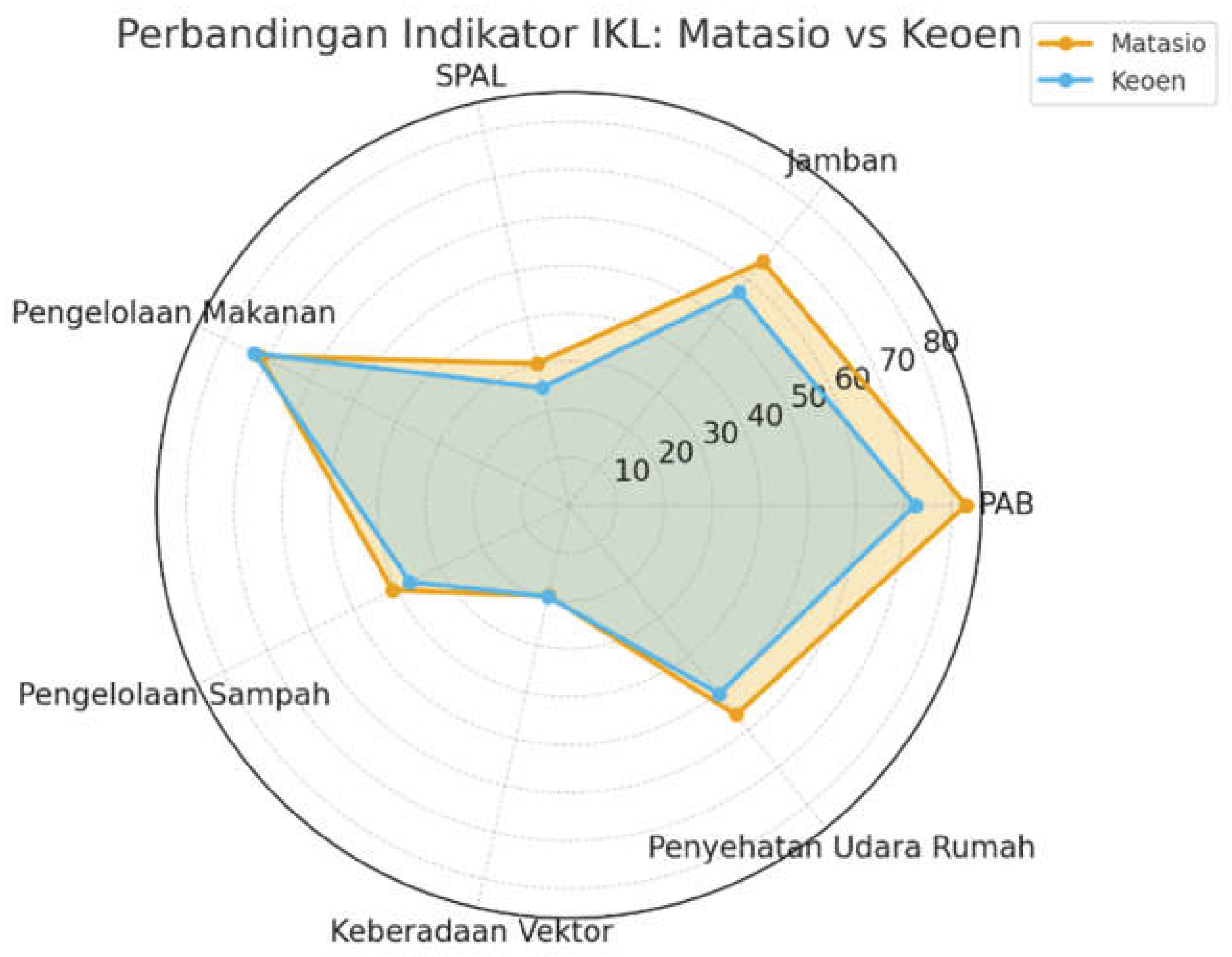
The radar chart above illustrates a comparison of the Environmental Health Index (EHI) between Matasio Village and Keoen Village in Pantai Baru Subdistrict, Rote Ndao Regency. Seven key indicators are compared: Clean Water Supply (CWS), Latrine Ownership, Wastewater Disposal System (WDS), Food Management, Solid Waste Management, Indoor Air Sanitation, and Vector Presence. Overall, the chart shows that Matasio Village (orange line) has higher scores than Keoen Village (blue line) across most indicators. This suggests that environmental sanitation and health conditions in Matasio Village are generally better, likely influenced by the availability of infrastructure, community hygiene practices, and stronger support from local environmental health programs. The most notable differences are observed in three key indicators: Clean Water Supply (CWS), Latrine Ownership, and the Wastewater Disposal System (WDS). In terms of clean water provision, Matasio Village demonstrates better performance, indicating more reliable and sustainable access to clean water sources for the community.
A similar trend is observed for the latrine ownership and wastewater disposal system (WDS) indicators, where Matasio Village demonstrates more adequate household sanitation systems. In contrast, Keoen Village lags behind in these three aspects, likely due to limited infrastructure, community behavioral patterns related to environmental hygiene, or lower levels of government intervention in basic sanitation programs. These conditions result in sanitation disparities between villages within the same subdistrict/district, highlighting the need for serious attention. For other indicators—such as Food Management, Solid Waste Management, Indoor Air Sanitation, and Vector Presence—both villages show relatively similar results, although Matasio consistently performs slightly better than Keoen. This similarity indicates that both villages face comparable challenges in maintaining household environmental quality and controlling disease vectors.
With its advantages in key areas such as clean water provision and sanitation, Matasio Village has greater potential to achieve a healthier overall environment. Based on the theory proposed by Green and Kreuter (Edberg, 2010), Matasio Village performs well in enabling factors, particularly access to clean water, latrine facilities, and wastewater disposal systems. However, disease occurrence may still persist due to weaknesses in predisposing factors (knowledge and awareness) and reinforcing factors (social norms and village-level regulations). Behavioral change is influenced by three main factors: predisposing, enabling, and reinforcing. In the context of this study, Matasio Village excels in enabling factors but remains limited in predisposing and reinforcing factors.
- Contextual Factors
-
(Dry Climate, Economic Conditions, Cultural Practices, Archipelagic Setting)

- Predisposing Factors
-
(Knowledge, Attitudes, and Risk Perception)
- Enabling Factors
-
(Access to Clean Water, Sanitation Facilities, Wastewater Disposal Systems, and Supporting Infrastructure)
- Reinforcing Factors
-
(Traditional Leaders, Community Health Volunteers, Village Regulations)
- Sanitation Behavior
-
(Latrine Use, Handwashing, Waste Management, Safe Drinking Water)
- Community Health Status
- (Diarrhea, Acute Respiratory Infections, Skin Diseases)
Strengthened by the RANAS model, the study findings indicate that environmental risk components remain high. The community has not yet developed sufficient awareness to manage wastewater and standing water around their households, which increases the risk of diarrheal diseases and acute respiratory infections (ARI). The attitude component reflects that sanitation is still perceived as a burden rather than a necessity for creating a healthy environment and community.
The norm component is evidenced by the continued presence of households without private family latrines. The practice of shared latrine use remains common and poses a potential risk for open defecation (ODF). This condition is largely driven by limited ability, as low levels of understanding and socioeconomic constraints prevent many households from constructing private latrines and wastewater disposal systems (SPAL). Low self-regulation is reflected in the absence of routine monitoring by sanitarians or local health workers, as well as the lack of social sanctions, which further hinders sustained behavior change toward clean and healthy practices. The RANAS model explains that a high Environmental Health Index (EHI) does not automatically lead to a reduction in environmentally related diseases, such as diarrhea, ARI, skin diseases, and other environment-based illnesses.
Despite the availability of sanitation facilities, the community has not yet developed strong risk perceptions, supportive social norms for sanitation, or effective self-regulation mechanisms to maintain healthy behaviors. Therefore, the gap between infrastructure availability and actual sanitation practices explains why higher index scores do not necessarily translate into lower disease incidence.
Although Matasio Village demonstrates a higher EHI compared to Keoen Village, environmentally related diseases are still present. This finding indicates that sanitation infrastructure alone is insufficient to reduce disease risk without sustained behavioral change. Sanitation sustainability depends not only on physical development but also on systematic, theory-based health promotion strategies. Based on these findings, efforts to improve environmental health should prioritize villages with lower performance, such as Keoen, through infrastructure development, hygiene education programs, and regular environmental monitoring to minimize inter-village disparities.
5. Conclusions
Based on the findings of this study, several conclusions can be drawn:
- Distribution of the Environmental Health Index in Pantai Baru District, Rote Ndao Regency
Based on the seven indicators analyzed, Matasio Village demonstrates a higher Environmental Health Index (EHI) compared to Keoen Village, particularly in key aspects such as clean water provision, latrine ownership, and wastewater disposal systems (SPAL). Although differences in other aspects—such as food management, solid waste management, indoor air sanitation, and vector presence—were not statistically significant, overall, Matasio exhibits better sanitation conditions. This finding indicates the existence of sanitation disparities among villages within the same district, which may be influenced by differences in infrastructure availability, community behavior, and the implementation of local environmental health programs.
- 2.
- Variation in the Environmental Health Index across Villages in Pantai Baru District, Rote Ndao Regency
The distribution of the Environmental Health Index in Pantai Baru District varies across villages. Some villages, such as Matasio, show higher levels of achievement in key environmental health indicators, while Keoen Village continues to demonstrate lower scores, particularly in access to clean water, household latrine ownership, and wastewater disposal systems (SPAL). These disparities highlight the need for more equitable and targeted sanitation development approaches in lower-performing villages to improve overall environmental health outcomes across the district.
- 3.
- Recommendations for Sustainable Intervention Models at the Community Level
Sustainable intervention models are recommended to be implemented at the community level, including:
| Level | Strategy |
| Individual Level | Risk education, demonstrations of improved and hygienic latrine use. |
| Household Level | Household latrine savings schemes, regular visits by community health cadres. |
| Community Level | Village sanitation regulations (Perdes Sanitasi), healthy home competitions. |
| Institutional Level | Monitoring of Community-Based Total Sanitation (STBM), sanitation incentive programs. |
Author’s Contribution Statement
The authors would like to express their sincere gratitude to all respondents in Matasio and Keoen Villages for their participation in this study. Appreciation is also extended to the entire research team for their valuable cooperation and commitment throughout the research process. Special thanks are addressed to Dr. Ahmad Yani, SKM, M.Kes, M.Kom, for his guidance and support. This manuscript is dedicated to the advancement of public health science, particularly as baseline evidence to support health policy formulation and decision-making in Rote Ndao Regency.
References
- Damar Irza, ; Laili Rahayuwati, Witdiawati, Raini Diah Susanti, A.Y. (2023) ‘Relationship Between Family Income And Availability Of Basic Sanitation In Stunting Locus’, Journal of Nursing Care, Volume 6 I.
- Edberg, M. (2010). B.J.& B. (2010) Essentials of Health Behavior: Social and Behavioral Theory in Public Health. Boston: Jones & Bartlett.
- Kornotan. Yan Rogers ; Izzan Naser. Muhammad; Ririh Yudhastuti, I. (2025) ‘The Relationship Between Community Knowledge and Attitudes Toward Latrine Availability in Telaga Nipa, West Seram Regency’, ViISIKES JURNAL KESEHATAN FAKULTAS KESEHATAN UNIVERSITAS DIAN NUSWANTORO, Volume 24.(P-ISSN: 1412-3746 E-ISSN: 2549-6557).
- Nasrulah, Nasrullah; Junaidi, Junaidi; Syahrizal, Syahrizal; Kartini, K. (2024) ‘The Relationship Between Basic Household Sanitation And Diarrheal Diseases In Samalanga Subdistrict Bireuen Regency 2024’, Aceh Santitation Journal, Vol. 3 No.(e-ISSN 2962-567X-P-ISSN 2963-895X). [CrossRef]
- Nastiti, A., Daniel, D., Oktavia, H., Fathiyannisa, H., & Sudradjat, A. (2025). (2025) ‘Contextual and psychosocial factors predicting sanitation behaviours in rural Indonesia.’, BMC Public Health, 25:633.(17 February 2025). [CrossRef]
- Nurhidayati. Vieta Annisa ; Riyadi. Hadi (2022) ‘Quality of Water Sources, Sanitation, and Hygiene in Households with Stunted Children in Rural and Urban Areas in West Java’, AMERTA NUTRITION SUPPLEMENTARY, Volume 24.(EDITION Special 2nd Amerta Nutrition Conference 2022), p. page 180-191, 2025. [CrossRef]
- Tyias, Silvia Retna Ning; Narwati Narwati, Demes Nurmayanti, Suprijandani, L.F. (2024) ‘Assessing the Correlation Between Basic Sanitation and Diarrhea Prevalence in Bulurejo Village, Gresilk: A Geographic Information System (GIS) Approach’, International Journal of Advanced Health Science and Technology, Vol. 4 No. [CrossRef]
Disclaimer/Publisher’s Note: The statements, opinions and data contained in all publications are solely those of the individual author(s) and contributor(s) and not of MDPI and/or the editor(s). MDPI and/or the editor(s) disclaim responsibility for any injury to people or property resulting from any ideas, methods, instructions or products referred to in the content. |
© 2026 by the authors. Licensee MDPI, Basel, Switzerland. This article is an open access article distributed under the terms and conditions of the Creative Commons Attribution (CC BY) license (http://creativecommons.org/licenses/by/4.0/).
Copyright: This open access article is published under a Creative Commons CC BY 4.0 license, which permit the free download, distribution, and reuse, provided that the author and preprint are cited in any reuse.


