

Submitted:
14 February 2026
Posted:
26 February 2026
You are already at the latest version
Abstract
This study uses a process -based technical approach combining X-ray radiography, visible and raking-light examination, and cross-modal image comparison to assess the construction logic of a Cubist-period painting associated with Pablo Picasso. Across the X-ray dataset, the painting shows orientation-dependent structural coherence, hierarchically organized planning seams with mechanically sensible terminations, and a multistage base-layer construction that remains interpretable under polarity inversion and rotation. Visible and raking-light images reveal physically incised inscriptions names, places, and numerals with later paint settling into grooves and, in some areas, bridging over them, establishing a clear sequence in which inscriptions precede over-painting. Reduced color and polarity-inversion checks confirm that these features are carried by luminance and surface relief rather than color artifacts. Together, these converging lines of evidence demonstrate a multi-campaign, orientation-aware con-struction process consistent with documented working methods from Picasso’s rele-vant period and difficult to replicate by superficial imitation.
Keywords:
technical art history
; X‑ray radiography
; raking-light imaging
; cross-modal registration
; subsurface planning
; Picasso 1
; Picasso
1. Introduction
Attributing works from the early twentieth century associated with Pablo Picasso presents persistent challenges in modern art history, particularly when an object falls outside the fully documented corpus. Picasso’s working practice between roughly 1906 and 1921 was highly experimental: he frequently reused canvases, revised compositions over multiple sessions, and moved fluidly between drawing, painting, collage, and constructed objects. These habits complicate traditional stylistic attribution while simultaneously creating opportunities for technical and process-based methods to illuminate authorship and originality (Golding 1988; Arslanoglu et al. 2013). Within this period, the guitar served as one of Picasso’s central exploratory motifs. Across analytic Cubist canvases, cardboard and metal constructions, and later synthetic variations, the guitar functioned not only as subject matter but also as a testing ground for breaking and rebuilding form (Golding 1988; Musée national Picasso-Paris 2026).
The painting, examined here, signed “Picasso,” and dated 9 April 1921, occupies an ambiguous art-historical position. Earlier analyses of the painting established a materials profile consistent with the period, including historic lead and iron pigments, PR4 red colorant, and nitrocellulose and copal at the art back, and documented iterative revisions not typical of simple copies (Bakovic et al. 2022). While painting resonates with Cubist guitar imagery, its chromatic emphasis, complex stratigraphy, and integrated textual and numerical elements do not fit neatly into Picasso’s best-known examples. These attributes raise valid questions regarding chronology, sequence of execution, and their relationship to Picasso’s documented phases, and they highlight the limitations of surface-based attribution (Golding 1988; Jiménez 2021).
Picasso’s known reuse and reorientation of support is central to interpreting this work. Technical investigations of securely attributed paintings from the Blue Period onward show that he frequently inverted or rotated canvases as he developed new compositions, often painting over earlier images (Hoenigswald 1997; Favero et al. 2017; Pouyet et al. 2020).This behavior is reflected in the present study, where subsurface structures become coherent only after specific rotations in X ray radiography (Favero et al. 2017; Pouyet et al. 2020).
Equally relevant is Picasso’s use of writing letters, names, dates, and place references not as later annotations but as active components of composition (Golding 1988; Delaney et al. 2010). In this painting, names, date numerals, and the place reference “ PARIS” are incorporated into the painted surface and show physical integration into the paint film, including relief, incision depth, and later overpaint settling within grooves (Delaney et al. 2010; Arslanoglu et al. 2013).
Within this framework, the present study evaluates the painting through process-based lenses. Rather than relying on surface appearance alone, we examine whether subsurface planning, surface stratigraphy, inscriptions, and orientation-dependent structures form a coherent internal logic consistent with documented practice. Using X-ray radiography, visible and raking-light imaging, and cross-modal registration, we evaluate whether the observed features reflect a reproducible, mechanically plausible, and historically coherent construction process (Favero et al. 2017; Pouyet et al. 2020).
2. Methods
The study followed a multi-step workflow designed to evaluate whether the painting exhibits coherent construction across depth (X-ray structures) and surface (visible and raking-light features). The workflow included: (A) X-ray radiography with orientation mapping; (B) cross-modal registration to UV/IR/visible datasets; (C) visible/raking-light and side-lit macro documentation of surface relief and stratigraphy; (D) epigraphic and numeral validation; and (E) materials context from previously reported findings. No destructive sampling was performed. All image adjustments were linear (brightness/contrast) without edge enhancement or non-linear filters. No sharpening, smoothing, non-linear filters, or automated tools (machine-learning or AI methods) were used.
2.1. X-Ray Radiography and Orientation-Mapping
The orientation-mapping workflow is summarized in Appendix A (Figure A1). Radiographs were assessed at native resolution in both normal and inverted polarity at canonical orientations (0°, 90°, 180°, 270°). Candidate features were advanced to interpretation only when they met four criteria: (1) continuity across adjacent crops; (2) tonal robustness under polarity inversion; (3) hierarchical logic (primary planning to admit sensible secondary terminations); and (4) refindability after rotation and modest tonal changes. Here, “refindability” denotes the ability to relocate and recognize the same structural feature after rotation and tonal adjustments without loss of geometric identity. For each locus, the orientation with maximum geometric coherence was selected, and ±15° fine steps around the optimum were used to confirm stability. This protocol operationalizes orientation-dependent coherence and mitigates pareidolia by requiring persistence across polarity/orientation stress-tests (Favero et al., 2017; Delaney et al., 2010; Pouyet et al., 2020).
2.2. Cross-Modal Registration
Structural boundaries detected in X-ray (planning seams, armatures) were coarsely registered to IR and UV datasets and to high-resolution visible images using stable landmarks (contour breaks, seam junctions, sound-hole geometry). Registration was demonstrated through side-by-side overlays with semi-transparent masks and reference ticks. Convergence between depth seams (X-ray) and surface features (IR undermarks, UV-active interventions, visible glyphs) was treated as positive evidence of a single constructional logic operating across depth and surface (Delaney et al., 2010; Pouyet et al., 2020). Cross-modal correspondence examples are shown in Appendix A (Figure A2).
2.3. Visible/Raking-Light Documentation
Normal-light images were paired with raking-light and side-lit macro views to evaluate relief phenomena (incision depth, paint displacement, localized ink reinforcement) and stratigraphic relations (inscription with later paint riding over grooves). Reduced-color and grayscale conversions functioned as confirmatory checks that legibility is carried by luminance/relief rather than hue contrast alone (Arslanoglu et al., 2013; Jiménez, 2021). To avoid ambiguity, we use “deliberately modified surfaces” to denote intentional physical interventions that shape micro-relief during construction. Anti-pareidolia PASS/FAIL criteria are illustrated in Appendix A (Figure A3).
2.4. Epigraphic and Numeral Validation
Letterforms (e.g., “LOLA,” “DOLORES,” “PARIS”) and numerals (1912 –1919) were recorded only when visible under at least two imaging conditions (e.g., color + raking-light; color + grayscale) and when stroke mechanics (initiation, termination, pressure tape) matched surrounding material logic (layering, burial, local settling). Polarity inversion and color-removal stress tests were applied as anti-pareidolia safeguards.
2.5. Materials Context and Quality Control
Previously reported findings-historic lead and iron pigments, PR4 red, copal and nitrocellulose, and a localized later refurbishment in phthalo green-confined to the lower band (Bakovic et al. 2022) were used as contextual constraints for mechanical plausibility and chronology. Quality control included dual review of plate selections, explicit recording of polarity/orientation states at which features were legible, and an auditable trail of crops and overlays for replication.
3. Results
3.1. X-Ray Corpus: Subsurface Structure and Orientation Logic
3.1.1. Rotated and Inverted Armature
When the radiograph is rotated by 180° (Figure 1) and viewed in inverted polarity (Suppl. Figure 1S) a coherent figurative armature emerges (cranial arc, facial axis, and shoulder/torso plane). These forms remain stable under small tonal changes and minor angular adjustments, supporting an interpretation of orientation-dependent structure rather than random density variation. Comparable rotation-dependent understructures have been reported in technical studies of Picasso’s reused supports (Pouyet et al. 2020).
3.1.2. Curvilinear Planning Contours
Across adjacent crops, a long continuous curvilinear boundary persists and withstands polarity inversion. Shorter luminous edits terminate against this main seam in a mechanically sensible manner, consistent with intentional base-layer planning rather than incidental texture (Favero et al., 2017; Pouyet et al., 2020). (Supplementary Figure S2).
3.1.3. Rotated Support Logic
In mapped zones A, B and C in Figure 2, dominance flips between edge families as the image rotates or polarity inverts, while long boundaries remain continuous. This behavior documents reused and reoriented support, consistent with documented practice in Picasso’s working methods (Hoenigswald 1997; Favero et al. 2017).
3.1.4. Base-Layer Guide and Cross-Modal Concordance
In the “Masks & Harlequins” area a primary seam separating painted domains persists across polarity states while secondary edges terminate sensibly against it (Figure 3). Orientation mapping (Supplementary Figure S3) reproduces the gain/loss of edge prominence without loss of geometric continuity, supporting interpretation as a base layer guide refined through later revisions.
At a shared locus, X-ray seams co-locate with UV active interventions and corresponding IR undermarks, demonstrating depth–surface alignment (Figure 4). The associated glyphs and date numerals confirmed across visible, raking-light, and IR-supported views are documented in Figure 5, Figure 6 and Figure 7, reinforcing that these surface inscriptions participate in the same constructional logic. (Delaney et al. 2010; Pouyet et al. 2020). A global inverted radiograph (Supplementary Figure S4) further shows a continuous spine-like contour traversing multiple domains with local edge thickening at junctions, consistent with multi-stage construction.
3.1.5. Workflow Confirmation of Rotation-Dependent Structure
To make the interpretation pathway explicit, we present a four-panel diagnostic workflow that proceeds from the raw radiograph to a heatmap of refindable boundaries, to a contour overlay demonstrating hierarchical terminations, and finally to an interpreted silhouette (Figure 5). The same long planning seam that remains legible under rotation and polarity inversion anchors each stage, demonstrate continuity and mechanical coherence from raw data to reconstruction. This presentation complements the rotated/inverted armature in Figure 1/Supplementary Figure S1 and the global seam continuity emphasized in Supplementary Figure S4.
3.1.6. X-Ray Pentimenti and X-Ray Difference Map
The principal pentimenti detected in radiography include (1) an earlier, broader base curve later tightened and raised, (2) a concealed rounded form within the central block, (3) a shifted right vertical block, (4) redrawn inner/outer contours in the upper-left rounded form, (5) earlier oblique strips at left replaced by a horizontal element and (6) abandoned background strokes (Figure 6A). The difference map shows hidden elements, not present in surface configuration: hidden background marks, earlier outline, concealed central form, abandoned rectangular elements, earlier base curve, and subsurface vertical bands (Figure 6B).
3.2. Visible-Light Corpus: Surface Inscriptions, Relief, and Stratigraphy
3.2.1. Names and Letterforms
Full-field and enlarged color views show letterforms “Ole Mia LOLA” and “DOLORES” without spectral manipulation. Stroke mechanics are consistent across loci, and raking-light reveals micro-relief with paint settling within grooves. Several areas show later paint, bridging earlier incisions, establishing a sequence in which inscriptions precede overpainting (Figure 7).
3.2.2. Context Inscription and Numerals Across Fields
The word “PARIS” is readable in normal light within the lower blue band and appears with nearby numeral clusters. Year numerals (12, 13, 15, 18, 19, 21) are visible across blue and yellow fields and under ranked light in the black area. The numbers show partial burial and stroke-order behavior consistent with early execution and later layering.(Figure 8A,B and Figure 9B). Raking reflected light views reveal incised strokes and later paint riding over engraved marks, establishing execution order and confirming contemporaneous inscription. Matched black-white and inverted raking views document micro-relief, incision depth, and paint displacement. Distributed numerals and contextual glyphs appear across multiple fields (Figure 9B,C).
3.2.4. Macro Topography and Ligatures
Side-lit macros document incision depth, paint displacement, and localized ink reinforcement forming ligature like structures (e.g., J / JPL + La) (Figure 10). Such deliberately modified surfaces are consistent with documented non-traditional interventions and support manipulation in Picasso’s practice.
3.2.5. Reduced-Color and Grayscale Confirmation
Letterforms and numerals persist through reduced-color, grayscale, and inverted-grayscale checks, indicating that legibility derives from luminance and relief rather than chromatic coincidence. These transformations serve as confirmatory controls and mitigate pareidolia concerns (Supplementary Figure S5).
3.3. High-Magnification Micro-Relief Motifs in the Tuner-Area Quadrants
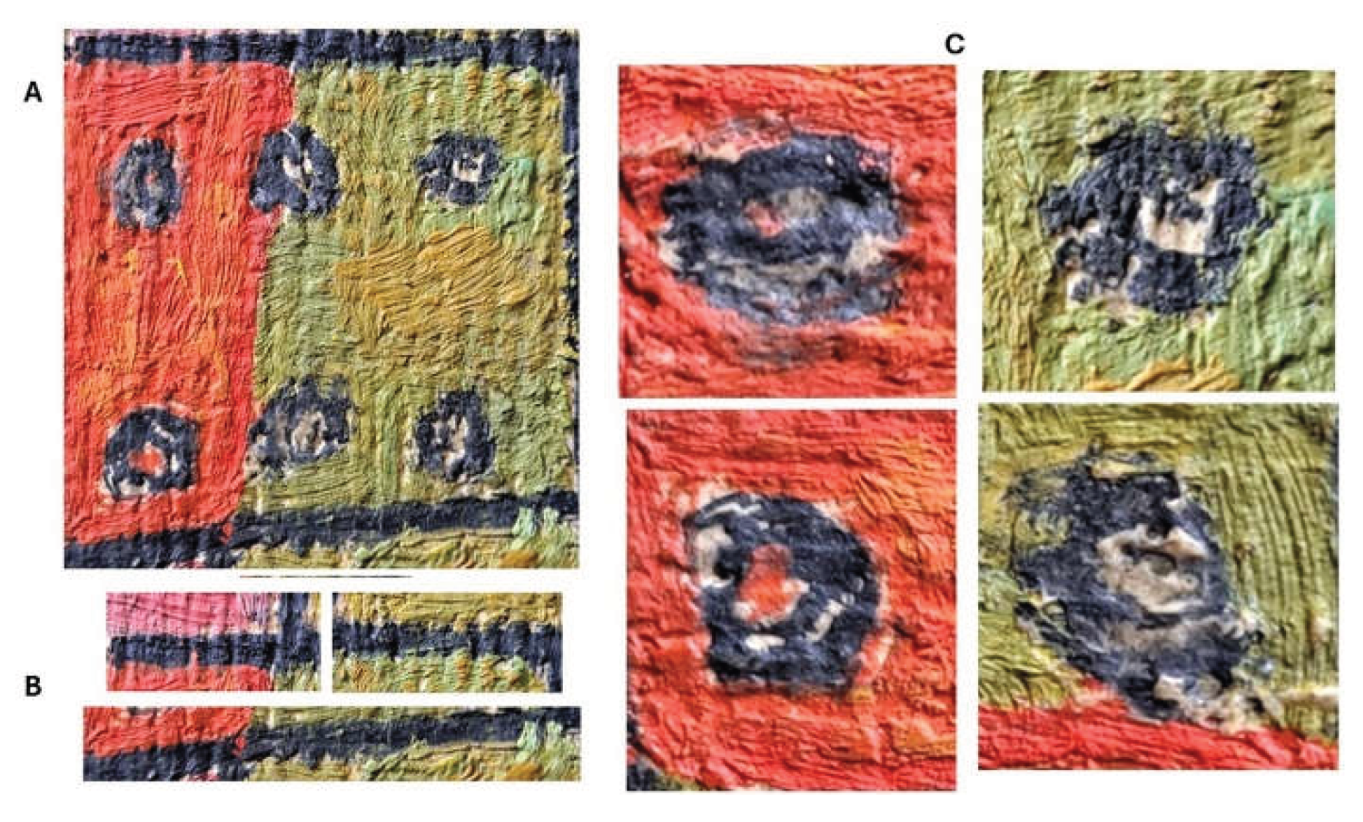
High-magnification imaging of the six tuner-area quadrants (Figure 11) reveal a set of recurring micro relief motifs that contribute an additional layer of process-based evidence for deliberate surface modification. These features compact circular and semi-circular forms, internally partitioned structures, and discrete pigment reservoirs , are visible across red, green, and transitional color fields. Their legibility persists under full-color, reduced-color, and grayscale transformations, indicating that they are carried by surface relief and luminance rather than color dependence. This behavior aligns with the anti-pareidolia criteria defined in Section 2.3 and reinforces that the motifs are physically present micro- structures rather than chromatic coincidence. Across the six tuner quadrants, the motifs share consistent mechanical behavior. Raking-light and side-lit views show shallow incisions and localized paint displacement surrounding the motifs, with pigment accumulation in recessed micro-basins. In several loci convex paint-ridges border the motifs, suggesting intentional manipulation of wet or semi-set paint. This morphology of recessed centers with peripheral displacement is consistent with deliberate micro-relief shaping rather than incidental canvas texture or casual brushwork. The repeated appearance of similarly proportioned structures across distinct color regions supports the interpretation of a reproducible working procedure rather than stochastic surface variation. Spatially, these motifs occupy bounded compositional cells defined by the tuner elements, a region already implicated in multi-stage construction from both X-ray and visible-light evidence. Their distribution within these compartments suggests that they were integrated during a specific campaign of surface intervention rather than accumulated over unrelated painting sessions.
Micro-relief continuity within each quadrant, combined with recurrent internal partitioning, points to an intentional patterning system. Although not interpreted here as iconographic or figurative content, the internal coherence, repetition, and structural persistence of these motifs satisfy continuity, polarity robustness, and refindability criteria defined for admissible features (Section 2.1, Section 2.2, Section 2.3 and Section 2.4). Together, the high-magnification motifs extend the surface-based evidence presented in Section 3.2 by demonstrating an additional tier of deliberate micro-relief modification embedded within the tuner-area construction. Their persistence under luminance-based transformations, mechanical coherence across loci, and bounded spatial organization indicate purposeful creation consistent with the broader multi-campaign, rotation-aware working process documented throughout this study. This micro-scale structural evidence further supports unified constructional logic and adds to the cumulative technical footprint that is challenging to replicate by superficial imitation.
4. Discussion
This study assesses whether the imaging results demonstrate an internally coherent, reproducible constructional logic consistent with Picasso’s working practices between 1906 and 1921. It asks whether subsurface structures (radiography) and surface or near-surface features (visible, raking-light, IR/UV) can be explained by a mechanically plausible sequence of planning, incision, and subsequent revisions. The approach is strictly process-based. It relies on features that persist under rotation and polarity stress tests, exhibit hierarchical seam behavior, show stratigraphic precedence of incisions, and maintain cross-modal co-location. Critically, strength derives not from any isolated motif or inscription but from the convergence of independent technical observations that remain stable across these transformations.
4.1. Orientation-Dependent Construction as a Robust Process Marker
A defining characteristic of the radiography dataset is its orientation-dependent coherence: subsurface structures that become geometrically intelligible only after rotation that remain stable under polarity inversion. In the radiograph in Figure 1 /Supplementary Figure S1, a coherent armature , comprising a cranial arc, facial axis, and shoulder/torso plane , emerges clearly at 180° rotation and persists in inverted polarity views. Longer boundaries also maintain continuity, even as local edge families gain or lose prominence with rotation (Figure 2; Supplementary Figure S3). Such refindable, rotation-sensitive legibility is difficult to reconcile with random density variation, which typically fragments or change identity under these stress conditions. The diagnostic workflow in Figure 5 shows that orientation-dependent coherence is not a post hoc drawing but a property that survives each admissibility criteria (Appendix A: continuity across crops, polarity robustness, hierarchical terminations, and refindability after rotation) before yielding an anatomically coherent armature. The pentimenti maps in Figure 6A highlights structures that remain geometrically intelligible only after rotation and persist under polarity inversion. This visual consolidation clarifies rotation-sensitive behavior by identifying the specific boundaries that retain identity across orientation tests. Thus, the diagnostic workflow in Figure 5 and the pentimenti maps in Figure 6A links the rotated/inverted structures of Figure 1 to the consolidated maps in Figure 6B and preempt interpretive ambiguity.
The demonstrated persistence of the same structural relationships across these five admissibility criteria supports deliberate planning on a reused and reoriented support rather than incidental texture. These findings align with published technical studies of Picasso’s working methods (Favero et al. 2017; Pouyet et al. 2020; Delaney et al. 2010). Comparable cross-modal analyses in La Miséreuse accroupie and Harlequin Musician likewise distinguished deliberate planning from coincidental density patterns (Pouyet et al. 2020; Delaney et al. 2010). These precedents reinforce the interpretation of rotation-dependent legibility as a high-value process marker that is not easily emulated superficially.
4.2. Base-Layer Planning, Seam Hierarchy, Cross-Modal Concordance, and Revision Cycles
Across the radiographs, planning exhibits a primary-secondary hierarchy where long, continuous boundaries separate major domains while shorter edits terminate cleanly against them in mechanically sensible ways. This is consistent with a base-layer guide that was refined through successive revision cycles rather than a single-pass execution. Importantly, these seams do not behave like incidental board texture or compositional ‘noise;’ they persist through polarity inversion and can be re-found after rotation without loss of geometric identity (Figure 3 and Supplementary Figure S2). The earlier base curve, concealed central form, and shifted right block (Figure. 6A) constitute a coherent revision cycle, confirming a base-layer guide refined through later campaigns. The difference map in Figure 6B isolates hidden elements that are absent from the surface configuration, providing a complementary view of covered forms and subsurface bands.
Visible-and raking-light imaging provides complementary stratigraphic evidence at the surface (Figure 7, Figure 8 and Figure 9). Incised inscriptions and numerals are physically embedded in the paint structure where later paint partially fills grooves and, in several loci, bridges over incision edges. This establishes a clear sequence in which incision/inscription precedes at least one subsequent overpaint campaign. When these observations are considered alongside the X-ray seam hierarchy, depth and surface evidence converge on a single construction logic unfolding over multiple campaigns. Cross modal registration (X-ray/UV/IR co-location in Figure 4) further strengthens this interpretation by showing that independently acquired datasets co-locate at multiple loci. Subsurface seams detected in X-ray correspond spatially with IR-visible undermarks and with UV active interventions, and they align with stable visible landmarks (contour breaks, junctions, and structural geometries). Such depth–surface concordance is difficult to reconcile with staged additions executed at unrelated times by different hands; instead, it supports a unified working process in which planning and subsequent revisions remained constrained by the same underlying geometry .
4.3. Comparative and Historical Context: Why the Inscriptions Matter
Comparative context is best introduced after the technical findings are established, because the present approach is process-based rather than stylistic. Within that boundary, the inscriptions provide historically coherent context: the painting contains physically incised names and place references (e.g., “LOLA,” “DOLORES,” “PARIS”) and distributed numerals that are integrated into the paint film rather than written as later, surface-only annotations. Picasso’s broader practice includes embedding letters, names, dates, and place references as compositional elements rather than as post hoc labels, and the stratigraphic integration observed here is compatible with that working milieu. At the same time, inscriptions and perceived motifs are not treated as handwriting attribution or iconographic proof. Their evidentiary value in this study is mechanical and stratigraphic. They are physically present, they follow plausible stroke mechanics and relief behavior, they persist across imaging conditions (including reduced-color and polarity/grayscale checks), and they participate in the same constructional system that governs the subsurface seams. This bounded use of context anchors interpretation in historically plausible practice while avoiding overreach from purely stylistic parallels.
Across the X-ray corpus, planning seams exhibit a primary–secondary hierarchy. Long, continuous boundaries partition major painted domains while shorter, localized edits terminate cleanly against them in mechanically sensible ways. This behavior visible, for example, in the curvilinear planning seam and its subordinate terminations in Figure 3 and Supplementary Figure S2, is consistent with a base-layer guide that structured later adjustments rather than a single-pass execution. The stability of these seams under polarity inversion and their refindability after rotation further supports their interpretation as intentional planning structures. Surface and near-surface imaging provide complementary stratigraphic evidence for multi-stage construction. Incised inscriptions and numerals are physically embedded in the paint structure: raking-light views show grooves with later paint partially filling them and, in some loci, bridging over incision edges (Figure 7, Figure 8 and Figure 9). This establishes a clear execution order in which incision/inscription precedes at least one subsequent overpaint campaign, aligning with the radiographic evidence for iterative revision cycles. Crucially, cross-modal registration indicates that depth and surface features are governed by the same geometric system. Subsurface seams detected in radiography co-locate with UV-active interventions and corresponding IR-visible undermarks at shared loci (Figure 4), and the registration is supported by stable landmarks (junctions, contour breaks, and structural geometries). Such depth–surface concordance is difficult to explain by staged additions executed at unrelated times; instead, it supports a unified working process in which planning, inscription, and later revisions remained constrained by the same underlying construction.
4.4. Multiyear Chronology and Embedded Context: A Palimpsest Model
The distribution of year numerals spanning 1912 –1919 across multiple color fields, together with the final dated signature (9 April 1921), is consistent with a palimpsest chronology in which earlier inscriptions were retained and subsequently overpainted or partially buried during later campaigns. The critical observation is not merely that numerals are present, but that they are physically integrated into the stratigraphy: raking-light relief and partial burial indicate execution prior to later paint deposition (Figure 8 and Figure 9). The same stratigraphic logic is evident in lettered inscriptions where later paint bridges earlier grooves (Figure 7). This multi-campaign behavior aligns with the broader technical picture of rotation-aware planning and iterative revision: subsurface structures indicate reuse/reorientation (Figure 1 and Figure 2), while surface stratigraphy records the temporal ordering of interventions (Figure 7, Figure 8 and Figure 9). Together, these datasets support an extended construction history rather than a single, closed execution event. Such multi-campaign behavior is compatible with documented revision histories in Picasso’s practice, particularly in contexts where supports are reused and compositions are repeatedly adjusted.
4.5. Materials Plausibility and Deliberately Modified Surfaces
The surface record includes deliberately modified micro-relief-incisions, displaced paint ridges, localized ink reinforcement, and ligature-like marks-whose visibility persists under reduced-color and grayscale controls (Figure 9 and Figure 10). Macro documentation further shows localized reinforcement and relief behavior that is consistent with purposeful manipulation of wet or semi-set paint (Figure 11). At higher magnification, recurrent micro-relief motifs in tuner-area quadrants exhibit consistent morphology and bounded placement (Figure 11), supporting a reproducible intervention rather than stochastic canvas texture. These behaviors also remain compatible with the previously reported materials context for the painting which identified period-consistent pigments and media and documented localized later refurbishment confined to a restricted zone (Bakovic et al. 2022). Within that constraint-based framework, the heterogeneous paint-film behavior and relief phenomena are more consistent with iterative, nontraditional working methods, and natural complex stratigraphy than with post hoc fabrication of a ‘look.’ Importantly, the present conclusions do not depend on destructive sampling: they arise from reproducible imaging observations and the mechanically coherent way those observations integrate across scales (Figure 10, Figure 11 and Figure 12) and across modalities (Figure 4).
4.6. Attributional Significance and Counter-Forgery Considerations
From a counter-forgery perspective, the strength of the evidence lies in converging constraints rather than in any single feature. The co-occurrence of (i) rotation-dependent subsurface coherence that survives polarity inversion (Figure 1; Supplementary Figure S1), (ii) rotation-stable seam architecture with primary–secondary hierarchy (Figure 3; Supplementary Figure S2), (iii) physically incised inscriptions and numerals with demonstrable stratigraphic precedence (Figure 7, Figure 8 and Figure 9), and (iv) cross-modal co-location linking depth seams to UV/IR/visible features (Figure 4) constitutes a process-based fingerprint that is difficult to stage convincingly. Accordingly, this study does not claim attribution on stylistic grounds alone. Rather, it shows that the painting’s internal constructional logic is coherent, reproducible, and mechanically plausible within the documented technical repertoire of the relevant period, thereby strengthening an originality-positive interpretation when considered alongside provenance and curatorial evaluation. Future work can remain non-destructive; optional elemental mapping (e.g., macro-XRF) could refine relationships among painted domains and planning seams, but it is not required for the principal conclusion that multiple independent modalities converge on a unified, multi-campaign, orientation-aware working process.
5. Conclusions
This study relies on non-destructive imaging and previously reported materials findings. Multiple, independent lines of technical imaging evidence converge on a coherent constructional narrative. X-ray radiography reveals orientation-dependent subsurface structures that remain identifiable under polarity inversion and modest tonal variation. Visible and raking-light imaging documents physically incised inscriptions—names, dates, and place references—whose grooves are partially filled or bridged by later paint, establishing a sequence in which inscriptions precede overpainting. Cross-modal registration demonstrates spatial concordance between subsurface seams and surface features, indicating that depth and surface are governed by the same multi-stage working process. Together, the evidence supports a painting developed across multiple campaigns with rotation-aware base-layer planning, iterative revisions, and deliberately modified surfaces. This reproducible technical footprint aligns with published descriptions of Picasso’s working methods and is difficult to replicate by superficial imitation. When considered alongside previously established curatorial and provenance evidence, the technical findings support an originality-positive assessment within a process-based attribution framework.
Supplementary Materials
The following supporting information can be downloaded at website of this paper posted on Preprints.org.
Author Contributions
Conceptualization, Methodology, Investigation, Data Curation, M.B.; Visualization, M.B.; Writing-original draft, M.B.; Writing, review & editing, M.B. A. P.M.
Funding
This research received no external funding.
Data Availability Statement
All imaging crops, polarity states, rotation mappings, and derived overlay files are available from the corresponding author on reasonable request.
Conflicts of Interest
The authors declare no conflict of interest.
References
- Arslanoglu, J.; Centeno, S.A.; Digney -Peer, S.; Duvernois, I. Picasso in The Metropolitan Museum of Art: An Investigation of Materials and Techniques. J. Am. Inst. Conserv. 2013, 52, 184–201. [Google Scholar] [CrossRef]
- Bakovic, M.; Karapandza, S.; Mcheik, S.; Pejovic Milic, A. Scientific Study of the Origin of the Painting from the Early 20th Century Leads to Pablo Picasso. Heritage 2022, 5, 1120–1140. [Google Scholar] [CrossRef]
- Casadio, F. Technical Analysis of the Materials and Techniques of Pablo Picasso: From the Blue Period to the Blue Seas of the Mediterranean. Art Institute of Chicago / Erice Lectures, 2010. [Google Scholar]
- Delaney, J.K.; Zeibel, J.G.; Thoury, M.; Littleton, R.; Palmer, M.; Morales, K.M.; de la Rie, E.R.; Hoenigswald, A.C. Visible and Infrared Imaging Spectroscopy of Picasso’s Harlequin Musician. Appl. Spectrosc. 2010, 64, 584–594. [Google Scholar] [CrossRef] [PubMed]
- Favero, P.A.; Mass, J.L.; Delaney, J.K; Woll, A.R.; Hull, A.M.; Dooley, K.A.; Finnefrock, A.C. Reflectance Imaging Spectroscopy and Synchrotron Radiation X-ray Fluorescence Mapping Used in a Technical Study of The Blue Room by Pablo Picasso. Heritage Sci. 2017, 5, 17. [Google Scholar] [CrossRef]
- Fuster -López, L.; Izzo, F.C.; Andersen, C.K.; Murray, A.; Vila, A.; Picollo, M.; Stefani, L.; Jiménez, R.; Aguado-Guardiola, E. Picasso’s 1917 Paint Materials and Their Influence on the Condition of Four Paintings. SN Appl. Sci. 2020, 2, 3803. [Google Scholar] [CrossRef]
- Golding, J. Cubism: A History and an Analysis, 1907 –1914, 3rd ed.; Belknap Press: Cambridge, MA, USA, 1988. [Google Scholar]
- Hoenigswald, A. Works in Progress: Pablo Picasso’s Hidden Images. In Picasso: The Early Years, 1892 –1906; McCully, M., Ed.; National Gallery of Art: Washington, DC, USA, 1997; pp. 299–309. [Google Scholar]
- Hoenigswald, A. Echoes on a Reused Canvas: Picasso and the Life of Images (1899). Bol. Arte 2025, 47, 151–155. [Google Scholar]
- Jiménez, R. A Fresh Look: Technical Analysis and Treatment of Picasso’s Science and Charity. SN Appl. Sci. 2021, 3, 507. [Google Scholar] [CrossRef]
- Musée national Picasso –Paris. Guitare. Available online: https://www.museepicassoparis.fr/fr/guitare (accessed on 5 February 2026).
- Pouyet, E.; Brummel, K.; Webster -Ccook, S.; Delaney, J.; Dejoie, C.; Pastorelli, G.; Walton, M. New Insights into Pablo Picasso’s La Miséreuse accroupie. SN Appl. Sci. 2020, 2, 1408. [Google Scholar] [CrossRef]
Figure 1.
Rotated inverted radiograph revealing coherent subsurface armature. When rotated and viewed in inverted polarity (Supplementary Figure S1) a stable subsurface structure becomes legible.
Figure 1.
Rotated inverted radiograph revealing coherent subsurface armature. When rotated and viewed in inverted polarity (Supplementary Figure S1) a stable subsurface structure becomes legible.
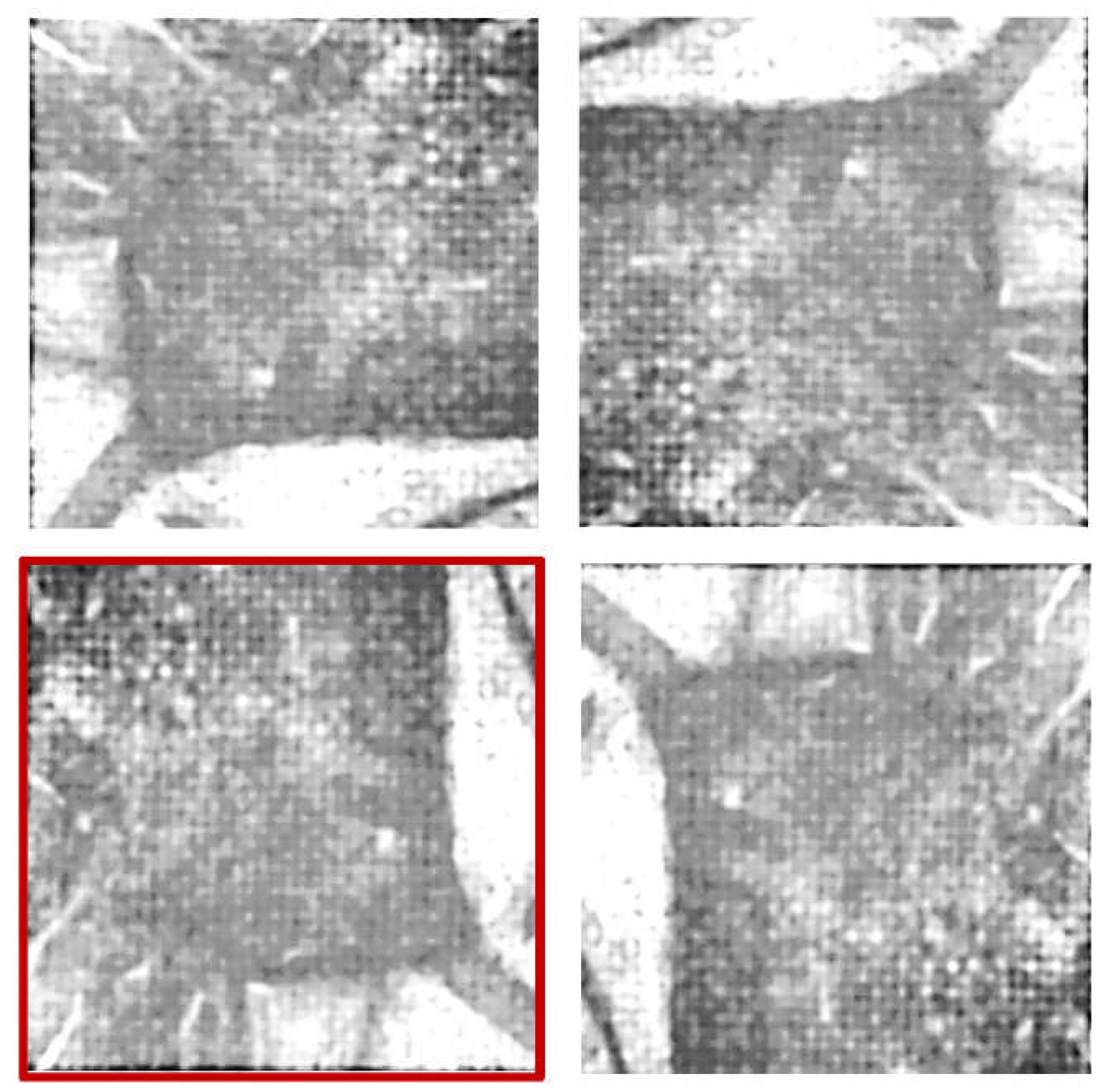
Figure 2.
Rotation dependent coherence across three zones with contextual motif labels. Across sequential rotations and polarity inversions, long structural boundaries remain continuous while dominance among local edge families changes. This behavior indicates a single underlying planning system on a reused support. Contextual motif labels denote commonly perceived shapes under rotation and are provided for orientation only, not as stylistic evidence. Interpretation is based strictly on structural criteria: continuity, hierarchy, polarity robustness, and refindability.
Figure 2.
Rotation dependent coherence across three zones with contextual motif labels. Across sequential rotations and polarity inversions, long structural boundaries remain continuous while dominance among local edge families changes. This behavior indicates a single underlying planning system on a reused support. Contextual motif labels denote commonly perceived shapes under rotation and are provided for orientation only, not as stylistic evidence. Interpretation is based strictly on structural criteria: continuity, hierarchy, polarity robustness, and refindability.
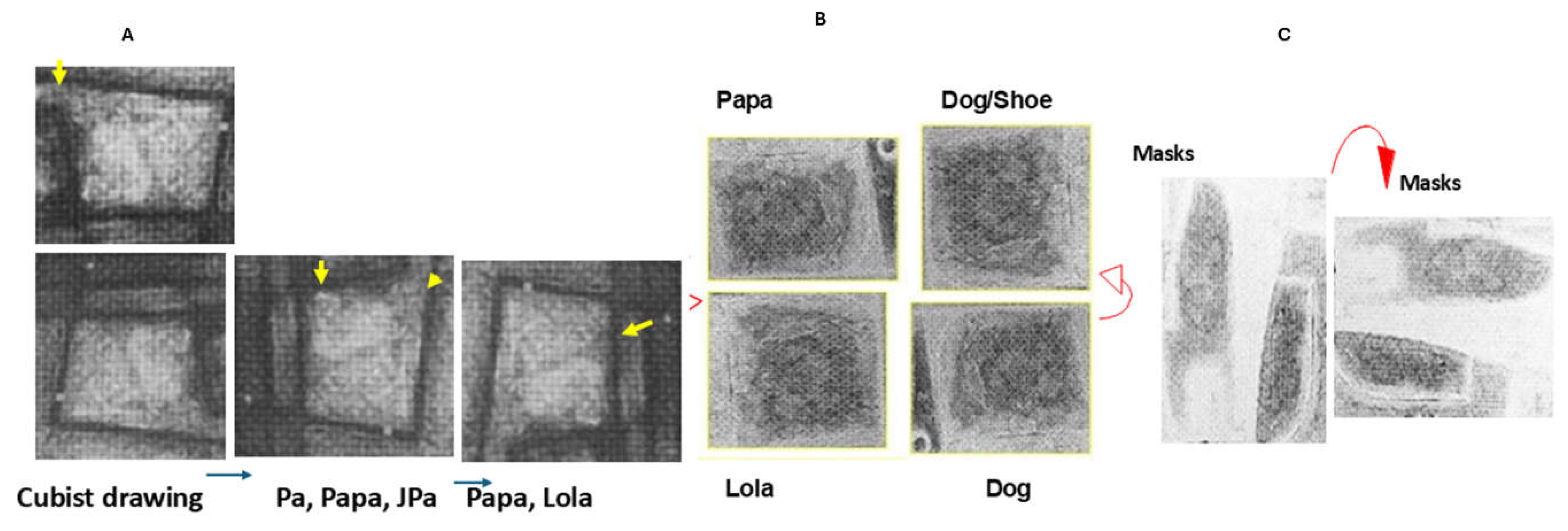
Figure 3.
Primary curvilinear planning seam with mechanically sensible terminations. Along continuous seam separating major painted domains persists across both normal and inverted polarity views. Shorter edits terminate cleanly against this seam, demonstrating a hierarchical planning structure. Orientation mapping reproduces gain and loss of prominence in local edges without altering geometric continuity, supporting interpretation of this boundary as an intentional base-layer guide refined in later campaigns.
Figure 3.
Primary curvilinear planning seam with mechanically sensible terminations. Along continuous seam separating major painted domains persists across both normal and inverted polarity views. Shorter edits terminate cleanly against this seam, demonstrating a hierarchical planning structure. Orientation mapping reproduces gain and loss of prominence in local edges without altering geometric continuity, supporting interpretation of this boundary as an intentional base-layer guide refined in later campaigns.
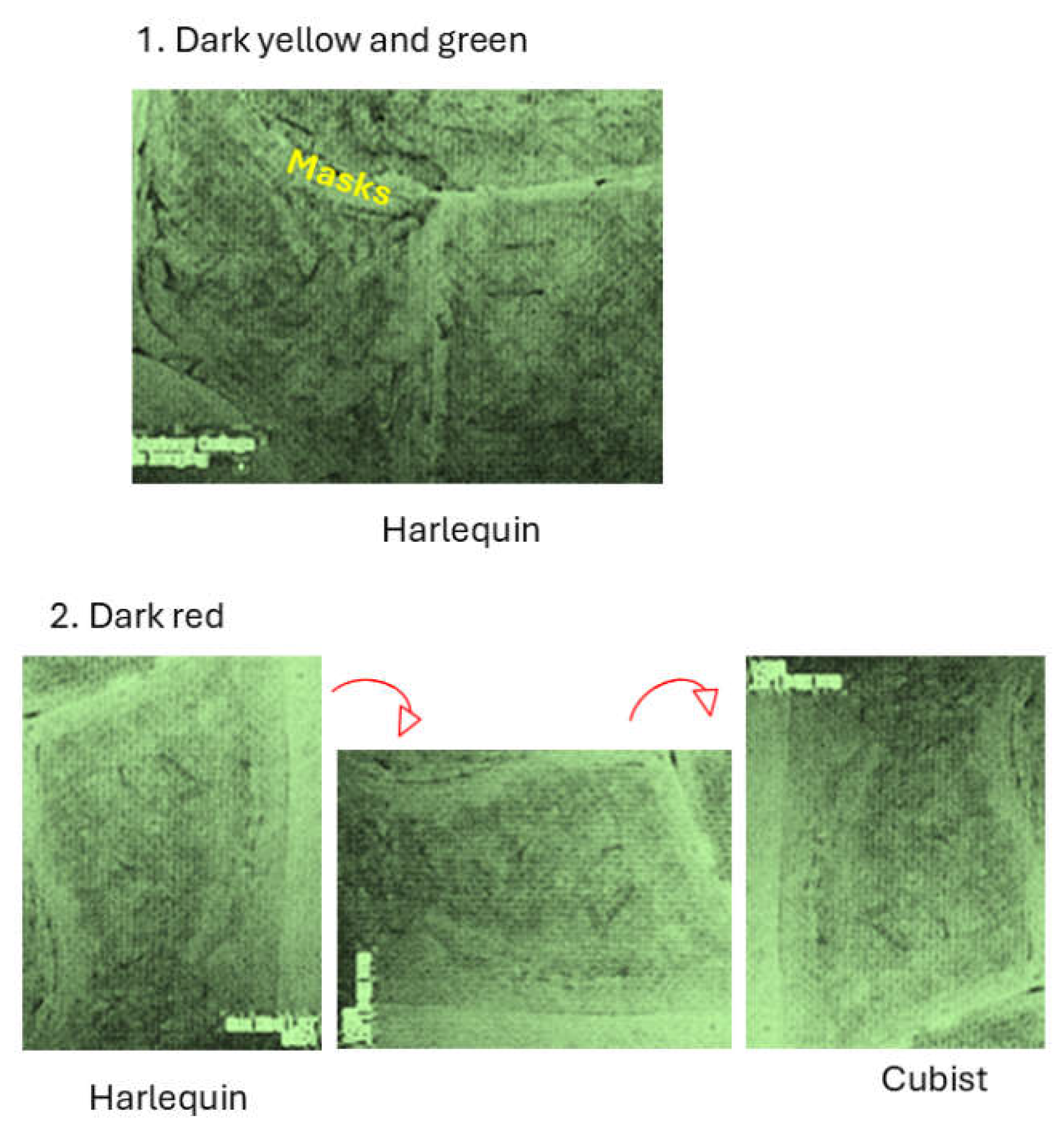
Figure 4.
Cross-modal correspondence between X-ray, UV, and IR datasets. Aligned crops from X-ray, UV, and IR imaging show the same subsurface seams co-locating with UV active interventions and IR-visible undermarks. This spatial convergence across modalities demonstrates that both depth and surface features are governed by a unified, multi-stage construction process. Time and instrument stamps are preserved to maintain chain-of-custody documentation.
Figure 4.
Cross-modal correspondence between X-ray, UV, and IR datasets. Aligned crops from X-ray, UV, and IR imaging show the same subsurface seams co-locating with UV active interventions and IR-visible undermarks. This spatial convergence across modalities demonstrates that both depth and surface features are governed by a unified, multi-stage construction process. Time and instrument stamps are preserved to maintain chain-of-custody documentation.
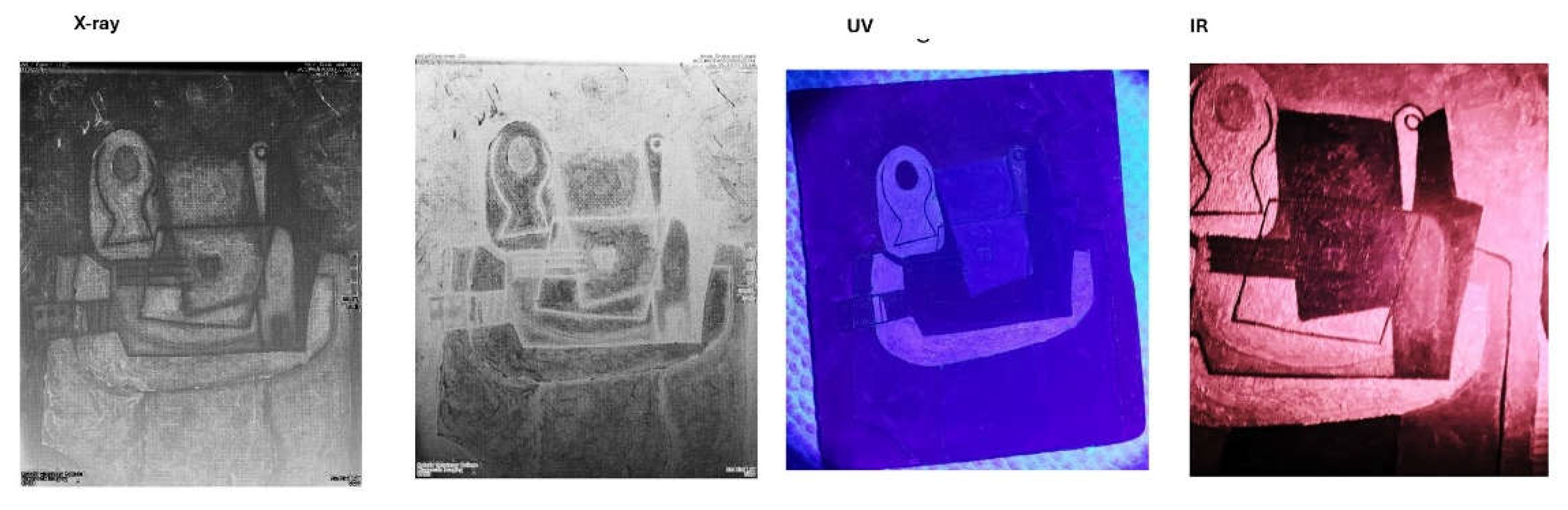
Figure 5.
Diagnostic reconstruction workflow from X-ray to interpreted figure. Four panels show the progression from X-ray to heat mapped features, to contour overlay, to a clean reconstructed silhouette of a figure; the long primary seam and subordinate terminations remain stable across the workflow. Only linear brightness/contrast , no edge enhancement or non-linear filters were applied.
Figure 5.
Diagnostic reconstruction workflow from X-ray to interpreted figure. Four panels show the progression from X-ray to heat mapped features, to contour overlay, to a clean reconstructed silhouette of a figure; the long primary seam and subordinate terminations remain stable across the workflow. Only linear brightness/contrast , no edge enhancement or non-linear filters were applied.
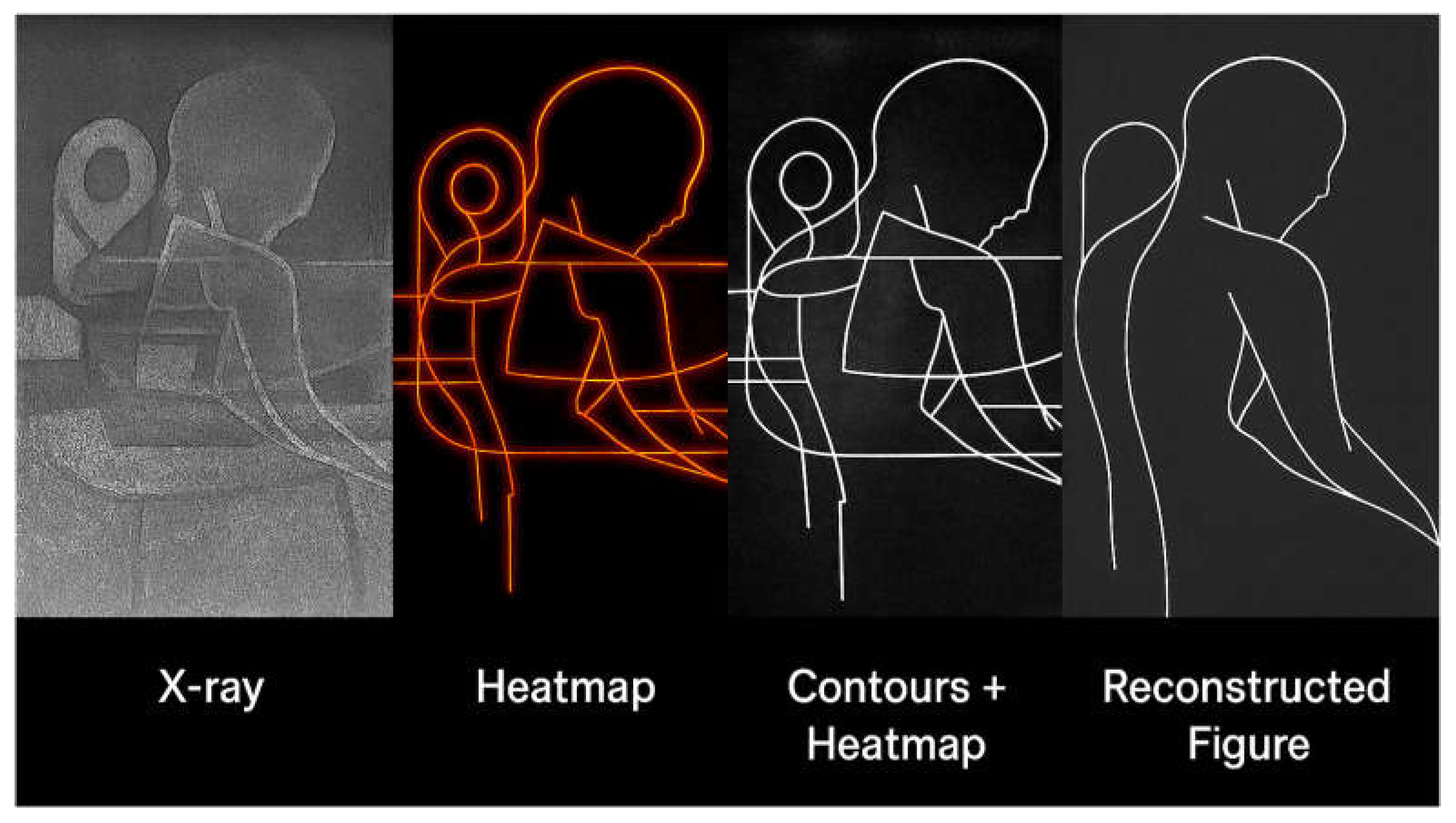
Figure 6.
X-ray pentimenti, understructures and Difference maps. A. Consolidated pentimenti and understructures derived from the inverse X-ray: 1) Earlier base shape; 2) Concealed central form; 3) Shifted right block; 4) Adjusted rounded form; 5) Altered strips; 6) Abandoned strokes. Understructures include broad lower brushwork (yellow), board texture exposure (green), and internal tonal variations (blue). B. Hidden elements, not present in surface configuration: Difference map highlighting hidden background marks, earlier outline, concealed central form, abandoned rectangular elements, earlier base curve, and subsurface vertical bands. Labels differentiate early sketch lines (dashed), covered paint areas (orange), concealed shape (blue), and subsurface bands (violet).
Figure 6.
X-ray pentimenti, understructures and Difference maps. A. Consolidated pentimenti and understructures derived from the inverse X-ray: 1) Earlier base shape; 2) Concealed central form; 3) Shifted right block; 4) Adjusted rounded form; 5) Altered strips; 6) Abandoned strokes. Understructures include broad lower brushwork (yellow), board texture exposure (green), and internal tonal variations (blue). B. Hidden elements, not present in surface configuration: Difference map highlighting hidden background marks, earlier outline, concealed central form, abandoned rectangular elements, earlier base curve, and subsurface vertical bands. Labels differentiate early sketch lines (dashed), covered paint areas (orange), concealed shape (blue), and subsurface bands (violet).
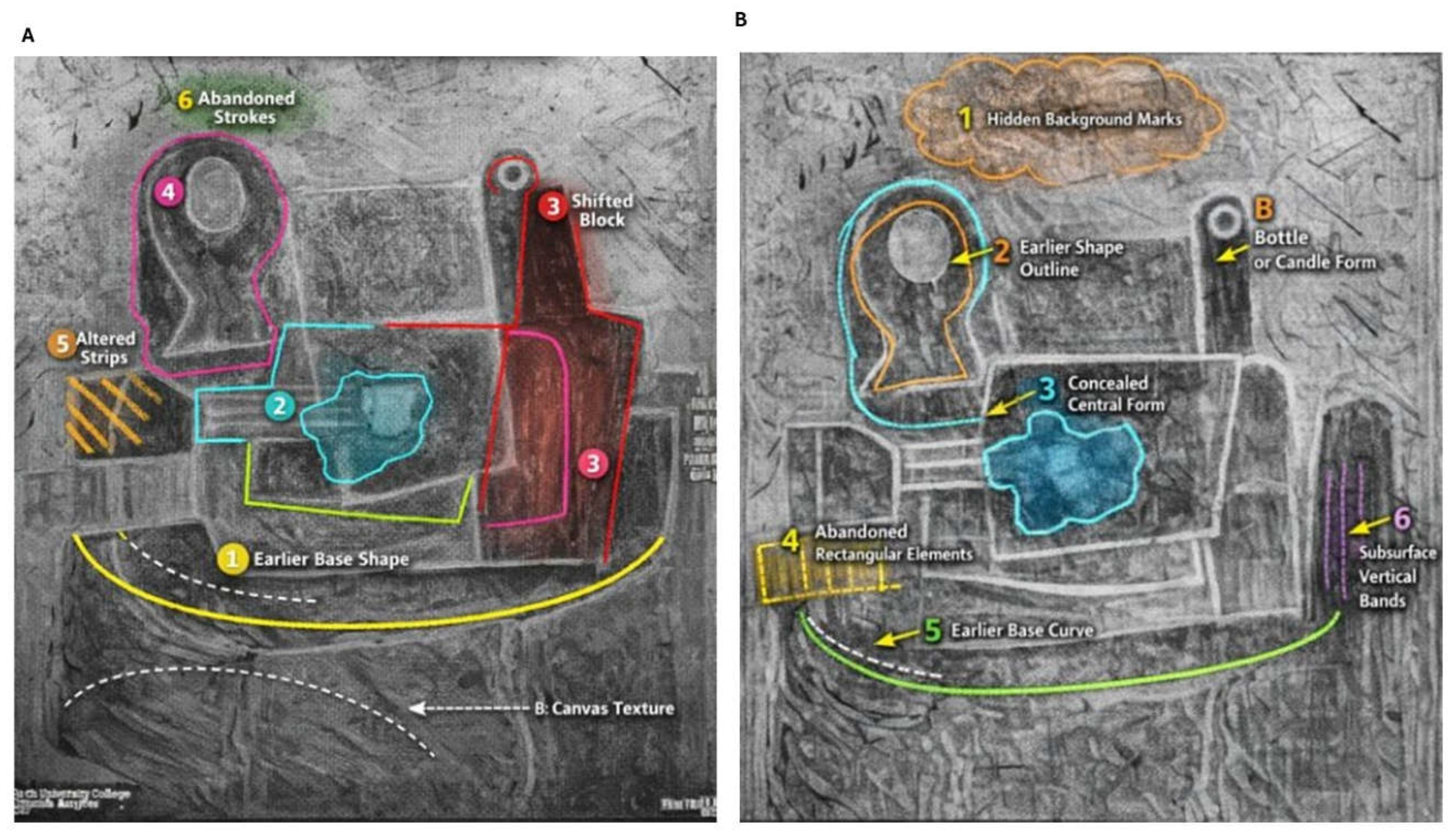
Figure 7.
Normal-light inscriptions and raking-light confirmation of incised relief. A: Normal-light, grayscale, and inverted views show the inscription “OLE MIA LOLA” clearly without spectral manipulation. B: Enlarged views reveal “DOLORES,” with consistent stroke mechanics across loci. Raking-light images highlight physical incisions and paint settling within the grooves. In several areas, later paint layers bridge over the incised marks, confirming that the inscriptions predate overpainting.
Figure 7.
Normal-light inscriptions and raking-light confirmation of incised relief. A: Normal-light, grayscale, and inverted views show the inscription “OLE MIA LOLA” clearly without spectral manipulation. B: Enlarged views reveal “DOLORES,” with consistent stroke mechanics across loci. Raking-light images highlight physical incisions and paint settling within the grooves. In several areas, later paint layers bridge over the incised marks, confirming that the inscriptions predate overpainting.
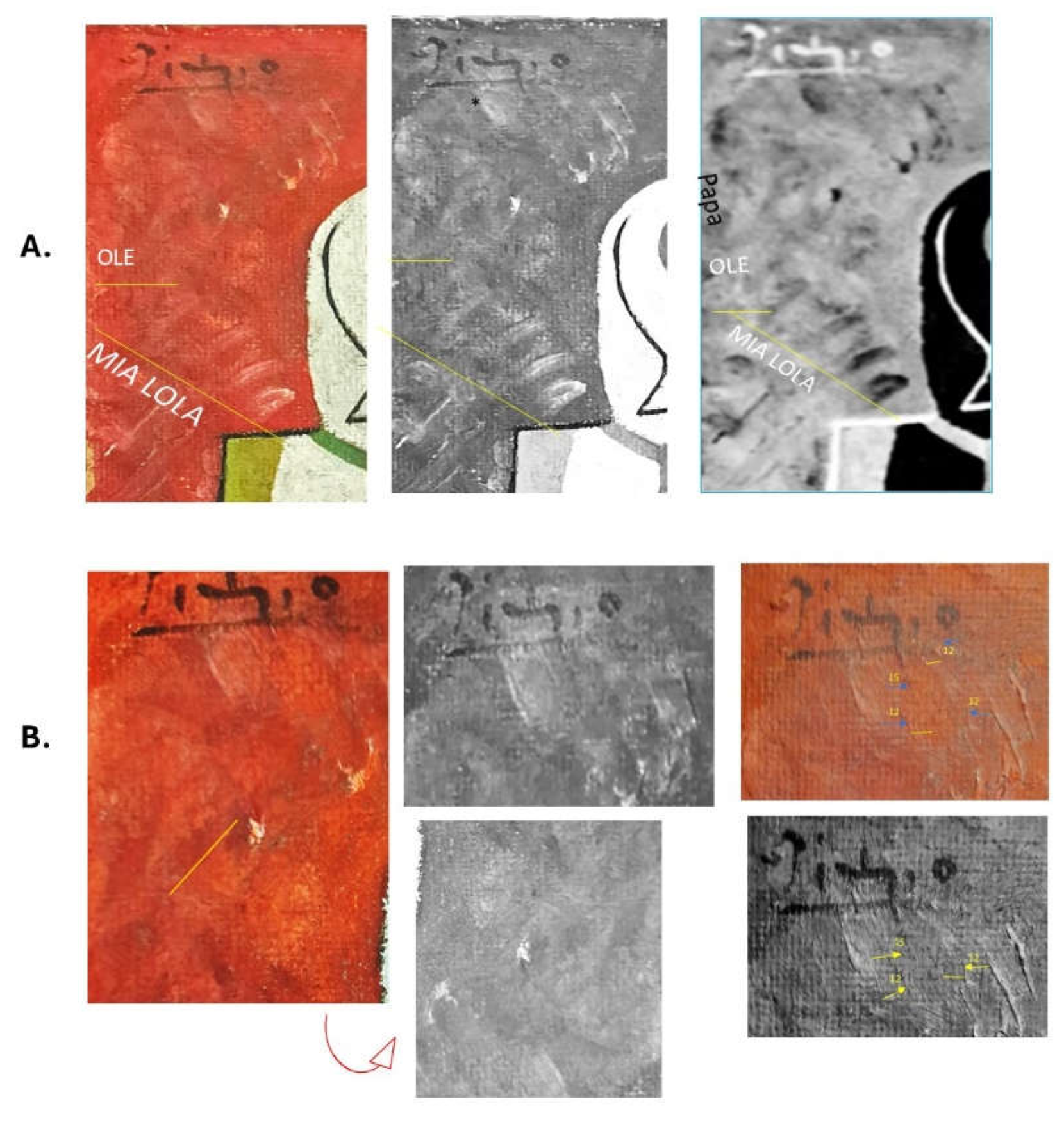
Figure 8.
Context inscription “PARIS” and distributed year numerals across fields. A: The inscription “PARIS” is visible in the lower blue band along with numerals (12, 13, 14, 15, 16) present in normal light. B: Additional numerals (12, 15, 18) appear in the adjacent yellow field. Partial burial and coherent stroke mechanics indicate early execution relative to overlying paint layers. Grayscale panels confirm that legibility relies on luminance and relief rather than hue contrast. Location markers function solely as spatial identifiers, not handwriting attributions.
Figure 8.
Context inscription “PARIS” and distributed year numerals across fields. A: The inscription “PARIS” is visible in the lower blue band along with numerals (12, 13, 14, 15, 16) present in normal light. B: Additional numerals (12, 15, 18) appear in the adjacent yellow field. Partial burial and coherent stroke mechanics indicate early execution relative to overlying paint layers. Grayscale panels confirm that legibility relies on luminance and relief rather than hue contrast. Location markers function solely as spatial identifiers, not handwriting attributions.
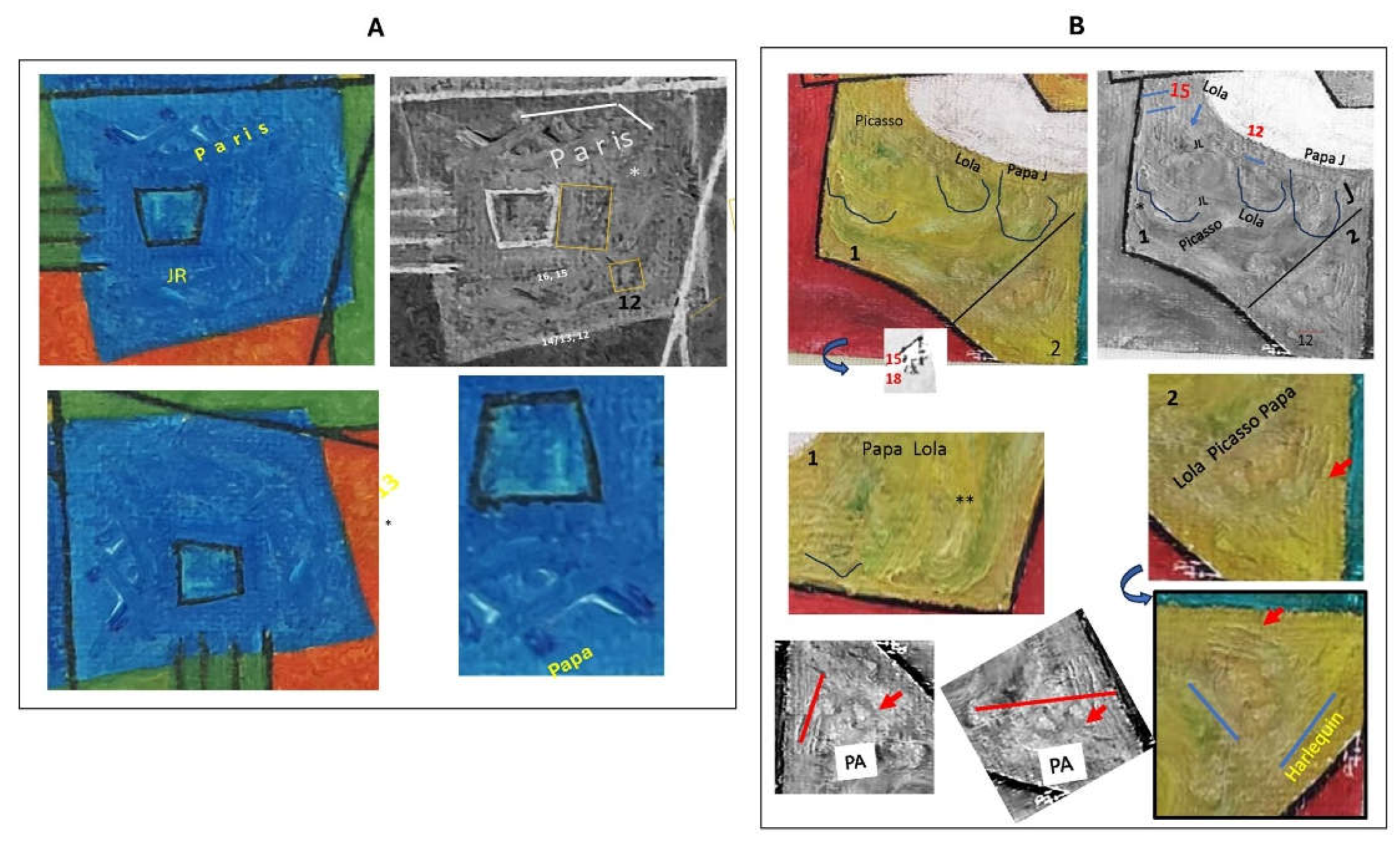
Figure 9.
Raking-light views demonstrate micro-relief, incision depth, and paint displacement. Raking-light images reveal deeply incised strokes and regions where later paint travels over earlier engravings, establishing execution order. Sub-panels B and C provide matched black –white and inverted raking-light views that emphasize incision depth, micro-relief, and local paint displacement. Numerals and contextual glyphs are distributed across multiple fields.
Figure 9.
Raking-light views demonstrate micro-relief, incision depth, and paint displacement. Raking-light images reveal deeply incised strokes and regions where later paint travels over earlier engravings, establishing execution order. Sub-panels B and C provide matched black –white and inverted raking-light views that emphasize incision depth, micro-relief, and local paint displacement. Numerals and contextual glyphs are distributed across multiple fields.
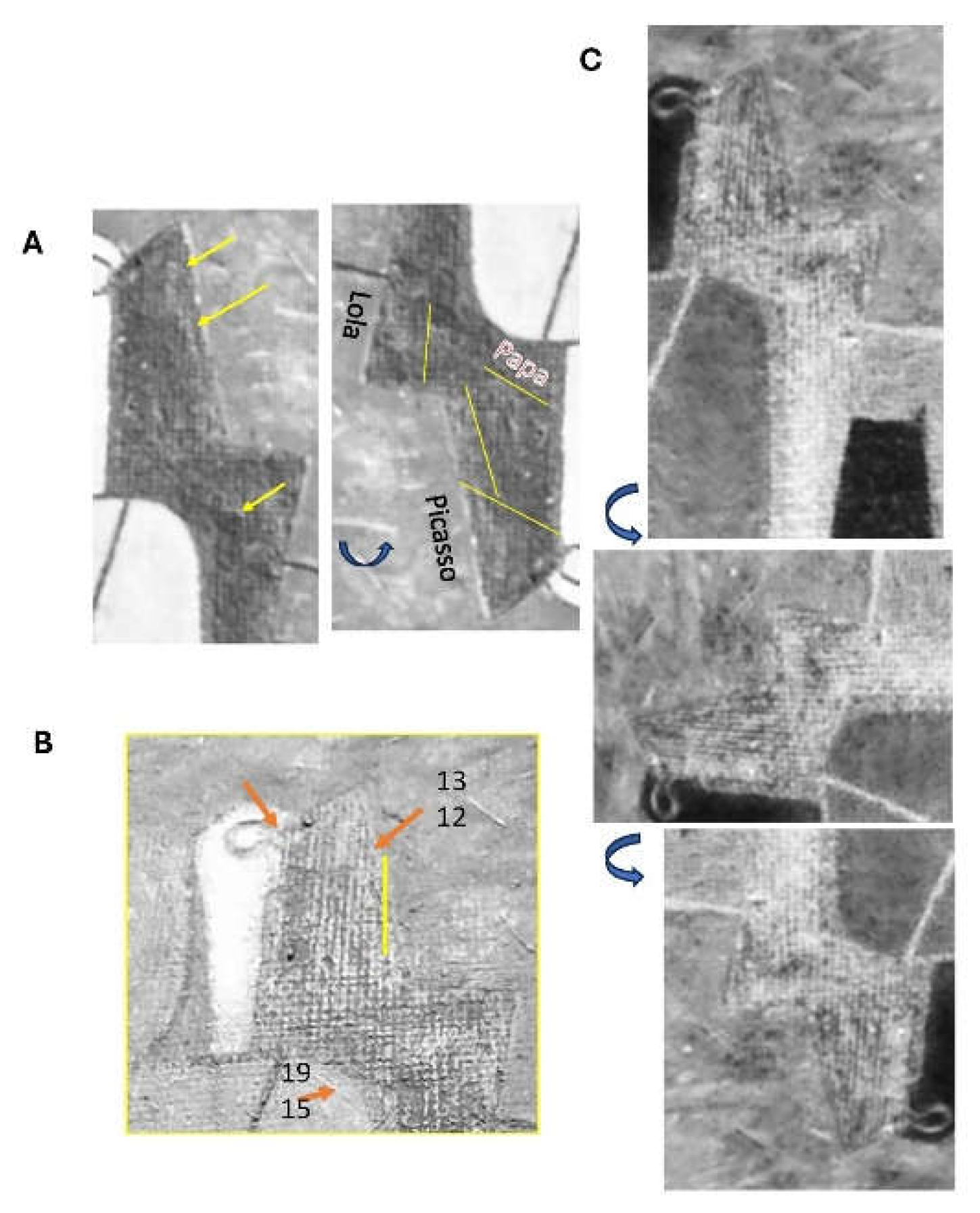
Figure 10.
Macro-topography of inscriptions and ligature-like features at the art back. Macro UV (top) and visible-light (bottom) views document incisions, displaced paint, and localized ink reinforcement associated with letter forms and initials. Side-lit macros show ligature-like constructions (e.g., “J,” “JPL + La”) formed through deliberate interventions in wet or semi wet paint. Sub-panels correspond to designated microsites within the painting.
Figure 10.
Macro-topography of inscriptions and ligature-like features at the art back. Macro UV (top) and visible-light (bottom) views document incisions, displaced paint, and localized ink reinforcement associated with letter forms and initials. Side-lit macros show ligature-like constructions (e.g., “J,” “JPL + La”) formed through deliberate interventions in wet or semi wet paint. Sub-panels correspond to designated microsites within the painting.
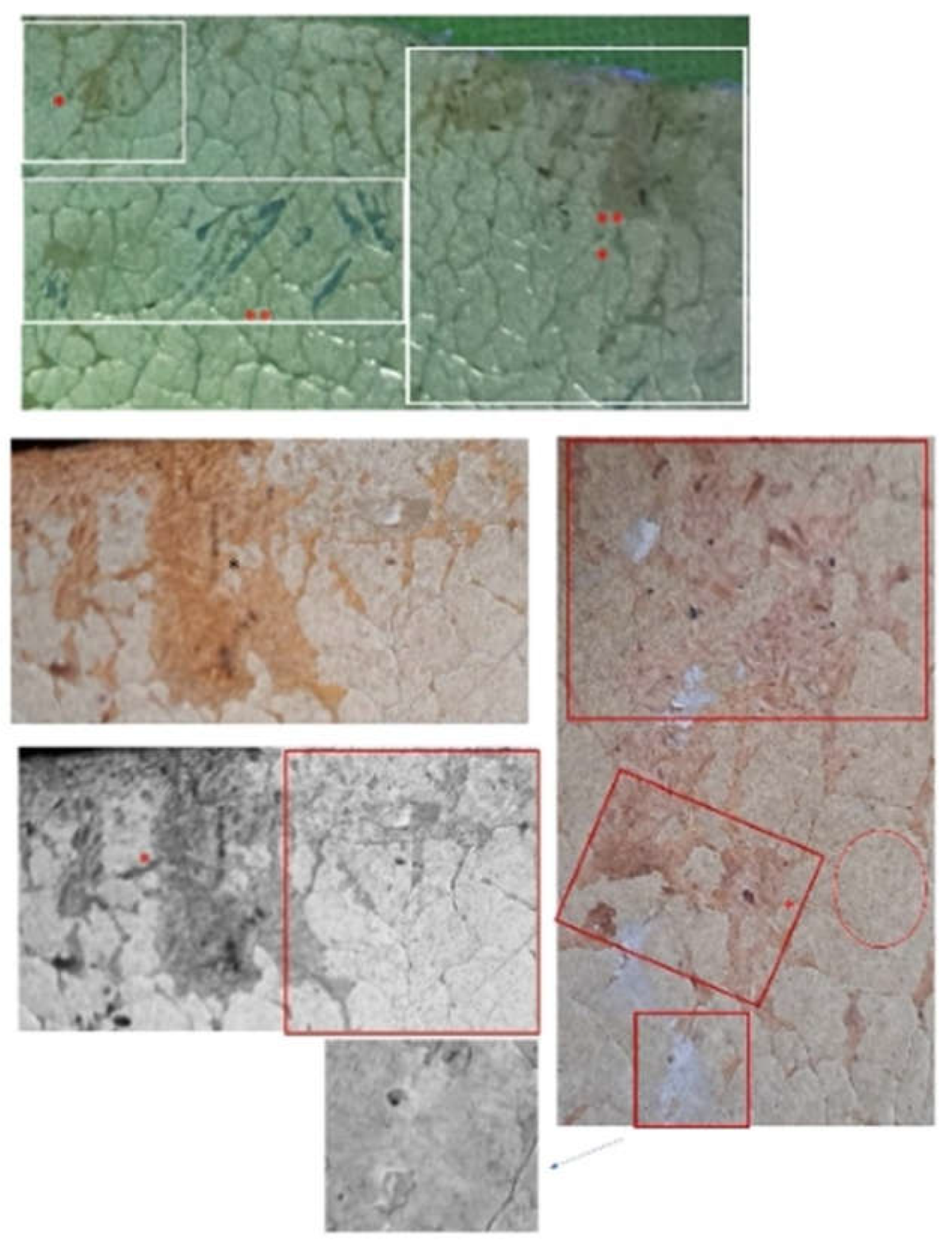
Figure 11.
High-magnification micro-relief motifs within the tuner-area quadrants. Panel A shows recurring circular and semi-circular relief motifs across red and green tuner fields. Panel B document elongated pigment ridges and incised microchannels whose internal pigment reservoirs demonstrate deliberate manipulation of semi-wet paint. Panels C show expanded views of the central red –green quadrant where the motifs repeat with consistent proportions and stroke mechanics. Visibility persists under full-color, reduced-color, and grayscale transformations (Supplementary Figure S5), confirming that the structures are carried by relief and luminance rather than color contrast.
Figure 11.
High-magnification micro-relief motifs within the tuner-area quadrants. Panel A shows recurring circular and semi-circular relief motifs across red and green tuner fields. Panel B document elongated pigment ridges and incised microchannels whose internal pigment reservoirs demonstrate deliberate manipulation of semi-wet paint. Panels C show expanded views of the central red –green quadrant where the motifs repeat with consistent proportions and stroke mechanics. Visibility persists under full-color, reduced-color, and grayscale transformations (Supplementary Figure S5), confirming that the structures are carried by relief and luminance rather than color contrast.
Disclaimer/Publisher’s Note: The statements, opinions and data contained in all publications are solely those of the individual author(s) and contributor(s) and not of MDPI and/or the editor(s). MDPI and/or the editor(s) disclaim responsibility for any injury to people or property resulting from any ideas, methods, instructions or products referred to in the content. |
© 2026 by the authors. Licensee MDPI, Basel, Switzerland. This article is an open access article distributed under the terms and conditions of the Creative Commons Attribution (CC BY) license (http://creativecommons.org/licenses/by/4.0/).
Copyright: This open access article is published under a Creative Commons CC BY 4.0 license, which permit the free download, distribution, and reuse, provided that the author and preprint are cited in any reuse.