

Submitted:
14 February 2026
Posted:
26 February 2026
You are already at the latest version
Abstract
Background: Mitragynine pseudoindoxyl (MP) is a semi-synthetic kratom metabolite increasingly sold online and over-the-counter, marketed misleadingly as "kratom" or "7-OH," despite lacking FDA approval and safety data in humans. Methods: This case report describes a 44-year-old male with polysubstance use history who developed opioid withdrawal after regular MP use (400 mg daily for pain management following neck injury). Vital signs, alcohol and opioid withdrawal scores and clinical outcomes were recorded. Results: The patient presented exhibiting symptoms of moderate opioid withdrawal. A buprenorphine macro-induction protocol was initiated. Following pre-treatment using chlorpromazine as an anti-emetic and diazepam to treat concomitant alcohol withdrawal, 32 mg buprenorphine were provided (16 mg x 2) on day one, with subsequent maintenance dosing and adjunctive medications. The patient demonstrated significant symptomatic improvement with decreased COWS scores and expressed interest in long-acting injectable buprenorphine maintenance therapy. Discussion: This represents the first documented case of MP withdrawal successfully managed with buprenorphine macro-induction, demonstrating the potential efficacy of this approach for novel semi-synthetic kratom metabolites when standard withdrawal management protocols are insufficient. Further studies should evaluate long term outcomes and validate findings.
Keywords:
mitragynine pseudoindoxyl
; kratom
; opioid withdrawal
; buprenorphine
; macro-induction
; substance use disorder
; 7-hydroxymitragynine
; novel opioids
1. Introduction
Kratom is a botanical substance derived from the leaves of the Mitragyna species, containing alkaloids that act as partial agonists at the mu-opioid receptor. [1] While traditionally consumed as a tea, kratom has increasingly been promoted in the United States for opioid-related indications, including pain management and self-directed treatment of opioid use disorder, despite the absence of FDA-approval for these indications. [2] Mitragynine is the most abundant alkaloid in kratom and undergoes metabolism to progressively more potent μ-opioid receptor agonists, including 7-hydroxymitragynine (7-HMG) and then mitragynine pseudoindoxyl (MP).
Over the last year, these metabolites have emerged as semi-synthetic products sold online and over the counter, generally misleadingly marketed as “kratom” or “7-OH”. [10] Although, there are animal studies to suggest that 7-HMG and MP are far more potent at the mu-opioid receptor than kratom, or mitragynine, there are no clinically validated dose-equivalent conversions between kratom, 7-HMG, and MP. [1] Moreover, the safety of 7-HMG and MP in humans remains understudied with no regulatory standards provided by the FDA and no FDA-approved indications for these substances. [5,11]
This case report describes a middle-aged male experiencing opioid withdrawal in the setting of reported mitragynine pseudoindoxyl (MP) use, for which his withdrawal and pain were successfully treated with a buprenorphine macro-induction protocol.
2. Case Report
A 44-year-old man with a history of alcohol use disorder, alcohol withdrawal-associated seizures, opioid use disorder, anxiety, and depression was admitted to an inpatient general medicine floor with a chief complaint of alcohol withdrawal and “kratom” withdrawal.
He reported an extensive history of substance use over the prior 25 years, punctuated by periods of sobriety both with and without medication support. He noted first substance use at the age of 16, smoking cannabis occasionally. His use escalated to MDMA, LSD, psilocybin-containing mushrooms, and mescaline within a year followed by a period of sobriety while incarcerated. Upon release, he started using cannabis again, along with smoking cocaine. He was unable to specify volume of use exactly but reported purchasing multiple “eight balls” (1/8th of an ounce, or 3.5g) per week. Shortly after this, he began injecting heroin. Life circumstances encouraged the patient to stop using, successfully achieving abstinence on methadone. He received a high dose taper coinciding with decreased heroin use, lasting approximately three months, after which, he was weaned off methadone entirely and was sober from all substances for almost seven years.
He briefly returned to use of medical cannabis (daily), K2 (synthetic cannabis), and sporadic cocaine use, however, he stopped all use again without medication support during a different period of incarceration. Within the preceding 18 months, he reported heavy alcohol use, progressing from 1 fifth (750ml) of hard liquor daily to 1.5 fifths (1,125ml of hard liquor daily in more recent months, including immediately prior to hospitalization. He additionally suffered a neck injury about 6 months prior to presentation, for which he started using mitragynine pseudoindoxyl chewable tablets for pain control.
He initially heard about them from a friend as synthetic, powerful, and accessible opioid-like medication. He purchased the mitragynine pseudoindoxyl at a local nicotine vaporizer shop. At initiation, he was using approximately 100 mg daily. Within 2-3 weeks, he required 200-400 mg daily to control his pain, which was intermittently more severe after he required a cervical fusion procedure for his neck. He reported using 400 mg of pseudoindoxyl daily as a maintenance dose. He stated that he would have increased his dose further, but was limited by the price of medication at $40 per day for 400 mg. Immediately prior to presenting to the hospital, he had to stop using for 2-3 days because his belongings and money were stolen. As a result, he reported using 1 bag of fentanyl and cocaine by injection prior to presenting to the hospital to ward off withdrawal symptoms.
On admission, he was in moderate alcohol and opioid withdrawal with Alcohol Withdrawal Symptoms (AWS) scores of 9 and Clinical Opiate Withdrawal Scale (COWS) 17, respectively. He reported symptoms including but not limited to nausea, diarrhea, diaphoresis, chills, piloerection, myalgias, tremor, anxiety, insomnia, and restlessness. He was tachycardic 101-129 and hypertensive 150s-170s/80-110s on admission, both of which stabilized to 60-90s and 100-130s/50-70s, respectively, through the course of treatment. His labs were significant for urine toxicology screening positive for cannabinoids, fentanyl, and cocaine. He was started on AWS and COWS monitoring every 4 hours with maximum scores and associated medications documented in Table 1.
Noting a COWS score of 26 on bedside assessment by an addiction medicine consultant, indicating moderately severe opioid withdrawal, and after discussion with patient regarding treatment goals and options for medications for opioid use disorder, the decision was made to proceed with a high-dose, or macro-induction, of buprenorphine. He reported a negative reaction to naltrexone injection given in the past, so insisted that he would not take a combined buprenorphine product with naloxone. As a result, the decision was made to proceed with a buprenorphine mono-product. He was pre-treated with chlorpromazine 25 mg IV followed by diazepam 5 mg IV 15 minutes later, then 16 mg buprenorphine (2x 8 mg buprenorphine), immediately followed by another 16 mg buprenorphine (2x 8 mg buprenorphine) as soon as the first two tablets were completely dissolved (approximately 30 minutes).
Buprenorphine 2 mg was provided every 4 hours as needed for COWS>5, pain, or opioid cravings were given following the induction. See further information on dosing in Table 1. He was additionally started on the following adjunctive medications: acetaminophen 1000 mg four times daily (increased from three times daily due to acute pain trigger), ketorolac 30 mg every 6 hours (increased from 15 mg every 6 hours due to acute pain trigger), clonidine 0.3 mg three times daily in addition to 0.1 mg as needed for vital signs elevations (systolic blood pressure >140, heart rate >110), and tizanidine 4 mg three times day (tapered starting day 4), and ondansetron as needed for nausea. See Figure 1 for a trend chart of vital signs and COWS.
3. Results
He noted a significant decrease in opioid withdrawal symptoms shortly after starting the buprenorphine macro-induction. On day 2, he felt that his opioid withdrawal, pain, and cravings were better controlled. On day 3, he expressed interest in maintenance buprenorphine therapy through long acting injectable buprenorphine (LAIB). By day 4, the patient stabilized on buprenorphine 24 mg daily (8 mg administered three times daily), however, during his hospital course he developed worsening pain around days 5-6 due to an abscess and overlying cellulitis in his right hand. He requested to stop buprenorphine to allow for pain management with full opioid agonists. All buprenorphine doses were discontinued by his primary medicine team for 24 hours. Upon re-evaluation by the addiction medicine consult team, he was agreeable to restarting buprenorphine at a reduced dose of 12 mg daily (4 mg administered three times daily) along with full opioid agonists for acute pain management in order to allow easy return to 24 mg total daily dose of buprenorphine at the resolution of his acute pain generator, in order to maintain progress towards the patient's goal of abstinence from kratom and other opioids on discharge. Due to a combination of insurance and personal issues, he left before LAIB dosing could be secured, but was provided resources to obtain medication upon arriving in his next destination.
4. Discussion
4.1. Kratom Misuse and Withdrawal
Although there have been multiple cases of documented withdrawal syndromes for kratom and 7-HMG metabolites–both successfully managed with buprenorphine–there were no documented cases of mitragynine pseudoindoxyl withdrawal, specifically, in the literature. [7,8,9,12,13] There were also no documented cases of using buprenorphine macro-induction for management of kratom-related withdrawal. Despite this, we were able to successfully manage withdrawal related to mitragynine pseudoindoxyl, as measured by decreased COWS scores and patient reported symptomatic improvement, through the use of buprenorphine macro-induction.
Kratom has dose-dependent effects, acting as a mild stimulant at low doses (<5 g) while producing opioid-like effects at 5 to 15 g and sedation at doses >15 g. [3.4] Despite the reputation as a safer alternative to opioids, kratom is not a risk-free intervention, being paradoxically associated with physical dependence and opioid use disorder. [2,6] There is currently no standard of care for treating patients with opioid use disorder related to kratom use, however, given the pharmacologic action of kratom at opioid receptors, buprenorphine has been utilized to treat kratom dependence. [2] Kratom-dependent individuals, meeting DSM-V criteria for opioid use disorder, were shown to be stabilized on buprenorphine dosing for treatment of opioid use disorder, with dosing based on kratom use. For example, those using <20g kratom could stabilize on 4/1mg-8/2 mg buprenorphine naloxone, whereas those using >40g kratom daily could be initiated on larger doses of 12/3 mg-16/4 mg of buprenorphine-naloxone daily. [6]
Other studies have shown buprenorphine can also be utilized for management of kratom-related withdrawal symptoms and subsequent maintenance therapy. One case report detailed an individual with alcohol use disorder in remission and opioid use disorder on 30 mg daily 7-HMG, who presented in moderate to severe opioid withdrawal and was successfully initiated on a standard buprenorphine micro induction of 2 mg sublingually, followed by 4 mg every 3 hours as needed based on COWS scoring. She was stabilized on Day 3 of admission on buprenorphine 8 mg twice daily. [7] Two other case reports have assessed successful inductions with buprenorphine-naloxone 4/1 mg given every 2 hours for a total of buprenorphine-naloxone 16/4 mg on Day 1 for individuals presenting with kratom withdrawal and opioid use disorder. Both of whom were stabilized outpatient at 8/2 mg twice daily. [8,9] Home inductions with buprenorphine, starting at 4-8 mg daily, for withdrawal and long-term maintenance in the setting of kratom dependence have also been proven to be successful when up titrated in the outpatient setting to buprenorphine 16-24 mg. [9]
4.2. Macro-Induction Buprenorphine: Safety Profile and Clinical Indications
Macro-induction buprenorphine, typically defined as administration of ≥16 mg on day one of treatment with initial loading doses typically ranging from 8-32 mg, has emerged in response to the proliferation of high-potency synthetic opioids. The safety profile of macro-induction has been established across multiple clinical settings and patient populations. Snyder et al. reported zero cases of respiratory depression or clinically significant precipitated withdrawal in a multicenter emergency department study of patients receiving up to 32 mg buprenorphine on day one, including those with fentanyl exposure. [14] Similarly, Herring et al. reported no respiratory depression or other severe adverse effects in 336 patients encounters receiving ≥12 mg buprenorphine induction. [15] Wu et al. similarly demonstrated the safety of high-dose inductions (≥24 mg day 1) in hospital settings without adverse respiratory events, additionally noting reduced length of stay compared to conventional dosing. [16] The safety of macro-induction extends to high-risk populations, with Berry et al. reporting successful initiation using ≥24 mg on day one in pregnant patients with opioid use disorder without maternal or fetal complications. [17]
Clinical indications for macro-induction over conventional or micro-dosing protocols center on use of high-potency synthetic opioids where standard ceiling doses may be pharmacologically inadequate. Tsui et al. demonstrated that buprenorphine maintenance doses ≥24 mg daily were significantly associated with improved treatment retention in the fentanyl era, compared to lower doses. [18] Case reports have documented treatment failures with standard dosing (8-16 mg) that were successfully managed with macro-dosing (32-48 mg), particularly in patients using ultra-high potency synthetic opioids. [19,20] Macro-induction has also demonstrated efficacy in managing buprenorphine-precipitated withdrawal. Bormann et al. and Quattlebaum et al. reported rapid stabilization of patients experiencing precipitated withdrawal following administration of high-dose buprenorphine (≥24 mg), rather than dose reduction or withholding. [21,22] Randomized controlled trials have further validated the efficacy of single high-dose approaches, with Ahmadi et al. demonstrating that single, high dose administration of buprenorphine can suppressing opioid craving and withdrawal for 48 hours without adverse events. [23] Given that mitragynine pseudoindoxyl exhibits substantially higher μ-opioid receptor binding affinity than mitragynine, comparable in potency to synthetic opioid, macro-induction represents a pharmacologically rational approach for MP-related withdrawal.
4.3. Synthetic Opioid and Adulterant Withdrawal and Future Directions
This case highlights the growing challenge of managing withdrawal from novel and synthetic opioid receptor agonists within an increasingly adulterated drug supply. Skolnick et al. have argued that the unique physicochemical properties of synthetic opioids have fundamentally disrupted conventional approaches to opioid overdose management, requiring a re-evaluation of established treatment paradigms [24]. This principle extends to withdrawal management, where conventional protocols may prove inadequate for substances with high receptor binding affinity and atypical pharmacokinetic profiles, as seen here with mitragynine pseudoindoxyl. As the complexity of withdrawal presentations increases, so too does the need for dedicated, systematic, and multimodal treatment approaches that can be rapidly adapted as the drug supply evolves [25].
Further complicating matters is the emergence of non-opioid adulterants that introduce overlapping withdrawal syndromes poorly addressed by opioid-directed therapies alone. Additions such as xylazine and medetomidine, veterinary α2-adrenergic agonists, have rapidly emerged as a fentanyl adulterants in multiple locations [26,27,28,29,30]. These adulterants are associated with severe skin ulceration in the case of xylazine and intractable withdrawal for medetomidine, characterized by sympathetic activation, treatment resistant vomiting, and encephalopathy, with higher rates of ICU admission and lower rates of symptom resolution compared to prior adulterant exposures [26,27,28,29,30]. These challenges speak to a need for a nimble community drug testing strategy and a willingness to revise previously effective strategies to meet the needs of those who use these substances.
5. Conclusions
Novel opioids and mu-agonists continue to adulterate the recreational drug supply. Use of novel modalities, like macro-induction buprenorphine, may be considered in some settings. Further research is needed to validate this therapy.
Author Contributions
Conceptualization, TWS,PD,KSL.; methodology, KSL.; formal analysis, PD,DG,EP,GF,MM,CM.; investigation, KF,TWS.; writing—original draft preparation, TWS,KF, KSL.; writing—review and editing, TWS, KF,PD,DG,EP,GF,CM,KSL.; supervision, KSL.; project administration, TWS. All authors have read and agreed to the published version of the manuscript.
Funding
This research received no external funding.
Institutional Review Board Statement
Ethical review and approval were waived for this study due to internal IRB policy for case reports and short case series with de-identified and retrospective analysis.
Informed Consent Statement
Informed consent was obtained from the subject involved in the study.
Data Availability Statement
Whole of data is available in the manuscript, no other data is available.
Acknowledgments
We acknowledge the entirety of the Jefferson Addiction Multidisciplinary Service.
Conflicts of Interest
authors declare no conflicts of interest.
Abbreviations
The following abbreviations are used in this manuscript:
| 7-HMC | 7-hydroxymitragynine |
| MP | mitragynine pseudoindoxyl |
| AWS | Alcohol Withdrawal Scale |
| HR | Heart Rate |
| SBP | Systolic Blood Pressure |
| COWS | Clinical Opiate Withdrawal Scale |
| LAIB | Long Acting Injectable Buprenorphine |
References
- Chakraborty, S.; Uprety, R.; Slocum, S. T.; Irie, T.; Le Rouzic, V.; Li, X.; Wilson, L. L.; Scouller, B.; Alder, A. F.; Kruegel, A. C.; Ansonoff, M.; Váradi, A.; Eans, S. O.; Hunkele, A.; Allaoa, A.; Kalra, S.; Xu, J.; Pan, Y.-X.; Pintar, J.; Kivell, B. M.; Pasternak, G. W.; Cameron, M. D.; McLaughlin, J. P.; Sames, D.; Majumdar, S. Oxidative metabolism as a modulator of kratom’s biological actions. Journal of Medicinal Chemistry 2021, 64(22), 16553–16572. [Google Scholar] [CrossRef]
- Wilson, L. L.; Chakraborty, S.; Eans, S. O.; et al. Kratom alkaloids, natural and semi-synthetic, show less physical dependence and ameliorate opioid withdrawal. Cellular and Molecular Neurobiology 2021, 41, 1131–1143. [Google Scholar] [CrossRef] [PubMed]
- Chang-Chien, G. C.; Odonkor, C. A.; Amorapanth, P. Is kratom the new “legal high” on the block? The case of an emerging opioid receptor agonist with substance abuse potential. Pain Physician 2017, 20(1), E195–E198. [Google Scholar] [CrossRef] [PubMed]
- Buresh, M. Treatment of kratom dependence with buprenorphine-naloxone maintenance. Journal of Addiction Medicine 2018, 12(6), 481–483. [Google Scholar] [CrossRef] [PubMed]
- Ellis, C. R.; Racz, R.; Kruhlak, N. L.; Kim, M. T.; Zakharov, A. V.; Southall, N.; Hawkins, E. G.; Burkhart, K.; Strauss, D. G.; Stavitskaya, L. Evaluating kratom alkaloids using PHASE. PLoS ONE 2020, 15(3), e0229646. [Google Scholar] [CrossRef]
- Weiss, S. T.; Douglas, H. E. Treatment of kratom withdrawal and dependence with buprenorphine/naloxone: A case series and systematic literature review. Journal of Addiction Medicine 2021, 15(2), 167–172. [Google Scholar] [CrossRef]
- Sivakumar, D.; Pascual, J.; Kennedy, M.; Clark, K. T.; Mason, J. M.; Walfield, A. L.; Maldonado, G. The successful use of buprenorphine to manage kratom withdrawal secondary to self-treatment of opioid withdrawal. Clinical Toxicology 2025, 63(11), 1018–1019. [Google Scholar] [CrossRef]
- Khazaeli, A.; Jerry, J. M.; Vazirian, M. Treatment of kratom withdrawal and addiction with buprenorphine. Journal of Addiction Medicine 2018, 12(6), 493–495. [Google Scholar] [CrossRef]
- Lei, J.; Butz, A.; Valentino, N. Management of kratom dependence with buprenorphine/naloxone in a veteran population. Substance Abuse 2021, 42(4), 497–502. [Google Scholar] [CrossRef]
- Hill, K.; Boyer, E. W.; Grundmann, O.; Smith, K. E. De facto opioids: Characterization of novel 7-hydroxymitragynine and mitragynine pseudoindoxyl product marketing. Drug and alcohol dependence 2025, 272, 112701. [Google Scholar] [CrossRef]
- Henningfield, J. E.; Grundmann, O.; Huestis, M. A.; Smith, K. E. Kratom safety and toxicology in the public health context: Research needs to better inform regulation. Frontiers in Pharmacology 2024, 15, 1403140. [Google Scholar] [CrossRef] [PubMed]
- Wightman, Rachel S.; Hu, David. A case of 7-OH mitragynine use requiring inpatient medically managed withdrawal. Journal of Addiction Medicine 2024, 10–1097. [Google Scholar] [CrossRef] [PubMed]
- Weiss, ST; Douglas, HE. Treatment of kratom withdrawal and dependence with buprenorphine/naloxone: a case series and systematic literature review. Journal of addiction medicine 2021, 15(2), 167–72. [Google Scholar] [CrossRef] [PubMed]
- Snyder, H.; Chau, B.; Kalmin, M.M.; et al. High-Dose Buprenorphine Initiation in the Emergency Department Among Patients Using Fentanyl and Other Opioids. JAMA Netw. Open 2023, 6, e231572. [Google Scholar] [CrossRef]
- Herring, A.A.; Vosooghi, A.A.; Luftig, J.; Anderson, E.S.; Zhao, X.; Dziura, J.; Hawk, K.F.; McCormack, R.P.; Saxon, A.; D'Onofrio, G. High-Dose Buprenorphine Induction in the Emergency Department for Treatment of Opioid Use Disorder. JAMA Netw. Open 2021, 4, e2117128. [Google Scholar] [CrossRef]
- Wu, S.A.; Archer, G.N.; Schnipke, B.D. High-dose buprenorphine inductions in hospital settings. Am. J. Med. Open 2025, 14, 100118. [Google Scholar] [CrossRef]
- Berry, M.; Kiefer, M.K.; Hinely, K.A.; Bowden, H.; Jordan, A.; Vilensky, M.; Rood, K.M. High-Dose Buprenorphine Initiation in the Management of Opioid Use Disorder in Pregnancy. Obstet. Gynecol. 2024, 143, 815–818. [Google Scholar] [CrossRef]
- Tsui, J.I.; Bhatraju, E.P.; Hallgren, K.A.; Rhew, I.C.; Samet, J.H. High-Dose Buprenorphine Treatment in the Setting of Fentanyl. JAMA Netw. Open 2025, 8, e2528119. [Google Scholar] [CrossRef]
- Danilewitz, M.; McLean, M. High-dose buprenorphine for treatment of high potency opioid use disorder. Drug Alcohol Rev. 2020, 39, 135–137. [Google Scholar] [CrossRef]
- Kahan, M.; Marion-Bellemare, L.; Samson, J.; et al. Macrodosing" sublingual buprenorphine and extended-release buprenorphine in a hospital setting: 2 case reports. J. Addict. Med. 2023, 17, 485–487. [Google Scholar] [CrossRef]
- Bormann, N.L.; Gout, A.; Kijewski, V.; Lynch, A. Case Report: Buprenorphine-precipitated fentanyl withdrawal treated with high-dose buprenorphine [version 2; peer review: 2 approved]. F1000Research 2023, 11, 487. [Google Scholar] [CrossRef]
- Quattlebaum, T.H.N.; Kiyokawa, M.; Murata, K.A. A case of buprenorphine-precipitated withdrawal managed with high-dose buprenorphine. Fam. Pract. 2022, 39, 292–294. [Google Scholar] [CrossRef]
- Ahmadi, J.; Jahromi, M.S.; Ghahremani, D.; et al. Single high-dose buprenorphine for opioid craving during withdrawal. Trials 2018, 19, 675. [Google Scholar] [CrossRef]
- Skolnick, P; Paavola, J; Heidbreder, C. Synthetic opioids have disrupted conventional wisdom for treating opioid overdose. Drug Alcohol Depend Rep. 2024, 12, 100268. [Google Scholar] [CrossRef]
- London, KS; Li, Y; Kahoud, JL; et al. Tranq Dope: Characterization of an ED cohort treated with a novel opioid withdrawal protocol in the era of fentanyl/xylazine. Am J Emerg Med. 2024, 85, 130–139. [Google Scholar] [CrossRef]
- D’Orazio, J; Nelson, L; Perrone, J; Wightman, R; Haroz, R. Xylazine adulteration of the heroin–fentanyl drug supply: a narrative review. Annals of Internal Medicine 2023, 176(10), 1370–6. [Google Scholar] [CrossRef] [PubMed]
- Durney, P; Paquin, E; Fitzpatrick, G; et al. Profound opioid and medetomidine withdrawal: a case series and narrative review of available literature. Psychoactives 2025, 4(4), 37. [Google Scholar] [CrossRef]
- London, KS; Durney, P; Warrick-Stone, T; Alexander, K; Kahoud, JL. Decreased effectiveness of a novel opioid withdrawal protocol following the emergence of medetomidine as a fentanyl adulterant. BioMed. 2025, 5(2), 13. [Google Scholar] [CrossRef]
- London, KS; Huo, S; Murphy, L; et al. Severe fentanyl withdrawal associated with medetomidine adulteration: a multicenter study from Philadelphia, PA. J Addict Med. 2025. [Google Scholar] [CrossRef]
- Durney, P; Kahoud, JL; Warrick-Stone, T; et al. Biochemical identification and clinical description of medetomidine exposure in people who use fentanyl in Philadelphia, PA. Int J Mol Sci. 2025, 26(14), 6715. [Google Scholar] [CrossRef]
Figure 1.
Trend lines of systolic blood pressure (SBP), Heart Rate (HR) and COWS scores across the duration of the hospitalization.
Figure 1.
Trend lines of systolic blood pressure (SBP), Heart Rate (HR) and COWS scores across the duration of the hospitalization.
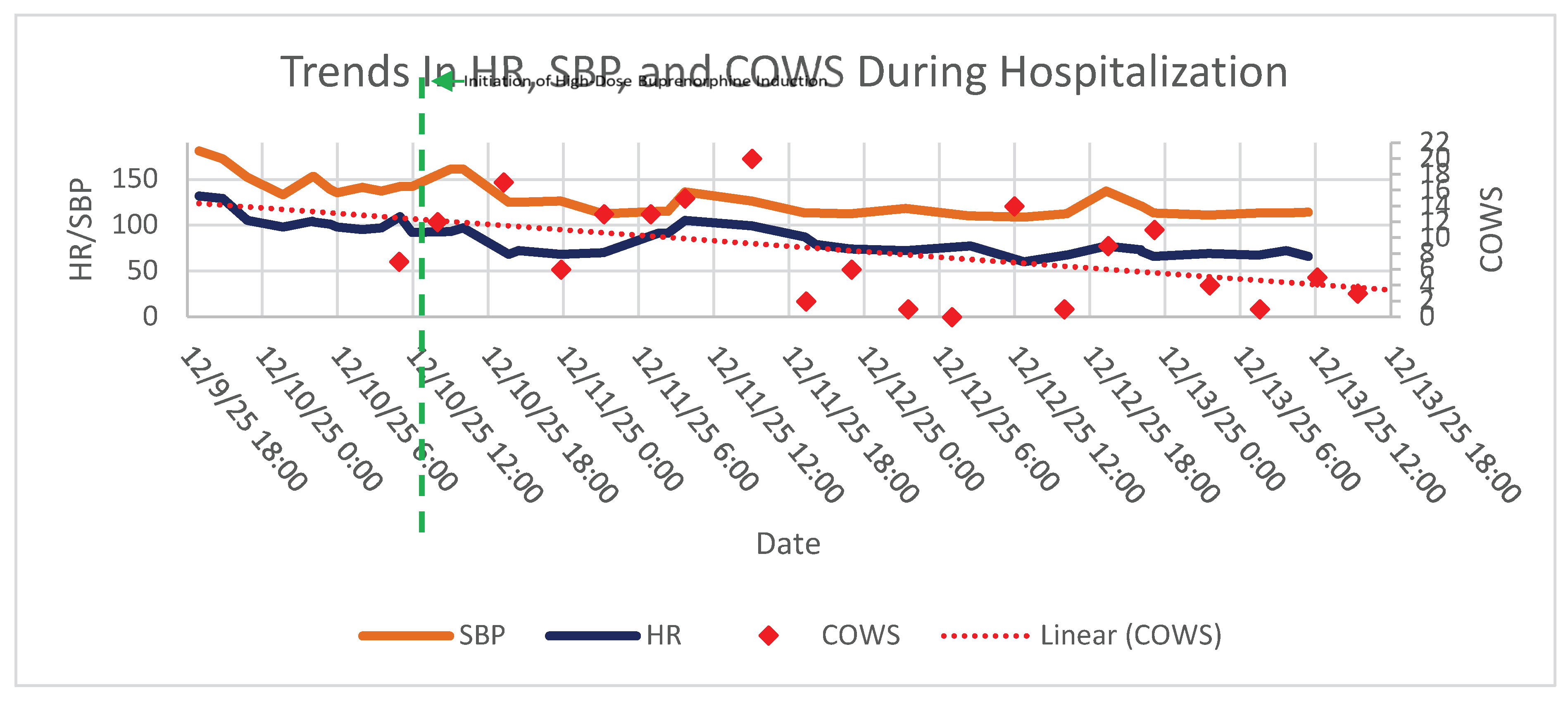

Table 1.
Buprenorphine Macro-Induction Titration Schedule with Benzodiazepines for Alcohol Withdrawal.
Table 1.
Buprenorphine Macro-Induction Titration Schedule with Benzodiazepines for Alcohol Withdrawal.
| Hospitalization Day | Maximum COWS Score | Buprenorphine Dosage Given (mg/day in dose) | AWS Score Range (24h) | Benzodiazepines given (for alcohol withdrawal) |
|---|---|---|---|---|
| 1 | 26 | 32 mg buprenorphine (2x 16 mg) | 6-9 | 15 mg diazepam (including 5 mg for buprenorphine macro-induction) + 2 mg lorazepam |
| 2 | 20 | 36 mg buprenorphine (24mg [8mg TID] + 8mg and 2x2 mg PRN) |
3-11 | 1 mg lorazepam |
| 3 | 14 | 32 mg buprenorphine (24 mg + 4x2 mg PRN) | 0-9 | 30 mg diazepam |
| 4 | 5 | 24 mg buprenorphine (8 mg TID) | 2-3 | 20 mg diazepam (5 mg QID) |
| 5 | 5 | 24 mg buprenorphine (8 mg TID) | 2-3 | 10 mg diazepam (5 mg BID) |
Disclaimer/Publisher’s Note: The statements, opinions and data contained in all publications are solely those of the individual author(s) and contributor(s) and not of MDPI and/or the editor(s). MDPI and/or the editor(s) disclaim responsibility for any injury to people or property resulting from any ideas, methods, instructions or products referred to in the content. |
© 2026 by the authors. Licensee MDPI, Basel, Switzerland. This article is an open access article distributed under the terms and conditions of the Creative Commons Attribution (CC BY) license (http://creativecommons.org/licenses/by/4.0/).
Copyright: This open access article is published under a Creative Commons CC BY 4.0 license, which permit the free download, distribution, and reuse, provided that the author and preprint are cited in any reuse.