

Submitted:
12 August 2026
Posted:
14 August 2026
You are already at the latest version
Abstract
The parallel evolution of agenda-setting and gatekeeping theory constitutes one of the most consequential intellectual trajectories in communication studies, yet the two traditions have developed largely in isolation from each other despite their deep functional interdependence. This paper undertakes a critical, integrative review of both traditions across the period 2000 to 2025, a quarter-century defined by the migration of public discourse from institutionally controlled media environments to algorithmically mediated digital platforms. Drawing on a structured synthesis of peer-reviewed scholarship, including the landmark platform-experiment literature of 2021–2025, the paper traces the transformation of gatekeeping from a process enacted by identifiable human decision-makers within institutional hierarchies to a distributed, computationally governed phenomenon in which algorithms, platform architectures, and user behaviors jointly determine the visibility of information. Simultaneously, it examines the reconfiguration of agenda-setting from a linear transfer of salience between media institutions and mass publics to a recursive, networked process shaped by personalization technologies, platform-specific affordances, and the fragmentation of formerly unified audiences into algorithmically constituted micro-publics. The paper introduces the concept of salience agency as an integrative meta-theoretical framework capable of capturing the convergence of gatekeeping and agenda-setting within contemporary communication systems. It argues that the algorithmic mediation of information visibility represents not merely a technological augmentation of existing communicative processes but a structural transformation that demands new theoretical vocabularies, new empirical methodologies, and new normative commitments. Implications for communication scholarship, media management, regulatory policy, and democratic governance are discussed, and priorities for future research are identified.
Keywords:
gatekeeping theory
; agenda-setting
; algorithmic curation
; digital media
; platform governance
; salience agency
; public discourse
; media theory
1. Introduction
The capacity of media systems to determine which issues, events, and interpretations achieve public visibility has long been recognized as among the most consequential dimensions of communicative power in democratic societies. Two theoretical traditions have supplied the dominant analytical frameworks for understanding this capacity. Gatekeeping theory, originating in Kurt Lewin's wartime studies of food distribution channels [24] and adapted to communication research by David Manning White [50], examines the processes, actors, and institutional structures through which information is selected, filtered, and channeled toward publics. Agenda-setting theory, inaugurated by McCombs and Shaw's landmark study of the 1968 United States presidential campaign [25], investigates the mechanisms through which media attention to particular issues shapes public perceptions of their importance, establishing a correspondence between the media agenda and the public agenda that has since been replicated across hundreds of empirical studies in diverse national and cultural contexts.
Despite their evident functional relationship — gatekeeping determines what information passes through institutional filters, while agenda-setting describes the consequences of that filtering for public cognition — these traditions have developed along largely separate intellectual trajectories. Gatekeeping research has concentrated on the internal sociology of media organizations, examining the decision-making routines, professional norms, and institutional pressures that shape editorial selection [40]. Agenda-setting research has concentrated on the external effects of media coverage on public opinion, treating the media agenda as a largely exogenous variable whose formation is analytically prior to the question of its influence [26]. The result is what this paper characterizes as a disciplinary bifurcation: a division of labor that has generated important insights within each tradition while obscuring the systemic connections between the processes of information selection and their consequences for public salience.
The digital transformation of the media landscape between 2000 and 2025 has rendered this bifurcation untenable. The rise of social media platforms, algorithmic content curation, and participatory digital culture has fundamentally altered the structures through which information achieves public visibility, collapsing the institutional boundaries that once separated the gatekeeping function from its agenda-setting consequences. In the algorithmic media environment, the act of filtering information and the act of conferring salience upon it are no longer sequential processes performed by distinct actors in distinct institutional settings; they are simultaneous, recursive, and frequently indistinguishable operations performed by computational systems whose decision logic is opaque both to the publics they serve and to the scholars who study them [7,40]. Recent large-scale field experiments conducted on Facebook and Instagram during the 2020 United States election cycle have confirmed empirically what theorists had argued conceptually: the feed-ranking algorithm is now a first-order determinant of what citizens see, substantially restructuring exposure to political information relative to chronological alternatives [16,18].
This paper undertakes a critical, integrative review of gatekeeping and agenda-setting theory across this transformative period, pursuing three interconnected objectives. The first is descriptive: to map the evolution of both traditions from their pre-digital foundations through their successive adaptations to the realities of digital and algorithmic media. The second is analytical: to identify and examine the points of theoretical convergence that the digital transformation has made visible, including the shared mechanisms of algorithmic filtering, platform governance, and networked information flow that now govern both processes simultaneously. The third is constructive: to propose the concept of salience agency — defined as the capacity of any actor, whether human, institutional, or algorithmic, to influence the visibility, prominence, and perceived importance of information within the public communication system — as an integrative meta-theoretical framework that bridges the analytical gap between gatekeeping and agenda-setting, accommodates the empirical complexity of the contemporary media landscape, and generates productive directions for future research.
The significance of this undertaking extends beyond academic communication theory. The processes through which information achieves public visibility are foundational to democratic governance, the formation of public opinion, and the capacity of citizens to make informed judgments about matters of collective concern. When these processes are governed by opaque algorithmic systems optimized for commercial engagement rather than democratic deliberation, the implications for the quality of public discourse and the health of democratic institutions are profound [44,52]. Understanding the convergence of gatekeeping and agenda-setting in the algorithmic age is therefore not merely a scholarly exercise but a civic imperative.
2. Review Methodology
This paper employs a structured integrative review methodology designed to synthesize theoretical and empirical contributions from communication studies, supplemented by relevant work in information science, political communication, computational social science, and platform governance research. The integrative review method was selected for its capacity to accommodate both quantitative and qualitative research traditions, to identify theoretical convergences across heterogeneous bodies of literature, and to generate new conceptual frameworks through systematic synthesis rather than mere aggregation [47].
The review encompasses peer-reviewed journal articles, scholarly monographs, edited volumes, and substantive institutional reports published between 2000 and 2025, with selective engagement with foundational texts from earlier periods where necessary to establish theoretical lineage. Literature was identified through systematic searches of major academic databases — Scopus, Web of Science, Communication Abstracts, and Google Scholar — using search terms encompassing "gatekeeping theory," "agenda-setting," "algorithmic curation," "platform governance," "digital media," "networked gatekeeping," and related constructs. Searches were supplemented by backward citation tracking from key recent publications and forward citation tracking from foundational texts in both traditions. Particular weight was given to the most recent empirical wave (2020–2025), including the large-scale platform experiments conducted in collaboration with Meta during the 2020 United States election [16,18,35], algorithm-audit studies [1], and cross-national surveys of news consumption [33].
The scope of the review is deliberately broad, encompassing work from diverse national and cultural contexts in recognition that the digital transformation of media systems is a global phenomenon whose dynamics vary significantly across geopolitical settings. Particular attention has been paid to scholarship examining platform governance beyond Western liberal democracies — including work on China [21], the Arab world [22], Ukraine [15], and Palestine [41] — to resist the universalization of theoretical models derived primarily from Western media systems.
The analytical framework is organized around three interconnected dimensions. The first is temporal, tracing the evolution of both traditions across the twenty-five-year period and identifying inflection points at which technological, institutional, or political developments necessitated theoretical revision. The second is structural, examining the architectural features of digital platforms that shape information filtering and salience conferral, including recommendation systems, content moderation policies, and platform-specific affordances. The third is normative, assessing the democratic implications of the observed transformations and evaluating the adequacy of existing regulatory frameworks for addressing them.
3. Theoretical Foundations: Gatekeeping and Agenda-Setting in the Pre-Digital Era
The study of how media systems shape the public visibility of issues has been central to understanding communicative power in democratic societies, and the gatekeeping and agenda-setting traditions supplied its primary analytical instruments. In the pre-digital era the two theories developed along distinct paths: gatekeeping illuminated the internal mechanics of media organizations, while agenda-setting measured the external influence of media coverage on public opinion. Together they laid the groundwork for understanding the flow and salience of information in traditional media environments — groundwork whose assumptions the algorithmic turn would later unsettle. Table 1 summarizes the principal milestones in the development of both traditions, from their mid-century origins to the threshold of the algorithmic era [2,5,6,19,25,26,39,40,42,50].
3.1. The Gatekeeping Tradition
Gatekeeping theory emerged from a fortuitous interdisciplinary transfer. Lewin's observation that food items pass through a series of "channels" governed by "gates" — decision points at which items are admitted or rejected [24] — was adapted by White to the study of news selection in his celebrated case study of a wire editor pseudonymously named "Mr. Gates" [50]. White demonstrated that the selection of news was governed not by objective criteria of newsworthiness alone but by the subjective judgments, personal biases, and professional routines of the individual gatekeeper. This finding — that the construction of "the news" is an inherently selective and interpretive process — supplied the foundational insight on which subsequent gatekeeping research was built.
Over the following decades the theory underwent progressive elaboration. Shoemaker developed a multi-level model situating the individual gatekeeper within concentric analytical levels — individual, routine, organizational, extra-media, and ideological — each exerting constraining influence on the selection process [39]. This model advanced decisively beyond White's individualistic framework by demonstrating that gatekeeping is not reducible to the preferences of individual decision-makers but is systematically shaped by institutional routines, organizational hierarchies, economic pressures, and broader ideological formations. Shoemaker and Vos later refined the framework, introducing the concept of audience gatekeeping to acknowledge the growing capacity of media consumers to participate in the selection and dissemination of information — an insight that anticipated the participatory dynamics of the digital environment [40].
A critical turning point was Barzilai-Nahon's reconceptualization of gatekeeping as a networked phenomenon [2]. Observing that the internet had introduced a communicative architecture fundamentally different from the one-to-many broadcast model assumed by classical theory, she proposed a network gatekeeping theory foregrounding network position, information control mechanisms, and the political relationship between gatekeepers and the "gated" — those whose access to information is controlled by gatekeeping processes. The reconceptualization was significant not only analytically but normatively: by identifying the gate as a distinct category with interests potentially opposed to those of the gatekeeper, it introduced questions of power, accountability, and legitimacy that earlier formulations had left underdeveloped. Subsequent work by Singer on "secondary gatekeeping" [42] and by Bruns on "gate watching" [5] extended the theory to the participatory dynamics of social media, in which users select, share, and amplify content in ways that complement and contest institutional editorial authority, while Bucher's analysis of algorithmic power marked the tradition's decisive confrontation with computational curation [6].
3.2. The Agenda-Setting Tradition
Agenda-setting theory was established by McCombs and Shaw's study of undecided voters in Chapel Hill, North Carolina, during the 1968 presidential election [25]. The study demonstrated a strong correlation between the issues emphasized in news coverage and the issues voters identified as most important, supporting the hypothesis that media do not tell people what to think but what to think about. This foundational insight — that media influence operates primarily through the conferral of salience rather than direct persuasion — has become one of the most robust findings in communication research.
The theory's evolution has proceeded through identifiable phases. The first level, established at Chapel Hill, concerns the transfer of object salience: the capacity of media to make certain issues more prominent in public consciousness. The second level, developed in the 1990s, extends the analysis to attribute salience — the capacity of media to shape not only which objects the public thinks about but which attributes of those objects are perceived as most important [26]. A newspaper that covers a candidate primarily in terms of leadership, for example, transfers salience not only to the candidate but to leadership as the evaluative frame through which the candidate is judged.
The emergence of digital media prompted a third level network agenda setting (NAS), which examines how media construct associative networks linking multiple objects and attributes, shaping not only what the public thinks about and in what terms but the cognitive associations through which discrete issues are connected into coherent interpretive frameworks [19]. NAS moved agenda-setting from a dyadic model of salience transfer to a network model of cognitive architecture in which the relationships among agenda items are as consequential as the items themselves. Vargo and Guo subsequently extended the NAS model to intermedia agenda-setting across digital platforms, demonstrating that the associative networks through which issues are cognitively linked are increasingly shaped by the algorithmic logic of platform-mediated information flows [48]. In the digital environment, the bundling of issues — the association of immigration with crime, or climate change with economic loss — is not merely a function of editorial framing but of algorithmic co-presentation, in which recommendation engines systematically present certain issues in conjunction with others on the basis of engagement optimization rather than journalistic judgment.
3.3. Points of Pre-Digital Convergence
Even before the digital transformation, perceptive scholars identified structural parallels between the traditions that pointed toward their eventual convergence. Both address the fundamental process through which certain information achieves public visibility while other information remains obscure. Both recognize that this process is not neutral but systematically shaped by institutional structures, professional norms, and power relations. And both implicitly acknowledge that the selection of information and the conferral of importance upon it are functionally inseparable — an item that passes through the gate simultaneously acquires a measure of public salience by virtue of its selection.
What prevented explicit integration in the pre-digital era was the institutional architecture of the legacy media system. In an environment characterized by a relatively small number of broadcasting and publishing institutions, each employing professional journalists governed by shared normative frameworks, the gatekeeping function was institutionally localized: it occurred within identifiable organizations whose decision-making could be studied through ethnographic, interview, and content-analytic methods. The agenda-setting function, by contrast, was diffused across the media system and manifested in its cumulative effects on public opinion. The institutional separation of these functions — one inside the newsroom, the other in the domain of public cognition — provided a pragmatic basis for their analytical separation, even as the theoretical grounds for that separation were always questionable.
The digital transformation dissolved this pragmatic basis by dissolving the institutional boundaries that sustained it. When algorithms replace editors, when users become distributors, and when platform architecture determines the conditions of information visibility, the gatekeeping function is no longer institutionally localized, and its agenda-setting consequences are no longer analytically separable from the filtering processes that produce them. The remainder of this paper examines that dissolution and its implications.
4. The Digital Media Landscape: Key Transformations (2000–2025)
The early twenty-first century ushered in a period of rapid and profound transformation in the media environment, reshaping how information is produced, disseminated, and consumed. As digital technologies matured and platforms emerged to challenge the dominance of traditional media, the foundations of public communication were fundamentally altered. This section traces the pivotal changes that redefined the media landscape between 2000 and 2025, highlighting the shift from institutionally controlled channels to algorithmically mediated networks.
4.1. From Institutional to Algorithmic Mediation
The period under examination witnessed a transformation in the architecture of public communication that is without precedent in the history of media. At the turn of the millennium, the dominant intermediaries between information producers and publics were institutional media organizations — newspapers, television networks, radio stations — staffed by professional journalists whose gatekeeping decisions were governed by established norms of newsworthiness, editorial standards, and institutional accountability. By 2025, these organizations, while still significant participants in the information ecosystem, had been substantially displaced as primary intermediaries by a small number of technology companies whose platforms — Meta, X, Google and YouTube, TikTok, and a handful of others — governed the visibility of information for billions of users through proprietary algorithmic systems [30,31]. The displacement is now measurable at the level of national news diets: by 2025, social media and video networks had for the first time overtaken television as the leading news source in the United States [33]. As shown in Table 2, this transformation unfolded across three analytically distinguishable phases [7,30].
The first phase, spanning roughly 2000 to 2008, was characterized by the digitization of legacy media and the emergence of early participatory platforms, including blogs, forums, and early social networking sites. During this period the internet was frequently conceptualized as a supplement to existing media structures rather than a qualitatively new communicative environment. Legacy organizations established online presences that largely reproduced their editorial hierarchies in digital form, and audience participation, while technically enabled, remained marginal to the primary circuits of information production [42].
The second phase, from approximately 2008 to 2016, witnessed the rapid ascendancy of social media platforms as major nodes in the information ecosystem. The proliferation of smartphones, the expansion of mobile internet access, and the development of algorithmically curated news feeds transformed platforms from social networking tools into primary channels of news consumption for large segments of the global population [12]. During this period the gatekeeping function began its migration from human editorial decision-makers to algorithmic systems, as platform companies discovered that personalized content feeds generated substantially higher engagement — and therefore advertising revenue — than chronologically ordered or editorially curated alternatives [36]. News organizations, in turn, became structurally dependent on platform distribution, reorganizing editorial workflows around the referral economies of a small number of dominant intermediaries [27,34].
The third phase, from 2016 onward, has been defined by the recognition — among scholars, policymakers, and publics — that the algorithmic mediation of information carries profound consequences for democratic governance, social cohesion, and epistemic integrity. The role of social media in the 2016 United States presidential election and the Brexit referendum catalyzed critical scrutiny of the mechanisms through which algorithmic systems shape public discourse [30], culminating in landmark regulatory responses including the European Union's Digital Services Act [10] and Artificial Intelligence Act [11]. This scrutiny generated a rapidly expanding body of scholarship on platform governance and algorithmic accountability — scholarship that provides the empirical foundation for the theoretical synthesis undertaken in this paper.
4.2. Hybrid Media Dynamics and the Dissolution of Categorical Boundaries
The concept of the hybrid media system, introduced by Chadwick [7], provides an essential analytical framework for understanding the contemporary information landscape. Chadwick argues that the media environment is characterized not by the simple displacement of "old" media by "new" media but by the ongoing interaction, competition, and mutual adaptation of diverse media logics — broadcast and networked, professional and participatory, institutional and algorithmic — within a single complex ecosystem. In this hybrid system, the boundaries between media production and consumption, between editorial selection and algorithmic curation, and between institutional authority and participatory influence are not fixed but fluid, contested, and continuously renegotiated.
The hybrid framework has profound implications for both traditions under review. For gatekeeping, it implies that the relevant unit of analysis is no longer the individual gatekeeper or media organization but the entire assemblage of human and non-human actors — journalists, editors, algorithms, platform policies, user behaviors, regulatory frameworks — that collectively determine the conditions of information visibility. For agenda-setting, it implies that the media agenda is no longer a singular construct measurable through content analysis of a finite set of outlets but a fragmented, platform-specific, and algorithmically personalized phenomenon that varies across audiences, platforms, and temporal contexts [46].
The dissolution of categorical boundaries has also generated new forms of intermedia agenda-setting. Harder and colleagues demonstrate that the directional flow of agenda influence between legacy media and digital platforms is reciprocal and dynamic, with issues originating on social media increasingly setting the agenda for legacy coverage and vice versa — even as traditional journalistic actors retain disproportionate influence over the composite news agenda during election periods [20]. The speed of this reciprocal influence has accelerated dramatically, with social media capable of elevating issues to national prominence within hours — a temporal compression that has fundamentally altered the rhythms of public discourse and the capacity of media professionals to exercise deliberative editorial judgment [48].
4.3. Platform Governance as Structural Gatekeeping
A critical analytical development of the post-2016 period has been the recognition that the governance structures of digital platforms — their terms of service, content moderation policies, and algorithmic design choices — function as structural gatekeeping mechanisms with consequences as far-reaching as any editorial decision [13]. Platform governance determines not only what content is visible but the conditions under which visibility is possible: the criteria by which content is recommended or suppressed, the standards by which it is evaluated for compliance with community guidelines, and the mechanisms through which users can contest moderation decisions.
Empirical research has increasingly documented the consequential nature of these governance structures. Roberts demonstrates that content moderation on major platforms functions not merely as a technical mechanism for removing harmful material but as a labor-intensive and politically significant process that shapes the informational environment according to platform priorities frequently opaque to external observers [37]. Zeng and Kaye's study of TikTok extends this insight, showing that governance on algorithm-intensive platforms increasingly operates through what they term visibility moderation — the calibrated amplification and suppression of content through recommendation infrastructure rather than through binary removal decisions [51]. Gillespie similarly documents the rise of "reduction" as a moderation strategy in which platforms quietly demote borderline content without removing it, exercising consequential gatekeeping power in a register that is nearly invisible to users and regulators alike [14]. Case-based scholarship reveals the political stakes of these arrangements: Siapera documents how Palestinian communicators navigating platform community standards have developed adaptive strategies for maintaining informational presence despite moderation policies that restrict conflict-related content [41], while Golovchenko and colleagues show how the information war over Ukraine was shaped by state actors, media institutions, and citizen curators operating within and against platform governance structures [15].
These cases underscore a broader analytical point: platform governance constitutes a form of gatekeeping structurally distinct from both traditional editorial gatekeeping and emergent algorithmic gatekeeping. Where editorial gatekeeping operates through the professional judgment of identifiable individuals and algorithmic gatekeeping through computational processes optimized for engagement, platform governance operates through the establishment of systemic rules and norms that define the parameters within which both of the former occur. It is, in this sense, a form of meta-gatekeeping — gatekeeping over the conditions of gatekeeping itself [13].
5. Empirical Analysis and Contemporary Data Synthesis (2000–2025)
This section synthesizes the empirical record on the evolving mechanisms of information filtering, gatekeeping, and agenda-setting across the review period. Drawing on recent scholarship, industry data, and comparative trends across platform architectures, it examines the transition from the digitization of legacy media to the rise of algorithmically curated platforms and the emergence of platform governance as a pivotal force in shaping public discourse. Three empirical domains are examined in turn: comparative filtering logics across platform types, algorithmic bias and salience distortion, and the counter-hegemonic potential of citizen journalism and decentralized networks.
5.1. Comparative Trends in Information Filtering Across Platform Architectures
Empirical investigation across the period reveals a fundamental and accelerating transformation in how information is prioritized, filtered, and disseminated. The shift was not merely quantitative — more content, more channels, more users — but qualitative, involving a structural reconfiguration of the relationships among producers, intermediaries, and audiences. By the early 2010s, platforms such as Facebook and Twitter had established themselves as significant nodes in the information ecosystem, capable of shaping content visibility in ways that paralleled and increasingly rivaled the editorial authority of legacy institutions [31]. By 2025, the algorithmic systems governing these platforms had assumed a gatekeeping function of historically unprecedented scale and complexity. Platform architecture constrains the logic of information filtering in distinctive and consequential ways: professional norms developed under conditions of institutional autonomy are compelled to coexist with platform-based algorithmic constraints operating according to fundamentally different logics of value [34]. Table 3 compares the principal gatekeeping mechanisms across the major platform types that now structure the information ecosystem [9,13].
Comparative evidence indicates that each architecture produces a distinctive information ecology. In the case of Meta and X, gatekeeping is enacted primarily through content moderation policies and the selective algorithmic weighting of content according to engagement signals and policy compliance [37]. Algorithm-audit research provides direct evidence of the material consequences of this weighting: Bandy and Dimakopoulos, comparing algorithmically curated with chronological Twitter timelines, found that the curation algorithm substantially altered users' media exposure, surfacing more accounts but fewer external news links and shifting the source composition of what users encountered [1]. For algorithm-intensive platforms such as TikTok, the gatekeeping mechanism is embedded within the recommendation engine itself, which curates content aligned with personal identities, preferences, and behavioral histories through what Bucher analyzes as programmed sociality — the algorithmic shaping of social relations and information exposure according to computational logics largely invisible to users [6]. This represents a qualitative departure from legacy gatekeeping logic. Where traditional editors selected content against professionally defined criteria of newsworthiness — timeliness, proximity, impact, prominence — the recommendation engine selects content on predicted individual relevance, substituting individualized pertinence for collective newsworthiness at the foundational level of information filtering. Critically, the inference of relevance is itself an act of gatekeeping: Thorson and colleagues demonstrate that Facebook's algorithmic classification of users as politically interested or uninterested becomes a self-fulfilling filter that determines whether political content reaches them at all [45].
The cumulative behavioral consequences of these architectural shifts are now visible in cross-national audience data. The Reuters Institute's forty-eight-market survey documents that social media and video networks reached 54% of Americans as a news source in 2025, overtaking both television news (50%) and news websites and applications (48%) for the first time, while personality-driven creators and podcasters increasingly rival institutional newsrooms as gateways to public affairs and roughly 7% of respondents globally — 15% among those under twenty-five — already use artificial intelligence chatbots to access news weekly [33]. Figure 1 visualizes this reconfiguration of the principal gateways through which publics now encounter news [33].
The agenda-setting implications of this substitution are profound. When the primary criterion of information visibility is individual relevance rather than collective importance, the structural conditions for the formation of a shared public agenda are undermined [44]. The classical agenda-setting model presupposed a common informational environment in which diverse publics encountered a broadly similar set of issues, enabling collective judgment about matters of shared concern. Algorithmic personalization fragments this common environment into millions of individualized micro-environments, each reflecting the inferred preferences, behaviors, and demographic characteristics of its user [36,46]. The public agenda, under these conditions, is no longer a collective construct but an aggregation of individual agendas whose points of convergence are incidental rather than structurally produced. Incidental exposure — encountering news while using platforms for other purposes — partially offsets this fragmentation, but such exposure is itself algorithmically conditioned and unevenly distributed across platforms and populations [12].
5.2. Algorithmic Bias, Salience Distortion, and Democratic Cognition
Algorithmic bias — the systematic and inequitable distortion of information visibility resulting from the design, training, or deployment of automated systems — carries direct and measurable consequences for the construction of public salience hierarchies. The empirical literature demonstrates that algorithms do not filter information neutrally; they prioritize on the basis of features and optimization objectives that may diverge substantially from criteria of public interest, democratic relevance, or informational accuracy. Guess and colleagues demonstrate that algorithmically mediated exposure to untrustworthy websites during the 2016 United States election was concentrated among specific demographic groups, with older and more ideologically extreme users disproportionately exposed to low-quality information [17]. The landmark 2020 election collaboration between academic researchers and Meta subsequently provided experimental evidence at unprecedented scale: González-Bailón and colleagues documented pronounced asymmetric ideological segregation in political news exposure on Facebook, with a large share of misinformation-labeled content circulating within homogeneously conservative audience segments [16], while Guess and colleagues found that replacing the ranking algorithm with a reverse-chronological feed substantially changed what users saw — increasing exposure to untrustworthy content while decreasing overall platform use — even though the three-month intervention did not measurably alter political attitudes [18]. Table 4 summarizes selected empirical evidence of algorithmic salience distortion across contexts and methodologies [1,3,4,8,16,17,18,43].
Two features of this evidence merit emphasis. First, the technical mechanisms of algorithmic bias are increasingly visible through methodological innovation. Dimakopoulos documents how algorithm-auditing techniques — sock-puppet audits, crowdsourced audits, reverse engineering — have enabled researchers to identify the input variables that determine visibility outcomes in news recommendation systems [9]. Large-scale analyses of language models reveal that these systems amplify biases embedded in training data, including biases of gender, race, institutional prestige, and political orientation, in ways that are systematic yet difficult to detect through conventional quality assurance [3]. As generative systems are increasingly deployed to summarize and curate news, the resulting distortion of salience acquires a structural character that transcends individual instances of bias. Second, the relationship between algorithmic mechanism and attitudinal outcome is more complex than early filter-bubble accounts assumed. The 2020 election experiments found that reducing exposure to like-minded sources did not measurably reduce affective polarization over the study window [35], and Metzler and Garcia argue on this basis that algorithmic effects must be understood as interacting with — rather than overriding — the social and psychological drivers of selective exposure [29]. The theoretical implication is not that algorithmic gatekeeping is inconsequential but that its consequences operate primarily at the level of exposure architecture, cumulative over time and unevenly across subpopulations, rather than through immediate attitudinal conversion.
Evidence from national media systems corroborates the structural reading. Analysis of United Kingdom election coverage shows that ownership structures and platform-driven logics of content optimization materially influence the salience of political candidates and their attributes [8]. Benkler and colleagues demonstrate that the networked architecture of American political communication, combined with platform amplification dynamics, facilitated an asymmetrically polarized media ecosystem in which disinformation achieved national salience [4]. Starbird and colleagues document how participatory disinformation campaigns exploit algorithmic amplification to elevate fringe interpretations of mass-casualty events into publicly salient counter-narratives [43]. Collectively, these findings indicate that in the algorithmic environment the classical transfer of salience identified by McCombs and Shaw [25] is simultaneously a transfer of bias, wherein the optimization objectives of the algorithmic gatekeeper become, through recursive feedback, the cognitive priorities of the public.
5.3. Citizen Journalism, Decentralized Networks, and Counter-Hegemonic Agenda-Setting
The emergence of citizen journalism and distributed news networks offers a counter-narrative to the concentration of gatekeeping power in algorithmic platforms, demonstrating that the digital environment retains meaningful — if structurally constrained — possibilities for participatory and counter-hegemonic agenda-setting. In contexts where institutional media are constrained by state censorship, commercial capture, or platform governance policies, distributed gatekeeping has enabled insurgent agendas to surface and achieve public visibility.
The empirical record provides numerous illustrations. In China during the early 2000s, netizens used blogs to construct an alternative information ecosystem that challenged the narrative monopoly of state media, demonstrating the capacity of decentralized communication to open spaces for political discourse even within authoritarian environments [21]. The Arab Spring uprisings provide a particularly instructive case: civil society actors deployed decentralized communication technologies to resist autocratic control over the information environment and construct political agendas independent of state channels [22]. Palestinian communicators have developed adaptive strategies for maintaining informational presence despite restrictive platform moderation [41], and citizen curators shaped the informational contest surrounding the Ukraine conflict [15]. Collaborative platforms exhibit a further variant: Wikipedia interacts with global news media to generate what Mesgari and colleagues describe as a collaborative knowledge ecosystem, in which topic salience is determined through the aggregated judgments of thousands of contributors rather than the decisions of a small number of institutional gatekeepers [28].
The evidence also reveals significant limitations of citizen journalism as an alternative to institutional gatekeeping. During the COVID-19 pandemic, audiences demonstrated continued and often increased reliance on traditional news media for verification and editorial safeguarding, suggesting that professional gatekeeping retains a form of public legitimacy that citizen journalism has not achieved [32]. Moreover, even the most structurally distributed networks are subject to what might be termed shadow gatekeeping. Shaw's study of an open online collective shows that while participation is actively encouraged through platform design, the salience of contributions is ultimately determined by structural features including administrator visibility decisions and algorithmic content ordering [38]. Kreiss and McGregor demonstrate that technology firms shape the parameters of political communication through infrastructure provision, data analytics, and partnership arrangements that concentrate consequential authority within platform companies even as surface dynamics appear decentralized [23]. The decentralized surface of participatory platforms frequently conceals concentrated decision-making authority, reproducing in new technological forms the gatekeeping hierarchies it ostensibly displaces [52].
These findings suggest that the digital environment presents not a binary between centralized institutional gatekeeping and decentralized participatory openness but a complex ecology in which multiple modes of gatekeeping and agenda-setting coexist, interact, and compete. The challenge for theory is to capture this complexity without either romanticizing the democratizing potential of decentralized networks or dismissing them as epiphenomenal to algorithmic platform power.
6. Synthesizing Gatekeeping and Agenda-Setting in the Algorithmic Ecosystem
In the algorithmic media landscape the boundaries between gatekeeping and agenda-setting have become progressively blurred. Traditional models treated the processes as distinct: gatekeeping involved the selection and filtering of information by journalists and editors, while agenda-setting referred to the prioritization of issues for public attention. The rise of algorithmic platforms has reconfigured these roles, embedding both selection and salience within complex automated systems. This section synthesizes the two traditions, arguing that the recursive, distributed, and technically mediated mechanisms of information visibility require integrated theoretical vocabulary.
6.1. The Convergence Thesis
The empirical patterns examined above collectively substantiate the central argument of this paper: the digital transformation has produced a functional convergence of gatekeeping and agenda-setting that demands theoretical integration. In the algorithmic environment, filtering information and conferring salience upon it are no longer sequential processes performed by distinct actors in distinct institutional settings. They are simultaneous, recursive, and frequently indistinguishable operations performed by computational systems whose design and optimization objectives embed specific — if often unacknowledged — assumptions about what information should be visible and to whom [6].
This convergence is manifest across multiple analytical dimensions. At the level of mechanism, recommendation systems simultaneously perform the gatekeeping function of selecting which content is presented and the agenda-setting function of determining its relative prominence and perceived importance. At the level of structure, platform architecture constitutes the institutional framework for both filtering and salience conferral, displacing the newsroom as the primary site at which the conditions of public visibility are determined [31]. At the level of outcome, personalized information environments simultaneously reflect the algorithm's filtering decisions and shape the user's salience perceptions in a recursive loop that defies the linear logic of classical models.
The implications for existing frameworks are substantial. Classical gatekeeping theory assumed the gate was a discrete decision point at which information was admitted or rejected by an identifiable human agent. In the algorithmic environment, the gate is a continuous probabilistic process in which information is assigned a visibility score determining its position within a personalized feed — a position that changes dynamically with real-time engagement signals [9]. The moderation repertoire itself has shifted from exclusion to modulation: platforms increasingly govern by adjusting visibility rather than admitting or removing content [14,51]. Classical agenda-setting theory assumed salience was transferred from a unified media agenda to a mass public through repeated common exposure. In the algorithmic environment there is no unified media agenda, no mass public, and no common content — only a multiplicity of algorithmically constituted micro-agendas tailored to individual users on predicted relevance and engagement potential [46].
6.2. Salience Agency: An Integrative Framework
The foregoing analysis motivates the introduction of salience agency as a unifying conceptual framework. Salience agency is defined as the capacity of any actor — human, institutional, or algorithmic — to influence the visibility, prominence, and perceived importance of information within the public communication system. Unlike traditional conceptualizations of gatekeeping authority, which locate agencies in identifiable decision-makers within institutional hierarchies, salience agency is distributed, recursive, and emergent. It encompasses the micro-gatekeeping acts of individual users (sharing, liking, commenting), the meso-level curation performed by platform algorithms (recommendation, moderation, ranking), and the macro-level influence of institutional media, regulatory bodies, and civil society organizations. Table 5 sets out the five analytical dimensions of the framework [2,6,40].
The concept addresses three analytical gaps in existing literature. First, it provides a vocabulary for describing the functional equivalence of diverse gatekeeping acts that operate at different scales and through different mechanisms but produce converging effects on public salience hierarchies. A journalist's editorial decision, an algorithm's ranking calculation, and a user's decision to share a post are ontologically distinct acts, yet each contributes to the same aggregate outcome: the construction of what the public perceives as important. Second, salience agency captures the recursive character of contemporary information flows, in which the outputs of gatekeeping and agenda-setting feed back into the inputs that drive subsequent iterations. Third, the framework accommodates the normative heterogeneity of the contemporary ecosystem, in which professional journalistic ethics, platform terms of service, community norms, and individual preferences simultaneously govern — and compete over — the criteria by which information achieves visibility.
Operationally, salience agency can be analyzed across the five dimensions set out in Table 5. By mapping empirical cases across these dimensions, researchers can generate systematic comparative analyses of salience agency across platforms, political contexts, and historical periods, identifying patterns of concentration, contestation, and change that remain invisible within the separate frameworks of gatekeeping and agenda-setting theory alone.
6.3. Recursive Dynamics: The Salience Loop
The recursive character of information flows in the algorithmic environment deserves particular theoretical emphasis, as it represents perhaps the most fundamental departure from the linear, sequential logic of classical models. In the legacy environment, the flow of influence was predominantly unidirectional: media organizations selected and presented information, audiences formed salience perceptions on that basis, and audience feedback — ratings, circulation figures, letters to the editor — influenced subsequent editorial decisions only indirectly and with significant delay. The information cycle was measured in days and weeks, and each cycle was largely independent of its predecessors.
In the algorithmic environment this cycle has been compressed to seconds and made continuously recursive. An algorithm presents content to a user; the user's engagement or non-engagement generates data that feeds back into the algorithm, modifying the criteria by which subsequent content is selected and ranked; the modified algorithm presents new content reflecting the user's revealed preferences as interpreted by the system; and the cycle repeats, continuously and in real time [6,36]. Each iteration simultaneously performs gatekeeping and agenda-setting, with the output of each cycle serving as the input to the next. Figure 2 depicts this recursive architecture, which this paper designates the salience loop [6,36,46].
The recursive dynamic has three consequential properties. The first is path dependence: because each iteration builds on the outputs of previous iterations, initial conditions — the user's first platform interactions, the content available at the moment of initial engagement, the algorithmic parameters then in effect — exert disproportionate influence on subsequent exposure, a mechanism empirically visible in the self-reinforcing classification dynamics documented on Facebook [45]. The second is convergence: optimization objectives designed to maximize engagement tend to drive the loop toward content that is emotionally arousing, ideologically confirming, or socially validating, regardless of informational accuracy or democratic relevance [44,52]. The third is opacity: because the loop operates within proprietary systems inaccessible to external scrutiny, the processes through which public salience is constructed are effectively invisible to the publics whose cognitive priorities they shape [9]. Table 6 contrasts the classical and algorithmic models of communication across their principal structural features [6,25,40,46].
The contrast summarized in Table 6 should not be read as a claim that the classical model has been wholly superseded. The hybrid media system ensures that editorial and algorithmic logics coexist and interpenetrate [7], and the experimental literature cautions against technologically determinist readings in which the algorithm unilaterally manufactures public opinion [29,35]. The claim, rather, is architectural: the infrastructure within which all salience-seeking actors — journalists, politicians, activists, ordinary users — must now operate is one whose default dynamics are recursive, personalized, and computationally governed.
7. Discussion: Implications for Theory, Practice, and Policy
The findings and conceptual advances presented above carry implications across three domains: communication theory, media management and professional journalism, and regulatory policy. As gatekeeping and agenda-setting converge within algorithmic environments, the recursive dynamics of salience agency reshape how information is filtered, prioritized, and made visible — and therefore how the construction of public knowledge must be understood, managed, and governed.
7.1. Theoretical Implications
The convergence documented in this paper necessitates a fundamental reorientation of communication theory. The salience agency framework represents one such reorientation, but its implications extend beyond the specific concepts it introduces. The analysis indicates that scholars should shift from examining discrete media effects toward studying systemic dynamics: how information ecosystems are constituted, and how public knowledge and public ignorance are collectively produced. The 2020 election experiments illustrate the stakes of this shift. Their finding that feed interventions changed exposure without changing short-run attitudes [18,35] is anomalous within a linear effects paradigm but intelligible within a systemic one: the power of algorithmic gatekeeping lies less in immediate persuasion than in the long-run architecture of visibility — path-dependent, cumulative, and unevenly distributed across the population [16,29].
This shift requires methodological as well as theoretical innovation. The recursive dynamics of the salience loop cannot be adequately captured by the cross-sectional surveys and content analyses that have dominated agenda-setting research, nor by the ethnographic and interview methods characteristic of gatekeeping research. Computational methods — agent-based modeling, network analysis, algorithm auditing, large-scale digital trace analysis — are essential for tracking the real-time processes through which salience is constructed [1,9,48]. At the same time, computational methods must be integrated with qualitative approaches capable of capturing the interpretive, cultural, and political dimensions of information filtering that purely quantitative analyses risk obscuring. The future of research in this domain lies in mixed-method designs combining computational rigor with interpretive depth.
The analysis also highlights the need for greater attention to the normative dimensions of communication theory. Classical gatekeeping and agenda-setting research was predominantly descriptive, identifying the mechanisms of filtering and salience conferral without evaluating their democratic adequacy. In an environment where the processes governing public information are opaque, commercially motivated, and demonstrably capable of distorting deliberation, purely descriptive approaches are insufficient. Communication theory must develop normative frameworks capable of evaluating the democratic legitimacy of different configurations of salience agency — frameworks that specify not only how salience is constructed but how it ought to be constructed in a society committed to informed self-governance [44].
7.2. Implications for Media Management and Professional Practice
For media managers and professional journalists, the convergence presents both challenges and opportunities. The challenge is institutional adaptation: organizations developed for an environment of concentrated editorial authority must now operate within an ecosystem in which that authority is distributed across a complex assemblage of human and algorithmic actors, and in which their own distribution depends on intermediaries they do not control [27,34]. This requires new technical competencies — platform analytics, algorithmic optimization, digital audience engagement — and the negotiation of profound tensions between journalistic norms of public service and the engagement-driven logics of platform distribution.
The opportunity lies in the distinctive value professional journalism can offer within the algorithmic ecosystem. In an environment saturated with unverified, algorithmically amplified content, the capacity for independent verification, contextual analysis, and accountable editorial judgment constitutes a form of institutional legitimacy that algorithmic systems cannot replicate. The COVID-19 pandemic demonstrated that audiences value this capacity and return to professional institutions when the stakes of accuracy are perceived as high [32]. Yet the 2025 audience data counsel against complacency: as personality-driven creators and AI chatbots claim growing shares of news attention [33], institutional journalism's gateway position is eroding even where its epistemic authority persists. The concept of entrepreneurial journalism [49] provides a useful framework for adaptation: by developing platform-literate editorial strategies that leverage algorithmic dynamics while maintaining commitments to accuracy, fairness, and public service, media organizations can position themselves as salience intermediaries — actors that mediate between the engagement logic of platforms and the deliberative requirements of democratic publics.
7.3. Policy and Regulatory Implications
The concentration of salience agency in a small number of technology companies whose algorithmic systems govern information visibility for billions of users represents a historically unprecedented concentration of communicative power [52]. This concentration is not adequately addressed by regulatory frameworks developed for a media environment of institutional pluralism, editorial accountability, and relatively transparent decision-making.
The European Union's Digital Services Act [10] and Artificial Intelligence Act [11] represent significant regulatory innovations, establishing requirements for algorithmic transparency, content moderation accountability, researcher data access, and the assessment of systemic risks posed by very large online platforms. Their effectiveness, however, depends on enforcement mechanisms capable of monitoring algorithmic behavior at scale and assessing the democratic consequences of governance decisions that are technically complex, commercially sensitive, and continuously evolving. Comparative research suggests that regulatory effectiveness depends critically on technical expertise within agencies, platform cooperation with external auditing, and independent research infrastructure for ongoing assessment of algorithmic impact [30,31]. The salience agency framework may be of practical value here by providing a common analytical vocabulary for assessing how platform architectures, algorithmic designs, and governance policies distribute the capacity to influence visibility — and whether the resulting distribution is compatible with democratic norms of communicative pluralism.
The cultivation of algorithmic literacy among citizens is a complementary priority. Just as media literacy education sought to equip citizens to evaluate media messages critically, algorithmic literacy would equip them to understand how their information environments are constructed, the commercial and political interests shaping those mechanisms, and the strategies available for diversifying exposure. Research on personalization effects suggests that without such literacy, the recursive dynamics of the salience loop will continue to narrow information exposure in ways that undermine the epistemic foundations of deliberation [17,36,45]. Because the loop is distributed and technically mediated, interventions at any single point — technical, professional, regulatory, or educational — are unlikely to suffice alone; sustained progress requires coordinated, cross-sectoral effort integrating expertise from computer science, social science, law, and media practice.
8. Conclusion
The trajectory identified in this paper — from human-controlled gates to algorithmically modulated visibility, from collective public agendas to personalized micro-agendas, from institutional accountability to platform opacity — represents not the end of gatekeeping and agenda-setting as communicative phenomena but their transformation into forms that demand new theoretical tools, new empirical methodologies, and new normative commitments. The quarter-century examined here has witnessed a structural reconfiguration of the processes through which democratic publics come to perceive certain issues as important and others as invisible, and this reconfiguration carries consequences extending far beyond academic communication theory.
The salience agency framework offers one integrative vocabulary for analyzing the distributed, recursive, and technically mediated processes that characterize the algorithmic environment. By reconceptualizing gatekeeping and agenda-setting as dimensions of a single unified process — the construction of information visibility — the framework enables a more comprehensive understanding of how public salience is produced, contested, and transformed. Its five analytical dimensions — agent identity, mechanism of influence, scale of effect, degree of transparency, and normative orientation — provide a structured basis for empirical investigation and comparative analysis across platforms, political contexts, and historical periods.
The evidence reviewed demonstrates that the algorithmic mediation of information visibility is neither politically neutral nor democratically benign. Algorithmic gatekeeping systematically favors engagement over accuracy and commercial profitability over public interest [4,52]; its recursive dynamics create self-reinforcing patterns of exposure that narrow rather than broaden the epistemic horizons of democratic citizens; and the concentration of salience agency in a small number of opaque technology companies poses a structural challenge to the communicative foundations of self-governance. At the same time, the most rigorous recent evidence warns against fatalism: algorithmic architectures shape exposure powerfully but do not mechanically dictate belief [18,35], citizen networks retain real if constrained counter-hegemonic capacity [21,22], and regulatory instruments capable of mandating transparency now exist [10,11].
Addressing the challenge will require sustained effort across multiple domains: scholars must build frameworks and methods adequate to the complexity of the algorithmic environment; media professionals must negotiate platform logics without subordinating journalistic values to algorithmic imperatives; policymakers must ensure transparency, accountability, and pluralism in the distribution of salience agency; and citizens must acquire the algorithmic literacy necessary to understand and shape the information environments in which their political judgments are formed. The convergence of gatekeeping and agenda-setting in the algorithmic age is, at its core, a question about the conditions under which democratic publics can form the informed, shared judgments on which self-governance depends. The adequacy of the salience agency framework will be determined not by its theoretical elegance but by its capacity to generate empirical insight, inform practical intervention, and contribute to the construction of information environments worthy of the democratic publics they serve.
9. Recommendations for Future Research
The analysis presented in this paper suggests five priorities for the next phase of scholarship. First, longitudinal designs are needed to test the cumulative-exposure hypothesis that emerges from the reconciliation of the experimental and observational literatures: if algorithmic gatekeeping operates through path-dependent exposure architecture rather than short-run persuasion [18,29,35], then studies spanning years rather than months — tracking cohorts across platform environments — are required to capture its effects on public agendas. Second, the salience agency framework should be operationalized and validated: comparative studies mapping empirical cases across its five dimensions could establish whether the framework discriminates meaningfully among platforms, national contexts, and historical periods. Third, research must extend to the generative-AI layer of the ecosystem, as chatbots and AI-mediated summaries become news gateways for younger users [33]; the gatekeeping and agenda-setting properties of conversational systems — which compress the entire salience loop into a single opaque interlocutor — remain almost entirely unstudied [3]. Fourth, the field requires systematic non-Western and comparative research, since the platform experiments that anchor current knowledge were conducted almost exclusively in the United States [16,18,35], while the governance dynamics documented in China, the Arab world, Ukraine, and Palestine [15,21,22,41] indicate that salience agency is configured differently under different political regimes. Fifth, regulatory scholarships should evaluate the Digital Services Act's researcher-access and risk-assessment provisions [10] as a natural experiment in mandated transparency, generating evidence on whether disclosure regimes materially alter the distribution of salience agency.
The funding statements
This work was supported and funded by the Deanship of Scientific Research at Imam Mohammad ibn Saud Islamic University (IMSIU) (grant number IMSIU-DDRSP2602).
Conflicts of Interest
The authors declare no conflicts of interest.
Transparency
The author confirms that the manuscript is an honest, accurate and transparent account of the study that no vital features of the study have been omitted and that any discrepancies from the study as planned have been explained. This study followed all ethical practices during writing.
Declaration of generative AI and AI-assisted technologies in manuscript preparation
The author used (Paperpal) for language editing and (Perplexity) to verify the accuracy of citations and references. The author reviewed and edited all content and assumed full responsibility for the published article.
Consent to Participate declaration
not applicable.
Ethics declaration
not applicable.
References
- Bandy, J.; Diakopoulos, N. More accounts, fewer links: How algorithmic curation impacts media exposure in Twitter timelines. Proc. ACM Hum.-Comput Interact. 2021, 5(CSCW1), Article 78. [Google Scholar] [CrossRef]
- Barzilai-Nahon, K. Toward a theory of network gatekeeping: A framework for exploring information control. J. Am. Soc. Inf. Sci. Technol. 2008, 59(9), 1493–1512. [Google Scholar] [CrossRef]
- Bender, E.M.; Gebru, T.; McMillan-Major, A.; Shmitchell, S. On the dangers of stochastic parrots: Can language models be too big? In Proceedings of the 2021 ACM Conference on Fairness, Accountability, and Transparency; Association for Computing Machinery: New York, 2021; pp. 610–623. [Google Scholar] [CrossRef]
- Benkler, Y.; Faris, R.; Roberts, H. Network propaganda: Manipulation, disinformation, and radicalization in American politics; Oxford University Press: New York, 2018. [Google Scholar] [CrossRef]
- Bruns, A. Gatewatching and news curation: Journalism, social media, and the public sphere; Peter Lang: New York, 2018. [Google Scholar] [CrossRef]
- Bucher, T. If...then: Algorithmic power and politics; Oxford University Press: New York, 2018. [Google Scholar] [CrossRef]
- Chadwick, A. The hybrid media system: Politics and power, 2nd ed.; Oxford University Press: New York, 2017. [Google Scholar] [CrossRef]
- Cushion, S.; Thomas, R. Reporting elections: Rethinking the logic of campaign coverage; Polity Press: Cambridge, 2018; ISBN 978-1-5095-1751-0. [Google Scholar]
- Diakopoulos, N. Automating the news: How algorithms are rewritten by the media; Harvard University Press: Cambridge, MA, 2019; ISBN 978-0-674-97698-6. [Google Scholar]
- European Parliament, Council of the European Union. Regulation (EU) 2022/2065 of the European Parliament and of the Council of 19 October 2022 on a single market for digital services and amending Directive 2000/31/EC (Digital Services Act). Off. J. Eur. Union 2022, L 277, 1–102. Available online: https://eur-lex.europa.eu/eli/reg/2022/2065/oj.
- European Parliament, Council of the European Union. Regulation (EU) 2024/1689 of the European Parliament and of the Council of 13 June 2024 laying down harmonised rules on artificial intelligence (Artificial Intelligence Act). Off J Eur Union. 2024; L 2024/1689. Available online: https://eur-lex.europa.eu/eli/reg/2024/1689/oj.
- Fletcher, R.; Nielsen, R.K. Are people incidentally exposed to news on social media? A comparative analysis. New Media Soc. 2018, 20(7), 2450–2468. [Google Scholar] [CrossRef]
- Gillespie, T. Custodians of the internet: Platforms, content moderation, and the hidden decisions that shape social media; Yale University Press: New Haven, 2018; ISBN 978-0-300-17313-0. [Google Scholar]
- Gillespie, T. Do not recommend? Reduction as a form of content moderation. Soc. Media Soc. 2022, 8(3). [Google Scholar] [CrossRef]
- Golovchenko, Y.; Hartmann, M.; Adler-Nissen, R. State, media and civil society in the information warfare over Ukraine: Citizen curators of digital disinformation. Int. Aff. 2018, 94(5), 975–994. [Google Scholar] [CrossRef]
- González-Bailón, S.; Lazer, D.; Barberá, P.; Zoizner, A.; Gitomer, A.; Aral, S.; et al. Asymmetric ideological segregation in exposure to political news on Facebook. Science 2023, 381(6656), 392–398. [Google Scholar] [CrossRef] [PubMed]
- Guess, A.M.; Nyhan, B.; Reifler, J. Exposure to untrustworthy websites in the 2016 US election. Nat. Hum. Behav. 2020, 4(5), 472–480. [Google Scholar] [CrossRef] [PubMed]
- Guess, A.M.; Malhotra, N.; Pan, J.; Barberá, P.; Allcott, H.; Brown, T.; et al. How do social media feed algorithms affect attitudes and behavior in an election campaign? Science 2023, 381(6656), 398–404. [Google Scholar] [CrossRef] [PubMed]
- Guo, L.; McCombs, M. (Eds.) The power of information networks: New directions for agenda setting; Routledge: New York, 2016. [Google Scholar] [CrossRef]
- Harder, R.A.; Sevenans, J.; Van Aelst, P. Intermedia agenda setting in the social media age: How traditional players dominate the news agenda in election times. Int. J. Press Polit. 2017, 22(3), 275–293. [Google Scholar] [CrossRef]
- Hassid, J. Safety valve or pressure cooker? Blogs in Chinese political life. J. Commun. 2012, 62(2), 212–230. [Google Scholar] [CrossRef]
- Howard, P.N.; Hussain, M.M. Democracy's fourth wave? Digital media and the Arab Spring; Oxford University Press: New York, 2013. [Google Scholar] [CrossRef]
- Kreiss, D.; McGregor, S.C. Technology firms shape political communication: The work of Microsoft, Facebook, Twitter, and Google with campaigns during the 2016 U.S. presidential cycle. Polit. Commun. 2018, 35(2), 155–177. [Google Scholar] [CrossRef]
- Lewin, K. Frontiers in group dynamics II: Channels of group life; social planning and action research. Hum. Relat. 1947, 1(2), 143–153. [Google Scholar] [CrossRef]
- McCombs, M.E.; Shaw, D.L. The agenda-setting function of mass media. Public Opin. Q. 1972, 36(2), 176–187. [Google Scholar] [CrossRef]
- McCombs, M.E.; Shaw, D.L. The evolution of agenda-setting research: Twenty-five years in the marketplace of ideas. J. Commun. 1993, 43(2), 58–67. [Google Scholar] [CrossRef]
- Meese, J.; Hurcombe, E. Facebook, news media and platform dependency: The institutional impacts of news distribution on social platforms. New Media Soc. 2021, 23(8), 2367–2384. [Google Scholar] [CrossRef]
- Mesgari, M.; Okoli, C.; Mehdi, M.; Nielsen, F.Å.; Lanamäki, A. The sum of all human knowledge": A systematic review of scholarly research on the content of Wikipedia. J. Assoc. Inf. Sci. Technol. 2015, 66(2), 219–245. [Google Scholar] [CrossRef]
- Metzler, H.; Garcia, D. Social drivers and algorithmic mechanisms on digital media. Perspect. Psychol. Sci. 2024, 19(5), 735–748. [Google Scholar] [CrossRef] [PubMed]
- Napoli, P.M. Social media and the public interest: Media regulation in the disinformation age; Columbia University Press: New York, 2019; ISBN 978-0-231-18454-0. [Google Scholar]
- Nechushtai, E. Could digital platforms capture the media through infrastructure? Journalism 2018, 19(8), 1043–1058. [Google Scholar] [CrossRef]
- Newman, N.; Fletcher, R.; Robertson, C.T.; Eddy, K.; Nielsen, R.K. Reuters Institute digital news report 2022; Reuters Institute for the Study of Journalism: Oxford, 2022; Available online: https://reutersinstitute.politics.ox.ac.uk/digital-news-report/2022.
- Newman, N.; Fletcher, R.; Robertson, C.T.; Ross Arguedas, A.; Nielsen, R.K. Reuters Institute digital news report 2025; Reuters Institute for the Study of Journalism: Oxford, 2025; Available online: https://reutersinstitute.politics.ox.ac.uk/digital-news-report/2025.
- Nielsen, R.K.; Ganter, S.A. Dealing with digital intermediaries: A case study of the relations between publishers and platforms. New Media Soc. 2018, 20(4), 1600–1617. [Google Scholar] [CrossRef]
- Nyhan, B.; Settle, J.; Thorson, E.; Wojcieszak, M.; Barberá, P.; Chen, A.Y.; et al. Like-minded sources on Facebook are prevalent but not polarizing. Nature 2023, 620(7972), 137–144. [Google Scholar] [CrossRef] [PubMed]
- Pariser, E. The filter bubble: What the internet is hiding from you; Penguin Press: New York, 2011; ISBN 978-1-59420-300-8. [Google Scholar]
- Roberts, S.T. Behind the screen: Content moderation in the shadows of social media; Yale University Press: New Haven, 2019; ISBN 978-0-300-23588-3. [Google Scholar]
- Shaw, A. Centralized and decentralized gatekeeping in an open online collective. Polit. Soc. 2012, 40(3), 349–388. [Google Scholar] [CrossRef]
- Shoemaker, P.J. Gatekeeping; Sage: Newbury Park, CA, 1991; ISBN 978-0-8039-4436-7. [Google Scholar]
- Shoemaker, P.J.; Vos, T.P. Gatekeeping theory; Routledge: New York, 2009. [Google Scholar] [CrossRef]
- Siapera, E. Tweeting #Palestine: Twitter and the mediation of Palestine. Int. J. Cult. Stud. 2014, 17(6), 539–555. [Google Scholar] [CrossRef]
- Singer, J.B. User-generated visibility: Secondary gatekeeping in a shared media space. New Media Soc. 2014, 16(1), 55–73. [Google Scholar] [CrossRef]
- Starbird, K.; Arif, A.; Wilson, T. Disinformation as collaborative work: Surfacing the participatory nature of strategic information operations. Proc. ACM Hum.-Comput Interact. 2019, 3(CSCW), Article 127. [Google Scholar] [CrossRef]
- Sunstein, C.R. #Republic: Divided democracy in the age of social media; Princeton University Press: Princeton, 2017. [Google Scholar] [CrossRef]
- Thorson, K.; Cotter, K.; Medeiros, M.; Pak, C. Algorithmic inference, political interest, and exposure to news and politics on Facebook. Inf. Commun. Soc. 2021, 24(2), 183–200. [Google Scholar] [CrossRef]
- Thorson, K.; Wells, C. Curated flows: A framework for mapping media exposure in the digital age. Commun. Theory 2016, 26(3), 309–328. [Google Scholar] [CrossRef]
- Torraco, R.J. Writing integrative literature reviews: Guidelines and examples. Hum. Resour. Dev. Rev. 2005, 4(3), 356–367. [Google Scholar] [CrossRef]
- Vargo, C.J.; Guo, L. Networks, big data, and intermedia agenda setting: An analysis of traditional, partisan, and emerging online U.S. news. J. Mass Commun. Q. 2017, 94(4), 1031–1055. [Google Scholar] [CrossRef]
- Vos, T.P.; Singer, J.B. Media discourse about entrepreneurial journalism: Implications for journalistic capital. J. Pract. 2016, 10(2), 143–159. [Google Scholar] [CrossRef]
- White, D.M. The "gate keeper": A case study in the selection of news. J. Q. 1950, 27(4), 383–390. [Google Scholar] [CrossRef]
- Zeng, J.; Kaye, D.B.V. From content moderation to visibility moderation: A case study of platform governance on TikTok. Policy Internet 2022, 14(1), 79–95. [Google Scholar] [CrossRef]
- Zuboff, S. The age of surveillance capitalism: The fight for a human future at the new frontier of power; PublicAffairs: New York, 2019; ISBN 978-1-61039-569-4. [Google Scholar]
Figure 1.
The Reconfiguration of News Gateways in the Algorithmic Era (2025). Note. Panel A shows the share of United States respondents using each source for news weekly in 2025; Panel B shows weekly use of emergent algorithmic gateways across the 48-market global sample. Data from Newman et al. [33]. Figure created by the author.
Figure 1.
The Reconfiguration of News Gateways in the Algorithmic Era (2025). Note. Panel A shows the share of United States respondents using each source for news weekly in 2025; Panel B shows weekly use of emergent algorithmic gateways across the 48-market global sample. Data from Newman et al. [33]. Figure created by the author.
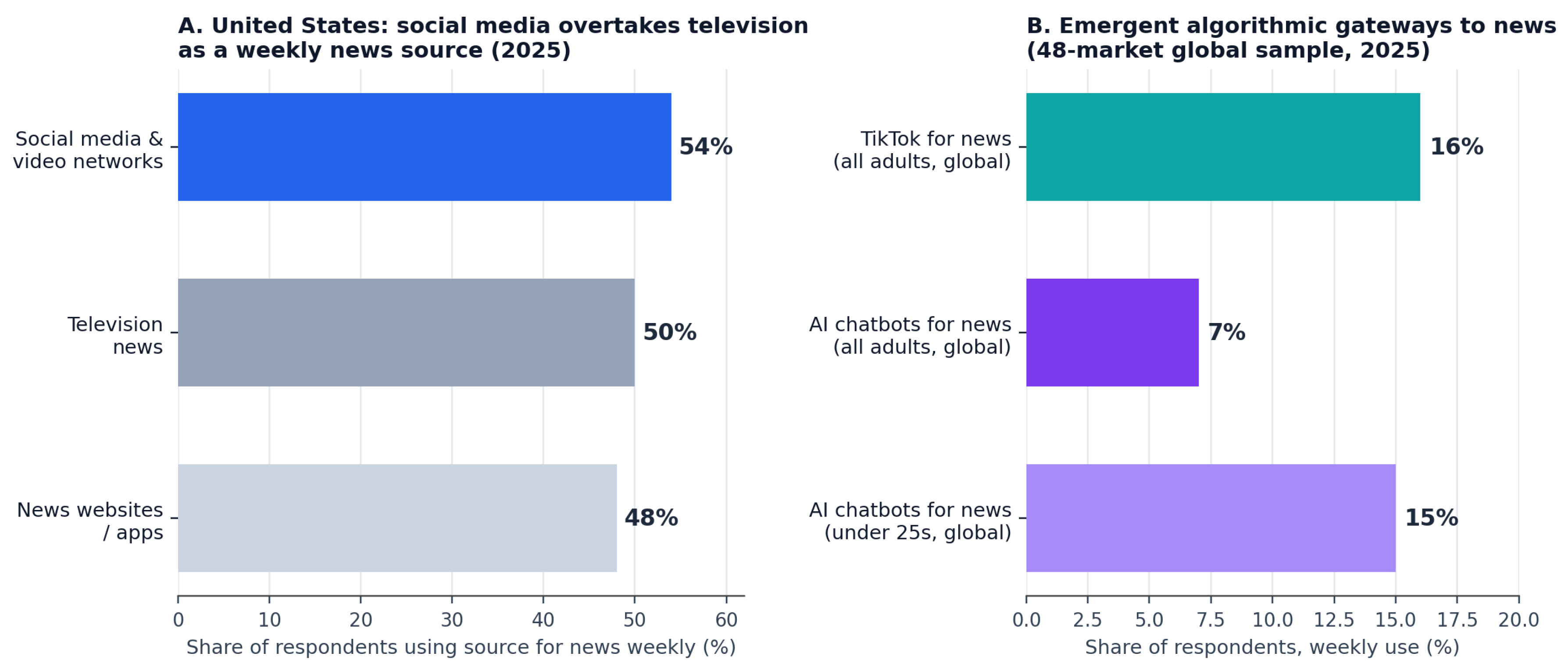
Figure 2.
The Salience Loop: Gatekeeping and Agenda-Setting as a Single Recursive Process. Note. The four-stage recursive cycle through which algorithmic curation (gatekeeping) and personalized salience formation (agenda-setting) continuously co-produce each other. Corner annotations identify the loop’s three consequential properties. Conceptualized by the author, drawing on Bucher [6], Pariser [36], and Thorson and Wells [46].
Figure 2.
The Salience Loop: Gatekeeping and Agenda-Setting as a Single Recursive Process. Note. The four-stage recursive cycle through which algorithmic curation (gatekeeping) and personalized salience formation (agenda-setting) continuously co-produce each other. Corner annotations identify the loop’s three consequential properties. Conceptualized by the author, drawing on Bucher [6], Pariser [36], and Thorson and Wells [46].
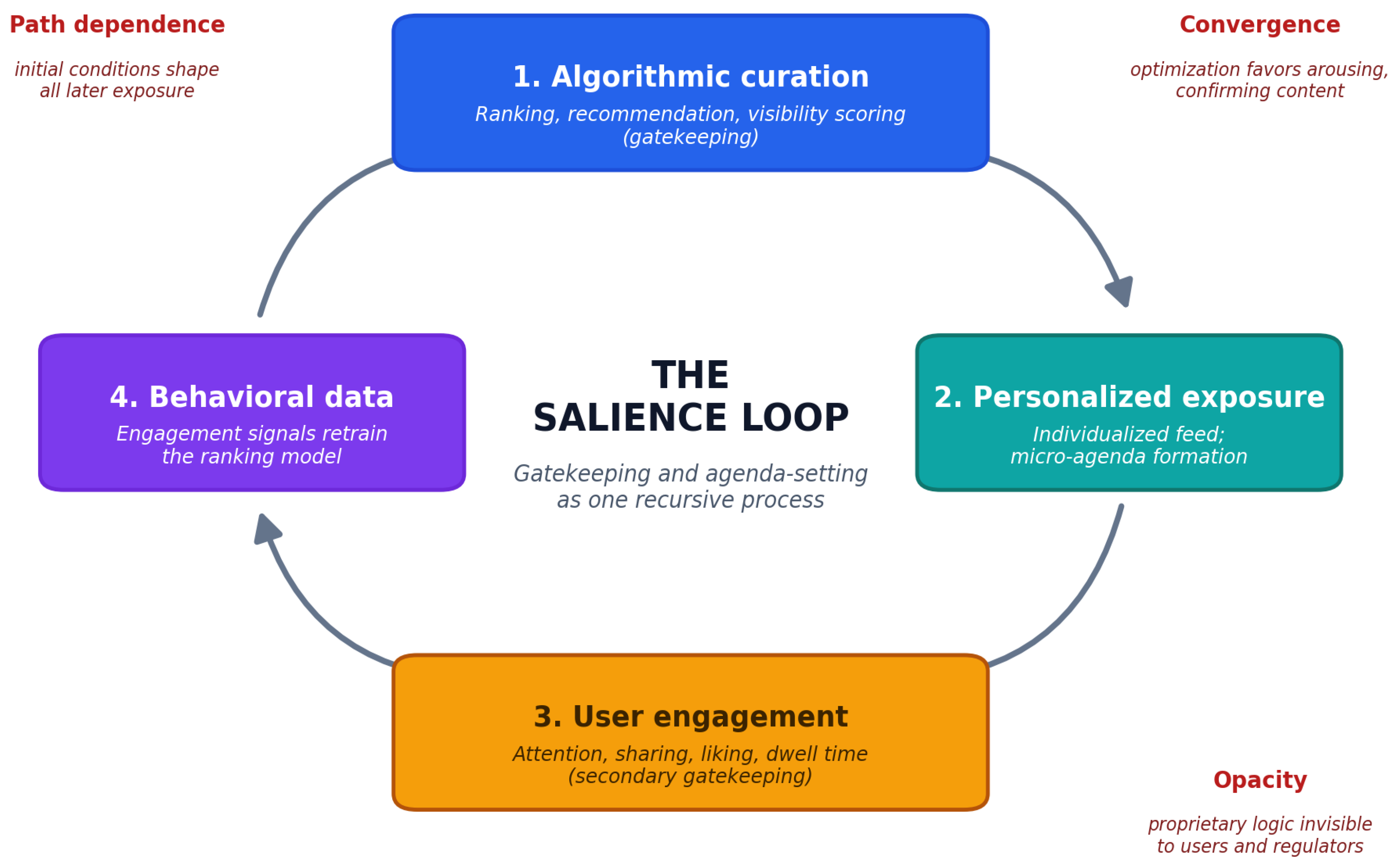

Table 1.
Foundational Milestones in the Evolution of Gatekeeping and Agenda-Setting Theory (1947–2018).
Table 1.
Foundational Milestones in the Evolution of Gatekeeping and Agenda-Setting Theory (1947–2018).
| Period | Scholar(s) | Tradition | Key Contribution | Analytical Focus |
|---|---|---|---|---|
| 1947 | Lewin [24] | Gatekeeping | Channel-and-gate metaphor for information flow | Conceptual foundation |
| 1950 | White [50] | Gatekeeping | Application to news selection ("Mr. Gates" case study) | Individual gatekeeper |
| 1972 | McCombs & Shaw [25] | Agenda-setting | First-level agenda-setting (Chapel Hill study) | Object salience transfer |
| 1991 | Shoemaker [39] | Gatekeeping | Multi-level model of gatekeeping influences | Individual, routine, organizational, extra-media, ideological levels |
| 1993 | McCombs & Shaw [26] | Agenda-setting | Second-level agenda-setting | Attribute salience transfer |
| 2008 | Barzilai-Nahon [2] | Gatekeeping | Network gatekeeping theory | Network position; gatekeeper–gated relations |
| 2009 | Shoemaker & Vos [40] | Gatekeeping | Audience gatekeeping; updated multilevel theory | Audience as active gatekeepers |
| 2014 | Singer [42] | Gatekeeping | Secondary gatekeeping in shared media spaces | User-generated visibility |
| 2016 | Guo & McCombs [19] | Agenda-setting | Third-level network agenda setting (NAS) | Associative issue–attribute networks |
| 2018 | Bruns [5]; Bucher [6] | Both | Gate watching; algorithmic power and programmed sociality | Participatory curation; computational gatekeeping |
Table 2.
Phases of Digital Media Transformation (2000–2025).
| Phase | Period | Defining Features | Predominant Gatekeeping Mode | Predominant Agenda-Setting Mode |
|---|---|---|---|---|
| 1 | 2000–2008 | Digitization of legacy media; emergence of blogs and early social platforms | Primarily institutional, with emergent participatory elements | Predominantly unidirectional; legacy media dominant |
| 2 | 2008–2016 | Ascendancy of social media; mobile internet proliferation; algorithmic news feeds | Migration from editorial to algorithmic selection; hybrid models | Reciprocal intermedia influence; platform-mediated salience |
| 3 | 2016–2025 | Platform scrutiny; regulatory responses (DSA, AI Act); AI-driven curation | Algorithmic dominance with platform-governance overlay | Fragmented micro-agendas; personalized salience hierarchies |
Table 3.
Comparative Gatekeeping Mechanisms Across Platform Types.
| Platform Type | Primary Gatekeeping Mechanism | Filtering Logic | Salience Criteria | Illustrative Example |
|---|---|---|---|---|
| Legacy media (print/broadcast) | Editorial selection by professional journalists | Professional news values (newsworthiness) | Timeliness, impact, proximity, prominence | Newspaper front-page placement |
| Social media (Meta, X) | Content moderation + algorithmic ranking | Community standards + engagement optimization | Engagement signals, policy compliance | Facebook News Feed algorithm |
| Video platforms (YouTube, TikTok) | Recommendation engine; visibility moderation | Behavioral prediction + personalization | Watch time, individual relevance, retention | TikTok "For You" page |
| Collaborative platforms (Wikipedia) | Community editing + consensus processes | Verifiability, notability, neutral point of view | Collective editorial judgment | Wikipedia article prominence and deletion policy |
| Search engines (Google) | Algorithmic indexing + ranking | Relevance scoring, authority signals | PageRank, content freshness, user signals | Google Search results ordering |
Table 4.
Selected Empirical Evidence of Algorithmic Salience Distortion (2018–2023).
| Source | Context and Method | Key Finding | Implication for Salience |
|---|---|---|---|
| Benkler et al. [4] | US political media ecosystem; network analysis | Asymmetric polarization driven by platform and network dynamics | Structural asymmetries in salience conferral across political orientations |
| Cushion & Thomas [8] | UK election coverage; content analysis | Ownership structures and platform logics shape candidate attribute visibility | Commercial interests distort political salience hierarchies |
| Starbird et al. [43] | Mass-shooting events; trace analysis | Participatory disinformation produces coordinated counter-narratives | Strategic actors exploit algorithmic amplification for agenda manipulation |
| Guess et al. [17] | 2016 US election; behavioral web data | Untrustworthy-website exposure concentrated among older, ideologically extreme users | Algorithmic exposure creates demographically stratified salience hierarchies |
| Bandy & Diakopoulos [1] | Twitter timelines; sock-puppet audit | Algorithmic curation shifted source composition: more accounts, fewer external news links | Curation restructures media exposure relative to chronological baseline |
| Bender et al. [3] | Large language models; critical analysis | LLMs amplify biases embedded in training data | AI-mediated curation reproduces inequitable visibility patterns |
| González-Bailón et al. [16] | 2020 US election; Facebook platform data | Pronounced asymmetric ideological segregation in political news exposure | Algorithmic and social curation jointly stratify the visible agenda |
| Guess et al. [18] | 2020 US election; field experiment | Chronological feed changed exposure and use but not short-run attitudes | Algorithmic power operates through exposure architecture, not immediate persuasion |
Note. Compiled by the author from the cited sources. Bracketed numbers refer to entries in the reference list.
Table 5.
Dimensions of Salience Agency: An Analytical Framework.
| Dimension | Description | Guiding Analytical Question |
|---|---|---|
| Agent identity | Human individual, institutional actor, or algorithmic system | Who or what exercises influence over information visibility? |
| Mechanism of influence | Editorial selection, algorithmic ranking, social sharing, regulatory intervention | Through what process is visibility determined? |
| Scale of effect | Individual, community, national, global | At what level does the salience effect operate? |
| Degree of transparency | Fully transparent, partially opaque, entirely opaque | To what extent are the criteria of visibility accessible to external scrutiny? |
| Normative orientation | Public interest, commercial engagement, political control, community consensus | What values or objectives guide the exercise of salience agency? |
Table 6.
Classical Versus Algorithmic Models of Communication.
| Feature | Classical Model | Algorithmic Model |
|---|---|---|
| Gate structure | Discrete decision points (admit/reject) | Continuous probabilistic visibility scoring |
| Gatekeeper identity | Identifiable human agents (editors, producers) | Opaque computational systems and platform policies |
| Audience conception | Mass public with broadly shared exposure | Fragmented micro-publics with personalized exposure |
| Information flow | Linear, predominantly unidirectional | Recursive, self-reinforcing (salience loop) |
| Temporal dynamics | News cycles measured in days or weeks | Real-time, continuous algorithmic updating |
| Feedback mechanism | Indirect and delayed (ratings, circulation, letters) | Direct and instantaneous (engagement data, behavioral signals) |
| Accountability framework | Professional norms, editorial codes of ethics | Terms of service, algorithmic design choices, regulatory instruments |
| Agenda formation | Unified media agenda transferred to public agenda | Multiple platform-specific, personalized micro-agendas |
Disclaimer/Publisher’s Note: The statements, opinions and data contained in all publications are solely those of the individual author(s) and contributor(s) and not of MDPI and/or the editor(s). MDPI and/or the editor(s) disclaim responsibility for any injury to people or property resulting from any ideas, methods, instructions or products referred to in the content. |
© 2026 by the authors. Licensee MDPI, Basel, Switzerland. This article is an open access article distributed under the terms and conditions of the Creative Commons Attribution (CC BY) license (http://creativecommons.org/licenses/by/4.0/).
Copyright: This open access article is published under a Creative Commons CC BY 4.0 license, which permit the free download, distribution, and reuse, provided that the author and preprint are cited in any reuse.