

Submitted:
06 February 2026
Posted:
15 February 2026
You are already at the latest version
Abstract
Sustainable environmental performance (SEP) among small and medium-sized enter-prises (SMEs) has attracted researchers and practitioners’ attention. The achievement of sustainable environmental performance has been largely dependent on the prevail-ing external ecosystem conditions. Yet in emerging economies such as Ghana, there is limited research and evidence on the extent to which external ecosystem resources in-fluence sustainable environmental performance. This study aims to investigate how external entrepreneurial ecosystem resources including policy, access to finance, mar-ket availability, institutional support, human capital and culture influence the sus-tainable environmental performance (SEP) of small and medium-sized enterprises (SMEs) using sample data from Ghana. Drawing on a positivist, deductive, objective, cross sectional design, we surveyed 386 SMEs manufacturing and service firms. Structural Equation Modeling (PLS-SEM) tested a multi-theory framework grounded in Resource Based View (RBV), Resource Dependency Theory (RDT) and Stakeholder Theory. The results indicate that policy, finance, institutional support, and markets exert significant positive effects on SMEs’ SEP. Culture and human capital were found to have weaker contribution to SMEs’ SEP. These findings highlight the primacy of structural over internal factors in resource constrained settings such as Ghana. We advance the RBV, RDT and the Stakeholder Theory by showing that external ecosys-tem resources act as critical environmental enablers for SMEs in developing economies. The findings offer globally relevant policy insights for advancing SDGs 12 (Responsible Consumption and Production) and 13 (Climate Action) through targeted ecosystem interventions.
Keywords:
external ecosystem resources
; sustainable environmental performance
; SMEs
; Ghana
; emerging economies
1. Introduction
SMEs contribute to economic development in Ghana, with an estimated proportion of close to 70% of industrial workers, as well as the Gross Domestic Product (GDP) (Abor et al., 2024; Mugano & Dorasamy, 2024). SMEs have a continuing difficulty in realizing sustainable environmental performance, although they have an economic significance (Basit, et al., 2024; Adjanor-Doku, Ellis & Affum-Osei, 2025). Most of them are still using unsustainable methods like poor energy usage, lack of proper waste management and reliance on non-renewable methods of production. Such activities undermine the Ghana development in the global sustainability goals, specifically SDG 12 (Responsible Consumption and Production) and SDG 13 (Climate Action) by posing a threat to the environment and climate change (Mensah & Awuah, 2019).
SMEs have to implement cleaner production methods, incorporate energy-saving mechanisms, and incorporate waste-cutting strategies into their processes in order to promote environmental sustainability (Journeault, Perron, & Vallières, 2021; Cavicchi, Oppi & Vagnoni, 2023). Nevertheless, Factor, Ulhøi and Romm (2021) claim that these transitions are usually seen as expensive and resources-consuming, which is incompatible with the short-term financial agenda of SMEs. This is further complicated by the inability to obtain green financing at affordable costs, a lack of enforcement of regulations, and a lack of powerful incentives to practice sustainability (Appiah et al., 2021). This leads to the fact that many SMEs are more concerned with the survival of their business in the short term rather than in the long term regarding the ecological responsibility, thus halting the process of SDGs 12 and 13 realization. It has been found that entrepreneurial ecosystems, which refer to facilitating policies, funding schemes, institutional designs, and market structures are one of the major determinants of business performance (Isenberg, 2010; Spigel & Stam, 2018; Shwetzer et al., 2019; Cunningham, Menter & Wirsching, 2019; Stam & Van de Ven, 2021).
In Ghana, the ecosystem, however, is not evenly distributed, and its green financing, institutional enforcement, and infrastructure of sustainable business practice are poorly created (Amankwah-Amoah et al., 2018; Amoako et al., 2021; Bamfo et al., 2023; Ackah & Boadu, 2025). Enhancing these elements of an ecosystem is essential to making SMEs implement environmentally friendly operations that comply with SDG 12 which offers sustainable production and consumption, and reducing the risks associated with environment and climate as described in SDG 13. The current research (see; Cavallo, Ghezzi & Rossi-Lamastra, 2021; Volkmann et al., 2021; Ferreira, Fernandes & Veiga, 2023) acknowledge the presence of an ecosystem in encouraging the development of SMEs, however, little research is known regarding its possible contribution to environmental sustainability. In this regard, environmental performance of SMEs in Ghana comes out as a national and international issue of concern. The available literature has been more inclined towards financial and operational performance (Asiedu & Boakye, 2020; Ahenkan et al., 2025) and has not given much consideration to ecological aspects that are vital in climate action and responsible production. A greater insight into the impact of entrepreneurial ecosystem factors on environmental sustainability of SMEs is thus of importance to the realization of SDGs 12 and 13. This paper, therefore, aims to explore how entrepreneurial ecosystem can influence sustainable environmental performance of SMEs in Ghana which is a gap in the literature and offers practical implications on policy and practice (2012). See the end of the document for further details on references.
2. Literature Review and Theoretical Discussion
The resource-based view (RBV), the resource dependency Theory (RDT), and the Stakeholder Theory can help to better comprehend the study of the relationship between entrepreneurial ecosystem and the sustainable environmental performance of the SMEs in Ghana. The theories give useful insights into the context of interactions of SMEs with the environment, accessing resources and responding to the demands of the stakeholders, which determine their sustainability outcome. The RBV focuses on the importance of distinctive, valuable, and inimitable resources in an organization to the attainment of competitive advantage (Barney, 1991; Amit & Schoemaker, 1993; Barney, Wright, & Ketchen, 2001). The access to finance, managerial competencies, green technologies, innovative proficiencies are some of the resources that are essential in the sustainable environmental performance of SMEs (Hart, 1995; Russo & Fouts, 1997). The RDT assumes that the organizations are reliant on the resources that are externally controlled by other organizations, including governments, suppliers, and financial institutions (Pfeffer & Salancik, 1978, Hillman, Withers, & Collins, 2009; Drees & Heugens, 2013).
Ghana has a high dependence of SMEs on the external players in the entrepreneurial environment to gain access to resources needed to support environmental sustainability. The stakeholder Theory holds the view that organizations must reconcile the interests of the different stakeholders, such as customers, suppliers, governments, and communities to realize success in the long-term (Freeman, 1984; Donaldson & Preston, 1995). Entrepreneurial ecosystems influence their interaction with the stakeholders and the way they can address sustainability requirements. Environmental practices affecting SMEs are on the policies of the government, industrial associations, and community expectations in the ecosystem.
2.1. Development of Conceptual Framework and Hypothesis
The conceptual framework is supported by the perspective that entrepreneurial ecosystem (EE) influences the potential of SMEs to attain sustainable environmental performance (SEP). Entrepreneurial ecosystems are composed of policies, access to finance, markets, culture, human capital and support systems (Isenberg, 2010; Stam, 2015; Spigel, 2017). The dimensions make it possible to innovate and mobilize resources and exchange knowledge, which helps SMEs adopt green practices. EE is represented as a second-order factor that impacts SEP by affecting resource efficiency, waste control, and environmental conformity (Genty, 2025; Reim, Tabares & Parida, 2025). Therefore, powerful EE has a positive impact on sustainable environmental performance and leads to the formulation of hypothesis. This is illustrated in Figure 1.
Comprehensively, the theoretical construct assumes that an entrepreneurial ecosystem that is robust and supportive has a positive impact on sustainable environmental performance (see; figure1). This steered the formulation of the hypotheses in the study and the choice of proper methodological procedures to be used to test the hypotheses.
2.2. Hypothesis Development
Sustainable environmental performance (SEP) has been a strategic need among small and medium-sized enterprises (SMEs), especially in the developing economies where the environmental degradation, poor regulatory framework and scarcity of resources continue to be a burning issue. With the world turning its focus to eco-innovation, circular production, and climate resilience, researchers begin to focus more on the fact that SMEs, in spite of their economic value often fail to live up to the demands of sustainability due to the lack of financial resources, technical capabilities, and favorable institutional conditions (Obeng et al., 2020; Mensah & Awuah, 2019).
In an entrepreneurial ecosystem, government policies, financial systems, market dynamics, cultural values, human capital and institutions support are all factors that essentially determine how much SMEs embrace and practice environmentally responsible behaviors (Isenberg, 2010; Spigel, 2017). Empirical data indicates that when policies in the form of environmental regulations, subsidies, and green incentives are empowered, firms tend to install cleaner technologies, but when such measures are poorly implemented and stakeholders are not at all involved, the sustainability results are undermined (Porter & van der Linde, 1995; Asiedu & Boakye, 2020; Baxter et al., 2023). The factor of financial availability is also decisive as affordable credits, green financing, and concessional funds help to decrease the initial costs of eco-innovation, but still, in emerging economies, SMEs have to deal with the high interest rates, compulsory collaterals, and the lack of facilities of green financing (Beck and Demirguc-Kunt, 2006; Appiah et al., 2021; Quartey et al., 2017). On the same note, consumer demand, green certifications, and export obligations define the market forces that draw firms towards environmentally friendly strategies, yet the demand of eco-friendly products is rather low in emerging economies because of the lack of awareness and financial restrictions (Dangelico & Vocalelli, 2017; Acheampong & Hinson, 2022).
The adoption of sustainability is also influenced by cultural values: cultures with a higher focus on environmental responsibility and innovation tend to adopt green behavior; however, there are still several emerging economies that focus on short-term survival rather than on sustainability (Schein, 2010; Hofstede, 2001; Jamali et al., 2017). SEP is also affected by human capital and institutional support, which equip skills, training, and enabling structures, which help in responsible practices. Based on this, the literature presents six hypotheses (H1-H6) of the relationship between government policies, financing, market conditions, culture, human capital and institutional support and sustainable environmental performance of SMEs. The researchers, therefore, propose the following hypothesis.
Government policies in an entrepreneurial ecosystem positively and significantly impact sustainable environmental performance of SMEs.
H2:
The positive and significant impact of entrepreneurial ecosystem financing on sustainable environmental performance of SMEs is true.
H3:
There is a positive and significant impact of entrepreneurial ecosystem markets on sustainable environmental performance of SMEs.
H4:
The culture of entrepreneurial ecosystem positively and significantly impacts the sustainable environmental performance of the SME.
H5:
Human capital has a positive significant impact on sustainable environmental performance of SMEs.
H6:
A well-established institutional support has a positive impact on the sustainable environmental performance of SMEs.
3. Research Methodology
The study follows a positivist paradigm, which presupposes that reality is objective, observable, and measurable in terms of the empirical study (Saunders, Lewis, & Thornhill, 2019). Such a philosophical stance complies with the objective of the study as testing theory-based correlations between the entrepreneurial ecosystem (EE) and sustainable environmental performance (SEP) of SMEs. The research is directed by positivism and adheres to a deductive research strategy whereby the hypotheses based on the current EE and sustainability theories are tested empirically.
A quantitative approach was chosen since it will enable the utilization of structured tools, statistical processing, and generalizing to the wider SME population. The research design was cross-sectional survey. Cross-sectional surveys are only used when one wants to capture data at a given point in time and also when one wants to establish the relationship between the constructs within the large population. The design agrees with deductive and positivist position, and it allows testing the hypothesis on the basis of numerical data at the same time, and it is cost-effective (Hair et al., 2019).
The research was in the manufacturing and service businesses of the SMEs. Owners, senior managers, and managers were involved in the research. This sampling frame utilized current national business registry and database of SME associations in order to provide representation by sector. The sample size of 386 SMEs in Ghana was used to collect the data on a voluntary basis. Such a sample size is sufficient and even more than structural equation modeling (SEM), specifically PLS-SEM. Hair et al. (2023) recommend at least ten times the greatest number of structural paths whereas Kline (2016) indicates that model stability requires at least 200 cases and Wolf et al. (2013) believes that samples of more than 300 are beneficial. Thus, the study sample of 386 increases statistical power and makes strong conclusions.
3.1. Measurement and Scale Development
All the study constructs were measured in terms of scales that were adjusted according to the previous studies to guarantee reliability and validity. The items were put within the context of the SME environment and were rated on a five-point Likert scale starting with 1 (strongly disagree) and ending with 5 (strongly agree). The measures of entrepreneurial ecosystems (EE) and sustainable environmental performance (SEP) were operationalized as multi-dimensional and single-dimensional measures respectively. In the context of prior research, entrepreneurial ecosystem was measured based on policy 4-items, financing 4-items, culture 4items, markets 4-items, human capital 4-items, support system 4-items (Isenberg, 2016; Stam, 2015; Adomako et al., 2016; Liguori et al., 2019; Sethar et al., 2022; Leendertse, Schrijvers, & Stam, 2022). The measures of sustainable environmental performance were founded on past studies and available literature (Hourneaux Jr et al., 2014; Puig et al., 2014; Campos et al., 2015). The items in the questionnaire were environmental integrity, waste management, biodiversity, renewable energy, greenhouse emission reduction and recycling.
3.2. Demographic and Firm Characteristics of Participants
Descriptive analysis of the study participants based on demographic and firm characteristics of the participants. The demographic profile of the 386 respondents reflects an 88.1% male-dominated sample and 11.9% females, while 58.5% of the participants fall in the age category of 41–50 years. 37.8% holds bachelor’s degrees and 29% master’s degrees. Majority, 60.9% recorded 10–15 years of experience, showing considerable exposure to the industry. Managers recorded 60.4%, non-managers 22.5%, and owners/CEOs accounted for 17.1%. The firm characteristics of the 386 SMEs showed sole proprietorships 60.4%, partnerships 37.8% and limited liability companies 1.8%. Participants in the manufacturing sector recorded 64.2%, service-oriented firms 32.6% and other activities 3.1%. Firm size showed 21 and 30 workers (43.8%), 31–40 workers (38.9%), only a few employed less than 20 or above 40 workers. Firm age recorded 6–10 years (46.4%), 11–15 years (34.2%), first years of operation (11.9%) and more than 20 years (7.5%).
4. Reliability and Validity
Cronbach’s alpha, rho_A, CR, and AVE were used to test the reliability and validity of the constructs. According to Table 1, Cronbach’s alpha values ranged from 0.705 to 0.838, outperforming the threshold of 0.70 for acceptability (Nunnally & Bernstein, 1994). Similarly, construct reliability was further supported by rho_A values of 0.718–0.855. Composite Reliability values were all above the recommended threshold, ranging from 0.834 to 0.900 (Hair et al., 2022). Similarly, AVE values ranged from 0.599 to 0.819. These values surpass the 0.50 threshold (Fornell & Larcker, 1981), hence satisfying convergent validity. Variance Inflation Factor (VIF) values were between 1.166 and 2.172 (See Table 1) which are well below the thresholds demonstrating no problem with multicollinearity Hair et al. (2022); Sarstedt et al. (2020).
4.1. Discriminant Validity
Discriminant validity was assessed using both the Fornell–Larcker and HTMT criteria. The Fornell-Lacker compares the square root of AVE with inter-construct correlations (Fornell & Larcker, 1981). As shown in Table 2, all AVE roots exceeded corresponding correlations, confirming construct distinctiveness. Culture (0.905) exceeded its correlations with financing (0.517) and institutional support (0.706), while sustainable environmental performance (0.903) was higher than its correlations with financing (0.725) and human capital (0.401). HTMT values (Henseler et al., 2015) were mostly below 0.85 (Kline, 2011), including culture–finance (0.693). Two values, policy and finance (0.845), markets and human capital (0.883) were below the 0.90 threshold, consistent with previous conclusions (See Voorhees et al., 2016; Rönkkö & Cho, 2022) (See Table 3).
4.2. Model Fit
All model fit indices suggest that the structural model provides a good fit to the data. The model showed acceptable fit indices with SRMR = 0.069; χ2 = 248.316 and NFI = 0.90 (Hu & Bentler, 1999). d_ULS was equally low at 0.855; 0.871 and d_G was 0.534; 0.548, also supporting model robustness. The result also showed R2 values of 0.85. according to Hair et al. (2019), are significant, moderate, and weak, respectively. However, according to Chin et al. (2020), the R2 must be interpreted in the context of the relevant field (Kraus et al., 2018; Leonidou et al., 2020). This shows that about 85.5% of the variance in SEP is significantly explained by the predictor variables.
5. Findings and Discussion
The study findings were analyzed using structural equation model to identify the direct effects of entrepreneurial ecosystem dimensions on SEP. The results are shown in Table 6/Figure 2. From these results, it can be determined that EEP had the strongest and most significant positive influence on SEP (β = 0.723, p < 0.001). This implies that favorable policies facilitating tax incentives, regulatory support, and innovation-oriented programs are fundamental drivers of SMEs’ capabilities in improving environmental sustainability, which is consistent with previous contributions that have focused on government interventions as crucial drivers of sustainability outcomes (Darko & Koranteng, 2021; Amankwah-Amoah et al., 2020).
EEF also has a significant positive impact on SEP, with β = 0.179 at p < 0.001, indicating that financial access plays a vital role in enabling SMEs to go green and invest in environmentally viable operations. Also, EEIS has a positive and significant effect, β = 0.102 at p = 0.005, indicating the role of support agencies and development organizations in enhancing the social and environmental contributions of SMEs.
Entrepreneurial ecosystem markets (EEM) showed a weaker but statistically significant impact (β = 0.085, p = 0.046), indicating that market access and competitive opportunities slightly affect SMEs’ environmental performance. On the other hand, culture (EEC) (β = 0.014, p = 0.724) and human capital (EEHC) (β = –0.041, p = 0.319) did not turn out to have significant impacts on SEP (See; Table 6/Figure 2). Such a finding can be interpreted to mean that cultural factors and workforce skills, though vital in firm operations, may not directly lead to relevant measurable environmental effects, especially in the absence of complementary policy and institutional mechanisms. But the finding for human capital becomes even more interesting to note, as this finding offers evidence that workforce capabilities would not be enough to drive sustainability, unless backed with financial, policy, and institutional support structures.
5.1. Discussion of the Results
The results of the present study offer meaningful insights regarding the effects of varying dimensions of entrepreneurial ecosystems on sustainable environmental performance (SEP) of the Ghanaian SMEs. Out of the six EE constructs analysed, policy, financing, and institutional support as well as markets were found to be important predictors of SEP, whereas culture and human capital did not have a direct impact. These findings are consistent with and build on existing studies on the sustainability of SMEs and ecosystem development. First, the policy of entrepreneurial ecosystem (EEP) positively impacted SEP to the largest extent, which emphasizes the importance of governmental regulatory and policy frameworks. According to previous research, tax incentives, enforcement of regulations, and innovation-driven policies have a strong impact on increasing the sustainability rates of the SMEs (Darko & Koranteng, 2021; Adomako et al., 2016). This is in line with Amankwah-Amoah et al. (2020), who suggest that robust policy mechanisms can minimise the institutional voids in emerging economies, as well as ensure alignment with SDGs, especially SDG 12 and SDG 13. Second, there was also entrepreneurial ecosystem financing (EEF), which had a profound impact on SEP and, once again, made it clear that access to capital is a condition to follow environmentally responsible practices.
According to Beck and Demirguc-Kunt (2006), one of the obstacles faced by SMEs in emerging economies is the lack of access to credit. SMEs can invest in green technologies and increase their efficiency using financial resources, which will contribute to SDG 9 on innovation and infrastructure (Asongu, Nwachukwu, & Orim, 2018). Third, the institutional support (EEIS) proved to have a positive impact on SEP, which reflects the importance of development agencies, industry associations and capacity-building programs. This observation is in line with Nyarku and Oduro (2018), who demonstrate that institutional support increases the capability of SMEs to adopt sustainability strategies using training and technical support. The fourth effect was of a lesser but significant impact on markets (EEM). According to Kraus et al. (2018), the most effective way to harness sustainability through the market is through consumer action where they demand products that are environmentally responsible, which many emerging economies have yet to harness. On the other hand, culture (EEC) and human capital (EEHC) did not significantly indicate SEP. Even though entrepreneurial behavior is culturally predetermined (Acquaah & Agyapong, 2015) and human capital is correlated with innovation (Unger et al., 2011), it still may not lead to SEP without adequate financial and policy assistance (Blankson, Cowan, and Darley, 2018). All in all, these results demonstrate that external structural conditions, especially policy and financing, have a more definitive impact on SME sustainability than the internal cultural or human resource strengths (Zahra & Wright, 2011; Spigel, 2017).
5.2. Conclusion
This paper has discussed the effect of entrepreneurial ecosystem on the sustainable environmental performance (SEP) of SMEs in Ghana in terms of policy, financing, markets, institutional support, human capital, and culture. The results indicate that policy, financing, markets and institutional support are strong aspirators of environmental performance of SMEs, but culture and human capital have a weak or no effect. This underlines the necessity of the SMEs in exploiting the ecosystem resources effectively to adopt practices that are environmentally responsible. This research has a theoretical contribution as it has gone further than the literature on the entrepreneurial ecosystem and focuses on sustainability transitions. Based on the Resource-Based View (RBV), Resource Dependency Theory (RDT), and Stakeholder Theory, the findings indicate that the external ecosystem resources and stakeholder networks can influence SMEs in producing environmental results in emerging economy context. In practice, the results imply that policymakers need to reinforce ecosystem aspects, including enabling regulations, green financing systems, and sustainability-related market incentives to enhance responsible production (SDG 12) and climate action (SDG 13). Nonetheless, generalization is restricted because the study is focused on Ghana. The model should be applied in other emerging economies in the future, they should take a longitudinal approach, and they should study the moderators like adoption of technology and enforcement of regulations. In general, enhancing the entrepreneurship ecosystem in emerging economies is crucial not only to the development of SMEs but also the promotion of sustainable environmental performance and the developmental goals at large.
5.3. Theoretical Implications
The paper theoretically links the entrepreneurial ecosystem factors to SMEs’ SEP performance through a combination of the Resource-Based View, Resource Dependency Theory, and Stakeholder Theory. From an RBV perspective, Barney (1991) notes that the ecosystem resources herein-varied as financing, institutional support, market, human capital, and culture-function as valuable complementary assets which enhance the SMEs’ capacity to operate in sustainable ways. Although RBV always emphasizes capability issues inside the firm, this paper extends the theory by showing how ecosystem resources play their critical enabling role in contexts where the internal resources of firms are constrained, such as is the case in Ghana. On RDT, by Pfeffer and Salancik (1978), the findings further suggest that there is a strong influence exerted by financing and institutional support due to SME dependence on other actors in order to overcome resource limitations and uncertainty. More than this, the significant influence of ecosystem policy suggests that regulatory frameworks do more than mitigate dependency; they shape SMEs’ strategic orientation toward sustainability. Thus, ecosystem governance systems can reduce vulnerability while creating environmental value. The study also extends Stakeholder Theory, Freeman (1984), by showing that SME sustainability outcomes are influenced by stakeholders on the supply side, notably government agencies, financial institutions, and market actors. The relatively weak influence of culture and human capital suggests that in emerging economies, it is the structural and regulative stakeholders that are more influential than societal or skill-based influences. This refines Stakeholder Theory by emphasizing the prevailing impact of finance and policy stakeholders in weak institutional contexts.
5.4. Managerial/Practical Implication
This paper has highlighted that the sustainable environmental performance of SMEs is greatly determined by the effectiveness of the interactions of firms in their respective entrepreneurial ecosystems. In the case of managers, sustainability is an undertaking that cannot be done in a vacuum but must exploit external support systems and align business operations with the overall ecosystem processes. To begin with, the high intensity of ecosystem policy implies that SME managers need to streamline the strategies concerning the environment with the regulations on the national and local level. By actively addressing environmental policy incentives, tax breaks, as well as compliance regimes, one can improve competitiveness and offer to the goal of sustainability. Establishing a friendship with regulatory bodies and industry bodies will ensure that SMEs expect policy changes and act accordingly. Second, the importance of financing and institutional support emphasizes the importance of building networks, which can help in accessing green financing and technical advice. Partnerships with government bodies, developmental organizations as well as business support institutions may offer the necessary resources to embrace eco-friendly technologies. Partnerships should be aggressively sought by managers, where they gain both financial and capacity building support. Third, the effects of market-based ecosystem factors imply that SMEs ought to be able to tap new market segments that are sustainability-focused. Placing the products in the green value chains and communication of environmental responsibility can draw in eco-friendly customers and investors. On the whole, the entrepreneurial ecosystem should be perceived by SME managers as a strategic facilitator of sustainability, with the use of policy aspects, funding sources, and market opportunities to solve the problem of limited resources and increase the level of environmental performance.
5.5. Policy Implications
The results of the present study have important policy implications for the policymakers who are interested in increasing the role of SMEs in promoting environmental sustainability, especially in terms of contributing to SDG 12 (Responsible Consumption and Production) and SDG 13 (Climate Action). The high impact of the entrepreneurial ecosystem policy on sustainable environmental performance implies the regulatory frameworks and incentives that should be established to motivate the SMEs to learn more cleaner production, waste minimization, and energy-efficient production processes. Specific incentives like tax rebates on environmentally friendly investments, incentives on renewable energy technologies and preferential bidding of sustainability-focused SMEs can be used to minimize financial obstacles and encourage businesses to adopt greener practices. Besides, the findings also indicate that financing, institutional support, and market access play a vital role in helping SMEs to align themselves with climate objectives. Enhancing access to renewable technologies that are affordable and expanding green financing mechanisms, as well as enhancing capacity-building programs in the field of environmental management, will allow the SMEs to reduce emissions and readiness to climate risk. The further implementation of climate resilience in the long-term and innovation can be done with the help of investment in green infrastructure and supply chain systems. Lastly, disorganized or disjointed attempts at policy-making discourage the sustainability of SMEs. In such a manner, policymakers in emerging economies need to integrate a strategy of financial regulation, industrial development and environmental objectives via a coordinated ecosystem to empower quick-minded production and help the climate mitigation efforts.
5.6. Limitations and Future Research Suggestions
Though this research is important for understanding the role of the entrepreneurial ecosystem in sustainable environmental performance (SEP), one should admit several weaknesses. To begin with, the study has analyzed ecosystems including policy, financing, markets, institutional support, culture, and human capital, there are other factors (technological infrastructure, digital transformation and innovation ecosystem) that were not taken into consideration. Future research should have a broader point of study detailing ecosystem enablers of SME environmental performance. Second, culture and human capital demonstrated insignificant outcomes on SEP that could indicate measurement bias or situational features of the Ghanaian SME environment. Future research would be able to use mixed method designs to understand the relationship between cultural norms and workforce capabilities and sustainability behaviors in more depth. Third, it is challenging to generalize due to the single-country nature of the situation, with entrepreneurial ecosystems being different in terms of institutional settings. Comparative analysis between developing and developed economies would assist in determining the existence of context-specific or general trends. Moreover, the cross-sectional design does not allow one to capture the changes with time. A longitudinal study is necessary to determine the varying impact of changing policies, financial mechanisms, and institutional support on SEP. Lastly, the research failed to consider any moderating or mediating factors like firm size, industry, or the level of internationalization. These contingencies should be examined in future studies to e plain when and to whom ecosystem factors exert the most significant influence.
Supplementary Materials
The following supporting information can be downloaded at the website of this paper posted on Preprints.org.
Author Contributions
Conceptualization, C.K.K, D.Y.D and V.Y.A; methodology, C.K.K, D.Y.D and V.Y.A; software, C.K.K, D.Y.D and V.Y.A; validation, C.K.K, D.Y.D and V.Y.A; formal analysis, C.K.K, D.Y.D and V.Y.A; investigation, X.X.; resources, C.K.K, D.Y.D and V.Y.A; data curation, C.K.K; writing—original draft preparation, C.K.K; writing—review and editing, C.K.K; visualization, C.K.K; supervision, D.Y.D and V.Y.A; project administration, D.Y.D; funding acquisition, D.Y.D. All authors have read and agreed to the published version of the manuscript.
Funding
No specific grants were received for the research.
Institutional Review Board Statement
“The study was conducted in accordance with the Declaration of Helsinki and approved by the Ethics Committee of Faculty of Management Sciences, Central University of Technology, Free State, South.
Informed consent statement
Informed consent was obtained from all subjects involved in the study.”.
Data availability statement
The datasets for the current study are not publicly available due to confidentiality agreements with research participants but are available from the corresponding author upon reasonable request.
Acknowledgments
This paper is based on the primary data collected during first author’s unpublished PhD thesis titled ‘‘Entrepreneurial marketing and sustainable business performance of SMEs in Ghana: mediating moderating role of entrepreneurial ecosystem.
Conflicts of Interest
We have no known competing financial interests or personal relationships that could influence the work reported in this paper.
References
- Abor, J.Y.; Quartey, P.; Nellis, J.G.; Subramanian, L. Monetary Economics in Emerging and Developing Countries; Taylor & Francis: London, United Kingdom; ISBN, 2024. [Google Scholar]
- Acheampong, G.; Hinson, R. E. Entrepreneurship and sustainable development in emerging economies: The role of institutional support. Journal of Small Business and Enterprise Development 2022, 29(2), 345–362. [Google Scholar] [CrossRef]
- Ackah, D.; Boadu, K.O. Entrepreneurship as a Catalyst for Innovation and Economic Growth in Ghana. Dama Acad. Sch. J. Res. 2025, 10, 28–47. [Google Scholar] [CrossRef]
- Adjanor-Doku, C.; Ellis, F.Y.; Affum-Osei, E. Environmental performance: A systematic review of literature and directions for future studies. Corp. Soc. Responsib. Environ. Manag. 2024, 32, 71–87. [Google Scholar] [CrossRef]
- Ahenkan, A.; Boon, E.; Akalibey, S.; Nordjo, E. Corporate Environmentalism and Business Sustainability in Ghana: Prospects and Challenges. Bus. Strat. Dev. 2025, 8, e70057. [Google Scholar] [CrossRef]
- Aliano, M.; Cestari, G.; Madonna, S. Sustainable Finance for SMEs; Springer Nature: Durham, NC, United States; ISBN, 2024. [Google Scholar]
- Amit, R.; Schoemaker, P.J.H. Strategic assets and organizational rent. Strateg. Manag. J. 1993, 14, 33–46. [Google Scholar] [CrossRef]
- Amponsah-Tawiah, K.; Dartey-Baah, K.; Addo, S. A.; Aboagye, E. The impact of financing constraints on the sustainability of SMEs in emerging economies. International Journal of Business and Social Research 2016, 6(5), 1–12. [Google Scholar]
- Appiah, K.; Ahiawodzi, A. K.; Buame, S. K. Institutional challenges and SME sustainability in Ghana. International Journal of Entrepreneurship and Small Business 2021, 42(3), 287–304. [Google Scholar] [CrossRef]
- Aragón-Correa, J.A.; Sharma, S. A Contingent Resource-Based View of Proactive Corporate Environmental Strategy. Acad. Manag. Rev. 2003, 28, 71–88. [Google Scholar] [CrossRef]
- Aragon-Correa, J.A.; Hurtado-Torres, N.E.; Sharma, S.; Morales, V.J.G.; Sharma, S.K. Environmental strategy and performance in small firms: A resource-based perspective. J. Environ. Manag. 2008, 86, 88–103. [Google Scholar] [CrossRef]
- Asiedu, M.; Boakye, J. K. Policy implementation challenges and SME environmental practices in Ghana. African Journal of Economic and Management Studies 2020, 11(4), 561–578. [Google Scholar] [CrossRef]
- Bamfo, B.A.; Asiedu-Appiah, F.; Ameza-Xemalordzo, E. Developing a framework for entrepreneurship ecosystem for developing countries: The application of institutional theory. Cogent Bus. Manag. 2023, 10. [Google Scholar] [CrossRef]
- Bansal, P. From Issues to Actions: The Importance of Individual Concerns and Organizational Values in Responding to Natural Environmental Issues. Organ. Sci. 2003, 14, 510–527. [Google Scholar] [CrossRef]
- Barney, J.B. The Emergence of Resource-Based Theory: A Personal Journey. J. Manag. 2021, 47, 1663–1676. [Google Scholar] [CrossRef]
- Barney, J.; Wright, M.; Ketchen, D.J. The resource-based view of the firm: Ten years after 1991. J. Manag. 2001, 27, 625–641. [Google Scholar] [CrossRef]
- Basit, S.A.; Gharleghi, B.; Batool, K.; Hassan, S.S.; Jahanshahi, A.A.; Kliem, M.E. Review of enablers and barriers of sustainable business practices in SMEs. J. Econ. Technol. 2024, 2, 79–94. [Google Scholar] [CrossRef]
- Baxter, S.; Barnes, A.; Lee, C.; Mead, R.; Clowes, M. Increasing public participation and influence in local decision-making to address social determinants of health: a systematic review examining initiatives and theories. Local Gov. Stud. 2022, 49, 861–887. [Google Scholar] [CrossRef]
- Becker, G.S. Human Capital: A Theoretical and Empirical Analysis, with Special Reference to Education, 2rd ed.; University of Chicago press: Chicago, IL, USA, 2009. [Google Scholar] [CrossRef]
- Brammer, S.; Walker, H. Sustainable procurement in the public sector: an international comparative study. Int. J. Oper. Prod. Manag. 2011, 31, 452–476. [Google Scholar] [CrossRef]
- Ángel del Brío, J.; Junquera, B.; Ordiz, M. Human resources in advanced environmental approaches–a case analysis. Int. J. Prod. Res. 2008, 46, 6029–6053. [Google Scholar] [CrossRef]
- Cai, W.; Li, G. The drivers of eco-innovation and its impact on performance: Evidence from China. J. Clean. Prod. 2018, 176, 110–118. [Google Scholar] [CrossRef]
- Cavallo, A.; Ghezzi, A.; Rossi-Lamastra, C. Small-medium enterprises and innovative startups in entrepreneurial ecosystems: exploring an under-remarked relation. Int. Entrep. Manag. J. 2020, 17, 1843–1866. [Google Scholar] [CrossRef]
- Cavicchi, C.; Oppi, C.; Vagnoni, E. Mobilising management control systems to support sustainability strategy in SMEs: the case of a waste disposal firm. Meditari Account. Res. 2022, 31, 1015–1037. [Google Scholar] [CrossRef]
- Cohen, W.M.; Levinthal, D.A. Absorptive capacity: A new perspective on learning and innovation. Adm. Sci. Q. 1990, 35, 128–152. [Google Scholar] [CrossRef]
- Cunningham, J.A.; Menter, M.; Wirsching, K. Entrepreneurial ecosystem governance: a principal investigator-centered governance framework. Small Bus. Econ. 2017, 52, 545–562. [Google Scholar] [CrossRef]
- Dangelico, R.M. Green Product Innovation: Where we are and Where we are Going. Bus. Strat. Environ. 2015, 25, 560–576. [Google Scholar] [CrossRef]
- Dangelico, R.M.; Vocalelli, D. “Green Marketing”: An analysis of definitions, strategy steps, and tools through a systematic review of the literature. J. Clean. Prod. 2017, 165, 1263–1279. [Google Scholar] [CrossRef]
- De Clercq, D.; Voronov, M. The Role of Cultural and Symbolic Capital in Entrepreneurs' Ability to Meet Expectations about Conformity and Innovation. J. Small Bus. Manag. 2009, 47, 398–420. [Google Scholar] [CrossRef]
- del Río González, P. Analysing the factors influencing clean technology adoption: a study of the Spanish pulp and paper industry. Bus. Strateg. Environ. 2005, 14, 20–37. [Google Scholar] [CrossRef]
- Delgado-Verde, M.; Amores-Salvadó, J.; Castro, G. M. D. Green knowledge management and financial performance: Evidence from European firms. Journal of Knowledge Management 2016, 20(2), 339–360. [Google Scholar] [CrossRef]
- Donaldson, T.; Preston, L.E. The Stakeholder Theory of the Corporation: Concepts, Evidence, and Implications. Acad. Manag. Rev. 1995, 20, 65–91. [Google Scholar] [CrossRef]
- Drees, J.M.; Heugens, P.P.M.A.R. Synthesizing and Extending Resource Dependence Theory. J. Manag. 2013, 39, 1666–1698. [Google Scholar] [CrossRef]
- Dumont, J.; Shen, J.; Deng, X. Effects of Green HRM Practices on Employee Green Behavior: The Role of Psychological Green Climate and Employee Green Values. Hum. Resour. Manag. 2017, 36, 118–128. [Google Scholar] [CrossRef]
- Egri, C.P.; Herman, S. Leadership in the North American Environmental Sector: Values, Leadership Styles, and Contexts of Environmental Leaders and their Organizations. Acad. Manag. J. 2000, 43, 571–604. [Google Scholar] [CrossRef]
- European Commission. Public procurement for a circular economy: Good practice and guidance; EU Publications: Brussels, 2017. [Google Scholar]
- Factor, A.; Ulhøi, J.P.; Romm.
- Ferreira, J.J.; Fernandes, C.I.; Veiga, P.M. The role of entrepreneurial ecosystems in the SME internationalization. J. Bus. Res. 2023, 157. [Google Scholar] [CrossRef]
- Fornell, C.; Larcker, D.F. Evaluating structural equation models with unobservable variables and measurement error. J. Mark. Res. 1981, 18, 39–50. [Google Scholar] [CrossRef]
- Fuchs, J.; Tesfamichael, M.; Clube, R.; Tomei, J. How does energy modelling influence policymaking? Insights from low- and middle-income countries. Renew. Sustain. Energy Rev. 2024, 203. [Google Scholar] [CrossRef]
- Genty, K.I.; Atiku, S.O.; Abata, A.M.; Semente, E.M. Nexus Between Business Ecosystem and Micro, Small and Medium Enterprises Performance. 2025, 31, 376–388. [Google Scholar] [CrossRef]
- Halme, M.; Jasch, C.; Scharp, M. Sustainable development and SMEs: Organising for innovation and sustainability. Greener Management International 2012, 55, 25–39. [Google Scholar]
- Hair, J.; Alamer, A. Partial Least Squares Structural Equation Modeling (PLS-SEM) in second language and education research: Guidelines using an applied example. Res. Methods Appl. Linguistics 2022, 1. [Google Scholar] [CrossRef]
- Hart, S. A natural-resource-based view of the firm. Acad. Manag. Rev. 1995, 20, 986–1014. [Google Scholar] [CrossRef]
- Arrindell, W. Culture’s consequences: Comparing values, behaviors, institutions, and organizations across nations. Behav. Res. Ther. 2003, 41, 861–862. [Google Scholar] [CrossRef]
- Iandolo, F.; La Sala, A.; Turriziani, L.; Caputo, F. Stakeholder engagement in managing systemic risk management. Bus. Ethic- Environ. Responsib. 2024, 34, 1069–1085. [Google Scholar] [CrossRef]
- Jamali, D.; Lund-Thomsen, P.; Jeppesen, S. SMEs and CSR in Developing Countries. Bus. Soc. 2016, 56, 11–22. [Google Scholar] [CrossRef]
- Journeault, M.; Perron, A.; Vallières, L. The collaborative roles of stakeholders in supporting the adoption of sustainability in SMEs. J. Environ. Manag. 2021, 287, 112349. [Google Scholar] [CrossRef] [PubMed]
- Leonidou, E.; Christofi, M.; Vrontis, D.; Thrassou, A. An integrative framework of stakeholder engagement for innovation management and entrepreneurship development. J. Bus. Res. 2020, 119, 245–258. [Google Scholar] [CrossRef]
- Lozano, R. A Holistic Perspective on Corporate Sustainability Drivers. Corp. Soc. Responsib. Environ. Manag. 2013, 22, 32–44. [Google Scholar] [CrossRef]
- Ritota, M.; Manzi, P. Pleurotus spp. Cultivation on Different Agri-Food By-Products: Example of Biotechnological Application. Sustainability 2019, 11, 5049. [Google Scholar] [CrossRef]
- Mensah, J.; Amoah, J.O.; Mattah, P.A.D.; Mensah, A. Causes and effects of weak enforcement of environmental sanitation laws in Ghana. J. Hum. Behav. Soc. Environ. 2022, 33, 663–684. [Google Scholar] [CrossRef]
- Mugano, G.; Dorasamy, N. SMEs Perspective in Africa; Springer Nature: Durham, NC, United States; ISBN, 2024. [Google Scholar]
- Nyarku, K.M.; Oduro, S. Effect of legal and regulatory framework on SMEs growth in the Accra Metropolis of Ghana. Int. J. Entrep. Innov. 2017, 19, 207–217. [Google Scholar] [CrossRef]
- Obeng, B.A.; Robson, P.; Haugh, H. Strategic entrepreneurship and small firm growth in Ghana. Int. Small Bus. Journal: Res. Entrep. 2012, 32, 501–524. [Google Scholar] [CrossRef]
- OECD. Green entrepreneurship, SMEs and sustainable development; OECD Publishing, 2019. [Google Scholar]
- E Porter, M.; van der Linde, C. Toward a New Conception of the Environment-Competitiveness Relationship. J. Econ. Perspect. 1995, 9, 97–118. [Google Scholar] [CrossRef]
- Renwick, D.W.S.; Redman, T.; Maguire, S. Green Human Resource Management: A Review and Research Agenda. Int. J. Manag. Rev. 2013, 15, 1–14. [Google Scholar] [CrossRef]
- Reim, W.; Tabares, S.; Parida, V. Small and Medium-Sized Enterprises and the Circular Economy: Leveraging Ecosystem Strategies for Circular Business Model Implementation. Organ. Environ. 2025, 38, 257–283. [Google Scholar] [CrossRef]
- Rivera, J.E. Business and Public Policy; Cambridge University Press (CUP): Cambridge, United Kingdom; ISBN, 2010. [Google Scholar]
- Robertson, J.L.; Barling, J. Greening organizations through leaders' influence on employees' pro-environmental behaviors. J. Organ. Behav. 2012, 34, 176–194. [Google Scholar] [CrossRef]
- Rönkkö, M.; Cho, E. An Updated Guideline for Assessing Discriminant Validity. Organ. Res. Methods 2020, 25, 6–14. [Google Scholar] [CrossRef]
- Russo, M.V.; Fouts, P.A. A RESOURCE-BASED PERSPECTIVE ON CORPORATE ENVIRONMENTAL PERFORMANCE AND PROFITABILITY. Acad. Manag. J. 1997, 40, 534–559. [Google Scholar] [CrossRef]
- Sarstedt, M.; Ringle, C.M.; Cheah, J.-H.; Ting, H.; I Moisescu, O.; Radomir, L. Structural model robustness checks in PLS-SEM. Tour. Econ. 2019, 26, 531–554. [Google Scholar] [CrossRef]
- Yergler, J.D. Organizational Culture and Leadership. In Leadersh. Organ. Dev. J., 4th ed.; 2012; Volume 33, pp. 421–423. [Google Scholar] [CrossRef]
- Stam, E.; Spigel.
- Shwetzer, C.; Maritz, A.; Nguyen, Q. Entrepreneurial ecosystems: a holistic and dynamic approach. J. Ind. Collab. 2019, 1, 79–95. [Google Scholar] [CrossRef]
- Stam, E.; van de Ven, A. Entrepreneurial ecosystem elements. Small Bus. Econ. 2019, 56, 809–832. [Google Scholar] [CrossRef]
- Sinkovics, N.; Sinkovics, R.R.; Yamin, M. The role of social value creation in business model formulation at the bottom of the pyramid – Implications for MNEs? Int. Bus. Rev. 2014, 23, 692–707. [Google Scholar] [CrossRef]
- Teixeira, A. A. C.; Oliveira, S. F.; Curado, C. The effect of human capital on environmental innovation. Environmental and Resource Economics 2018, 71(2), 303–339. [Google Scholar] [CrossRef]
- Testa, F.; Iraldo, F.; Vaccari, A.; Ferrari, E. Why Eco-labels can be Effective Marketing Tools: Evidence from a Study on Italian Consumers. Bus. Strat. Environ. 2013, 24, 252–265. [Google Scholar] [CrossRef]
- Volkmann, C.; Fichter, K.; Klofsten, M.; Audretsch, D.B. Sustainable entrepreneurial ecosystems: an emerging field of research. Small Bus. Econ. 2019, 56, 1047–1055. [Google Scholar] [CrossRef]
- Voorhees, C.M.; Brady, M.K.; Calantone, R.; Ramirez, E. Discriminant validity testing in marketing: an analysis, causes for concern, and proposed remedies. J. Acad. Mark. Sci. 2016, 44, 119–134. [Google Scholar] [CrossRef]
- Wagner, M. On the relationship between environmental management, environmental innovation and patenting: Evidence from German manufacturing firms. Res. Policy 2007, 36, 1587–1602. [Google Scholar] [CrossRef]
- Wernerfelt, B. A resource-based view of the firm. Strat. Manag. J. 1984, 5, 171–180. [Google Scholar] [CrossRef]
- Wright, P.M.; Dunford, B.B.; Snell, S.A. Human resources and the resource based view of the firm. J. Manag. 2001, 27, 701–721. [Google Scholar] [CrossRef]
Figure 1.
The relationship between external ecosystem resources and sustainable environmental performance .
Figure 1.
The relationship between external ecosystem resources and sustainable environmental performance .
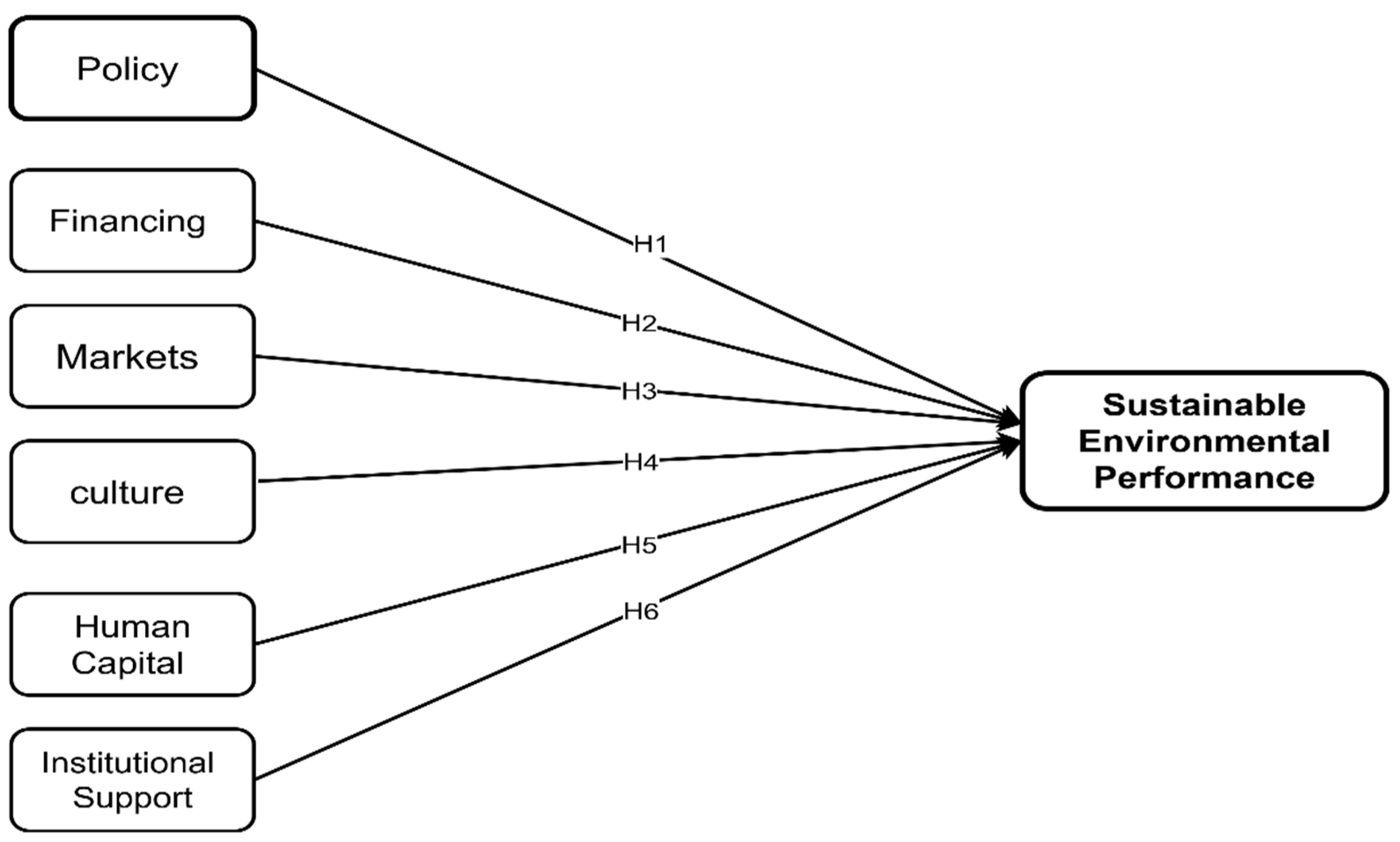
Figure 2.
Path relationship establishing the relationship between external ecosystem and environmental performance .
Figure 2.
Path relationship establishing the relationship between external ecosystem and environmental performance .
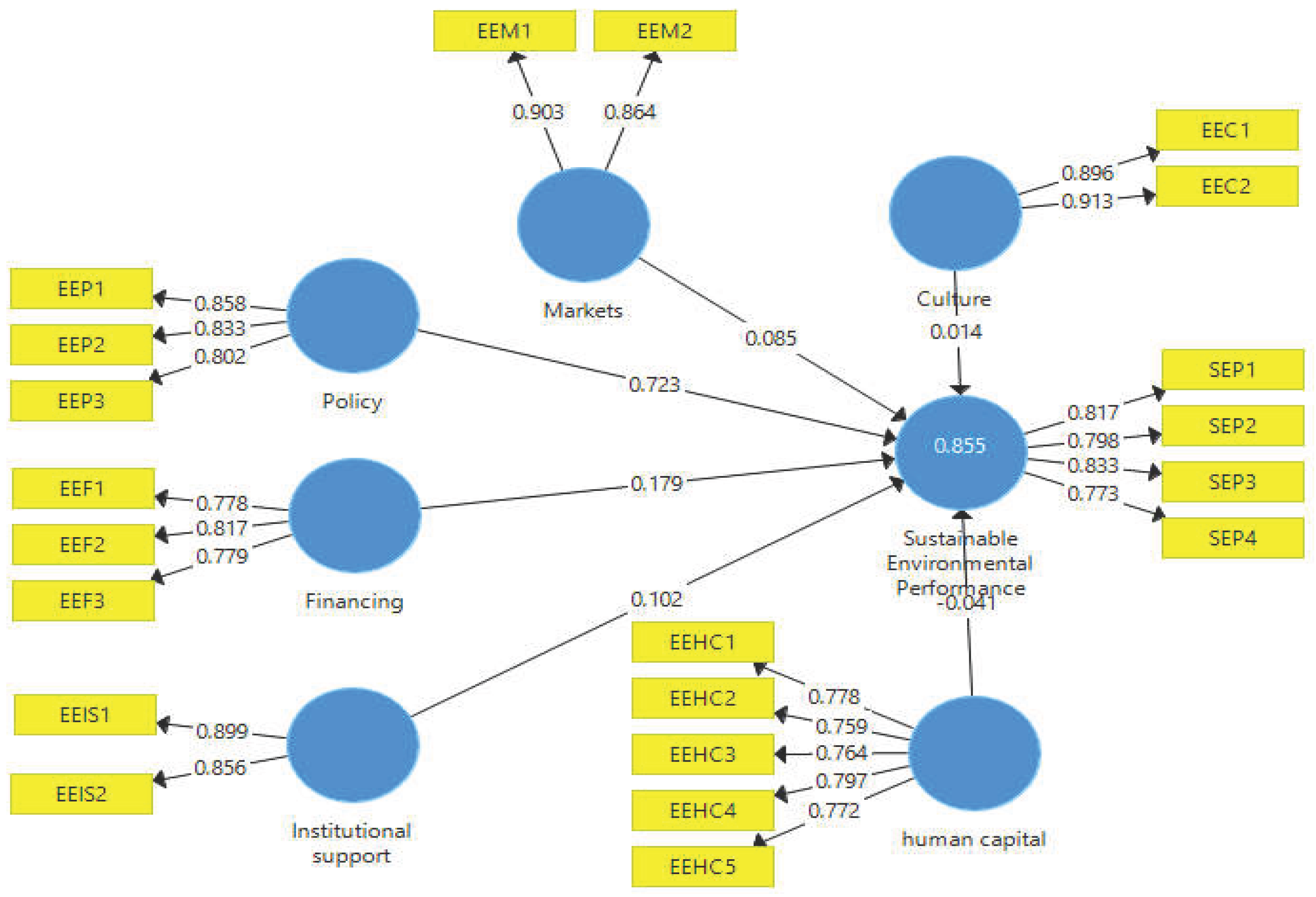

Table 1.
Reliability and validity estimates.
| Constructs | Items | Factor Loadings | CA | rho_A | CR | AVE | VIF |
| Culture | EEC1 | 0.896 | 0.779 | 0.783 | 0.900 | 0.819 | 1.686 |
| EEC1 | 0.913 | 1.686 | |||||
| Financing | EEF1 | 0.778 | 0.711 | 0.721 | 0.834 | 0.626 | 1.166 |
| EEF2 | 0.817 | 1.884 | |||||
| EEF3 | 0.779 | 1.835 | |||||
| Institutional support | EEIS1 | 0.899 | 0.705 | 0.718 | 0.871 | 0.771 | 1.420 |
| EEIS2 | 0.856 | 1.420 | |||||
| Markets | EEM1 | 0.903 | 0.721 | 0.733 | 0.877 | 0.781 | 1.465 |
| EEM2 | 0.864 | 1.465 | |||||
| Policy | EEP1 | 0.858 | 0.776 | 0.776 | 0.870 | 0.691 | 1.817 |
| EEP2 | 0.833 | 1.725 | |||||
| EEP3 | 0.802 | 1.428 | |||||
| Sustainable Environmental Performance | SEP1 | 0.817 | 0.820 | 0.821 | 0.881 | 0.649 | 1.867 |
| SEP2 | 0.798 | 1.732 | |||||
| SEP3 | 0.833 | 1.976 | |||||
| SEP4 | 0.773 | 1.706 | |||||
| Human capital | EEHC1 | 0.778 | 0.838 | 0.855 | 0.882 | 0.599 | 2.172 |
| EEHC2 | 0.759 | 2.128 | |||||
| EEHC3 | 0.764 | 2.115 | |||||
| EEHC4 | 0.797 | 1.746 | |||||
| EEHC5 | 0.772 | 1.656 |
Note: CA (Cronbach Alpha), CR (composite reliability), AVE (average variance extracted), VIF variance inflation factor.
Table 2.
Fornell-Larcker criterion.
| Construct | EEC | EEF | EEIS | EEM | EEP | SEP | EEHC |
| EEC | 0.905 | ||||||
| EEF | 0.517 | 0.791 | |||||
| EEIS | 0.706 | 0.395 | 0.878 | ||||
| EEM | 0.341 | 0.423 | 0.281 | 0.884 | |||
| EEP | 0.447 | 0.666 | 0.383 | 0.332 | 0.831 | ||
| SEP | 0.509 | 0.725 | 0.466 | 0.404 | 0.903 | 0.806 | |
| EEHC | 0.546 | 0.472 | 0.446 | 0.741 | 0.333 | 0.401 | 0.774 |
Table 3.
Heterotrait–Monotrait ratio.
| Constructs | EEC | EEF | EEIS | EEM | EEP | SEP | EEHC |
|---|---|---|---|---|---|---|---|
| EEC | |||||||
| EEF | 0.693 | ||||||
| EEIS | 0.644 | 0.544 | |||||
| EEM | 0.451 | 0.618 | 0.380 | ||||
| EEP | 0.574 | 0.845 | 0.511 | 0.443 | |||
| SEP | 0.635 | 0.816 | 0.607 | 0.523 | 0.429 | ||
| EEHC | 0.619 | 0.629 | 0.528 | 0.883 | 0.387 | 0.458 |
Note: EEC (culture), EEF (financing), EEIS (Institutional support), EEM(Markets), EEP(Policy), EEHC (Human Capital).
Table 6.
Path Relationship .
| Path relationship | Hypothesis | Original Sample (O) | Sample Mean (M) | Standard Deviation (STDEV) | T Statistics (|O/STDEV|) | P Values |
| EEP -> SEP | H1 | 0.723 | 0.722 | 0.035 | 20.721 | 0.000 |
| EEF-> SEP | H2 | 0.179 | 0.181 | 0.036 | 4.929 | 0.000 |
| EEM -> SEP | H3 | 0.085 | 0.079 | 0.042 | 1.998 | 0.046 |
| EEC-> SEP | H4 | 0.014 | 0.016 | 0.041 | 0.353 | 0.724 |
| EEHC -> SEP | H5 | -0.041 | -0.035 | 0.041 | 0.998 | 0.319 |
| EEIS-> SEP | H6 | 0.102 | 0.101 | 0.036 | 2.829 | 0.005 |
Note: EEC (culture), EEF (financing), EEIS (Institutional support), EEM(Markets), EEP(Policy), EEHC (Human Capital).
Disclaimer/Publisher’s Note: The statements, opinions and data contained in all publications are solely those of the individual author(s) and contributor(s) and not of MDPI and/or the editor(s). MDPI and/or the editor(s) disclaim responsibility for any injury to people or property resulting from any ideas, methods, instructions or products referred to in the content. |
© 2026 by the authors. Licensee MDPI, Basel, Switzerland. This article is an open access article distributed under the terms and conditions of the Creative Commons Attribution (CC BY) license.
Copyright: This open access article is published under a Creative Commons CC BY 4.0 license, which permit the free download, distribution, and reuse, provided that the author and preprint are cited in any reuse.


