

Submitted:
14 February 2026
Posted:
26 February 2026
You are already at the latest version
Abstract
We present a standardized cross-domain framework for measuring context sensitivity in large language models (LLMs) using the Delta Relational Coherence Index (ΔRCI). Across 25 model-domain runs (14 unique models, 50 trials each, 112,500 total responses), we compare medical (closed-goal) and philosophical (open-goal) reasoning domains using a three-condition protocol (TRUE/COLD/SCRAMBLED). We find that: (1) both domains elicit robust positive context sensitivity (mean ΔRCI: philosophy=0.317, medical=0.351), with medical showing significantly higher sensitivity (U=40, p=0.041); (2) inter-model variance is comparable across domains (SD: philosophy=0.047, medical=0.041), indicating that context sensitivity is a stable trait within each domain; (3) vendor signatures show significant differentiation (F(7,17)=3.63, p=0.014), with Moonshot (Kimi K2) showing highest context sensitivity; (4) the expected information hierarchy (ΔRCI_COLD > ΔRCI_SCRAMBLED) holds in 25/25 model-domain runs (100%), validating that even scrambled context retains partial information; and (5) position-level analysis reveals domain-specific temporal signatures consistent with theoretical predictions. All 25 model-domain runs show positive ΔRCI, confirming universal context sensitivity across architectures and domains. This dataset provides the first standardized benchmark for cross-domain context sensitivity measurement in state-of-the-art LLMs.
Keywords:
context sensitivity
; ∆RCI
; cross-domain AI evaluation
; medical reasoning
; philosophical reasoning
; LLM benchmarking
1. Introduction
1.1. Background
Large language models increasingly serve as reasoning tools across diverse domains, from medical diagnostics to philosophical inquiry. In-context learning—the ability to adapt behavior based on conversational history—is fundamental to modern LLMs [2], yet how domain structure shapes this context sensitivity remains poorly understood.
Current benchmarks focus primarily on accuracy and task completion [12], with context evaluation itself underdeveloped [14]. Following the operant tradition [11], we treat model outputs as behavioral data rather than cognitive states, measuring what models do with context rather than inferring internal representations.
Prior work [4] introduced the Delta Relational Coherence Index (RCI) and demonstrated behavioral patterns across 7 closed models. However, that study used aggregate metrics, mixed trial definitions, and lacked open-weight model comparisons.
1.2. Research Gap
Current LLM benchmarks are increasingly saturated and redundant [12], measuring task accuracy rather than behavioral dynamics. No existing benchmark provides:
- Standardized cross-domain context sensitivity measurement
- Unified methodology across open and closed architectures
- Position-level temporal analysis across task types
- Systematic vendor-level behavioral characterization
1.3. Research Questions
- 1.
- RQ1: How does domain structure (closed-goal vs open-goal) affect aggregate context sensitivity?
- 2.
- RQ2: Do temporal dynamics differ systematically between domains at the position level?
- 3.
- RQ3: Are architectural differences (open vs closed models) domain-specific?
- 4.
- RQ4: Do vendor-level behavioral signatures persist across domains?
1.4. Contributions
- 1.
- Standardized framework: Unified 50-trial methodology with corrected trial definition across 14 models and 2 domains
- 2.
- Cross-domain validation: First systematic comparison of RCI in medical vs philosophical reasoning
- 3.
- Architectural diversity: Balanced open (7) and closed (5-6) model inclusion in both domains
- 4.
- Baseline dataset: 25 model-domain runs providing reproducible benchmarks for 14 state-of-the-art LLMs
- 5.
- Universal positive context sensitivity: All 25 model-domain runs show positive RCI, confirming robust context utilization across architectures
2. Related Work
2.1. Context Sensitivity in LLMs
Transformer architectures process context through self-attention mechanisms [13], enabling in-context learning [2] that underpins modern LLM capabilities. However, measuring how models use conversational context—beyond whether they produce correct answers—remains underdeveloped [14]. Recent work on decoupling safety behaviors into orthogonal subspaces [5] provides independent evidence that model behaviors can be decomposed along interpretable dimensions, supporting our approach of isolating context sensitivity as a measurable behavioral axis.
2.2. Cross-Domain AI Evaluation
Domain-specific evaluation has advanced significantly, with medical AI benchmarks demonstrating that LLMs can encode clinical knowledge [10] and safety alignment methods shaping model behavior through constitutional principles [1]. Yet cross-domain behavioral comparison remains rare: existing benchmarks (MMLU, HELM) measure accuracy within domains but do not track how the same model’s behavioral dynamics shift across task structures. Our RCI framework addresses this gap by providing a domain-agnostic metric that captures context sensitivity independent of correctness.
2.3. Paper 1 Foundation
Prior work [4] introduced the RCI metric and three-condition protocol (TRUE/COLD/SCRAMBLED), demonstrating domain-dependent behavioral mode-switching across 7 closed models. That study established the “presence > absence” principle—that even scrambled context retains partial information—but was limited to aggregate-only analysis, mixed trial methodology, and closed-weight models exclusively.
3. Methodology
3.1. Experimental Design
Three-condition protocol applied to each trial:
- TRUE: Model receives coherent 29-message conversational history before prompt
- COLD: Model receives prompt with no prior context
- SCRAMBLED: Model receives same 29 messages in randomized order before prompt
Where RCI is computed via cosine similarity of response embeddings using Sentence-BERT [9] (all-MiniLM-L6-v2, 384D). This embedding-based approach captures semantic similarity without requiring domain-specific annotation, enabling cross-domain comparison.
Metric variants: We compute three related metrics:
- RCI (primary): Context sensitivity relative to no-context baseline
- RCI: Context sensitivity relative to scrambled baseline
- Hierarchy test: Validates that RCI>RCI, confirming scrambled context retains partial information
3.2. Domains
Medical (closed-goal): 52-year-old STEMI case with diagnostic/therapeutic targets.
Philosophy (open-goal): Consciousness inquiry with no single correct answer.
Both use 30 prompts per trial, enabling position-level analysis of context sensitivity across conversation depth.
3.3. Models
14 unique models across 25 model-domain runs from 8 vendors:
- OpenAI: GPT-4o, GPT-4o-mini, GPT-5.2
- Anthropic: Claude Haiku, Claude Opus
- Google: Gemini Flash
- DeepSeek: V3.1
- Moonshot: Kimi K2
- Meta: Llama 4 Maverick, Llama 4 Scout
- Mistral: Mistral Small 24B, Ministral 14B
- Alibaba: Qwen3 235B
Medical: 13 models (6 closed + 7 open). Philosophy: 12 models (5 closed + 7 open). 12 models appear in both domains (paired comparison).
3.4. Data Scale

Table 1.
Data scale summary.
| Parameter | Value |
|---|---|
| Unique models | 14 |
| Model-domain runs | 25 |
| Trials per run | 50 |
| Prompts per trial | 30 |
| Conditions per trial | 3 (TRUE, COLD, SCRAMBLED) |
| Total trials | 1,250 |
| Total responses | 112,500 |
4. Results
4.1. Dataset Overview
Figure 1.
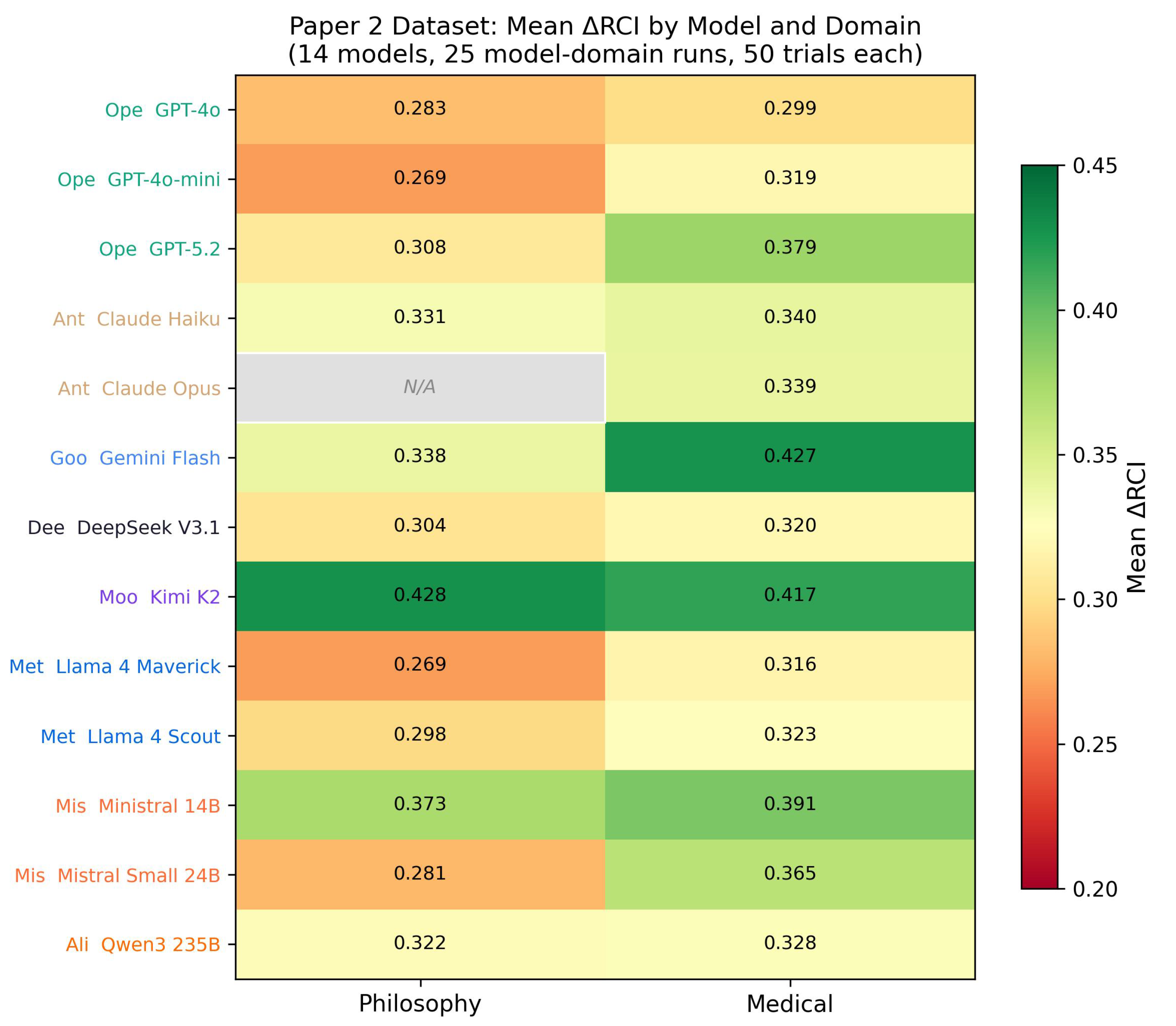
Mean RCI by model and domain across 25 model-domain runs (14 unique models, 50 trials each). All 25/25 model-domain runs show positive RCI (context enhances coherence). Kimi K2 shows highest sensitivity in both domains (philosophy: 0.428, medical: 0.417). Gemini Flash shows highest medical sensitivity (RCI = 0.427). Claude Opus appears only in medical domain (gray cell for philosophy).
Figure 1.
Mean RCI by model and domain across 25 model-domain runs (14 unique models, 50 trials each). All 25/25 model-domain runs show positive RCI (context enhances coherence). Kimi K2 shows highest sensitivity in both domains (philosophy: 0.428, medical: 0.417). Gemini Flash shows highest medical sensitivity (RCI = 0.427). Claude Opus appears only in medical domain (gray cell for philosophy).
4.2. Domain Comparison
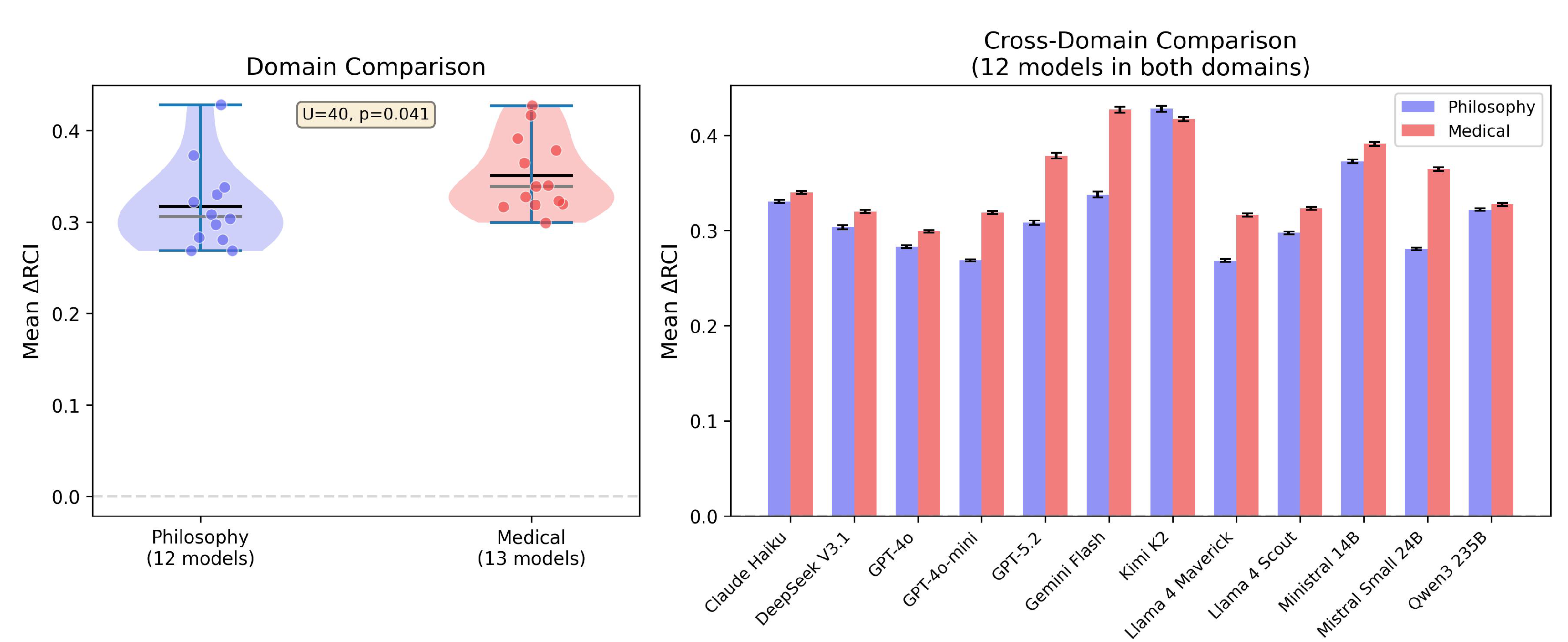
Notable patterns: Gemini Flash shows higher medical sensitivity (0.427 vs 0.338), GPT-5.2 higher in medical (0.379 vs 0.308), Kimi K2 consistently highest in both domains.
Figure 2.
Left: Violin plots comparing philosophy (n=12) and medical (n=13) RCI distributions. Right: Paired bar chart for 12 models tested in both domains. Medical shows significantly higher context sensitivity (Mann-Whitney U=40, p=0.041).
Figure 2.
Left: Violin plots comparing philosophy (n=12) and medical (n=13) RCI distributions. Right: Paired bar chart for 12 models tested in both domains. Medical shows significantly higher context sensitivity (Mann-Whitney U=40, p=0.041).
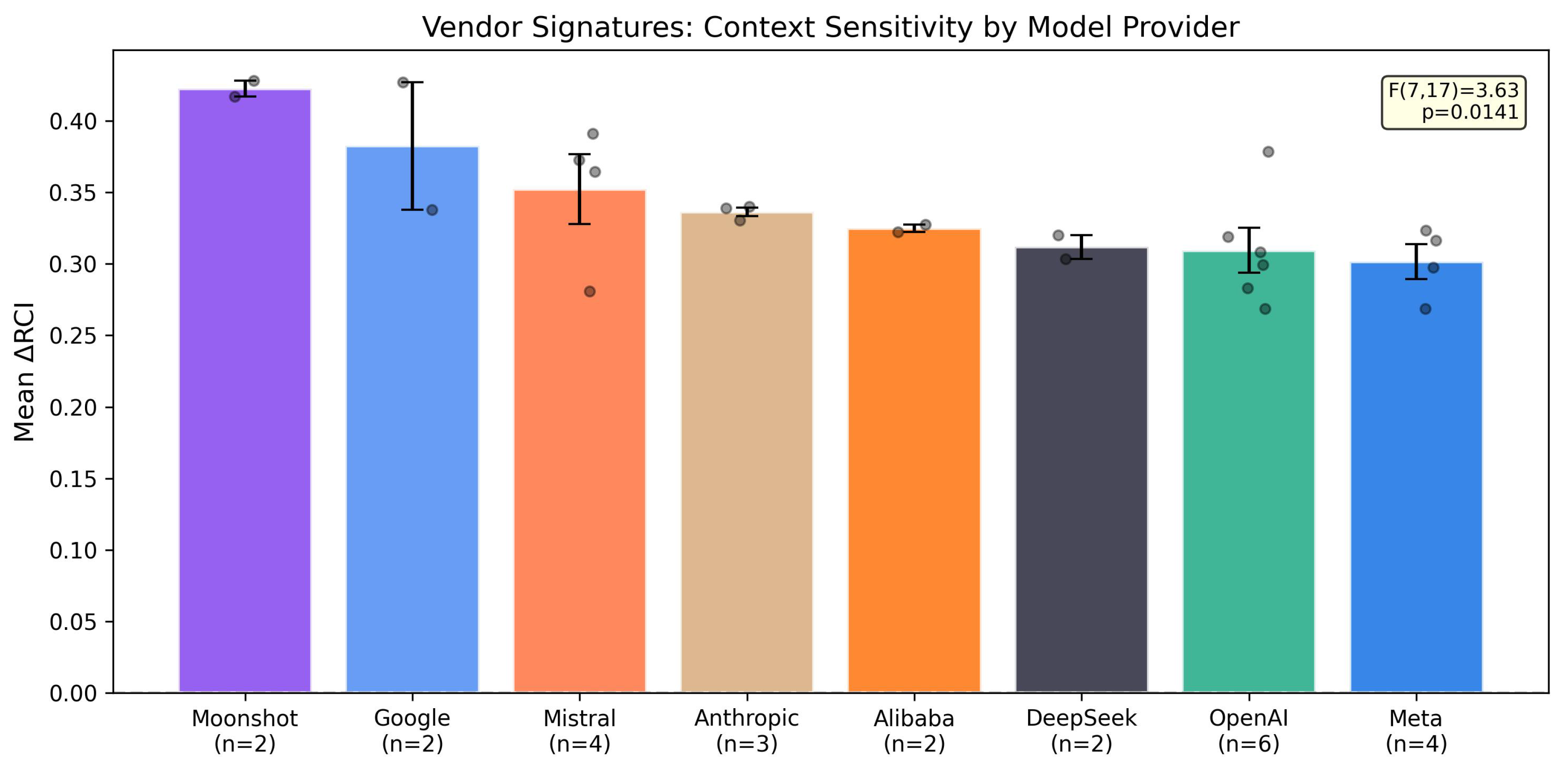
Table 2.
Domain comparison summary. Mann-Whitney U=40, p=0.041; rank-biserial r=0.49 (medium-large effect). Unit of analysis: Each model-domain run treated as one independent observation. Medical shows significantly higher context sensitivity than philosophy.
Table 2.
Domain comparison summary. Mann-Whitney U=40, p=0.041; rank-biserial r=0.49 (medium-large effect). Unit of analysis: Each model-domain run treated as one independent observation. Medical shows significantly higher context sensitivity than philosophy.
| Domain | Mean RCI | SD | n |
|---|---|---|---|
| Philosophy | 0.317 | 0.047 | 12 |
| Medical | 0.351 | 0.041 | 13 |
4.3. Vendor Signatures
One-way ANOVA across 8 vendors: F(7,17) = 3.63, p = 0.014 (significant).
Figure 3.
Mean RCI by vendor, sorted by descending mean. Error bars show SEM. ANOVA: F(7,17)=3.63, p=0.014 (significant).
Figure 3.
Mean RCI by vendor, sorted by descending mean. Error bars show SEM. ANOVA: F(7,17)=3.63, p=0.014 (significant).
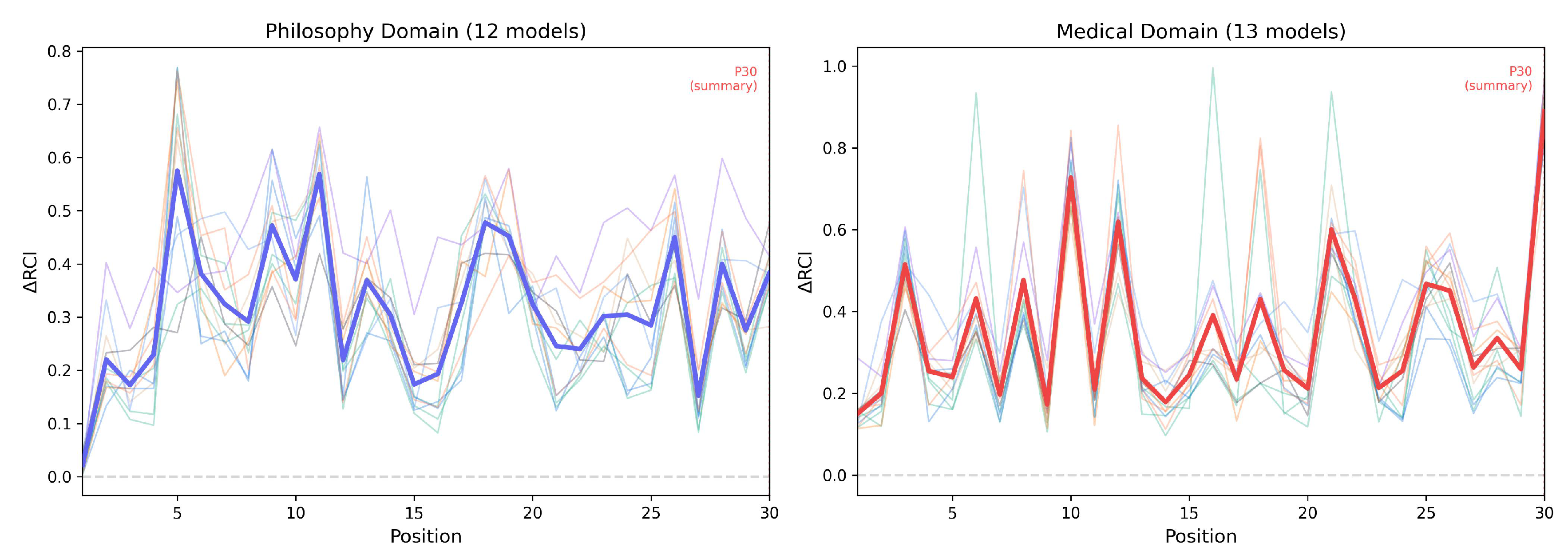
Table 3.
Vendor rankings by mean RCI. Moonshot and Google rank highest, with Meta and OpenAI showing lower but consistent sensitivity. Note: n reflects model-domain runs, not unique models.
Table 3.
Vendor rankings by mean RCI. Moonshot and Google rank highest, with Meta and OpenAI showing lower but consistent sensitivity. Note: n reflects model-domain runs, not unique models.
| Rank | Vendor | n (models) | Mean RCI |
|---|---|---|---|
| 1 | Moonshot | 2 | 0.423 |
| 2 | 2 | 0.383 | |
| 3 | Mistral | 4 | 0.352 |
| 4 | Anthropic | 3 | 0.336 |
| 5 | Alibaba | 2 | 0.325 |
| 6 | DeepSeek | 2 | 0.312 |
| 7 | OpenAI | 6 | 0.310 |
| 8 | Meta | 4 | 0.302 |
Vendor differences are significant (F(7,17)=3.63, p=0.014), confirming that vendor signatures reflect genuine architectural or training differences. Moonshot’s consistent dominance across both domains and Meta’s lower sensitivity represent the behavioral extremes.
4.4. Position-Level Patterns
Philosophy domain (12 models): Gradual rise followed by plateau, no remarkable P30 effect (z=0.55). Oscillations and prompt-specific variation dominated, with weaker positional structure than medical domain.
Medical domain (13 models): Higher amplitude oscillations with upward drift, strong P30 summarization spike (z=3.74), greater inter-model variability. Certain positions (P3, P10-12, P21) consistently drove high RCI across models, suggesting prompt-specific rather than smooth positional effects.
Figure 4.
Position-level RCI trajectories across 30 prompt positions. Left: Philosophy (12 models). Right: Medical (13 models). Bold lines show domain mean; thin lines show individual models. P30 marks the summarization task.
Figure 4.
Position-level RCI trajectories across 30 prompt positions. Left: Philosophy (12 models). Right: Medical (13 models). Bold lines show domain mean; thin lines show individual models. P30 marks the summarization task.
4.5. Information Hierarchy
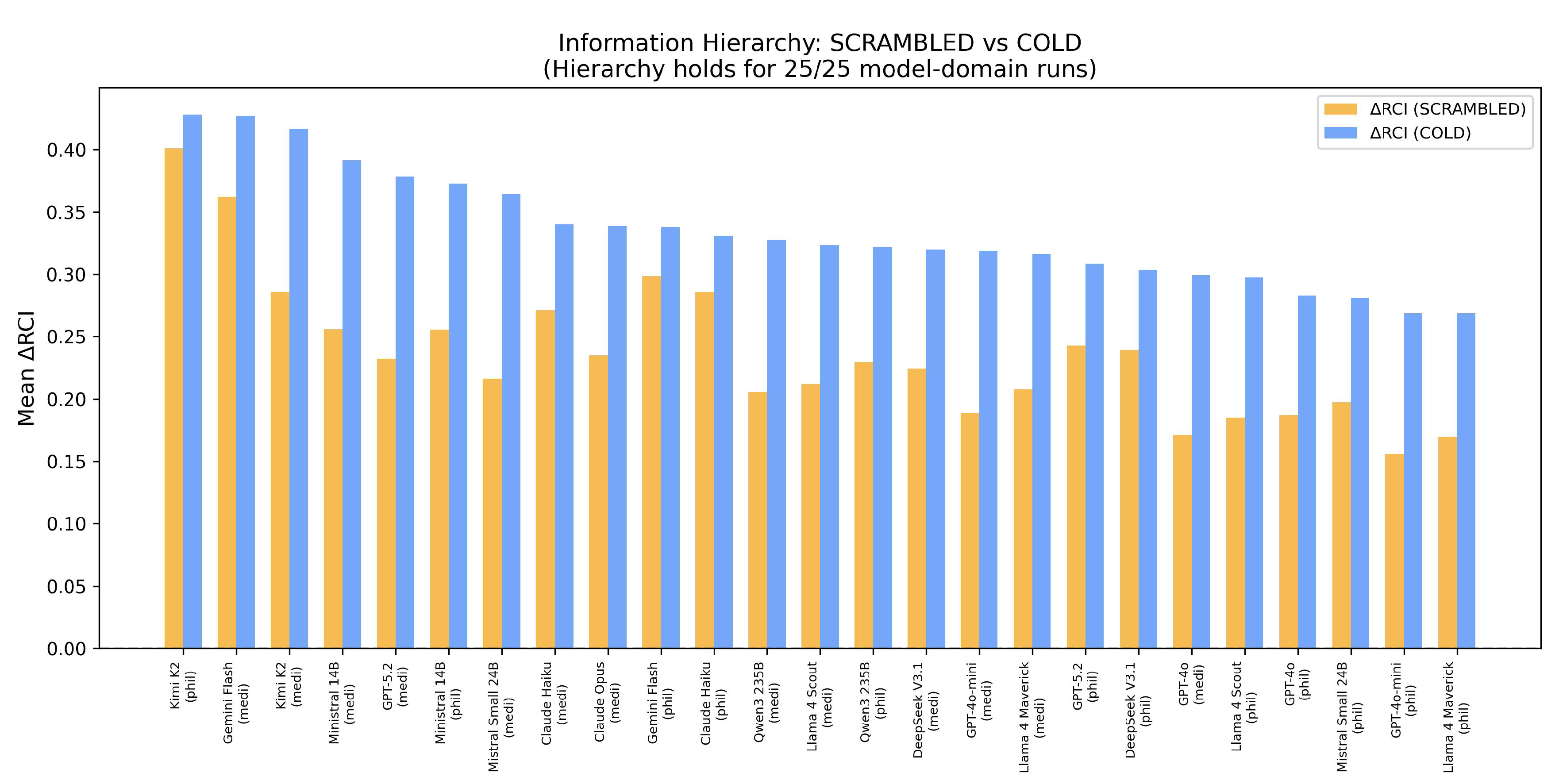
The theoretical prediction from [4]—that scrambled context should retain partial information compared to no context—was tested across 25 model-domain runs.
Logic: If scrambled retains partial info, SCRAMBLED responses should be closer to TRUE than COLD responses are, yielding RCI_COLD >RCI_SCRAMBLED.
Observed: Hierarchy holds in 25/25 runs (100%). This universally validates the “presence > absence” claim with no exceptions.
Figure 5.
RCI computed with SCRAMBLED vs COLD baselines. Expected hierarchy: RCI_COLD >RCI_SCRAMBLED. Hierarchy holds in 25/25 testable runs (100%), validating the “presence > absence” principle universally.
Figure 5.
RCI computed with SCRAMBLED vs COLD baselines. Expected hierarchy: RCI_COLD >RCI_SCRAMBLED. Hierarchy holds in 25/25 testable runs (100%), validating the “presence > absence” principle universally.
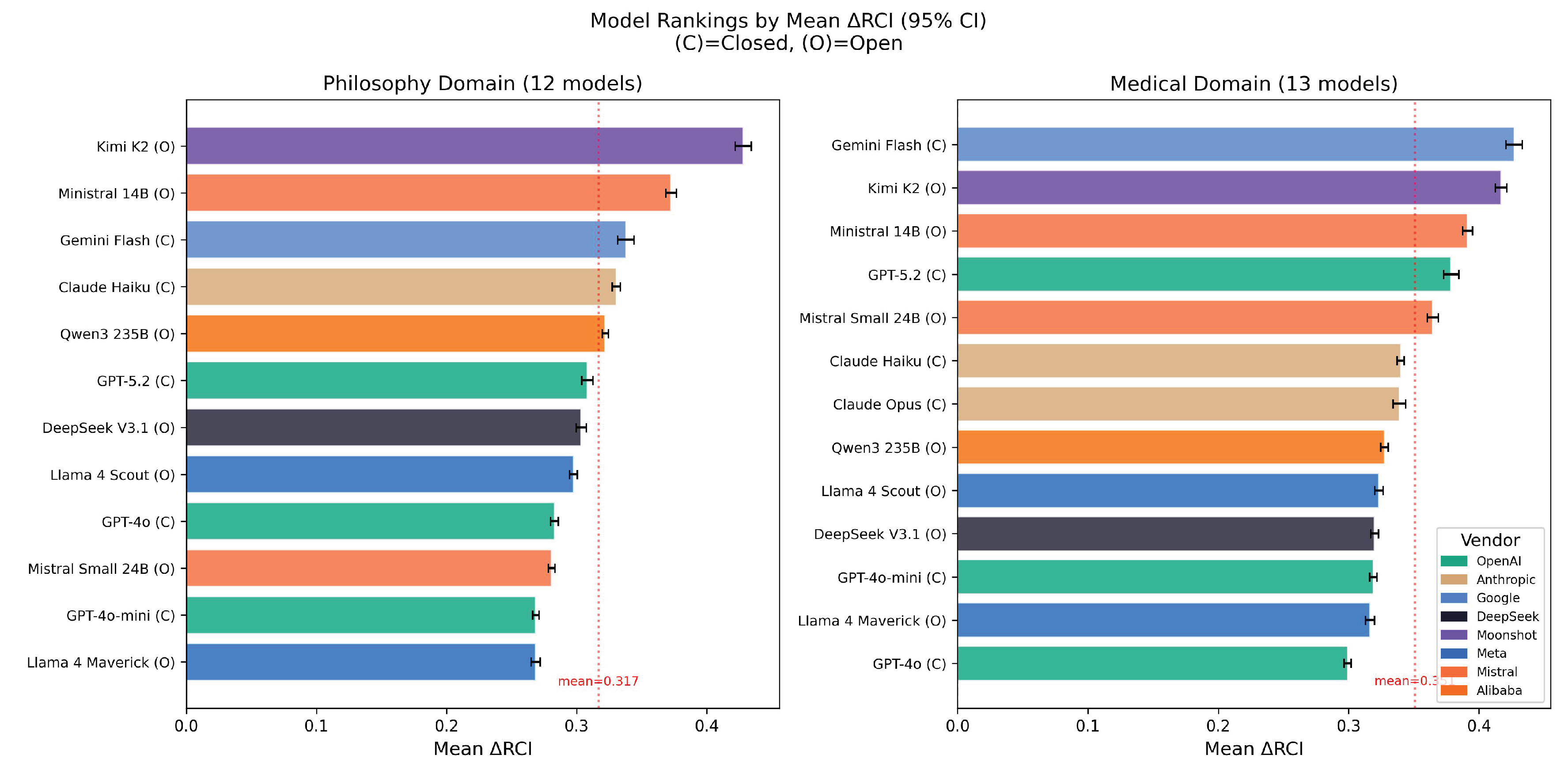
4.6. Model Rankings
Philosophy top 3:
- 1.
- Kimi K2 (O): 0.428
- 2.
- Ministral 14B (O): 0.373
- 3.
- Gemini Flash (C): 0.338
Medical top 3:
- 1.
- Kimi K2 (O): 0.417
- 2.
- Ministral 14B (O): 0.391
- 3.
- GPT-5.2 (C): 0.379
Figure 6.
Model rankings by mean RCI with 95% confidence intervals. Left: Philosophy (12 models). Right: Medical (13 models). (C)=Closed, (O)=Open. Dashed red line shows domain mean.
Figure 6.
Model rankings by mean RCI with 95% confidence intervals. Left: Philosophy (12 models). Right: Medical (13 models). (C)=Closed, (O)=Open. Dashed red line shows domain mean.
Cross-domain consistency: Kimi K2 and Ministral 14B rank #1 and #2 in both domains.
5. Discussion
5.1. Medical Domain Shows Higher Context Sensitivity
The significant domain-level difference (U=40, p=0.041) indicates that medical (closed-goal) reasoning elicits higher aggregate context sensitivity than philosophical (open-goal) reasoning. This is consistent with the Type 2 task enablement hypothesis explored in Paper 3: guideline-bounded tasks create stronger context dependence because clinical reasoning inherently requires accumulation of prior case information. Both domains show comparable inter-model variance (SD: philosophy=0.047, medical=0.041), indicating stable behavioral differentiation within each domain.
5.2. Cross-Domain Patterns
Gemini Flash shows higher context sensitivity in medical (0.427) than philosophy (0.338), a pattern shared with GPT-5.2 (0.379 vs 0.308) and several other models. This medical > philosophy pattern is consistent with closed-goal tasks creating stronger context dependence. All models show positive RCI in both domains, confirming universal context utilization.
5.3. Open vs Closed Architecture
Open models show competitive or superior context sensitivity in both domains:
- Medical open mean: 0.351 vs closed mean: 0.351 (identical)
- Philosophy open mean: 0.325 vs closed mean: 0.306
This suggests that open-weight models, despite generally smaller parameter counts, can achieve comparable context sensitivity.
5.4. Vendor Clustering
5.5. Information Hierarchy Validation
The universal confirmation of the expected hierarchy (RCI_COLD >RCI_SCRAMBLED in 25/25 runs, 100%) is a strong methodological validation. It confirms that scrambled context retains partial information—even disrupted conversational structure provides extractable signal. This validates the three-condition protocol as a well-ordered measurement framework and universally confirms the “presence > absence” principle [4].
5.6. Limitations
- 1.
- Single scenario per domain: One medical case (STEMI) and one philosophical topic (consciousness)
- 2.
- Embedding model ceiling: all-MiniLM-L6-v2 [9] may not capture all semantic distinctions
- 3.
- Temperature fixed at 0.7: Other settings may yield different patterns
- 4.
- Claude Opus: Medical only (absent from philosophy); recovered data lacks response text
- 5.
- Position-level noise: 50 trials provide limited statistical power for 30-position analysis
5.7. Future Directions
Several extensions would strengthen cross-domain comparisons:
- Token limit variation: Testing whether max_tokens (currently 1024) affects context sensitivity differently across domains
- Multilingual prompts: Extending RCI measurement to non-English conversations to assess language-specific effects
- Quantifying openness: Since philosophy is open-goal, measuring response entropy could provide a continuous “openness” metric for domain characterization, enabling more precise comparisons than the binary closed/open classification
- Temperature sweeps: Systematic variation of temperature (0.0–1.0) to map the context sensitivity–randomness tradeoff
6. Conclusions
This study establishes a standardized cross-domain framework for measuring context sensitivity in LLMs. Across 14 models and 112,500 responses, we find that:
- 1.
- Context sensitivity is universally positive across all models in both domains (25/25 runs)
- 2.
- Medical domain elicits higher sensitivity: Closed-goal reasoning shows significantly higher RCI than open-goal reasoning (p=0.041), with comparable inter-model variance
- 3.
- Information hierarchy is universal: The “presence > absence” principle holds in 100% of model-domain runs
- 4.
- Open models compete with closed: No systematic architectural disadvantage for open-weight models
- 5.
- Vendor signatures are significant: Organizational design choices create significant and consistent behavioral patterns (F(7,17)=3.63, p=0.014)
Data Availability Statement
All experimental data and analysis code are available at: https://github.com/LaxmanNandi/MCH-Research
Acknowledgments
This research builds on human-AI collaborative methodology established in Paper 1 [4]. AI systems (Claude, ChatGPT, DeepSeek) assisted with data analysis, visualization, and manuscript preparation. The framework, findings, and interpretations remain the author’s sole responsibility.
Appendix A Complete Per-Model Statistics
Table A1.
Complete per-model statistics for all 25 model-domain runs (50 trials each).
| Model | Domain | Type | Mean RCI | SD | 95% CI |
|---|---|---|---|---|---|
| GPT-4o | Philosophy | Closed | 0.283 | 0.011 | ±0.003 |
| GPT-4o-mini | Philosophy | Closed | 0.269 | 0.009 | ±0.002 |
| GPT-5.2 | Philosophy | Closed | 0.308 | 0.015 | ±0.004 |
| Claude Haiku | Philosophy | Closed | 0.331 | 0.012 | ±0.003 |
| Gemini Flash | Philosophy | Closed | 0.338 | 0.022 | ±0.006 |
| DeepSeek V3.1 | Philosophy | Open | 0.304 | 0.014 | ±0.004 |
| Kimi K2 | Philosophy | Open | 0.428 | 0.022 | ±0.006 |
| Llama 4 Maverick | Philosophy | Open | 0.269 | 0.012 | ±0.003 |
| Llama 4 Scout | Philosophy | Open | 0.298 | 0.011 | ±0.003 |
| Ministral 14B | Philosophy | Open | 0.373 | 0.015 | ±0.004 |
| Mistral Small 24B | Philosophy | Open | 0.281 | 0.009 | ±0.003 |
| Qwen3 235B | Philosophy | Open | 0.322 | 0.009 | ±0.003 |
| GPT-4o | Medical | Closed | 0.299 | 0.010 | ±0.003 |
| GPT-4o-mini | Medical | Closed | 0.319 | 0.010 | ±0.003 |
| GPT-5.2 | Medical | Closed | 0.379 | 0.021 | ±0.006 |
| Claude Haiku | Medical | Closed | 0.340 | 0.010 | ±0.003 |
| Claude Opus | Medical | Closed | 0.339 | 0.017 | ±0.005 |
| Gemini Flash | Medical | Closed | 0.427 | 0.023 | ±0.006 |
| DeepSeek V3.1 | Medical | Open | 0.320 | 0.010 | ±0.003 |
| Kimi K2 | Medical | Open | 0.417 | 0.016 | ±0.004 |
| Llama 4 Maverick | Medical | Open | 0.316 | 0.012 | ±0.003 |
| Llama 4 Scout | Medical | Open | 0.323 | 0.011 | ±0.003 |
| Ministral 14B | Medical | Open | 0.391 | 0.014 | ±0.004 |
| Mistral Small 24B | Medical | Open | 0.365 | 0.015 | ±0.004 |
| Qwen3 235B | Medical | Open | 0.328 | 0.010 | ±0.003 |
References
- Bai, Y.; Jones, A.; Ndousse, K.; et al. Constitutional AI: Harmlessness from AI Feedback. arXiv 2022, arXiv:2212.08073. [Google Scholar] [CrossRef]
- Brown, T.; Mann, B.; Ryder, N.; et al. Language Models are Few-Shot Learners. Advances in Neural Information Processing Systems 2020, arXiv:2005.1416533. [Google Scholar]
- Datasaur. LLM Scorecard 2025. 2025. Available online: https://datasaur.ai/blog-posts/llm-scorecard-22-8-2025.
- Laxman, M M. Context Curves Behavior: Measuring AI Relational Dynamics with ΔRCI. Preprints.org 2026. [Google Scholar] [CrossRef]
- Mou, X.; et al. Decoupling Safety into Orthogonal Subspace. arXiv 2025, arXiv:2510.09004. [Google Scholar] [CrossRef]
- Nguyen, T.; et al. A Framework for Neural Topic Modeling with Mutual Information. Neurocomputing 2025. [Google Scholar] [CrossRef]
- NIH PMC. Empirically derived evaluation requirements for responsible deployments of AI in safety-critical settings. In npj Digital Medicine; 2025. [Google Scholar] [CrossRef]
- Ouyang, L.; Wu, J.; Jiang, X.; et al. Training language models to follow instructions with human feedback. Advances in Neural Information Processing Systems 2022, arXiv:2203.0215535. [Google Scholar]
- Reimers, N.; Gurevych, I. Sentence-BERT: Sentence Embeddings using Siamese BERT-Networks. Proceedings of EMNLP 2019, 2019. [Google Scholar]
- Singhal, K.; Azizi, S.; Tu, T.; et al. Large Language Models Encode Clinical Knowledge. Nature 2023, 620, 172–180. [Google Scholar] [CrossRef] [PubMed]
- Skinner, B. F. Verbal Behavior; Copley Publishing Group, 1957. [Google Scholar]
- Subramani, N.; Srinivasan, R.; Hovy, E. SimBA: Simplifying Benchmark Analysis. Findings of EMNLP 2025 2025. [Google Scholar] [CrossRef]
- Vaswani, A.; Shazeer, N.; Parmar, N.; et al. Attention Is All You Need. Advances in Neural Information Processing Systems 2017, arXiv:1706.0376230. [Google Scholar]
- Xu, Y.; et al. Does Context Matter? ContextualJudgeBench for Evaluating LLM-based Judges. Proceedings of ACL 2025 2025. [Google Scholar] [CrossRef]
Disclaimer/Publisher’s Note: The statements, opinions and data contained in all publications are solely those of the individual author(s) and contributor(s) and not of MDPI and/or the editor(s). MDPI and/or the editor(s) disclaim responsibility for any injury to people or property resulting from any ideas, methods, instructions or products referred to in the content. |
© 2026 by the authors. Licensee MDPI, Basel, Switzerland. This article is an open access article distributed under the terms and conditions of the Creative Commons Attribution (CC BY) license (http://creativecommons.org/licenses/by/4.0/).
Copyright: This open access article is published under a Creative Commons CC BY 4.0 license, which permit the free download, distribution, and reuse, provided that the author and preprint are cited in any reuse.


