

Submitted:
12 February 2026
Posted:
13 February 2026
You are already at the latest version
Abstract
Previous research has found association between PM2.5 exposure and the worsening of depression. Nevertheless, studies specifically examining the harmful effect of components of PM2.5 were relatively limited.A national survey enrolled individuals aged 45 and older, gathering personal data and assessing depression in mainland China. Monthly exposure to PM2.5 and its seven components, black carbon (BC), organic matter (OM), nitrate (NO3-), sulfate (SO42-), ammonium (NH4+), soil particles (SOIL) and sea salt (SS) were matched via each participant's residence. Linear mixed effect models (LME) to assess the association between single pollutants with depression score, and weighted quantile sum (WQS) regression was used to investigate the effect of mixed exposure and identify contribution of each component. The modified effects of social activity and green space were evaluated. 9,725 participants for depression were included in this analysis, respectively. In single exposure model, per interquartile range (IQR) rise in PM2.5 (29.18μg/m3), BC (2.25μg/m3), OM (7.18μg/m3), SOIL (6.04μg/m3) and SS (0.14μg/m3) were significantly associated with increase of 0.90 (95%CI: 0.59, 1.20), 0.71[0.42, 1.09], 0.94[0.61, 1.26]), 0.51[0.38, 0.63]), 0.53[0.33, 0.73] point in depression score. In mixed exposure models, for each IQR increase in the mixture of all components, depression score increased by 1.104 (95%CI: 0.901, 1.307), and BC held the largest index weight (33.6%), followed by SOIL (28.59%) and SS (25.05%). The harmful effect of PM2.5 and specific components on depression were lower in those participating in social activity or in higher level green space (p< 0.05).The harmful effects of PM2.5 on depression may be influenced by its components. Social activity and green space could reduce the risk of depression related to PM2.5 and its components.
Keywords:
PM2.5 and its components
; depression
; middle-aged and older adults
; social activity
; green space
1. Introduction
Population ageing has become a major global challenge. According to WHO, the proportion of individuals aged 65 and over will rise from 12% in 2015 to 22% in 2050, reaching nearly 2 billion [1]. It is estimated that more than 20% of the population aged 60 and over suffered from mental or neurological disorders, which accounted for 6.6% of the total Disability-Adjusted Life Years (DALYs) of this population. Depression was the most prevalent of these disorders in older population, accounting for approximately 7%.
Air pollution is indeed a significant global public health issue. Epidemiological studies about the association of fine particulate matter with depression were mainly focused on the ambient PM2.5 mass. However, PM2.5 is complex heterogeneous mixture of miscellaneous chemical composition, whose major components include organic matter (OM), black carbon (BC), nitrate (NO3-), sulfate (SO42-), ammonium (NH4+), soil particles (SOIL) and sea salt (SS). Previous studies were based on the assumption that the toxicity of PM2.5 components was consistent, which overlooked the difference in potential toxicity of chemical components of PM2.5, especially those derived from combustion processes [2,3]. Considering the facts of China's substantial elderly population and the continuous high levels of particulate matter, it is essential to assess the effect of exposure to various components of PM2.5 on depression in middle-aged and elderly populations.
To fill these knowledge gaps, a national study was carried out, and the impact of long-term exposure to PM2.5 and its components (including BC, OM, NO3-, SO42-, NH4+, SOIL, and SS) on depression among middle-aged and elderly people in China was investigated. And then, the modifying effects of social activity and green space on the association were evaluated.
2. Materials and Methods
2.1. Study Population
All of participants were drawn from the China Health and Retirement Longitudinal Study (CHARLS) launched by National School for Development (China Center for Economic Research). The CHARLS constructed a nationally representative subsets of Chinese older adults (participants aged 45 years or above) based on a four-stage and well-established sample design [4], in which it covered 125 cities from 28 provinces across China’s mainland. In each wave of survey, participants’ information including socioeconomic and demographic characteristics, lifestyle, behavior patterns, and health status was comprehensively collected through standard questionnaires by well-trained investigators, in the form of face-to-face interviews. More details are available elsewhere (http://charls.pku.edu.cn/en/data/User2018.pdf).To avoid the influence of COVID-19 on depression [5,6], this analysis was conducted using the CHARLS data of four waves (2011-2018). In addition, CHARLS only provides the city in which each participant resides, and detailed home addresses are not disclosed to the public.
In this study, 17,596 participants were involved at baseline. Then, adults under the age of 45 at baseline were excluded. Additionally, considering the focus on mental and neurological diseases, participants diagnosed with memory-related diseases (such as Alzheimer's Disease, Brain Atrophy, and Parkinson's Disease), with emotional or psychiatric issues, with cancer or malignant tumors (excluding minor skin cancers) or who had previously taken medication for mental illness were excluded. Individuals with missing outcome information and key personal information were excluded. Ultimately, a total of 9,725 participants were included in the analysis. Detailed inclusion and exclusion criteria were shown in Supplementary Figure S1.
2.2. Exposure Assessment
Monthly spatially-resolved estimates of surface-level total PM2.5 and its seven specific components, including organic matter (OM), black carbon (BC), sulfate (SO42-), nitrate (NO3-), ammonium (NH4+), soil particles (SOIL), and sea salt (SS) for the period 2000-2017, were obtained from the V4.CH.02 product, a dataset formulated by the Atmospheric Composition Analysis Group at Washington University [7,8]. Datasets for China was developed using the methodology described previously [9,10]. By well incorporating satellite-based aerosol optical depth observations, gridded estimates at 0.01° × 0.01° spatial resolution were predicted by utilizing the nested GEOS-Chem chemical transport model (http://geos-chem.org, accessed on November 15th, 2023) and geographically weighted regression. The predicted PM2.5 estimates demonstrated substantial alignment with measurements from globally dispersed ground sites, evidenced by a high coefficient of determination (R2 = 0.81) and a slope of 0.90. While further calibration for the compositional values was not undertaken due to the absence of available ground-based observations across mainland China, this methodology proved effective without calibration, as evidenced by its application in North America [8] and global estimates [10]. Currently, the V4.CH.02 product from China is extensively utilized for exposure assessment in the field of environmental epidemiology [3,11,12].
In this study, we extracted data on the monthly total mass of PM2.5 and the concentrations of its seven chemical components across mainland China for the period from 2000 to 2017. Consistent with prior studies [13,14], we employed a 1-year average of PM2.5 mass and its seven components at the city level prior to the survey year as a measure of PM2.5 influence in our primary analyses. For instance, for participants enrolled in 2018, we aligned the annual average concentrations for 2017 as their final exposure in the wave 4 survey.
2.3. Outcome Assessment
The depression status of the participants was measured using the 10-item Center for Epidemiologic Studies Depression scale (CES-D-10). The validity of CES-D-10 has been examined among Chinese adults [15]. Each question measured the frequency of a specific type of negative mood using a score of 0 (rarely or none), 1 (some days), 2 (occasionally), 3 (most of the time). The sum of score for each question was calculated as the depressive score to indicate the general depressive status for each participant. The depressive score ranged from 0 to 30, with a higher score indicating a higher severity of depressive symptoms.
2.4. Statistical Analysis
Baseline characteristics were summarized as proportions (%) for categorical variables and mean (SD) for continuous variables. The Spearman rank correlation analysis was applied to assess the relationship among PM2.5 mass and each component in 125 cities in 2011.
Linear mixed effect models (LME) with time-varying exposures were established to investigate associations of PM2.5 or its components with depression score. Our analysis was first performed without adjustments (M1) and then expanded by introducing additional covariates. M2 was adjusted for age and sex. M3 (main model) was further adjusted for sociodemographic background (education attainment, marital status, building type, cooking fossil type, location of residence), health status (cardiovascular related diseases, disabled), and behavior characteristics (smoking, alcohol drinking, social activity).
Where i denoted the subject index; j denoted the visit index; denoted the intercept; denoted the regression coefficients for PM2.5 and its components, respectively. denoted a set of adjusted covariates and denoted the corresponding coefficients; cityi denoted a fixed effect to control the unmeasured city-specific risk 7 factors, such as traditional culture [14,16]; denoted random intercept to model the correlation between records from the same subject, respectively.
To check the exposure-response (ER) curve for the associations of exposure to PM2.5 and its 7 components with depression score, we separately included a cubic spline with 4 knots for each exposure of interest based on generalized additive mixed models (GAMM). The significance of linear and nonlinear terms was obtained using the Wald test, while the likelihood ratio test was used to compare the merits of linear and nonlinear models. Subgroup analyses were performed stratified by whether participated in social activity (yes / no) and level of green space coverage (high / low), which based on the median Normalized Difference Vegetation Index (NDVI) of study cities. Furthermore, we merged these two factors, to compare the effect in population participated in social activity and in high greenness (Yes + High) with no social activity and in low greenness(No + Low). In line with prior studies, the 2-sample z-test were used to examine potential effect differences between subgroups [17]. The subgroup analyses were conducted only for PM2.5 and components which were significantly associated with outcomes. To determine the effect of mixed exposure of PM2.5, and identify the relative contribution of each component, weighted quantile sum (WQS) regression was conducted adjusting confounders which were included in the main model [18].
Several sensitivity analyses were performed to evaluate the robustness of our effect estimates. First, we further adjusted PM2.5 or residuals of PM2.5 to control for confounding among the components of PM2.5 due to high correlation. Second, we further adjusted the random effect of community using a random intercept. Third, we switched the model from an individual random effects model to an individual fixed effects model (less efficient in estimation, but with smaller bias) [19], controlling for the same covariates as in the main model, although some covariates that do not vary across individuals were absorbed by the individual fixed effects. Fourthly, to explore how the measurement error influenced the estimated association between PM2.5 and its constituents with depression, we used a bootstrap method to incorporate the data-generation procedure during model inference [20]. The detailed information for bootstrap method could be found in Supplementary Text S1.
Statistical analyses were conducted using R (version 4.2.1). This included the application of the "lme4", "lmerTest", and "gamm4" packages for the execution of linear mixed effect model and generalized additive mixed model analyses. Additionally, the "plm" package was employed for the analysis of the fixed effects model. The "gWQS" package was employed for identifying contributions of all components. Two-sided p-value< 0.05 was considered statistically significant.
3. Results
3.1. Descriptive Results
The distribution of annual average of PM2.5 and its components at baseline were shown in Table S1 in the supplement. The concentration of PM2.5 ranged from 4.32 to 82.41μg/m3, with an average [SD] concentration of 44.11[18.63]μg/m3. The average [SD] concentrations of BC, OM, NO3-, SO42-, NH4+, SOIL, and SS were 2.76 [1.59]μg/m3, 8.62 [4.05]μg/m3, 10.17 [5.45]μg/m3, 10.15 [3.53]μg/m3, 6.71 [2.78]μg/m3, 4.52 [5.42]μg/m3, and 0.15 [0.15]μg/m3, respectively. Notably, NH4+, NO3-, BC, OM, and SO42- demonstrated higher correlations with PM2.5, with correlation coefficients of 0.944, 0.932, 0.917, 0.886, and 0.868, respectively. SOIL exhibited a moderately correlation with PM2.5, with a coefficient of 0.428. SS presented negative correlation with PM2.5 and most of other components, although these correlations were relatively weaker. The correlation coefficients among BC, OM, NO3-, SO42-, and NH4+ were varied among 0.735-0.967 (Table S2 in the supplement).
Table 1 showed the characteristics for population in this analysis (N=36,847). The age (mean [SD]) of participants at baseline was 57.63 [8.34] years, and 4,736 (48.7%) were male. At baseline (2011), a higher proportion of participants completed primary education (41.6%), got married (90.5%), never drank (65.6%), lived in single story (62.6%) and used fossil fuels (55.0%). A lower proportion of participants were smokers (39.9%), lived in urban area (38.1%), and had cardiovascular disease (35.2%) or diabetes (13.9%). By 2018, the proportion married, living in a single story and using fossil fuels had declined to 84.8%, 49.3% and 33.4%, respectively. The proportion smoking had increased to 43.1%, and the proportion with CVD and diabetes had increased to 59.2% and 38.4%, respectively.
3.2. Association of PM2.5 and Its Components with Depression Score
The results from the primary linear mixed effect model analysis (M3) revealed significant associations between exposure to PM2.5, BC, OM, SOIL, and SS and increased depression scores in the population. For each interquartile range (IQR) increase in exposure to these pollutants, depression score significantly rose by 0.90 (95% CI: 0.59, 1.21), 0.71 (95% CI: 0.34, 1.09), 0.94 (95% CI: 0.61, 1.26), 0.51 (95% CI: 0.38, 0.63) and 0.53 (95% CI: 0.33, 0.73), respectively. For each IQR increase in SO42-, depression score rose by 0.18 (95% CI: -0.03, 0.38, p=0.088), although not significantly. No significant associations were observed of exposure to NO3- and NH4+ with depression scores (Table 2).
Figure 1 showed the nonlinear associations of PM2.5 and its components with depression scores. The exposure-response relationship for depression scores indicated that the nonlinear models for PM2.5, BC, OM, and SS did not significantly improve over the linear models (pcompare > 0.05). The associations of NO3-, SO42-, NH4+ were not significant in either linear or nonlinear models (plinear > 0.05, pnonlinear >0.05). The nonlinear model for SOIL showed a significant improvement over the linear model, but the association between SOIL and depression scores was almost linear within 95% of the concentration distribution.
3.3. Contribution of PM2.5 Components to Depression
The combined effects and contribution of the seven components were shown in Figure 2. For each IQR increase in the mixture of all components, depression score increased by 1.104 (95%CI: 0.901, 1.307), and BC held the largest index weight (33.6%), followed by SOIL (28.59%) and SS (25.05%). Compared with single exposure model, the contribution of OM was weaker in the mixture, with index weight of 7.38%.
3.4. Subgroup Analyses
For this analysis, stratified analyses were conducted for PM2.5, BC, OM, SOIL, SS, which were significantly associated with depression, as well as for SO42-, which was marginally significant. Social activity may be a potential modifier of PM2.5, OM, and SO42-. In those did not participated in social activities, depression scores increased by 0.99 (95% CI: 0.68, 1.31), 1.04 (95% CI: 0.71, 1.37), and 0.26 (95% CI: 0.04, 0.48) for each IQR increase of these three pollutants, respectively. The harmful effects of these three pollutants were lower among those who participated in social activities, with depression scores increasing by 0.81 (95% CI: 0.50, 1.13), 0.85 (95% CI: 0.51, 1.18), and 0.11 (95% CI: -0.11, 0.32), respectively. Green space may be a potential modifier of OM, SO42-, SOIL and SS. In those exposed to low level green space, depression scores increased by1.18 (95% CI: 0.83, 1.53) and 0.22 (95% CI: 0.00, 0.44) for each IQR increase of OM and SO42-, respectively. The harmful effects of these pollutants were even lower among those exposed to higher level green space, with depression scores changing by 0.82 (95% CI: 0.49, 1.16) and -0.01 (95% CI:-0.27, 0.25), respectively. Furthermore, compared with population with “social activity + high greenness”, those with “no social activity + low greenness” showed higher depression score cause by these pollutants. We also found that individuals living in high levels green space were more susceptible to SOIL and SS. For each IQR increase in SOIL or SS, the increase in depression scores was 0.81 (95% CI: 0.61, 1.01) and 0.65 (95% CI: 0.44, 0.86) in high level green space, higher than 0.45 (95% CI: 0.31, 0.58) and 0.48 (95% CI: 0.28, 0.68) for low level green space (Figure 3 and Table S3 in the supplement).
3.5. Sensitivity Analyses
The sensitivity analysis results were shown in Table 2. After adjustment for within-community correlations, the results for each pollutant remained robust. After further adjustment for residual of PM2.5, or replacing individual random intercepts with individual fixed effects, the point estimate for the association between NO3- and depression scores changed from negative to positive, although not significantly. The results after bootstrap error correction were all comparable to the estimates obtained directly from regression in the two analysis.
4. Discussion
In this research, we found that exposure to PM2.5 mass and its components (BC, OM, SOIL, SS) were associated with higher depression levels in middle aged and older population in China. We further identified the relative contribution of each components, and found the protective effect of social activity and green space. The results would potentially contribute to a more nuanced understanding of the health impact of harmful components in ambient particulate pollution.
4.1. Main Findings
Consistent with our findings, a meta-analysis encompassing 16 studies [21] identified significant positive correlations between PM2.5 exposure and depression within the middle-aged and older populations in China. A quasi-experimental study utilizing the CHARLS database found that long-term exposure to PM2.5 led to a linear increase in depression score [14]. A cohort study based on China Family Panel Studies (CFPS) found that long-term exposure to PM2.5 components were associated with the existence of depressive symptoms in adults, and for each standard unit increase in BC, OM, NH4+, NO3- and SO42-, the odds ratio (OR) was 1.118 (95%CI: 1.020, 1.225), 1.134 (95%CI: 1.028, 1.252), 1.127 (95%CI: 1.011, 1.255), 1.107(95%CI: 9.981, 1.248) and 1.117 (95%CI: 1.020, 1.224), respectively [12]. Our research based on the CHARLS cohort offered results for older population and about additional components. We further found the potential harmful effect of natural sources of PM2.5, such as SOIL and SS. Although we did not find significant association between water-soluble ions (NO3-, SO42-, NH4+) and depression, we found that after further adjusting for residual of PM2.5, or applying fixed-effect model, the harmful effects tended to be significant, which suggested that the associations we did not initially find may be influenced by confounder. The evaluation of non-linear relationships indicated that linear models in our main analysis were able to simulate the actual associations of pollutants with outcomes, as the application of non-linear models did not significantly improve model performance in comparison to linear models. Despite of the high variability in SOIL, the exposure-response relationship within the 95% concentration range essentially maintained a linear association with the outcomes.
4.2. Contributions of PM2.5 Components and Underlying Biological Mechanism
The toxicity of PM2.5 mixtures may be depended on its components. However, there is currently insufficient evidence on the toxicity of the various components of PM2.5 on depression. We observed that BC had the largest hazardous contribution to depression. BC is smaller and more likely to enter the circulation and brain parenchyma through olfactory or sensory nerve pathways, inducing neurotoxic effects. Animal experiments showed that BC may cause inflammation and oxidative stress and its molecular precursors, polycyclic aromatic hydrocarbons (PAHs), could also cause neurotoxicity [22,23]. We observed that the effect of OM on depression in the single exposure model was higher than other pollutants, while in the mixed exposure model the contribution of OM was relative weaker. It may be attribute to the similar sources of OM and BC, and the high correlation possibly affect the result of single exposure model for OM. BC and OM predominantly originates from the incomplete combustion of fossils, biofuels, and biomass, including motor vehicle emissions and coal combustion [24,25].
We found the relative high contribution of SS and SOIL to depression. SOIL particles often contain heavy metals and silica dioxide [26,27], substances that can pose toxicity risks to human health, and are mainly suspended in the air due to mechanical processes, including wind erosion and transportation, as well as industrial activities such as mining and cement production. A Boston study found the association of Nickel (Ni) in PM2.5 with reduced verbal memory, recognition, and executive function [28]. A cross-sectional study found that potassium (K) and iron (Fe) were associated with poorer cognitive function [29]. SS is primarily composed of elements such as sodium (Na+), chloride (Cl-), and potassium (K+), along with other typical ions in seawater. The concentration of these naturally occurring particulate matters is influenced by wind speed, temperature, and humidity levels [30]. It was reported that SS was associated with hypertension [3] and dementia [31]. There were almost no epidemiological studies or mechanistic studies about the effects of sea salt on depression, but both our study and that of Li et al. have found that SS may have a detrimental effect on brain function, which deserved to be brought to the attention of future researchers.
NO3-, SO42-, NH4+ are secondary inorganic aerosols present in the atmosphere, predominantly generated from photochemical reactions involving gases released from the combustion of fuels like coal and petroleum. These reactions transpire under the influence of ultraviolet light, ozone, and hydroxyl radicals. Although we did not observe significant associations between these ions and depression, previous studies indicated that they could be neurotoxic agents [32]. Sulphate was able to create an acidic environment in the microcirculation and promotes the absorption of metallic components of particulate matter, allowing toxic compounds to settle deep in the lungs [33]. NH4+ and NO3- could lead to inflammation, oxidative stress and mitochondrial impairment [34,35].
Our results showed the high contribution of BC, SOIL, and SS to depression in Chinese middle-aged and elder population, suggesting precise control of PM2.5 emissions in the following ways. Firstly, we should continue to promote the use of clean energy, strictly control new production capacity in high-energy-consuming and high-polluting industries, and strengthen the control of industrial and traffic emissions. Secondly, the prevention and control of soil pollution and groundwater pollution should be promoted, including the monitoring of soil heavy metals and other harmful substances, pollution risk control and remediation, and the control of pollution sources in arable land and industrial and mining enterprises. Thirdly, establishing a cooperative management system for sea salt in coastal cities, improving the monitoring of the exposure level and composition of sea salt, and strengthening health education for local residents [35].
4.3. Modification Effect of Social Activity and Greenspace
Previous studies have shown that frequent social activity was associated with lower risk of depression in older adults [36,37,38]. In this study, we found the associations of PM2.5 and some of its components with depression were lower in middle-aged and elderly people who regularly participated in social activities. We found that the associations of OM、SO42- with depression were lower in those living at high green space levels. The findings also indicated that those who both engaged in social activities and resided in areas with high green space levels exhibited the least adverse effect of PM2.5 components on depression. Previous research has indicated that green space was associated lower risk of depression and anxiety in the elderly population [39]. The potential mechanisms for the effect of green remains unclear, but may be explained by improving air quality, providing places for physical and social activity, and reducing stress. We also found that the harmful effect of SOIL on depression was higher in people in high level green space. It may be attributed to the different components of SOIL particles in different areas of China [40,41] and from different sources. Previous studies have found the effect of residential, transport and power generation on iron and lead concentrations in PM2.5 [42]. A cross-sectional study found that the adverse effect of TC, NH4+, K, and Fe was higher in people living in areas with lower greenspace, while the effects of Ca2+, Na+ and V were lower in lower greenspace [29]. More researches about the effect of different SOIL components in various area are needed to achieve precise control of air quality. In conclusion, this study calls for multi-pronged social support to reduce the risk of depression more effectively in the elderly population. On the one hand, for the individual, older people should be encouraged to go out of their homes and participate in social activities. On the other hand, at the environmental level, more outdoor activity areas and social facilities should be provided, such as pocket park and forest park.
4.4. Strengths and Limitations
This study has several major strengths. Primarily, it was the first nationwide epidemiological investigation exploring the relationship between PM2.5 and its components with depression in China's middle-aged and older populations utilizing a longitudinal design. We identified several components that play a major contribution, which would provide theoretical support for precise control of PM2.5 pollution, particularly in low- and middle-income regions experiencing high levels of air pollution. Secondly, our study employed a range of sensitivity analyses to verify the robustness of our findings. These methods encompassed adjustments for all available confounding factors, additional adjustments for PM2.5 residual to assess the independent effects of each component, the use of fixed-effect models that offer reduced bias albeit with lower power, bootstrap simulations to model the impact of exposure errors, and accounting for community correlation.
However, our study also acknowledges some limitations. First, due to lack of detailed residential addresses of participants, we assigned exposure at the city level. Previous study suggested that bias might result in the investigated associations towards null effects and generally underestimated the risk [43]. However, the results kept robust after the simulation of exposure errors using the bootstrap methods. What’s more, because this was an observational study, it was not possible to determine causal associations. To more definitively ascertain the health impacts of PM2.5 and its components on mental and neurodegenerative diseases, larger population samples, more accurate exposure measurements, and enhanced study methodologies are needed in future research.
5. Conclusions
In conclusion, exposure to PM2.5 and its components were associated with depression, and BC, SOIL and SS may make major contributions. More social activity and higher greenspace may help to reduce the depression symptoms caused by PM2.5 and its components. These findings hold substantial relevance for enhancing the understanding of the harmful effects of PM2.5 components and offer epidemiological evidence particularly pertinent to low- and middle-income regions experiencing high levels of pollution.
Supplementary Materials
The following supporting information can be downloaded at: Preprints.org, Text S1. A bootstrap method to correct the exposure measurement errors.; Table S1. Descriptive statistics of PM2.5 and its components in the baseline year (2011).; Table S2. Correlation between pollutants in 125 cities in the CHARLS dataset in 2011.; Table S3. The effect (β [95%CI]) of total PM2.5 and each component on depression, stratified by social activity (Yes / No) and NDVI (high / low).; Figure S1. Flowchart of participants included in this study.
Funding
This research received no external funding.
Institutional Review Board Statement
Not applicable.
Informed Consent Statement
Not applicable.
Data Availability Statement
Health-related data is available at http://opendata.pku.edu.cn/, while PM2.5 and its component can be found at https://sites.wustl.edu/acag/datasets/surface-pm2-5-archive/.
Conflicts of Interest
The authors declare no conflicts of interest.The funders had no role in the design of the study; in the collection, analyses, or interpretation of data; in the writing of the manuscript; or in the decision to publish the results”.
References
- WHO. "Mental health of older adults." 2017. 2023/8/28 https://www.who.int/news-room/fact-sheets/detail/mental-health-of-older-adults.
- Achilleos, S., M.-A. Kioumourtzoglou, C.-D. Wu, J. D. Schwartz, P. Koutrakis and S. I. Papatheodorou. "Acute effects of fine particulate matter constituents on mortality: A systematic review and meta-regression analysis." Environment International 109 (2017): 89-100. https://www.sciencedirect.com/science/article/pii/S0160412016310418. [CrossRef]
- Liu, L., Y. Zhang, Z. Yang, S. Luo and Y. Zhang. "Long-term exposure to fine particulate constituents and cardiovascular diseases in chinese adults." Journal of Hazardous Materials 416 (2021): 126051. https://www.sciencedirect.com/science/article/pii/S0304389421010153. [CrossRef]
- 4. (!!! INVALID CITATION !!! [4]):.
- The Lancet, P. "Covid-19 and mental health." Lancet Psychiatry 8 (2021): 87. [CrossRef]
- Zawilska, J. B. and K. Kuczyńska. "Psychiatric and neurological complications of long covid." J Psychiatr Res 156 (2022): 349-60. [CrossRef]
- Hammer, M. S., A. van Donkelaar, C. Li, A. Lyapustin, A. M. Sayer, N. C. Hsu, R. C. Levy, M. J. Garay, O. V. Kalashnikova, R. A. Kahn, et al. "Global estimates and long-term trends of fine particulate matter concentrations (1998–2018)." Environmental Science & Technology 54 (2020): 7879-90. [CrossRef]
- van Donkelaar, A., R. V. Martin, C. Li and R. T. Burnett. "Regional estimates of chemical composition of fine particulate matter using a combined geoscience-statistical method with information from satellites, models, and monitors." Environmental Science & Technology 53 (2019): 2595-611. [CrossRef]
- Donkelaar, A. v., R. V. Martin, M. Brauer and B. L. Boys. "Use of satellite observations for long-term exposure assessment of global concentrations of fine particulate matter." Environmental Health Perspectives 123 (2015): 135-43. https://ehp.niehs.nih.gov/doi/abs/10.1289/ehp.1408646. [CrossRef]
- Philip, S., R. V. Martin, A. van Donkelaar, J. W.-H. Lo, Y. Wang, D. Chen, L. Zhang, P. S. Kasibhatla, S. Wang, Q. Zhang, et al. "Global chemical composition of ambient fine particulate matter for exposure assessment." Environmental Science & Technology 48 (2014): 13060-68. [CrossRef]
- Liu, L., S. Luo, Y. Zhang, Z. Yang, P. Zhou, S. Mo and Y. Zhang. "Longitudinal impacts of pm2.5 constituents on adult mortality in china." Environmental Science & Technology 56 (2022): 7224-33. [CrossRef]
- Ju, K., L. Lu, W. Liao, C. Yang, Z. Xu, W. Wang, L. Zhao and J. Pan. "Long-term exposure of pm(2.5) components on the adults' depressive symptoms in china - evidence from a representative longitudinal nationwide cohort." Sci Total Environ 857 (2023): 159434. [CrossRef]
- Hu, K. and Q. He. "Associations of pm(2.5) intensity and duration with cognitive impairment: A longitudinal analysis of middle-aged and older adults in china." Environ Res 215 (2022): 114261. [CrossRef]
- Xue, T., T. Guan, Y. Zheng, G. Geng, Q. Zhang, Y. Yao and T. Zhu. "Long-term pm(2.5) exposure and depressive symptoms in china: A quasi-experimental study." Lancet Reg Health West Pac 6 (2021): 100079. [CrossRef]
- Boey, K. W. "Cross-validation of a short form of the ces-d in chinese elderly." International Journal of Geriatric Psychiatry 14 (1999): 608-17. [CrossRef]
- Ng, C. H. "The stigma of mental illness in asian cultures." Aust N Z J Psychiatry 31 (1997): 382-90. [CrossRef]
- Zhou, P., S. Mo, M. Peng, Z. Yang, F. Wang, K. Hu and Y. Zhang. "Long-term exposure to pm2.5 constituents in relation to glucose levels and diabetes in middle-aged and older chinese." Ecotoxicology and Environmental Safety 245 (2022): 114096. https://www.sciencedirect.com/science/article/pii/S0147651322009368. [CrossRef]
- Carrico, C., C. Gennings, D. C. Wheeler and P. Factor-Litvak. "Characterization of weighted quantile sum regression for highly correlated data in a risk analysis setting." J Agric Biol Environ Stat 20 (2015): 100-20. [CrossRef]
- Gunasekara, F. I., K. Richardson, K. Carter and T. Blakely. "Fixed effects analysis of repeated measures data." International Journal of Epidemiology 43 (2013): 264-69. [CrossRef]
- Szpiro, A. A., L. Sheppard and T. Lumley. "Efficient measurement error correction with spatially misaligned data." Biostatistics 12 (2011): 610-23. [CrossRef]
- Borroni, E., A. C. Pesatori, V. Bollati, M. Buoli and M. Carugno. "Air pollution exposure and depression: A comprehensive updated systematic review and meta-analysis." Environmental Pollution 292 (2022): 118245. https://www.sciencedirect.com/science/article/pii/S0269749121018273. [CrossRef]
- Niranjan, R. and A. K. Thakur. "The toxicological mechanisms of environmental soot (black carbon) and carbon black: Focus on oxidative stress and inflammatory pathways." Frontiers in Immunology 8 (2017). https://www.scopus.com/inward/record.uri?eid=2-s2.0-85021736572&doi=10.3389%2ffimmu.2017.00763&partnerID=40&md5=3020f50c2ca4bbbef0cc48d2c6b32d4d. [CrossRef]
- Vaezzadeh, V., X. Yi, F. R. Rais, C. W. Bong, M. W. Thomes, C. W. Lee, M. P. Zakaria, A. J. Wang, G. Zhong and G. Zhang. "Distribution of black carbon and pahs in sediments of peninsular malaysia." Marine Pollution Bulletin 172 (2021): 112871. https://www.sciencedirect.com/science/article/pii/S0025326X2100905X. [CrossRef]
- Anenberg, S. C., J. Schwartz, D. Shindell, M. Amann, G. Faluvegi, Z. Klimont, G. Janssens-Maenhout, L. Pozzoli, R. V. Dingenen, E. Vignati, et al. "Global air quality and health co-benefits of mitigating near-term climate change through methane and black carbon emission controls." Environmental Health Perspectives 120 (2012): 831-39. https://ehp.niehs.nih.gov/doi/abs/10.1289/ehp.1104301. [CrossRef]
- Ren, Y. Q., J. Wei, Y. Y. Ji, Z. H. Wu, F. Bi, R. Gao, X. Z. Wang and H. Li. "Chemical composition of fine organic aerosols during a moderate pollution event in summertime in beijing: Combined effect of primary emission and secondary formation." Atmospheric Environment 246 (2021): 118167. https://www.sciencedirect.com/science/article/pii/S1352231020308979. [CrossRef]
- Lustberg, M. and E. Silbergeld. "Blood lead levels and mortality." Archives of Internal Medicine 162 (2002): 2443-49. [CrossRef]
- Merget, R., T. Bauer, H. Küpper, S. Philippou, H. Bauer, R. Breitstadt and T. Bruening. "Health hazards due to the inhalation of amorphous silica." Archives of Toxicology 75 (2002): 625-34. https://www.scopus.com/inward/record.uri?eid=2-s2.0-0035715512&doi=10.1007%2fs002040100266&partnerID=40&md5=37b1a6d4023a69b00f347b488f770b0e. [CrossRef]
- Wurth, R., M. A. Kioumourtzoglou, K. L. Tucker, J. Griffith, J. Manjourides and H. Suh. "Fine particle sources and cognitive function in an older puerto rican cohort in greater boston." Environmental Epidemiology 2 (2018). https://www.scopus.com/inward/record.uri?eid=2-s2.0-85108608110&doi=10.1097%2fEE9.0000000000000022&partnerID=40&md5=8b5a8d51df1d0123d896c56107b038d9. [CrossRef]
- Pan, R., Y. Zhang, Z. Xu, W. Yi, F. Zhao, J. Song, Q. Sun, P. Du, J. Fang, J. Cheng, et al. "Exposure to fine particulate matter constituents and cognitive function performance, potential mediation by sleep quality: A multicenter study among chinese adults aged 40-89 years." Environ Int 170 (2022): 107566. [CrossRef]
- Requia, W. J., I. Jhun, B. A. Coull and P. Koutrakis. "Climate impact on ambient pm2.5 elemental concentration in the united states: A trend analysis over the last 30 years." Environment International 131 (2019): 104888. https://www.sciencedirect.com/science/article/pii/S0160412019305355. [CrossRef]
- Li, J., Y. Wang, K. Steenland, P. Liu, A. van Donkelaar, R. V. Martin, H. H. Chang, W. M. Caudle, J. Schwartz, P. Koutrakis, et al. "Long-term effects of pm2.5 components on incident dementia in the northeastern united states." The Innovation 3 (2022): 100208. https://www.sciencedirect.com/science/article/pii/S2666675822000042. [CrossRef]
- Dasarathy, S., R. P. Mookerjee, V. Rackayova, V. Rangroo Thrane, B. Vairappan, P. Ott and C. F. Rose. "Ammonia toxicity: From head to toe?" Metabolic Brain Disease 32 (2017): 529-38. [CrossRef]
- Ting, F., G. Hongyu, Z. Linghan, V. Vishal, N. Athanasios and W. R. J. "Highly acidic ambient particles, soluble metals, and oxidative potential: A link between sulfate and aerosol toxicity." Environmental Science & Technology 51 (2017): 2611-20. https://link.cnki.net/doi/10.1021/acs.est.6b06151. [CrossRef]
- Heidari, R. "Brain mitochondria as potential therapeutic targets for managing hepatic encephalopathy." Life Sciences 218 (2019): 65-80. https://www.sciencedirect.com/science/article/pii/S0024320518308233. [CrossRef]
- Wei, H., W. Guangfa, L. Shou-En, K. Howard, W. Yuedan, H. Min, L. Weiwei, R. David, O.-S. Pamela, D. S. R, et al. "Inflammatory and oxidative stress responses of healthy young adults to changes in air quality during the beijing olympics." American journal of respiratory and critical care medicine 186 (2012): 1150-9. https://link.cnki.net/doi/10.1164/rccm.201205-0850OC. [CrossRef]
- Domènech-Abella, J., E. Lara, M. Rubio-Valera, B. Olaya, M. V. Moneta, L. A. Rico-Uribe, J. L. Ayuso-Mateos, J. Mundó and J. M. Haro. "Loneliness and depression in the elderly: The role of social network." Social Psychiatry and Psychiatric Epidemiology 52 (2017): 381-90. [CrossRef]
- Roh, H. W., C. H. Hong, Y. Lee, B. H. Oh, K. S. Lee, K. J. Chang, D. R. Kang, J. Kim, S. Lee, J. H. Back, et al. "Participation in physical, social, and religious activity and risk of depression in the elderly: A community-based three-year longitudinal study in korea." PLOS ONE 10 (2015): e0132838. [CrossRef]
- Yao, Y., T. Lu, Y. Liu, Q. Qin, J. Jiang and H. Xiang. "Association of depressive symptoms with ambient pm(2.5) in middle-aged and elderly chinese adults: A cross-sectional study from the china health and retirement longitudinal study wave 4." Environ Res 203 (2022): 111889. [CrossRef]
- Sugiyama, T., E. Leslie, B. Giles-Corti and N. Owen. "Associations of neighbourhood greenness with physical and mental health: Do walking, social coherence and local social interaction explain the relationships?" Journal of Epidemiology & Community Health 62 (2008): e9-e9. [CrossRef]
- Yang, J., Q. Fu, X. Guo, B. Chu, Y. Yao, Y. Teng and Y. Wang. "Concentrations and seasonal variation of ambient pm(2.5) and associated metals at a typical residential area in beijing, china." Bull Environ Contam Toxicol 94 (2015): 232-9. [CrossRef]
- Zhou, X., Z. Li, T. Zhang, F. Wang, Y. Tao, X. Zhang, F. Wang, J. Huang, T. Cheng, H. Jiang, et al. "Chemical nature and predominant sources of pm10 and pm2.5 from multiple sites on the silk road, northwest china." Atmospheric Pollution Research 12 (2021): 425-36. https://www.sciencedirect.com/science/article/pii/S1309104220302920. [CrossRef]
- Ying, Q., M. Feng, D. Song, L. Wu, J. Hu, H. Zhang, M. J. Kleeman and X. Li. "Improve regional distribution and source apportionment of pm(2.5) trace elements in china using inventory-observation constrained emission factors." Sci Total Environ 624 (2018): 355-65. [CrossRef]
- Guo, Y., A. G. Barnett and S. Tong. "Spatiotemporal model or time series model for assessing city-wide temperature effects on mortality?" Environmental Research 120 (2013): 55-62. https://www.sciencedirect.com/science/article/pii/S0013935112002721. [CrossRef]
Figure 1.
Exposure-Response Curves of PM2.5 and Its Components with Depression Score. Notes: Adjusted for individual information (age, sex), sociodemographic background (education attainment, marital status, building type, cooking fossil type, location of residence), health status (cardiovascular related diseases, disabled), and behavior characteristics (smoking, alcohol drinking, social activity); the blue dashed line represents the 95% concentration distribution of the pollutant, and the red dashed line represents the 99% concentration distribution of the pollutant. Plinear represents the p-value for linear mixed model; Pnonlinear represents the p-value for smooth item in generalized additive mixed model; Pcompare represents the p-value from the likelihood ratio test between the linear model and the nonlinear model, if p < 0.05, it indicates that the nonlinear model did not significantly improve the performance of the linear model. Abbreviation: PM2.5 = fine particulate matter; BC= black carbon; OM= organic matter; NO3-= nitrate; SO42- = sulfate; NH4+ = ammonium; SOIL = soil particles; SS = sea salt.
Figure 1.
Exposure-Response Curves of PM2.5 and Its Components with Depression Score. Notes: Adjusted for individual information (age, sex), sociodemographic background (education attainment, marital status, building type, cooking fossil type, location of residence), health status (cardiovascular related diseases, disabled), and behavior characteristics (smoking, alcohol drinking, social activity); the blue dashed line represents the 95% concentration distribution of the pollutant, and the red dashed line represents the 99% concentration distribution of the pollutant. Plinear represents the p-value for linear mixed model; Pnonlinear represents the p-value for smooth item in generalized additive mixed model; Pcompare represents the p-value from the likelihood ratio test between the linear model and the nonlinear model, if p < 0.05, it indicates that the nonlinear model did not significantly improve the performance of the linear model. Abbreviation: PM2.5 = fine particulate matter; BC= black carbon; OM= organic matter; NO3-= nitrate; SO42- = sulfate; NH4+ = ammonium; SOIL = soil particles; SS = sea salt.
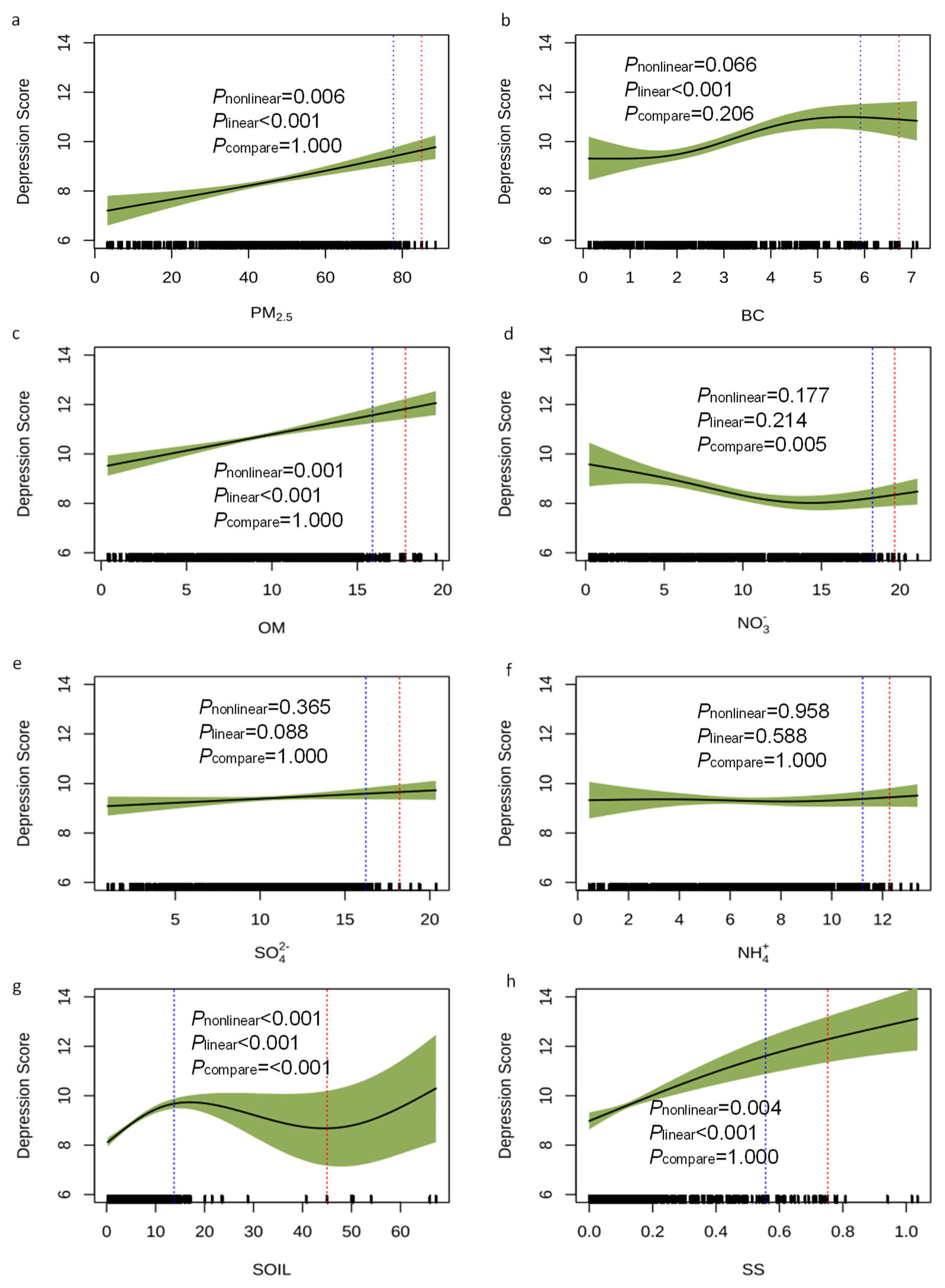
Figure 2.
Index weights of PM2.5 constituents from weighted quartile sum (WQS) regression for depression score associated with per quartile increases in the co-exposures of PM2.5 constituents. Notes: Adjusted for individual information (age, sex), sociodemographic background (education attainment, marital status, building type, cooking fossil type, location of residence), health status (cardiovascular diseases, disabled), and behavior characteristics (smoking, alcohol drinking, social activity). Abbreviation: PM2.5 = fine particulate matter; BC= black carbon; OM= organic matter; NO3-= nitrate; SO42- = sulfate; NH4+ = ammonium; SOIL = soil particles; SS = sea salt.
Figure 2.
Index weights of PM2.5 constituents from weighted quartile sum (WQS) regression for depression score associated with per quartile increases in the co-exposures of PM2.5 constituents. Notes: Adjusted for individual information (age, sex), sociodemographic background (education attainment, marital status, building type, cooking fossil type, location of residence), health status (cardiovascular diseases, disabled), and behavior characteristics (smoking, alcohol drinking, social activity). Abbreviation: PM2.5 = fine particulate matter; BC= black carbon; OM= organic matter; NO3-= nitrate; SO42- = sulfate; NH4+ = ammonium; SOIL = soil particles; SS = sea salt.
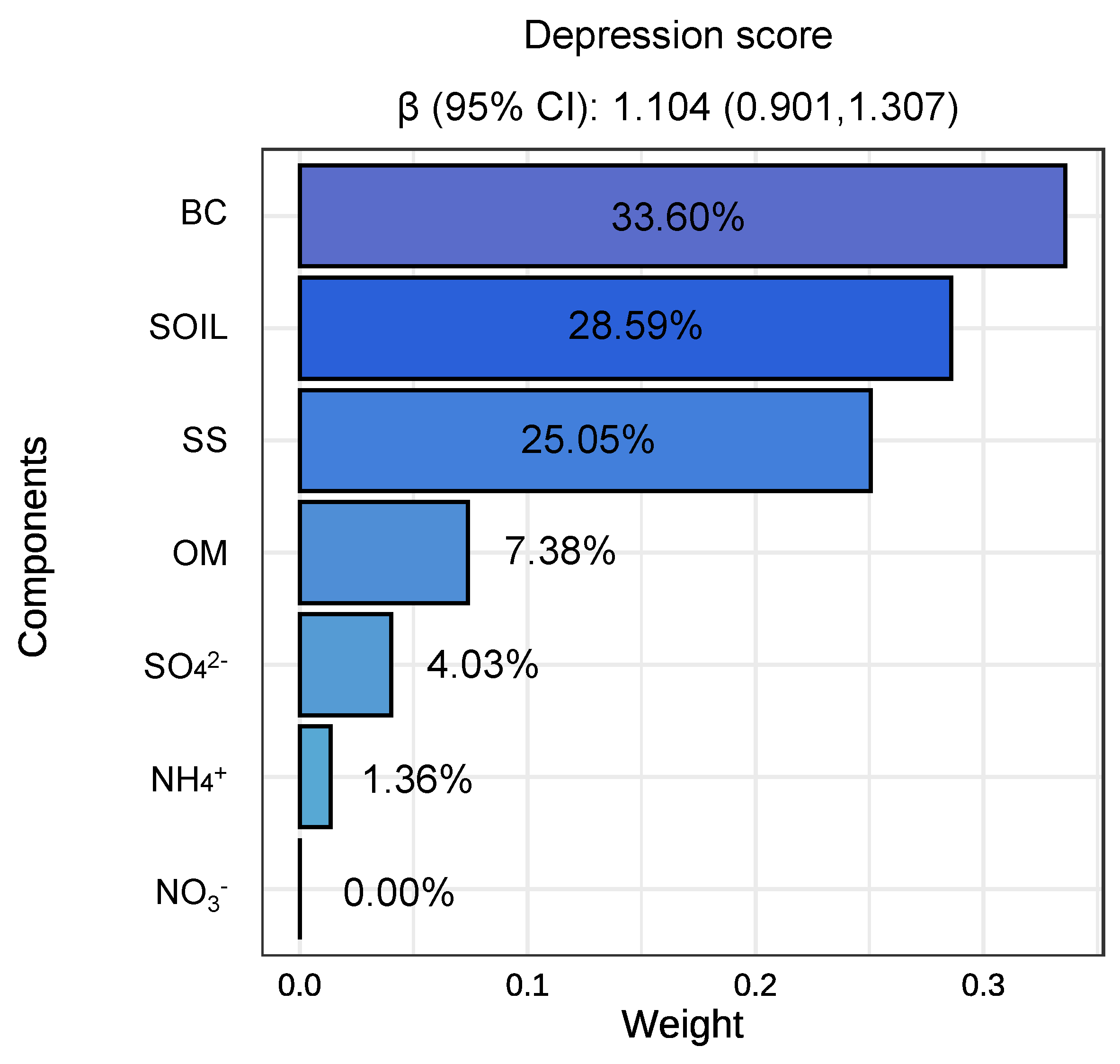
Figure 3.
The Association of PM2.5 and Its Components with Depression Score, stratified by social activity or NDVI. Notes: *p-interaction<0.05;**p-interaction<0.01;***p-interaction<0.001. Abbreviation: PM2.5 = fine particulate matter; BC= black carbon; OM= organic matter; NO3-= nitrate; SO42- = sulfate; NH4+ = ammonium; SOIL = soil particles; SS = sea salt.
Figure 3.
The Association of PM2.5 and Its Components with Depression Score, stratified by social activity or NDVI. Notes: *p-interaction<0.05;**p-interaction<0.01;***p-interaction<0.001. Abbreviation: PM2.5 = fine particulate matter; BC= black carbon; OM= organic matter; NO3-= nitrate; SO42- = sulfate; NH4+ = ammonium; SOIL = soil particles; SS = sea salt.
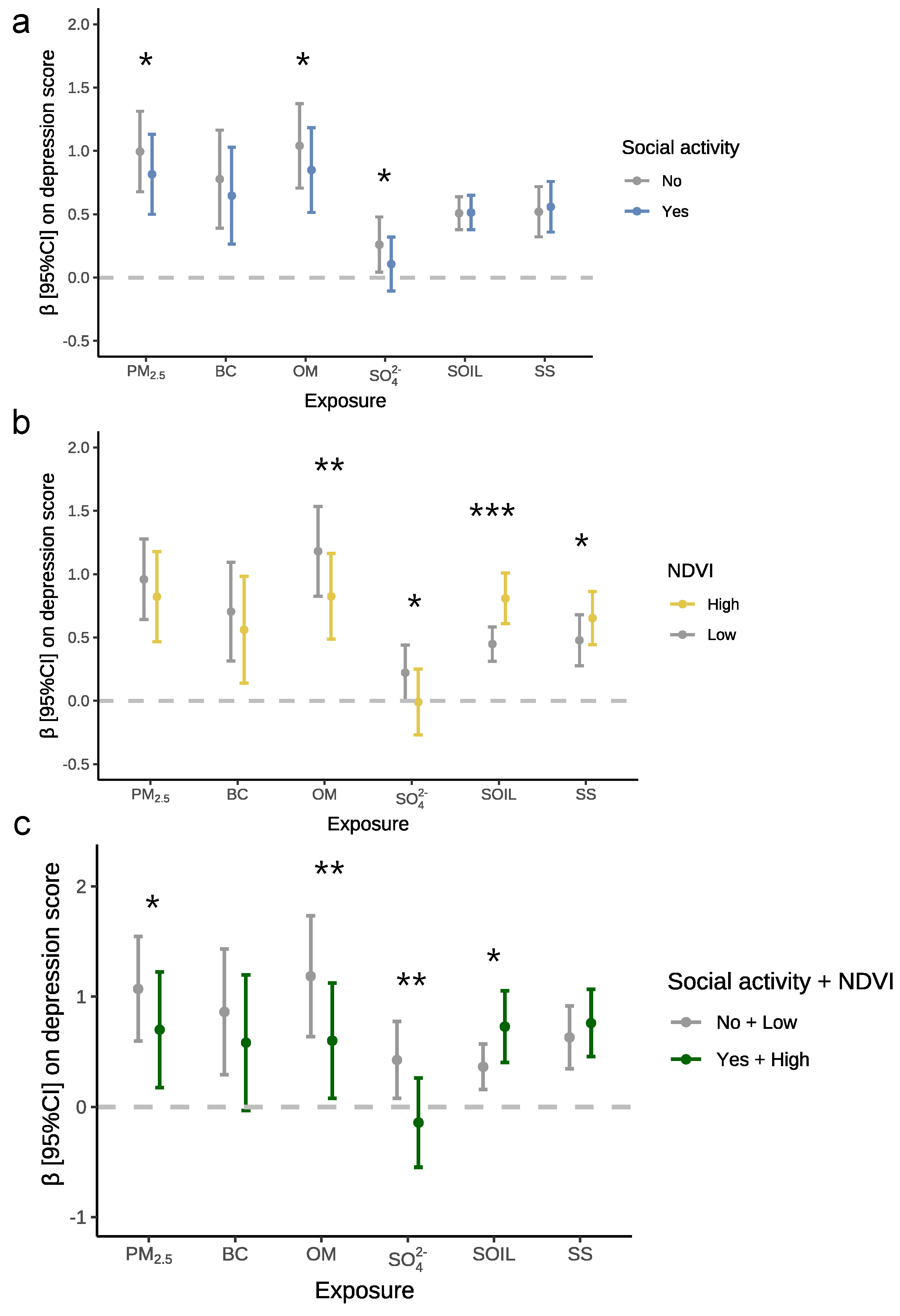

Table 1.
Longitudinal characteristics for the population.
| Sample | Total | 2011 | 2013 | 2015 | 2018 |
| Sample | 36847 | 9725 | 9134 | 9203 | 8785 |
| Age (mean±SD) | 60.75±8.64 | 57.63±8.34 | 59.74±8.35 | 61.64±8.34 | 64.30±8.08 |
| Sex = Male (%) | 17872 (48.5) | 4736 (48.7) | 4457 (48.8) | 4483 (48.7) | 4196 (47.8) |
| Education (%) | |||||
| Middle school or above | 13066 (35.5) | 3495 (35.9) | 3311 (36.2) | 3259 (35.4) | 3001 (34.2) |
| Primary school | 15429 (41.9) | 4042 (41.6) | 3738 (40.9) | 3828 (41.6) | 3821 (43.5) |
| Illiteracy | 8352 (22.7) | 2188 (22.5) | 2085 (22.8) | 2116 (23.0) | 1963 (22.3) |
| Marriage = Yes (%) | 32412 (88.0) | 8797 (90.5) | 8145 (89.2) | 8017 (87.1) | 7453 (84.8) |
| Smoking = Yes (%) | 15801 (42.9) | 3880 (39.9) | 3960 (43.4) | 4173 (45.3) | 3788 (43.1) |
| Drinking (%) | |||||
| <1/month | 2866 (7.8) | 778 (8.0) | 706 (7.7) | 755 (8.2) | 627 (7.1) |
| ≥1/month | 9828 (26.7) | 2572 (26.4) | 2518 (27.6) | 2452 (26.6) | 2286 (26.0) |
| Never | 24153 (65.5) | 6375 (65.6) | 5910 (64.7) | 5996 (65.2) | 5872 (66.8) |
| Social Activity = Yes (%) | 18175 (49.3) | 4688 (48.2) | 5032 (55.1) | 4535 (49.3) | 3920 (44.6) |
| Building type = one story (%) | 20925 (56.8) | 6089 (62.6) | 5689 (62.3) | 4814 (52.3) | 4333 (49.3) |
| Place of residence = Urban (%) | 13877 (37.7) | 3709 (38.1) | 3439 (37.7) | 3471 (37.7) | 3258 (37.1) |
| Cooking energy type = fossil (%) | 16408 (44.5) | 5352 (55.0) | 4231 (46.3) | 3889 (42.3) | 2936 (33.4) |
| Cardiovascular disease = Yes (%) | 16972 (46.1) | 3424 (35.2) | 3929 (43.0) | 4416 (48.0) | 5203 (59.2) |
| Disabled = Yes (%) | 9709 (26.3) | 1349 (13.9) | 2056 (22.5) | 2927 (31.8) | 3377 (38.4) |
Table 2.
The effect (β [95%CI]) for each IQR increase of PM2.5 and each component on depression score.
Table 2.
The effect (β [95%CI]) for each IQR increase of PM2.5 and each component on depression score.
| Exposure | IQR | M1 | M2 | M3 | M4 | M5 | M6 | M7 |
| PM2.5 | 29.18 | 0.89 (0.58, 1.20) | 0.94 (0.63, 1.24) | 0.90 (0.59, 1.20) | 0.90 (0.59, 1.20) | 0.90 (0.59, 1.20) | 0.95 (0.64, 1.25) | 0.93 (0.65, 1.23) |
| BC | 2.25 | 0.51 (0.13, 0.89) | 0.70 (0.32, 1.08) | 0.71 (0.34, 1.09) | 0.24 (-0.18, 0.65) | 0.72 (0.34, 1.09) | 0.82 (0.44, 1.20) | 0.70 (0.34, 1.06) |
| OM | 7.18 | 1.61 (1.30, 1.92) | 1.17 (0.85, 1.49) | 0.94 (0.61, 1.26) | 1.06 (0.72, 1.40) | 0.93 (0.61, 1.26) | 0.89 (0.54, 1.23) | 0.92 (0.58, 1.26) |
| NO3- | 8.48 | -1.16 (-1.51, -0.81) | -0.50 (-0.86, -0.14) | -0.20 (-0.57, 0.18) | 0.13 (-0.26, 0.51) | -0.19 (-0.56, 0.19) | 0.11 (-0.30, 0.53) | -0.18 (-0.56, 0.20) |
| SO42- | 5.32 | 0.16 (-0.04, 0.36) | 0.20 (0.00, 0.41) | 0.18 (-0.03, 0.38) | 0.75 (0.50, 1.00) | 0.18 (-0.02, 0.38) | 0.22 (0.02, 0.42) | 0.20 (-0.01, 0.41) |
| NH4+ | 4.58 | -0.30 (-0.60, -0.00) | 0.01 (-0.29, 0.31) | 0.10 (-0.20, 0.40) | 0.54 (0.23, 0.86) | 0.10 (-0.20, 0.40) | 0.25 (-0.06, 0.56) | 0.10 (-0.25, 0.45) |
| SOIL | 6.04 | 0.64 (0.52, 0.76) | 0.55 (0.43, 0.68) | 0.51 (0.38, 0.63) | 0.55 (0.42, 0.67) | 0.51 (0.38, 0.63) | 0.49 (0.36, 0.62) | 0.48 (0.42, 0.54) |
| SS | 0.14 | 0.66 (0.47, 0.85) | 0.55 (0.36, 0.75) | 0.53 (0.33, 0.73) | 0.39 (0.18, 0.59) | 0.53 (0.33, 0.73) | 0.49 (0.29, 0.69) | 0.54 (0.35, 0.73) |
Note: M1: unadjusted linear effect mixed model; M2: M1 additionally adjusted for individual information (age, sex); M3: main model, M2 additionally adjusted for sociodemographic background (education attainment, marital status, building type, cooking fossil type, location of residence), health status (cardiovascular related diseases, disabled), and behavior characteristics (smoking, alcohol drinking, social activity) ; M4: M3 additionally adjusted for residual of PM2.5; M5: M3 additionally adjusted for random intercept of community; M6: Similar to control variables in M3, but replacing individual random intercepts with individual fixed effects. M7: Similar to control variables in M3, but the estimated effects are obtained through 1000 bootstrap iterations. Bold values were statistical significant (P<0.05).
Disclaimer/Publisher’s Note: The statements, opinions and data contained in all publications are solely those of the individual author(s) and contributor(s) and not of MDPI and/or the editor(s). MDPI and/or the editor(s) disclaim responsibility for any injury to people or property resulting from any ideas, methods, instructions or products referred to in the content. |
© 2026 by the authors. Licensee MDPI, Basel, Switzerland. This article is an open access article distributed under the terms and conditions of the Creative Commons Attribution (CC BY) license (http://creativecommons.org/licenses/by/4.0/).
Copyright: This open access article is published under a Creative Commons CC BY 4.0 license, which permit the free download, distribution, and reuse, provided that the author and preprint are cited in any reuse.


