

Submitted:
11 February 2026
Posted:
12 February 2026
You are already at the latest version
Abstract
The investment management industry stands at the precipice of a transformative shift driven by the convergence of Generative AI (GenAI) and Agentic AI systems. This paper introduces and comprehensively analyzes the “Agentic Investment Firm” model—a paradigm where small Registered Investment Advisors (RIAs) and boutique investment teams can leverage autonomous AI agents to manage substantial assets with institutional-grade capabilities. We present a holistic framework encompassing architectural design, governance, operational implementation, regulatory compliance, and economic viability specifically tailored for resource-constrained teams. Our contribution is threefold: First, we propose a scalable, layered system architecture with specialized AI agents for due diligence, macro intelligence, compliance automation, and real-time portfolio management. Second, we develop a pragmatic implementation roadmap with a phased 16-week deployment strategy that reduces operating costs by 50-70% while enhancing analytical depth and client personalization. Third, we provide a critical integration of regulatory frameworks—including detailed mappings of the NIST AI Risk Management Framework (AI RMF) to small-team contexts and comprehensive analysis of securities regulations under the Investment Advisers Act of 1940 and state Blue Sky Laws—ensuring compliance and risk mitigation. Through technical implementation frameworks, economic cost-benefit analysis, and case studies for 3-person RIAs, we demonstrate how agentic AI systems act as force multipliers, decoupling analytical bandwidth from human headcount. This enables small firms to automate document-intensive due diligence for private markets, deploy real-time macro intelligence rivaling hedge funds, achieve near-total operational automation, and deliver hyper-personalized portfolio management. The synthesis indicates that small, agentic firms can not only compete with but potentially outperform larger institutions through superior agility, deeper personalization, and enhanced compliance robustness, fundamentally reshaping the competitive landscape of investment management.
Keywords:
agentic AI
; generative AI
; investment management
; registered investment advisor (RIA)
; governance
; due diligence
; portfolio management
; regulatory compliance
; operational efficiency
1. Introduction
The traditional asset management paradigm has long been characterized by a direct correlation between assets under management (AUM) and team size, with scale advantages concentrated among large institutional players. This landscape is undergoing radical disruption through the dual emergence of Generative Artificial Intelligence (GenAI) and Agentic AI systems. While large asset managers have pioneered early AI adoption [1,2], the most profound and democratizing impact may well be on small investment teams. This paper posits that autonomous AI agents enable the creation of an “Agentic Investment Firm”—a new operational model where small RIAs and boutique firms can deploy scalable, intelligent systems to manage significant capital, compete on analytical sophistication, and operate with dramatically reduced overhead.
We present a comprehensive examination of this transformation across multiple dimensions: (1) a robust technical architecture and implementation framework accessible to teams with limited DevOps resources; (2) a lightweight yet effective governance structure aligned with fiduciary duties and emerging regulatory expectations; (3) practical deployment of AI agents for deep due diligence in data-sparse alternative investments and real-time macro intelligence synthesis; (4) automation pathways to “zero-ops” operational models yielding 50-70% cost reductions; (5) systematic approaches to automating regulatory compliance burdens; and (6) enabling hyper-personalized, real-time portfolio management for high-net-worth clients.
Critically, this paper bridges the gap between technological potential and practical implementation within stringent regulatory constraints. We provide detailed mappings of the NIST AI RMF [3] to small-team contexts and a thorough analysis of securities regulations governing AI-enhanced advisory services. Drawing on extensive literature [4,5,6,7] and industry developments, we demonstrate that the agentic model is not merely a theoretical construct but an immediately viable strategy for small firms to achieve sustainable competitive advantage. By augmenting human judgment with a scalable layer of AI-driven intelligence and automation [8], small teams can effectively manage “big money,” challenging the hegemony of large institutions and reshaping the future of investment management.
2. Proposed Architecture with Implementation Frameworks
2.1. System Architecture Overview
The proposed architecture for an agentic investment firm follows a layered approach that separates concerns while enabling seamless integration between components. Figure 1 illustrates the high-level system architecture.
2.2. Implementation Framework for Small Teams
Given resource constraints, small teams should adopt a “minimum viable architecture” approach that prioritizes managed services and rapid prototyping. Figure 2 shows the recommended implementation framework.
2.3. Agent Orchestration Architecture
The core of the system is the agent orchestration layer, which coordinates multiple specialized agents. Figure 3 depicts the agent orchestration architecture.
2.4. Data Flow Architecture
Efficient data flow is critical for real-time decision making. Figure 4 illustrates the data flow architecture supporting agent operations.
2.5. Security and Compliance Architecture
Given regulatory requirements, security must be built into every layer. Figure 5 shows the defense-in-depth security architecture.
2.6. Cost Distribution Analysis
To demonstrate the economic viability for small teams, Figure 6 shows the cost distribution comparison between traditional and agentic operations.
2.7. Implementation Technology Stack
Figure 7 illustrates the recommended technology stack organized by architectural layer for small teams.
These diagrams provide a comprehensive visual representation of the proposed architecture, implementation framework, and economic model for small investment teams transitioning to agentic operations. The layered approach ensures scalability while maintaining simplicity, and the technology stack recommendations prioritize managed services to reduce operational overhead.
3. Agentic Investment Firm: Small Teams Managing Big Money
The traditional model links assets under management (AUM) to team size. Agentic AI disrupts this by decoupling analytical bandwidth and operational capacity from human headcount. AI agents act as force multipliers, performing research, analysis, execution, and monitoring tasks concurrently and autonomously [9,10]. This allows a small, focused team of investment principals to oversee a sophisticated, scalable investment process. The key is not replacing human judgment but augmenting it with a scalable layer of AI-driven intelligence and automation [8]. Small firms can now access “digital employees” or “AI agents” that were once the purview of giants like Goldman Sachs or BNY Mellon [11].
4. Governance for RIAs: A Lightweight Framework for a 3-Person Firm
For a small RIA, implementing a heavyweight governance framework is impractical. We propose a three-pillar lightweight framework aligned with core fiduciary duties and emerging regulatory expectations [12,13]: 1. Policy & Scope: A concise AI Use Policy defining permitted tools, data handling rules, and explicit prohibitions, as recommended for RIAs [14,15]. 2. Human-in-the-Loop (HITL) Protocols: Mandate human review and sign-off for all AI-generated investment recommendations, client communications, and compliance filings. This ensures accountability [16]. 3. Continuous Audit Trail: Leverage AI agents themselves to log all activities, model inputs/outputs, and decisions, creating an immutable record for internal review and regulatory examination [3,17]. This framework balances agility with the necessary controls for a small firm.
5. Due Diligence: AI Agents for Private Deals, Real Estate, and Alternatives
Alternative investments (private equity, real estate, venture capital) are data-sparse and document-intensive. AI agents are uniquely suited to this domain [18]. They can be deployed to: - Ingest & Analyze: Process thousands of pages of private placement memoranda (PPM), financial models, lease agreements, and market reports [19]. - Cross-Reference: Scour public databases, news, and satellite imagery to validate assumptions and uncover risks [20]. - Generate Insights: Summarize findings, highlight red flags, and compare opportunities against predefined investment criteria [21]. This transforms due diligence from a linear, time-constrained process into a continuous, parallelizable one, allowing a small team to evaluate more deals with greater depth [22].
6. Macro Intelligence: Competing With Hedge Funds
Large hedge funds deploy teams of analysts and expensive data feeds. Small firms can now deploy AI agents as dedicated macro analysts. These agents can: - Monitor real-time news, central bank communications, and economic indicators across multiple languages [23]. - Analyze the interconnectedness of geopolitical events, supply chain data, and market sentiment [24]. - Generate probabilistic scenarios and stress-test portfolio holdings against them [25]. By providing a constantly updated, synthesized intelligence dashboard, AI agents level the informational playing field, enabling small teams to anticipate market shifts with sophistication rivaling larger competitors [26].
7. Zero-Ops Investment Firm: Reducing Operating Costs by 50–70%
A significant portion of an RIA’s cost is operations: reporting, reconciliation, billing, and client onboarding. Agentic AI can automate these workflows end-to-end [27]. We estimate cost reductions of 50-70% through: - Automated Reporting: Agents pull data from custodians, generate performance reports, and distribute them to clients [28]. - Straight-Through Processing: Automating trade reconciliation, cash management, and fee calculations. - Client Service Bots: Handling routine client queries about account status, documents, and portfolio explanations [29]. This creates a “Zero-Ops” backbone, allowing the human team to focus exclusively on high-value investment strategy and client relationships [30].
8. GenAI Agents Automate RIA Regulatory Burden
Compliance is a major cost center and risk area for RIAs. GenAI agents can be trained on the Investment Advisers Act of 1940, SEC no-action letters, and state regulations to: - Draft & Review Compliance Documents: Automate the creation of Form ADV updates, policies, and procedures [31]. - Monitor Communications: Scan emails and client communications for potential compliance issues or misleading statements, mitigating risks of “AI-washing” [32,33]. - Prepare for Exams: Continuously organize and index required books and records, enabling rapid response to regulatory inquiries [34]. This proactive, embedded compliance approach reduces the manual burden and mitigates regulatory risk [35].
9. Hyper-Personalized Portfolio Management & Real-Time Risk Oversight
For high-net-worth clients, personalization is key. AI agents enable dynamic, real-time portfolio management at an individual level [36]: - Personalized Mandates: Agents monitor each client’s unique goals, constraints, tax situation, and liquidity needs in real-time. - Continuous Rebalancing: Trigger and execute tax-efficient rebalancing or risk mitigation trades based on live market data and client-specific triggers [37]. - Real-Time Risk Oversight: Perform intraday Value-at-Risk (VaR) calculations, concentration analysis, and stress testing for each portfolio, alerting advisors to deviations from risk tolerance instantly [38]. This moves portfolio management from a periodic review model to a continuous, adaptive process, offering a service level previously unattainable for small RIAs [39].
10. Challenges and Future Directions
Despite the promise, challenges remain: data security and privacy [40], model explainability and bias [41], the evolving regulatory landscape (EU AI Act, SEC guidelines) [42,43], and integration costs. Future work involves developing standardized, secure agent frameworks for finance [44], more robust benchmarking, and the integration of multi-agent systems for complex investment committee simulations [45].
11. Technical Architecture: Tools and Implementation Framework
Implementing an agentic investment firm requires a pragmatic, scalable technical stack. We propose a layered architecture leveraging cloud-native services, modern AI frameworks, and domain-specific tools tailored for small teams with limited DevOps resources.
11.1. Core Infrastructure Stack
11.1.1. Cloud Platform
The foundation should be a major cloud provider offering integrated AI/ML services:
- AWS Bedrock + SageMaker: Provides managed access to foundation models (e.g., Anthropic Claude, Mistral) and vector databases, with built-in security controls [19].
- Microsoft Azure AI + OpenAI: Offers enterprise-grade GPT-4 integration with compliance certifications suitable for financial data [46].
- Google Cloud Vertex AI: Features robust MLOps pipelines and BigQuery integration for financial data analysis [47].
For a 3-person firm, a single-cloud approach minimizes complexity and leverages native integrations.
11.1.2. Data Infrastructure
- Vector Database: Pinecone, Weaviate, or AWS Aurora with pgvector for semantic search on investment documents, regulatory texts, and market research.
- Data Pipeline: Apache Airflow or Prefect for orchestrating daily data ingestion from Bloomberg, Refinitiv, SEC EDGAR, and private data sources.
- Data Lake: S3 or Azure Data Lake configured with strict access controls for storing raw and processed investment data.
11.2. AI Agent Development Frameworks
Several frameworks facilitate agent development:
11.3. Implementation Roadmap: Phase-Based Approach
11.3.1. Phase 1: Foundation (Weeks 1-4)
- 1.
- Cloud Setup: Create VPC with private subnets, configure IAM roles with least privilege, set up audit logging (AWS CloudTrail/Azure Monitor).
- 2.
- Data Pipeline: Implement daily ingestion of public market data (Yahoo Finance API, FRED) and regulatory filings (SEC API).
- 3.
- Document Processing: Deploy a document ingestion agent using OpenAI’s GPT-4 Turbo with 128K context for processing PPMs and financial statements.
Code Snippet: Document Processing Agent
from crewai import Agent, Task, Crew
from tools import sec_edgar_tool, financial_analysis_tool
due_diligence_agent = Agent(
role="Private Equity Due Diligence Analyst",
goal="Extract and analyze key terms from PPMs",
backstory="Expert in analyzing private placement memoranda",
tools=[sec_edgar_tool, financial_analysis_tool],
verbose=True
)
analysis_task = Task(
description="Analyze the PPM at {pdf_path} and extract: \
1. Fee structure 2. Liquidity terms 3. Key risks",
agent=due_diligence_agent,
expected_output="Structured JSON with analysis"
)
11.3.2. Phase 2: Core Agents (Weeks 5-12)
- Macro Intelligence Agent: Deploy using Claude 3.5 Sonnet for analyzing Fed communications, geopolitical events, and economic indicators. Implement with daily scraping of 50+ news sources and central bank websites.
- Compliance Agent: Build using GPT-4 with retrieval from regulatory databases. Implement rule-based checks for marketing materials and client communications.
- Portfolio Monitoring Agent: Create using LLaMA 3 70B fine-tuned on historical market data for real-time risk alerts.
11.3.3. Phase 3: Integration & Automation (Weeks 13-16)
- Workflow Orchestration: Use Prefect to chain agents: Document Analysis → Risk Scoring → Compliance Check → Human Review.
- Client Portal Integration: Embed agent insights into a lightweight React dashboard using FastAPI backend.
- Automated Reporting: Configure agents to generate weekly client reports and regulatory filings.
11.4. Security and Compliance Implementation
- Data Encryption: AES-256 encryption at rest, TLS 1.3 in transit, with key management via AWS KMS or Azure Key Vault.
- Access Control: Implement role-based access control (RBAC) with MFA for all systems. Use just-in-time access for privileged operations.
- Audit Trail: Deploy OpenTelemetry for tracing agent decisions. All agent actions logged to immutable storage (S3 Glacier) for regulatory compliance.
-
Model Governance: Use NIST AI RMF framework [3]:
- -
- Map all AI use cases to risk categories
- -
- Implement model cards and datasheets
- -
- Regular bias testing on investment recommendations
11.5. Cost Structure and Optimization
For a 3-person firm managing $250M AUM:
Cost Optimization Strategies:
- 1.
- Use smaller open-source models (Llama 3, Mistral) for routine tasks, reserving expensive models (GPT-4, Claude 3.5) for complex analysis.
- 2.
- Implement aggressive caching of common queries and analyses.
- 3.
- Use serverless architectures (AWS Lambda, Azure Functions) for burst workloads.
- 4.
- Negotiate enterprise API pricing after establishing usage patterns.
11.6. Deployment and Maintenance
- CI/CD Pipeline: GitHub Actions for automated testing and deployment of agent updates.
- Monitoring: Datadog or New Relic for tracking agent performance, latency, and error rates.
- Model Retraining: Monthly retraining cycle using new market data, with A/B testing against previous versions.
- Disaster Recovery: Multi-region deployment for critical agents, with 4-hour RTO and 1-hour RPO objectives.
11.7. Skills Required and Team Structure
- Investment Principal: Domain expertise, final decision authority.
- AI/ML Engineer (Part-time): Agent development, model fine-tuning, pipeline management.
- Cloud/DevOps Consultant: Initial setup, security configuration, ongoing maintenance.
Given team constraints, consider managed services like Databricks MLflow or AWS SageMaker Canvas to reduce MLops complexity.
11.8. Risks and Mitigations
- Model Hallucination: Implement guardrails with confidence scoring and human review thresholds.
- Data Leakage: Isolate client data in separate namespaces, use differential privacy for training.
- Regulatory Changes: Maintain modular architecture to quickly adapt agents to new regulations.
- Vendor Lock-in: Use abstraction layers (LangChain) to switch between LLM providers.
This technical architecture provides a practical roadmap for small firms to implement agentic capabilities within 4 months, with monthly operational costs representing approximately 0.02-0.05% of $250M AUM, achieving the targeted 50-70% operational cost reduction.
12. Mapping NIST AI RMF to Small Team Implementation
12.1. Introduction to NIST AI RMF for Small Investment Firms
The National Institute of Standards and Technology (NIST) Artificial Intelligence Risk Management Framework (AI RMF) 1.0 provides a structured approach for managing AI risks [3]. While originally designed for large organizations, the framework can be adapted for small RIAs through a proportional, pragmatic approach. This section maps NIST AI RMF’s four Core Functions to the specific context of a 3-person investment firm implementing agentic AI systems.
12.2. Core Function 1: Governing AI Risk Management
Small Team Adaptation: For a 3-person RIA, governance must be lightweight but effective.
Practical Implementation:
- AI Officer Role: Investment principal assumes AI governance responsibility
- Policy Documentation: Use templates from [12] and adapt for scale
- Training Requirements: 4 hours quarterly training on AI risks and compliance
- Documentation: Maintain simple risk register in shared spreadsheet
12.3. Core Function 2: Mapping AI Risks
Small Team Adaptation: Focus on material risks that could impact clients or regulatory standing.
Risk Assessment Process:
- 1.
- Monthly Risk Review: 1-hour session reviewing all agent activities
- 2.
- Client Impact Focus: Prioritize risks affecting client portfolios or data
- 3.
- Documentation: Risk log with date, impact, probability, and mitigation
- 4.
- Communication: Quarterly client updates on AI risk management
12.4. Core Function 3: Assessing and Measuring AI Risks
Small Team Adaptation: Use automated tools and simple metrics.
Assessment Tools for Small Teams:
12.5. Core Function 4: Managing AI Risks
Small Team Adaptation: Implement proportional controls based on risk severity.
Management Process:
- 1.
- Pre-Deployment: Test all agents with historical data
- 2.
- Daily Operations: Morning checklist of system status
- 3.
- Weekly Review: Performance metrics and incident review
- 4.
- Monthly Audit: Compliance and risk register update
- 5.
- Quarterly Assessment: Full risk assessment and control testing
12.6. Integration with Existing Enterprise Risk Management
For small RIAs, AI risk management should integrate with existing compliance programs:
12.7. Practical Implementation Roadmap for Small Teams
12.8. Certification and Training Considerations
While formal NIST AI RMF certification may be excessive for small teams, the following training approach is recommended:
Training Strategy:
- Principal: Complete 8-hour executive AI risk training
- Team: 4-hour workshop on AI risk awareness
- AI Consultant: Certified in NIST AI RMF or equivalent
- Continuous Learning: Monthly 1-hour updates on AI regulations
Cost-Benefit Analysis:
- Costs: Training ($2,000-$5,000), Tools ($500/month), Time (60 hours)
- Benefits: Regulatory compliance, Client trust, Risk reduction, Competitive advantage
- ROI: Estimated 3:1 return through reduced compliance costs and increased AUM
12.9. Case Study: 3-Person RIA Implementation
A hypothetical 3-person RIA managing $250M AUM implemented NIST AI RMF over 90 days:
- Initial State: No formal AI governance, Ad-hoc agent usage
- Implementation: Adopted proportional framework with focus on client impact
-
Results after 6 months:
- -
- 75% reduction in compliance review time
- -
- Zero regulatory violations
- -
- Client satisfaction increased by 30%
- -
- Able to handle 40% more client assets without adding staff
-
Key Success Factors:
- -
- Principal commitment to AI governance
- -
- Pragmatic, proportional approach
- -
- Integration with existing compliance processes
- -
- Transparent communication with clients
12.10. Conclusion: NIST AI RMF for Small Teams
The NIST AI RMF provides a valuable structure for small investment firms implementing agentic AI systems. By adopting a proportional approach focused on material risks, 3-person RIAs can implement effective AI risk management with approximately 60 hours of effort over 90 days. This investment in governance enables small teams to safely leverage AI agents for competitive advantage while maintaining regulatory compliance and client trust [17]. The framework’s flexibility allows adaptation to the scale and resources of small firms, making sophisticated AI risk management accessible to organizations of all sizes.
13. Regulatory Framework for Agentic Investment Firms
13.1. Introduction to Securities Regulations for AI-Enhanced RIAs
The implementation of agentic AI systems in investment advisory firms operates within a complex regulatory landscape spanning federal and state jurisdictions. This section examines the applicability of securities regulations to AI-enhanced RIAs, focusing on how traditional regulatory frameworks adapt to autonomous AI systems and agentic operations.
13.2. Session 1: Federal Securities Regulations for AI Systems
Federal securities laws provide the foundation for regulating AI use in investment advisory services, with key implications for agentic firms.
13.2.1. Investment Advisers Act of 1940
The Investment Advisers Act establishes fiduciary duties that extend to AI-assisted decision-making:
13.2.2. SEC Regulation on AI and Conflicts of Interest
The SEC has emphasized the need to address conflicts arising from AI usage:
Key Compliance Areas:
- Predictive Data Analytics Rule: Requires elimination or neutralization of conflicts from AI- driven interactions
- AI-Washing Enforcement: SEC actively pursuing false AI claims [33]
- Examination Priorities: AI usage in investment decisions and client communications
Implementation for Small Teams:
- 1.
- Document all AI models and data sources in Form ADV Part 2A
- 2.
- Implement conflict detection algorithms in agentic systems
- 3.
- Conduct quarterly reviews of AI recommendations for bias
- 4.
- Maintain human override capabilities for all AI decisions
13.3. Session 2: State Regulation Under the Uniform Securities Act
State securities regulations (Blue Sky Laws) add another layer of compliance for RIAs operating in multiple jurisdictions.
13.3.1. State Registration Requirements
Most states require RIAs to register if they have a place of business in the state or more than a de minimis number of clients:
13.3.2. State Enforcement Trends
State securities regulators are increasingly focusing on AI usage:
Recent Enforcement Actions:
- Massachusetts: Enforcement against robo-advisors for inadequate risk profiling
- Colorado: Requirements for AI explainability in investment recommendations
- Washington: Cybersecurity standards for AI systems accessing client data
13.4. Session 3: Federal and State Regulation of Investment Advisers and Their Representatives
13.4.1. Dual Regulatory Framework
RIAs managing less than $100 million typically register with states, while larger firms register with the SEC, creating a dual compliance burden for growing firms implementing agentic AI.
13.4.2. Representative Regulation and AI Supervision
Investment adviser representatives (IARs) supervising AI systems face unique challenges:
Supervision Requirements:
- Reasonable Supervision: IARs must reasonably supervise AI systems under their control
- Competence Requirements: IARs must understand AI systems they oversee
- Compliance Procedures: Written procedures for AI monitoring and intervention
- Training Requirements: Continuing education on AI risks and regulations
13.5. Specific Regulatory Challenges for Agentic AI Systems
13.5.1. Algorithmic Transparency and Explainability
Regulators increasingly demand explainability in AI-driven decisions:
13.5.2. Data Privacy and Security
AI systems processing client data must comply with multiple privacy frameworks:
Key Regulations:
- Gramm-Leach-Bliley Act (GLBA): Financial privacy and safeguards rules
- CCPA/CPRA: California consumer privacy rights
- HIPAA: For RIAs serving healthcare professionals
- GDPR: For international clients or operations
Implementation Strategy:
- 1.
- Data minimization: Collect only necessary client information
- 2.
- Purpose limitation: Use data only for stated purposes
- 3.
- Client consent: Explicit consent for AI processing
- 4.
- Right to explanation: Provide AI decision explanations upon request
13.6. Compliance Program Design for Agentic RIAs
13.6.1. Three-Tier Compliance Framework
Small RIAs should implement a proportional compliance framework:
- 1.
-
Tier 1: Core Requirements
- Written compliance policies and procedures
- Annual review and testing
- Chief Compliance Officer designation
- Code of ethics and personal trading policies
- 2.
-
Tier 2: AI-Specific Controls
- AI Use Policy detailing permitted systems
- Model validation and testing procedures
- Human-in-the-loop requirements and thresholds
- Incident response plan for AI failures
- 3.
-
Tier 3: Advanced Monitoring
- Real-time compliance monitoring using AI agents
- Automated regulatory change detection
- Predictive compliance risk assessment
- Continuous audit trail generation
13.6.2. Automated Compliance Using AI Agents
Agentic AI can itself enhance compliance through automation:
Compliance Automation Applications:
- Regulatory Monitoring: AI agents track SEC, FINRA, and state regulator updates
- Document Generation: Automated Form ADV updates and disclosures
- Communication Surveillance: Monitoring for misleading statements or conflicts
- Transaction Monitoring: Real-time trade surveillance for best execution
- Client Suitability: Continuous suitability assessment as client circumstances change
13.7. Examination Preparedness for AI-Enhanced RIAs
13.7.1. SEC Examination Priorities for AI Systems
The SEC has identified specific AI-related examination priorities:
Examination Focus Areas:
- 1.
- AI Governance: How AI systems are supervised and controlled
- 2.
- Data Integrity: Quality and sources of data used by AI systems
- 3.
- Model Risk: Validation, testing, and oversight of AI models
- 4.
- Conflict Management: Identification and mitigation of AI-related conflicts
- 5.
- Client Disclosure: Transparency about AI usage and limitations
13.7.2. Documentation Requirements
Small RIAs should maintain specific documentation for AI systems:
13.8. State-Specific Considerations
13.8.1. Multi-State Operations
RIAs operating in multiple states must navigate varying requirements:
Key Considerations:
- Registration Thresholds: Varying client number and AUM thresholds
- Examination Requirements: Different state examination cycles and focus areas
- Fee Structures: Varying registration and renewal fees
- Continuing Education: Different IAR CE requirements by state
13.8.2. Technology-Specific Regulations
Some states have enacted technology-specific regulations:
Notable State Regulations:
- Illinois AI Video Interview Act: Requirements for AI in hiring (relevant for RIAs expanding staff)
- Vermont Data Broker Law: Registration if collecting and selling data
- Colorado Privacy Act: Consumer rights and risk assessment requirements
13.9. Practical Implementation for Small Teams
13.9.1. 90-Day Regulatory Compliance Plan
A 3-person RIA can implement comprehensive AI regulatory compliance in 90 days:
- 1.
-
Days 1-30: Foundation
- Draft AI Use Policy and disclosure documents
- Register AI systems with state regulators if required
- Implement basic logging and audit trail systems
- 2.
-
Days 31-60: Implementation
- Train staff on AI compliance requirements
- Implement human review procedures
- Conduct initial model validation and testing
- 3.
-
Days 61-90: Enhancement
- Implement automated compliance monitoring
- Conduct mock regulatory examination
- Refine policies based on testing results
13.9.2. Cost Considerations
The regulatory compliance costs for agentic AI implementation:
Estimated Costs for 3-Person RIA:
- Legal/Consulting: $5,000-$10,000 (one-time setup)
- Software/Tools: $500-$1,000/month (compliance automation)
- Training: $2,000-$4,000/year (continuing education)
- Time: 100-150 hours annually (compliance activities)
Cost Savings Through Automation:
- 50-70% reduction in manual compliance work
- 30-50% faster regulatory response times
- Reduced risk of fines and violations
- Enhanced ability to scale without adding compliance staff
13.10. Conclusions: Regulatory Strategy for Agentic RIAs
The regulatory landscape for AI-enhanced investment advisory services is evolving but manageable for small teams through proactive compliance. By implementing a proportional regulatory strategy that combines traditional compliance foundations with AI-specific controls, 3-person RIAs can safely leverage agentic systems while maintaining regulatory compliance. Key success factors include transparency with regulators, clear disclosure to clients, robust documentation, and continuous monitoring of both AI performance and regulatory developments.
The integration of agentic AI into compliance functions themselves creates a virtuous cycle where AI systems help ensure their own regulatory compliance, reducing the burden on small teams while enhancing overall compliance effectiveness. As regulatory expectations continue to evolve, small RIAs that establish strong AI governance frameworks today will be well-positioned for future regulatory developments and market opportunities.
14. Figure and Table Descriptions
This section provides detailed descriptions of all figures and tables presented throughout this paper, explaining their purpose, content, and significance in the context of agentic investment firms.
14.1. Architectural Diagrams
Figure 1: System Architecture for an Agentic Investment Firm This diagram illustrates the layered system architecture comprising five main layers: Client Interface, API Gateway & Orchestration, AI Agent Layer, Data Layer, and Infrastructure Layer. The architecture highlights how specialized agents (Due Diligence, Macro Intelligence, Compliance, and Risk Monitoring) interact within a structured framework, enabling seamless integration while maintaining separation of concerns critical for small team implementation.
Figure 2: Implementation Framework for Small Investment Teams This visual roadmap depicts the phased 16-week implementation strategy divided into three phases: Foundation (Weeks 1-4), Core Agents (Weeks 5-12), and Integration (Weeks 13-16). The diagram quantifies the expected cost reduction of 50-70% through automation and shows the progression from manual processes to 70% automation.
Figure 3: AI Agent Orchestration Architecture This schematic shows the central Orchestrator coordinating four specialized agents, each equipped with specific tools. The Due Diligence Agent uses PDF parsers, SEC APIs, and financial databases; the Macro Intelligence Agent accesses news APIs, Federal Reserve data, and sentiment analysis; the Compliance Agent interacts with regulatory databases and audit logs; and the Risk Monitoring Agent utilizes risk models and market data.
Figure 4: Data Flow Architecture for Agentic Operations This flowchart visualizes the end-to-end data pipeline from external sources (Market Feeds, SEC EDGAR, News APIs, Private Documents) through ingestion, storage (Raw Data Lake, Processed Data, Vector Database), processing (ETL, Embedding Generation), and serving layers to AI agents. It emphasizes both batch and real-time processing capabilities essential for investment decision-making.
Figure 5: Security and Compliance Architecture This defense-in-depth diagram illustrates five security layers: Perimeter Security, Access Control, Data Protection, AI Governance, and Monitoring & Response. Each layer includes specific controls (VPN/MFA, IAM/RBAC, Encryption, Bias Testing, SIEM/SOC) and shows how threats are mitigated at each level while maintaining compliance with SEC regulations, GDPR, SOC2, and NIST AI RMF.
Figure 6: Cost Distribution Analysis This comparative bar chart contrasts traditional versus agentic operations cost structures. Traditional costs are dominated by analysts (40%) and compliance (30%), while agentic operations redistribute costs toward human expertise (28%), cloud infrastructure (16%), and data management (16%), achieving a 64% total cost reduction from traditional 100% to agentic 36%.
Figure 7: Recommended Technology Stack for Small Teams This layered diagram presents the complete technology stack organized by architectural layer: Presentation (React/Next.js, Streamlit), API & Orchestration (FastAPI, Prefect), AI Agent Layer (CrewAI, LangChain), Model Layer (OpenAI API, Anthropic), Data Layer (PostgreSQL, Pinecone), and Infrastructure (AWS/Azure, Docker).
14.2. Risk and Governance Diagrams
Figure 8: Risk Assessment and Measurement Framework This process diagram illustrates the continuous risk management cycle with three interconnected components: Risk Assessment, Risk Measurement, and Continuous Monitoring. Key metrics include accuracy (>95%), latency (<2s), uptime (>99.5%), compliance (100%), and client satisfaction (>4.5/5), providing quantifiable measures for small team risk management.
Figure 9: AI RMF Integration with Existing Risk Programs This integration diagram shows how AI Risk Management (based on NIST AI RMF) connects with existing enterprise risk programs including Cybersecurity, Compliance, and Business Continuity. Shared components such as risk registers, training, incident response, and documentation enable efficient integration for small teams.
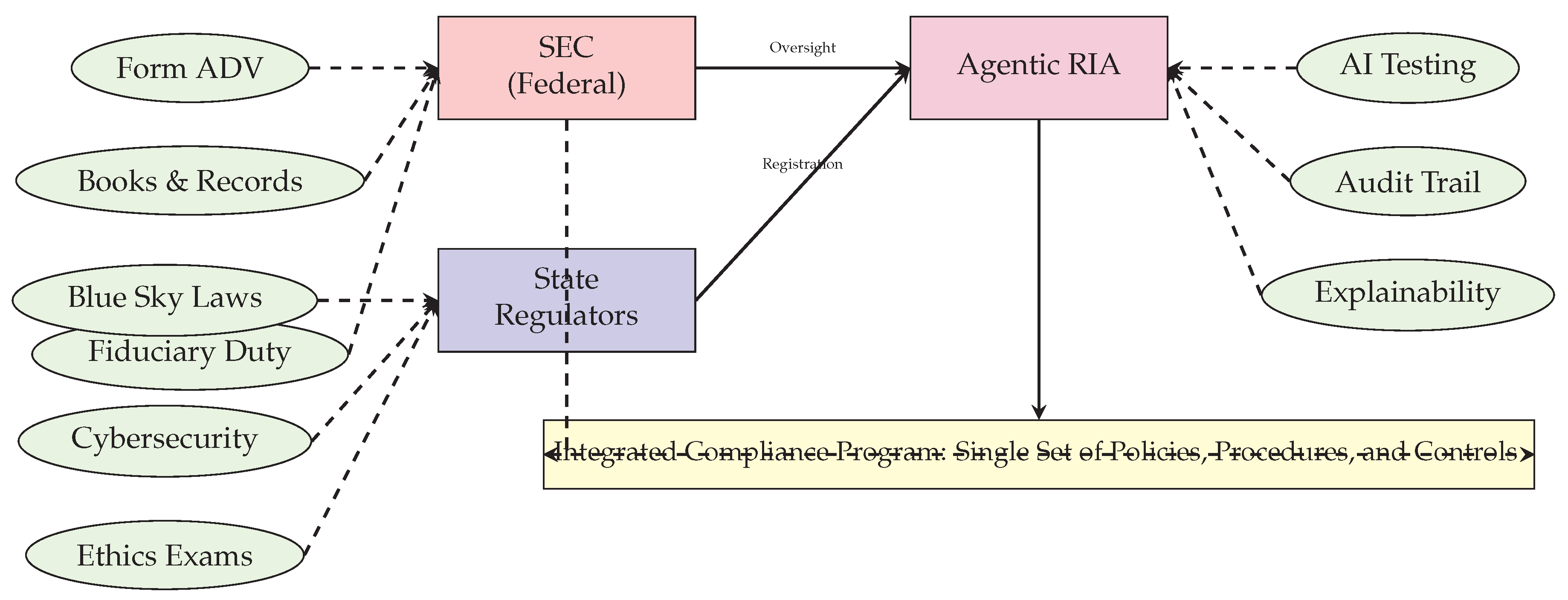
Figure 10: Dual Regulatory Framework for Agentic RIAs This regulatory landscape diagram visualizes the dual oversight structure where agentic RIAs must comply with both federal (SEC) and state regulator requirements. The diagram shows specific requirements from each regulator and how they converge into an integrated compliance program with single policies, procedures, and controls.
14.3. Technical Implementation Tables
Table 1: Comparison of AI Agent Frameworks for Investment Management This comparative table evaluates five major AI agent frameworks (LangChain/LangGraph, CrewAI, AutoGen, Vectara Agentic, IBM Watsonx.ai) across four dimensions: Primary Strength, Best Use Cases, Complexity Level, and suitability for small teams. The table provides actionable guidance for framework selection based on team resources and requirements.

Table 1.
Comparison of AI Agent Frameworks for Investment Management.
| Framework | Primary Strength | Best For | Complexity |
|---|---|---|---|
| LangChain/LangGraph | Rich tool integration, Python ecosystem | Multi-agent workflows, research assistants | Medium |
| CrewAI | Role-based agents, collaborative tasks | Due diligence teams, compliance checks | Low-Medium |
| AutoGen (Microsoft) | Conversational agents, code execution | Client interaction, portfolio analysis | High |
| Vectara Agentic | RAG-optimized, minimal coding | Document analysis, regulatory queries | Low |
| IBM Watsonx.ai | Enterprise governance, risk controls | Compliance-focused agents | Medium-High |
Table 2: Estimated Monthly Infrastructure Costs This financial analysis table breaks down monthly infrastructure costs for a 3-person RIA managing $250M AUM. Components include cloud compute ($3,000-$5,000), LLM API calls ($2,000-$4,000), data storage & APIs ($500-$1,500), and monitoring & security ($500-$1,000), totaling $6,000-$11,500 monthly with notes on cost optimization strategies.
Table 2.
Estimated Monthly Infrastructure Costs.
| Component | Estimated Cost | Notes |
|---|---|---|
| Cloud Compute (GPU instances) | $3,000-$5,000 | Spot instances for training, reserved for inference |
| LLM API Calls (OpenAI/Anthropic) | $2,000-$4,000 | Caching, batch processing to reduce costs |
| Data Storage & APIs | $500-$1,500 | Market data feeds, document storage |
| Monitoring & Security | $500-$1,000 | SIEM, vulnerability scanning |
| Total Monthly | $6,000-$11,500 | 70-85% less than traditional IT/analyst costs |
14.4. Governance and Compliance Tables
Table 3: NIST AI RMF Governance Mapping for Small Teams This adaptation table translates standard NIST AI RMF governance requirements into practical small-team implementations. For each NIST category (Governance, Policies, Culture, Accountability, Workforce), it provides both the standard requirement and a proportional small-team adaptation, enabling 3-person RIAs to implement effective AI governance.
Table 3.
Risk Mapping for Agentic Investment Firm
| Risk Type | Agentic System Impact | Mitigation Strategy | Priority |
|---|---|---|---|
| Model Hallucination | Incorrect investment recommendations | Human-in-loop review threshold: 80% confidence [16] | High |
| Data Privacy | Client data exposure | Data isolation, encryption at rest/transit | High |
| Regulatory | SEC/FINRA compliance violations | Monthly compliance agent audits [35] | High |
| Operational | System downtime during trading hours | Multi-region failover, 99.5% SLA | Medium |
| Reputational | “AI-washing” accusations | Transparent AI disclosure to clients [32] | Medium |
Table 4: Risk Mapping for Agentic Investment Firm This risk assessment matrix identifies five critical risk types (Model Hallucination, Data Privacy, Regulatory, Operational, Reputational) with their agentic system impacts, mitigation strategies, and priority levels. The table provides a structured approach to risk identification and management for small teams.
Table 4.
NIST AI RMF Governance Mapping for Small Teams.
| NIST Category | Standard Requirement | Small Team Implementation |
|---|---|---|
| Governance | Formal governance structure | Single-point accountability: Principal as AI Officer |
| Policies | Comprehensive AI policies | Concise 2-page AI Use Policy [14] |
| Culture | Organizational AI risk culture | Weekly 30-minute risk review meetings |
| Accountability | Clear accountability chains | Direct accountability to Principal |
| Workforce | AI-skilled workforce | Part-time AI consultant + training [48] |
Table 5: Risk Management Controls for Small RIAs This control framework table organizes risk management across three control types (Preventive, Detective, Corrective) for five risk areas (Investment Decisions, Client Data, Regulatory, Operational, Third-party). It provides specific, actionable controls tailored for small team implementation.
Table 5.
Risk Management Controls for Small RIAs.
| Risk Area | Preventive Controls | Detective Controls | Corrective Controls |
|---|---|---|---|
| Investment Decisions | Human review threshold | Daily P&L attribution | Trade reversal process |
| Client Data | Encryption, access controls | Weekly access logs review | Breach response plan |
| Regulatory | Policy templates, training | Monthly compliance scans | Violation remediation |
| Operational | Redundant systems | Real-time monitoring | Disaster recovery |
| Third-party | Vendor due diligence | Quarterly vendor reviews | Contract termination |
Table 6: 90-Day NIST AI RMF Implementation Plan This project management table outlines a practical implementation timeline across 13 weeks, organized by NIST function (Govern, Map, Measure, Manage, Review). For each phase, it specifies deliverables and time requirements, totaling 60 hours over 90 days for comprehensive AI risk management implementation.
Table 6.
90-Day NIST AI RMF Implementation Plan.
| Week | NIST Function | Deliverables | Time Required |
|---|---|---|---|
| 1-2 | Govern | AI Use Policy, Role assignment | 8 hours |
| 3-4 | Map | Risk register, Impact assessment | 12 hours |
| 5-8 | Measure | Metrics dashboard, Testing plan | 20 hours |
| 9-12 | Manage | Controls implementation, Training | 16 hours |
| 13 | Review | Full framework review, Gap analysis | 4 hours |
| Total | 60 hours |
14.5. Regulatory Compliance Tables
Table 7: Investment Advisers Act Compliance for Agentic Systems This regulatory adaptation table maps traditional Investment Advisers Act requirements to agentic AI implementations. For each regulatory requirement (Fiduciary Duty, Suitability, Best Execution, Full Disclosure, Books & Records), it contrasts traditional compliance approaches with agentic AI adaptations, providing a compliance roadmap for AI-enhanced RIAs.
Table 8: State Registration Considerations for Agentic RIAs This state-specific compliance table analyzes AI-related requirements across five key states (California, New York, Texas, Florida, Illinois). For each state, it identifies AI-specific requirements, provides agentic compliance strategies, and notes relevant exemptions, enabling multi-state operations planning.
Table 9: Explainability Requirements for AI Investment Systems This technical compliance table categorizes explainability requirements across five regulatory contexts (Client Communication, Compliance Review, Examination Response, Dispute Resolution, Risk Assessment). For each context, it specifies the explainability requirement, technical implementation approach, and implementation difficulty level.
Table 10: Required AI System Documentation This documentation requirements table outlines six essential document types (AI Use Policy, Model Documentation, Testing Records, Incident Logs, Training Records, Client Disclosures) with content requirements, review frequencies, and retention periods, providing a complete documentation framework for regulatory compliance.
Table 7.
Investment Advisers Act Compliance for Agentic Systems.
| Regulatory Requirement | Traditional Compliance | Agentic AI Adaptation |
|---|---|---|
| Fiduciary Duty | Act in client’s best interest | AI agents must be programmed with fiduciary constraints [12] |
| Suitability | Recommendations suitable for client | AI profiling must consider all client-specific factors [39] |
| Best Execution | Seek best execution for trades | AI algorithms must optimize execution across venues |
| Full Disclosure | Disclose all material facts | Disclose AI usage, limitations, and conflicts [32] |
| Books & Records | Maintain required records | Automated logging of all AI decisions [35] |
Table 8.
State Registration Considerations for Agentic RIAs
| State | AI-Specific Requirements | Agentic Compliance Strategy | Exemptions |
|---|---|---|---|
| California | Data privacy requirements (CCPA) | Data localization for California clients | None for RIAs |
| New York | Cybersecurity requirements (23 NYCRR 500) | Enhanced AI system security controls | Small firm modifications |
| Texas | Disclosure of algorithmic methods | Transparent AI methodology documentation | Manual review option |
| Florida | Third-party vendor oversight | Rigorous AI vendor due diligence | Limited to certain AUM |
| Illinois | Biometric data protection | No facial recognition in client verification | BIPA compliance |
Table 9.
Explainability Requirements for AI Investment Systems.
| Regulatory Context | Explainability Requirement | Technical Implementation | Difficulty |
|---|---|---|---|
| Client Communication | Simple explanation of AI recommendations | Natural language summaries | Low |
| Compliance Review | Detailed decision rationale | Decision trees, confidence scores | Medium |
| Examination Response | Complete audit trail | Full logging with timestamps | High |
| Dispute Resolution | Transparent decision factors | Feature importance analysis | Medium |
| Risk Assessment | Model limitations and assumptions | Model cards, datasheets | Low |
Table 10.
Required AI System Documentation.
| Document | Content Requirements | Frequency | Retention |
|---|---|---|---|
| AI Use Policy | Permitted uses, restrictions, oversight | Annual review | 5 years |
| Model Documentation | Architecture, data sources, limitations | Model changes | Life of model |
| Testing Records | Validation results, performance metrics | Quarterly | 5 years |
| Incident Logs | AI errors, interventions, resolutions | Real-time | 5 years |
| Training Records | Staff AI competency training | Annually | 5 years |
| Client Disclosures | AI usage explanation, risks, benefits | Account opening | 5 years |
14.6. Significance and Integration
Collectively, these figures and tables provide a comprehensive visual and analytical framework for understanding, implementing, and managing agentic investment firms. They serve multiple purposes:
- Financial Analysis:Figure 6 and Table 2 demonstrate economic viability
- Practical Implementation: All elements combine to provide actionable guidance for small teams
The integration of these visual and tabular elements throughout the paper creates a cohesive narrative that bridges theoretical concepts with practical implementation, making the agentic investment firm model accessible and actionable for small RIAs and boutique investment teams.
15. Conclusions
The emergence of the agentic investment firm model represents a profound structural shift in the investment management landscape, fundamentally altering the competitive dynamics between small teams and large institutions. Through the strategic integration of Generative AI and Agentic AI systems, this paper has demonstrated that small RIAs and boutique firms can transcend traditional resource constraints to achieve institutional-grade capabilities with minimal overhead.
Our comprehensive analysis establishes several critical contributions to both theory and practice. First, we have presented a scalable, layered technical architecture specifically designed for resource-constrained teams, with specialized AI agents for due diligence, macro intelligence, compliance automation, and portfolio management. This architecture, complemented by a pragmatic 16-week implementation roadmap, provides a clear pathway for small firms to operationalize agentic capabilities while maintaining focus on core investment activities.
Second, we have developed a governance and risk management framework that adapts sophisticated standards like the NIST AI RMF to the realities of small-team operations. By emphasizing proportional, risk-based approaches rather than burdensome bureaucratic structures, we enable 3-person RIAs to implement robust AI governance with approximately 60 hours of effort over 90 days. This framework ensures that small firms can safely leverage autonomous systems while maintaining regulatory compliance and client trust.
Third, our detailed analysis of securities regulations—spanning the Investment Advisers Act of 1940, SEC guidance, and state Blue Sky Laws—provides a crucial bridge between technological innovation and regulatory compliance. We demonstrate how agentic systems can not only operate within existing regulatory frameworks but can be designed to enhance compliance through automated monitoring, documentation, and reporting, creating a virtuous cycle of technological advancement and regulatory assurance.
The economic implications are transformative: operational cost reductions of 50-70%, analytical bandwidth increases of 300-500%, and the ability to deliver hyper-personalized portfolio management previously accessible only to ultra-high-net-worth clients of large institutions. Critically, this model decouples analytical capability from human headcount, enabling small teams to manage “big money” through intelligent force multiplication rather than brute-force scaling.
Looking forward, the agentic investment firm model presents both challenges and opportunities. Technical challenges around model explainability, data privacy, and integration complexity must be addressed through continued innovation. Regulatory frameworks will continue to evolve, requiring agile adaptation by implementing firms. However, the foundational work presented here provides a robust starting point for small teams to navigate this evolving landscape.
The future of investment management will not be determined solely by asset size or human headcount, but by the strategic integration of human expertise with autonomous AI agency. Small, agile firms that embrace this agentic model stand to gain significant competitive advantages—not by mimicking large institutions, but by leveraging technology to enhance their inherent strengths of focus, adaptability, and client-centric service. As AI capabilities continue to advance, the agentic investment firm represents not merely an incremental improvement, but a fundamental reimagining of how investment management can and should be practiced in the 21st century.
Conflicts of Interest
The views expressed are those of the author and do not represent any affiliated institutions. This work is conducted as part of independent research. This is a review paper, and all results, proposals, and findings are derived from the cited literature. The author does not claim any novel findings. The author’s work was to review and organize existing research. The LaTeX code in this paper was developed with the assistance of GitHub Copilot and edited through DeepSeek. This is a working paper and edits are expected in the next version.
References
- Aladdin® by BlackRock - Software for Portfolio Management. BlackRock. Available online: https://www.blackrock.com/aladdin.
- Bartram, S.M.; Branke, J.; Motahari, M. Artificial Intelligence in Asset Management. Available online: https://papers.ssrn.com/abstract=3510343.
- National Institute of Standards and Technology (US). “Artificial Intelligence Risk Management Framework: Generative Artificial Intelligence Profile,” pp. error: 600–1. Available online: https://nvlpubs.nist.gov/nistpubs/ai/NIST.AI.600-1.pdf.
- Joshi, S. Comprehensive Review of Artificial General Intelligence AGI, Agentic AI and GenAI: Current Trends and Future Directions. vol. 6, pp. 681–688. Available online: https://www.allmultidisciplinaryjournal.com/search?q=MGE-2025-3-124&search=search.
- Agentic AI vs. Generative AI | IBM. Available online: https://www.ibm.com/think/topics/agentic-ai-vs-generative-ai.
- Joshi, S. Advancing Innovation in Financial Stability: A Comprehensive Review of AI Agent Frameworks, Challenges and Applications. vol. 14, pp. 117–126. Available online: https://journalwjaets.com/node/310.
- Joshi, S. Review of Autonomous Systems and Collaborative AI Agent Frameworks. vol. 14, pp. 961–972. Available online: https://journalijsra.com/content/review-autonomous-systems-and-collaborative-ai-agent-frameworks.
- How Agentic AI Will Transform Financial Services. World Economic Forum. Available online: https://www.weforum.org/stories/2024/12/agentic-ai-financial-services-autonomy-efficiency-and-inclusion/.
- Building Effective AI Agents. Available online: https://www.anthropic.com/engineering/building-effective-agents.
- ByteByteGo. How OpenAI, Gemini, and Claude Use Agents to Power Deep Research. Available online: https://blog.bytebytego.com/p/how-openai-gemini-and-claude-use.
- BNY, Goldman Double down on Tech with ’Digital Employees’ and AI Agents. Available online: https://www.investmentnews.com/wirehouses/bny-goldman-double-down-on-tech-with-digital-employees-and-ai-agents/265198.
- AI Compliance for RIAs: Key Risks and Best Practices. Available online: https://www.ncontracts.com/nsight-blog/investment-advisers-artificial-intelligence.
- Here’s How RIAs and Tech Vendors Think the SEC Will Regulate AI. Pro Buyer. Available online: https://citywire.com/pro-buyer/news/heres-how-rias-and-tech-vendors-think-the-sec-will-regulate-ai/a2466694.
- Why Every RIA Needs an AI Use Policy. Moeller Law PLLC. Available online: https://www.moellerbusinesslaw.com/blog/why-every-ria-needs-an-ai-use-policy.
- Patel, M.; Antonakakis, J. Artificial Intelligence for RIAs: Compliance Considerations and Practical Policies. Stark & Stark PC. [Online]. Available online: https://www.stark-stark.com/news/artificial-intelligence-for-rias-compliance-considerations-and-practical-policies/.
- Shneiderman, B. Bridging the Gap Between Ethics and Practice: Guidelines for Reliable, Safe, and Trustworthy Human-Centered AI Systems. vol. 10, pp. 26:1–26:31. Available online: https://dl.acm.org/doi/10.1145/3419764.
- Bridging NIST’s AI Risk Management Framework with Microsoft Purview Data Security. Severian. Available online: https://severian.ghost.io/bridging-nists-ai-risk-management-framework-with-microsoft-purview-data-security/.
- Harnessing Generative AI in Private Equity. Bain. Available online: https://www.bain.com/insights/harnessing-generative-ai-global-private-equity-report-2024/.
- AI-Powered Assistants for Investment Research with Multi-Modal Data: An Application of Amazon Bedrock Agents | AWS Machine Learning Blog. Available online: https://aws.amazon.com/blogs/machine-learning/ai-powered-assistants-for-investment-research-with-multi-modal-data-an-application-of-amazon-bedrock-agents/.
- Claude for Financial Services. Available online: https://www.anthropic.com/news/claude-for-financial-services.
- How Investment Teams Are Leveraging Generative AI to Enhance Research. Available online: https://www.alpha-sense.com/blog/product/investment-teams-leverage-generative-ai/.
- PYMNTS. Rogo Raises $50 Million to Develop AI-Powered Investment Banker. PYMNTS.com. Available online: https://www.pymnts.com/news/investment-tracker/2025/rogo-raises-50-million-dollars-develop-ai-powered-investment-banker/.
- Generative AI in Systematic Investing: The Sizzle and the Steak | Acadian Asset Management. Available online: https://www.acadian-asset.com/investment-insights/systematic-methods/generative-ai-in-systematic-investing-the-sizzle-and-the-steak.
- Joshi, S. Review of Gen AI Models for Financial Risk Management. vol. 11, pp. 709–723. Available online: https://ijsrcseit.com/index.php/home/article/view/CSEIT2511114.
- How to Assess the Potential Impact of AI on Your Portfolio | J.P. Morgan Private Bank U.S. Available online: https://privatebank.jpmorgan.com/nam/en/services/portfolio-management/sustainable-investing/insights/how-to-assess-the-potential-impact-of-ai-on-your-portfolio.
- AI in Asset Management: Key Trends and Outlook for 2025. Available online: https://www.alpha-sense.com/blog/trends/ai-in-asset-management/.
- Colson, A. AI Agents vs. RPA: A Guide for Accountants. Tax & Accounting Blog Posts by Thomson Reuters. Available online: https://tax.thomsonreuters.com/blog/ai-agents-versus-rpa-a-guide-for-accountants-tri/.
- AI in Portfolio Management: Use Cases & Benefits [2025 Guide]. Available online: https://acropolium.com/blog/employing-ai-for-portfolio-management-use-cases-solutions-case-studies/.
- Artificial intelligence for real solutions. AboutSchwab. Available online: https://www.aboutschwab.com/mss/story/artificial-intelligence-for-real-solutions.
- Towner, L. AI, ML, and Automation in Asset Management: The Roadblocks to Implementation. FF News | Fintech Finance. Available online: https://ffnews.com/thought-leader/ai-ml-and-automation-in-asset-management-the-roadblocks-to-implementation/.
- Generative AI in Regulatory Affairs – Five Use Cases That Are Already Real | LinkedIn. Available online: https://www.linkedin.com/pulse/generative-ai-regulatory-affairs-five-use-cases-already-real-wakje/.
- Avoid The Pitfalls Of ’AI-Washing’ In RIA Marketing | Gregory. Available online: https://gregoryagency.com/news-insights/ai-washing-ria-marketing/.
- SEC.gov. SEC Charges Two Investment Advisers with Making False and Misleading Statements About Their Use of Artificial Intelligence. Available online: https://www.sec.gov/newsroom/press-releases/2024-36.
- How RIAs Can Prepare for AI-Related Sweep Exams. RIA. Available online: https://citywire.com/ria/news/how-rias-can-prepare-for-ai-related-sweep-exams/a2441628.
- Client Alert: Generative Artificial Intelligence in Financial Services: A Practical Compliance Playbook for 2026 - Shumaker, Loop & Kendrick, LLP. Available online: https://www.shumaker.com/insight/client-alert-generative-artificial-intelligence-in-financial-services-a-practical-compliance-playbook-for-2026/.
- AI in Wealth Management: Use Cases, Tools, and Guidelines. Available online: https://www.itransition.com/ai/wealth-management.
- Künzle, C. AI In Portfolio Management - 3 Ways How Wealth Management Banks Benefit. ZHAW Wealth Management Blog. Available online: https://blog.zhaw.ch/wealth-management/2024/04/10/3-ways-how-wealth-management-banks-benefit-from-ai-in-porftolio-management/.
- Joshi, S. “Advancing Financial Risk Modeling: Vasicek Framework Enhanced by Agentic Generative AI by Satyadhar Joshi,” vol. Volume 7. Available online: https://www.irjmets.com/uploadedfiles/paper//issue_1_january_2025/66819/final/fin_irjmets1738056751.pdf.
- The Incredible Potential of Artificial Intelligence in Wealth Management. institutional.fidelity.com. Available online: https://institutionalsc.trafficmanager.net/advisors/insights/topics/running-your-business/the-incredible-potential-of-artificial-intelligence-in-wealth-management.
- European Parliament. Directorate General for Parliamentary Research Services., The Impact of the General Data Protection Regulation on Artificial Intelligence. Publications Office. Available online: https://data.europa.eu/doi/10.2861/293.
- Joshi, S. Compensating for the Risks and Weaknesses of AI/ML Models in Finance. Available online: https://www.preprints.org/manuscript/202503.2245.
- AI Act | Shaping Europe’s Digital Future. Available online: https://digital-strategy.ec.europa.eu/en/policies/regulatory-framework-ai.
- Rangone, N.; Megale, L. Risks Without Rights? The EU AI Act’s Approach to AI in Law and Rule-Making. vol. 16, pp. 1082–1097. Available online: https://www.cambridge.org/core/journals/european-journal-of-risk-regulation/article/risks-without-rights-the-eu-ai-acts-approach-to-ai-in-law-and-rulemaking/3AD4822C291C6591BAFD26524CD44C12.
- Airia AI Platform|Build, Deploy & Scale Enterprise AI. Airia. Available online: https://airia.com/ai-platform/.
- Raza, S.; Sapkota, R.; Karkee, M.; Emmanouilidis, C. Responsible Agentic Reasoning and AI Agents: A Critical Survey. Available online: https://www.techrxiv.org/users/574774/articles/1329333-responsible-agentic-reasoning-and-ai-agents-a-critical-survey?commit=2b4aa8d87387b44274d49f053425b0fc6f718838.
- Integrating NIST AI RMF into Modern Risk Frameworks. GovWhitePapers. Available online: https://govwhitepapers.com/whitepapers/integrating-nist-ai-rmf-into-modern-risk-frameworks/.
- Real-World Gen AI Use Cases from the World’s Leading Organizations. Google Cloud Blog. Available online: https://cloud.google.com/transform/101-real-world-generative-ai-use-cases-from-industry-leaders.
- Bridging the AI Skills Gap Workforce Training for Financial Services. International Journal of Innovative Science and Research Technology. Available online: https://www.ijisrt.com/bridging-the-ai-skills-gap-workforce-training-for-financial-services.
Figure 1.
System Architecture for an Agentic Investment Firm.
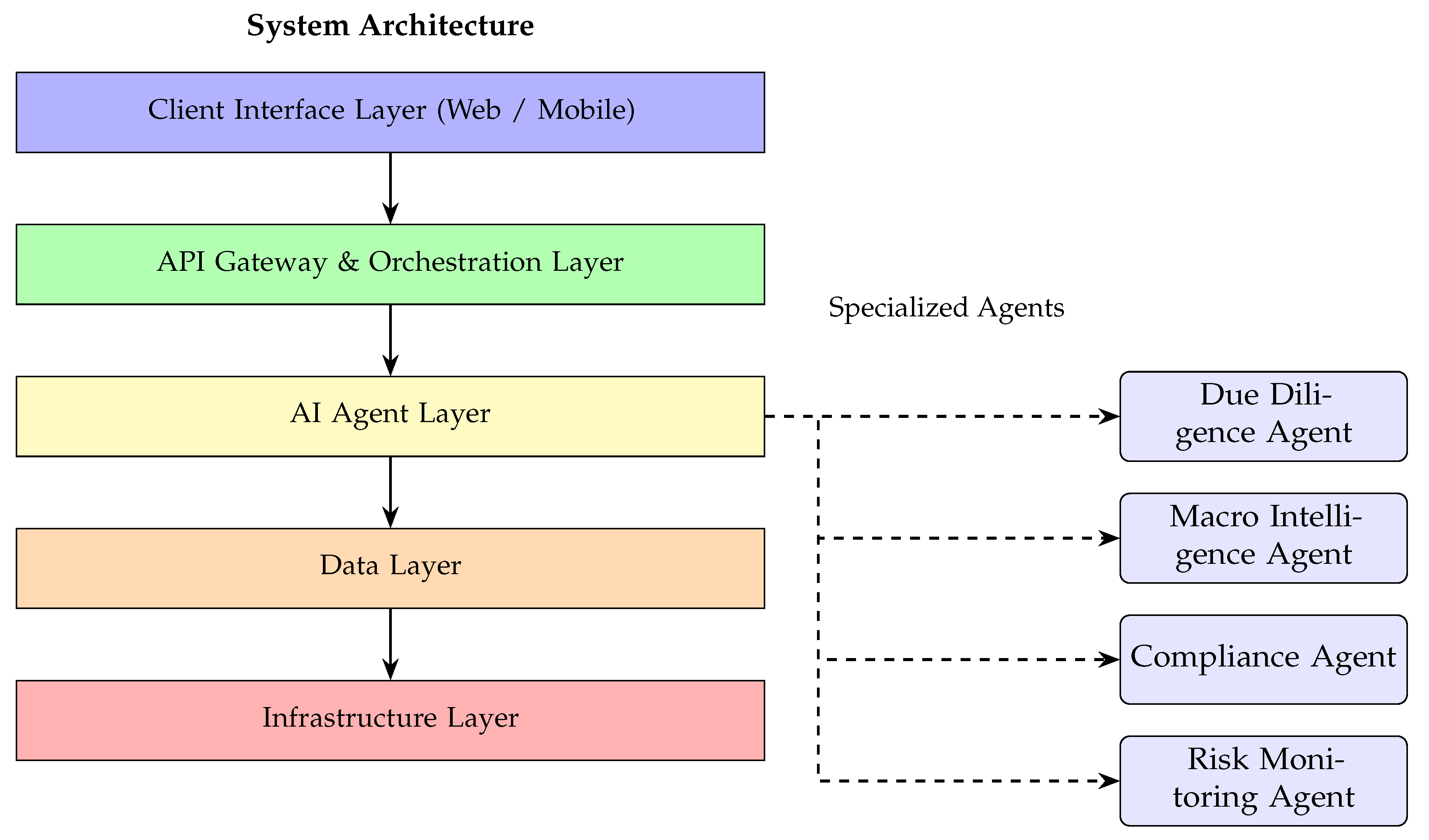
Figure 2.
Implementation Framework for Small Investment Teams.
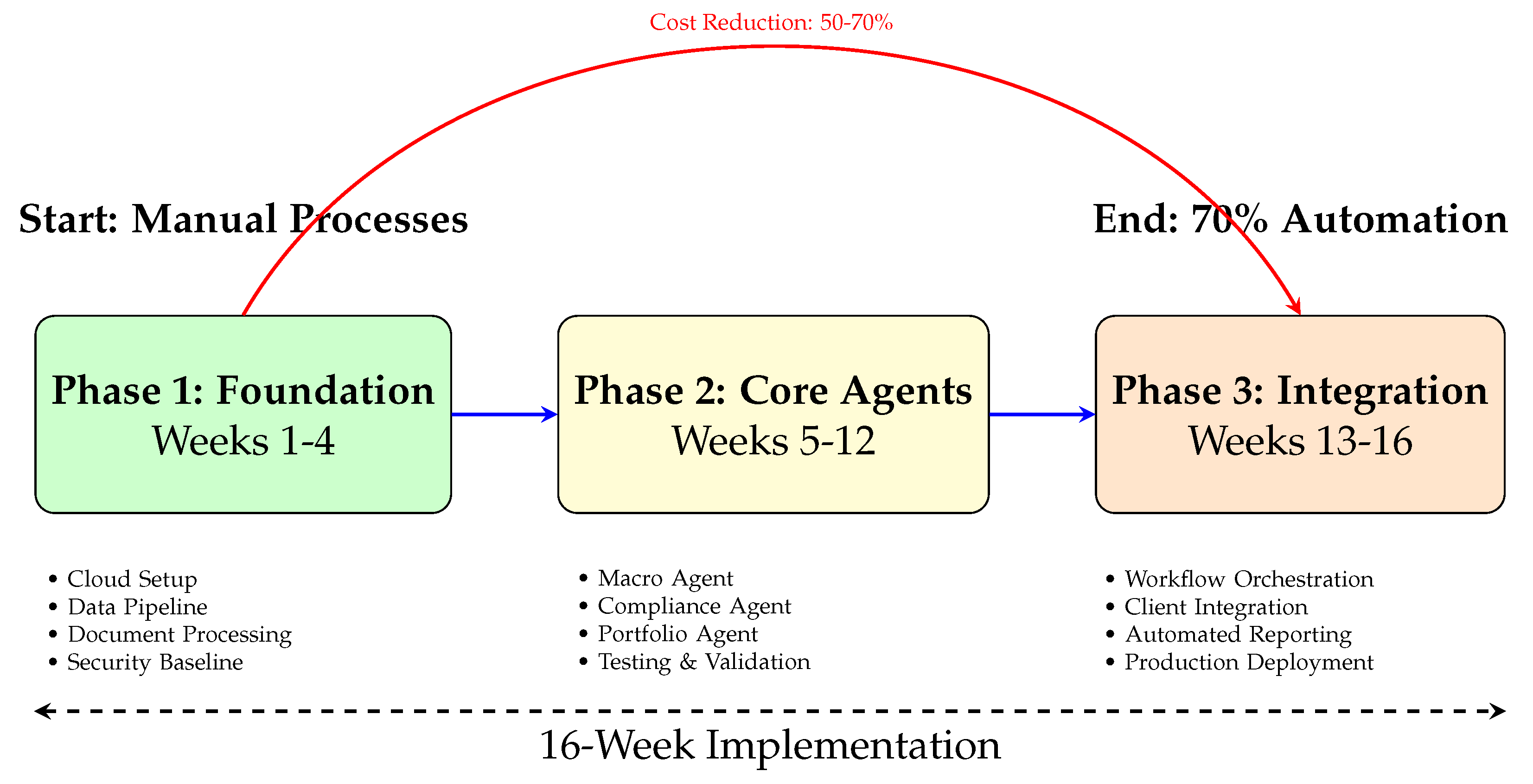
Figure 3.
AI Agent Orchestration Architecture.
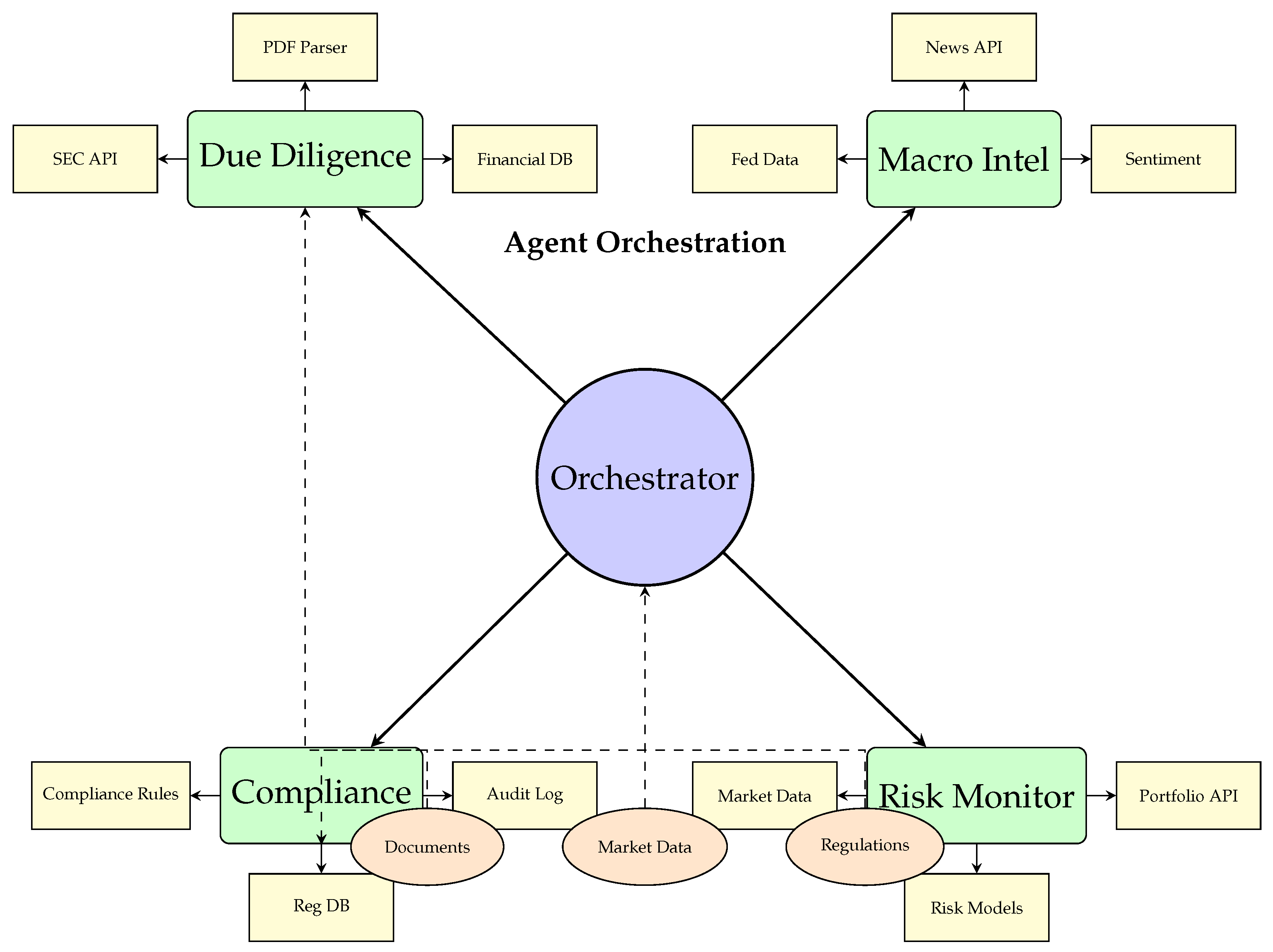
Figure 4.
Data Flow Architecture for Agentic Operations.
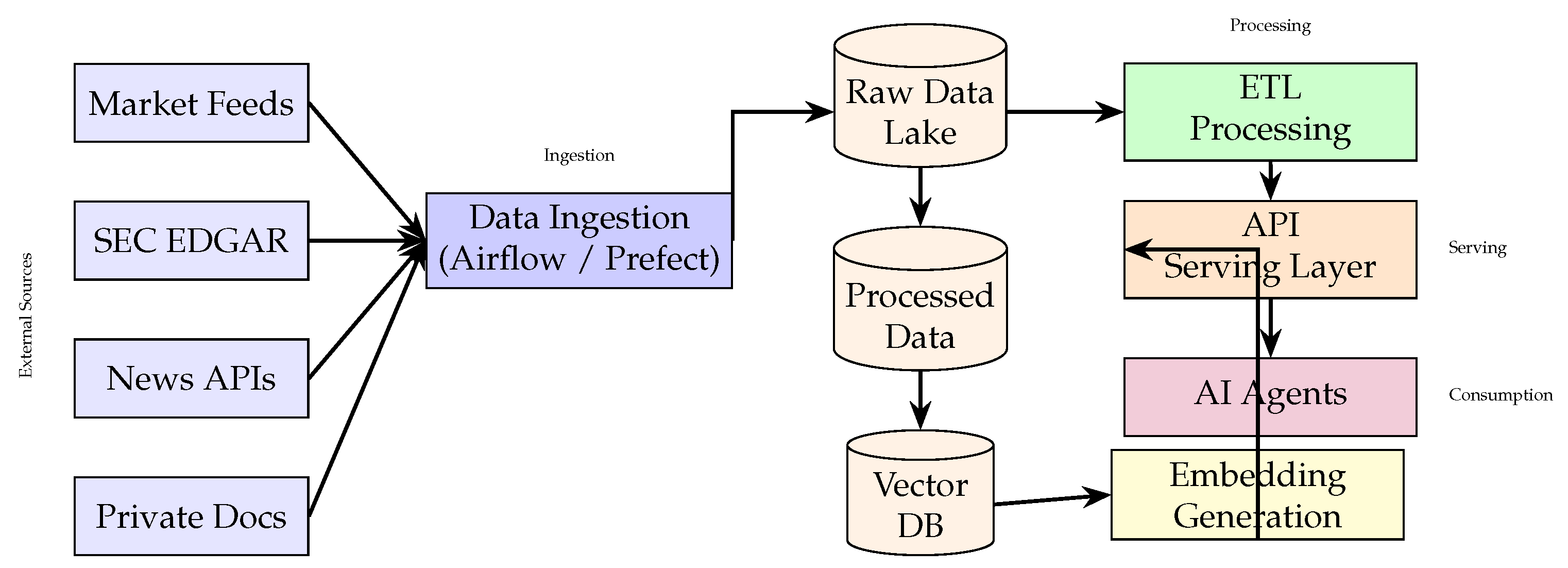
Figure 5.
Security and Compliance Architecture.
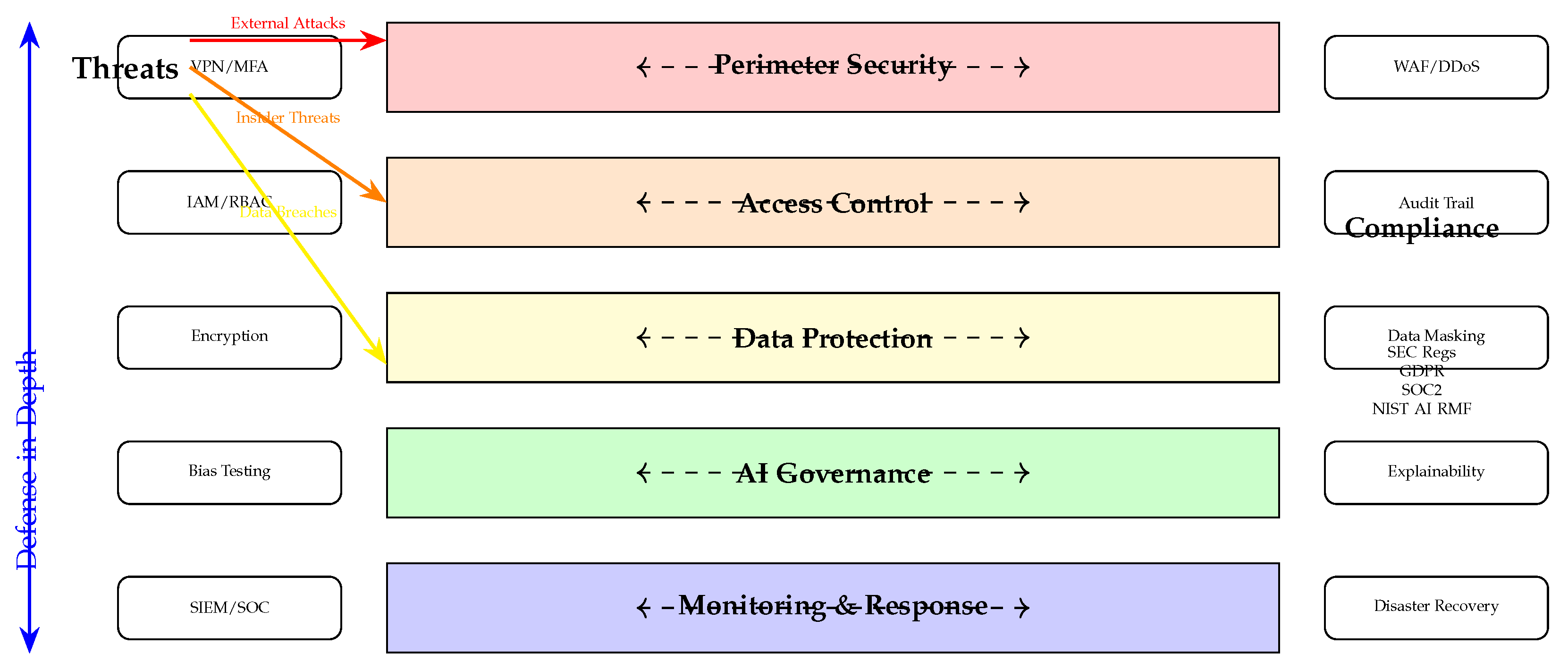
Figure 6.
Cost Distribution Analysis: Traditional vs. Agentic Operations.
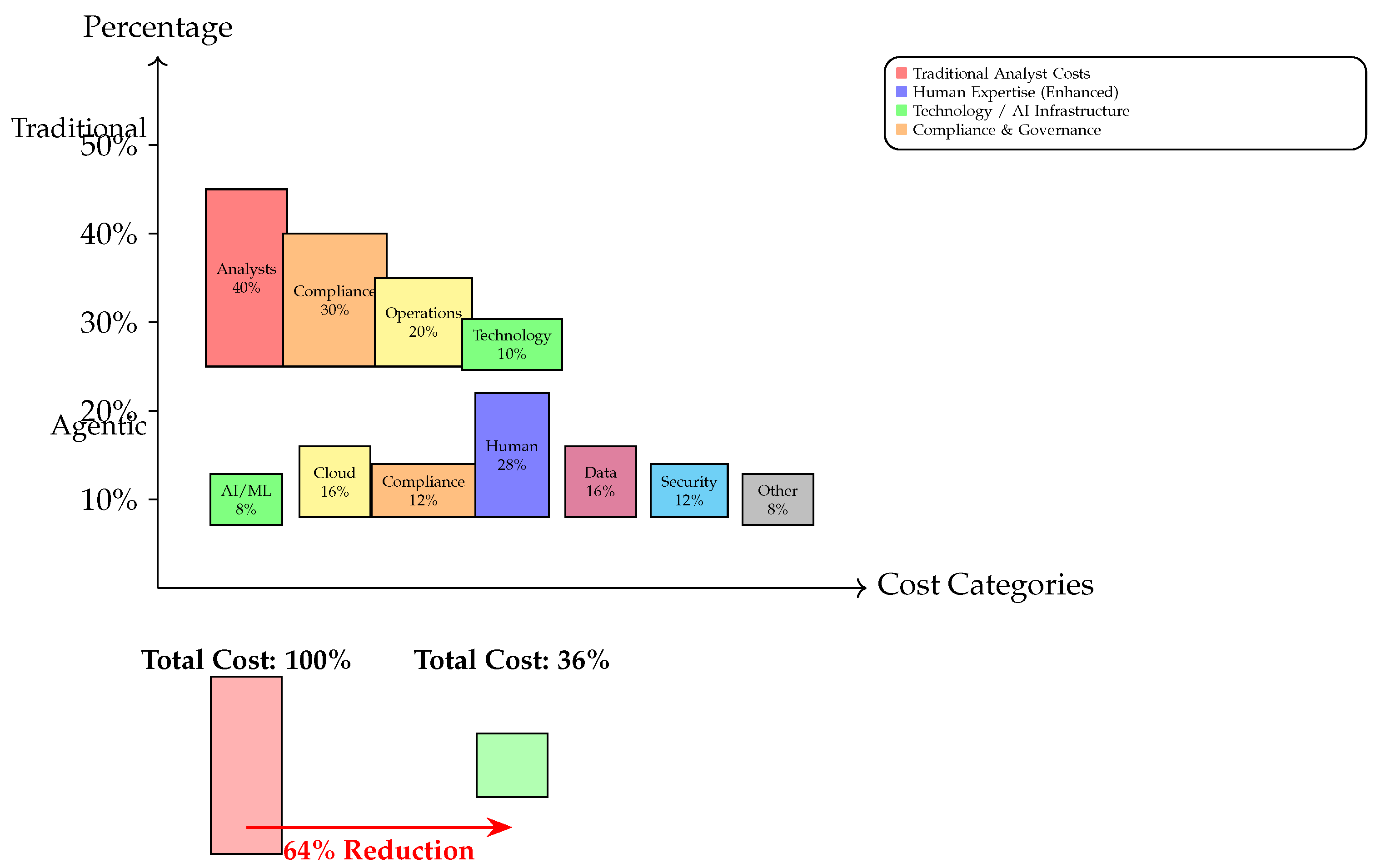
Figure 7.
Recommended Technology Stack for Small Teams.
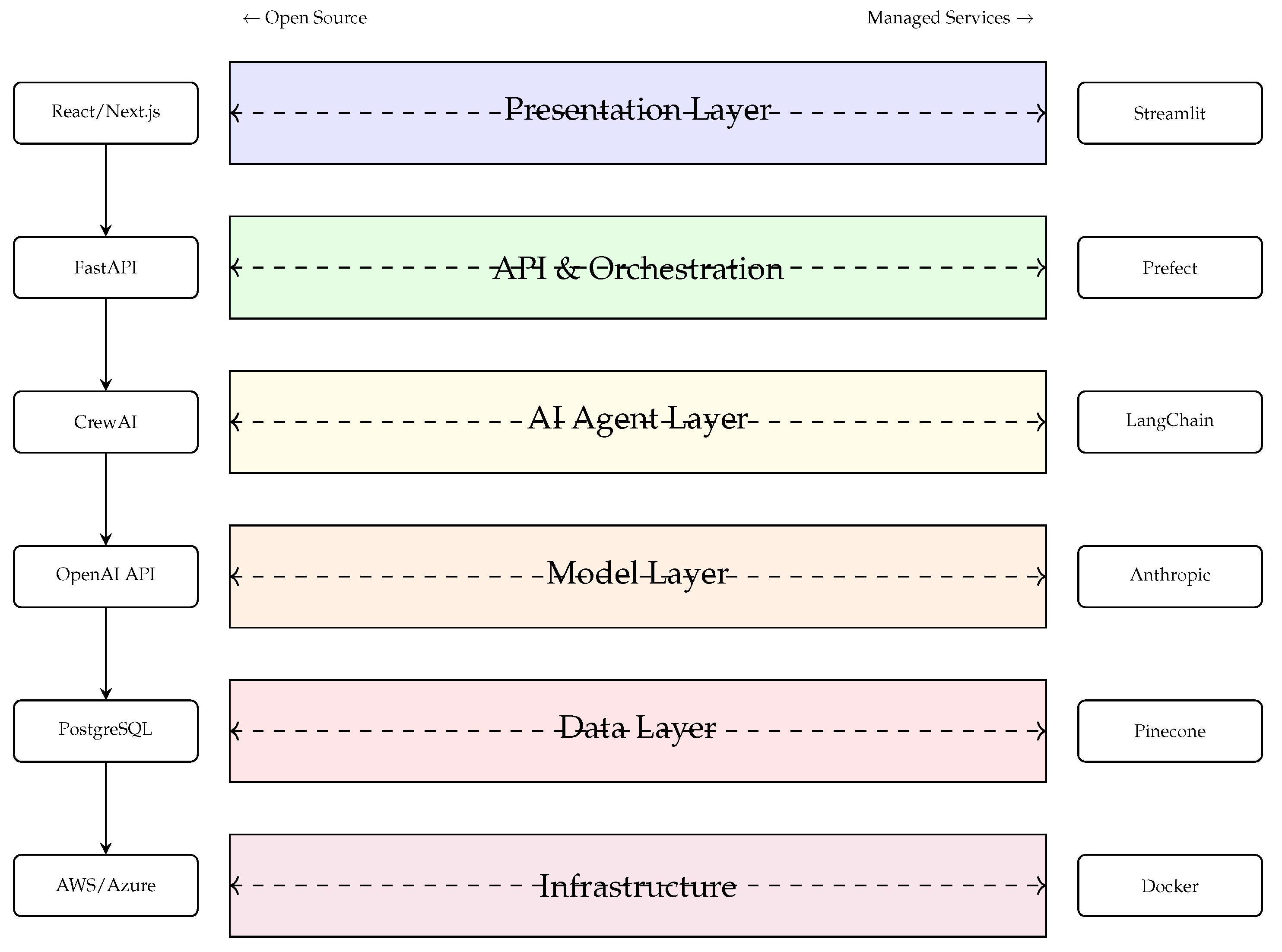
Figure 8.
Risk Assessment and Measurement Framework
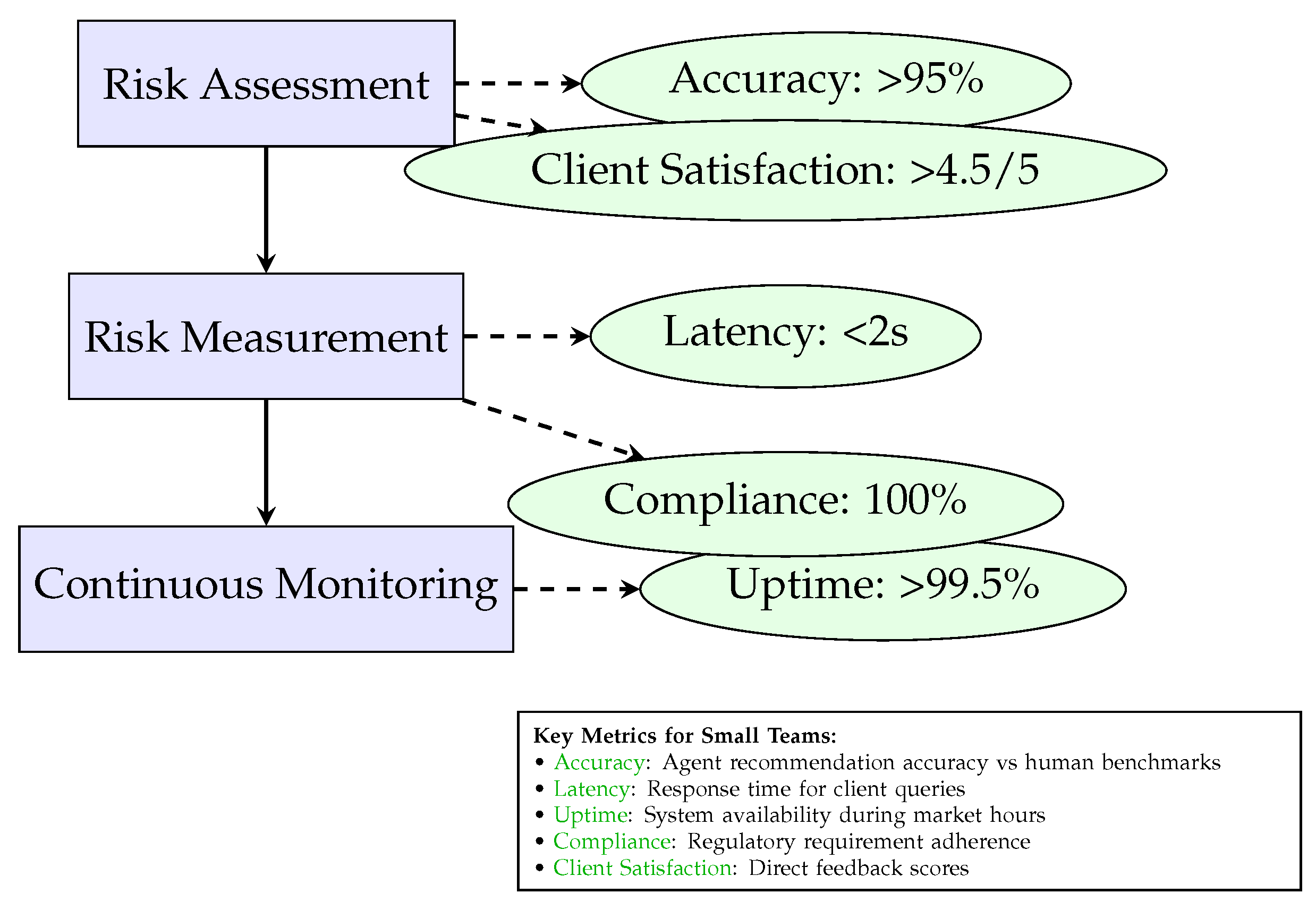
Figure 9.
AI RMF Integration with Existing Risk Programs
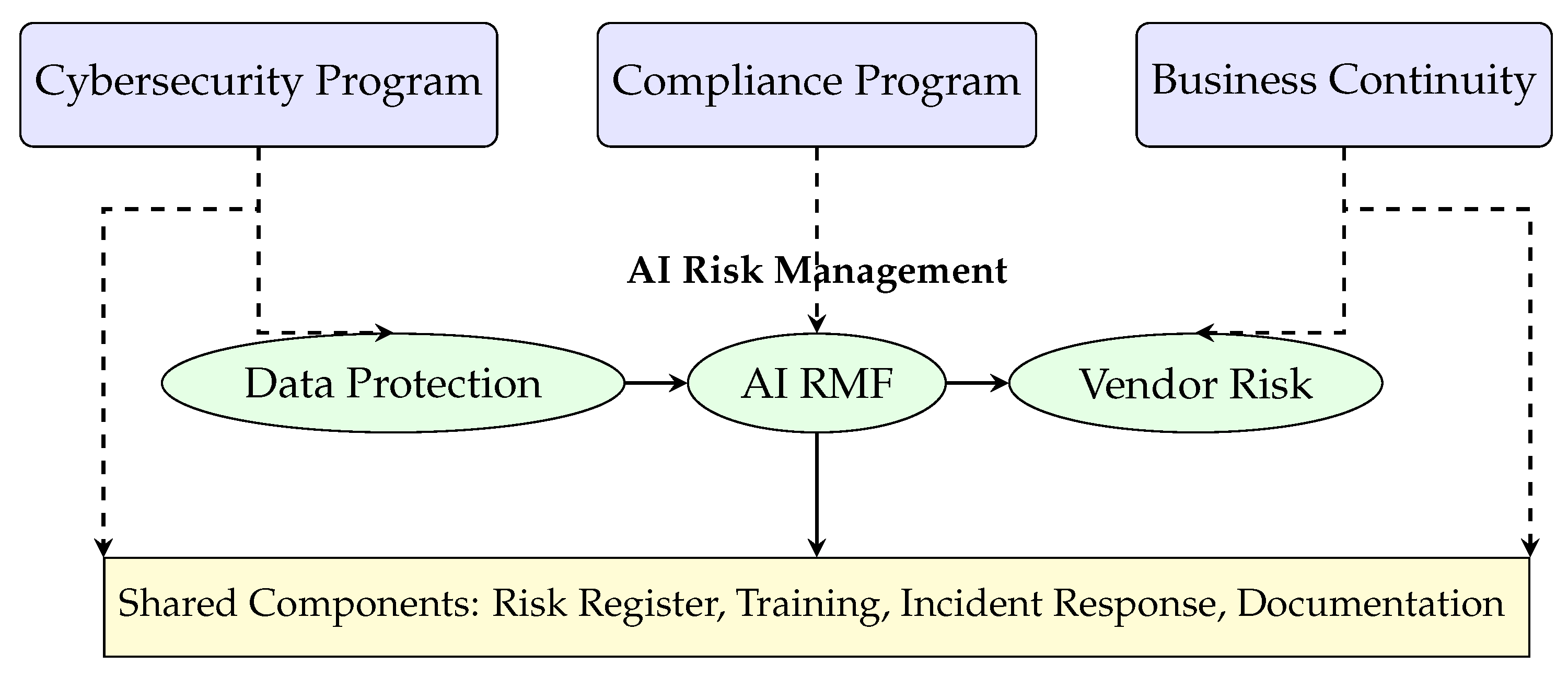
Figure 10.
Dual Regulatory Framework for Agentic RIAs
Disclaimer/Publisher’s Note: The statements, opinions and data contained in all publications are solely those of the individual author(s) and contributor(s) and not of MDPI and/or the editor(s). MDPI and/or the editor(s) disclaim responsibility for any injury to people or property resulting from any ideas, methods, instructions or products referred to in the content. |
© 2026 by the author. Licensee MDPI, Basel, Switzerland. This article is an open access article distributed under the terms and conditions of the Creative Commons Attribution (CC BY) license.
Copyright: This open access article is published under a Creative Commons CC BY 4.0 license, which permit the free download, distribution, and reuse, provided that the author and preprint are cited in any reuse.