

Submitted:
11 February 2026
Posted:
12 February 2026
You are already at the latest version
Abstract
Women’s entrepreneurial empowerment in rural developing countries is one of the key engines for inclusive and sustainable economic development. Women’s participation in entrepreneurial activities in Pakistan is limited by a lack of institutional support, deep-seated cultural factors, and a lack of access to finances. Financial accessibility has been generally identified as a basic criterion for entrepreneurial activities; however, it depends on existing support institutions. The effect of financial accessibility and cultural factors on entrepreneurial empowerment in rural women of Pakistan is analyzed for a deeper understanding of the role of mediation through social capital. The study presents a combination of regression mediation using the PROCESS macro with artificial neural networks; it utilizes a two-part PROCESS–ANN approach. This study proposes that social capital acts as a mediating object and outlines a PROCESS–ANN model using Empowerment Theory and Social Capital Theory. Prior studies contained limitations due to the isolated examination of either financial factors or cultural factors for determining the effect of either one on entrepreneurial activities. Data on 385 rural women entrepreneurs of Sindh and Punjab provinces of Pakistan were obtained using surveys. The findings of this study using PROCESS provide evidence of mediation where entrepreneurial empowerment was found to be significantly affected by direct factors of both financial accessibility and cultural factors, along with a mediated effect of social capital. ANN also tested mediation, where cultural factors showed strong results in impacting entrepreneurial empowerment. The paper proposes that a framework based on PROCESS–ANN provides evidence of validity in determining factors for improving inclusive and sustainable entrepreneurial activities. By validating a PROCESS–ANN framework in alignment with SDG 5 for achieving gender equality, 8 for achieving decent work and undertaking inclusive and sustainable economies, and 10 for achieving reduced inequalities in inclusive and sustainable activities, this paper presents a constructive message within existing literature for inclusive and sustainable activities.
Keywords:
women’s entrepreneurship
; financial accessibility
; socio-cultural interventions
; social capital
; rural empowerment
; sustainable development
; Pakistan
1. Introduction
The need for women to engage in entrepreneurship activities has come to be increasingly acknowledged as necessary for sustainable economic growth. Despite this, several deep-seated hindrances, which are embedded in conservative, patriarchal societies, exist that dissuade women in such nations from participating in formal sector employment as well as entrepreneurship. Such hindrances are even more prominent in rural regions, because women’s freedoms in rural regions are impeded by their limited mobility, as well as the unavailability of facilities to support them [1,2]. The rural regions of Pakistan provide an example of how, in patriarchal societies, women’s entrepreneurship efforts are thwarted by infrastructure and market availability in their surroundings [3,4,5].
There is general agreement on the view that access to finance is an elementary ingredient for entrepreneurship. Financing serves as an important means for women in the sense that it empowers, sustains, and nurtures entrepreneurship, as well as improving access to financial security, decision-making, and control in the household or community. Yet, in rural Pakistan, there is considerable challenge for women in gaining formal access to finance in view of collateral, lack of penetration, and gender disparities in lending, thereby forcing women in these rural settings to access finance in the form of savings or borrowing from informal sources [6,7,8]. Despite the impact created by microfinance, entrepreneurial empowerment in finance has not been generated solely by financial inclusion [9,10].
Recent studies also highlight the significance of institutional and sociocultural factors in influencing the effectiveness of financial accessibility (FA). In the rural settings, the absence of favorable sociocultural norms, poor digital literacy, and inadequate institutional ecosystems remain challenges for the entrepreneurship potential of women in the region [3,11,12,13]. Hence, the use of socio-cultural interventions (SCI) such as mentorship programs, interactions, capacity building, and awareness generation has recently proved to be a noteworthy strategy in overcoming negative social attitudes and ensuring the socio-cultural acceptability of women in the economy [14]. Research on entrepreneurship for sustainable development has also identified the need for support in terms of alignment in the respective fields [14,15].
Under this paradigm, social capital (SC) has a key role to play in enabling and equipping women entrepreneurs. Under scenarios wherein the institutional setting is weakly developed, SC acts as a spark to ignite access to markets, knowledge, and investment capital [5]. In the case of rural Pakistani women, SC plays a crucial role in overcoming the limitations of physical mobility to access markets, understand market requirements, and gain support in material as well as intangible terms. The role of SC as an intermediary between financial access, societal interventions, and entrepreneurial empowerment has received ample significance, but little heed has been given to it, especially within a rural and patriarchal setup [16].
Previous studies conducted in Pakistan addressed the implications of financial competency and microfinance usage in the context of sociocultural challenges associated with women entrepreneurship [3,5,11]. Nonetheless, a major convergence in the prevailing literature focuses on the issue of finance/culture in a disjointed manner without considering the cumulative process of how empowerment outcomes are formed and how the interlocking mechanisms of resources are conjointly created. This complements the overall world trends, which consider digital inclusion as imperative in facilitating entrepreneurial outcomes [12,15,17].
Apart from generating wealth, financial inclusion brings about empowerment and decision-making capacity that are particularly valued in semi-mobile economies that lack mobility and are characterized by gender subordination in rural settings [7,8]. Finance can empower women’s ability to handle resources and generate sustainable long-term financial stability when accompanied by financial literacy and online financial services [18,19,20]. However, all said and done, such outcomes are quite fleeting and hard to maintain in the lack of strong SC and supportive sociocultural contexts.
Therefore, SC plays an enabling and transformative role simultaneously. By promoting trust and cooperation, it can leverage the effects of the ease of finances on the outcome of the emotion of empowerment and the impact of sociocultural interventions [17,21]. Along with the reinforcement of bonding and bridging SC, the conception of entrepreneurship in the group form and buddy enterprises enables the dimensions of psychological empowerment and resilience [20,22]. Sociocultural interventions cannot generate sustainable outcomes if they lack a basis in social structures and social acceptance in the community networks and structures [13,23]. In this context, this research seeks to examine how the role of FA and sociocultural mediations affects the entrepreneurial empowerment of rural women in Pakistan, as facilitated by SC as an intervening variable. By examining the regions of Punjab and Sindh, this research strives to fill an identified research void in the body of literature encompassing women’s entrepreneurship and sustainability by examining and analyzing an integrated perspective of social, cultural, and financial considerations. The research will implement an increasingly popular methodology that combines the efficacy of Artificial Neural Networks (ANN analysis) and regression analysis in delineating and illustrating the unfolding of linear and nonlinear patterns and trends. So as to enhance new comprehension and understanding in the theoretical frameworks of SDGs 5, 8, and 10. Consequently, the central research question being pursued in this study is: In what way do FA and SCI affect the empowerment of rural women entrepreneurs via the mediated influence of SC?
2. Materials and Methods
2.1. Study Area and Sample Selection
In order to investigate the determinants influencing Pakistani rural women's entrepreneurial empowerment, this study used a cross-sectional survey design. The provinces of Punjab and Sindh, which were chosen because of their sizable populations, economic importance, and significant participation of women in informal and small-scale entrepreneurial activity, provided the data. These provinces are appropriate for examining rural women's entrepreneurship since they reflect a variety of sociocultural and economic circumstances.
Women who were either actively operating small firms or had taken part in entrepreneurship-related activities made up the target group, guaranteeing that respondents had firsthand knowledge of financial systems, sociocultural constraints, and social networks. Convenience sampling, which is frequently employed in field-based entrepreneurship and gender studies where access to a full sampling frame is restricted, was used.
In accordance with accepted methodological norms, the necessary sample size was calculated using an online sample size calculator [24]. To improve statistical dependability, a goal of 400 respondents was established. 385 complete and useable questionnaires were kept for analysis following data screening and validation, which is more than the minimum sample size advised for multivariate and mediation analyses [25].
2.2. Data Collection Instrument and Measures
A standardized questionnaire was used to gather data, and it was distributed both in-person and online using Google Forms. This allowed for a wider sample of rural respondents with different levels of digital access. A five-point Likert scale, with 1 denoting "strongly disagree" and 5 denoting "strongly agree," was used to measure each item.
To guarantee content validity, the questionnaire was created using validated scales from earlier research. It was divided into two sections: key study constructs and demographic characteristics. Below is the description of the constructs along with their measurement properties.
- FA: Evaluated through the subjects’ access to credit and their ability to afford financial instruments by using three indicators from [26].
- SCI: Assessed with three questions adapted from [27], probing participation in cultural support interventions, community engagement, and mentoring.
- SC: Assessed using three items modified from [20], highlighting support from others, public collaboration, and trust-based relationships.
- Empowerment of Rural Women Entrepreneurs (ERW): It is assessed using three empowerment measures based on [5], which include entrepreneurial confidence, autonomy, and decision-making power. The instrument showed internal consistency with a Cronbach’s alpha value of 0.852 for all 12 items. Reliability at the construct level showed that the instrument is reliable with values above the 0.70 threshold [28,29].
2.3. Respondent Profile
The study utilized core demographic variables such as age, educational level, and existing entrepreneurial experience. The demographic distribution of the sample was heterogeneous, and this increased the overall validity of the study findings in a rural context. About 66.2% (n = 255) of the respondents belonged to the 20-39 years age group, and this highlighted the dominance of women who are active participants in their economy. In terms of educational attainment, 51.9% (n = 200) of the participants have primary and secondary education.
2.4. Hypothesis Development
Based on Empowerment Theory and Social Capital Theory, the following hypotheses were formulated:
H1: Financial accessibility has a direct positive effect on the empowerment of rural women entrepreneurs.
H2: Socio-cultural interventions have a direct positive effect on the empowerment of rural women entrepreneurs.
H3: Social capital has a direct positive effect on the empowerment of rural women entrepreneurs.
H4: Financial accessibility has a direct positive effect on social capital.
H5: Social capital mediates the relationship between financial accessibility and the empowerment of rural women entrepreneurs.
H6: Socio-cultural interventions have a direct positive effect on social capital.
H7: Social capital mediates the relationship between socio-cultural interventions and the empowerment of rural women entrepreneurs.
2.5. Data Analysis Strategy
Data analysis was conducted in multiple stages using IBM SPSS version 25 and PROCESS Macro version 4.2. First, Exploratory Factor Analysis (EFA) was performed to examine the underlying factor structure of the measurement items and to confirm construct dimensionality. Sampling adequacy was assessed using the Kaiser–Meyer–Olkin (KMO) measure and Bartlett’s Test of Sphericity.
Second, descriptive statistics and correlation analyses were conducted to examine relationships among the core variables. To test the proposed hypotheses and mediating effects, regression-based mediation analysis was performed using PROCESS Macro (Model 4) with bootstrapped confidence intervals. This approach is well-suited for testing indirect effects and provides robust estimates without requiring strict normality assumptions.
All seven hypotheses were statistically supported at p < 0.001. FA and SCI demonstrated significant direct effects on women’s empowerment and SC. Moreover, SC was found to partially mediate the relationships between FA and empowerment, as well as between SCI and empowerment, underscoring its central role in translating resources and interventions into sustainable empowerment outcomes.
3. Results
3.1. Conceptual Model and Hypothesis Testing
This study investigates the direct and indirect relationships among FA, SCI, SC, and ERW. Building on prior literature that has primarily emphasized direct effects, the present analysis incorporates SC as a mediating mechanism to explain how financial and socio-cultural factors translate into empowerment outcomes.
The conceptual framework (Figure 1) specifies seven hypothesized paths, including two mediation routes: FA → SC → ERW and SCI → SC → ERW. Hypotheses were tested using regression-based mediation analysis.
The results summarized in Table 1 indicate that all hypothesized relationships are statistically significant at p < 0.001. FA exhibits a significant positive effect on women’s empowerment (β = 0.570, R² = 0.325), supporting H1. Similarly, SCI positively influences empowerment (β = 0.571, R² = 0.327), confirming H3. SC also demonstrates a strong direct effect on empowerment (β = 0.611, R² = 0.337), supporting H7.
Furthermore, FA and SCI significantly predict SC (β = 0.592 and β = 0.535, respectively), confirming H2 and H4. Mediation analysis reveals that SC significantly mediates the relationships between FA and empowerment (H5) as well as between SCI and empowerment (H6). The higher explained variance in the mediated models (R² = 0.440 and 0.327) highlights the central role of SC in strengthening empowerment outcomes.
3.2. Exploratory Factor Analysis (EFA)
Exploratory Factor Analysis (EFA) was conducted to examine the underlying structure of the measurement items. The Kaiser–Meyer–Olkin (KMO) measure of sampling adequacy was 0.903, and Bartlett’s Test of Sphericity was statistically significant (p < 0.001), confirming the suitability of the data for factor analysis [30].
Using principal component extraction with Promax rotation, four distinct factors emerged, explaining 71.75% of the total variance. The factors corresponded to SCI, empowerment of rural women, SC, and FA. All retained items loaded above the recommended threshold of 0.40, indicating strong construct representation. The EFA results, presented in Table 2, confirm the stability and coherence of the measurement structure.
3.3. Confirmatory Factor Analysis (CFA)
Confirmatory Factor Analysis (CFA) was performed using AMOS (version 24) to validate the measurement model. All standardized factor loadings were statistically significant and exceeded acceptable levels, supporting convergent validity. Composite reliability (CR) values ranged from 0.801 to 0.824, while average variance extracted (AVE) values ranged from 0.574 to 0.61, exceeding recommended thresholds. Table 3 summarizes the results of the confirmatory analysis. CFA was employed solely to validate the measurement model and ensure construct validity before hypothesis testing. Structural relationships and mediation effects were subsequently examined using regression-based PROCESS analysis rather than SEM.
Model fit indices indicated an excellent fit to the data (CMIN/DF = 1.995; CFI = 0.980; NFI = 0.961; IFI = 0.980; RMSEA = 0.051; SRMR = 0.025), as summarized in Table 4. Discriminant validity was confirmed, as inter-construct correlations were below unity and AVE square roots exceeded corresponding correlations. These results validate the adequacy of the measurement model for structural analysis [31,32,33].
3.4. Discriminant Validity Test
Additionally, discriminant validity was examined to ensure construct validity. [34] advise that discriminant validity can be weighed by defining whether the correlations between constructs are significantly lower than unity. Table 5 presents the discriminant validity results, confirming that all constructs exhibit satisfactory discriminant validity.
3.5. Artificial Neural Network (ANN) Analysis
To complement the regression-based findings and capture potential nonlinear relationships, an Artificial Neural Network (ANN) analysis using the Levenberg–Marquardt backpropagation algorithm was conducted [35,36]. FA, SCI, and SC were specified as input variables, while women’s empowerment served as the output variable.
With consistent training, validation, and testing errors, the ANN model showed good predictive performance. The model's regression coefficient (R = 0.678) showed a significant correlation between the empowerment results that were anticipated and those that were seen. Low overfitting and appropriate generalization were further supported by mean squared error (MSE) values across training, validation, and testing datasets.
SCI had the greatest impact on empowering results, according to the sensitivity analysis, followed by SC and FA. These results highlight the significance of social and cultural factors in influencing women's empowerment as entrepreneurs.
3.6. Robustness and Validation of Results
The results' validity and robustness are well supported by the convergence of ANN-based predictive modeling and SPSS-based confirmatory analysis. Both explanatory power and predictive stability were confirmed by model diagnostics, and reliability and validity indicators reached or beyond standard levels.
Overall, the results support SC's mediation function in converting FA and sociocultural interventions into long-term entrepreneurial empowerment for Pakistani rural women. The hybrid analytical framework improves theoretical rigor and practical relevance, providing a comprehensive knowledge of empowerment mechanisms in patriarchal and resource-constrained environments.
4. Discussion
As a mediating mechanism for SC, this study examines how FA and SCI contribute towards entrepreneurial empowerment for rural women in Pakistan. As opposed to simply reporting findings based on statistical results, findings are interpreted using a variety of lenses, such as those of empowerment theories, SC theories, and the wider sustainability theories.
The contributions from these findings are that, in a rural and patriarchal society, FA alone cannot provide sufficient empowerment for women. Although financial resources can thus be seen to be a prime requirement for any entrepreneurial venture to be established, their impact can be largely affected by the prevailing social atmosphere. This particular finding seems to authenticate that empowerment cannot be actually achieved unless it is combined with supportive institutions to provide women with sufficient empowerment. This seems to hold good for rural Pakistan, where women's mobility is restricted and they are expected to adhere to patriarchal traditions [37,38,39].
One of the major theoretical concepts offered in the study is the role of SC as a mediator. On various fronts, SC helps in building cooperation, trust, and learning among the actors. It helps women achieve empowerment in terms of financial as well as socio-cultural efforts. Using their SC, the individuals can easily access the market, transfer knowledge, reduce risk, as well as keep motivation levels for the entrepreneurial actions. It is in accordance with the concept of SC theory, as it helps in reducing the limitations imposed by the structure [40,41,42].
Enhanced SC was found to mediate empowerment indirectly via socio-cultural intervention. Mentoring and engagement activities that influence perceptions, legitimize women’s participation in the economy, and foster group-level confidence tend to be especially important in a more conservative rural context in which entrepreneurship might require both economic and social sanction to the entrepreneur. Socio-cultural intervention fosters a context in which economic access leads to sustainable empowerment rather than simply yielding short-term economic outcomes [43,44].
This study is also significant in making sense of empowerment dynamics in terms of their complex and non-linear nature, with the inclusion of an analysis utilizing an Artificial Neural Network (ANN) perspective. Results gathered from the ANN emphasize the superiority of the role of attitude/normative changes in facilitating the process of entrepreneurship, thus revealing how the role of socio-cultural initiatives is more important than FA in empowerment dynamics [45,46].
Regarding sustainable development, this study adds greater knowledge with regard to sustainable and inclusive entrepreneurship. In a rural setting, women's empowerment in entrepreneurship directly contributes to economic diversification, rural development, and households’ resilience, which are all core elements of achieving sustainable development objectives. The aforementioned activities provide long-run socioeconomic advantages that not only benefit individual entrepreneurs but also include benefits associated with increased SC and inclusion. In this regard, this research supports the relevance of Sustainable Development Goals related to reducing inequality (SDG 10), promoting decent work and economic growth (SDG 8), and achieving gender equality (SDG 5) [47,48,49,50,51,52].
In conclusion, this study has proved that SC forms an integral part of the linkage between FA, SCI, and the outcomes of empowerment in entrepreneurship among rural women. The research has helped in the development of an understanding of the concept of SC and its role in making entrepreneurship empowering rural women from the patriarchal settings of India.
4.1. Theoretical Implications
Through the extension of the Resource-Based View (RBV) theory and the Empowerment theory in the context of rural women's entrepreneurship in developing countries, the paper has contributed to the development of theoretical knowledge [53]. From the findings, the entrepreneurship capabilities of rural women emerge from the complementarity of financial availability and socio-cultural factors, and not merely from firm resources, tangible and intangible, within the purview of traditional RBV theory. Financial resources cannot be deemed an adequate strategic resource per se, and the significance of financial resources becomes applicable when these are positioned in suitable socio-cultural settings so that the rural women use these resources constructively.
Besides, the paper has offered empirical support to the SC Theory, as it describes the manner by which social connections, trust networks, and community participation can act as resources and catalysts within a social setting where the available support structures are quite limited [54]. In such a social setting, SC can play a significant role, as it can increase trust within financial institutions, apart from assisting with financial and business resources to women entrepreneurs.
Further, the empowerment process is considered as a joint, dynamic, and cyclical process as opposed to a linear process achieved through the allocation of resources expands the empowerment theory as it proves the positive interdependence of SC and empowerment in a cyclical process. The outcomes have proven the self-reinforcing nature of both SC and empowerment in a cyclical process wherein empowerment increases agency, which in turn increases social networks; this notion supports the paradigms of sustainable development placed on community-level growth. The outcomes support the need for a multidimensional framework of empowerment in the context of women’s entrepreneurship.
4.2. Practical Implications
The findings of this study have the following major implications for Non-Governmental Organizations and development practitioners seeking to promote sustainable and inclusive entrepreneurship. First, programs intended to promote entrepreneurship among rural women must be holistic in nature and combine financial inclusiveness and other interventions that are socioculturally embedded. Financial programs that lack such interventions are bound to lack long-term effectiveness in bringing about empowerment. Second, there is a need to develop gender-sensitive economic structures. Top priority must be accorded to the development of micro-credit schemes, savings options, and educational campaigns in the context of rural women. The approach must not only enhance access to finances but also improve levels of autonomy and decision-making power. Long-term effects can be improved with the integration of economic services within comprehensive community structures. Third, peer networking, cooperatives, and mentoring can also be improved to help women access markets, remain entrepreneurial, and collectively bargain. Because group approaches can minimize risk while promoting collective accountability, knowledge, and psychological empowerment, they can be important in women’s enterprise success, especially when resources are minimal. Finally, the infusion of digital and AI-driven solutions into projects aimed at empowering entrepreneurs offers an exciting frontier that could be leveraged to address obstacles posed by market engagement, financial inclusion, or information inequalities. Specifically, digital financial services, e-learning, or AI-driven decision-making may enhance efficiency and outreach capabilities, especially in more remote or dispersed rural communities. However, it is important that inclusiveness and the mitigation of existing or further development of potential inequalities are a priority.
5. Conclusions
The research aims to investigate the impact of financial and sociocultural factors of entrepreneurship on the empowerment of rural women in Pakistan, keeping in view the mediating effect of SC. The significance of the study also resides in the synthesis of the economic, social, and cultural aspects of the research, which will complement the knowledge regarding the effects of entrepreneurship on the empowerment of rural women.
Findings show that financial inclusion by itself cannot serve as an adequate tool in empowering women as entrepreneurs. Instead, other aspects in which women are situated as they engage in entrepreneurship interact with financial resource availability to produce empowerment as an outcome. The important mediating factor in this regard is provided by the role of SC, which helps women convert accessibility, which may be of financial as well as sociocultural character, into entrepreneurial action.
The research adds to the theory development process regarding the Resource-Based View, Empowerment Theory, and SC Theory, specifically related to rural women entrepreneurs, and thus enhances the available body of literature related to sustainability and entrepreneurship. The significance of empowerment as a social process and the role of institutional resources within empowerment are emphasized in the research, thus underlining the significant role of sustainable development. The perspective taken by the research integrates with sustainability goals, including equality, employment, and reducing inequality as dimensions of required development.
In addition, practical implications of these findings can be realized by development agencies, financial organizations, as well as policymakers. Initiatives must therefore adopt holistic approaches that take into consideration both FA, as well as sociocultural implementations targeting rural women entrepreneurs. These financial programs can therefore be made much more effective by promoting SC within networks, cooperatives, as well as partnerships. Moreover, the use of digital platforms, as well as AI-driven tools, shows tremendous promise in meeting financial as well as learning objectives.
The findings in this research make it clear that a crucial vector that underlines and enables a lasting level of entrepreneurial ERW is indeed SC, as it bridges resources, networks, and institutions in relation to both SCI and FA. The research also constitutes a strong theoretical construct for developing entrepreneurial policies based on inclusivity.
5.1. Limitations and Directions for Future Research
However, despite all its contributions to entrepreneurial empowerment, this research is subject to limitations that can provide directions for other studies to explore. First, this research employed a cross-sectional approach, making it difficult to find connections with regard to causes and effects on various factors such as FA, sociocultural interventions, SC, and entrepreneurial empowerment for women. Indeed, longitudinal and experimental studies can provide directions on how empowerment and change occur with regular modifications to empowerment processes.
Second, though the specific outreach to female entrepreneurs living in rural Punjab and Sindh leads to regionally specific insights, the ability to generalize findings either to Pakistan or to other countries could be affected by institutional or cultural factors. Further research is needed that could take a more comparative or multinational form to determine if SC functioning as a mediation is a consistent outcome.
Third, there is potential for social desirability and response biases because of the use of self-report data through surveys. Future research might use mixed methods involving qualitative research methods such as interviewing and ethnographic research, or objective performance outcomes to improve understanding of empowerment dynamics, despite the use of pre-established scales and reliability analysis. Even though convenience sampling is consistent with previously done research on entrepreneurship in difficult environments, it has weaknesses regarding representation.
Fourth, even with the inclusion of SC variables and the role of sociocultural and economic accessibility variables in the research, there were other variables that might also play an important role that were not considered. Such variables include digital literacy and the availability of institutions and technologies that might affect the outcome of female entrepreneurship. Additionally, the final work should aim to experiment with other machine learning methods. Although the artificial neural network analysis provides information regarding the nonlinear association and predicting capability, other AI methods, such as explainable AI, may help policymakers have a better understanding of the outcomes of the empowerment based on the aforementioned complexities. Overall, some limitations in this study provide indications on directions to extend research on sustainable women's entrepreneurship and on developing more sophisticated and context-sensitive paradigms that empower rural women and promote sustainable developments.
Funding
This study received no external funding.
Institutional Review Board Statement
This study was conducted in accordance with the Declaration of Helsinki and approved by the ethics committee of Near East University NEU/SS/2024/1853.
Informed Consent Statement
Informed consent was obtained from all subjects involved in the study.
Data Availability Statement
The original contributions presented in the study are included in the article; further inquiries can be directed to the corresponding author.
Acknowledgments
This work is based on the first author’s doctoral dissertation, titled “Empowering Rural Women Entrepreneur in Pakistan: Enhancing Access to Capital, Market Linkages, and Local Resources”. The planned submission date is January 2025. The dissertation supervisor is the second author of this work.
Conflicts of Interest
The authors declare no conflicts of interest.
References
- M. A. Roomi and G. Parrott, “Barriers to development and progression of women entrepreneurs in Pakistan,” Journal of Entrepreneurship, vol. 17, no. 1, pp. 59–72, 2008.
- A. N. Choudhry, R. Abdul Mutalib, and N. S. A. Ismail, “Socio-cultural factors affecting women economic empowerment in Pakistan: A situation analysis,” International Journal of Academic Research in Business and Social Sciences, vol. 9, no. 5, pp. 90–102, 2019.
- S. H. Farooq, A. U. Din, I. A. Soomro, and A. Riviezzo, “Unveiling the path to sustainable poverty alleviation in Pakistan: Investigating the role of microfinance interventions in empowering women entrepreneurs,” Scandinavian Journal of Management, vol. 40, no. 2, p. 101331, 2024.
- G. O. C. Bongomin, J. C. Munene, J. M. Ntayi, and C. A. Malinga, “Exploring the mediating role of social capital in the relationship between financial intermediation and financial inclusion in rural Uganda,” International Journal of Social Economics, vol. 45, no. 5, pp. 829–847, 2018.
- S. Marlow and A. Martinez Dy, “Is it time to rethink the gender agenda in entrepreneurship research?,” International Small Business Journal, vol. 36, no. 1, pp. 3–22, 2018.
- M. Sadiq, A. Ihsan, and A. H. Khattak, “Women economic empowerment through the lens of financial inclusion in Pakistan,” Journal of Business & Tourism, vol. 9, no. 1, pp. 21–36, 2023.
- M. Shehzadi, F. Khaled, and K. Fatima, “Reproductive rights and women’s empowerment in Pakistan: A policy and socio-cultural analysis,” Al-Kashaf, vol. 4, no. 3, pp. 9–22, 2024.
- R. Naguib and D. Jamali, “Female entrepreneurship in the UAE: A multi-level integrative lens,” Gender in Management: An International Journal, vol. 30, no. 12, pp. 135–161, 2015.
- N. Dutta and S. Mallick, “Gender and access to finance: Perceived constraints of majority-female-owned Indian firms,” British Journal of Management, vol. 34, no. 2, pp. 973–996, 2023.
- M. Ejaz and M. Qayum, “Financial inclusion and women’s empowerment in Pakistan,” Pakistan Journal of Humanities and Social Sciences, vol. 11, no. 4, pp. 4493–4501, 2023.
- D. J. Kelley, C. G. Brush, P. G. Greene, and Y. Litovsky, “Global Entrepreneurship Monitor 2010 Women’s Report,” Babson College, 2013, [Online]. Available: https://www.babson.edu/media/babson/site-assets/content-assets/academics/centres-and-institutes/center-for-womens-entrepreneurial-leadership/gem-2010-womens-report.pdf.
- F. Nawaz, A. Sajjad, and M. W. Farooq, “Financial inclusion (FI) mediates the relationship between financial literacy (FL) and women’s economic empowerment (WEE),” Bulletin of Business and Economics, vol. 12, no. 3, pp. 761–769, 2023.
- T. Nguse, G. Desalegn, B. Oshora, A. Tangl, R. J. Nathan, and M. Fekete-Farkasne, “Enhancing women economic empowerment through financial inclusion: Evidence from SMEs in Ethiopia,” Polish Journal of Management Studies, vol. 25, pp. 278–290, 2022.
- N. Kabeer, “Gender equality, economic growth, and women’s agency: The ‘endless variety’ and ‘monotonous similarity’ of patriarchal constraints,” Feminist Economics, vol. 22, no. 1, pp. 295–321, 2016.
- R. Hasan, M. Ashfaq, T. Parveen, and A. Gunardi, “Financial inclusion – does digital financial literacy matter for women entrepreneurs?,” International Journal of Social Economics, vol. 50, no. 8, pp. 1085–1104, 2023.
- R. Senna, E. Agbolosoo, and D. Eyaakor, “Socio-cultural factors affecting the performance of women entrepreneurs in Adaklu Waya in the Volta region of Ghana,” Technium Social Sciences Journal, vol. 23, pp. 490–503, 2021.
- M. F. Jalil, A. Ali, and R. Kamarulzaman, “The influence of psychological capital and social capital on women entrepreneurs’ intentions: The mediating role of attitude,” Humanities and Social Sciences Communications, vol. 10, no. 1, pp. 1–14, 2023.
- S. Bhatia and G. Dawar, “The impact of financial inclusion on social and political empowerment: Mediating role of economic empowerment,” Journal of the Knowledge Economy, vol. 15, no. 3, pp. 13727–13744, 2024.
- A. Andriamahery and M. Qamruzzaman, “Do access to finance, technical know-how, and financial literacy offer women empowerment through women’s entrepreneurial development?,” Frontiers in Psychology, vol. 12, p. 776844, 2022.
- P. M. Machio, D. N. Kimani, P. C. Kariuki, A. M. Ng’ang’a, and M. M. Njoroge, “Social capital and women’s empowerment,” Forum for Social Economics, vol. 53, no. 3, pp. 322–340, July 2024.
- N. Kabeer, “Is microfinance a ‘magic bullet’ for women’s empowerment? Analysis of findings from South Asia,” Economic and Political Weekly, vol. 40, no. 44/45, pp. 4709–4718, 2005.
- P. J. Ferri, D. Deakins, and G. Whittam, “The measurement of social capital in the entrepreneurial context,” Journal of Enterprising Communities: People and Places in the Global Economy, vol. 3, no. 2, pp. 138–151, 2009.
- D. O. Amadasun and A. T. Mutezo, “Influence of access to finance on the competitive growth of SMEs in Lesotho,” Journal of Innovation and Entrepreneurship, vol. 11, no. 1, p. 56, 2022.
- Calculator.net, “Sample size calculator.” 2022. [Online]. Available: https://www.calculator.net/sample-size-calculator.html.
- D. Lakens, “Sample size justification,” Collabra: Psychology, vol. 8, no. 1, p. 33267, 2022.
- R. I. Sabir and M. B. Majid, “Factors affecting women empowerment: A micro financing perspective,” Journal of Entrepreneurship and Business Venturing, vol. 3, no. 1, pp. 45–57, 2023.
- Z. N. Babar, K. Al-Sulaiti, O. Aldereai, J. Abbas, and I. Al-Sulaiti, “Empowering women entrepreneurs: The influence of family support and country of origin effects on financial inclusion,” Journal of Excellence in Business Administration, vol. 1, no. 2, pp. 39–63, 2023.
- J. F. Hair, B. J. Babin, R. E. Anderson, and W. C. Black, Multivariate Data Analysis, 7th ed. Pearson, 2014.
- M. Saunders, P. Lewis, and A. Thornhill, Research Methods for Business Students, 8th ed. Pearson, 2019.
- H. F. Kaiser, “An index of factorial simplicity,” Psychometrika, vol. 39, no. 1, pp. 31–36, 1974.
- R. P. Bagozzi and Y. Yi, “On the evaluation of structural equation models,” Journal of the Academy of Marketing Science, vol. 16, pp. 74–94, 1988.
- P. M. Bentler and D. G. Bonett, “Significance tests and goodness of fit in the analysis of covariance structures,” Psychological Bulletin, vol. 88, no. 3, pp. 588–606, 1980.
- Z. Awang, SEM Structural Equation Modeling Using AMOS Graphic. Shah Alam, Malaysia: Universiti Teknologi MARA Publication Centre (UPENA), 2012, p. 167.
- C. Fornell, “Structural equation models with unobservable variables and measurement error: Algebra and statistics,” The University of Michigan, 1981. Accessed: Oct. 21, 2024. [Online]. Available: https://scholar.google.com/scholar_lookup?title=Structural+Equation+Models+with+Unobservable+Variables+and+Measurement+Error:+Algebra+and+Statistics&author=Fornell,+C.&author=Larcker,+D.F.&publication_year=1981&journal=J.+Mark.+Res.&volume=18&pages=382%E2%80%93388&doi=10.1177/002224378101800313.
- A. S. Albahri et al., “Hybrid artificial neural network and structural equation modeling techniques: a survey,” Complex & Intelligent Systems, vol. 8, no. 2, pp. 1781–1801, 2022.
- L. Zhang, H. Wang, and Y. Li, “A deep learning-based artificial neural network for prediction of electricity consumption in smart grids,” IEEE Transactions on Industrial Informatics, vol. 19, no. 8, pp. 5361–5369, 2023.
- F. Aziz, S. M. Sheikh, and I. H. Shah, “Financial inclusion for women empowerment in South Asian countries,” Journal of Financial Regulation and Compliance, vol. 30, no. 4, pp. 489–502, 2022.
- F. Aziz, S. M. Sheikh, and I. H. Shah, “Financial inclusion for women empowerment in South Asian countries,” Journal of Financial Regulation and Compliance, vol. 30, no. 4, pp. 489–502, 2022.
- Z. N. Babar, K. Al-Sulaiti, O. Aldereai, J. Abbas, and I. Al-Sulaiti, “Empowering women entrepreneurs: The influence of family support and country of origin effects on financial inclusion,” Journal of Excellence in Business Administration, vol. 1, no. 2, pp. 39–63, 2023.
- J. S. Coleman, “Social capital in the creation of human capital,” American Journal of Sociology, vol. 94, pp. S95–S120, 1988.
- R. Hasan, M. Ashfaq, T. Parveen, and A. Gunardi, “Financial inclusion – does digital financial literacy matter for women entrepreneurs?,” International Journal of Social Economics, vol. 50, no. 8, pp. 1085–1104, 2023.
- M. Sadiq, A. Ihsan, and A. H. Khattak, “Women economic empowerment through the lens of financial inclusion in Pakistan: Analysis of the moderation effect of financial literacy,” Journal of Business & Tourism, vol. 9, no. 1, pp. 21–36, 2023.
- A. N. Choudhry, R. Abdul Mutalib, and N. S. A. Ismail, “Socio-cultural factors affecting women economic empowerment in Pakistan: A situation analysis,” International Journal of Academic Research in Business and Social Sciences, vol. 9, no. 5, pp. 90–102, 2019.
- N. Choudhry, R. Abdul Mutalib, and N. S. A. Ismail, “Socio-cultural factors affecting women economic empowerment in Pakistan: A situation analysis,” International Journal of Academic Research in Business and Social Sciences, vol. 9, no. 5, pp. 90–102, 2019.
- S. Albahri et al., “Hybrid artificial neural network and structural equation modeling techniques: a survey,” Complex & Intelligent Systems, vol. 8, no. 2, pp. 1781–1801, 2022.
- L. Zhang, H. Wang, and Y. Li, “A deep learning-based artificial neural network for prediction of electricity consumption in smart grids,” IEEE Transactions on Industrial Informatics, vol. 19, no. 8, pp. 5361–5369, 2023.
- International Labour Organization (ILO), “Decent Work and Economic Growth.” [Online]. Available: https://www.ilo.org/global/topics/decent-work/lang--en/index.htm.
- OECD, “The Role of Women’s Entrepreneurship in Rural Development.” [Online]. Available: https://www.oecd.org/cfe/smes/entrepreneurship-and-rural-development/.
- UN Women, “Progress of the World’s Women 2019–2020.” [Online]. Available: https://www.unwomen.org/en/digital-library/progress-of-the-worlds-women.
- United Nations, “SDG 5: Gender Equality.” [Online]. Available: https://www.un.org/sustainabledevelopment/gender-equality/.
- United Nations, “SDG 8: Decent Work and Economic Growth.” [Online]. Available: https://www.un.org/sustainabledevelopment/economic-growth/.
- United Nations, “SDG 10: Reduced Inequalities.” [Online]. Available: https://www.un.org/sustainabledevelopment/inequality/.
- R. E. Freeman, S. D. Dmytriyev, and R. A. Phillips, “Stakeholder Theory and the Resource-Based View of the Firm,” Journal of Management, vol. 47, no. 7, pp. 1757–1770, 2021. [CrossRef]
- Y. Huang, T. Gong, and L. Shih, “Examining the impact of green human resource management on green innovative work behavior: A multilevel analysis,” Corp Soc Responsibility Env, vol. 31, no. 6, pp. 6401–6418, Nov. 2024. [CrossRef]
Figure 1.
Conceptual Model.
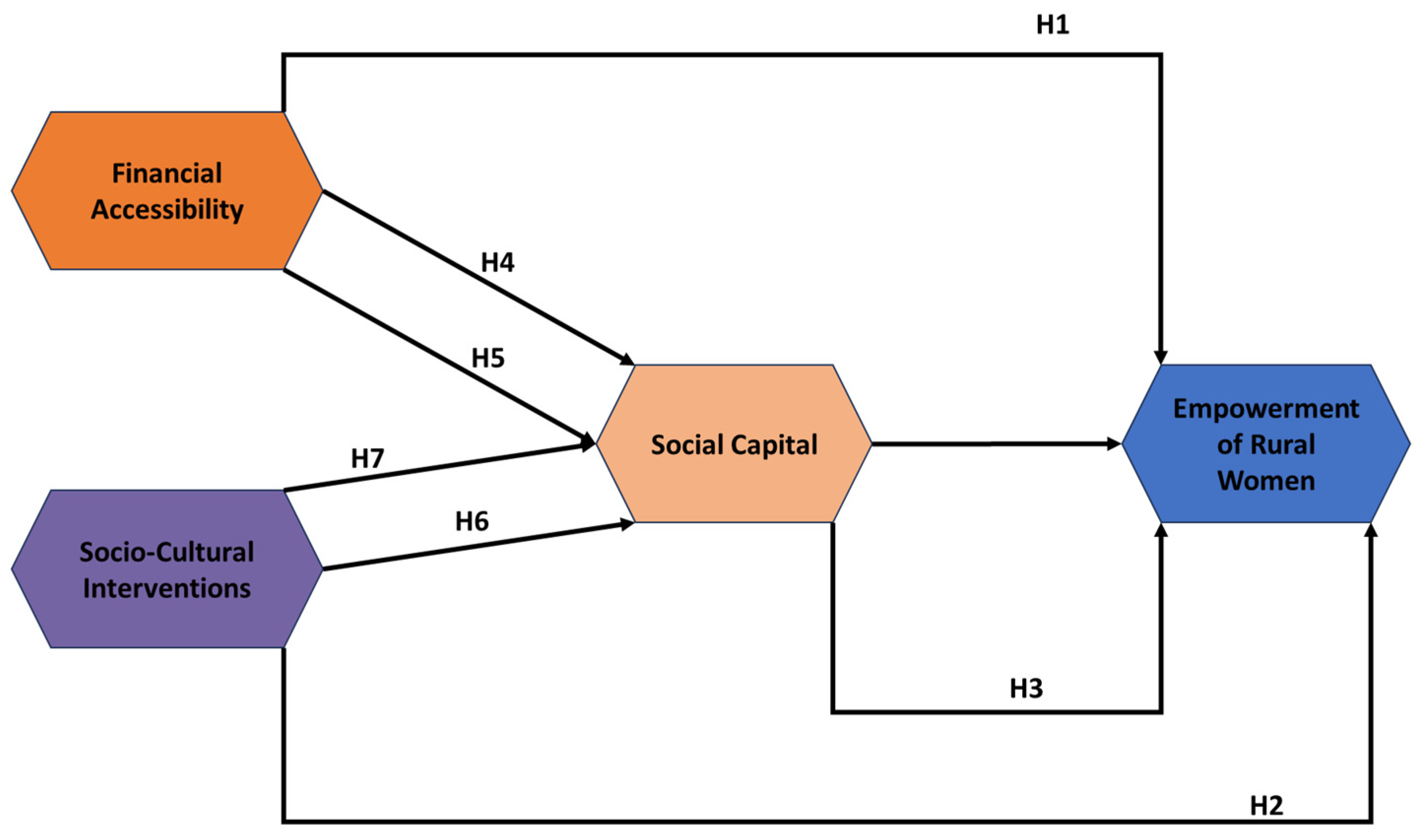
Figure 2.
CFA Results.
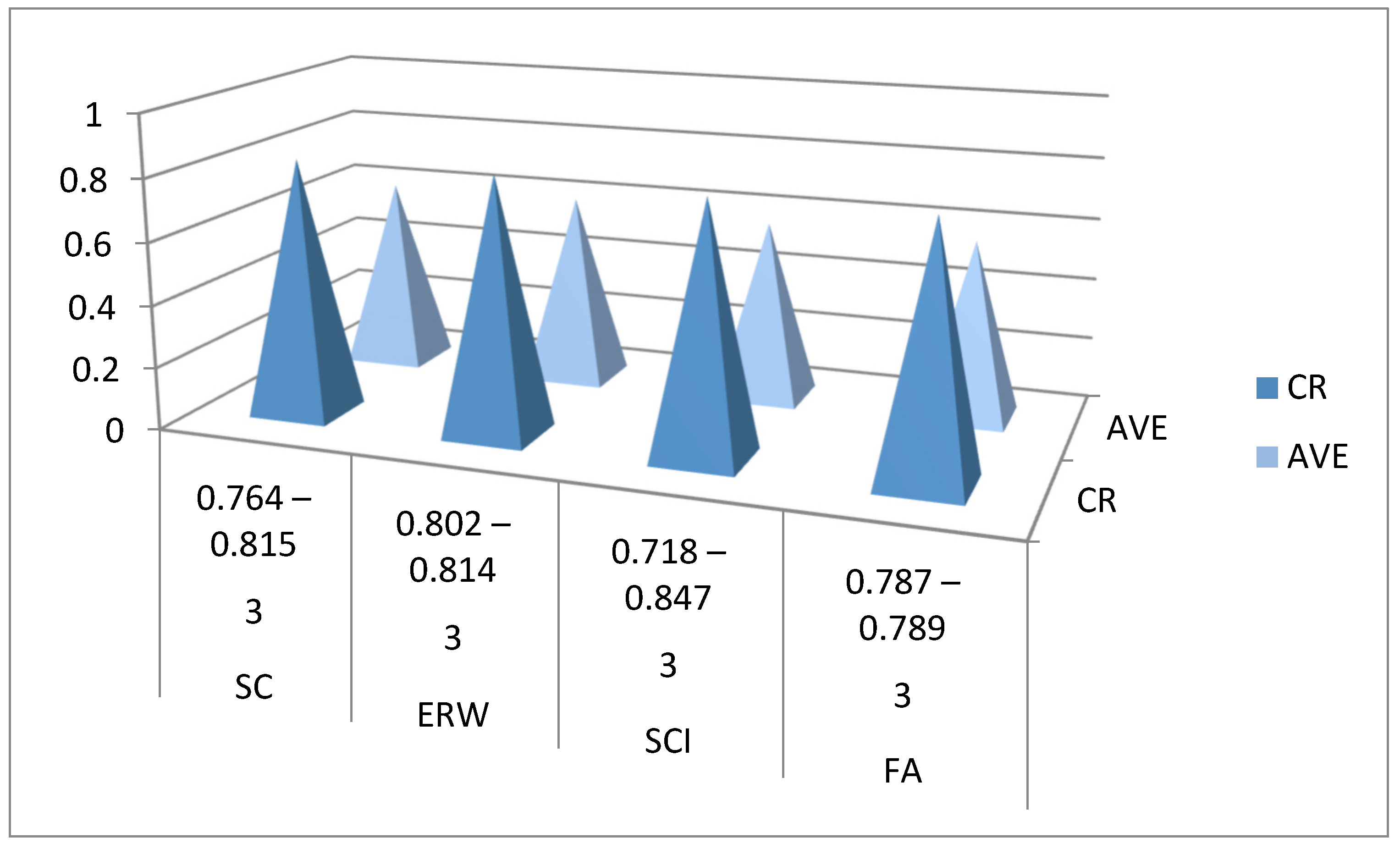
Figure 3.
Conformity factor analysis diagram.
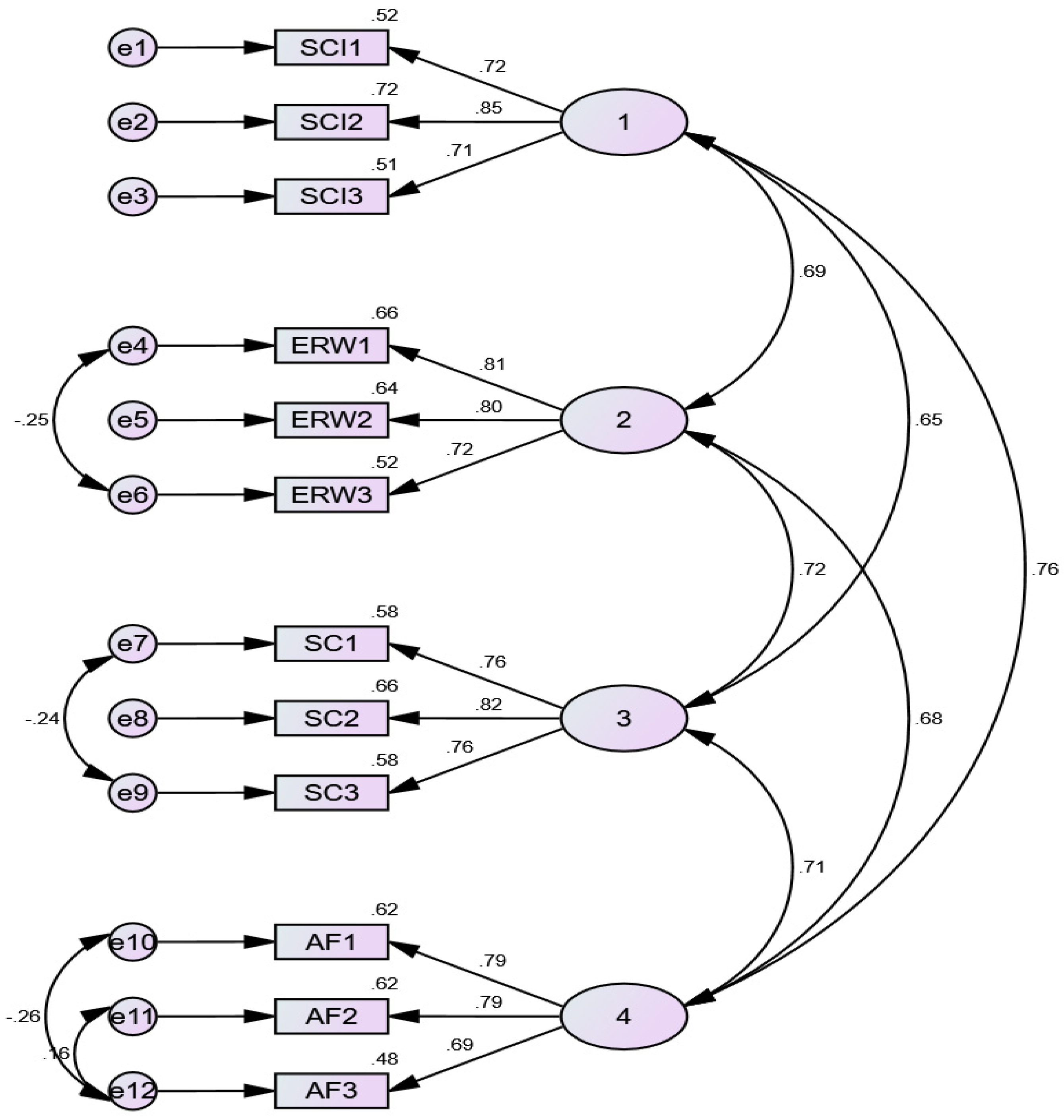

Table 1.
Results of hypothesis testing.
| Linkage | R2 | F Test | ρ-νalue | Β Coefficient |
Hypotheses Acceptance | |
| H1 | FA - ERW | 0.325 | 184.787 | 0.001 | 0.570 | Supported |
| H2 | FA - SC | 0.350 | 206.205 | 0.001 | 0.592 | Supported |
| H3 | SCI - ERW | 0.327 | 185.744 | 0.001 | 0.571 | Supported |
| H4 | SCI - SC | 0.284 | 153.186 | 0.001 | 0.535 | Supported |
| H5 | FA – SC - ERW | 0.4404 | 150.3422 | 0.001 | 0.5747 | Supported |
| H6 | SC - ERW | 0.337 | 228.028 | 0.001 | 0.611 | Supported |
| H7 | SCI – SC - ERW | 0.3266 | 185.7440 | 0.001 | 0.5809 | Supported |
| Note: FA (Financial Accessibility), SCI (Socio-cultural interventions), SC (Social capital), ERW (Empowerment of rural women). | ||||||
Table 2.
Exploratory factor analysis of the data.
| Factor | Factor Loading | %variance explained | Initial eigenvalue | Cronbach |
|
Factor 1: Socio-cultural interventions | ||||
| SCI1 | 0.789 | 49.05 |
5.886 |
0.795 |
| SCI2 | 0.843 | |||
| SCI3 | 0.871 | |||
|
Factor 2: Empowerment of rural women | ||||
| ERW1 | 0.748 | 8.75 | 2.050 | 0.801 |
| ERW2 | 0.902 | |||
| ERW3 | 0.859 | |||
| Factor 3: Social Capital | ||||
| SC1 | 0.710 |
7.45 |
1.895 |
0.803 |
| SC2 | 0.896 | |||
| SC3 | 0.872 | |||
| Factor 4: Financial Accessibility | ||||
| FA1 | 0.604 |
6.49 |
1.779 |
0.786 |
| FA2 | 0.906 | |||
| FA3 | 0.882 | |||
Note: SCI (Socio-cultural interventions), ERW (Empowerment of rural women), SC (Social Capital), FA (Financial Accessibility), VE (%variance explained), IE (Initial eigenvalue).
Table 3.
Confirmatory factor analysis results.
| Construct | Items | Factor loading | CR | AVE |
| SC | 3 | 0.764 – 0.815 | 0.824 | 0.61 |
| ERW | 3 | 0.802 – 0.814 | 0.823 | 0.61 |
| SCI | 3 | 0.718 – 0.847 | 0.804 | 0.579 |
| FA | 3 | 0.787 – 0.789 | 0.801 | 0.574 |
Note: SC (Social capital), ERW (Empowerment of rural women), SCI (Socio-cultural interventions), FA (Financial Accessibility).
Table 4.
Fitted indicators for the CFA model.
| Model | CMIN | DF | P | CMIN/DF | CFI | NFI | IFI | RMSEA | SRMR |
| 87.758 | 44 | 0.000 | 1.995 | 0.980 | 0.961 | 0.980 | 0.051 | 0.0247 |
Table 5.
Discriminant validity test.
| AF | SCI | SC | ERW | |
| FA | 0.809103 | .617** | .592** | .570** |
| SCI | .617** | 0.83492 | .535** | .571** |
| SC | .592** | .535** | 0.830181 | .611** |
| ERW | .570** | .571** | .611** | 0.83902 |
Correlation is significant at the 0.01 level (2-tailed). Note: FA (Financial Accessibility), SCI (Socio-cultural interventions), SC (Social capital), ERW (Empowerment of rural women). AVE values are bolded.
Disclaimer/Publisher’s Note: The statements, opinions and data contained in all publications are solely those of the individual author(s) and contributor(s) and not of MDPI and/or the editor(s). MDPI and/or the editor(s) disclaim responsibility for any injury to people or property resulting from any ideas, methods, instructions or products referred to in the content. |
© 2026 by the authors. Licensee MDPI, Basel, Switzerland. This article is an open access article distributed under the terms and conditions of the Creative Commons Attribution (CC BY) license (http://creativecommons.org/licenses/by/4.0/).
Copyright: This open access article is published under a Creative Commons CC BY 4.0 license, which permit the free download, distribution, and reuse, provided that the author and preprint are cited in any reuse.