

Submitted:
10 February 2026
Posted:
11 February 2026
You are already at the latest version
Abstract
Accurate and rapid determination of moisture content in waste sludge is essential for optimizing dewatering processes, reducing disposal costs, and minimizing environmental impact. This study investigates the use of Fourier Transform Near-Infrared (FT-NIR) spectroscopy combined with Partial Least Squares Regression (PLS-R) for predicting the moisture content of dewatered sludge. A total of 96 sludge samples, with dry matter contents ranging from 12.4% to 24.6%, were collected from two treatment plants. FT-NIR spectra were acquired over the 800–2500 nm range, and chemometric models were developed to correlate spectral information with gravimetrically determined moisture content. The optimized PLS-R model demonstrated strong predictive performance, achieving a cross-validated coefficient of determination (R²CV) of 0.87, a root mean square error of cross-validation (RMSECV) of 0.92%, and a residual predictive deviation (RPD) of 2.73. Independent test set validation confirmed the robustness of the model (R²test = 0.88, RMSEP = 0.88%, RPD = 2.92), supported by strong calibration results (R² = 0.95, RMSEE = 0.60%, RPD = 4.46). Principal component analysis indicated that spectral variability observed in sludge samples was primarily associated with WWTP-specific characteristics, reflecting moisture–organic matter interactions. These results demonstrate that FT-NIR spectroscopy is a promising tool for sludge moisture prediction.
Keywords:
moisture quantification
; dewatered sludge
; near-infrared spectroscopy
; sFT-NIR
; PLS-R model
1. Introduction
The substantial volume of waste sludge generated in wastewater treatment plants requires appropriate treatment to prevent secondary pollution and to reduce the environmental impact. Waste sludge is characterized by an exceptionally high water content, along with a colloidal and compressible structure [1]. After thickening, sludge is mechanically dewatered to achieve a 20-30% solids content [2], a step critical for reducing transportation costs, improving calorific value for incineration, and minimizing leachate generation [3]. Dewatering separates the sludge into two phases: dewatered sludge and an excess liquid phase, commonly referred to as “centrate”. Although centrate typically represents a small volumetric fraction, its return to the plant influent introduces high concentrations of dissolved organic matter, ammonia, and phosphorus. This internal recirculation increases organic and nutrient loading, compromises process efficiency, and contributes to elevated greenhouse gas emissions; effects that are further increased by climate change driven hydraulic and pollutant load fluctuations [4,5].
Moisture content is a critical parameter for evaluating dewatering effectiveness, directly influencing disposal strategies, operational costs, and environmental impacts, especially in cases where sludge is incinerated [6,7]. Sludge moisture content is affected by the efficiency of dewatering equipment, feed water characteristics, type of treatment plant, and conditioning methods. Current sludge moisture monitoring relies on laboratory-based gravimetric method, which is highly time-consuming and therefore unsuitable for real-time process control [8]. Existing process control practices focus on monitoring suspended solids in feed sludge and centrate, which provides only limited insight into dewatering performance and fail to directly reflect the moisture content of the final cake. Consequently, despite the critical role of moisture content, the lack of on-site, real-time measurement technologies remains a significant barrier to the automation and optimization of the dewatering process.
Information obtained from wavelength-dependent absorption measurements at the molecular level offers a promising alternative to conventional analytical methods. Near-Infrared (NIR) spectroscopy is a type of vibrational spectroscopic technique operating within the wavelength range of 750 to 2500 nm (13300 to 4000 cm⁻¹) and is based on overtone and combination vibrations of hydrogen-containing molecular groups such as O–H, N–H, and C–H [9]. Consequently, NIR spectra provide indirect information on the molecular structure, functional groups, and physical properties of a sample. Consequently, NIR spectra provide integrated information regarding the molecular structure, functional groups, and physical properties of a matrix. Recent technological advancements have enabled a transition from benchtop laboratory measurements to compact, non-intrusive instruments suitable for rapid, on-site, and real-time process monitoring [10]. NIR spectroscopy is widely recognized as a robust tool for moisture determination across diverse industries. Specifically, FT-NIR has demonstrated high performance in agricultural and food research, enabling simultaneous multi-parameter analysis with minimal sample preparation [11,12,13]. In environmental engineering, use of FT-NIR has been investigated for wastewater quality monitoring, including pharmaceuticals, emerging pollutants, and rapid parameter prediction [14,15,16]. Furthermore, previous studies have utilized FT-NIR to characterize sewage sludge stability and compositional parameters [17,18,19]. However, despite the proven adaptability of this technology, its application for the direct estimation of moisture content in dewatered waste sludge from WWTPs remains unexplored.
In this context, this study investigated the potential of FT-NIR spectroscopy as a rapid tool for estimating sludge moisture content using Partial Least Squares (PLS) regression. Principal Component Analysis (PCA) was applied to the spectral data to explore chemical relationships and matrix variations among dewatered sludge samples. Beyond the experimental modelling, this research also assessed the applicability of in-line NIR spectroscopy for real-time monitoring of dewatering operations by comparing model performances from recent literature and addressing the practical challenges of on-site implementation in WWTPs. Successful implementation of this approach could substantially enhance sludge dewatering management, thereby improving operational efficiency and cost-effectiveness while reducing the environmental impact of wastewater treatment facilities.
2. Material and Methods
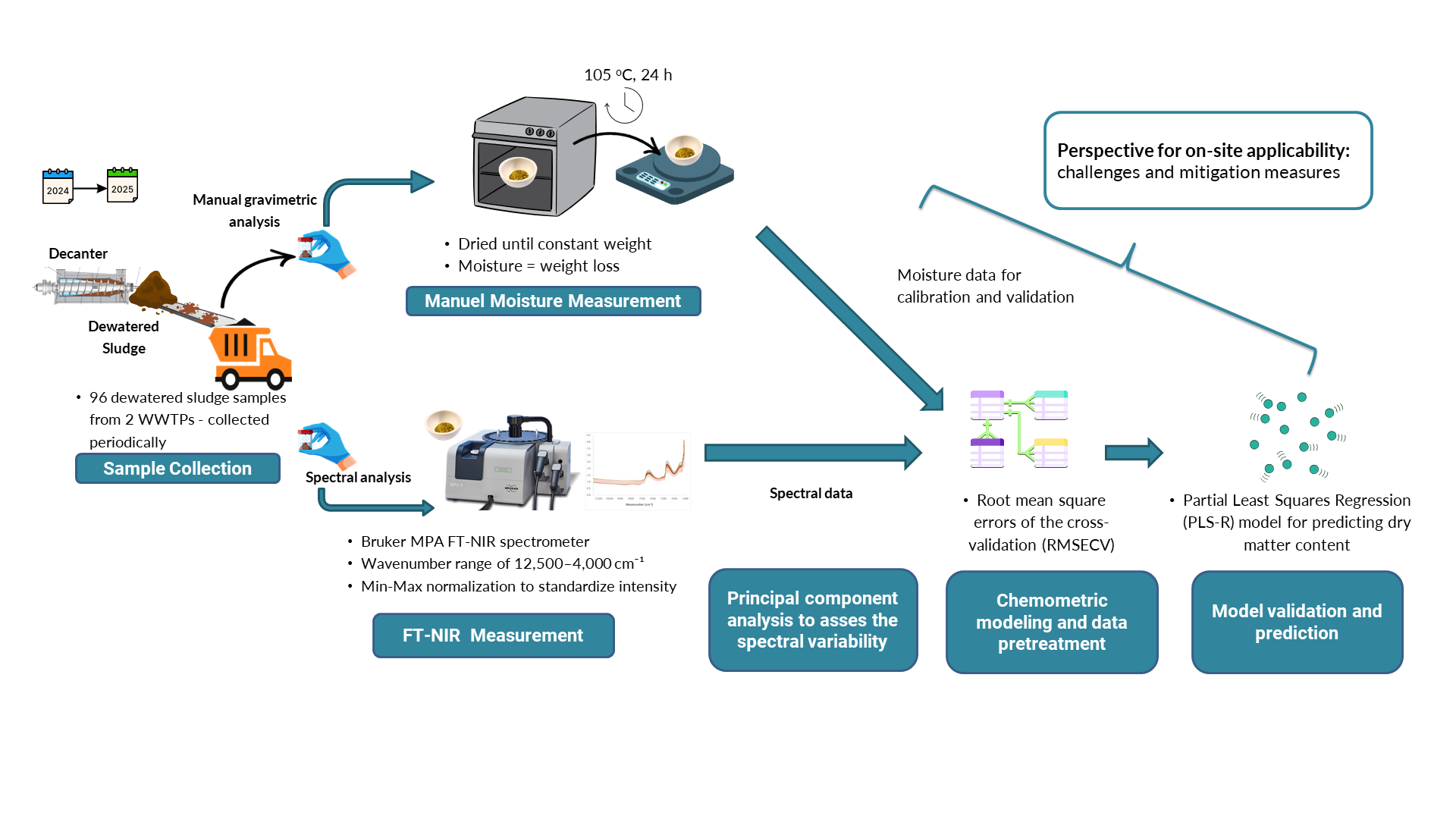
The effectiveness of FT-NIR spectroscopy for estimating sludge moisture was evaluated according to the conceptual framework illustrated in Figure 1. Following sample collection, moisture content was determined in the laboratory using the conventional gravimetric method to serve as the reference. FT-NIR spectra were subsequently acquired and processed using chemometric techniques to assess the potential of FT-NIR’s performance as a rapid predictive method. The following subsections describe the sampling, spectral acquisition, and modelling procedures in detail.
2.1. Sludge Sample Collection and Laboratory Method for Moisture Measurement
A total of 96 sludge samples were collected from two full-scale urban wastewater treatment plants, WWTP 1 and WWTP 2, serving approximately 220,000 and 670,000 population equivalents, respectively. Both facilities utilize biological processes for carbon, phosphorus, and nitrogen removal, followed by sludge thickening and centrifuge-based dewatering. The dewatering units are equipped with polyelectrolyte dosing and sludge pumping systems. The plants treat a combination of domestic and pre-treated industrial wastewater, with WWTP 1 receiving a higher industrial fraction than WWTP 2.
Waste sludge was sampled at the dewatering unit outlets over an eight-month period (May 2024–January 2025. To ensure a robust calibration range, samples were collected during both steady-state operations and equipment start-up phases, providing samples with higher moisture content. After collection, samples were stored in airtight polyethylene containers at 4 °C to minimize evaporation and analysed within 48 hours.
Reference moisture content was determined using the gravimetric method described in Standard Methods 2540B [20] with measurements performed in triplicates. Approximately 10 g of each sample was dried in a laboratory oven at 105 °C until a constant weight was achieved (up to 24 h). The moisture content was then calculated based on mass loss using the following equation:
where W is the moisture content of sludge (%), M1 is the mass before drying (gram), M2 is the mass after drying at 105 oC (gram). The dry matter content (%) of the sludge was then calculated as 100 – W.
2.2. FT-NIR Spectral Acquisition of the Sludge and Principal Component Analysis
FT-NIR spectral measurements were performed using a Bruker MPA FT-NIR spectrometer equipped with a lead sulfide (PbS) detector (Bruker Optik GmbH, Ettlingen, Germany). Samples were scanned in diffuse reflectance mode using the instrument’s rotating sphere accessory. Spectral data were collected in the wavenumber range of 12,500–4,000 cm⁻¹ (corresponding to 800–2,500 nm) at a spectral resolution of 8 cm⁻¹, with each spectrum representing the average of 64 scans. All measurements were conducted at room temperature and recorded using OPUS software (v7.2, Bruker Optik GmbH, Germany).
Principal component analysis (PCA) was performed on the spectral dataset to investigate the underlying structure of variability among the sludge samples. Furthermore, correlation loading plots were analyzed to identify the specific spectral variables driving the sample groupings observed within the principal component space.
2.3. PLS-R Model Development and Validation
A total of 96 waste sludge samples were utilized to develop and validate Partial Least Squares Regression (PLS-R) model for predicting dry matter content (%DM) from FT-NIR spectral data. Spectral pre-processing and model development were performed using the OPUS software. To identify the optimal model configuration, various spectral ranges and pre-processing techniques including smoothing, derivative transformations, and normalization were systematically evaluated using the software’s "Optimize" function. This function iteratively compares various combinations based on their cross-validation errors, and the configuration yielding the lowest Root Mean Square Error of Cross-Validation (RMSECV) was selected.
Model performance was assessed using a comprehensive set of statistical metrics: the coefficient of determination (R2), the number of latent variables (LVs), and the Root Mean Square Errors of Estimation (RMSEE), Cross-Validation (RMSECV), and Prediction (RMSEP). Additionally, the Residual Predictive Deviation (RPD) was calculated as the ratio of the standard deviation of the reference values to the corresponding error metrics (RMSEE, RMSECV, or RMSEP), serving as an indicator of predictive reliability.
A multi-step validation strategy was employed to ensure model robustness. For the internal validation, Leave-One-Out Cross-Validation (LoO-CV) was applied to the entire dataset. In this procedure, each sample is excluded iteratively while a calibration model is built on the remaining samples to calculate a generalized error estimate (RMSECV). For the external validation; the dataset was randomly partitioned into a calibration set (64 samples) and an independent test set (32 samples). The model was calibrated on the former and subsequently applied to the latter to determine external validation metrics (R2, RMSEP, and RPD).
The number of LVs was selected to minimize RMSE while preventing overfitting, ensuring the final model was both accurate and generalizable.
The equations used are given below:
Root Mean Square Error of Cross Validation:
where M is the number of samples in the data set, is the value of ith sample measured with the reference method and is the value of ith sample predicted with model
Root Mean Square Error of Estimation:
where M is the number of samples in the data set, R is the number latent variable and SSE is the sum of squared errors.
Residual Prediction Deviation:
where SD is the standard deviation of the reference values of the samples and SEP is the standard error of prediction.
The coefficient of determination:
where M is the number of samples in the data set, is the value of ith sample measured with the reference method, is the value of ith sample predicted with model and Ym is the mean of the reference values.
3. Results and Discussion
3.1. Characterization of the Waste Sludge
A total of 96 samples were collected from the dewatering process of two advanced biological wastewater treatment plants between May 2024 and January 2025. The dry matter content of the sludge samples ranged from 12.4% to 24.6% (mean: 19.8% ± 2.5%) consistent with literature values for mechanically dewatered sludge, which typically range from 13-30% [21,22,23,24]. These samples therefore cover nearly the full range of dry matter contents encountered in wastewater treatment plants. The distribution of dry matter content was approximately normal, with a slight right skew, and the median value of 20.9%. This relatively uniform and well-distributed dataset provides a robust basis for developing and validating chemometric prediction model.
3.2. Principal Component Analysis of Spectral Data
Principal component analysis was performed on the FT-NIR spectral data of the sludge samples to explore the underlying structure of variability and to evaluate the influence of WWTP origin, sampling date and sampling time within the day. The first three principal components accounted for 95% of the total variance, with PC1 explaining 88%, PC2 explaining 4%, and PC3 3%, indicating a limited number of highly structured variance sources rather than random noise (Figure 2).
The dominance of PC1 indicates that FT-NIR spectra are primarily driven by the intrinsic physicochemical characteristics of the sludge matrix. This is consistent with the behavior of complex, heterogeneous materials, where bulk properties strongly influence near-infrared absorbance. When PCA scores were visualized by WWTP origin, a robust separation between WWTP 1 and WWTP 2 was observed, primarily along the PC1 axis. WWTP 1 samples formed a compact cluster at negative PC1 values, whereas WWTP 2 samples exhibited broader dispersion at positive values (Figure 2a). Given that PC1 explains 88% of the total variance, site-specific characteristics represent the dominant source of spectral variability. These differences likely arise from variations in influent composition (industrial vs. domestic fractions), processing conditions, and stabilization efficiency [25,26]. The tighter clustering observed for WWTP 1 samples suggests a more homogeneous sludge composition, while the spread of WWTP 2 samples points to increased heterogeneity, potentially reflecting a more diverse influent profile or fluctuating operational conditions.
In contrast, PCA scores grouped by sampling time (morning, afternoon, evening, night) showed no distinct clustering, indicating that daily changes have a negligible effect on sludge characteristics captured by FT-NIR (Figure 2b). Similarly, samples grouped by sampling date exhibited substantial overlap (Figure 2c). he absence of systematic temporal variation along PC1 confirms the relative stability of the sludge characteristics throughout the study period. This stability may be attributed to the buffering effects of the treatment process residence time, alongside the relatively constant nature of waste sludge generated by biological processes. Collectively, these factors may reduce short-term variability and prevent significant fluctuations in sludge composition, resulting in a stable spectral signature. Minor dispersion observed along PC2 and PC3 may be associated with localized, short-term events (e.g., rainfall, sudden industrial discharges, and/or operational changes) rather than persistent changes (Figure 2b, Figure 2c).
Overall, the PCA results demonstrate that WWTP origin is the primary driver for FT-NIR spectral variability, while sampling date and intra-day sampling time has only a minimal influence.
3.3. Interpretation of Correlation Loading Plots
Correlation loading plots for PC1, PC2, and PC3 are presented in Figure 3 to better explain the relationships between individual spectral variables and the principal components, as well as the chemical features underlying the observed sample groupings.
The correlation loading plot for PC1 reveals the chemical basis for the site-dependent separation observed in this study. The PC1 loadings exhibited strong positive correlations (r > 0.7) across broad spectral regions, particularly in the high- and low-wavenumber ranges. This indicates that PC1 reflects global matrix properties rather than isolated molecular features. High correlations in the 12,000–9,000 cm⁻¹ region are consistent with higher-order O–H overtones and scattering-related effects, suggesting an important contribution from moisture content and physical structure. Similarly, strong positive correlations in the 7,500–6,700 cm⁻¹ range (first O–H overtone and combination bands) correspond to first O–H overtone and combination bands, further emphasizing the role of water–matrix interactions [27,28,29,30]. Very high correlations in the 5,400–4,500 cm⁻¹ region associated with both the O–H combination band of water and overlapping C–H and N–H combination bands, point to systematic differences in organic matter composition, including lipids, proteins, and carbohydrates, and variations in moisture–organic interactions [31]. Conversely, a sharp negative feature around 8,900–8,500 cm⁻¹ indicates an inverse relationship between specific overtone bands and the dominant PC1 trend, likely reflecting differences in water interactions (e.g., bound vs free water) and/or their specific interactions with organic matrix components. Collectively, these features indicate PC1 as a composite axis integrating moisture levels, organic matter abundance and composition, and matrix-related scattering, which collectively explain why origin of waste sludge exerts such a strong influence on the PCA scores.
The PC2 loadings displayed a distinctly bipolar structure, with moderate positive correlations at high wavenumbers and strong negative correlations in the 8,600–7,400 cm⁻¹ region. This pattern indicates that PC2 captures contrasts between specific organic fractions rather than total organic matter concentration. The negatively correlated mid-NIR region is usually associated with second overtones and combination bands of C–H from lipids and protein-related structures [31], suggesting that PC2 reflects qualitative shifts in organic composition. Moderate positive features at lower wavenumbers, involving overlapping O–H, N–H, and C–H combination bands, further support this interpretation. These characteristics explain why PC2 contributes to minor dispersion seen in sampling date or episodic events but does not override the dominant site-dependent separation.
PC3 loadings were characterized by relatively low absolute correlation values, with moderate positive correlations in the high-wavenumber region and localized negative features in the mid- and lower-wavenumber ranges. This pattern is indicative of fine-scale heterogeneity, potentially arising from minor biochemical variations, subtle moisture redistribution, or residual physical effects such as particle size variability. The absence of systematic grouping along PC3 in the score plots confirms that this component represents residual variability rather than a dominant or process-driven factor.
In summary, FT-NIR spectral variability is hierarchically structured, with site-specific sludge characteristics being driven by moisture–organic matter interactions and matrix properties, as the dominant source of variance, followed by secondary compositional contrasts and residual sample-specific heterogeneity. PCA analysis revealed no significant spectral differences between samples collected at different times or dates within the same WWTP, thereby confirming the temporal stability of sludge properties. Conversely, samples from different WWTPs were consistently separated in PCA space, indicating that WWTP-specific characteristics are the dominant source of spectral variability. These discrepancies are likely to be caused by variations in influent composition, relative contributions of industrial and domestic wastewater, and/or differences of operational parameters relevant to sludge stabilization. The hierarchical structure and temporal stability of the FT-NIR-based moisture estimation of dewatered sludge demonstrate its robustness for routine monitoring and large-scale screening applications. Furthermore, the discriminatory capability of the FT-NIR–PCA for identifying the WWTP origin of dewatered sludge could be an important tool to identify the potential source of uncontrolled or unauthorized sludge discharges.
3.4. FT-NIR Spectral Features Relevant to Moisture Prediction
The raw FT-NIR spectra of sludge samples, collected over the 12,000–3,500 cm⁻¹ range, exhibited distinct absorbance features associated with moisture and organic matter (Figure 4a). Prominent absorption bands were observed at 7,398–6,364 cm⁻¹, which is predominantly attributed to O–H overtone and combination bands of water, known to dominate this spectral window, particularly around ~7,200 and ~6,900 cm⁻¹ [29,30]. Furthermore, additional absorption features were identified in the 5,847–4,810 cm⁻¹ range, corresponding to combination bands involving O–H and N–H stretching vibrations. Overall, these spectral regions are characteristic of water-associated absorptions and moisture-related contributions and are consistent with previous observations in similar matrices [30].The intensity of the water-related bands increased with moisture content, highlighting the sensitivity of FT-NIR spectroscopy to variations in sludge water content and establishing a clear spectral–molecular basis for quantitative prediction. Minor baseline shifts and noise were evident across samples, likely reflecting physical differences such as particle size or surface water distribution. Applying Min–Max normalization (Figure 4b) effectively minimized these variations while preserving relevant chemical information, thereby improving spectral consistency for subsequent modelling. These well-defined, moisture-specific spectral features underpin the predictive performance of the PLS-R models. By capturing chemically meaningful information in targeted spectral regions, the pre-processed spectra provide a robust foundation for accurate regression and moisture quantification.
3.5. PLS-R Model Development and Validation for Moisture Prediction
Among the measurements, two samples’ data were identified as outliers and excluded from the calibration. Descriptive statistics of the dataset are presented in Table 1. The remaining 94 samples were separated into two data-sets, as a calibration data-set (62 samples) and a test data-set (32 samples), with similar distributions of dry matter content to ensure representative model development.
The optimized PLS-R model, developed using FT-NIR spectra and Min–Max normalization over informative spectral regions (10,364–5,439 and 4,621–3,799 cm⁻¹), achieved excellent calibration performance with seven latent variables (LVs). High coefficients of determination (R²T = 0.949) and low error values (RMSEE = 0.60 %) were observed, along with an RPD of 4.46, indicating strong predictive capacity on the calibration set (Table 2). Internal model validation using leave-one-out cross-validation yielded slightly lower but still robust performance (R²CV = 0.866, RMSECV = 0.92 %, RPD = 2.73). This reduction is expected and reflects the model’s ability to generalize beyond the calibration data. External validation on the independent test set further confirmed the model’s predictive strength, with R²test = 0.879, RMSEP = 0.88 %, and RPD = 2.92. The close agreement between cross-validation and test set metrics indicates that the model is not overfitted and maintains high predictive accuracy when applied to unseen samples.
Figure 5 illustrates the regression plots of predicted versus reference dry matter content (%DM) for both cross-validation (a) and external test-set validation (b). In both cases, the points are closely distributed around the 1:1 line, and the linear regression fits yield high coefficients of determination (R²C = 0.9273 for cross-validation and R²T = 0.9498 for the test set). The slopes near unity and low intercepts further support the model’s accuracy and stability across calibration and validation datasets. These results, together with the high RPD values and low error metrics summarized in Table 2, confirm the robustness and predictive power of the PLS-R model. Overall, the findings demonstrate that FT-NIR spectroscopy, together with appropriate chemometric modelling, provides a reliable and rapid tool for monitoring of sludge moisture content in wastewater treatment processes. In the literature studies on moisture content prediction in food products reports R2 values ranging from 0.81 to 0.99. Consistently, the R2 value obtained in the present investigation of sludge moisture prediction aligns well with the trends observed in the extant literature [11,12,13,32,33].
3.6. Practical Considerations for On-Site NIR-Based Sludge Moisture Monitoring
This study demonstrates the potential of FT-NIR technology to effectively estimate sludge moisture across samples from two WWTPs under laboratory conditions. To assess the feasibility of extending this approach toward real-time, on-site implementation, the performance of benchtop and in-line NIR systems was benchmarked against values reported in the literature (Table 3). Previous FT-NIR and visible-near-infrared (Vis-NIR) studies on soil moisture report R² values typically ranging from 0.78 to 0.97. Given the comparable matrix complexity and moisture variability, these values provide a relevant benchmark for dewatered sludge.
Across reported studies, high predictive accuracy (R² ≈ 0.78–0.97) has been achieved using chemometric approaches such as PLS-R, PCR, and MRA within the 4,000–12,000 cm⁻¹ spectral range, confirming the strong capability of NIR-based methods for moisture estimation. Consistent with these findings, the results of the present study support FT-NIR spectroscopy as a reliable and rapid tool for sludge moisture quantification under laboratory conditions. Extending this capability to on-site, real-time monitoring could enable timely moisture assessment and optimized chemical dosing, representing a significant advancement over conventional practices.
In practice, FT-NIR systems are predominantly used for high-resolution laboratory analyses, whereas diode array NIR instruments are more commonly deployed for in-line applications due to their lower cost, mechanical robustness, and sufficient spectral resolution for moisture determination. Benchtop FT-NIR instruments typically operate over the12,500–4,000 cm-1 range, [10], achieving high accuracy (R² ≈ 0.81–0.99), and have been widely applied for moisture analysis in food and forage samples. In contrast, diode array NIR systems are generally cover narrower spectral range (11,111–5,882 cm-1 ) [10,34,35], while still achieving high predictive performance for moisture quantification (R² = 0.88–0.96).
However, compared to laboratory measurements, the robustness of in-line NIR methods may be significantly reduced under field conditions if systems are not adequately adapted to WWTP-specific environments. Factors such as variable sludge composition, surface heterogeneity, fouling, vibration, and fluctuating ambient conditions can adversely affect spectral quality and model stability. In this context, this section outlines key WWTP-specific challenges for on-site NIR implementations, together with mitigation strategies to improve robustness, and reproducibility under operational conditions, as summarised in Table 4.
In general, factors affecting the accuracy and robustness of the technology include sampling representativeness and sensor condition. These can be addressed through physical and modelling strategies. Physical measures include sensor placement and sampling design, whereas modelling strategies involve multivariate calibration and appropriate data processing. Specific challenges for sludge dewatering applications in WWTPs include surface heterogeneity, sensor fouling, harsh environments, and vibration. Intermittent operation and temperature fluctuations, can lead to optical fouling, and variable sludge surfaces may cause scattering effect. To mitigate these issues, careful sensor placement (e.g., above conveyors or free-fall streams), surface stabilisation, or use of metal chutes can reduce surface variability and vibration effects [36,37]. Additionally, Optical cleaning systems and protected installation can reduce optical fouling. Beyond physical measures, model optimisation may further improve robustness. Multivariate model calibration, inclusion of process-influencing variables and optimal data pre-processing strengthen predictive performance. Moreover, artificial intelligence (AI) and machine learning (ML) based adaptive calibration may improve accuracy and compensate field-related variability. Beyond moisture, NIR may enable estimation of organic matter, nitrogen, metals, carbon fractions [18], nutrients [19] and polymers [10,30,38].

Table 3.
Challenges and mitigation methods of on-site use of NIR spectroscopy for sludge dewatering.
Table 3.
Challenges and mitigation methods of on-site use of NIR spectroscopy for sludge dewatering.
| Potential challenges and limitations | Mitigation methods | |
|---|---|---|
| Operational and environmental challenges | Challenges for sludge dewatering processes in WWTPs include; - Surface roughness and texture of the sludge and their variability - Fouling and ambient conditions. The dewatering process typically operates intermittently during day-time or night-time. Therefore, occurrence of fouling in optical paths due to temperature differences& condensation - Vibration: dewatering equipment and conveyors usually generate significant vibration |
- Installing a suitable structure, to create smooth surface or a metal chute to facilitate an interface for NIR installation, may help to minimise variations in roughness, and shape of sludge [36,37]. - Implementing an effective cleaning strategy& protected installation may help to reduce fouling and impact of ambient conditions - Selection of suitable location (such as over a conveyor belt, on a chute, or in a free-fall stream) can reduce the impact of vibration - Introduction of AI and ML into calibration model may contribute to adaptive calibration or fault compensation. |
| Method robustness | Factors that can affect robustness include; - Representative sampling, - Variations in physical conditions such as sensor location, distance and depth [36,39]. |
Physical measures: - Defining effective sample size and frequency. - Selecting suitable NIR sensor location and distance to ensure representativeness and robustness. - Design and installation of suitable structure or a chute. Modelling related measures; - To mitigate the effects of physical parameter variability and improve model robustness, the following strategies may be applied: (i) multivariate model calibration as well as integration of factors into the model calibration that has impact to the process [40], and (ii) the application of pre-processing methods such as standard normal variate (SNV), PLS-based pre-processing, and multiplicative scatter correction (MSC) methods [41,42]. |
Table 4.
Performance comparison of benchtop FT-NIR and in-line NIR spectroscopy.
| Application type | Material | Number of samples | Type of Instrument |
Wavelength Range (cm-1) |
Moisture (%) | Validation for R2 | Model | Reference |
|---|---|---|---|---|---|---|---|---|
| Benchtop FT-NIR | WWTP sludge | 96 | FT-NIR | 12,500–4,000 | 75.4-87.6 | 0.88 | PLS-R | This study |
| Apricot | 82 | 9,400–5,450 | 5-39 | 0.99 | PLS-R | [12] | ||
| Herbage | 100 | 10,000–4,000 | 57-89 | 0.87/0.83 | PLS-R/ PCR* | [33] | ||
| Green tea | 30 | 12,000-4,000 | 3-45 | 0.99 | PLS-R | [32] | ||
| Turmeric | 120 | 12,500–3,600 | 7-9.5 | 0.81 | PLS-R | [11] | ||
| Soil | 393 | 12,000-3,800 | 0.6-13.2 | 0.96 | PLS-R | [43] | ||
| 48 | Vis-NIR | 9091–4000 | 3.5-13 | 0.97 | MRA** | [44] | ||
| 802 | 7692–4000 | 0-16 | 0.84 | PCR* | [45] | |||
| 107 | 28,571-4,000 | 5-25 | 0.78-0.87 | PLS-R | [46] | |||
| In-line NIR | Poultry manure | 109 | FT-NIR | 10,000–4,000 | 18.5-54 | 0.93 | PLS-R | [13] |
| Pasta | 12 | Diode array NIR | 32,468–5,869 | 31-74 | 0.96 | PLS-R | [47] | |
| Meat industry | 54 | 6,600–4,762 | 23.2-24 | 0.88 | PLS-R | [48] |
*Principal Component Regression, ** Multiple Regression Analysis.
4. Conclusions
The management of wastewater treatment plants relies heavily on efficient sludge dewatering processes, which require accurate and timely determination of moisture content to reduce the environmental impacts and enhance process resilience. However, conventional gravimetric methods for moisture analysis are time-consuming and labour-intensive, limiting effective process control and highlighting the need for reliable and faster analytical techniques.
In this context, this study investigated the applicability of the FT-NIR spectroscopy with partial least squares regression model for quantifying the moisture content of dewatered waste sludge using 96 samples from two different WWTPs. PCA results demonstrated strong temporal stability of sludge spectral characteristics within each WWTP, with no significant differences observed across sampling times or dates. In contrast, samples from different WWTPs showed clear and consistent separation, confirming that WWTP-specific characteristics are the primary drivers of FT-NIR spectral variability.
The FT-NIR method achieved accurate moisture predictions, with strong cross-validation performance (R2c = 0.93; RMSEE = 0.71; RMSECV = 0.92; RPD = 2.73), and comparable test set validation results (R2T = 0.95; RMSEE = 0.6; RMSEP = 0.88; RPD = 2.92). In addition, the study also assessed the practical perspective for on-site of NIR spectroscopy implementation in wastewater treatment plants, addressing the potential operational and environmental challenges and discussing mitigation strategies to enhance method robustness.
Overall, the results demonstrate that FT-NIR spectroscopy has strong potential as a reliable and rapid alternative to conventional gravimetric methods for sludge moisture quantification. Its application can support more sustainable, efficient, and cost-effective sludge management in wastewater treatment facilities.
5. Future Directions
Future studies should expand FT-NIR-based moisture measurements to waste sludge from a broader range of wastewater treatment plants and further investigate WWTP-specific spectral fingerprinting for identifying the sources of uncontrolled or unauthorized sludge discharges. In addition, NIR-based monitoring approaches are expected to play an increasingly important role in the real-time optimization of sludge management processes. Overall, these perspectives highlight the need for continued research to advance the development and full-scale implementation of FT-NIR technologies in wastewater treatment applications.
Funding
The authors gratefully acknowledge financial support through SMART4ENV project. This project has received funding from the European Union’s Horizon Europe Widening Participation and Spreading Excellence Programme under Grant Agreement No 101079251 (SMART4ENV-Enhancing the Scientific Capacity of TUBITAK MAM in The Field of Smart Environmental Technologies for Climate Change Challenges).
References
- Wu, B.; Dai, X.; Chai, X. Critical Review on Dewatering of Sewage Sludge: Influential Mechanism, Conditioning Technologies and Implications to Sludge Re-Utilizations. Water Res. 2020, 180, 115912. [CrossRef]
- Akkurt, Ş. A Review of New Technological Applications in the Use of Sewage Sludge for Sustainable Agriculture. Int. J. Agric. Environ. Food Sci. 2025, 9, 307. [CrossRef]
- Mahmoud, A.; Olivier, J.; Vaxelaire, J.; Hoadley, A. Advances in Mechanical Dewatering of Wastewater Sludge Treatment. In Wastewater Reuse and Management; 2013; pp. 253–303 ISBN 9789400749429.
- Hyrycz, M.; Ochowiak, M.; Krupińska, A.; Włodarczak, S. Influence of Effluent Quality from Sludge Dewatering on Electricity Consumption. Polish J. Chem. Technol. 2023, 25, 50–55. [CrossRef]
- Iqbal Hossain, K.M. Resilience of Wastewater Treatment Plants to Climate Change : Challenges and Adaptive Strategies. Int. J. Business, Soc. Sci. Res. 2024, 12, 41–48. [CrossRef]
- Choi, A.E.S.; Evangelista, D.G.; Ortenero, J.R. Streamlining Extracellular Polymeric Substance Removal: Fuzzy Multi-Objective Optimization of Ultrasonic-Fenton Treatment. Resour. Environ. Sustain. 2024, 15, 100141. [CrossRef]
- Song, E.; Han, S.K. Real-Time Sensor-Controlled Coagulant Dosing and Pressure in a Novel Sludge Dewatering System. Clean Technol. 2025, Vol. 7, Page 82 2025, 7, 82. [CrossRef]
- Vaxelaire, J.; Cézac, P. Moisture Distribution in Activated Sludges: A Review. Water Res. 2004, 38, 2215–2230. [CrossRef]
- Blanco, M.; Villarroya, I. NIR Spectroscopy: A Rapid-Response Analytical Tool. TrAC - Trends Anal. Chem. 2002, 21, 240–250. [CrossRef]
- Beć, K.B.; Grabska, J.; Huck, C.W. Principles and Applications of Miniaturized Near-Infrared (NIR) Spectrometers. Chem. - A Eur. J. 2021, 27, 1514–1532. [CrossRef]
- Thangavel, K.; Dhivya, K. Determination of Curcumin, Starch and Moisture Content in Turmeric by Fourier Transform near Infrared Spectroscopy (FT-NIR). Eng. Agric. Environ. Food 2019, 12, 264–269. [CrossRef]
- Özdemir, İ.S.; Öztürk, B.; Çelik, B.; Sarıtepe, Y.; Aksoy, H. Rapid, Simultaneous and Non-Destructive Assessment of the Moisture, Water Activity, Firmness and SO2 Content of the Intact Sulphured-Dried Apricots Using FT-NIRS and Chemometrics. Talanta 2018, 186, 467–472. [CrossRef]
- Tamburini, E.; Castaldelli, G.; Ferrari, G.; Marchetti, M.G.; Pedrini, P.; Aschonitis, V.G. Onsite and Online FT-NIR Spectroscopy for the Estimation of Total Nitrogen and Moisture Content in Poultry Manure. Environ. Technol. 2015, 36, 2285–2294. [CrossRef]
- Sousa, A.C.; Lucio, M.M.L.M.; Neto, O.F.B.; Marcone, G.P.S.; Pereira, A.F.C.; Dantas, E.O.; Fragoso, W.D.; Araujo, M.C.U.; Galvão, R.K.H. A Method for Determination of COD in a Domestic Wastewater Treatment Plant by Using Near-Infrared Reflectance Spectrometry of Seston. Anal. Chim. Acta 2007, 588, 231–236. [CrossRef]
- Zhang, Y.; Hao, Y.; Cai, W.; Shao, X. Simultaneous Determination of Phenol and P-Nitrophenol in Wastewater Using near-Infrared Diffuse Reflectance Spectroscopy with Adsorption Preconcentration. Anal. Methods 2011, 3, 703–708. [CrossRef]
- Quintelas, C.; Mesquita, D.P.; Ferreira, E.C.; Amaral, A.L. Quantification of Pharmaceutical Compounds in Wastewater Samples by near Infrared Spectroscopy (NIR). Talanta 2019, 194, 507–513. [CrossRef]
- Soriano-Disla, J.M.; Gómez, I.; Guerrero, C.; Navarro-Pedreño, J.; García-Orenes, F. The Potential of NIR Spectroscopy to Predict Stability Parameters in Sewage Sludge and Derived Compost. Geoderma 2010, 158, 93–100. [CrossRef]
- Reed, J.P.; Devlin, D.; Esteves, S.R.R.; Dinsdale, R.; Guwy, A.J. Performance Parameter Prediction for Sewage Sludge Digesters Using Reflectance FT-NIR Spectroscopy. Water Res. 2011, 45, 2463–2472. [CrossRef]
- Galvez-Sola, L.; Morales, J.; Mayoral, A.M.; Paredes, C.; Bustamante, M.A.; Marhuenda-Egea, F.C.; Barber, J.X.; Moral, R. Estimation of Parameters in Sewage Sludge by Near-Infrared Reflectance Spectroscopy (NIRS) Using Several Regression Tools. Talanta 2013, 110, 81–88. [CrossRef]
- APHA Standard Methods for the Examination of Water and Wastewater, 20th Edition; APHA American Public Health Association, 1216, Washington, 2012;
- Andreoli, C.V.; von Sperling, M. arco.; Fernandes, F. Sludge Treatment and Disposal. In Proceedings of the IWA Publishing; IWA Publishing, 2007; Vol. 1.
- Wang, W.; Luo, Y.; Qiao, W. Possible Solutions for Sludge Dewatering in China. Front. Environ. Sci. Eng. China 2010, 4, 102–107. [CrossRef]
- Hyrycz, M.; Ochowiak, M.; Krupińska, A.; Włodarczak, S.; Matuszak, M. A Review of Flocculants as an Efficient Method for Increasing the Efficiency of Municipal Sludge Dewatering: Mechanisms, Performances, Influencing Factors and Perspectives. Sci. Total Environ. 2022, 820. [CrossRef]
- Rao, B.; Wang, G.; Xu, P. Recent Advances in Sludge Dewatering and Drying Technology. Dry. Technol. 2022, 40, 3049–3063. [CrossRef]
- Amanatidou, E.; Samiotis, G.; Trikoilidou, E.; Tzelios, D.; Michailidis, A. Influence of Wastewater Treatment Plants’ Operational Conditions on Activated Sludge Microbiological and Morphological Characteristics. Environ. Technol. 2016, 37, 265–278. [CrossRef]
- Kowalski, M.; Kowalska, K.; Wiszniowski, J.; Turek-Szytow, J. Qualitative Analysis of Activated Sludge Using FT-IR Technique. Chem. Pap. 2018 7211 2018, 72, 2699–2706. [CrossRef]
- Weyer, L.G.; Lo, S.-C. Spectra-Structure Correlations in the Near-Infrared. 2006.
- Schwanninger, M.; Rodrigues, J.C.; Fackler, K.; Schwanninger, M.; Rodrigues, J.C.; Fackler, K. A Review of Band Assignments in near Infrared Spectra of Wood and Wood Components. J. Near Infrared Spectrosc. 2011, 19, 287–308. [CrossRef]
- Grabska, J.; Bec, K.; Huck, C. What Is Hidden Underneath NIR Lineshape of Water? Proc. 21st Int. Conf. Near Infrared Spectrosc. 2025, 261–269. [CrossRef]
- Moll, V.; Beć, K.B.; Grabska, J.; Huck, C.W. Investigation of Water Interaction with Polymer Matrices by Near-Infrared (NIR) Spectroscopy. Molecules 2022, 27, 5882. [CrossRef]
- Gudjónsdóttir, M.; Hilmarsdóttir, G.S.; Ögmundarson, Ó.; Arason, S. Near-Infrared Spectroscopy and Chemometrics for Effective Online Quality Monitoring and Process Control during Pelagic Fishmeal and Oil Processing. Foods 2024, Vol. 13, Page 1186 2024, 13, 1186. [CrossRef]
- Sinija, V.R.; Mishra, H.N. FTNIR Spectroscopic Method for Determination of Moisture Content in Green Tea Granules. Food Bioprocess Technol. 2011, 4, 136–141. [CrossRef]
- Parrini, S.; Acciaioli, A.; Franci, O.; Pugliese, C.; Bozzi, R. Near Infrared Spectroscopy Technology for Prediction of Chemical Composition of Natural Fresh Pastures. J. Appl. Anim. Res. 2019, 47, 514–520. [CrossRef]
- Melucci, D.; Monti, D.; D’Elia, M.; Luciano, G. Rapid in Situ Repeatable Analysis of Drugs in Powder Form Using Reflectance Near-Infrared Spectroscopy and Multivariate Calibration. J. Forensic Sci. 2012, 57, 86–92. [CrossRef]
- Krause, J.; Grüger, H.; Gebauer, L.; Zheng, X.; Knobbe, J.; Pügner, T.; Kicherer, A.; Gruna, R.; Längle, T.; Beyerer, J. SmartSpectrometer—Embedded Optical Spectroscopy for Applications in Agriculture and Industry. Sensors 2021, Vol. 21, Page 4476 2021, 21, 4476. [CrossRef]
- Vargas, J.M.; Roman-Ospino, A.D.; Sanchez, E.; Romañach, R.J. Evaluation of Analytical and Sampling Errors in the Prediction of the Active Pharmaceutical Ingredient Concentration in Blends From a Continuous Manufacturing Process. J. Pharm. Innov. 2017, 12, 155–167. [CrossRef]
- Velez, N.L.; Drennen, J.K.; Anderson, C.A. Challenges, Opportunities and Recent Advances in near Infrared Spectroscopy Applications for Monitoring Blend Uniformity in the Continuous Manufacturing of Solid Oral Dosage Forms. Int. J. Pharm. 2022, 615, 121462. [CrossRef]
- Handbook of Near-Infrared Analysis; Donald, A., B., Ciurczak, E.W., Eds.; Third Edit.; Taylor & Francis Group, 2008.
- Sierra-Vega, N.O.; Román-Ospino, A.; Scicolone, J.; Muzzio, F.J.; Romañach, R.J.; Méndez, R. Assessment of Blend Uniformity in a Continuous Tablet Manufacturing Process. Int. J. Pharm. 2019, 560, 322–333. [CrossRef]
- Mohan, S.; Momose, W.; Katz, J.M.; Hossain, M.N.; Velez, N.; Drennen, J.K.; Anderson, C.A. A Robust Quantitative near Infrared Modeling Approach for Blend Monitoring. J. Pharm. Biomed. Anal. 2018, 148, 51–57. [CrossRef]
- Shi, Z.; McGhehey, K.C.; Leavesley, I.M.; Manley, L.F. On-Line Monitoring of Blend Uniformity in Continuous Drug Product Manufacturing Process—The Impact of Powder Flow Rate and the Choice of Spectrometer: Dispersive vs. FT. J. Pharm. Biomed. Anal. 2016, 118, 259–266. [CrossRef]
- Colón, Y.M.; Florian, M.A.; Acevedo, D.; Méndez, R.; Romañach, R.J. Near Infrared Method Development for a Continuous Manufacturing Blending Process. J. Pharm. Innov. 2014, 9, 291–301. [CrossRef]
- Zornoza, R.; Guerrero, C.; Mataix-Solera, J.; Scow, K.M.; Arcenegui, V.; Mataix-Beneyto, J. Near Infrared Spectroscopy for Determination of Various Physical, Chemical and Biochemical Properties in Mediterranean Soils. Soil Biol. Biochem. 2008, 40, 1923–1930. [CrossRef]
- Dalal, R.. .; Henry, R.. Simultaneous Determination of Moisture, Organic Carbon, and Total Nitrogen by Near Infrared Reflectance Spectrophotometry. Soil Sci. Soc. Am. J. 1985, 50, 120.
- Chang, C.-W.; Laird, D.A.; Mausbach, M.J.; Hurburgh, C.R. Near-Infrared Reflectance Spectroscopy–Principal Components Regression Analyses of Soil Properties. Soil Sci. Soc. Am. J. 2001, 65, 480–490. [CrossRef]
- Nocita, M.; Stevens, A.; Noon, C.; Van Wesemael, B. Prediction of Soil Organic Carbon for Different Levels of Soil Moisture Using Vis-NIR Spectroscopy. Geoderma 2013, 199, 37–42. [CrossRef]
- De Temmerman, J.; Saeys, W.; Nicolaï, B.; Ramon, H. Near Infrared Reflectance Spectroscopy as a Tool for the In-Line Determination of the Moisture Concentration in Extruded Semolina Pasta. Biosyst. Eng. 2007, 97, 313–321. [CrossRef]
- Dixit, Y.; Casado-Gavalda, M.P.; Cama-Moncunill, R.; Cullen, P.J.; Sullivan, C. Challenges in Model Development for Meat Composition Using Multipoint NIR Spectroscopy from At-Line to In-Line Monitoring. J. Food Sci. 2017, 82, 1557–1562. [CrossRef]
Figure 1.
Conceptual flowchart of the study.
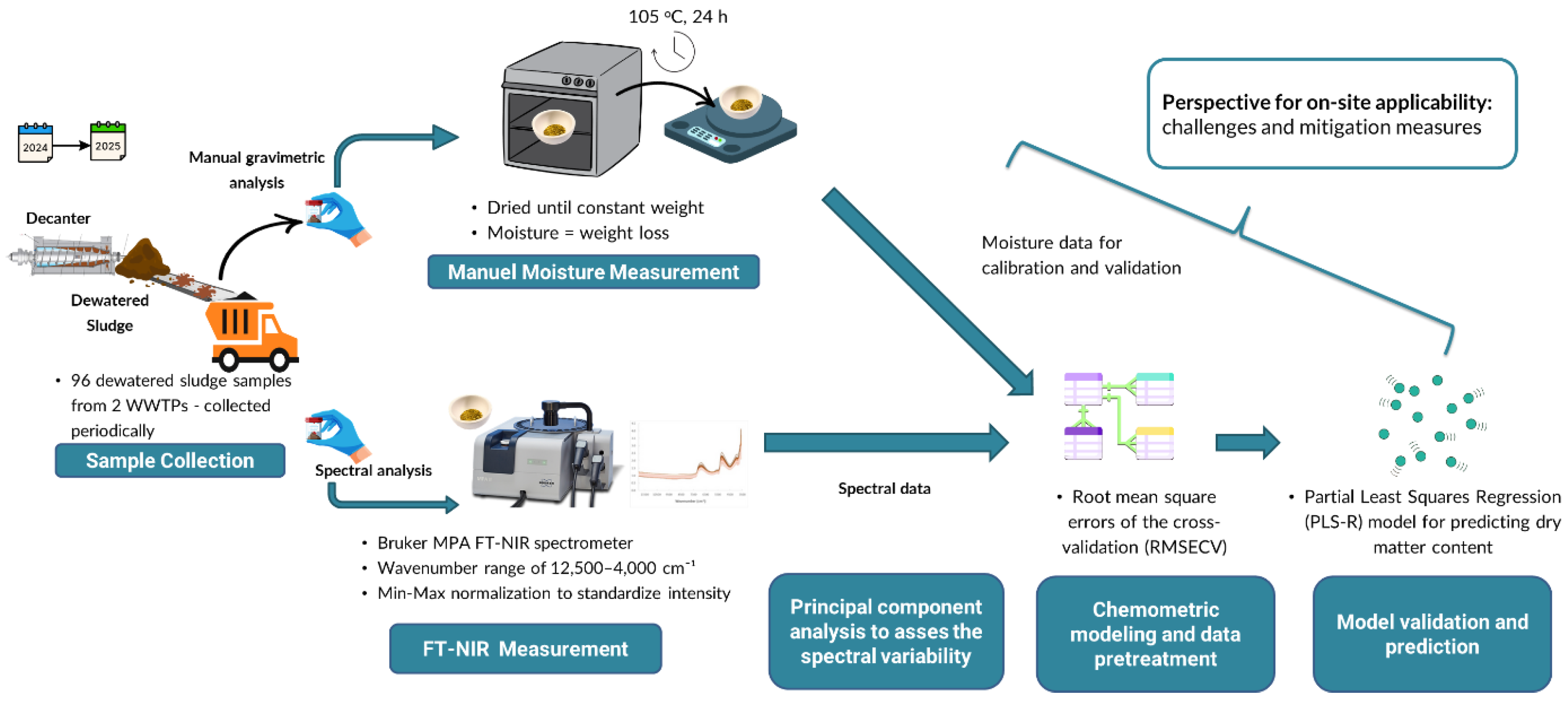
Figure 2.
Three-dimensional PCA score plots of FT-NIR spectra of the sludge samples showing distribution along PC1 (88%), PC2 (4%), and PC3 (3%). (a) origin of WWTP, (b) sampling time (morning, afternoon, evening, night) and (c) sampling date.
Figure 2.
Three-dimensional PCA score plots of FT-NIR spectra of the sludge samples showing distribution along PC1 (88%), PC2 (4%), and PC3 (3%). (a) origin of WWTP, (b) sampling time (morning, afternoon, evening, night) and (c) sampling date.
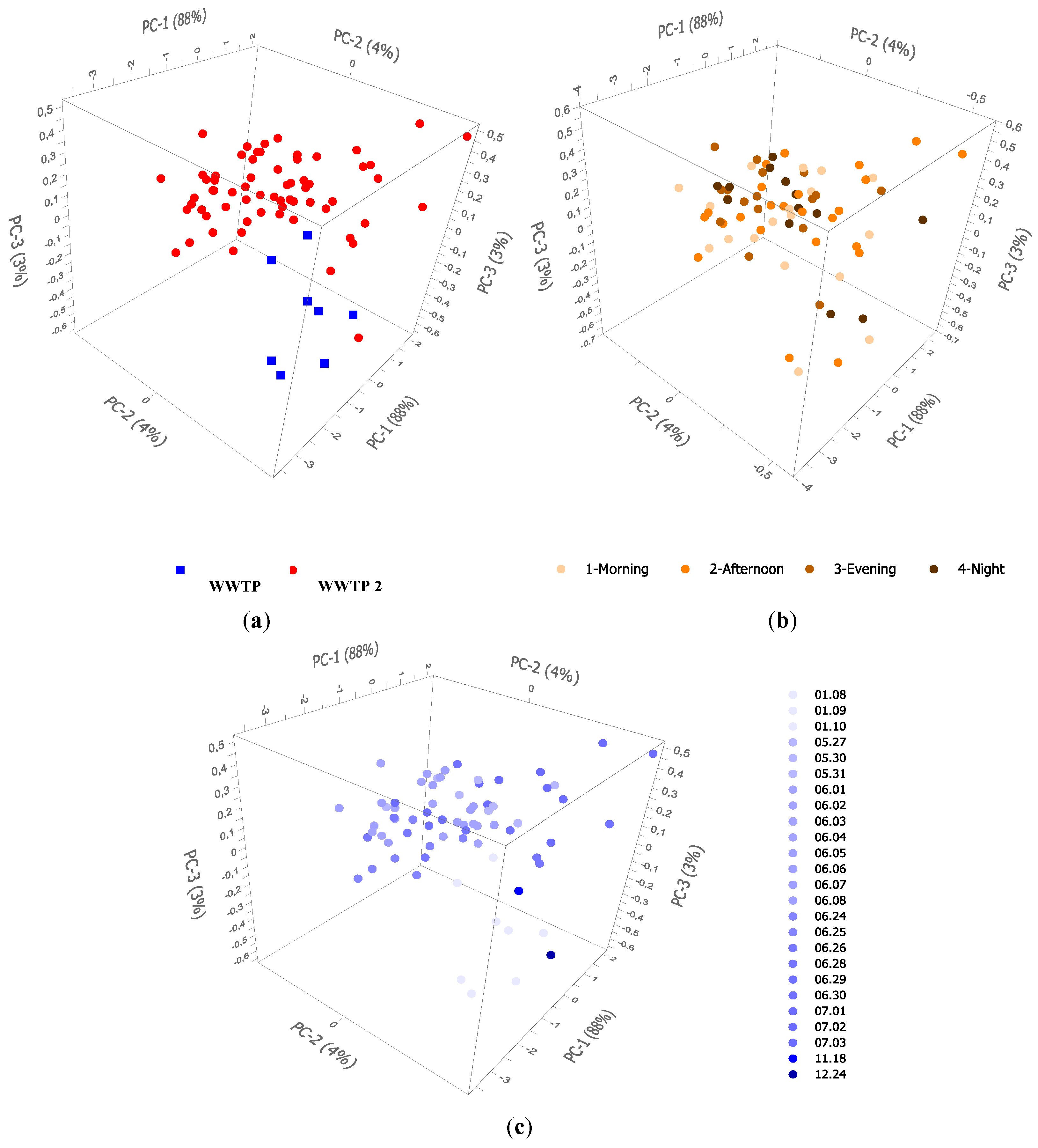
Figure 3.
Correlation loading plots for PC1, PC2, and PC3 obtained from FT-NIR spectra of sludge samples. The horizontal red dashed lines indicate correlation coefficient thresholds at ±0.7.
Figure 3.
Correlation loading plots for PC1, PC2, and PC3 obtained from FT-NIR spectra of sludge samples. The horizontal red dashed lines indicate correlation coefficient thresholds at ±0.7.
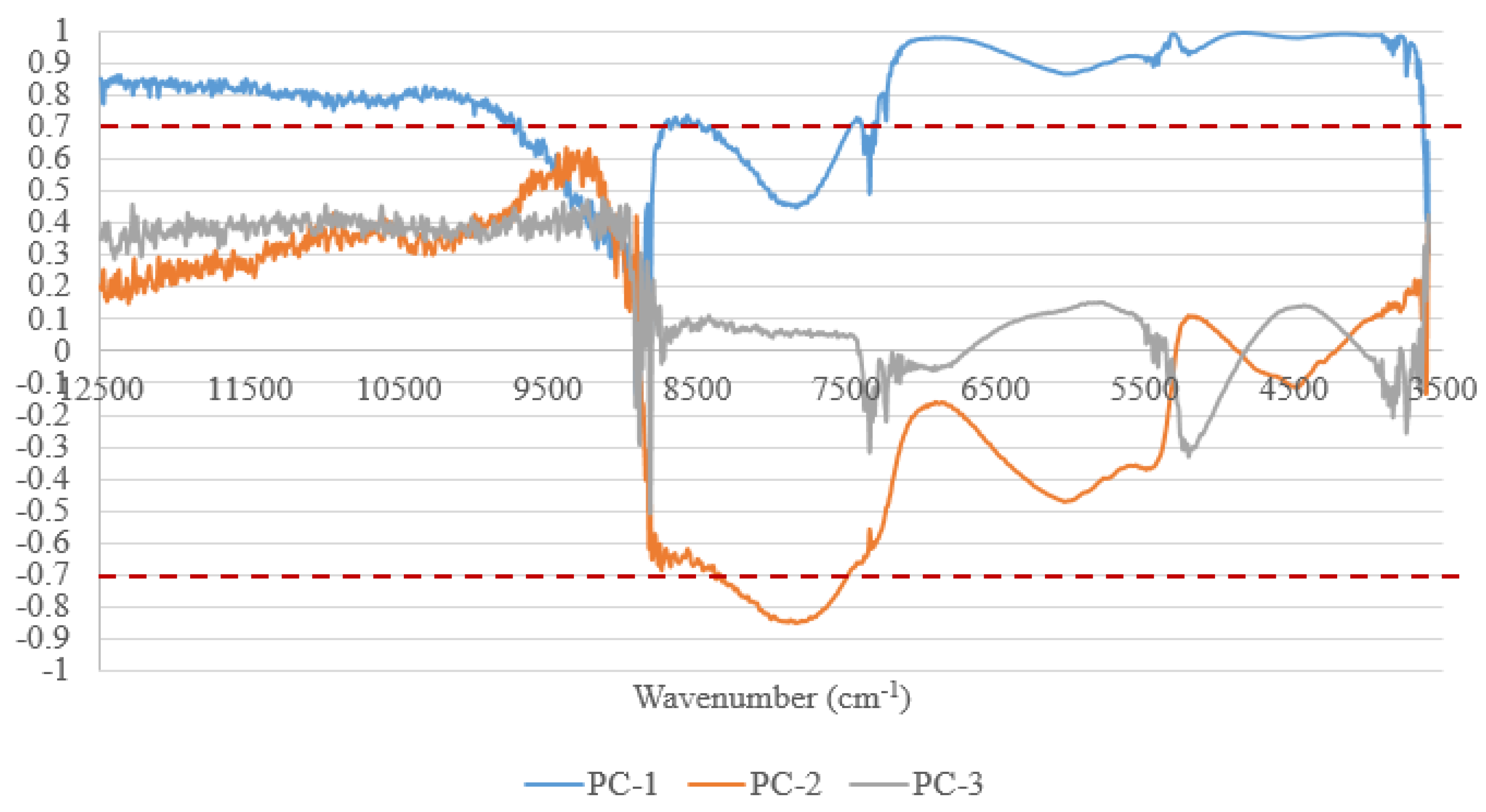
Figure 4.
FT-NIR spectra of sludge samples in the 12,000–3,500 cm⁻¹ range. a) Raw spectra color-coded by moisture content, highlighting absorbance bands associated with moisture (O-H, N-H) and organic matter (C-H). Increased intensity in water-related bands reflects higher moisture levels in sludge samples. b) Spectra after Min-Max normalization, showing reduced baseline shifts and improved consistency across samples while preserving key spectral features relevant to moisture estimation.
Figure 4.
FT-NIR spectra of sludge samples in the 12,000–3,500 cm⁻¹ range. a) Raw spectra color-coded by moisture content, highlighting absorbance bands associated with moisture (O-H, N-H) and organic matter (C-H). Increased intensity in water-related bands reflects higher moisture levels in sludge samples. b) Spectra after Min-Max normalization, showing reduced baseline shifts and improved consistency across samples while preserving key spectral features relevant to moisture estimation.
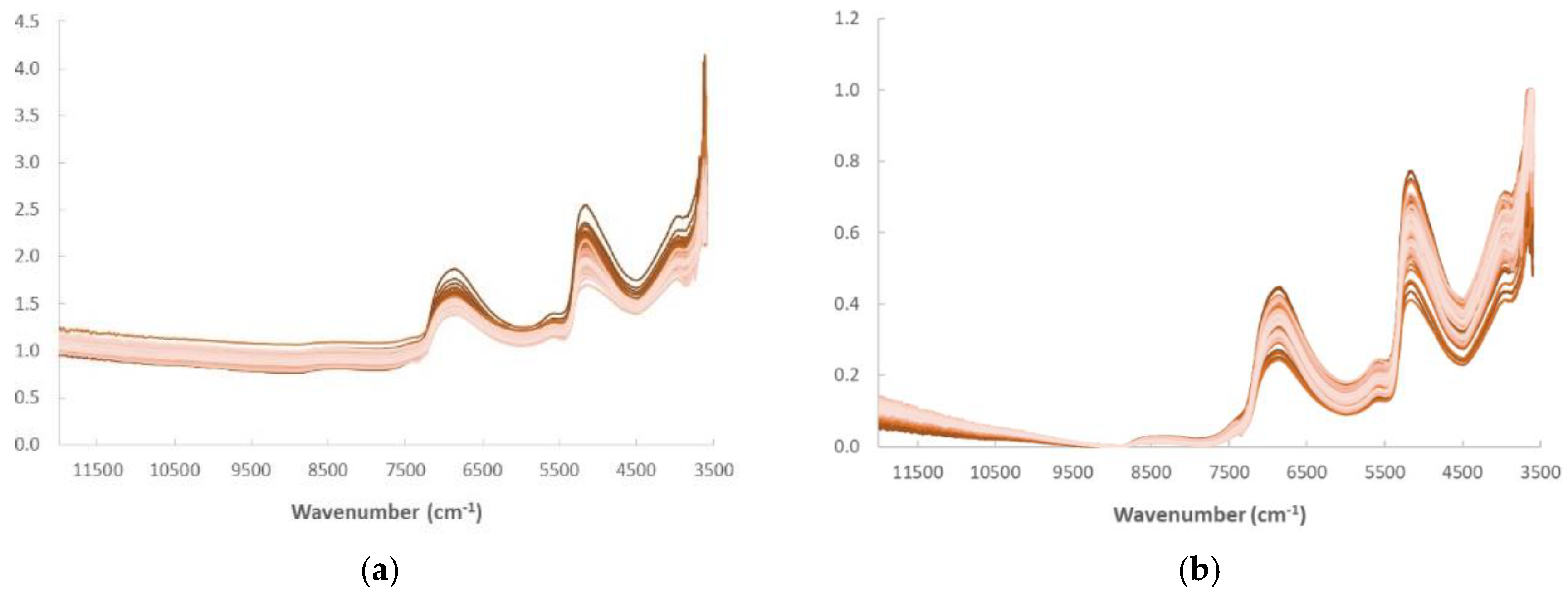
Figure 5.
PLS-R regression plot of predicted versus measured (reference) dry matter content (%DM) for the calibration set a) Cross-Validation b) Test-Set-Validation.
Figure 5.
PLS-R regression plot of predicted versus measured (reference) dry matter content (%DM) for the calibration set a) Cross-Validation b) Test-Set-Validation.
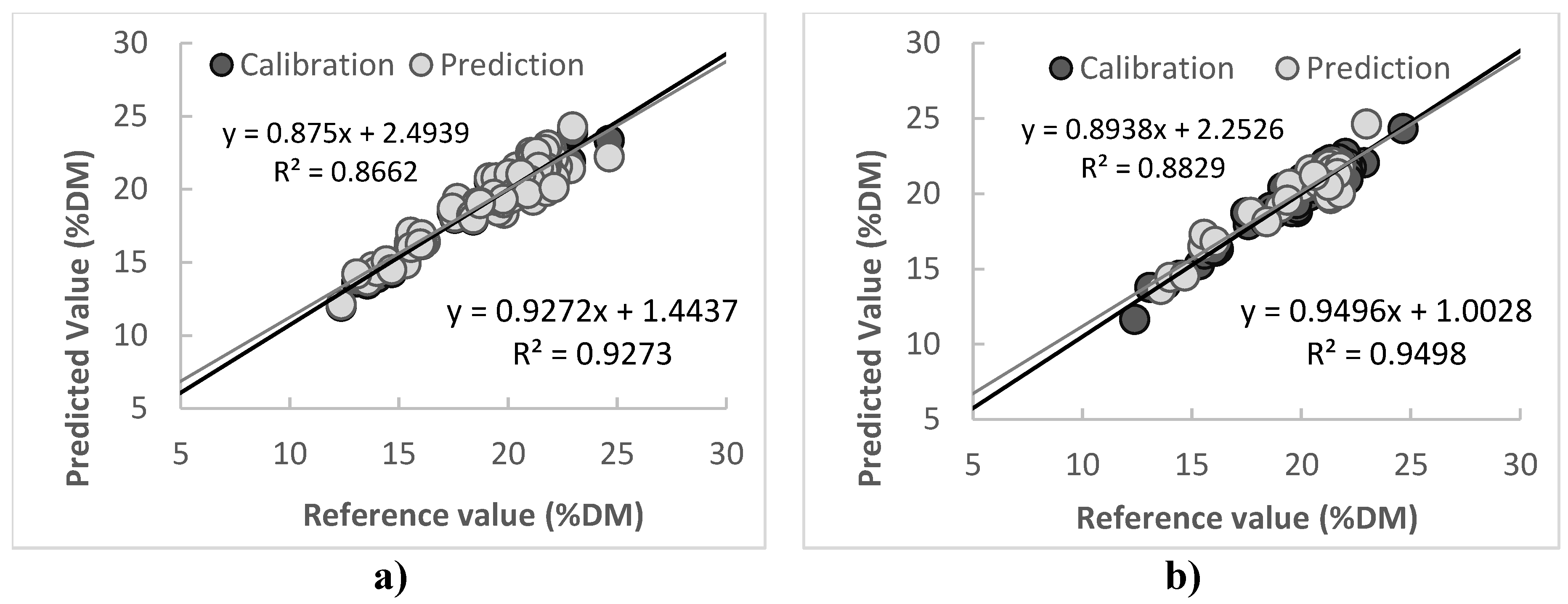
Table 1.
Descriptive statistics of the data set used for PLS-R model establishment.
| Dry matter content (%) | ||
|---|---|---|
| TSV (Calibration) | TSV (Validation) | |
| n | 62* | 32 |
| Mean | 19.9 | 19.7 |
| Minimum | 12.4 | 13.6 |
| Maximum | 24.6 | 23.0 |
| STD | 2.5 | 2.6 |
*2 samples were excluded from the data set as they were identified as outliers.
Table 2.
PLS model performance parameters.
| Dry Matter (%) | Cross-Validation | ||||||||
| Calibration | Validation | ||||||||
| Spectral range | LV | R2C | RMSEE | RPD | LV | R2CV | RMSECV | RPD | |
|
10364 - 5439 4621 - 3799 |
7 | 0.927 | 0.71 | 3.71 | 7 | 0.866 | 0.92 | 2.73 | |
| Test Set Validation | |||||||||
| Training | Test | ||||||||
| Spectral range | LV | R2T | RMSEE | RPD | LV | R2test | RMSEP | RPD | |
|
10364 - 5439 4621 - 3799 |
7 | 0.949 | 0.60 | 4.46 | 7 | 0.879 | 0.883 | 2.92 | |
LV: latent variable number, Rc2: coefficient for determination of calibration model, Rcv2: coefficient for determination of cross validation model, RMSECV: root mean square error for cross validation, RMSEP: root mean square error for prediction, RPD: residual prediction deviation) and informative spectral regions used for the calibration and validation of the prediction models for moisture content of waste sludges.
Disclaimer/Publisher’s Note: The statements, opinions and data contained in all publications are solely those of the individual author(s) and contributor(s) and not of MDPI and/or the editor(s). MDPI and/or the editor(s) disclaim responsibility for any injury to people or property resulting from any ideas, methods, instructions or products referred to in the content. |
© 2026 by the authors. Licensee MDPI, Basel, Switzerland. This article is an open access article distributed under the terms and conditions of the Creative Commons Attribution (CC BY) license (http://creativecommons.org/licenses/by/4.0/).
Copyright: This open access article is published under a Creative Commons CC BY 4.0 license, which permit the free download, distribution, and reuse, provided that the author and preprint are cited in any reuse.


