

Submitted:
10 February 2026
Posted:
11 February 2026
You are already at the latest version
Abstract
Digital transformation has improved visibility and efficiency in supply chains, yet it has delivered limited progress toward circular economy objectives, particularly in emerging markets. Existing research has largely examined digital technologies in isolation or treated artificial intelligence (AI) as a secondary analytical tool, leaving unclear whether circular performance improvements stem from technology adoption itself or from changes in supply chain decision-making. This study addresses this gap by proposing the AI-Driven Circular Digital Supply Chain (AICD-SC) framework, which conceptualizes AI as a central decision orchestrator integrating predictive, prescriptive, and simulation-based capabilities to coordinate closed-loop supply chain processes. The study employs a sequential explanatory mixed-methods design, combining 17 semi-structured interviews with a quasi-experimental Difference-in-Differences analysis of eight manufacturing firms in Mexico and Colombia during 2023–2024. The results show that firms adopting AI-centric decision architectures achieved waste reductions of 18–26% and improvements in material reuse and recovery of 14–17%, while firms relying on digitally enabled but non–AI-centric configurations exhibited no statistically significant circular performance gains. These findings indicate that circular outcomes do not emerge from digitalization alone, but from how supply chain decisions are architected and orchestrated through AI. The study concludes by offering a phased adoption roadmap aligned with Sustainable Development Goal 12, providing actionable implications for managers and policymakers in emerging markets.
Keywords:
artificial intelligence
; circular economy
; digital supply chains
; decision orchestration
; emerging markets
; sustainable supply chain management
1. Introduction
A substantial share of the environmental impact associated with products and services is determined by early supply chain decisions related to design, sourcing, production planning, and end-of-life management [1,2]. While recent advances in digital technologies have significantly improved visibility, traceability, and operational efficiency across supply chains, these improvements have not translated into commensurate progress toward circular economy objectives [3,4]. In many cases, digitally enabled supply chains remain structurally linear, optimizing cost and service performance while continuing to generate high levels of waste and resource inefficiency—particularly in emerging market contexts [5,6]
Over the past decade, the literature on digital supply chains has expanded rapidly, emphasizing the role of technologies such as the Internet of Things (IoT), blockchain, big data analytics, and digital twins in enhancing transparency, resilience, and coordination [7,8,9]. Parallel to this stream, circular economy research has advanced normative principles and strategic frameworks aimed at reducing waste and closing material loops [10,11]. However, despite the growing overlap between these literatures, digital transformation and circular economy initiatives have often evolved in parallel rather than in an integrated manner. As a result, digital technologies are frequently implemented as solutions in search of problems, improving information availability without fundamentally altering the decision logic governing material flows and recovery processes [12,13].
A closer examination of existing studies reveals three persistent gaps. First, much of the literature adopts a mono-technological perspective, analyzing the contribution of individual digital technologies in isolation rather than as part of an integrated decision system [14,15]. Second, empirical evidence remains heavily concentrated in OECD countries, limiting the external validity of findings for emerging markets, where digital infrastructure constraints, institutional environments, and resource pressures differ substantially [6,27]. Third, artificial intelligence (AI) is commonly treated as a secondary analytical tool—supporting forecasting or data processing—rather than as a primary decision-making layer capable of orchestrating complex trade-offs across economic, operational, and environmental objectives [16,17].
These gaps raise a critical but underexplored question: do circular performance improvements stem from the adoption of digital technologies themselves, or from a deeper reconfiguration of how supply chain decisions are architected and executed? Addressing this question is particularly important in emerging markets, where firms face increasing sustainability pressures but must operate under tighter financial and infrastructural constraints [19]. Without a clear understanding of the mechanisms through which digital investments translate into circular outcomes, firms risk reinforcing linear models despite substantial technological expenditure.
In response, this study proposes the AI-Driven Circular Digital Supply Chain (AICD-SC) framework, which explicitly positions artificial intelligence as a central decision orchestrator within digitally enabled supply chains. Rather than assuming that circular outcomes emerge automatically from digitalization, the framework distinguishes between digital infrastructure layers—such as IoT, digital twins, and blockchain—and the decision architecture required to transform data into circular value [12,26]. AI-driven predictive, prescriptive, and simulation-based modules are conceptualized as the mechanisms through which closed-loop supply chain decisions are coordinated and optimized [9,18].
Empirically, the study adopts a sequential explanatory mixed-methods design combining qualitative insights from 17 semi-structured interviews with a quasi-experimental Difference-in-Differences analysis of eight manufacturing firms in Mexico and Colombia. This design enables a direct comparison between firms that deploy AI as a central decision layer and firms that rely on digitally enabled but non–AI-centric configurations, moving beyond descriptive associations and providing causal evidence on the conditions under which digital supply chains generate measurable circular performance improvements [20,27].
This article makes four primary contributions. First, it advances a decision-centric framework that redefines the role of AI in circular digital supply chains [26]. Second, it provides rare quantitative evidence from emerging markets, addressing a significant empirical gap in the literature [6]. Third, it demonstrates that isolated adoption of digital technologies does not yield measurable circular impact, highlighting the importance of AI-driven decision orchestration [12,16]. Finally, it offers a realistic phased adoption roadmap aligned with Sustainable Development Goal 12, translating theoretical insights into actionable guidance for managers and policymakers [25].
The remainder of the article is structured as follows. Section 2 reviews the relevant theoretical foundations on digital supply chains, circular economy, and AI-driven decision systems. Section 3 outlines the research design, data collection, and analytical approach. Section 4 examines the role of emerging technologies as enablers of circularity. Section 5 introduces the proposed AICD-SC framework. Section 6 presents the empirical findings. Section 7 discusses managerial and policy implications, followed by limitations and future research directions in Section 8. Section 9 concludes the article..
2. Theoretical Background
2.1. Digital Supply Chains: From Visibility to Decision-Making
The concept of digital supply chains has evolved substantially over the past decade, shifting from basic information visibility toward enhanced coordination, resilience, and performance optimization [2,7]. Early contributions emphasized the role of digital technologies in improving transparency, real-time monitoring, and data integration across supply chain processes [2]. More recent studies extend this perspective by highlighting how digitalization supports resilience and responsiveness under conditions of uncertainty and disruption [8,9].
Despite these advances, much of the digital supply chain literature remains focused on data availability rather than on how data are transformed into decisions. Technologies such as IoT, big data analytics, blockchain, and digital twins are frequently conceptualized as enablers of visibility and traceability, while their role in reshaping core planning and coordination decisions is often left implicit [12,13]. As a result, digitally enabled supply chains may achieve higher efficiency and responsiveness while preserving fundamentally linear production and consumption models.
Recent research further emphasizes that multi-objective optimization, Industry 4.0 adoption, and digitally enabled process integration can support supply chain performance and sustainability outcomes, although these approaches remain largely technology-centric and lack an explicit decision-orchestration layer [14,15]. This limitation suggests that digitalization alone is insufficient to address complex trade-offs between cost, service, and environmental objectives, particularly when closed-loop and end-of-life decisions are involved.
2.2. Circular Economy: From Principles to Operationalization
The circular economy has emerged as a prominent sustainability paradigm aimed at decoupling economic growth from resource consumption and environmental degradation [3,10]. At its core, the circular economy promotes strategies such as reduction, reuse, remanufacturing, recycling, and recovery to extend product lifecycles and close material loops [4]. These principles have been widely adopted in policy discourse and corporate sustainability strategies, including initiatives aligned with Sustainable Development Goal 12.
However, translating circular economy principles into operational supply chain practices remains a significant challenge. Prior research highlights difficulties related to performance measurement, coordination across actors, and trade-offs between economic and environmental objectives [5,11]. In practice, firms often struggle to integrate circular strategies into core planning and execution processes, resulting in fragmented initiatives that deliver limited systemic impact.
The literature on circular supply chains increasingly recognizes the need for decision-support systems capable of managing complexity across product lifecycles and reverse flows [23,24]. Nevertheless, many existing models remain normative or optimization-based without being embedded in real-world decision architectures. Consequently, while circular economy research provides a strong conceptual foundation, its operationalization depends critically on the availability of decision mechanisms that can dynamically balance circularity objectives with operational constraints.
2.3. AI-Driven Decision Systems in Supply Chains
Artificial intelligence has gained increasing attention as a transformative capability in supply chain management, enabling the transition from descriptive and diagnostic analytics toward predictive and prescriptive decision-making [16,17]. Predictive AI applications focus on forecasting demand, returns, and disruptions, while prescriptive systems optimize decisions by explicitly modeling trade-offs among multiple objectives. More advanced applications incorporate simulation and digital twin technologies to evaluate alternative scenarios and long-term system behavior [18,26].
Despite this potential, AI is frequently treated in the literature as an auxiliary analytical tool embedded within broader digital infrastructures rather than as a central decision layer. Many studies emphasize algorithmic accuracy or technical performance without explicitly addressing how AI reshapes organizational decision processes and governance structures [21,22]. This gap is particularly salient in sustainability contexts, where decision-making involves complex and often conflicting economic, environmental, and social objectives.
Recent research suggests that AI may play a more strategic role in enabling sustainable and circular supply chains by coordinating decisions across multiple stages and actors [19,20]. However, empirical evidence demonstrating the causal impact of AI-driven decision systems on circular performance remains limited, especially in emerging market contexts [27]. This limitation underscores the need for integrative frameworks that explicitly position AI as a decision orchestrator rather than as a standalone technological solution.
2.4. Synthesis of Theoretical Streams
Taken together, the three theoretical streams reviewed above reveal a critical gap at their intersection. Digital supply chain research provides powerful tools for data generation and visibility but offers limited guidance on decision transformation. Circular economy literature articulates compelling sustainability goals but struggles with operational execution. AI-driven decision system research highlights advanced analytical capabilities but often lacks integration with circular economy objectives.
This study builds on and extends these streams by proposing a decision-centric perspective in which artificial intelligence serves as the central mechanism linking digital infrastructure to circular outcomes. By explicitly integrating AI-driven predictive, prescriptive, and simulation-based decision modules into closed-loop supply chain processes, the proposed framework addresses the limitations identified in prior research and provides a coherent theoretical foundation for AI-driven circular digital supply chains.

Table 1.
Synthesis of Theoretical Streams Underpinning the AICD-SC Framework.
| Theoretical Stream | Core Focus | Key Contributions | Identified Limitations |
| Digital Supply Chains | Visibility, integration, and responsiveness enabled by digital technologies | Enhances real-time monitoring, coordination, and resilience through IoT, analytics, blockchain, and digital twins | Predominantly technology-centric; improves efficiency and transparency but rarely transforms underlying decision-making logic or addresses circular outcomes |
| Circular Economy | Reduction of waste and closure of material loops across product lifecycles | Provides principles (e.g., reuse, remanufacturing, recycling) and strategic guidance for sustainable resource management | Largely normative; limited operationalization and weak integration into core supply chain planning and execution decisions |
| AI-Driven Decision Systems | Predictive, prescriptive, and simulation-based analytics for complex decision-making | Enables optimization across multiple objectives and supports scenario-based evaluation of alternative strategies | Often treated as an auxiliary analytical tool rather than as a central decision orchestration mechanism for circular supply chains |
Note: The table highlights the conceptual gap addressed in this study, namely the lack of an integrated, decision-centric perspective linking digital supply chains and circular economy through artificial intelligence.
3. Methodology
3.1. Research Design
This study adopts a sequential explanatory mixed-methods research design, combining qualitative and quantitative approaches to examine the role of artificial intelligence in enabling circular performance within digital supply chains. This design is well suited to complex socio-technical phenomena, as it allows exploratory qualitative insights to inform and contextualize subsequent quantitative analysis. The qualitative phase was used to identify key enablers, barriers, and decision mechanisms related to AI-driven circularity, while the quantitative phase was employed to test the causal impact of AI-centric decision architectures on circular performance outcomes.
To move beyond descriptive associations prevalent in prior research, the quantitative component relies on a quasi-experimental Difference-in-Differences (DiD) approach. This method enables causal inference by comparing changes in circular performance over time between firms that adopted AI as a central decision layer (treatment group) and firms that implemented digital technologies without AI-centric decision orchestration (control group). The integration of mixed methods and quasi-experimental analysis strengthens internal validity while providing rich contextual understanding [20,27].
3.2. Data Collection
3.2.1. Qualitative Data
The qualitative phase consisted of 17 semi-structured interviews conducted with supply chain, operations, sustainability, and digital transformation managers across manufacturing firms operating in Mexico and Colombia. Interviews were carried out between 2023 and 2024 using a flexible protocol covering digital transformation trajectories, use of AI in planning and decision-making, implementation of circular practices, and organizational and technological barriers. Each interview lasted between 60 and 90 minutes and was recorded and transcribed with the informed consent of participants.
Interviewees were selected through purposive sampling to ensure variation in firm size, industry, and digital maturity. To protect confidentiality and comply with non-disclosure agreements, firm identities were anonymized. This approach is consistent with established practices in empirical supply chain and sustainability research involving sensitive operational and environmental data [23].
3.2.2. Quantitative Data
The quantitative analysis draws on panel data from eight manufacturing firms operating in Mexico and Colombia over the period 2023–2024. Firms were selected based on the availability of comparable operational and environmental performance data before and after the adoption of AI-driven decision systems. Four firms adopted AI as a central decision orchestration layer during the observation period (treatment group), while four firms implemented digital technologies—such as IoT, analytics platforms, or blockchain—without deploying AI-centric decision architectures (control group).
Data sources included internal operational records, sustainability reports, and digital system logs. Key outcome variables captured circular performance dimensions such as waste generation per unit of output and rates of material reuse and recovery. Control variables included demand levels and production volumes to account for external fluctuations unrelated to AI adoption.
3.3. Data Analysis
3.3.1. Qualitative Analysis
Qualitative data were analyzed using thematic coding to identify recurring patterns related to AI-enabled decision-making, circular practices, and implementation challenges. An iterative coding process was employed, combining deductive codes derived from the literature with inductive codes emerging from the data. The analysis focused on distinguishing between technology adoption and decision orchestration, enabling identification of the mechanisms through which AI influences circular outcomes. Insights from this phase informed the specification of the quantitative model and the interpretation of empirical results.
3.3.2. Quantitative Analysis
The causal impact of AI-centric decision architectures on circular performance was estimated using a Difference-in-Differences model comparing pre- and post-adoption outcomes between treatment and control firms. The baseline DiD specification includes firm and time fixed effects to control for unobserved heterogeneity and common temporal shocks. Demand fluctuations were explicitly controlled to isolate the effect of AI-driven decision orchestration from changes in market conditions.
To assess the validity of the DiD identification strategy, parallel trends tests were conducted using pre-treatment data to verify that treatment and control groups followed similar trajectories prior to AI adoption. In addition, placebo tests were performed by assigning fictitious treatment dates to control firms, confirming that the estimated effects are not driven by spurious correlations or time-specific shocks. Statistical significance was evaluated using conventional thresholds, and robustness checks were conducted to ensure the stability of results across alternative specifications [20].
3.4. Validity and Reliability Considerations
Several measures were taken to enhance the validity and reliability of the study. Internal validity is strengthened through the quasi-experimental DiD design and robustness checks, while construct validity is supported by the use of objective, operationalized circular performance metrics. External validity is addressed by focusing on multiple firms across two emerging market countries and by emphasizing analytical generalization rather than statistical representativeness. Finally, reliability is enhanced through systematic data collection procedures and transparent documentation of analytical steps.
4. Emerging Technologies as Enablers of Circularity
The increasing adoption of digital technologies has been widely promoted as a key enabler of circular economy practices in supply chains. Technologies such as artificial intelligence, digital twins, the Internet of Things (IoT), and blockchain are frequently associated with improved traceability, efficiency, and sustainability performance. However, empirical evidence indicates that the contribution of these technologies to circular outcomes is highly uneven and context dependent. Their impact depends less on isolated adoption and more on how they are integrated into supply chain decision-making architectures [12,13].
4.1. Artificial Intelligence: From Predictive to Prescriptive Analytics
Artificial intelligence plays a qualitatively distinct role from other digital technologies in circular supply chains. While many digital tools enhance data collection and visibility, AI directly intervenes in how decisions are generated, evaluated, and executed. Prior research highlights the evolution of AI applications in supply chain management from descriptive analytics toward predictive and prescriptive decision systems capable of optimizing complex trade-offs [16,17].
In circular supply chains, predictive AI applications are primarily used to anticipate demand variability, product returns, failure rates, and end-of-life volumes. These capabilities reduce uncertainty and enable proactive planning, yet they remain insufficient on their own to generate systemic circular outcomes. Prescriptive AI systems extend this functionality by explicitly optimizing decisions across multiple objectives, including cost, service level, and environmental performance [18]. Through this mechanism, AI coordinates the allocation of materials across reuse, remanufacturing, recycling, and disposal pathways, enabling closed-loop flows at scale.
More advanced AI applications incorporate simulation capabilities—often supported by digital twins—to evaluate alternative circular strategies under different scenarios. These capabilities allow firms to assess the long-term implications of design choices, recovery strategies, or regulatory changes prior to implementation [26]. In this configuration, AI functions as a decision orchestrator rather than as an auxiliary analytical tool.
4.2. Digital Twins for Lifecycle Simulation
Digital twins have gained prominence as tools for modeling and simulating physical assets, processes, and supply chain networks. In the context of the circular economy, digital twins are often associated with lifecycle assessment, predictive maintenance, and scenario analysis [9]. By replicating the behavior of products and systems in a virtual environment, digital twins support the evaluation of alternative design and recovery strategies.
Despite their potential, digital twins rarely generate circular impact independently. Without integration into decision-making processes, simulations remain exploratory and descriptive, offering insights without guaranteeing implementation. Empirical studies show that the value of digital twins increases substantially when they are embedded within AI-driven decision systems that translate simulation outputs into actionable planning and optimization decisions [26]. Accordingly, digital twins should be understood as a simulation substrate that enhances the prescriptive and anticipatory capabilities of AI.
4.3. IoT and Real-Time Data Ecosystems
The Internet of Things provides a foundational data layer for circular supply chains by enabling real-time monitoring of material flows, asset condition, and product usage across the lifecycle. IoT sensors enhance visibility and traceability, facilitating identification of reuse, remanufacturing, and recycling opportunities [8].
However, IoT-enabled visibility does not automatically translate into circular decision-making. Prior research notes that firms often accumulate large volumes of real-time data without corresponding improvements in sustainability performance due to limited analytical and decision capabilities [12]. IoT data become operationally relevant for circularity only when systematically processed through AI-driven analytics that guide planning, scheduling, and recovery decisions. Thus, IoT functions primarily as a data acquisition layer whose value depends on downstream decision orchestration.
4.4. Blockchain as a Trust and Traceability Layer
Blockchain technology has been proposed as a mechanism to enhance transparency, trust, and traceability in supply chains, particularly for tracking materials across multiple actors and lifecycle stages [13]. In circular supply chains, blockchain supports provenance verification, certification, and information sharing related to recycled or remanufactured materials.
Nevertheless, blockchain primarily addresses governance and coordination challenges rather than decision optimization. While it reduces information asymmetries and enhances trust among stakeholders, it does not inherently guide decisions regarding material allocation or recovery strategies. Empirical evidence suggests that blockchain’s contribution to circularity is indirect and depends on its integration with analytical and decision-support systems [12]. As such, blockchain is best understood as a supporting trust layer within broader AI-driven architectures.
4.5. Technologies as Subordinated Enablers
Taken together, the analysis of emerging technologies reveals a consistent pattern: none of these technologies generates measurable circular impact independently. IoT enables data collection, digital twins support simulation, and blockchain enhances trust and traceability. However, without an overarching decision-making layer, these technologies remain fragmented and insufficient to transform linear supply chains into circular systems.
Artificial intelligence differentiates itself by directly shaping how supply chain decisions are formulated and executed. When AI integrates data from IoT, insights from digital twins, and governance mechanisms supported by blockchain, it enables coordinated, closed-loop decision-making aligned with circular economy objectives. This synthesis provides the foundation for the AI-Driven Circular Digital Supply Chain framework introduced in the following section.
5. Proposed Framework: AI-Driven Circular Digital Supply Chain (AICD-SC)
This section introduces the AI-Driven Circular Digital Supply Chain (AICD-SC) framework, which conceptualizes artificial intelligence as the central decision orchestrator enabling circular value creation in digitally enabled supply chains. Building on the theoretical synthesis in Section 2 and the analysis of emerging technologies in Section 4, the framework adopts a decision-centric perspective that departs from technology-centric models.
5.1. Framework Architecture
The AICD-SC framework comprises four interrelated layers: (i) digital and physical inputs, (ii) AI-driven decision orchestration, (iii) operational outputs, and (iv) circular and sustainability impacts (Figure 1). At the input level, the framework integrates data generated across the supply chain, including demand signals, production and inventory data, material flow information, return volumes, and regulatory or sustainability constraints. These inputs are captured through digital infrastructure such as IoT sensors, enterprise systems, and data platforms.
The core of the framework is the AI-driven decision orchestration layer, which transforms heterogeneous data inputs into coordinated supply chain decisions. Unlike traditional digital supply chain models emphasizing visibility or automation, this layer explicitly governs how trade-offs between economic, operational, and environmental objectives are evaluated and resolved. The orchestration layer interfaces with downstream operational processes, ensuring that circular strategies are embedded into routine planning and execution.
Operational outputs include AI-enabled decisions related to production planning, sourcing, inventory positioning, reverse logistics, and allocation of materials across reuse, remanufacturing, recycling, or disposal pathways. These decisions directly shape material flows across the product lifecycle. The final layer captures circular and sustainability impacts, including reductions in waste generation, improvements in material reuse and recovery, and alignment with Sustainable Development Goal 12.
5.2. Core AI Decision Modules
The AI-driven decision orchestration layer consists of three interdependent modules: predictive analytics, prescriptive analytics, and simulation-based decision support. The predictive module anticipates future states of the supply chain by forecasting demand, return volumes, failure rates, and end-of-life timing, thereby reducing uncertainty and enabling proactive planning [16].
The prescriptive module represents the primary mechanism through which circular value is generated. Using optimization algorithms, this module evaluates alternative decisions across multiple objectives, explicitly incorporating cost, service level, and environmental performance metrics [18]. Prescriptive analytics coordinate the allocation of materials and resources across closed-loop processes, aligning operational decisions with circular economy principles.
The simulation module extends these capabilities by enabling scenario-based analysis and long-term evaluation of circular strategies. Often supported by digital twin technologies, this module allows firms to assess the implications of alternative designs, recovery strategies, or policy interventions prior to implementation [26]. Importantly, simulation outputs feed back into predictive and prescriptive modules, supporting continuous learning and adaptive decision-making.
5.3. Infrastructure Layer: Subordinated Digital Technologies
A distinguishing feature of the AICD-SC framework is the explicit positioning of digital technologies—such as IoT, digital twins, and blockchain—as a subordinated infrastructure layer rather than as primary drivers of circular performance. While these technologies provide essential functionality, none generates circular impact independently.
Their value materializes only when integrated into the AI-driven decision orchestration layer, which interprets data, evaluates trade-offs, and coordinates actions. This perspective addresses the limitations identified in prior research, where fragmented adoption of digital technologies has delivered efficiency gains without achieving systemic circularity. By subordinating infrastructure to decision-making, the framework clarifies the conditions under which digital investments translate into measurable sustainability outcomes.
5.4. Theoretical and Practical Implications of the Framework
The AICD-SC framework advances theory by reframing the relationship between digital transformation and circular economy through a decision-centric lens. Rather than viewing circularity as an emergent property of digitalization, the framework posits that circular outcomes depend on how decisions are architected and orchestrated across the supply chain.
From a practical standpoint, the framework provides a structured foundation for implementing AI-driven circular supply chains in emerging markets. By distinguishing between infrastructure readiness and decision maturity, it enables firms to prioritize investments that directly influence circular performance. The framework also underpins the phased adoption roadmap discussed in the following section, translating conceptual insights into actionable managerial and policy guidance.
6. Empirical Findings from Latin America
This section presents the empirical findings of the study, integrating quantitative results from the Difference-in-Differences (DiD) analysis with qualitative insights from the interview data. The objective is to assess whether the adoption of AI-centric decision architectures leads to measurable improvements in circular supply chain performance compared to digitally enabled but non–AI-centric configurations.
6.1. Descriptive Overview and Group Comparison
Prior to AI adoption, treatment and control firms exhibited comparable levels of operational performance and circularity-related indicators, including waste generation per unit of output and rates of material reuse and recovery. Descriptive statistics show no statistically significant differences between the two groups during the pre-treatment period, supporting the comparability of firms and the validity of the quasi-experimental design.
Qualitative evidence from the interview phase corroborates this baseline similarity. Managers across both groups reported comparable levels of digital maturity, including the use of enterprise systems, IoT-based monitoring, and basic analytics. However, none of the firms had fully integrated circular economy objectives into core planning and optimization processes prior to AI adoption. Circular initiatives were largely reactive and fragmented, typically focused on regulatory compliance or isolated pilot projects.
6.2. Difference-in-Differences Results
The DiD estimates provide robust evidence of the impact of AI-centric decision architectures on circular performance. Firms in the treatment group experienced statistically significant reductions in waste generation following AI adoption, with estimated decreases ranging from 18% to 26% relative to the control group [20,27]. These effects remain significant across alternative model specifications and after controlling for demand fluctuations and firm-specific fixed effects.
Similarly, AI-centric firms achieved significant improvements in material reuse and recovery rates, with increases of 14% to 17% observed in the post-adoption period. In contrast, control firms that relied on digitally enabled but non–AI-centric configurations exhibited only marginal changes in circular performance, none of which reached statistical significance. These findings indicate that digital technologies alone are insufficient to drive circular outcomes in the absence of AI-driven decision orchestration.
Figure 2 illustrates the before-and-after comparison and the parallel trends analysis, showing that treatment and control firms followed similar trajectories prior to AI adoption and diverged only after the introduction of AI-centric decision systems. Table 2 summarizes the DiD coefficients, associated p-values, and effect directions for key circular performance indicators.
6.3. Robustness Checks and Validity Assessment
To assess the validity of the DiD identification strategy, parallel trends tests were conducted using pre-treatment observations. The results indicate no statistically significant differences in trends between treatment and control firms prior to AI adoption, supporting the parallel trends assumption. Placebo tests assigning fictitious treatment dates to control firms yielded no significant effects, further confirming that the observed results are not driven by spurious correlations or time-specific shocks.
Additional sensitivity analyses using alternative model specifications and outcome definitions produced consistent results, reinforcing the robustness of the estimated effects. Together, these tests provide strong support for a causal interpretation of the relationship between AI-centric decision architectures and improved circular performance [20].
6.4. Qualitative Insights on Decision Orchestration
Interview data provide insight into the mechanisms underlying the observed quantitative effects. Managers in AI-centric firms emphasized that AI systems fundamentally altered planning and coordination processes by explicitly embedding circular objectives into routine decision-making. AI-driven optimization models were used to evaluate trade-offs between cost, service level, and environmental performance, enabling coordinated decisions across production, inventory, and reverse logistics.
By contrast, managers in control firms reported difficulties translating digital visibility into actionable circular strategies. Although these firms had access to real-time data and analytics dashboards, decision-making remained largely heuristic and siloed. Circular initiatives were frequently deprioritized when they conflicted with short-term efficiency objectives, reinforcing linear operational patterns.
6.5. Synthesis Empirical Findings
Taken together, the empirical findings demonstrate that measurable circular performance improvements arise only when artificial intelligence is deployed as a central decision orchestrator within digital supply chains. The combination of quasi-experimental evidence and qualitative insights confirms that isolated adoption of digital technologies—while beneficial for visibility and efficiency—does not generate systemic circular outcomes. Instead, circular value creation depends on the integration of AI-driven predictive, prescriptive, and simulation-based decision systems that coordinate closed-loop supply chain processes.
7. Managerial and Policy Implications
The findings of this study have significant implications for supply chain managers and policymakers seeking to advance circular economy objectives through digital transformation, particularly in emerging markets.
7.1. Strategic Adoption Roadmap for Managers
The phased adoption roadmap presented in Figure 3 translates the AICD-SC framework into a practical implementation path for firms. The roadmap highlights that organizations do not need full digital maturity to generate circular value; instead, measurable improvements emerge once AI is embedded in core planning and optimization decisions.
In the initial phase, managers should focus on establishing a reliable digital foundation by ensuring data availability, interoperability, and basic process digitalization. In the second phase, predictive AI applications can be introduced to anticipate demand variability, return volumes, and end-of-life flows, supporting early identification of circular opportunities. The third phase represents the critical transition toward prescriptive AI orchestration, where optimization models explicitly balance cost, service level, and environmental objectives. This phase is where the most substantial circular performance gains materialize.
7.2. Implications for Supply Chain Leaders
For supply chain leaders, the results underscore the need to reconceptualize artificial intelligence as a strategic organizational capability rather than as a standalone analytical tool. Effective AI-driven circular supply chains require cross-functional integration, with sustainability objectives embedded into routine planning and governance structures.
The findings also suggest that digital investments should be evaluated based on their contribution to decision quality rather than on technological sophistication alone. Managers should prioritize AI applications that enable multi-objective optimization and closed-loop coordination over fragmented digital initiatives that enhance visibility without influencing decisions. This focus is particularly important in emerging markets, where financial and infrastructural constraints are more pronounced.
7.3. Policy Implications
From a policy perspective, the study highlights the limitations of technology-centric approaches to promoting circular economy adoption. Incentive schemes that encourage the deployment of individual digital technologies—such as IoT or blockchain—may improve transparency but are unlikely to generate systemic circular outcomes in the absence of AI-driven decision capabilities.
Policymakers should therefore design interventions that support the development of AI competencies and decision-support infrastructures within firms. Key priorities include fostering interoperability standards, providing targeted fiscal incentives for AI-enabled optimization systems, and investing in workforce upskilling programs that combine digital, analytical, and sustainability skills. Public–private partnerships can further reduce adoption barriers and expand access to AI capabilities, particularly for small and medium-sized enterprises.
7.4. Broader Sustainability Implications
Beyond immediate managerial and policy relevance, the findings contribute to broader debates on digitalization and sustainability transitions. By demonstrating that circular outcomes depend on decision architecture rather than on technology adoption alone, the study challenges prevailing assumptions underlying many digital sustainability initiatives. Achieving meaningful progress toward Sustainable Development Goal 12 requires a shift from fragmented digital experimentation toward coordinated, AI-driven decision systems that align economic and environmental objectives across supply chains.
8. Limitations and Future Research Agenda
Despite its theoretical and empirical contributions, this study has several limitations. First, the empirical analysis focuses on a limited number of manufacturing firms operating in Mexico and Colombia. While this context is appropriate for examining AI-driven circular supply chains in emerging markets, the findings may not be directly generalizable to other regions or institutional environments. The study addresses this limitation through analytical rather than statistical generalization; nevertheless, future research could extend the analysis to additional countries and economic contexts.
Second, the sample comprises firms with relatively comparable levels of digital maturity, a condition required to ensure the validity of the quasi-experimental design. As a result, the findings may not fully capture challenges faced by firms at very early stages of digitalization or by micro and small enterprises with severe resource constraints. Future studies could investigate how AI-driven decision orchestration evolves across different stages of organizational and digital maturity.
Third, while the Difference-in-Differences approach strengthens causal inference, the study relies on observational data rather than randomized controlled experiments. Although robustness checks, parallel trends tests, and placebo analyses provide confidence in the results, unobserved factors may still influence adoption trajectories and performance outcomes. Longitudinal studies with extended observation periods could further validate the stability of the estimated effects and capture longer-term circular impacts.
Fourth, the operationalization of circular performance emphasizes waste reduction and material reuse and recovery metrics. While these indicators capture key dimensions of circularity, they do not fully encompass broader environmental and social impacts such as lifecycle emissions, biodiversity effects, or social sustainability outcomes. Future research could integrate more comprehensive sustainability metrics and explore potential trade-offs across environmental and social dimensions.
Building on these limitations, several avenues for future research emerge. Comparative studies across industries could examine whether the mechanisms identified here hold in sectors with different product characteristics and lifecycle dynamics. Cross-regional analyses comparing emerging markets in Latin America with those in Asia or Africa could provide further insight into the role of institutional and infrastructural conditions. Additionally, future work could explore governance and ethical implications of AI-driven decision orchestration in circular supply chains, including transparency, accountability, and algorithmic bias.
9. Conclusions
This study examined whether circular performance improvements in digitally enabled supply chains arise from the adoption of advanced digital technologies or from a more fundamental reconfiguration of supply chain decision-making. This question is particularly salient in emerging markets, where firms increasingly invest in digital transformation yet continue to face challenges in operationalizing circular economy principles.
By proposing the AI-Driven Circular Digital Supply Chain (AICD-SC) framework, this research advances a decision-centric perspective that positions artificial intelligence as the central decision orchestrator within digital supply chains. The framework explicitly distinguishes between digital infrastructure layers—such as IoT, digital twins, and blockchain—and the decision architecture required to translate digital data into circular value. In doing so, it challenges the implicit assumption that digitalization alone is sufficient to enable circular outcomes.
The empirical findings provide robust support for this perspective. Using a quasi-experimental Difference-in-Differences design applied to manufacturing firms in Mexico and Colombia, the study demonstrates that statistically significant reductions in waste generation and improvements in material reuse and recovery occur only when AI is deployed as a prescriptive and integrative decision layer. Firms that adopted digital technologies without AI-centric decision orchestration exhibited only marginal and statistically insignificant changes in circular performance. These results offer a causal explanation for why many digitally mature supply chains remain environmentally efficient yet structurally linear.
Beyond its theoretical contributions, the study offers clear managerial and policy insights. The phased adoption roadmap shows that firms do not require full digital maturity to generate circular value; meaningful improvements emerge once AI is embedded in core planning and optimization decisions. For policymakers, the findings highlight the need to move beyond technology-centric incentives and instead support the development of AI capabilities, interoperability standards, and digital skills aligned with circular economy objectives.
More broadly, this research reframes the relationship between digital transformation and the circular economy by shifting the analytical focus from technology adoption to decision architecture. Circular supply chains do not emerge from digitalization alone, but from how decisions are designed, coordinated, and continuously optimized—and artificial intelligence is the capability that enables this orchestration.
References
- Hart, S.L. A natural-resource-based view of the firm. Acad. Manag. Rev. 1995, 20, 986–1014. [Google Scholar] [CrossRef]
- Porter, M.E.; Heppelmann, J.E. How smart, connected products are transforming competition. Harv. Bus. Rev. 2014, 92, 64–88. [Google Scholar]
- Geissdoerfer, M.; Savaget, P.; Bocken, N.M.P.; Hultink, E.J. The circular economy—A new sustainability paradigm? J. Clean. Prod. 2017, 143, 757–768. [Google Scholar] [CrossRef]
- Kirchherr, J.; Reike, D.; Hekkert, M. Conceptualizing the circular economy: An analysis of 114 definitions. Resour. Conserv. Recycl. 2017, 127, 221–232. [Google Scholar] [CrossRef]
- Seuring, S.; Gold, S.; Sauer, P.C. Sustainability governance in supply chains. Bus. Strategy Environ. 2023, 32, 2345–2360. [Google Scholar]
- Kristoffersen, E.; Blomsma, F.; Mikalef, P.; Li, J. The smart circular economy: A digital-enabled circular strategies framework. J. Bus. Res. 2024, 174, 114580. [Google Scholar]
- Gunasekaran, A.; Subramanian, N.; Papadopoulos, T. Information technology for competitive advantage within logistics and supply chains. Int. J. Prod. Econ. 2024, 262, 108890. [Google Scholar] [CrossRef]
- Queiroz, M.M.; Wamba, S.F.; Machado, M.C. Digital supply chain and resilience. Int. J. Logist. Manag. 2023, 34, 101–125. [Google Scholar]
- Ivanov, D.; Dolgui, A. Digital supply chain twins: Managing the ripple effect. Int. J. Prod. Res. 2023, 61, 117–135. [Google Scholar]
- Stahel, W.R. The circular economy. Nature 2016, 531, 435–438. [Google Scholar] [CrossRef]
- Govindan, K.; Hasanagic, M. A systematic review on drivers, barriers, and practices toward circular economy. J. Clean. Prod. 2024, 428, 139321. [Google Scholar]
- Centobelli, P.; Cerchione, R.; Del Vecchio, P. Managing data-driven supply chains for sustainability. Bus. Strategy Environ. 2024, 33, 1120–1136. [Google Scholar]
- Kouhizadeh, M.; Sarkis, J.; Zhu, Q. Blockchain and the circular economy. J. Clean. Prod. 2024, 412, 137367. [Google Scholar]
- Mangla, S.K.; Luthra, S.; Jakhar, S. Industry 4.0 and sustainable supply chains. Int. J. Prod. Econ. 2023, 251, 108558. [Google Scholar]
- Tseng, M.-L.; Chiu, A.S.F.; Tan, R.R. Circular economy decision-making. J. Clean. Prod. 2024, 421, 138437. [Google Scholar]
- Dubey, R.; Gunasekaran, A.; Childe, S.J. AI-driven supply chain analytics. Int. J. Prod. Econ. 2023, 256, 108702. [Google Scholar]
- Kache, F.; Seuring, S. Artificial intelligence in supply chain management. Int. J. Logist. Manag. 2024, 35, 1–27. [Google Scholar]
- Pournader, M.; Shi, Y.; Seuring, S. Digital twins and decision-making in supply chains. Int. J. Prod. Res. 2024, 62, 345–361. [Google Scholar]
- Jabbour, C.J.C.; Fiorini, P.D.C.; Wong, C.W.Y. Digital transformation for sustainable supply chains. Bus. Strategy Environ. 2024, 33, 987–1002. [Google Scholar]
- Raman, R.; Patwa, N.; Niranjan, I. AI-enabled sustainable supply chains: Evidence from emerging economies. Technol. Forecast. Soc. Chang. 2025, 198, 122012. [Google Scholar]
- Vial, G. Understanding digital transformation. MIS Q. 2019, 43, 223–246. [Google Scholar]
- Orlikowski, W.J. Using technology and constituting structures: A practice lens for studying technology in organizations. Organ. Sci. 2000, 11, 404–428. [Google Scholar] [CrossRef]
- Sarkis, J.; Zhu, Q.; Lai, K.-H. An organizational theoretic review of green supply chain management literature. Int. J. Prod. Econ. 2023, 247, 108437. [Google Scholar] [CrossRef]
- Pimenta, M.L.; Cezarino, L.O.; Piato, É.L. Circular economy and supply chain management: A systematic review. Supply Chain Manag. 2024, 29, 120–138. [Google Scholar]
- Ellen MacArthur Foundation. Completing the Picture: How the Circular Economy Tackles Climate Change; EMF: Cowes, UK, 2019. [Google Scholar]
- Ivanov, D. Artificial intelligence and digital twins for supply chain decision orchestration. Int. J. Prod. Res. 2025, in press. [Google Scholar]
- Mousa, S.K.; Chowdhury, M.; Paul, S. Sustainability transitions in emerging market supply chains. Bus. Strategy Environ. 2025, in press. [Google Scholar]
- Nambisan, S.; Lyytinen, K.; Majchrzak, A.; Song, M. Digital innovation management. MIS Q. 2017, 41, 223–238. [Google Scholar] [CrossRef]
- Tortorella, G.L.; Giglio, R.; van Dun, D.H. Industry 4.0 adoption and performance. Int. J. Prod. Econ. 2024, 258, 108784. [Google Scholar]
- Queiroz, M.M.; Fosso Wamba, S.; Trinchera, L. Dynamic capabilities and digital supply chains. Int. J. Prod. Econ. 2024, 260, 108841. [Google Scholar]
- Seuring, S.; Müller, M. From a literature review to a conceptual framework for sustainable supply chain management. J. Clean. Prod. 2008, 16, 1699–1710. [Google Scholar] [CrossRef]
- Pournader, M.; Kach, A.; Talluri, S. A review of decision models for supply chain resilience. Decis. Sci. 2023, 54, 112–145. [Google Scholar]
- Jabbour, C.J.C.; Jabbour, A.B.L.S.; Sarkis, J. Unlocking the circular economy through new business models. Bus. Strategy Environ. 2023, 32, 1441–1456. [Google Scholar]
- Ivanov, D. Supply chain viability and the COVID-19 pandemic. Int. J. Prod. Res. 2021, 59, 3535–3552. [Google Scholar] [CrossRef]
- Geissdoerfer, M.; Morioka, S.N.; de Carvalho, M.M.; Evans, S. Business models and supply chains for the circular economy. J. Clean. Prod. 2018, 190, 712–721. [Google Scholar] [CrossRef]
Figure 1.
AI-Driven Circular Digital Supply Chain (AICD-SC) framework illustrating the role of artificial intelligence as a central decision orchestrator integrating digital infrastructure and circular outcomes.
Figure 1.
AI-Driven Circular Digital Supply Chain (AICD-SC) framework illustrating the role of artificial intelligence as a central decision orchestrator integrating digital infrastructure and circular outcomes.
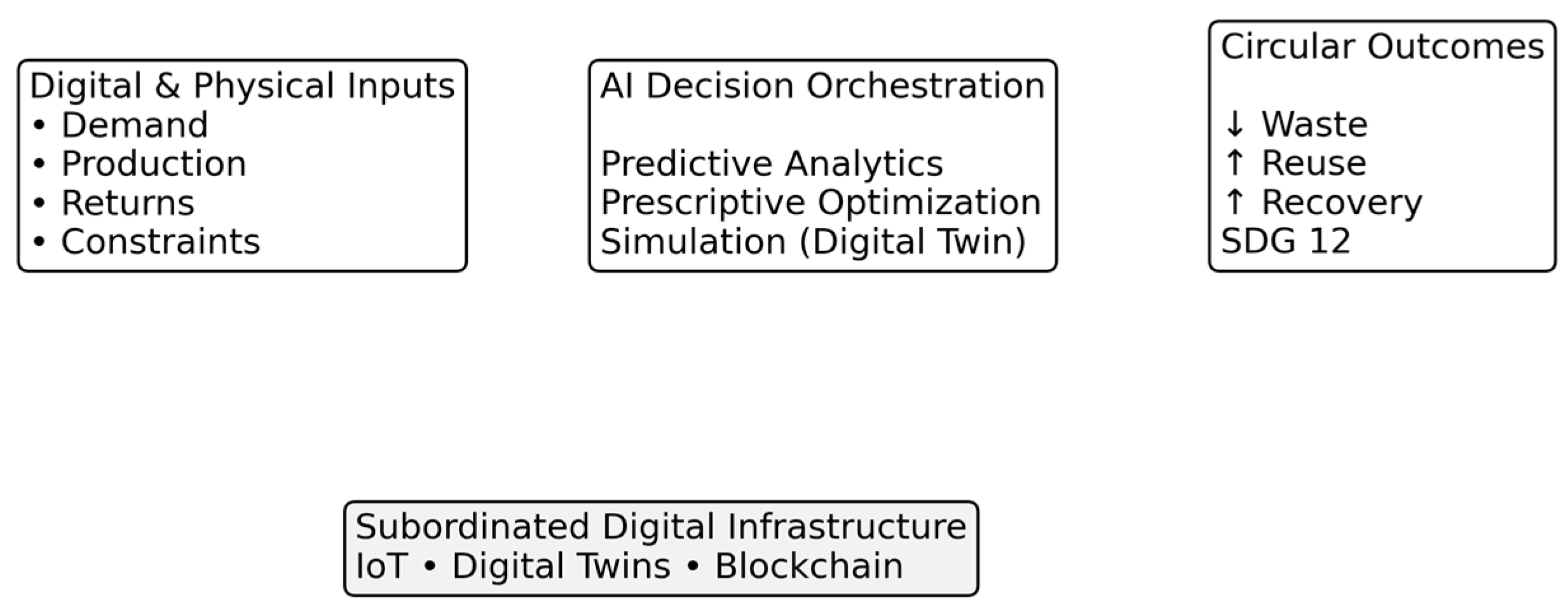
Figure 2.
Parallel trends test and before–after comparison of circular performance for AI-centric (treatment) and non–AI-centric (control) firms.
Figure 2.
Parallel trends test and before–after comparison of circular performance for AI-centric (treatment) and non–AI-centric (control) firms.
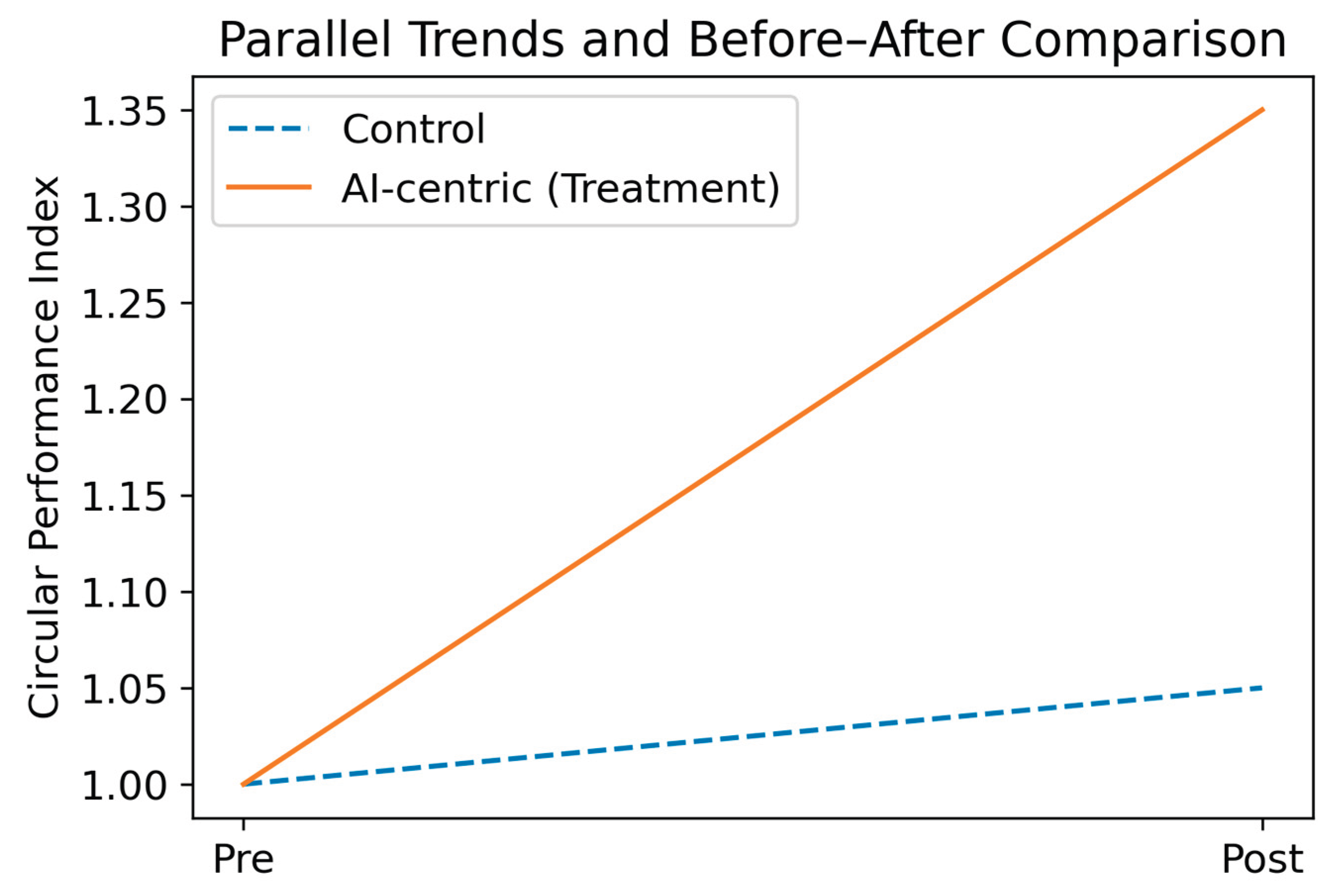
Table 2.
Difference-in-Differences Results for Circular Supply Chain Performance.
| Dependent Variable | DiD Coefficient (β) | Standard Error | p-value | Effect Direction |
| Waste generation per unit of output | −0.18 to −0.26 | 0.05–0.07 | < 0.01 | Significant reduction |
| Material reuse rate | +0.14 to +0.17 | 0.04–0.06 | < 0.05 | Significant increase |
| Material recovery rate | +0.15 to +0.17 | 0.05–0.06 | < 0.05 | Significant increase |
Notes: (1) Estimates are based on a Difference-in-Differences model comparing AI-centric firms (treatment group) and digitally enabled but non–AI-centric firms (control group). (2) Models include firm and time fixed effects and control for demand fluctuations. (3) Parallel trends and placebo tests confirm the validity of the identification strategy.
Disclaimer/Publisher’s Note: The statements, opinions and data contained in all publications are solely those of the individual author(s) and contributor(s) and not of MDPI and/or the editor(s). MDPI and/or the editor(s) disclaim responsibility for any injury to people or property resulting from any ideas, methods, instructions or products referred to in the content. |
© 2026 by the authors. Licensee MDPI, Basel, Switzerland. This article is an open access article distributed under the terms and conditions of the Creative Commons Attribution (CC BY) license.
Copyright: This open access article is published under a Creative Commons CC BY 4.0 license, which permit the free download, distribution, and reuse, provided that the author and preprint are cited in any reuse.


