
Submitted:
09 February 2026
Posted:
10 February 2026
You are already at the latest version
Abstract
This paper investigates cylindrical sphere packings, that is, patterns of uniform spheres with mutually disjoint interiors which are all tangent to a common cylinder. The key unifying themes are existence and uniqueness of hexagonal packings, in which each sphere is tangent to six others. Constructions are both intuitive and subtle, but result in the complete characterization in term of integer parameter pairs $(m,n)$. Interesting questions in rigidity and density are encountered. Density questions arise because the packings, being of equal diameter, lie within the space between inner and outer cylinders. This density problem hoovers between the 2D and 3D sphere packing cases, and though it is not solved here, it is conjectured that the hexagonal packings are densest for the countable number of cylinders which support them. Other geometric objects are along for the ride, including equilateral triangles and the packings' dual graphs, which are associated with patterns of carbon atoms forming buckytubes. Interesting structural rigidity questions also arise.
Keywords:
sphere packing
; packing density
; rigidity
; bucktubes
Introduction
This is a paper about sphere packings on cylinders in 3-space. That is, infinite configurations of congruent spheres with mutually disjoint interiors which are all tangent to the outside of a given cylinder. Figure 1 will set the scene.
The objects involved here, spheres and cylinders, are so familiar that the reader is encouraged to imagine hands-on constructions — or actually do hands-on contructions, as the author has enjoyed with undergraduate students. Getting started is only slightly more difficult than it would appear: Figure 1 illustrates hexagonal packings, in which each sphere is tangent to six others. These play the central role in our story here, and despite their simple and pleasing visual nature, characterizing these packings faces engaging challenges. Combinatorics enters in a crucial way, with abstract triangulations representing patterns of sphere tangency. These can be realized concretely using yet another familiar, manipulable object, the flat equilateral triangle. Figure 2 illustrates the triangulations behind three of the packings from Figure 1; they are realized as cylindrical polyhedra formed by equilateral triangles, each associated with a triple of mutually tangent spheres.
Figure 2 also illustrates what nature produces with its own manipulations: paired with the polyhedra are the familiar patterns of buckytubes, representing carbon atoms and their bonds. The combinatorics of buckytubes are in one-to-one correspondence with the duals of triangulations of hexagonal sphere packings. Our interests here are geometric, but there may well be concrete applications in the study of carbon structures, which are of great interest in physics and material science. The packings themselves are of scientific interest, as they are common in modeling of many natural columnar structures, from plant cells, to foams, crystals, and nanoparticles. The term “sphere packing” will, for many readers, raise the issue of packing density. In our case, the spheres have the same diameter, so they lie in the space between two cylinders. How much of the volume can they occupy? Our discussion of density questions shows that there is much work yet to be done with these cylindrical sphere packings.
Overview:
The geometric objects involved here — cylinders, spheres, triangles — are so familiar that this paper can take a top-down approach, hopefully sharing the sense of discovery which physicists enjoy but which all too often is obscured in mathematical writing. In Part A we construct sphere packings with a hexagonal themed approach — one that a reader with the right maker skills might even realize concretely. Applying thought experiments, visualization, and intuition, we reach a characterization of all cylindrical packings with hexagonal combinatorics. Part B continues the intuitive approach with a second construction of hCSP’s using equilateral triangles. Although this does not provide a new proof of existence and uniqueness, it raises interesting questions in a major related topic, rigidity theory. In Part C, we then move to discuss packing density, a topic with a long mathematical history. That leaves Part D of the paper, where we fill in the formal, computational, and at times annoying details which justify our earlier constructions and results.
Part A: Hexagonal Packings
Let us set the environment for our constructions. We work in with cylindrical coordinates . Cyl will denote a cylinder of radius whose central axis is the z-axis. This will be the inner cylinder in packings, and one attaches spheres of diameter 1 with mutually disjoint interiors tangent to this inner cylinder. The result is called a Cylindrical Sphere Packing (CSP) on Cyl. Spheres tangent to the outside of Cyl will also be tangent to the inside of the outer cylinder Cyl. The region between these is called the solid cylinder for r and is the setting for the density issue discussed in Part C. There is a crucial additional cylinder involved, the mid cylinder Cyl. This contains the centers of the spheres of the packing; since it enters nearly all our computations, we denote its radius by .
A.1. The Construction
There are myriad ways to build CSP’s, but we will concentrate on a systematic approach based on hexagonal flowers. For a given cylinder Cyl, start by attaching the “base” sphere at the point ; in most images, will appear as pale red, while the other spheres will be light blue. Attach a sphere to Cyl so that it is tangent to , and then another, which is tangent to both and . (By convention, is chosen so the triple of mutually tangent spheres is counterclockwise oriented as viewed from outside the cylinder.) As we will see shortly, other spheres are added as the construction proceeds. Figure 3 shows the situation we have reached at this point. Obscured in the picture is the euclidean triangle formed by the centers of these three spheres; it is equilateral with unit edge lengths.
Now continue construction counterclockwise around , sphere-by-sphere: whenever a tangent triple is already in place, compute to get the next tangent triple .
This closure property applies to the completion of hex flowers about any central sphere. We will prove closure in Part D, but accepting that for now, the final construction stage is a recursive process carried out ad infinitum: (1) Among the spheres already placed on Cyl at a given stage, find some tangent pair which is missing one of its shared neighbors. (2) Compute the location and put that new sphere in place. (3) Return to step (1) and repeat.A Pleasant Surprise: When you work your way around and are ready to position , you will find that it precisely matches ! You have completed a hex flower for — a pattern of 6 successively tangent spheres with mutually disjoint interiors all tangent to and surrounding the central sphere .
Everything is going so well, is it not? It would seem that you will complete the hex flower for every sphere, leading to a hexagonal CSP. Voila?? — But wait; perhaps the reader has already anticipated an obstruction.
An Unpleasant Surprise? As the pattern of added spheres grows outward from , those being added to the right around the cylinder might not be compatible with those added to the left. There might be spheres whose hex flowers cannot be completed because the next tangent sphere to be added would improperly overlap a sphere already in place.
Indeed, this is the typical situation: we will see that the process will generically fail to produce a hexagonal sphere packing. Figure 4 illustrates two failed attempts starting with the same parameters: everything looks good on the front, but you peek around the back and you see that things do not fit. The ragged gap is what you might expect; the more pleasant gap along a helix is called a line-slip, and we will say more about it later.
We will have a lot to say about this construction, but let us start with issues that may have occurred to the reader. First is that the radius r might be too small for Cyl to support even a single hex flower, much less a hexagonal packing. That is the case, and we establish the positive lower bound in §D.1.. Second is that due to the choices in the reiterated step (1), the resulting configuration may not be unique (see Figure 4). In fact, it will be unique if and only if it is a hexagonal packing. Our task in the next section is to identify those isolated cases in which a hexagonal packing emerges.
A.2. The Hexagonal Cases
When does this construction process succeed in building a hexagonal CSP (denoted an hCSP)? We approach this question by observing success and discovering the key parameters. All our reasoning will be proven in Part D.
So let us assume we encounter a configuration of spheres tangent to Cyl in which every sphere is the center of a hex flower, as with the examples in Figure 1. There is an unmistakable visual uniformity within each hCSP. There are strings of spheres forming spirals around the cylinder — indeed, there are three families of spirals (two typically stand out visually while the third may be harder to see). All the spirals from any one family will fill out the full packing. Examples are illustrated in Figure 5.
Focus on any spiral and note its regularity: the centers actually lie along a helical arc, hinting at an underlying isometry: combining a translation in the z direction with an associated rotation about the z-axis gives an isometry of which maps each sphere of that spiral to the next. In other words, in a given spiral path, the heights z and angles of successive sphere centers change by constant amounts. This key observation leads us to a particular closed string of tangent spheres of special interest.
The base sphere of has a flower with a counterclockwise list of petals. Necessarily one of these petals, say , has height less than or equal to that of while its counterclockwise neighbor, , has height greater than . Start taking steps from along the spiral through and . There are two possibilities:
- (1)
- After taking some number m of steps you have returned to .
- (2)
- After taking m steps, you find that an additional n steps along another spiral (namely, one parallel to that through and ) will bring you back to .
In either case, the result is a closed string of spheres with disjoint interiors which starts and ends at . We will call this an -necklace and we refer to the full packing as an -hCSP. (In case (1), we take .)
As one might guess from studying Figure 6, is just an infinite stack of copies of its necklace. We exploit that in the proof of the following theorem, which shows that the pairs serve to parametize all hCSP’s.
Theorem 1.
For every pair of integers with and there is an essentially unique radius r whose cylinder Cyl supports an -hCSP. This hCSP is unique up to isometries of . Moreover, every hCSP is an -hCSP for some such pair .
Our proof is based on observations and a dynamic thought experiment; formal justifications are in Part D, along with details on how to compute the relevant parameters.
Proof.
From the given m and n, we first need to identify appropriate geometric parameters. Suppose is a hCSP with -necklace. Using our earlier observations, the positions of the first two spheres of the necklace, and , are enough to reconstruct the entire packing. We can arrange that is centered on the mid cylinder at and is centered at . Recall that and that . The only geometric parameters we need, then, are and , with playing the role of . We may assume henceforth that ; if not, one can reflect the sphere packing in the -plane to get a CSP with the roles of m and n interchanged.
Two Special Cases: For cases and we compute explicit r and values. When , we have and an -hCSP will have a necklace of m spheres that stretches horizontally around Cyl. The edges connecting necklace centers forms a regular unit-sided p-gon inscribed in a circle of radius R. An easy computation gives R and we conclude
For an -hCSP, we see from symmetry in the -plane that the sphere and its tangent neighbor will have centers directly above one another, implying . The sphere S neighboring and and opposite will have height 0. The line from the center of to the tangency point of and has length , as does the line from there to the center of S. Replicating around the cylinder, there will be of these segments forming a regular -gon inscribed in a circle of radius R, and we conclude
The General Case: Assuming now that , we consider a string of tangent spheres as though it were a string of pearls — a pearl necklace. We will be draping this necklace around a cylinder Cyl. If r where equal to , as computed earlier, then the pearls would form a choker about Cyl, a tight horizontal necklace. If r where any larger, the necklace could not reach around Cyl. On the other hand, we know there is a smallest cylinder that supports a hexagonal flower. The r we need is somewhere between these extremes.
For our thought experiment, consider decreasing r from its maximum value and watching the behavior of the necklace draped on Cyl. First, however, we must add some rigidity: Let S denote the pearl along the necklace. For a given r, if you gently pull S downward you will reach a point where it can physically go no lower. The tension in the necklace will then force the first m pearls to lie along a downward sloping geodesic — the shortest path along Cyl from to S. The remaining n pearls must lie along an upward sloping geodesic, wrapping the rest of the way around from S to . We call this paricular necklace -elegant. It is clearly unique for a given cylinder Cyl. Since geodesic paths on cylinders are helical, this means that in an -elegant necklace, the heights of the first m pearls drop in equal successive steps, which we will denote by , while the heights of the remaining n pearls rise in equal successive steps, denoted by . It is elegant necklaces that we work with from now on.
For each Cyl, the lowest pearl S in its -elegant necklace is at height . This lowest pearl will clearly drop in height as r decreases, so becomes more negative as r decreases. But what are we watching for? If an elegant necklace were part of a global hexagonal sphere packing, then S would be the center of a hex flower of spheres in that packing. One of its petals would be the next sphere with height increment (extending the spiral direction of the first m pearls), and its neighboring petal would be the pearl after S in the necklace, with height increment . Look to the necklaces of Figure 7 to visualize the situation. For each of those -elegant necklaces, we show a green sphere tangent to S with height increment , while the blue sphere is the pearl of the necklace itself, tangent to S with height increment .
What you want to watch is the distance between the centers of and . Denote this distance by . If this necklace were part of a hexagonal packing on Cyl, then and would necessarily be tangent, so . This distance function provides our opening!
When r takes its maximum value, the necklace is a horizontal choker, and would be identical, and . However, as suggested in Figure 7, as r decreases, and move apart, so increases. Indeed, if you visualize the necklace on progressively smaller cylinders you will see it drooping until it eventually collapses — the pearls cannot remain tangent to the cylinder without beginning to overlap. At some point the pearl before S and the pearl after S in the necklace will be tangent to one another, meaning and must be far apart and . As is clearly a continuous function, the intermediate value theorem ensures some radius r for which and and are tangent. For r, this necklace is called the -Goldilocks necklace. Once you have the -Goldilocks necklace, our earlier construction method lets you fill out the rest of an hCSP. Indeed, stacking translated and rotated copies of the necklace will give you the full packing on Cyl.
A closer study of shows that the radius r for which is unique, so we will be justified in writing . The argument is presented in Part D, but is based on another bit of geometry: connecting the centers of and forms a triangle in 3-space with two sides of unit length. If denotes the angle at S in this triangle, then and will be tangent if and only if this triangle is equilateral, if and only if , if and only if . As it happens, as r decreases from its maximul value , the angle is strictly decreasing. Therefore, it can take the value only once, namely, when , proving uniqueness.
Summarizing, given , there is a single radius r whose -elegant necklace is -Goldilocks, and hence part of a -hCSP on Cyl. Conversely, we have observed that every hCSP contains an -elegant necklace for some m and n, and this is clearly -Goldilocks. Thus hCSP’s are (up to isometries) in one-to-one correspondence with integer pairs , where . □
One consequence of this theorem is confirmation of our earlier comments: for all but countably many radii r, our construction of hex flowers onf Cyl starting from a tangent pair will encounter an unpleasant surprise — hex flowers that cannot be completed. In Part D we present a table containing the exceptional values , those that support hCSP’s for . The reader is encouraged to see what can be gleaned from this table, recalling that only and are explicit, while other entries are numerical approximations. This open question in particular may come to mind:
Open Question 1. Does there exist a cylinder Cyl which supports an -hCSP for two distinct pairs , ?
In Part D we present, for parameters m and n, a non-linear system of two equations for r and . However, as we have only numerical approximations to the solutions, this open question will be difficult to address.
Part B: Rigidity
Viewing a cylinder as simply a rolled up plane, the reader may see other ways to construct hCSP’s. We discuss an appealing but naive approach that does not quite work. However, a slightly trickier one succeeds while also leading to interesting rigidity questions.
It is well known that the plane is the universal cover of the cylinder. We will formalize this in Part D, but as an analogy, picture rolling a cardboard tube (the cylinder) so it picks up wrapping paper (the plane) to make it easier to store. One ends up with several sheets of paper over every point of the tube, but identifying sheets over the same points as a single layer leaves just a cylinder.
With this image in mind, the reader is offered this thought experiment: Start with a close packed hexagonal lattice of uniform spheres resting on the plane. (This is just one of the planar sheets of spheres within a canonball packing of space.) Consider Cyl as a (infinite) rolling pin which has glue on it. Start rolling across the tops of the spheres, each sphere adhering to the rolling pin as it passes by. In your mind’s eye are you starting to see emergence of a CSP?
Of course, there is a difficulty we have faced before: as you keep rolling along, the spheres already adhering to the rolling pin will start to encounter new spheres still in the lattice. If the direction in which we are rolling and the radius of the rolling pin are just right, each attached sphere that encounters a new sphere will match it identically, so they just merge into one and we continue rolling along. In this instance, have we realized a hCSP? I thought so when I first imagined this process — but I was wrong! Due to the curvature of the rolling pin, spheres tangent in the plane will become separated as they are picked up. So we do not get a sphere packing! Still, the attempt makes clear how sensitive the construction is to the radius of the cylinder and its rolling direction, and one can see in a natural way how different helical patterns of spheres arise.
Disappointing? Perhaps, but also suggestive. Let us unroll an existing hCSPus and see what we learn. What we unroll, however, is the mid cylinder, since it contains the sphere centers. The centers for each triple of tangent spheres in defines a unit-sided equilateral triangle, and these attach to one another to form a cylindrical polyhedron. The whole process is depicted in Figure 8.
Six triangles meet at every vertex of this poyhedron. We have cut it open along one of its spiral edge paths, and it opens up to lie perfectly flat in the plane; it becomes part of the familiar equilateral tiling of the plane, which we denote by . Note that is not covering the cylinder itself, but rather the cylindrical polyhedron. Our unrolling defines a fundamental region in , whose opposite edges are to be identified. In Figure 8 the red stars are points associated with the center of ; the vector from one to the next generates the fundamental group of the covering. Especially note the blue edge path connecting successive stars: it has steps along one axis and along another, so is an -hCSP.
Now you may see a real opportunity to construct hCSP’s by reverse engineering this unrolling — though there are some complications. The procedure starts with integers , and a fundamental vector formed, as in Figure 8, with m steps along one axis and n along another in . Place a cylinder on the plane at the initial end of and with axis perpendicular to . Role it towards the terminal end, picking up vertices as it roles along. If you have chosen a cylinder of the proper radius r, the beginning and end of will find themselves at the same point on the cylinder. You have now built the polyhedron for an -hCSP and all that is left is to place a sphere at every vertex.
This construction is quite subtle, so the reader is encouraged to spend some time visualizing the mechanics. As the vertices are picked up and triangles are added to the growing polyhedron, the structure has to crinkle up because the triangles remain connected, yet must take their various tilts. It is not easy to picture: the vertices end up on the cylinder, but the faces, to remain flat and equilateral, find themselves magically inside. You might think at first that , but the crinkled nature of the polyhedron forces r to be larger.
In the and cases, the mechanics are easier to visualize (and explicit radii are already known). However, as mechanically attractive as this approach to hCSP’s is, there is little hope that one can prove existence and uniqueness for general via this route.
Nevertheless, these experiments lead to another broad topic: rigidity. Picture the skeleton of an hCSP, the edges between tangent spheres, as a physical structure in space (though infinite in extent). Treat the edges as unit length bars joined at each end to 5 other bars with flexible joints. Is that structure mechanically rigid? That is, is this the only shape it can take? Figure 9 illustrates that the answer is no for -hCSP’s. For other pairs, however, the author finds it difficult to imagine any such flexibility.
Open Question 2.Is the skeleton for an -hCSP rigid when ?
For general reference on rigidity, the reader is directed to [5].
There is one more question that might come to mind for those who know the historical importance of hexagonal combinatorics in the development of circle packing. A foundational theorem is this: Suppose is a collection of circles in the plane having mutually disjoint interiors and a tangency graph that forms a hexagonal triangulation of the plane. Then all circles of must have the same radius. I.e., it is a penny packing. See [11]. This suggests the following conjecture, which we will not pursue here:
Conjecture 1.
Suppose is a configuration of spheres tangent to a common cylinder having mutually disjoint interiors and a tangency graph that forms a hexagonal triangulation of the cylinder. Then all spheres of have the same radius.
In other words, up to a scaling factor, must be one of our hCSP’s. The limiting case of the conjecture, when and the cylinder becomes a plane, would, if true, be a direct extension of the penny packing result for circles in the plane.
Part C: Packing Density
The topic of “sphere packing” is surprisingly broad and has a mathematical history reaching back two millennia: what is the densest arrangement of congruent spheres in a given region, that is, the arrangement that takes up the greatest proportion of the volume? The dimension 2 and 3 cases are most familiar. In the plane, the “penny packing”, a hexagonal arrangement of congruent discs, is easily proven to maximize area density. However, the step to dimension 3 is far from easy. In fact, the famous Kepler Conjecture of 1611 proposed that in 3-space, the “cannonball packing” would maximize volume density. This was only proven in 1998 by Thomas Hales [6]. Again there is a hexagonal character to the pattern because the spheres are arranged in planar sheets, like the penny packing of discs, which are then stacked atop one another. Mathematicians have, of course, pushed to higher dimension, where the results are even more challenging. The density problem remains open except for dimensions 8 and 24, where the answers have earned Maryna Viazovska the Fields Medal in 2022. These provide the basis for important error correcting codes (see [3,4]).
For cylindrical sphere packings, the issue hovers somewhere between the 2 and 3 dimensional cases: we might call it 2 and 1/2 dimensional — the spheres live in 3D space hugging a 2D surface. What is the sphere packing that occupies the greatest proportion of the volume of the solid cylinder about Cyl?
Spheres tangent to Cyl are also tangent to the inside of Cyl, and there has been research in the physics literature about density of packings within cylinders. These questions arises in various natural and physical situations, with cylinders containing cells, crystals, soft spheres, or foams, for example. See [2,8,9] and works cited there. These studies often model systems on solid spheres and their critical parameter is , the ratio of the diameter of the cylinder to that of the spheres. For less than roughly , simulations suggest that the densest packing will have all spheres tangent to the cyclinder wall, while for larger values of there may be spheres interior to the cylinder. This cutoff converts to in our setting, and from Table 1 one can see that the -, -, -, -, and -hCSP’s fall within this setting. The work by physicists has been largely based on simulations, both physical and computer based, along with numerical approximations and anayltic searches. Though this work consistently shows that nature prefers the hexagonal motif, purely mathematical claims about density remain open.
Suppose is a CSP on Cyl. Since the solid cylinder about Cyl has infinite volume, a natural way to define density takes the limit of densities in truncated cylinders. (Density is also called “average density” or “packing fraction”.)
For , let n be the number of spheres with centers having height z in . We then define the pre-density and density as
Only those having a limit are competitors for maximal density. But the limiting process is not without its problems. Given a CSP on Cyl with maximal density, one can randomly remove any billion spheres and what is left has equal density. So in practice one searches for packings which follow some motif that seems to optimize pre-densities. The search process is tricky to justify, computing pre-densities is difficult, and proving maximality is even harder. With the classical 2D/3D cases in mind, along with nature’s apparent preferences, we are led to this conjecture. An affirmative answer, at least for small r, is posited in the physics literature [9,10], but a mathematical justification remains to be found.
Conjecture 2.
If Cyl supports a hexagonal cylindrical sphere packing , then has the maximal density among all sphere packings on Cyl.
There is one case in which we can affirm this conjecture, if you are willing to treat the plane as a cylinder with infinite radius. The solid cylinder is now the slab of space between planes and . Maximality of the hexagonal packing of spheres within this slab follows easily from maximality of the penny packing in the 2D case. The slab is the union of the Voronoi cells of the sphere centers, the Voronoi cell of a sphere center consisting of all points closest to that center than to any other. The global density is identical to the density of a sphere within its cell.
As grows and the cylinder Cyl associated with the -hCSP grows, the density of will converge to this value, roughly . I ask the reader to test their intuition: Is the density of an -hCSP larger or smaller than ? The intuition of the author failed on this question, but the reader can settle the issue with data provided in §Figure 1. As to proofs, §Figure 1 also presents some evidence for the -hCSP cases of the Conjecture. The approach is limited, however, and even for these limited cases the arguments remain incomplete.
As for the general situation, most cylinders Cyl do not support hCSP’s, and the density question becomes much more difficult. In the physics literature the parameter is varied continuously in simulations, and hCSP’s emerge only for isolated values. For other values, hexagonal close packing still seems to be nature’s preference, but with spiral patterns of gaps — what are called line-slip packings.
Figure 10.
Line-slip packings: largely hexagonal, but with spiral gaps.
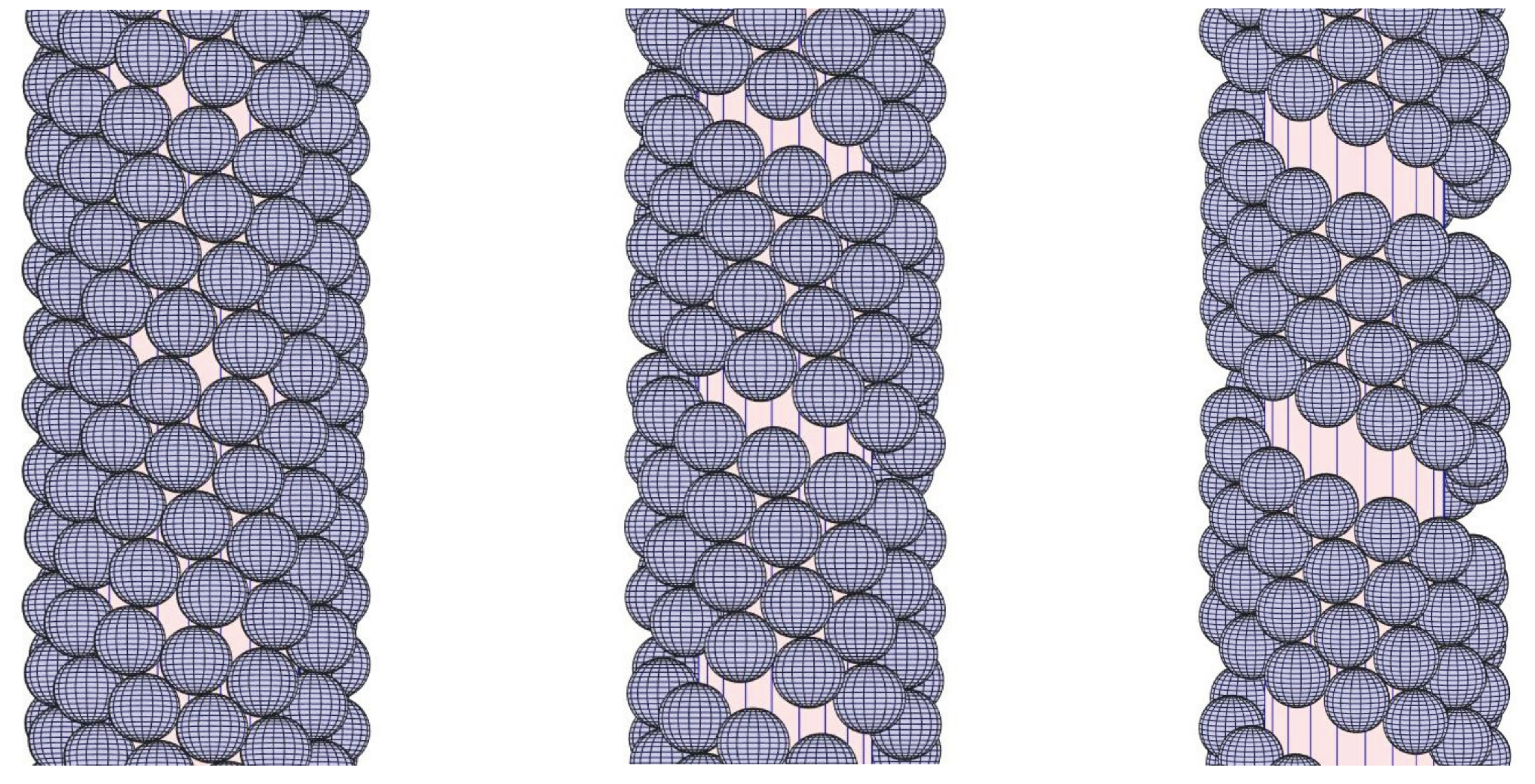
This figure illustrates cylinders of three different radii, so we are not comparing their densities. Rather, note that while packing (a) would appear to be rigid, it has spheres which are tangent to just 5 neighbors. As for packings (b) and (c), these have open gaps and appear to be somewhat flexible. However, with its smaller gap, it would seem difficult to add any spheres to (b), whereas with (c) one can conceive of adjustments that would allow additional spheres and thus perhaps larger density.
Part D: Computations
The developments and claims in Parts A, B, and C depended on the reader’s familiarity with spheres, cylinders, and triangles and on their ability to carry out and visualize manipulations. Now it is time to back up this work with mathematical rigor.
First some general and standard background facts. Isometries of are homeomorphisms which preserve euclidean distance, hence they preserve cylinders, spheres, and flat triangles. In the sequel we restrict attention to cylinders with central axis the z-axis and to isometries that map the z-axis to itself, and hence map CSP’s to CSP’s. They are generated by combinations of translations in the z-direction, rotations about the z-axis, and reflections in the coordinate planes. We can apply an isometry to move any sphere of a CSP so its center is on the positive x-axis, as we have done with the base sphere . A useful observation for later is that given any two points on a common cylinder, there is an isometry which interchanges those two points.
D.1. Smallest cylinder
Our definition of CSP allows the cylinder Cyl to have any radius . However, we are interested in hexagonal flowers. When the attached spheres must all touch the z-axis, and the best one can hope for is shown in Figure 11(a). This may look promising until you note that flowers have only 5 petals, one exactly opposite the central sphere. Problems persists briefly as r gets larger. One might be led to the CSP of Figure 11(b), where and . Base and the spheres directly above and below do have hex flowers, but as the view from the back shows in Figure 11(c), the other spheres have room for only five neighbors.
A close look at Figure 11(c) will note gaps that are ringed by four spheres. These suggest room for improvement. Decreasing from the initial value introduces a twist, and as you know if you have ever played with a rope — twisting makes it smaller around. Here the twisting ends with the CSP of Figure 11(d), having . At this point, the opposite petals and are tangent to one another, so it is clear that we can not decrease r any further.
Lemma 1.
The minimum radius r for which Cyl supports a hex flower is . Moreover, this hex flower extends to an hCSP, namely, the -hCSP shown in Figure 1.
In the notation we have adopted, this minimal radius is denoted . Henceforth we assume our cylinders have radius .
D.2. Hex Flower Closure
It is evident physically when working with a real life cylinder and real life (uniform) spheres, that if you position a sphere, place a tangent petal sphere, and then successively add additional tangent spheres, a hex flower will result — that is, as you place the sixth sphere, it will be precisely tangent to the first sphere. We now prove this.
Lemma 2.
Suppose that , that S is a sphere attached to Cyl, and that is a sphere tangent to S. If spheres are successively tangent spheres placed about S, then is identical to .
Proof.
Without loss of generality, we may assume that S is centered at while is centered at . We will show that and . Repeating that argument will show that and , and hence is identical to .
The argument depends on a study of equilateral triangles (all unit-sided in the following). Denote by the triangle formed by centers of the tangent triple . Let be the line segment between (the centers of) S and . This is an edge shared by and , and it is evident that these are the only equilateral triangles with vertices on Cyl which have as an edge.
We refer to as the reflection of in . The justification lies with an observation we made earlier: there is an isometry T that maps Cyl to itself and interchanges S and . This clearly interchanges and , and therefore . The change in angle (the coordinate) from to is the negative of the change in angle from S to , which is . We conclude that . Likewise with heights, . Reflecting in, successively and , we have successive the expressions
In consequence,
Repeating by reflecting in and then in , we have and . In other words, equals . □
This result confirms our observations about the three spiral paths within an hCSP; see Figure 5. In each path one enters a flower via (the center of) one petal, passes through the central sphere, and exits via the opposite petal. Now we see that the increments in angle and height in each step are identical, implying that those centers lie on a common helix. Of course, in an -hCSP, one path degenerates to a closed ring, while in an -hCSP, one path degenerates to an infinite vertical path.
D.3. Universal covers
It is well known that the plane is the universal cover for a cylinder. In studying sphere packings on a given cylinder Cyl, the centers are given in cylindrical coordinates by , where . Since only the coords and z vary, it is convenient to define a universal covering map from the -plane onto the mid cylinder Cyl. This is periodic in the first coordinate, so . A convenient fundamental domain is the strip .
Using , spheres attached to Cyl may be identified with their “centers” as points in the -plane. Given a hex flower on Cyl, geodesics between centers on Cyl lift to straight lines, so on the plane that hex flower defines three straight line segments. We are now in position to formalize the general hex construction undertaken in §A.2. by working in the -plane.
Constructions started with base sphere centered at and a tangent sphere centered at . We then computed tangent to and , with center . Define the vectors from (the center of) to , from to , and from to . The six centers about are in the directions . The construction continues by successively adding neighbors to complete the hex flower of any existing sphere. Proceeding ad infinitum in the plane, we generate the hexagonal lattice
In the generic situation, projecting these points to centers on a mid cylinder Cyl will lead to distinct centers that are too close — their spheres would not have disjoint interiors. This can only be avoided if is -periodic.
Lemma 3.
Given Cyl, tangent spheres generate an hCSP on Cyl if and only if the associated lattice Λ is -periodic, if and only if Λ contains , if and only if there exist integers so that .
Figure 12 illustrates the situation for the -hCSP: • the lattice with edges for tangencies • the shaded fundamental domain • the spiral through in red • the spiral through in green • the spiral through in blue • the covering map • the projection to the mid cylinder Cyl.
In this figure, one can see a concrete meaning for m and n: the full lattice is formed by parallel copies of the green spiral or copies of the red spiral. Though harder to see, it is formed as well by copies of the blue spiral. In biological studies of plant growth, 3-tuples are known as parastichy numbers and arise in the context of phyllotaxis, the growth of spiral patterns in plants, such as sunflowers, pine cones, or corn. (See [7,10].) We will stick with our notation.
A cautionary note about covering maps: is not the classical textbook covering map — the covering map used, e.g., in the related physics literature (see [10]). It differs by a scaling by factor R in the first variable, so infinitesimal distances in the plane and the mid cylinder are not equal (except for the -hCSP, in which case ). Neither is the covering map discussed in relation to Figure 8, which is actually covering an underlying polyhedral cylinder.
Lemma 3 confirms the second statement in Theorem 1. However, this approach is not helpful in proving the first statement, so in the next subsection we prove the mathematical details to support that part of our proof.
D.4. Monotonicity Results
We confirm various claims made about necklaces on cylinders Cyl in the proof of Theorem 1. Integers m and n are given with . We search for appropriate geometric parameters r and by considering -elegant necklaces in the covering lattice described above: the first m sphere centers are incremented by the lattice vector while the remaining n are incremented by , with and . Two key equations reflect the fact that a necklace must be closed:
- (a)
- Height closure: .
- (b)
- Angle closure: .
Height closure implies , meaning we can eliminate in subsequent expressions. The radius r enters because when moving between tangent spheres on Cyl the increments in angle and in height z are related. Specifically
Computation gives
meaning that the angles are decreasing as functions of and of r.
Consider an -elegant necklace on Cyl. We claimed in our proof of Theorem 1 that this necklace is unique. If were to become more negative, then both and would increase, implying both and would decrease, contradicting the angle closure condition. Likewise, if were to become less negative, both and would decrease, and would increase, again contradicting the angle closure condition. Thus there is only one -elegant necklace on Cyl and hence only one associated height increment .
Next, applying implicit differentiation to the angle closure condition (b) gives
Since , the expression for is positive. Therefore, as we have claimed, when the radius r of the cylinder decreases, then the height of the lowest sphere S of the -elegant necklace decreases — i.e., the necklace droops lower.
We showed by the intermediate value theorem that there is some radius r so that Cyl supports an -Goldilocks necklace. The final claim to verify is that this r is unique. Recall that this involved the lowest sphere, S, in -elegant necklaces along with two tangent spheres (see Figure 7). The first of these, , is displaced from S at by the vector and the second by vector . Let be the angle at S in the triangle formed by these three and let , a function of . It suffices to show that .
Applying an isometry we may assume S is centered at , at , and at . In euclidean coordinates, the 3D vectors from S to and to are, respectively, the unit vectors
Let us agree to some abbreviations: and , for , and also and . These will greatly facilitate the computations involving .
Computing the derivative, we see
Note that , so . We get the inequalities and , and in turn,
Now we note a succession of inequalities:
This is what we wanted to show: the fact that implies that there will be only one cylinder Cyl supporting an -Goldilocks necklace. This completes the details for the claims we made in the proof of Theorem 1.
That brings us to the practical problem of finding the values of r and for a given pair . We noted earlier the explicit solutions for cases and , but to the author’s knowledge there are no other explicit solutions. The approach to the proof of Theorem 1, wherein the value of r is decreased until an -Goldilocks necklace is found, can be implemented numerically. This table provides approximate values for values of r for m in the range 2 to 13.
There are some patterns in the data that confirm your intuition. As you might expect, the values are increasing across rows and down columns. As m grows, r grows, so Cyl has less and less curvature, and the packing looks increasing like the hexagonal close packing of spheres attached to a plane, Cyl. Intuition about twisted ropes leads to a more subtle pattern: As you more tightly twist a rope, we expect to see its diameter decreasing. Consider elegant pearl necklaces with the same number of pearls, say, for example, 12 pearls as in Figure 13. As n grows at the expense of m, the height increment becomes more negative, the twist is more visually evident, and the cylinder radius decreases.
The table entries suggest that is less than — in other words, you see r increasing as you move up and to the right in the table. This is an observation not a proof, but is supported by intuition.
D.5. About Density
Has the reader made their best guess about packing density for hCSP’s? Is the density greater or smaller than the roughly achieved by the hexagonal sphere packing on a plane? This table provides a sampling of approximate densities; aside from the case, I have chosen -hCSP’s for consistency.

Table 2.
Representative densities for hCSP’s.
| (3,0) | (4,0) | (5,0) | (10,0) | (50,0) | (100,0) | (300,0) | (∞,0) | ||
|---|---|---|---|---|---|---|---|---|---|
| r | 0.01963 | 0.07735 | 0.20711 | 0.35065 | 1.11803 | 7.46299 | 15.418112 | 47.247355 | ∞ |
| density | 0.50714 | 0.53033 | 0.56060 | 0.57582 | 0.59721 | 0.60430 | 0.60453 | 0.60459 | 0.60460 |
Turning now to the density Conjecture 2, it seems plausible that this is true in the limited case of -hCSP’s. Here is a potential line of reasoning. Suppose is an -hCSP on Cyl, some and we wish to compare its density to that of , a CSP on the same cylinder. The direct approach would compare the numbers V and of spheres in truncated cylinders. Such counting may be staightforward for , but it is likely more involved for . We suggest, instead, moving to consideration of triangulations T and formed by the centers.
How do triangulations help? Truncations of T and to heights will be triangulations of an annulus, hence with euler characteristic . The number of boundary edges is clearly bounded above independent of h, while V and E and F grow without bound. Counting edges by faces gives
In light of this, we can compare the numbers of faces rather than the numbers of vertices in the truncated triangulations. And we might do this indirectly by looking at the face areas.
We lift T and under the covering map so we can work in the plane, that is, in the -plane as described in §D.3.. The triangles in the plane correspond to geodesic triangles on Cyl, and their euclidean areas are proportional to surface areas, with scaling factor . We may be able to avoid counting by comparing areas: if the areas of triangles of T are no bigger than those of , then the number of faces in a truncated portion of the triangulations will be no smaller, and we would conclude that denden, as conjectured.
A triangle in the plane will be called “special for R” if the lifts of its three vertices under determine a unit-sided equilateral triangle inscribed in Cyl (i.e., so the lifted vertices are centers for a tangent triple of spheres; see, e.g., Figure 2.) Among the special triangles for R, there is only one (up to translations and horizontal flips) which has a side that is vertical. (Its projection to Cyl is also vertical and has geodesic length 1). We will denote this triangle by . One can show that for any R, has area strictly smaller than any other special triangle for R.
We return to our triangulations T and . As is an -hCSP, all its faces are copies of . If we assume for a moment that the competing packing is also hexagonal, the faces in would all have areas strictly larger that those of T. Without knowing anything further about the triangulations, we can conclude that the number of triangles in T will outrun the number in , implying via (3) that denden. Of course, existence of such a would provide a positive answer to Open Question 1. So what of more general competitors ? One is tempted to posit that the area for faces of T is smallest in other situations.
Open Question 3. If t is a triangle in the -plane whose corners lift to points on Cyl at least euclidean distance 1 apart from one another, is the area of t greater than or equal to the area of the special triangle ?
A positive answer would ensure that has maximal density among all CSP’s on Cyl. It is tempting to exploit some extremal property of equilateral triangles, but note that is not itself an equilateral triangle, nor is the corresponding geodesic triangle on Cyl equilateral — at least two of its geodesic sides are length greater than 1.
Finally, note that this paricular approach only applies when is an -hCSP. Other situations seem to require much more detailed analysis, perhaps like that employed by Hales [6], to understand the excluded volume. One might start by breaking the solid cylinder into Voronoi cells associated with the sphere centers: these cell would be bounded by planes and parts of the inner and outer cylinders. In any case, there seem to be interesting new questions here and perhaps some of them will capture the reader’s attention.
Acknowledgments
During the preparation of this manuscript, the author used Matlab(R2025b) and CirclePack https://github/kensmath/CirclePack for computations and Matlab for images. The author has reviewed the output and takes full responsibility for the content of this publication.
Conflicts of Interest
The author declares no conflicts of interest.
References
- Beardon, A.F.; Dubejko, T.; Stephenson, K. Spiral hexagonal circle packings in the plane. Geometriae Dedicata 1994, 49, 39–70. [Google Scholar] [CrossRef]
- Chan, H.K.; Winkelmann, J. Columnar Structures of Spheres: Fundamentals and Applications; Jenny Stanford Publishing: Singapore, 2023. [Google Scholar]
- Cohn, F.; Kumar, A.; Miller, S.D.; Radchenko, D.; Viazovska, M. The sphere packing problem in dimension 24. Annals of Mathematics 2017, 185(3), 1017–1033. [Google Scholar] [CrossRef]
- Conway, J.; Sloane, N.J.A. Sphere packings, lattices and groups, 3rd Ed. ed; Springer: New York, 1999. [Google Scholar]
- Graver, J.; Servatius, B.; Servatius, H. Combinatorial rigidity. In Graduate Studies in Math. 2; Amer. Math. Soc, 1993. [Google Scholar]
- Hales, T.C. A proof of the Kepler conjecture. Ann. of Math. 2005, 162, 1065–1185. [Google Scholar] [CrossRef]
- Levitov, L.S. Fibonacci numbers in botany and physics: Phyllotaxis. JEPT Letters 1991, 54, 542. [Google Scholar]
- Mughal, A.; Chan, H.K.; Weaire, D. Phyllotactic Description of Hard Sphere Packing in Cylindrical Channels. Phy. Rev. Letters 2011, 106, 115704. [Google Scholar] [CrossRef] [PubMed]
- Mughal, A. Screw symmetry in columnar crystals. Philosophical Magazine 2013, 93, 31=33, 4070–4077. [Google Scholar] [CrossRef]
- Mughal, A.; Weaire, D. Theory of cylindrical dense packings of disks. Phy. Rev. E 2014, 89, 040307. [Google Scholar] [CrossRef] [PubMed]
- Rodin, B.; Sullivan, D. The convergence of circle packings to the Riemann mapping. J. Differential Geometry 1987, 26, 349–360. [Google Scholar] [CrossRef]
- Stephenson, K. Introduction to Circle Packing: the Theory of Discrete Analytic Functions; Camb. Univ. Press: New York, 2005; ISBN 0-521-82356-0, QA640.7.S74. [Google Scholar]
- Thurston, W. The finite Riemann mapping theorem, 1985. Invited talk, An International Symposium at Purdue University in celebrations of de Branges’ proof of the Bieberbach conjecture, March 1985. [Google Scholar]
Figure 1.
Hexgonal cylindrical sphere packings (truncated for display).
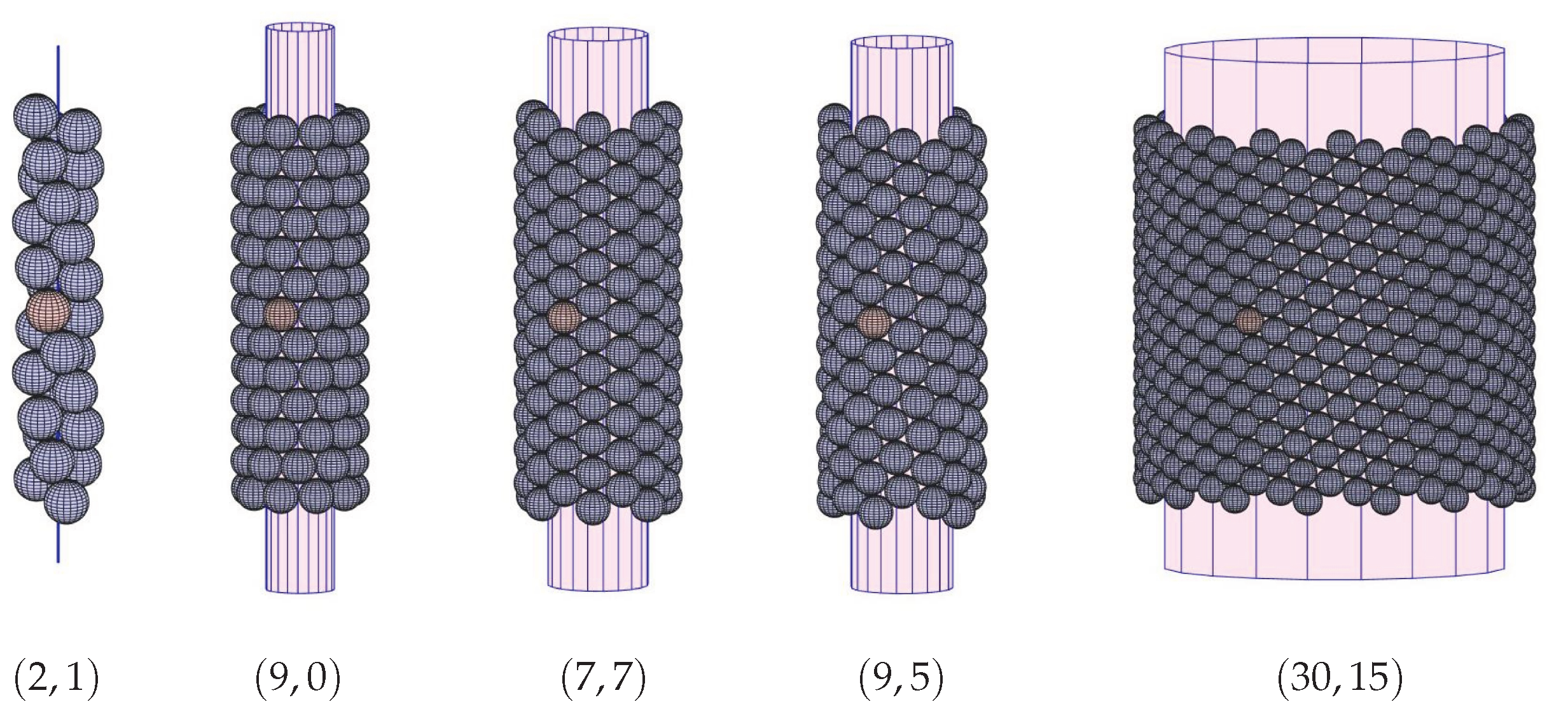
Figure 2.
Samples of cylindrical polyhedra and dual buckytubes associated with hCSP’s.
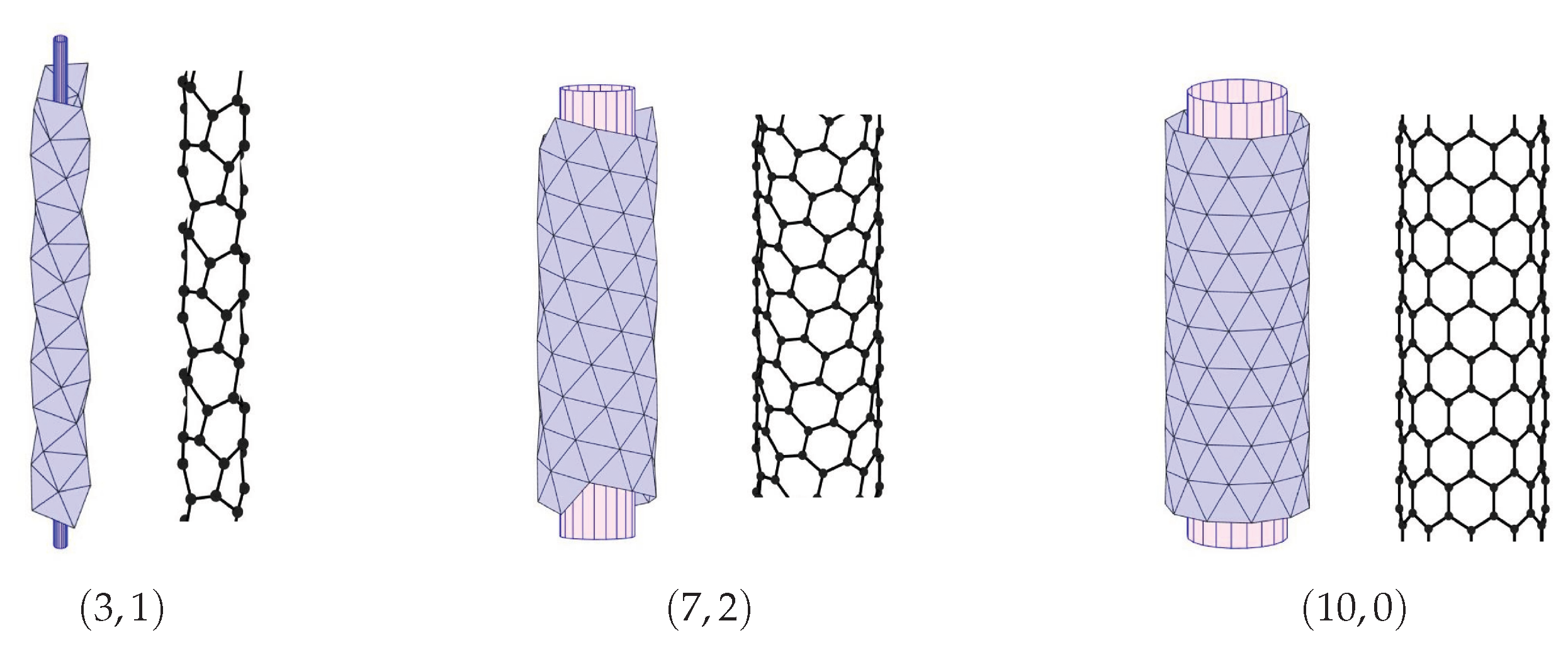
Figure 3.
The inner, mid, and outer cylinders, and a tangent triple of spheres.
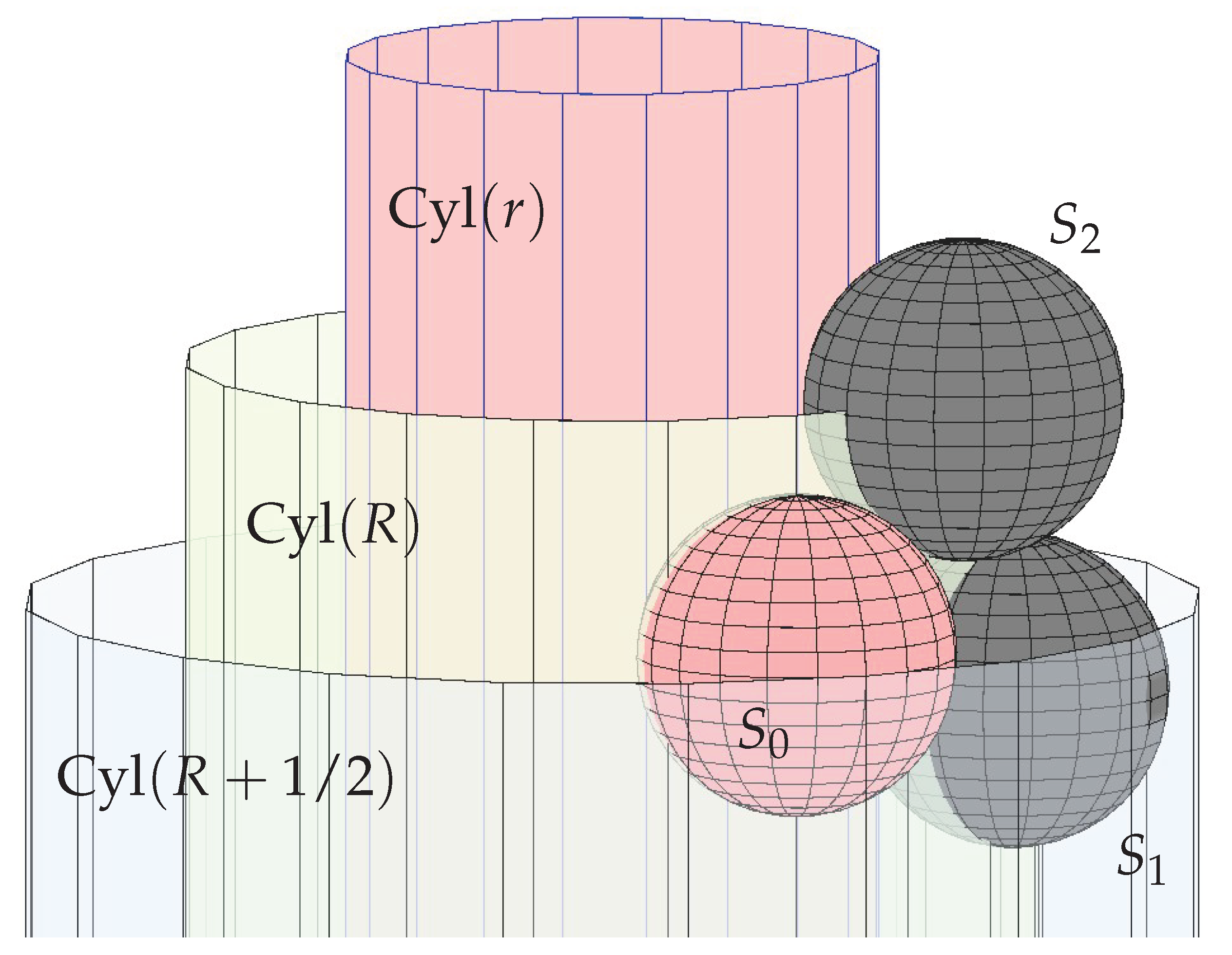
Figure 4.
Construction worked? No! Ragged or line-slip gap around back.
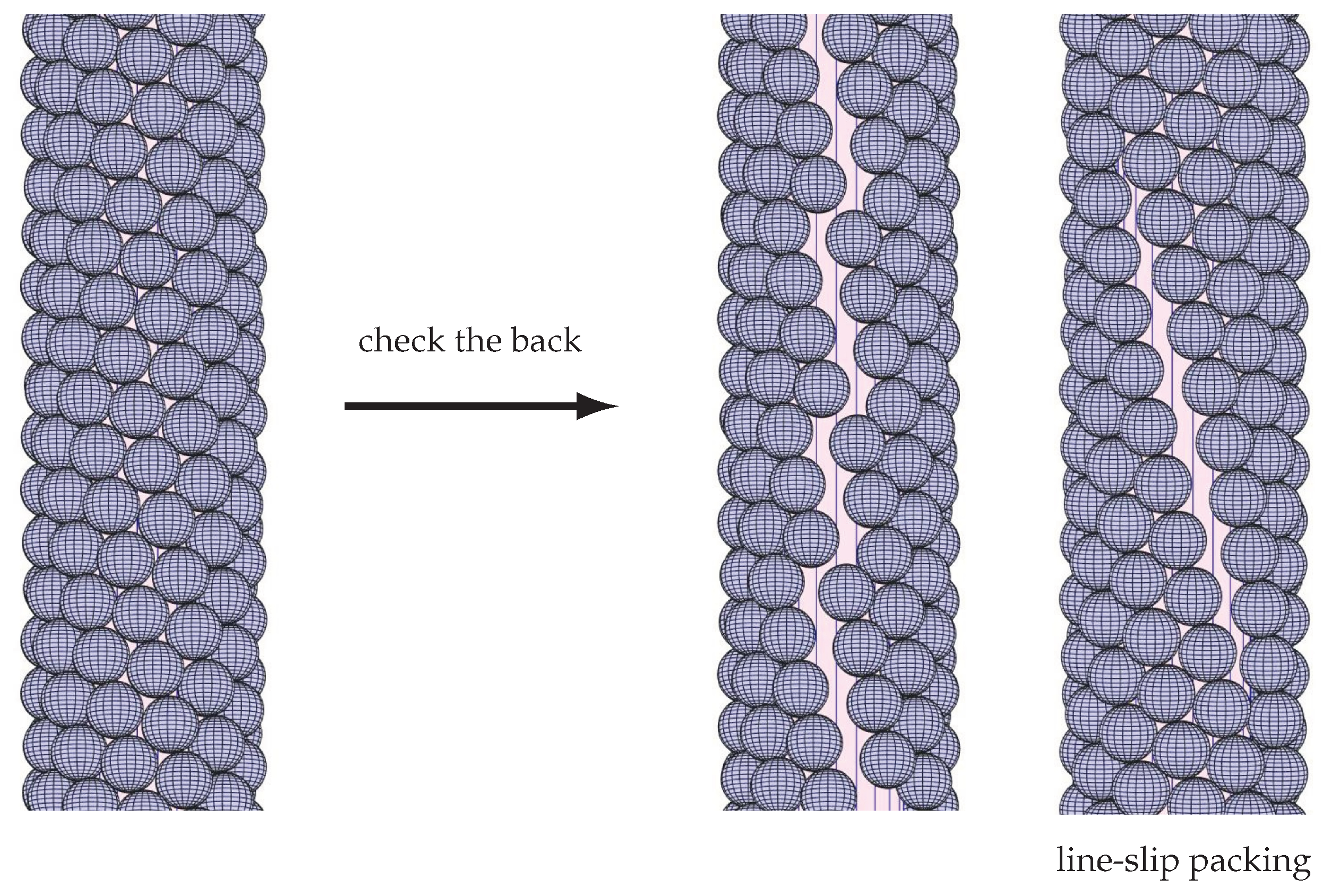
Figure 5.
The three spiraling strings of tangent spheres
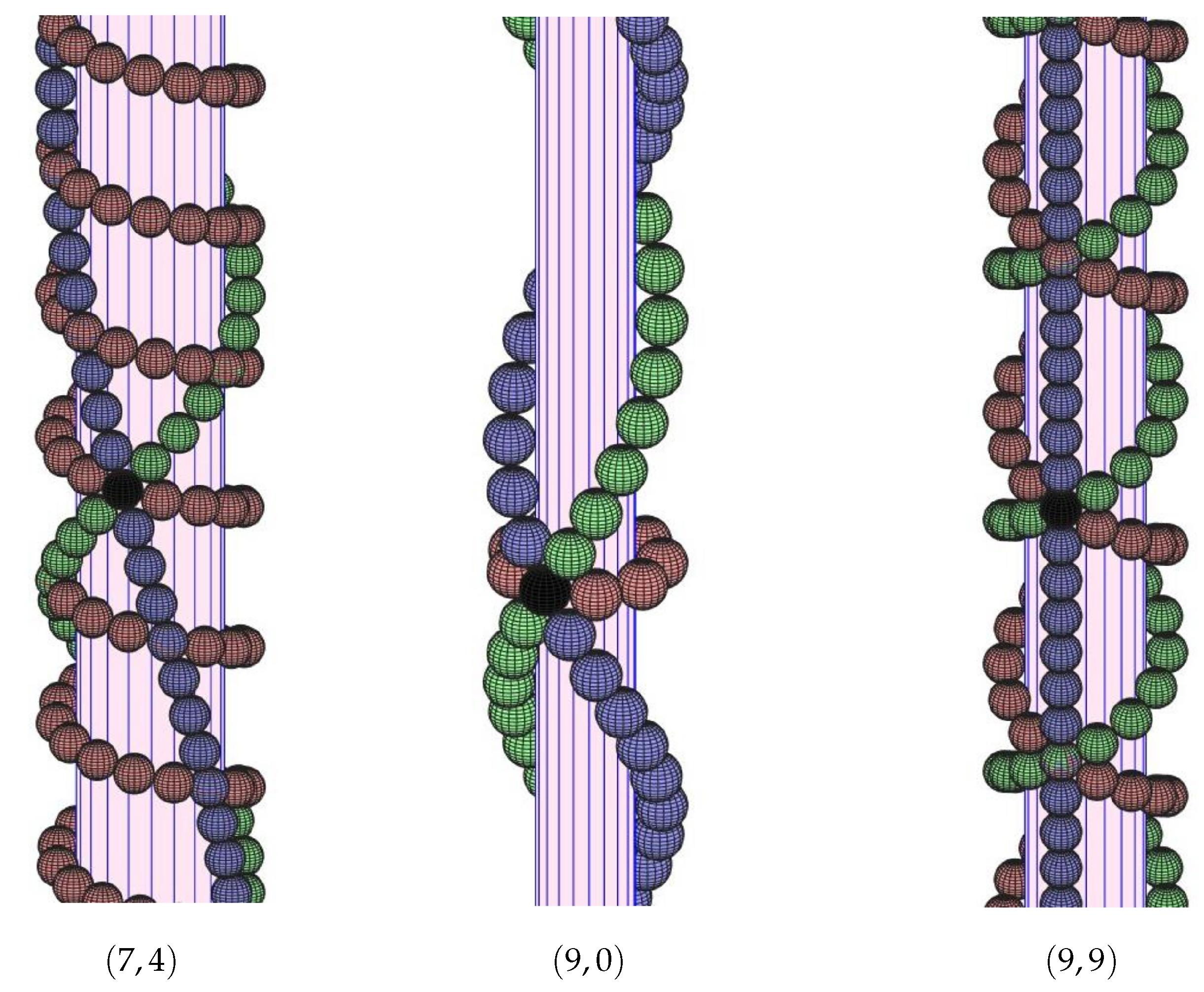
Figure 6.
-necklaces for the hCSP’s of Figure 1.
Figure 6.
-necklaces for the hCSP’s of Figure 1.
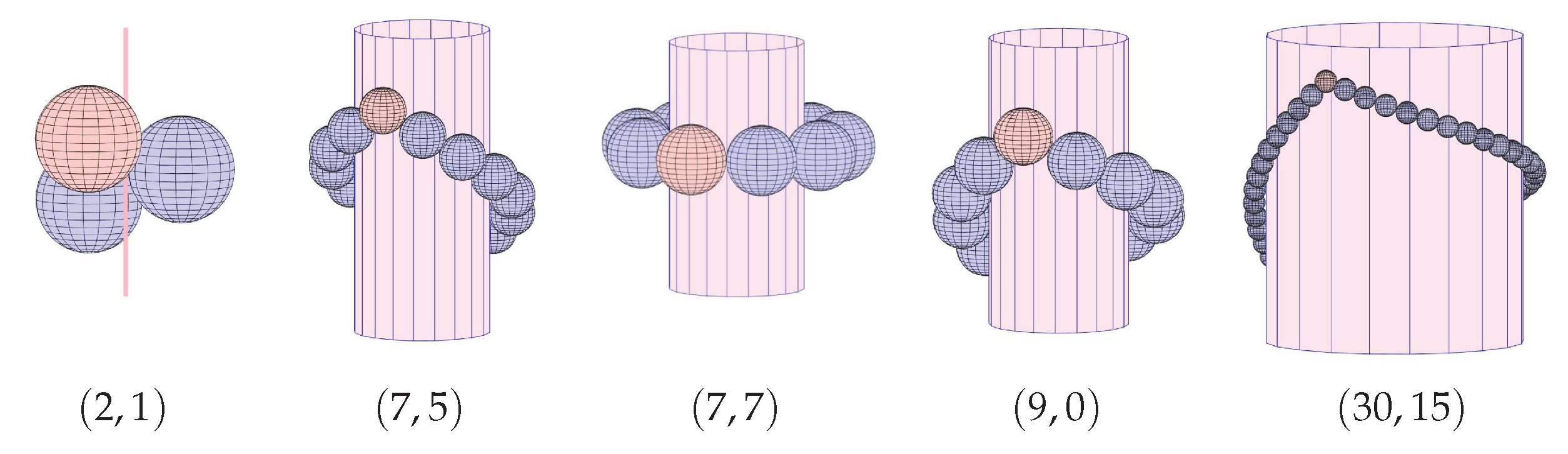
Figure 7.
-elegant necklaces on various cylinders.
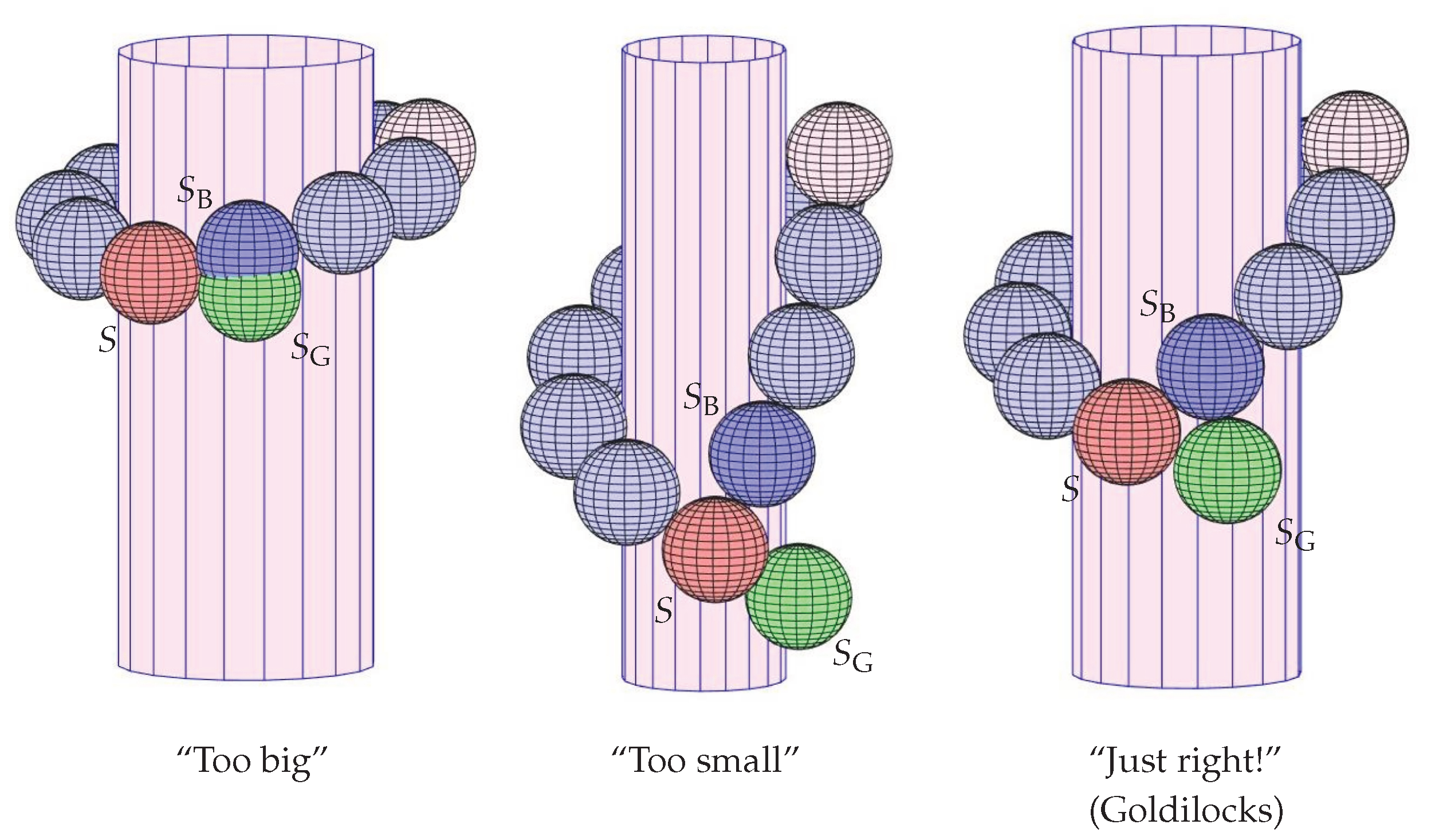
Figure 8.
Unrolling a (truncated) -hCSP polyhedron.
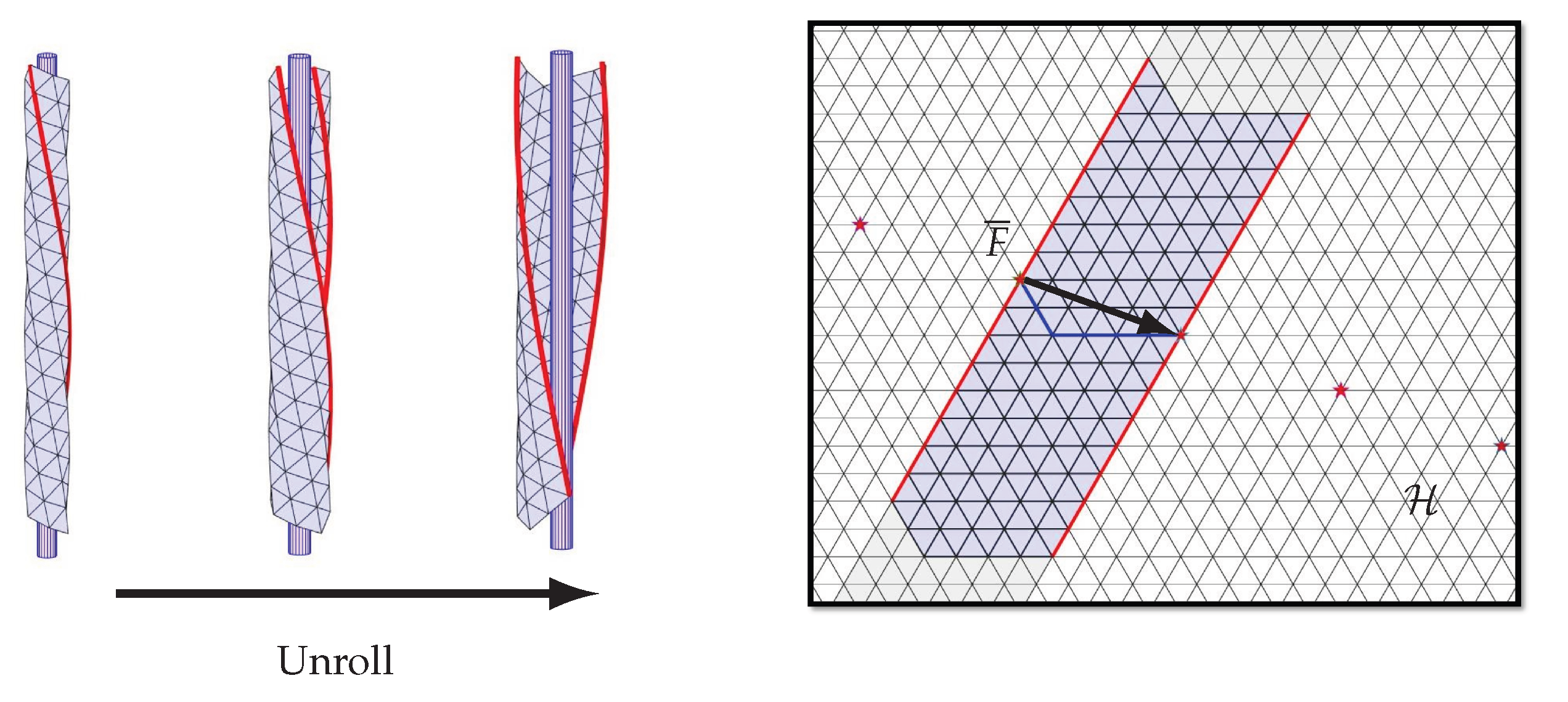
Figure 9.
An -hCSP polyhedron is not rigid.
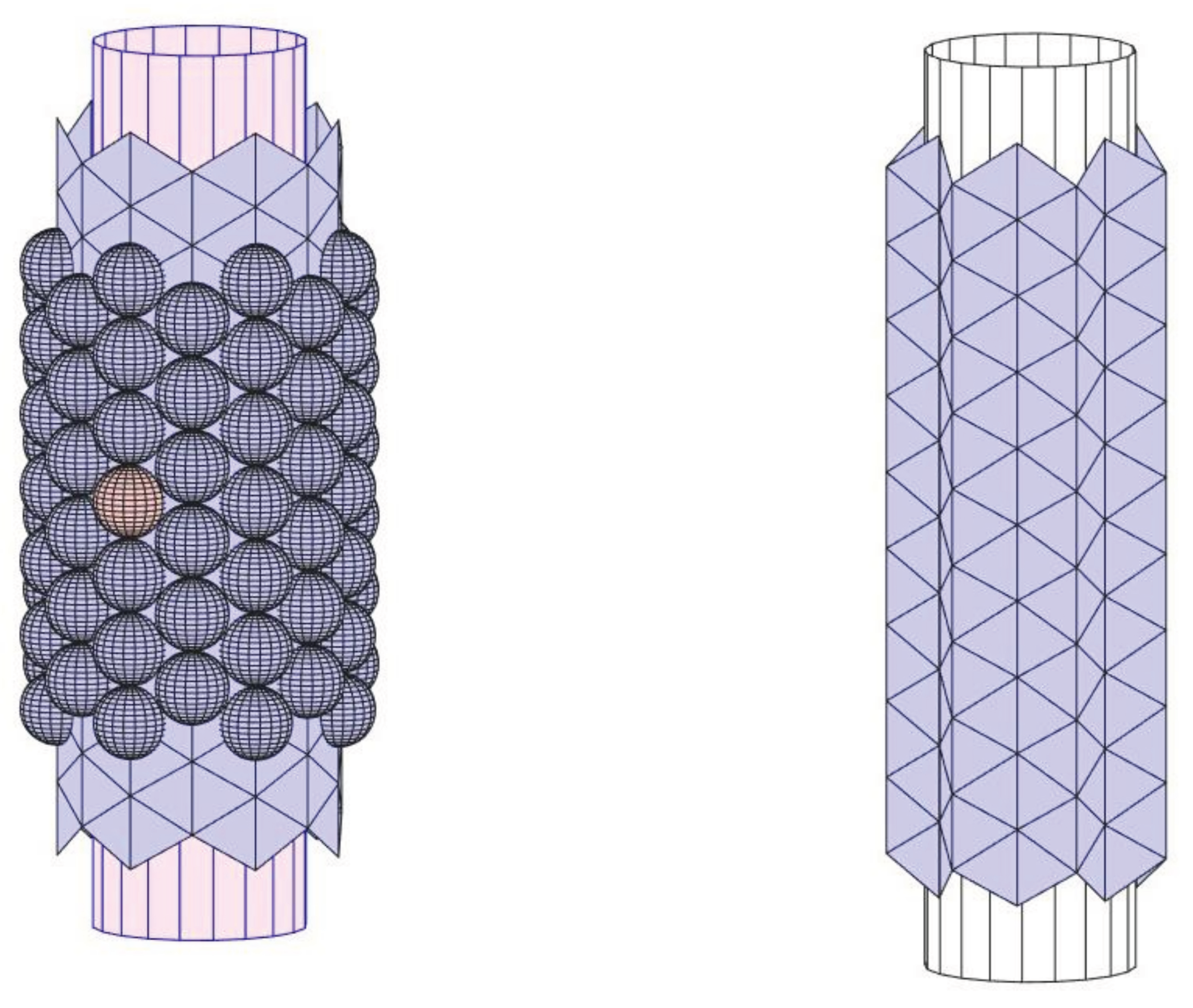
Figure 11.
Search for the smallest cylinder.
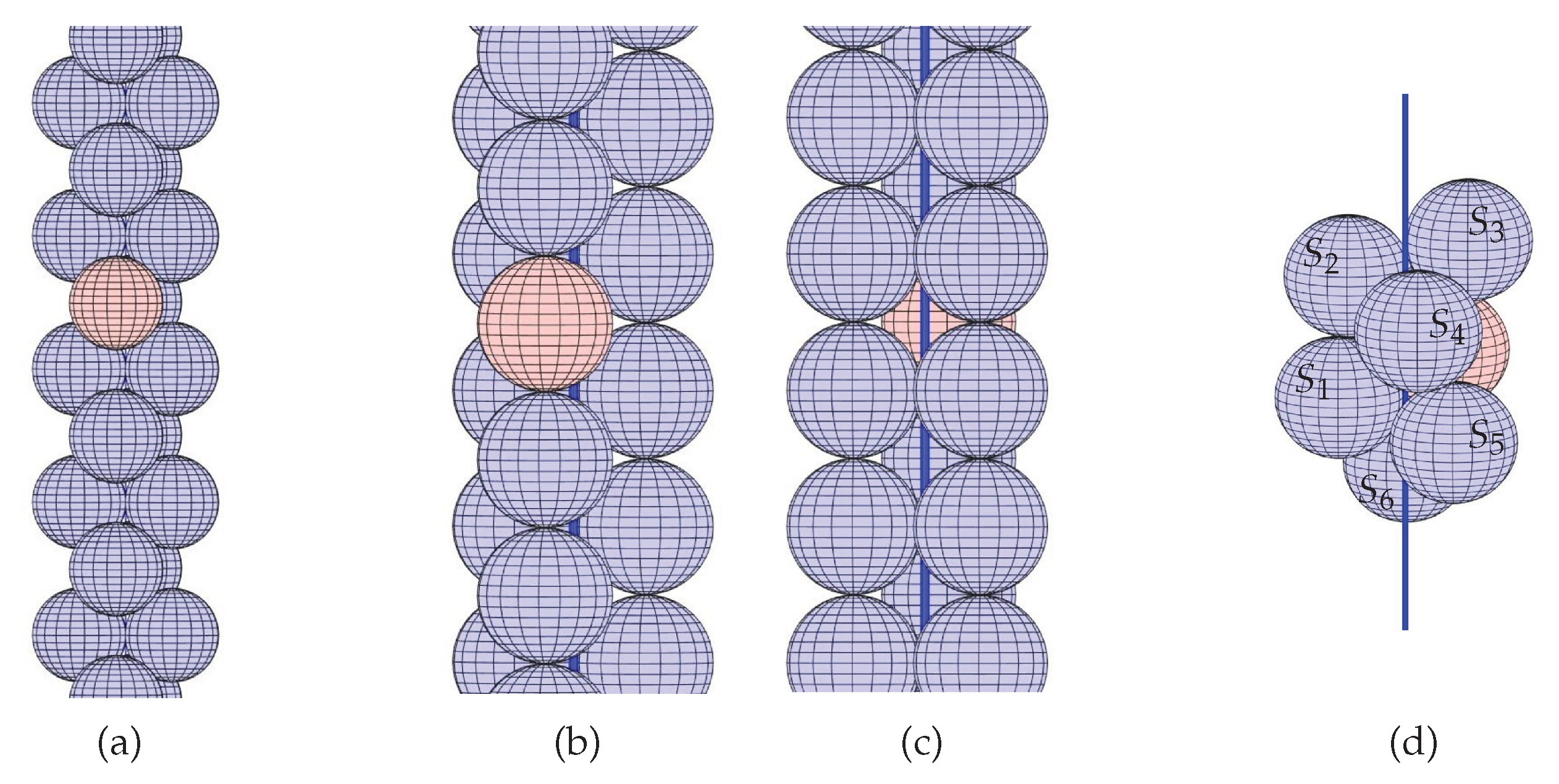
Figure 12.
The lattice for the -hCSP covering the mid cylinder.
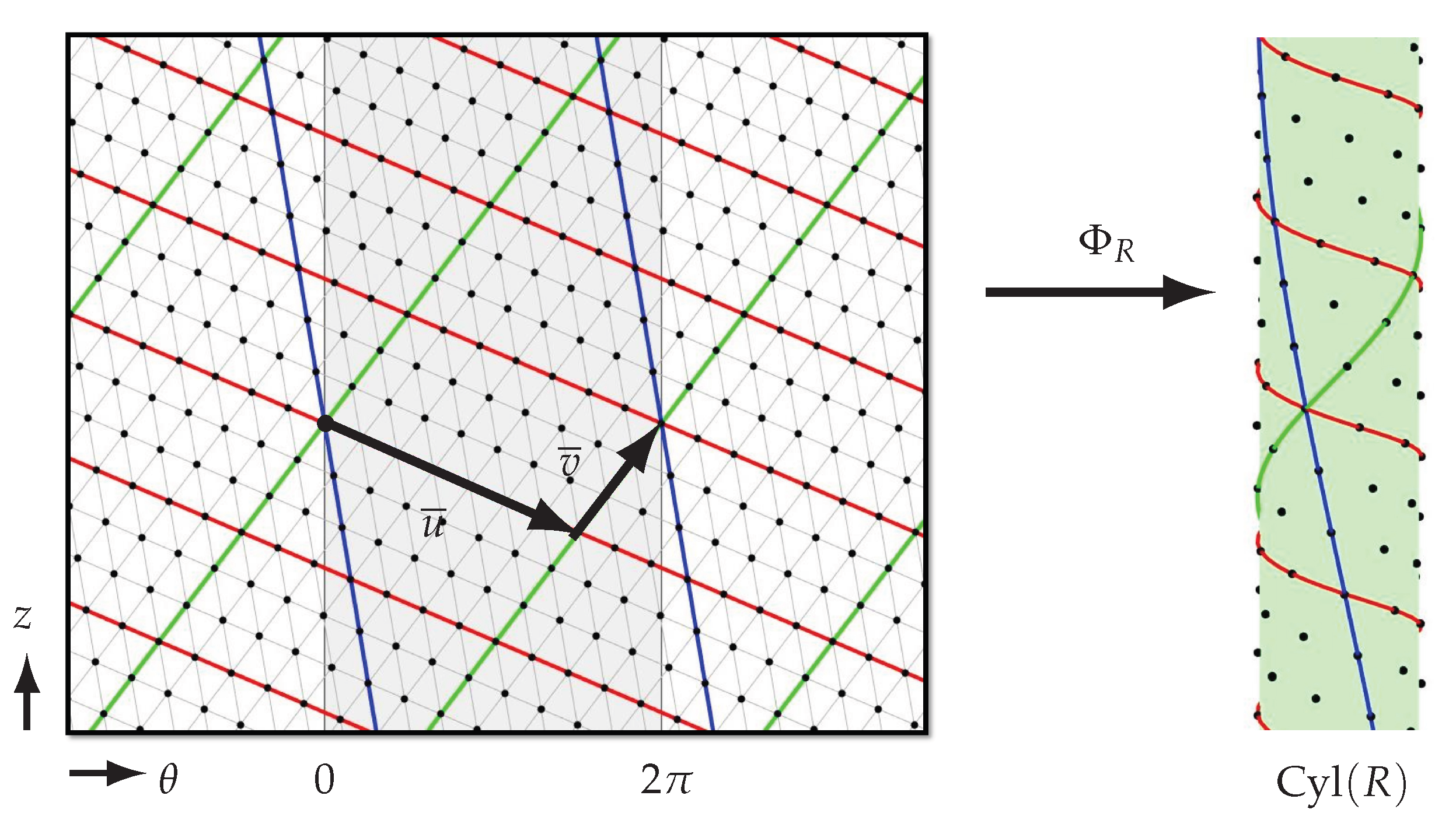
Figure 13.
Twelve-pearl necklaces: More twist means a smaller cylinder?
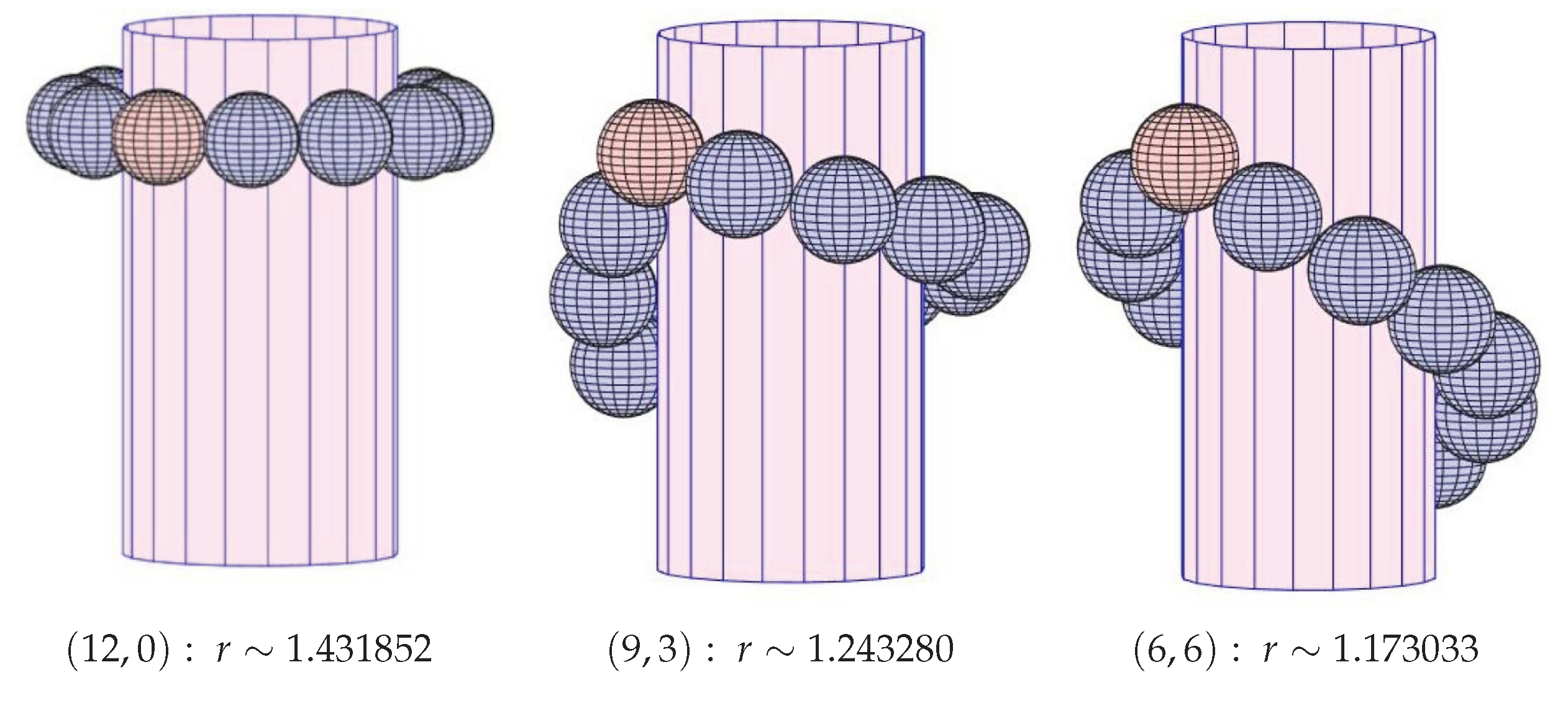
Table 1.
Cylinder radii for -hCSP’s, .
| 0 | 1 | 2 | 3 | 4 | 5 | 6 | |
|---|---|---|---|---|---|---|---|
| 2 | * | 0.0196290419 | 0.1123724357 | ||||
| 3 | 0.0773502692 | 0.1452616461 | 0.2431283644 | 0.3660254038 | |||
| 4 | 0.2071067812 | 0.2856098969 | 0.3846240416 | 0.5018804956 | 0.6315167192 | ||
| 5 | 0.3506508084 | 0.4325849755 | 0.5311569265 | 0.6444141170 | 0.7688700797 | 0.9012585384 | |
| 6 | 0.5 | 0.5831845450 | 0.6807569165 | 0.7908960515 | 0.9111728813 | 1.0392003480 | 1.1730326075 |
| 7 | 0.6523824355 | 0.7359998206 | 0.8324219685 | 0.9399926944 | 1.0568342905 | 1.1811092662 | 1.3112354268 |
| 8 | 0.8065629649 | 0.8902678585 | 0.9855566370 | 1.0909457796 | 1.2049023274 | 1.3259498048 | 1.4527672542 |
| 9 | 0.9619022001 | 1.0455414663 | 1.1397724649 | 1.2432804142 | 1.3547712360 | 1.4730137330 | 1.5969015931 |
| 10 | 1.1180339887 | 1.2015408950 | 1.2948084394 | 1.3966743006 | 1.5060242195 | 1.6218126006 | 1.7430843299 |
| 11 | 1.2747327664 | 1.3580813817 | 1.4504786749 | 1.5508976867 | 1.6583736322 | 1.7719955302 | 1.8909327960 |
| 12 | 1.4318516526 | 1.5150326938 | 1.6066469807 | 1.7057899444 | 1.8116080132 | 1.9233014648 | 2.0401412351 |
| 13 | 1.5892907344 | 1.6723076354 | 1.7632209762 | 1.8612236940 | 1.9655605867 | 2.0755248045 | 2.1904720432 |
| 7 | 8 | 9 | 10 | 11 | 12 | 13 | |
| 7 | 1.4459414186 | ||||||
| 8 | 1.5842617208 | 1.7195498855 | |||||
| 9 | 1.7254702745 | 1.8579272334 | 1.9936207664 | ||||
| 10 | 1.8690058043 | 1.9988486482 | 2.1320179590 | 2.2680134412 | |||
| 11 | 2.0144434561 | 2.1418868738 | 2.2726988110 | 2.4064189762 | 2.5426391734 | ||
| 12 | 2.1614633356 | 2.2866935874 | 2.4153065939 | 2.5468806365 | 2.6810370913 | 2.8174391632 | |
| 13 | 2.3098049512 | 2.4329930196 | 2.5595707414 | 2.6891317304 | 2.8213209281 | 2.9558226383 | 3.0923728858 |
Disclaimer/Publisher’s Note: The statements, opinions and data contained in all publications are solely those of the individual author(s) and contributor(s) and not of MDPI and/or the editor(s). MDPI and/or the editor(s) disclaim responsibility for any injury to people or property resulting from any ideas, methods, instructions or products referred to in the content. |
© 2026 by the authors. Licensee MDPI, Basel, Switzerland. This article is an open access article distributed under the terms and conditions of the Creative Commons Attribution (CC BY) license (http://creativecommons.org/licenses/by/4.0/).
Copyright: This open access article is published under a Creative Commons CC BY 4.0 license, which permit the free download, distribution, and reuse, provided that the author and preprint are cited in any reuse.


