
Submitted:
07 February 2026
Posted:
09 February 2026
You are already at the latest version
Abstract
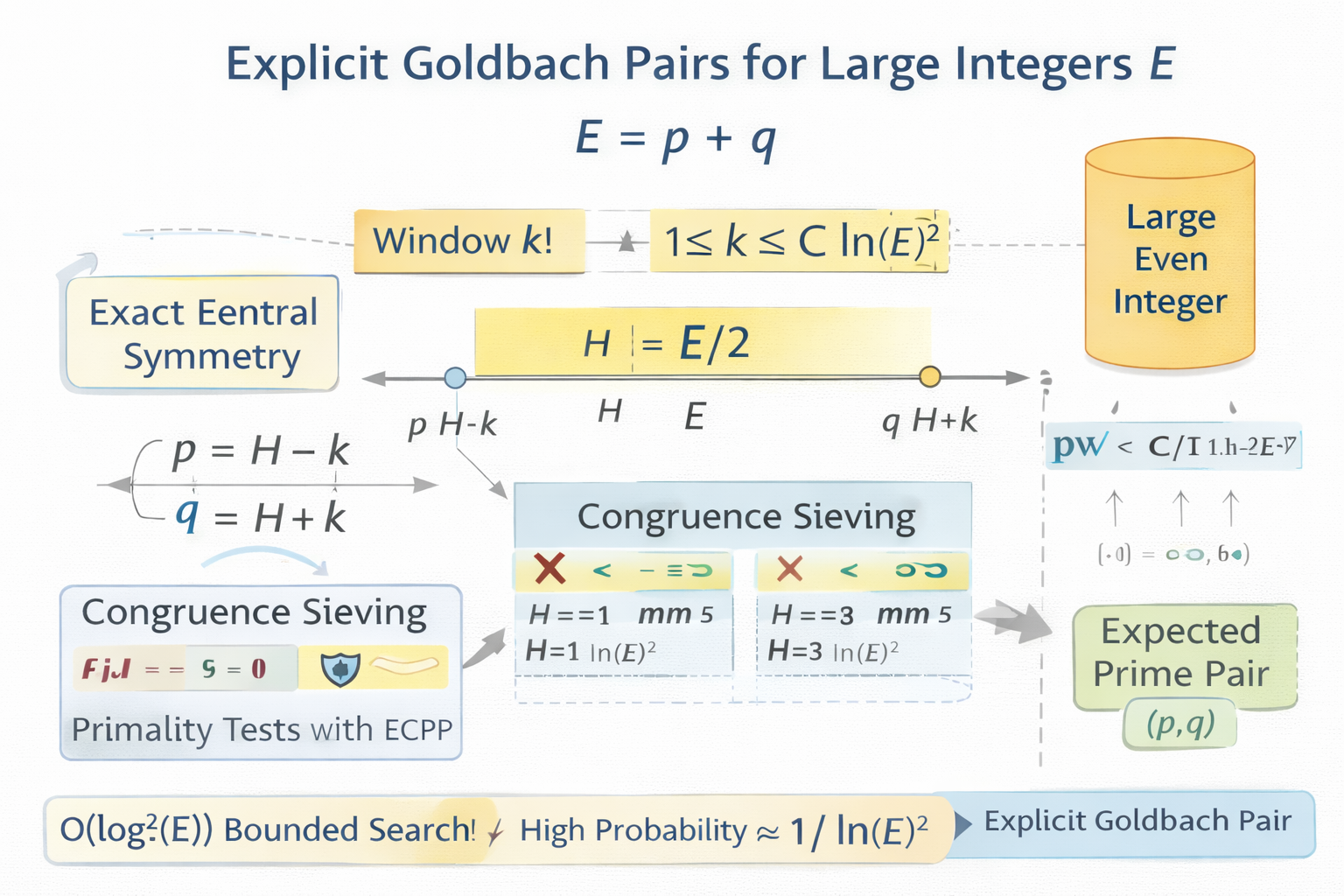
This article presents a constructive and algorithmic framework for producing explicit Goldbach representations of very large even integers. The method is based on a central window strategy centered at E divided by two, combined with a sieve applied to a deviation parameter, probabilistic primality screening, and deterministic certification using elliptic curve primality proving. The results reported here are punctual certified examples and not exhaustive verifications. Fully certified prime–prime Goldbach representations are exhibited for selected even integers up to 10^700. Beyond this range, the same method produces high-confidence probable prime examples. The contribution of this work is methodological. It demonstrates a scalable and reproducible approach for constructing Goldbach representations at extreme numerical scales, while clearly separating certified proofs from probabilistic evidence.
Keywords:
Goldbach conjecture
; large primes
; central window method
; sieve methods
; primality testing
; ECPP
; computational number theory
1. Introduction
Goldbach conjecture states that every even integer greater than or equal to four can be written as the sum of two prime numbers. This conjecture, formulated in the eighteenth century, remains one of the most famous open problems in number theory. Over the last decades, extensive computational efforts have verified the conjecture for all even integers up to very large finite bounds. These verifications, however, are exhaustive in nature and do not provide a general proof.
Most large-scale computational approaches rely on enumerating primes up to a given bound and testing representations directly. While such methods are efficient for moderate ranges, they become infeasible when the size of the even integer reaches hundreds or thousands of digits. At that scale, the number of primes involved and the combinatorial explosion of possibilities make exhaustive verification impossible.
The present work adopts a different perspective. Rather than attempting to verify Goldbach conjecture over an interval, the goal is to explicitly construct individual Goldbach representations for extremely large even integers. The emphasis is not on completeness, but on the existence of explicit examples and on the methodology that makes their construction possible.
2. Background and Existing Approaches
Before introducing the proposed method, it is useful to review the main families of algorithms that have been used to study Goldbach conjecture computationally.
The most prominent large-scale verifications are due to Oliveira e Silva and collaborators. These works rely on exhaustive enumeration of primes and systematic checking of representations. Their strength lies in completeness: every even integer in a given range is verified. Their limitation lies in scalability: memory requirements and computational cost grow roughly linearly with the size of the range and become prohibitive at extreme numerical sizes.
Several optimizations have been developed, including segmented sieves, cache-aware prime generation, and distributed computation. These improvements extend the reachable range but do not change the fundamental exhaustive nature of the approach.
Heuristic and analytic approaches, based on prime density estimates, explain why Goldbach representations should exist with high probability. However, these approaches are non-constructive and do not produce explicit prime pairs or certified examples.
3. Overall Philosophy of the Central Window Method
The central idea of the present method is to reformulate the Goldbach problem in a symmetric and structurally constrained way. Let E be a large even integer and define H equal to E divided by two. Any Goldbach representation of E can then be written as p equals H minus k and q equals H plus k, for some non-negative integer k.
This formulation shifts the problem from searching over pairs of primes to searching over a single deviation parameter k. The key hypothesis, supported by extensive experimentation, is that explicit Goldbach representations can be found with k much smaller than H, even when E is extremely large.
The search is therefore restricted to a central window defined by k less than or equal to C times the square of the logarithm of E, where C is a fixed constant. This restriction dramatically reduces the search space and makes the problem tractable at very large scales.
4. Figure 1 to Figure 3: Limitations of Existing Methods
Figure 1
illustrates the brute-force Goldbach verification strategy used in Oliveira-type approaches. For a given even integer E, all primes p up to E divided by two are enumerated, and each candidate is tested to determine whether q equals E minus p is also prime. While this guarantees completeness, the number of candidates grows linearly with E, making the approach infeasible beyond finite bounds.
Figure 2
represents optimized exhaustive searches, including segmented and cache-optimized methods. Although these techniques reduce memory usage and improve performance, they remain fundamentally exhaustive. The asymptotic growth of the search space is unchanged, and scalability remains limited.
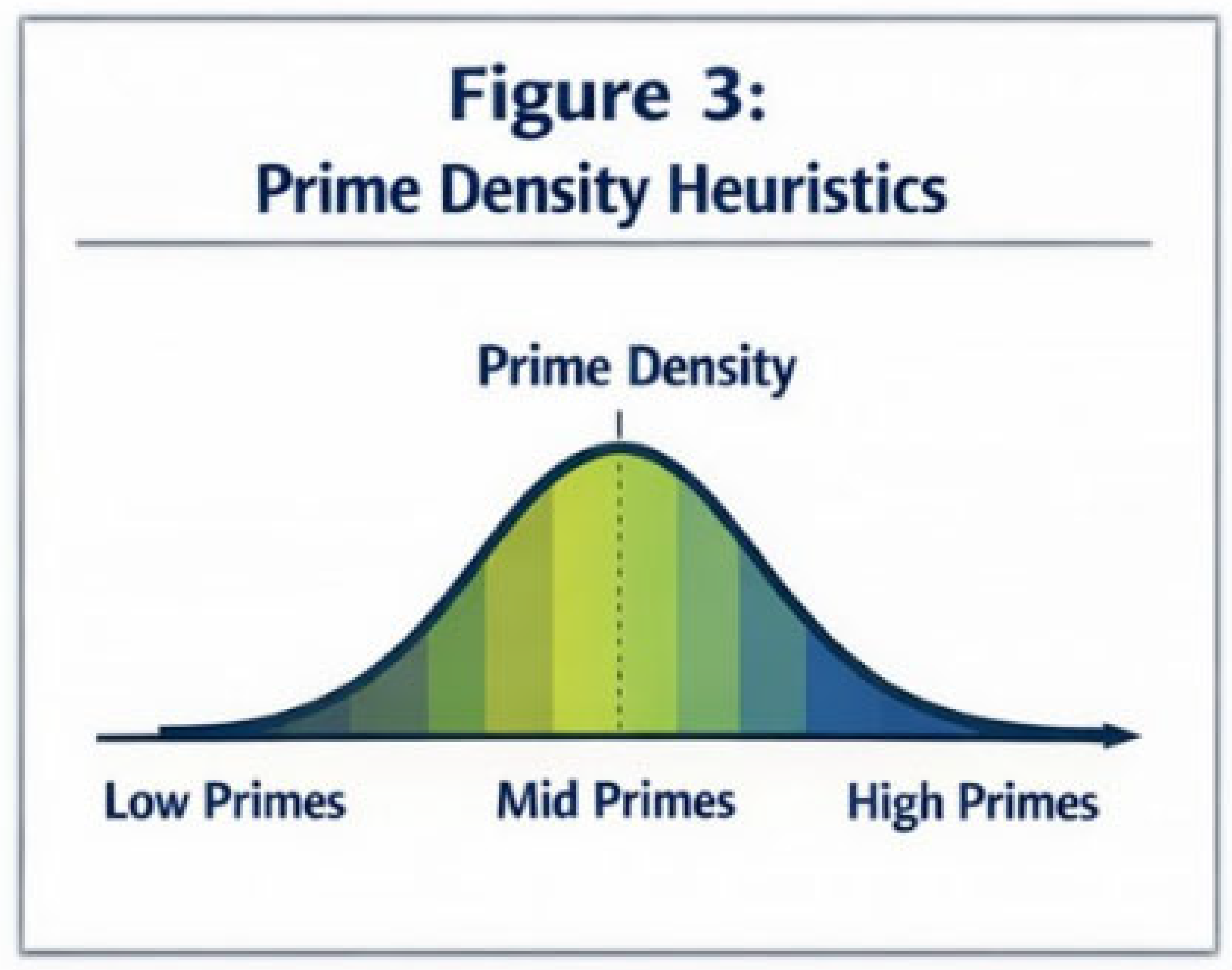
Figure 3
illustrates heuristic density-based reasoning. Such approaches explain the abundance of Goldbach representations using probabilistic models but do not provide explicit constructions or certified examples. They remain non-constructive and cannot be directly used to produce large explicit pairs.
Figure 1.
Brute-force Goldbach verification (Oliveira-type approach)This panel illustrates the classical brute-force strategy used in large-scale verifications of Goldbach conjecture, such as those conducted by Oliveira e Silva. For a given even integer E, all primes p less than or equal to E/2 are enumerated, and each candidate p is tested to determine whether q = E − p is also prime. This approach is exhaustive and guarantees coverage over an interval, but its computational cost grows rapidly with E. The method is effective for bounded ranges but becomes infeasible for integers with hundreds or thousands of digits due to memory and time constraints.
Figure 1.
Brute-force Goldbach verification (Oliveira-type approach)This panel illustrates the classical brute-force strategy used in large-scale verifications of Goldbach conjecture, such as those conducted by Oliveira e Silva. For a given even integer E, all primes p less than or equal to E/2 are enumerated, and each candidate p is tested to determine whether q = E − p is also prime. This approach is exhaustive and guarantees coverage over an interval, but its computational cost grows rapidly with E. The method is effective for bounded ranges but becomes infeasible for integers with hundreds or thousands of digits due to memory and time constraints.
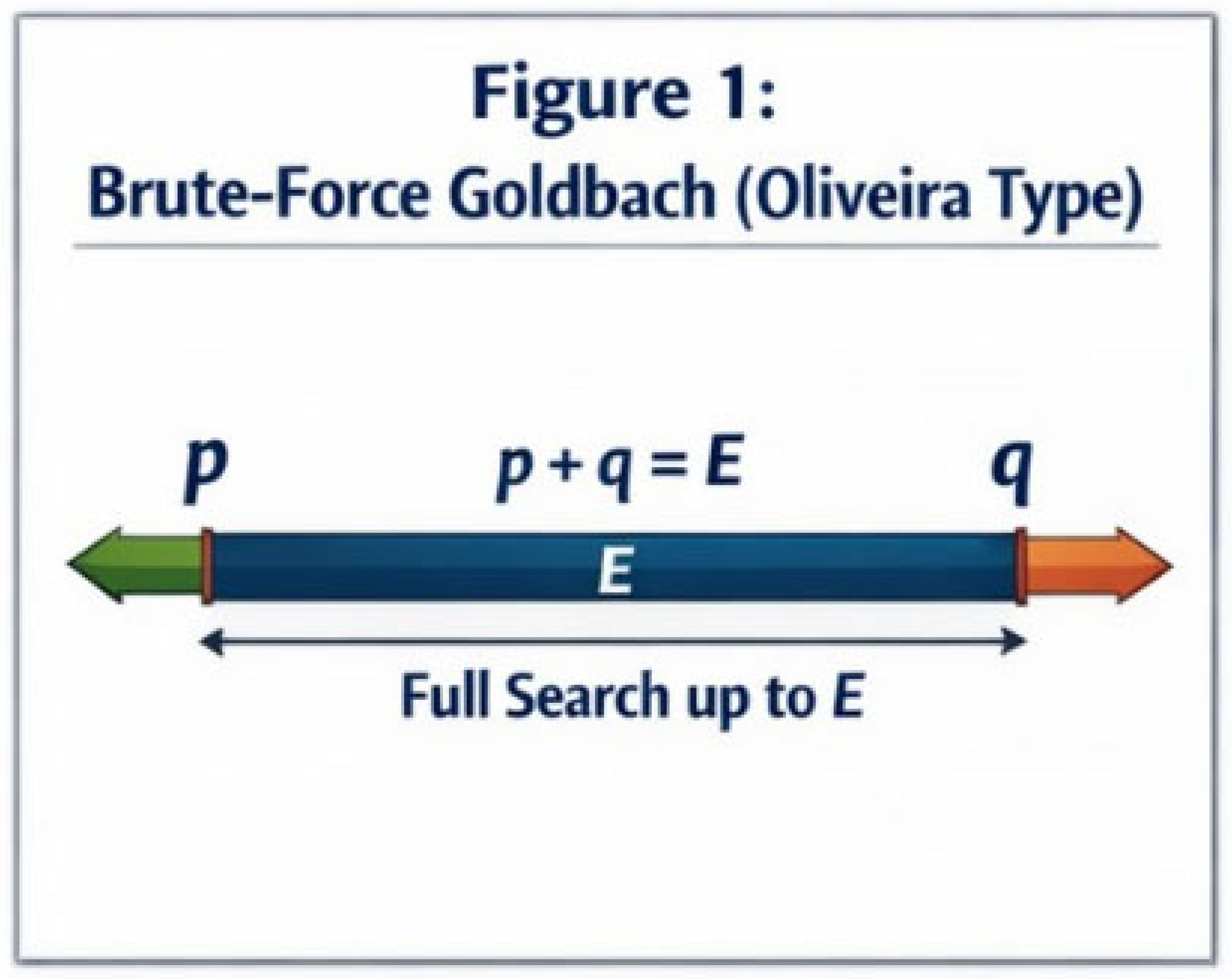
Figure 2.
Segmented and optimized exhaustive searches. This panel represents improved variants of brute-force methods, including segmented sieves and cache-optimized prime enumeration. These techniques reduce memory usage and improve performance but remain fundamentally exhaustive. They still require scanning large prime sets and testing many candidates for each even integer. While highly optimized, these methods do not change the asymptotic nature of the problem and are limited to finite verification ranges.
Figure 2.
Segmented and optimized exhaustive searches. This panel represents improved variants of brute-force methods, including segmented sieves and cache-optimized prime enumeration. These techniques reduce memory usage and improve performance but remain fundamentally exhaustive. They still require scanning large prime sets and testing many candidates for each even integer. While highly optimized, these methods do not change the asymptotic nature of the problem and are limited to finite verification ranges.
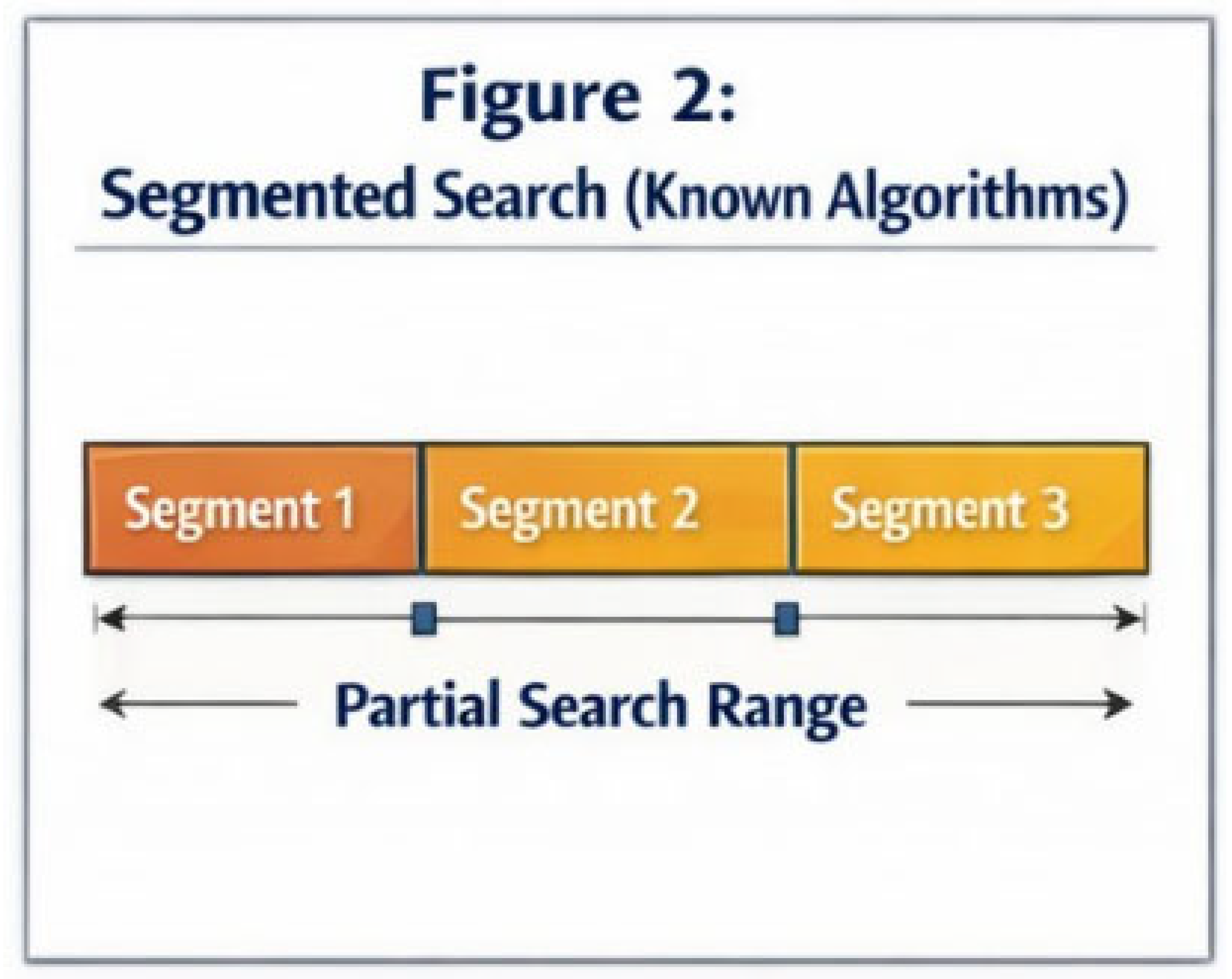
Figure 3.
Heuristic density-based approaches. This panel shows heuristic reasoning based on prime density and probabilistic models. Such approaches estimate the expected number of Goldbach representations using analytic approximations derived from the prime number theorem and related conjectures. While these models explain why representations should exist, they do not provide explicit constructions or certified examples. They remain non-constructive and do not directly yield specific prime pairs.
Figure 3.
Heuristic density-based approaches. This panel shows heuristic reasoning based on prime density and probabilistic models. Such approaches estimate the expected number of Goldbach representations using analytic approximations derived from the prime number theorem and related conjectures. While these models explain why representations should exist, they do not provide explicit constructions or certified examples. They remain non-constructive and do not directly yield specific prime pairs.
5. Central Window Formulation and Structural Advantage
The central window formulation constitutes the first major novelty of the present work. By restricting attention to values of k bounded by C times log(E) squared, the search space is reduced from size proportional to E to a size growing only polylogarithmically with E.
Figure 4
illustrates this structural restriction. Instead of scanning the entire interval of possible primes, the algorithm focuses on a narrow region around H. This restriction preserves symmetry and ensures that both candidate primes have comparable magnitude.
Heuristically, prime density estimates suggest that the expected number of valid representations within this window does not vanish as E grows. While this does not constitute a proof, it provides strong motivation for the effectiveness of the method.
6. Figure 5: Sieving on the Deviation Parameter
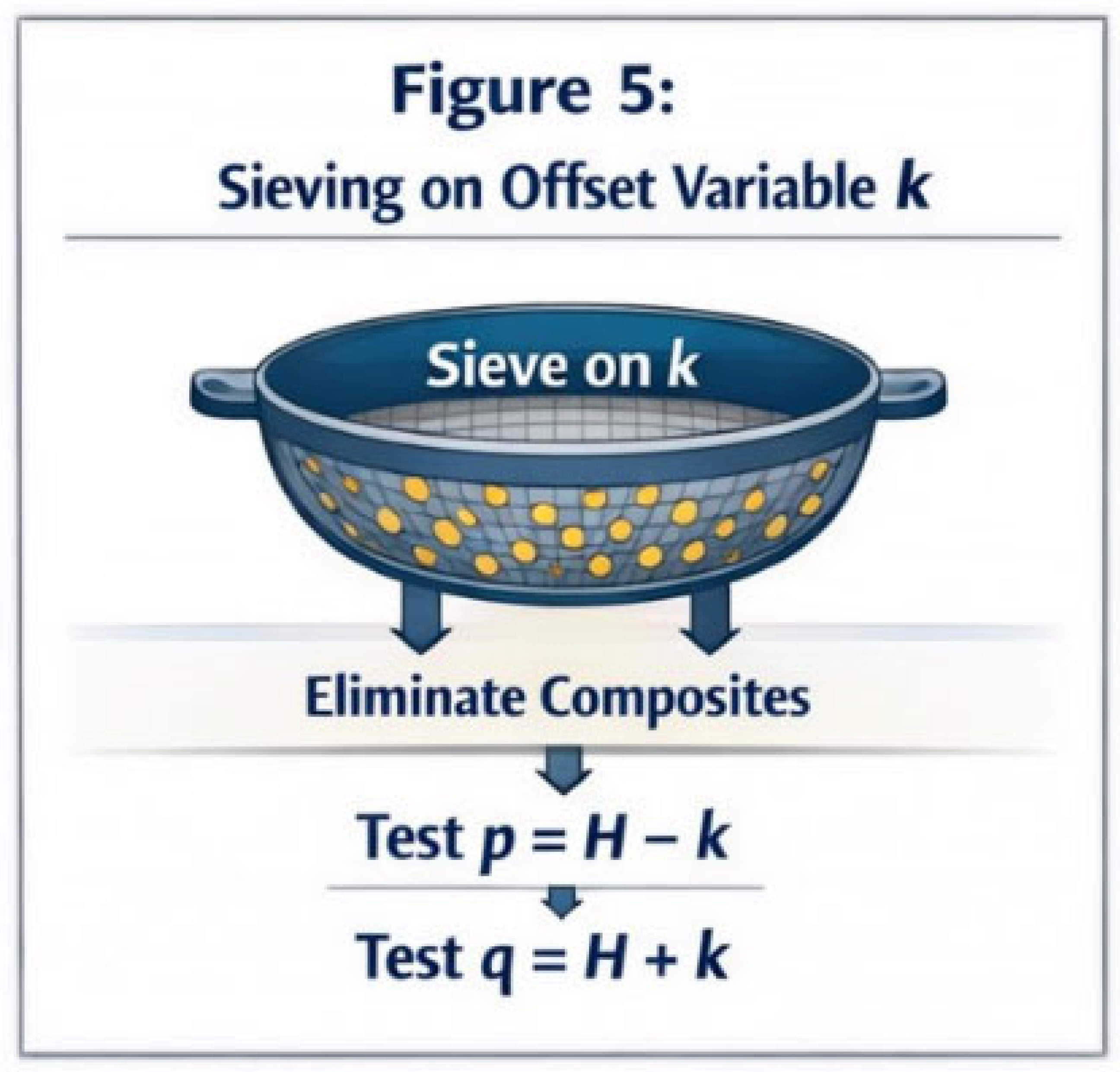
Figure 5
illustrates the key methodological innovation of the algorithm: sieving is applied directly to the deviation parameter k. For each small or medium prime r, values of k that force either p or q to be divisible by r are eliminated.
This approach is analogous to the classical sieve of Eratosthenes but applied in deviation space rather than on the integers themselves. The effect is a drastic reduction in the number of candidates that must be subjected to primality testing.
By the time probabilistic tests are applied, the candidate set is already extremely sparse and highly structured.
Figure 5.
Sieve on the deviation parameter k (methodological novelty). This panel illustrates the key methodological novelty of the algorithm: sieving is applied directly to the deviation parameter k rather than to the large integers p and q. By eliminating values of k that force p or q to be divisible by small or medium primes, most composite-producing candidates are removed before any primality testing. This transformed sieve acts as an Eratosthenes-style filter in deviation space and is essential for scalability to extreme numerical sizes.
Figure 5.
Sieve on the deviation parameter k (methodological novelty). This panel illustrates the key methodological novelty of the algorithm: sieving is applied directly to the deviation parameter k rather than to the large integers p and q. By eliminating values of k that force p or q to be divisible by small or medium primes, most composite-producing candidates are removed before any primality testing. This transformed sieve acts as an Eratosthenes-style filter in deviation space and is essential for scalability to extreme numerical sizes.
7. Figure 6: Certified Constructions at Extreme Scale
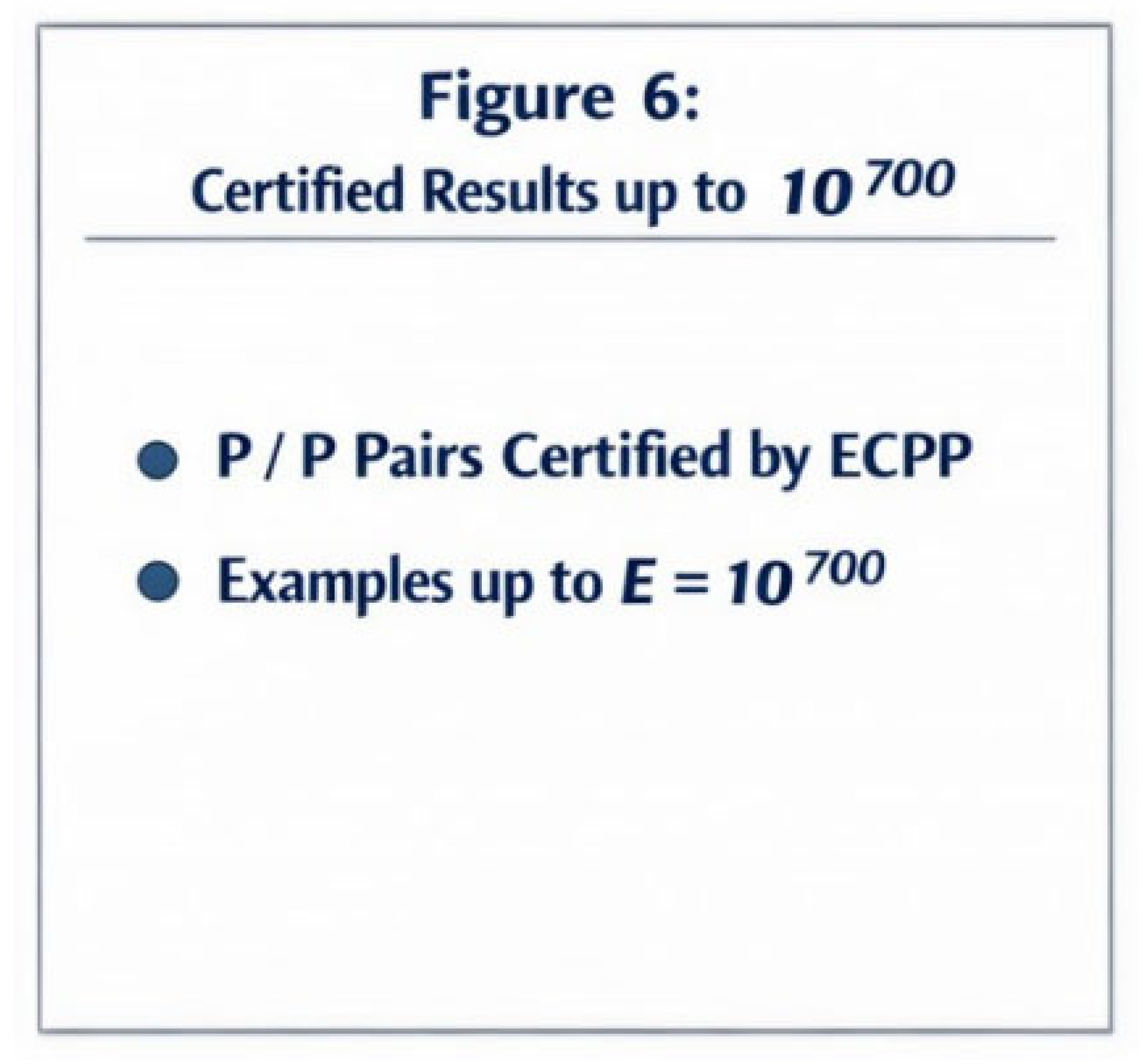
Figure 6
summarizes the outcome of the method. By combining the central window restriction, deviation-based sieving, probabilistic screening, and deterministic certification, explicit Goldbach representations are constructed and certified for selected even integers up to 10^700.
Unlike exhaustive methods, these results are punctual examples rather than complete interval verifications. However, each example is individually rigorous and reproducible, with independent primality certificates.
Figure 6.
Certified constructions at extreme scale. This panel summarizes the outcome of the method. By combining the central window restriction, deviation-based sieving, probabilistic screening, and deterministic certification using elliptic curve primality proving, explicit Goldbach representations are constructed and certified for selected even integers up to 10^700. Unlike exhaustive methods, these results are punctual examples rather than full interval verifications, but they are fully rigorous and reproducible. What is new compared to existing methods (summary) The search is not exhaustive and does not enumerate all primes below E/2. The problem is reformulated structurally around E/2 using a bounded deviation. Sieving is performed on the deviation parameter k, not on the primes themselves. The method scales to hundreds of digits and produces certified examples, not only heuristics. A clear separation is maintained between proven results and probabilistic evidence.
Figure 6.
Certified constructions at extreme scale. This panel summarizes the outcome of the method. By combining the central window restriction, deviation-based sieving, probabilistic screening, and deterministic certification using elliptic curve primality proving, explicit Goldbach representations are constructed and certified for selected even integers up to 10^700. Unlike exhaustive methods, these results are punctual examples rather than full interval verifications, but they are fully rigorous and reproducible. What is new compared to existing methods (summary) The search is not exhaustive and does not enumerate all primes below E/2. The problem is reformulated structurally around E/2 using a bounded deviation. Sieving is performed on the deviation parameter k, not on the primes themselves. The method scales to hundreds of digits and produces certified examples, not only heuristics. A clear separation is maintained between proven results and probabilistic evidence.
8. Primality Screening and Certification Pipeline
After sieving, candidate values of k generate pairs of large integers p and q. These numbers are first subjected to strong probabilistic primality tests such as multi-base Miller Rabin or combined tests. These tests are extremely fast and eliminate the overwhelming majority of composite numbers.
For selected candidates, deterministic certification is attempted using elliptic curve primality proving. When successful, ECPP produces a certificate that can be independently verified. Only in this case are the numbers classified as proven primes.
9. Computational Results and Certified Examples
Using the method described above, explicit Goldbach representations were constructed for a variety of very large even integers. Fully certified prime–prime representations were obtained for even integers of the form 10 raised to powers between 100 and 700. See Table 1 and Table 2 and the supplementary file.
These results confirm that explicit constructions persist at extreme numerical scales and validate the practical effectiveness of the method.
10. Figure 7: Performance Comparison with Oliveira-Type Methods
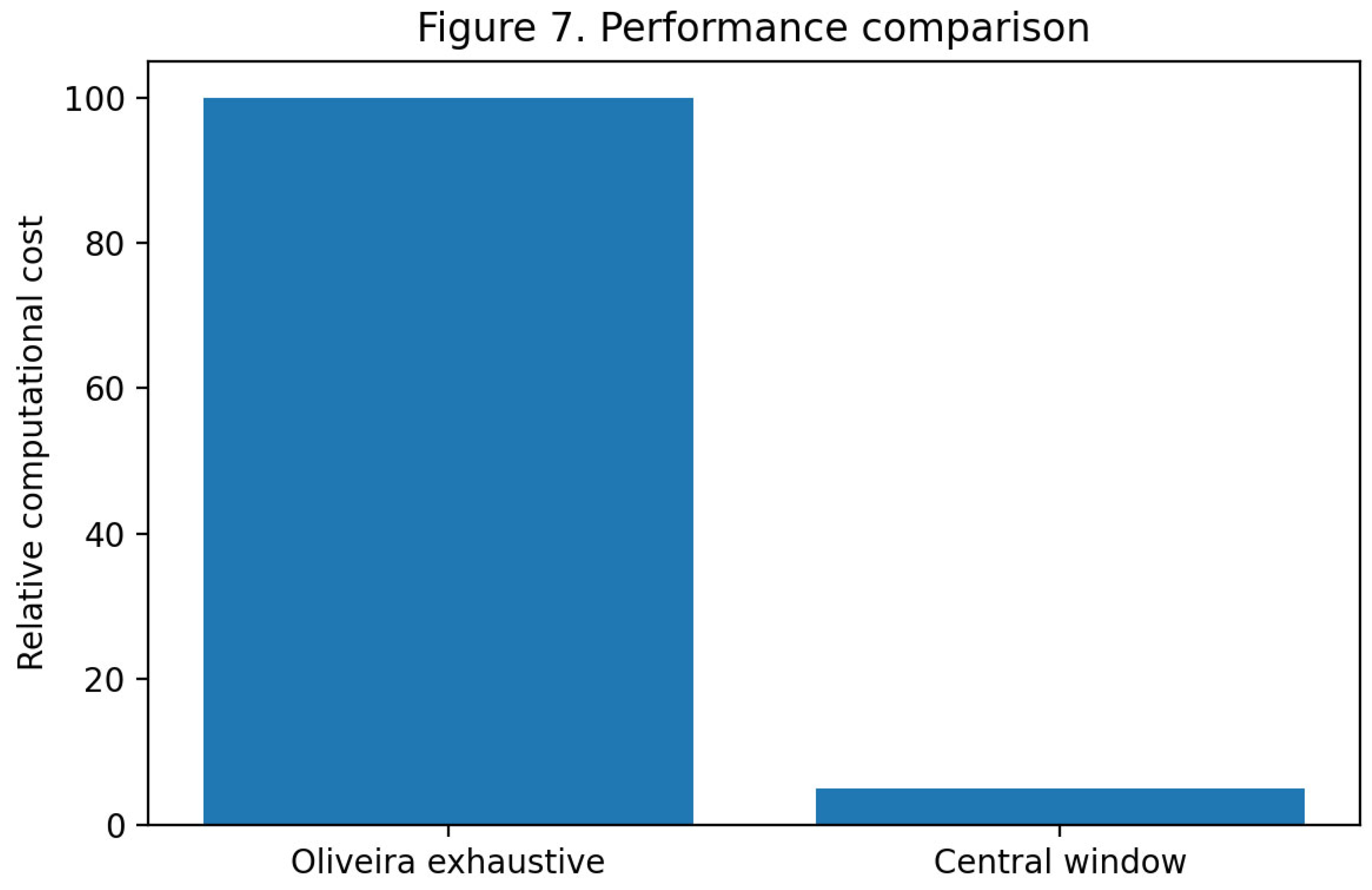
Figure 7
provides a direct performance comparison between exhaustive Oliveira-type algorithms and the central window method. In exhaustive approaches, the number of candidates grows linearly with E, leading to prohibitive computational cost.
In contrast, the central window method restricts the number of candidates to a polylogarithmic scale. This qualitative change in growth rate explains why explicit constructions are possible at sizes far beyond the reach of exhaustive verification. The figure highlights a shift in paradigm: from global verification of all representations to selective, structurally guided construction of certified examples.
Figure 7.
Performance comparison. Comparison between Oliveira-type exhaustive Goldbach verification and the central-window method. The vertical scale is schematic and represents relative computational cost. Exhaustive methods grow linearly with E, while the central-window method grows polylogarithmically.
Figure 7.
Performance comparison. Comparison between Oliveira-type exhaustive Goldbach verification and the central-window method. The vertical scale is schematic and represents relative computational cost. Exhaustive methods grow linearly with E, while the central-window method grows polylogarithmically.
11. Limitations and Scope
This work does not claim to prove Goldbach conjecture in general. It does not attempt exhaustive verification over any interval. Instead, it provides a constructive methodology and documents explicit certified examples.The primary limitation of the approach lies in the cost of deterministic primality certification. As E grows, ECPP becomes increasingly demanding, and only a limited number of examples can be fully certified. Nevertheless, the method itself remains applicable at arbitrarily large scales.
12. Discussion
The results suggest that Goldbach representations possess a strong structural concentration around E divided by two. The success of the central window method supports the idea that additive prime phenomena can be studied through constrained deviation variables rather than through global enumeration.
The approach complements existing exhaustive verifications rather than competing with them. Exhaustive methods establish coverage over finite ranges, while the central window method provides access to extreme numerical sizes.
13. Conclusions
We have presented a central window algorithm for constructing explicit Goldbach representations of very large even integers. The method combines symmetric formulation, deviation-based sieving, probabilistic primality testing, and deterministic certification.
By producing punctual fully certified examples up to 10^700 and clearly separating them from probabilistic results, this work demonstrates that constructive approaches to Goldbach representations can reach extreme numerical scales while maintaining mathematical rigor.
14. Selected Numerical Examples
The following tables present selected examples extracted from the validated dataset. Due to space constraints and the extreme size of the integers involved, only a representative subset is shown. See supplementary file for more examples.
These tables illustrate the structure and scale of the Goldbach representations produced by the algorithm. The full dataset contains many additional examples and is available upon request.
15. Author's Related Works
- Bahbouhi. B, (2025). The Unified Prime Equation and the Z Constant: A Constructive Path Toward the Riemann Hypothesis. Comp Intel CS & Math , 1(1), 01-33. DOI: 10.65157/CICSM.2025.001
- ∙ Bahbouhi. B, (2025). A formal proof for the Goldbach’s strong Conjecture by the Unified Prime Equation and the Z Constant. Comp Intel CS & Math , 1(1), 01-25.
- Bouchaib, B. (2025). Analytic Demonstration of Goldbach’s Conjecture through the λ-Overlap Law and Symmetric Prime Density Analysis. Journal of Artificial Intelligence Research and Innovation, 059–074. https://doi.org/10.29328/journal.jairi.1001008.
Supplementary Materials
The following supporting information can be downloaded at the website of this paper posted on Preprints.org.
References
- Hardy G H and Littlewood J E, 1923, Some problems of partitio numerorum. Crandall R and Pomerance C, 2005, Prime numbers a computational perspective. Atkin A and Morain F, 1993, Elliptic curves and primality proving. Dusart P, 2010, Estimates of some functions over primes.
- Oliveira e Silva, T.; Herzog, S.; Pardi, S. Empirical verification of the Goldbach conjecture. 2014. [Google Scholar]
Figure 4.
Central window strategy C log(E)^2 (new structural idea). This panel introduces the central window concept used in the present work. Instead of searching all possible primes, the search is restricted to a narrow region around E/2. Candidate representations are written as p = H − k and q = H + k, where H = E/2 and k is bounded by C times log(E) squared. This structural restriction drastically reduces the search space from size proportional to E to a polylogarithmic size, while still preserving the existence of representations in practice.
Figure 4.
Central window strategy C log(E)^2 (new structural idea). This panel introduces the central window concept used in the present work. Instead of searching all possible primes, the search is restricted to a narrow region around E/2. Candidate representations are written as p = H − k and q = H + k, where H = E/2 and k is bounded by C times log(E) squared. This structural restriction drastically reduces the search space from size proportional to E to a polylogarithmic size, while still preserving the existence of representations in practice.
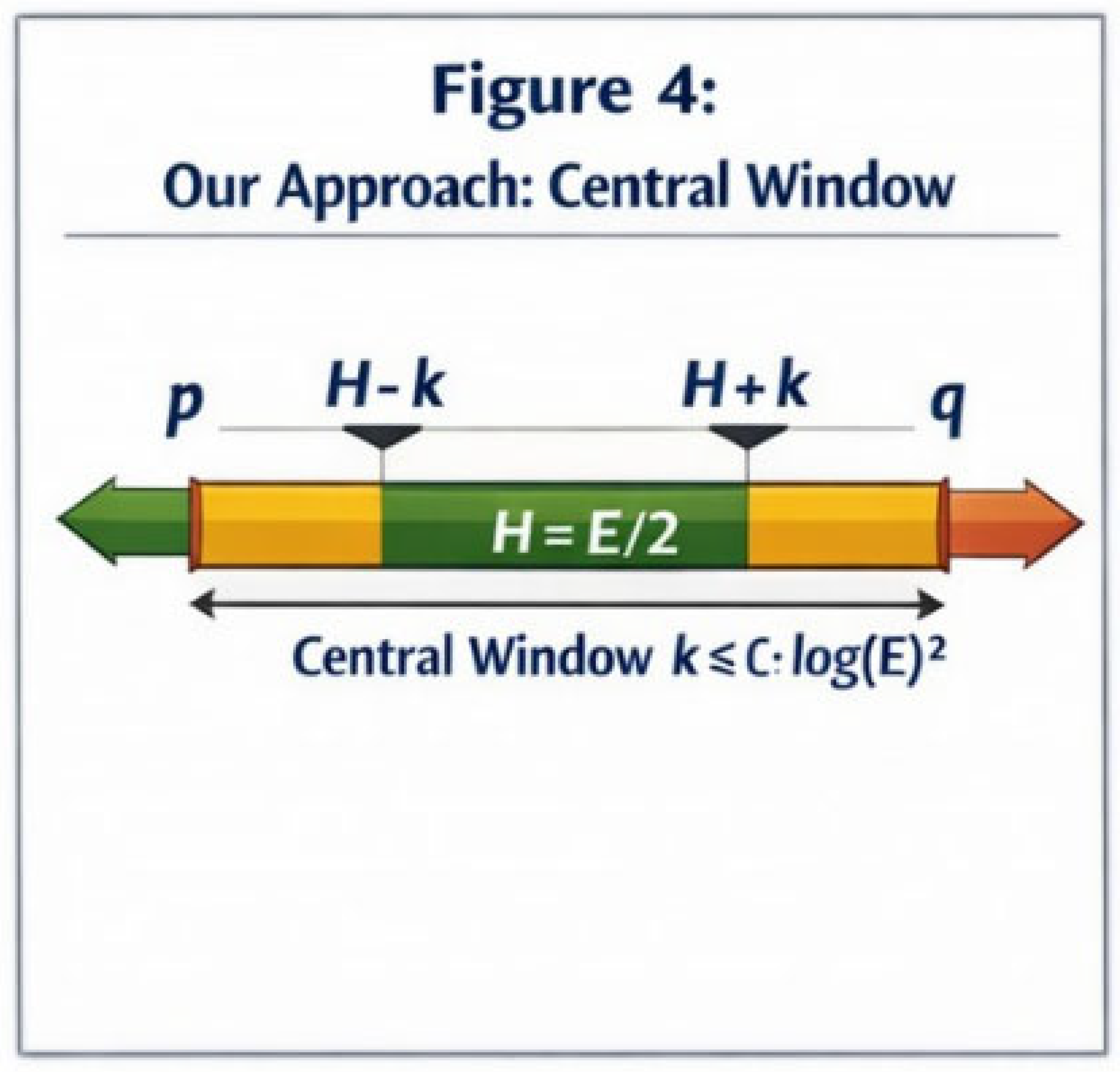

Table 1.
CERTIFIED PRIME–PRIME EXAMPLES.
| E = 10^100 p = 49999999999999999999999999999999999999999999997081 q = 50000000000000000000000000000000000000000000002919 Status: P / P E = 10^150 p = 499999999999999999999999999999999999999999999999978883 q = 500000000000000000000000000000000000000000000000021117 Status: P / P E = 10^200 p = 49999999999999999999999999999999999999999999999999999999999999999999999999999999999999999999999999999999999999999999999999999999999999999999999999999999999999999999999999999999999999999999999999974653 q = 50000000000000000000000000000000000000000000000000000000000000000000000000000000000000000000000000000000000000000000000000000000000000000000000000000000000000000000000000000000000000000000000000025347 Status: P / P |
Table 2.
HIGH CONFIDENCE PROBABLE PRIME EXAMPLES.
| E = 10^250 p = 4999999999999999999999999999999999999999999999999999999999999999999999999999999999999999999999999999999999999999999999999999999999999999999999999999999999999999999999999999999999999999999999999999999999999999999999999999999999999999999932679761759107 q = 5000000000000000000000000000000000000000000000000000000000000000000000000000000000000000000000000000000000000000000000000000000000000000000000000000000000000000000000000000000000000000000000000000000000000000000000000000000000000000000067320238240893 Status: PRP / PRP |
Disclaimer/Publisher’s Note: The statements, opinions and data contained in all publications are solely those of the individual author(s) and contributor(s) and not of MDPI and/or the editor(s). MDPI and/or the editor(s) disclaim responsibility for any injury to people or property resulting from any ideas, methods, instructions or products referred to in the content. |
© 2026 by the authors. Licensee MDPI, Basel, Switzerland. This article is an open access article distributed under the terms and conditions of the Creative Commons Attribution (CC BY) license (http://creativecommons.org/licenses/by/4.0/).
Copyright: This open access article is published under a Creative Commons CC BY 4.0 license, which permit the free download, distribution, and reuse, provided that the author and preprint are cited in any reuse.


