
Submitted:
05 February 2026
Posted:
06 February 2026
You are already at the latest version
Abstract
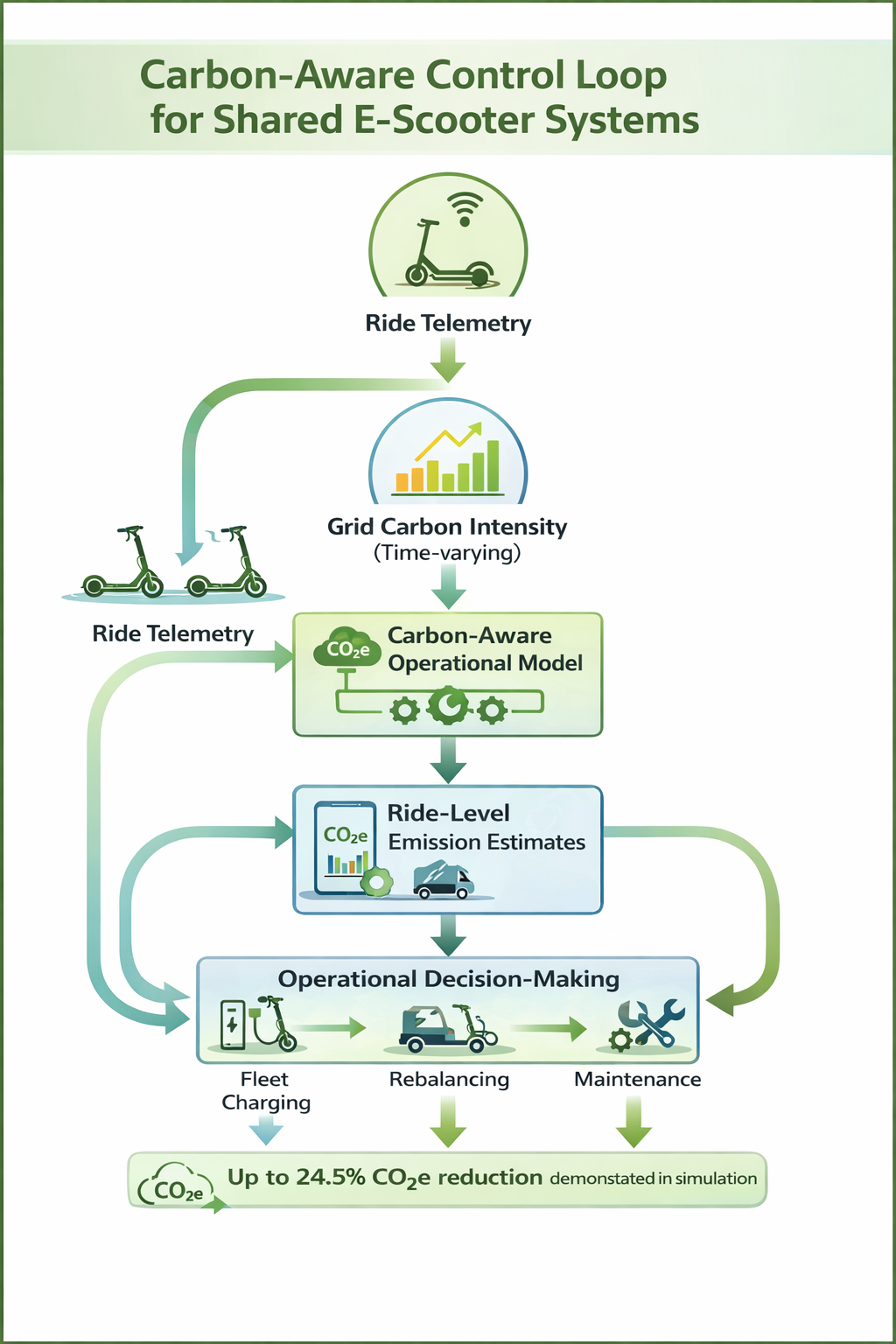
Shared electric scooters (e-scooters) are increasingly promoted as low-carbon urban mobility solutions due to their energy efficiency and zero tailpipe emissions. However, recent life cycle assessment (LCA) studies indicate that the environmental performance of shared e-scooter systems is highly sensitive to factors such as manufacturing processes, charging practices, fleet rebalancing operations, and limited vehicle lifetimes. Most existing assessments rely on static, average-based LCA models that fail to capture the influence of operational decisions and temporal variability. This study proposes a carbon-aware operational framework that reframes sustainability assessment in shared e-scooter systems as an operational decision-making problem. The framework integrates ride-level vehicle telemetry, temporally varying electricity grid carbon intensity, and dynamically allocated lifecycle impacts to estimate greenhouse gas emissions on a per-ride basis. These metrics are embedded into operational control processes to enable carbon-aware charging and rebalancing strategies. To support early validation, we simulate 1,000 urban e-scooter rides under both conventional and carbon-aware scenarios. Results show that ride-level GHG emissions can be reduced by 24.5% solely through improved charging schedules and optimized logistics—without changes in hardware or fleet size. This work offers a data-driven and algorithm-agnostic decision-support architecture that advances LCA from retrospective reporting to real-time environmental management in micro-mobility systems.
Keywords:
shared electric scooters
; micro-mobility
; life cycle assessment (LCA)
; ride-level emissions
; carbon-aware decision-making
; dynamic LCA
; sustainable operations
Copyright: This open access article is published under a Creative Commons CC BY 4.0 license, which permit the free download, distribution, and reuse, provided that the author and preprint are cited in any reuse.


