
Submitted:
04 February 2026
Posted:
05 February 2026
You are already at the latest version
Abstract
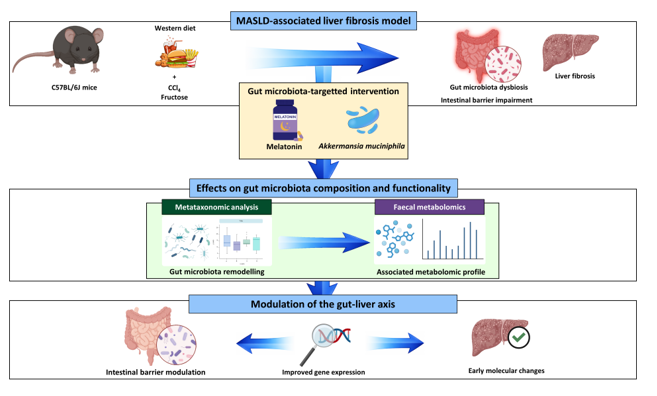
Metabolic dysfunction-associated steatotic liver disease (MASLD) is the most common cause of chronic liver disease worldwide. Fibrosis is the main prognostic factor and the last reversible stage before cirrhosis, yet therapeutic options remain limited. Given the strong contribution of gut dysbiosis to MASLD progression, strategies targeting the gut microbiota are of growing interest. This study aims to evaluate the effect of melatonin, a well-known antioxidant, anti-inflammatory and antifibrotic compound, and Akkermansia muciniphila, a next-generation probiotic, on a MASLD-associated liver fibrosis model. Eight-week-old C57BL/6J mice were fed with control or Western diet supplemented with fructose and intraperitoneal CCl₄ to induce liver fibrosis. After eight weeks, animals received either no intervention, melatonin, A. muciniphila, or both for four weeks. Serum biochemistry, liver histology and gut and liver gene expression were evaluated and multi-omic analyses were performed, including gut microbiota profiling and faecal metabolomics. Statistical analyses assessed intergroup differences and correlations across datasets. Both interventions partially restored gut microbiota composition and functionality and modulated hepatic and intestinal gene expression. Melatonin and A. muciniphila exerted protective effects against MASLD-associated fibrosis, which supports their potential as adjunctive therapeutic strategies to mitigate liver injury through modulation of the gut–liver axis.
Keywords:
gut microbiota
; Akkermansia muciniphila
; melatonin
; liver fibrosis
; MASLD
Copyright: This open access article is published under a Creative Commons CC BY 4.0 license, which permit the free download, distribution, and reuse, provided that the author and preprint are cited in any reuse.


