

Submitted:
03 February 2026
Posted:
04 February 2026
You are already at the latest version
Abstract
In many hospitality workplaces, customer deviant behaviour is no longer an occasional frustration but a routine part of frontline employees' day, steadily draining their energy, dignity and desire to deliver great service. Yet in sub-Saharan Africa, especially in Ghana, there is still limited evidence showing how this behaviour undermines employees' motivation and what can realistically be done inside organisations to buffer its impact. This study explored how mistreatment from customers affects the service motivation of frontline employees in Ghanaian hotels and examines whether supportive supervisors can act as a protective buffer. Using a quantitative cross-sectional survey of 508 frontline staff in licensed hotels in the Kumasi Metropolis, the study applies Partial Least Squares Structural Equation Modelling (PLS-SEM) to test these relationships. The findings reveal that when customers display deviant behaviour, employees feel less motivated to offer high-level service. On the other hand, strong supervisor emotional support uplifts service motivation and partially mediates the harm caused by deviant customers. These results show that everyday supervisory support (listening, empathizing, and standing up for staff) can make a tangible difference to how motivated employees feel after difficult customer encounters. The study therefore offers practical guidance for hotel managers who want to safeguard employees and sustain high service standards in demanding customer environments.
Keywords:
customer deviant behaviour
; frontline employee service motivation
; supervisor emotional support
; Ghana hospitality industry
1. Introduction
Over the past decade, Ghana's hospitality industry has undergone substantial expansion. It is driven by several factors, including the growth of domestic tourism, increasing international arrivals, and rising investment in the sector's value chain (Preko & Anyigba, 2024; Quansah et al., 2023). While this growth brings opportunities for socio-economic development, it has intensified the demands placed on frontline employees (Ampofo et al., 2022). This demand stems from confronting diverse customer expectations and deviant behaviour without sufficient and consistent supervisory support (Akosa et al., 2025; Ma et al., 2023).
Customer deviant behaviour is a critical challenge because it disrupts service encounters and threatens employees' emotional well-being and motivation (Abas et al., 2024). Because service quality in hospitality fundamentally depends on employees' emotional regulation, display of positive affect, and sustained interpersonal engagement, increased exposure to customer misbehaviour has direct implications for both service excellence and employee retention (Mistakis et al., 2025; Booyens et al., 2022; Özekici & Ünlüönen, 2022). Extant literature has documented that repeated encounters with hostile customers induce emotional exhaustion (Zhao et al., 2024; Gaspani, 2022; Pradhan, 2022), weaken employees' intrinsic motivation for performance, ultimately eroding their motivation to maintain service-oriented behaviours (Namin et al., 2022).
In the face of customer deviant behaviour, supervisor emotional support represents a vital organisational resource that can buffer the negative impact of customer misbehaviour. This is possible because supervisors play an essential role in helping employees interpret adverse customer interactions and regulate emotional responses (Anderson et al., 2025; Lamothe et al., 2021). Studies have shown that supportive supervision enhances employee resilience, mitigates work stressors, and sustains engagement even under adverse conditions (Nabawanuka & Ekmekcioglu, 2024; Meacham et al., 2023). When supervisors are perceived as empathetic, responsive, and approachable, employees are better equipped to manage challenging service interactions and maintain motivation (Kamran-Disfani et al., 2023).
Despite growing recognition of the importance of supervisory support, there remains limited empirical evidence examining its mediating role in the relationship between customer deviant behaviour and service motivation, particularly within the hospitality context. Existing research has tended to focus on these constructs independently, exploring customer misbehaviour (Tekmen & Kaptangil, 2022; Sarwar et al., 2021; Gong et al., 2020) or supervisor support (Cheng et al., 2022; Hwang et al., 2021; Eissa et al., 2020) without integrating them into a comprehensive explanatory framework. This conceptual and empirical gap restricts understanding of the mechanisms through which organisational support systems can buffer the detrimental consequences of customer deviance on employee motivation and performance outcomes.
Against the above background, the present study investigates how customer deviant behaviour influences frontline employees' service motivation and whether supervisor emotional support mediates this relationship within Ghana's hospitality industry. The study makes at least four key contributions. First, it extends hospitality and organisational behaviour literature to a sub-Saharan African context that remains underrepresented in empirical research, thereby generating insights grounded in Ghana's service environment. Second, it advances theory by conceptualising supervisor emotional support as a central mechanism that mitigates the negative outcomes of customer deviance. Third, it offers practical implications for hospitality management. It does so by underscoring the value of emotionally supportive supervisory practices in nurturing employee motivation. Fourth, the present study illuminates pathways through which hospitality organisations can strengthen employee resilience and motivation and sustain high-quality service delivery in the face of increasing customer-related challenges.
2. Theory and Hypotheses Development
2.1. Theoretical Framing
The Conservation of Resources (COR) theory was first introduced by Hobfoll (1989). The theory can be used to explain motivation in emotionally demanding environments (Chen et al., 2024). The theory posits that people are fundamentally driven to acquire, protect, and retain resources that are vital for effective functioning and well-being (Sonnentag & Meier, 2024). These resources encompass emotional energy, psychological resilience, social support, and relational stability, which are core elements that enable employees to cope with stressful service work (Sonnentag & Meier, 2024). According to Bardoel and Drago (2021), COR theory asserts that when individuals perceive a threat to or encounter resource loss, they experience diminished motivation. This theoretical perspective has been widely applied in organisational behaviour and hospitality research to explain employee reactions to emotionally taxing work conditions and customer-related stressors (Bardoel & Drago, 2021). A central principle of COR theory is that resource loss has a disproportionately greater psychological impact than resource gain (Liu, 2024). Therefore, negative experiences exert a stronger influence on emotional well-being and behavioural outcomes than positive or neutral events (Ye et al., 2022).
On the other hand, employees with limited resource reserves are more vulnerable to cumulative loss cycles, whereas those with access to supportive mechanisms such as social or supervisory support are better placed to stem these downward spirals (Fajri & Agbo, 2024). In service-intensive workplaces such as hospitality, customer interactions, emotional labour, and supervisor-employee relationships constitute key components of an employee's resource system (Sun et al., 2025). When these systems are strained, the capacity to maintain motivation for effective service delivery declines (Sun et al., 2025). From the COR theory perspective, customer deviance, expressed through verbal aggression, disrespect, or unreasonable demands, poses a direct threat to employees' emotional and psychological resources. We argue that frequent exposure to such behaviour drains emotional energy and gradually erodes intrinsic motivation to provide high-quality service. Moreover, COR theory emphasises the importance of resource replenishment and protective mechanisms that help individuals restore emotional balance after adverse experiences. Within this context, we also argue that supervisor emotional support functions as a critical resource-conserving mechanism for frontline hospitality staff. In this respect, supportive supervisors can offer empathy, validation, and guidance, helping employees reframe negative encounters, rebuild emotional reserves, and sustain their motivation despite frequent exposure to difficult customer interactions. COR theory, therefore, provides an appropriate conceptual framework for analysing the effects of customer deviant behaviour on frontline employees' service motivation within Ghana's hospitality sector.
2.2. Conceptual Review
Customer deviant behaviour refers to customer actions that intentionally or unintentionally violate social norms, organisational rules, or expected standards of conduct within service settings (Ahmadi et al., 2023). It encompasses behaviours such as verbal aggression, rudeness, excessive complaints, unreasonable demands, intimidation, and other disruptive actions that undermine orderly service delivery (Dootson et al., 2023). Mayr and Teller (2024) describe customer deviant behaviour as a form of interpersonal mistreatment that generates psychological strain for service employees by threatening dignity, fairness, and mutual respect in service encounters. Such behaviour is often unpredictable and can interfere with employees' emotional regulation, concentration, and task performance (Hu et al., 2022). In the hospitality industry, where frontline employees engage in frequent and emotionally intensive customer interactions, these deviant behaviours are particularly damaging (Mayr et al., 2022). Hotel establishments depend heavily on positive customer and employee exchanges. Therefore, deviant customer actions can disrupt service flow, increase emotional exhaustion, and erode employees' motivation to provide high-quality service (Ji et al., 2022).
Liewendahl and Heinonen (2020) characterise service motivation as the psychological energy and willingness employees bring to service interactions, shaping how they display empathy, patience, and emotional labour. Frontline employee service motivation denotes the internal drive or desire that compels frontline staff to deliver high quality service, demonstrate care toward customers, and engage positively in service encounters (Wang et al., 2021). It reflects an employee's intrinsic commitment to meeting customer needs and upholding service standards, even when facing demanding or stressful situations (Kim et al., 2021). In the hospitality industry, this form of motivation is especially critical because service provision depends largely on direct, real-time interactions between employees and customers (Chen & Peng, 2021). High levels of service motivation enable employees to remain courteous, responsive, and proactive, thereby enhancing guest satisfaction and strengthening organisational competitiveness (Waseem et al., 2021). Conversely, low service motivation diminishes service quality and can compromise the overall customer experience in this service-driven sector (Waseem et al., 2021).
Supervisor emotional support refers to a supervisor's capacity to provide empathy, understanding, and emotional reassurance when employees encounter stressful or challenging situations (Mohr et al., 2021). It involves acknowledging employees' feelings, offering comfort, and fostering a psychologically safe environment that helps employees manage emotional strain and feel valued (Uddin et al., 2023). Nielsen et al. (2023) further define supervisor emotional support as the provision of emotional resources such as encouragement, validation, and attentive listening that strengthen employees' resilience and well-being, particularly during difficult interpersonal encounters at work. In the hospitality settings, where frontline employees routinely interact with demanding or unpredictable customers, such support plays a stabilising role (Pohl et al., 2022). For instance, supportive supervisors help employees cope with the pressures of customer deviance, recover from negative encounters, and sustain the motivation required for consistent, high-quality service delivery (Shin et al., 2021)
2.3. Hypotheses Development
Empirical research consistently shows that customer deviant behaviour undermines frontline employees' emotional well-being and service motivation (Tekmen & Kaptangil, 2022). Behaviours such as verbal hostility, disrespect, and unreasonable demands generate substantial emotional strain, increase stress, and deplete the psychological resources necessary for sustained service performance (Hwang et al., 2021). Muhammad and Sarwar (2021) report that repeated exposure to such negative customer interactions diminishes employees' cognitive focus and emotional engagement, reducing their capacity to deliver high-quality service. Hu et al. (2020) further demonstrate that persistent mistreatment triggers withdrawal tendencies, emotional distancing, and reduced discretionary effort, indicating a decline in intrinsic service motivation. Additional evidence suggests that customer deviance erodes employees' positive affect, contributes to burnout, and heightens turnover intentions and counterproductive behaviours (Gong et al., 2020). Sarwar et al. (2021) confirm that customer deviant behaviour weakens frontline employee motivation, emotional stability, and service-oriented behaviour in hospitality contexts. Based on this evidence, we hypothesise that as follows. H1: There is a significant negative relationship between customer deviant behaviour and frontline employee service motivation in Ghana's hospitality industry.
Customer deviant behaviour has also been identified as a stressor shaping how frontline employees perceive their work environment, including their evaluation of supervisory emotional support (Zang et al., 2021). Encounters with rude, aggressive, or otherwise dysfunctional customer actions elicit strong negative emotional reactions such as frustration, anxiety, and emotional exhaustion (Xiao et al., 2022). As these emotional demands accumulate, employees may experience reduced cognitive and emotional capacity to recognise or fully appreciate supportive behaviours from supervisors (Xiao et al., 2022). Chen and Wu (2022) indicate that employees who frequently confront deviant customers are more likely to feel overwhelmed, which can distort or dampen their perceptions of supervisory support. Eissa et al. (2020) argue that heightened stress stemming from customer deviance can lead employees to view even genuine supervisory efforts as inadequate or misaligned with their needs. Similarly, Cheng et al. (2022) find that the emotional labour required to manage dysfunctional customer interactions can weaken employees' trust in supervisors' ability to offer appropriate emotional support. This strain has been linked to increased frustration and a greater tendency to interpret supervisory actions negatively, especially when support is perceived as delayed, inconsistent, or insufficient (Hwang et al., 2021; Zang et al., 2021; Fan et al., 2022). Based on these findings, the following hypothesis emerges. H2: There is a significant negative relationship between customer deviant behaviour and supervisor emotional support.
Supervisor emotional support provides a crucial psychological resource that enhances employees' resilience, stabilizes their emotional states, and strengthens their motivation to remain engaged in service activities (Liu et al., 2024; Öksüz et al., 2023). Santos et al. (2023) show that supportive supervisors increase service motivation by demonstrating empathy, acknowledging employee challenges, and creating an environment in which employees feel respected and understood. Such behaviours facilitate emotional regulation and enable employees to manage stressful customer encounters without experiencing a decline in motivation (Santos et al., 2023). Song et al. (2021) further find that supervisor emotional support promotes psychological detachment from work-related stressors, reducing the emotional burden associated with customer mistreatment and sustaining employees' service motivation. Supportive supervisory relationships also foster alignment with organisational goals by cultivating a climate of trust and mutual respect, which further enhances motivation and commitment to service performance (Alzgool et al., 2023). This evidence leads us to propose the following hypothesis. H3: There is a significant positive relationship between supervisor emotional support and frontline employees' service motivation in Ghana's hospitality industry.
Research also suggests that supervisor emotional support can act as a mediating mechanism in the relationship between customer deviant behaviour and employees' motivational outcomes. Dar and Rehman (2022) show that higher levels of perceived supervisory support alleviate the negative emotions elicited by dysfunctional customer interactions, thereby helping employees sustain their motivation to deliver quality service. Similarly, Han et al. (2021) identify a positive association between perceived supervisor support and intrinsic motivation, indicating that supportive supervisory practices bolster employees' resilience in the face of customer mistreatment. Bani-Melhem et al. (2021) find that supervisory emotional support buffers employee stress despite customer misbehaviour. Chen and Wu (2022) demonstrate that supervisor emotional support mediates the relationship between customer mistreatment and employee service behaviour, highlighting its role in shaping employees' emotional and behavioural responses. Irshad et al. (2021) further underscore how emotional strain resulting from negative supervisory behaviours can foster deviant workplace outcomes, also reinforcing the importance of supportive supervision as a protective factor. Dar and Rahman (2022) similarly confirm the buffering role of supervisor emotional support in reducing the impact of interactional injustice on frontline staff. As a result of this evidence, we hypothesise that H4: Supervisor emotional support mediates the relationship between customer deviant behaviour and frontline employees' service motivation.
2.4. Conceptual Framework
Figure 1 presents the research model reflecting the potential associations. It posits that customer deviant behaviour significantly weakens the service motivation of frontline employees. As such, we predict that supervisor emotional support will strengthen employees' service motivation and partially mediate the influence of customer deviant behaviour, suggesting that supportive leadership can mitigate the motivational impoverishment from rude or uncivil customers in hotel settings.
4. Methodology
The present study is based on the positivist research philosophy. This philosophical approach posits that, as in natural sciences, social phenomena can be objectively observed and measured by empirical techniques (Avci, 2024; Shar, 2024). Based on this view, we used the quantitative approach to statistically test the proposed relationships among customer deviant behaviour, frontline employee motivation and supervisory emotional support. In terms of design, we used the cross-sectional explanatory survey to collect data at a single point in time (Hunziker & Blankenagel, 2024; Escandallo & Baradillo, 2024). The study site was the Kumasi Metropolis, in the Ashanti region. The region is one of the fastest-growing tourism centres in Ghana, with Kumasi having the largest concentration of hotels (Ghana Tourism Authority, 2024). The target population was front office staff in the registered hotels in Kumasi Metropolis. The sample frame was developed from the Directory of Licensed Enterprises provided by the Ghana Tourism Authority, and only those that fell within the official sub-metro boundaries of Kumasi Metropolitan Assembly were included.
In 2024, the total number of licensed hotels operating in Kumasi is about three thousand one hundred and twelve (3,112) (Ghana Tourism Authority, 2024). Staff rosters in each hotel were obtained from management. This list served as the sampling frame for the selection of eligible frontline employees. The minimum sample size was determined using Cochran's formula for large populations, which yielded an initial estimate of 286 respondents. Because the study employed a multistage sampling technique, a design effect of 1.60 was applied, increasing the required sample to approximately 457 participants (Bujan, 2021). To accommodate a projected non-response rate of 10 per cent, this figure was further adjusted by dividing by 0.90, resulting in a final target sample size of about 509 participants (457.6 ÷ 0.90 = 508.4), which was rounded to 508 for this study. For this study, data were collected from frontline hotel employees. We used a structured, self-administered questionnaire specifically developed for this study. The instrument consisted of four sections. Section A captured demographic information, Section B measured customer deviant behaviour, Section C assessed frontline employee service motivation, and Section D examined supervisors' emotional support. Participants rated each item on a six-point Likert scale ranging from 1 (strongly disagree) to 6 (strongly agree). The data were then analysed using Partial Least Squares Structural Equation Modelling (PLS SEM) with SmartPLS version 4.1.
3. Results
3.1. Demographics
The demographic figures in Table 1 suggest a relatively youthful workforce. In terms of education, most respondents were well qualified. The figures point to a generally highly educated employee base. Employment histories showed a strong mix of both experienced and relatively new staff. Employment status seems evenly distributed. About 35% are engaged on full-time renewable contracts, 32.9% in full-time permanent positions, and 32.5% working part-time, highlighting varied forms of job engagement in the sector. Regarding hotel characteristics, illustrate a strong presence of medium and large operations in the metropolis.
3.2. Construct Validity
The factor loadings (see Table 2) suggest construct validity for all three latent variables. Each item loads clearly on its intended construct, with all values above the commonly recommended minimum of 0.70, which points to adequate indicator reliability (Bujang, 2021). Customer deviant behaviour items loaded between 0.713 and 0.857, supervisor emotional support shows loadings, ranging from 0.760 to 0.877, service motivation has loadings between 0.764 and 0.907, suggesting that the items work together well to capture the core features of the motivation construct. These figures indicate that the items consistently tap into the same underlying concept and support good convergent validity.
3.3. Reliability and Convergent Validity
The reliability and convergent validity results are displayed in Table 3. The results indicate that all constructs are measured with satisfactory quality. Cronbach's Alpha values for customer deviant behaviour (0.824), frontline employees' service motivation (0.852), and supervisor emotional support (0.840) are all above the commonly accepted threshold of 0.70, which points to strong internal consistency among the items (SPSSanalysis, 2025). The composite reliability estimates (rho_a and rho_c), which range from 0.839 to 0.901, further support the reliability of the scales by showing that the indicators for each construct hang together well. The AVE values of 0.656, 0.695, and 0.677 all exceed the recommended minimum of 0.50, suggesting adequate convergent validity and indicating that each construct explains a substantial share of the variance in its indicators.
3.4. Discriminant Validity Using Heterotrait-Monotrait Ratio (HTMT)
The HTMT results in Table 4 indicate that discriminant validity is well established among the three constructs. All HTMT values fall below the conservative threshold of 0.85, demonstrating that each construct is empirically distinct from the others. The HTMT ratios between frontline employees' service motivation and customer deviant behaviour (0.514), supervisor emotional support and customer deviant behaviour (0.441), and supervisor emotional support and service motivation (0.794) confirm that no construct exhibits excessive overlap. These values demonstrate that the indicators measure conceptually different phenomena, thereby supporting the adequacy of the measurement model's discriminant validity.
3.5. R-Square Statistics
The R-square results in Table 5 indicate the proportion of variance in the endogenous constructs explained by customer deviance in PLS SEM applications. R2 is interpreted as the proportion of variance in an endogenous construct explained by its predictors, with values around 0.50 often described as substantial in many social science contexts (Frost, 2025; Fernando, 2025). The R2 values (see Table 5) describe how much Variance in the endogenous constructs is explained by customer deviant behaviour. The R2 of 0.503 for service motivation means that customer deviant behaviour accounts for over 50% of the variation in employee motivation. This means customer deviant behaviour has substantial explanatory power for motivation within the model (Frost, 2025; Fernando, 2025). By contrast, the R2 of 0.139 for supervisor emotional support shows that customer deviant behaviour explains about 13.9% of the Variance in supervisory support, which is modest but still meaningful in practical terms (Frost, 2025; Fernando, 2025). Taken together, these results suggest that customer deviant behaviour is an important predictor, especially for frontline employees' service motivation.
3.6. Effect Size (F2)
The findings in Table 6 illustrate the effect size (F2), which reflects how meaningful relationships are. Using standard guidelines provided by Cohen, where 0.01 = small, 0.09 = medium, 0.25 = large, the effect size of customer deviant behaviour on frontline employees' service motivation (F2 = 0.079) can be regarded as small (see Table 6). This means that difficult customer encounters do influence motivation, but only to a limited degree on their own. The effect on supervisors' emotional support (F2 = 0.161) is moderate (see Table 6), indicating that frequent deviant behaviour from customers may noticeably shape how supervisors respond and support their staff. By far the strongest relationship is from supervisors' emotional support to frontline employees' service motivation (F2 = 0.626) (see Table 6). This means that supervisors' support makes a substantial difference to how motivated employees feel to keep delivering good service despite challenging customers
3.7. Collinearity Statistics
The VIF values reported in Table 7 indicate that multicollinearity is not a concern within the measurement model. All items demonstrate VIF values well below the commonly accepted threshold of 5.0, with the highest value being 2.784 for MOT2. These results show that the indicators do not exhibit problematic overlap and each contributes uniquely to its respective construct. Overall, the VIF statistics confirm that the model meets collinearity requirements, supporting the stability and reliability of the structural estimates.
3.8. Inferential Statistics
The results (see Figure 2 and Table 8) indicate strong and statistically significant relationships among all variables in the proposed model. First, a significant negative effect was found between customer deviant behaviour and frontline employees' service motivation (B = –0.213, t = 4.961, p = 0.000), meaning that higher levels of customer deviant behaviour are associated with lower service motivation. Thus, H1 was supported. Second, customer deviant behaviour significantly and negatively predicted supervisor emotional support (B = –0.373, t = 8.261, p = 0.000), indicating that frontline employees experiencing deviant customer actions also perceive lower levels of supervisory emotional support. Therefore, H2 was supported.
Third, supervisor emotional support showed a positive and significant effect on frontline employees' service motivation (B = 0.601, t = 16.246, p = 0.000), demonstrating that supportive supervisors substantially enhance employees' motivation. Hence, H3 was supported. Finally, the mediation test revealed a significant indirect effect of customer deviant behaviour on service motivation through supervisor emotional support (B = –0.224, t = 7.324, p = 0.000). This confirms that customer deviant behaviour reduces service motivation partly because it diminishes emotional support from supervisors. Thus, H4 was supported.
4. Discussion
Our results show that customer deviant behaviour has a clear damaging impact on frontline employees' service motivation (B = –0.213, p < 0.001). This finding is consistent with studies showing that hostility, disrespect, and unreasonable customer demands create emotional strain that weakens employees' psychological resources, leaving them feeling worn down and less driven to serve (Tekmen & Kaptangil, 2022; Hwang et al., 2021). For Muhammad and Sarwar (2021), persistent mistreatment disrupts cognitive focus and emotional engagement, and repeated negative encounters often lead to emotional withdrawal and burnout. On the other hand, lower discretionary effort at work (Hu et al., 2020; Gong et al., 2020). Taken together, these patterns suggest that customer deviant behaviour gradually erodes frontline employees' intrinsic service motivation in hospitality settings (Sarwar et al., 2021). Viewed through the lens of COR theory, this finding reflects the cumulative impact of ongoing resource loss: employees must expend emotional energy to manage deviant customers, which depletes key psychological resources over time. COR theory stresses that resource loss is more harmful than resource gain and that prolonged depletion undermines people's ability to invest in work goals. In this context, customer deviance operates as a resource-draining stressor that directly undermines employees' capacity to sustain high levels of service motivation. Therefore, our negative empirical relationship fits well with COR's core proposition that depleted resources eventually translate into reduced motivation and performance.
The findings also show that customer deviant behaviour significantly lowers employees' perceptions of supervisor emotional support (B = –0.373, p < 0.001). This finding resonates with evidence that aggressive or dysfunctional customers trigger strong negative reactions such as frustration, anger, and anxiety, which can distort how employees see their broader work environment (Xiao et al., 2022; Zang et al., 2021). The problem is that when emotional strain intensifies, employees may struggle to notice or appreciate supportive gestures from their supervisors (Chen & Wu, 2022). Research further suggests that overwhelmed employees often judge supervisory efforts as insufficient (Eissa et al., 2020) and can lose confidence in management's ability to provide adequate emotional backing (Cheng et al., 2022). This strain feeds into more negative evaluations of supervisory behaviour, especially when support seems delayed or uneven (Fan et al., 2022; Hwang et al., 2021). From a COR perspective, this pattern illustrates how resource depletion can cloud the perception of resource availability. As customer deviant behaviour drains emotional resources, employees enter a state of heightened vulnerability. COR theory indicates that individuals experiencing high levels of resource loss become more sensitive to further losses and less able to recognise potential gains. In such circumstances, even genuine emotional support from supervisors may be perceived as inadequate because employees' resource reservoirs are already severely depleted. Customer deviant behaviour, therefore, not only exhausts resources directly, but also undermines the perceived effectiveness and availability of secondary resources such as supervisor emotional support, which is consistent with the observed empirical pattern.
At the same time, the data show that supervisor emotional support has a strong and positive effect on frontline employees' service motivation (B = 0.601, p < 0.001). This supports a growing body of work demonstrating that supportive supervisors provide crucial psychological resources, including empathy, encouragement, and emotional reassurance, which help employees remain resilient and engaged in their service roles (Liu et al., 2024; Öksüz et al., 2023). Santos et al. (2023) report that employees who feel understood and valued by their supervisors tend to show higher levels of service motivation, because such support helps them regulate emotions during stressful customer encounters. Similarly, Song et al. (2021) argue that supervisor support enables employees to psychologically detach from customer-related stressors, which prevents emotional overload and sustains their motivation. Alzgool et al. (2023) add that supportive supervisory relationships strengthen trust and deepen employees' commitment to delivering high-quality service. These observations align closely with COR Theory, which emphasises the importance of resource-replenishing mechanisms to offset emotional depletion. In this framework, supervisor emotional support acts as a vital replenishing resource that restores emotional energy, reduces vulnerability to further loss, and maintains employees' willingness to invest effort in service delivery. The strong positive effect observed in the study, therefore, fits well with COR's expectation that access to supportive relationships can preserve and even enhance frontline service motivation in demanding hospitality environments.
Finally, the mediation analysis shows that supervisor emotional support significantly transmits the effect of customer deviant behaviour onto frontline employees' service motivation (B = –0.224, p < 0.001). This suggests that part of the decline in motivation occurs because customer mistreatment undermines how much emotional support employees feel they receive from their supervisors. This result is in line with studies highlighting the buffering role of supportive supervision. For example, Dar and Rehman (2022) find that supervisor support can dampen negative emotions that arise from dysfunctional customer interactions, helping employees hold on to their motivation. Han et al. (2021) similarly show that supportive supervisors strengthen employees' resilience in the face of customer mistreatment, which, in turn, boosts intrinsic motivation. Work by Bani-Melhem et al. (2021) indicates that emotional support from supervisors can soften the stress associated with customer sabotage, making it easier for employees to stay engaged. Chen and Wu (2022) also document that supervisor support mediates the link between customer mistreatment and deviant responses, underscoring its pivotal role in shaping outcomes. Interpreted through COR theory, the mediation effect illustrates how supervisor emotional support functions as a resource-restoring mechanism: while customer deviant behaviour drains emotional resources, supportive supervision helps replenish them, thereby limiting the loss of motivation. The significant mediation thus aligns with COR's central idea that access to replenishing resources reduces the impact of resource-depleting stressors and helps employees maintain their motivation in challenging work environments.
5. Conclusions
We explored how customer deviant behaviour affects frontline employees' service motivation and the crucial mediating role of supervisor emotional support, with a specific focus on Ghana's hospitality industry. The evidence showed that deviant customer behaviour significantly undermines employees' motivation. This is consistent with the idea that hostile or disrespectful encounters drain emotional and psychological resources that are needed to stay engaged in service work. The findings further indicated that customer deviant behaviour reduces employees' perceptions of supervisor emotional support. This suggests that emotional strain from mistreatment can distort how staff interpret their supervisors' intentions and efforts. At the same time, supervisor emotional support emerged as a strong positive predictor of service motivation and a significant mediator, showing that supportive supervisors can meaningfully cushion the motivational damage caused by difficult customers. Interpreted through conservation of resources theory, the results provide empirical support for the view that resource loss triggered by customer deviance can be offset by replenishing resources, such as emotional backing from supervisors, underscoring the value of relational and emotional resources in sustaining motivation in high-contact service settings. Taken together, the study adds to both theory and practice by clarifying how customer deviant behaviour erodes service motivation and by demonstrating the protective role of supportive supervision; for hospitality organisations in Ghana, investing in emotionally supportive supervisory practices and systems that protect employees from customer mistreatment is therefore vital for employee well-being, service quality, and long-term organisational sustainability.
Based on these findings, several practical recommendations were proposed. First, because customer deviant behaviour significantly reduces frontline employees' service motivation, hotel management should reinforce mechanisms to minimise customer misconduct. This can be achieved, for example, by establishing clear behavioural guidelines for guests, strengthening complaint-handling procedures, and empowering staff to report or manage abusive incidents in a safe and structured way. These measures can help shield employees from hostile encounters that sap their energy and drive. Second, since customer deviant behaviour also undermines employees' perceptions of supervisor emotional support, supervisors need targeted training to build emotional intelligence, empathy, and responsive communication skills so that they can offer reassurance, understanding, and practical assistance even during high-stress customer situations. Third, given the strong positive effect of supervisor emotional support on service motivation, hotels should institutionalise supportive leadership by embedding emotional support in performance appraisals, leadership development programmes, and everyday managerial routines, ensuring that encouragement and guidance are not left to individual discretion alone. Finally, because the mediation analysis showed that customer deviant behaviour lowers motivation partly by eroding perceived supervisory support, human resource departments should introduce formal support structures such as regular debriefing sessions after difficult customer incidents, access to counselling, and stress-management initiatives; such systems can help frontline employees process negative experiences and maintain their motivation over time.
As with any research, the study has some limitations that readers should keep in mind. First, the focus on registered hotels within the Kumasi Metropolis means that the findings may not fully capture conditions in other parts of Ghana or in different types of hospitality operations, where customer profiles, organisational cultures, and management practices may differ. This geographic and sectoral concentration, therefore, limits the extent to which the results can be generalised beyond the study context. Second, the exclusive use of a quantitative approach is another limitation. While it enabled robust statistical testing of relationships among customer deviant behaviour, supervisor emotional support, and service motivation, it could not fully uncover the nuanced emotions, personal narratives, and coping strategies that employees draw on when facing deviant customers. In addition, the reliance on self-reported questionnaires introduces potential biases, such as social desirability, recall errors, and subjective interpretation of items, which may be especially relevant for sensitive topics like abusive customer behaviour or perceived lack of support. Finally, the cross-sectional design restricts the ability to infer causality or track changes over time, as it does not show how patterns of customer deviance, supervisory support, and motivation evolve as workplace dynamics shift if a longitudinal study were undertaken.
These limitations open up several useful directions for future research. First, broadening the geographical and industry scope by including multiple regions in Ghana or different types of service settings could improve the generalisability of findings and reveal important contextual differences in customer deviant behaviour and employee responses. Comparative studies across regions, hotel categories, or even other service sectors might show how cultural norms, organisational policies, or labour market conditions shape the impact of deviant customers and the effectiveness of supervisory support. Second, incorporating qualitative or mixed-method designs would allow researchers to capture richer accounts of employees' emotional experiences, sense-making, and coping mechanisms; interviews or focus groups could surface aspects of strain, resilience, and meaning that survey items cannot fully convey. Third, future work could reduce the limitations of self-report data by triangulating with alternative sources, such as supervisor ratings, customer feedback, or observational data on customer–employee interactions, thereby strengthening the validity of behavioural measures. Lastly, adopting longitudinal designs would enable scholars to follow employees over time, providing stronger grounds for causal inference and offering insight into how customer behaviour, supervisory support, and service motivation shift across different seasons, organisational changes, or economic conditions in the hospitality industry.
Author Contributions
Conceptualization, M.B., D.YD. and D.C.; methodology, H M.B., D.YD. and D.C; software, M.B., D.YD. and D.C; validation, M.B., D.YD. and D.C.; formal analysis, M.B., D.YD. and D.C; M.B., D.YD. and D.C; resources, M.B., D.YD. and D.C; data curation,M.B; writing—original draft preparation, M.B; writing—review and editing, D.YD.; visualization, M.B.; supervision, D.YD. and D.C; project administration, D.Y.D; funding acquisition, D.Y.D. All authors have read and agreed to the published version of the manuscript.
Funding
No specific grants were received for the research.
Institutional Review Board Statement
“The study was conducted in accordance with the Declaration of Helsinki and approved by the Ethics Committee of Faculty of Management Sciences, Central University of Technology, Free State, South (FMSEC201222 on 4th March 2025).”.
Informed Consent Statement
“Informed consent was obtained from all subjects involved in the study.”.
Data Availability Statement
The datasets for the current study are not publicly available due to confidentiality agreements with research participants but are available from the corresponding author upon reasonable re-quest.
Acknowledgments
This paper is based on the primary data collected during first author’s unpublished PhD thesis titled “The impact of abusive customer behaviour on the customer-oriented behaviours of frontline hotel employees in Ghana: the mediated moderation effects of employee alienation and perceived supervisor support”.
Conflicts of Interest
We have no known competing financial interests or personal relationships that could influence the work reported in this paper.
References
- Abas, B.; Iqbal, S.; Bukhari, S.; Villivalam, S.; Khan, M. A retrospective of workplace deviance in hospitality: a two-tier literature review. Vision 2024, 09722629231220990. [Google Scholar] [CrossRef]
- Ahmadi Alvar, Z.; Feiz, D.; Modarresi, M. The meta-analysis of organisational deviant behaviours research: past, present, and future. International Journal of Organizational Analysis 2023, 31(7), 3436–3478. [Google Scholar] [CrossRef]
- Akosa, F.; Huang, S.; Ali Abadi, H.; Wen, J. Unveiling hotel career beliefs among frontline employees in Ghana: a social constructivist approach. Current Issues in Tourism 2025, 1–30. [Google Scholar] [CrossRef]
- Alzgool, M.; AlMaamari, Q.; Mozammel, S.; Ali, H.; Imroz, S. M. Abusive supervision and individual, organisational citizenship behaviour: Exploring the mediating effect of employee well-being in the hospitality sector. Sustainability 2023, 15(4), 2903. [Google Scholar] [CrossRef]
- Ampofo, E. T.; Owusu, J.; Coffie, R. B.; Asiedu-Appiah, F. Work engagement, organisational embeddedness, and life satisfaction among frontline employees of star-rated hotels in Ghana. Tourism and Hospitality Research 2022, 22(2), 226–240. [Google Scholar] [CrossRef]
- Andersen, L. P.; Pihl-Thingvad, J.; Andersen, D. R. How Superiors Support Employees to Manage Emotional Demands: A Qualitative Study. International Journal of Environmental Research and Public Health 2025, 22(5), 670. [Google Scholar] [CrossRef]
- Avcı, A. B. Exploring quantitative analysis of thermal comfort in architecture as a positivist research paradigm . In Architecture Applications; Dal, M., Ed.; Bidge Publications, 2024; pp. 5–32. [Google Scholar] [CrossRef]
- Bani-Melhem, S.; Quratulain, S.; Al-Hawari, M. A. Does employee resilience exacerbate the effects of abusive supervision? A study of frontline employees' self-esteem, turnover intention, and innovative behaviors. Journal of Hospitality Marketing & Management 2021, 30(5), 611–629. [Google Scholar] [CrossRef]
- Bardoel, E. A.; Drago, R. Acceptance and strategic resilience: An application of conservation of resources theory. Group & Organization Management 2021, 46(4), 657–691. [Google Scholar] [CrossRef]
- Booyens, I.; Hadjisolomou, A.; Nickson, D.; Cunningham, T.; Baum, T. 'It's not a big deal': customer misbehaviour and social washing in hospitality. International Journal of Contemporary Hospitality Management 2022, 34(11), 4123–4141. [Google Scholar] [CrossRef]
- Bujang, M. A. A Step-by-Step Process on Sample Size Determination for Medical Research. The Malaysian journal of medical sciences: MJMS 2021, 28(2), 15–27. [Google Scholar] [CrossRef]
- Chen, G.; Wang, J.; Huang, Q.; Sang, L.; Yan, J.; Chen, R.; Ding, H. Social support, psychological capital, multidimensional job burnout, and turnover intention of primary medical staff: a path analysis drawing on conservation of resources theory. Human resources for health 2024, 22(1), 42. [Google Scholar] [CrossRef]
- Chen, S. W.; Peng, J. C. Determinants of frontline employee engagement and their influence on service performance. The International Journal of Human Resource Management 2021, 32(5), 1062–1085. [Google Scholar] [CrossRef]
- Chen, Y. C.; Wu, C. The relationship between customer mistreatment and workplace deviance: mediating and moderating effects. European Journal of Work and Organizational Psychology 2022, 31(6), 830–841. [Google Scholar] [CrossRef]
- Cheng, P.; Jiang, J.; Xie, S.; Liu, Z. Dysfunctional customer behavior influences on employees' emotional labor: The moderating roles of customer orientation and perceived organisational support. Frontiers in Psychology 2022, 13, 966845. [Google Scholar] [CrossRef]
- Cronbach, L. J. Coefficient alpha and the internal structure of tests. Psychometrika 1951, 16(3), 297–334. [Google Scholar] [CrossRef]
- Dar, N.; Rahman, W. Interactional justice and deviant workplace behavior: The mediating role of perceived supervisor support in hotel industry of KP-Pakistan. Journal of Entrepreneurship, Management, and Innovation 2022, 4(1), 149–166. [Google Scholar] [CrossRef]
- Dootson, P.; Greer, D. A.; Letheren, K.; Daunt, K. L. Reducing deviant consumer behaviour with service robot guardians. Journal of Services Marketing 2023, 37(3), 276–286. [Google Scholar] [CrossRef]
- Eissa, G.; Lester, S. W.; Gupta, R. Interpersonal deviance and abusive supervision: The mediating role of supervisor negative emotions and the moderating role of subordinate organisational citizenship behavior. Journal of Business Ethics 2020, 166(3), 577–594. [Google Scholar] [CrossRef]
- Escandallo, J. C.; Baradillo, D. A sequential explanatory approach on the relationship between social literacy and student engagement as mediated by English speaking skills. In EPRA International of Multidisciplinary Research (IJMR); 2024. [Google Scholar] [CrossRef]
- Fajri, A.; Agbo, A. A. A systematic literature review of innovative work behavior in conservation of resources theory. Economics and Business International Conference Proceeding 2024, Vol. 1(No. 2), 605–615. Available online: http://103.97.100.158/index.php/EBiC/article/view/472.
- Fan, L.; Zhou, X.; Ren, J.; Ma, J.; Yang, Y.; Shao, W. A self-regulatory perspective on the link between customer mistreatment and employees' displaced workplace deviance: the buffering role of mindfulness. International Journal of Contemporary Hospitality Management 2022, 34(7), 2704–2725. [Google Scholar] [CrossRef]
- Fernando, J. R-Squared: Definition, Calculation, and Interpretation. 2025. Available online: https://www.investopedia.com/terms/r/r-squared.asp.
- Fornell, C.; Larcker, D. F. Evaluating Structural Equation Models with Unobservable Variables and Measurement Error. Journal of Marketing Research 1981, 18(1), 39–50, (Original work published 1981). [Google Scholar] [CrossRef]
- Frost, J. How to Interpret Regression Models that have Significant Variables but a Low R-squared. 2025. Available online: https://statisticsbyjim.com/regression/low-r-squared-regression/.
- Gaspani, F. Dealing with client misbehaviour in high-end hotels: guest-centred service and frontline workers' tactics. International Journal of Work Organisation and Emotion 2022, 13(2), 120–136. [Google Scholar] [CrossRef]
- Gong, T.; Wang, C. Y.; Lee, K. The consequences of customer-oriented constructive deviance in luxury-hotel restaurants. Journal of Retailing and Consumer Services 2020, 57, 102254. [Google Scholar] [CrossRef]
- Han, Y.; Kim, Y.; Hur, W. M. The effects of perceived supervisor incivility on child-care workers' job performance: The mediating role of emotional exhaustion and intrinsic motivation. Current Psychology 2021, 40(4), 1979–1994. [Google Scholar] [CrossRef]
- Henseler, J.; Ringle, C.M.; Sarstedt, M. A new criterion for assessing discriminant validity in variance-based structural equation modeling. Journal of the Academy of Marketing Science 2015, 43, 115–135. [Google Scholar] [CrossRef]
- Hobfoll, S. E. Conservation of resources: a new attempt at conceptualising stress. American psychologist 1989, 44(3), 513. [Google Scholar] [CrossRef]
- Hu, H. H. H. S.; Lai, H. S. H.; King, B. Restaurant employee service sabotage and customer deviant behaviors: The moderating role of corporate reputation. Journal of Hospitality & Tourism Research 2020, 44(7), 1126–1152. [Google Scholar] [CrossRef]
- Hu, J.; Ma, X.; Xu, X.; Liu, Y. Treat for affection? Customers' differentiated responses to pro-customer deviance. Tourism Management 2022, 93, 104619. [Google Scholar] [CrossRef]
- Hunziker, S.; Blankenagel, M. Cross-sectional research design. In Research design in business and management: A practical guide for students and researchers; Springer Fachmedien Wiesbaden: Wiesbaden, 2024; pp. 187–199. [Google Scholar] [CrossRef]
- Hwang, J.; Yoo, Y.; Kim, I. Dysfunctional customer behavior, employee service sabotage, and sustainability: can social support make a difference? International journal of environmental research and public health 2021, 18(7), 3628. [Google Scholar] [CrossRef] [PubMed]
- Irshad, M.; Hussain, M.; Qureshi, M. A. Abusive supervision: A cataylist for the employee deviance work behavior. Reviews of Management Sciences 2021, 3(2), 114–130. [Google Scholar] [CrossRef]
- Ji, Y.; Xu, X.; Ji, J. Feeling good and doing more: How does the customer respond to pro-customer deviance in the context of hospitality. Frontiers in Psychology 2022, 13, 1025210. [Google Scholar] [CrossRef] [PubMed]
- Joynt, G. M.; Gopalan, P. D.; Argent, A.; Chetty, S.; Wise; et al. The critical care society of Southern Africa consensus statement on ICU triage and rationing (ConICTri). Southern African Journal of Critical Care (Online) 2019, 35(1), 36–52. [Google Scholar] [CrossRef]
- Kamran-Disfani, O.; Bagherzadeh, R.; Bhattarai, A.; Farhang, M.; Scheer, L. K. Constructive resistance in the frontlines: how frontline employees' resistance to customer incivility affects customer observers. Journal of Service Research 2023, 26(4), 560–577. [Google Scholar] [CrossRef]
- Kim, M.; Koo, D. W.; Han, H. S. Innovative behavior motivations among frontline employees: The mediating role of knowledge management. International Journal of Hospitality Management 2021, 99, 103062. [Google Scholar] [CrossRef]
- Lamothe, J.; Geoffrion, S.; Couvrette, A.; Guay, S. Supervisor support and emotional labor in the context of client aggression. Children and youth services review 2021, 127, 106105. [Google Scholar] [CrossRef]
- Liewendahl, H. E.; Heinonen, K. Frontline employees' motivation to align with value propositions. Journal of Business & Industrial Marketing 2020, 35(3), 420–436. [Google Scholar] [CrossRef]
- Liu, H. Uncovering the mediating role of resilience between EFL teacher turnover intention and well-being: A conservation-of-resources theory perspective. System 2024, 124, 103394. [Google Scholar] [CrossRef]
- Liu, X.; Mao, J. Y.; Ni, D.; Quan, J.; Zheng, X. The Impacts of Supervisor Support on Employee Service Performance: A Change Perspective. Journal of Service Research 2024, 10946705241297298. [Google Scholar] [CrossRef]
- Ma, X.; Xu, X.; Hu, J. Does pro-customer behavior always do the trick? An investigation of pro-customer deviance. International Journal of Hospitality Management 2023, 114, 103552. [Google Scholar] [CrossRef]
- Mayr, K.; Teller, C. Channel-switching behaviour and customer deviance. International Journal of Retail & Distribution Management 2024, 52(10/11), 1073–1091. [Google Scholar] [CrossRef]
- Mayr, K.; Schwendtner, T.; Teller, C.; Gittenberger, E. Unethical customer behaviour: causes and consequences. International Journal of Retail & Distribution Management 2022, 50(13), 200–224. [Google Scholar] [CrossRef]
- Meacham, H.; Tham, T. L.; Holland, P.; Bartram, T.; Halvorsen, B. The role of high-involvement work practices, supervisor support and employee resilience in supporting the emotional labour of frontline nurses. The InTernaTIonal Journal of human resource managemenT 2023, 34(4), 745–767. [Google Scholar] [CrossRef]
- Mitsakis, F.; Hadjisolomou, A.; Kouki, A. Customer abuse and harassment in the hospitality industry: the immersion of an everyday workplace crime. Current Issues in Tourism 2025, 28(2), 182–202. [Google Scholar] [CrossRef]
- Mohr, C. D.; Hammer, L. B.; Brady, J. M.; Perry, M. L.; Bodner, T. Can supervisor support improve daily employee well-being? Evidence of supervisor training effectiveness in a study of veteran employee emotions. Journal of Occupational and Organizational Psychology 2021, 94(2), 400–426. [Google Scholar] [CrossRef]
- Muhammad, L.; Sarwar, A. When and why organisational dehumanisation leads to deviant work behaviors in hospitality industry. International Journal of Hospitality Management 2021, 99, 103044. [Google Scholar] [CrossRef]
- Nabawanuka, H.; Ekmekcioglu, E. B. Understanding the link between supervisor and co-worker support, job characteristics, work engagement and employee resilience: evidence from Uganda. African Journal of Economic and Management Studies 2024, 15(4), 670–686. [Google Scholar] [CrossRef]
- Namin, B. H.; Marnburg, E.; Bakkevig Dagsland, Å. H. Frontline service employees' profiles: exploring individual differences in perceptions of and reactions to workplace incivility. Behavioral sciences 2022, 12(3), 76. [Google Scholar] [CrossRef]
- Nguyen, P. T.; Sanders, K.; Schwarz, G. M.; Rafferty, A. E. The linkage between cognitive diversity and team innovation: Exploring the roles of team humor styles and team emotional intelligence via the conservation of resources theory. Organisational Psychology Review 2022, 12(4), 428–452. [Google Scholar] [CrossRef]
- Nielsen, M. B.; Johannessen, H. A.; Christensen, J. O.; Finne, L. B. Emotional dissonance and burnout among child welfare workers: The moderating role of social support from colleagues, supervisors, and organisation. Journal of Social Work 2023, 23(4), 615–635. [Google Scholar] [CrossRef]
- Nunnally, J. C.; Bernstein, I. H. Psychometric theory SPSS Statistics (Version 28), 3rd ed.; McGraw-Hill; IBM Corporation, 1994. [Google Scholar]
- Öksüz, M.; Tosyalı, H.; Tosyali, F. The link between supervisor support, servicing efficacy and job satisfaction among frontline hotel employees: an investigation in Turkey. Personnel Review 2023, 52(7), 1773–1790. [Google Scholar] [CrossRef]
- Özekici, Y. K.; Ünlüönen, K. Problematic customer behaviours and their triggers: the perspective of restaurant employees. Journal of Hospitality and Tourism Insights 2022, 5(3), 663–686. [Google Scholar] [CrossRef]
- Pohl, S.; Battistelli, A.; Djediat, A.; Andela, M. Emotional support at work: A key component for nurses' work engagement, their quality of care and their organisational citizenship behaviour. International Journal of Africa Nursing Sciences 2022, 16, 100424. [Google Scholar] [CrossRef]
- Pradhan, S. Work stressors and job outcomes: an empirical investigation of frontline service employees in the Indian hospitality industry. In Evidence-Based HRM: a Global Forum for Empirical Scholarship; Emerald Publishing Limited, February 2022; Vol. 10, No. 1, pp. 35–52. [Google Scholar] [CrossRef]
- Preko, A.; Anyigba, H. The tourism and hospitality career progression pathway. International Hospitality Review 2024, 38(1), 54–80. [Google Scholar] [CrossRef]
- Quansah, P. E.; Moore, M.; Mensah, I. Impacts of COVID-19 on emerging tourist destinations and recovery strategies in Ghana. COVID-19, Tourist Destinations and Prospects for Recovery: Volume Two: An African Perspective 2023, 179–204. [Google Scholar] [CrossRef]
- Santos, C.; Coelho, A.; Filipe, A.; Marques, A. M. A. The dark side of leadership: abusive supervision and its effects on Employee's behavior and well-being. Journal of Strategy and Management 2023, 16(4), 672–688. [Google Scholar] [CrossRef]
- Sarwar, A.; Muhammad, L.; Sigala, M. Unraveling the complex nexus of punitive supervision and deviant work behaviors: findings and implications from hospitality employees in Pakistan. International Journal of Contemporary Hospitality Management 2021, 33(5), 1437–1460. [Google Scholar] [CrossRef]
- Shar, A. An Overview: Epistemological Foundations of the Qualitative and Quantitative Research Approaches. International Journal of Recent Innovations in Medicine and Clinical Research 2024, 64 3(4), 35–40. [Google Scholar] [CrossRef]
- Shin, Y.; Lee, E. J.; Hur, W. M. Supervisor incivility, job insecurity, and service performance among flight attendants: the buffering role of co-worker support. Current Issues in Tourism 2022, 25(6), 901–918. [Google Scholar] [CrossRef]
- Song, Y. H.; Skarlicki, D. P.; Shao, R.; Park, J. Reducing customer-directed deviant behavior: The roles of psychological detachment and supervisory unfairness. Journal of Management 2021, 47(8), 2008–2036. [Google Scholar] [CrossRef]
- Sonnentag, S.; Meier, L. L. Gain and loss cycles revisited: What to consider when testing key assumptions of conservation of resources theory. Journal of Management Scientific Reports 2024, 2(2), 154–167. [Google Scholar] [CrossRef]
- SPSS analysis. Cronbach's Alpha using SPSS. 2025. Available online: https://spssanalysis.com/cronbachs-alpha-in-spss/.
- Sun, C.; Zhao, X.; Guo, B.; Chen, N. Will Employee–AI Collaboration Enhance Employees' Proactive Behavior? A Study Based on the Conservation of Resources Theory. Behavioral Sciences 2025, 15(5), 648. [Google Scholar] [CrossRef]
- Tekmen, E. E.; Kaptangil, K. The determinants of constructive deviant behaviour of frontline tourism employees: An exploration with perceived supervisory support and intrinsic motivation. Journal of Tourism, Sustainability and Well-being 2022, 10(1), 58–74. [Google Scholar] [CrossRef]
- Uddin, M.; Ali, K. B.; Khan, M. A.; Ahmad, A. Supervisory and co-worker support on the work-life balance of working women in the banking sector: A developing country perspective. Journal of family Studies 2023, 29(1), 306–326. [Google Scholar] [CrossRef]
- Wang, J.; Fu, X.; Wang, Y. Can "bad" stressors spark "good" behaviors in frontline employees? Incorporating motivation and emotion. International journal of contemporary hospitality management 2021, 33(1), 101–124. [Google Scholar] [CrossRef]
- Waseem, D.; Biggemann, S.; Garry, T. An exploration of the drivers of employee motivation to facilitate value co-creation. Journal of Services Marketing 2021, 35(4), 442–452. [Google Scholar] [CrossRef]
- Xiao, B.; Liang, C.; Liu, Y.; Zheng, X. Service staff encounters with dysfunctional customer behavior: Does supervisor support mitigate negative emotions? Frontiers in Psychology 2022, 13, 987428. [Google Scholar] [CrossRef]
- Ye, C.; He, B.; Sun, X. Subordinates' negative workplace gossip leads to supervisor abuse: based on the conservation of resources theory. Chinese management studies 2022, 16(2), 315–333. [Google Scholar] [CrossRef]
- Zang, D.; Liu, C.; Jiao, Y. Abusive supervision, affective commitment, customer orientation, and proactive customer service performance: Evidence from hotel employees in China. Frontiers in Psychology 2021, 12, 648090. [Google Scholar] [CrossRef]
- Zhao, X.; Wang, F.; Mattila, A. S.; Leong, A. M. W.; Cui, Z.; Yang, H. The impact of customer misbehavior on frontline employees' work–family conflict and withdrawal behaviors. International Journal of Contemporary Hospitality Management 2024, 36(12), 4011–4030. [Google Scholar] [CrossRef]
Figure 1.
Supervisor emotional support in customer deviant behaviour and frontline hotel employees' service motivation.
Figure 1.
Supervisor emotional support in customer deviant behaviour and frontline hotel employees' service motivation.
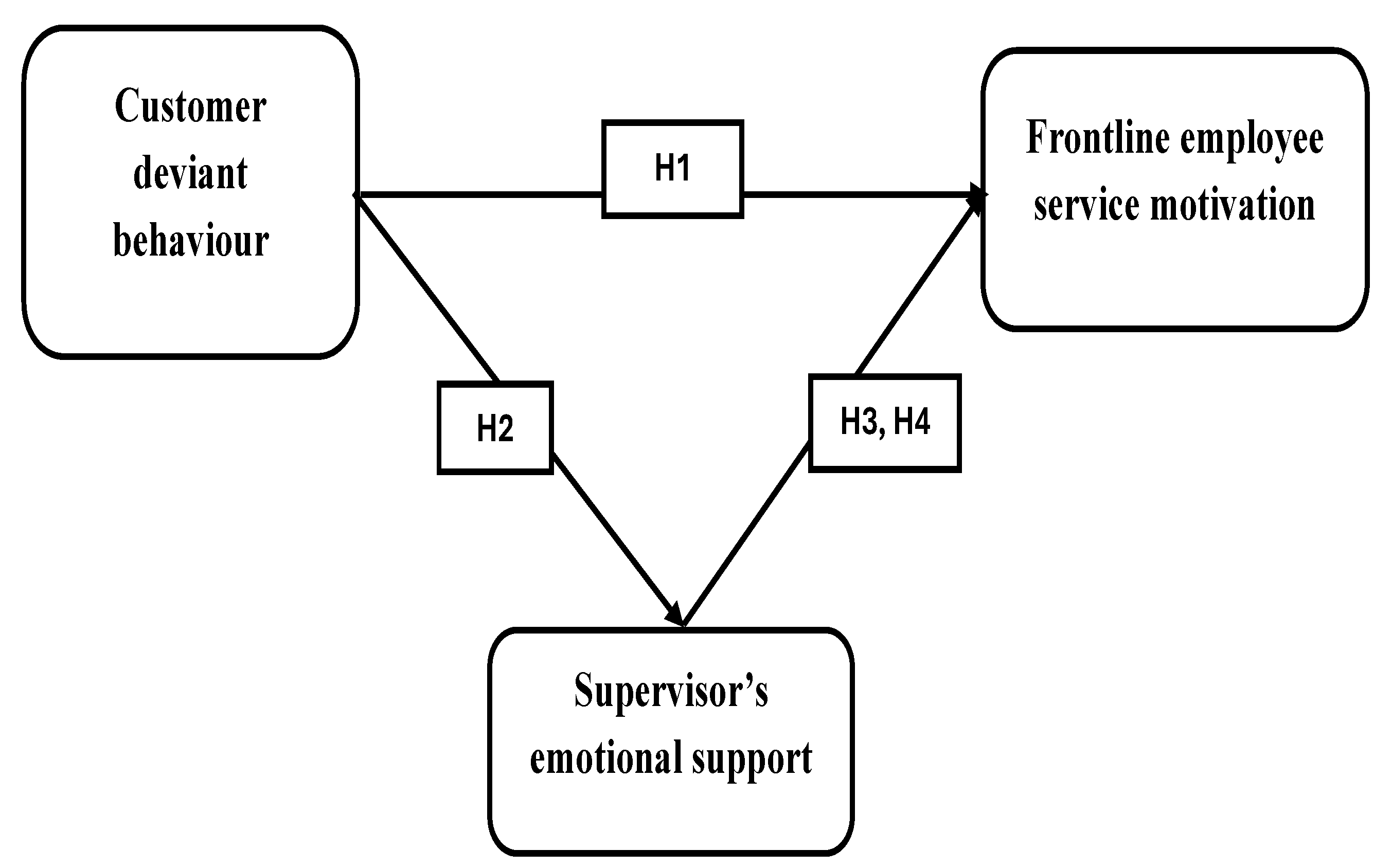
Figure 2.
PLS SEM for direct and mediating relationships.
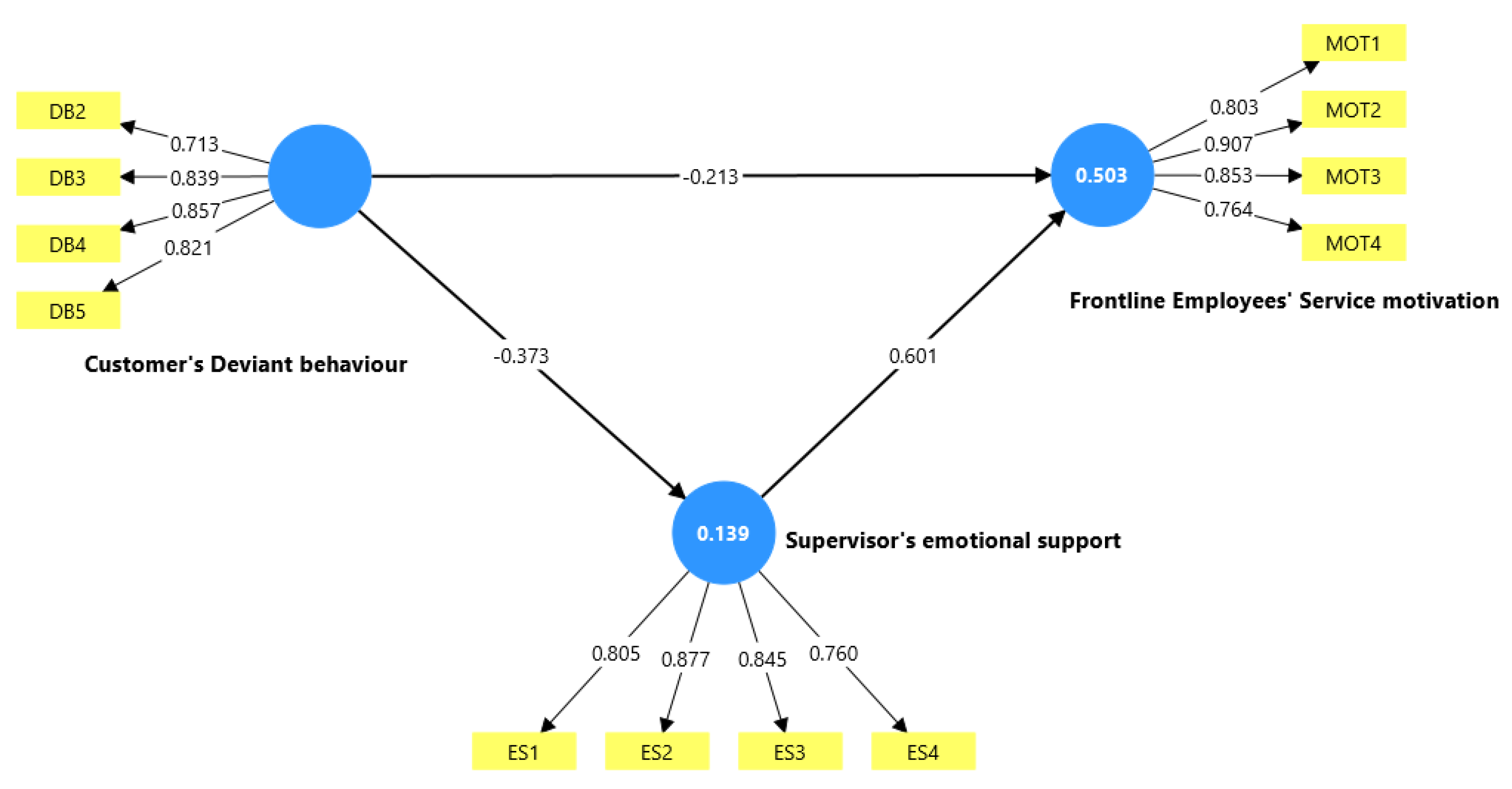

Table 1.
Demographic data of respondents.
| Gender | Frequency | Percentage (%) |
| Male | 223 | 43.9 |
| Female | 283 | 55.7 |
| LGBQT+ | 2 | 0.4 |
| Total | 508 | 100.0 |
| Age | Frequency | Percentage (%) |
| 20-30 | 130 | 25.6 |
| 31-40 | 213 | 41.9 |
| 41-50 | 134 | 26.4 |
| Above 50 years | 31 | 6.1 |
| Total | 508 | 100.0 |
| Highest education | Frequency | Percentage (%) |
| PhD | 61 | 12.0 |
| Masters | 123 | 24.2 |
| Honours/PGDIP | 77 | 15.2 |
| Bachelors/Adv Dip | 84 | 16.5 |
| Diploma | 119 | 23.4 |
| Below Diploma | 44 | 8.7 |
| Total | 508 | 100.0 |
| Length of service | Frequency | Percentage (%) |
| 0-5 years | 117 | 23.0 |
| 6-10 Years | 105 | 20.7 |
| 11-15 years | 210 | 41.3 |
| 16-20 year | 66 | 13.0 |
| 21- and above years | 10 | 2.0 |
| Total | 508 | 100.0 |
| Primary job status | Frequency | Percentage (%) |
| Full time permanent | 167 | 32.9 |
| Full time contract renewable | 176 | 34.6 |
| Part-Time contract | 165 | 32.5 |
| Total | 508 | 100.0 |
| Hotel size | Frequency | Percentage (%) |
| Small | 84 | 16.5 |
| Medium | 249 | 49.0 |
| Large | 175 | 34.4 |
| Total | 508 | 100.0 |
| Hotel year of existence | Frequency | Percentage (%) |
| 1-5 | 112 | 22.0 |
| 6-10 | 218 | 42.9 |
| More than 10years | 178 | 35.0 |
| Total | 508 | 100.0 |
Table 2.
construct validity.
| Construct | Customer's deviant behaviour | Frontline employees' service motivation | Supervisor's emotional support |
|---|---|---|---|
| DB2 | 0.713 | ||
| DB3 | 0.839 | ||
| DB4 | 0.857 | ||
| DB5 | 0.821 | ||
| ES1 | 0.805 | ||
| ES2 | 0.877 | ||
| ES3 | 0.845 | ||
| ES4 | 0.760 | ||
| MOT1 | 0.803 | ||
| MOT2 | 0.907 | ||
| MOT3 | 0.853 | ||
| MOT4 | 0.764 |
Table 3.
Reliability and convergent validity.
| Construct | Cronbach's Alpha | Composite reliability (rho_a) | Composite reliability (rho_c) | Average variance extracted (AVE) |
|---|---|---|---|---|
| Customer's deviant behaviour | 0.824 | 0.839 | 0.883 | 0.656 |
| Frontline employees' service motivation | 0.852 | 0.868 | 0.901 | 0.695 |
| Supervisor's emotional support | 0.840 | 0.848 | 0.893 | 0.677 |
Table 4.
Discriminant validity using Heterotrait-monotrait ratio (HTMT).
| Path | Heterotrait-monotrait ratio (HTMT) |
|---|---|
| Frontline Employees' Service motivation <-> Customer's Deviant behaviour | 0.514 |
| Supervisor's emotional support <-> Customer's Deviant behaviour | 0.441 |
| Supervisor's emotional support <-> Frontline Employees' Service motivation | 0.794 |
Table 5.
R-Square statistics.
| Variable | R-square |
|---|---|
| Frontline employees' service motivation | 0.503 |
| Supervisor's emotional support | 0.139 |
Table 6.
F-Square (Effect size).
| Path | f-square |
|---|---|
| Customer's Deviant behaviour -> Frontline Employees' Service motivation | 0.079 |
| Customer's Deviant behaviour -> Supervisor's emotional support | 0.161 |
| Supervisor's emotional support -> Frontline Employees' Service motivation | 0.626 |
Table 7.
Collinearity statistics using VIF.
| Variable dimensions | VIF |
|---|---|
| DB2 | 1.508 |
| DB3 | 1.970 |
| DB4 | 2.021 |
| DB5 | 1.770 |
| ES1 | 1.877 |
| ES2 | 2.343 |
| ES3 | 2.109 |
| ES4 | 1.638 |
| MOT1 | 1.782 |
| MOT2 | 2.784 |
| MOT3 | 2.276 |
| MOT4 | 1.683 |
Table 8.
Direct and mediating effects.
| Hypothesis | B-value | t-statistic | p-values | Decision |
|---|---|---|---|---|
| H1: Customer's Deviant behaviour -> Frontline Employees' Service motivation | -0.213 | 4.961 | 0.000 | Supported |
| H2: Customer's Deviant behaviour -> Supervisor's emotional support | -0.373 | 8.261 | 0.000 | Supported |
| H3: Supervisor's emotional support -> Frontline Employees' Service motivation | 0.601 | 16.246 | 0.000 | Supported |
| H4: Customer's Deviant behaviour -> Supervisor's emotional support -> Frontline Employees' Service motivation | -0.224 | 7.324 | 0.000 | Supported |
Disclaimer/Publisher’s Note: The statements, opinions and data contained in all publications are solely those of the individual author(s) and contributor(s) and not of MDPI and/or the editor(s). MDPI and/or the editor(s) disclaim responsibility for any injury to people or property resulting from any ideas, methods, instructions or products referred to in the content. |
© 2026 by the authors. Licensee MDPI, Basel, Switzerland. This article is an open access article distributed under the terms and conditions of the Creative Commons Attribution (CC BY) license.
Copyright: This open access article is published under a Creative Commons CC BY 4.0 license, which permit the free download, distribution, and reuse, provided that the author and preprint are cited in any reuse.