

Submitted:
02 February 2026
Posted:
05 February 2026
You are already at the latest version
Abstract
This paper explores how supply chain risk management (SCRM) enhances organizational resilience (OR) in manufacturing enterprises through resource reconfiguration. In the context of the COVID-19 pandemic and rising political and economic uncertainties, manufacturing firms face severe supply chain disruptions. Based on dynamic capability theory, the study analyzes the relationship between SCRM, resource reconfiguration (RR), and OR, highlighting RR as a key mediator. Empirical analysis of 266 Chinese manufacturing firms reveals that risk identification, control, and mitigation promote RR, thus boosting resilience, while risk assessment is less effective. The study underscores that resource reconfiguration is crucial for dynamic adjustments and sustaining a competitive advantage. This research contributes to dynamic capability and supply chain resilience literature with both theoretical and practical implications.
Keywords:
resource reconfiguration
; supply chain risk management
; organizational resilience
; mediating
1. Introduction
The COVID-19 pandemic, which broke out in 2019, caused severe disruption globally. Meanwhile, the increasing complexity of global geopolitics, cybersecurity challenges, natural disasters, and trade disputes in recent years has presented most companies with significant challenges at every stage of their supply chains[1]. Many suppliers are unable to fulfill their delivery obligations, and customer demand is extremely difficult to predict[2], highlighting the importance of supply chain resilience [1,3]. As a pillar of the global economy, manufacturing is highly sensitive to supply chain disruptions[4]. Because manufacturing production systems are highly dependent on cross-regional supply chain networks, many manufacturing companies face widespread global challenges[5]. Therefore, the literature urgently needs insights into resilient practices or capabilities that help manufacturing companies survive in volatile environments.
Resilience is inherently a dynamic capability, enabling companies to cope with emerging challenges and disruptions and recover quickly [6]. Therefore, companies must build resilience to survive during periods of economic turmoil [7]and be flexible in preparing for and responding to disruptions. Supply chain risk management is viewed as a dynamic capability, indicating that risk management within the supply chain is an evolving process of continuously adjusting and reconfiguring organizational resources and strategies [8]. It includes four stages: risk identification, risk assessment, risk mitigation, and risk control[9]. Governments worldwide have invested in supply chain risk management to enhance organizational resilience. For example, the Chinese government plans to allocate 1.4 trillion yuan to improve the resilience of the mainland's manufacturing sector[10]. Over the past decade, Serbian manufacturing companies have witnessed a robust transformation towards resilience[11]. While resilience—the ability to withstand and recover from disruptions—is crucial for a company's survival[12], this approach is essential. However, empirical research on these impacts remains insufficient in the literature on operations management. Most scholars have elaborated on this topic in detail. Existing research mostly adopts qualitative methods [13,14]. At the same time, keywords related to supply chain management, such as "resilience" and "developing countries," have only appeared in recent studies, indicating that there is very little research on these topics[15].
Moreover, under the current volatile natural conditions, supply chain risk management is an important research topic in supply chain management, and its attention continues to increase[16]. More empirical research is needed to better understand the application of supply chain risk management. Although some empirical studies have explored the impact of supply chain risk management on organizational resilience, the specific pathways through which supply chain risk management affects resilience have not yet been clearly revealed[17]. Scholars believe that certain specific factors play an important role in this "black box" and call for in-depth research[18,19]. Therefore, we aim to empirically examine the impact of supply chain risk management on organizational resilience and reveal its underlying mechanisms. We adopt the dynamic capability perspective as our theoretical basis. This theory is a core topic in the field of strategic management, and its essence lies in the dynamic adaptation of organizational capabilities to the external environment[20]. It emphasizes that enterprises must be able to perceive external changes, seize key resource opportunities, and reconfigure internal resources to maintain a competitive advantage in an uncertain environment[21]. "Perception" emphasizes information gathering and judgment, which is highly consistent with the process of identifying and assessing risks. "Seizing" is reflected in taking strategic actions against risks or opportunities, directly corresponding to the design and implementation of countermeasures. "Reconfiguration" emphasizes dynamic adjustment and learning feedback, corresponding to the monitoring and improvement phase and resource reconfiguration in risk management. Dynamic capabilities are the capability mechanism supporting the continuous and effective operation of supply chain risk management, while the supply chain risk management process is the specific manifestation of dynamic capabilities at the supply chain level.
Furthermore, resource reconfiguration is crucial for the survival of any enterprise[22] and can enhance organizational resilience[23]. It emphasizes the ability of manufacturing enterprises to strategically integrate, divest, or redeploy their supply chain resources and capabilities in a timely and effective manner to adapt to new environments[24]. Unlike traditional resource management, resource reconfiguration is not a static resource optimization but a dynamic process, reflecting an enterprise's ability to continuously learn and self-update in uncertain environments [21,25]. In supply chain risk management, enterprises typically obtain key information through risk identification and assessment, and then utilize resource reconfiguration capabilities to adjust key aspects such as production, procurement, and logistics, thereby transforming risk response measures into stable operational performance and adaptive advantages[26,27]. Therefore, resource reconfiguration is a core mediating mechanism for enhancing organizational resilience in supply chain risk management, reflecting the evolutionary process by which enterprises transform management practices into sustainable competitive advantages in dynamic environments. However, existing research lacks in-depth exploration of resilience mechanisms in corporate resource reconfiguration practices [28]. Therefore, this study regards resource reconfiguration as one of the core mediating mechanisms by which supply chain risk management affects organizational resilience, revealing the evolution of corporate capabilities in response to external shocks and providing a new analytical perspective.
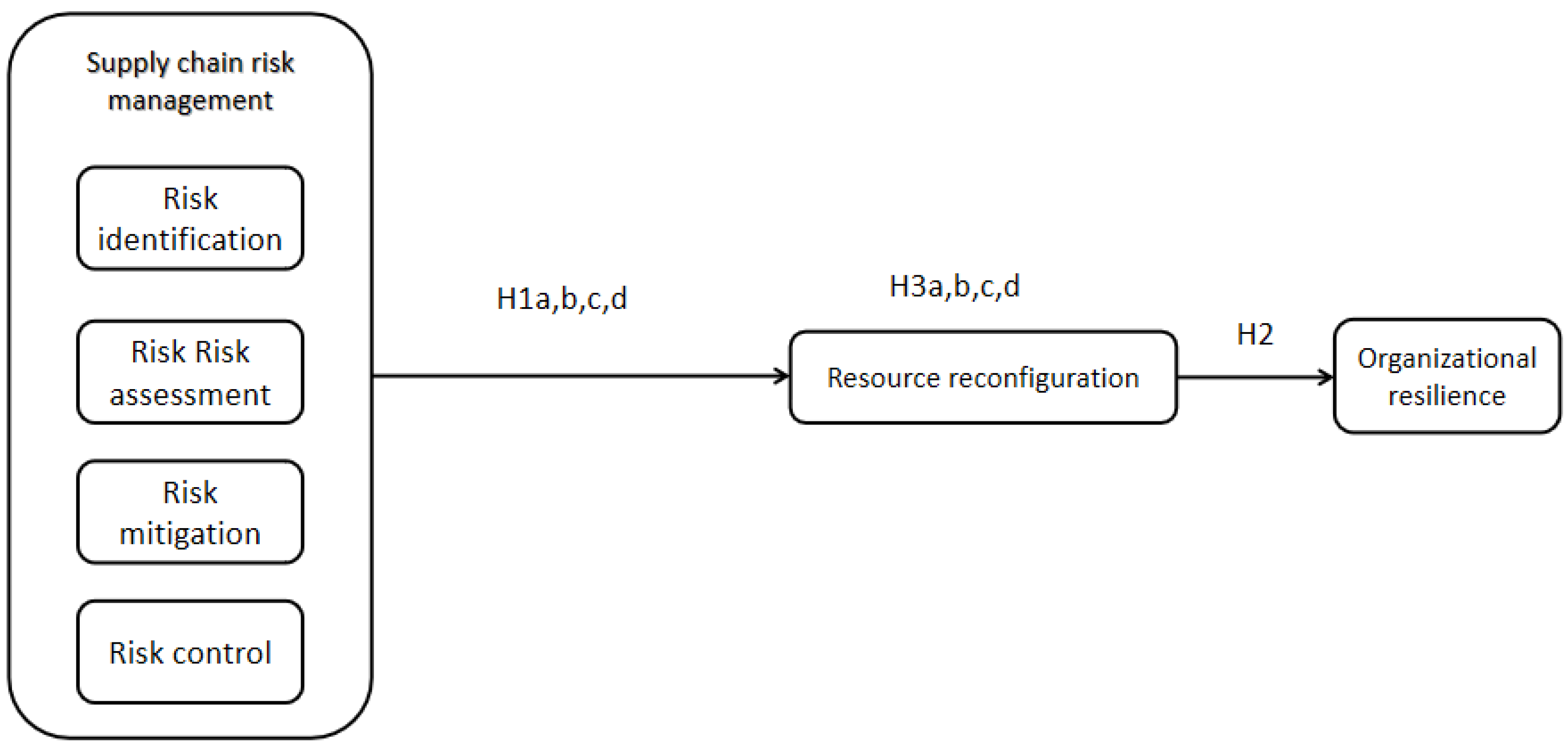
Therefore, based on a dynamic relationship model, we focus on examining the mediating role of resource reconfiguration in the relationship between supply chain risk management and organizational resilience. Overall, this paper aims to answer the following three specific research questions:
- • Question 1: How does supply chain risk management affect resource reconfiguration?
- • Question 2: How does resource reconfiguration affect organizational resilience?
- • Question 3: How does resource reconfiguration mediate between supply chain risk management and organizational resilience?
We empirically studied these three questions using survey data from 266 Chinese manufacturing enterprises. By answering these questions, our research contributes to the literature. First, by studying the internal mechanisms and evolutionary paths from supply chain risk management to organizational resilience, we contribute to the Dynamic Capability (DCV) model. Second, this study provides an important extension to the DCV perspective by systematically examining the internal mechanisms of the transformation from supply chain risk management to organizational resilience. Third, the study finds that risk identification, risk mitigation, and risk control can significantly promote resource reconfiguration to further enhance organizational resilience, while risk assessment, due to its highly standardized and static characteristics, is difficult to effectively embed in a dynamic environment and therefore fails to be transformed into resilience capabilities through resource reconfiguration. This paper uses an empirical analysis method to systematically examine the impact of risk management practices on organizational resilience, and further reveals the key mediating role of resource restructuring in this process, providing new empirical evidence for the application of dynamic capability theory in the fields of risk management and supply chain resilience.
2. Theoretical Background
2.1. Independent Variable: Supply Chain Risk Management
Past literature has used the terms "risk," "uncertainty," "vulnerability," and "risk source" interchangeably; however, risk is defined as "the expected outcome of an uncertain event, such as the existence of a risk due to an uncertain event" [29]. Risk management (RM) describes a company's ability to manage current risks and supply chain disruptions, as well as future disruptions. Ho proposed that supply chain risk management is a collaborative effort among organizations, and its main measure is to use appropriate quantitative and qualitative risk management strategies to track, assess, and control various factors that may negatively impact each link in the supply chain[30]. This study argues that supply chain risk management is a multifaceted concept, and a comprehensive supply chain risk management framework includes the identification, assessment, monitoring, and control of supply chain risks[31].
Risk identification refers to a comprehensive understanding of potential risks within the supply chain, continuously searching for short-term risks, observing risks in relevant supply chain areas, and setting early warning indicators to identify risks in the supply chain [31]. As the first step in supply chain risk management, accurate identification of potential risks is crucial for enterprises to proactively avoid losses[32]. Since the impact of supply chain disruptions largely depends on whether the probability of risk occurrence can be identified on time, enterprises need to establish a systematic risk identification mechanism to accurately identify and track potential sources of supply chain risks[33]. Therefore, risk identification plays a crucial role and influences the outcomes of subsequent supply chain risk management processes[34,35].
Risk assessment is considered an evaluation of the occurrence of risks, including identifying potential sources of risk, assessing the probability of supply chain risks, analyzing the potential impact of supply chain risks, evaluating the urgency of supply chain risks, and classifying and prioritizing supply chain risks[31]. This process aims to provide in-depth information on risk antecedents and critical vulnerabilities, emphasizing the interrelationship between risks and triggering events[29,35]. Furthermore, the purpose of risk assessment is to prepare for the next steps in supply chain risk management practices, namely, mitigating and controlling supply chain risks[34,35].
Risk mitigation, including demonstrating possible response strategies and assessing their effectiveness, is a crucial activity for companies[31]. Risk mitigation aims to address supply chain risks through appropriate measures, such as pre-disruption mitigation strategies or post-incident contingency plans[36]. The effectiveness of risk mitigation depends on close collaboration with supply chain partners and an awareness of the importance of supply chain risk management practices within the company[37] [34,35] [38]. The results achieved through risk mitigation contribute to the implementation of subsequent risk control phases[34,35].
Risk control primarily refers to reducing the frequency and impact of supply chain risks through professional risk management processes and a highly sensitive awareness[31]. Multiple studies have emphasized the role of risk control in reducing the frequency and impact of supply chain risks [31,38].
In summary, continuing the perspective from the previous discussion on defining the connotation of supply chain risk management, and considering the characteristics of Chinese manufacturing enterprises, a comprehensive understanding of supply chain risk factor management was achieved through subsequent standardized procedures, including enterprise surveys, information feedback, continuous revisions, and data verification.
2.2. Mediating/Intervening Variable: Resource Reconfiguration
"Reconfigurability refers to the ability to reconfigure resources in a timely and effective manner to deploy new configurations that match the new environment" [25], which is crucial for the survival of any company [22]. Lee defines it as the extent to which manufacturing companies strategically reconfigure their supply chain resources and capabilities in a timely and effective manner to adapt to new environments[24]. The high degree of uncertainty in supply chain dynamics[39] leads to ambiguity in the value and function of resources available for recovery. In this context, companies need to acquire, dispose of, and reorganize their existing resource base to develop the ability to adapt to the changing environment[26], which contributes to the company's survival and resilience. By learning about the external environment, companies can reconfigure and adjust resources and processes, proactively building capabilities to gain sustainable benefits after a crisis[40,41], enabling them to effectively respond to current social crises[42]. Research based on the dynamic capabilities perspective shows that firms can respond to crises and gain a sustainable competitive advantage by developing new resources or reconfiguring existing organizational resources [43]. Once a firm identifies a potential threat or opportunity, frequent reconfigurating processes enable core firms to quickly reconfigure available resources and capabilities, further facilitating product production and delivery[44]. Highly reconfigurable supply chains can respond quickly and effectively to market fluctuations, such as changes in customer demand, emerging trends, or competitive pressures[45].
The concept of supply chain reconfiguration has been used to address market disturbances and changes, defined as the ability of a supply chain to alter and adjust its structure and function to adapt to new changes[46]. Most scholars generally agree on measuring resource reconfiguration from a single dimension [23,17,47,48,49]. Therefore, a single dimension is also used to measure resource reconfiguration, which is currently the most mainstream and commonly used method. Thomas and Douglas, based on dynamic capabilities theory, found that companies utilize flexibility, absorptive capacity, and agility to reconfigure their internal resources, and that improving network integration is a way for SMEs to overcome resource constraints[50]. Goumagias pointed out that companies reconfigure resources when responding to changes in the internal and external environment, often collaborating with external stakeholders to integrate new knowledge and resources[51]. Research results indicate that resource reconfiguration and reallocation are the result of organizational learning. In traditional industries, resource reconfiguration and reallocation both positively impact sustainable competitive advantage, generating a "synergistic effect" of sustainable competitive advantage. Parker and Ameen also point out that corporate resource reconfiguration can directly and positively influence organizational resilience[48]. On the other hand, against the backdrop of rapidly changing supply chain environments and increasingly fierce market competition, manufacturing companies' resource management behavior also needs to be adjusted on time to adapt to environmental changes. Continuous supply chain restructuring can quickly adapt to constantly changing market demands, optimize costs, and maintain production performance [52]. Companies need to reconfigure resources to cope with supply chain disruptions, and resource reconfiguration is a key mechanism for managing disruptions and building resilient supply chains[53].
Based on the results of the aforementioned empirical studies, we found that few empirical studies have explored the mediating role of resource reconfiguration between supply chain risk management and organizational resilience [54[23,48]. Notably, no research has yet specifically focused on the mediating role of resource reconfiguration between supply chain risk management and organizational resilience. Therefore, this study aims to explore the role of resource reconfiguration in the relationship between supply chain risk management and organizational resilience.
2.3. Dependent Variable: Organization Resilience
In recent years, organizational resilience has received increasing attention from academia and practitioners. Su and Junge divide organizational resilience into three phases: pre-adversity, during adversity, and post-adversity, corresponding to three supply chain resilience strategies: proactive, concurrent, and reactive[55]. However, some related concepts, such as "pre-adversity" and "anticipation," seem to overlap with the practice of a broader management approach: supply chain risk management (e.g., risk prevention and control). In this study, organizational resilience is defined as the ability to effectively absorb shocks and develop situation-specific responses under disruptive conditions, focusing on the ability to adequately respond to shocks, quickly recover to the original state, transition to a new, more ideal state, prepare for financial consequences, and maintain the expected level of control over structure and function. It is argued that this is achieved through actively identifying and developing potential resources and capabilities[56].
Literature indicates that organizational resilience enables firms to respond quickly to changes in uncertain environments, thereby reducing the negative impact of supply chain disruptions and improving operational performance. First, from a "trait" perspective, scholars argue that organizational resilience is an inherent attribute exhibited by firms, reflecting the interaction between firms and their environment; firms with organizational resilience are better able to adapt to turbulent environments[57,58,59]. Second, from an "outcome" perspective, scholars believe that organizational resilience is the result of a firm's successful adaptation to adversity, relating to organizational recovery, survival, learning, and growth[60,61,62,63]. Third, from a "process" perspective, scholars define organizational resilience as a dynamic, gradual, and continuous process that enables recovery and development during crises[64,65,66]. Fourth, from a "capability" perspective, scholars believe that organizational resilience is a dynamic and flexible organizational capability formed by a combination of numerous capabilities, including prediction, stabilization, and adaptation, when faced with difficulties[67,68,69,70,71,72,73].
In summary, existing research has yielded diverse perspectives on the connotation of organizational resilience, but the definition and characterization from a "capability" perspective has gained the most widespread acceptance[74]. This paper focuses on manufacturing enterprises, defining organizational resilience based on the research perspective of "resilience as capability," defining it as the ability of manufacturing enterprises to make rapid and efficient decision-making responses to changes and to adapt to the environment through flexible innovation models when facing sudden disruptions or shocks. In today's world, where various unexpected and uncertain events occur frequently, exploring the organizational resilience of manufacturing enterprises has significant theoretical and practical value.
2.4. Dynamic Capabilities View
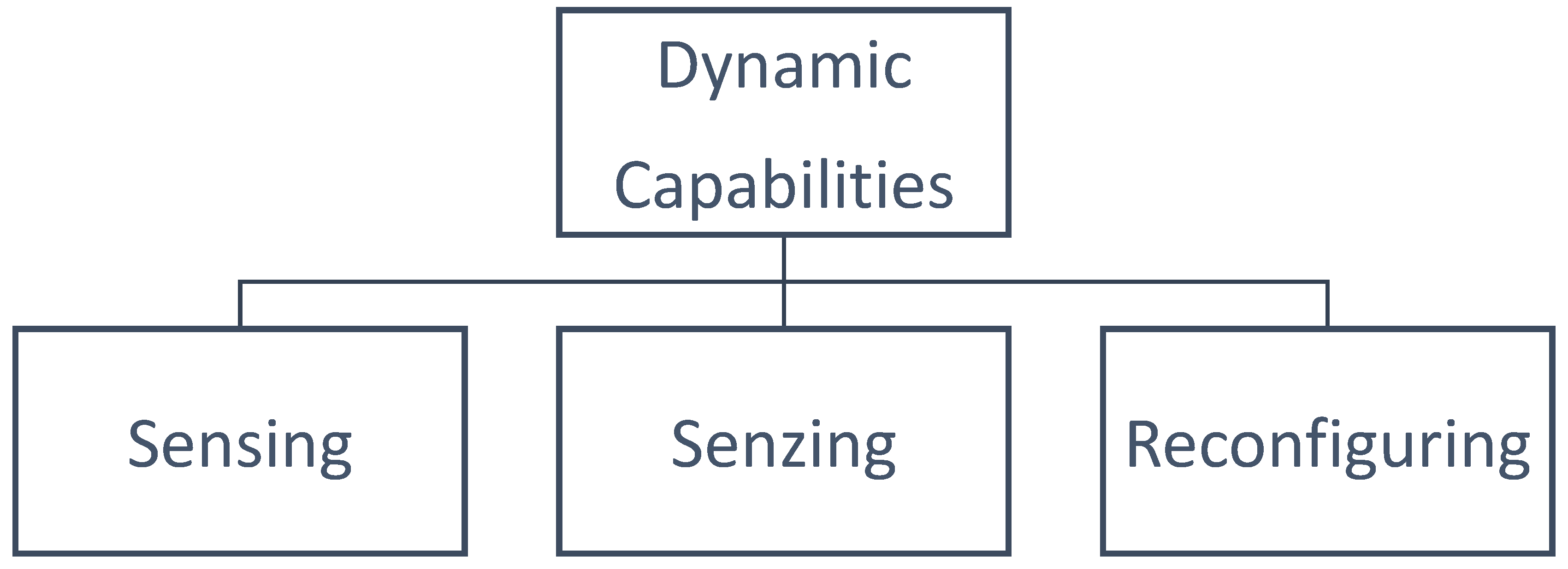
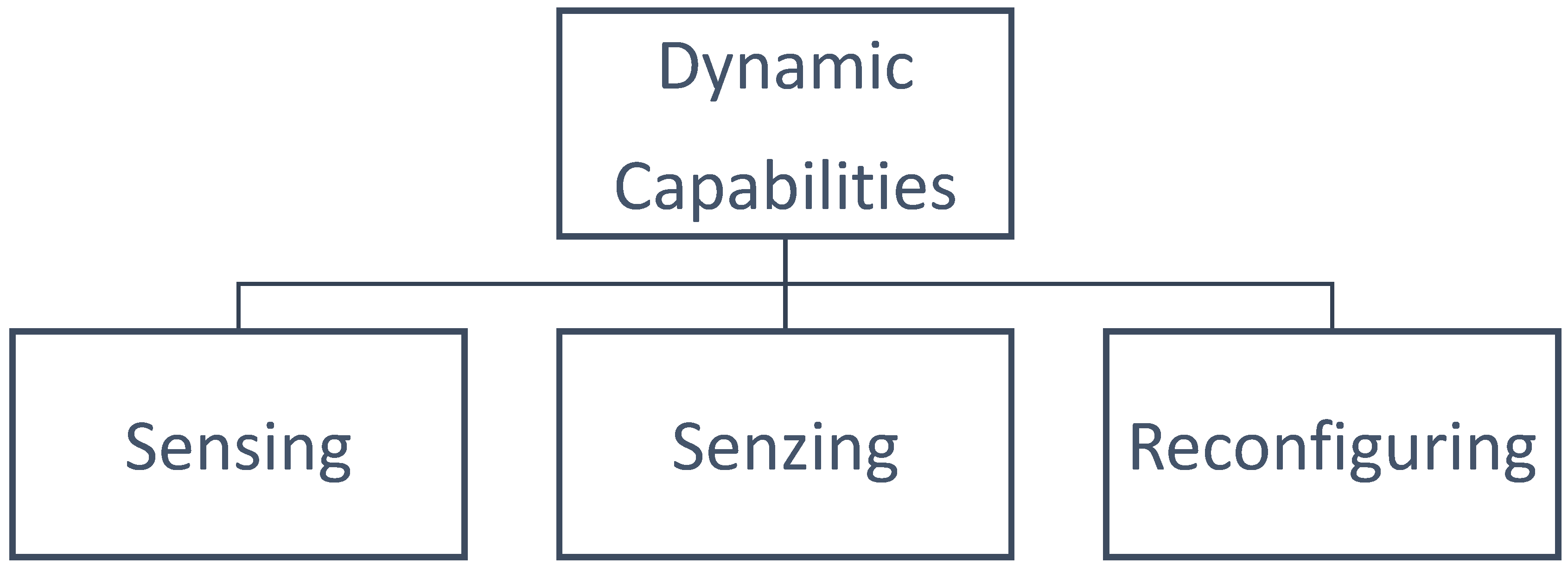
We draw upon the theory of dynamic capabilities[20,21]to theoretically explore the relationship between supply chain risk management, resource reconfiguration, and organizational resilience. While a firm's long-term performance depends to some extent on how the (external) business environment rewards its traditions, the development and application of dynamic capabilities (internal) are central to a firm's success (and failure)[21]. He points out that dynamic capabilities can be decomposed into (1) the ability to perceive and shape opportunities and threats, (2) the ability to seize opportunities, and (3) the ability to maintain competitiveness by enhancing, combining, protecting, and, when necessary, reallocating the firm's intangible and tangible assets, as shown in Figure 1.
Dynamic capabilities theory is a core issue in the field of strategic management, its essence lying in the dynamic adaptation of organizational capabilities to the external environment [20]. The evolution of this theory can be traced back to the "resource-based view (represented by Wernerfelt & Barney), core competence theory (represented by Prahalad & Hamel), and dynamic capabilities theory (represented by Teece & Pisano)." On the one hand, the resource-based view focuses on the relationship between heterogeneous resources (VRIN) and a firm's competitive advantage[75,76], exploring the reasons for performance differences between firms from an internal perspective. However, this theoretical perspective has a strong static analytical tendency and fails to effectively explain the crucial issue of how firms transform resources into competitive advantages in turbulent environments. On the other hand, core competence theory supplements and refines the understanding of specific firm competencies. Dynamic capabilities theory argues that firms, as a collection of capabilities, can shape their core competencies through long-term accumulation and cultivation of product innovation capabilities, organizational management capabilities, and market positioning capabilities[77]. However, this theoretical perspective overlooks issues such as "path dependence," "conventional traps," and "core rigidity," making it difficult to guide enterprises in resource transformation and capability upgrading[78]. To effectively address the static tendencies of the resource-based view and the rigidity traps of the core competency theory, dynamic capability theory emerged. It lays the foundation for the dynamic matching of enterprise resources, capabilities, and environment, helping enterprises break through existing path dependence and conventional traps, and enhance their competitive advantage. As the founders and pioneers of dynamic capability theory, the research of Teece et al. has established its core position in the field of strategic management.
Within the dynamic capabilities framework, the "environment" defined for analytical purposes is not limited to the traditional industry level, but rather refers to the business "ecosystem" context encompassing the firm itself, its customers, suppliers, and related organizations, institutions, and individuals [21]. According to Teece, dynamic capabilities theory emphasizes that firms effectively adapt to the dynamic environment and maintain competitive advantage by continuously sensing environmental changes, breaking through existing path dependencies, and constantly updating and reconstructing their capabilities[20]. The core connotation of the dynamic capabilities view further points out that dynamic capabilities not only support the evolutionary adaptation of firms but also strengthen their competitive position by shaping the external environment. Firms gain a sustainable competitive advantage precisely through their heterogeneous combination of resources and capabilities[75,3].
Figure 1.
Foundations of dynamic capability.Source: Main Components [21]
Figure 1.
Foundations of dynamic capability.Source: Main Components [21]
In the context of supply chain risk management, this logic is specifically manifested in enterprises' proactive identification of potential risks (such as supplier financial instability), their proactive grasp of risk mitigation opportunities (such as developing alternative suppliers), and their efforts to enhance system resilience and minimize the impact of disruptions by restructuring supply chain processes and resource allocation. Supply chain risk management is viewed as a dynamic capability, indicating that risk management in the supply chain is an evolving process of continuously adjusting and reconfiguring organizational resources and strategies [8].
Resilience itself is a dynamic capability because it enables firms to cope with emerging challenges and disruptions and recover quickly[6]. Therefore, firms must build resilience to survive during periods of economic turmoil[7] and be flexible in preparing for and responding to disruptions. Duchek points out that organizational resilience is a new type of dynamic capability exhibited by firms in turbulent environments[67]. It enables firms to respond to changes with rapid and efficient decision-making and adapt to the environment through flexible innovation models, turning crises into opportunities and risks into mitigation[79]. Dynamic capability theory helps explain the relationship between mediating variables (resource reconfiguration), independent variables (supply chain risk management), and dependent variables (organizational resilience).
While the aforementioned studies have identified supply chain risk management and resource reconfiguration as types of dynamic capabilities, most research on dynamic capabilities remains conceptual, with few exploring practical issues related to enhancing firm resilience from a dynamic capabilities theory perspective[80]. Furthermore, significant gaps exist in understanding the determinants of firm resilience and how these dynamic capabilities contribute to it[81]. This study aims to address this research need by considering the dynamic capabilities of supply chain risk management and resource reconfiguration as key factors in enhancing firm resilience.
3. Hypothesis Development
3.1. The Relationship Between Supply Chain Risk Management and Resource Reconfiguration
Resources are a crucial component of supply chain risk management [82]. Naimi et al. point out that the ability to manage and reconfigure resources is particularly critical in volatile environments[83]. From the perspective of dynamic capabilities theory, organizations must continuously adapt to changing environments by flexibly reconfigurating their resource base [21]. In this context, risk management infrastructure is described as a firm's "resource structure designed to manage risk" [82], thereby enhancing organizational resilience[84]. Similarly, Sirmon et al. found that when firms suffer market shocks due to industry disruptions, reconfiguring underlying resources helps mitigate the impact of external shocks[26]. Zhong et al. further demonstrate that resource reconfiguration can improve supply chain performance by providing alternative resources and minimizing the impact of disruptions[85]. By reconfiguring and adjusting resources and processes, companies can strengthen their capabilities and achieve sustainable benefits after a crisis[40,41], thereby enhancing their ability to effectively cope with ongoing supply chain disruptions [42]. Based on the above discussion, this paper proposes the following hypothesis:
H1a: Risk identification positively affects resource reconfiguration.
H1b: Risk assessment positively affects resource reconfiguration.
H1c: Risk mitigation positively affects resource reconfiguration.
H1d: Risk control positively affects resource reconfiguration.
3.2. The Relationship Between Resource Reconfiguration and Organizational Resilience
In the context of major emergencies such as the COVID-19 pandemic, a company's ability to reconfigure existing resources and acquire new ones can enhance supply chain stability[86,87]. Resource reconfiguration reflects a company's ability to increase, allocate, or redeploy resources and business units[88,89] and is considered a third type of dynamic capability[21]. Research in strategic management shows that companies capable of continuous resource reconfiguration tend to achieve better growth and development performance[90,91,92].
Sudden changes in the external environment often obscure the value and utility of a firm's existing resources [82]. In such situations, the reallocation and effective utilization of resources are crucial for firms to restore organizational function during crises[93]. Emergencies present both threats and opportunities for firms. To minimize the negative impact of threats, firms need to seize emerging opportunities and utilize them by updating, adjusting, and reconfigurating key risk management resources[88]. Therefore, existing research indicates that in highly uncertain environments, a firm's ability to restructure and reconfigure resources is key to adapting to environmental changes [82,94].
From a dynamic capability perspective, the ability to reconfigure resources is crucial for developing organizational resilience [95]. Furthermore, Annareli and Nonino also point out that the ability to reconfigure resources is essential for enhancing organizational resilience[96]. In research on organizational resilience in SMEs, scholars have also emphasized the important role of resource reconfiguration in identifying and responding to extreme events [97]. The establishment of organizational resilience is based on the ability to restructure resources[43]. In addition, companies can enhance organizational resilience by implementing risk management, resource reconfiguration, and adjusting supply chain flexibility, thereby achieving business continuity and viability[98]. Zhang et al. indicate that resource reconfiguration has a positive impact on organizational resilience (including agility and flexibility)[23]. Parker and Ameen point out that sufficient resources have a positive impact on the understanding, preparedness, and flexibility of organizational resilience[48]. Based on the above discussion, this paper proposes the following hypothesis:
H2: Resource reconfiguration positively affects organizational resilience.
3.3. The Mediating Effect of Resource Reconfiguration on Supply Chain Risk Management and Organizational Resilience
The rational utilization of resources is of great significance to enterprise development. For manufacturing enterprises, idle resources are considered an important capability for enhancing organizational resilience[99]. Similarly, Ernst and Kim showed that organizations can enhance their capabilities by acquiring knowledge and resources from other organizations[100]. Ambulkar et al. further pointed out that focusing solely on supply chain disruptions is insufficient to help enterprises build resilience[82]; in highly impactful disruption environments, resource reconfiguration plays a key mediating role between supply chain disruption concerns and organizational resilience. Meanwhile, Ye, in their study of emerging industries, found from a dynamic capability perspective that resource reconfiguration also plays a mediating role in the U-shaped impact of digital technology applications on organizational resilience[47].
Furthermore, Jiang et al., based on data analysis from 220 Chinese manufacturing companies, found that resource reconfiguration plays a fully mediating role between supply chain disruption orientation and organizational resilience[101]. However, Ongkowijoyo and Christian, in their study of the resilience of Indonesian manufacturing companies under severe supply chain disruption scenarios, pointed out that although resource reconfiguration is an important component of adaptive supply chain management, it did not significantly enhance organizational resilience under highly severe disruption conditions[17]. Koh et al. also noted that the relationship between resource efficiency and organizational resilience remains a relatively under-researched area, necessitating further in-depth exploration of its intrinsic connections and mechanisms[102]. Despite the differing research findings, Ambulkar et al. consistently agreed that companies capable of rapid resource reconfiguration tend to exhibit higher levels of organizational resilience compared to those with weaker resource reconfiguration capabilities[82].
Building on this, Ambulkar et al. defined resource reconfiguration as "the ability of an enterprise to reconfigure, adjust, and reorganize its resources in response to changes in the external environment," [82]and Parker & Ameen pointed out that resource reconfiguration is one of the key variables supporting supply chain resilience[48]. By reconfiguring resources and reducing the impact of disruptions, enterprises can improve the robustness of their supply chains, which is particularly critical in highly uncertain supply chain environments[82]. The fundamental and sudden changes in production and distribution models have forced enterprises to reconfigure business processes and adjust their operations on an unprecedented scale, making organizational resilience and supply chain configuration important issues that need to be addressed in both business practice and academic research[103,104,105]. Related research further shows that resource reconfiguration can support enterprises in making real-time adjustments to supply chain operations, thereby improving risk mitigation strategies[106]. Li et al. also pointed out that firms with dynamic resource reconfiguration capabilities are better able to cope with sudden disruptions and maintain organizational resilience[107]. Furthermore, Manuj and Mentzer found that the ability to reconfigure tangible and intangible resources can significantly improve a firm's risk management capabilities and its ability to recover from shocks[108]. Firms need to reconfigure resources to cope with supply chain disruptions, and resource reconfiguration is a key mechanism for coping with disruptions and enhancing resilience [53]. Resource reconfiguration is a very important dynamic capability in dynamic capability theory [21]. Therefore, the following hypothesis can be made:
H3a: Resource reconfiguration mediates the relationship between risk identification and organizational resilience.
H3b: Resource reconfiguration mediates the relationship between risk assessment and organizational resilience.
H3c: Resource reconfiguration mediates the relationship between risk mitigation and organizational resilience.
H3d: Resource reconfiguration mediates the relationship between risk control and organizational resilience.
Figure 1.
1 Foundations of dynamic capability.Source: Main Components [21]
Figure 1.
1 Foundations of dynamic capability.Source: Main Components [21]
In the context of supply chain risk management, this logic is specifically manifested in enterprises' proactive identification of potential risks (such as supplier financial instability), their proactive grasp of risk mitigation opportunities (such as developing alternative suppliers), and their efforts to enhance system resilience and minimize the impact of disruptions by restructuring supply chain processes and resource allocation. Supply chain risk management is viewed as a dynamic capability, indicating that risk management in the supply chain is an evolving process of continuously adjusting and reconfiguring organizational resources and strategies [8].
Resilience itself is a dynamic capability because it enables firms to cope with emerging challenges and disruptions and recover quickly[6]. Therefore, firms must build resilience to survive during periods of economic turmoil[7] and be flexible in preparing for and responding to disruptions. Duchek points out that organizational resilience is a new type of dynamic capability exhibited by firms in turbulent environments[67]. It enables firms to respond to changes with rapid and efficient decision-making and adapt to the environment through flexible innovation models, turning crises into opportunities and risks into mitigation[79]. Dynamic capability theory helps explain the relationship between mediating variables (resource reconfiguration), independent variables (supply chain risk management), and dependent variables (organizational resilience).
While the aforementioned studies have identified supply chain risk management and resource reconfiguration as types of dynamic capabilities, most research on dynamic capabilities remains conceptual, with few exploring practical issues related to enhancing firm resilience from a dynamic capabilities theory perspective[80]. Furthermore, significant gaps exist in understanding the determinants of firm resilience and how these dynamic capabilities contribute to it[81]. This study aims to address this research need by considering the dynamic capabilities of supply chain risk management and resource reconfiguration as key factors in enhancing firm resilience.
3. Hypothesis Development
3.1. The Relationship Between Supply Chain Risk Management and Resource Reconfiguration
Resources are a crucial component of supply chain risk management [82]. Naimi et al. point out that the ability to manage and reconfigure resources is particularly critical in volatile environments[83]. From the perspective of dynamic capabilities theory, organizations must continuously adapt to changing environments by flexibly reconfigurating their resource base [21]. In this context, risk management infrastructure is described as a firm's "resource structure designed to manage risk" [82], thereby enhancing organizational resilience[84]. Similarly, Sirmon et al. found that when firms suffer market shocks due to industry disruptions, reconfiguring underlying resources helps mitigate the impact of external shocks[26]. Zhong et al. further demonstrate that resource reconfiguration can improve supply chain performance by providing alternative resources and minimizing the impact of disruptions[85]. By reconfiguring and adjusting resources and processes, companies can strengthen their capabilities and achieve sustainable benefits after a crisis[40,41], thereby enhancing their ability to effectively cope with ongoing supply chain disruptions [42]. Based on the above discussion, this paper proposes the following hypothesis:
H1a: Risk identification positively affects resource reconfiguration.
H1b: Risk assessment positively affects resource reconfiguration.
H1c: Risk mitigation positively affects resource reconfiguration.
H1d: Risk control positively affects resource reconfiguration.
3.2 The Relationship between Resource Reconfiguration and Organizational Resilience
In the context of major emergencies such as the COVID-19 pandemic, a company's ability to reconfigure existing resources and acquire new ones can enhance supply chain stability[86,87]. Resource reconfiguration reflects a company's ability to increase, allocate, or redeploy resources and business units[88,89] and is considered a third type of dynamic capability[21]. Research in strategic management shows that companies capable of continuous resource reconfiguration tend to achieve better growth and development performance[90,91,92].
Sudden changes in the external environment often obscure the value and utility of a firm's existing resources [82]. In such situations, the reallocation and effective utilization of resources are crucial for firms to restore organizational function during crises[93]. Emergencies present both threats and opportunities for firms. To minimize the negative impact of threats, firms need to seize emerging opportunities and utilize them by updating, adjusting, and reconfigurating key risk management resources[88]. Therefore, existing research indicates that in highly uncertain environments, a firm's ability to restructure and reconfigure resources is key to adapting to environmental changes [82,94].
From a dynamic capability perspective, the ability to reconfigure resources is crucial for developing organizational resilience [95]. Furthermore, Annareli and Nonino also point out that the ability to reconfigure resources is essential for enhancing organizational resilience[96]. In research on organizational resilience in SMEs, scholars have also emphasized the important role of resource reconfiguration in identifying and responding to extreme events [97]. The establishment of organizational resilience is based on the ability to restructure resources[43]. In addition, companies can enhance organizational resilience by implementing risk management, resource reconfiguration, and adjusting supply chain flexibility, thereby achieving business continuity and viability[98]. Zhang et al. indicate that resource reconfiguration has a positive impact on organizational resilience (including agility and flexibility)[23]. Parker and Ameen point out that sufficient resources have a positive impact on the understanding, preparedness, and flexibility of organizational resilience[48]. Based on the above discussion, this paper proposes the following hypothesis:
H2: Resource reconfiguration positively affects organizational resilience.
3.3The Mediating Effect of Resource Reconfiguration on Supply Chain Risk Management and Organizational Resilience
The rational utilization of resources is of great significance to enterprise development. For manufacturing enterprises, idle resources are considered an important capability for enhancing organizational resilience[99]. Similarly, Ernst and Kim showed that organizations can enhance their capabilities by acquiring knowledge and resources from other organizations[100]. Ambulkar et al. further pointed out that focusing solely on supply chain disruptions is insufficient to help enterprises build resilience[82]; in highly impactful disruption environments, resource reconfiguration plays a key mediating role between supply chain disruption concerns and organizational resilience. Meanwhile, Ye, in their study of emerging industries, found from a dynamic capability perspective that resource reconfiguration also plays a mediating role in the U-shaped impact of digital technology applications on organizational resilience[47].
Furthermore, Jiang et al., based on data analysis from 220 Chinese manufacturing companies, found that resource reconfiguration plays a fully mediating role between supply chain disruption orientation and organizational resilience[101]. However, Ongkowijoyo and Christian, in their study of the resilience of Indonesian manufacturing companies under severe supply chain disruption scenarios, pointed out that although resource reconfiguration is an important component of adaptive supply chain management, it did not significantly enhance organizational resilience under highly severe disruption conditions[17]. Koh et al. also noted that the relationship between resource efficiency and organizational resilience remains a relatively under-researched area, necessitating further in-depth exploration of its intrinsic connections and mechanisms[102]. Despite the differing research findings, Ambulkar et al. consistently agreed that companies capable of rapid resource reconfiguration tend to exhibit higher levels of organizational resilience compared to those with weaker resource reconfiguration capabilities[82].
Building on this, Ambulkar et al. defined resource reconfiguration as "the ability of an enterprise to reconfigure, adjust, and reorganize its resources in response to changes in the external environment," [82]and Parker & Ameen pointed out that resource reconfiguration is one of the key variables supporting supply chain resilience[48]. By reconfiguring resources and reducing the impact of disruptions, enterprises can improve the robustness of their supply chains, which is particularly critical in highly uncertain supply chain environments[82]. The fundamental and sudden changes in production and distribution models have forced enterprises to reconfigure business processes and adjust their operations on an unprecedented scale, making organizational resilience and supply chain configuration important issues that need to be addressed in both business practice and academic research[103,104,105]. Related research further shows that resource reconfiguration can support enterprises in making real-time adjustments to supply chain operations, thereby improving risk mitigation strategies[106]. Li et al. also pointed out that firms with dynamic resource reconfiguration capabilities are better able to cope with sudden disruptions and maintain organizational resilience[107]. Furthermore, Manuj and Mentzer found that the ability to reconfigure tangible and intangible resources can significantly improve a firm's risk management capabilities and its ability to recover from shocks[108]. Firms need to reconfigure resources to cope with supply chain disruptions, and resource reconfiguration is a key mechanism for coping with disruptions and enhancing resilience [53]. Resource reconfiguration is a very important dynamic capability in dynamic capability theory [21]. Therefore, the following hypothesis can be made:
H3a: Resource reconfiguration mediates the relationship between risk identification and organizational resilience.
H3b: Resource reconfiguration mediates the relationship between risk assessment and organizational resilience.
H3c: Resource reconfiguration mediates the relationship between risk mitigation and organizational resilience.
H3d: Resource reconfiguration mediates the relationship between risk control and organizational resilience.
Figure 1.
Research model.
4. Research Methodology
This paper employs Partial Least Squares Structural Equation Modeling (PLS-SEM) to analyze the data, using the latest version, SmartPLS v. 4.1.1.6, because it can perform mediation analysis without increasing complexity or requiring a larger sample size[109]. Therefore, PLS-SEM is suitable for analyzing the mediation effects in the hypothetical model presented in this paper. Furthermore, the normality assumption can be relaxed in PLS-SEM[110,111,112], which helps analyze Likert scale data in this study. Finally, due to its advantage in handling small sample data [111,112], PLS-SEM is suitable for comparative analysis of the manufacturing subsample in this study. A drawback of PLS-SEM is its lower sensitivity to the discriminant validity assessed by the widely used Fornell-Larcker criterion[110,113]. However, this shortcoming can be addressed by using the heterotrait-homogeneous correlation ratio (HTMT) as a supplementary criterion for determining validity[114].
4.1. Questionnaire Development
We used a questionnaire survey to test our hypotheses. Questionnaire surveys are the most commonly used method in empirical operations management research[115]. Survey results can explain and predict phenomena or relationships, thus contributing to theoretical development [116]. We designed our questionnaire based on an adaptation of existing effective tools. We extensively reviewed the literature to identify survey items that could effectively measure our constructs. To ensure conceptual equivalence, we employed the following translation/back-translation procedure. First, we developed an English questionnaire and translated it into Chinese. Then, two researchers independently translated the Chinese version back into English. We compared the translated version with the original and made minor modifications to the Chinese version when differences were found. A third researcher was invited to participate when necessary.
We pre-tested this indicator through interviews with four practitioners. Specifically, our target audience consisted of managers or senior executives and related managers at the managerial level and above who understood supply chain risk management and were responsible for their companies' supply chain management. These four respondents came from companies of different industries, sizes, and ages. We provided definitions for all variables in the survey to help respondents better understand the relevant indicators. We considered supply chain risk management as a second-order structure. We adjusted the organizational resilience measure based on the research of Shela et al. [56]. Organizational resilience measures a company's ability to proactively identify and develop potential resources and capabilities, effectively absorb shocks, and develop responses tailored to specific situations. We used a 7-point Likert scale, where "1" represents "strongly disagree" and "7" represents "strongly agree." We adjusted the measures of supply chain risk management and resource reconfiguration based on the research of [31] and [54]. We asked respondents to assess their company's level of supply chain risk management and resource reconfiguration capabilities. We used a 5-point Likert scale, where "1" represents "strongly disagree" and "5" represents "strongly agree." Before formal data collection, we conducted a pilot study with 30 participants to assess the clarity of the entire questionnaire[117]. We then interviewed the pilot participants who completed the questionnaire. Based on their valuable feedback, we revised and improved the questionnaire to ensure all items were easy to understand (see Appendix A for details).
4.2. Sampling and data collection
This study chose to conduct this survey in China for two main reasons. First, Chinese manufacturing enterprises play a vital role globally and are widely considered a global manufacturing powerhouse[115], thus providing a large sample population for the sampling design. Second, the 2024 "Guidelines for Improving Supply Chain Management Level of Manufacturing Enterprises in China (Trial)" proposes to enhance supply chain security, specifically through four measures: strengthening risk warning and response preparedness, improving supplier risk management systems, diversifying logistics and transportation networks, and building a proactive supply chain risk control culture. This aligns with our research theme of "supply chain risk management." Furthermore, the National Development and Reform Commission's revision of the "Catalogue of Encouraged Industries in the Western Region" (2025 edition) grants preferential corporate income tax rates (reduced to 15%) to eligible industries [118], indicating that the westward transfer of Chinese manufacturing is a key direction of national strategic planning in recent years. Chongqing, with its strong manufacturing base and well-developed industrial system, possesses strong regional representativeness and research value, consistently ranking first in the western region's manufacturing sector. Meanwhile, as a core city in the Chengdu-Chongqing economic circle, a key national development area, Chongqing's manufacturing transformation and upgrading practices have exemplary significance for the entire country. Therefore, our sample companies included all manufacturing enterprises in Chongqing, ensuring the general applicability of the research results.
The sampling framework for this study was built upon information and services provided by a leading professional market research and consulting firm in China. This firm, a member of the China Information Industry Association, possesses a comprehensive directory of companies and information, including the names and contact details of senior management. With the sampling framework in place, we first contacted randomly selected companies, informing them of the purpose and significance of our research, inviting them to participate, and identifying eligible respondents. We explained the research objectives to increase their willingness to participate. Eligible respondents' companies should have ISO certification and demonstrate an understanding of the company's current operations, risk management, and plans. Through this communication method, we sent the final version of the questionnaire to 1000 manufacturing companies via email, WeChat QR code, and paper surveys. The emails also included a letter explaining the research objectives and questionnaire completion instructions. Email and online survey methods offer numerous advantages, such as overcoming geographical limitations and saving time and costs [119]. After filtering out ineligible samples (i.e., incomplete questionnaires, companies without ISO certification, and options with sudev greater than 1), we obtained 266 qualified and usable samples, representing a response rate of 26.60%.

Table 4.
1 Respondent Profile.
| Demographics | Frequency | Percentage (%) |
| Firm Age | ||
| <10 | 107 | 40.2 |
| 11-20 | 61 | 22.9 |
| 21-30 | 57 | 21.4 |
| 31-40 | 14 | 5.3 |
| 41-50 | 7 | 2.6 |
| >50 | 20 | 7.5 |
| Firm Size | ||
| Large companies | 99 | 37.2 |
| medium-sized companies | 59 | 22.2 |
| Small Business | 106 | 39.8 |
| micro-companies | 2 | .8 |
| Business Ownership | ||
| Sole proprietorship | 44 | 16.5 |
| Partnership | 19 | 7.1 |
| Limited liability company | 148 | 55.6 |
| Stock corporation | 55 | 20.7 |
| Sector | ||
| Agricultural and sideline food processing industry | 8 | 3.0 |
| Food Manufacturing | 17 | 6.4 |
| textile industry | 6 | 2.3 |
| The paper and paper products industry | 3 | 1.1 |
| Printing and recorded media reproduction industry | 1 | 0.4 |
| Stationery and office supplies manufacturing industry | 3 | 1.1 |
| Oil, coal, and other fuel processing industries | 4 | 1.5 |
| Chemical raw materials and chemical products manufacturing industry | 14 | 5.3 |
| pharmaceutical manufacturing | 6 | 2.3 |
| Rubber and plastic products industry | 6 | 2.3 |
| Non-metallic mineral products industry | 4 | 1.5 |
| Ferrous metal smelting and rolling processing industry | 2 | 0.8 |
| Non-ferrous metal smelting and rolling processing industry | 16 | 6.0 |
| Metal products industry | 13 | 4.9 |
| General equipment manufacturing industry | twenty four | 9.0 |
| Specialized equipment manufacturing | 29 | 10.9 |
| Transportation equipment manufacturing | twenty two | 8.3 |
| Electrical machinery and equipment manufacturing industry | twenty one | 7.9 |
| Computer communications and other electronic equipment manufacturing | 27 | 10.2 |
| Instrument Manufacturing | 19 | 7.1 |
| Other manufacturing industries (please specify) | twenty one | 7.9 |
| More than 1 Location | ||
| Yes | 156 | 58.6 |
| No | 110 | 41.4 |
| Position | ||
| Owner | 20 | 7.5 |
| Director | 58 | 21.8 |
| Manager | 150 | 56.4 |
| Others | 38 | 14.3 |
| Respondent Experience | ||
| <5 Years | 120 | 45.1 |
| 6-15 Years | 132 | 49.6 |
| 16-25 Years | 10 | 3.8 |
| >25 Years | 4 | 1.5 |
| Age | ||
| <30 Years | 40 | 15.0 |
| 31-35 Years | 68 | 25.6 |
| 36-40 Years | 69 | 25.9 |
| 41-45 Years | 56 | 21.1 |
| 46-50 Years | 19 | 7.1 |
| >50 Years | 14 | 5.3 |
Table 4.1 presents an overview of each company and basic information about the respondents. We conducted a demographic analysis based on the main economic region, administrative division, industry, company history, company sales, and the respondents' positions in the 266 valid samples. The results show that our sample covers companies of various sizes and establishment times from different industries, indicating the representativeness and general applicability of this study [120]. Over 85.72% of the respondents held management or higher positions related to the supply chain, indicating that they had some understanding of the questionnaire topics.
4.3. Nonresponse Bias and Common Method Bias
Non-response bias refers to the difference in survey results between respondents and non-respondents, which can lead to biased survey findings[121]. Following the work of Wagner and Kemmerling, we conducted an independent samples test to compare responses from early respondents received within the first two weeks with responses from late respondents received in the third week or later[122]. We found no statistically significant difference between early and late respondents (p > 0.05)[123], indicating that non-response bias did not significantly affect this study. We also took several steps to mitigate and test for potential common method bias (CMB).
The data in this study came from a single source and used the same research methods; therefore, testing for systematic bias or variance (CMV) was crucial. Since CMV can distort construct validity and bias the analytical results, this study employed a marker variable technique to control for its influence [124,125]. This study introduced a theoretically irrelevant marker variable (positive mindset), adapted from the study of Shou et al. [126], and incorporated it into all endogenous constructs in the research model. However, after adding the marker variable to the model, the R² values of endogenous constructs did not show significant differences (∆R² < 0.10)[125], as shown in Table 4.2, and the significant and non-significant path coefficients (β values) also remained essentially unchanged, as shown in Table 4.3. Therefore, CMV was not a major issue in this study.
Table 4.
2 R2 Values of the Baseline and Marker Adjusted Models.
| Endogenous Construct | Baseline Model | R2 Value Adjusted Model | ∆R2 |
| RR | 0.633 | 0.692 | 0.059 |
| OR | 0.692 | 0.637 | -0.055 |
Table 4.
3 Path Coefficient & Significance of the Baseline and Marker Adjusted Models.
| Path | Baseline Model | Marker Adjusted Model | ||||||||
|
Original sample (O) |
Sample mean (M) |
Standard deviation (STDEV) |
T values | P values |
Original sample (O) |
Sample mean (M) |
Standard deviation (STDEV) |
T values | P values | |
| RA -> RR -> OR | -0.021 | -0.01 | 0.028 | 0.77 | 0.442 | -0.021 | -0.01 | 0.028 | 0.772 | 0.44 |
| RC -> RR -> OR | 0.176 | 0.174 | 0.043 | 4.126 | 0 | 0.176 | 0.174 | 0.043 | 4.135 | 0 |
| RI -> RR -> OR | 0.332 | 0.332 | 0.039 | 8.517 | 0 | 0.333 | 0.332 | 0.039 | 8.542 | 0 |
| RM -> RR -> OR | 0.241 | 0.241 | 0.04 | 6.028 | 0 | 0.241 | 0.24 | 0.04 | 6.048 | 0 |
| RA -> RR | -0.027 | -0.012 | 0.035 | 0.769 | 0.442 | -0.027 | -0.012 | 0.035 | 0.769 | 0.442 |
| RC -> RR | 0.221 | 0.219 | 0.053 | 4.152 | 0 | 0.221 | 0.219 | 0.053 | 4.152 | 0 |
| RI -> RR | 0.418 | 0.418 | 0.048 | 8.646 | 0 | 0.418 | 0.418 | 0.048 | 8.646 | 0 |
| RM -> RR | 0.303 | 0.302 | 0.046 | 6.583 | 0 | 0.303 | 0.302 | 0.046 | 6.583 | 0 |
| RR -> OR | 0.796 | 0.796 | 0.028 | 28.327 | 0 | 0.797 | 0.795 | 0.028 | 28.572 | 0 |
4.4. Reliability and Validity
Convergent validity refers to the consistency among multiple measures measuring the same latent construct[127]. This study assessed convergent validity by examining factor loadings and average variance extracted (AVE). Generally, an AVE value higher than 0.50 indicates that the latent variable can explain more than 50% of the variance of its measure[128]. Meanwhile, factor loadings higher than 0.70 indicate good reliability of the measurement model; for items with factor loadings between 0.40 and 0.70, a comprehensive assessment combining construct reliability and validity indicators is necessary[111].
Table 4.
4 Construct reliability and validity.
| Construct | Items | Factor Loadings | Cronbach's alpha |
Composite reliability (rho_a) |
Composite reliability (rho_c) |
Average variance extracted (AVE) |
| OR | OR1 | 0.851 | 0.912 | 0.912 | 0.934 | 0.74 |
| OR2 | 0.855 | |||||
| OR3 | 0.855 | |||||
| OR4 | 0.891 | |||||
| OR5 | 0.849 | |||||
| RA | RA1 | 0.737 | 0.71 | 0.919 | 0.803 | 0.584 |
| RA2 | 0.928 | |||||
| RA5 | 0.59 | |||||
| RC | RC1 | 0.892 | 0.911 | 0.912 | 0.938 | 0.79 |
| RC2 | 0.886 | |||||
| RC3 | 0.88 | |||||
| RC4 | 0.896 | |||||
| RI | RI1 | 0.88 | 0.903 | 0.903 | 0.932 | 0.774 |
| RI2 | 0.87 | |||||
| RI3 | 0.897 | |||||
| RI4 | 0.872 | |||||
| RM | RM1 | 0.911 | 0.902 | 0.903 | 0.939 | 0.836 |
| RM2 | 0.916 | |||||
| RM3 | 0.916 | |||||
| RR | RR1 | 0.895 | 0.91 | 0.912 | 0.937 | 0.788 |
| RR2 | 0.862 | |||||
| RR3 | 0.892 | |||||
| RR4 | 0.902 |
According to the results in Table 4.4, the factor loadings of most measurement items were significantly higher than 0.70, indicating good reliability of the indicators [128]. RA1 (0.737) met the recommended criteria, while RA5 (0.590) was in the acceptable range of 0.40–0.70, but it was retained because its combined reliability and AVE both met the criteria. All item loadings for the other constructs (OR, RC, RI, RM, RR) were between 0.849 and 0.916, showing strong measurement ability. Regarding internal consistency, the Cronbach's α coefficients for each construct were all higher than 0.70, with OR (0.912), RC (0.911), RI (0.903), RM (0.902), and RR (0.910) all exceeding 0.90, indicating high internal consistency of the scale. The α value for RA was 0.71, also meeting the minimum reliability requirement. Regarding combinatorial reliability, the rho_a and rho_c values for each construct were both above 0.80, further validating the reliability of the measurement model[128]. Furthermore, the mean variance extracted (AVE) for each construct ranged from 0.584 to 0.836, all exceeding the recommended threshold of 0.50, indicating that the latent variables could effectively explain the variance of their measurement indicators, demonstrating good convergent validity[128], and can be used for subsequent structural model analysis.
This study used the Heterotrait-Monotrait Ratio(HTMT) method because it is considered the most suitable indicator for verifying whether constructs in a research model are distinguishable from each other [114]. For conceptually similar constructs, an HTMT value greater than 0.90, and for conceptually dissimilar constructs, an HTMT value greater than 0.85, both indicate a lack of discriminative validity. However, in such cases, if the bootstrap confidence interval of the HTMT has a 90% probability of not exceeding 1, discriminative validity can be confirmed [129]. The test results are shown in Table 4.5.
Table 4.
5 HTMT.
| OR | RA | RC | RI | RM | RR | |
| OR | ||||||
| RA | 0.143 | |||||
| RC | 0.725 | 0.099 | ||||
| RI | 0.781 | 0.093 | 0.769 | |||
| RM | 0.804 | 0.151 | 0.743 | 0.711 | ||
| RR | 0.872 | 0.102 | 0.781 | 0.841 | 0.789 |
Table 4.5 shows that the overall discriminant validity among the latent variables is good. Except for the RR and OR values, which are slightly high at 0.872 but do not exceed the threshold of 0.90, the HTMT values among the other variables are all below 0.85, indicating that the constructs are basically independent.
4.5. Hypotheses Testings
This study used SmartPLS v4.1.1.4 to test the structural equation model (PLS-SEM) and evaluated the significance of path coefficients and mediation effects using a bootstrap method (10,000 resamplings). The explanatory power of the structural model was evaluated using the coefficient of determination (R²). The results showed that the R² for RR was 0.692 and the R² for OR was 0.633, both significantly higher than the 0.26 reference standard proposed by Cohen[130], indicating that the model has strong explanatory and predictive power. To test for multicollinearity, this study calculated the variance inflation factor (VIF) for each path. The results showed that all VIF values were between 1.000 and 2.341, far below the conservative threshold of 5.0[131], indicating that the model does not have a serious multicollinearity problem, as shown in Table 4.6.
Table 4.
Assessment of Structural Model.
| Number | Path | Std. Beta | Std. Error | p-value | t-vavalue | VIF | f² |
BCI LL (2.5%) |
BCI UL (97.5%) |
| Direct effects | |||||||||
| H1a | RA -> RR | -0.027 | 0.035 | 0.769 | 0.442 | 1.022 | 0.002 | -0.117 | 0.025 |
| H1b | RC -> RR | 0.221 | 0.053 | 4.152 | 0 | 2.341 | 0.068 | 0.118 | 0.324 |
| H1c | RI -> RR | 0.418 | 0.048 | 8.646 | 0 | 2.176 | 0.26 | 0.32 | 0.508 |
| H1d | RM -> RR | 0.303 | 0.046 | 6.583 | 0 | 2.065 | 0.144 | 0.217 | 0.397 |
| H2 | RR -> OR | 0.796 | 0.028 | 28.327 | 0 | 1 | 1.728 | 0.73 | 0.843 |
| Mediating effects | |||||||||
| H3a | RA -> RR -> OR | -0.021 | 0.028 | 0.77 | 0.442 | -0.092 | 0.02 | ||
| H3b | RC -> RR -> OR | 0.176 | 0.043 | 4.126 | 0 | 0.093 | 0.258 | ||
| H3c | RI -> RR -> OR | 0.332 | 0.039 | 8.517 | 0 | 0.253 | 0.404 | ||
| H3d | RM -> RR -> OR | 0.241 | 0.04 | 6.028 | 0 | 0.165 | 0.323 | ||
| Coefficient of Determination | R2 | ||||||||
| RR | 0.692 | ||||||||
| OR | 0.633 |
Based on the data analysis in Table 4.6, regarding direct effects, RI has a significant and positive effect on RR (β = 0.418, t = 8.646, p < 0.001, f² = 0.260), RM also has a significant positive effect on RR (β = 0.303, t = 6.583, p < 0.001, f² = 0.144), and RC also reaches a significant level (β = 0.221, t = 4.152, p < 0.001, f² = 0.068). In contrast, RA has no significant effect on RR (β = −0.027, t = 0.442, p = 0.769, f² = 0.002); H1a is not supported. Furthermore, the effect of RR on OR was significant and positive (β = 0.796, t = 28.327, p < 0.001, f² = 1.728), supporting hypothesis H2 and indicating that RR has a very strong positive effect on OR.
Regarding the mediating effect, the Bootstrap bias-corrected confidence interval (BCI) was used for testing. The results showed that RI had a significant indirect effect on OR through RR (β = 0.332, t = 8.517, 95% CI [0.253, 0.404]), the indirect effect of RM was also significant (β = 0.241, t = 6.028, 95% CI [0.165, 0.323]), and RC also had a significant mediating effect (β = 0.176, t = 4.126, 95% CI [0.093, 0.258]). However, the indirect effect of RA on OR through RR was not significant (β = −0.021, t = 0.770, 95% CI [−0.092, 0.020]).
Overall, RR played a significant mediating role in the influence of RI, RM, and RC on OR, while RA had limited explanatory power in this model. The structural model as a whole demonstrated high explanatory and predictive power, supporting subsequent theoretical and practical analyses.
4.6. Robustness and Endogeneity Tests
To verify the robustness of the findings, this study further analyzed the nonlinear effects of the structural model, focusing on the quadratic effects of each path. Since quadratic effects are the most common and representative nonlinear form in PLS path models[132], this study included squared terms in all paths between exogenous and endogenous variables to identify potential curvilinear relationships [133].
Based on 5000 bootstrap resampling runs and using a 5% BCa confidence interval for two-tailed significance testing, the results showed that most quadratic path coefficients did not reach statistical significance. For example, RA² → RR (β = −0.160, t = 0.824, p = 0.410), RM² → RR (β = −0.118, t = 0.263, p = 0.793), and RA → RR (β = 0.137, t = 0.691, p = 0.489) were all not significant. However, the quadratic terms of some variables still show significant relationships, such as RC² → RR (β = −3.280, t = 7.585, p < 0.001), RI² → RR (β = −1.663, t = 3.518, p < 0.001), and RR² → OR (β = −1.429, t = 4.309, p < 0.001), indicating that these relationships have significant inverted U-shaped or diminishing marginal effects, as shown in Table 4.7. Although individual paths have significant nonlinear effects, the linear relationships of the core theoretical paths remain stable, and the main research conclusions have not changed substantially due to the introduction of quadratic terms, indicating that the structural model of this study has good robustness.
Table 4.
7 Nonlinearity Test.
| Path |
Original sample (O) |
Sample mean (M) |
Standard deviation (STDEV) |
T statistics (|O/STDEV|) |
P values |
| RA -> RR | 0.137 | 0.168 | 0.199 | 0.691 | 0.489 |
| RA2 -> RR | -0.16 | -0.179 | 0.194 | 0.824 | 0.41 |
| RC -> RR | 3.6 | 3.667 | 0.443 | 8.129 | 0 |
| RC2 -> RR | -3.28 | -3.343 | 0.432 | 7.585 | 0 |
| RI -> RR | 2.015 | 2.091 | 0.475 | 4.244 | 0 |
| RI2 -> RR | -1.663 | -1.741 | 0.473 | 3.518 | 0 |
| RM -> RR | 0.32 | 0.355 | 0.464 | 0.689 | 0.491 |
| RM2 -> RR | -0.118 | -0.157 | 0.447 | 0.263 | 0.793 |
| RR -> OR | 2.215 | 2.188 | 0.336 | 6.601 | 0 |
| RR2 -> OR | -1.429 | -1.401 | 0.332 | 4.309 | 0 |
Secondly, to address the urgent need to resolve endogeneity issues in strategic management research [134,135], this study employed the Gaussian Copula (GC) method in SmartPLS 4 to identify potential endogeneity problems. Before testing, the four assumptions of the GC method were verified: (1) the endogenous regression variables are continuous or discrete; (2) the endogenous regression variables exhibit significant non-normality; (3) the error term follows a normal distribution; and (4) the correlation between the endogenous regression variables and the error term can be described by a Gaussian Copula function[136,137]. This study satisfies the first assumption because all variables in the model are continuous. To test the nonnormality of endogenous regression variables, this study used the Kolmogorov-Smirnov test[138]and the Shapiro-Wilk test [139] in the R language (Appendix B) and obtained significant results, as shown in Table 4.8.
Table 4.
Test of Normality.
| Variable | mean | Standard deviation | Shapiro-Wilk W | Shapiro-Wilk p | Kolmogorov-Smirnov D | Kolmogorov-Smirnov p |
| RI | 4.371241 | 0.6050963 | 0.8802 | 1.31e-13 | 0.1742 | 1.96e-07 |
| RA | 2.983722 | 0.6937223 | 0.9736 | 7.73e-05 | 0.1072 | 4.43e-03 |
| RM | 4.226015 | 0.6950254 | 0.8902 | 5.89e-13 | 0.1545 | 6.14e-06 |
| RC | 4.172932 | 0.5849371 | 0.9142 | 3.2e-11 | 0.1651 | 1e-06 |
| RR | 4.096805 | 0.8339942 | 0.8258 | 1.35e-16 | 0.2308 | 9.94e-13 |
| OR | 6.488722 | 0.6546961 | 0.7609 | 2.23e-19 | 0.2254 | 3.67e-12 |
As shown in Table 4.8, the p-values for all variables are < 0.05, indicating significant non-normality in all endogenous regression variables. Regarding the distribution of the error term (i.e., the third hypothesis) and the correlation structure between the endogenous regression variables and the error term (i.e., the fourth hypothesis), this study agrees with Eckert & Hohberger that these hypotheses cannot be tested [137]. This is because the error term is unobservable, and therefore its correlation with the regression variables cannot be tested [137,140]. This study used SmartPLS 4 software to perform the Gaussian Copula test, supplemented by a 5000-sample bootstrapping method, BCa confidence intervals, and a two-tailed test with a significance level of 0.05 [141], as shown in Table 4.9.
Table 4.
9 Gaussian Copula Test Results.
|
Original sample (O) |
Sample mean (M) |
Standard deviation (STDEV) |
T statistics (|O/STDEV|) |
P values | |
| GC (RA -> RR) -> RR | 0.075 | 0.04 | 0.357 | 0.21 | 0.833 |
| GC (RC -> RR) -> RR | -0.286 | -0.286 | 0.072 | 3.978 | 0 |
| GC (RI -> RR) -> RR | -0.208 | -0.212 | 0.045 | 4.676 | 0 |
| GC (RM -> RR) -> RR | -0.106 | -0.102 | 0.049 | 2.164 | 0.031 |
| GC (RR -> OR) -> OR | -0.227 | -0.225 | 0.04 | 5.62 | 0 |
| RA -> RR | -0.089 | -0.042 | 0.348 | 0.254 | 0.799 |
| RC -> RR | 0.614 | 0.618 | 0.115 | 5.347 | 0 |
| RI -> RR | 0.698 | 0.698 | 0.083 | 8.413 | 0 |
| RM -> RR | 0.429 | 0.422 | 0.085 | 5.071 | 0 |
| RR -> OR | 0.925 | 0.924 | 0.031 | 29.395 | 0 |
Based on the data in Table 4.9, the results show that, except for the risk assessment and resource reconfiguration path, the GC paths of most hypothetical relationships are significant. These results indicate the absence of endogeneity issues.
Finally, given that this study uses a complete sample for model estimation, it is necessary to examine the potential impact of unobserved heterogeneity to ensure the robustness of the results. Therefore, this study uses the FIMIX-PLS method [142] to identify the presence of unobserved heterogeneity in the sample. Specifically, G*Power software was used to determine the initial number of segments required to run FIMIX-PLS, with the following parameters set: 4 predictor variables, two-tailed t-test, effect size 0.15, significance level α = 0.05, and statistical power 0.80. The results show that at least 85 samples are required for each segment. Therefore, with a total sample size of 266, FIMIX-PLS analysis was performed on two segments (i.e., 266 / 85 = 3.13 segments), with a maximum number of iterations set to 5000, repeated 10 times, and the default stopping criterion of 10⁻⁷ [134] adopted. Based on the above analysis, the model selection criterion combinations are shown in Table 4.10.
Table 4.
FIMIX PLS-Test.
| Criterion | Segment 1 |
| AIC (Akaike's information criterion) | 909.795 |
| AIC3 (modified AIC with Factor 3) | 932.795 |
| AIC4 (modified AIC with Factor 4) | 955.795 |
| BIC (Bayesian information criterion) | 992.215 |
| CAIC (consistent AIC) | 1015.215 |
| HQ (Hannan-Quinn criterion) | 942.906 |
| MDL5 (minimum description length with factor 5) | 1505.897 |
| LnL (LogLikelihood) | -431.897 |
| EN (normed entropy statistic) | 0.423 |
| NFI (non-fuzzy index) | 0.422 |
| NEC (normalized entropy criterion) | 153.354 |
Table 4.10 shows the goodness-of-fit indices for FIMIX-PLS. Following the recommendations of Sarstedt et al. [143], this study combined multiple information criteria to determine the optimal segmentation scheme. The results showed that AIC (909.795), AIC₃ (932.795), and AIC₄ (955.795) all supported the multi-segmentation model, while BIC (992.215) and CAIC (1015.215) favored the single-segmentation scheme. Other indices, such as HQ (942.906), MDL₅ (1505.897), LnL (−431.897), EN (0.423), NFI (0.422), and NEC (153.354), also did not show strong signals of unmeasured heterogeneity. The differences between these criteria indicate that no obvious potential clusters or heterogeneity were observed in the data[134,132], and a single-partition model can be reasonably used for subsequent analysis.
Table 4.
Sample Sizes of Segments.
| Segment | Segment1 | Segment2 | Segment3 |
| Size (%) | 0.517 | 0.362 | 0.121 |
Table 4.
R-square of Segments.
| Original sample R-squares | Weighted average R-squares | Segment1 | Segment2 | Segment3 | |
| OR | 0.633 | 0.569 | 0.261 | 0.903 | 0.889 |
| RR | 0.692 | 0.673 | 0.468 | 0.871 | 0.957 |
Furthermore, as shown in Table 4.11, the sample segmentation results indicate that Segment 1 and Segment 2 constitute the main groups, accounting for approximately 51.7% and 36.2%, respectively, while Segment 3 accounts for only 12.1%, with a smaller sample size and failing to form a typical multi-segment structure. According to Table 4.12, the R² values of RR and OR differ across segments. Segment 1 has a lower R² (OR = 0.261, RR = 0.468), while Segment 2 (OR = 0.903, RR = 0.871) and Segment 3 (OR = 0.889, RR = 0.957) have higher R² values. This suggests that the models in Segment 2 and Segment 3 fit better, but Segment 1, despite having a larger sample size, has a lower R² value, indicating that it does not exhibit significant multi-segment heterogeneity overall. In other words, although the explanatory power of the model varies across different segments, Segment 1 and Segment 2, which constitute the majority of the sample, show robust performance.
The entropy statistic (EN) was 0.423, slightly below the recommended threshold of 0.5[134], indicating some uncertainty in cluster classification, but the overall sample attribution was relatively clear. However, the NEC (153.354) and MDL₅ (1505.897) indices suggest that the three-segment model is relatively complex, with limited compression effect, and does not support multi-segment schemes.
Overall, although the AIC series of indices (AIC₃ = 932.795) suggests the possibility of a three-segment scheme, other key criteria (BIC = 992.215, CAIC = 1015.215, etc.) favor a single-segment model. Therefore, in this study, the unobserved potential heterogeneity can be considered a non-essential issue. The single model based on the summary data is not only statistically more robust but also provides strong support for the results of the structural model in this study[133,134].
5. Discussion
Supply Chain Risk Management and Resource Reconfiguration
Resource reconfiguration refers to a firm’s ability to adjust and restructure resources in response to external disruptions [83]. This study employed well-validated scales to measure resource reconfiguration, all demonstrating high reliability (Cronbach’s α > 0.7) and convergent validity (AVE > 0.5; CR > 0.7), ensuring methodological rigor. Empirical results indicate that risk identification (RI) and risk control (RC) have significant positive effects on resource reconfiguration, while the effects of risk assessment (RA) and risk mitigation (RM) are weaker and only marginally significant. This aligns with the dynamic capabilities perspective, which emphasizes that firms maintain competitive advantage by sensing opportunities and threats, seizing opportunities, and reconfiguring resources and processes in highly uncertain environments[21]. RI and RC, as higher-order, hard-to-imitate capabilities, enable firms to quickly acquire external information and adjust internal resource allocation, thereby facilitating resource reconfiguration and enhancing supply chain resilience[43,135]. By contrast, RA and RM are more procedural and routine-based; while they can mitigate localized risks, they are less effective in demonstrating unique dynamic capabilities. These findings confirm that specific dimensions of supply chain risk management (SCRM) drive resource reconfiguration, providing a foundation for organizational resilience.
Prior literature generally supports the notion that SCRM enhances a firm’s ability to respond to disruptions and facilitates resource reconfiguration [30,34]. For instance, Baryannis et al. highlight that comprehensive risk identification and control strengthen supply chain stability and resource realignment[144]. Baz and Ruel、Hohenstein similarly argue that SCRM practices constitute the necessary basis for dynamic resource adjustments, which is consistent with our findings regarding the positive roles of RI, RM, and RC[9,31]. However, the limited effectiveness of RA in this study contrasts with some prior research suggesting that risk assessment can guide prioritization and resource reconfiguration[29]. In the context of Chinese manufacturing, RA often takes a formalistic form, emphasizing compliance or reporting rather than translating into actual resource adjustments, echoing Ongkowijoyo & Christian, who note that risk assessment alone may not improve resilience in highly uncertain emerging markets[17].
Resource Reconfiguration and Organizational Resilience
Our analysis further shows that resource reconfiguration positively affects organizational resilience (OR, β = 0.447, p < 0.001). Using established measurement scales, the structural model demonstrates high reliability and validity, confirming the robustness of results. This finding aligns with dynamic capabilities theory, which posits that firms sustain competitive advantage in dynamic environments by continuously acquiring, integrating, and reconfiguring resources [20,21]. Resource reconfiguration, as a higher-order capability, reflects sensitivity and adaptability to environmental changes and enhances resilience by reorganizing critical resources. Its rarity and inimitability make it a key source of organizational resilience.
Empirically, proactive adjustments of internal and external resources enable firms to withstand supply chain disruptions and market fluctuations, maintaining or even enhancing resilience during crises. This supports the “sense–seize–reconfigure” logic in dynamic capabilities and reinforces the view that resilience itself can be conceptualized as a dynamic capability[67]. Prior studies also corroborate these findings: Bode et al., Vanpoucke et al., and Annarelli & Nonino emphasize that firms can strengthen adaptability and resilience through resource reconfiguration[93,95,96]. Case studies during the COVID-19 pandemic demonstrate that rapid supply chain resource reconfiguration mitigates disruptions, consistent with our results[86,87].
Mediating Role of Resource Reconfiguration between Supply Chain Risk Management and Organizational Resilience
Within the dynamic capabilities framework, SCRM functions as a sensing and control mechanism, while resource reconfiguration acts as the transformation mechanism. RI and RA help identify threats and opportunities, and RM and RC facilitate responsive actions. However, only through resource reconfiguration can these SCRM practices translate into sustainable organizational resilience, forming a “risk management–resource reconfiguration–resilience” chain.
Our empirical results confirm that resource reconfiguration mediates the relationship between SCRM and organizational resilience. Specifically, RI and RC have the strongest indirect effects on OR via reconfiguration, while RM is significant under low environmental dynamism. Risk assessment exhibits a negligible mediating effect, suggesting that analysis alone is insufficient; effective reconfiguration is necessary to convert risk management into resilience. This finding aligns with prior studies highlighting the necessity of dynamic resource adjustments[82,101,48]. It also addresses the emerging markets’ context, where formalistic risk assessment without flexible reallocation fails to yield full resilience[17,145].
In summary, our study demonstrates that resource reconfiguration serves as a bridge between SCRM and organizational resilience. The findings extend dynamic capabilities theory by empirically validating the “sense–reconfigure–resilience” logic in the context of Chinese manufacturing firms. Practically, firms cannot rely solely on risk management practices to build resilience; they must actively reconfigure internal and external resources to sustain competitive advantage in turbulent environments.
6. Conclusions and Implications
This study, based on dynamic capabilities theory and a supply chain risk management framework, systematically assesses the relationship between risk management processes, supply chain integration, and organizational resilience and reveals the realistic path to resilience formation in China's manufacturing industry through IPMA analysis. This study makes several contributions to relevant theory and practice. First, it systematically examines different types of risk management activities and their relationship with organizational resilience. Second, it reveals from a dynamic capabilities perspective how risk management activities are transformed into corporate adaptability through supply chain integration. Finally, this study provides managers with detailed practical guidelines on how to rationally allocate resources and efforts to enhance supply chain resilience. Overall, this study enriches empirical research on organizational resilience and supply chain risk management, addressing the previous lack of attention to the mediating role of risk management activities.
Specifically, this study finds that supply chain integration plays a crucial mediating role between risk management and organizational resilience. While risk identification, assessment, mitigation, and control are core activities of risk management, they do not automatically translate into resilience. Only when these activities are embedded in cross-organizational networks and form synergistic mechanisms through supply chain integration can they truly enhance corporate adaptability. This finding provides important theoretical support for explaining why some high-investment risk management systems fail to improve corporate resilience in reality.
According to the latest IPMA analysis, the overall performance of each construct is as follows: Risk Assessment (RA=49.776), Risk Control (RC=61.95), Risk Identification (RI=76.403), Risk Mitigation (RM=76.222), and Risk Response (RR=71.27). Further MV performance indicators show:
Risk Assessment (RA) is low (RA1=51.41, RA2=49.06, RA5=48.308), indicating that the company lacks a mature methodology for risk probability assessment, impact calculation, and comprehensive evaluation, and risk management remains primarily experience-based.
- Risk Control (RC) is moderate (RC1=57.143, RC2=59.962, RC3=73.183, RC4=57.707), indicating that institutionalized control and process governance have not yet formed a closed loop, hindering overall efficiency.
- Risk Identification (RI) is high (RI1=79.95, RI2=78.947, RI3=69.173, RI4=77.82), reflecting the company's strong environmental awareness and risk perception capabilities.
- Risk Mitigation (RM) is good (RM1=80.733, RM2=73.935, RM3=74.311), indicating strong execution capabilities in emergency response, resource allocation, and operational recovery.
- Risk Response (RR) is high (RR1=62.03, RR2=62.406, RR3=84.68, RR4=75.564), showing that the company can cope with shocks through rapid response and resource reorganization.
The Supply Chain Integration (SCI) score was the most prominent (SCI1=77.945, SCI2=76.441, SCI3=84.398, SCI4=79.449, SCI5=86.278), indicating that enterprises have developed mature networked capabilities in information sharing, collaborative planning, resource complementarity, and partner trust.
These results suggest that the resilience of Chinese manufacturing enterprises does not primarily rely on internal risk control and assessment systems, but rather on their supply chain-level collaboration, redundancy, and resource reconfiguration capabilities. When shocks occur, enterprises can quickly absorb the impact through cross-organizational resource mobilization, thereby compensating for structural deficiencies in their own risk assessment capabilities.
In practice, this study provides several insights for managers and policymakers. First, enterprises should not over-invest limited resources in static, formalized risk assessment tools, but should prioritize strengthening supply chain information sharing, collaborative planning, alternative resource allocation, and partnership governance. Second, in the process of the government promoting the "supply chain leader" system and industrial chain security policies, emphasis should be placed on building cross-enterprise collaborative platforms, rather than solely emphasizing internal compliance and reporting management. Furthermore, enterprises can leverage digital tools such as big data and blockchain to achieve end-to-end traceability and transparency, thereby enhancing supply chain resilience. Multi-source sourcing and cross-regional backups can help address geopolitical and trade uncertainties.
Overall, the IPMA results reveal a typical "Chinese-style resilience path": centered on high-level supply chain integration and strong execution in risk identification and mitigation, supported by relatively weak risk assessment and moderate risk control. This model represents "operational resilience," where enterprises rely on rapid perception, immediate response, and supply chain collaboration to cope with uncertainty, rather than sophisticated modeling and prediction. Static risk assessment is insufficient to effectively improve resilience; true resilience stems from the dynamic adjustment mechanism formed by resource reconfiguration capabilities and supply chain collaboration.
This study still has some limitations. First, the sample data comes from Chinese manufacturing enterprises, whose institutional environment, industrial structure, and government intervention exhibit significant national characteristics; therefore, the applicability of the conclusions to other countries or institutional environments still needs verification. Second, this study uses cross-sectional data, which cannot fully capture the dynamic process of resilience formation; future studies could use longitudinal data or event studies to deepen the causal explanation. Secondly, while core dimensions of risk management and supply chain integration were incorporated, emerging factors such as digital capabilities and geopolitical exposure were not fully considered, which may affect the model's completeness. Finally, organizational resilience, as a multi-layered capability, requires further exploration of its micro-behavioral mechanisms through case studies or multi-method designs. Future research could expand on digital and cognitive resilience capabilities, exploring how dynamic capabilities at the individual and team levels aggregate to form overall corporate resilience, while also paying attention to potential negative effects of dynamic capabilities, such as path dependence or rigid routines.
Author Contributions
Conceptualization, L.C. and M.S.S.; methodology, J.L.; software, L.C.; validation, L.C., J.L., and M.S.S.; formal analysis, L.C., W.S.S.; investigation, J.L.; data curation, L.C.; writing—original draft preparation, L.C., J.L., and M.S.S.; writing—review and editing, M.S.S.; All authors have read andagreed to the published version of the manuscript.
Funding
This work is funded by the Ministry of Higher Education of Malaysia under the FRGSGrant scheme FRGS/1/2023/SS02/USM/02/1.
Institutional Review Board Statement
Not applicable.
Informed Consent Statement
Not applicable.
Data Availability Statement
Data are contained within the article.
Acknowledgments
We would like to acknowledge the contribution of researchers under the FRGSgrant scheme FRGS/1/2023/SS02/USM/02/1, such as Noor Hazlina Ahmad, Anwar Allah Pitchay, Yuvaraj Ganesan, and Zubir Azhar.
Conflicts of Interest
The authors declare no conflicts of interest.
Abbreviations
The following abbreviations are used in this manuscript:
| SCRM | Supply Chain Risk Management |
| RI | Risk Assessment |
| RA | Risk Mitigation |
| RM | Risk Control |
| RC | Organizational Resilience |
| OR | Resource Reconfiguration |
| RR | Average Variance Extracted |
| AVE | Heterotrait–Monotrait Ratio |
| HTMT | Supply Chain Risk Management |
Appendix A. Measurement Items in Detail
| Varible | Item | Original Scale Items | Items proposed for this study | Sources |
| Organizational resilience | 1 | Our firm can adequately respond to unexpected disruptions by quickly restoring its operation. | Our firm can adequately respond to unexpected disruptions by quickly restoring our operations. | Shela et al. (2024). |
| 2 | Our firm can quickly return to its original state after being disrupted. | Same as the original scale item.. | ||
| 3 | Our firm can move to a new, more desirable state after being disrupted. | Same as the original scale item. | ||
| 4 | Our firm is well prepared to deal with the financial consequences of potential disruptions. | Our firm is well prepared to deal with the financial situation of potential disruptions. | ||
| 5 | Our firm can maintain a desired level of control over structure and function at the time of disruption. | Same as the original scale item. | ||
| Risk Identification | 1 | We are comprehensively informed about basically possible risks in our supply chain. | Same as the original scale item. | Baz & Ruel(2021) |
| 2 | We are constantly searching for short-term risks in our supply chain. | Same as the original scale item. | ||
| 3 | In the course of our risk analysis for all suppliers and supply chain partners, we select relevant observation fields for supply risks. | Same as the original scale item. | ||
| 4 | In the course of our risk analysis for all supply chain partners, we define early warning indicators. | In the course of our risk analysis for all SC partners, we set early warning indicators. | ||
| Risk Assessment | 1 | In the course of our risk analysis, we look for the possible sources of supply chain risks. | Same as the original scale item. | |
| 2 | In the course of our risk analysis, we evaluate the probability of supply chain risks. | In the course of our risk analysis, we evaluate the probability of supply chain risks occurring. | ||
| 3 | In the course of our risk analysis, we analyze the possible impact of supply chain risks. | Same as the original scale item. | ||
| 4 | In the course of our risk analysis, we classify and prioritize our supply chain risks. | Same as the original scale item. | ||
| 5 | In the course of our risk analysis, we evaluate the urgency of our supply chain risks. | Same as the original scale item. | ||
| Risk Mitigation | 1 | In the course of our risk analysis, we demonstrate possible reaction strategies. | Same as the original scale item. | |
| 2 | In the course of our risk analysis, we evaluate the effectiveness of possible reaction strategies. | Same as the original scale item. | ||
| 3 | Supply chain risk management is an important activity in our company. | Same as the original scale item. | ||
| Risk Control | 1 | Our employees are highly sensitized to the perception of supply risks | Same as the original scale item. | |
| 2 | Our risk management processes are very professionally designed. | Same as the original scale item. | ||
| 3 | We have managed to minimize the frequency of occurrence of supply chain risks over the last three years. | We have managed to minimize the frequency of occurrence of supply chain risks over the last three years. | ||
| 4 | We have clearly managed to minimize the impact of the occurrence of supply chain risks over the last three years. | We have managed to minimize the impact of the occurrence of supply chain risks over the last three years. | ||
| Resource Reconfiguration | 1 | We align our company's resources and processes in response to changing environments. | Same as the original scale item. | Ongkowijoyo et al. (2020) |
| 2 | We reconfigure our resources and processes in response to a dynamic environment. | Same as the original scale item. | ||
| 3 | We restructure our resource base to react to a changing business environment. | Same as the original scale item. | ||
| 4 | We are updating our resource base in response to changes in the business environment. | Same as the original scale item. |
Appendix B
# ===============================
# Descriptive + Normality Tests
# ===============================
data <- read.csv("paper07.csv", header = TRUE)
vars <- c("RI","RA","RM","RC","RR","OR")
results <- data.frame(
Variable = character(),
Mean = numeric(),
SD = numeric(),
Shapiro_W = numeric(),
Shapiro_p = numeric(),
KS_D = numeric(),
KS_p = numeric(),
stringsAsFactors = FALSE
)
for (var in vars) {
x <- data[[var]]
x <- na.omit(x)
m <- mean(x)
s <- sd(x)
# Shapiro–Wilk
shapiro <- shapiro.test(x)
ks <- ks.test(x, "pnorm", mean = m, sd = s)
results <- rbind(results, data.frame(
Variable = var,
Mean = round(m, 6),
SD = round(s, 7),
Shapiro_W = round(shapiro$statistic, 4),
Shapiro_p = format(shapiro$p.value, scientific = TRUE, digits = 3),
KS_D = round(ks$statistic, 4),
KS_p = format(ks$p.value, scientific = TRUE, digits = 3)
))
}
print(results)
write.csv(results, "Table_Normality_Results.csv", row.names = FALSE)
Appendix C. Structural Model
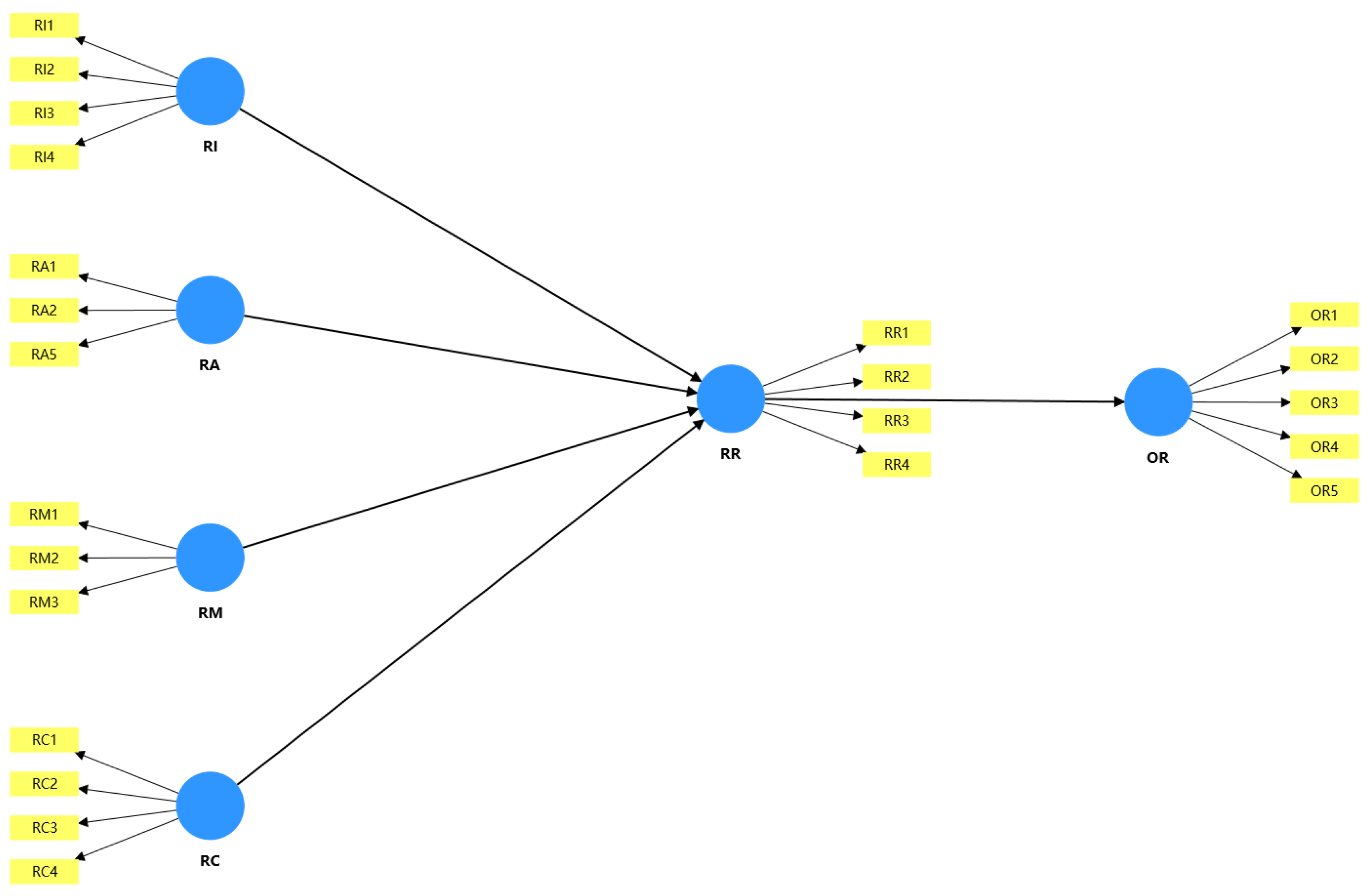
Appendix D. Importance Performance Chart
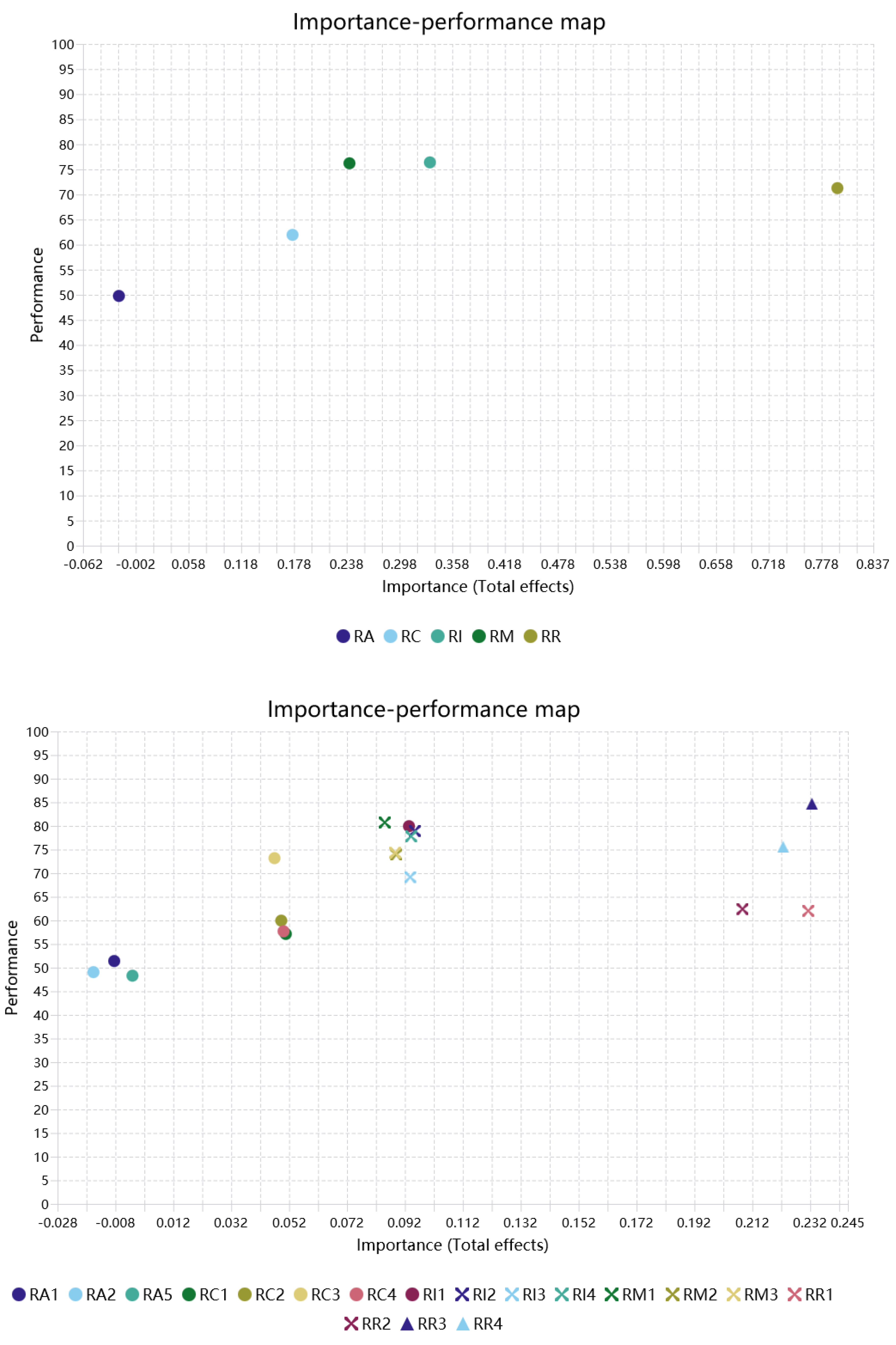
References
- Spieske, A., & Birkel, H. (2021). Improving supply chain resilience through industry 4.0: A systematic literature review under the impressions of the COVID-19 pandemic. Computers & Industrial Engineering, 158, 107452.
- Ivanov, D. (2020). Predicting the impacts of epidemic outbreaks on global supply chains: A simulation-based analysis on the coronavirus outbreak (COVID-19/SARS-CoV-2) case. Transportation Research Part E: Logistics and Transportation Review, 136, 101922.
- Brandon-Jones, E., Squire, B., Autry, C. W., & Petersen, K. J. (2014). A contingent resource-based perspective of supply chain resilience and robustness. Journal of supply chain management, 50(3), 55-73.
- Sztajerowska, M. (2023), “Supply-chain disruptions and new investment policies in the post-COVID-19 world: Initial insights from project-level data”, OECD Working Papers on International Investment, No. 2023/01, OECD Publishing, Paris, . [CrossRef]
- Arriola, C., Guilloux-Nefussi, S., Koh, S. H., Kowalski, P., Rusticelli, E., & Van Tongeren, F. (2020). Efficiency and risks in global value chains in the context of COVID-19. OECD Publishing.
- Ponomarov, S. Y., & Holcomb, M. C. (2009). Understanding the concept of supply chain resilience. The International Journal of Logistics Management, 20(1), 124–143. [CrossRef]
- Kamble, S. S., Gunasekaran, A., Subramanian, N., Ghadge, A., Belhadi, A., & Venkatesh, M. (2021). Blockchain technology’s impact on supply chain integration and sustainable supply chain performance: Evidence from the automotive industry. Annals of Operations Research, 327(1), 575–600. [CrossRef]
- Pereira, C. R., & Silva, F. J. G. (2018). Supply chain risk management: A dynamic capability perspective. International Journal of Production Research, 56(22), 6922–6935. [CrossRef]
- Hohenstein, N. O. (2022). Supply chain risk management in the COVID-19 pandemic: Strategies and empirical lessons for improving global logistics service providers’ performance. The International Journal of Logistics Management, 33(4), 1336–1365. [CrossRef]
- Choi, T. M., Dolgui, A., Ivanov, D., & Pesch, E. (2022). OR and analytics for digital, resilient, and sustainable manufacturing 4.0. Annals of Operations Research, 310(1), 1-6.
- Sofic, A., Rakic, S., Pezzotta, G., Markoski, B., Arioli, V., & Marjanovic, U. (2022). Smart and resilient transformation of manufacturing firms. Processes, 10(12), 2674.
- De Marchi, M., Friedrich, F., Riedl, M., Zadek, H., & Rauch, E. (2023). Development of a resilience assessment model for manufacturing enterprises. Sustainability, 15(24), 16947.
- Rincón-Guio, C., & Sarache, W. (2024). Mapping the multifaceted landscape of resilience in manufacturing strategy: a systematic literature review and future research avenues. Journal of Industrial Integration and Management, 9(02), 157-193.
- El-Breshy, S., Elhabashy, A. E., Fors, H., & Harfoush, A. (2024). Resiliency of manufacturing systems in the Industry 4.0 era–a systematic literature review. Journal of Manufacturing Technology Management, 35(4), 624-654.
- Singh, N., Ashish, D. K., & Dixit, A. (2025). Construction supply chain: a systematic literature review with bibliometric analysis. Journal of Global Operations and Strategic Sourcing, 18(3), 471-497.
- Solari, F., Lysova, N., Romagnoli, G., Montanari, R., & Bottani, E. (2024). Insights from 20 years (2004–2023) of supply chain disruption research: Trends and future directions based on a bibliometric analysis. Sustainability, 16(17), 7530.
- Ongkowijoyo, G., & Christian, T. F. (2020). Adaptive supply chain management under severe supply chain disruption: Evidence from Indonesia. Journal of Distribution Science, 18(11), 91–103. [CrossRef]
- Ivanov, D. (2025). Blackout and supply chains: Cross-structural ripple effect, performance, resilience and viability impact analysis. Annals of Operations Research, 348(3), 1127-1143.
- Ivanov, D., Dolgui, A., & Sokolov, B. (2019). The impact of digital technology and Industry 4.0 on the ripple effect and supply chain risk analytics. International journal of production research, 57(3), 829-846.
- Teece, D. J., Pisano, G., & Shuen, A. (1997). Dynamic capabilities and strategic management. Strategic management journal, 18(7), 509-533.
- Teece, D. J. (2007). Explicating dynamic capabilities: the nature and microfoundations of (sustainable) enterprise performance. Strategic management journal, 28(13), 1319-1350.
- Chan, J. H., & Reiner, D. (2019). “Dominance by birthright”? Reconfiguration of firm boundaries to acquire new resources and capabilities. Industrial Management & Data Systems, 119(9), 1888–1907.
- Zhang, S., Sun, Q., Dai, L., & Wang, X. (2023). Turn calamities into blessings: The impact of resource reconfiguration and organisational resilience on the company's recovery and growth in the COVID-19 times. Journal of Organizational Change Management, 36(2), 257–272. [CrossRef]
- Lee, N. C. A. (2021). Reconciling integration and reconfiguration management approaches in the supply chain. International Journal of Production Economics, 242, 108288. [CrossRef]
- Wei, H.-L., & Wang, E. T. G. (2010). The strategic value of supply chain visibility: Increasing the ability to reconfigure. European Journal of Information Systems, 19(2), 238–249. [CrossRef]
- Sirmon, D. G., Hitt, M. A., & Ireland, R. D. (2007). Managing firm resources in dynamic environments to create value: Looking inside the black box. Academy of Management Review, 32(1), 273–292. [CrossRef]
- Zhang, L., Li, J., & Zhao, Y. (2023). Environmental uncertainty, resource reconfiguration, and firm performance: Evidence from COVID-19. Technovation, 122, 102674. [CrossRef]
- Long, H., Zhang, H., Wu, T., & Han, J. (2025). The effect of resource restructuring on supply chain resilience in the context of digital transformation. Systems, 13(5), 324. [CrossRef]
- Manuj, I., & Mentzer, J. T. (2008). Global supply chain risk management strategies. International Journal of Physical Distribution & Logistics Management, 38(3), 192–223. [CrossRef]
- Ho, W., Zheng, T., Yildiz, H., & Talluri, S. (2015). Supply chain risk management: a literature review. International journal of production research, 53(16), 5031-5069.
- El Baz, J., & Ruel, S. (2021). Can supply chain risk management practices mitigate the disruption impacts on supply chains’ resilience and robustness? Evidence from an empirical survey in a COVID-19 outbreak era. International Journal of Production Economics, 233, 107972. [CrossRef]
- Yang, M., Lim, M. K., Qu, Y., Ni, D., & Xiao, Z. (2023). Supply chain risk management with machine learning technology: A literature review and future research directions. Computers & Industrial Engineering, 175, 108859.
- Chowdhury, M. M. H., & Quaddus, M. (2017). Supply chain resilience: Conceptualization and scale development using dynamic capability theory. International Journal of Production Economics, 188, 185–204.
- Fan, Y., & Stevenson, M. (2018). A review of supply chain risk management: Definition, theory, and research agenda. International Journal of Physical Distribution & Logistics Management, 48(3), 205–230. [CrossRef]
- Wieland, A., & Wallenburg, C. M. (2012). Dealing with supply chain risks: Linking risk management practices and strategies to performance. International Journal of Physical Distribution & Logistics Management, 42(10), 887–905. [CrossRef]
- Azadegan, A., Mellat Parast, M., Lucianetti, L., Nishant, R., & Blackhurst, J. (2020). Supply chain disruptions and business continuity: An empirical assessment. Decision Sciences, 51(1), 38–73.
- Berg, E., Knudsen, D., & Norrman, A. (2008). Assessing performance of supply chain risk management programmes: A tentative approach. International Journal of Risk Assessment and Management, 9(3), 288–310.
- Zsidisin, G. A., Ellram, L. M., Carter, J. R., & Cavinato, J. L. (2004). An analysis of supply risk assessment techniques. International Journal of Physical Distribution & Logistics Management, 34(5), 397–413. [CrossRef]
- Son, J. Y., & Orchard, R. K. (2013). Effectiveness of policies for mitigating supply disruptions. International Journal of Physical Distribution & Logistics Management, 43(8), 684–706. [CrossRef]
- Helfat, C. E., & Peteraf, M. A. (2003). The dynamic resource-based view: Capability lifecycles. Strategic Management Journal, 24(10), 997–1010. [CrossRef]
- Ramaswami, A., Hillman, T., Janson, B., Reiner, M., & Thomas, G. (2008). A demand-centered, hybrid life-cycle methodology for city-scale greenhouse gas inventories. Environmental Science & Technology, 42(16), 6450–6456. [CrossRef]
- Polyviou, M., Croxton, K. L., & Knemeyer, A. M. (2019). Resilience of medium-sized companies to supply chain disruptions: The role of internal social capital. International Journal of Operations & Production Management, 40(1), 68–91. [CrossRef]
- Eisenhardt, K. M., & Martin, J. A. (2000). Dynamic capabilities: What are they? Strategic Management Journal, 21(10-11), 1105–1121. [CrossRef]
- Salvador, F., Rungtusanatham, M. J., & Madiedo Montanez, J. P. (2015). Antecedents of mass customization capability: Direct and interaction effects. IEEE Transactions on Engineering Management, 62(4), 618–630. [CrossRef]
- Ma, B., Xia, L. X., & Lim, R. (2007, September). Modeling supply chain's reconfigurability using fuzzy logic. In 2007 IEEE Conference on Emerging Technologies and Factory Automation (EFTA 2007) (pp. 234–241). IEEE. [CrossRef]
- Zidi, S., Hamani, N., & Kermad, L. (2022). Antecedents and enablers of supply chain reconfigurability and their effects on performance. The International Journal of Advanced Manufacturing Technology, 120(5), 3027–3043. [CrossRef]
- Ye, J., Wang, S., & Li, H. (2024). Digital technology, resource reconfiguration, and organisational resilience: An inverted U-shaped relationship. Technovation, 132, 102711. [CrossRef]
- Parker, H., & Ameen, K. (2018). The role of resilience capabilities in shaping how companies respond to disruptions. Journal of Business Research, 88, 535–541. [CrossRef]
- Li, L., Gong, Y., Wang, Z., & Liu, S. (2023). Big data and big disaster: A mechanism of supply chain risk management in global logistics industry. International Journal of Operations & Production Management, 43(2), 274–307. [CrossRef]
- Thomas, G. H., & Douglas, E. J. (2024). Resource reconfiguration by surviving SMEs in a disrupted industry. Journal of Small Business Management, 62(1), 140–174. [CrossRef]
- Goumagias, N., Fernandes, K. J., Nucciarelli, A., & Li, F. (2022). How to overcome path dependency through resource reconfiguration. Journal of Business Research, 145, 78–91. [CrossRef]
- Weihe, H. U. A. N. G., & Jing, G. O. N. G. (2023). Prospect for the development of natural gas network and the multi-energy integration technology in pipeline networks. Oil & Gas Storage and Transportation, 42(12), 1321–1328. [CrossRef]
- Zhang, L., Gu, F., & He, M. (2024). The influence of digital transformation on the reconfigurability and performance of supply chains: A study of the electronic, machinery, and home appliance manufacturing industries in China. Sustainability, 16(7), 2689. [CrossRef]
- ONGKOWIJOYO, G., SUTRISNO, T. F., TEOFILUS, T., & HONGDIYANTO, C. (2020). Adaptive supply chain management under severe supply chain disruption: evidence from Indonesia. Journal of Distribution Science, 18(11), 91-103.
- Su, W., & Junge, S. (2023). Unlocking the recipe for organizational resilience: A review and future research directions. European Management Journal, 41(6), 1086-1105.
- Shela, V., Danks, N. P., Ramayah, T., & Ahmad, N. H. (2024). An application of the COA framework: Building a sound foundation for organizational resilience. Journal of Business Research, 179, 114702. [CrossRef]
- Conz, E., & Magnani, G. (2020). A dynamic perspective on the resilience of companies: A systematic literature review and a framework for future research. European Management Journal, 38(3), 400–412.
- Hillmann, J., & Guenther, E. (2021). Organizational resilience: A valuable construct for management research? International Journal of Management Reviews, 23(1), 7–44. [CrossRef]
- Morales, S. N., Martínez, L. R., Gómez, J. A. H., López, R. R., & Torres-Argüelles, V. (2019). Predictors of organizational resilience by factorial analysis. International Journal of Engineering Business Management, 11, 1–13. [CrossRef]
- Välikangas, L., & Hamel, G. (2003). En busca de la resiliencia. Harvard Business Review, 81(9), 40-52.
- Liu, Y., & Yin, J. (2020). Stakeholder relationships and organizational resilience. Management and Organization Review, 16(5), 986–990. [CrossRef]
- Ruiz-Martin, C., López-Paredes, A., & Wainer, G. (2018). What we know and do not know about organizational resilience. International journal of production management and engineering, 6(1), 11-28.
- Sahebjamnia, N., Torabi, S. A., & Mansouri, S. A. (2018). Building organizational resilience in the face of multiple disruptions. International Journal of Production Economics, 197, 63–83. [CrossRef]
- Anderson, L. B., & Guo, J. S. (2021). Communicating stakeholder resilience: Understanding how resilience discourse can build a fully functioning society. Journal of Public Relations Research, 33(1), 23–38.
- McCarthy, I. P., Collard, M., & Johnson, M. (2017). Adaptive organizational resilience: An evolutionary perspective. Current Opinion in Environmental Sustainability, 28, 33–40.
- Tasic J, Amir S, Tan J, et al. A multilevel framework to enhance organizational resilience[J]. Journal of Risk Research, 2020,23(6):713-738.
- Duchek, S. (2020). Organizational resilience: A capability-based conceptualization. Business Research, 13(1), 215–246. [CrossRef]
- He, Z., Huang, H., Choi, H., & Bilgihan, A. (2023). Building organizational resilience with digital transformation. Journal of Service Management, 34(1), 147–171. [CrossRef]
- Limnios, E. A. M., Mazzarol, T., Ghadouani, A., & Schilizzi, S. G. M. (2014). The resilience architecture framework: Four organizational archetypes. European Management Journal, 32(1), 104–116. [CrossRef]
- Rahi, K. (2019). Indicators to assess organizational resilience – A review of empirical literature. International Journal of Disaster Resilience in the Built Environment, 10(2–3), 85–98. [CrossRef]
- Quendler, E. (2017). Organisational resilience: Building business value in a changing world. Journal for International Business and Entrepreneurship Development, 10(2), 101–119. [CrossRef]
- Xie, X., Wu, Y., Palacios-Marqués, D., & Ribeiro-Navarrete, S. (2022). Business networks and organizational resilience capacity in the digital age during COVID-19: A perspective utilizing organizational information processing theory. Technological Forecasting and Social Change, 177, 121548. [CrossRef]
- Ozanne, L. K., Chowdhury, M., Prayag, G., & Mollenkopf, D. A. (2022). SMEs navigating COVID-19: The influence of social capital and dynamic capabilities on organizational resilience. Industrial Marketing Management, 104, 116–135. [CrossRef]
- Barney, J. B. (1991). Firm resources and sustained competitive advantage. Journal of Management, 17(1), 99–120. [CrossRef]
- Wernerfelt, B. (1984). A resource-based view of the firm. Strategic management journal, 5(2), 171-180.
- Prahalad, C. K., & Hamel, G. (1990). The core competence of the corporation. Harvard Business Review, 68(3), 79–91.
- MacKinnon, D., & Derickson, K. D. (2012). From resilience to resourcefulness: A critique of resilience policy and activism. Progress in Human Geography, 37(2), 253–270. [CrossRef]
- Li, P. P. (2020). Organizational resilience for a new normal: Balancing the paradox of global interdependence. Management and Organization Review, 16(S3), 503–509. [CrossRef]
- Zhao, S., Li, Y., & Yin, L. (2021). Entrepreneurial leadership, organizational resilience and new venture performance. Foreign Economics & Management , 43(3), 1–14. [CrossRef]
- Hernández-Linares, R., Kellermanns, F. W., & López-Fernández, M. C. (2021). Dynamic capabilities and SME performance: The moderating effect of market orientation. Journal of Small Business Management, 59(1), 162–195. [CrossRef]
- Singh, S. K., & El-Kassar, A. N. (2019). Role of big data analytics in developing sustainable capabilities. Journal of Cleaner Production, 213, 1264–1273. [CrossRef]
- Ambulkar, S., Blackhurst, J., & Grawe, S. (2015). Firm's resilience to supply chain disruptions: Scale development and empirical examination. Journal of Operations Management, 33–34, 111–122.
- Al Naimi, M., Faisal, M. N., Sobh, R., & Uddin, S. M. F. (2021). Antecedents and consequences of supply chain resilience and reconfiguration: An empirical study in an emerging economy. Journal of Enterprise Information Management, 34(6), 1722–1745. [CrossRef]
- Munir, M. A., Hussain, A., Farooq, M., Rehman, A. U., & Masood, T. (2024). Building resilient supply chains: Empirical evidence on the contributions of ambidexterity, risk management, and analytics capability. Technological Forecasting and Social Change, 200, 123146. [CrossRef]
- Zhong, J., Cheng, H., & Jia, F. (2024). Supply chain resilience capability factors in agri-food supply chains. Operations Management Research, 1–19. [CrossRef]
- Nandi, S., Sarkis, J., Hervani, A., & Helms, M. (2020). Do blockchain and circular economy practices improve post-COVID-19 supply chains? A resource-based and resource dependence perspective. Industrial Management & Data Systems, 121(2), 333–363. [CrossRef]
- Pan, S. L., Cui, M., & Qian, J. (2020). Information resource orchestration during the COVID-19 pandemic: A study of community lockdowns in China. International Journal of Information Management, 54, 102175. [CrossRef]
- Karim, S., & Capron, L. (2016). Reconfiguration capabilities and the value of corporate diversification. Strategic Management Journal, 37(3), 517–535. [CrossRef]
- Helfat, C. E., & Peteraf, M. A. (2015). Managerial cognitive capabilities and the dynamic capabilities view. Organization Science, 26(6), 1406–1423. [CrossRef]
- Davis, J. L., Eisenhardt, K. M., & Bingham, C. B. (2009). Optimal structure, market dynamism, and the development of capabilities in high technology companies. Organization Science, 20(2), 251–265. [CrossRef]
- Hitt, M. A., Ireland, R. D., & Hoskisson, R. E. (2020). Strategic management: Competitiveness and globalization (12th ed.). Cengage Learning.
- Sapienza, H. J., Autio, E., George, G., & Zahra, S. A. (2006). A capabilities perspective on the effects of early internationalization on firm survival and growth. Academy of Management Review, 31(4), 914–933. [CrossRef]
- Bode, C., Wagner, S. M., Petersen, K. J., & Ellram, L. M. (2011). Understanding responses to supply chain disruptions: Insights from information processing and resource dependence perspectives. Academy of Management Journal, 54(4), 833–856.
- Tushman, M. L., & Anderson, P. (1986). Technological discontinuities and organizational environments. Administrative Science Quarterly, 31(3), 439–465. [CrossRef]
- Vanpoucke, E., Vereecke, A., & Wouters, M. (2014). The influence of interorganizational integration on the relationship between supply chain uncertainty and performance. Journal of Operations Management, 32(5), 135–147. [CrossRef]
- Annarelli, A., & Nonino, F. (2016). Strategic and operational management of organizational resilience: Current state of research and future directions. Omega, 62, 1–18.
- Sullivan-Taylor, B., & Branicki, L. (2011). Creating resilient SMEs: The role of dynamic capabilities in responding to extreme events. International Journal of Disaster Risk Reduction, 1(1), 73–82. [CrossRef]
- Liu, C. L., Shang, K. C., Lirn, T. C., Lai, K. H., & Lun, Y. V. (2018). Supply chain resilience, firm performance, and management policies in the liner shipping industry. Transportation Research Part A: Policy and Practice, 110, 202–219. [CrossRef]
- Safari, A., Balicevac Al Ismail, V., Parast, M., Gölgeci, I., & Pokharel, S. (2024). Supply chain risk and resilience in startups, SMEs, and large companies: A systematic review and directions for research. The International Journal of Logistics Management, 35(2), 680–709. [CrossRef]
- Ernst, D., & Kim, L. (2002). Global production networks, knowledge diffusion, and local capability formation. Research Policy, 31(8-9), 1417–1429. [CrossRef]
- Jiang, Y., Feng, T., & Huang, Y. (2024). Antecedent configurations toward supply chain resilience: The joint impact of supply chain integration and big data analytics capability. Journal of Operations Management, 70(2), 257–284. [CrossRef]
- Koh, S. L., Suresh, K., Ralph, P., & Saccone, M. (2023). Quantifying organizational resilience: An integrated resource efficiency view. International Journal of Production Research, 61(1), 1–20. [CrossRef]
- Al Naimi, M., Faisal, M. N., Sobh, R., & Bin Sabir, L. (2022). A systematic mapping review exploring 10 years of research on supply chain resilience and reconfiguration. International Journal of Logistics Research and Applications, 25, 1191–1218. [CrossRef]
- Kähkönen, A.-K., Evangelista, P., Hallikas, J., Immonen, M., & Lintukangas, K. (2021). COVID-19 as a trigger for dynamic capability development and supply chain resilience improvement. International Journal of Production Research, 61, 2696–2715. [CrossRef]
- Ambrosini, V., Bowman, C., & Collier, N. (2020). Dynamic capabilities and resource reconfiguration: The role of resource alignment in enhancing supply chain resilience. International Journal of Operations & Production Management, 40(5), 782–803.
- Li, X., Zhao, Y., & Chen, J. (2022). Dynamic resource reconfiguration and resilience in supply chains. Production Planning & Control, 33(12), 1037–1051. [CrossRef]
- Manuj, I., & Mentzer, J. T. (2021). The role of resource reconfiguration in risk management and organizational resilience. Supply Chain Management: An International Journal, 26(6), 815–832. [CrossRef]
- Afum, E., Agyabeng-Mensah, Y., Baah, C., Agyapong, G. K., Armas, J. A. L., & Al Farooque, O. (2022). Prioritizing zero-waste performance and green differentiation advantage through the Prism of circular principles adoption: A mediated approach. Journal of Cleaner Production, 361, 132182.
- Afum, E., Agyabeng-Mensah, Y., Sun, Z., Frimpong, B., Kusi, L. Y., and Acquah, I. S. K. (2020). Exploring the link between green manufacturing, operational competitiveness, firm reputation and sustainable performance dimensions: a mediated approach. Journal of Manufacturing Technology Management, 31(7), 1417–1438.
- Hair, J. F., Risher, J. J., Sarstedt, M., and Ringle, C. M. (2019). When to use and how to report the results of PLS-SEM. European Business Review, 31(1), 2–24.
- Nguyen, O. T. K., Liu, L. Y. J., Haslam, J., and McLaren, J. (2023). The moderating effect of perceived environmental uncertainty and task uncertainty on the relationship between performance management system practices and organizational performance: evidence from Vietnam. Production Planning and Control, 34(5), 423–441.
- Rönkkö, M., and Evermann, J. (2013). A critical examination of common beliefs about partial least squares path modeling. Organizational Research Methods,16(3),425-448.
- Henseler, J., Ringle, C. M., & Sarstedt, M. (2015). A new criterion for assessing discriminant validity in variance-based structural equation modeling. Journal of the Academy of Marketing Science, 43(1), 115–135. [CrossRef]
- Zhao, X., Huo, B., Selen, W., Yeung, J.H.Y., 2011. The impact of internal integration and relationship commitment on external integration. J. Oper. Manag. 29 (1–2), 17–32.
- Malhotra, M.K., Grover, V., 1998. An assessment of survey research in POM: from constructs to theory. J. Oper. Manag. 16 (4), 407–425.
- Huo, B., Zhao, X., & Li, X. (2021). The impact of supply chain integration on firm performance: The moderating role of environmental uncertainty. International Journal of Production Economics, 235, 108081. [CrossRef]
- Shi, X. (2025, March 17). What the new “Catalogue of Encouraged Industries in the Western Region” can bring to Xinjiang [Article]. Xinjiang Daily. [CrossRef]
- Kamble, S., Gunasekaran, A., Arha, H., 2018. Understanding the Blockchain technology adoption in supply chains-Indian context. Int. J. Prod. Res. 57 (7), 2009–2033.
- Flynn, B. B., Huo, B., & Zhao, X. (2010). The impact of supply chain integration on performance: A contingency and configuration approach. Journal of Operations Management, 28(1), 58–71. [CrossRef]
- Dillman, D.A., 2007. In: Hoboken, N.J. (Ed.), Mail and Internet Surveys : the Tailored Design Method, second ed. Wiley, Hoboken, N.J.
- Wagner, S.M., Kemmerling, R., 2010. Handling nonresponse in logistics research. J. Bus. Logist. 31 (2), 357–381.
- Handfield, R.B., Cousins, P.D., Lawson, B., Petersen, K.J., 2015. How can supply management really improve performance? A knowledge-based model of alignment capabilities. J. Supply Chain Manag. 51 (3), 3–17.
- Podsakoff, P. M., MacKenzie, S. B., Lee, J. Y., & Podsakoff, N. P. (2003). Common method biases in behavioral research: A critical review of the literature and recommended remedies. Journal of Applied Psychology, 88(5), 879–903. [CrossRef]
- Lindell, M. K., & Whitney, D. J. (2001). Accounting for common method variance in cross-sectional research designs. Journal of Applied Psychology, 86(1), 114–121. [CrossRef]
- Shou, Z., Chen, J., Zhu, W., & Yang, L. (2014). Firm capability and performance in China: The moderating role of guanxi and institutional forces in domestic and foreign contexts. Journal of Business Research, 67(2), 77–82. [CrossRef]
- Hair Jr, J. F., Howard, M. C., & Nitzl, C. (2020). Assessing measurement model quality in PLS-SEM using confirmatory composite analysis. Journal of business research, 109, 101-110.
- Ramayah, T., Cheah, J., Chuah, F., Ting, H., & Memon, M. A. (2018). Partial least squares structural equation modeling (PLS-SEM) using SmartPLS 3.0: An updated and practical guide to statistical analysis (2nd ed.). Pearson.
- Franke, G., & Sarstedt, M. (2019). Heuristics versus statistics in discriminant validity testing: A comparison of four procedures. Internet Research, 29(3), 430–447. [CrossRef]
- Cohen, J. (1988). Statistical power analysis for the behavioral sciences (2nd ed.). Lawrence Erlbaum Associates.
- Naz, F., Kumar, A., Majumdar, A., & Agrawal, R. (2022). Is artificial intelligence an enabler of supply chain resiliency post-COVID-19? An exploratory state-of-the-art review for future research. Operations Management Research, 15, 378–403. [CrossRef]
- Hair, J. F., Hult, G. T. M., Ringle, C. M., & Sarstedt, M. (2022). A primer on partial least squares structural equation modeling (PLS-SEM) (3rd ed.). Sage.
- Sarstedt, M., Ringle, C. M., Cheah, J. H., Ting, H., Moisescu, O. I., & Radomir, L. (2020). Structural model robustness checks in PLS-SEM. Tourism Economics, 26(4), 531–554. [CrossRef]
- Hair, J. F., Hult, G. T. M., Ringle, C. M., & Sarstedt, M. (2017). A primer on partial least squares structural equation modeling (PLS-SEM). Sage.
- Sarstedt, M., Ringle, C. M., & Hair, J. F., Jr. (2017). Partial least squares structural equation modeling. In C. Homburg, M. Klarmann, & A. Vomberg (Eds.), Handbook of market research (pp. 587–632). Springer, Cham. [CrossRef]
- Dubey, R., Gunasekaran, A., Childe, S. J., Blome, C., & Papadopoulos, T. (2018). Antecedents of resilience in supply chains: An empirical study. IEEE Transactions on Engineering Management, 65(2), 351–362. [CrossRef]
- Shaver, J. M. (1998). Accounting for endogeneity when assessing strategy performance: Does entry mode choice affect FDI survival? Management Science, 44(4), 571–585. [CrossRef]
- Becker, J. M., Proksch, D., & Ringle, C. M. (2021). Revisiting Gaussian copulas to handle endogenous regressors. Journal of the Academy of Marketing Science, 50(1), 46–66. [CrossRef]
- Eckert, C., & Hohberger, J. (2022). Addressing endogeneity without instrumental variables: An evaluation of the Gaussian Copula approach for management research. Journal of Management, 48(1), 14–28. [CrossRef]
- Kolmogorov, A. (1933). Foundations of the theory of probability. Chelsea.
- Shapiro, S. S., & Wilk, M. B. (1965). An analysis of variance test for normality (complete samples). Biometrika, 52(3/4), 591–611. [CrossRef]
- Ullah, S., Akhtar, P., & Zaefarian, G. (2018). Dealing with endogeneity bias: The generalized method of moments (GMM) for panel data. Industrial Marketing Management, 71, 69–78. [CrossRef]
- Ringle, C. M., Wende, S., & Becker, J. M. (2022). SmartPLS 4. Boenningstedt: SmartPLS. https://www.smartpls.com.
- Hahn, C., Johnson, M. D., Herrmann, A., & Huber, F. (2002). Capturing customer heterogeneity using a Finite Mixture PLS approach. Schmalenbach Business Review, 54, 243–269.
- Sarstedt, M., Becker, J. M., Ringle, C. M., & Schwaiger, M. (2011). Uncovering and treating unobserved heterogeneity with FIMIX-PLS: Which model selection criterion provides an appropriate number of segments? Schmalenbach Business Review, 63(1), 34–62. [CrossRef]
- Baryannis, G., Validi, S., Dani, S., & Antoniou, G. (2019). Supply chain risk management and artificial intelligence: State of the art and future research directions. International Journal of Production Research, 57(7), 2179–2202.
- Karman, A., Prokop, J., & de Sousa Jabbour, A. B. L. (2024). Network redundancy, collaboration, and resilience: Evidence from European supply chains. Supply Chain Management: An International Journal, 29(2), 145–162. [CrossRef]
Disclaimer/Publisher’s Note: The statements, opinions and data contained in all publications are solely those of the individual author(s) and contributor(s) and not of MDPI and/or the editor(s). MDPI and/or the editor(s) disclaim responsibility for any injury to people or property resulting from any ideas, methods, instructions or products referred to in the content. |
© 2026 by the authors. Licensee MDPI, Basel, Switzerland. This article is an open access article distributed under the terms and conditions of the Creative Commons Attribution (CC BY) license.
Copyright: This open access article is published under a Creative Commons CC BY 4.0 license, which permit the free download, distribution, and reuse, provided that the author and preprint are cited in any reuse.


