

Submitted:
02 February 2026
Posted:
04 February 2026
You are already at the latest version
Abstract
Background/Objectives: Transcatheter edge-to-edge repair (TEER) has become an established therapeutic option for selected patients with mitral regurgitation (MR). However, primary (degenerative) and secondary (functional) MR represent distinct disease entities, characterized by different pathophysiological mechanisms, clinical trajectories, and determinants of benefit. This review aims to provide an interventional cardiology-oriented synthesis of TEER, emphasizing the fundamental differences between primary and secondary MR and their i for patient selection, procedural strategy, and outcome interpretation. Methods: A targeted literature search was performed in PubMed and Embase to identify pivotal randomized trials, registries, guideline documents, and high-quality reviews addressing TEER in MR. The available evidence was synthesized narratively, with a focus on mechanistic insights, TEER-specific imaging and procedural endpoints, and clinically relevant outcomes.Results: In primary MR, TEER functions as a valve-centered therapy, with procedural success primarily determined by anatomical suitability and the balance between durable MR reduction and avoidance of elevated transmitral gradients. In secondary MR, TEER should be considered an adjunctive intervention within a comprehensive heart failure strategy, with benefit dependent on patient phenotype, myocardial substrate, optimization of background therapy, and appropriate timing. Emerging phenotypes, such as atrial functional MR, further challenge traditional classification and highlight the need for mechanism-based selection. Across MR subtypes, residual MR and transmitral gradients emerge as key post-procedural endpoints with differential prognostic implications. Conclusions: TEER represents a phenotype-specific intervention rather than a uniform solution for MR. Recognizing the distinct interventional paradigms of primary and secondary MR is essential to optimize patient selection, procedural decision-making, and clinical outcomes.
Keywords:
mitral regurgitation
; transcatheter edge-to-edge repair
; primary mitral regurgitation
; secondary mitral regurgitation
; atrial functional mitral regurgitation
; patient selection
1. Introduction
1.1. Burden and Clinical Relevance of Mitral Regurgitation
Mitral regurgitation (MR) is one of the most prevalent valvular heart diseases in contemporary clinical practice and represents a major contributor to morbidity, reduced quality of life, and adverse cardiovascular outcomes when moderate-to-severe or severe and left untreated [1]. Persistent MR imposes a chronic volume overload on the left-sided cardiac chambers, promoting progressive atrial and ventricular remodeling, pulmonary hypertension, and, in advanced stages, right ventricular dysfunction [2]. Importantly, the clinical impact of MR is highly heterogeneous and depends not only on regurgitation severity but also on its underlying mechanism, temporal evolution, and interaction with ventricular and atrial compliance [3]. These factors critically influence both the natural history of the disease and the response to interventional therapies.
1.2. Rationale for Transcatheter Edge-to-Edge Repair
Despite the established role of surgical repair for selected patients with primary MR, a substantial proportion of patients encountered in real-world settings are not referred for surgery or are deemed unsuitable because of advanced age, frailty, comorbidities, or an unfavorable risk–benefit profile [4]. Transcatheter edge-to-edge repair (TEER) was developed to address this unmet clinical need by offering a less invasive approach capable of achieving meaningful MR reduction with acceptable procedural safety in appropriately selected patients [5]. Over time, advances in device design, imaging integration, and procedural technique have expanded the anatomical applicability of TEER and improved procedural consistency compared with early experience [2]. However, TEER should not be regarded as a universal solution for all MR phenotypes; rather, its effectiveness is intrinsically linked to careful patient selection and a clear understanding of the mechanism driving regurgitation.
1.3. Aim and Scope of the Review
The present narrative review focuses exclusively on TEER for MR, adopting a cardiology intervention-centered perspective that emphasizes phenotype-driven evaluation, specific imaging and procedural endpoints, and realistic expectations regarding clinical benefit and durability. Particular attention is devoted to the differential behavior of TEER in primary versus secondary MR, including atrial functional MR, as well as to the prognostic implications of residual MR and transmitral gradients after the procedure.
2. Materials and Methods
A targeted literature search was conducted in PubMed and Embase to identify pivotal randomized trials, registries, guideline documents, and high-quality reviews addressing TEER for MR, with specific attention to differences between primary and secondary mechanisms. The retrieved evidence was selected and synthesized in a narrative manner, prioritizing clinical relevance, methodological rigor, and consistency with contemporary recommendations. This review does not present new or unpublished data. The manuscript was prepared in accordance with the International Committee of Medical Journal Editors (ICMJE) recommendations for the conduct, reporting, editing, and publication of scholarly work in medical journals.
3. Results
3.1. Phenotypes and Severity Assessment in the TEER Era
Assessment of mitral regurgitation relies on two fundamental aspects: first, identification of the mechanism responsible for systolic backward flow from the left ventricle into the left atrium; and second, estimation of the severity of this regurgitant volume. Echocardiography can address both objectives. MR quantification integrates qualitative, semi-quantitative, and quantitative parameters, whereas the underlying mechanism is classified as primary (also termed organic or degenerative) or secondary (functional). Secondary MR should further be distinguished into “ventricular functional” and “atrial functional” subtype [1]. An overview is provided in Figure 1.
3.1.1. Mechanistic Classification: Primary vs. Secondary MR
Primary mitral regurgitation (PMR) is characterized by intrinsic structural abnormalities of the mitral valve apparatus, including leaflet prolapse, flail segments, chordal rupture, valve perforation, degenerative leaflet thickening and calcification, radiation/drugs exposure, congenital cleft leaflet or parachute valve, leading to loss of effective coaptation [6].
Depending on the underlying mechanistic subtype, mitral regurgitation can also be classified according to Carpentier’s functional scheme. Type I refers to normal leaflet motion; regurgitation may result from a leaflet cleft or perforation and, in some cases, from annular dilatation, although annular dilatation is more typically considered within the spectrum of functional MR. Type II encompasses excessive leaflet motion, including prolapse and flail leaflet due to chordal rupture, and is commonly associated with myxomatous degeneration (Barlow disease) or fibroelastic deficiency. Finally, a further mechanism that may be encountered in primary MR is Type IIIa, characterized by systolic-diastolic leaflet restriction, most often due to rheumatic disease or severe mitral annular calcification [7].
In this setting, the left ventricle is initially exposed to volume overload but is not the primary driver of regurgitation, and symptoms often emerge despite preserved or only mildly impaired systolic function [8].
In severe regurgitation, global left ventricular remodelling may be observed, together with moderate-to-severe left atrial dilatation. The mitral annulus may be enlarged while maintaining preserved dynamic function. Leaflets are frequently moderately to markedly thickened, with prolapse or flail and a variable degree of calcification. Leaflet tethering and systolic tenting are typically absent, and the interpapillary muscle distance is usually normal. The regurgitant jet may be central or eccentric; it is often late systolic in the presence of prolapse, whereas it may appear holosystolic in flail leaflet or calcific-degenerative disease. The PISA is commonly hemispheric [6]. From an interventional standpoint, PMR represents a valve-centered disease, where the feasibility and durability of TEER depend predominantly on leaflet anatomy, coaptation geometry, and the ability to achieve stable leaflet grasping without inducing functionally relevant mitral stenosis [5].
Secondary mitral regurgitation (SMR), by contrast, arises as a consequence of myocardial disease rather than primary valvular pathology. In ventricular SMR, leaflet tethering and annular dilation are driven by left ventricular remodeling, papillary muscle displacement, and altered closing forces, resulting in incomplete leaflet coaptation despite structurally normal leaflets [9]. Ventricular remodeling is secondary to ischaemic etiology due to coronary artery disease or non-ischaemic cardiomyopathy. In this context, MR severity is tightly coupled to ventricular geometry and loading conditions, and may fluctuate over time [10]. Regional systolic dysfunction, most commonly involving the inferior wall, may lead to segmental remodelling and ischaemia, with consequent posterior papillary muscle dysfunction, which is typically supplied exclusively by the right coronary artery. Left atrial enlargement is variable, whereas annular dilatation is usually mild. Leaflet morphology is generally preserved. Tethering is typically asymmetric, with systolic tenting and an increased distance between the posterior papillary muscle and the intervalvular fibrosa. The regurgitant jet is usually directed posteriorly (towards the involved posterior leaflet), and jet density is commonly uniform throughout systole; the PISA is frequently non-hemispheric.
When left ventricular dysfunction is global, such as after a large anterior myocardial infarction, in non-ischaemic dilated cardiomyopathy, or following multiple infarctions in different territories, ventricular remodelling becomes diffuse, with increased left ventricular sphericity. Left atrial dilatation is often severe. The mitral annulus is enlarged, flattened, and functionally adynamic. Leaflet morphology is typically preserved; however, tethering is generally symmetric and systolic tenting is markedly increased. The interpapillary muscle distance is increased. The regurgitant jet is usually central or only mildly eccentric. On colour Doppler, a biphasic pattern may be observed, with increased regurgitant intensity in early and late systole and a mid-systolic drop-out; the PISA is frequently non-hemispheric [6].
A distinct SMR phenotype is atrial functional mitral regurgitation (AFMR), in which regurgitation is primarily related to left atrial enlargement and annular dilation, often in the setting of long-standing atrial fibrillation or heart failure with preserved ejection fraction (HFpEF), with relatively preserved left ventricular size and function in earlier stages [11].
AFMR challenges the traditional ventricular-centric paradigm of SMR and introduces additional uncertainty regarding optimal timing and expected benefit of TEER, given the paucity of randomized data and the complex interplay between atrial remodeling, rhythm, and annular geometry.
Distinguishing ventricular from atrial secondary mitral regurgitation (SMR) is clinically relevant because therapeutic indications and the level of supporting evidence differ between these entities. Ventricular SMR is primarily suggested by a left ventricular ejection fraction (LVEF) <50%, with or without regional wall motion abnormalities, in the presence of restricted leaflet motion due to tethering with otherwise normal leaflet morphology; the regurgitant jet may be central or eccentric. Additional supportive features include dilatation of the left ventricle, left atrium, and mitral annulus. Clinical correlates typically include ischaemic heart disease and dilated cardiomyopathy. In contrast, atrial SMR is characterized by LVEF ≥50% without regional wall motion abnormalities or leaflet tethering, and by a non-dilated or only mildly dilated left ventricular cavity (LV end-diastolic diameter <56 mm in women and <63 mm in men; indexed LV end-diastolic volume <71 mL/m2 in women and <79 mL/m2 in men). Key anatomic criteria include mitral annular dilatation (anteroposterior diameter >35 mm) and left atrial enlargement (LAVI >34 mL/m2). Additional features include normal leaflet morphology and motion with a usually central jet, atrial fibrillation, and HFpEF [1].
3.1.2. Echocardiographic Grading of MR Severity: An Integrative Approach
Accurate grading of MR severity is central to TEER candidacy but remains intrinsically challenging, particularly in secondary disease. Current recommendations emphasize an integrative approach combining quantitative, semi-quantitative, and qualitative parameters rather than reliance on a single metric [12]. Quantitative measures such as effective regurgitant orifice area (EROA), regurgitant volume, and regurgitant fraction provide a numerical estimate of severity but are sensitive to technical assumptions and hemodynamic conditions, especially in SMR where regurgitant orifice geometry is often dynamic [11].
Semi-quantitative parameters, including vena contracta width and pulmonary vein flow patterns, offer complementary information but may be misleading in the presence of eccentric or multiple jets, which are common in both PMR and SMR. Qualitative assessment of color Doppler jet morphology and extent remains useful for initial screening but should not be used in isolation to define severity, particularly when TEER is being considered [3].
Specific Criteria for Severe MR are: flail leaflet, vena contracta ≥ 0.7 cm, PISA radius ≥ 1.0 cm at Nyquist 30- 40 cm/s, central large jet > 50% of left atrium area, pulmonary vein systolic flow reversal, enlarged left ventricle with normal function. Additional criteria that support a diagnosis of severe mitral regurgitation include the presence of a large regurgitant flow persisting throughout systole, together with a continuous-wave Doppler profile that appears holosystolic, dense, and classically triangular/early peaking. On transmitral inflow, an E-wave–dominant pattern with a peak E velocity above 1.2 m/s may further suggest significant regurgitant volume. Quantitatively, severity is reinforced by an effective regurgitant orifice area greater than 0.40 cm2, a regurgitant volume exceeding 60 mL, and a regurgitant fraction above 50% [6].
Importantly, MR severity is flow-dependent. In SMR, reduced forward stroke volume may lead to underestimation of EROA and regurgitant volume despite clinically significant MR, whereas acute increases in preload or afterload can transiently exaggerate regurgitation [10]. These considerations underscore the need to interpret echocardiographic findings within the broader clinical and hemodynamic context, rather than applying rigid numerical thresholds divorced from patient phenotype.
3.1.3. TEER-Relevant Pitfalls in MR Quantification
Several diagnostic pitfalls have direct implications for TEER selection and outcome interpretation. First, multiple or eccentric jets may result in underestimation of total regurgitant burden when only a single jet is quantified, a scenario frequently encountered in degenerative disease with complex leaflet pathology. Second, dynamic SMR may appear non-severe at rest but become significant under exertion or volume loading, potentially explaining discordance between imaging findings and symptom burden. Third, reliance on EROA alone may be misleading in SMR, where smaller absolute orifice areas can still confer substantial prognostic impact in the setting of advanced ventricular disease [6].
Conversely, in PMR, aggressive pursuit of minimal residual MR must be balanced against the risk of excessive leaflet approximation and subsequent transmitral gradient elevation, which carries its own prognostic and symptomatic consequences [13]. These pitfalls reinforce the concept that MR grading for TEER should be purpose-driven: the objective is not merely to label severity, but to identify patients in whom regurgitation is both mechanistically addressable and clinically meaningful.
3.1.4. Role of Advanced Imaging Beyond Standard Echocardiography
Three-dimensional transesophageal echocardiography (3D TEE) is the cornerstone of TEER planning and intraprocedural guidance, enabling detailed assessment of leaflet anatomy, coaptation gaps, jet origin, and spatial relationships critical for successful leaflet grasping [14]. In most patients, comprehensive TEE is sufficient to determine feasibility and strategy. Cardiac computed tomography (CT) plays a complementary, selective role in TEER candidates rather than serving as a routine modality. CT is particularly valuable in the presence of significant mitral annular calcification (MAC), where it allows precise characterization of calcium distribution, annular geometry, and residual valve area, all of which influence the risk of post-procedural mitral stenosis [15]. CT may also assist in borderline cases by providing additional information on annular dimensions and spatial constraints when echocardiographic assessment is inconclusive [16]. However, CT should be viewed as an adjunct to, not a replacement for, high-quality echocardiography in TEER decision-making.
3.2. Patient Selection and Interventional Decision-Making
3.2.1. Goals of TEER and Definition of Procedural Intent
Appropriate patient selection for TEER requires a clear definition of procedural intent, which differs substantially between primary and secondary MR. In primary MR, the primary goal of TEER is durable reduction of regurgitation through restoration of leaflet coaptation, ideally achieving mild or less residual MR while preserving an adequate mitral valve area [5]. In this setting, procedural success is closely tied to anatomical suitability and technical execution, and the procedure is judged predominantly on valve-related endpoints.
In secondary MR, the objectives of TEER are broader and more nuanced. Rather than pursuing complete elimination of regurgitation, the interventional goal is to reduce MR to a degree sufficient to alleviate symptoms, decrease heart failure hospitalizations, and favorably modify clinical trajectory within the context of optimized heart failure therapy [9]. As such, the concept of “procedural success” in secondary MR is inseparable from patient phenotype, baseline ventricular remodeling, and post-procedural clinical response, rather than from echocardiographic endpoints alone.
3.2.2. Defining Expected Benefit Versus Futility
A central challenge in TEER decision-making is distinguishing patients likely to derive meaningful benefit from those in whom the procedure may be futile. In secondary MR, randomized evidence has demonstrated that TEER confers clinical benefit only in selected populations, emphasizing the importance of aligning MR severity with ventricular size, function, and symptom burden [9]. Patients with extreme ventricular dilation or advanced myocardial disease may exhibit MR that is largely epiphenomenal, such that reducing regurgitation does not translate into improved outcomes [10].
Conversely, patients with secondary MR in whom regurgitation is disproportionately severe relative to ventricular remodeling may represent a subgroup in which MR itself is a dominant driver of symptoms and adverse events, and therefore a more suitable target for TEER [17]. Although the proportionality framework remains debated, it has reinforced the broader principle that TEER benefit in secondary MR depends less on absolute MR severity and more on the relationship between regurgitation and the underlying myocardial substrate.
In primary MR, futility is more often related to anatomical constraints or competing comorbidities rather than to the mechanism of regurgitation itself. Severe leaflet calcification, inadequate leaflet length, extensive commissural involvement, or a high risk of post-procedural mitral stenosis may limit the likelihood of durable MR reduction and should prompt careful reconsideration of TEER candidacy [18].
3.2.3. The Interventional Heart Team Perspective
Decision-making for TEER is inherently multidisciplinary, but from an interventional cardiology standpoint, the Heart Team process should focus on integrating anatomical feasibility, clinical phenotype, and procedural risk rather than on binary eligibility criteria alone. Imaging specialists play a pivotal role in defining leaflet anatomy, coaptation geometry, and potential constraints, while heart failure specialists contribute to optimization of medical and device therapy and assessment of reversibility of symptoms [2].
Importantly, the Heart Team should explicitly discuss procedural endpoints and acceptable trade-offs before intervention. In primary MR, this often involves balancing the desire for minimal residual MR against the risk of elevated transmitral gradients. In secondary MR, the discussion should center on whether a moderate degree of residual MR is acceptable if accompanied by symptomatic improvement and reduced heart failure burden [13].
3.2.4. Anatomic and Echocardiographic Selection Criteria
There are no differences in the echocardiographic, valve anatomy-based selection criteria between primary and secondary MR; the two entities differ primarily in clinical indications and in the pattern of subvalvular apparatus remodeling. In general, the key parameters to consider include the regurgitant jet location, mitral valve area, the presence and extent of calcifications (particularly within the grasping zone), posterior leaflet length, flail gap, and any additional anatomical or procedural features relevant to device feasibility and procedural complexity [7].
Accordingly, anatomical criteria for TEER suitability are driven by the complexity of valve morphology and by center experience (Figure 2).
The ideal anatomy for TEER is a non-complex valve, characterized by central pathology (regurgitant jet A2-P2), absence of calcification, a large mitral valve area (>4 cmq), posterior leaflet length >10 mm, tenting height and flail gap <10 mm, and flail width <15 mm. Conversely, very complex anatomy, generally better addressed with surgery or alternative transcatheter options, is defined by mitral valve area <3.0 cm2, significant (mean gradient >5 mmHg) and/or rheumatic mitral stenosis, concentric mitral annular calcification and calcification within the grasping zone, posterior leaflet length <5 mm, multiple or wide jets, deep cleft or leaflet perforation [1].
3.2.5. Endpoints that Matter in TEER Practice
Traditional valve-centric endpoints, such as reduction in MR grade, remain important but are insufficient to capture the full impact of TEER, particularly in secondary MR. Clinical endpoints including functional status, quality of life, and heart failure hospitalizations have emerged as key measures of success and should be considered integral to post-procedural assessment [9]. At the same time, procedural parameters such as residual MR and transmitral mean pressure gradient have gained recognition as prognostically relevant variables that reflect the balance between effective regurgitation reduction and preservation of diastolic inflow [13]. The key TEER-specific differences between primary and secondary mitral regurgitation, including mechanistic drivers, selection criteria, and procedural priorities, are summarized in Table 1.
3.3. TEER in Primary Mitral Regurgitation
3.3.1. Clinical Positioning of TEER in Primary MR
Since the early phases of clinical adoption, transcatheter edge-to-edge repair has not been established as a routine treatment for primary (degenerative/organic) MR and has been reserved for carefully selected symptomatic patients with favourable anatomy who are deemed inoperable or at prohibitive/high surgical risk or in whom the anticipated benefit of surgery is outweighed by comorbidities and frailty [19]. In this population, TEER is positioned as a valve-directed therapy aimed at reducing regurgitation by restoring leaflet coaptation, rather than as a disease-modifying intervention targeting myocardial pathology [20]. Consequently, patient selection hinges on anatomical feasibility and procedural safety, with less emphasis on ventricular remodeling or heart failure phenotype compared with secondary MR.
Importantly, the objectives of TEER in primary MR differ from those in secondary MR. While symptomatic improvement remains a central goal, the interventional intent is typically to achieve durable and substantial MR reduction, ideally to mild or less, without inducing clinically relevant mitral stenosis [2]. This balance between efficacy and safety is a defining feature of TEER in degenerative disease.
The recent 2025 ESC/EACTS Guidelines on valvular heart disease have repositioned TEER in PMR, upgrading its recommendation from Class IIb, Level B in the 2021 European guidance to Class IIa, Level B. Accordingly, TEER should now be considered a preferred option in patients with PMR who are symptomatic, deemed at high surgical risk by the Heart Team, and who meet specific anatomical suitability criteria predictive of procedural success [1]. This upgrade is supported by favourable evidence from two registries and one randomized trial, showing high procedural success and signals of improved outcomes, including lower mortality in appropriately selected high-risk patients [19,21,22].A Class IIa recommendation with broadly similar selection principles is also reflected in the most recent ACC/AHA guidelines [23].
Conversely, TEER is not the preferred strategy for severe PMR in asymptomatic patients, including those with or without left ventricular dilatation, atrial fibrillation, elevated sPAP, or left atrial enlargement-clinical scenarios in which surgical intervention, preferably mitral valve repair, remains the recommended approach [1]. Figure 3 summarizes the indications for TEER in severe PMR according to the ESC/EACTS 2025 and ACC/AHA 2020 guidelines.
3.3.2. Anatomical Suitability and Predictors of Durable MR Reduction
Anatomical assessment is the cornerstone of TEER feasibility in primary MR. Favorable features include adequate leaflet length, a clearly defined regurgitant jet origin, limited commissural involvement, and sufficient coaptation reserve to allow stable leaflet grasping [24].
Three-dimensional transesophageal echocardiography plays a pivotal role in defining these anatomical parameters and guiding clip positioning strategy, particularly in complex degenerative anatomies [14]. In selected cases, cardiac computed tomography may provide additional information on annular geometry and residual valve area, especially when there is concern for post-procedural mitral stenosis in the presence of calcification [15]. Historically, lesions located in the anterior and bileaflet locations have been considered difficult to treat surgically. In the EXPANDed analysis (a pooled, contemporary, patient-level dataset from the prospective EXPAND and EXPAND G4 studies using MitraClip G3/G4), outcomes of mitral TEER were evaluated according to degenerative MR (DMR) lesion location (posterior, anterior, or bileaflet prolapse/flail as assessed by an echocardiography core laboratory). Among 556 subjects with DMR/mixed MR and identifiable lesion location (389 posterior, 106 anterior, 61 bileaflet), procedural efficiency and acute effectiveness were high across all groups, with similarly favorable procedure/device times and high procedural success (discharge MR ≤2+). Thirty-day major adverse event rates were low across all groups (posterior, 4.4% [17 of 388]; anterior, 3.8% [4 of 105]; bileaflet, 6.6% [4 of 61]; P = 0.65) and not significantly different by lesion location. At 1 year, TEER was associated with sustained and substantial MR reduction regardless of lesion location, with high proportions achieving MR ≤1+ in paired analyses (82% posterior, 93% anterior, and 97% bileaflet), alongside consistent improvements in NYHA functional class and quality of life (KCCQ). One-year mortality and heart-failure hospitalization rates did not differ significantly among groups, although anterior disease showed numerically higher event rates. Overall, these data support that with contemporary MitraClip generations, demonstrate that subjects with DMR treated with TEER experienced significant improvements in outcomes, regardless of the location of prolapse or flail, and effective and durable MR reduction can be achieved even in anatomies traditionally considered more challenging (anterior and bileaflet DMR) [25].
Durability of MR reduction in primary MR is closely linked to achieving optimal leaflet capture and minimizing residual regurgitation at the end of the procedure. Inadequate grasping or residual prolapse may predispose to recurrent MR over time, underscoring the importance of meticulous intraprocedural imaging and a conservative approach to clip deployment rather than procedural expediency [2].
3.3.3. Evidence from Pivotal Trials and Contemporary Registries
The EVEREST II trial established the foundational evidence for TEER in primary MR by demonstrating the feasibility and safety of the edge-to-edge approach in patients with degenerative disease, albeit with lower rates of complete MR elimination compared with surgery [5]. Long-term follow-up confirmed sustained symptomatic improvement in selected patients, while also highlighting the importance of careful anatomical selection to minimize the need for reintervention [24]. Subsequent registries and contemporary real-world data have expanded these observations, reflecting improved device technology, refined patient selection, and greater operator experience [26]. In the EXPAND trial, a prospective, multicenter, international, single-arm study enrolling patients with primary and secondary MR across 57 centers with 12-month follow-up, treatment with the third-generation MitraClip system resulted in substantial MR reduction in contemporary real-world practice. At 1 year, 84.5% of patients with primary MR achieved MR ≤1+, accompanied by significant improvements in clinical outcomes (NYHA functional class I/II in 80.3% and a +21.6-point increase in KCCQ score) [27]. In the EXPAND G4 study, a prospective, multicenter, international, single-arm trial enrolling patients with primary (500 patients) and secondary MR, TEER using the fourth-generation MitraClip system was safe and effective at 1 year. Durable MR reduction to ≤1+ was achieved in 88.8% of patients with primary MR, with concomitant improvements in functional status and quality of life [28].
The CLASP IID trial was the first randomized study to directly compare the Edwards PASCAL device with MitraClip in patients at prohibitive surgical risk with severe, symptomatic degenerative mitral regurgitation. Participants with 3+/4+ DMR were allocated in a 2:1 ratio to PASCAL or MitraClip. The trial evaluated early safety (30-day composite MAE), primary effectiveness (MR ≤2+ at 6 months), and prespecified 1-year outcomes including MR reduction thresholds (≤2+ and ≤1+) alongside clinical status, echocardiography, functional capacity, and quality of life. Overall, PASCAL achieved noninferiority to MitraClip for the primary safety and effectiveness endpoints, and 1-year follow-up showed high survival, durable MR reduction, and sustained improvements in symptoms, function, and quality of life, supporting PASCAL as an effective option for prohibitive-risk patients with significant DMR [22]. These data consistently show high procedural success rates and meaningful symptom relief in appropriately selected high-risk patients with primary MR, reinforcing the role of TEER as a viable alternative when surgery is not an option.
3.3.4. Residual MR and Transmitral Gradient: A Critical Trade-Off
A distinctive challenge of TEER in primary MR is balancing effective regurgitation reduction against the risk of elevated transmitral mean pressure gradient. Aggressive leaflet approximation aimed at eliminating MR may inadvertently reduce mitral valve area and lead to functional mitral stenosis, particularly in patients with small annuli or pre-existing calcification. Evidence suggests that elevated residual transmitral gradients after TEER are associated with worse clinical outcomes in primary MR, with a signal driven predominantly by increased mortality rather than heart failure hospitalization [13].These findings underscore the importance of defining procedural success not solely by MR grade but by a composite assessment that includes transmitral gradient and valve area. In primary MR, accepting mild residual MR may be preferable to achieving near-complete MR elimination at the cost of elevated gradients, particularly in elderly or frail patients [2].
3.3.5. Expected Outcomes and Limitations
In appropriately selected patients with primary MR, TEER is associated with significant symptomatic improvement and acceptable mid-term durability, particularly when procedural endpoints are carefully balanced [26]. However, the procedure does not replicate the long-term durability of surgical repair in low-risk populations and should therefore be framed as a tailored intervention for patients in whom surgical options are limited or undesirable.
Real-world registries support the feasibility and procedural safety of TEER in PMR and report encouraging short- to mid-term outcomes; however, robust long-term evidence remains limited and randomized data with extended follow-up are still scarce. Overall, the available literature, predominantly observational, suggests acceptable mid-term safety and clinical effectiveness, with mortality largely driven by patient comorbidities and frailty rather than valve-related failure. Although newer-generation devices and increasing operator experience are improving procedural performance and outcomes, uncertainty persists regarding long-term durability and comparative effectiveness versus surgical repair, underscoring the need for adequately powered randomized trials with longer follow-up [7].
Taken together, TEER in primary MR exemplifies a valve-centered interventional paradigm in which success depends on anatomical suitability, procedural precision, and judicious acceptance of trade-offs between residual MR and transmitral gradient.
3.3.6. Future Directions
Two randomized programs are addressing the evidence gap for primary/degenerative MR in patients who are surgical candidates. REPAIR MR (NCT04198870) is a prospective, multicenter, open-label noninferiority RCT that randomizes 500 patients 1:1 to MitraClip (TEER) versus surgical mitral valve repair in older and/or moderate surgical-risk patients with severe primary MR, with two co-primary endpoints at 2 years and planned follow-up to 10 years [22,29].
In parallel, PRIMARY (NCT05051033) is a prospective, multicenter, open-label strategy trial in patients ≥60 years with severe degenerative MR and anatomy suitable for both approaches, randomizing TEER vs. surgical repair (1:1); it is designed to evaluate longer-term comparative effectiveness (composite clinical and valve-related outcomes over several years) and patient-centered endpoints, with extended follow-up to 10 years [30]. For the high surgical-risk spectrum, MITRA-HR (NCT03271762) is a prospective, multicenter, randomized 1:1 trial enrolling 330 patients with severe primary MR considered eligible for high-risk surgery, comparing MitraClip versus conventional surgery. The trial is designed to test noninferiority for clinical efficacy and potential superiority for safety; its primary composite endpoint at 12 months includes all-cause mortality, unplanned cardiovascular rehospitalization, and mitral-valve reintervention, with a key secondary safety assessment based on 30-day major adverse events [31].
3.4. TEER in Secondary Mitral Regurgitation
3.4.1. Secondary MR as a Manifestation of Myocardial Disease
Secondary mitral regurgitation (SMR) is best understood as a dynamic manifestation of underlying myocardial disease rather than a primary valvular disorder, with regurgitation resulting from ventricular remodeling, papillary muscle displacement, annular dilation, and altered closing forces [9]. These features distinguish SMR fundamentally from primary MR and explain why valve-directed interventions alone may not uniformly translate into clinical benefit.
From an interventional perspective, TEER in SMR should be integrated within a comprehensive heart failure strategy [17]. This conceptual shift has major implications for patient selection, timing of intervention, and interpretation of outcomes.
3.4.2. Guideline-Directed Medical and Device Therapy as a Prerequisite
Optimization of guideline-directed medical therapy (GDMT) and, when indicated, cardiac resynchronization therapy (CRT) represent essential prerequisites before considering TEER in SMR [32]. Pharmacological agents that reduce preload and afterload or improve ventricular remodeling may significantly attenuate MR severity, potentially obviating the need for intervention in some patients [33]. Similarly, CRT can reduce functional MR by improving ventricular synchrony and papillary muscle coordination in selected patients [34].
Failure to optimize background therapy may lead to inappropriate attribution of symptoms to MR and overestimation of the expected benefit of TEER [10]. Consequently, TEER should generally be reserved for patients who remain symptomatic despite stable, maximally tolerated GDMT and appropriate device therapy, ensuring that MR is a persistent and clinically relevant contributor to the patient’s condition.
According to the 2025 ESC/EACTS Guidelines on the management of valvular heart disease, the first decision step in ventricular secondary MR is whether significant obstructive coronary artery disease (CAD) coexists. When CAD is present and the patient is scheduled for coronary artery bypass grafting (CABG), surgical mitral valve intervention is recommended concomitantly (Class I, Level B). In contrast, in symptomatic patients with chronic severe ventricular SMR and non-complex CAD, percutaneous coronary intervention (PCI) followed by TEER after re-evaluation of MR severity may be considered (Class IIb, Level C). When no concomitant CAD is present, TEER is recommended (Class I, Level A) to reduce heart failure hospitalizations and improve quality of life in haemodynamically stable, symptomatic patients with impaired LVEF (<50%) and persistent severe ventricular SMR despite optimized guideline-directed medical therapy and cardiac resynchronization therapy (when indicated), provided that predefined clinical and echocardiographic eligibility criteria are met.
In contrast, in selected symptomatic patients with severe ventricular secondary MR who do not meet the specific clinical and echocardiographic criteria, TEER may be considered for symptom improvement (Class IIb, Level B) after careful Heart Team assessment and evaluation for advanced heart failure therapies, including LVAD and/or heart transplantation. In practice, this may apply when advanced heart failure is absent, or when present but LVAD/heart transplantation are contraindicated or TEER is pursued as a bridge while awaiting these strategies.
In atrial SMR, once medical therapy has been optimized, including appropriate rhythm or rate control, if severe regurgitation persists and the Heart Team considers the patient to be at high surgical risk, TEER may be considered for symptom improvement (Class IIb, Level B).
Overall, the following clinical, echocardiographic, and laboratory features are commonly regarded as predictors of a favourable post-procedural outcome after TEER: NYHA class ≥II; LVEF 20–50%; LVESD ≤70 mm; at least one heart failure hospitalization within the previous year; elevated natriuretic peptide levels (BNP ≥300 pg/mL or NT-proBNP ≥1000 pg/mL); systolic pulmonary artery pressure ≤70 mmHg; no severe right ventricular dysfunction; absence of advanced heart failure; no coronary artery disease requiring revascularization; no severe aortic and/or tricuspid valve disease; and absence of hypertrophic, restrictive, or infiltrative cardiomyopathies [1]. Figure 4 reports the indications for TEER in secondary mitral regurgitation (SMR), including both atrial and ventricular phenotypes, according to the ESC/EACTS 2025 and ACC/AHA 2020 guidelines.
3.4.3. Divergent Randomized Evidence: A Mechanistic Reinterpretation
COAPT, MITRA-FR, and the more recent RESHAPE-HF2 trial represent the pivotal randomized evidence base for TEER in chronic ventricular SMR on top of GDMT. Together, they illustrate that the benefit of TEER is highly contingent on patient phenotype, trial inclusion thresholds for SMR severity, ventricular size/function, and the rigor of background HF optimization. Figure 5 summarize the inclusion and exclusion criteria of the MITRA-FR, COAPT, and RESHAPE-HF2 trials.
In COAPT (NEJM 2018) trial, TEER with MitraClip plus maximally tolerated GDMT reduced heart-failure hospitalizations and improved survival compared with GDMT alone over 24 months in symptomatic HF patients with severe SMR who remained symptomatic despite optimized therapy [35]. These benefits were sustained at longer follow-up: the prespecified 5-year analysis confirmed durable reductions in HF hospitalizations and lower all-cause mortality, despite protocol-permitted crossover in the control group after 2 years [36]. In a real world cohort half of the patients undergoing TMVR showed COAPT-like characteristics and these patients showed a substantially better clinical outcome; instead the mid-term functional benefit was similar in COAPT-like and other patients. The exact proportion of patients fulfilling COAPT selection criteria in the real-world is unknown. In a real-world cohort of 394 patients with functional mitral regurgitation referred to a tertiary centre, only a small minority (56 patients, 14%) met the COAPT eligibility criteria. The most frequent reasons for exclusion were MR ≤ 2 (22%), LVEF < 20% or >50% (19%), and non-optimized GDMT (21.3%). Among non-COAPT patients, weighted 4-year survival was higher in patients who received MitraClip compared to those who were left in optimized medical therapy [37].
By contrast, MITRA-FR did not demonstrate superiority of TEER plus medical therapy over medical therapy alone for the composite of death or HF hospitalization at 12 months; the neutral signal persisted at extended follow-up (24 months) in subsequent reporting. The divergent outcomes between COAPT and MITRA-FR have been widely interpreted through differences in enrolled populations (degree of LV dilatation/remodelling, proportionality between SMR severity and LV size), procedural effectiveness (MR reduction durability), and the structure and enforcement of background GDMT [10,38].
RESHAPE-HF2 adds contemporary randomized data in symptomatic HF patients with clinically significant functional/secondary MR treated with TEER on a background of maximally tolerated GDMT reporting superiority of TEER over GDMT alone for 2-year outcomes driven largely by fewer HF hospitalizations, alongside consistent improvement in patient-reported health status [17].
The apparently discordant results of the MITRA-FR and COAPT trials have profoundly influenced contemporary understanding of TEER in SMR. Rather than representing conflicting evidence, these trials are increasingly interpreted as complementary experiments conducted in biologically distinct patient populations.
In MITRA-FR, patients were characterized by advanced LV dilation and relatively modest degrees of mitral regurgitation, defined according to contemporaneous European thresholds, with limited exclusion based on ventricular size and no centralized optimization of GDMT. In this setting, MR appeared largely proportional to the degree of LV remodeling, and reduction of regurgitation did not translate into reverse remodeling or improved clinical outcomes.
MITRA-FR defined severe SMR using lower quantitative thresholds (EROA >20 mm2 or regurgitant volume >30 mL) and did not mandate additional markers of recent heart failure instability, such as a prior hospitalization or elevated natriuretic peptide levels. The trial enrolled patients with less severe MR relative to LV dilatation and did not impose strict requirements on HF instability or intensive GDMT optimization, resulting in a population in whom ventricular disease was likely the dominant driver of outcomes [10]. In contrast, COAPT selected a highly phenotyped population with relatively more severe SMR in relation to LV size, less advanced LV remodelling, and tighter anatomical constraints. Eligibility required an ASE-based definition of significant MR and objective evidence of recent heart failure instability (at least one HF hospitalization and/or elevated natriuretic peptide levels), despite maximally tolerated guideline-directed medical therapy and CRT when indicated, with centralized oversight to ensure therapeutic optimization [36]. Patients with advanced right ventricular dysfunction or severe pulmonary hypertension were excluded. Within this framework, TEER achieved durable MR reduction, promoted reverse LV remodelling, and translated into marked reductions in HF hospitalizations and all-cause mortality. RESHAPE-HF2 broadened inclusion to patients with clinically significant (not only severe) SMR, but maintained requirements for symptomatic HF despite optimized therapy and contemporary management, demonstrating benefit of TEER mainly driven by reductions in HF events and improvement in health status. RESHAPE-HF2 enrolled patients with clinically significant SMR including those with moderate-to-severe MR (not limited to severe MR), used heart failure eligibility criteria broadly similar to COAPT, and emphasized optimization of background therapy prior to randomization [17] . Figure 6 compares the baseline characteristics of the randomized populations enrolled in the three studies.
To reconcile these observations, a conceptual framework has been proposed distinguishing proportionate and disproportionate SMR based on the relationship between regurgitation severity and LV size, rather than on absolute MR metrics alone [39]. In this model, the ratio between effective regurgitant orifice area (EROA) and LV end-diastolic volume (LVEDV) was introduced as a post hoc descriptor of this relationship, with values around 0.14 mm2/mL suggested as a threshold separating proportionate from disproportionate MR phenotypes. Importantly, this ratio was not intended as a rigid clinical cut-off, but as a mechanistic construct to contextualize trial results and illustrate how similar absolute EROA values may carry different pathophysiological significance depending on LV geometry [40].
Overall, these trials support the concept that appropriate phenotyping, balancing MR severity, LV size/function, HF trajectory, and likelihood of durable MR reduction, is critical for patient selection for TEER in ventricular SMR.Therefore, a practical continuum is delineated: MITRA-FR reflects a broader SMR/HF population in whom correcting MR may be less likely to change hard outcomes when ventricular disease predominates, whereas COAPT identifies a subgroup in which severe SMR acts as a key driver of decompensation and is modifiable by durable MR reduction. RESHAPE-HF2 strengthens the overall evidence supporting TEER in appropriately selected ventricular SMR patients treated in the modern GDMT era, and it reinforces the central role of careful phenotyping (clinical status, HF trajectory, LV size/function, pulmonary pressures, RV function, and likelihood of achieving sustained MR ≤2+) when translating trial results into Heart Team decision-making.
Subsequent analyses and expert commentaries have emphasized that this ratio-based interpretation should be applied cautiously, acknowledging the continuous nature of SMR phenotypes and the limitations of post hoc analyses [41]. Nonetheless, the framework underscores a central concept: TEER benefit in SMR appears more likely when regurgitation severity is disproportionately large relative to LV remodeling, whereas in advanced ventricular disease MR may represent a downstream epiphenomenon with limited therapeutic leverage.
Finally, an updated meta-analysis including a total of 1,442 patients from the three randomized trials (MITRA-FR, COAPT, and RESHAPE-HF2) demonstrated that, in symptomatic patients with moderate-to-severe functional mitral regurgitation, TEER in addition to guideline-directed medical therapy significantly reduces the composite of death or heart-failure hospitalization, as well as heart-failure hospitalizations alone, at 24 months [42].
3.4.4. Beyond Randomized Trials: Real-World Complexity and Limits of Extrapolation
Real-world registries and post-market studies have expanded TEER to SMR populations extending beyond strict COAPT-like criteria, including patients with more advanced ventricular remodeling, higher pulmonary pressures, or mixed phenotypes [43]. While procedural safety and acute MR reduction remain high across these cohorts, clinical benefit is more heterogeneous and less predictable [44].
Importantly, these data reinforce that procedural success—defined by effective MR reduction and acceptable transmitral gradients—does not uniformly translate into improved outcomes when MR reflects advanced myocardial disease rather than an independent driver of clinical deterioration [40,41]. The durability of MR reduction, interaction with ongoing ventricular remodeling, and ability to further optimize GDMT after TEER emerge as critical modifiers of long-term benefit, supporting a phenotype-driven rather than threshold-based approach to patient selection. This conceptual interpretation of proportionate and disproportionate secondary MR, based on the relationship between EROA and left ventricular size, is summarized in Table 2.
3.4.5. Timing of Intervention and Treatment of Moderate Secondary MR
The optimal timing of TEER in SMR remains an area of active investigation. Traditionally, intervention has been reserved for patients with severe SMR; however, emerging data suggest that earlier treatment in selected patients with moderate SMR may confer symptomatic and hemodynamic benefit [45]. In particular, patients with less advanced ventricular remodeling and preserved contractile reserve may derive greater benefit from MR reduction before irreversible myocardial damage occurs.Nevertheless, the evidence supporting TEER in moderate SMR is primarily observational, and randomized data are lacking [1]. As such, early intervention strategies should be considered investigational and limited to carefully selected patients within experienced centers, pending further trial evidence.
3.4.6. Clinical Outcomes and Expectations
In appropriately selected patients with SMR, TEER is consistently associated with improvements in functional status and quality of life, as well as reductions in heart failure hospitalizations [36]. Survival benefit, however, appears contingent on patient phenotype, background therapy optimization, and sustained MR reduction over time.
3.4.7. Atrial Secondary Mitral Regurgitation
Atrial functional mitral regurgitation (AFMR) represents a distinct phenotype of secondary MR in which regurgitation is primarily driven by left atrial enlargement and annular dilation, typically in the context of long-standing atrial fibrillation and/or heart failure with preserved ejection fraction, with relatively preserved left ventricular geometry in earlier stages [11]. In AFMR, leaflet tethering is minimal, and loss of coaptation results predominantly from annular remodeling and altered atrial–ventricular coupling.
The rationale for TEER in AFMR is based on restoring leaflet coaptation and reducing regurgitant volume in a setting where ventricular disease is not the dominant driver of MR [46]. Observational data suggest that TEER is technically feasible in AFMR and may lead to symptomatic improvement, although robust randomized evidence is lacking [47]. Consequently, TEER in AFMR should be considered on an individualized basis, with careful attention to annular dimensions, leaflet anatomy, and realistic expectations regarding durability and long-term outcomes.
3.4.8. Residual MR and Transmitral Gradient After TEER
Across TEER-treated populations, residual MR and transmitral mean pressure gradient have emerged as interrelated procedural endpoints that critically influence outcomes. Residual moderate or greater MR has consistently been associated with worse clinical outcomes, particularly in secondary MR, where incomplete MR reduction may negate the potential benefit of intervention [9]. Accordingly, post-TEER assessment should jointly consider residual MR and transmitral gradients rather than either parameter in isolation [13]. The clinical interpretation of residual MR and transmitral gradients after TEER, and their differential relevance in primary versus secondary MR, is outlined in Table 3.
Recent evidence indicates that elevated residual transmitral gradients after TEER are associated with increased mortality in patients with primary MR, whereas this association is weaker or absent in secondary MR, likely reflecting differences in ventricular compliance and diastolic filling dynamics [13]. These findings underscore that procedural success in TEER should be defined by a balanced endpoint, integrating MR reduction and transmitral gradient rather than pursuing maximal MR elimination indiscriminately.
3.4.9. Challenging Anatomies and Special Scenarios
Mitral annular calcification represents a particularly challenging substrate for TEER, as calcific involvement may limit leaflet mobility, impair grasping, and increase the risk of post-procedural mitral stenosis [15]. In such cases, careful preprocedural imaging and conservative procedural strategies are essential.
Mixed degenerative–functional MR further complicates decision-making, as the relative contribution of leaflet pathology versus ventricular remodeling may be difficult to delineate, necessitating individualized assessment [3]. Concomitant pulmonary hypertension or significant right-sided disease may attenuate symptomatic benefit after TEER and should be considered modifiers of expected outcome rather than absolute contraindications [48].
4. Conclusions
Transcatheter edge-to-edge repair has emerged as a central component of contemporary mitral regurgitation management, but its clinical value is highly dependent on disease phenotype, patient selection, and the definition of appropriate procedural endpoints. Primary and secondary mitral regurgitation represent fundamentally distinct interventional paradigms, and the application of a uniform TEER strategy across these entities risks oversimplifying a biologically and clinically heterogeneous condition.
In primary mitral regurgitation, TEER is best framed as a valve-centered therapy in carefully selected high-risk patients, where durable reduction of regurgitation must be balanced against the risk of elevated transmitral gradients and functional mitral stenosis. In secondary mitral regurgitation, TEER should be considered an adjunctive treatment within a comprehensive heart failure strategy, with benefit contingent on optimized background therapy, appropriate timing, and a favorable relationship between regurgitation severity and ventricular remodeling.
Emerging phenotypes, such as atrial functional mitral regurgitation, further challenge traditional classification schemes and highlight the need for refined, mechanism-based selection rather than reliance on MR severity alone. Across all phenotypes, procedural success should be defined by a balanced assessment of residual MR and transmitral gradient, recognizing their differential prognostic implications in primary versus secondary disease.
Future research should focus on phenotype-driven trial design, standardization of TEER-specific endpoints, and clarification of the optimal timing of intervention, particularly in earlier stages of secondary and atrial functional MR. Addressing these gaps will be essential to further integrate TEER into a personalized, evidence-based management framework for mitral regurgitation.
Author Contributions
Conceptualization, M.M. and L.G.G..; methodology, G.M.F., S.G.; validation, G.M.F.., G.M.S., and M.M.G.; formal analysis, M.M., L.G.G.; resources, M.M., L.G.G.; data curation, M.M., L.G.G., G. M.F., S.G.; writing—original draft preparation, M.M., L.G.G., G.M.F.; writing—review and editing, M.M., L.G.G., G.M.F.; visualization, G.M.F., S.G., G.M.S., M.M.G.; .; supervision, G.M.F., G.M.S., M.M.G.; project administration, G.M.F. All authors have read and agreed to the published version of the manuscript.
Funding
This research received no external funding.
Institutional Review Board Statement
Not applicable.
Informed Consent Statement
Not applicable.
Data Availability Statement
No new data were created or analyzed in this study.
Acknowledgments
During the preparation of this manuscript, the authors used ChatGPT 5.2 for exclusively for grammar/syntax refinement, and for assisting in the generation of selected graphical elements within some of the included figures. No AI system was involved in generating the scientific content or drafting the manuscript. The authors have reviewed and edited the output and take full responsibility for the content of this publication.
Permission
No third-party copyrighted material has been used in the manuscript figures. All images/figures were entirely created by the authors specifically for this submission; therefore, no permissions are required and no copyright attribution is applicable.
Conflicts of Interest
The authors declare no conflicts of interest.
Abbreviations
The following abbreviations are used in this manuscript:
| ACC/AHA | American College of Cardiology/American Heart Association |
| AF | Atrial fibrillation |
| AFMR | Atrial functional mitral regurgitation |
| ASE | American Society of Echocardiography |
| BNP | B-type natriuretic peptide |
| CABG | Coronary artery bypass grafting |
| CAD | Coronary artery disease |
| CRT | Cardiac resynchronization therapy |
| CT | Computed tomography |
| DMR | Degenerative mitral regurgitation |
| EROA | Effective regurgitant orifice area |
| ESC/EACTS | European Society of Cardiology/European Association for Cardio-Thoracic Surgery |
| GDMT | Guideline-directed medical therapy |
| HF | Heart failure |
| HFpEF | Heart failure with preserved ejection fraction |
| ICMJE | International Committee of Medical Journal Editors |
| KCCQ | Kansas City Cardiomyopathy Questionnaire |
| LA | Left atrium |
| LAVI | Left atrial volume index |
| LV | Left ventricle |
| LVAD | Left ventricular assist device |
| LVEDD | Left ventricular end-diastolic diameter |
| LVEDV | Left ventricular end-diastolic volume |
| LVEF | Left ventricular ejection fraction |
| LVESD | Left ventricular end-systolic diameter |
| MAC | Mitral annular calcification |
| MR | Mitral regurgitation |
| MS | Mitral stenosis |
| NT-proBNP | N-terminal pro–B-type natriuretic peptide |
| NYHA | New York Heart Association |
| OMT | Optimal medical therapy |
| PCI | Percutaneous coronary intervention |
| PISA | Proximal isovelocity surface area |
| PMR | Primary mitral regurgitation |
| QoL | Quality of life |
| RCT | Randomized controlled trial |
| RV | Right ventricle |
| SMR | Secondary mitral regurgitation |
| sPAP | Systolic pulmonary artery pressure |
| TEER | Transcatheter edge-to-edge repair |
| TMVR | Transcatheter mitral valve repair |
| TTE | Transthoracic echocardiography |
| TEE/3D TEE | Transesophageal echocardiography/three-dimensional transesophageal echocardiography |
References
- Praz F, Borger MA, Lanz J, Marin-Cuartas M, Abreu A, Adamo M, Ajmone Marsan N, Barili F, Bonaros N, Cosyns B, et al. ESC/EACTS Scientific Document Group. 2025 ESC/EACTS Guidelines for the management of valvular heart disease. Eur Heart J. 2025 Nov 21;46(44):4635-4736.
- von Stein P, Iliadis C. Transcatheter edge-to-edge repair for mitral regurgitation. Trends Cardiovasc Med. 2025 Jul;35(5):320–5.
- Unger P, Pibarot P, Tribouilloy C, Lancellotti P, Maisano F, Iung B, et al. Multiple and Mixed Valvular Heart Diseases. Circ Cardiovasc Imaging. 2018 Aug;11(8). [CrossRef]
- Badhwar V, Chikwe J, Gillinov AM, Vemulapalli S, O’Gara PT, Mehaffey JH, et al. Risk of Surgical Mitral Valve Repair for Primary Mitral Regurgitation. J Am Coll Cardiol. 2023 Feb;81(7):636–48.
- Feldman T, Foster E, Glower DD, Kar S, Rinaldi MJ, Fail PS, Smalling RW, Siegel R, Rose GA, Engeron E, et al.; EVEREST II Investigators. Percutaneous repair or surgery for mitral regurgitation. N Engl J Med. 2011 Apr 14;364(15):1395-406.
- Zoghbi WA, Adams D, Bonow RO, Enriquez-Sarano M, Foster E, Grayburn PA, Hahn RT, Han Y, Hung J, Lang RM, Little SH, et al. Recommendations for Noninvasive Evaluation of Native Valvular Regurgitation: A Report from the American Society of Echocardiography Developed in Collaboration with the Society for Cardiovascular Magnetic Resonance. J Am Soc Echocardiogr. 2017 Apr;30(4):303-371.
- Amicone S, Zannoni J, Barletta M, Mainardi C, Cozza E, Grelli A, Vella A, Marsili G, Tusa M. Transcatheter Mitral Edge-to-Edge Repair: A Selection of the Mitral Regurgitation Subtype and Definition of the Optimal Time for Intervention. Rev Cardiovasc Med. 2025 Dec 4;26(12):44073. [CrossRef]
- Antoine C, Benfari G, Michelena HI, Maalouf JF, Nkomo VT, Thapa P, Enriquez-Sarano M. Clinical Outcome of Degenerative Mitral Regurgitation: Critical Importance of Echocardiographic Quantitative Assessment in Routine Practice. Circulation. 2018 Sep 25;138(13):1317-1326.
- Mack MJ, Lindenfeld J, Abraham WT, Kar S, Lim DS, Mishell JM, Whisenant BK, Grayburn PA, Rinaldi MJ, Kapadia SR, et al.; COAPT Investigators. 3-Year Outcomes of Transcatheter Mitral Valve Repair in Patients With Heart Failure. J Am Coll Cardiol. 2021 Mar 2;77(8):1029-1040. [CrossRef]
- Obadia JF, Messika-Zeitoun D, Leurent G, Iung B, Bonnet G, Piriou N, Lefèvre T, Piot C, Rouleau F, Carrié D, et al.; MITRA-FR Investigators. Percutaneous Repair or Medical Treatment for Secondary Mitral Regurgitation. N Engl J Med. 2018 Dec 13;379(24):2297-2306.
- Zoghbi WA, Levine RA, Flachskampf F, Grayburn P, Gillam L, Leipsic J, Thomas JD, Kwong RY, Vandervoort P, Chandrashekhar Y. Atrial Functional Mitral Regurgitation: A JACC: Cardiovascular Imaging Expert Panel Viewpoint. JACC Cardiovasc Imaging. 2022 Nov;15(11):1870-1882.
- Enriquez-Sarano M, Avierinos JF, Messika-Zeitoun D, Detaint D, Capps M, Nkomo V, Scott C, Schaff HV, Tajik AJ. Quantitative determinants of the outcome of asymptomatic mitral regurgitation. N Engl J Med. 2005 Mar 3;352(9):875-83. [CrossRef]
- Sammour YM, Bou Chaaya RG, Hatab T, Zaid S, Aoun J, Wessly P, Kharsa C, Zoghbi WA, Nagueh S, Atkins MD, et al. Impact of Residual Transmitral Mean Pressure Gradient on Outcomes After Mitral Transcatheter Edge-to-Edge Repair. JACC Adv. 2024 Sep 4;3(10):101227. [CrossRef]
- Ma J, Wei P, Zhang F, Chang J, Gao M, Wang C, Yan X, Wang C, Wang S, Xie Y, et al. Procedural simplification in mitral valve transcatheter edge-to-edge repair: full echocardiographic guidance and outcomes. Int J Cardiol Heart Vasc. 2025 Jun 20;59:101730. [CrossRef]
- Nagasaka T, Patel V, Suruga K, Guo Y, Koren O, Shechter A, Patel D, Salseth T, Chakravarty T, Gupta A, et al. Prognostic significance of mitral annular calcification assessed by computed tomography for transcatheter edge-to-edge repair outcomes. EuroIntervention. 2025 Aug 4;21(15):e847-e857.
- Mitsis A, Kyriakou M, Fouseki A, Myrianthopoulos K, Hadjicosti M, Christodoulou E, Kadoglou NP, Eftychiou C. Cardiac Computed Tomography in Structural Heart Interventions: From Preprocedural Planning to Procedural Strategy. Rev Cardiovasc Med. 2025 Dec 24;26(12):46998. [CrossRef]
- Anker SD, Friede T, von Bardeleben RS, Butler J, Khan MS, Diek M, Heinrich J, Geyer M, Placzek M, Ferrari R, et al; RESHAPE-HF2 Investigators. Transcatheter Valve Repair in Heart Failure with Moderate to Severe Mitral Regurgitation. N Engl J Med. 2024 Nov 14;391(19):1799-1809. [CrossRef]
- Berretta P, Kempfert J, Van Praet F, Salvador L, Lamelas J, Nguyen TC, Wilbring M, Gerdisch M, Rinaldi M, Bonaros N, et al. Risk-related clinical outcomes after minimally invasive mitral valve surgery: insights from the Mini-Mitral International Registry. Eur J Cardiothorac Surg. 2023 Jun 1;63(6):ezad090.
- Makkar RR, Chikwe J, Chakravarty T, Chen Q, O'Gara PT, Gillinov M, Mack MJ, Vekstein A, Patel D, Stebbins AL, et al. Transcatheter Mitral Valve Repair for Degenerative Mitral Regurgitation. JAMA. 2023 May 23;329(20):1778-1788. [CrossRef]
- Feldman T, Kar S, Rinaldi M, Fail P, Hermiller J, Smalling R, Whitlow PL, Gray W, Low R, Herrmann HC, et al.; EVEREST Investigators. Percutaneous mitral repair with the MitraClip system: safety and midterm durability in the initial EVEREST (Endovascular Valve Edge-to-Edge REpair Study) cohort. J Am Coll Cardiol. 2009 Aug 18;54(8):686-94.
- Benfari G, Sorajja P, Pedrazzini G, Taramasso M, Gavazzoni M, Biasco L, et al. Association of transcatheter edge-to-edge repair with improved survival in older patients with severe, symptomatic degenerative mitral regurgitation. Eur Heart J. 2022 May 1;43(17):1626–35. [CrossRef]
- Zahr F, Smith RL, Gillam LD, Chadderdon S, Makkar R, von Bardeleben RS, Ruf TF, Kipperman RM, Rassi AN, Szerlip M, et al.; CLASP IID Pivotal Trial Investigators. One-Year Outcomes From the CLASP IID Randomized Trial for Degenerative Mitral Regurgitation. JACC Cardiovasc Interv. 2023 Oct 26:S1936-8798(23)01358-4. [CrossRef]
- Debski M, Tsampasian V, Zacharias J, Ring L, Vassiliou VS. ACC/AHA vs ESC/EACT Guidelines on valvular heart disease: EJPC Guideline comparison review. Eur J Prev Cardiol. 2026 Jan 12:zwag015. [CrossRef]
- Feldman T, Kar S, Elmariah S, Smart SC, Trento A, Siegel RJ, Apruzzese P, Fail P, Rinaldi MJ, Smalling RW, et al.; EVEREST II Investigators. Randomized Comparison of Percutaneous Repair and Surgery for Mitral Regurgitation: 5-Year Results of EVEREST II. J Am Coll Cardiol. 2015 Dec 29;66(25):2844-2854.
- Kar S, Price MJ, Morse MA, Rinaldi MJ, Mahoney P, Denti P, Asch FM, Zamorano JL, Aiyer J, Huang R, et al. Transcatheter Repair in Posterior, Anterior, and Bileaflet Mitral Valve Disease: 1-Year Results From EXPANDed. JACC Cardiovasc Interv. 2025 Apr 14;18(7):898-908.
- Baldus S, Doenst T, Pfister R, Gummert J, Kessler M, Boekstegers P, Lubos E, Schröder J, Thiele H, Walther T, et al.; MATTERHORN Investigators. Transcatheter Repair versus Mitral-Valve Surgery for Secondary Mitral Regurgitation. N Engl J Med. 2024 Nov 14;391(19):1787-1798. [CrossRef]
- Kar S, von Bardeleben RS, Rottbauer W, Mahoney P, Price MJ, Grasso C, Williams M, Lurz P, Ahmed M, Hausleiter J, et al. Contemporary Outcomes Following Transcatheter Edge-to-Edge Repair: 1-Year Results From the EXPAND Study. JACC Cardiovasc Interv. 2023 Mar 13;16(5):589-602.
- von Bardeleben RS, Mahoney P, Morse MA, Price MJ, Denti P, Maisano F, Rogers JH, Rinaldi M, De Marco F, Rollefson W, et al. 1-Year Outcomes With Fourth-Generation Mitral Valve Transcatheter Edge-to-Edge Repair From the EXPAND G4 Study. JACC Cardiovasc Interv. 2023 Nov 13;16(21):2600-2610. [CrossRef]
- McCarthy PM, Whisenant B, Asgar AW, Ailawadi G, Hermiller J, Williams M, Morse A, Rinaldi M, Grayburn P, Thomas JD, et al. Percutaneous MitraClip Device or Surgical Mitral Valve Repair in Patients With Primary Mitral Regurgitation Who Are Candidates for Surgery: Design and Rationale of the REPAIR MR Trial. J Am Heart Assoc. 2023 Feb 21;12(4):e027504. [CrossRef]
- ClinicalTrials.gov. Percutaneous or Surgical Repair In Mitral Prolapse And Regurgitation for ≥60 Year-olds (PRIMARY). Identifier: NCT05051033. Bethesda (MD): U.S. National Library of Medicine. Updated 2026 Jan 30; accessed 2026 Jan 31.
- Piriou N, Al Habash O, Donal E, Senage T, Le Tourneau T, Pattier S, Guyomarch B, Roussel JC, Trochu JN, Vahanian A, et al. The MITRA-HR study: design and rationale of a randomised study of MitraClip transcatheter mitral valve repair in patients with severe primary mitral regurgitation eligible for high-risk surgery. EuroIntervention. 2019 Jul 20;15(4):e329-e335. [CrossRef]
- Pagnesi M, Adamo M, Sama IE, Anker SD, Cleland JG, Dickstein K, Filippatos GS, Inciardi RM, Lang CC, Lombardi CM, et al. Clinical impact of changes in mitral regurgitation severity after medical therapy optimization in heart failure. Clin Res Cardiol. 2022 Aug;111(8):912-923. [CrossRef]
- Spinka G, Bartko PE, Heitzinger G, Prausmüller S, Winter MP, Arfsten H, Strunk G, Rosenhek R, Kastl S, Hengstenberg C, et al. Guideline directed medical therapy and reduction of secondary mitral regurgitation. Eur Heart J Cardiovasc Imaging. 2022 Jun 1;23(6):755-764. [CrossRef]
- Michalski B, Stankovic I, Pagourelias E, Ciarka A, Aarones M, Winter S, Faber L, Aakhus S, Fehske W, Cvijic M, et al. Relationship of Mechanical Dyssynchrony and LV Remodeling With Improvement of Mitral Regurgitation After CRT. JACC Cardiovasc Imaging. 2022 Feb;15(2):212-220. [CrossRef]
- Asch FM, Grayburn PA, Siegel RJ, Kar S, Lim DS, Zaroff JG, Mishell JM, Whisenant B, Mack MJ, Lindenfeld J, et al.; COAPT Investigators. Echocardiographic Outcomes After Transcatheter Leaflet Approximation in Patients With Secondary Mitral Regurgitation: The COAPT Trial. J Am Coll Cardiol. 2019 Dec 17;74(24):2969-2979. [CrossRef]
- Stone GW, Lindenfeld J, Abraham WT, Kar S, Lim DS, Mishell JM, Whisenant B, Grayburn PA, Rinaldi M, Kapadia SR, et al.; COAPT Investigators. Transcatheter Mitral-Valve Repair in Patients with Heart Failure. N Engl J Med. 2018 Dec 13;379(24):2307-2318. [CrossRef]
- Zancanaro E, Buzzatti N, Denti P, Guicciardi NA, Melillo E, Monaco F, Agricola E, Ancona F, Alfieri O, De Bonis M, et al. Eligibility to COAPT trial in the daily practice: A real-world experience. Catheter Cardiovasc Interv. 2024 Aug;104(2):368-377. doi:10.1056/nejmoa1806640.
- Iung B, Armoiry X, Vahanian A, Boutitie F, Mewton N, Trochu JN, Lefèvre T, Messika-Zeitoun D, Guerin P, Cormier B, et al.; MITRA-FR Investigators. Percutaneous repair or medical treatment for secondary mitral regurgitation: outcomes at 2 years. Eur J Heart Fail. 2019 Dec;21(12):1619-1627. [CrossRef]
- Grayburn PA, Sannino A, Packer M. Proportionate and Disproportionate Functional Mitral Regurgitation. JACC Cardiovasc Imaging. 2019 Feb;12(2):353–62.
- Pibarot P, Delgado V, Bax JJ. MITRA-FR vs. COAPT: lessons from two trials with diametrically opposed results. Eur Heart J Cardiovasc Imaging. 2019 Jun 1;20(6):620–4. [CrossRef]
- Koell B, Orban M, Weimann J, Kassar M, Karam N, Neuss M, Petrescu A, Iliadis C, Unterhuber M, Adamo M, et al. EuroSMR Investigators. Outcomes Stratified by Adapted Inclusion Criteria After Mitral Edge-to-Edge Repair. J Am Coll Cardiol. 2021 Dec 14;78(24):2408-2421. [CrossRef]
- Ammirabile N, Giacoppo D, Mazzone PM, Landolina D, Spagnolo M, Capodanno D. Transcatheter edge-to-edge repair plus guideline-directed medical therapy versus guideline-directed medical therapy alone for symptomatic functional mitral regurgitation: a comprehensive, up-to-date meta-analysis of randomised trials. EuroIntervention. 2026 Jan;22(2):e101–12. [CrossRef]
- Tang GHL, Price MJ, Rottbauer W, Mahoney PD, Hausleiter J, Raake PW, Rollefson WA, Lurz P, Denti P, Chehab BK, et al. Transcatheter Edge-to-Edge Repair in Secondary Mitral Regurgitation With Extended Non-COAPT-Like Features: From the EXPANDed Studies. JACC Heart Fail. 2025 Sep;13(9):102565. [CrossRef]
- Binder C, Siegel RJ. Advancing the Management of Mitral Regurgitation: A New Era of Personalization and Innovation. American College of Cardiology. 2025 Jun 2;
- Lurz P, Rudolph V, Rassaf T, Luedike P, Schmitz T, Kister T, Geisler T, Lubos E, Eitel I, von Bardeleben RS, et al.; Of The MiCLASP Study Investigators OB. Transcatheter mitral repair in patients with symptomatic moderate functional mitral regurgitation: 1-year outcomes from the MiCLASP study. EuroIntervention. 2025 Aug 4;21(15):e858-e868. [CrossRef]
- Doldi P, Stolz L, Orban M, Karam N, Praz F, Kalbacher D, Lubos E, Braun D, Adamo M, Giannini C, et al. Transcatheter Mitral Valve Repair in Patients With Atrial Functional Mitral Regurgitation. JACC Cardiovasc Imaging. 2022 Nov;15(11):1843-1851. [CrossRef]
- Bao C, Wei K, Zhao D, Zhang J, Mei J, Ma N. Surgical Strategy for Atrial Functional Mitral Regurgitation With Atrial Fibrillation. J Am Heart Assoc. 2025 Oct 7;14(19). [CrossRef]
- Ratwatte S, Strange G, Playford D, Stewart S, Celermajer DS. Prevalence of pulmonary hypertension in mitral regurgitation and its influence on outcomes. Open Heart. 2023 Jun 6;10(1):e002268.
Figure 1.
Diagnostic algorithm for mitral regurgitation. The workflow integrates identification of the underlying mechanism—primary (degenerative/organic) versus secondary (functional)—and assessment of MR severity. Key clinical and echocardiographic features of each subtype are summarized, together with the main transthoracic echocardiographic criteria used to grade severe MR. [1,6]. Abbreviations: MR, mitral regurgitation; HFpEF, heart failure preserved ejection fraction; LA, left atrium; LV, left ventricle, PW, pulsed wave doppler, VTI, velocity time integral; LVOT, left ventricular outflow tract, EROA, effective regurgitant orifice area; ROA, regurgitant orifice area; R vol, regurgitant volume, RF, regurgitant fraction.
Figure 1.
Diagnostic algorithm for mitral regurgitation. The workflow integrates identification of the underlying mechanism—primary (degenerative/organic) versus secondary (functional)—and assessment of MR severity. Key clinical and echocardiographic features of each subtype are summarized, together with the main transthoracic echocardiographic criteria used to grade severe MR. [1,6]. Abbreviations: MR, mitral regurgitation; HFpEF, heart failure preserved ejection fraction; LA, left atrium; LV, left ventricle, PW, pulsed wave doppler, VTI, velocity time integral; LVOT, left ventricular outflow tract, EROA, effective regurgitant orifice area; ROA, regurgitant orifice area; R vol, regurgitant volume, RF, regurgitant fraction.
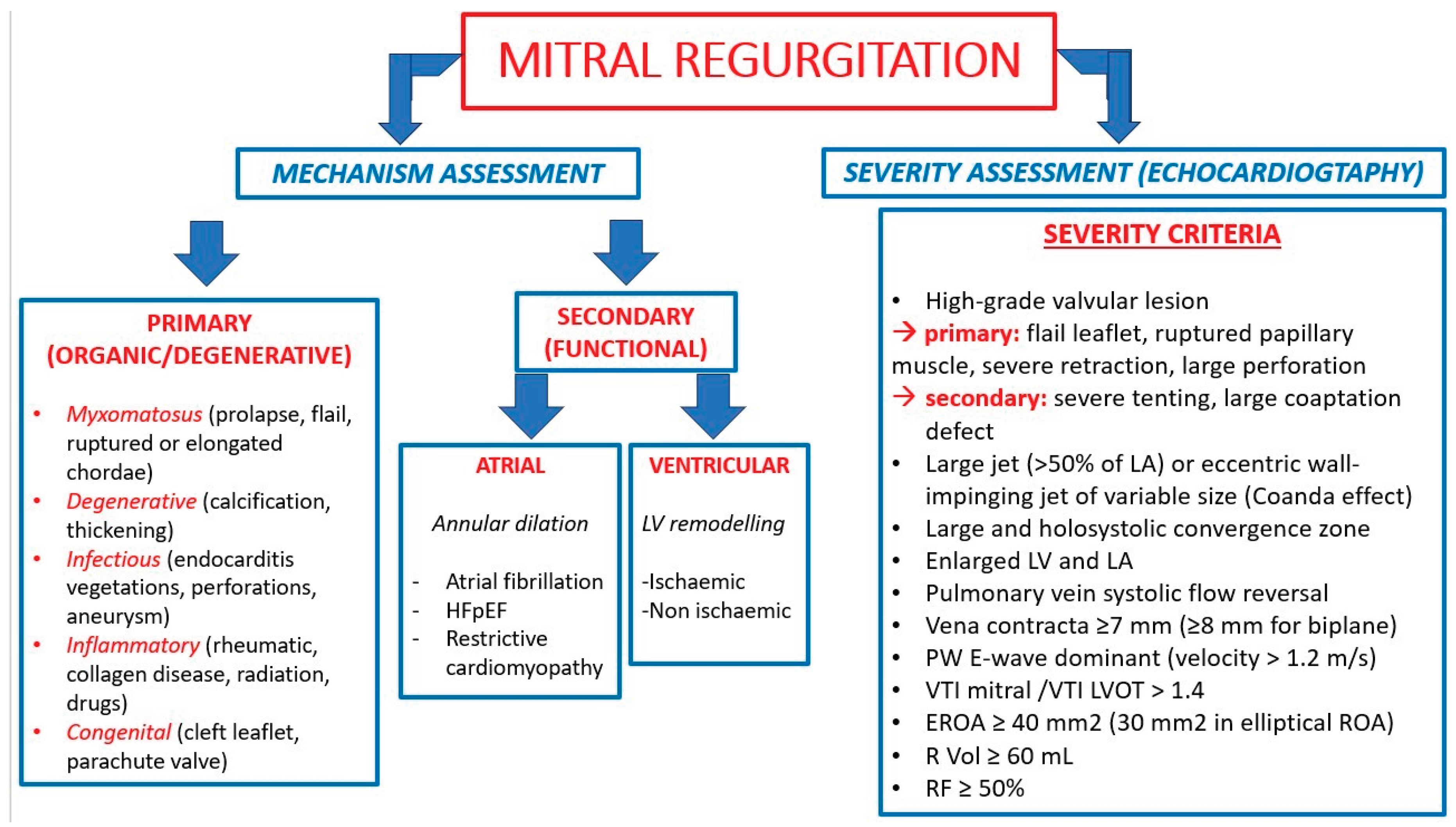
Figure 2.
Mitral valve anatomical complexity classes based on key anatomical/echocardiographic criteria and their correlation with TEER suitability [1]. Abbreviations: TEER, transcatheter edge-to-edge repair; MVA, mitral valve area; MAC, mitral annular calcification; TMVI, transcatheter mitral valve intervention; MS, mitral stenosis.
Figure 2.
Mitral valve anatomical complexity classes based on key anatomical/echocardiographic criteria and their correlation with TEER suitability [1]. Abbreviations: TEER, transcatheter edge-to-edge repair; MVA, mitral valve area; MAC, mitral annular calcification; TMVI, transcatheter mitral valve intervention; MS, mitral stenosis.
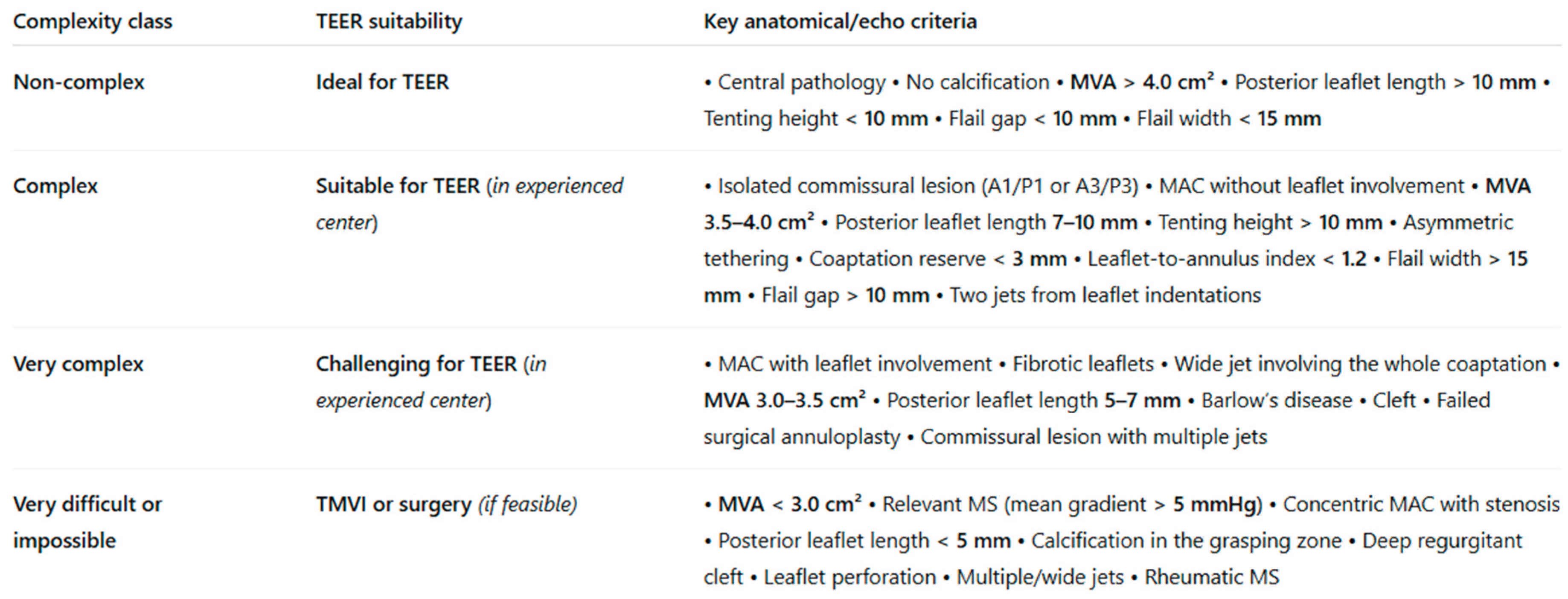
Figure 3.
Indications for transcatheter edge-to-edge repair (TEER) in severe primary mitral regurgitation. [1,24]. Abbreviations: MR, mitral regurgitation; ESC: European society of Cardiology; ACC/AHA, American college of Cardiology/American Heart association; COR: class of recommendation; LOE: level of evidence; MV, mitral valve.
Figure 3.
Indications for transcatheter edge-to-edge repair (TEER) in severe primary mitral regurgitation. [1,24]. Abbreviations: MR, mitral regurgitation; ESC: European society of Cardiology; ACC/AHA, American college of Cardiology/American Heart association; COR: class of recommendation; LOE: level of evidence; MV, mitral valve.
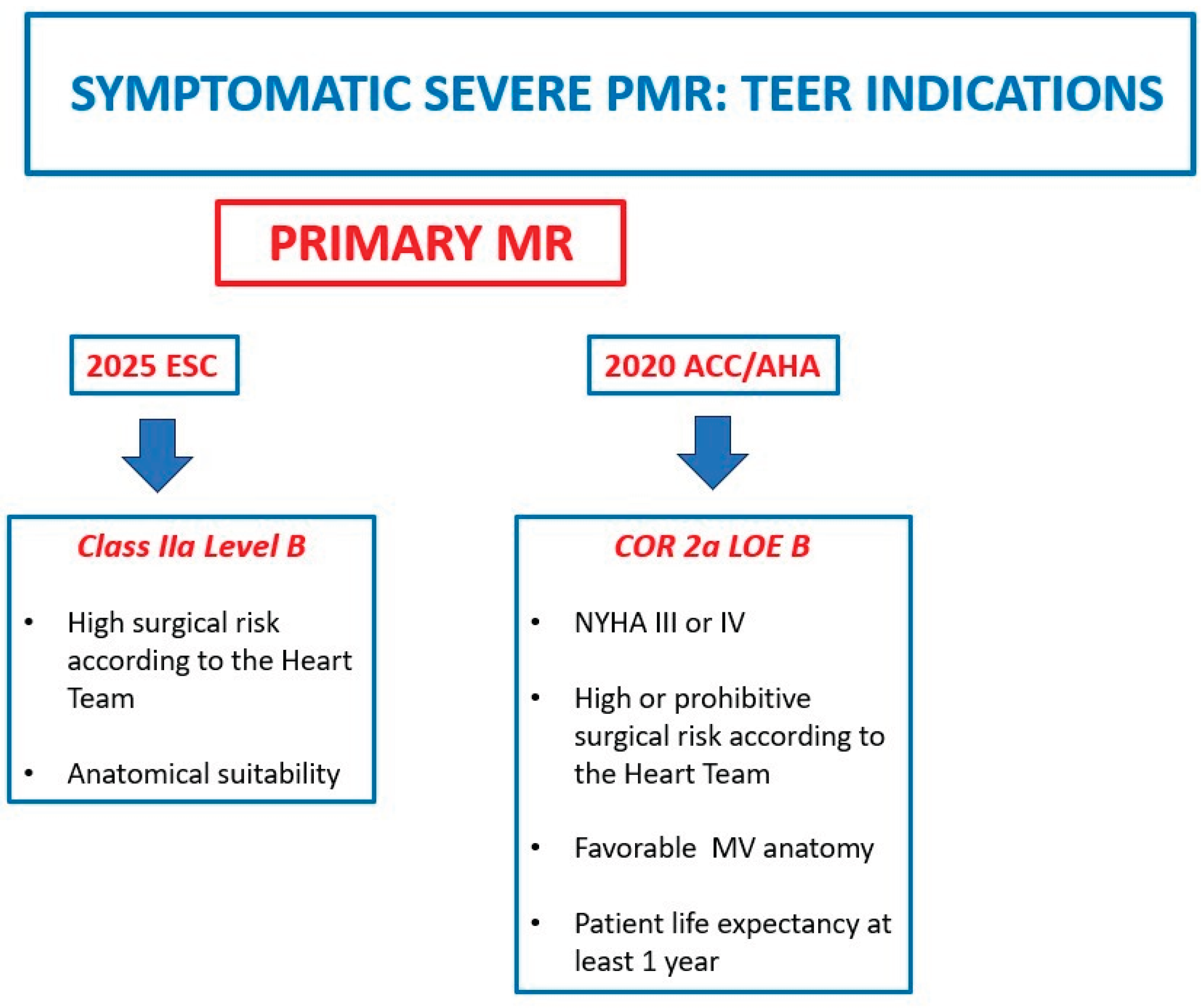
Figure 4.
Guideline recommendations for TEER in secondary mitral regurgitation. The figure summarizes the classes of recommendation and levels of evidence for transcatheter edge-to-edge repair (TEER) in secondary mitral regurgitation (SMR), including both ventricular functional MR and atrial functional MR, according to ESC/EACTS and ACC/AHA guideline recommendations. [1,24]. Abbreviations: SMR, seconday mitral regurgitation; GDMT, guideline directed medical therapy; ESC, European society of Cardiology; LVEF, left ventricular ejection fraction, HF, heart failure, LVAD, left ventricular assisted device; NYHA, New York heart association; ACC/AHA, American College of Cardiology; COR, class of recommendations; LOE, level of evidence; LVESD, left ventricular endsystolic diameter, PASP, pulmonary artery systolic pressure; MV, mitral valve; OMT, optimized medical therapy.
Figure 4.
Guideline recommendations for TEER in secondary mitral regurgitation. The figure summarizes the classes of recommendation and levels of evidence for transcatheter edge-to-edge repair (TEER) in secondary mitral regurgitation (SMR), including both ventricular functional MR and atrial functional MR, according to ESC/EACTS and ACC/AHA guideline recommendations. [1,24]. Abbreviations: SMR, seconday mitral regurgitation; GDMT, guideline directed medical therapy; ESC, European society of Cardiology; LVEF, left ventricular ejection fraction, HF, heart failure, LVAD, left ventricular assisted device; NYHA, New York heart association; ACC/AHA, American College of Cardiology; COR, class of recommendations; LOE, level of evidence; LVESD, left ventricular endsystolic diameter, PASP, pulmonary artery systolic pressure; MV, mitral valve; OMT, optimized medical therapy.
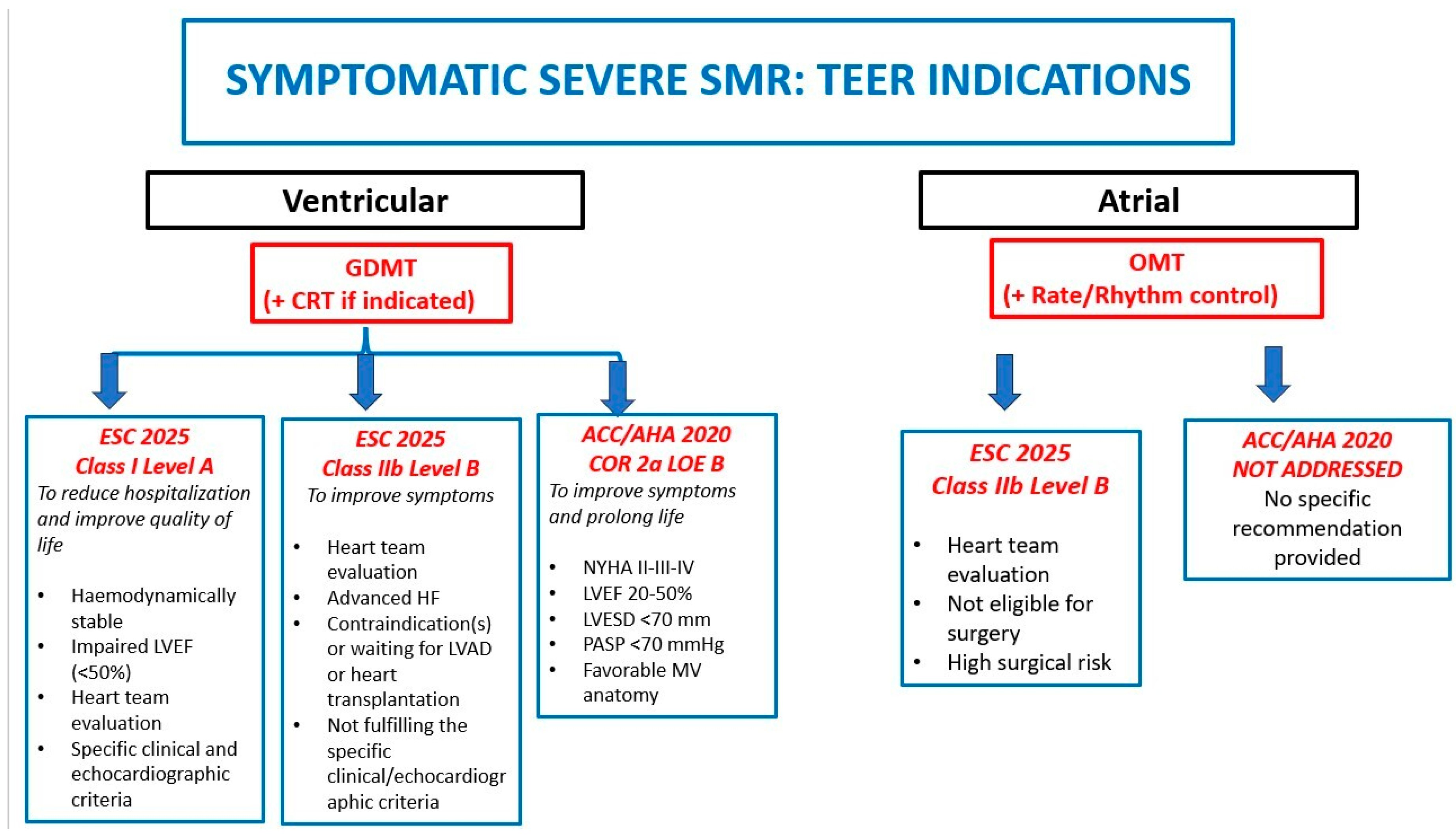
Figure 5.
Key inclusion and exclusion criteria of MITRA-FR, COAPT, and RESHAPE-HF2 randomized trials evaluating transcatheter edge-to-edge repair in symptomatic heart failure with ventricular secondary mitral regurgitation. Abbreviations: HF, heart failure, NYHA, New York heart association; MR, mitral regurgitation; EROA, effective regurgitant orifice area; LVEF, left ventricular ejection fraction; LVESD, left ventricular end + systolic diameter; HF, heart failure; TEER, transcatheter edge-to-edge repair; CAD, coronary artery disease; RV, right ventricle; ACS, acute coronary syndrome; TIA, transient ischemic attack.
Figure 5.
Key inclusion and exclusion criteria of MITRA-FR, COAPT, and RESHAPE-HF2 randomized trials evaluating transcatheter edge-to-edge repair in symptomatic heart failure with ventricular secondary mitral regurgitation. Abbreviations: HF, heart failure, NYHA, New York heart association; MR, mitral regurgitation; EROA, effective regurgitant orifice area; LVEF, left ventricular ejection fraction; LVESD, left ventricular end + systolic diameter; HF, heart failure; TEER, transcatheter edge-to-edge repair; CAD, coronary artery disease; RV, right ventricle; ACS, acute coronary syndrome; TIA, transient ischemic attack.
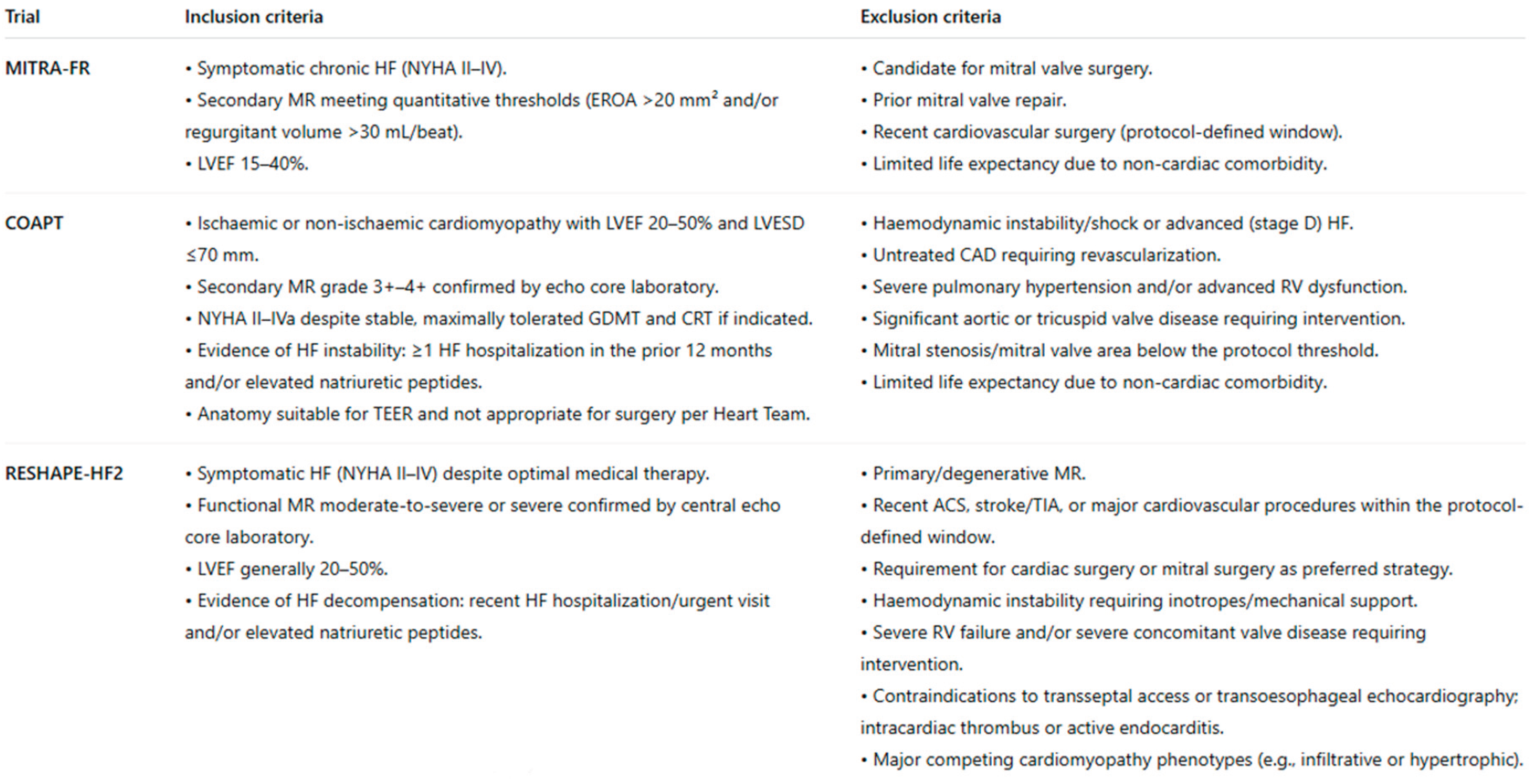
Figure 6.
Baseline characteristics of the randomized populations enrolled in MITRA-FR, COAPT, and RESHAPE-HF2. The figure compares key demographic, clinical, and echocardiographic features across trials, including sample size, age and sex distribution, ischaemic aetiology, atrial fibrillation burden, symptom severity (NYHA class), left ventricular systolic function and remodelling (LVEF and LV size/volumes), mitral regurgitation severity (effective regurgitant orifice area and regurgitant volume when available), natriuretic peptide levels, renal function and the prevalence of cardiac resynchronization therapy. Differences in baseline LV remodelling and MR severity highlight heterogeneity in enrolled phenotypes and provide context for interpreting trial outcomes. Abbreviations: NYHA, New York Heart Association, HF, heartr failure; CRT, cardiac resynchronization therapy; BNP, B-type natriuretic peptide; NT-proBNP, N-terminal pro–B-type natriuretic peptide; GFR, glomerular filtration rate; LVEF, left ventricular ejection fraction; LV, left ventricle; EROA, effective regurgitant orifice area; HF, hea LV, left ventricle; MR, mitral regurgitation.
Figure 6.
Baseline characteristics of the randomized populations enrolled in MITRA-FR, COAPT, and RESHAPE-HF2. The figure compares key demographic, clinical, and echocardiographic features across trials, including sample size, age and sex distribution, ischaemic aetiology, atrial fibrillation burden, symptom severity (NYHA class), left ventricular systolic function and remodelling (LVEF and LV size/volumes), mitral regurgitation severity (effective regurgitant orifice area and regurgitant volume when available), natriuretic peptide levels, renal function and the prevalence of cardiac resynchronization therapy. Differences in baseline LV remodelling and MR severity highlight heterogeneity in enrolled phenotypes and provide context for interpreting trial outcomes. Abbreviations: NYHA, New York Heart Association, HF, heartr failure; CRT, cardiac resynchronization therapy; BNP, B-type natriuretic peptide; NT-proBNP, N-terminal pro–B-type natriuretic peptide; GFR, glomerular filtration rate; LVEF, left ventricular ejection fraction; LV, left ventricle; EROA, effective regurgitant orifice area; HF, hea LV, left ventricle; MR, mitral regurgitation.
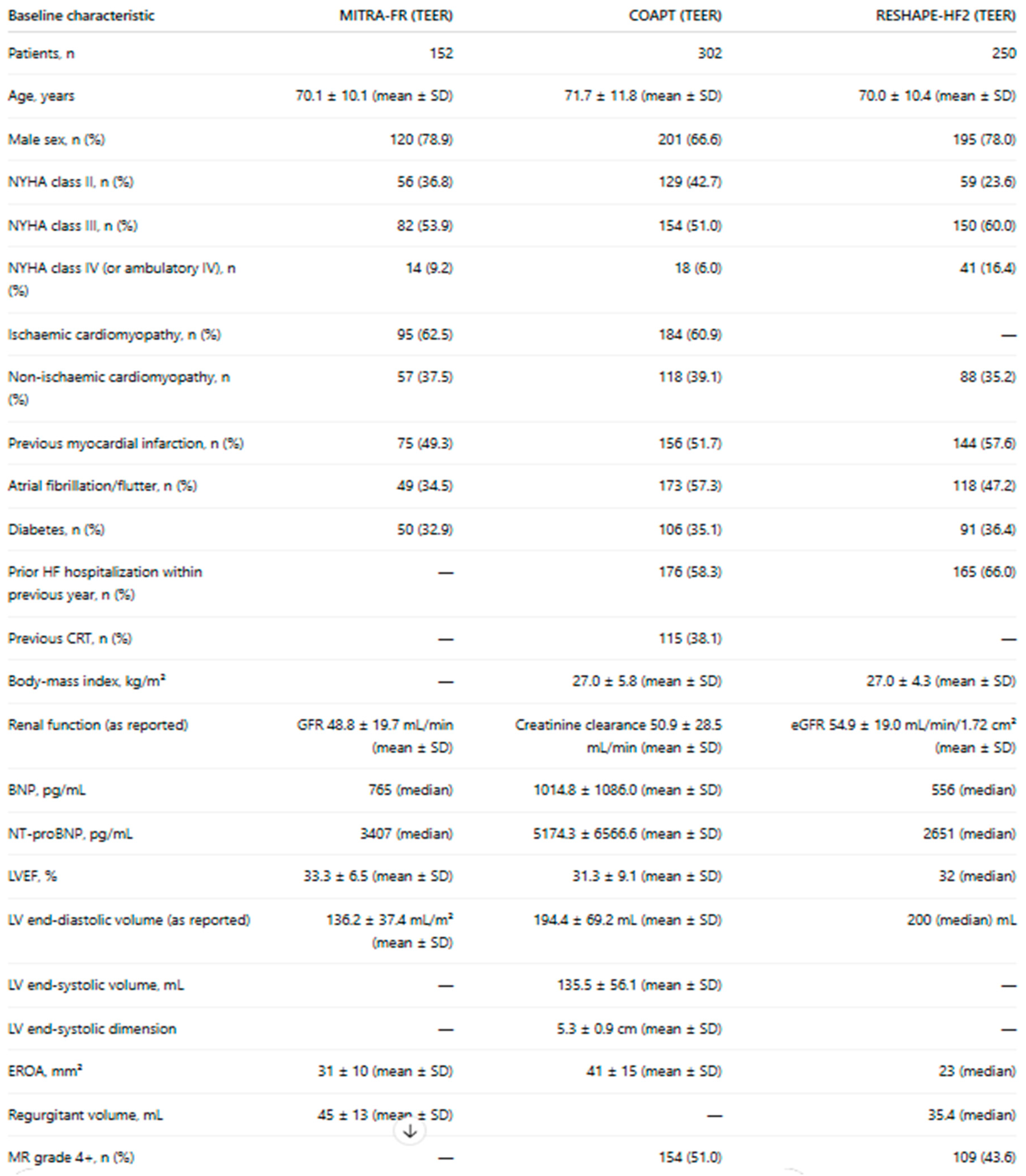

Table 1.
Key differences between primary and secondary mitral regurgitation in the context of transcatheter edge-to-edge repair.
Table 1.
Key differences between primary and secondary mitral regurgitation in the context of transcatheter edge-to-edge repair.
| Domain | Primary MR (Degenerative) | Secondary MR (Functional) |
| Underlying mechanism | Intrinsic leaflet/chordal pathology | Ventricular and/or atrial remodeling |
| Role of the ventricle | Initially preserved; passive volume overload | Primary driver of MR |
| Conceptual role of TEER | Valve-centered repair | Adjunctive therapy within HF management |
| Main determinant of benefit | Anatomical suitability and procedural success | Patient phenotype and myocardial substrate |
| MR severity interpretation | More stable, anatomy-driven | Dynamic, flow- and loading-dependent |
| Key selection focus | Leaflet length, coaptation geometry, calcification | LV size/function, symptoms despite GDMT |
| Procedural endpoint priority | Durable MR ≤ mild with acceptable gradient | MR reduction sufficient to improve symptoms |
| Residual MR tolerance | Low | Moderate residual MR may be acceptable |
| Transmitral gradient relevance | High prognostic impact | Lower and less consistent impact |
GDMT: guidelines-directed medical therapy; LV: left ventricle; MR: mitral regurgitation; TEER: transcatheter edge-to-edge repair.
Table 2.
Conceptual interpretation of secondary mitral regurgitation based on the relationship between EROA and left ventricular size.
Table 2.
Conceptual interpretation of secondary mitral regurgitation based on the relationship between EROA and left ventricular size.
| Feature | Proportionate SMR | Disproportionate SMR |
| Underlying driver | LV remodeling-dominant | MR burden-dominant |
| EROA relative to LV size | Small relative to LV volume | Large relative to LV volume |
| EROA/LVEDV ratio | Low (≈ <0.14 mm2/mL)* | Higher (≈ ≥0.14 mm2/mL)* |
| Typical LV phenotype | Marked dilatation, advanced remodeling | Less dilated LV |
| Expected response to TEER | Limited or neutral | Potentially favorable |
| Evidence source | MITRA-FR-like population | COAPT-like population |
* Values derived from post hoc analyses; not intended as rigid clinical cut-offs. EROA: effective regurgitant orifice area; LV left ventricle; LVEDV: left ventricle end-diastolic volume; TEER: transcatheter edge-to-edge repair.
Table 3.
Interpretation of key procedural endpoints after transcatheter edge-to-edge repair.
| Parameter | Clinical meaning | Interpretation in Primary MR | Interpretation in Secondary MR |
| Residual MR | Marker of procedural efficacy | Strong prognostic relevance | Prognostic relevance, but phenotype-dependent |
| MR ≤ mild | Ideal procedural target | Strongly recommended | Desirable but not mandatory |
| MR = moderate | Often suboptimal | Usually unacceptable | May be acceptable if symptoms improve |
| Transmitral mean gradient | Marker of functional stenosis | Strong prognostic impact | Less consistent prognostic impact |
| Gradient ≥ 5 mmHg | Warning signal | Associated with worse outcomes | Often tolerated |
| MR–gradient balance | Core procedural trade-off | Favor gradient preservation | Favor MR reduction |
| Post-procedural assessment | Echo + clinical | Echo-dominant | Clinical-dominant |
MR: mitral regurgitation.
Disclaimer/Publisher’s Note: The statements, opinions and data contained in all publications are solely those of the individual author(s) and contributor(s) and not of MDPI and/or the editor(s). MDPI and/or the editor(s) disclaim responsibility for any injury to people or property resulting from any ideas, methods, instructions or products referred to in the content. |
© 2026 by the authors. Licensee MDPI, Basel, Switzerland. This article is an open access article distributed under the terms and conditions of the Creative Commons Attribution (CC BY) license (http://creativecommons.org/licenses/by/4.0/).
Copyright: This open access article is published under a Creative Commons CC BY 4.0 license, which permit the free download, distribution, and reuse, provided that the author and preprint are cited in any reuse.