

Submitted:
31 January 2026
Posted:
03 February 2026
You are already at the latest version
Abstract
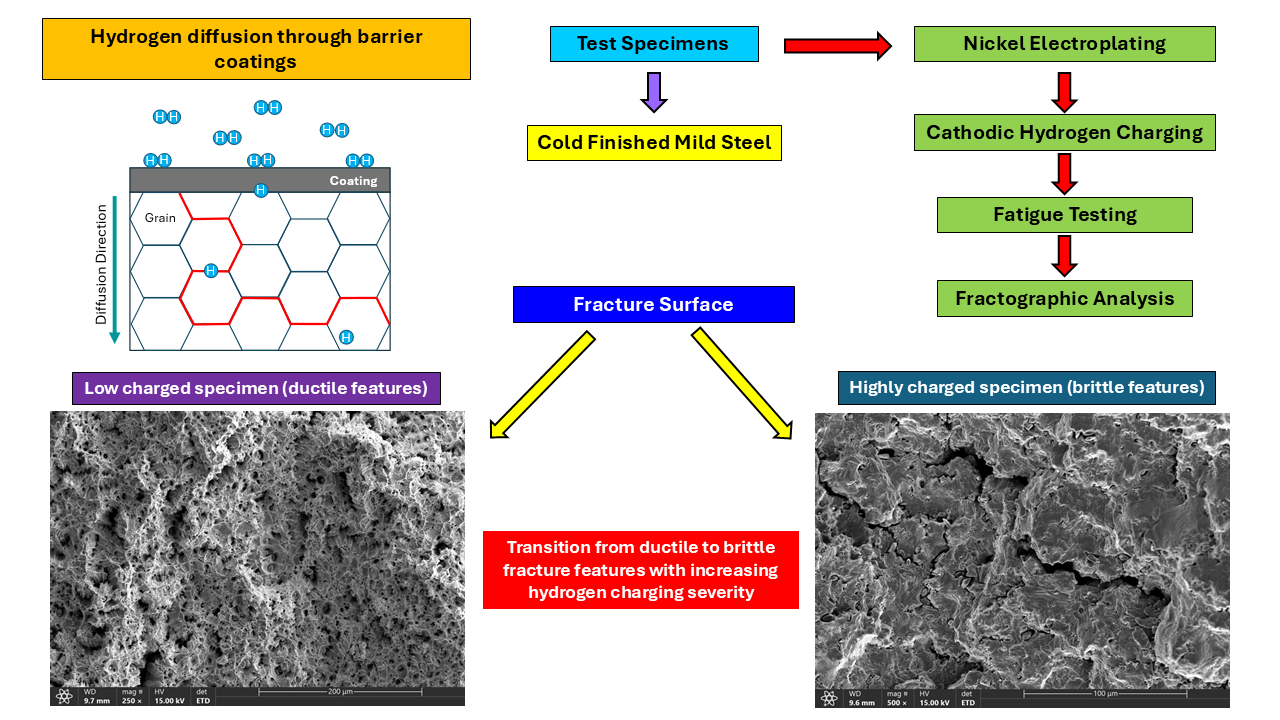
This study investigates the fatigue behavior of cold-finished mild steel coated with nickel as a hydrogen permeation barrier. Hydrogen was introduced to the coated specimens through electrochemical charging at controlled charging current densities to induce varying levels of hydrogen exposure. Subsequent fatigue tests were carried out to assess the impact of hydrogen permeation on fatigue life. The primary objective was to assess the influence of hydrogen on the number of cycles to failure, and to evaluate the effectiveness of nickel coatings as permeation barriers to impede hydrogen ingress under cyclic loading conditions. The experimental results revealed a non-monotonic relationship between fatigue life and hydrogen charging severity. At low to moderate hydrogen charging levels, the fatigue response of the coated steel was relatively stable, reflecting the ability of the nickel coating to limit hydrogen ingress. However, at higher charging current densities, the fatigue life decreased abruptly, indicating the existence of a threshold beyond which the protective capability of the nickel coating diminishes and hydrogen embrittlement (HE) becomes dominant. The findings from this research provide insights into the fatigue performance of nickel-coated steels and supports the informed design of structural components for service in hydrogen-rich environments.
Keywords:
hydrogen embrittlement
; diffusible hydrogen
; nickel electroplating
; cathodic charging
; cyclic loading
Copyright: This open access article is published under a Creative Commons CC BY 4.0 license, which permit the free download, distribution, and reuse, provided that the author and preprint are cited in any reuse.


