
Submitted:
02 February 2026
Posted:
02 February 2026
You are already at the latest version
Abstract
Mergers and acquisitions, as strategies for external growth of companies, often hinder cooperation between the acquiring company and the target companies. If management rejects the takeover bid, the acquirers approach the shareholders directly, turning the transaction into a hostile takeover. As a central phenomenon in the field of mergers and acquisitions, hostile takeovers significantly influence the functioning of capital markets and corporate governance through their role as a mechanism for sanctioning and correcting inefficient management. The disciplinary role is related to agency theory, which highlights conflicts of interest between shareholders and managers. The purpose of this study is to conduct a systematic review of the literature on hostile mergers and acquisitions, using the PRISMA methodology supplemented by a bibliometric approach and a content analysis of the effect of hostile takeovers on post-takeover performance. Additionally, we investigate the implications of corporate governance and the legislative and institutional environment on hostile takeover decisions, under conditions of adequate risk management. The 37 articles analyzed highlight the orientation of studies towards Anglo-Saxon influences and the concentration of publications in a small number of prestigious journals. Content analysis reveals conflicting ideas about the role of hostile takeovers as an effective disciplinary mechanism and their varied impact on performance. Risk-taking depends on companies' objectives and the strategy pursued to achieve success. Governance structures act both to protect the company and to expose it to hostile takeovers when the focus is on short-term profit at the expense of long-term shareholder value. In contrast, anti-takeover provisions generate declines in hostile M&A activity, and transaction efficiency is reduced in emerging institutional environments, where internal governance and the regulatory framework decisively shape the form and success of takeovers.
Keywords:
mergers and acquisitions
; hostile takeovers
; systematic review
; bibliometric analysis
1. Introduction
As the central pillar of modern economies, companies generate economic growth, social welfare, and financial market stability. Intense competition and dynamic technological change drive the expansion of corporate responsibilities and the need for expansion both domestically and internationally (Gupta, 2012). Profit growth is the main objective of companies (Mallikarjunappa & Nayak, 2007), which must be combined with quality and excellence in business, achieved only through considerable effort, to provide a sustainable competitive advantage (Prakash & Balakrishna, 2007). As companies grow in size and complexity, the separation between ownership and control becomes more pronounced, generating potential conflicts of interest between shareholders and management. Conflicts lead to inefficient decisions and decreased performance, affecting both the value of the firm and its role in the economy and society (Meckling & Jensen, 1976).
In this context, limiting dysfunctions and allocating resources efficiently can be ensured through corporate governance and corporate control market mechanisms, such as mergers and acquisitions (Manne, 1965).
Mergers and acquisitions (M&A) can be classified as the sale and purchase of companies, either in whole or in part (Mohlmann, 2012); a combination of at least two companies to form a new entity (Roberts et al., 2003). Seen as a major force in a changing environment (Gupta, 2012), mergers and acquisitions are effective methods of corporate structuring, which have become a common phenomenon for increasing market share and global dominance (Gupta, 2012; Mantravadi & Reddy, 2007). The rationale behind M&A is synergy, i.e., the union of two companies is more valuable than the sum of their individual values (Mohlmann, 2012).
The overall evolution of mergers and acquisitions between 1985 and 2025 (Figure 1) shows a general upward trend in both the number of transactions and their value, but with cyclical characteristics influenced by macroeconomic and financial conditions. The marked fluctuations in the trend are caused by periods of expansion and crisis in the global economy. In the early period, the growth in transactions was slow and steady, especially in terms of the number of transactions, against a backdrop of market development and liberalization. Between 1999 and 2000, the first major wave of M&A was observed, with 39,783 transactions worth USD 4,116 billion, invested mainly in the technology sector. Subsequently, however, excessive speculation led to the collapse of the dot-com bubble and a decline in trading interest. A new wave of growth emerged around 2007, when the global financial crisis forced companies to engage in M&A, resulting in 47,455 transactions worth USD 4.90 billion. The effects of the crisis were felt in the following years as well, with the number of transactions remaining stable but at lower values.
The peak of the period in terms of number (56,382) and value (USD 5.235 billion) was generated by another global crisis, namely the COVID-19 pandemic, as a result of which many companies ceased operations or were forced to sell their management. This evolution confirms the role of mergers and acquisitions as a mechanism for restructuring and consolidating the global economy.
In most M&A transactions, the target is acquired through a share purchase, seen as an opportunity for development, with the target thus willing to be acquired amicably (Roberts et al., 2003). Alternatively, the target may oppose the acquisition, in which case the acquisition becomes hostile. For these transactions, the management of the target companies recommended that shareholders reject the offer (Mohlmann, 2012). However, in order to complete hostile takeovers, public offers are made directly to the target shareholders without obtaining the consent of the management (Gupta, 2012).
The impact on post-M&A companies is controversial. Most often, hostile takeovers are associated with a negative impact (Chatjuthamard et al., 2023; Meckling & Jensen, 1976; Mohlmann, 2012; Rufolo et al., 2025), often on both entities involved. The performance improvements of bidders are small and observable in the short term, while in the long term, post-takeover performance is negative, especially in terms of profit returns (Chatjuthamard et al., 2023; Mohlmann, 2012).
The impact on post-M&A companies is controversial. Most often, hostile takeovers are associated with a negative impact (Chatjuthamard et al., 2023; Meckling & Jensen, 1976; Mohlmann, 2012; Rufolo et al., 2025), often on both entities involved. The performance improvements of bidders are small and observable in the short term, while in the long term, post-takeover performance is negative, especially in terms of profit returns (Chatjuthamard et al., 2023; Mohlmann, 2012).
Often, however, hostility manifests itself in the negotiation process rather than in performance (Schwert, 2000). Transactions can even be successfully completed when shareholders consider the offer timely and favorable to the company and anticipate benefits that exceed the transaction costs (Mohlmann, 2012). Moreover, the resulting corporate restructurings increase the combined market value of the companies and increase shareholder wealth as a private benefit (Shleifer & Summers, 1988).
The transaction itself characterizes the companies involved in several ways (González-Torres et al., 2020). First, hostile takeovers indicate companies with agency conflicts between managers and shareholders, often with inefficient resource allocation and poor performance. The transaction brings about changes in market structure and competition through consolidation and redistribution of economic power, thus requiring a solid public policy and regulatory framework to protect companies and investors from unjustified takeovers.
In the transactional approach, both companies bear costs for defending or enforcing the offer, once successful, thereby nullifying the independence of the target, aspects that amplify the importance of understanding and managing these complex mechanisms. The shareholders of the target company are considered the main beneficiaries of takeovers, while the shareholders of the bidding company have similar chances of gain and loss, but in the most favorable scenario, they obtain modest gains. However, the net benefits obtained by shareholders do not necessarily constitute an accurate measure of the real welfare gains generated by takeovers. Only through further research can the implications for social and economic welfare, as well as public policy guidelines in the field of hostile takeovers, be more precisely defined (Fortier, 1989).
The importance of hostile transactions stems from understanding their role in corporate restructuring. Considered complex but powerful mechanisms for disciplining management and correcting internal inefficiencies within companies, hostile mergers and acquisitions can generate benefits if executed effectively (González-Torres et al., 2020). The key to success is cultural, strategic, and financial compatibility between companies, followed by proper change management. However, the necessary balance is often not found due to the assumed risks and integration challenges, making it relevant to focus on the influence of corporate governance and regulatory compliance on the outcome of the transaction. An evolution of hostile takeovers globally between 1985 and 2025 is shown in Figure 2.
Compared to the overall M&A market, hostile takeovers are much more volatile and show a general downward trend over the long term. This time, the period of expansion of hostile takeovers coincides with the first years of analysis (1985–1989), when the number of hostile transactions reached its peak of 146 transactions. However, the values are not very high compared to the rest of the period, a phenomenon associated with the deregulation of financial markets and the emergence of "corporate raiders" investors. The reaction of the context is immediate, with the adoption of defensive mechanisms and stricter regulations, resulting in a rapid decline in takeovers.
Similar to global M&A trends, hostile takeovers are on the rise again amid the tech boom, reaching their peak in 2000 (USD 331.49 billion). After the stock market bubble burst due to excessive speculation by companies, hostile takeovers became occasional, declining sharply in number, while the value of transactions increased considerably in the context of global crises, when hostile takeovers became an optimal solution for continuing business. Overall, hostile takeovers were an important mechanism for corporate restructuring in the 1980s and 1990s, gradually losing their importance as a result of the strengthening of corporate protection mechanisms and increased investor interest in negotiated transactions.
The percentage evolution of hostile transactions out of total global M&A transactions (Figure 3) shows a long-term downward trend, both in terms of transaction volume and value. At the beginning of the analysis period, hostile transactions accounted for the largest share, reaching 3.33% of the total number of M&A transactions and up to 24.82% of the total value. The shares reflect the context characterized by permissive regulations and the considerable involvement of corporate raiders in multiple hostile takeovers. Since the 1990s, there has been a stabilization of investments and a shift towards amicable transactions at the expense of hostile operations, which have seen an immediate decline.
The instant effect is generated by measures adopted to strengthen corporate governance mechanisms, the introduction of anti-takeover strategies such as poison pills or staggered board structures, stricter regulations, and the orientation of investors towards negotiated transactions, which are much more efficient and less costly.
During the rest of the period, the number of hostile transactions fell below 0.5%, with minor exceptions in 1993 (0.63%) and 1995 (0.67%), while the value fell below 10% (except for 1995, with 11.09%). Although the value of hostile transactions remains more volatile, with more frequent episodes of growth, this does not substantially change the overall downward trend, as they are associated with temporary opportunities for strategic growth or a favorable economic context. Thus, the evolution of transactions reflects the maturing of the market from impulsive and massive hostile takeover reactions to growth opportunities based on consensus and strategic cooperation.
Although the share of hostile takeovers in total global M&A transactions has declined significantly, research into them remains relevant from both a theoretical and practical perspective. The importance of understanding hostile takeovers is not determined by their frequency, but by the economic, strategic, and institutional impact they generate. As they represent situations that test the effectiveness of corporate governance, they can highlight conflicts of interest between management and shareholders, thus providing a relevant analytical framework for assessing agency problems.
Often large in scale, hostile transactions can alter the structure of financial markets and competitive strategies, with consequences for investment behavior and regulatory policies, leading to an increase in anti-takeover mechanisms. Thus, further research into hostile transactions contributes to understanding corporate governance and the dynamics of conflicts that arise, as well as how they evolve over time. It is worth noting the cyclical nature, influenced by crises, asset undervaluation, or rapid technological transformations, which increases interest in hostile M&A, despite all the restrictive provisions in force.
Therefore, given the above, an analysis of companies' reactions to control mechanisms and their controversial impact is a topic of interest for both academic research and public decision-makers. Thus, the purpose of this study is to investigate the relationship between hostile takeovers and company performance through a systematic review of the literature. The central objective is to determine the impact of hostile mergers and acquisitions on the performance of the resulting company, while also examining the implications of corporate governance and institutional and legislative characteristics on the incidence of hostile takeovers.
In general, the evidence suggests that hostile mergers and acquisitions cannot be considered entirely an effective disciplinary mechanism. While some studies note improvements in efficiency or long-term value, others find limited or even negative effects on post-takeover performance. Beyond the performance results, hostile takeovers frequently generate managerial conflicts and post-merger mistrust that hinder integration and value creation. The institutional context influences the incidence of takeover activity, with transactions more prevalent in transparent institutional environments with well-developed capital markets and lower information asymmetries. Emerging markets and anti-takeover regulations generally reduce the frequency of takeovers.
2. Results
2.1. Exploring the literature through bibliometric analysis
2.1.1. Descriptive structure of the publications analyzed
The general characterization of the studies allows for the identification of trends and provides an overview of the sample. The temporal distribution of articles (Figure 4) indicates a heterogeneous evolution of publications over 33 years (1993–2025). In the early stages, hostile takeovers attracted the attention of researchers with two publications in 1993 and 1996, followed by a downward trend with one or even zero articles published per year. A first notable increase in publications was observed in 2006, with three articles published, in a context of increased global merger and acquisition activity. However, the increase was followed again by a drastic but temporary decline, with several years in which publications were minimal or non-existent. The volatile evolution suggests an exploratory stage of the subject rather than a constant interest in academic research.
Since 2017, the specialized literature has been consolidating, with the number of articles published reaching a peak of four articles during the period analyzed. After a decline in 2018, the number of publications stabilised at higher levels, with three articles between 2023 and 2024, reflecting renewed interest and increased relevance as a research topic. Overall, research is evolving upward, from an emerging stage to a more consolidated and developing field, a trend that supports the relevance of a systematic and bibliometric review to synthesize existing findings and identify future research directions.
Analyzing the distribution of articles by number of authors, we find that the majority of studies (38%, or 13 articles) are the result of collaboration between two authors. In the case of 11 studies, or 30% of publications, the final works are the result of collaboration between three authors. The rest of the articles are written by one author (7 studies/19% of the research) or four authors (13%/5 studies), as shown in Figure 5.
An analysis of the number of citations for the top ten documents in the sample highlights an uneven distribution of articles, with most citations attributed to reference works (Table 1). The uneven distribution suggests a small number of key works that set the theoretical and empirical benchmarks and directions for further research. The article by Giroud (2010) is the most influential work, with 611 citations, followed by Schwert (2000) and Shivdasani (1993), with 421 and 412 citations, respectively, indicating the fundamental nature of these works in the field
Works with significant impact are also published by Atanassov (2013), with 364 citations, and Cain (2017), with 231 citations, studies which, although relatively recent, have gained visibility and relevance in the literature. At the opposite end of the spectrum are articles with a lower impact, such as those by Agrawal (2003) and Weir (2005), with 68 citations each, which have a narrower focus on the topic addressed.
The distribution of articles according to the countries analyzed highlights the concentration of research in a few dominant states (Table 2). The US stands out with 16 documents and 1,913 citations, occupying a central position in the field analyzed, both in terms of research volume and impact on literature. The next position is occupied by England with 7 articles, but with a high impact through 973 citations, unlike Thailand, which with 6 articles obtains only 34 citations and a low scientific impact. Four articles analyze Australia (205 citations) and the Netherlands (257 citations); three articles analyze Scotland (107 citations) and two articles analyze Belgium, with a high impact relative to the number of citations (637 citations). The rest of the countries in the sample appear in one article each, with a low number of citations, a distribution that confirms the geographical concentration of research and its impact.
Broken down by the journals in which they are published, the articles reinforce the concentration of publications in a small number of prestigious journals with a high number of citations (Table 3). The most relevant sources in terms of number of documents and citations are the Journal of Financial Economics (4 documents, 1036 citations) and the Journal of Finance (3 documents, 915 citations). Articles published in these journals benefit from much greater exposure, as they are considered reference works. Other journals with a similar number of articles, such as the Journal of Corporate Finance (3 documents, 213 citations) and the Journal of Accounting & Economics (2 documents, 440 citations), have a lower impact due to their lower number of citations. The rest of the journals publish a single article with a much lower number of citations, a sign of the uneven distribution of scientific influence. Therefore, in determining scientific impact, in addition to the quantity of articles, the prestige of the publication source is also important, providing relevant, high-quality research.
The top ten authors ranked by number of published documents reveal significant discrepancies between research productivity and scientific impact (Table 4). The data show that a large number of publications does not automatically imply a high level of influence; more specifically, the authors with the most papers are cited the least often: Jiraporn Pornsit (6 documents, 34 citations) and Chaiuthamard Pattanaporn (5 documents, 26 citations). On the other hand, authors with only one article, such as Muller Holger M. and Giroud Xavier, have a considerable impact, with over 600 citations. This demonstrates that the value of the papers is determined in particular by the relevance and usefulness of the research for other authors.
2.1.2. Bibliometric analysis of the literature
To answer the first research question (RQ1: What are the main directions and thematic clusters in the literature on hostile M&A transactions?), we performed a bibliometric analysis using VOSviewer software, providing a broad overview of the structure and evolution of research on mergers and acquisitions. The maps detail the relationships between concepts, authors, documents, and sources, highlighting the theoretical foundations and thematic directions of research. The analysis starts from the thematic structure of the field by analyzing keywords, gradually moving on to co-citation and bibliographic coupling networks. Finally, citation and co-authorship networks are analyzed to assess scientific impact. Approaching studies in an analytical framework allows for a clear understanding of the organization of studies and research directions that have been consolidated over time.
The co-occurrence map of keywords, created using VOS-viewer software, takes into account the top 10 keywords in terms of number of occurrences in studies (Figure 6). The nodes in the network represent keywords, and their size reflects their frequency of occurrence. The links between nodes reflect the occurrence of terms in the same articles, while the thickness of the links reflects the intensity of the association. The map delineates two thematic clusters, corresponding to the research directions.
The red cluster forms the thematic core of the analysis, centred on the concepts of corporate governance, ownership and firm. The connection with the terms governance, hostile takeover, determinants, takeovers and mergers and acquisitions reflects the research direction of the studies towards governance mechanisms and their role in strategic decisions of firms such as mergers and acquisitions and hostile takeovers.
The green cluster has as its central nodes the terms market and performance, closely linked to mergers, targets, and free cash flow. The cluster suggests a research direction focused on efficiency, market performance, and the evaluation of M&A target firms, developing economic results and market reaction.
Overall, the co-occurrence map of keywords highlights two complementary perspectives, one institutional-organizational and one performance- and market-oriented. The connections between the two clusters indicate the interdependence between corporate governance and market performance, illustrated by conceptual bridges such as takeovers and mergers.
In terms of density, the most important keywords include corporate governance, ownership, performance, market, and firm. The central position in the network suggests that the literature focuses on governance mechanisms and their influence on performance outcomes. Lower density is found for the second group of keywords, which focuses on the takeover activity itself (targets, determinants, hostile takeovers). There is a strong correlation between the two groups, indicating that hostile transactions are analyzed in terms of their economic consequences and strategic implications, with reference to agency theory and corporate finance.
An analysis of the frequency of the top 10 keywords in Table 5 confirms the central role of corporate governance with 15 occurrences. A second group consisting of the terms "Market," "Ownership," and "Performance" each have 12 occurrences and reflect the close link between ownership structure, market mechanisms, and firm performance. The terms "Firm" (8 occurrences), "Hostile Takeovers" (8 occurrences), and "Takeovers" (7 occurrences) indicate interest in restructuring processes through takeovers and their impact on firms.
The analysis of authors' co-citations is performed using a minimum threshold of 10 citations per author, grouped into thematic clusters (Figure 7). The major group, in red, brings together fundamental contributions to the theory of mergers and acquisitions and the corporate control market through the works of authors Jensen, Shleifer, Morck, Mitchell, Harford, Franks, Masulis, Palepu, Schwert, and Karpoff. The group belongs to researchers frequently co-cited in the formation of the literary foundations of mergers and acquisitions, with the development of agency theory, shareholder value, managerial discipline, and post-transaction performance. The interconnections between authors indicate a developed body of work that lays the foundation for empirical and conceptual studies.
The second group, colored green, plays a complementary role, highlighting aspects related to behavioral finance and managerial characteristics in merger and acquisition decisions. The authors of the green cluster, such as Bertrand, Manne, and Fama, explore the role of managerial behavior related to managerial bias, overconfidence, and executive traits in influencing M&A outcomes.
Fama, Karpoff, and Schwert are authors who link the two groups, connecting classical financial theories with the influence of managerial behaviors. Thus, the co-citation network illustrates the evolution of the literature from traditional theories to managerial approaches that trigger hostile mergers and acquisitions. The results of the co-citation analysis support the need to examine hostile mergers and acquisitions in a broad institutional and managerial context.
The analysis of source co-citations illustrates the main sources of article publication and the interdisciplinary nature of the field by bringing together journals in the fields of finance, economics, accounting, and strategic management. This time, the sources are grouped into three clusters, shown in Figure 8. The dominant group, in red, includes top journals in the field of finance, with central positions in the network for the Journal of Financial Economics and the Journal of Finance. The larger size of the nodes of these journals reflects the intensity of co-citations and their fundamental role in shaping empirical and theoretical research. Other journals such as the Journal of Corporate Finance, Journal of Banking & Finance, Review of Financial Studies, and Financial Management reinforce the group and the focus on financial theory, valuation, and company performance.
The blue cluster comprises leading economic journals, with the Journal of Political Economy having the greatest influence, followed by the American Economic Review, the Quarterly Journal of Economics, and the RAND Journal of Economics. This group develops market efficiency, industrial organization, and institutional frameworks, strongly connected to finance journals so that M&A studies combine financial and economic theories.
The third group, green, brings together management and strategy journals, notably the Strategic Management Journal, Academy of Management Journal, Academy of Management Review, and Management Science. The green cluster's research delves into managerial decision-making, organizational integration, and companies' strategic outcomes.
Intermediate positions are held by the Journal of Accounting and Economics and Management Science, which serve as bridges in combining managerial, economic, and financial theories in investigating the dynamics of takeovers. The convergence between fields supports the relevance of examining mergers and acquisitions from a financial, managerial, and organizational perspective.
The analysis of co-citations in the cited references is performed using a minimum threshold of 10 citations per article, as shown in Figure 9. The network consists of a small number of fundamental studies that serve as models for subsequent research, grouped into two distinct thematic streams.
The red group predominates with contributions to financial economics and the corporate control market. Jensen (1976, Journal of Financial Economics) develops agency theory and managerial incentives, later detailing (Jensen - 1986, American Economic Review) cash flow theory and its implications for corporate control and M&A. This is followed by related works on the effects on shareholder wealth following takeover activities and market reactions, with Karpoff (1989, Journal of Financial Economics) and Schwert (2000, Journal of Finance). Co-citation links indicate the central role in explaining the financial and governance dimensions of hostile takeovers.
The second green cluster combines institutional and informational perspectives on mergers and acquisitions. The fundamental works in this group conceptualize the corporate control market through Manne (1965, Journal of Political Economy) and delve into information asymmetries and the probability of hostile takeovers in Palepu's study (1986, Journal of Accounting and Economics).
The link between clusters is made by Bertrand and Mullainathan (2003, Journal of Political Economy) through the development of behavioral and managerial dimensions in the analysis of corporate results. The integrated approach reflects the complexity of the field as a result of the combination of financial, institutional, and behavioral perspectives.
The bibliographic coupling analysis contains documents with at least 10 citations, divided into three strongly interconnected thematic clusters, suggesting a mature and conceptually interconnected field of research (Figure 10).
The dominant red cluster, with eight documents, brings together fundamental works that have played a central role in the development of the field. The main node is formed by Schwert's (2000) work, whose size highlights its significant influence on subsequent literature. Alongside this, studies by Renneboog (2019), Sudarsanam (2006), Rao and Nicholson (2016), Wan (2009), and Muehlfeld (2011) reflect concerns related to research on financial fundamentals, valuation, and empirical explanatory models.
The green cluster groups together works focused on corporate governance, ownership structure, and managerial control mechanisms, with a central role attributed to Shivdasani (1993) in classic works on governance alongside Franks (1996) and Weisbach (1993). More recent studies by Agrawal (2003), Eichholtz (2008), Heyden (2017), and Tunyi (2019) indicate the expansion of the theoretical framework to modern contexts.
The third cluster, shown in blue, brings together works focused on advanced methodological and empirical approaches. Giroud (2010) and, not far behind, Atanassov (2013) are the works with the largest and most influential nodes, combining fundamental literature with corporate governance. The studies by Frattaroli (2020) and Chajuthamard (2023) delve deeper into the causes and impact of managerial decisions. The structure of the bibliographic coupling confirms the cumulative nature of the field and the role of fundamental works in its further development.
An examination of common references between journals, shown in Figure 11, identifies three groups of publications that are based on similar knowledge bases.
The red cluster contains core journals in the field of finance and accounting, such as the Journal of Finance, Journal of Accounting and Economics, Journal of Applied Economics, Journal of Real Estate Finance, International Journal of Finance, and Financial Management. The bibliographic coupling between journals is strong, indicating an interdependence between company performance, market reactions, and the financial results of mergers and acquisitions.
The blue cluster focuses on corporate finance and international business, with the most influential papers published in the Journal of Corporate Finance. Closely related to this are the journals Research in International Business, South African Journal of Business, and Management Accounting Research, which focus on corporate decision-making, governance structures, and the cross-border dimensions of mergers and acquisitions.
The green cluster brings together journals on management, strategy, and socio-economic considerations, including the Journal of Financial Economics, Business Strategy and the Environment, Management Research Review, Quarterly Review of Economics, and Corporate Social Responsibility. Although the thematic scope of the journals is varied, they are connected by common references that integrate strategic, environmental, and governance concerns into the literature on mergers and acquisitions.
Overall, the Bibliographic Coupling analysis highlights the interdisciplinary nature of the field and the need for varied approaches for a comprehensive analysis of M&A.
The bibliographic coupling analysis at the author level brings together 43 researchers cited at least 10 times (Figure 12). The results highlight five strongly interconnected clusters. The central cluster, in red, is the most concentrated and includes authors who are well-established in fundamental literature, such as Weisbach, Franks, and Berger. The authors in the core share common classical references on corporate governance and finance.
A second cluster, in green, brings together authors concerned with advanced methods of analysis, such as Jiraporn, Giroud, and Cain. The bibliographic coupling in this group is based on similar recent works and strategies for causal identification of post-M&A performance, complementary to the classical literature.
The blue cluster, represented by authors Renneboog, Wan, and Muehlfeld, approaches transactions from the perspective of corporate governance and strategic decisions, with an emphasis on market reactions and the financial impact of M&A. The yellow cluster is the smallest, with Heyden's study representing a link between traditional approaches and emerging research directions through the development of general conceptual frameworks. The purple cluster, represented by Cao, focuses on regional implications in emerging or comparative markets. The structure of the network reflects the cumulative and integrated nature of the research as a whole, combining classical theories with innovative approaches.
The analysis of the citation network at document level was performed using a minimum threshold of 10 citations per document, resulting in six thematic clusters with several central papers as fundamental landmarks in the specialized literature (Figure 13). In the yellow cluster, Schwert (2000) occupies a dominant position, being intensely cited as a theoretical and methodological landmark in the literature. A strong influence is also exerted by the blue cluster through Giroud (2010) and Atanassov (2013), who develop current perspectives of the literature and rigorous causal analyses, acting as intermediaries between clusters.
Other works of significant importance are those by Shivdasani (1993) and Franks (1996), which combine theories with an in-depth study of corporate governance and managerial control mechanisms. Thus, fundamental works maintain their influence on the literature, while recent studies contribute to its expansion.
The authors' citation map divides the papers into four thematic clusters, taking into account a minimum threshold of ten citations per author (Figure 14). The most influential node is that of author Jiraporn, who, together with other researchers in the green group, reflects concerns about research into control mechanisms and company performance. Being a dense cluster with influential authors, it can be considered the main core of the field. The red cluster brings together classic works on restructuring and managerial discipline. Agrawal, as a representative of the blue cluster, brings together debates on ownership structure, agency conflicts, and the capital market, while the yellow cluster plays an intermediate role as a theoretical transition node between researches.
The co-authorship map between authors highlights the structure of scientific collaborations between authors in the field, as shown in Figure 15. The dominant node is represented by Jiraporn, as part of the main cluster of collaboration between authors. The group connects with all clusters, combining basic elements with different areas of research. The blue cluster suggests interdisciplinary and international collaborations, unlike the green one, which focuses on a regional network of researchers from the same institutional context. The research in the yellow group is more specific but connected to the basic work, while the last group, represented in purple, is the most limited in terms of collaboration, being connected only to the central cluster. The overall structure of the map highlights a highly centralized network that facilitates collaboration with and between different peripheral groups.
2.2. Implications of hostile mergers and acquisitions
The studies in the sample were divided into one main category focusing on the implications of hostile mergers and acquisitions on company performance and two secondary categories. The main category consists of ten studies (Agrawal & Jaffe, 2003; Berger & Ofek, 1996; Carline & Gogineni, 2021; Franks & Mayer, 1996; Giroud & Mueller, 2010; Rao-Nicholson et al., 2016; Renneboog & Vansteenkiste, 2019; Schwert, 2000; Sudarsanam & Mahate, 2006; Wan & Wong, 2009).
The first secondary category develops interdependencies between corporate governance and hostile takeovers, a relationship found in 24 studies (Atanassov, 2013; Biggs et al., 2017; Bui et al., 2024; Campbell & Jerzemowska, 2017; Chatjuthamard et al., 2022; Chatjuthamard et al., 2023; Chatjutha-mard et al., 2024; Day et al., 2023; Denlertchaikul et al., 2022; Gi-roud & Mueller, 2010; Heyden et al., 2017; Likitapiwat et al., 2023; Lskavyan & Spata-reanu, 2006; Morck et al., 1988; Muehlfeld et al., 2011; O’Sullivan & Wong, 1999; Schoenberg & Thornton, 2006; Sinha, 2004; Shivdasani, 1993; Sridharan & Reinganum, 1995; Tunyi et al., 2019; Vuorenmaa, 2024; Weir et al., 2005; Weisbach, 1993).
The second subcategory reflects the implications of the institutional and legislative environment on hostile takeovers, with further details provided in 12 articles (Atanassov, 2013; Biggs et al., 2017; Bui et al., 2024; Cain et al., 2017; Carline & Gogineni, 2021; Chindasombatcharoen et al., 2024; Denlertchaikul et al., 2022; Eichholtz & Kok, 2008; Frattaroli, 2020; Lskavyan & Spatareanu, 2006; Muehlfeld et al., 2011; Weir et al., 2005). Depending on the content developed, the articles were included in several categories.
2.2.1. Implications of hostile takeovers on company performance
To answer the second research question (RQ2: What are the implications of hostile takeovers on performance as highlighted in the literature?), we group together studies that investigate the evolution of companies' post-M&A performance. The analysis of the impact on performance is captured by various indicators. Most studies analyze the evolution of operational performance expressed by return on assets -ROA (Carline & Gogineni, 2021; Franks & Mayer, 1996; Giroud & Mueller, 2010; Rao-Nicholson et al., 2017; Renneboog & Vansteenkiste, 2019); sales growth (Rao-Nicholson et al., 2017; Schwert, 2000); Abnormal Performance Return- APR (Sudarsanam & Mahate, 2006); Operating Performance on Assets -OPA and Operating Performance on Sales -OPS (Agrawal & Jaffe, 2003).
Financial performance is analyzed in two studies through return on equity -ROE (Renneboog & Vansteenkiste, 2019; Schwert, 2000).
Stock market performance is analyzed both in the short term through cumulative abnormal returns - CAR (Franks & Mayer, 1996; Giroud & Mueller, 2010; Renneboog & Van-steenkiste, 2019; Wan & Wong, 2009) and in the long term through Buy-and-Hold Abnormal Returns -HAR (Renneboog & Vansteenkiste, 2019) and Calendar-Time Abnormal Returns -CTAR (Agrawal & Jaffe, 2003; Renneboog & Vansteenkiste, 2019).
A single study (Berger & Ofek, 1996) addresses performance through value creation through diversification, rather than through operational or stock performance. More specifically, excess value reflects the ratio between the actual value of the company and the imputed value of the segments as independent entities.
The samples analyzed in the studies focus either on literature (Renneboog & Vanstenkiste, 2019) or on a sample of several companies (Berger & Ofek, 1996; Carline & Gogineni, 2021; Giroud & Mueller, 2010; Wan & Wong, 2009). Other studies use takeover bids (Franks & Mayer, 1996; Schwert, 2000) or direct acquisitions (Agrawal & Jaffe, 2003; Franks & Mayer, 1996; Rao-Nicholson et al., 2016; Sudarsanam & Mahate, 2006).
Data is collected from various databases. The most commonly used are the Compustat Database (Agrawal & Jaffe, 2003; Berger & Ofek, 1996; Carline & Gogineni, 2021; Giroud & Mueller, 2010; Schwert, 2000); CRSP (Agrawal & Jaffe, 2003; Berger & Ofek, 1996; Schwert, 2000; Wan & Wong, 2009); SDC Platinum (Carline & Gogineni, 2021; Rao-Nicholson et al., 2016; Schwert, 2000). Other studies include independently used databases such as the Orbis Database (Rao-Nicholson et al., 2016); AMDATA (Franks & Mayer, 1996); Acquisitions Monthly (Sudarsanam & Mahate, 2006); Lexis/Nexis (Berger & Ofek, 1996).
Once collected, the data are tested using complex methodologies. Most studies, namely six articles, test Ordinary Least Squares linear regressions (Carline & Gogineni, 2021; Giroud & Mueller, 2010; Rao-Nicholson et al., 2016; Schwert, 2000; Sudarsanam & Mahate, 2006; Wan & Wong, 2009). Five articles develop event studies (Agrawal & Jaffe, 2003; Giroud & Mueller, 2010; Schwert, 2000; Sudarsanam & Mahate, 2006; Wan & Wong, 2009). Comparative studies are addressed in two publications (Franks & Mayer, 1996; Sudarsanam & Mahate, 2006), as is the matching pairs method (Agrawal & Jaffe, 2003; Franks & Mayer, 1996).
Other methodologies included address logistic regressions (Berger & Ofek, 1996), Probit regressions (Schwert, 2000), univariate analysis (Rao-Nicholson et al., 2016), literature analysis (Renneboog & Vansteenkiste, 2019), and the difference-in-differences method (Giroud & Mueller, 2010).
The success of the transaction is conditioned by determining factors such as the negotiation of the offer. The hostility of transactions derives primarily as a result of strategic negotiation and less as a result of other factors such as poor management. The process strictly reflects the strategic choices of bidders and targets to maximize gains. When discussing the anticipated redistribution of assets, there is a higher level of negotiation, but without negatively affecting performance in the event of failed negotiations (Franks & Mayer, 1996). The lack of negotiation, on the other hand, leads to bidding wars, to the detriment of bidders, often associated with lower returns for them and a reduced chance of success by approximately 34% (Schwert, 2000).
Financial performance, analyzed in two studies, reveals both a positive impact (Renneboog & Vansteenkiste, 2019) and declines in returns (Schwert, 2000). Post-M&A, the combined firm has positive but low returns with slow growth over time (Renneboog & Vansteenkiste, 2019). The debt-to-equity ratio inversely influences the probability of takeover success. In terms of results, hostile targets experience declines in sales and return on equity. Depending on the bidders, hostility does not significantly affect their returns. Larger bidders achieve higher returns, positively correlated with the growth of the target.
Serial acquisitions, whether related acquisitions or concentrated acquisitions, cause the expected performance to decline from one transaction to another. For transactions with pre-bid events, hostile bids have lower success rates, with an initial return 4.7% higher and lower mark-up returns (Schwert, 2000). A different situation is observed for hostile bids identified by the Securities Data Corporation, for which the chances of success are higher, given that hostility generates auctions with multiple bidders and a higher probability of matching.
Moving on to studies examining operational performance, there is a correlation between pre-M&A operational performance and post-M&A performance (Franks & Mayer, 1996; Rao-Nicholson et al., 2017). In most cases, the anticipated gains from hostile bids are substantial. The performance of companies prior to bids is not low, a sign that board turnover is not driven by previous managerial failures, for which hostile takeovers serve a disciplinary function (Agrawal & Jaffe, 2003; Franks & Mayer, 1996). The lower the performance, the greater the likelihood of hostile takeovers. No operational underperformance is observed prior to acquisition (Agrawal & Jaffe, 2003).
In the long term, operational performance is influenced by the size of the target, the cross-border nature of the transactions, and the friendly nature of the operations. In the case of friendly M&As, operational performance improves when taking into account the adjusted sales margin for the industry, size, and pre-M&A performance. Friendly transactions also contribute to easier and more efficient integration and faster synergy gains, due to their ability to mitigate losses and generate superior performance (Rao-Nicholson et al., 2017).
For some mergers and acquisitions, hostile takeovers impair long-term operational performance, even when the acquiring firms had superior performance prior to the merger or acquisition. The impact is strong when conditioned by the macroeconomic context, such as financial crises, and cross-border transactions, diversification, and large cash reserves are harmful during these periods. The decline in operational performance is also determined by the adoption of anti-takeover laws in industries that are uncompetitive compared to competitive ones, where the effect is insignificant (Gi-roud & Mueller, 2010). Improved operational performance can be achieved by having board members with multiple director positions, given that overconfidence in the CEO leads to poor performance (Carline & Gogineni, 2021; Cho & Chung, 2022; Renneboog & Vansteenkiste, 2019).
Analyzed on the capital market, it can be seen that friendly acquisitions with high ratings destroy more value than hostile acquisitions with similar ratings. Post-acquisition performance is higher for single hostile transactions than for multiple ones and creates more value for acquiring shareholders (Sudarsanam & Mahate, 2006). In the short term, the results of announcements and returns achieved are not sustained in the long term (Renneboog & Vansteenkiste, 2019). Although transactions generate significant gains for target company shareholders, the benefits to acquirers are limited and often negative in the long term; more specifically, stock returns significantly underperform as a result of disciplinary takeover (Agrawal & Jaffe, 2003). Hostile M&A generates negative market reactions, with announcements associated with abnormal negative returns, increased uncertainty, high transaction costs, and a reduced likelihood of transaction completion. Abnormal negative returns are recorded for acquirers whose operational performance is stagnant or declining. Hostility explains the distribution of value at announcement, but is not a robust predictor of subsequent economic success.
In the short term, target companies record strongly positive cumulative abnormal returns, while for acquiring companies they are slightly positive or slightly negative, depending on the type of target and the attitude of the transaction (Renneboog & Vansteenkiste, 2019). Although hostile bids are associated with higher premiums, they generate higher cumulative abnormal returns for targets, as there is a transfer of additional value to target shareholders, but the risk of overpayment for the acquirer increases.
Once again, differences arise depending on the competitiveness of the industry. For companies in non-competitive industries, share prices are falling, compared to competitive industries that are affected little and insignificantly (Giroud & Mueller, 2010; Wan & Wong, 2009). For oil companies, shares have fallen in anticipation of takeovers, with the negative reaction of the capital market due to anticipated future difficulties. The market value of companies is also affected when political or regulatory intervention amplifies the negative effects of hostile M&A and diminishes takeover premiums. Share prices also fall when the development of the legal framework in non-competitive industries increases costs and wages (Giroud & Mueller, 2010), and the potential benefits are thus outweighed by the costs of implementation (Wan & Wong, 2009).
An analysis of managerial performance shows that a high level of value destruction for the target company favors higher profits for bidders. Thus, the targeted companies are diversified ones, with an average level of value destruction higher than that of independent companies. Value losses are mainly caused by excessive subsidies and investments in poorly performing segments (Berger & Ofek, 1996) and inadequate corporate governance.
Poor governance by acquirers leads to poor long-term performance, given that post-M&A execution and integration are also weak. Long-term performance can be stimulated through incentives for CEOs, post-merger restructuring, and rare governance refluxes, which would lead to a steady increase in stock returns (Renneboog & Vansteenkiste, 2019). However, hostile takeovers generate a higher probability of changes in the board of directors, but only in the case of successful hostile takeovers (Sudarsanam & Mahate, 2006). In such cases, asset sales and bonus levels increase. But when takeovers lead to changes in management control, the performance of the targets of the transaction is significantly weaker and the corporate control market acts as a disciplinary device (Franks & Mayer, 1996).
2.2.2. Interdependencies between governance structures and hostile takeovers
Corporate governance plays a decisive role in determining the outcome of the transaction, representing a central research objective (RQ3: How does corporate governance influence involvement in hostile transactions according to the analyzed literature?). Quantifying the implications requires diverse samples and techniques. In terms of the sample analyzed, some studies have focused their research on a single company (Biggs et al., 2017; Campbell & Jerzemowska, 2017; Vuorenmaa, 2024), but most articles included a larger sample of companies (Atanassov, 2013; Denlertchaikul et al., 2022; Giroud & Mueller, 2010; Lskavyan & Spatareanu, 2006; Morck et al., 1988; O’Sullivan & Wong, 1999; Shivdasani, 1993; Sinha, 2004; Sridharan & Reinganum, 1995; Tunyi et al., 2019).
Other studies have directly analyzed transactions (Bui et al., 2024; Day et al., 2023; Morck et al., 1988; Schoenberg & Thornton, 2006; Weir et al., 2005), or failed takeover attempts (Heyden et al., 2017; Muehlfeld et al., 2011), while some have only specified the final number of observations (Chatjuthamard et al., 2022; Chatjuthamard et al., 2023; Chatjuthamard et al., 2024; Likitapiwat et al., 2023). Only one study is a literature review, using articles from top journals as a sample (Weisbach, 1993).
The databases from which the samples were extracted are diverse. Eight articles use the Compustat Database (Atanassov, 2013; Chatjuthamard et al., 2022; Chatjutha-mard et al., 2023; Chatjuthamard et al., 2024; Denlertchaikul et al., 2022; Giroud & Mu-eller, 2010; Heyden et al., 2017; Sridharan & Reinganum, 1995). Three articles use Acquisitions Monthly as their database (O'Sullivan & Wong, 1999; Schoenberg & Thornton, 2006; Weir et al., 2005); Institutional Shareholder Services- ISS (Chatjuthamard et al., 2022; Chatjuthamard et al., 2023; Chatjuthamard et al., 2024); Wall Street Journal (Morck et al., 1988; Shivdasani, 1993; Sridharan & Reinganum, 1995).
Other databases are found in two studies each: Financial Times (O'Sullivan & Wong, 1999; Weir et al., 2005); SDC Platinum (Bui et al., 2024; Muehlfeld et al., 2011); Thomson DataStream (Heyden et al., 2017; Tunyi et al., 2019).
Acquisition and integration materials, along with annual reports and news, are researched in four publications (Biggs et al., 2017; Campbell & Jerzemowska, 2017; O’Sullivan & Wong, 1999; Vuorenmaa, 2024). The rest of the databases used in the studies are individual values, without correspondence with other articles, such as the Amadeus Database (Lskavyan & Spatareanu, 2006); Center for Research in Security Prices (Shivdasani, 1993); FAME Database (O’Sullivan & Wong, 1999); KOMPASS (Schoenberg & Thornton, 2006).
From a methodological point of view, most studies, namely eleven articles, develop logistic regressions (Atanassov, 2013; Chatjuthamard et al., 2022; Chatjuthamard et al., 2023; Day et al., 2023; Muehlfeld et al., 2011; O'Sullivan & Wong, 1999; Shivdasani, 1993; Sinha, 2004; Sridharan & Reinganum, 1995; Tunyi et al., 2019; Weir et al., 2005).
Eight articles apply Ordinary Least Squares linear regressions (Bui et al., 2024; Chat-juthamard et al., 2024; Denlertchaikul et al., 2022; Giroud & Mueller, 2010; Heyden et al., 2017; Likitapiwat et al., 2023; Schoenberg & Thornton, 2006; Tunyi et al., 2019) or Two-Stage Least Squares (Denlertchaikul et al., 2022; Likitapiwat et al., 2023).
Three articles develop the difference-in-differences method (Atanassov, 2013; Campbell & Jerzemowska, 2017; Giroud & Mueller, 2010), and probit regression (Bui et al., 2024; Morck et al., 1988; Tunyi et al., 2019), respectively. Other methods used are tobit regression (Bui et al., 2024; Day et al., 2023); matching methods (Heyden et al., 2017; Likitapiwat et al., 2023); interviews (Biggs et al., 2017; Vuorenmaa, 2024); descriptive analysis (Morck et al., 1988; Weisbach, 1993); univariate analysis (O'Sullivan & Wong, 1999); event study (Giroud & Mueller, 2010).
Hostile takeovers can be strategic or disciplinary, each targeting distinct types of companies. Strategic takeovers are synergistic, generally amicable, motivated by business combination, diversification, and superior performance. Disciplinary takeovers aim to correct inefficient management and restructure the company (Morck et al., 1988).
Most studies consider hostile mergers and acquisitions to be disciplinary mechanisms for weak and short-sighted management, with high accounting profitability and low stock market performance (Bui et al., 2024; Campbell & Jerzemowska, 2017; Chatjuthamard et al., 2022; Chatjuthamard et al., 2024; Heyden et al., 2017; Likitapiwat et al., 2023; Morck et al., 1988; Shivdasani, 1993; Tunyi et al., 2019; Weisbach, 1993). Hostile takeovers are favored by poor management, with governance issues (Morck et al., 1988; Tunyi et al., 2019), thus becoming the result of a combination of the role of disciplinary mechanism and corporate governance architecture (Weisbach, 1993). Hostile takeovers are favored by weak management, with governance issues (Morck et al., 1988; Tunyi et al., 2019), thus becoming the result of a combination of the role of disciplinary mechanism and corporate governance architecture (Weisbach, 1993). Their frequency is higher in companies where the board and ownership structure fail to discipline management, with the market acting as an alternative governance mechanism. The economic and reputational incentives of directors determine the effectiveness of internal governance, not the formal structure of the board of directors (Shivdasani, 1993).
However, some opinions contradict the role of disciplinary mechanism. Hostile takeovers do not effectively fulfill the role of a disciplinary mechanism (Biggs et al., 2017; Lskavyan & Spatareanu, 2006) or are disciplinary mechanisms of last resort, without being a perfect substitute for internal governance due to high costs and the ambiguity of the role of executive ownership (O'Sullivan & Wong, 1999). In other cases, they cannot function as a disciplinary mechanism or play a role in major structural changes (Denler-tchaikul et al., 2022; Weir et al., 2005).
In reality, it discourages innovation, which is stimulated only by anti-takeover measures and a favorable long-term institutional environment. Decisions to change are based on internal mechanisms, with the effectiveness of hostile M&A depending on the size of the company, its attractiveness to acquirers, and the institutional context. Hostile takeovers do not predominantly target underperforming companies and do not systematically correct internal governance, playing a role in the reallocation of assets in the economy (Sinha, 2004). Inefficient internal governance structures do not predispose companies to hostile takeovers, but they are more likely to occur when executives hold few shares, non-executive directors are of poor quality, and operational performance is weak (O’Sullivan & Wong, 1999). It has also been found that ownership concentration plays an insignificant role in explaining performance, as it is determined endogenously by the characteristics of the firm and the uncertainty of the economic environment. There is a nonlinear relationship between volatility and shareholder concentration, suggesting that investors react more quickly to risks and institutional constraints than to initiate managerial discipline through hostile M&A (Lskavyan & Spatareanu, 2006). Transactions are difficult to complete, being exceptions and not practiced as effective mechanisms of managerial discipline (Biggs et al., 2017). Governance structures also influence takeovers by deteriorating performance and changing the level of institutional costs of the takeover (Shivdasani, 1993).
The threat of hostile takeovers is associated with the role of external discipline on management, being an effective and complementary governance mechanism (Atanassov, 2013), while managerial ownership is an internal governance mechanism that unites the interests of shareholders and managers who adjust their holdings to align with new shareholders (Chatjuthamard et al., 2023). High exposure to hostile threats is associated with lower levels of managerial holdings by about 7.22% (Chatjuthamard et al., 2022; Chatjuthamard et al., 2023). Hostile takeovers generate conflicts at the management level, highlighting the limitations of internal governance mechanisms dependent on local regulations and shareholder structure (Biggs et al., 2017).
Susceptibility to hostile takeovers also influences managerial behavior through rating agency assessments, as credit ratings reflect managerial discipline, company risk, and governance. Companies exposed to takeovers receive credit ratings that are 7.89% more favorable. The disciplinary mechanism associated with the takeover market increases the value of the company by mitigating agency problems. Credit rating agencies have a favorable perception of hostile takeover susceptibility, assigning higher credit ratings in the case of exposure to takeover threats. Takeover threats cause a substantial reduction in the costs of senior management agencies, exacerbating the agency's debt costs. Companies with high exposure to takeovers receive good credit ratings (Chatjuthamard et al., 2022).
Some studies analyze management in terms of "myopia" and "hyperopia" characteristics. Myopia, or management focused on short-term profit at the expense of long-term shareholder value, is punished in the capital market through hostile discipline (Chindasombatcharoen et al., 2024; Tunyi et al., 2019). Management performance that is lower than accounting profitability and below the capital market level makes companies more likely targets for hostile takeovers.
Hypermetropia, characteristic of management oriented towards long-term shareholder value, does not frequently face disciplinary action through hostile takeovers. Managers concerned with maintaining long-term shareholder value succeed even at the expense of company profitability. Hypermetropic managers accept lower current profitability but focus on creating long-term value. This type of high-performing management is the least likely to be the target of hostile takeovers, as are companies that change their performance category from poor to superior. In contrast, companies that maintain poor performance are associated with high takeover risks.
Thus, it appears that the takeover market does not punish investments aimed at creating long-term value, and efficient managers are the least exposed to hostile M&A. Instead, takeovers target poor performance and inefficient allocation of resources over time, penalising inefficient management and managerial myopia (Tunyi et al., 2019).
Other studies include in their analysis managerial behavior from the perspective of ensuring a "quiet life" (Chatjuthamard et al., 2024; Giroud & Mueller, 2010; Likitapiwat et al., 2023) and socio-emotional wealth (Campbell & Jerzemowska, 2017). Hostile M&As are an effective corporate governance mechanism in non-competitive industries, allowing for the emergence of managerial slack.
The threat of hostile takeovers disciplines managers, reducing opportunistic behavior and excessive risk aversion. The threat of hostile takeovers is a mechanism of corporate governance, whose effectiveness depends on the intensity of competition in the industry. Laws to reduce hostile takeovers diminish the market for corporate control and weaken managerial discipline. In uncompetitive industries, limiting hostile M&A allows managers to live a more peaceful life. In competitive industries with market-disciplined firms, eliminating hostile takeovers has no significant effect. Hostile M&A does not universally discipline management, being critical in industries lacking competition and other external control mechanisms.
Reducing external discipline through anti-takeover legislation causes managers in non-competitive industries to increase operating costs, salaries, and administrative expenses, according to the "quiet life" hypothesis. In competitive industries, formal governance is replaced by the market, while in non-competitive industries, shareholder protection is achieved through hostile M&A (Giroud & Mueller, 2010).
Managers react strategically to takeover pressure by being forced to engage in innovative CSR initiatives with uncertain outcomes. Excessive anti-takeover protection encourages conservative CSR strategies for a quiet managerial life, to the detriment of long-term value.
Corporate governance and the takeover market are complementary, so investors and CSR activists could initiate incentive mechanisms to promote long-term CSR stability and consistency (Likitapiwat et al., 2023).
Majority shareholders influence the completion of the takeover by exerting pressure on the target board and management to make decisions before takeover bids (Bui et al., 2024). Majority and unaffiliated institutional shareholders contribute to the rejection of bids that are undesirable to managers (Weisbach, 1993). The probability of hostile takeovers increases when large blocks of shares are held by majority shareholders unaffiliated with management, who are more willing to accept the takeover. However, willingness to accept decreases when the blocks of shares are controlled by majority shareholders affiliated with management, who are loyal to the existing management and oppose hostile takeovers. The board of directors and hostile takeovers act as substitute mechanisms, while unaffiliated majority holdings and hostile takeovers act as complementary mechanisms of corporate control.
Opportunistic transactions can be reduced by evaluating the composition of boards of directors, with particular attention to independent directors. Strong CEOs can contribute to more efficient decision-making processes, but their dominance leads to mergers that could reduce the value of the company (Bui et al., 2024).
The length of the CEO's term of office conditions the strategic response, through different risk-taking models, with a nonlinear effect on investment decisions and returns that change differently over time. For low-risk investments, the relationship with the length of the term of office is U-shaped. For high-risk investments, the relationship with the length of the term of office is inverted U-shaped.
Non-executive directors, as part of corporate governance, have a role in influencing the dynamics of hostile takeovers. More specifically, the more prestigious the position, the greater the hostility towards offers. After the initial rejection, hostility increases the likelihood of price revisions, thus fulfilling a negotiating role. The importance of the role of non-executive directors is associated with a low takeover success rate and weaker market reactions. Hostility does not necessarily maximize shareholder value, as non-executive directors often act to protect their position and reputational capital at the expense of shareholders. On the other hand, high hostility could also be justified by other factors, such as the rejection of takeover bids because the price is lower than the perceived value of the target company (Day et al., 2023).
The presence of outside directors in company management does not significantly reduce hostile takeovers and does not guarantee effective monitoring. Outside directors of target companies are less involved and hold smaller stakes in the shares. In other companies, they hold fewer similar positions and have limited influence over decisions. In the case of foreign investors, it has been found that they can act as catalysts for growth-oriented acquisition strategies. Companies should consider how foreign investment can influence their merger and acquisition activities and overall strategic direction (Bui et al., 2024).
The type of takeover significantly influences the outcome of the transaction. The choice between a tender offer and a proxy contest is strategic and depends on the type of management problem, the control structure, and the financial structure of the target company. The financial performance of companies and their ownership profile are factors that influence the takeover mechanism. Takeovers through proxy contests are effective when managerial inefficiency is publicly visible and shareholders can be persuaded to vote against management (Sridharan & Reinganum, 1995). The most likely targets are management-controlled companies, as management control reduces the likelihood of a takeover succeeding and is also a more expensive acquisition option. Poor financial performance makes companies more susceptible to proxy contests and less susceptible to hostile takeover bids. Firms that are more leveraged and tend to be management-controlled are more likely to be targets of proxy contests than takeover bids. Indebted companies are targets for takeovers (Sridharan & Reinganum, 1995). In the event of high competition among bidders, the chances of success of hostile M&A are reduced, generating higher costs and a greater probability of withdrawal (Muehlfeld et al., 2011).
The most likely targets are management-controlled companies, as management control reduces the likelihood of a takeover succeeding and is also a more expensive acquisition option. Poor financial performance makes companies more susceptible to proxy contests and less susceptible to hostile takeover bids. Firms that are more leveraged and tend to be management-controlled are more likely to be targets of proxy contests than takeover bids. Indebted companies are targets for takeovers (Sridharan & Reinganum, 1995). In the event of high competition among bidders, the chances of success of hostile M&A are reduced, generating higher costs and a greater probability of withdrawal (Muehlfeld et al., 2011).
Negotiation is used to obtain a more favorable price. In target companies, the behavior of non-executive directors is selfish, emphasizing reputation as the main priority, which increases the hostility of companies. The importance of leadership negatively affects both the success of the takeover and the cumulative returns.
From the negotiation stage onwards, hostile mergers and acquisitions are characterized by mistrust, conflict, and the initial use of coercive control, requiring balancing mechanisms through cooperation and the promotion of trust (Vuorenmaa, 2024). Often, the negotiation process becomes political and is fueled by mistrust between both parties, and the idea of hostile bids starts with the target company's executives. Board governance can improve the transaction through negotiation, or, conversely, block efficient transactions, requiring additional mechanisms to coordinate the interests of directors with those of shareholders (Day et al., 2023).
The structure of boards of directors, such as the presence of independent directors and dual CEOs, acts as institutional mechanisms of resistance against takeovers with total control, by increasing negotiation costs and due diligence (Bui et al., 2024).
Targets of hostile takeovers are prone to different roles for the chairman and CEO, employing non-executive board members with fewer other management or director positions than in other companies. The number of executive shares held in hostile companies is lower, a sign that hostile bids are likely to be pursued when managers hold enough equity to reject the bid or raise the price to a level too expensive for bidders (O'Sullivan & Wong, 1999).
Post-bid, companies can act strategically to limit losses of control, balancing choices between economic and socio-emotional values. To regain control, shares can be purchased after the transaction so that influence can be exercised to regain control. Thus, managerial control regained through reverse takeover demonstrates the influence of companies' initial connections such as legitimacy, social networks, or coalition capacity (Campbell & Jerzemowska, 2017).
Target companies can also initiate defense strategies, the most effective being "white knights" and "management buyouts." The rest of the tactics have little impact on the outcome of the bid, and management's ability to use defensive tactics is limited. The increase in the bid premium is largely influenced by competition between bidders and less by specific defensive tactics (Schoenberg & Thornton, 2006).
Post-M&A, hostile M&A generates a high level of mistrust, as the hostility during the negotiation phase carries over into the integration phase, affecting relations between the parties and hindering cooperation. The initial reaction to hostile M&A is forced control by the acquirer, who takes over decision-making, limits the target's autonomy, and imposes its own policies and procedures (Biggs et al., 2017). However, forced control undermines integration, jeopardizing its success. Excessive control creates perceptions of betrayal, amplifies cultural resistance, and leads to uncertain behavior and latent opposition. The possibility of completing an acquisition creates uncertainty for managers and employees, even more so if it becomes hostile. The press exerts even greater pressure on managers and employees, hindering the integration process (Biggs et al., 2017). The combination of forced management control and support systems increases confidence in the success of the takeover by ensuring stability. However, for family businesses, integration is fragile because family attachment to the firm and informal influence are difficult to neutralize (Campbell & Jerzemowska, 2017; Nahidi, 2022).
Symbolic discourse cannot replace or compensate for the lack of fairness in governance, and it is necessary to combine forced control with support control. Stability, clarity, and accountability can be achieved through forced control, but cooperation, trust, and cultural integration can be achieved through the promotion of control.
Trust is rebuilt gradually, through joint planning, by sharing objectives, but above all by recognizing mutual dependence (Vuorenmaa, 2024). The success of hostile bids is due to the mechanisms, instruments, and decisions of the acquirer, but also takes into account the management of the acquired company and the shareholders' visions aimed at maximizing profitability (Biggs et al., 2017). In the case of family management, takeovers are both a mechanism for managerial discipline and a strategic trigger for protecting socio-emotional wealth. In these circumstances, they may fail more easily because of socio-emotional wealth and less for financial reasons, demonstrating the relative stability of managerial control for acquirers (Campbell & Jerzemowska, 2017).
The friendly nature of the takeover is a decisive factor in the completion of the transaction, with a higher chance of success (approximately three times higher) compared to hostile bids. Hostile M&A are much more prone to abandonment, regulatory intervention, and managerial opposition (Muehlfeld et al., 2011).
2.2.3. Uncertainty and risk in hostile takeovers
Hostile takeovers are characterized by high uncertainty and risk, which are important factors in the trajectory of transactions (RQ4: How is the risk associated with hostile M&A perceived according to the literature?). Hostile takeovers involve threats to managerial control, organizational stability, and the long-term value of the company. The risks manifest themselves both financially and operationally, as well as in terms of reputation and strategic autonomy.
When companies are protected from hostile takeovers, managers adopt a quiet lifestyle, avoiding large customers and minimizing operational risk. Managers prefer, according to the quiet life hypothesis, safe management without risky and lengthy investments, avoiding risky investments when protected from takeover market discipline, and radically changing their behavior in the event of takeover threats (Likitapiwat et al., 2023).
An active takeover market acts as a disciplinary mechanism to reduce managerial entrenchedness and stimulate risk-taking. Greater risk-taking can lead to increased risk transfer and exposure of creditors to risks unrelated to expected returns. However, for reputational reasons, managers often do not act to disadvantage creditors through risk transfer or underinvestment (Chatjuthamard et al., 2022). There is a nonlinear relationship between volatility and shareholder concentration, suggesting that investors react more quickly to risks and institutional constraints than to initiate managerial discipline through hostile M&A (Lskavyan & Spatareanu, 2006).
Exposure to takeovers reduces managerial behavior oriented towards "quiet life" and stimulates risk-taking, acceptance of concentrated commercial relationships and profitable and risky strategies, transforming the M&A market into a mechanism of corporate governance with effects on the sustainability and strategy of the firm (Chatjuthamard et al., 2024; Likitapiwat et al., 2023). with effects on the sustainability and strategy of the firm (Chatjuthamard et al., 2024; Likitapiwat et al., 2023).
Effective governance transparently establishes the consistency of the transaction with the strategic objectives and interests of the parties so that potential risks are mitigated. Directors and managers oppose hostile bids because of the inherent risks (Biggs et al., 2017). Risky acquisitions are mainly undertaken by large companies, unlike small companies, which prefer safe acquisitions. In small firms, the CEO, who is often also the chairman of the board of directors, tends to favor less risky transactions (Bui et al., 2025).
The threat of hostile takeovers triggers greater risk-taking and increased customer concentration, to a level that is optimal for maximizing shareholder wealth. Greater exposure to takeover leads to a higher customer concentration of 8.10%–9.16%, which is characterized by high risk given that the loss of an important customer generates significant revenue losses. Shareholders can implement risk-taking incentives to optimize them (Likitapiwat et al., 2023).
The degree of risk-taking depends on susceptibility to takeover and can be quantified by financial and non-financial variables such as corporate social responsibility. There is an increase in the variability of Corporate Social Responsibility, with managers adopting risky strategies and investments, supported by the assumption of a peaceful life. Managers exposed to takeover threats invest in risky corporate social responsibility projects in line with the responsible actions of investors. As exposure intensifies, managers adopt more complex and risky CSR strategies, reducing managerial risk avoidance and limiting opportunistic behavior oriented towards comfort and excessive stability.
Most often, merger and acquisition decisions are based on managerial considerations, and anti-takeover provisions do not encourage strategies that increase agency conflicts associated with the firm's risk profile. Innovative but risky projects are tolerated by shareholders, unlike creditors, who are more inclined to shut them down (Atanassov, 2013). Poor management of the target company assumes insufficient risks and has a deficient decision-making process (Mork et al, 1988). Furthermore, strategic risk-taking is encouraged, while low-value or purely defensive investment is discouraged (Carline & Gogineni, 2021). Managers prioritize shareholder interests over the protection offered by anti-takeover mechanisms because a high level of anti-takeover provisions leads to higher merger and acquisition values, including for shareholders, although they are much riskier for managers. However, managers do not prioritize risk inhibition, being interested in the protection offered by anti-takeover provisions and initiating investments in corporate innovation. A higher level of expected return encourages investors to take more risks, leading to ownership concentration, which is inversely proportional to company size (Lskavyan & Spatareanu, 2006).
Faced with the risk of losing control and possibly their jobs, managers subject to myopia reduce risky investments in research and development and implement investments with immediate benefits (Denlertchaikul et al., 2022; Tunyi et al., 2019; Weir et al., 2005). The low level of effort for innovation is explained by the long period of time it takes for benefits to materialize, acting instead to obtain current gains. Myopic managers, concerned with short-term financial performance and less with mitigating long-term risks, also face greater exposure to climate risks (Chindasombatcharoen et al., 2024). Exposure to climate change is not influenced by vulnerability to takeovers, although firms that are more vulnerable to takeovers have greater exposure to physical risks. For new business opportunities, firms vulnerable to hostile takeovers are not inclined to invest in other business opportunities and prefer to mitigate risks through existing operations. Exposure to climate change is not influenced by vulnerability to takeovers, although firms that are more vulnerable to takeovers have greater exposure to physical risks. For new business opportunities, firms vulnerable to hostile takeovers are not inclined to invest in other business opportunities and prefer to mitigate risks through existing operations.
Greater vulnerabilities to hostile takeovers improve credit ratings. Takeovers reduce managerial agency costs to a greater extent than they increase debt agency costs. The latter arise from conflicts between shareholders and creditors, manifested through risk transfer and underinvestment. Shareholders may favor riskier projects for the benefits gained if they succeed, while losses are borne by creditors. Such behaviors generate agency costs of debt, also known as asset substitution problems, i.e., the substitution of risky assets with safe ones (Chatjuthamard et al., 2022).
Opportunities for takeovers that offer value growth often involve overlapping core industries, with higher personal risk for managers. From a managerial perspective, the protection offered by anti-takeover provisions is valuable to shareholders because it reduces personal risk, while encouraging risk-taking that can generate value growth. A high level of managerial protection through anti-takeover mechanisms encourages managers to take risks and act proactively to capitalize on opportunities to create value through mergers and acquisitions (Carline & Gogineni, 2021).
The risk of takeover is low for companies that evolve from underperforming to outperforming categories. Underperforming companies that do not evolve are exposed to the risk of takeover, while outperforming companies that do not regress are exposed to low takeover risks (Tunyi et al., 2019). The takeover risk also decreases for small companies that are not very attractive to corporate buyers (Weir et al., 2005).
Risk mitigation behavior involves investing in projects with low cash flow volatility; diversification activities to stabilize revenue streams and reduce customer concentration. The tangibility of assets is another way of mitigating risk due to the ownership of fixed assets as collateral in case of financial difficulties. On the other hand, it is also considered a risk generator due to high maintenance costs (Chatjuthamard et al., 2024). The transaction can also be prevented by independent directors concerned about financial risks and process complications (Wan & Wong, 2009) and by privatizing the company with increased monitoring (Weir et al., 2005). Resistance to hostile takeovers is also due to management's desire to retain power (Campbell & Jerzemowska, 2017). Companies may also invest in risky, high-return projects to create the impression of profitability, thereby avoiding hostile takeovers (Giroud & Mueller, 2010).
Financing transactions through debt amplifies leverage and, at the same time, the risk of default, to the detriment of bondholders (Renneboog & Vansteenkiste, 2019). For these risky companies, there is an increase in the yields of the issuer's bonds. Alternative payment methods can be used to reduce the risk associated with the payment of shares. New shares are associated with a decrease in holdings and a high risk of loss of control. Thus, debt financing is preferred over new shares (Sridharan & Reinganum, 1995).
The failure of the transaction may be influenced by excessive control, which prevents the effective integration of the company and the achievement of the desired synergy. Excessive control by the acquirer creates the risk of collaboration failure (Vuorenmaa, 2024). The failure of a hostile takeover is considered a public event that calls into question the competence of the CEO. Investors mitigate the risk of failure by selecting targets that can obtain the commitment of majority shareholders to accept the transaction (Weir et al., 2005). Failed hostile takeovers lead to an increase in low-risk investments at the beginning and end of a career, with a reduction in the middle of the term. For high-risk investments, the behavior is the opposite (Heyden et al., 2017). Retaining the CEO after a failed hostile takeover influences the company's risk profile, determining the type of future investments and amplifying or reducing the likelihood of new takeover attempts.
2.2.4. Hostile takeovers in an institutional and legislative context
The institutional and legislative context determines the concerns of researchers analyzing hostile takeovers with various samples and methodologies, which are of interest to the present study (RQ5: How does the legislative and institutional context influence the level of hostile transactions in the literature?). The data researched comes from samples of companies in four studies (Atanassov, 2013; Denlertchaikul et al., 2022; Frattaroli, 2020; Lskavyan & Spatareanu, 2006); directly hostile M&A transactions in three studies (Bui et al., 2024; Eichholtz & Kok, 2008; Weir et al., 2005); total number of observations in two studies (Carline & Gogineni, 2021; Chindasombatcharoen et al., 2024) and one study investigates M&A attempts (Muehlfeld et al., 2011) and legislative implications (Cain et al., 2017).
The most widely used databases are SDC Platinum and Compustat, with five articles (Bui et al., 2024; Cain et al., 2017; Carline & Gogineni, 2021; Chindasombatcharoen et al., 2024; Muehlfeld et al., 2011), and four articles (Atanassov, 2013; Carline & Gogineni, 2021; Denlertchaikul et al., 2022; Frattaroli, 2020).
RiskMetrics is addressed in two articles (Cain et al., 2017; Carline & Gogineni, 2021), as is CRSP (Cain et al., 2017; Carline & Gogineni, 2021), and two other publications study laws (Biggs et al., 2017; Cain et al., 2017). Other sources of data include Capital IQ (Frattaroli, 2020); Earnings call transcripts (Chindasombatcharoen et al., 2024); Financial Times (Weir et al., 2005); Mint Global (Bui et al., 2024); NBER Patent Database (Atanassov, 2013); Worldscope (Eichholtz & Kok, 2008).
From a methodological point of view, OLS remains the most widely used method (Bui et al., 2024; Carline & Gogineni, 2021; Chindasombatcharoen et al., 2024; Denlertchaikul et al., 2022; Eichholtz & Kok, 2008), with the 2SLS variant also being encountered (Denlertchaikul et al., 2022). Four studies apply logistic regressions (Atanassov, 2013; Cain et al., 2017; Muehlfeld et al., 2011; Weir et al., 2005) and one applies logistic regression with stepwise variable selection (Eichholtz & Kok, 2008). Other methods encountered are event studies (Eichholtz & Kok, 2008; Frattaroli, 2020); the difference-in-differences method (Atanassov, 2013; Frattaroli, 2020); comparative legislative analysis (Biggs et al., 2017); generalized method of moments (Lskavyan & Spatareanu, 2006); probit and tobit regressions (Bui et al., 2024).
Hostile M&As are shaped and limited by corporate governance, the legislative and institutional framework. Legislative updates limit the ability of boards to block bids and give shareholders decision-making power. Thus, the corporate control market supports shareholder democracy and the protection of minority shareholders, and hostile bids have a low probability of success. However, legislation can also be interpreted strategically, providing support for delaying transactions and legal disputes. The outcome of hostile M&A is a combination of the bid, regulatory constraints, shareholder reaction, and legal interpretation (Biggs et al., 2017; Chindasombatcharoen et al., 2024).
The effects of anti-takeover provisions lead to declines in hostile M&A activity (Biggs et al., 2017; Carline & Gogineni, 2021; Chindasombatcharoen et al., 2024; Denler-tchaikul et al., 2022; Frattaroli, 2020), reducing the pressure exerted by foreign investors on management. From a classical perspective, anti-takeover provisions increase agency conflict. However, the results show that they can function as a mechanism for aligning managerial decisions with shareholder interests.
The quality of transactions thus becomes higher, and shareholders obtain abnormal positive returns (Carline & Gogineni, 2021; Denlertchaikul et al., 2022).
From other perspectives, anti-takeover legislation has a negative impact on shareholder value (Frattaroli, 2020) and innovation (Atanassov, 2013) or does not change the probability of hostile takeovers at all (Cain et al., 2017). The market anticipates a reduction in shareholder value as a result of the decline in hostile M&A, acting by weakening the external governance mechanism. Managerial consolidation occurs at the institutional level and not at the behavioral or operational level.
The reduction in market discipline leads to significant negative cumulative abnormal returns for protected firms, but without opportunistic effects on managerial behavior. There is a reconfiguration of governance mechanisms, with market control being partially replaced by internal contractual incentives. Corporate governance adapts by using equity-based compensation, a sign of substitution between external and internal discipline. For CEOs, total compensation increases and executive directors rely more on equity, aligning incentives between management and shareholders (Renneboog & Vansteenkiste, 2019).
For companies in countries that adopt anti-takeover legislation, there are declines in the number of patents and citations per patent. Hostile takeovers stimulate innovation both quantitatively and qualitatively, and reducing the threat of hostile takeovers leads to a decline in innovation. The negative effect of anti-takeover laws is felt two years after adoption but can be mitigated by alternative governance mechanisms, such as competition and pension fund ownership (Atanassov, 2013).
Takeover legislation has varying effects on hostile takeovers. Laws can reduce market discipline for corporate control and firm value, but they increase the bargaining power of targets when an offer arises. High protection against hostile takeovers is associated with low-value companies, which, however, obtain higher premiums due to their increased bargaining power. Poison pill and business combination laws do not have as visible an impact as fair price laws, which have reduced hostile takeovers (Cain et al., 2017).
An investigation of the factors influencing the change in status of a public company to a private one reveals that the private nature of companies does not lead to greater exposure to hostile takeovers. The threat of hostile takeovers is therefore not a predictor of the change from public to private. In the case of public-to-private transactions, the hostile M&A market plays a marginal role in the decision-making process, which is based not on inferior performance, but on managerial considerations and internal monitoring mechanisms such as listing costs and market undervaluation (Weir et al., 2005). Private companies do not have weaker accounting performance or excess free cash flow, but growth opportunities are more limited. Internal governance is effective without relying on hostile M&A, which is less attractive due to regulatory costs or transparency obligations.
The public status of companies encourages opposition to hostile M&A, reducing the likelihood of the transaction being completed, as they are more visible to the public and attract more opposition from shareholders, authorities, and the media. However, companies are strongly affected by competition between bidders, the institutional context, and public status, with hostile M&A thus being classified as costly and risky strategies, dependent on managerial experience and the regulatory environment (Muehlfeld et al., 2011).
In the real estate sector, the corporate control market does not act through hostile takeovers to sanction managers, but these only occur for reasons of poor performance.
The corporate control market in the real estate sector also functions in the absence of hostile acquisitions or with a very rare incidence (2 out of 95). The lack of hostile real estate takeovers is justified by the lower value created compared to friendly takeovers, high transparency, and the homogeneous structure of assets. In the case of friendly takeovers, the performance of the target companies is poor prior to the takeover, and takeover announcements generate positive returns, which supports the hypothesis of an efficient market for control and inefficient management. Thus, corporate governance in the real estate sector is achieved predominantly through cooperative mechanisms, without the need for discipline through hostile takeovers (Eichholtz & Kok, 2008).
From an institutional perspective, the threat of hostile takeovers is a context-dependent mechanism with a limited role as an external governance mechanism. Hostile M&As are constrained by institutional and corporate governance factors, making them more difficult to carry out and less frequent than friendly transactions. In transition economies, the threat of hostile takeovers is weak or insufficiently substituted by the concentration of ownership determined endogenously by firm characteristics and economic uncertainty. Investors react more quickly to institutional risks and constraints than to initiate managerial discipline through hostile M&As. The absence of mature capital markets, investor protection, and effective legal frameworks cannot be compensated for by concentrating ownership or threatening hostile takeovers to improve company performance (Lskavyan & Spatareanu, 2006).
The institutional environment and operational specifics reduce the need and economic attractiveness of hostile takeovers, but corporate governance is ensured through alternative, less conflictual mechanisms (Eichholtz & Kok, 2008). There is an increase in the difficulties of hostile M&A, with lower completion rates in emerging economies with less stable legal frameworks and weak investor protection. The large differences in completion rates between regions indicate the importance of institutional quality, with a clear and predictable institutional framework being important for reducing conflicts and abandonments of operations (Muehlfeld et al., 2011).
The institutional context, characterized by limited transparency and information asymmetries, favors cooperative transactions, especially for foreign buyers, who are oriented toward stability and negotiations with dominant CEOs or majority shareholders. The corporate control market disciplines management mainly through the influence of large shareholders and institutional arrangements that encourage friendly agreements. The effectiveness of hostile M&A is reduced in emerging institutional environments, where internal governance and the regulatory framework decisively shape the form and success of takeovers (Bui et al., 2024).
Thus, it appears that the takeover market does not punish investments aimed at long-term value creation, and efficient managers are the least exposed to hostile M&A (Tunyi et al., 2019). Instead, takeovers target poor performance and inefficient allocation of resources over time, penalizing inefficient management and managerial myopia.
3. Discussion
The literature on hostile mergers and acquisitions highlights heterogeneous results, reflecting the complexity of the mechanisms influencing managerial behavior and company performance.
Controversies arise from the role of hostile takeovers as a mechanism for disciplining the market. Some studies support the corporate control market hypothesis, showing that the threat of a hostile takeover constrains managers to maximize shareholder value and reduce opportunistic behavior. Contrary to this view, other research challenges the effectiveness of the disciplinary mechanism, showing that hostile takeovers do not correct poor managerial performance, but rather reflect strategic conflicts or redistributions of control. In other cases, they are used only as disciplinary mechanisms of last resort, without perfectly substituting internal governance.
The divergence of results suggests that hostile takeovers cannot be understood in isolation, requiring analysis in close connection with the structure of corporate governance and associated particularities. Factors such as ownership concentration, shareholder typology, the power and independence of the board of directors, and the influence of the CEO and management play a decisive role in the likelihood of a hostile takeover and its outcome. Thus, hostile takeovers are the result of the interaction between governance deficiencies and the disciplinary function of the market, and are rarely considered autonomous mechanisms for correcting managerial inefficiencies (RQ3: How does corporate governance influence involvement in hostile transactions according to the analyzed literature?). Mixed results are also highlighted in terms of the impact on performance, both operational and stock market (RQ2: What are the implications of hostile takeovers on performance as highlighted in the literature?). Studies analyzing the capital market reaction show a positive impact of takeover announcements, generating abnormal positive returns for target companies. For acquirers, however, short-term returns are often negative. In the long term, stock returns vary, with some studies identifying underperformance and others gradual performance, suggesting the difficulties markets face in accurately assessing the benefits and costs of post-takeover integration. The differences in impact on performance can be explained by management and transaction characteristics. The literature highlights more favorable effects of hostile takeovers when companies with weak management or short-sighted managerial behavior are targeted, while in the case of companies with strong management, the disciplinary benefits are limited. Similarly, single acquisitions are associated with superior performance compared to serial acquisitions, which are often initiated by managerial overconfidence and poor performance. Thus, management plays a key role in determining post-M&A outcomes.
On an organizational level, hostile takeovers generate tensions within management structures, leading to internal conflicts and mistrust between the entities involved. The impact of these differences is negative for short-term performance, delaying the realization of anticipated synergies. However, the literature identifies ways to mitigate adverse effects through gradual integration of companies and mutual collaboration for long-term performance.
Although companies can use defense strategies, their role is ambiguous, requiring alignment between management and shareholder objectives. Mechanisms such as "white knight" or management buyouts can reduce managerial uncertainty and prevent loss of control, but at the same time, they can focus on managerial interests to the detriment of maximizing shareholder value.
Numerous studies emphasize the importance of investigating the institutional and legislative context as an important determinant of hostile takeover dynamics. In institutional environments characterized by high transparency and low information asymmetries, cooperative transactions are favored, especially for foreign acquirers. In contrast, emerging economies and jurisdictions with restrictive legislation restrict hostile takeovers and limit the disciplinary mechanisms of the corporate control market. Although the effect of anti-takeover legislation reduces the frequency of transactions, the effects on shareholder value are heterogeneous, generating both value losses and abnormal positive returns from taking on greater strategic risks.
The analysis of the literature on hostile takeovers has several theoretical and practical implications that reflect the complexity and controversial nature of these transactions.
From a theoretical point of view and in accordance with the first research question (RQ1: What are the main directions and thematic clusters in the literature on hostile M&A transactions?), it was observed that most of the studies analyzed focused on the United States, followed by the developed economies of the United Kingdom, Australia, and the Netherlands. The high dependence on the Anglo-Saxon institutional context limits the generalisation of conclusions, requiring an expansion of research on emerging economies or those with restrictive regulations, where conclusions on disciplinary mechanisms may differ substantially.
The analysis of publication sources revealed a concentration of publications in several prestigious journals, such as the Journal of Financial Economics, a dispersion that suggests a dominant theoretical core that has influenced the entire research agenda and conceptual frameworks used. This structure is confirmed by the clusters developed, which are dominated by groups of fundamental classical works, connected to nuclei formed on the basis of newer approaches referring to the role of CSR, managerial risk, and implications for credit ratings.
The heterogeneity of the literature stems from theoretical controversies identified in establishing the role of hostile takeovers as a mechanism for disciplining the market. Whether they do not contribute to correcting inefficient management, do not improve performance, or represent last resort solutions, the divergences focus on the conditioning of effects by firm-specific factors, such as ownership structures, management quality, or degree of transparency. The results of hostile transactions should be interpreted as the result of the interaction between corporate governance and the market's disciplinary function, directly targeting theoretical perspectives on agency problems.
From a practical perspective, the literature highlights differentiated effects on the entities involved and the willingness to take risks (RQ4: How is the risk associated with hostile M&A perceived according to the literature?). The threat of hostile takeovers stimulates risk-taking and the adoption of dynamic strategies, including CSR, which improve companies' credit ratings. From the moment hostile takeover announcements are made, abnormal positive returns are generated for the shareholders of the target companies. In contrast, acquirers face negative returns in the short term, with long-term changes in the sense of underperformance followed by gradual performance, depending on the strategy implemented and the context of the transaction.
The effects of takeovers are more favorable if the target companies have weak management or are characterized by short-sighted behavior, in which case transactions can successfully correct managerial behavior. Also, for one-off acquisitions, superior performance is observed compared to serial transactions, which are often associated with managerial overconfidence and poor results.
At the organizational level, hostile takeovers generate internal tensions and conflicts, which can be mitigated through collaboration, gradual integration of the new company, and effective long-term governance mechanisms. Defense mechanisms such as white knights or management buyouts are also common, but their effectiveness is questionable when conflicts of interest arise between management or dominant shareholders.
To reduce the risk of takeover, investments with low cash flow volatility can be initiated, as well as diversification of the company's sources of income, measures combined with maintaining a low concentration of customers so that the impact of divestitures is minimal.
The literature also highlights the importance of transparency and information asymmetries, namely that transparency favors cooperative transactions, while in emerging economies or those with restrictive legislation, the disciplinary function of the market is limited. Regarding the last research question on regulation and its influence on the incidence of takeovers (RQ5: How does the legislative and institutional context influence the level of hostile transactions in the literature?), there is a reduction in the frequency of hostile transactions due to anti-takeover legislation. In a highly regulated context, the effects on shareholder value are unclear, being associated with both losses and abnormal positive returns following risk-taking. On the other hand, excessive protection can lead to conservative managerial behavior, with reduced willingness to take risks in favor of stability-oriented strategies.
4. Materials and Methods
The research methodology of the study was structured in three successive stages. In the first stage, a systematic selection of articles was carried out, according to the PRISMA (Preferred Reporting Items for Systematic Reviews and Meta-Analyses) model.
To identify the studies, a systematic search of specialist articles on hostile mergers and acquisitions was carried out, using the Web of Science database as a source. To avoid linguistic bias, no linguistic restrictions were applied in the search. The English terms "mergers and acquisitions," "acquisitions and mergers," "M&A," "hostile," "unfriendly," "hostile takeovers," and "performance" were used to identify publications. The keywords were used in the following combinations: ("mergers and acquisitions" OR "acquisitions and mergers" OR "M&A") AND ("hostile" OR "unfriendly" OR "hostile takeovers") AND "performance." The literature search was conducted in December 2025.
The search using the specified terms led to the identification of 15,246 publications. In addition, only Open Access publications, of the article type, belonging to the categories: Economics, Business Finance, Business, Management were included. Refining the results by category resulted in the number of publications being narrowed down to 1,684 articles.
After initial examination of the title and abstract, 1,632 publications that did not delve into hostile M&A transactions in relation to company performance were excluded. The next step was to organize the results (n=52) by investigating the full text, a stage that narrowed the sample to 21 articles, the rest (n=31) being excluded because they did not correspond to the topic under investigation.
In addition, the bibliographic resources of the 21 publications were consulted, and 47 studies of interest were selected. Of these, 24 publications were duplicates, 4 were not open access, and 3 articles were not relevant to the research topic. The remaining 16 articles were included in this review. The final sample consists of 37 articles. The results obtained at each stage of the study selection process are shown in the PRISMA diagram (Figure 16).
The data used were extracted from the articles by a single person, and the following characteristics were analyzed: the purpose of the study; the sample used; the time period included; the databases consulted; the analysis methodology; and the results obtained. A summary of the characteristics of the studies is presented in Table 1 in the Appendix.
The quality of the studies included in the review was assessed taking into account the following criteria: clarity of study objectives; explicit description of hypotheses; quality of data from recognised databases and adequate sample; appropriate methodology with verification of endogeneity and robustness of results; measurement of performance through indicators and distinction between short/long term; quality of final interpretations through conclusions supported by the results obtained.
For failure to meet the criteria, 0 points were awarded; 0.5 for partial fulfillment and 1 point for clear fulfillment of the requirements. By adding up the scores for each criterion, a total quality score was obtained for each study. The maximum score achieved was 9.5 points out of a total of 10 points, obtained by a single study (Giroud & Mueller, 2010). The minimum score obtained was 4.5 points for two studies (Campbell & Jerzemowska, 2017; Vuorenmaa, 2024). Although the quality of the studies was analyzed, it was not taken into account in the formulation of the results or in the exclusion of studies, as they can provide an overview of the scope of the study in the field, possible further research, and important contributions. The evaluation of the studies in terms of quality is shown in Table 2 in the appendix.
In the second stage, a bibliometric analysis of the selected articles was performed using VOSviewer software. This method allows for a general quantitative and objective mapping of the field, highlighting influential works, dominant themes, and the connections between them. The indicators analyzed are grouped according to the objectives of the analysis, namely performance indicators (number of publications; distribution by journals, authors, and countries; number of citations); impact indicators (frequency of citations; identification of fundamental works); relational indicators (co-citation, co-authorship, and co-occurrence networks).
In the third stage, a content analysis of the studies was carried out to examine in depth the theoretical frameworks, methodologies used, and reported results. The studies were distributed according to the topics addressed, namely: implications for performance; the influence of corporate governance; the implications of legislation and the institutional environment on the incidence of hostile takeovers. The allocation of studies is carried out taking into account the context addressed, the methodologies used, and the results obtained, with studies being classified into several categories if they contain multiple perspectives.
Throughout the study, we pursue the following research questions:
- RQ1: What are the main directions and thematic clusters in the literature on hostile M&A transactions?
- RQ2: What are the implications of hostile takeovers on performance as highlighted in the literature?
- RQ3: How does corporate governance influence involvement in hostile transactions according to the literature analyzed?
- RQ4: How is the risk associated with hostile M&A perceived according to the literature?
- RQ5: How does the legislative and institutional context influence the level of hostile transactions in the literature?
The methodological sequence through the three stages allows for a complementary approach between systematic selection, quantitative perspective, and interpretive content analysis, as well as the progressive answering of all research questions.
5. Conclusions
The purpose of this study was to conduct a systematic integrative review to map the structure of the field and develop the impact of hostile mergers and acquisitions on company performance. At the same time, it aims to establish the implications of corporate governance, institutional, and legislative characteristics, given the risk involved in these operations.
The research methodology was carried out in three successive stages. In the first stage, a systematic selection of articles was made using the PRISMA model and the Web of Science database, resulting in the selection of 21 articles. Another 16 articles were added to the final sample by consulting bibliographic references. The final 37 articles were included in the second stage, bibliometric analysis, with the aim of identifying the structure of the field, the main journals, authors, and keywords. The studies were found to focus on the United States, followed by the United Kingdom, Australia, and the Netherlands, a sign of dependence on the Anglo-Saxon institutional context.
The analysis of publication sources revealed a concentration of publications in several prestigious journals, such as the Journal of Financial Economics, as the dominant theoretical core, in which the main keywords used include corporate governance; market; mergers and acquisitions; ownership. At the cluster level, groups of classic fundamental works dominate, connecting with nuclei formed on the basis of newer approaches with reference to the role of CSR, managerial risk, and implications for credit ratings.
In the third stage, a content analysis of the studies was performed, a limitation present in other systematic studies (González-Torres et al., 2020; Reis et al., 2015). Depending on their content, the articles were divided into three categories: the implications of hostile takeovers on performance; the influence of corporate governance on hostile M&A decisions; the implications of legislation and the institutional environment on the incidence of hostile takeovers.
In terms of the sample used in the research, most studies, namely 14 articles out of 37, analyzed a sample consisting of several companies (Atanassov, 2013; Berger & Ofek, 1996; Biggs et al., 2017; Denlertchaikul et al., 2022; Frattaroli, 2020; Giroud & Mueller, 2010; Lskavyan & Spatareanu, 2006; Morck et al., 1988; O’Sullivan & Wong, 1999; Shivdasani, 1993; Sinha, 2004; Sridharan & Reinganum, 1995; Tunyi et al., 2019; Wan & Wong, 2009).
Ten studies analyzed transactions (Agrawal & Jaffe, 2003; Bui et al., 2024; Cain et al., 2017; Day et al., 2023; Eichholtz & Kok, 2008; Franks & Mayer, 1996; Morck et al., 1988; Rao-Nicholson et al., 2016; Schoenberg & Thornton, 2006; Sudarsanam & Mahate, 2006; Weir et al., 2005). Other articles have directly mentioned the number of observations (Carline & Gogineni, 2021; Chatjuthamard et al., 2022; Chatjuthamard et al., 2023; Chatjuthamard et al., 2024; Chindasombatcharoen et al., 2024; Likitapiwat et al., 2023); a single hostile takeover (Biggs et al., 2017; Campbell & Jerzemowska, 2017; Vuorenmaa, 2024); takeover bids (Franks & Mayer, 1996; Schwert, 2000); takeover attempts (Heyden et al., 2017; Muehlfeld et al., 2011); articles (Renneboog & Vansteenkiste, 2019; Weisbach, 1993) and legislation (Cain et al., 2017).
The data were taken from various databases, the most used database being Compustat Database with 13 studies (Agrawal & Jaffe, 2003; Atanassov, 2013; Berger & Ofek, 1996; Carline & Gogineni, 2021; Chatjuthamard et al., 2022; Chatjuthamard et al., 2023; Chatjuthamard et al., 2024; Denlertchaikul et al., 2022; Frattaroli, 2020; Giroud & Mueller, 2010; Heyden et al., 2017; Schwert, 2000; Sridharan & Reinganum, 1995). Other frequently used databases are SDC Platinum (Bui et al., 2024; Cain et al., 2017; Carline & Gogineni, 2021; Muehlfeld et al., 2011; Rao-Nicholsonet al., 2016; Schwert, 2000); CRSP (Agrawal & Jaffe, 2003; Berger & Ofek, 1996; Cain et al., 2017; Carline & Gogineni, 2021; Schwert, 2000; Shivdasani, 1993; Wan & Wong, 2009); Acquisitions Monthly (O’Sullivan & Wong, 1999; Schoenberg & Thornton, 2006; Sudarsanam & Mahate, 2006; Weir et al., 2005); Institutional Shareholder Services (Chatjuthamard et al., 2022; Chatjuthamard et al., 2023; Chatjuthamard et al., 2024).
From a methodological perspective, OLS linear regressions and logistic regressions were the most commonly used research methods. Fourteen publications tested OLS linear regressions (Bui et al., 2024; Carline & Gogineni, 2021; Chatjuthamard et al., 2024; Denlertchaikul et al., 2022; Eichholtz & Kok, 2008; Giroud & Mueller, 2010; Heyden et al., 2017; Liki-tapiwat et al., 2023; Rao-Nicholsonet al., 2016; Schoenberg & Thornton, 2006; Schwert, 2000; Sudarsanam & Mahate, 2006; Tunyi et al., 2019; Wan & Wong, 2009); and logistic regressions (Atanassov, 2013; Berger & Ofek, 1996; Cain et al., 2017; Chatjuthamard et al., 2022; Chatjuthamard et al., 2023; Day et al., 2023; Eichholtz & Kok, 2008; Muehlfeld et al., 2011; O’Sullivan & Wong, 1999; Shivdasani, 1993; Sinha, 2004; Sridharan & Reinganum, 1995; Tunyi et al., 2019; Weir et al., 2005). Eight other articles conducted event studies (Agrawal & Jaffe, 2003; Campbell & Jerzemowska, 2017; Eichholtz & Kok, 2008; Fratta-roli, 2020; Giroud & Mueller, 2010; Schwert, 2000; Sudarsanam & Mahate, 2006; Wan & Wong, 2009). The rest of the articles used various methodologies.
Most studies consider hostile mergers and acquisitions to be disciplinary mechanisms for weak and short-sighted management, with high accounting profitability and low stock market performance (Bui et al., 2024; Campbell & Jerzemowska, 2017; Chatjuthamard et al., 2022; Chatjuthamard et al., 2024; Heyden et al., 2017; Likitapiwat et al., 2023; Morck et al., 1988; Shivdasani, 1993; Tunyi et al., 2019; Weisbach, 1993).
However, some opinions contradict the role of disciplinary mechanisms. Hostile takeovers are not effective disciplinary mechanisms (Biggs et al., 2017; Lskavyan & Spatareanu, 2006) or are disciplinary mechanisms of last resort, without being a perfect substitute for internal governance due to high costs and the ambiguity of the role of executive ownership (O'Sullivan & Wong, 1999). In other cases, they cannot function as a disciplinary mechanism or play a role in major structural changes (Denler-tchaikul et al., 2022; Weir et al., 2005).
In terms of results, company performance depends primarily on negotiation (Franks & Mayer, 1996), with a lack thereof leading to lower returns and reduced chances of success (Schwert, 2000).
Post-acquisition, takeover performance is higher for single hostile transactions than for multiple ones (Sudarsanam & Mahate, 2006) due to CEO overconfidence and lack of integration capacity (Renneboog & Vansteenkiste, 2019). The combined firm has positive but low returns with slow growth over time (Renneboog & Vansteenkiste, 2019; Schwert, 2000; Sudarsanam & Mahate, 2006).
From another perspective, hostile takeovers have a negative impact on performance. In the long term, takeovers impair operational performance (Giroud & Mueller, 2010), and stock returns underperform (Agrawal & Jaffe, 2003).
However, hostile takeovers are the result of a combination of disciplinary mechanisms and corporate governance architecture (Weisbach, 1993), with management negatively affecting both the success of the takeover and cumulative returns (Day et al., 2023). Poor long-term performance is caused by weak governance of acquirers and poor post-M&A execution and integration (Franks & Mayer, 1996; Renneboog & Vansteenkiste, 2019); poor pre-M&A operational performance (O'Sullivan & Wong, 1999); and excessive subsidization and investment in poorly performing segments (Berger & Ofek, 1996).
However, hostile takeovers are the result of a combination of disciplinary mechanisms and corporate governance architecture (Weisbach, 1993), with management negatively affecting both the success of the takeover and cumulative returns (Day et al., 2023). Poor long-term performance is caused by weak governance of acquirers and poor post-M&A execution and integration (Franks & Mayer, 1996; Renneboog & Vansteenkiste, 2019); poor pre-M&A operational performance (O'Sullivan & Wong, 1999); and excessive subsidization and investment in poorly performing segments (Berger & Ofek, 1996).
From a management perspective, myopia, or management focused on short-term profit at the expense of long-term shareholder value, favors hostile takeovers (Chindasombatcharoen et al., 2024; Tunyi et al., 2019). However, when faced with the risk of losing control, managers subject to myopia reduce risky investments and implement investments with immediate benefits (Denlertchaikul et al., 2022; Tunyi et al., 2019).
The effects of anti-takeover provisions lead to declines in hostile M&A activity (Biggs et al., 2017; Carline & Gogineni, 2021; Chindasombatcharoen et al., 2024; Denler-tchaikul et al., 2022; Frattaroli, 2020), reducing the pressure exerted by foreign investors on management. Moreover, strategic risk-taking is encouraged and low-value or purely defensive investment is discouraged (Carline & Gogineni, 2021), with transactions being of higher quality and generating positive abnormal returns (Carline & Gogineni, 2021; Denlertchaikul et al., 2022). From other perspectives, anti-takeover legislation has a negative impact on shareholder value (Frattaroli, 2020) and innovation (Atanassov, 2013) or does not change the probability of hostile takeovers at all (Cain et al., 2017).
The institutional environment and operational specifics reduce the necessity and economic attractiveness of hostile takeovers (Eichholtz & Kok, 2008). Hostile M&As are constrained by institutional factors, and the institutional context characterized by limited transparency and information asymmetries favors cooperative transactions, especially for foreign acquirers. The efficiency of hostile M&As is reduced in emerging institutional environments, where internal governance and the regulatory framework decisively shape the form and success of takeovers (Bui et al., 2024), highlighting the importance of a clear and predictable institutional framework for reducing conflicts and hostile takeovers (Muehlfeld et al., 2011).
The findings of the systematic review offer several important practical implications for companies, policymakers, and future academic research. The evidence suggests that hostile takeovers should not be viewed solely as threats or opportunistic events, but as signals of underlying governance and performance conditions. Companies with weak managerial oversight, dispersed ownership, or consistent underperformance are more likely to receive hostile takeover bids. Consequently, vulnerability to takeovers can be reduced by strengthening the internal governance mechanisms that determine and gradually improve long-term performance. At the same time, acquiring firms should act cautiously when initiating hostile transactions, especially in the case of serial acquisitions, which are often associated with poor post-merger performance.
The results also have implications for governments and regulators. Although anti-takeover legislation reduces hostile bids, the literature highlights that excessive legal protection can weaken market discipline and negatively affect shareholder value. Therefore, policymakers should strike a balance in the regulatory framework between maintaining the disciplinary role of the market and protecting companies from short-term opportunism. Transparent institutional environments favor efficient outcomes and cooperative transactions.
The analysis contributes to the literature by demonstrating that hostile takeovers are primarily context-dependent governance mechanisms and, secondarily, solutions to managerial inefficiency. The results are influenced by the interaction between governance structures, managerial behavior, ownership concentration, and institutional and legislative frameworks. For future research, it is recommended to further explore the implications for company performance. Despite the extensive literature, relatively few studies examine both the short-term and long-term effects on the performance of hostile takeovers. Further research is needed to differentiate between the effects of the announcement and the long-term operational, financial, and stock market outcomes. In addition, governance literature has largely focused on senior management, shareholders, and boards of directors, with limited attention to employees, customers, or suppliers. Future studies could explore how hostile takeovers affect stakeholder relations, organizational trust, and how these factors, in turn, influence post-merger performance. Extending the research to emerging markets and varied institutional contexts would also improve understanding of how legal, cultural, and economic environments shape the role and effectiveness of hostile M&As.
The originality of the study stems from its integrated and synthetic approach to the literature on hostile M&A transactions. The complementary analysis offers originality by combining the mapping of the quantitative structure of the field with content analysis and qualitative interpretation of the studies.
Bibliometric maps and research clusters are used to identify the most influential publications, authors, journals, or keywords that objectively address the evolution of the field. In order to explain the theoretical content in depth, the research is continued with a content analysis of the studies focused on examining the theoretical frameworks, explanatory mechanisms, methodologies used, and main conclusions obtained. Thus, combining the two methods increases methodological rigor and the credibility of the conclusions, and the results of the study benefit from cross-validation. The bibliometric analysis indicates which works and central themes in the literature are highlighted by the bibliometric analysis, while the reasons for the importance of the studies and their effective contributions are developed through content analysis.
Given the geographical and institutional dependence of research, dominated by Anglo-Saxon markets, and the implications for the generalisation of results, the paper highlights a research gap that can contribute to the existing literature and the expansion of research in emerging economies.
The multidimensional approach of the studies contributes to a nuanced understanding of operations, ranging from approaches to the classic characteristics of corporate governance to strategies for managerial risk-taking, credit rating establishment, and the development of Corporate Social Responsibility.
Last but not least, the originality is supported by the emphasis on managerial and public policy implications, outlining an analytical framework for managers, investors, and policy makers. Despite its contributions, the study has a number of limitations. The use of qualitative methods may lead to biased understanding and classification of articles, as well as to different interpretations of the original meanings of the selected studies. Another limitation may be considered the querying of a single database and the explicit inclusion of studies in the categories of Economics, Business Finance, Business, and Management. Furthermore, the study analyses only published articles, omitting working papers, conference papers and books. Another limitation of the study could be the choice of keywords, as there is a possibility that some studies of interest, which could also be defined by other representative phrases, may have been excluded.
In terms of the content of the articles analyzed, dependence on existing literature and studies published in prestigious journals may lead to publication bias. The focus of most studies in the sample on developed economies limits the general applicability of the conclusions to different institutional contexts and emerging economies with strict anti-takeover regulations.
Furthermore, although bibliometric analysis identifies research trends, causal relationships are not directly evaluated. Content analysis, although it does not test causality, allows the identification and comparison of causal relationships proposed in the existing literature. The lack of an empirical analysis limits the ability to test and validate the identified theoretical hypotheses and conclusions.
As future research directions, different databases can be queried and studies belonging to several categories can be included. The research can be extended to emerging economies and alternative legal systems, as well as beyond actors and performances, tracking the entire decision-making process using different combinations of keywords.
Also of interest is exploring the relationship between hostile takeovers, CSR, digitization, and sustainability, as well as conducting empirical studies to support the literature findings.
Author Contributions
Conceptualization, M.O. and G.G.P.; methodology, G.G.P.; validation, G.G.P.; investigation, G.G.P.; resources, G.G.P.; writing—original draft preparation, G.G.P.; writing—review and editing, M.O. and G.G.P.; visualization, M.O. and G.G.P.; supervision, M.O.; project administration, M.O. and G.G.P. All authors have read and agreed to the published version of the manuscript.
Funding
This research received no external funding.
Institutional Review Board Statement
Not applicable.
Informed Consent Statement
Not applicable.
Data Availability Statement
Not applicable.
Conflicts of Interest
The authors declare no conflicts of interest.
Abbreviations
The following abbreviations are used in this manuscript:
| 2SLS | Two-Stage Least Squares |
| APR | Abnormal Performance Return |
| ASEAN | Association of Southeast Asian Nations |
| CAR | Cumulative Abnormal Returns |
| CEO | Chief Executive Officer |
| CRSP | Center for Research in Security Prices |
| CTAR | Calendar-Time Abnormal Returns |
| HAR | Buy-and-Hold Abnormal Returns |
| ISS | Institutional Shareholder Services |
| KBE | Knowledge-Based Economy |
| M&A | Mergers and Acquisitions |
| OLS | Ordinary Least Squares |
| OPA | Operating Performance on Assets |
| OPS | Operating Performance on Sales |
| PRISMA | Preferred Reporting Items for Systematic Reviews and Meta-Analyses |
| ROA | Return on Assets |
| ROE | Return on Equity |
| SENS | Stock Exchange News Service |
Appendix

Table 1.
Characteristics of the studies included in the review.
| Article | Purpose | Sample | Time | Database | Method | Result |
|---|---|---|---|---|---|---|
| Agrawal & Jaffe (2003) | Testing the underperformance of target companies before and after takeover. | 2,083 acquisitions | 1926-1996 | CRSP, Compustat, Wall Street Journal, New York Times Index | Matching pairs, event study | Target companies do not underperform. |
| Atanassov (2013) | Determining the influence of governance on innovation in hostile M&A. | 13,339 companies | 1976- 2000 | NBER Patent Database, Compustat, Compact D/SEC | Logit, differences-in-differences | Hostile takeovers stimulate innovation in terms of both quantity and quality. |
| Berger & Ofek (1996) | If the loss of value from diversification increases the likelihood of takeover and breakup. | 1,513/1,558 firms | 1984 - 1987 | Compustat, CRSP, W.T. Grimm Mergerstat Review, Lexis/Nexis | Logit | Disciplining management that destroys value occurs through aggressive acquisitions and post-takeover restructuring. |
| Biggs et al. (2017) | The role of the M&A market as a disciplinary mechanism. | one hostile takeover | 2009 | SENS announcements, documents, economic press, interviews, company websites, legislation | Interviews, Comparative legislative analysis | Hostile takeovers generate conflicts between managers. |
| Bui et al. (2025) | Identifying the determining factors in mergers and acquisitions. | 674 transactions | 2005- 2020 | SDC Platinum, Mint Global, FiinPro | Tobit, OLS, Probit | Voluntary agreement seems essential for decisions on mergers and acquisitions. |
| Cain et al. (2017) | Evaluating the relationship between hostile takeovers and takeover laws. | 17 laws, 4,613 listings through mergers | 1965- 2014 | RiskMetrics, State Takeover Laws, WestLaw, LexisNexis, SDC Platinum, Wall Street Journal, CRSP, Compustat, WRDS | Logit | Poison pill and business combination laws have no impact on hostile M&A, while fair pricing laws reduce hostile takeovers. |
| Campbell & Jerzemowska (2017) | The importance of socio-emotional wealth in family business takeovers. | acquisition of W. Kruk by Vistula & Wólczanka | 2008 | Actual events, timelines, news, market reports, documents, legislation | Event study | Family businesses limit losses of control and tension between economic and socio-emotional values. |
| Carline & Gogineni (2021) | The role of corporate governance in post-M&A success. | 4,361 firms | 1988 – 2002 | SDC Platinum, Compustat, CRSP, RiskMetrics | OLS | The role of governance is indirectly relevant in hostile M&A. |
| Chatjuthamard et al. (2022) | Research on the effect of hostile takeovers on credit ratings. | 8,533 observations per year per company | 1996-2014 | ISS, Compustat | Logit | Companies with greater exposure to takeovers receive better credit ratings. |
| Chatjuthamard et al. (2023) | The effect of the takeover market on managerial ownership. | 23,613 observations | 1996 - 2014 | Compustat, ISS, ExecuComp | Logit | Hostile threats lead to a decrease in managerial ownership. |
| Chatjuthamard et al. (2024) | Investigating the influence of hostile M&A on customer concentration. | 15,241 observations per year per company | 1996- 2014 | ISS, Compustat | OLS | Greater exposure to takeover increases customer concentration considerably. |
| Chindasombatcharoen et al. (2024) | Relationship between vulnerability to hostile M&A and climate risk strategies. | 28,339 observations per year per company | 2001 – 2014 | Compustat, Earnings call transcripts | OLS | Firms more vulnerable to hostile takeovers have greater exposure to physical climate risks. |
| Day et al. (2023) | The importance of target company management during takeovers. | 422 takeovers | 2004–2016 | Connect 4 Mergers and Acquisitions | Logit, Tobit | Positive relationship between the importance of the director and hostility, with an effect on bid prices. |
| Denlertchaikul et al. (2022) | Examining the effects of hostile threats on managerial innovation. | 583 companies | 1990- 2010 | Compustat | OLS, 2SLS | More active markets and hostile bids hinder managerial efforts in corporate innovation. |
| Eichholtz & Kok (2008) | The functioning of the corporate control market in the real estate sector as a disciplinary mechanism. | 95 takeovers | 1999– 2004 | Global Property Research, Datastream, Worldscope, Thomson Research | Logistic regression with stepwise variable selection, OLS, event study | In the real estate sector, hostile M&As do not create more value than friendly ones. |
| Franks & Mayer (1996) | Determining the role of hostile takeovers in correcting managerial failures. | 325 offers, 80 hostile takeovers | 1985-1986 | AMDATA, London Share Price DataBase | Comparative study, Descriptive analysis, Matching | Hostile takeovers do not function as a mechanism for correcting inefficient management. |
| Frattaroli (2020) | Investigating whether anti-takeover legislation leads to management consolidation. | Listed French public companies | 2011- 2016 | Compustat, Capital IQ | Difference-in-differences, comparative event study | Protectionist legislation reduces the risk of hostile M&A and negatively affects shareholder value. |
| Giroud & Mueller (2010) | The effect of hostile M&A on firm performance depending on industry competitiveness. | 10,960 companies | 1976 - 1995 | Compustat | Difference-in-differences, event-study, OLS | In non-competitive industries, share prices fall, while in competitive industries the impact is small and insignificant. |
| Heyden et al. (2017) | The influence of failed takeovers on CEOs' strategic investment behaviors. | 71 failed takeover attempts | 1995 - 2006 | Thomson One Banker, Compustat | Matched-pair study, OLS | Failed attempts lead to nonlinear relationships between the target CEO's tenure and the uncertainty of expected returns. |
| Likitapiwat et al. (2023) | Testing whether managers slow down risky behavior in the face of hostile threats. | 19,952 observations | 1990- 2012 | MSCI-ESG KLD | OLS, 2SLS, Propensity Score Matching | Managers exposed to high takeover threats have higher CSR variability, associated with riskier behavior. |
| Lskavyan & Spatareanu (2006) | Analyzing the relationship between ownership concentration and performance in the context of hostile M&A. | 561 companies | 1995- 1998 | Amadeus Database | Generalized Method of Moments | Ownership concentration is insignificant in explaining performance in countries with weak or strong market monitoring. |
| Morck et al. (1988) | Test whether the reasons for acquisitions determine their hostile or friendly nature. | 454 companies / 82 takeovers | 1981–1985 | Fortune 500, Wall Street Journal Index | Probit, Comparative descriptive analysis | Hostility reflects an attempt to correct and restructure management, not simply negotiation conflicts. |
| Muehlfeld et al. (2011) | Analyze the main determinants of M&A completion in the food processing industry. | 13,911 M&A attempts | 1986– 2006 | SDC Platinum | Logit | Hostile bids are less likely to be completed and successful compared to friendly transactions. |
| O’Sullivan & Wong (1999) | Ownership and composition of the board of directors in companies targeted by hostile M&A. | 116 companies | 1989-1993 | Acquisitions Monthly, Acquisitions International, FAME, Stock Exchange Official Yearbooks, Financial Times, Annual Reports | Logit, Univariate analysis | Hostile M&A plays a disciplinary role, being more prone to changes in president and CEO. |
| Rao-Nicholsonet al. (2016) | The impact of M&A on post-M&A operational performance. | ASEAN countries | 2001-2012 | SDC Platinum, Orbis | Univariate analysis, OLS | Friendly transactions have a relatively positive impact on performance. |
| Renneboog & Vansteenkiste (2019) | Identifying the factors of post-M&A success or failure. | 151 studies | 1983-2019 | Academic literature | Critical synthesis analysis of the literature | The hostility of the offer influences post-M&A results. |
| Schoenberg & Thornton (2006) | Establishing the effectiveness of post-hostile bid defense strategies. | 56 hostile takeovers | 1996 - 1999 | Acquisitions Monthly, financial press, Factiva, Reuters Business Briefing, KBE, KOMPASS |
OLS | Effective defense strategies are "white knights" and "management buyouts." |
| Schwert (2000) | The distinction between hostile and friendly takeovers. | 2,300 takeover bids | 1975–1996 | CRSP, Compustat, SDC Platinum, Public announcements and SEC reports | Event study, probit, OLS | Economically, most hostile transactions are indistinguishable from friendly transactions. |
| Shivdasani (1993) | The contribution of the structure of the board of directors and shares to the incidence of hostile takeovers. | 1,158 firms | 1980-1988 | CRSP, Value Line Investment Survey, Wall Street Journal Index, Dow Jones News Retrieval Service | Logit | Hostile takeovers are complementary mechanisms for corporate control and often occur where internal governance is ineffective. |
| Sinha (2004) | Assessing the significance of hostile takeover bids as a corporate governance mechanism. | 218 firms | 1988-1995 | London Business School, Risk Measurement Service, Times 1000 | Logit | Underperformance of companies is not found to be a significant factor in the likelihood of a hostile takeover bid. |
| Sridharan & Reinganum (1995) | Influence of target performance and ownership profile on hostile takeover decisions. | 151 firms | 1978- 1995 | Tenderbase, The Wall Street Journal, Compustat | Logit | The financial performance and ownership profile of the target influence the choice of takeover mechanism. |
| Sudarsanam & Mahate (2006) | Analysis of long-term performance and shareholder wealth. | 519 acquisitions | 1983–1995 | Investors Chronicle, Acquisitions Monthly, Extel News, Financial Times Mergers and Acquisitions International | OLS, event studies, comparisons | Hostile acquisitions create more value for acquirers' shareholders than friendly acquisitions. |
| Tunyi et al. (2019) | Testing the hypothesis of managerial inefficiency in relation to involvement in hostile takeovers. | 3,522 firms | 1988 - 2017 | Thomson DataStream | Logit, probit, OLS | Managers who prioritize short-term gains increase the likelihood of becoming a takeover target. |
| Vuorenmaa (2024) | Interaction between management control systems and confidence in takeover integration. | An acquisition | 33 interviews, acquisition and integration materials | Interpretive qualitative study, review of acquisition and integration materials | The combined use of coercive and supportive management control systems supports the development of post-acquisition trust. | |
| Wan & Wong (2009) | Impact on the market value of companies that do not merge due to political barriers. | Foreign oil and gas companies | 2005 | CRSP | Event study, OLS | Political barriers generate significant economic costs for hostile takeovers. |
| Weir et al. (2005) | Implications of changing a company's status from public to private. | 95 public-to-private transactions | 1998–2000 | Acquisitions Monthly, Financial Times, Extel Company News | Logit | Firms that go private do not face a greater threat of hostile takeovers. |
| Weisbach (1993) | Role of hostile takeovers in the corporate governance system. | Articles | 1983-1993 | Top Journals | Theoretical review, empirical synthesis | Corporate governance affects the likelihood of hostile takeovers. |
Table 2.
Assessment of the quality of studies.
| Article | Design Clarity | Data Quality | Methodology | Performance Measurement | Interpretation | Overall Score | |||||
| Clear objectives | Explicit hypotheses | Known Sources | Adequate sample | Methodological Rigor | Endogeneity considerations | Robustness checks | Performance indicators | Short/ long term distinction | Conclusions supported by results | ||
| Agrawal & Jaffe (2003) | 1 | 0,5 | 1 | 1 | 1 | 0 | 1 | 1 | 0,5 | 1 | 8 |
| Atanassov (2013) | 1 | 0 | 1 | 1 | 1 | 1 | 1 | 0 | 1 | 1 | 8 |
| Berger & Ofek (1996) | 1 | 0 | 1 | 1 | 1 | 0 | 1 | 1 | 0,5 | 1 | 7,5 |
| Biggs et al. (2017) | 1 | 1 | 0 | 1 | 1 | 0 | 0 | 0 | 0 | 1 | 5 |
| Bui et al. (2025) | 1 | 1 | 1 | 1 | 1 | 0,5 | 1 | 0 | 0 | 1 | 7,5 |
| Cain et al. (2017) | 0,5 | 0 | 1 | 1 | 1 | 0,5 | 1 | 0 | 1 | 1 | 7 |
| Campbell & Jerzemowska (2017) | 1 | 1 | 0 | 0,5 | 1 | 0 | 0 | 0 | 0 | 1 | 4,5 |
| Carline & Gogineni (2021) | 1 | 1 | 1 | 1 | 1 | 0,5 | 1 | 0,5 | 0,5 | 1 | 8,5 |
| Chatjuthamard et al. (2022) | 0,5 | 1 | 1 | 1 | 1 | 1 | 1 | 0 | 0 | 1 | 7,5 |
| Chatjuthamard et al. (2023) | 0,5 | 1 | 1 | 1 | 1 | 1 | 1 | 0 | 0 | 1 | 7,5 |
| Chatjuthamard et al. (2024) | 0,5 | 1 | 1 | 1 | 1 | 1 | 1 | 0 | 0 | 1 | 7,5 |
| Chindasombatcharoen et al. (2024) | 1 | 0 | 1 | 1 | 1 | 1 | 1 | 0 | 1 | 1 | 8 |
| Day et al. (2023) | 1 | 1 | 1 | 1 | 1 | 0 | 1 | 0 | 0 | 1 | 7 |
| Denlertchaikul et al. (2022) | 1 | 1 | 1 | 1 | 1 | 1 | 1 | 0,5 | 0 | 1 | 8,5 |
| Eichholtz & Kok (2008) | 1 | 1 | 1 | 1 | 1 | 0 | 1 | 0,5 | 0,5 | 1 | 8 |
| Franks & Mayer (1996) | 1 | 0,5 | 1 | 1 | 1 | 0 | 0 | 1 | 0 | 1 | 6,5 |
| Frattaroli (2020) | 1 | 1 | 1 | 1 | 1 | 0 | 1 | 0,5 | 1 | 1 | 8,5 |
| Giroud & Mueller (2010) | 1 | 1 | 1 | 1 | 1 | 1 | 1 | 1 | 0,5 | 1 | 9,5 |
| Heyden et al. (2017) | 1 | 1 | 1 | 1 | 1 | 1 | 1 | 0 | 0 | 1 | 8 |
| Likitapiwat et al. (2023) | 1 | 1 | 1 | 1 | 1 | 1 | 1 | 0 | 0 | 1 | 8 |
| Lskavyan & Spatareanu (2006) | 1 | 1 | 1 | 1 | 1 | 1 | 0,5 | 0,5 | 1 | 0 | 8 |
| Morck et al. (1988) | 1 | 1 | 1 | 1 | 1 | 0 | 0 | 0 | 0 | 1 | 6 |
| Muehlfeld et al. (2011) | 1 | 0 | 1 | 1 | 1 | 0 | 0 | 0 | 0 | 1 | 5 |
| O’Sullivan & Wong (1999) | 1 | 1 | 1 | 1 | 1 | 0,5 | 0,5 | 0 | 0 | 1 | 7 |
| Rao-Nicholsonet al. (2016) | 1 | 0 | 1 | 1 | 1 | 0 | 0 | 0 | 0 | 1 | 5 |
| Renneboog & Vansteenkiste (2019) | 1 | 1 | 1 | 1 | 1 | 0 | 1 | 1 | 0 | 1 | 8 |
| Schoenberg & Thornton (2006) | 1 | 0 | 1 | 1 | 1 | 0,5 | 0,5 | 1 | 0 | 1 | 7 |
| Schwert (2000) | 1 | 0 | 1 | 1 | 1 | 0 | 0 | 0 | 0,5 | 1 | 5,5 |
| Shivdasani (1993) | 1 | 1 | 1 | 1 | 1 | 0,5 | 0,5 | 1 | 0 | 1 | 8 |
| Sinha (2004) | 1 | 1 | 1 | 1 | 1 | 0 | 1 | 0 | 0 | 1 | 7 |
| Sridharan & Reinganum (1995) | 1 | 1 | 1 | 1 | 1 | 0 | 1 | 0 | 0 | 1 | 7 |
| Sudarsanam & Mahate (2006) | 1 | 0 | 1 | 1 | 1 | 0 | 0 | 0 | 0,5 | 1 | 5,5 |
| Tunyi et al. (2019) | 1 | 1 | 0,5 | 1 | 1 | 0 | 1 | 1 | 1 | 1 | 8,5 |
| Vuorenmaa (2024) | 1 | 1 | 1 | 1 | 1 | 1 | 1 | 0 | 0 | 1 | 8 |
| Wan & Wong (2009) | 1 | 0 | 0 | 1 | 1 | 0 | 0,5 | 0 | 0 | 1 | 4,5 |
| Weir et al. (2005) | 1 | 1 | 1 | 1 | 1 | 1 | 0,5 | 1 | 0 | 1 | 8,5 |
| Weisbach (1993) | 1 | 1 | 0,5 | 1 | 1 | 0 | 1 | 0 | 0 | 1 | 6,5 |
References
- (Agrawal & Jaffe, 2003) Agrawal, A., & Jaffe, J. F. (2003). Do takeover targets underperform? Evidence from operating and stock returns. Journal of Financial and Quantitative Analysis, 38(4), 721-746. [CrossRef]
- (Atanassov, 2013) Atanassov, J. (2013). Do hostile takeovers stifle innovation? Evidence from antitakeover legislation and corporate patenting. The Journal of Finance, 68(3), 1097-1131. [CrossRef]
- (Berger & Ofek, 1996) Berger, P. G., & Ofek, E. (1996). Bustup takeovers of value-destroying diversified firms. The Journal of Finance, 51(4), 1175-1200. [CrossRef]
- (Biggs et al., 2017) Biggs, A. K., Scheepers, C. B., & Botha, M. M. (2017). The influence of post-2008 legislation on an acquisition that turned hostile: A South African case study. South African Journal of Business Management, 48(3), 47-61. [CrossRef]
- (Bui et al., 2025) Bui, K., Le, T., & Ngo, T. (2025). Drivers of merger and acquisition activities in vietnam: insights from targets’ perspectives and deal characteristics. International Journal of Financial Studies, 13(1), 19. [CrossRef]
- (Cain et al., 2017) Cain, M. D., McKeon, S. B., & Solomon, S. D. (2017). Do takeover laws matter? Evidence from five decades of hostile takeovers. Journal of financial economics, 124(3), 464-485. [CrossRef]
- (Campbell & Jerzemowska, 2017) Campbell, K., & Jerzemowska, M. (2017). Contested takeovers of family firms and socioemotional wealth: a case study. Baltic Journal of Management, 12(4), 447-463. [CrossRef]
- (Carline & Gogineni, 2021) Carline, N. F., & Gogineni, S. (2021). Antitakeover provisions and investment in mergers and acquisitions: A causal reevaluation. Journal of Corporate Finance, 69, 101962. [CrossRef]
- (Chatjuthamard et al., 2022) Chatjuthamard, P., Ongsakul, V., & Jiraporn, P. (2022). Do hostile takeover threats matter? Evidence from credit ratings. Plos one, 17(1), e0260688. [CrossRef]
- (Chatjuthamard et al., 2023) Chatjuthamard, P., Kijkasiwat, P., Jiraporn, P., & Uyar, A. (2023). The takeover market’s effect on managerial ownership: evidence from hostile takeover susceptibility. Management Research Review, 46(7), 996-1015. [CrossRef]
- (Chatjuthamard et al., 2024) Chatjuthamard, P., Jiraporn, P., Lee, S. M., & Sarajoti, P. (2024). Customer concentration, managerial risk aversion, and hostile takeover threats. The Quarterly Review of Economics and Finance, 95, 268-279. [CrossRef]
- (Chindasombatcharoen et al., 2024) Chindasombatcharoen, P., Chatjuthamard, P., Jiraporn, P., & Wongsinhirun, N. (2024). Climate change exposure and the takeover market: A text-based analysis. Business Strategy and the Environment, 33(8), 8587-8592. [CrossRef]
- (Cho & Chung, 2022) Cho, S., & Chung, C. Y. (2022). Review of the literature on merger waves. Journal of Risk and Financial Management, 15(10), 432. [CrossRef]
- (Day et al., 2023) Day, C., Bugeja, M., Spiropoulos, H., & Matolcsy, Z. (2023). Non-executive directorship importance and takeover hostility: Australian evidence. Accounting & Finance, 63(1), 769-793. [CrossRef]
- (Denlertchaikul et al., 2022) Denlertchaikul, N., Chatjuthamard, P., Jiraporn, P., & Phiromswad, P. (2022). Do takeover threats stifle or promote managerial efforts to innovate? Evidence from takeover vulnerability, and text-based measure of innovation. Administrative Sciences, 12(3), 110. [CrossRef]
- (Eichholtz & Kok, 2008) Eichholtz, P. M., & Kok, N. (2008). How does the market for corporate control function for property companies?. The journal of real estate finance and economics, 36(2), 141-163. [CrossRef]
- (Franks & Mayer, 1996) Franks, J., & Mayer, C. (1996). Hostile takeovers and the correction of managerial failure. Journal of financial economics, 40(1), 163-181. [CrossRef]
- (Frattaroli, 2020) Frattaroli, M. (2020). Does protectionist anti-takeover legislation lead to managerial entrenchment?. Journal of financial economics, 136(1), 106-136. [CrossRef]
- (Fortier, 1989) Fortier, D. (1989). Hostile takeovers and the market for corporate control. Economic Perspectives, 13(1), 2-16.
- (Giroud & Mueller, 2010) Giroud, X., & Mueller, H. M. (2010). Does corporate governance matter in competitive industries?. Journal of financial economics, 95(3), 312-331. [CrossRef]
- (González-Torres et al., 2020) González-Torres, T., Rodríguez-Sánchez, J. L., Pelechano-Barahona, E., & García-Muiña, F. E. (2020). A systematic review of research on sustainability in mergers and acquisitions. Sustainability, 12(2), 513. [CrossRef]
- (Gupta, 2012) Gupta, P. K. (2012). Mergers and acquisitions (M&A): The strategic concepts for the nuptials of corporate sector. Innovative Journal of Business and Management, 1(2), 60–68.
- (Heyden et al., 2017) Heyden, M. L., Kavadis, N., & Neuman, Q. (2017). External corporate governance and strategic investment behaviors of target CEOs. Journal of Management, 43(7), 2065-2089. [CrossRef]
- (Institute for Mergers, Acquisitions and Alliances) Institute for Mergers, Acquisitions and Alliances (n.d). M&A Statistics.
- (Likitapiwat et al., 2023) Likitapiwat, T., Treepongkaruna, S., & Jiraporn, P. (2023). CSR variability, managerial risk aversion, and hostile takeover threats. Corporate Social Responsibility and Environmental Management, 30(2), 773-790. [CrossRef]
- (Lskavyan & Spatareanu, 2006) Lskavyan, V., & Spatareanu, M. (2006). Ownership concentration, market monitoring and performance: Evidence from the UK, the Czech Republic and Poland. Journal of Applied Economics, 9(1), 91-104. [CrossRef]
- (Mallikarjunappa & Nayak, 2007) Mallikarjunappa, T., & Nayak, P. (2007). Why do Mergers and Acquisitions quite often fail. Aims International, 1(1), 53-69.
- (Manne, 2019) Manne, H. G. (2019). Mergers and the market for corporate control. Corporate Governance (pp. 27-38). Gower.
- (Mantravadi & Reddy, 2007) Mantravadi, P., & Reddy, A. V. (2007). Relative size in mergers and operating performance: Indian experience. Economic and Political Weekly, 3936-3942.
- (Meckling & Jensen, 1976) Meckling, W. H., & Jensen, M. C. (1976). Theory of the Firm. Managerial behavior, agency costs and ownership structure, Journal of Financial Economics, 3(4), 305–360. [CrossRef]
- (Meglio & Risberg, 2011) Meglio, O., & Risberg, A. (2011). The (mis) measurement of M&A performance—A systematic narrative literature review. Scandinavian journal of management, 27(4), 418-433.
- (Mohlmann, 2012) Mohlmann, B. (2012). Hostile takeovers: The long term effect on shareholder value of acquiring companies. Rotterdam: University of Rotterdam, Erasmus School of Economics.
- (Morck et al., 1988) Morck, R., Shleifer, A., & Vishny, R. W. (1988). Characteristics of targets of hostile and friendly takeovers. In Corporate takeovers: Causes and consequences (pp. 101-136). University of Chicago Press.
- (Muehlfeld et al., 2011) Muehlfeld, K., Weitzel, U., & Van Witteloostuijn, A. (2011). Mergers and acquisitions in the global food processing industry in 1986–2006. Food Policy, 36(4), 466-479. [CrossRef]
- (Nahidi, 2022) Nahidi, N. (2022). Essays on Acquisition Outcomes. (Doctoral dissertation, Ca’ Foscari University of Venice).
- (O’Sullivan & Wong, 1999) O'Sullivan, N., & Wong, P. (1999). Board composition, ownership structure and hostile takeovers: Some UK evidence. Accounting and Business Research, 29(2), 139-155. [CrossRef]
- (Prakash & Balakrishna, 2007) Prakash, P., & Balakrishna, C. H. (2007). Mergers and Acquisitions Human and Cultural Issues. SCMS Journal of Indian Management, 3(4), 29–34.
- (Rao-Nicholsonet al., 2016) Rao-Nicholson, R., Salaber, J., & Cao, T. H. (2016). Long-term performance of mergers and acquisitions in ASEAN countries. Research in International Business and Finance, 36, 373-387. [CrossRef]
- (Reis et al., 2015) Reis, N. R., Carvalho, F., & Ferreira, J. V. (2015). An overview of three decades of mergers and acquisitions research. Revista Ibero-Americana de Estratégia, 14(2), 51-71. [CrossRef]
- (Renneboog & Vansteenkiste, 2019) Renneboog, L., & Vansteenkiste, C. (2019). Failure and success in mergers and acquisitions. Journal of Corporate Finance, 58, 650-699. [CrossRef]
- (Roberts et al., 2003) Roberts, A., Wallace, W., & Moles, P. (2003). Mergers and acquisitions. Pearson Education.
- (Rufolo et al., 2025) Rufolo, A., Paientko, T., & Dziergwa, K. (2025). M&As and Corporate Financial Performance: An Empirical Study of DAX 40 Firms. FinTech, 4(3), 43. [CrossRef]
- (Schoenberg & Thornton, 2006) Schoenberg, R., & Thornton, D. (2006). The impact of bid defences in hostile acquisitions. European Management Journal, 24(2-3), 142-150. [CrossRef]
- (Schwert, 2000) Schwert, G. W. (2000). Hostility in takeovers: in the eyes of the beholder?. The journal of finance, 55(6), 2599-2640. [CrossRef]
- (Shivdasani, 1993) Shivdasani, A. (1993). Board composition, ownership structure, and hostile takeovers. Journal of accounting and economics, 16(1-3), 167-198. [CrossRef]
- (Shleifer & Summers, 1988) Shleifer, A., & Summers, L. H. (1988). Breach of trust in hostile takeovers. In Corporate takeovers: Causes and consequences (pp. 33-68). University of Chicago Press..
- (Sinha, 2004) Sinha, R. (2004). The role of hostile takeovers in corporate governance. Applied Financial Economics, 14(18), 1291-1305. [CrossRef]
- (Sridharan & Reinganum, 1995) Sridharan, U. V., & Reinganum, M. R. (1995). Determinants of the choice of the hostile takeover mechanism: An empirical analysis of tender offers and proxy contests. Financial management, 57-67. [CrossRef]
- (Sudarsanam & Mahate, 2006) Sudarsanam, S., & Mahate, A. A. (2006). Are friendly acquisitions too bad for shareholders and managers? Long-term value creation and top management turnover in hostile and friendly acquirers. British Journal of Management, 17(S1), S7-S30. [CrossRef]
- (Tunyi et al., 2019) Tunyi, A. A., Ntim, C. G., & Danbolt, J. (2019). Decoupling management inefficiency: Myopia, hyperopia and takeover likelihood. International Review of Financial Analysis, 62, 1-20. [CrossRef]
- (Vuorenmaa, 2024) Vuorenmaa, E. (2024). From distrust to trust: Balancing between forcing and fostering management control systems in a hostile cross-border post-acquisition integration. Management Accounting Research, 64, 100889. [CrossRef]
- (Wan & Wong, 2009) Wan, K. M., & Wong, K. F. (2009). Economic impact of political barriers to cross-border acquisitions: an empirical study of CNOOC's unsuccessful takeover of Unocal. Journal of Corporate Finance, 15(4), 447-468. [CrossRef]
- (Warhurst, 2005) Warhurst, A. (2005). Future roles of business in society: the expanding boundaries of corporate responsibility and a compelling case for partnership. Futures, 37(2-3), 151-168. [CrossRef]
- (Weir et al., 2005) Weir, C., Laing, D., & Wright, M. (2005). Incentive effects, monitoring mechanisms and the market for corporate control at going private transactions in the UK. Journal of Business Finance & Accounting, 32(5), 909-943.
- (Weisbach, 1993) Weisbach, M. S. (1993). Corporate governance and hostile takeovers. Journal of Accounting and Economics, 16(1-3), 199-208. [CrossRef]
Figure 1.
Number & Value of M&A Worldwide. Source: Institute for Mergers, Acquisitions and Alliances.
Figure 1.
Number & Value of M&A Worldwide. Source: Institute for Mergers, Acquisitions and Alliances.
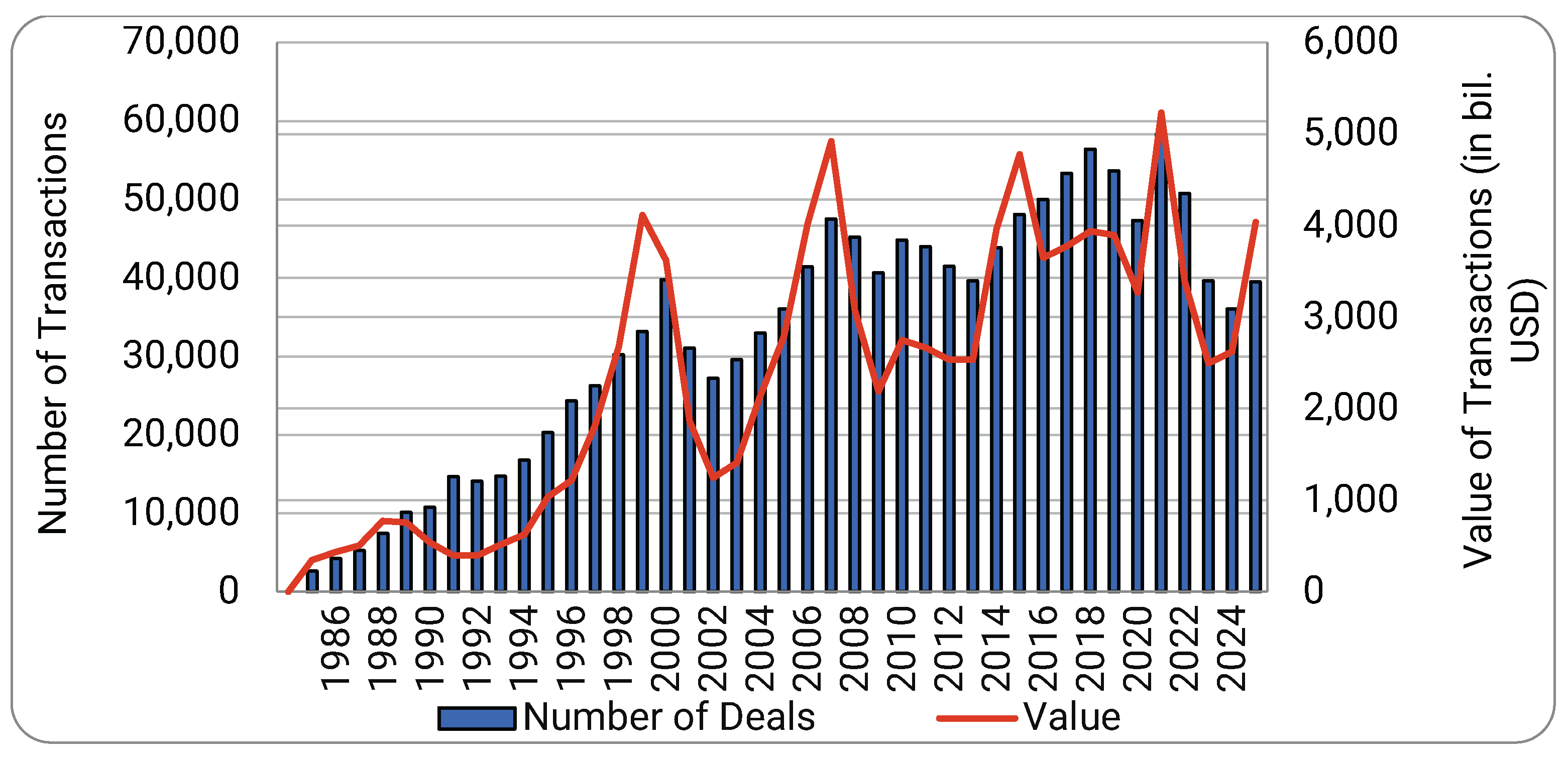
Figure 2.
The evolution of hostile takeovers globally. Source: Institute for Mergers, Acquisitions and Alliances.
Figure 2.
The evolution of hostile takeovers globally. Source: Institute for Mergers, Acquisitions and Alliances.
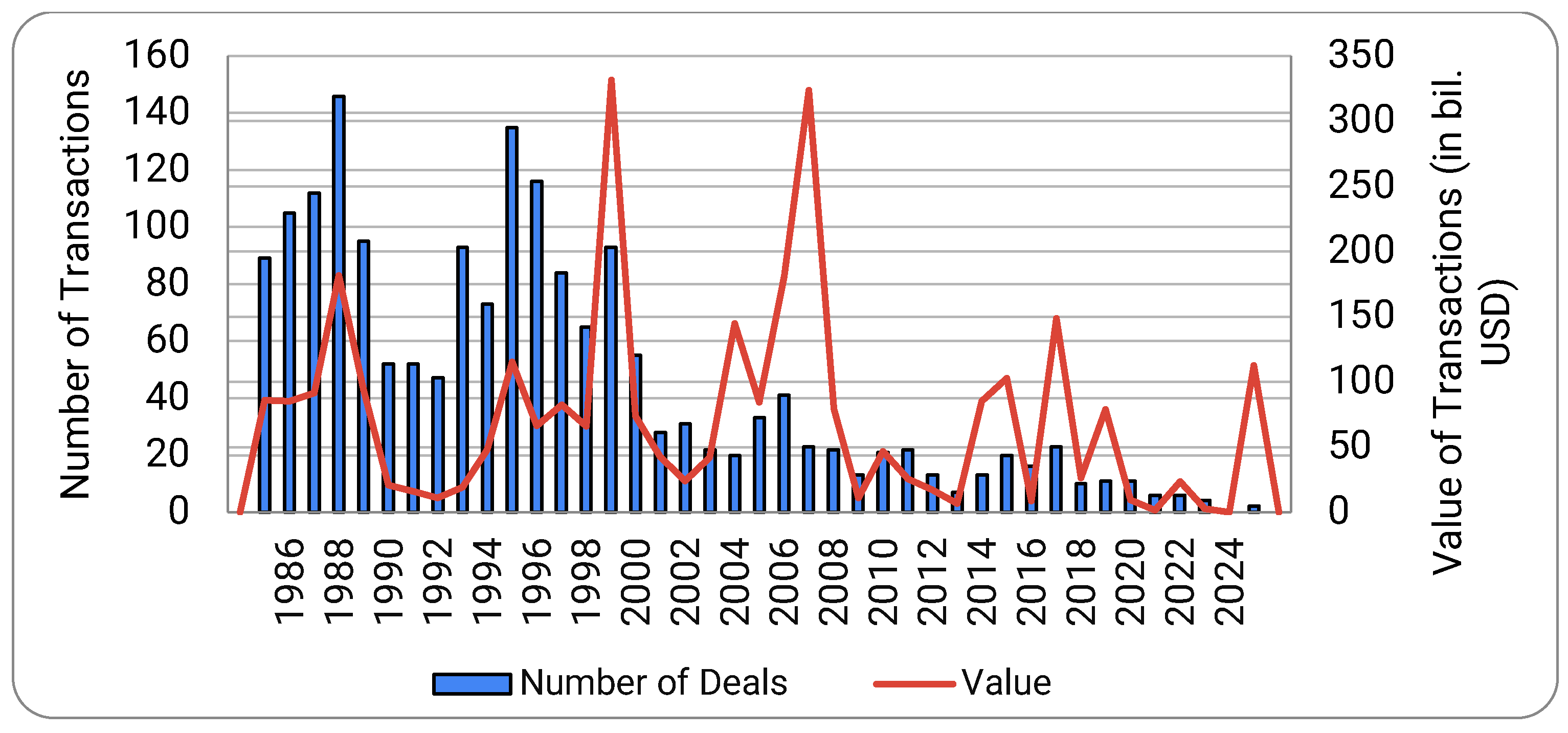
Figure 3.
Share of hostile takeovers in total global M&A in terms of number and value. Source: Authors’ processing based on Institute for Mergers, Acquisitions and Alliances.
Figure 3.
Share of hostile takeovers in total global M&A in terms of number and value. Source: Authors’ processing based on Institute for Mergers, Acquisitions and Alliances.
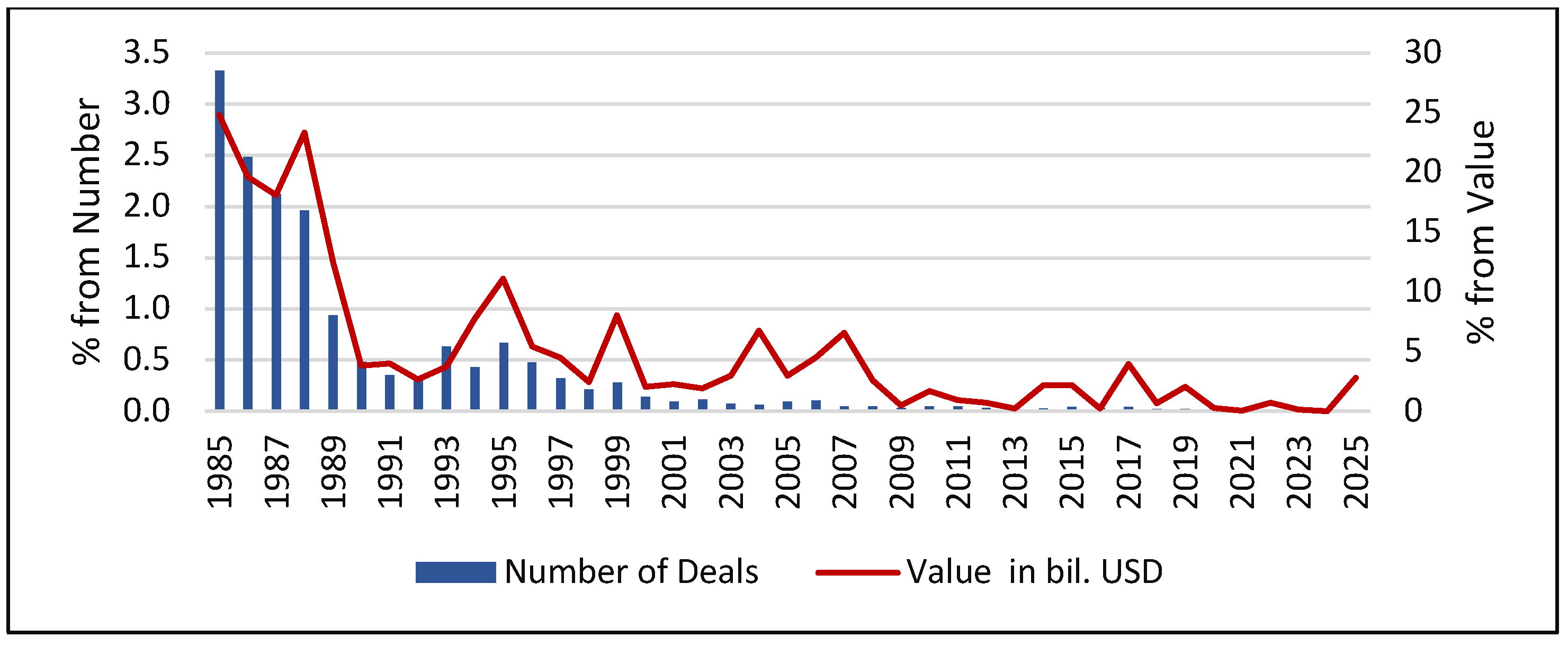
Figure 4.
Overall dynamics of M&A article publication.
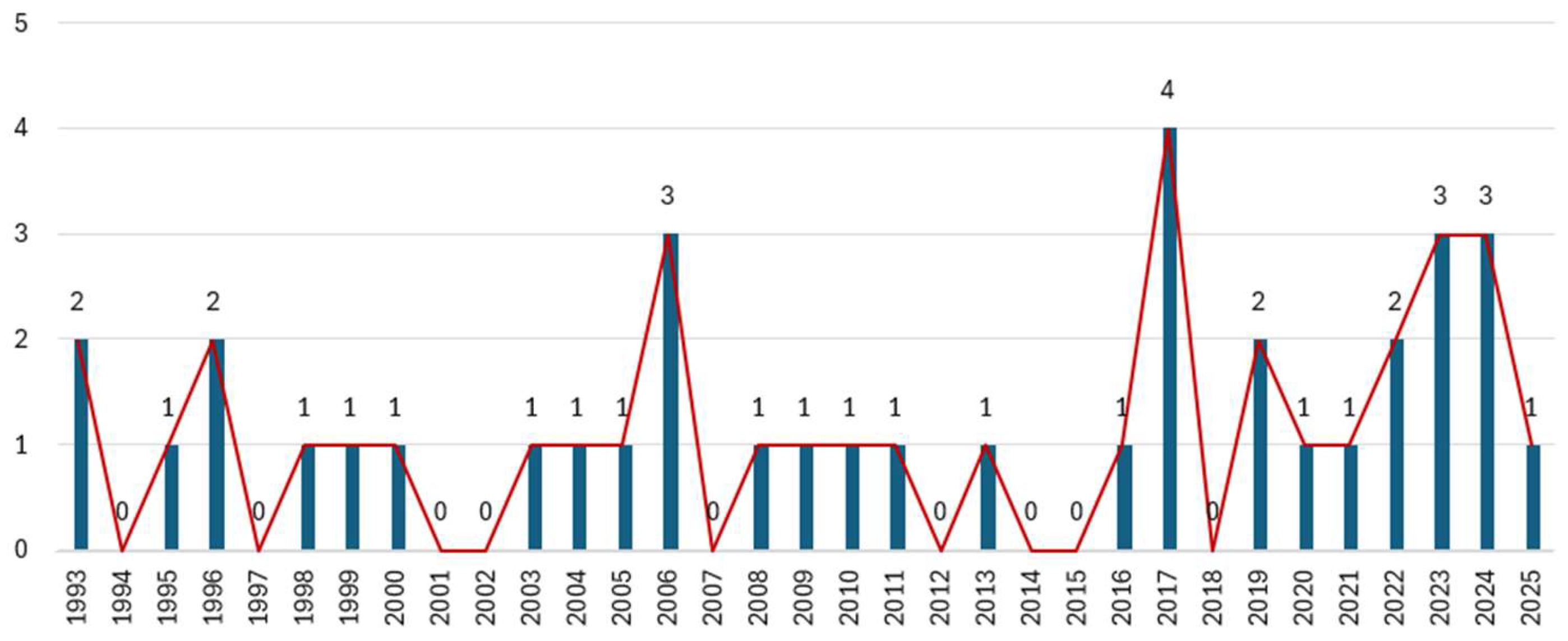
Figure 5.
Distribution of articles by number of authors.
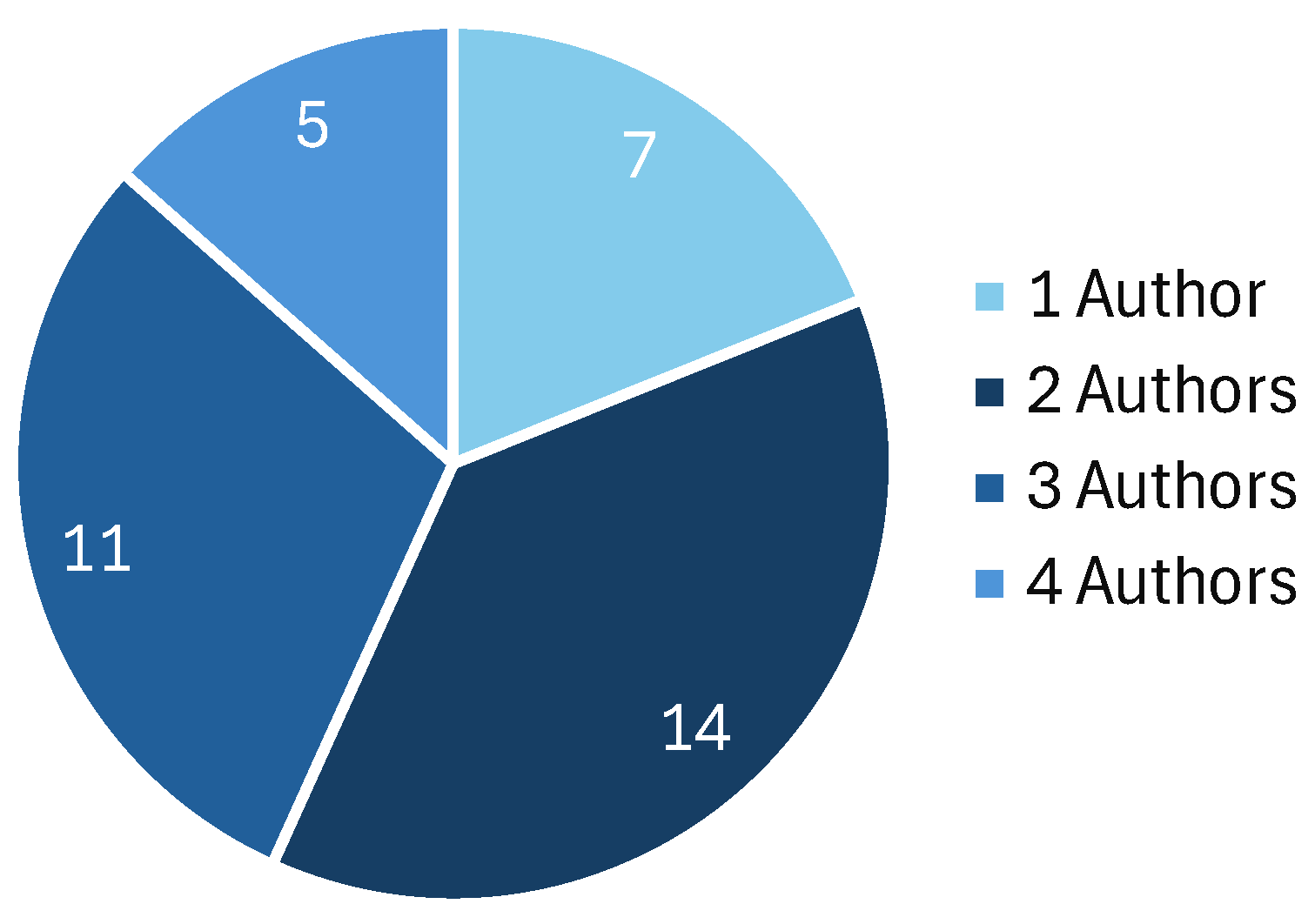
Figure 6.
Keyword co-occurrence map.
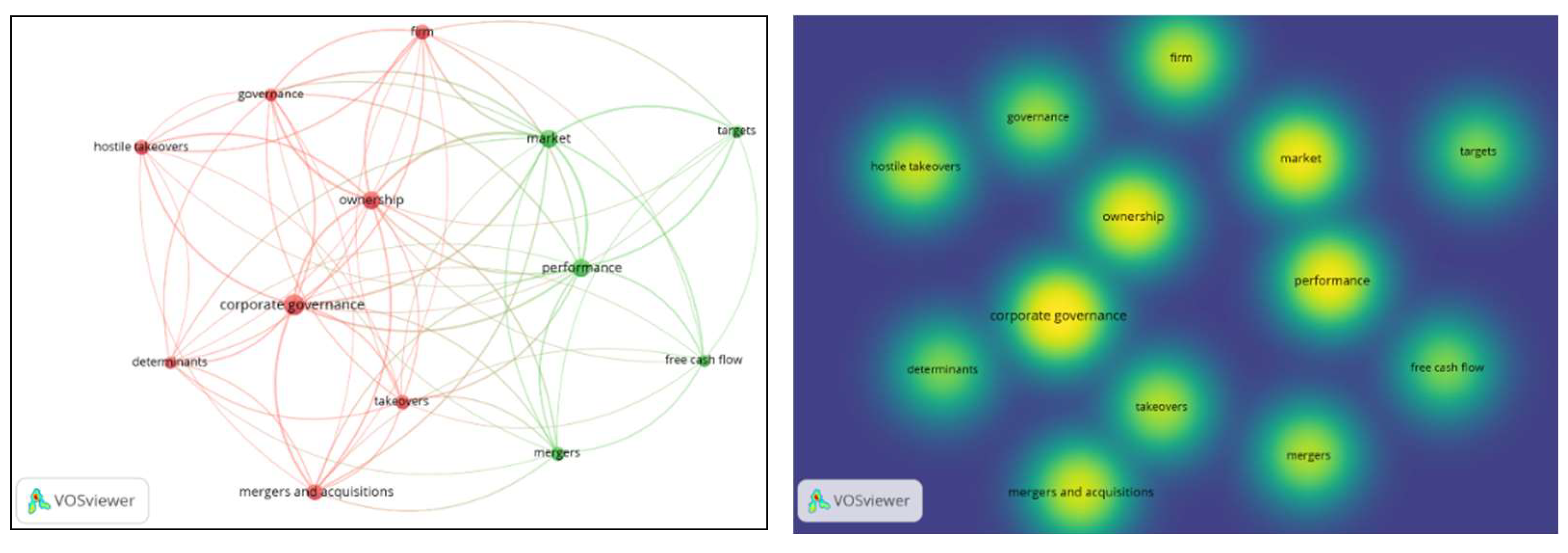
Figure 7.
Co-citation analysis of cited authors.
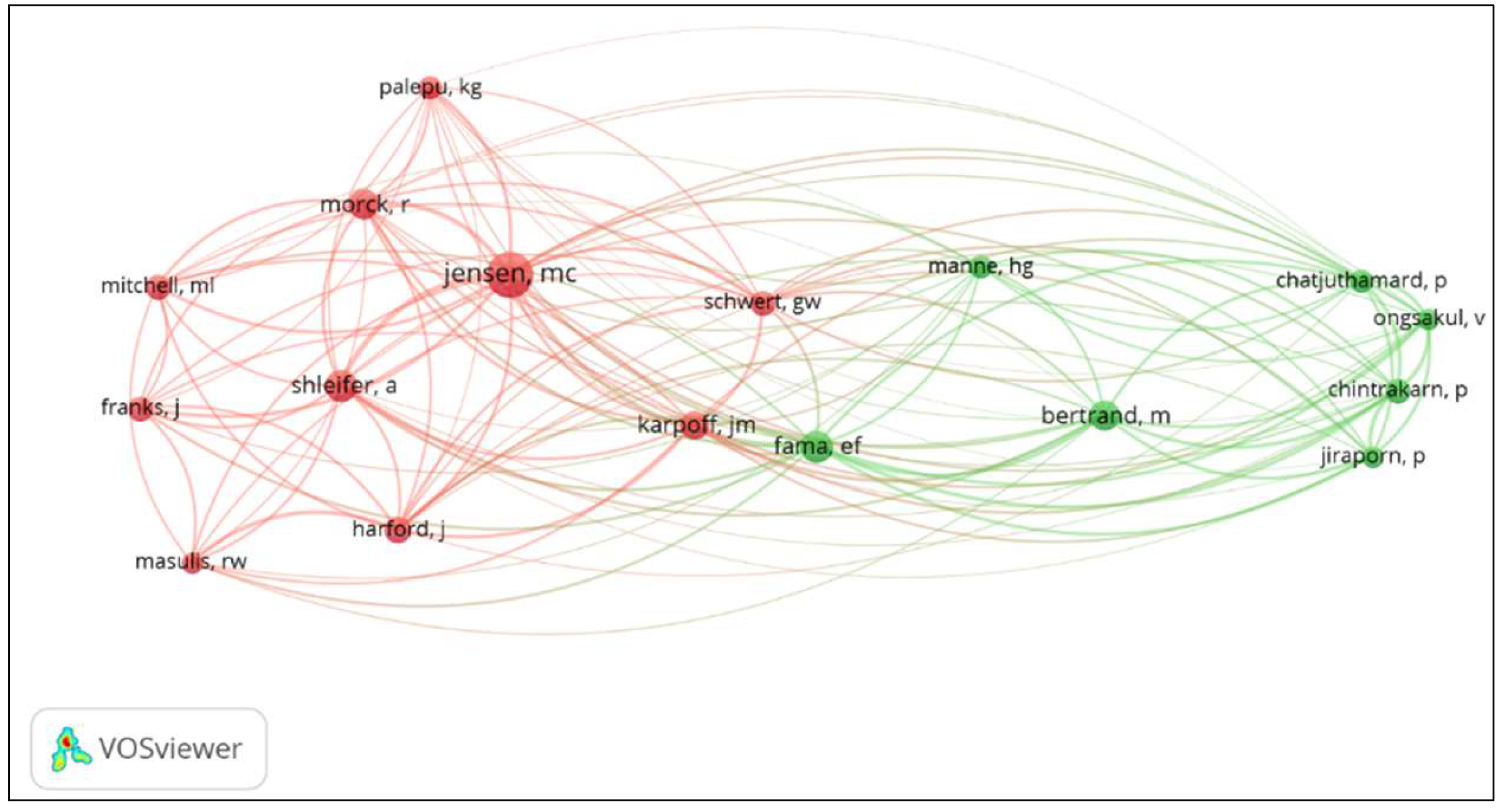
Figure 8.
Co-Citation analysis of Cited Sources.
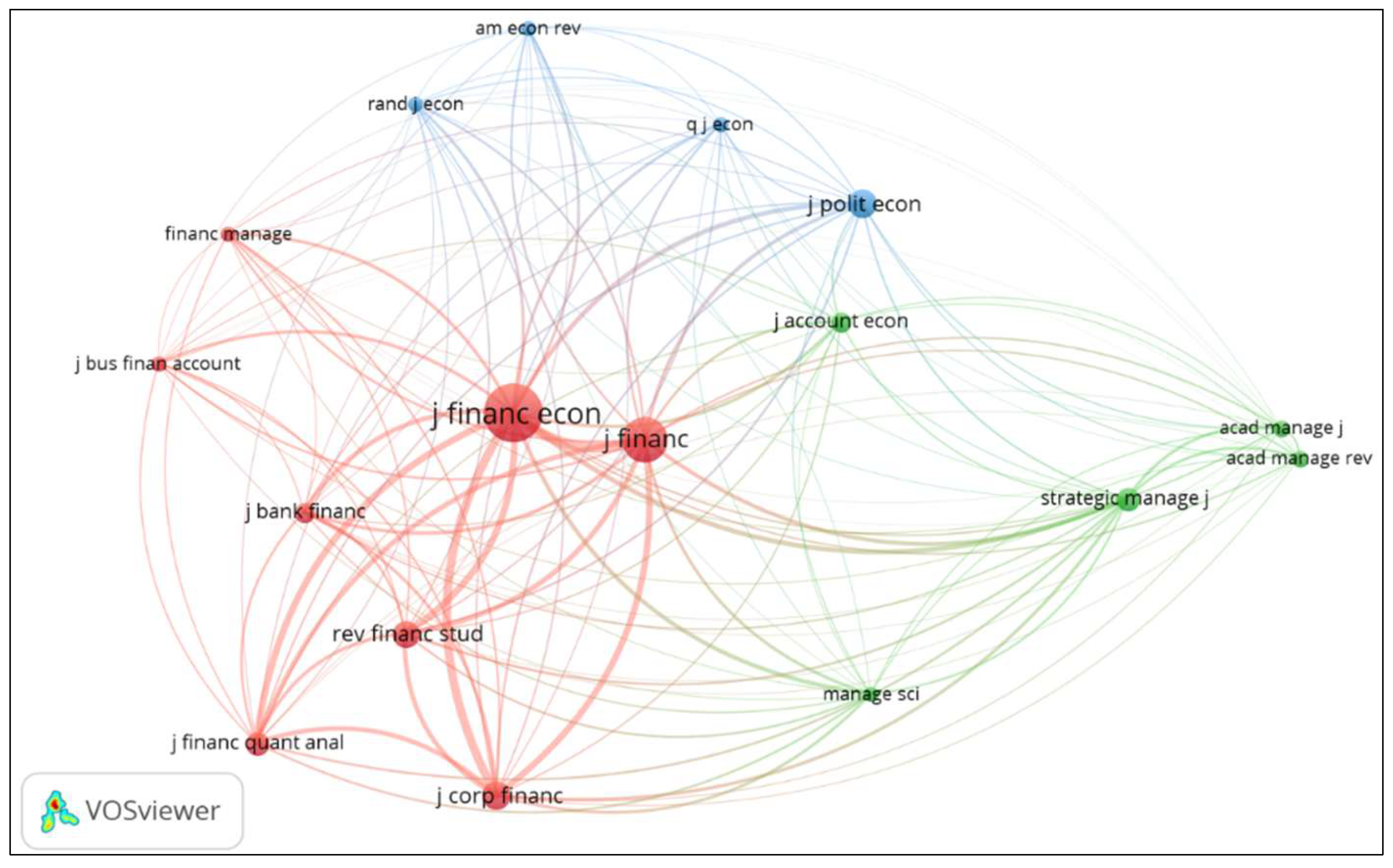
Figure 9.
Co-citation analysis of cited references.
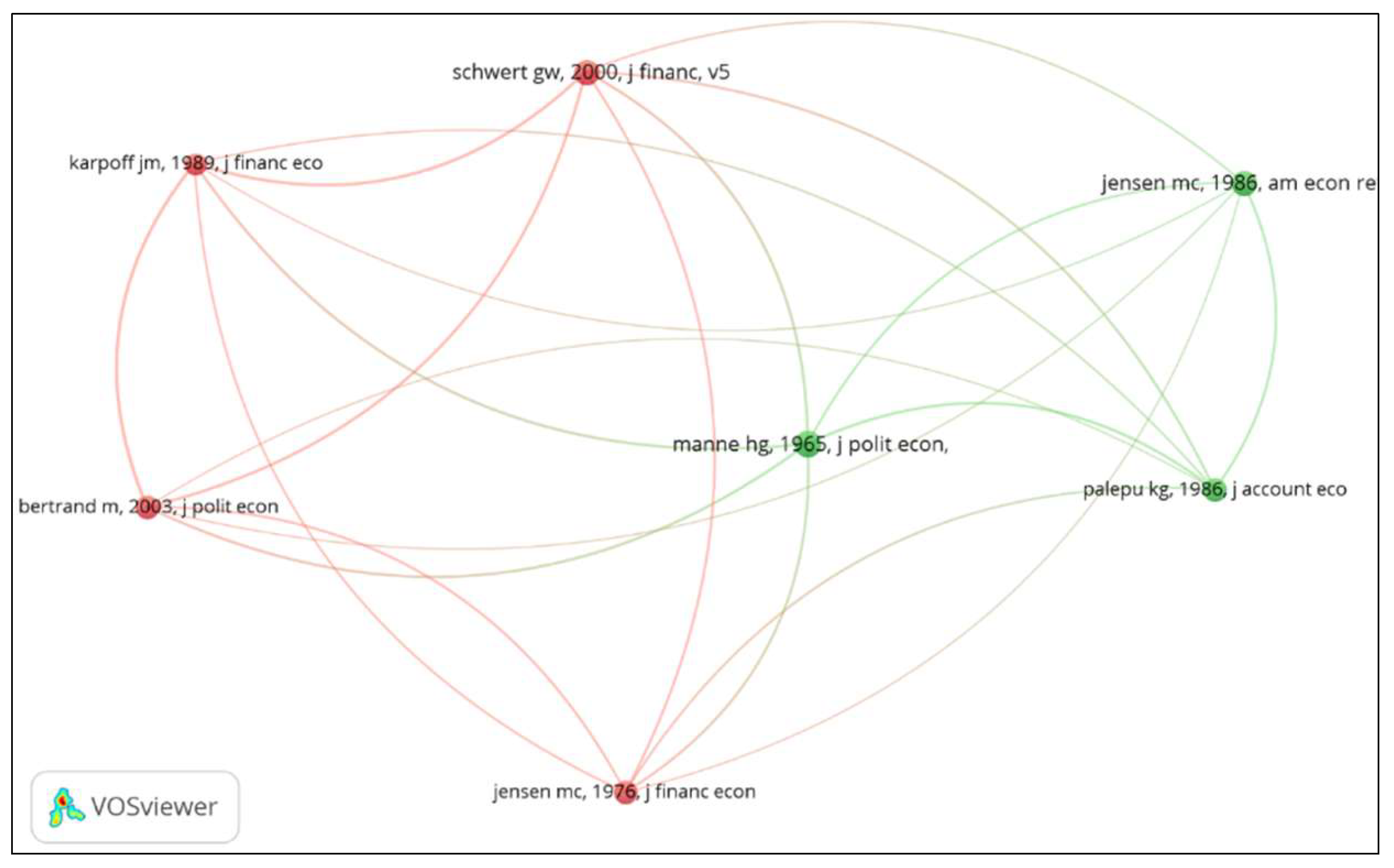
Figure 10.
Bibliographic Coupling – documents.
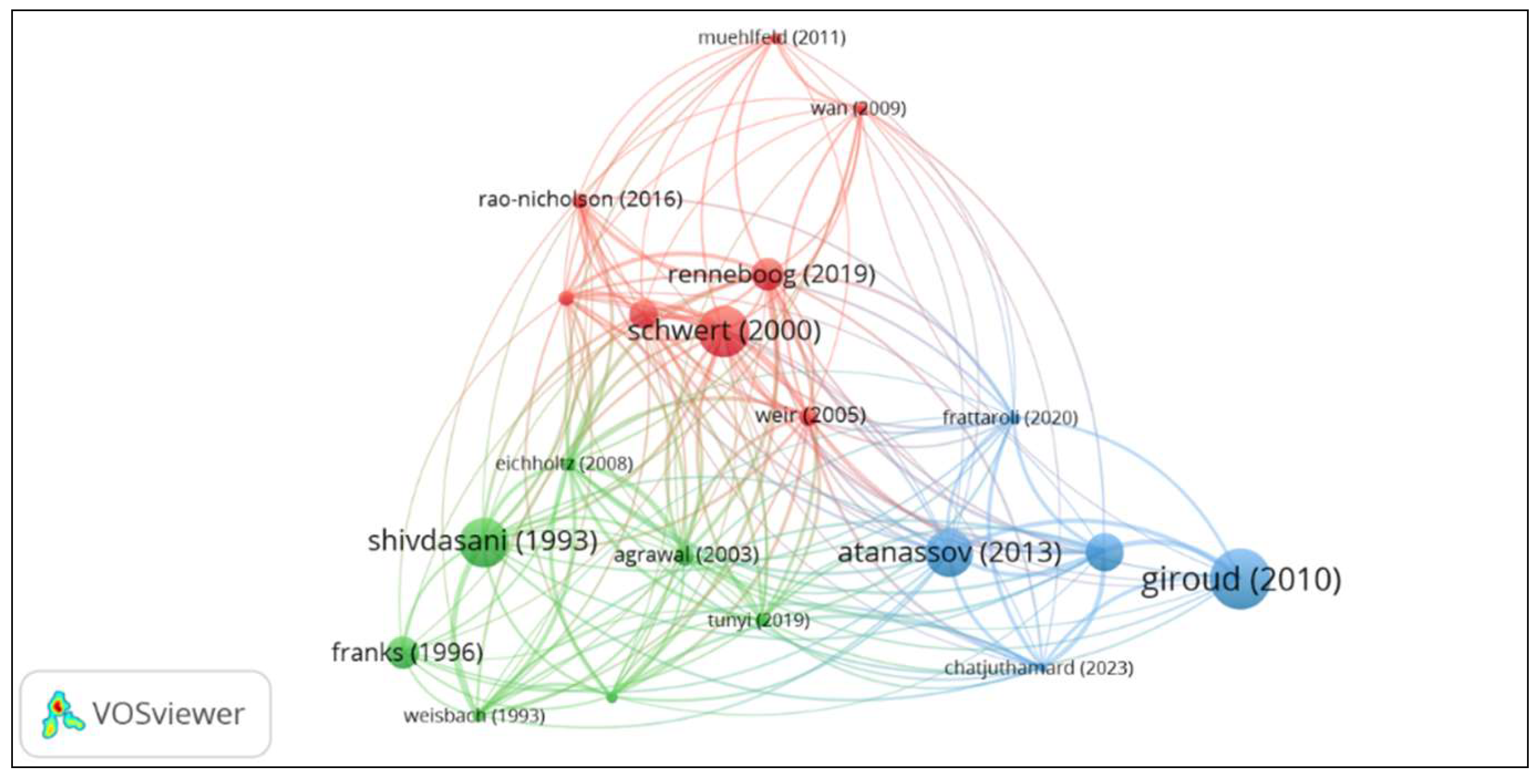
Figure 11.
Bibliographic Coupling -Sources.
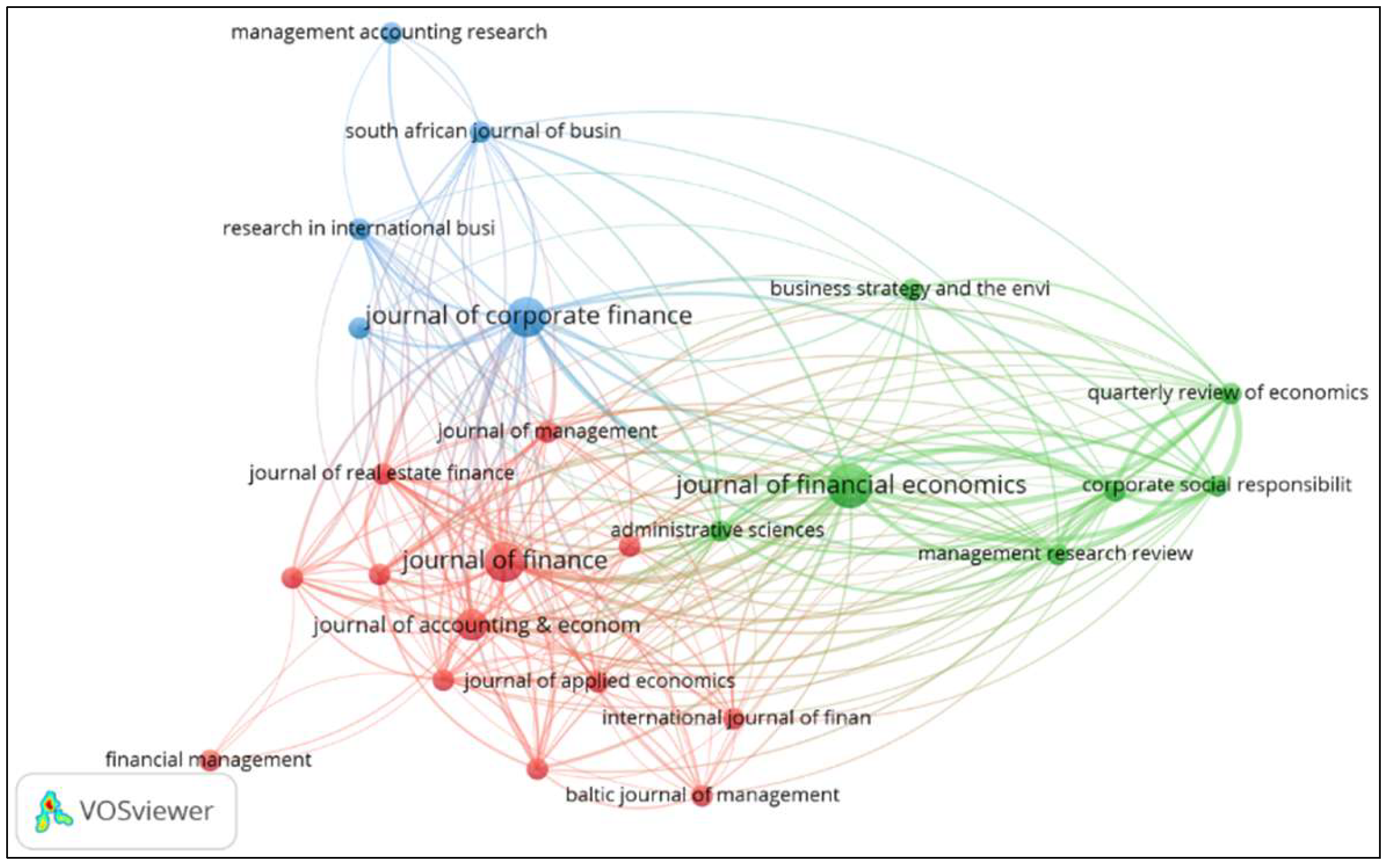
Figure 12.
Bibliographic Coupling -Authors.
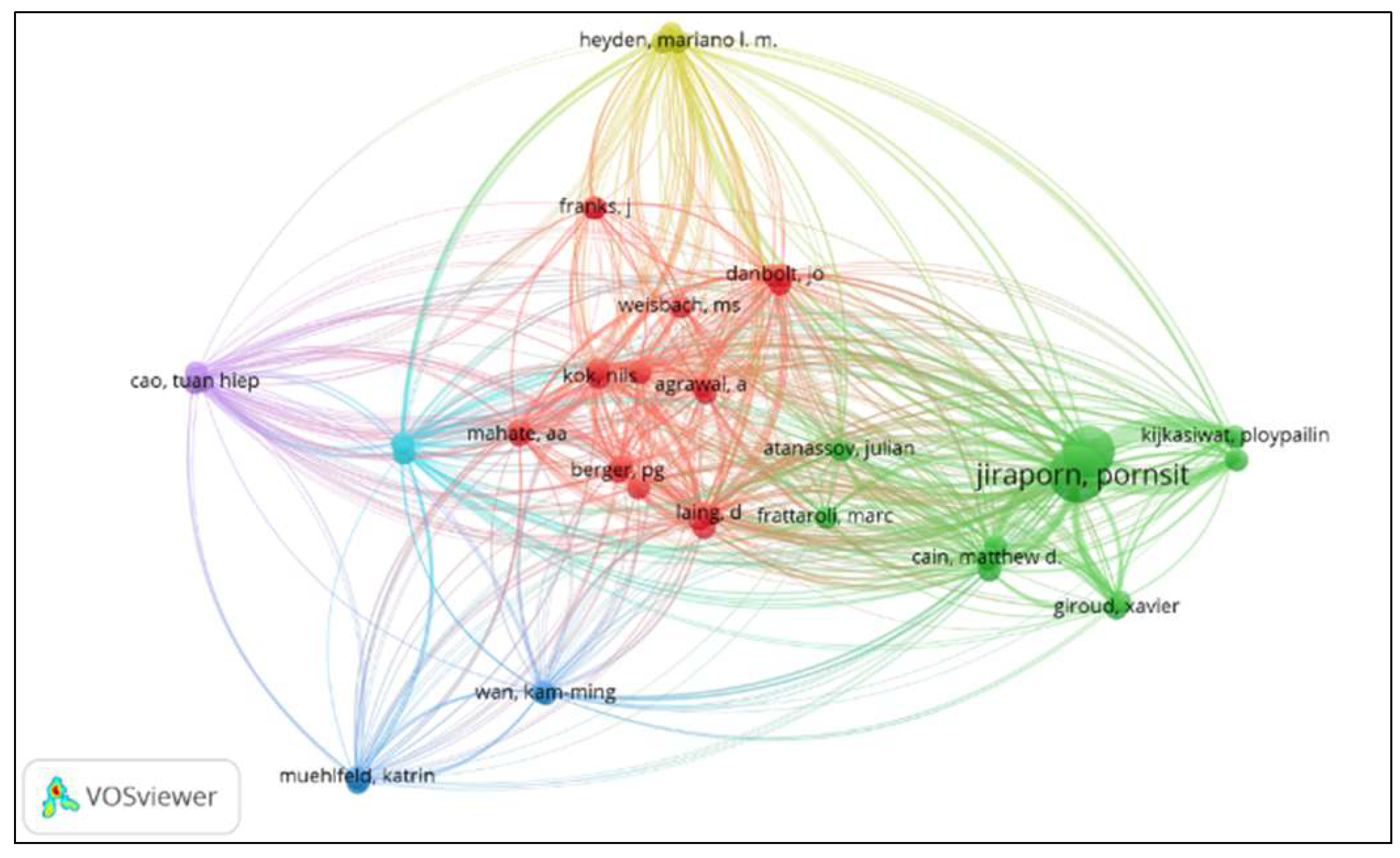
Figure 13.
Citation- Documents.
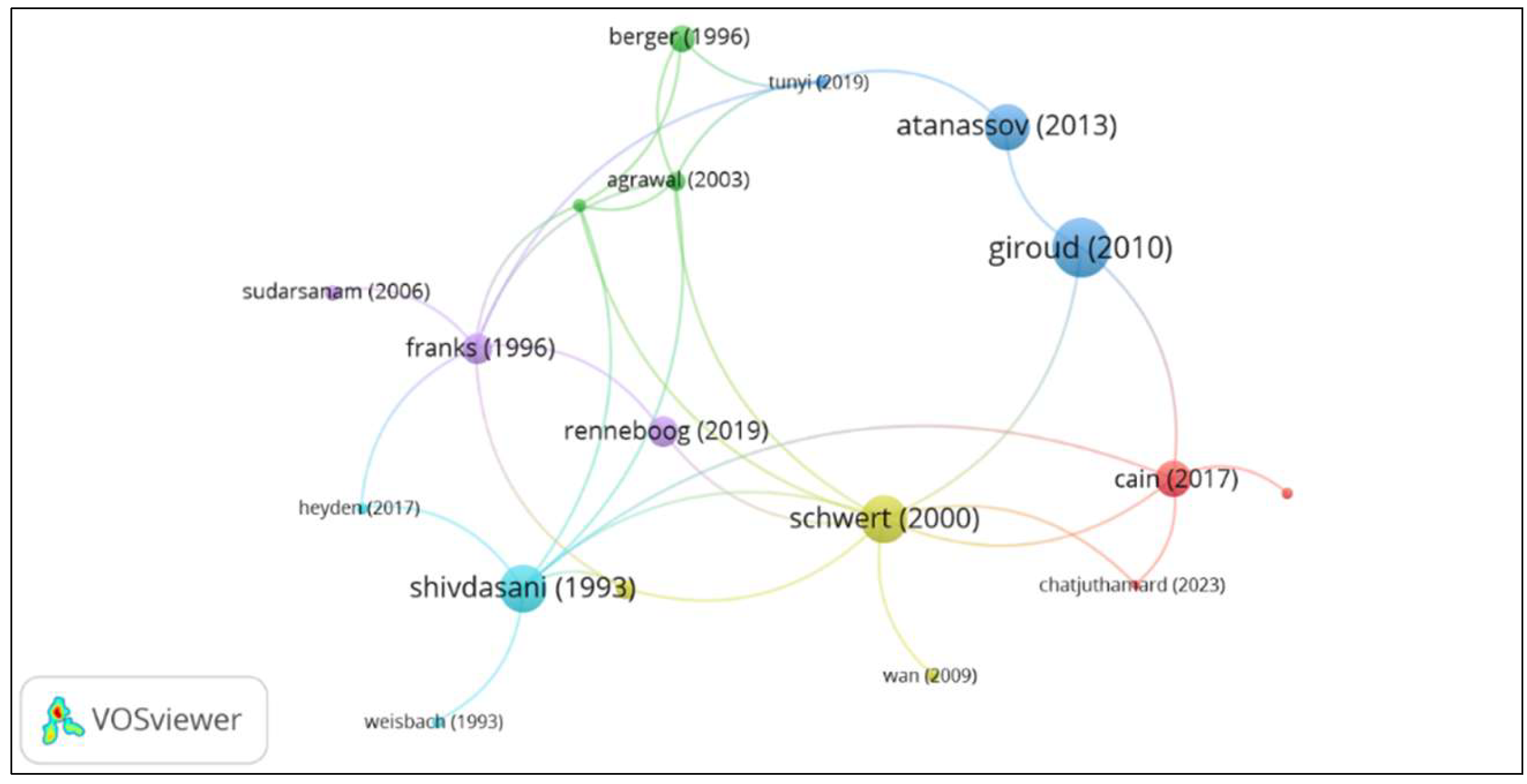
Figure 14.
Citation of authors.
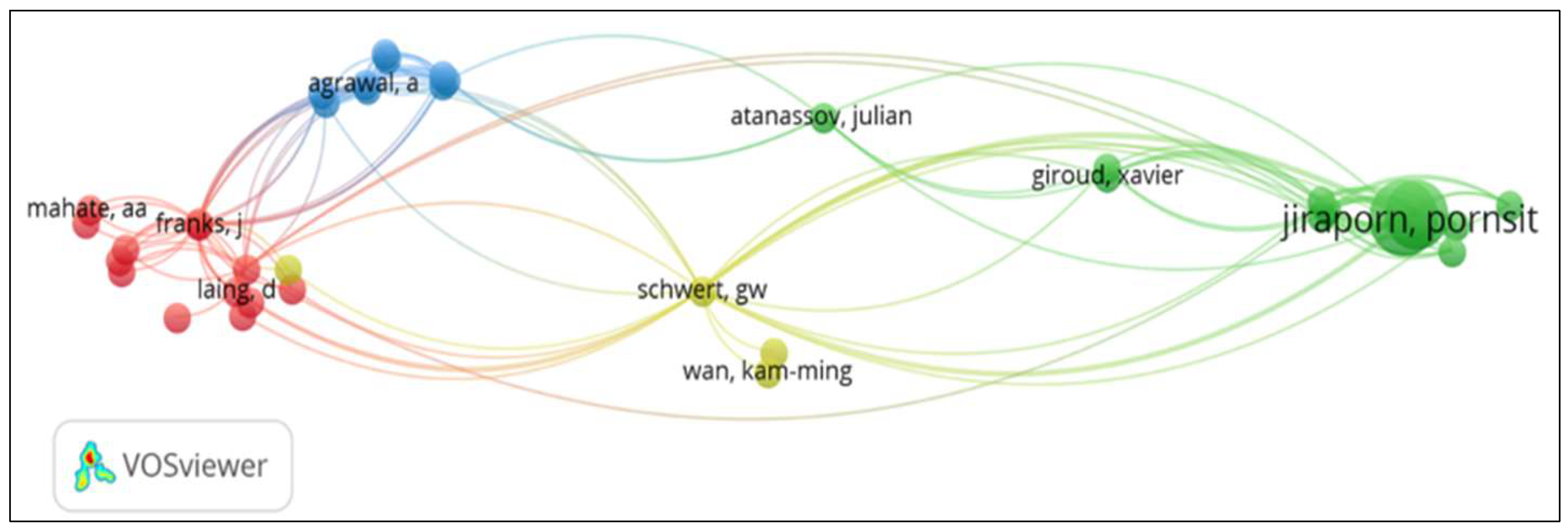
Figure 15.
Co-authorship – Authors.
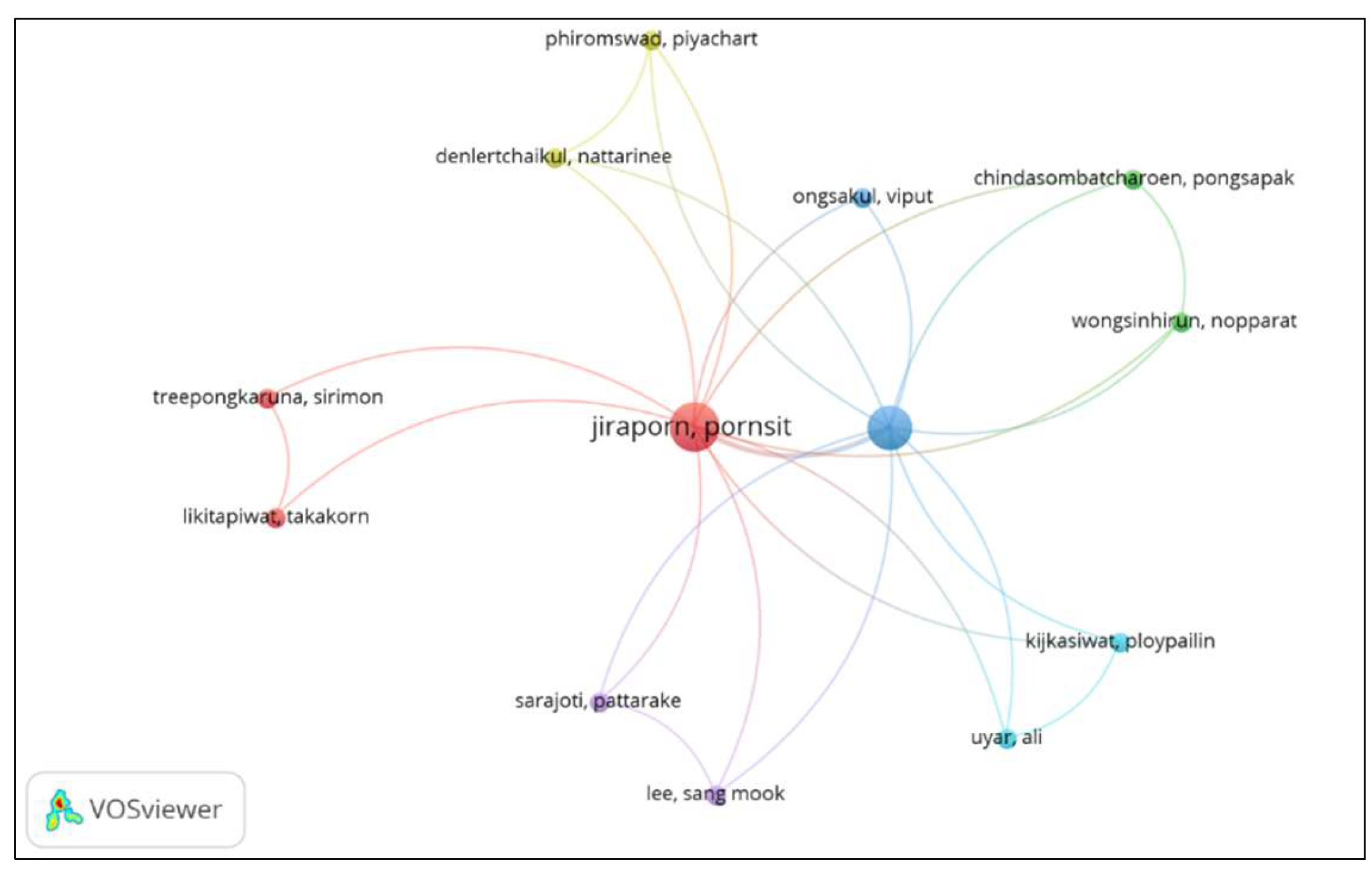
Figure 16.
PRISMA Diagram.
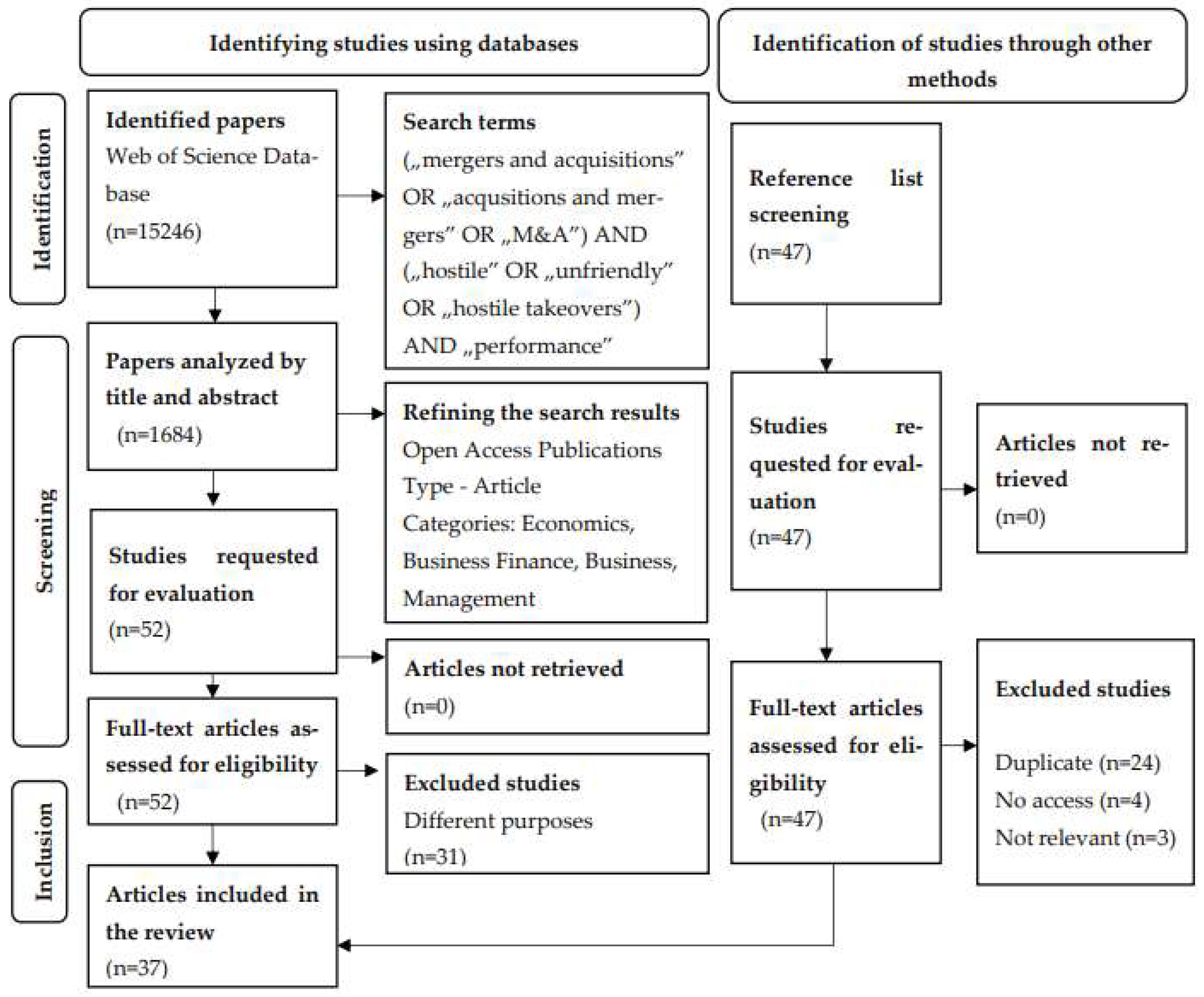
Table 1.
Classification of documents according to the number of citations.
| Document | Citations |
|---|---|
| Giroud (2010) | 611 |
| Schwert (2000) | 421 |
| Shivdasani (1993) | 412 |
| Atanassov (2013) | 364 |
| Cain (2017) | 231 |
| Renneboog (2019) | 172 |
| Franks (1996) | 167 |
| Berger (1996) | 130 |
| Agrawal (2003) | 68 |
| Weir (2005) | 68 |
*Giroud (2010) is the author with the highest number of citations.
Table 2.
Distribution of articles by region analyzed.
| Country | Documents | Citations |
|---|---|---|
| USA | 16 | 1913 |
| England | 7 | 973 |
| Thailand | 6 | 34 |
| Australia | 4 | 205 |
| Netherlands | 4 | 257 |
| Scotland | 3 | 107 |
| Belgium | 2 | 637 |
| United Arab Emirates | 1 | 45 |
| Switzerland | 1 | 27 |
| Spain | 1 | 25 |
* The US is analyzed in most articles.
Table 3.
Distribution of articles by journal.
| Source | Documents | Citations |
|---|---|---|
| Journal of Financial Economics | 4 | 1036 |
| Journal of Finance | 3 | 915 |
| Journal of Corporate Finance | 3 | 213 |
| Journal of Accounting & Economics | 2 | 440 |
| Journal of Business Finance & Accounting | 1 | 68 |
| Journal of Financial and Quantitative Analysis | 1 | 68 |
| Research in International Business and Finance | 1 | 46 |
| British Journal of Management | 1 | 45 |
| Journal of Real Estate Finance and Economics | 1 | 34 |
| International Review of Financial Analysis | 1 | 31 |
* Top journals account for most citations.
Table 4.
Distribution of authors according to the number of publications.
| Author | Documents | Citations |
|---|---|---|
| Jiraporn, Pornsit | 6 | 34 |
| Chatjuthamard, Pattanaporn | 5 | 26 |
| Muller, Holger M. | 1 | 611 |
| Giroud, Xavier | 1 | 611 |
| Schwert, GW | 1 | 421 |
| Shivdasani, A | 1 | 412 |
| Atanassov, Julian | 1 | 364 |
| Solomon, Steven Davidoff | 1 | 231 |
| Mckeon, Stephen B. | 1 | 231 |
| Cain, Matthew D. | 1 | 231 |
* The number of publications is not directly correlated with the number of citations.
Table 5.
Use of keywords in articles.
| Keyword | Occurrences |
|---|---|
| Corporate Governance | 15 |
| Market | 12 |
| Ownership | 12 |
| Performance | 12 |
| Mergers and Acquisitions | 9 |
| Firm | 8 |
| Hostile Takeovers | 8 |
| Takeovers | 7 |
| Mergers | 7 |
| Governance | 6 |
* Corporate governance is the most frequently used keyword in the studies in the sample.
Disclaimer/Publisher’s Note: The statements, opinions and data contained in all publications are solely those of the individual author(s) and contributor(s) and not of MDPI and/or the editor(s). MDPI and/or the editor(s) disclaim responsibility for any injury to people or property resulting from any ideas, methods, instructions or products referred to in the content. |
© 2026 by the authors. Licensee MDPI, Basel, Switzerland. This article is an open access article distributed under the terms and conditions of the Creative Commons Attribution (CC BY) license (http://creativecommons.org/licenses/by/4.0/).
Copyright: This open access article is published under a Creative Commons CC BY 4.0 license, which permit the free download, distribution, and reuse, provided that the author and preprint are cited in any reuse.