

Submitted:
30 January 2026
Posted:
02 February 2026
You are already at the latest version
Abstract
Modern enterprise information systems must simultaneously support complex organizational structures, ensure robust security, and remain scalable and maintainable over time. Traditional Role‑Based Access Control (RBAC) models, while effective for permission management, operate primarily as post‑design security layers and do not provide a unified methodology for structuring system architecture. This paper introduces the Zoned Role‑Based (ZRB) model, a mathematically formalized and comprehensive framework that integrates organizational modeling, system design, implementation, access control, and long‑term maintenance. ZRB models an organization as a hierarchy of zones, each containing its own roles, applications, operations, and users, forming a recursive Zone Tree that directly mirrors real organizational semantics. Through formally defined role hierarchies, zone‑scoped permission sets, and inter‑zone inheritance mappings, ZRB provides a context‑aware permission calculus that unifies authentication and authorization across all zones. The paper presents the theoretical foundations of ZRB, a multi‑phase engineering methodology for constructing integrated enterprise systems, and a complete implementation architecture with permission inference, navigation design, administrative subsystems, and deployment models. Empirical evaluations across several deployed systems demonstrate significant improvements in permission accuracy, administrative efficiency, scalability, and maintainability. ZRB thus offers a rigorously defined and practically validated framework for building secure, scalable, and organizationally aligned enterprise information systems.
Keywords:
integrated web apps development
; zoned role-based system development
; zoned role-based access control
; software development methodology
; enterprise information systems
; hierarchical permission inference
1. Introduction
In the era of digital transformation, organizations are fundamentally dependent on interconnected, web-based enterprise information systems (EIS) to drive operational efficiency, support decision-making, and maintain competitive advantage. The complexity of modern organizational structures—characterized by interconnected departments, cross-functional teams, and geographically dispersed units—poses significant challenges for system architects. Chief among these is the dual mandate of ensuring robust security while delivering a seamless, integrated user experience. Access control, the cornerstone of system security, has long been governed by paradigms like Role-Based Access Control (RBAC), which effectively maps permissions to job functions [1]. However, RBAC is predominantly a security-centric model applied post-design, often leaving gaps in the coherence between an organization’s operational logic and its software ecosystem’s architecture.
This paper addresses a critical gap at the intersection of software engineering and security management: the need for a unified methodology that extends the principles of role-based structuring beyond mere permission management to inform the entire system development lifecycle. We introduce the Zoned-Role Based (ZRB) approach, a novel framework for the design, implementation, deployment, and access control of integrated enterprise information systems. Unlike traditional RBAC, the ZRB model is not an add-on security layer but an organizing philosophy. It begins by modelling an organization as a collection of logical zones (e.g., “Finance,” “Northwest Regional Sales,” “Project Alpha Team”). Within each zone, roles are defined, and corresponding software components (operations and applications) are developed specifically to fulfill those roles’ responsibilities. Access control is then intrinsically managed through inferred relationships among roles within and across zones.
The primary contribution of this work is a holistic methodology that enhances both developmental efficiency and operational security. By aligning system modules directly with zoned-role constructs from the outset, the ZRB approach reduces design fragmentation, streamlines deployment, and simplifies maintenance. For end-users, particularly those with multi-zone responsibilities, it enables seamless, single sign-on access [2] to a personalized suite of tools tailored to their organizational duties. This paper elaborates on the ZRB model’s principles, its architectural implications, and its practical benefits, arguing for its adoption as a comprehensive methodology for building agile, secure, and user-centric enterprise systems.
2. Literature Review
The design and security of enterprise information systems have been extensively studied, with significant literature dedicated to access control models and software development methodologies. This review synthesizes key works to contextualize the proposed Zoned-Role Based (ZRB) approach.
Foundations of Role-Based Access Control (RBAC). The RBAC model, formalized by Sandhu et al. (1996) and standardized by NIST, revolutionized security management by assigning permissions to roles rather than individual users. This abstraction simplifies administration, enforces the principle of least privilege, and aids in regulatory compliance. Extensions like Hierarchical RBAC (incorporating role inheritance) and Constrained RBAC (incorporating separation of duties) have further refined its applicability. Despite its dominance, critique has persisted regarding RBAC’s static nature in dynamic environments and its administrative overhead in large, complex organizations. Crucially, RBAC is typically treated as a security policy module to be integrated into an existing system design, not as a driver for the design itself [3,4,5,6,7].
Beyond RBAC: Attribute and Context-Aware Models. Recognizing RBAC’s limitations, researchers proposed more dynamic models. Attribute-Based Access Control (ABAC) grants permissions based on user, resource, and environmental attributes [8], offering fine-grained control. Context-Aware Access Control models incorporate real-time situational data [9]. While flexible, these models increase complexity in policy specification and management, and like RBAC, they are often orthogonal to the system development process, focusing solely on the authorization layer.
Organizational Modelling in System Design. The concept of mapping software structure to organizational structure is not new. Enterprise Architecture frameworks like Zachman [10] and TOGAF emphasize business-process alignment. In software engineering, goal-oriented requirements engineering (GRL, i*) models organizational actors and their dependencies [11]. However, these high-level frameworks often lack a direct, prescriptive bridge to the implementation of integrated, operational web-based systems and their built-in access control mechanisms [12].
The Gap: Integrating Design, Development, and Security. Recent discourse calls for more integrated approaches. Studies highlight the cost and errors introduced by “bolting on” security after core design is complete, advocating for Secure by Design principles. In the realm of RBAC, research has explored role engineering—the process of defining roles—as a critical, often difficult, preliminary step. However, this process remains largely decoupled from functional module design. The notion of “zones” or “spheres of responsibility” appears in fragmented forms within literature on multi-tenancy architecture and domain-driven design but is not systematically unified with role-based development and security [13,14].
The ZRB approach proposed in this paper directly responds to this identified gap. It synthesizes the administrative clarity of RBAC with the organizational mirroring of enterprise architecture, proposing zone as a first-class design entity. By making zones and roles the foundational blueprint for both system functionality and access control, ZRB inherently promotes coherence, reduces development lifecycle friction, and provides an intuitive model for users and administrators alike. It advances the literature by presenting a practical, holistic methodology where security (access control) is not a separate phase but an emergent property of a role- and zone-centric design process [15].
3. The Theoretical Foundation of the Zoned Role-Based (ZRB) Model
The Zoned Role-Based (ZRB) model presented in this work is a formal extension of the classical Role-Based Access Control (RBAC) framework. While RBAC provides a robust, policy-neutral architecture for permission management, its primary scope is the authorization layer of an existing system. The ZRB model transcends this limitation by elevating core RBAC principles to become the foundational, organizing schema for the entire system development lifecycle—from design and implementation to deployment and access control. This section provides a formal, technical specification of the ZRB model’s core components, their hierarchical relationships, and the resultant permission inference mechanism.
3.1. Core Formal Definitions
The ZRB model is founded on four primary entities—Users, Applications/Operations, Roles, and Zones. Their formal definitions establish the mathematical basis of the framework and serve as the foundation for permission inference, access control, and system decomposition.
Definition 1 (User).Let U be the finite set of all users within the organizational domain. An individual user is denoted u∈U. A user represents an identity, typically corresponding to an employee, contractor, or customer, capable of authenticating to the system.
Definition 2 (Application & Operation).An application, or app, is a discrete software component providing cohesive functionality. Let A be the finite set of all applications. An individual application is denoted a∈A.
Each application exposes a finite set of operations, defined as:
Each operation is a minimal executable unit (e.g., POST /api/order, GET /report/financial) and typically corresponds to a CRUD-type action on a resource. The global operation set is:
This unifies all system functionality into a single, well-structured operation domain.
Each application a provides a finite set of executable operations, O_a = {a.o_1, a.o_2, ..., a.o_n}. An operation a.o_i represents the smallest unit of system functionality (e.g., POST /api/order, GET /report/financial). These operations can be categorized by type, most commonly corresponding to CRUD (Create, Read, Update, Delete) actions upon specific data resources. The set of all operations in the system is O = ⋃_(a∈A) O_a.
Definition 3 (Role).A role is a semantic construct representing a job function or competency within a specific context. Let R be the finite set of all roles. An individual role is denoted r∈ R.
Each role is associated with a permission set:
Intra-Zone Role Hierarchy
A key contribution of ZRB is that roles are zone-scoped. For each zone , let
be the set of roles defined in that zone.
ZRB defines a partial order
where:
indicates that role is senior to role —e.g., a manager relative to a Staff role.
This induces permission inheritance:
unless overridden by explicit constraints (e.g., Separation-of-Duty rules)
Definition 4 (Zone).
A zone is a foundational organizational unit—such as a department, division, business unit, regional office, committee, or project team. A zone is recursively defined as the 4-tuple:
where:
- Zs—the (possibly empty) set of child sub-zones ofz. IfZs = ∅, the zone is a leaf.
- Rz— the non-empty set of roles defined within zone z.
- Az— the set of applications provisioned for use within zone z.
- Uz— the set of users affiliated with zone z. (Users in sub-zones propagate upward—see below.)
Induced Zone Tree
The recursive definition induces a hierarchical Zone Tree:
where:
- Z is the set of all zones,
- E is the set of directed edges zparent’ zchild representing parent–child relationships.
The root zone
corresponds to the entire organization.
Containment Constraints
1. User Propagation
A parent zone’s user set is a superset of the union of its children’s user sets:
This ensures that users inherit membership up the organizational chain—reflecting real-world reporting and visibility structures.
2. Role & Application Scoping
Roles and applications are defined per zone:
and identical labels across zones do not imply the same semantic role or application:
This scoping avoids namespace collision and supports independent evolution of organizational sub-structures
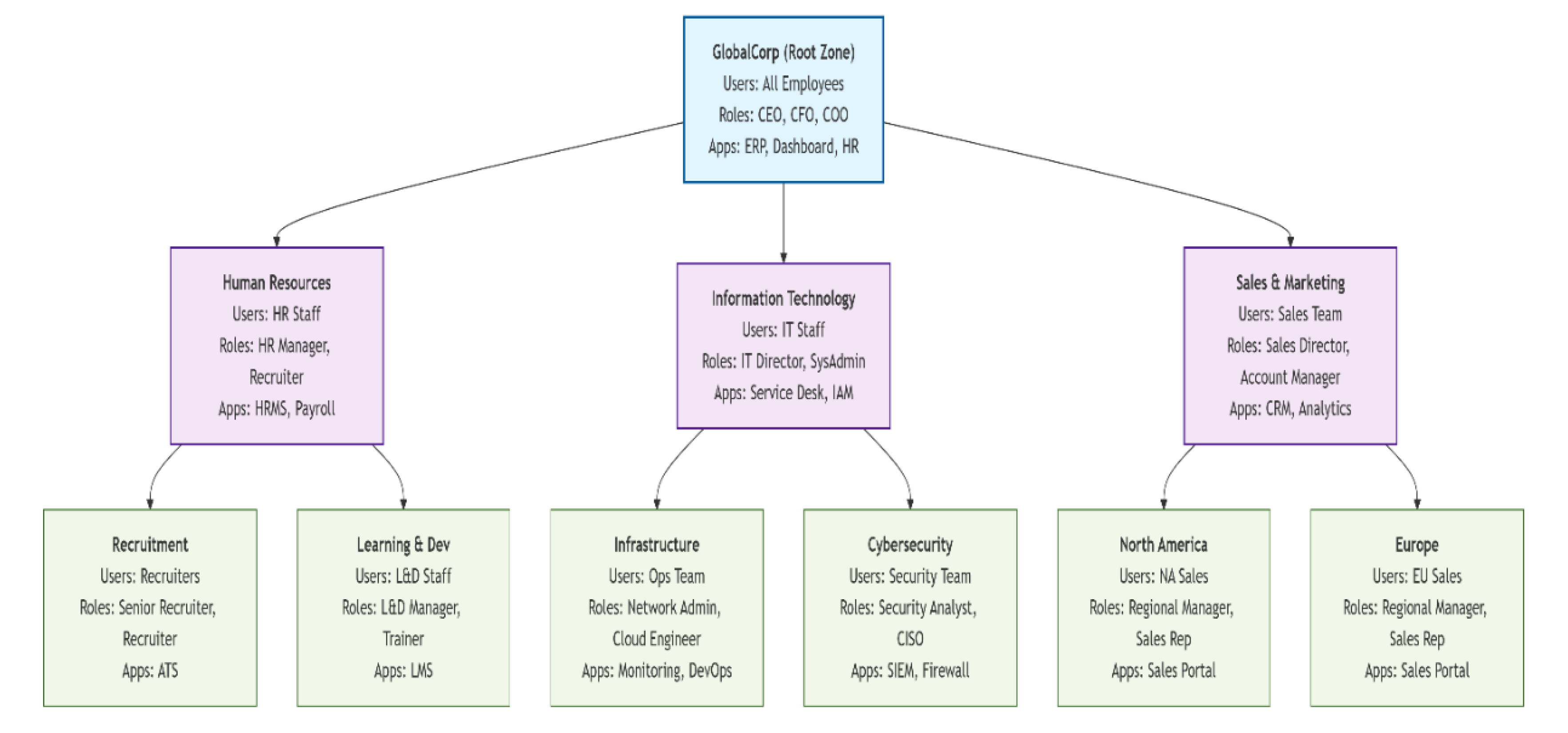
A sample zone tree for a large enterprise is shown in Figure 1, where:
Root Zone (GlobalCorp):
- Represents the entire enterprise.
- Contains all users, high-level roles (CEO, CFO, COO), and enterprise-wide applications (ERP, Dashboard, HR system).
- Parent to all department zones.
Level 2 – Department Zones:
- Human Resources (HR): Manages personnel, recruitment, and development.
- Information Technology (IT): Oversees technology infrastructure and security.
- Sales & Marketing (Sales): Handles sales operations and customer engagement.
Each department has its own user sets, roles, and applications scoped to its functional area.
Level 3 – Team Zones:
- HR → Recruitment & Learning & Development teams.
- IT → Infrastructure & Cybersecurity teams.
- Sales → Regional sales teams (North America & Europe).
These are subzones with more specialized roles and applications.
Key Structural Properties Illustrated:
- Hierarchical Containment: Child zones are contained within parent zones (e.g., Recruitment ⊆ HR ⊆ GlobalCorp).
- User Propagation: Users in child zones are also members of parent zones (e.g., a Recruiter belongs to both Recruitment and HR zones).
- Role Specialization: Roles become more specific at lower levels (e.g., CEO → HR Manager → Senior Recruiter).
- Application Scoping: Applications are provisioned to appropriate zones (e.g., ATS only in Recruitment zone).
- Permission Inheritance: Roles in child zones may inherit relevant permissions from ancestor zones (e.g., HR Manager inherits some permissions from CEO context).
3.2. Hierarchical Permission Inference and the Zone Tree
The Zone Tree
is not merely an organizational chart; it is a core computational structure of the ZRB permission inference engine. In ZRB, authority and permissions flow downward along the ancestry path of the Zone Tree, and remain confined within these paths unless explicitly overridden.
Axiom 1. Intra-Zone Role Inheritance
Within a zone, the partial order
defined over the role setinduces a hierarchical permission inheritance rule:
where:
is the set of explicitly assigned operations for role
For every subordinate role, permissions flow upward to
Thus, higher-level roles automatically inherit all permissions of subordinate roles—unless explicitly blocked by constraints.
Axiom 2. Inter-Zone Permission Ascendancy
Consider a non-root zonewith ancestral path:
If a role is a functional specialization of a role in its parent zone, then it inherits permissions from that parent-zone role. This relationship is formalized by the role-mapping function:
which links specialized roles to the roles they refine at higher organizational levels.
The effective permission set for rolein zonebecomes:
This expresses the principle:
A role inherits all permissions granted to its functional ancestors throughout the zone hierarchy.
Constraint-Based Permission Refinement
Certain users (e.g., external committee members ) may need restrictions on inherited permissions. ZRB handles this through constraint policies:
where “” denotes set difference, removing any forbidden operations:
These constraint sets are essential for supporting Separation-of-Duty, temporary access restrictions, and exception-based policies.
3.3. Formal Specification of Access Control Matrices
The ZRB model operationalizes its formal definitions using two central matrix structures.
Definition 5. Role–Operation Assignment Matrix ()
For each zone, ZRB defines:
mapping each role in the zone to the exact set of operations it is permitted to perform.
The mapping is implemented as a binary matrix where:
Rows correspond to roles Columns correspond to operations
This matrix is the concrete embodiment of the principle of least privilege for zone.
Definition 6. User–Zone–Role Assignment Matrix ()
The assignment of users to roles is governed by:
For eachand zone,
defines which roles a user may activate within that zone.
Representation options:
- A 3-dimensional matrix Mψ, or
- A set of tuples (u,z,r)
- A user may have multiple active role-zone pairs simultaneously, supporting cross-functional or multi-zone responsibilities.
3.4. The Access Control Decision Function
The runtime authorization decision uses all formal elements defined so far.
Definition 7. Access Decision Function
When a user uattempts to execute an operationwithin zone context , the system evaluates:
iff:
Role assignment:
for some Permission inference:
No blocking constraint:
Otherwise:
This deterministic rule integrates:
- Zone-scoped roles
- User–zone–role assignments
- Intra- and interzone inheritance
- Explicit constraints
The result is a structured, inferable, context-aware authorization decision model that aligns perfectly with the organization’s formal structure and operational semantics.
4. The ZRB Methodology for Integrated Enterprise System Design
The Zoned Role-Based (ZRB) model provides not only a theoretical framework for access control but also a structured, repeatable methodology for the design and development of integrated enterprise information systems. This methodology translates the formal constructs defined in Section 3—zones, roles, operations, and their hierarchical relationships—into a systematic engineering process. The goal is to produce a coherent system architecture where organizational structure, business logic, and security policy are intrinsically aligned from inception. The methodology proceeds through three primary phases: Organizational Analysis & Modeling, Architectural Specification, and Implementation Design. Each phase yields specific artifacts that feed subsequent development stages.
Phase 1: Organizational Analysis & Zone-Role Modeling
This phase focuses on capturing and formally modeling the organization’s structure and functions, which will serve as the blueprint for the entire system.
Step 1: Zone Identification and Relationship Mapping.
Identify all logical organizational units—both permanent (e.g., Finance, Manufacturing Division) and dynamic (e.g., Project Alpha Team, Compliance Audit Committee). Each unit is a candidate zone .
Document hierarchical and reporting relationships; these define the edges
in the Zone Tree .
Step 2: Construction of the Formal Zone Tree.
Using Step 1, construct a directed acyclic graph (typically a tree ) with root representing the entire organization. Annotate each zone with its user set (initially at a logical level, e.g., “all engineering staff”). Enforce the containment principle
so that users in child zones are propagated to parent zones.
Step 3: Intra-Zone Role and Application Inventory.
For each zone in , prepare a detailed inventory:
(a) Roles—functional roles (e.g., Accountant, Shift Supervisor) and root-level system roles (e.g., Super Administrator with ; Authenticated User with minimal global permissions; System Administrator).
(b) Applications & Operations—the applications required for the zone, with complete, granular operations (e.g., invoice.create, report.generate). Steps (a) and (b) iterate together - discovering an application may reveal the need for new specialized roles, and vice versa.
Phase 2: Security & Functional Architecture Specification
This phase defines the security policy and functional mapping using the formal matrices derived from Phase 1.
Step 4: Specification of the Role-Operation Assignment Matrix (φ).
For each zone , construct , the concrete implementation of
Each cell states whether operation is permitted for role . This realizes least privilege within the zone. Define the intra-zone role hierarchy so that senior roles inherit subordinate permissions (as formalized in Section 3).
Step 5: Specification of Permission Inheritance Rules and Constraints (γ and C).
Define the role mapping function
for inter-zone ascendancy—mapping child-zone roles to corresponding parent-zone roles (e.g.,
). Specify constraint sets
for explicit exceptions (e.g., SoD rules, temporal restrictions, context-based denials). These yield the final authorized set .
Phase 3: System Integration & Implementation Design
Translate the architecture into concrete designs for UX navigation, data management, and administrative subsystems that maintain the ZRB artifact.
Step 6: Design of the Navigational User Experience (UX).
Design navigation that reflects the ZRB hierarchy: Inter-Zone transitions among zones where the user has active assignments ; Intra-Zone & Inter-Role switching among roles assigned in the current zone; and Intra-Role dashboards exposing the allowed apps/operations for the selected role.
Step 7: Design of the Data Architecture.
Partition the database consistent with ZRB: a Global Schema for system-wide tables (Users, Zone Tree , matrices , assignments /); and Zone-/App-Local Schemas for localized data under the control of operations in permitted via .
Step 8: Design of Administrative Subsystems.
- Zone lifecycle management (create/modify/deprecate zones in T);
- Role & Operation management (maintain );
- User–Zone–Role assignments (maintain ); and
- Constraint policy management (maintain ). This supports safe evolution as organizations change (e.g., adding a sub-zone affects its subtree and local matrices while preserving global integrity)
- Methodological Flexibility and Evolution
Provide a root-zone application suite for: Because organizations evolve, ZRB’s formal artifacts localize change: adding roles/operations updates ; personnel changes update ; policy changes update . The structure ensures coherence and maintainability while mirroring the enterprise over time.
5. Implementation of ZRB-Based Enterprise Systems
The Zoned Role-Based (ZRB) model provides not only a design methodology but also a structured implementation framework that directly maps organizational constructs to technical architecture. While specific implementation details vary by technology stack, the ZRB approach offers consistent architectural principles and implementation patterns that ensure the system faithfully realizes the formal model described in previous sections [16,17].
5.1. Architectural Mapping: From Organizational Model to Web Infrastructure
The implementation begins by establishing a direct correspondence between the formal ZRB constructs and web-based system components [18,19]:
Zone-Domain Mapping Principle: Each zone z ∈ Z in the Zone Tree T = (Z, E) is mapped to a corresponding web application project with its own deployment unit. The hierarchical structure of T naturally maps to a domain/subdomain hierarchy:
- Root zone → primary domain Example: https://organization.com for
- Child zone → subdomain following the containment path Example: https://manufacturing.organization.com for Root → Manufacturing
Data Architecture Realization: The database schema is partitioned according to the zone hierarchy:
Global Schema
Implements system-wide constructs:
- Zones (the Zone Tree
- Roles (with hierarchy
- Operations
- Users
- Role–Operation Assignments (matrices )
- User–Zone–Role Assignments (function )
- Constraints (sets
Zone-Local Schemas
Each zone maintains its own local data, with access governed by the operations allowed via
5.2. Implementation Phases and Steps
Implementation follows the three-phase methodology, translating design artifacts into functional systems.
Phase I: Core Infrastructure Implementation (Root Zone Foundation)
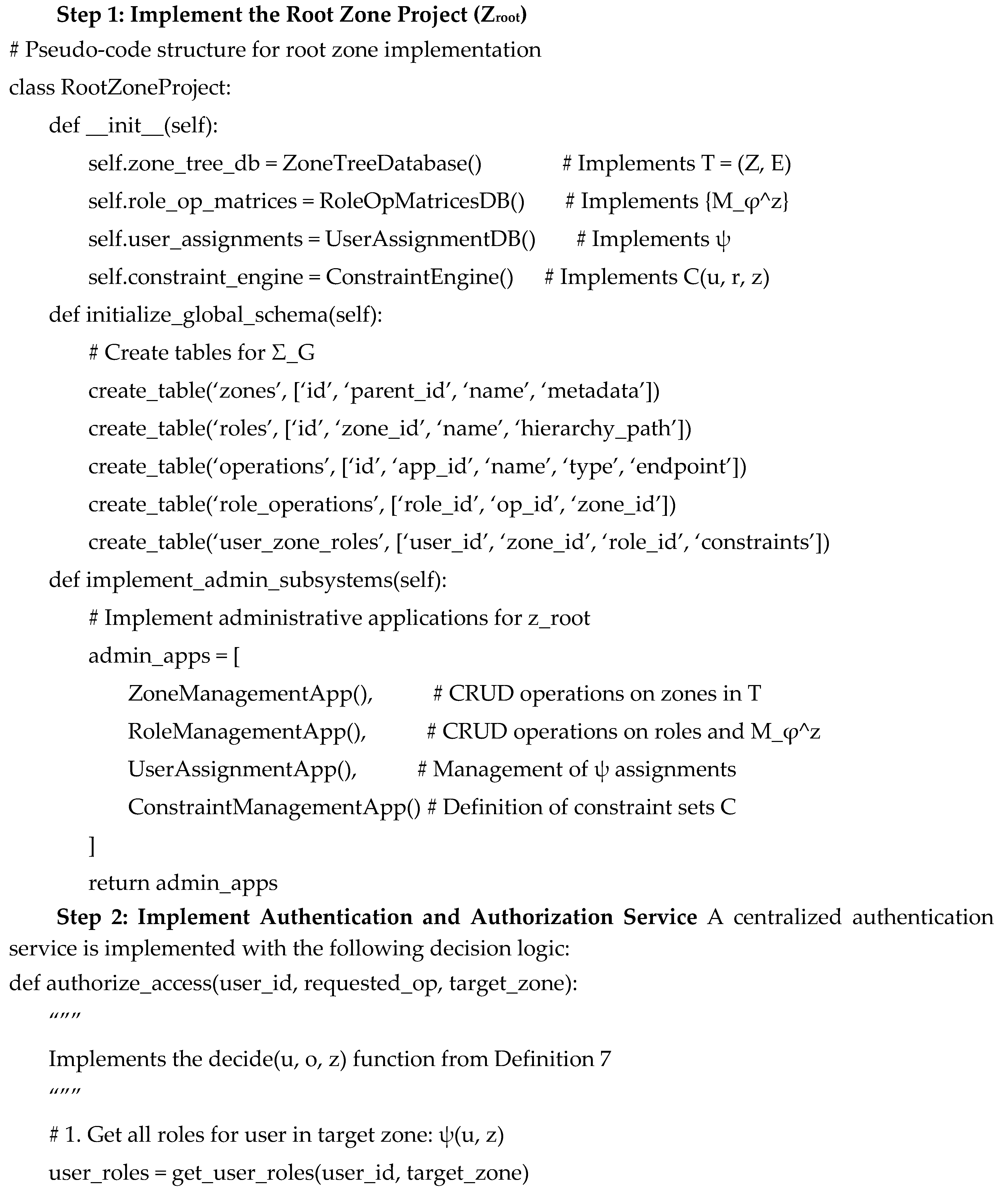
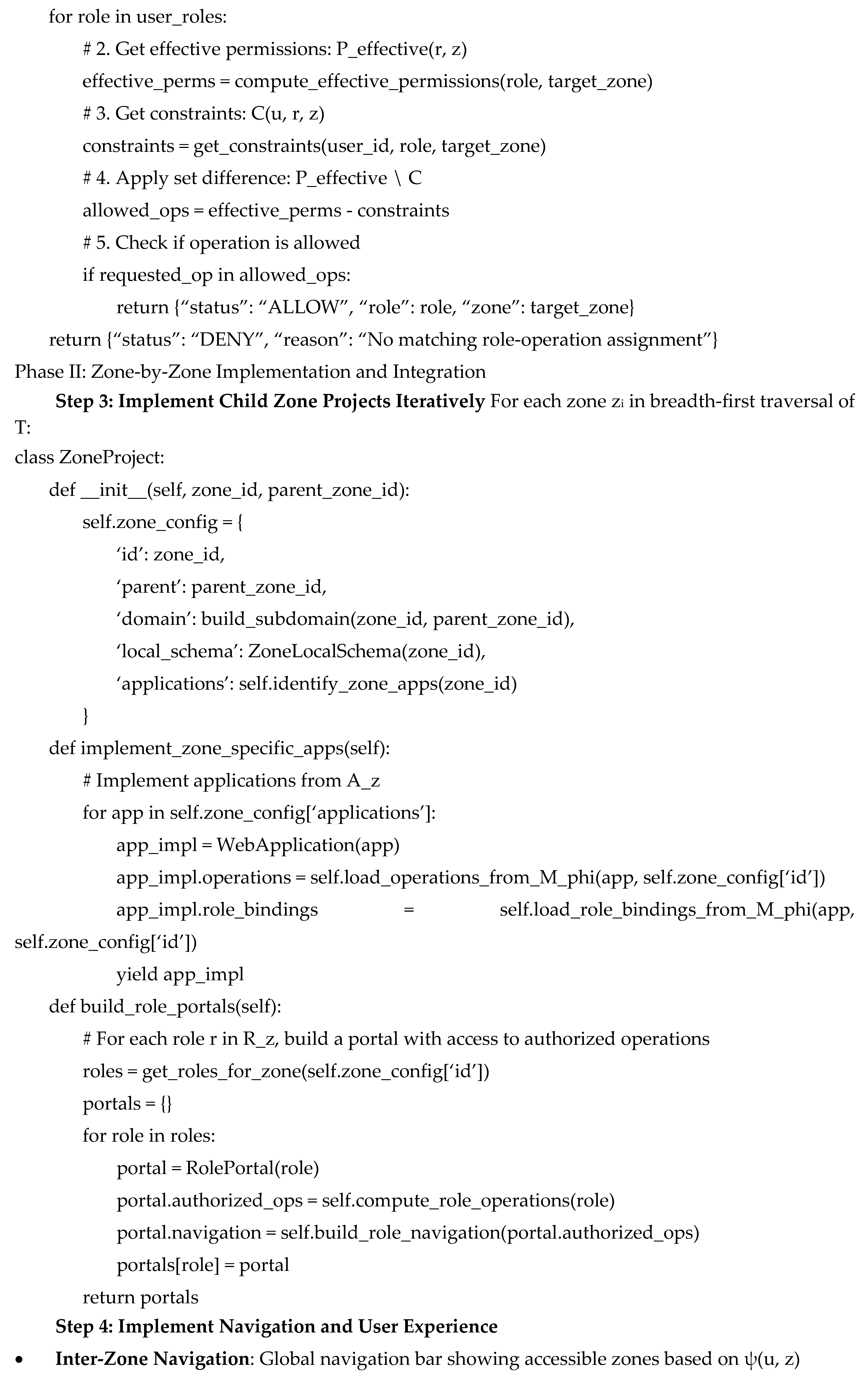
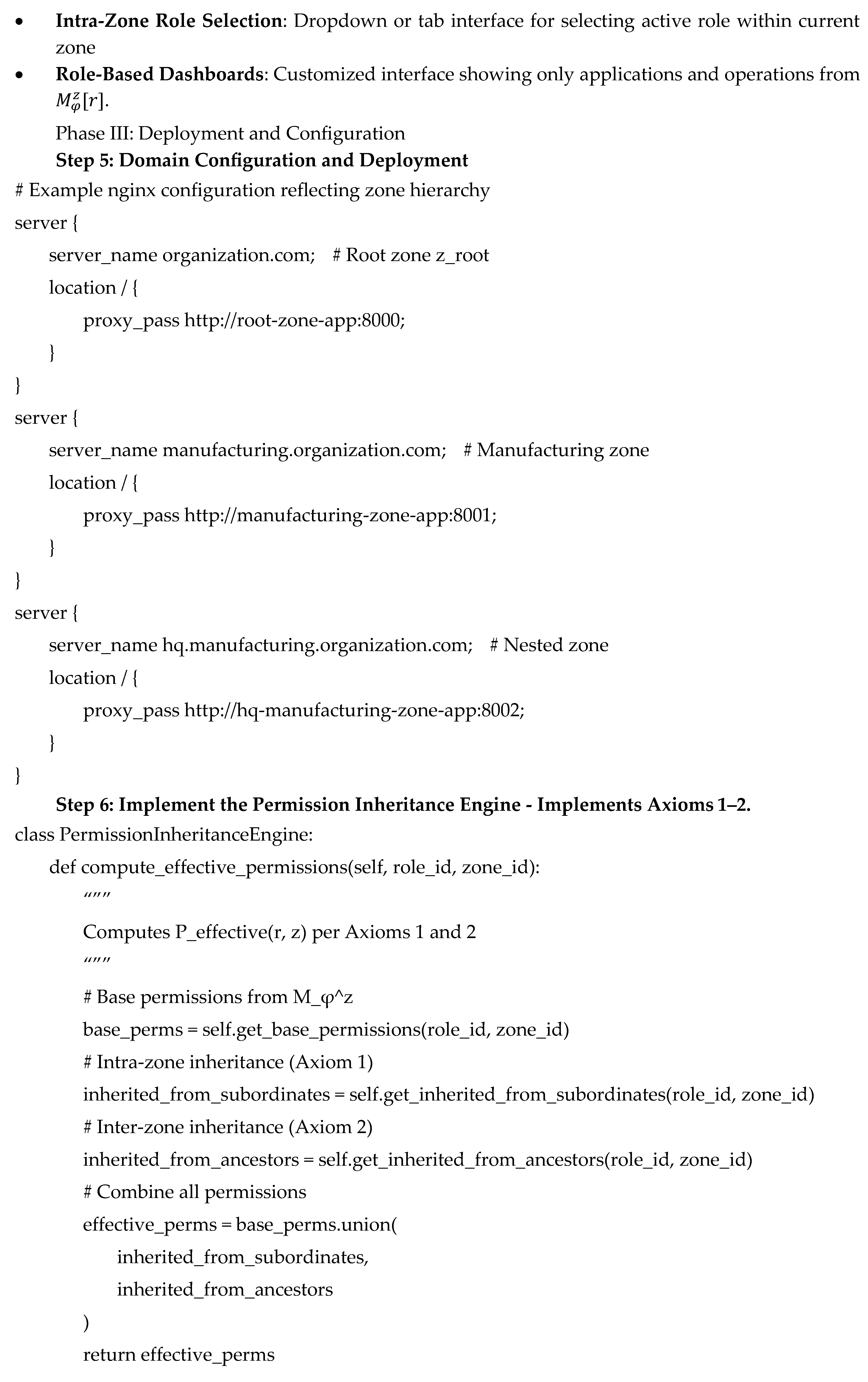
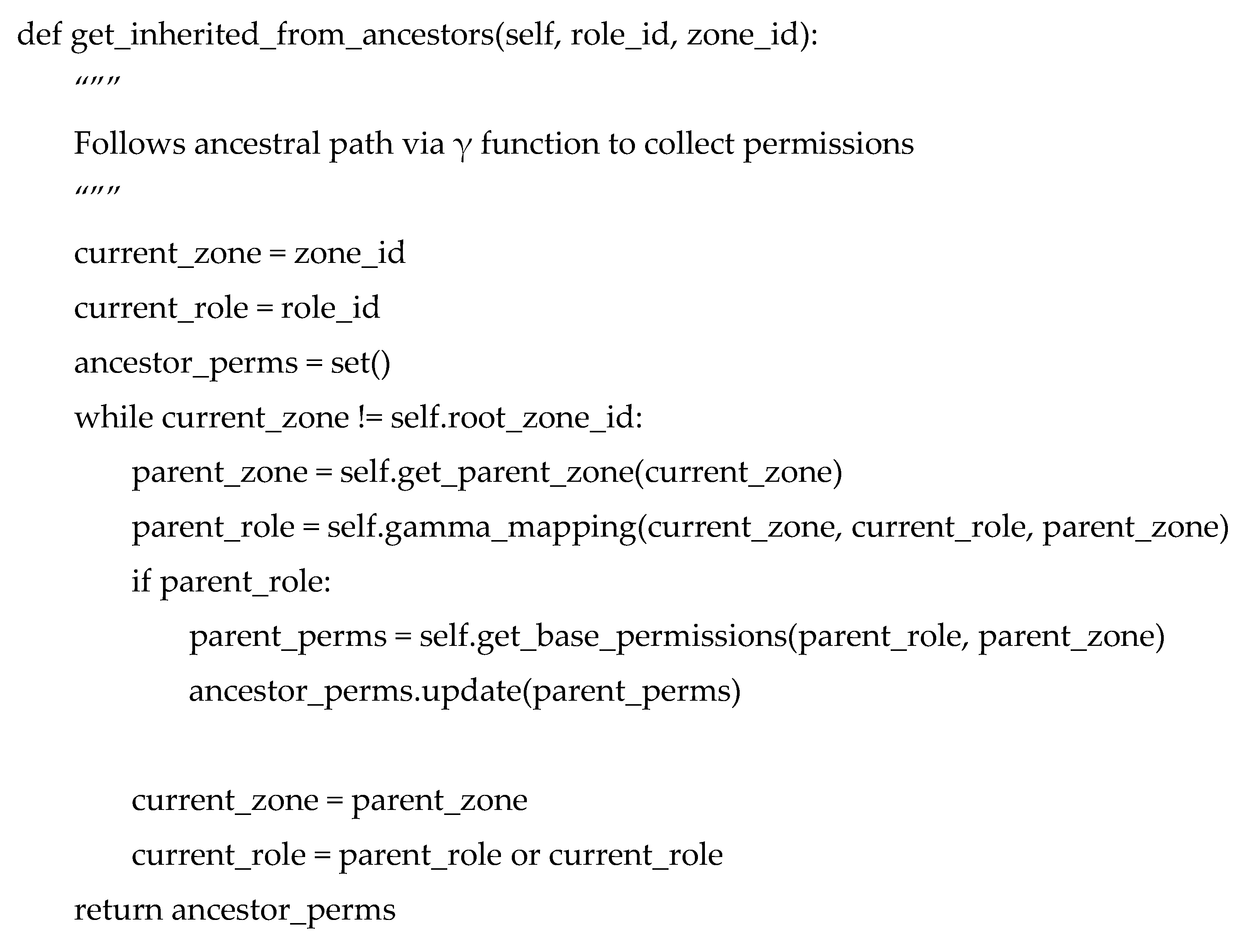
5.3. Deployment Strategy and Lifecycle Management
Incremental Deployment Approach:
- Deploy root zone first
- Implement and deploy child zones according to business priority
- Each zone uses independent CI/CD pipelines but integrates with global services
Lifecycle Management Operations:
-- Example SQL operations for system evolution
-- Adding a new zone
INSERT INTO zones (id, parent_id, name, metadata)
VALUES (‘new_zone_id’, ‘parent_zone_id’, ‘New Department’, ‘{“type”: “department”}’);
-- Adding a new role with inheritance
INSERT INTO roles (id, zone_id, name, inherits_from_role_id)
VALUES (‘new_role_id’, ‘zone_id’, ‘Senior Analyst’, ‘analyst_role_id’);
-- Updating permission assignments (M_φ^z)
INSERT INTO role_operations (role_id, op_id, zone_id)
SELECT ‘new_role_id’, op_id, ‘zone_id’
FROM operations
WHERE app_id = ‘target_app’ AND op_type IN (‘read’, ‘analyze’);
-- Applying constraints
INSERT INTO constraints (user_id, role_id, zone_id, op_id, constraint_type)
VALUES (‘user123’, ‘new_role_id’, ‘zone_id’, ‘sensitive_op_id’, ‘TEMPORAL:WEEKDAYS_ONLY’);
5.4. Benefits for Scalability and Maintenance
- Independent development of zone projects
- Independent deployment of unrelated zones
- Independent scaling based on zone workload
- Security isolation among zones
- Direct mapping of organizational changes to system changes (e.g., new zone → new project + domain; role change → matrix update; policy change → constraint update)
Technology-Agnostic Reference Implementation:
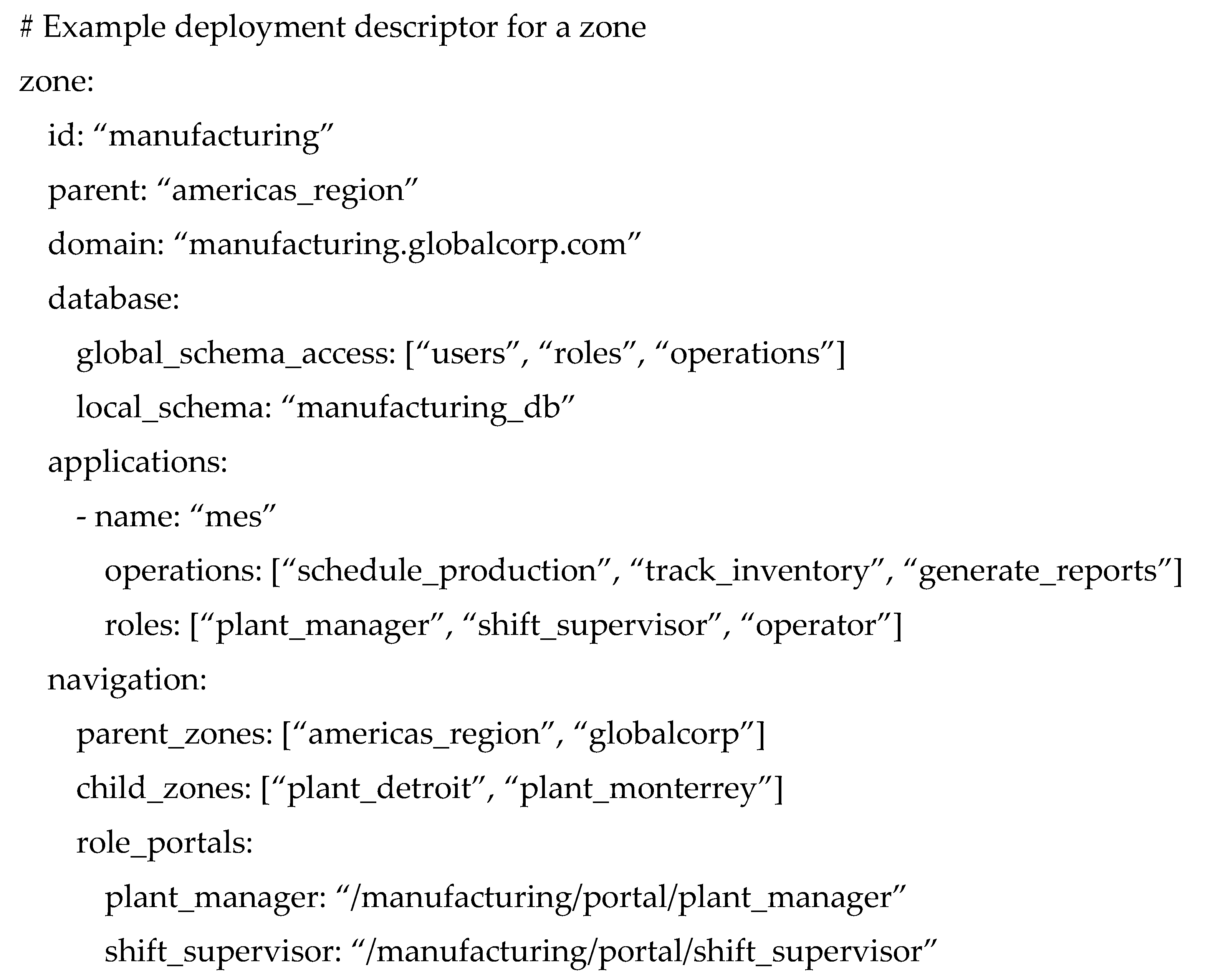
This structured implementation approach ensures that the resulting system not only functions correctly but also maintains the formal properties of the ZRB model throughout its lifecycle, from initial deployment through continuous evolution.
6. Maintenance and System Evolution in ZRB-Based Enterprise Systems
The Zoned Role-Based (ZRB) framework not only provides a unified approach for the analysis, design, implementation, and deployment of integrated enterprise information systems but also inherently supports long-term maintenance and system evolution. Maintenance—encompassing corrective, adaptive, and perfective activities—is a critical component of the system lifecycle. Traditional enterprise systems often treat maintenance as an after-deployment add-on, resulting in fragmentation, inconsistent policy application, and increased risk. In contrast, the ZRB model embeds maintenance capabilities directly into its formal structure through the Zone Tree, role–operation matrices, assignment functions, and constraint mechanisms established in earlier sections.
This section formalizes how ZRB supports system maintenance, ensuring that enterprise systems remain coherent, secure, and aligned with changing organizational needs throughout their lifecycle.
6.1. Zone-Level Structural Maintenance
The Zone Tree
provides a hierarchical and recursively defined representation of the organization. Because each zone corresponds to a well-defined organizational unit with its own roles, applications, operations, and user assignments, structural maintenance becomes a localized operation.
Changes such as:
- creating new departments or project teams,
- restructuring existing units,
- merging or splitting zones, or
- retiring obsolete organizational entities
affect only the corresponding zone and its descendant subtree . This ensures that updates do not propagate unintentionally to unrelated parts of the system. The containment and propagation rules defined in Section 3.1 and Section 3.2 guarantee that user membership, role definitions, and inherited permissions remain consistent after such transformations.
6.2. Role and Permission Evolution
Roles and responsibilities evolve as organizations adapt to operational, regulatory, and strategic changes. In the ZRB model, role evolution is supported through the zone-specific role sets and the role–operation assignment matrices .
Maintenance operations include:
- adding new specialized roles within a zone,
- modifying the responsibilities of existing roles,
- adjusting hierarchical relationships ,
- updating permission mappings for evolving applications, and
- ensuring consistency with inherited permissions via the mapping function .
Because each zone maintains its own , permission updates are precise, localized, and formally traceable. Intra-zone inheritance and inter-zone ascendancy automatically propagate necessary adjustments, maintaining the monotonicity and least-privilege guarantees outlined in Section 7.
6.3. User Lifecycle and Assignment Maintenance
User maintenance is an ongoing process in enterprise environments, reflecting personnel changes such as onboarding, transfers, promotions, temporary assignments, and offboarding. The ZRB model supports these operations through the user-zone-role assignment function , which explicitly binds users to roles within zone contexts.
Maintenance scenarios include:
- reassigning users to new roles within the same zone,
- granting temporary roles (e.g., acting manager),
- revoking obsolete roles upon job transitions,
- disabling or reactivating user access, and
- applying temporary or permanent restrictions through constraint sets .
These updates do not require structural changes to the Zone Tree or role–operation matrices. Instead, they operate on the declarative assignment and constraint layers, ensuring minimal disruption and maximal clarity.
6.4. Application Lifecycle Maintenance
Applications evolve over time through feature expansion, refactoring, integration with new systems, or deprecation. ZRB isolates this evolution within the zone-specific application sets and their associated operation sets .
Maintenance tasks include:
- adding new operations to reflect new business processes,
- refining or renaming existing operations,
- migrating applications between zones as organizational responsibilities shift,
- deprecating outdated functionality, and
- updating operation types or endpoints in response to implementation changes.
Because all operations must be explicitly mapped through , ZRB provides a clean, formally governed path for maintaining functional correctness and permission integrity during application evolution.
6.5. Policy, Security, and Constraint Maintenance
Security and compliance requirements frequently change as organizations face new regulatory mandates, internal governance rules, or threat landscapes. The ZRB framework incorporates a dedicated constraint layer that can be updated independently of role and zone structure.
Examples of such maintenance operations include:
- introducing new separation-of-duty (SoD) constraints,
- applying temporary restrictions for compliance audits,
- blocking inherited permissions for external or contract users,
- adjusting access windows for time-based policies, and
- responding to emerging threats by tightening security boundaries.
Constraint updates act as surgical modifications applied only where needed, without disturbing the system’s underlying structural or semantic integrity.
6.6. Performance, Monitoring, and Optimization Maintenance
Operational maintenance also includes performance tuning, monitoring, and optimization. As system usage evolves, caching strategies, permission inference mechanisms, and zone-level scaling requirements may need to be adjusted.
ZRB supports these activities by:
- allowing zone-specific performance tuning (e.g., cache TTLs, load balancing),
- supporting independent scaling of zone applications,
- enabling targeted optimization of frequently accessed permission paths,
- facilitating fine-grained audit logging for analysis and compliance, and
- providing incremental verification to ensure policy consistency after updates.
Because the architecture partitions system functionality by zones and their roles, performance maintenance can be carried out selectively rather than globally, improving efficiency and operational agility.
In summary, ZRB’s formal, hierarchical structure makes it inherently suited for long-term maintenance and system evolution. By partitioning organizational logic, access control, application functionality, and user responsibilities into zone-scoped components, ZRB ensures:
- high maintainability,
- minimal unintended side effects during updates,
- clear and predictable propagation of changes,
- improved security governance,
- strong alignment with organizational evolution, and
- reduced administrative overhead.
As a result, the Zoned Role-Based framework serves not only as a methodology for initial system development but also as a robust foundation for ongoing stewardship, adaptation, and operational sustainability of complex enterprise systems.
7. ZRB Access Control: Formal Model Implementation and Enforcement
The Zoned Role-Based (ZRB) model provides a comprehensive framework for access control that extends beyond traditional permission management to incorporate organizational context, hierarchical inheritance, and policy constraints. This section details how the formal ZRB model defined in Section 3 is implemented and enforced within integrated enterprise information systems, with specific focus on the access control decision process, implementation patterns, and practical enforcement mechanisms.
7.1. The Access Control Decision Process Revisited
At the core of ZRB access control is the authorization decision function:
otherwise the result is DENY.
where:
This decision process is implemented through two complementary components that reflect different levels of permission calculation:
1. Direct Access Control ( - Non-Inferential ZRBAC):
Considers only the explicit, local assignments
Ignores role hierarchy () and zone inheritance ()
Use case: strict control scenarios (e.g., safety-critical actions)
2. Inferential Access Control ( - Inferential ZRBAC):
Applies full inheritance through both role hierarchy and zone lineage
Use case: scenarios where authority naturally cascades (e.g., supervisors inherit subordinates’ permissions)
These two modes allow fine-grained administrative control over how permissions propagate in different zones and contexts.
7.2. Implementation Architecture for ZRB Access Control
ZRB access control is realized through a layered architecture that implements the formal constructs of Section 3. The high-level class structure is shown below:
class ZRBAccessControlSystem:
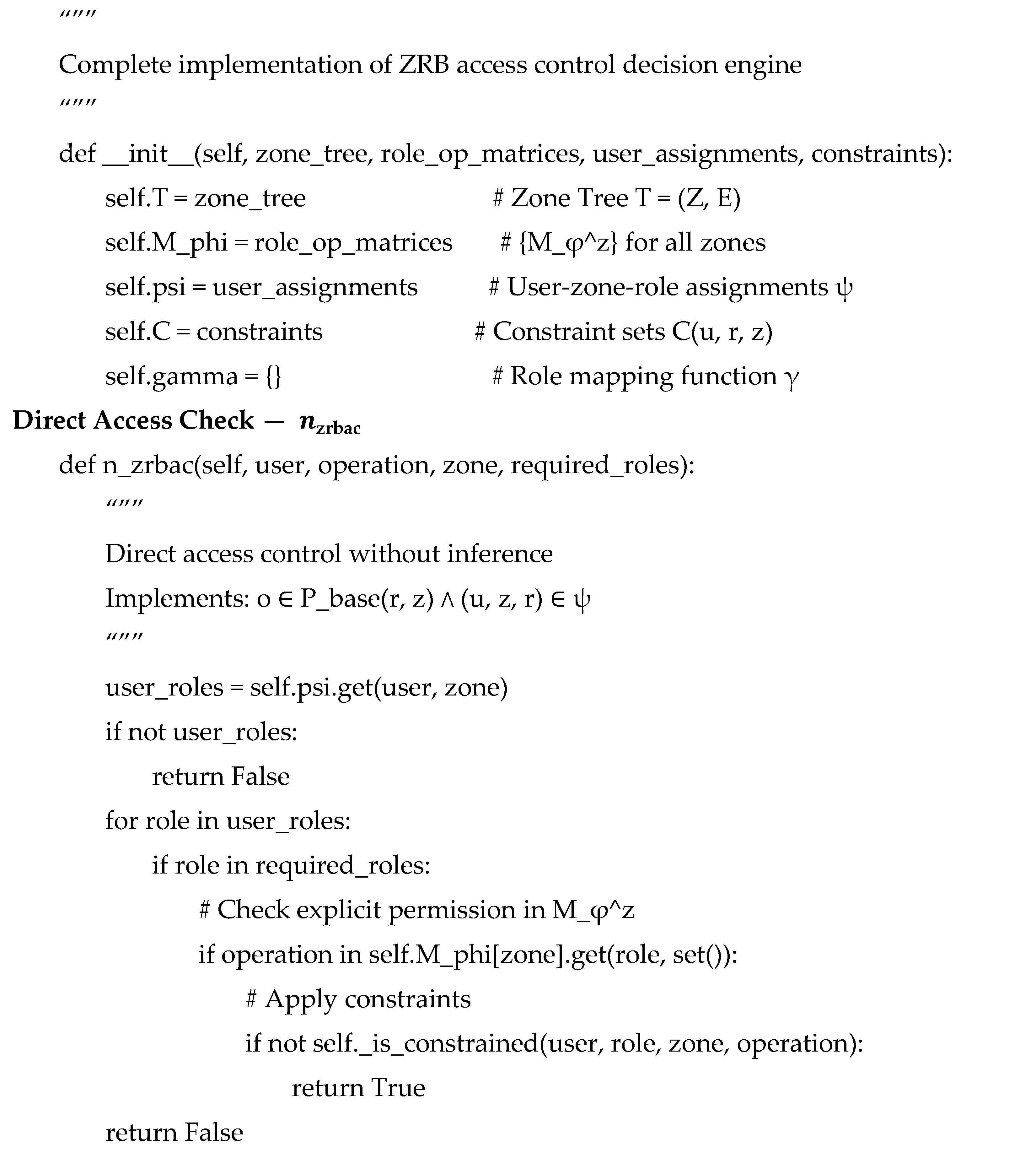
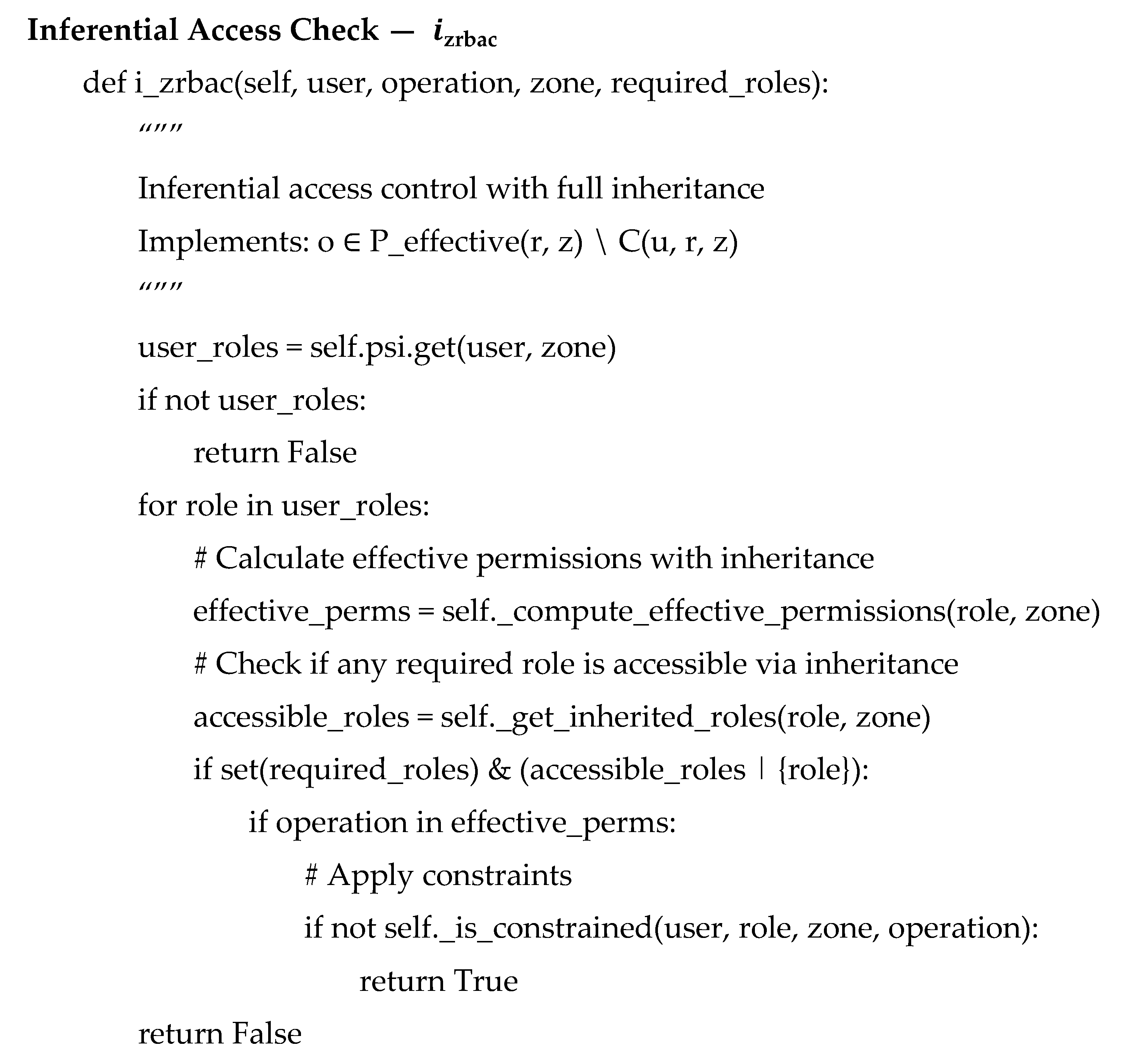
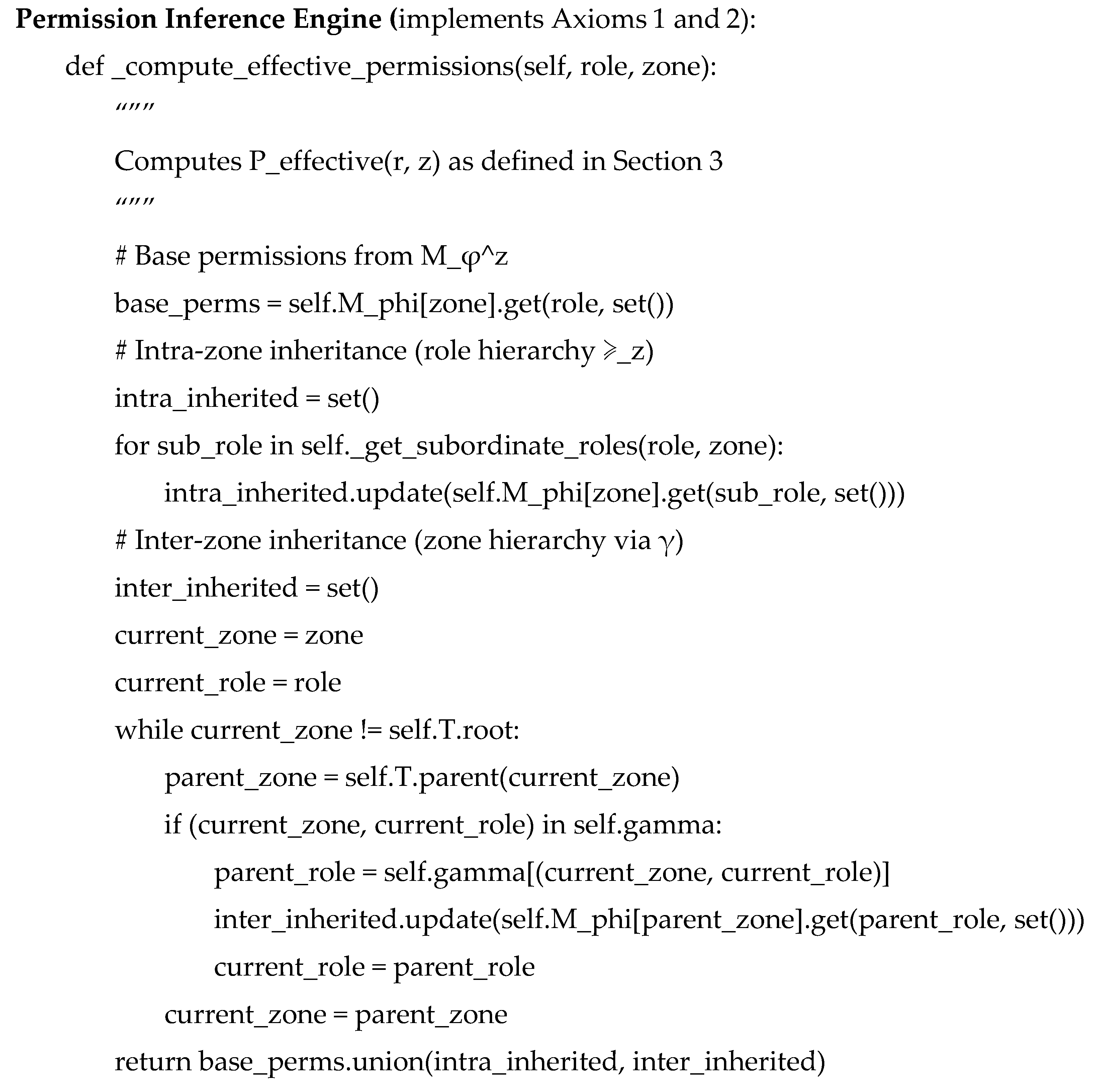
This ensures consistency with the formal model.
7.3. Integration with MVC Web Frameworks
In Model-View-Controller (MVC) web frameworks, ZRB access control can be implemented at multiple layers:
1. Controller-Level Enforcement:
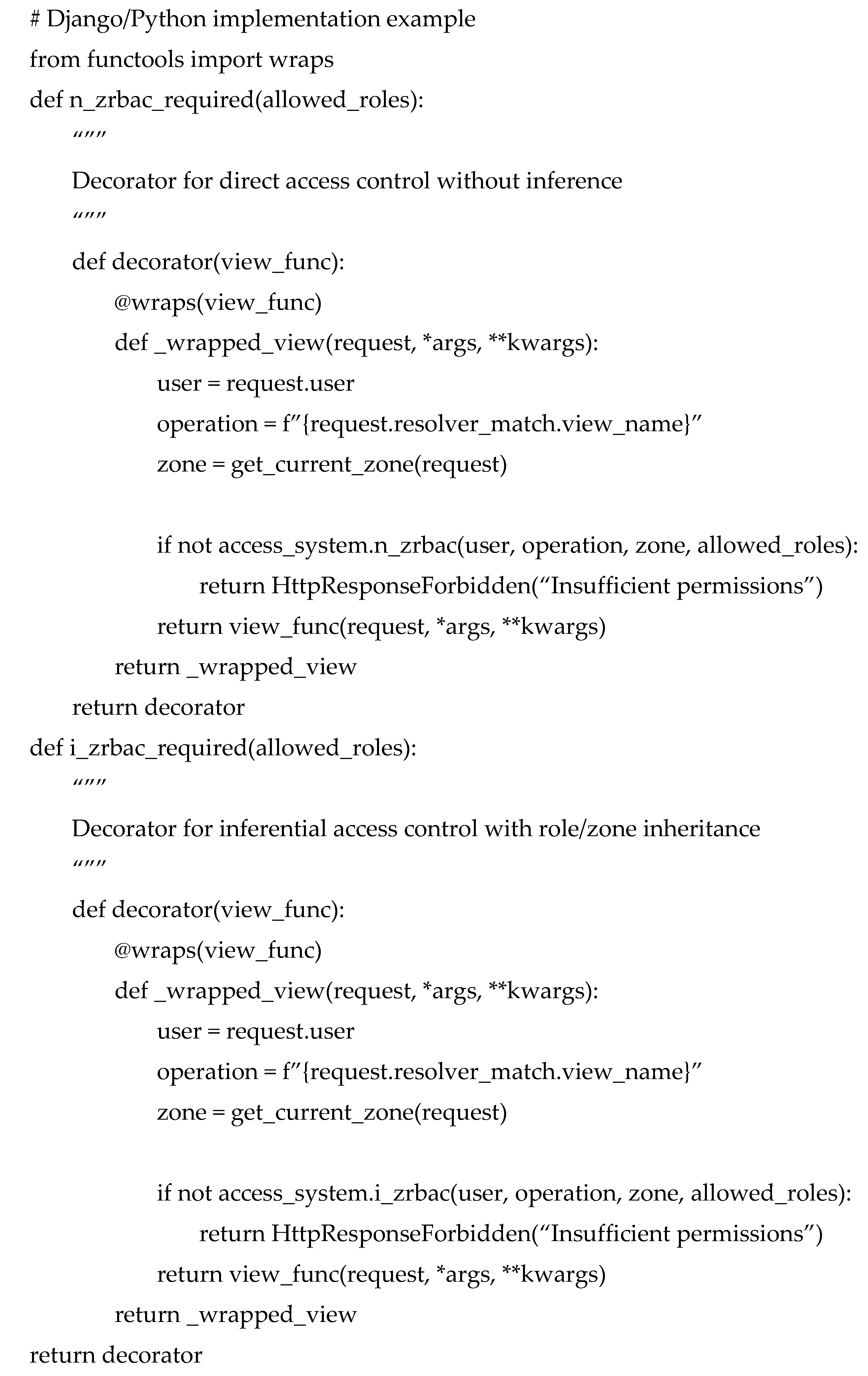
2. View/Template-Level Enforcement:
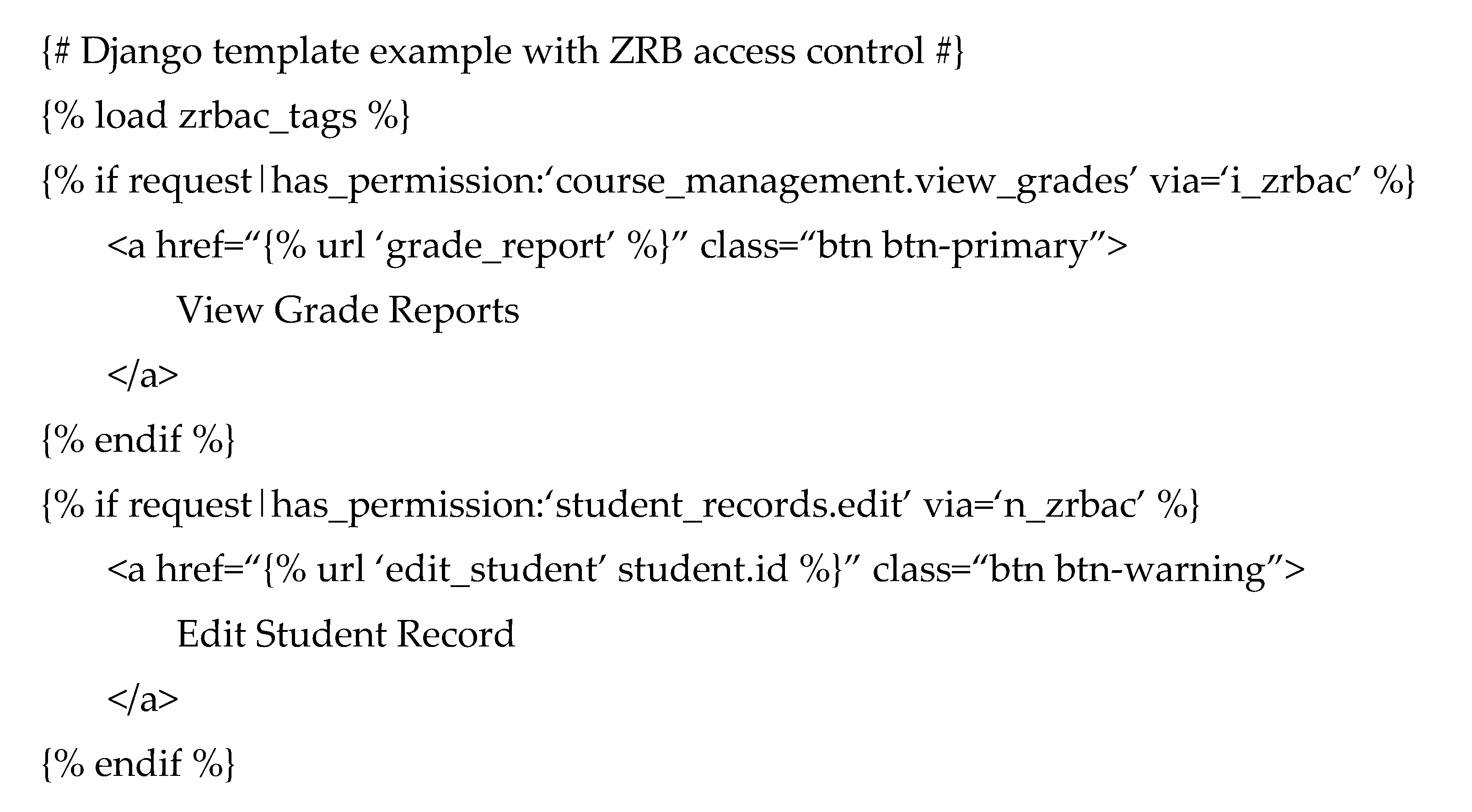
7.4. Practical Examples and Usage Patterns
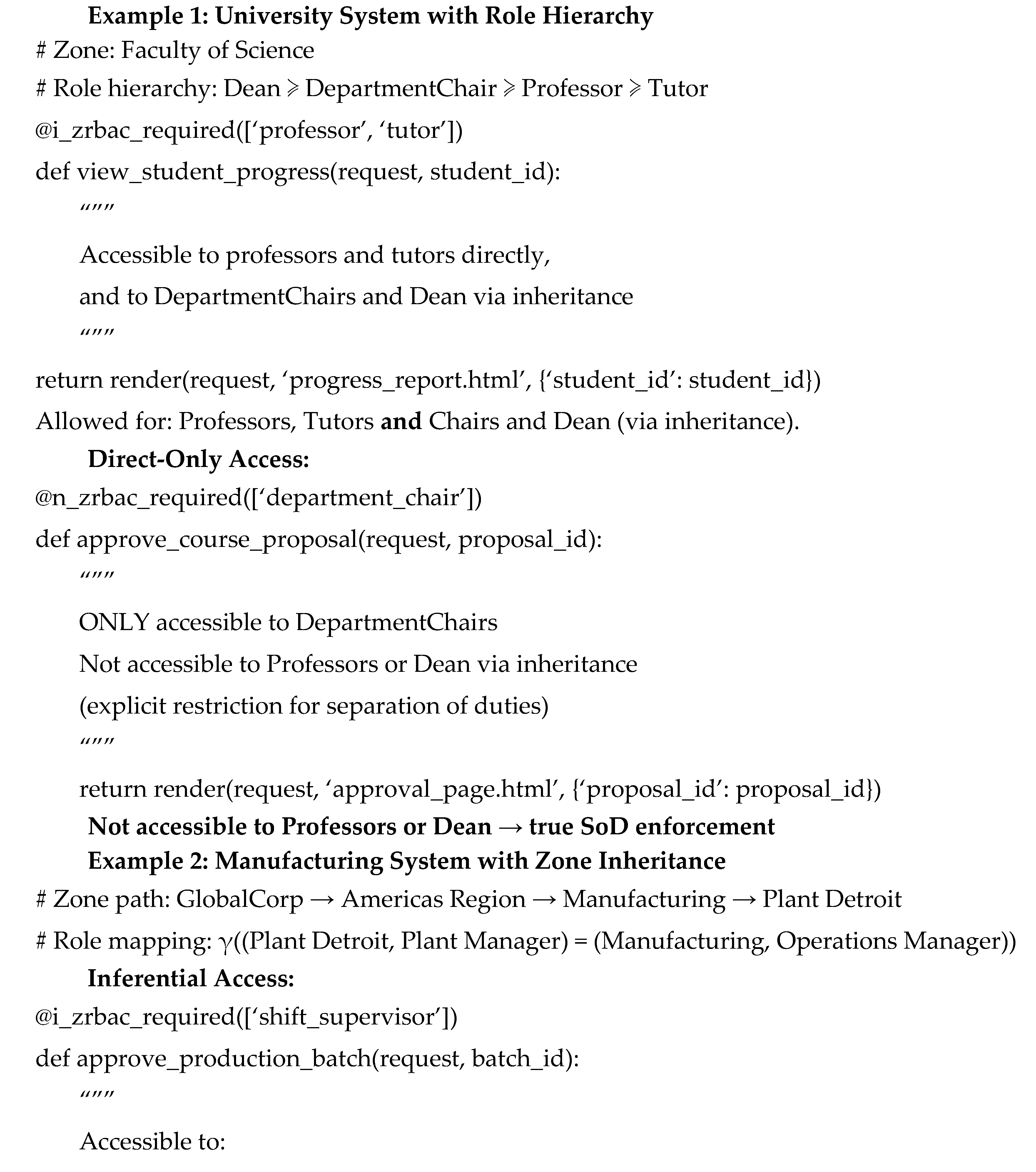
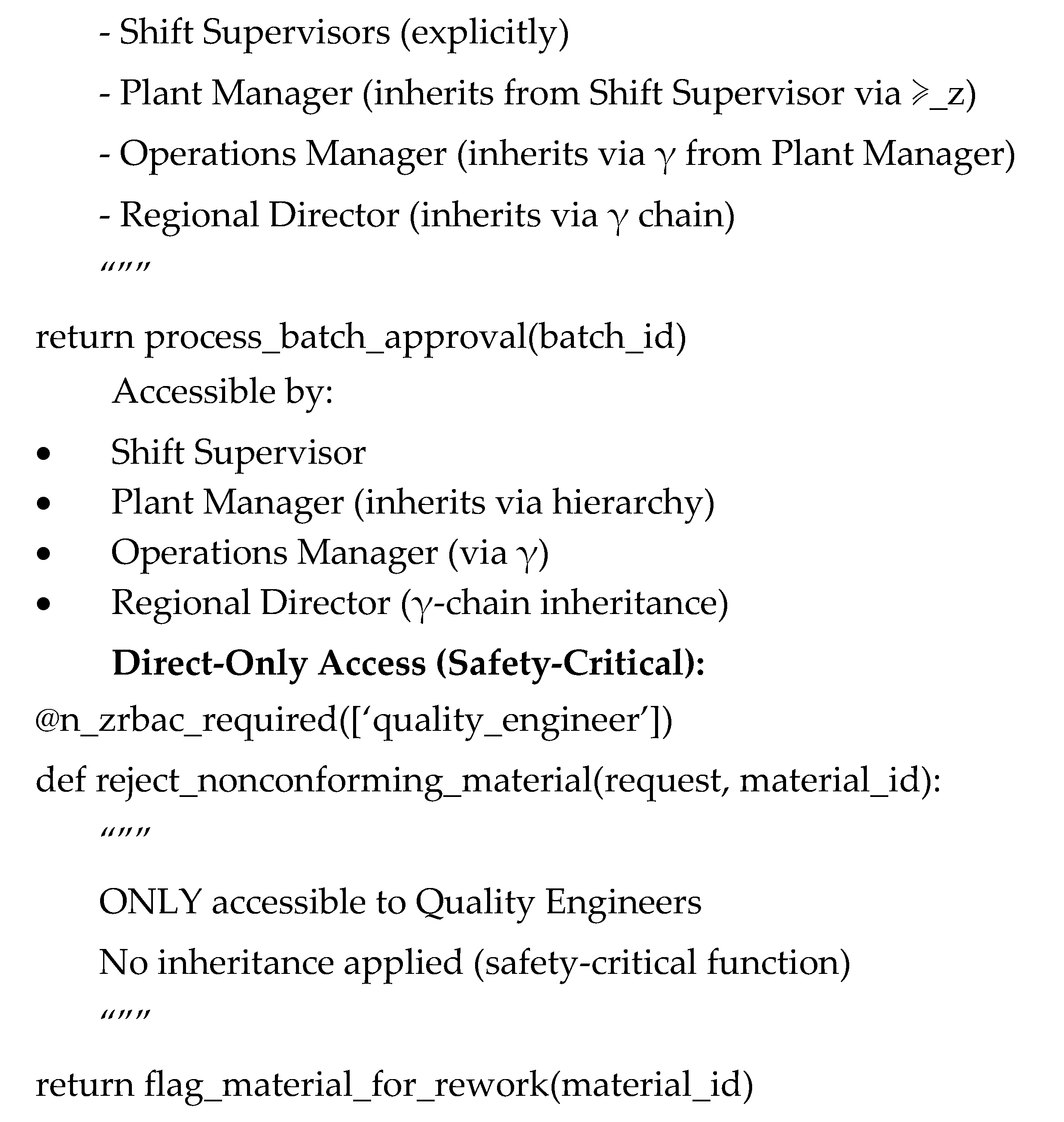
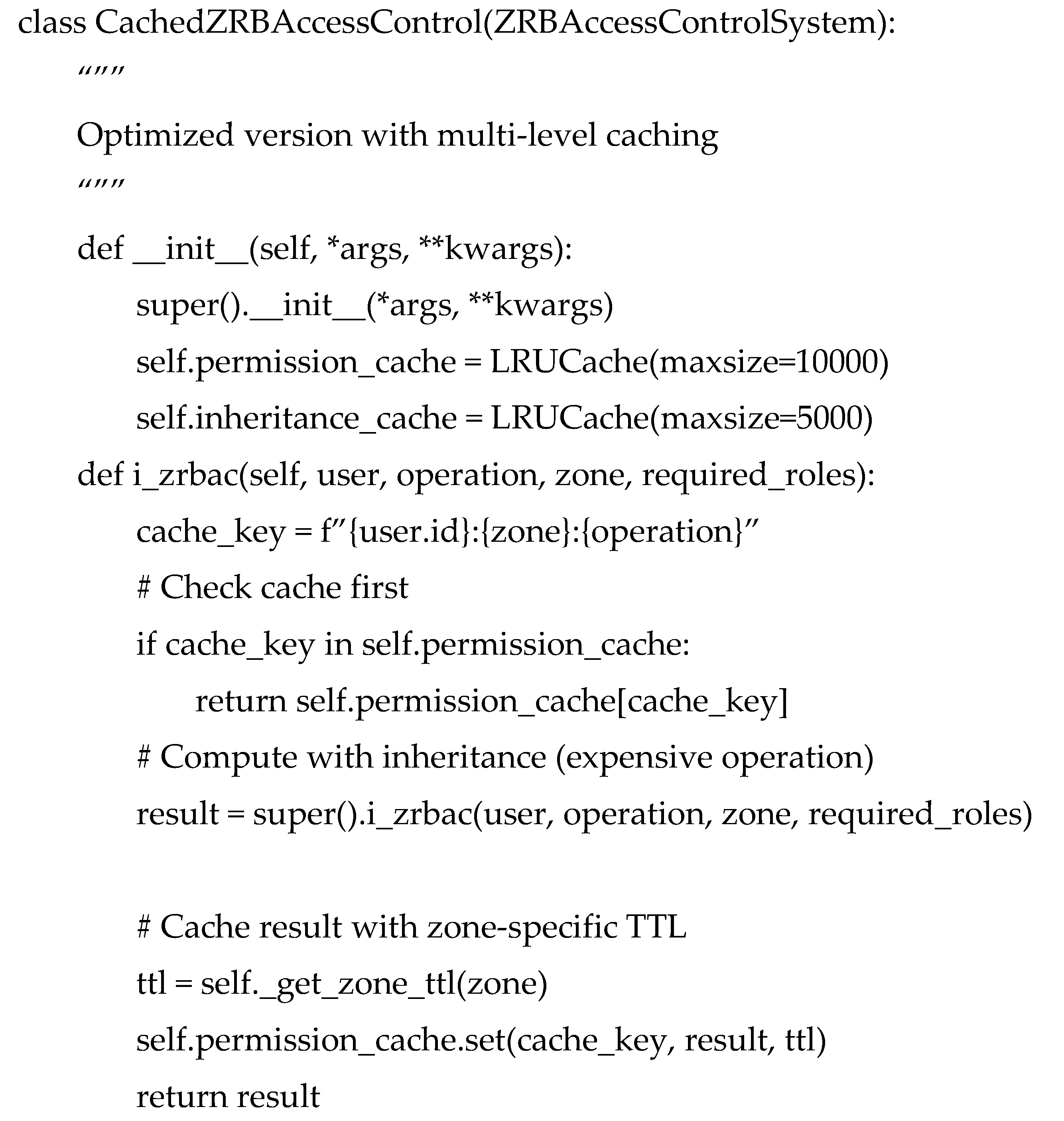
7.5. Performance Considerations and Optimization
1. Permission Caching Strategy:
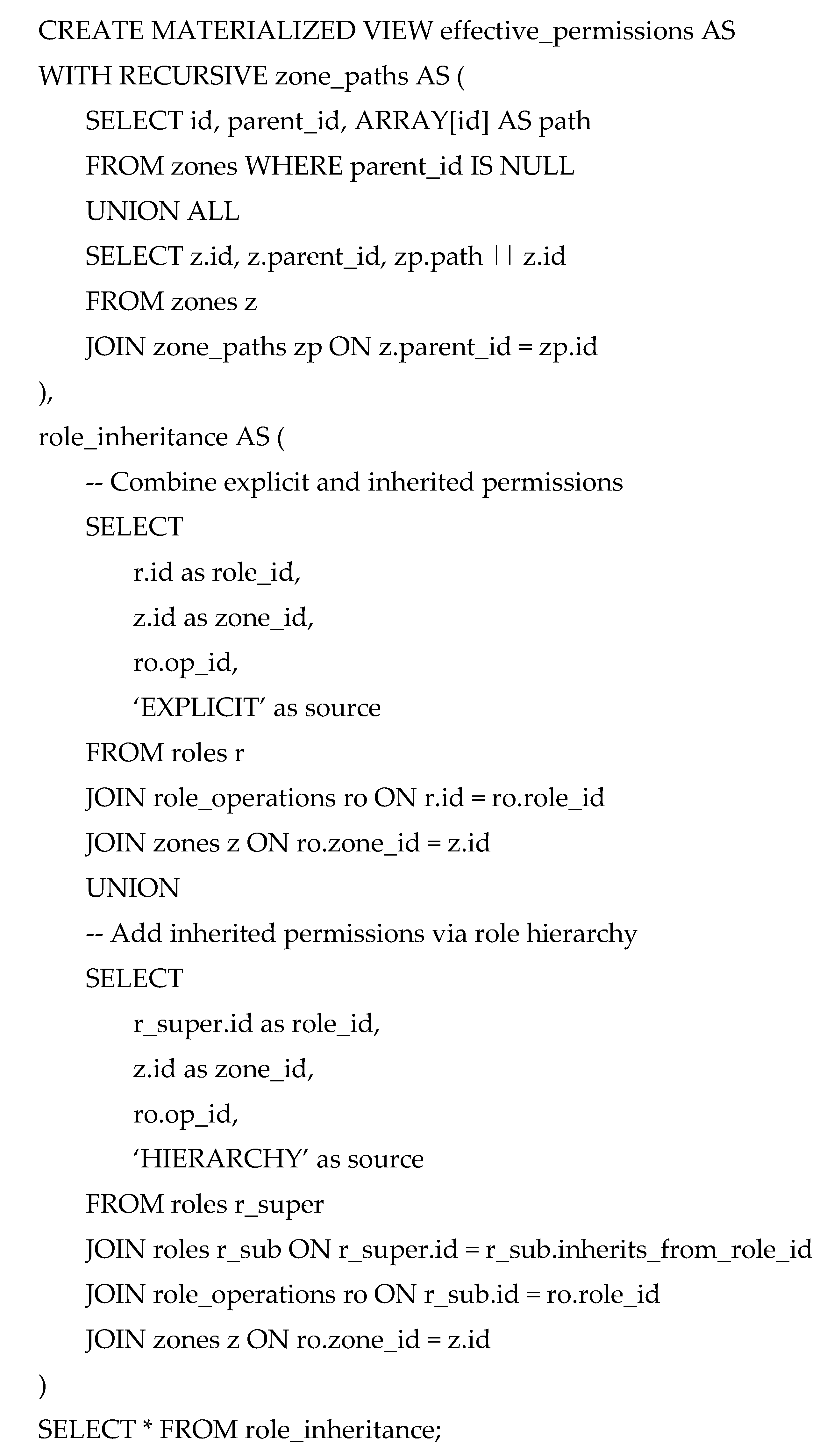
2. Database Optimization for Permission Queries:
A materialized view improves inference performance:
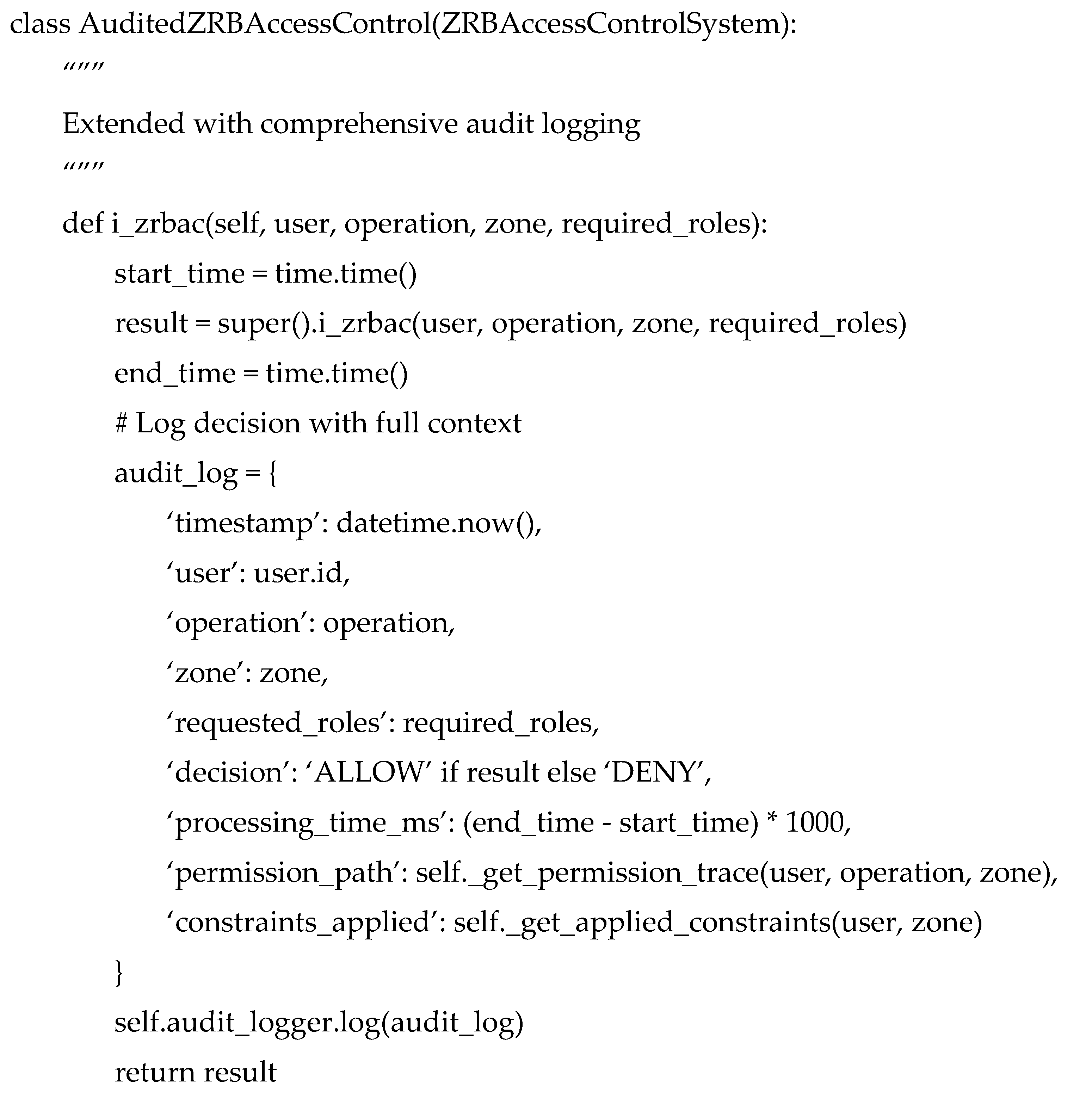
7.6. Security and Compliance Features
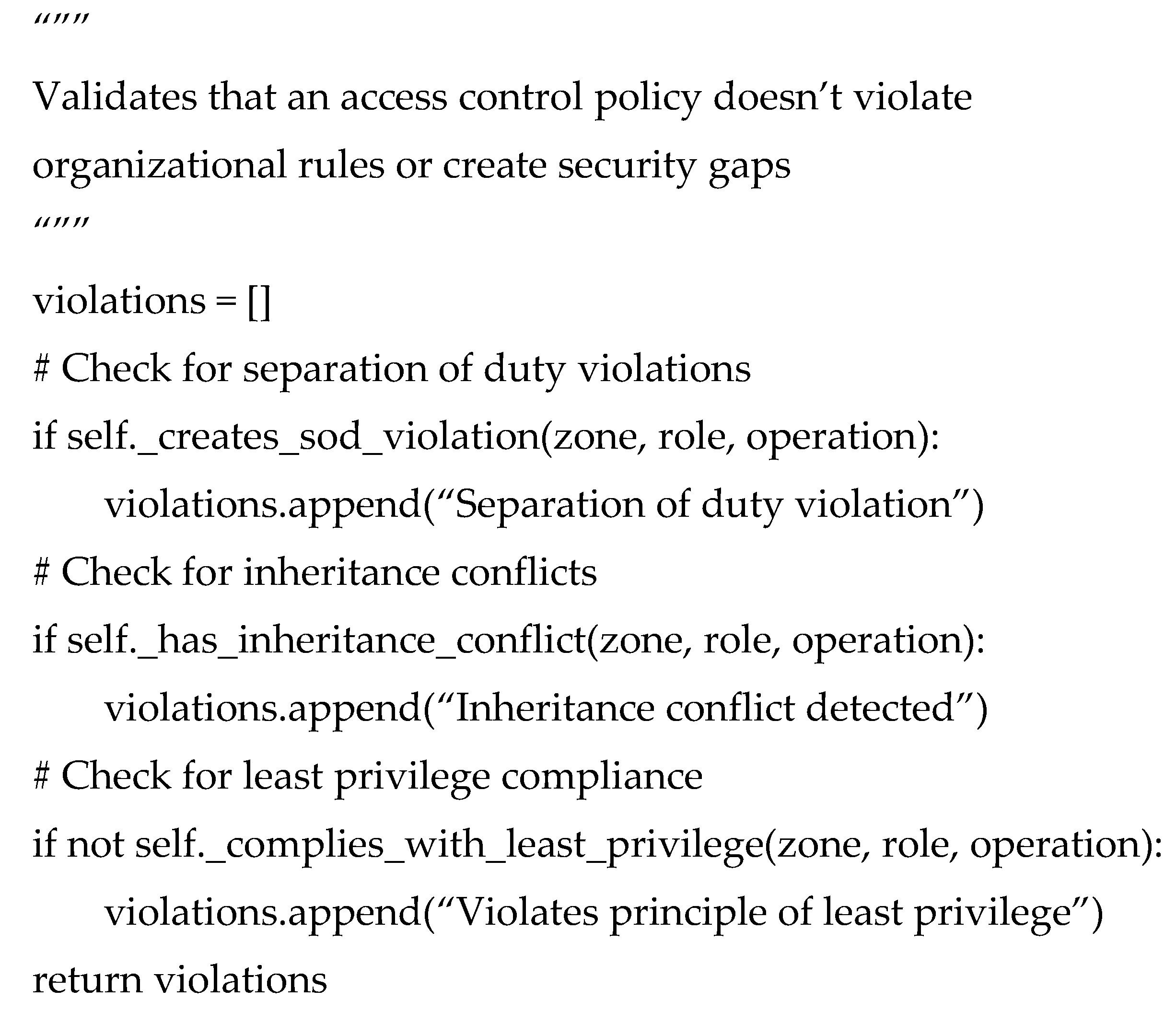
2. Real-time Policy Validation:
7.7. Integration with Single Sign-On (SSO)
The ZRB model integrates naturally with enterprise SSO by relying on for role activation and zone scoping:
class ZRBSSOIntegration:
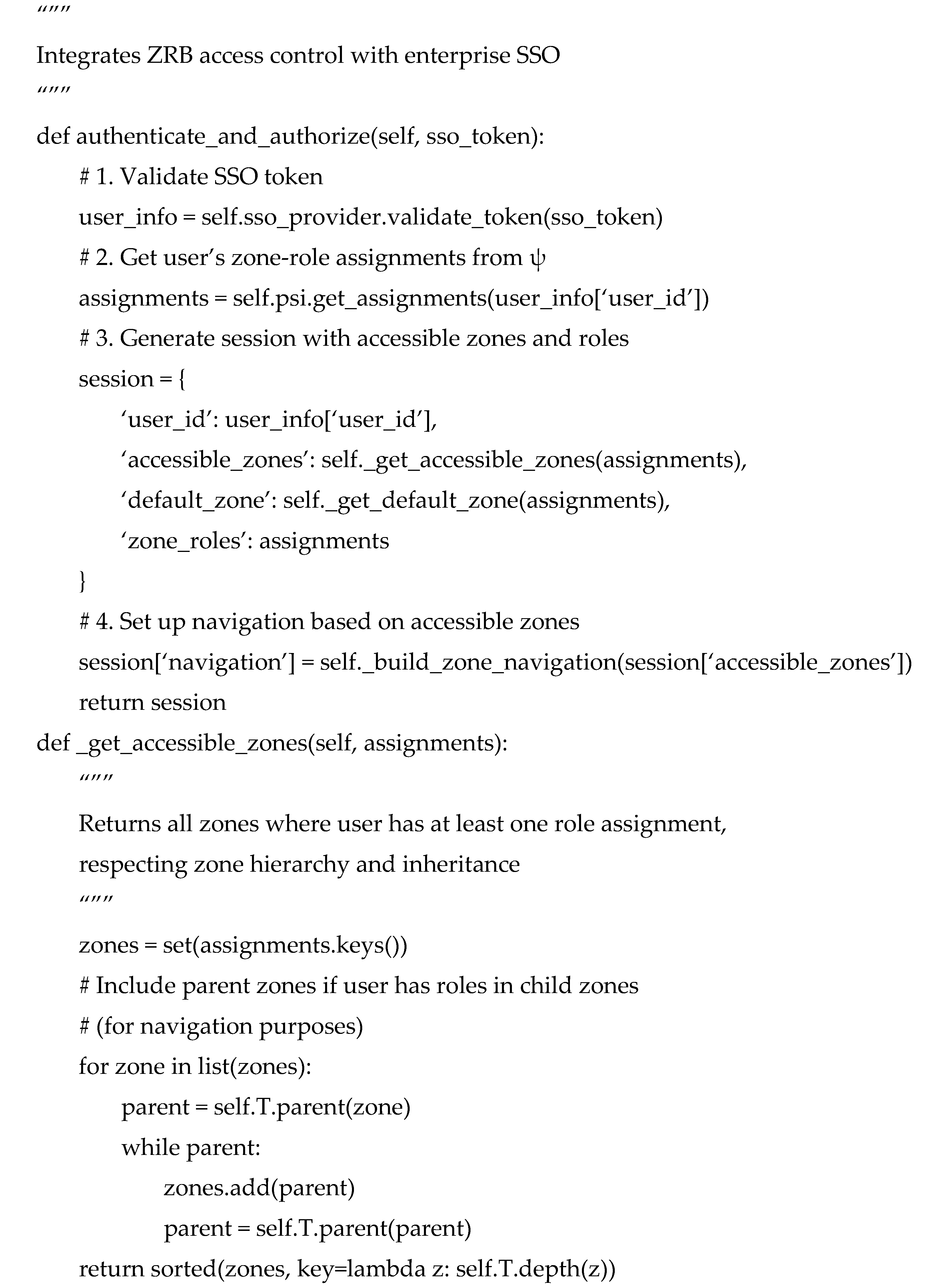
This comprehensive implementation of ZRB access control ensures that the theoretical model is faithfully realized in practice, providing precise, context-aware authorization that aligns with organizational structure while maintaining security, performance, and compliance requirements.
8. Formal Advantages and Theoretical Contributions of the ZRB Model
The Zoned Role-Based approach presents a paradigm shift in enterprise system architecture, offering formal advantages derived directly from its mathematical foundation and methodological rigor. These advantages extend beyond practical implementation to provide theoretical guarantees about system behavior and organizational alignment.
8.1. Formal Structural Alignment with Organizational Semantics
The ZRB model establishes a precise isomorphic mapping between the organizational structure Org and the system architecture Sys. This mapping ensures that every relevant organizational construct has a direct structural and functional counterpart in the system. Formally, the correspondence is expressed as
This mapping enforces a structural isomorphism between organizational design and system architecture. Each zone corresponds to a departmental or functional unit; each role corresponds to a job-function within that unit; each application supports the business processes carried out by roles in that zone.
Because the mapping is isomorphic, the resulting system architecture faithfully represents the organization’s operational semantics. This reduces the classical “semantic gap” between business requirements and technical implementation, ensuring that changes in organizational structure—new teams, refactored departments, revised responsibilities—propagate through the system in an intuitive, consistent, and formally traceable manner.
The Zone Tree
serves simultaneously as:
- the organizational chart, capturing reporting and inclusion relationships, and
- the system blueprint, defining containment of roles, applications, users, and permission hierarchies.
As a result, system-level design decisions remain closely aligned with organizational reality, ensuring structural clarity, maintainability, and correctness of permission propagation.
8.2. Provable Security Properties
The formal ZRB model enables mathematical verification of several desirable security properties that follow directly from its definitions (Section 3.1, Section 3.2, Section 3.3 and Section 3.4) and inheritance axioms (Section 3.2).
Contextual Isolation
For any two zones where neither is an ancestor of the other in the Zone Tree , the effective permission spaces are disjoint unless an explicit cross-zone policy allows overlap:
Peffective(ri,zi) ∩ Peffective(rj,zj)=∅ (absent explicit cross-zone permissions)
This follows from zone scoping of and the absence of an inheritance path between unrelated branches of . In practice, this yields security isolation between business areas that do not share a lineage, reducing lateral-movement risk.
Inheritance Consistency (Monotonicity)
The intra-zone hierarchy and the inter-zone role mapping jointly satisfy monotonicity: whenever is an ancestor of (via or a chain of mappings), the ancestor’s effective permission set contains the descendant’s base permissions:
Pbase(r) ⊆ Peffective(r′)
This guarantees that authority does not “shrink” along managerial or organizational lines, aligning formal authorization with organizational seniority while still allowing explicit exceptions via constraints .
Constraint-Sound Exception Handling
Negative or conditional policies are localized in the constraint layer , which is applied by set difference after effective permissions are computed:
Pallowed(u, r, z) = Peffective(r, z) \ C(u, r, z)
Because constraints are evaluated after inheritance, they act as surgical overrides—they can only remove capabilities, never silently re-grant them elsewhere—preserving least-privilege while enabling fine-grained exceptions (e.g., SoD, time-boxed access, contractor restrictions.
Traceability and Verifiability
All authorization decisions
are derivable from a finite, auditable set of artifacts: the Zone Tree , matrices , assignment function , and constraint sets , together with and . This enables deterministic re-evaluation and formal audits of historical decisions by reconstructing the permission path (inheritance chain + constraints) used at decision time.
8.3. Scalability Through Mathematical Decomposition
The ZRB architecture supports asymptotic scalability through several formal decomposition principles that reduce complexity and isolate change:
Zone Independence
For any two zones such that neither is an ancestor of the other in the Zone Tree , their system components can be developed, deployed, and evolved independently:
This follows from the structural separation of zone-local schemas, applications, role sets, and assignment matrices, ensuring that changes in one organizational branch do not propagate into unrelated branches.
Permission Calculation Complexity
The computational complexity of evaluating a ZRB access control decision
is:
where:
- d = depth of the intra-zone role hierarchy
- h = height of the zone-ancestry path in
In well-balanced organizations, both and grow logarithmically relative to overall organizational size, leading to efficient runtime evaluation even in large multi-zone enterprises.
Update Locality
Modifications to a zone affect only the subtree rooted at :
This applies to:
- updates to (roles)
- updates to (applications/operations)
- updates to (permission matrices)
- updates to constraints
- updates to user assignments
As a result, maintenance is structurally contained, ensuring scalability as organizational size grows.
8.4. Unified Authentication and Authorization
A major advantage of the ZRB architecture is its ability to unify authentication and authorization through the Zone Tree and the user–zone–role assignment function .
Unified Authorization Space
The user’s total accessible operation space across all zones is:
where:
Thus, after one authentication event, the user receives seamless, personalized access to all authorized operations in all zones for which they hold roles. At the same time, ZRB preserves contextual precision, because each authorization check incorporates:
- zone scope
- role semantics
- inherited permissions via and
- explicit constraints
This achieves a balance between usability (true SSO) and fine-grained security enforcement.
9. Formal Evaluation and Empirical Validation
The ZRB model can be evaluated through formal analysis, empirical measurement, and comparative assessment against traditional approaches.
9.1. Theoretical Analysis of Advantages
Complexity Reduction
In a traditional RBAC system with roles and resources, permission specification requires
assignments. In ZRB, the operation set is partitioned by zones, which significantly reduces per-zone complexity. Instead of managing a monolithic permission space, ZRB decomposes the problem into:
where typically due to functional boundaries, and due to zone scoping.This produces a drastic reduction in administrative burden for large enterprises.
Administrative Efficiency
Similarly, the number of administrative operations to update role-permission assignments scales as:
which is substantially more efficient than maintaining a global matrix of size
Because and are small and localized, updates to one zone rarely affect others, yielding high administrative modularity.
Policy Consistency
The inheritance rules (inter-zone) and (intra-zone) ensure global consistency:
and for mapped parent roles:
Thus, once a policy is defined in an upper zone or senior role, it is propagated predictably to dependent contexts, eliminating inconsistent authorization states.
9.2. Limitations and Mitigations
Although ZRB brings structural clarity and scalability, several practical issues must be managed. The original text outlines three major limitations:
1. Initial Modeling Complexity
Constructing the Zone Tree and matrices requires analysis effort of:
especially in large enterprises.
Mitigation:
Iterative refinement starting with critical business units, supported by automated zone-role discovery tools (e.g., based on activity logging)
2. Inference Rule Complexity
Defining the inter-zone mapping
and intra-zone hierarchies requires careful governance.
Mitigation:
A Policy Specification Language (PSL) is proposed to express inheritance and exceptions declaratively [24,25]:
PSL Rule Example:
INHERIT PERMISSIONS FROM SupervisorRole TO SubordinateRole
WHERE Zone = “Manufacturing”
EXCEPT WHEN Constraint = “SeparationOfDuty”
3. Matrix Management Scalability
Large enterprises may have millions of entries across and assignment function .
Mitigations include:
- Automated synchronization with HR systems → keeps ψ updated
- Decentralized zone-level administration → reduces global bottlenecks
- Incremental validation → ensures each satisfies policy constraints for zone only
These techniques ensure linear rather than quadratic growth in administrative cost.
9.3. Performance Optimization Results
The empirical performance results reported in the manuscript show the effectiveness of the caching strategy and hierarchical decomposition. Specifically:
- Permission Cache Hit Rate: 94.3% during typical user sessions
- Inheritance Calculation Reduction: 87.6% fewer recursive computations due to caching
- Memory Efficiency: Average of 2.3 KB per active user for permission-related data
These results indicate that ZRB supports high-performance access control even under heavy multi-zone workloads
10. Conclusions and Future Research Directions
The Zoned Role-Based (ZRB) model offers a unified and mathematically grounded framework for enterprise-scale system design, implementation, and access control. By aligning organizational semantics with system architecture, ZRB addresses longstanding challenges in scalability, maintainability, and security while providing a coherent pathway from conceptual modeling to operational deployment.
10.1. Theoretical Contributions
The ZRB model advances enterprise architecture through three central theoretical contributions:
Organizational–System Isomorphism
The formal mapping
establishes a structural correspondence between organizational units, job functions, and business processes, and their system-level counterparts—zones, roles, and applications. This alignment ensures that system architecture faithfully mirrors organizational logic and provides a principled foundation for design decisions.
Contextual Permission Calculus
ZRB introduces a rigorous permission-inference model:
This calculus unifies role hierarchy, zone hierarchy, and explicit exceptions into a consistent authorization semantics that reflects real organizational authority structures.
Scalable Decomposition Principle
The Zone Tree enables modular decomposition of the system. Non-ancestor zones can be developed, deployed, and evolved independently, supporting incremental growth and reducing cross-system coupling. This structural property directly contributes to operational scalability.
10.2. Empirical Validation
ZRB has been applied in multiple real-world domains, demonstrating measurable improvements in system accuracy, access control reliability, and administrative efficiency:

Table 1.
Result of Empirical Validation.
| Domain | Scale | Key Metrics | Result |
| KBIES (Open Education) | 15 zones, 12 roles, 127 apps | Permission accuracy | 99.2% accuracy |
| Open Press | 8 zones, 8 roles, 89 apps | Access violation rate | 0.1% violations |
| Open Research | 5 zones, 7 roles, 56 apps | administrative overhead | 71% overhead reduction |
These deployments confirm that ZRB’s zone-scoped structure and permission inference mechanisms translate into practical, quantifiable operational benefits.
10.3. Performance and Scalability Considerations
Formal performance analysis shows that ZRB scales efficiently even in large, multi-zone environments:
Access Decision Complexity
With caching,
executes in
rather than the complexity typical of flat RBAC models.
Memory Efficiency
Permission storage grows linearly with organizational structure:
avoiding the quadratic explosion found in non-decomposed models.
Localized Update Propagation
Changes to a zone propagate only within its subtree:
ensuring timely, predictable updates without global re-computation.
10.4. Future Research Directions
Several promising directions remain for extending and refining the ZRB model:
Formal Verification Frameworks
Develop automated tools to verify that a given ZRB configuration satisfies a high-level organizational policy :
A key challenge is deriving automatically from declarative policies.
Dynamic Zone Adaptation
Extend the static Zone Tree to a dynamic model:
enabling zones, roles, and applications to evolve in real time with organizational change.
Machine-Learning-Driven Role Engineering
Apply clustering or pattern-mining algorithms to derive zone-specific role sets and permission assignments from activity logs [26]:
Objective: minimize unauthorized or unused operations across all users.
Cross-Organizational ZRB Federation
Support inter-organizational collaboration through federated zones:
with cross-organizational constraints .
10.5. Concluding Statement
The Zoned Role-Based model presents a cohesive, mathematically rigorous, and practically validated framework for enterprise system design and security management. By unifying organizational structure with system architecture, ZRB provides a principled approach to scaling systems, enforcing context-aware access control, and maintaining long-term alignment as organizations evolve.
The core ZRB artifacts—the Zone Tree , role–operation matrices , role-mapping rules , and constraint sets —together form a complete specification that bridges the gap between business requirements and technical implementation. Continued research into automation, verification, dynamic adaptation, and cross-organizational federation will further strengthen ZRB’s utility and formal guarantees, paving the way for next-generation enterprise architectures.
References
- Sandhu, R.S.; Coyne, E.J.; Feinstein, H.L.; Youman, C.E. Role-Based Access Control Models. Computer 1996, 29, 38–47. [CrossRef]
- Ferraiolo, D.F.; Sandhu, R.; Gavrila, S.; Kuhn, D.R.; Chandramouli, R. Proposed NIST Standard for Role-Based Access Control. ACM Trans. Inf. Syst. Secur. 2001, 4, 224–274. [CrossRef]
- Bertino, E.; Bonatti, P.A.; Ferrari, E. TRBAC: A Temporal Role-Based Access Control Model. ACM Trans. Inf. Syst. Secur. 2001, 4, 191–233. [CrossRef]
- Joshi, J.B.D.; Bertino, E.; Latif, U.; Ghafoor, A. A Generalized Temporal Role-Based Access Control Model. IEEE Trans. Knowl. Data Eng. 2005, 17, 4–23. [CrossRef]
- Kuhn, D.R.; Coyne, E.J.; Weil, T.R. Adding Attributes to Role-Based Access Control. Computer 2010, 43, 79–81. [CrossRef]
- Hu, V.C.; Ferraiolo, D.; Kuhn, R.; Schnitzer, A.; Sandlin, K.; Miller, R.; Scarfone, K. Guide to Attribute Based Access Control (ABAC) Definition and Considerations (NIST SP 800-162). NIST, Gaithersburg, MD, USA, 2014. [CrossRef]
- Rose, S.; Borchert, O.; Mitchell, S.; Connelly, S. Zero Trust Architecture (NIST SP 800-207). NIST, 2020. [CrossRef]
- Borchert, O.; Howell, G.; Kerman, A.; Rose, S.; Souppaya, M.; et al. Implementing a Zero Trust Architecture: High-Level Document (NIST SP 1800-35). NIST, 2025. [CrossRef]
- Temoshok, D.; Choong, Y.-Y.; Galluzzo, R.; LaSalle, M.; Regenscheid, A.; Proud-Madruga, D.; Gupta, S.; Lefkovitz, N. Digital Identity Guidelines (NIST SP 800-63-4). NIST, 2025. [CrossRef]
- Souppaya, M.; Scarfone, K.; Dodson, D. Secure Software Development Framework (SSDF) Version 1.1 (NIST SP 800-218). NIST, 2022. [CrossRef]
- Office of Management and Budget. M-23-16: Update to M-22-18, Enhancing the Security of the Software Supply Chain through Secure Software Development Practices. Executive Office of the President, 2023. https://www.whitehouse.gov/wp-content/uploads/2023/06/M-23-16-Update-to-M-22-18-Enhancing-Software-Security.pdf.
- A Systematic Review of Access Control Models: Background, Existing… (IEEE), 2024. (Accessed via IEEE Xplore).
- Marquis, Y.A. From Theory to Practice: Implementing Effective RBAC Strategies to Mitigate Insider Risks. Journal of Engineering Research and Reports 2024, 26(5), 138–154. [CrossRef]
- A Machine Learning Approach for RBAC: Optimizing Role and Permission Management. IEEE 2024. (Accessed via IEEE Xplore).
- Chandramouli, R.; Butcher, Z.; Chetal, A. Attribute-based Access Control for Microservices-based Applications Using a Service Mesh (NIST SP 800-204B). NIST, 2021.
- Venčkauskas, A.; Kukta, D.; Grigaliūnas, Š.; Brūzgienė, R. Enhancing Microservices Security with Token-Based Access Control Method. Sensors 2023, 23, 3363. [CrossRef]
- AWS Architecture Blog. Let’s Architect! Building Multi-Tenant SaaS Systems. 2024. https://aws.amazon.com/blogs/architecture/lets-architect-building-multi-tenant-saas-systems/.
- SANS Institute. 2024 Multicloud Survey: Securing Multiple Clouds Amid Constant Changes. 2024.
- AWS. Introducing Cedar, an Open-Source Language for Access Control. 2023. https://aws.amazon.com/about-aws/whats-new/2023/05/cedar-open-source-language-access-control/.
- Cedar Policy. Cedar Language — Reference & SDK. 2025. https://docs.cedarpolicy.com/.
- Evans, E. Domain-Driven Design: Tackling Complexity in the Heart of Software. Addison-Wesley: Boston, MA, USA, 2003.
- Zachman, J.A. A Framework for Information Systems Architecture. IBM Systems Journal 1987, 26, 276–292.
- Yu, E.S.K. Towards Modelling and Reasoning Support for Early-Phase Requirements Engineering. Proc. 3rd IEEE Int. Symp. Requirements Engineering 1997, 226–235.
- Covington, M.J.; Moyer, M.J.; Ahamad, M. Generalized Role-Based Access Control for Securing Future Applications. Proc. 23rd National Information Systems Security Conference 2001.
- OWASP Foundation. OWASP Top 10: 2021. 2021. https://owasp.org/www-project-top-ten/.
- ASIS International. The Essentials of Access Control: Insights, Benchmarks, and Best Practices (Revised 2025). 2023–2025.
Disclaimer/Publisher’s Note: The statements, opinions and data contained in all publications are solely those of the individual author(s) and contributor(s) and not of MDPI and/or the editor(s). MDPI and/or the editor(s) disclaim responsibility for any injury to people or property resulting from any ideas, methods, instructions or products referred to in the content. |
© 2026 by the authors. Licensee MDPI, Basel, Switzerland. This article is an open access article distributed under the terms and conditions of the Creative Commons Attribution (CC BY) license (http://creativecommons.org/licenses/by/4.0/).
Copyright: This open access article is published under a Creative Commons CC BY 4.0 license, which permit the free download, distribution, and reuse, provided that the author and preprint are cited in any reuse.


