
Submitted:
28 January 2026
Posted:
29 January 2026
You are already at the latest version
Abstract
Natural disaster, such as flooding, have profound and far-reaching impacts on various aspects of life, including the tourism industry. The world faces numerous environmental challenges, and among these, flooding stands out as one of the most hazardous natural disasters confronting humanity today. However, limited research exists on the assessment of the impact of flooding on tourism activities within these specific setting. The justification for this study is that limited study was conducted on this study area regarding the impact of flooding on tourism activities in Agodi gardens. Research methods that were adopted was mixed methods research consisting of both quantitative and qualitative data. For quantitative; a descriptive cross-sectional study design was employed, with the use of interview-administered questionnaires and an In-depth interview was conducted for the qualitative data. Sample size was calculated using Leslie Kish formular resulting to a quantitative data collection of 422 questionnaires at Agodi gardens. Descriptive statistics and Chi-square were used to analyze data at 5% level of significance, and as well thematic approach was used to analyze information. The mean age of the respondents was 27 years, majority of the respondents (59.7%) were male, 76.3% were Christians, and 42.4% were students. The major visiting party were those who visited alone (36.0%), while about half of the respondents’ purpose of visit was for leisure (50.2%). About 44.5% agreed that flooding caused damages to vegetation, more than half of the respondents (53.6%) agreed that flooding disrupts tourist activities. For In-depth interview, six management staffs all agreed that flooding disrupted the garden which led to the limited number of tourists, poor revenue, poor management of existing facilities, lack of channelization, and the improper construction of drainage system. The study concluded that the threats of flooding in Agodi gardens is real and its impact on the environment is a potential risk factor on the tourists, the local community, the human health, and the revenue growth. This study recommended that the management should monitor the usage of the existing facilities to ensure that drainage systems are well managed. Also, the management should ensure strict adherence to proper waste management practices within the garden.
Keywords:
flood
; tourism
; environmental health
; natural resources
Introduction
Tourism is the ephemeral movement of people to destinations outside their abode, the activities undertaken during their stay in those destinations, and the facilities created, and services provided to cater for their needs (Collins-Kreiner and Wall, 2015). It entails the motivations and experiences of the tourists, the expectations of and adjustments made by residents of reception areas and the roles played by the numerous agencies and institutions which intercede between them (Collins-Kreiner and Wall, 2015). Tourism is a multifaceted phenomenon involving moving to and staying in destinations outside one’s customary place of residence.
Tourism generates a sizeable stream of income in payment for goods and services available, accounting for an appreciable component of the world’s exports of goods and services. It also creates significant opportunities for employment in the service sector of the economy associated with tourism. These service industries include transportation, such as airlines, cruise ships, and taxicabs; hospitality, such as accommodation and restaurants, including hotels and resorts; and entertainment venues, such as amusement parks, casinos, shopping malls, music venues, and theatres (Thapa Parajuli, 2014).
Tourism is the largest and fastest-growing industry in the world, as it accounts for about 7% of the world’s capital investment. Africa has a meaningful share in the growing international tourism trade in terms of both tourist arrival and receipt. Today, tourism is no longer a leisure activity but one that has captured the attention of economists as a major wellspring of foreign exchange for developing and developed countries, compelling aspiring nations to develop tourist sites and standardized operations and improve infrastructure that supports tourism such as electricity, airports, rail, roads, and seaports. Unlike oil, which is non-renewable and which, at best, employs less than 2% of the population, tourism is an inclusive, sustainable, labor-intensive industry engaging both skilled and unskilled labor UNWTO (2012).
Tourism in Nigeria centers largely on events due to the country’s ample number of ethnic groups, but also includes rainforests, savannahs, waterfalls, and other natural attractions. Nigeria’s tourism potential is copious and admirable for attracting global tourists. The weather, climate, vegetation, quality airspace, sunshine, beautiful scenery, rocks, falls, captivating beaches, historical relics, rich cultural diversity, friendly people, and wildlife are all Nigeria’s tourism assets. This undoubtedly makes Nigeria a leading tourism heaven in Africa. The World Trade Organization (WTO, 2014) noted the tourism and hospitality industry is one of Africa’s greatest but most under-invested assets, with a market worth $50 billion. However, there is $203.7 billion untapped potential, which is four times the current level. The importance of the Nigerian tourism industry lies in its tourism resources used in generating foreign exchange.
Tourism is climate sensitive and, by nature, a place-dependent sector (Scott and Lemieux, 2010; Saarinen et al., 2012; Becken et al., 2015). Man’s activities, along with his over-indulgence in environmental interaction has disrupted the ecological equilibrium. The resultant non-inert forces confined in the earth and environment are the mainspring of environmental hazards like earthquakes, droughts, and floods. Such disasters precipitate destruction and potentially damage lives and property. The ecosystem imbalance emanates when physical growth and development happen fast with rapid urbanisation. It steers the construction of large-scale water implementations, destruction of forest areas, development of industries with bad waste drain management, and paving of major highways. As ecosystems change, future complications emerge due to exposure to pathogens, toxic radiation, loss of water or food resources e.t.c. Most sources essential for sound health, longevity, and, in a nutshell, for sustaining life are usually harmed by natural disasters.
In recent years, tourism has been severely affected by natural disasters and the subsequent crises they cause. Withal, any study on the correlation between water and tourism must appraise the effects of climatic variability. As many studies deduce, these episodes generally spawn significant damage to the affected places’ physical environments and socio-economic activities, as well as to inhabitants’ health. The consequences of such a relationship include tourism’s vulnerability to water level risings and flooding events.
Flood damage evaluations are germane to carrying out vulnerability analyses. The impact of floods on the tourism industry encompasses the decline of visitor numbers and consequent business losses, damage to facilities and local infrastructure, and substantial rebuilding costs. The damages to tourism triggered by floods are classified as direct or indirect. Direct damage includes the interruption of business activities due to the direct physical impact of the flooding on facilities. Indirect damage is caused by floods, but not at the same time or in the same place as where the disaster occurs.
Flooding, as one of the most recurring and pervading of all environmental hazards and of various types and magnitudes, betide in most terrestrial portions of the globe, whipping up huge annual losses in terms of damage and disruption to economic livelihoods, businesses, infrastructure, services, and public health.
Within Nigeria, flood occurrences have been recorded across the six geographical zones over the past decade, shedding light on regional disparities. The North-West zone emerges as the most flood-prone region, experiencing 31 instances, followed by the North-Central and North-East zones with 20 and 19 occurrences, respectively. In contrast, the South-East, South-South, and South-West zones witnessed the fewest floods. Certain years witnessed heightened flood occurrences, such as 2015 and 2017, with 17 incidents each, followed by 2018 and 2019, each recording 12 instances. Conversely, the years 2014 and 2016 had the lowest incidence, with only one flood each in the South-West and North-West regions, respectively. The North-West zone, despite its higher vulnerability to flooding, also harbors the highest projected population in the country, estimated at approximately 49 million people, followed by the South-West with 38,257,260 people (Nura and Alison, 2023).
However, the widespread occurrence of flooding underscores its global prevalence and highlights the urgent need for comprehensive risk mitigation measures to safeguard lives, livelihoods, and developmental progress. Climate change and risky urbanization patterns are anticipated to exacerbate these risks in the coming years, necessitating proactive strategies to tackle this multi-faceted challenge (Tabari, 2020).
The emphasis on developing Agodi Park and Gardens reflects the understanding of the pivotal role that tourism plays in contributing to the economic growth and cultural exchange within the state. By prioritizing renovation and infrastructure development at this attraction, the government aims to provide an enriching experience for both domestic and international visitors, ultimately bolstering the tourism sector and creating sustainable livelihood opportunities for local communities. As one of the state’s most favored tourist destinations, Agodi Park and Gardens serves as a testament to the commitment of the authorities in Oyo state to foster a thriving tourism industry that celebrates the region’s natural beauty and cultural heritage while promoting economic prosperity and cultural exchange (Helen and Praise, 2020).
Few studies were carried out on the environmental and social impacts of the flooding disaster on tourism, tourists, and inhabitants of Agodi Gardens’ environs. However, recently, “a lot” has happened, from increasing rates of climate variability, pollution, and erosion, to a growing population in the environs of Agodi Gardens. This study, therefore, assessed the impact of flooding on tourism activities within Agodi Gardens.
Research Question
- What are the effects of flooding on tourists’ activities at Agodi Gardens?
- What are the effects of flooding on revenue growth in Agodi Gardens’ environs (taking employment opportunities and business turnover as the benchmark)?
Hypothesis
- There is no significant relationship between damages caused by flooding and effects of damages caused by flooding on revenue growth at Agodi Gardens.
Methodology
Study Area
Agodi Gardens is one of the places in the world that reminds us of life’s beauty amidst the ugliness of man’s structures. Located in a city of brown roofs, Agodi Gardens is a tourist attraction that attracts every lover of life to Ibadan (see Figure 1.1 below). Agodi Gardens, which sit at the foot of Old Mokola Hill, was formerly known as Agodi Zoological and Botanical Gardens, created in 1967.
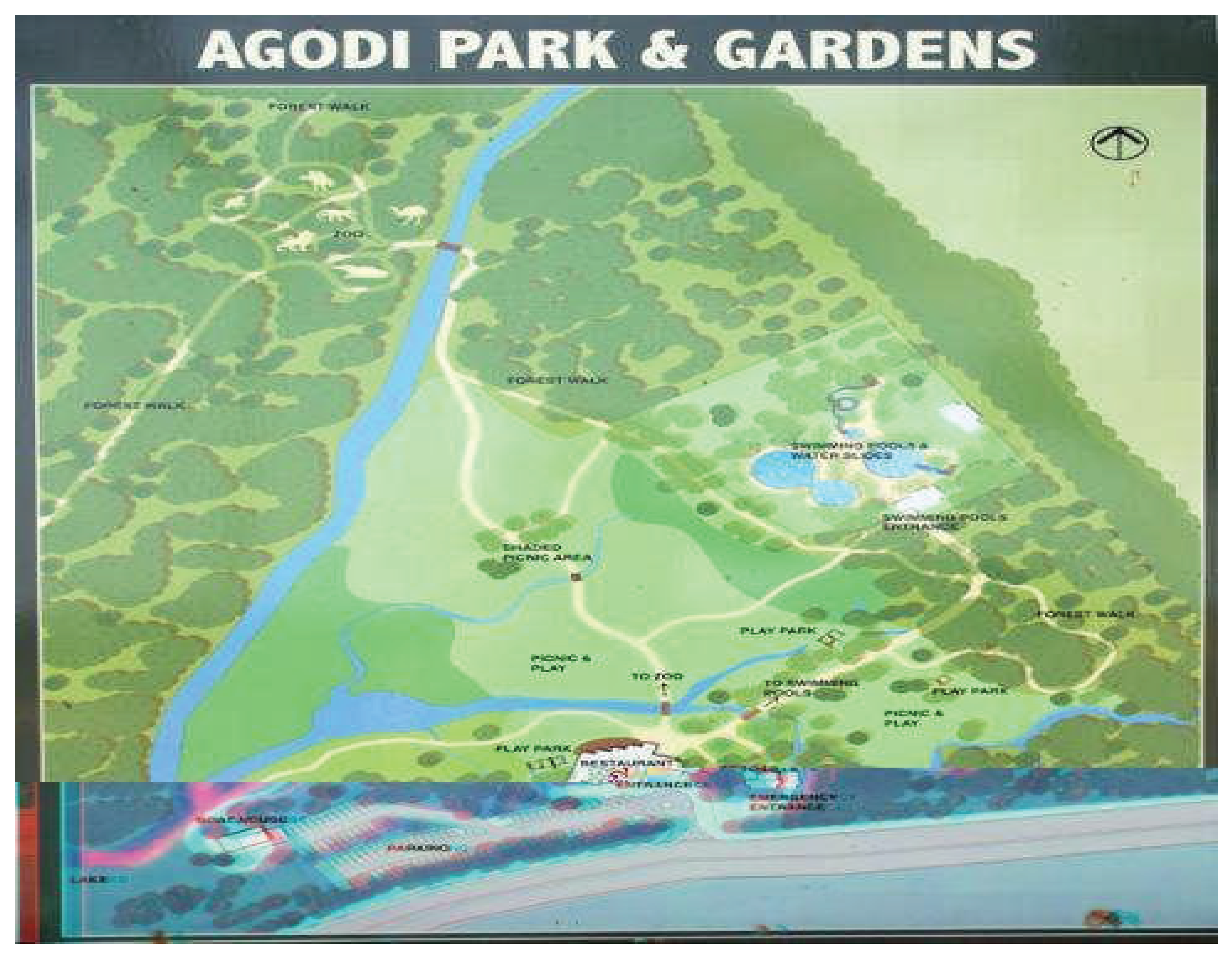
However, the gardens were destroyed by the historic Ogunpa flood disaster in 1980, as most animals were swept away by the raging water. However, it was renovated in 2012 by the Oyo State Government and reopened in 2014, as shown in Figure 1.0. Agodi Gardens, which is the epitome of peace because of the abundance of forestry surrounding it, has a lot of nice features, including a water park, children’s play area, rides, picnic spots, restaurant area, a lake, and a mini zoo.
It is a very serene, lush, and green environment,
and it is perfect for those who crave the quietness of solitude, picnics, a
get-together with friends and family, or just some time out. Agodi Gardens is
also a first-choice recreational facility for nature enthusiasts, garden
parties, outdoor events, concerts, and even weddings.
Figure 1.0.
Map of Agodi Park and Gardens.
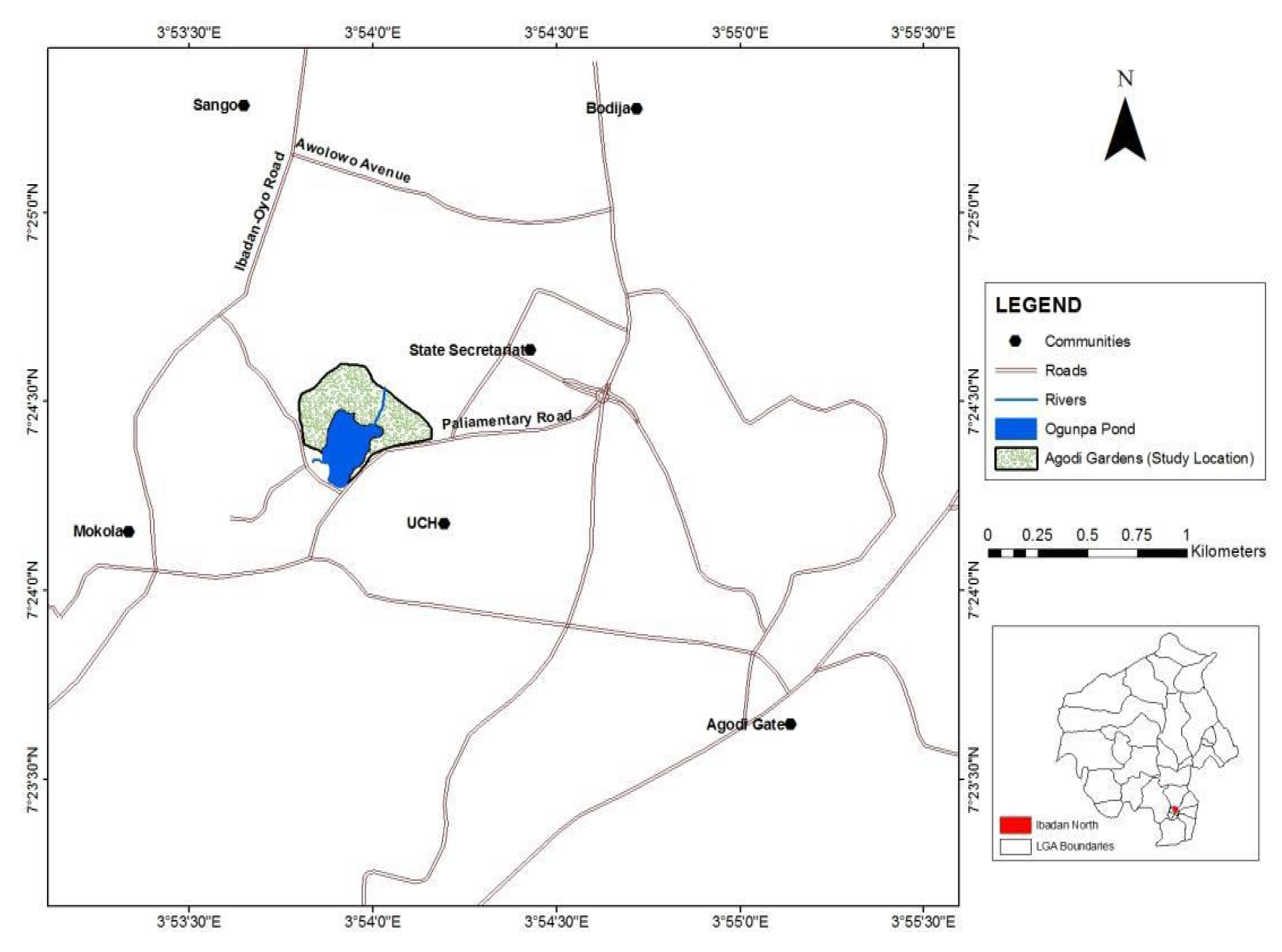
Figure 1.1.
Layout of Agodi Park and Garden.
Design
A mixed survey of both qualitative and quantitative data was used for this study. A descriptive cross sectional survey study design was adopted, using an interview-administered questionnaire to elicit information from respondents and In-depth interviews were conducted for members of staff at Agodi garden.
Population and Sampling
The study population comprised of six members of staff of Agodi Gardens in Ibadan, Oyo State and four hundred and twenty-two tourists that visited the site at the time of the study.
Sample Size Determination
The sample size for this study was calculated using Leslie Kish formula (1965) for single proportion which was :
N = Z2 x pq
d2
Where, N = sample size.
Z = 1.96 [95% confidence level (CI)].
p = the prevalence 50%
q = 1-p (1- P = 0.5)
d = desired level of accuracy, set at 0.05.
N = (1.96)2 × 0.5 × 0.5
(0.05)2
N = 384.16
In order to accommodate error, non-responsive rate of 10% was added to the sample size,
A non-response rate of 10% of 384.16 = 38.416 approximately 38.
Therefore, 38 was added to the sample size calculated to make the sample size 422 in order to address issues of incomplete response.
Sampling Technique
Purposive sampling technique was used for the study based on the characteristics of a specific population of interest to enable the research questions to be answered appropriately. This sampling method was used to select among the staff and tourists.
Method of Data Collection
Four research assistants were recruited and trained for the purpose of this research. They were given in-depth training on ethics of research work and procedures essential to conducting the study. Face-to-face interviewer-administered questionnaire were adopted in this research to elicit information on the socio-demographic information of respondents, identification of the damage caused by flooding at Agodi Gardens. The third section assessed the effects of flooding on tourist activities at Agodi Gardens. The fourth section examined the effects of flooding on the social well-being of inhabitants of Agodi Gardens environs (taking employment opportunities and business turnover as benchmark). The fifth section evaluated the measures in place to minimize the potential damage to natural resources and tourism development because of flooding at Agodi Gardens. The sixth section identified ways the damages caused by flooding on tourism development in Agodi Gardens can be sustainably managed.
A brief introduction was given to the respondents before participating in the study. The completed questionnaire and recorded interviews were examined for completeness and accuracy before leaving the field.
Method of Data Analysis
Data collected for the study was analyzed using descriptive statistics, such as frequency distribution to examine the demographic characteristics of the respondents. A Likert scale was used to examine respondents’ assessment of the impacts of flooding on tourist activities in the study area. In the data analysis, the study made use of correlation analysis (using chi-square) to compare observed results with the expected impacts of flooding on tourism. The inferential statistical method was used to analyze obtained information.
The data collected were checked for completeness and accuracy. Copies of questionnaire were cleaned, sorted, coded, entered. Data was processed and analyzed using descriptive and inferential statistics (Chi-square). The researcher used simple percentage and frequency to present the research objectives and data collection. The hypotheses were tested at 0·05 levels of significance using Chi-Square Test.
Damage caused were scored on an 8-point reference scale; where scores of 0-5 and 6-8 score were categorized as low and high damage caused respectively. The effect of damages was scored on an 8-reference scale; scores of 0-5 and 6-8 effect-score were respectively categorized as low and high effect of damage. Descriptive statistics of mean, standard deviation, frequency, percentages, and range was used to summarize the result. Chi-square was used to test the association between damages caused by flooding and effects of flooding on tourist activities, and association between damages caused by flooding and effects of damages caused by flooding on revenue growth. Descriptive and inferential (Chi-square) statistics was used to test the association between.
Result
Effects of Flooding on Tourist’s Activities (N=422)
More than half of the respondents (53.6%) agreed that flooding disrupts tourist activities, while about 5.2% of the respondents strongly disagreed that flooding destroys and damages infrastructure and reduce patronage. About 51.9% of the respondents agreed that flooding reduces number of visitors and reduce earnings at the garden. About half of the respondents (50.9%) agreed that flooding disasters makes the garden less attractive, while about 7.8% strongly disagreed that flooding result in the depletion of animals at the garden. About half of the respondents (55.0%) agreed that with regular flooding, natural appearance is destroyed at the garden. Of the respondents, 6.9% strongly disagreed that flooding pollutes the environment and about 51.9% of the respondents agreed that flood disaster result to loss of plants and vegetation (Table 1.0).
Effects of Damages Caused by Flooding on Revenue Growth
Result showed the effects of flooding on revenue growth at the garden. However, statistics revealed that 45.5% of the respondents agreed that flooding caused loss of animals at the garden thereby, making the garden become less attractive, while 5.2% strongly disagreed that flooding effect is a result of damage to plants and natural features, about 51.7% agreed that flooding causes damage to infrastructures at the garden thereby resulting to less patronage at the garden. About half of the respondent (54.0%) agreed that poor management of flood disaster affect their earnings, while 56.4% agreed that flooding disrupts activities at the garden. Finally, 6.6% of respondent disagreed that flood disaster damage recreational facilities at the garden thereby making it less attractive to tourist (Table 1.3).
Hypothesis
Hypothesis One
There is no significant relationship between damages caused by flooding and effects of damages caused by flooding on revenue growth. The result shows that of all the damage characteristics variables damages caused by flooding and effects of damages caused by flooding on revenue growth. Chi square value is 71.743 and p value is (0.000). Statistically, all variables were statistically significant at (p=0.000). Based on the result, the null hypothesis that stated that there is no significant relationship between damages caused by flooding and effects of damages caused by flooding on revenue growth was therefore accepted (p<0.05) (Table 1.4).
Qualitative Results
4.11. Semi-Structured Interview Results
The responses of the participants during the In-depth interviews are highlighted in this section.
There were six participants (tourist garden administrative staff members) who gave consent to
participate in the interview from Agodi gardens. The interview was conducted for 2 days in order for us engage extensively and as well elicit information from the management staffs. The answers to the interview questions were recorded through an electronic device in order to ensure an accurate and reliable information.
Do tourism developments destroy natural environmental resources?
A large proportion of the staffs strongly agreed that tourism developments destroy nature as it ruins natural vegetations and as well cause desertification of wildlife species.
Do you know about Agodi gardens?
Yes, Agodi has been in existence in the 50’s. Still protected by the government. Initially, it was just for spiritual meetings and tree reserved. Ogunpa flood happened 2011 across AMandC Agodi garden, killed a lot of animals and children park. Agodi was later privatized. Now a park and a garden+ pool side AG1
Not really, 3 years I have been here. It’s for parties, picnic, for games, pool, paint balling games, horse riding, bicycle ride AG 2
Before, there was boat riding AG3
Yes, I got here after renovation, it’s for tourist, for parties, picnic., Natural beauty, pool, trees, game arena (virtual, table tennis, snookers, paint ball games), restaurants, saloon, makeup artist, lounge/ bar. AG4
Yes, Agodi was better previously and fun, I was employed last year December, We need intervention of the government The zoo is under maintenance AG5
What are the natural resources present at Agodi gardens?
Trees, forest walkways, mini-zoo, garden. AG2
The ambient atmosphere AG3
Agodi garden formerly had boat ride, but now cancelled because of flood and bushes. AG4
Pool side, Table tennis, Barstin castle, snookers, virtual games, Horse ride, Paint gun-games, Games. AG5.
Have you ever visited Agodi gardens during the raining season
Most of the participants said yes, they work at the garden. Most of the participants said Yes, they visit Agodi gardens during the raining season
No, but during raining season, there is no destruction AG4
Yes, Terrible during rainy season, the garden is always in bad condition AG5
What does the condition have the garden during raining season?
Terrible during rainy season, the garden is always in bad condition AGQ
Grasses walkable during low rain sinking on grass during rainy season AG2
Flood is not constant except we have constant rainfall AG3
Barricade, destroyed, damp lawn/ grasses. AG4
We have started channelization, to reduce the effects of flood AG5
What is your take on the constant flooding of Agodi Gardens during the raining season?
It is a natural disaster AG1
There is an overflow of flood during raining season from the dam. AG2
Overflow of flood during raining season AG3
Scattered parties during picnics and events. Yes, water from UCH, Secretariat flood/ run-water to Agodi garden AG4
Flood carries tourist properties ‘AG5
It disturbs the social gathering spot AG6
Do you think that constant tourist visit to the site is affecting the natural set up at the gardens?
Most of the participant answered “No”
No, does not affect during holidays, we have stamped grasses. AG2
No, but there is Restroom overuse AG3
What are the damages caused by flooding at Agodi gardens?
Flooding limits the number of tourists. AG1
Stops people from easy passage flooded water fountain and Kayokie. AG2
Flood, water on the lawn during heavy rainfall. AG4
Destroyed streams. AG4
Revenue: Destroyed boat ride. AG4
Management and government have been cleaning bushes. AG4
Limits number of tourist. It affects sales of vendors. AG5.
Damages: condemned Bridge due to flood, especially during the month of MAY- TO September AG5.
What are the effects of flooding on tourists’ activities at Agodi gardens?
Limits the number of tourists. AG1
Tourists are yet to utilize the function of the zoo; Government should renovate the zoo. AG2
None, since there is on-going work on proper drainage. AG3
Government is generating money here, but not maintaining the garden for maximum use by the tourist. AG5.
How has the damages caused by flooding at Agodi gardens affected the revenue growth of the state government
Excess Rain affects business. AG1
Excessive flood, channelization. AG2
The government is not investing much. AG3
No tourist, No revenue, the garden will not be patronized. AG4
What are the measures in place to minimize the potential damages to natural resources and tourism development because of flooding at Agodi gardens?
Channelization AG1
Get bulldozer to enlarge the drainage path. AG2
We need concrete bridge in Agodi by the government. Channelization is the best solution AG5
Do more rock casting to reduce in-flow of flood?
Divert water from UCH and secretariat.
Channelization of stream free flow of water.
Do more rock casting to reduce in-flow of flood AG6
Discussion
Effects of Flooding on Tourists’ Activities at Agodi Gardens
From this study, majority of the respondents strongly agreed that one of the major effects of flooding on tourists’ activities at Agodi gardens is that flooding disrupts tourist activities thereby making the garden less attractive. Furthermore, flooding destroys/ damages infrastructural facilities, reduces patronage, and as well leads to loss of plants and vegetation. However, there were some previous studies that have been conducted by researchers regarding the flooding effects on tourism activities within a geographical area. In a view to this, a case study report on Nigerian Flood Impact, Recovery and Mitigation Assessment Report (2023) supported these results about the effects of flooding on tourist’s activities in Agodi gardens such that the statistical study indicated that flooding effects recorded 67.9% of destruction of crops, 56.1% loss of personal properties, and 42.3% of farmland destruction. The results of the study illustrate the impact of flooding on tourist’s activities within Agodi gardens. In a similar vein, other research study stated that flooding effects on tourists’ activities does have far-reaching consequences on individuals, organizations, communities, and on tourism activities (Rossello et al.l, 2020). This implies that the implication of flooding effects does not only emphasizes on the tourist’s activities, but they do also have direct impacts on human health, the local community and as well the tourism organization [business losses, poor management of existing facilities and loss of revenue]. Moreover, other scholars argued that the effects of flooding on tourist’s activities does have a psychological impact on the tourist destinations such that they contribute to the indirect consequences that influences the tourist’s arrival and destinations across several regions (Jin et al., 2019). Nevertheless, the psychological impact has led to the less patronage of the tourists and as well loss of revenue growth for the tourism organizations. This research however suggests that flooding have contributed negatively on tourism activities.
Damages Caused by Flooding on Revenue Growth
From this study, a large proportion of respondents agreed that the effects of damaged caused by flooding have an impact on the revenue growth at the Agodi garden. For example, a large fraction of the respondents agreed that flooding caused loss of animals at the garden thereby making the garden become less attractive, other larger percentages of respondents agreed that flooding causes damage to infrastructures at the garden, and as well poor management of flood disaster which affects their earnings. While about half of the respondents agreed that flooding disrupts activities at the garden. Studies conducted by researchers on the economic impact of flooding in Alberta supported this study regarding the damages caused by flooding on revenue growth. Nonetheless, this case study further stated about how flooding have led to administrative costs, employment losses, net loss of normal profit, and loss of capital, management, and labor (Alberta Water Portal Society, 2023). Similarly, Pan’s (2022) recent study on the impact of flooding on revenue growth stated how flooding does have an impact on the tourism industry’s performance, and as well alter the tourism industry’s policies. This study implies that the reason for firm’s performance and changes in policies is due to inefficient crisis management, poor public choices and poor city planning or management system. Accordingly, Merz et al. (2010) and Sharma and Franks (2013) argued that direct flooding has greater impacts on the physical aspects of tourism business such as environment, infrastructure, and natural environment. This study however suggests further research in order to seek strategies on how to generate revenue streams in order to improve and revitalize existing tourism facilities, and as well build resilient structures to manage future occurrences of flooding at Agodi gardens.
Conclusion and Recommendation
The study also identified various flood control/ management suggestion, such as channelization of high flow of water during the raining season away from the garden, building of concrete bridges to divert excess in-flow of water from the garden. The most commonly mentioned effect of flood disaster was lack of proper management of existing facilities at the garden and destruction of plants, vegetation, and animals. Additionally, the respondents expressed sadness as a result of loss of boat cruise, canoe ride and zoo that were present in the garden before the effect of the flood disaster,
Overall, the study explains the damaged caused by flooding activities at the garden and the importance of effective control and management of flood disaster.
It suggests the need for targeted awareness campaigns, enhanced access to guidance from individual personnel, ministry of tourism organization, and state government on measures to minimize and combat the flooding effect. Encouraging support from community influencers, ministry of tourism, natural reserve organization and the state government, can play a significant role in prevention/ reduction of impact of flooding on tourism activities. Deducing from the result, damages caused by flooding is one of the determinants of tourists’ activities in the study coverage.
On this note, Assessment of the impact of flooding on Tourism activities within Agodi Gardens, Ibadan cannot be overemphasized. The stakeholders should ensure the integrity of the environment as a natural system by making the garden natural as possible. This will make flooding occurrence at Agodi gardens be reduced to the barest minimum.
Recommendation
Based on the findings of this study, the following recommendations were made:
- The Management of the garden should monitor the usage of the facilities to ensure that the available drainage systems are well maintained.
- The Staffs should see to the prompt sanitation of the environment in order to prevent the occurrence of flood due to blockage of drainage system through debris.
- Tourist should abide strictly with the rule of using waste management facilities appropriately which will prevent flooding occurrence.
- Stakeholders should pay attention to investing on Agodi Gardens by improving on the facilities as a strategy in making their brands publicized.
- The National Emergency Management Agency (NEMA) should constantly monitor the adherence of people living within the Agodi Gardens environment in order to prevent flooding from distorting the tourism activities of the area.
- The Government should construct good drainage system that will allow unhindered flow of water during rainy season
- Further research could investigate how contaminated floodwater can pollute the environment, especially the aquatic habitats. This could be conducted by understanding how the water quality can disrupt delicate ecosystem and its natural habitat at Agodi Gardens. Such research could contribute to identifying the source of flooding and its impacts within the environment.
References
- Adegboyega, S.A.; Onuoha, O.C.; Adesuji, K.A.; Olajuyigbe, A.E.; Olufemi, A.A.; Ibitoye, M.O. An integrated approach to modelling of flood hazards in the rapidly growing city of Osogbo, Osun State, Nigeria. Space Science International 2018, 4(1), 1–15. [Google Scholar] [CrossRef]
- Adekola, O.; Lamond, J. A media framing analysis of urban flooding in Nigeria: Current narratives and implications for policy. Regional Environmental Change 2018, 18, 1145–1159. [Google Scholar] [CrossRef]
- Akindele, E.O.; Ekwemuka, M.C.; Apeverga, P.; Amusa, T.O.; Olajuyigbe, S.; Coker, O.M.; Olaleru, F.; Fasona, M.; Usen, E.N.; Ringim, A.S.; et al. Assessing awareness on biodiversity conservation among Nigerians: The Aichi Biodiversity Target 1. Biodiversity and Conservation 2021, 30, 1947–1970. [Google Scholar] [CrossRef] [PubMed]
- Babafemi, O; Adedayo, O.L.; Oluyinka, O.; Ogunjinmi, A.; Olaniyi, O.; Adediran, O.J. Assessment of Botanical/Biological Gardens for Recreation and Tourism in Southwestern Nigeria. Elizade University Journal of Research in Hospitality and Toursim Management 2022, 4, 132–158. [Google Scholar]
- Becken, S.; Zammit, C.; Hendrikx, J. Developing Climate Change Maps for Tourism: Essential Information or Awareness Raising? Journal of Travel Research 2015, 54(4), 430–441. [Google Scholar]
- Brown, J. R.; van Dam, A.; Earnshaw, R.; Encarnação, J.; Guedj, R.; Preece, J.; Scheiderman, B.; Vince, J. 1999, Human-centered computing, online communities and virtual environments, special report on the First Join European Commission/National Science Foundation Advanced Research Workshop, June 1-4, 1999, Chateau de Bonas, France. Computer Graphics 33(3), 42–62.
- Camilleri, M.A. The Tourism Industry: An Overview. In Travel Marketing, Tourism Economics, and the Airline Product; 2017; pp. 1–204. [Google Scholar]
- Chioma, O.C.; Chitakira, M.; Olanrewaju, O.O.; Louw, E. Impacts of flood disasters in Nigeria: A critical evaluation of health implications and management. Jàmbá: Journal of Disaster Risk Studies 2019, 11, 1–9. [Google Scholar] [CrossRef] [PubMed]
- Cloke, H.; Di Baldassarre, G.; Landeg, O.; Pappenberger, F.; Ramos, M.H. Hydrological risk: Floods. In Science for Disaster Risk Management 2017: Knowing Better and Losing Less; European Union: Luxembourg, 2019; pp. 198–238. [Google Scholar]
- Collins-Kreiner, N.; Wall, G. Tourism and Religion: Spiritual Journeys and Their Consequences, The Changing World Religion Map; Springer: Netherlands, 2015; pp. 689–707. [Google Scholar]
- Daily Post. Death Toll in Jigawa Flooding Hits 97 as Two More Residents Die. Daily Post. 23 September 2022. Available online: https://dailypost.ng/2022/09/23/death-toll-in-jigawa-flooding-hits-97-as-two-more-residents-die/#:~{}:text=Two%20more%20persons%20have%20died,the%20incident%20to%20DAILY%20POST.
- Djimesah, I.E.; Okine, A.N.D.; Mireku, K.K. Influential factors in creating warning systems towards flood disaster management in Ghana: An analysis of 2007 northern flood. International Journal of Disaster Risk Reduction 2018, 28, 318–326. [Google Scholar] [CrossRef]
- Echendu, A.J. The impact of flooding on Nigeria’s sustainable development goals (SDGs). Ecosyst. Health Sustain 2020, 6, 1–13. [Google Scholar]
- Echendu, A.J. The impact of flooding on Nigeria’s sustainable development goals (SDGs). Ecosyst. Health Sustain 2020, 6, 1–13. [Google Scholar]
- Echendu, A.J. Flooding in Nigeria and Ghana: Opportunities for partnerships in disaster-risk reduction. Sustainability: Science, Practice and Policy 2021, 18(1), 1–15. [Google Scholar] [CrossRef]
- Elagib, N.A.; AlZayed, I.S.; Saad, S.A.G.; Mahmood, M.I.; Basheer, M.; Fink, A.H. Debilitating floods in the Sahel are becoming frequent. Journal of Hydrology 2021, 16 599, 126362. [Google Scholar] [CrossRef]
- Federal Republic of Nigeria. Nigeria’s Adaptation Communication to the United Nations Framework Convention on Climate Change; Federal Ministry of Environment: Abuja, Nigeria, 2021; pp. 1–93. [Google Scholar]
- Global Climate Change Alliance Plus. Nigeria Climate Change Response Programme-NCCRP; NCCRP: Clichy, France, 2020; pp. 1–3. [Google Scholar]
- Helen, O.O.; Praise, E. Assessment of Tourists’ Perception and Satisfaction in Agodi Park and Gardens Ibadan as a nature-based tourism attraction. International Journal of Research –GRANTHAALAYAH 2020, 8(7), 144–159. [Google Scholar]

Table 1.1.
Effects of Flooding on Tourists’ Activities.
| Effects of flooding on tourists’ activities at Agodi gardens | Strongly Disagree Frequency (%) | Disagree Frequency (%) |
Undecided Frequency (%) |
Agree Frequency (%) | Strongly Frequency Agree (%) |
|---|---|---|---|---|---|
| Flooding disrupts tourist activities | 37 (8.8) | 35 (8.3) | 37 (8.8) | 226 (53.6) | 87 (20.6) |
| Flooding destroys / damages infrastructure and reduce patronage | 22 (5.2) | 54 (12.8) | 46 (10.9) | 217 (51.4) | 83 (19.7) |
| Flooding reduces number of visitors and reduce earnings | 25 (5.9) | 35 (8.3) | 54 (12.8) | 219 (51.9) | 89 (21.1) |
| Flooding disasters makes garden less attractive | 23 (5.5) | 39 (9.2) | 58 (13.7) | 215 (50.9) | 87 (20.6) |
| Flooding result in the depletion of animals at the garden | 33 (7.8) | 71 (16.8) | 80 (19.0) | 169 (40.0) | 69 (16.4) |
| With regular flooding natural appearance is destroyed | 22 (5.2) | 45 (10.7) | 39 (9.2) | 232 (55.0) | 84 (19.9) |
| Flooding pollutes the environment | 29 (6.9) | 50 (11.8) | 42 (10.0) | 231 (54.7) | 70 (16.6) |
| Flood disaster result to loss of plants and vegetation | 28 (6.6) | 39 (9.2) | 52 (12.3) | 219 (51.9) | 84 (19.9) |
Table 1.3.
Effects of Flooding on the Social Well-Being of Stakeholders.
| Effects of damages caused by flooding on revenue growth | Strongly Disagree Frequency (%) | Disagree Frequency (%) |
Undecided Frequency (%) |
Agree Frequency (%) |
Strongly Agree Frequency (%) |
|---|---|---|---|---|---|
| With loss of animals the garden becomes less attractive | 36 (8.5) | 61 (14.5) | 60 (14.2) | 192 (45.5) | 73 (17.3) |
| As a result of damage to plants and natural features | 22 (5.2) | 44 (10.4) | 48 (11.4) | 234 (55.5) | 74 (17.5) |
| Damage to infrastructures at the garden less patronage | 20 (4.7) | 44 (10.4) | 55 (13.0) | 218 (51.7) | 85 (20.1) |
| Poor management of flood disaster affect their earnings | 19 (4.5) | 31 (7.3) | 49 (11.6) | 228 (54.0) | 95 (22.5) |
| Flooding disrupts activities at the garden | 13 (3.1) | 35 (8.3) | 44 (10.4) | 238 (56.4) | 92 (21.8) |
| Flood disaster damage recreational facilities at the garden thereby making it less attractive | 24 (5.7) | 28 (6.6) | 42 (10.0) | 216 (51.2) | 112 (26.5) |
Table 1.4.
Relationship between damages caused by flooding at Agodi Gardens and effects of damages caused by flooding on revenue growth at Agodi Gardens.
Table 1.4.
Relationship between damages caused by flooding at Agodi Gardens and effects of damages caused by flooding on revenue growth at Agodi Gardens.
| Damage Category | Low Effect | High Effect | Df | X2 | P-value |
|---|---|---|---|---|---|
| Low damage | 131 (54.1%) | 111 (45.9%) | 1 | 71.743a | 0.000 * |
| High Damage | 25 (13.9%) | 155 (86.1%) |
Disclaimer/Publisher’s Note: The statements, opinions and data contained in all publications are solely those of the individual author(s) and contributor(s) and not of MDPI and/or the editor(s). MDPI and/or the editor(s) disclaim responsibility for any injury to people or property resulting from any ideas, methods, instructions or products referred to in the content. |
© 2026 by the author. Licensee MDPI, Basel, Switzerland. This article is an open access article distributed under the terms and conditions of the Creative Commons Attribution (CC BY) license.
Copyright: This open access article is published under a Creative Commons CC BY 4.0 license, which permit the free download, distribution, and reuse, provided that the author and preprint are cited in any reuse.


