

Submitted:
28 January 2026
Posted:
29 January 2026
You are already at the latest version
Abstract
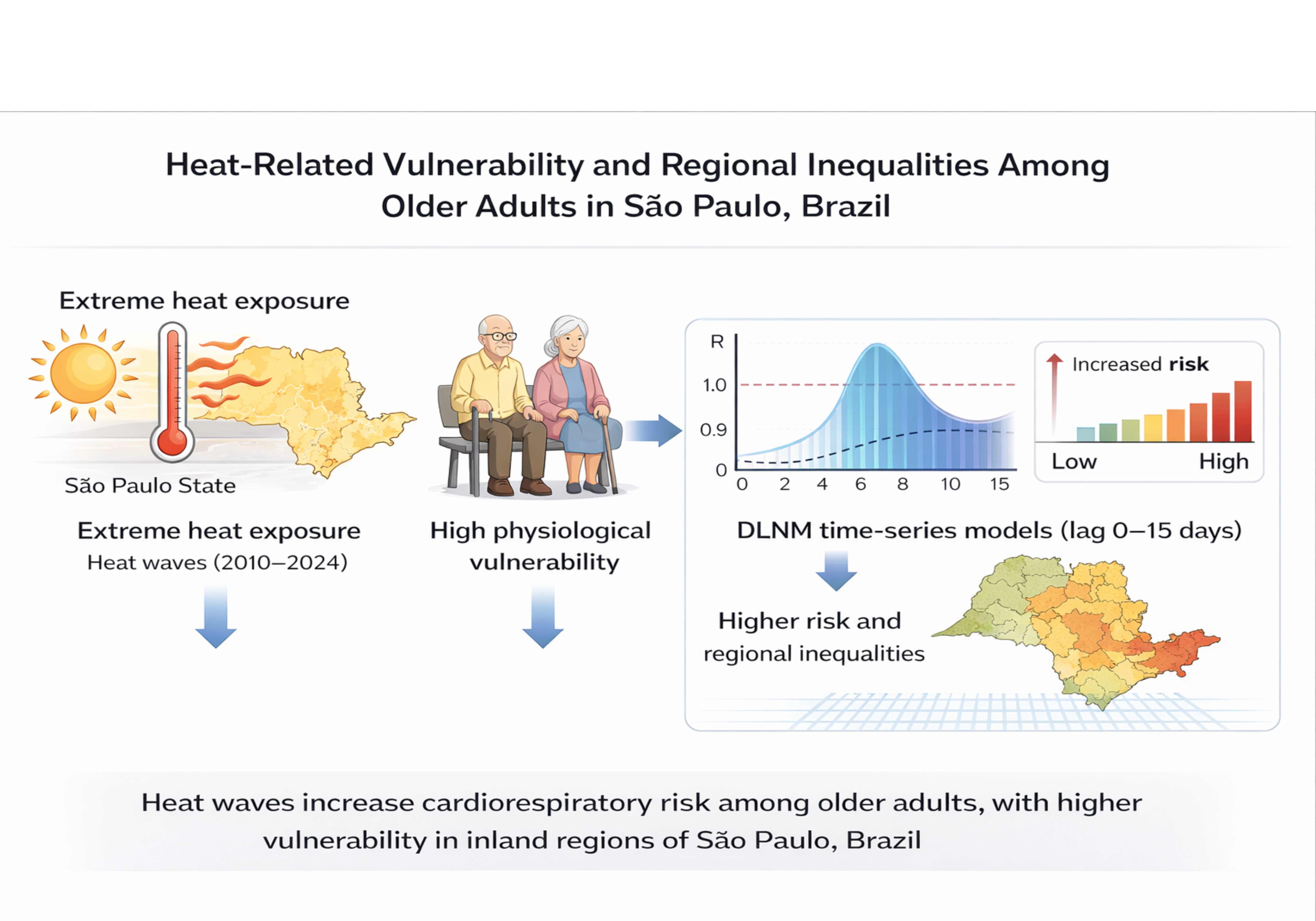
Older adults are particularly vulnerable to extreme heat, but evidence of the role of social factors in regional heat vulnerability remains limited. To assess the impacts of heat waves on cardiorespiratory hospitalizations and mortality, we developed a Climate Vulnerability Index by Regional Health Department (RHD), including adults aged ≥60 years across 17 RHDs in São Paulo State, Brazil. Health data were obtained from national information systems, and heat wave exposure was derived from ERA5 reanalysis data for 2010–2019 and 2023–2024, excluding 2020–2022. Associations between heat waves and health outcomes were estimated using distributed lag non-linear models with lags of 0–15 days. Cumulative relative risks, along with sociodemographic, sanitation, and health system indicators, were integrated to construct the Index based on IPCC sensitivity and adaptive capacity domains. Heat waves were associated with increased risks of cardiorespiratory hospitalizations and mortality across all RHDs, with stronger effects observed for mortality and inland regions. Higher vulnerability was concentrated in RHDs characterized by larger older adult populations, greater heat-related risks, and weaker health system and sanitation indicators, whereas more developed regions showed lower vulnerability. Overall, the Index provides a practical tool to support territorial prioritization and targeted heat–health adaptation strategies in ageing populations.
Keywords:
extreme heat
; aged
; public health
1. Introduction
The global population is ageing, while exposure to high ambient temperatures is increasing because of climate change. Older age has consistently been identified as one of the strongest non-modifiable determinants of vulnerability to heat, outweighing the influence of most other individual risk factors. Physiological changes associated with ageing, a higher prevalence of chronic diseases, the use of multiple medications, and reduced thermoregulatory capacity contribute to an increased susceptibility to heat-related adverse health outcomes among older adults [1].
Epidemiological evidence has consistently shown a robust association between temperature extremes and adverse health outcomes in this population. A meta-analysis by Yu et al. (2012) reported that heat-related mortality among older adults (≥65 years) increases by approximately 2–5% for each 1°C rise in temperature, an effect magnitude greater than that observed for cold-related mortality in individuals aged ≥50 years [2]. Complementing these findings, Åström and colleagues showed that people aged 65 years and older experience significantly higher risks of both mortality and morbidity during heat waves compared with younger age groups [3].
Recent systematic reviews consistently show that exposure to high ambient temperatures increases cardiovascular and respiratory risks, particularly among older adults. Across climate zones, heat exposure has been strongly associated with higher cardiovascular mortality, with population ageing and widespread heat exposure expected to further amplify the burden of heat-related cardiovascular disease under climate warming [4].
Large multi-country reviews also report significant associations between heat waves and cardiovascular and respiratory mortality— especially for ischemic heart disease, stroke, heart failure, and chronic obstructive pulmonary disease— while associations with morbidity outcomes are weaker and more heterogeneous., suggesting that mortality may be a more sensitive indicator of heat-related health impacts in older populations [5].
Despite this growing body of evidence, the magnitude of heat-related impacts varies substantially across settings, suggesting that contextual factors — such as social conditions, healthcare system capacity, and territorial inequalities — play a fundamental role in shaping heat vulnerability among older adults. These factors are central components of climate vulnerability, as defined by the dimensions of exposure, sensitivity, and adaptive capacity [6].
In particular, a substantial knowledge gap persists regarding how heat-related health impacts among older adults are spatially distributed and which social and structural determinants intensify vulnerability. Although several Brazilian studies have investigated the effects of extreme temperatures on health outcomes, most have focused on large metropolitan areas or broad geographic regions, with limited consideration of territorial inequalities, age-specific risks, or the integration of social vulnerability and health system characteristics [7,8].
Moreover, few studies have employed spatial analytic approaches or composite indices capable of capturing the complex interplay between environmental exposure, social conditions, and health system capacity.
Brazil’s Unified Health System (Sistema Único de Saúde, SUS) is a universal public health system predominantly financed through public revenues, including general taxation, and designed to ensure comprehensive, free health care at the point of use for the entire population [9].
The system is founded on the principles of universality, equity, and integrality and is characterized by a high degree of decentralization, with substantial responsibilities devolved to states and municipalities. Primary health care is organized mainly through the Family Health Strategy, a community-based model in which multidisciplinary teams provide territorially oriented, first-contact and longitudinal care. Health service organization has been progressively regionalized through the establishment of health regions and integrated care networks, with the aim of reducing territorial inequalities and improving access to care [10,11].
Within this framework, the state of São Paulo is subdivided into Regional Health Departments (RHDs), which function as meso-level administrative units responsible for coordinating primary care, hospital services, and health surveillance across groups of municipalities [12]. These regional entities constitute a particularly relevant geographic and governance scale for analysing inequalities in health service provision, health outcomes, and vulnerability among older adults. Moreover, this regional scale is highly pertinent to public health planning and climate adaptation strategies within Brazil’s Unified Health System. Importantly, it enables the examination of how variations in social conditions and health system capacity shape both exposure and adaptive responses to environmental and climatic risks, such as heat waves.
Against this background, the present study aims to assess the impact of heat waves on cardiovascular and respiratory hospitalizations and mortality among older adults in Brazil, using a regional analytical framework based on the RHDs of the state of São Paulo. By integrating social and health system determinants into composite vulnerability measures, this study seeks to provide a more comprehensive understanding of territorial inequalities in heat-related health risks. We hypothesize that heat waves are associated with increased cardiorespiratory morbidity and mortality among older adults, with disproportionately higher impacts in more socially and structurally vulnerable health regions. Our findings indicate that regional disparities in social vulnerability and health system capacity play a critical role in shaping heat-related health outcomes, underscoring the importance of regionally tailored adaptation and health system strengthening strategies in the context of climate change.
2. Materials and Methods
2.1. Study Design and Ethical Approval
This ecological time-series study examined the short-term association between heat waves and cardiorespiratory morbidity and mortality among older adults (≥60 years) in the state of São Paulo, Brazil, using data from 2010-2019 and 2023–2024. In Brazil, individuals aged ≥60 years are officially classified as older adults within public health policies. The years 2020–2022 were excluded from all analyses (morbidity and mortality) to minimize potential distortions related to the COVID-19 pandemic. For mortality outcomes, complete historical data were available up to 2023, but the years 2020–2022 were likewise excluded.
This study used publicly available, anonymized secondary data obtained from the Brazilian Unified Health System (DATASUS). The project was submitted to the Research Ethics Committee of Botucatu Medical School, São Paulo State University (UNESP), which determined that formal ethical approval was not required.
The reporting of this observational study followed the STROBE (Strengthening the Reporting of Observational Studies in Epidemiology) recommendations.
2.2. Study Area and RHDs
The state of São Paulo is the most populous in Brazil and comprises 645 municipalities organized into 17 RHDs, which coordinate healthcare planning and service provision under the State Health Secretariat. Each RHD includes a headquarters municipality and a group of reference municipalities concentrating specialized health services. Analyses at the RHD level allow the assessment of regional inequalities in health outcomes and system capacity. Detailed information on RHD composition is provided in the Supplementary Material.
2.3. Sociodemographic, Sanitation, and Health System Variables
To characterize contextual vulnerability and support the construction of the Climate Vulnerability Index, sociodemographic, sanitation, and health system indicators were compiled at the RHDs level. Sociodemographic variables included the number and proportion of older adults (≥60 years) and the mean Human Development Index (HDI), obtained from the Brazilian Institute of Geography and Statistics (IBGE). Sanitation indicators comprised population coverage of piped water supply and sewerage, also retrieved from IBGE. Health system structure and performance indicators included measures of health service infrastructure, human resources (composite human resources index), primary healthcare coverage, and public health financing (per capita expenditure index). These data were obtained from Fundação SEADE, the Information System on Public Health Budgets (SIOPS), and DATASUS, the national health information system of the Brazilian Unified Health System and complemented by regional performance indicators described by Paschoalotto et al (2018) [12]. These indicators were used to compose the adaptive capacity dimension of the vulnerability index and are summarized in Table 1 (with additional details in Supplementary Table S2).
2.4. Climate Data and Definition of Heat Waves
Daily air temperature data were obtained from the ERA5 reanalysis dataset produced by the European Centre for Medium-Range Weather Forecasts (ECMWF) and made available through the Copernicus Climate Data Store. ERA5 provides hourly meteorological data at a spatial resolution of 0.25° with global coverage and has demonstrated reliability for regional climate analyses in Brazil [13].
Original GRIB files were processed using Python (version 3.11) scripts to extract daily temperature series, convert units to degrees Celsius (°C), and export cleaned datasets in comma-separated values (CSV) format for statistical analysis.
Heat waves were identified based on the historical temperature climatology of the state of São Paulo. A heat wave was defined as a period in which daily air temperatures exceeded the seasonal climatological mean (calculated for the 1991–2020 reference period) by 3-5 °C for at least three consecutive days, in accordance with definitions adopted in Brazilian national studies and public health surveillance frameworks [14,15]. Heat wave exposure was modelled as a binary variable (1 = heat wave day; 0 = non–heat wave day). Exploratory analyses indicated that heat wave events occurred synchronously across the state, precluding differentiation of exposure patterns between RHDs. Consequently, exposure did not vary spatially across regions, reflecting the synoptic-scale nature of heat wave events affecting São Paulo.
2.5. Mortality and Hospitalization Data
Daily counts of morbidity and mortality among older adults (≥60 years) were obtained from national health information systems maintained by the DATASUS. Hospital admissions were extracted from the Hospital Information System (SIH/SUS), while mortality data were obtained from the Mortality Information System (SIM/SUS). Microdata were downloaded and pre-processed in R (version 4.5.2) using the microdatasus package [16], which enables automated extraction, decoding, and standardization of DATASUS records.
The primary outcomes were daily counts of hospital admissions and deaths with a principal diagnosis of cardiovascular or respiratory diseases. Diagnoses were coded according to the International Classification of Diseases, 10th Revision (ICD-10: I00–I99 for cardiovascular diseases and J00–J99 for respiratory diseases), which are recognized as highly sensitive to extreme temperature exposure among older populations. Individual records included the municipality of residence, allowing aggregation at the municipal level and subsequently at the RHDs level.
2.6. Statistical Analysis
Analyses were initially conducted separately for cardiovascular and respiratory causes, considering both hospital admissions and deaths. Descriptive statistics were used to characterize temporal and spatial patterns across the 17 RHDs. For inferential modelling, cardiovascular and respiratory outcomes were subsequently combined into a single cardiorespiratory category.
The association between heat wave exposure and daily cardiorespiratory outcomes was assessed using a Distributed Lag Non-Linear Model (DLNM) framework [17], which allows simultaneous estimation of non-linear exposure–response relationships and delayed effects across multiple lag days. Time-series regression models were fitted using Generalized Additive Models (GAM) with a Poisson distribution, appropriate for count data. Long-term trends and seasonality were controlled using smooth functions of time. All analyses were conducted in R (version 4.5.2) using the packages dlnm, mgcv, splines, and ggplot2. A two-sided significance level of 5% (p < 0.05) was adopted.
2.7. Heat Wave–Health Linkage
Dates of heat wave events were linked to the daily time series of hospital admissions and deaths among older adults to estimate both immediate and delayed effects. Model results were expressed as relative risks (RR) with corresponding 95% confidence intervals (95% CI). Cumulative effects were estimated from the distributed lag non-linear models to capture the total delayed impact of heat wave exposure over the defined lag period.
2.8. Construction of the Climate Vulnerability Index
The Climate Vulnerability Index for Older Adults in São Paulo by the Regional Health Department was constructed in accordance with the conceptual framework proposed by the Intergovernmental Panel on Climate Change (IPCC, 2001), incorporating the dimensions of exposure, sensitivity, and adaptive capacity [18].
Because heat-wave exposure, operationalized as the number of heat-wave days, showed minimal variability across RHDs, the exposure dimension was not included in the composite index and was used for descriptive purposes only. This approach is consistent with methodological recommendations for vulnerability index construction in contexts characterized by spatially homogeneous exposure [19].
The sensitivity dimension comprised: (i) the proportion of older adults in the population (weight = 0.15); (ii) relative risk of cardiorespiratory hospitalizations among older adults following heat waves (weight = 0.25); and (iii) relative risk of cardiorespiratory mortality among older adults following heat waves (weight = 0.25).
The adaptive capacity dimension included: (i) mean HDI (weight = 0.08); (ii) coverage of piped water supply and sewerage (weight = 0.10); (iii) primary health care coverage through the Family Health Strategy (weight = 0.09); (iv) density of health human resources (weight = 0.05); and (v) public health financing indicators (weight = 0.03).
Indicator selection and weighting were informed by IPCC and WHO/PAHO [20] frameworks. Although weighting schemes inherently involve normative choices, weights were assigned based on theoretical relevance and empirical evidence from previous climate–health vulnerability indices, with greater emphasis placed on health outcome indicators that directly reflect observed impacts of heat exposure among older adults.
All indicators were normalized using Min–Max scaling, with inverse normalization applied when higher values corresponded to lower vulnerability. The final index was calculated as a weighted sum of the sensitivity (total weight = 0.65) and adaptive capacity (total weight = 0.35) dimensions.
The normalized composite vulnerability index was classified into three categories (low, moderate, and high vulnerability) using empirically derived terciles based on the distribution of index values across the 17 RHDs. The cut-off points were ≤0.459 for low vulnerability, >0.459 to ≤0.527 for moderate vulnerability, and >0.527 for high vulnerability. A detailed description of indicators, weights, and theoretical justifications is provided in the Supplementary Material.
A sensitivity analysis was conducted to assess the robustness of the composite vulnerability index to alternative weighting and classification schemes (Supplementary Table S3). The index was recalculated using equal weights for all nine indicators and reclassified into low, moderate, and high vulnerability using empirically derived terciles of the unweighted scores across the 17 RHDs. Only four regions changed the vulnerability category, always between adjacent classes, and the overall spatial pattern of vulnerability was preserved. These findings indicate that the index is reasonably robust to weighting choices; therefore, the theoretically driven weighted index, prioritizing health impact and adaptive capacity indicators, was retained as the primary measure for subsequent analyses.
2.9. Data Availability, Code, and Use of Artificial Intelligence
All scripts used for climate data processing (Python version 3.11) and statistical analyses (R 4.5.2) were deposited in GitHub (github.com/rfsaldanha/microdatasus). Health data were obtained from publicly available DATASUS systems, and climate data were sourced from the Copernicus Climate Data Store (ERA5).
Generative artificial intelligence tools were used exclusively for language editing and minor text refinement and did not influence study design, data collection, analysis, interpretation, or visualization. No generative AI tool was used to generate data, graphics, or analytical code.
3. Results
The analysis revealed regional heterogeneity in vulnerability to heat waves among older adults in the state of São Paulo, reflecting differences in demographic composition, health outcomes, and structural conditions across the 17 RHDs. Heat wave exposure was unevenly distributed over the study period and was associated with substantial variation in cardiorespiratory hospitalizations and mortality among older adults. Distributed lag non-linear models showed both immediate and delayed effects of heat waves, with cumulative risks varying consistently across regions. The Climate Vulnerability Index to Heat Waves among Older Adults synthesized these patterns, highlighting inland and structurally disadvantaged regions as priority areas for mitigation and adaptation actions based on combined sensitivity and adaptive capacity profiles.
3.1. Climate Patterns and Heat Wave Occurrence
Between 2010 and 2024 (excluding 2020–2022), the state of São Paulo experienced between 5 (2011) and 13 (2018) heat wave episodes per year, with an apparent increase in frequency after 2014 (see Supplementary Table S4 for detailed annual counts and characteristics). The highest maximum temperature was 42.6 °C, recorded in 2012, and most heat wave events occurred between August and December, identifying late winter and early spring as the periods of greatest exposure to extreme heat.
3.2. Sociodemographic and Health System Context
Table 1 summarizes the sociodemographic and structural characteristics of the 17 RHDs in São Paulo, including the size and composition of the older population, human development, basic sanitation, primary care coverage, and a composite index of health human resources. These indicators capture both the sensitivity of local populations (e.g., ageing structure) and key aspects of their adaptive capacity (e.g., primary care and workforce availability), which are later incorporated into the Climate Vulnerability Index.
Regions such as RHD I – Grande São Paulo and RHD VII – Campinas showed higher HDI and sanitation coverage, but also a high proportion of older adults, indicating a substantial ageing burden in densely urbanized areas. In contrast, RHD XII – Registro combined lower HDI, more limited water and sewerage coverage, lower primary care coverage, and a less favorable human resources index, reflecting marked structural and social vulnerabilities.
3.3. Cardiorespiratory Morbidity and Mortality Among Older Adults
Cardiorespiratory hospitalizations and deaths among older adults (≥ 60 years) varied substantially across RHDs over the periods 2010-2019 and 2023–2024 (hospitalizations) and 2010–2019 and 2023 (mortality). Table 2 presents the total number of hospitalizations and deaths due to cardiovascular and respiratory causes in each RHD, highlighting the concentration of the absolute burden in RHD I – Greater São Paulo and other large and densely populated regions such as Campinas, Sorocaba and São José do Rio Preto, whereas RHD XII – Registro consistently shows the lowest counts.
3.4. Effect of Heat Waves on Cardiorespiratory Mortality
For the time-series analyses, daily counts of cardiovascular and respiratory outcomes were aggregated into a single cardiorespiratory endpoint for both hospitalizations and deaths, reflecting their shared pathophysiological pathways and enhancing statistical power. Cumulative relative risks (RRs) of cardiorespiratory mortality and hospitalizations associated with heat wave exposure over lags 0–15 days were then estimated for older adults in each of the 17 Regional Health Departments (RHDs) of São Paulo State and are presented in Table 3 and Figure 1.
Note: Relative risks represent cumulative effects over a 0-15-day lag period following heat wave exposure. Estimates were obtained using distributed lag models and correspond to the total excess risk accumulated over the lag window.
Overall, the results show that heat waves are associated with substantial increases in cardiorespiratory risk, with relative risks for mortality generally exceeding those for hospitalizations across most RHDs. This pattern suggests that extreme heat may trigger more severe clinical events that progress rapidly to death, highlighting the particular vulnerability of older adults and the need for targeted heat-health action plans at the regional level.
3.5. Climate Vulnerability Index for Older Adults
To characterize how susceptibility to heat waves varies across São Paulo State, a Climate Vulnerability Index for Older Adults was constructed for each Regional Health Department (RHD). The index combines indicators of sensitivity (demographic and health impacts) and adaptive capacity (socioeconomic conditions and health system resources), generating a composite score that was subsequently categorized into low, moderate, and high vulnerability levels, as presented in Table 4 and Table 5.
To facilitate the visual interpretation of regional differences in climate vulnerability, the classification of RHDs into low, moderate, and high vulnerability categories was spatially represented using a thematic map (Figure 2).
Taken together, the Climate Vulnerability Index revealed a heterogeneous pattern across the 17 RHDs, with roughly one third of regions classified as highly vulnerable and another third as presenting low vulnerability. High-vulnerability RHDs were mainly located in inland areas with greater sensitivity and/or more limited adaptive capacity, whereas low-vulnerability RHDs tended to concentrate in more metropolitan and socioeconomically advantaged areas. This spatial clustering underscores the need for regionally tailored adaptation strategies, prioritizing highly vulnerable inland RHDs while sustaining protective measures in lower-vulnerability settings.
4. Discussion
By integrating cumulative relative risk estimates with spatial representations of the Climate Vulnerability Index, this study demonstrates marked spatial heterogeneity in the health impacts of heat waves among older adults in São Paulo State. The integration of composite vulnerability indices to assess spatial heterogeneity has been widely applied in climate change research in Brazil, particularly in subnational analyses [21].
Our findings are consistent with nationwide evidence showing a significant association between heat exposure and hospitalizations in Brazil. In a large multicity study covering more than 1,800 cities between 2000 and 2015, Zhao et al. (2019) reported that approximately 6% of hospitalizations during hot seasons were attributable to heat exposure, with a disproportionate burden among older adults and marked geographic heterogeneity [22]. While that study quantified the overall heat-related morbidity burden, our analysis advances this evidence by identifying regional patterns of vulnerability within São Paulo State, highlighting the role of demographic structure, health outcomes, and adaptive capacity in shaping unequal health impacts under relatively homogeneous heat exposure conditions. This finding suggests that regional differences in heat-related health impacts are driven less by climatic variation and more by contrasts in demographic structure, socioeconomic conditions, pre-existing health status, and adaptive capacity, which emerge as central determinants of regional heat-related risk.
The stronger association observed between heat waves and mortality compared with hospitalizations is consistent with known physiological vulnerabilities of older adults to thermal stress. Large multicity evidence from Latin America shows that marginal increases in high temperatures are associated with steep rises in mortality risk, particularly among older adults and for cardiovascular and respiratory causes [23].
Age-related impairments in thermoregulation, reduced sweating capacity, diminished cardiovascular reserve, and a higher prevalence of chronic cardiorespiratory conditions may limit the ability of older adults to compensate for extreme heat exposure. Dehydration, electrolyte imbalance, increased blood viscosity and heightened cardiovascular strain can precipitate acute events such as arrhythmias, heart failure decompensation and ischemic episodes, potentially leading to death without prior hospital admission, particularly in frail or medically complex individuals. These mechanisms, together with the higher prevalence of chronic cardiopulmonary and metabolic diseases among older adults, are consistent with systematic review evidence showing that heat waves disproportionately increase mortality and morbidity in older adults and medically vulnerable groups [24].
While these mechanisms highlight the biological susceptibility of older adults to extreme heat, vulnerability is not determined by physiology alone. Biological fragility is often amplified by social and structural conditions, such as poverty, racial inequities, housing quality, and unequal access to cooling and healthcare. Beyond biological susceptibility, the heterogeneous distribution of climate vulnerability across regions reflects underlying social, environmental, and health-system inequalities. Recent Brazilian evidence from the 2023 extreme heat wave in Rio de Janeiro illustrates how extreme heat events disproportionately affect socially vulnerable populations [25].
In the present study, regions classified as highly vulnerable tended to combine greater demographic sensitivity and lower adaptive capacity, including higher proportions of older adults, less favorable socioeconomic conditions, limited access to cooling resources, and a higher burden of chronic diseases. This pattern further supports the usefulness of the index as a tool to identify territories where social, environmental, and health system factors converge to amplify heat-related risks among older adults.
Consistent with these findings, Santos et al. reported that heat-related excess mortality in the 14 most populous Brazilian urban areas was highest among older adults, individuals with low educational attainment and Black and Brown populations, highlighting the intersection between social stratification and climatic risk [25].
RHDs such as Greater São Paulo, Campinas, and Ribeirão Preto—among the most populous and economically developed areas of the state—were classified as having low climate vulnerability, whereas more peripheral and less affluent regions concentrated the highest vulnerability scores. This pattern, in which metropolitan and economically more developed regions generally exhibit lower vulnerability, likely reflects better housing conditions, greater availability of healthcare services and higher adaptive capacity. These findings align with the climate-vulnerability framework adopted in IPCC assessments, where exposure, sensitivity and adaptive capacity jointly determine climate-related risk [19,26], and with empirical studies showing that heat-related mortality and morbidity disproportionately affect socioeconomically deprived or underserved communities through mechanisms involving housing quality, neighborhood context, access to cooling and pre-existing health inequalities [27,28].
Taken together, these findings indicate that the observed spatial pattern of climate vulnerability among older adults is primarily driven by differences in sensitivity and adaptive capacity, rather than by substantial spatial variation in heat-wave exposure. Accordingly, the index was conceived to capture regional differences in vulnerability under conditions of relatively homogeneous heat-wave exposure, thereby highlighting how variations in sensitivity and adaptive capacity among older populations lead to unequal health impacts across territories.
From a public health perspective, the observed regional disparities have important implications for the Unified Health System (SUS). The identification of highly vulnerable RHDs in our study aligns with previous work emphasizing that heat-related health risks in Brazil are strongly shaped by regional socioeconomic and environmental inequalities across Brazilian regions [29].
Integrating climate- and heat-vulnerability indicators into regional health planning within the SUS could support more efficient allocation of resources and improve preparedness for extreme heat events, especially in territories where older adults are overrepresented. In this context, highly vulnerable regions become priority areas for targeted adaptation strategies, including heat–health early warning systems, active surveillance of older adults during heat waves, and strengthening of primary care and emergency response capacity, which are essential to reduce avoidable morbidity and mortality among older adults in an ageing and warming society [30,31].
Climate change is increasingly recognized as a major stressor to population health and to the health systems that aim to safeguard well-being, particularly in low- and middle-income countries. In this context, climate change and health vulnerability and adaptation assessments are considered an important strategy to inform decision-makers about current weather–health relationships, vulnerable groups, future risks, and priority adaptation options [32].
Our vulnerability index responds directly to these needs by providing a standardized, operational tool that summarizes multidimensional heat-related vulnerability among older adults across RHDs, thus generating information that is readily usable within routine SUS planning and governance processes.
However, international experience indicates that, despite the growing number of such assessments, their results have not consistently contributed to a cumulative, comparable global evidence base and are often not effectively integrated into adaptation decision-making [32].
In many settings, this reflects the limited participation of the health sector in national climate policy processes and persistent barriers, including restricted data access, a scarcity of climate–health models, uncertainties in climate projections, and insufficient funding and technical capacity, particularly in developing countries [33].
By relying on publicly available health, demographic, and socioeconomic data, our study illustrates a feasible pathway to build a heat-vulnerability index in a data- and resource-constrained context, offering a pragmatic template that could be adapted by other health systems facing similar challenges. Although this approach does not overcome structural constraints such as limited funding, data gaps, or modeling capacity, it provides proof of concept that useful decision-support tools can be developed even in resource-constrained settings. Importantly, translating vulnerability assessments into concrete adaptation actions requires explicit integration with climate-resilient health system agendas and multisectoral governance. In this context, the index can facilitate coordination between the health sector and other sectors—such as environment, civil protection, and urban planning—by providing a common territorial metric that can be used to align health priorities with broader climate adaptation and disaster risk reduction strategies.
Finally, previous work has highlighted the need for capacity building and partnerships to enable vulnerability and adaptation assessments from local to national levels and to ensure that the resulting evidence is translated into effective policies and interventions [32]. In addition, periodically updating the index would allow changes in heat-related vulnerability to be monitored over time, for instance following expansions in primary care coverage, socioeconomic shifts, or the implementation of adaptation policies. In this sense, the index functions not only as a diagnostic tool, but also as a practical instrument for tracking the effects of health and social interventions on climate-related vulnerability among older adults.
The application and periodic updating of our index within the SUS could be embedded in such capacity-building efforts, for example through collaborations between health authorities, academia, and meteorological and environmental agencies, and through the development of technical guidance and training for subnational health managers. In this way, the index not only characterizes current spatial patterns of vulnerability but can also serve as a practical entry point for strengthening institutional capacity to plan, implement, and evaluate health adaptation to climate change.
5. Limitations
This study has several limitations that should be considered when interpreting the findings. The vulnerability index was constructed using secondary data aggregated at the level of RHDs, which may mask important intra-regional heterogeneities and local micro-environments of risk. The selection and operationalization of indicators were constrained by data availability and quality, meaning that some relevant social, environmental, and health system dimensions (for example, informal housing conditions, micro-urban heat island characteristics, or detailed indicators of primary care performance) could not be incorporated, potentially leading to residual confounding or misclassification of vulnerability. Furthermore, the index captures structural vulnerability to heat under recent climatic conditions and does not explicitly account for future changes in climate, demographics, or health system capacity, so its values should not be interpreted as fixed characteristics of territories over time. Finally, although the index was developed to be conceptually generalizable, its specific configuration reflects the organization and data infrastructure of the Brazilian Unified Health System and may require adaptation and local validation before being applied in other health system contexts or to other population groups.
Ethics Statement
This study used publicly available, anonymized secondary data from the Brazilian Unified Health System (DATASUS). According to Brazilian regulations, ethical approval was not required.
Supplementary Materials
The following supporting information can be downloaded at the website of this paper posted on Preprints.org. Supplementary Table S1. Composition of the 17 Regional Health Departments (RHDs) in São Paulo State (municipalities and population); Supplementary Table S2. IPCC-based dimensions, variables, weights, and justification used to construct the Climate Vulnerability Index to Heat Waves among Older Adults by Regional Health Department (IVCI-SP/RHD); Supplementary Table S3. Sensitivity analysis of the Climate Vulnerability Index to Heat Waves among Older Adults (IVCI-SP/RHD): comparison of weighted and unweighted (equal-weight) approaches across Regional Health Departments; Supplementary Table S4. Annual occurrence of heat waves in São Paulo State between 2010 and 2024, excluding 2020–2022.
Author Contributions
Conceptualization, A.V.; Methodology, T.M., P.B., J.C. and A.V.; Software, T.M. and S.A.; Validation, T.M., S.A., P.B. and A.V.; Formal analysis, T.M.; Investigation, R.D., P.B. and A.V.; Resources, P.B. and A.V.; Data curation, T.M.; Writing—original draft preparation, T.M., R.D., S.A. and A.V.; Writing—review and editing, T.M., R.D., S.A., P.B., T.S., J.N., N.C. and A.V.; Visualization, P.B. and A.V.; Supervision, P.B. and A.V.; Project administration, P.B. and A.V.; Funding acquisition, P.B. and A.V. All authors have read and agreed to the published version of the manuscript.
Funding
This work was supported by a postdoctoral fellowship from the Coordenação de Aperfeiçoamento de Pessoal de Nível Superior – Brasil (CAPES; Finance Code 001).
Data Availability Statement
The data supporting the findings of this study are available within the article and its Supplementary Materials, as well as at https://github.com/rfsaldanha/microdatasus.
Acknowledgments
The authors gratefully acknowledge the support of the Research Core/LabData of the Department of Academic Activities Management (DGAA), Hospital das Clínicas, Botucatu Medical School, São Paulo State University (HCFMB-UNESP).
Conflicts of Interest
The authors declare no conflicts of interest.
References
- Meade, R.D.; Akerman, A.P.; Notley, S.R.; McGinn, R.; Poirier, P.; Gosselin, P.; Kenny, G.P. Physiological Factors Characterizing Heat-Vulnerable Older Adults: A Narrative Review. Environ. Int. 2020, 144, 105909. [Google Scholar] [CrossRef]
- Yu, W.; Mengersen, K.; Wang, X.; Ye, X.; Guo, Y.; Pan, X.; Tong, S. Daily Average Temperature and Mortality among the Elderly: A Meta-Analysis and Systematic Review of Epidemiological Evidence. Int. J. Biometeorol. 2012, 56, 569–581. [Google Scholar] [CrossRef]
- Åström, D.O.; Forsberg, B.; Rocklöv, J. Heat Wave Impact on Morbidity and Mortality in the Elderly Population: A Review of Recent Studies. Maturitas 2011, 69, 99–105. [Google Scholar] [CrossRef]
- Liu, J.; Varghese, B.M.; Hansen, A.; Zhang, Y.; Driscoll, T.; Morgan, G.; Dear, K.; Gourley, M.; Capon, A.; Bi, P. Heat Exposure and Cardiovascular Health Outcomes: A Systematic Review and Meta-Analysis. Lancet Planet. Health 2022, 6, e484–e495. [Google Scholar] [CrossRef] [PubMed]
- Cheng, J.; Xu, Z.; Bambrick, H.; Prescott, V.; Wang, N.; Zhang, Y.; Su, H.; Tong, S.; Hu, W. Cardiorespiratory Effects of Heatwaves: A Systematic Review and Meta-Analysis of Global Epidemiological Evidence. Environ. Res. 2019, 177, 108610. [Google Scholar] [CrossRef] [PubMed]
- Climate Change 2014: Impacts, Adaptation, and Vulnerability; Intergovernmental Panel on Climate Change, Ed.; Fifth Assessment Report (AR5), Working Group II; 5th Assessment Report (AR5) – Working Group II.; Field, C. B. Barros, V. R. Dokken, D. J. Mach, K. J. Mastrandrea, M. D. Bilir, T. E. Chatterjee, M. Ebi, K. L. Estrada, Y. O. Genova, R. C. Girma, B. Kissel, E. S. Levy, A. N. MacCracken, S. Mastrandrea, P. R. White, L. L. Cambridge, United Kingdom. 2014; ISBN 978-1-107-05807-1.
- Diniz, F.R.; Gonçalves, F.L.T.; Sheridan, S. Heat Wave and Elderly Mortality: Historical Analysis and Future Projection for Metropolitan Region of São Paulo, Brazil. Atmosphere 2020, 11, 933. [Google Scholar] [CrossRef]
- Silveira, I.H.; Cortes, T.R.; Bell, M.L.; Junger, W.L. Effects of Heat Waves on Cardiovascular and Respiratory Mortality in Rio de Janeiro, Brazil. PLOS ONE 2023, 18, e0283899. [Google Scholar] [CrossRef]
- Paim, J.; Travassos, C.; Almeida, C.; Bahia, L.; Macinko, J. The Brazilian Health System: History, Advances, and Challenges. Lancet Lond. Engl. 2011, 377, 1778–1797. [Google Scholar] [CrossRef]
- Bigoni, A.; Malik, A.M.; Tasca, R.; Carrera, M.B.M.; Schiesari, L.M.C.; Gambardella, D.D.; Massuda, A. Brazil’s Health System Functionality amidst of the COVID-19 Pandemic: An Analysis of Resilience. Lancet Reg. Health Am. 2022, 10, 100222. [Google Scholar] [CrossRef]
- Macinko, J.; Harris, M.J. Brazil’s Family Health Strategy - Delivering Community-Based Primary Care in a Universal Health System. N. Engl. J. Med. 2015, 372, 2177–2181. [Google Scholar] [CrossRef]
- Paschoalotto, MAC; Passador, CS; Passador, JL; Oliveira, LR; Lopes, JEF; Dantas, MK. A Regionalização Do SUS: Proposta de Avaliação de Desempenho Dos Departamentos Regionais de Saúde do Estado de São Paulo [Regionalization of the Brazilian Unified Health System: a performance evaluation proposal for the Regional Health Departments of São Paulo State]. Saúde Soc. São Paulo (in Portuguese). 2018, 27, 80–93. [Google Scholar] [CrossRef]
- de Araújo, C.S.P.; Silva, J.R.I.; Almeida, C.D.G.C. de Total Precipitation and Air Temperature Data Obtained from ERA5-Land Reanalysis: Validation and Accuracy. Rev. Caatinga 2025, 38, e12578–e12578. [Google Scholar] [CrossRef]
- Silva, N. de S.; Alves, J.M.B.; da Silva, E.M.; Sousa, G.M. de Ocorrência de Ondas de Calor com Dados de Reanálises em áreas do Nordeste, Amazônia e Centro-Sudeste do Brasil [Occurrence of heat waves based on reanalysis data in areas of Northeastern, Amazonian and Central-Southeastern Brazil]. Rev. Bras. Meteorol. (in Portuguese). 2023, 37, 441–451. [Google Scholar] [CrossRef]
- Firpo, M.Â.F.; Sansigolo, C.A.; Assis, S.V. de Climatologia e variabilidade sazonal do número de ondas de calor e de frio no Rio Grande do Sul associadas ao ENOS [Climatology and seasonal variability of the number of heat and cold waves in Rio Grande do Sul associated with ENSO]. Rev. Bras. Meteorol. (in Portuguese). 2012, 27, 95–106. [Google Scholar] [CrossRef]
- Saldanha, R. de F.; Bastos, R.R.; Barcellos, C. Microdatasus: pacote para download e pré-processamento de microdados do Departamento de Informática do SUS (DATASUS) [Microdatasus: an R package for downloading and preprocessing microdata from the Brazilian Unified Health System database (DATASUS)]. Cad. Saúde Pública (in Portuguese). 2019, 35, e00032419. [Google Scholar] [CrossRef]
- Gasparrini, A.; Armstrong, B.; Kenward, M.G. Distributed Lag Non-Linear Models. Stat. Med. 2010, 29, 2224–2234. [Google Scholar] [CrossRef]
- Climate Change 2001: Impacts, Adaptation, and Vulnerability.; Contribution of Working Group II to the Third Assessment Report of the Intergovernmental Panel on Climate Change.; Cambridge University Press.: Cambridge, United Kingdom., 2001.
- Estoque, R.C.; Ishtiaque, A.; Parajuli, J.; Athukorala, D.; Rabby, Y.W.; Ooba, M. Has the IPCC’s Revised Vulnerability Concept Been Well Adopted? Ambio 2023, 52, 376–389. [Google Scholar] [CrossRef]
- Pan American Health Organization (PAHO) / World Health Organization (WHO) Mudanças Climáticas e Saúde No Envelhecimento: Desafios e Estratégias Adaptativas [Climate change and health in ageing: challenges and adaptive strategies]; Washington, DC: OPAS/OMS, 2025; (in Portuguese).
- Menezes, J.A.; Confalonieri, U.; Madureira, A.P.; Duval, I. de B.; dos Santos, R.B.; Margonari, C. Mapping Human Vulnerability to Climate Change in the Brazilian Amazon: The Construction of a Municipal Vulnerability Index. PLoS ONE 2018, 13, e0190808. [Google Scholar] [CrossRef]
- Zhao, Q.; Li, S.; Coelho, M.S.Z.S.; Saldiva, P.H.N.; Hu, K.; Arblaster, J.M.; Nicholls, N.; Huxley, R.R.; Abramson, M.J.; Guo, Y. Geographic, Demographic, and Temporal Variations in the Association between Heat Exposure and Hospitalization in Brazil: A Nationwide Study between 2000 and 2015. Environ. Health Perspect. 2019, 127, 017001. [Google Scholar] [CrossRef] [PubMed]
- Kephart, J.L.; Sánchez, B.N.; Moore, J.; Schinasi, L.H.; Bakhtsiyarava, M.; Ju, Y.; Gouveia, N.; Caiaffa, W.T.; Dronova, I.; Arunachalam, S.; et al. City-Level Impact of Extreme Temperatures and Mortality in Latin America. Nat. Med. 2022, 28, 1700–1705. [Google Scholar] [CrossRef]
- Arsad, F.S.; Hod, R.; Ahmad, N.; Ismail, R.; Mohamed, N.; Baharom, M.; Osman, Y.; Radi, M.F.M.; Tangang, F. The Impact of Heatwaves on Mortality and Morbidity and the Associated Vulnerability Factors: A Systematic Review. Int. J. Environ. Res. Public. Health 2022, 19, 16356. [Google Scholar] [CrossRef]
- Fernandez-Medina, R.D.; Peixoto, E.M.; Rodrigues, D.; Said, R.; Holanda, C.A.; Freire, C. da S.; de Almeida, A.M.; de Carvalho Cardoso, S.C.; Sergio Ribeiro, M.; de Mello, C.M.B.; et al. Excess Mortality Associated with Extreme Heat in Rio de Janeiro, Brazil, 2023. Rev. Panam. Salud Pública 2025, 49, e76. [Google Scholar] [CrossRef] [PubMed]
- Xu, R.; Zhao, Q.; Coelho, M.S.Z.S.; Saldiva, P.H.N.; Abramson, M.J.; Li, S.; Guo, Y. Socioeconomic Inequality in Vulnerability to All-Cause and Cause-Specific Hospitalisation Associated with Temperature Variability: A Time-Series Study in 1814 Brazilian Cities. Lancet Planet. Health 2020, 4, e566–e576. [Google Scholar] [CrossRef] [PubMed]
- dos Santos, D.M.; Libonati, R.; Garcia, B.N.; Geirinhas, J.L.; Salvi, B.B.; Silva, E.L. e; Rodrigues, J.A.; Peres, L.F.; Russo, A.; Gracie, R.; et al. Twenty-First-Century Demographic and Social Inequalities of Heat-Related Deaths in Brazilian Urban Areas. PLOS ONE 2024, 19, e0295766. [Google Scholar] [CrossRef]
- Gronlund, C.J. Racial and Socioeconomic Disparities in Heat-Related Health Effects and Their Mechanisms: A Review. Curr. Epidemiol. Rep. 2014, 1, 165–173. [Google Scholar] [CrossRef]
- Neves, J.M.; Garcia, K.K.S.; Oliveira, B.F.A.; Horta, M.A. Too Hot to Ignore: The Escalating Health Impact of Heatwaves in Brazil. Int. J. Environ. Res. Public. Health 2025, 22, 1451. [Google Scholar] [CrossRef]
- Watts, N.; Adger, W.N.; Agnolucci, P.; Blackstock, J.; Byass, P.; Cai, W.; Chaytor, S.; Colbourn, T.; Collins, M.; Cooper, A.; et al. Health and Climate Change: Policy Responses to Protect Public Health. The Lancet 2015, 386, 1861–1914. [Google Scholar] [CrossRef]
- Deering, S. Clinical Public Health, Climate Change, and Aging. Can. Fam. Physician 2023, 69, 233–235. [Google Scholar] [CrossRef] [PubMed]
- Berry, P.; Enright, P.M.; Shumake-Guillemot, J.; Villalobos Prats, E.; Campbell-Lendrum, D. Assessing Health Vulnerabilities and Adaptation to Climate Change: A Review of International Progress. Int. J. Environ. Res. Public. Health 2018, 15, 2626. [Google Scholar] [CrossRef]
- Ansah, E.W.; Amoadu, M.; Obeng, P.; Sarfo, J.O. Health Systems Response to Climate Change Adaptation: A Scoping Review of Global Evidence. BMC Public Health 2024, 24, 2015. [Google Scholar] [CrossRef]
Figure 1.
Cumulative relative risks (RRs) of cardiorespiratory mortality and hospitalizations among older adults associated with heat wave exposure (lag 0-15 days), by RHDs, State of São Paulo, Brazil. Source: DLNM modelling – SIM/SUS (DATASUS, 2024). Note: Relative risks represent cumulative effects over a 0–15-day lag period following heat wave exposure. Estimates were obtained using distributed lag models and correspond to the total excess risk accumulated over the lag window.
Figure 1.
Cumulative relative risks (RRs) of cardiorespiratory mortality and hospitalizations among older adults associated with heat wave exposure (lag 0-15 days), by RHDs, State of São Paulo, Brazil. Source: DLNM modelling – SIM/SUS (DATASUS, 2024). Note: Relative risks represent cumulative effects over a 0–15-day lag period following heat wave exposure. Estimates were obtained using distributed lag models and correspond to the total excess risk accumulated over the lag window.
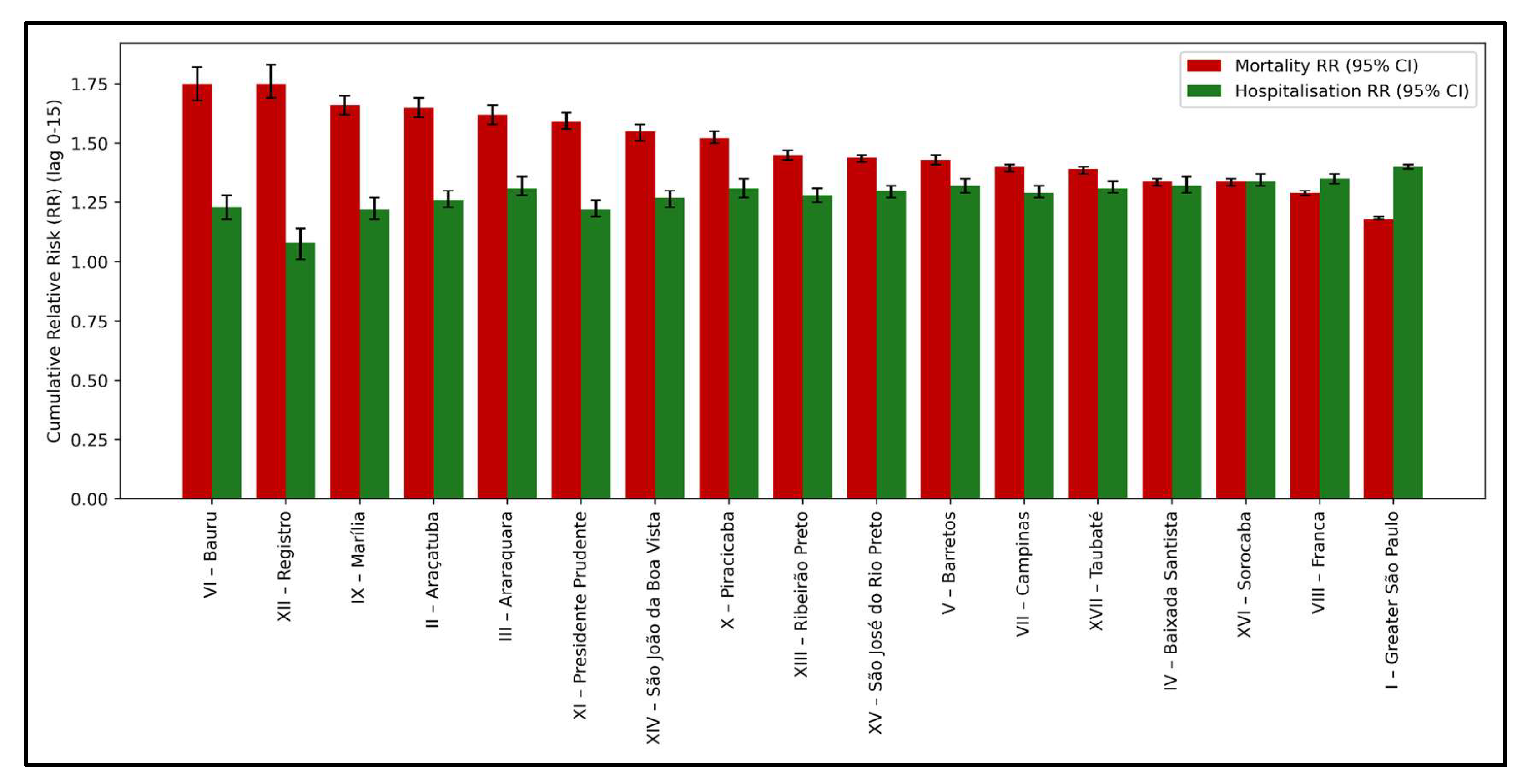
Figure 2.
Spatial distribution of the Climate Vulnerability Index to heat waves among older adults by Regional Health Department (RHD), São Paulo State, Brazil.
Figure 2.
Spatial distribution of the Climate Vulnerability Index to heat waves among older adults by Regional Health Department (RHD), São Paulo State, Brazil.
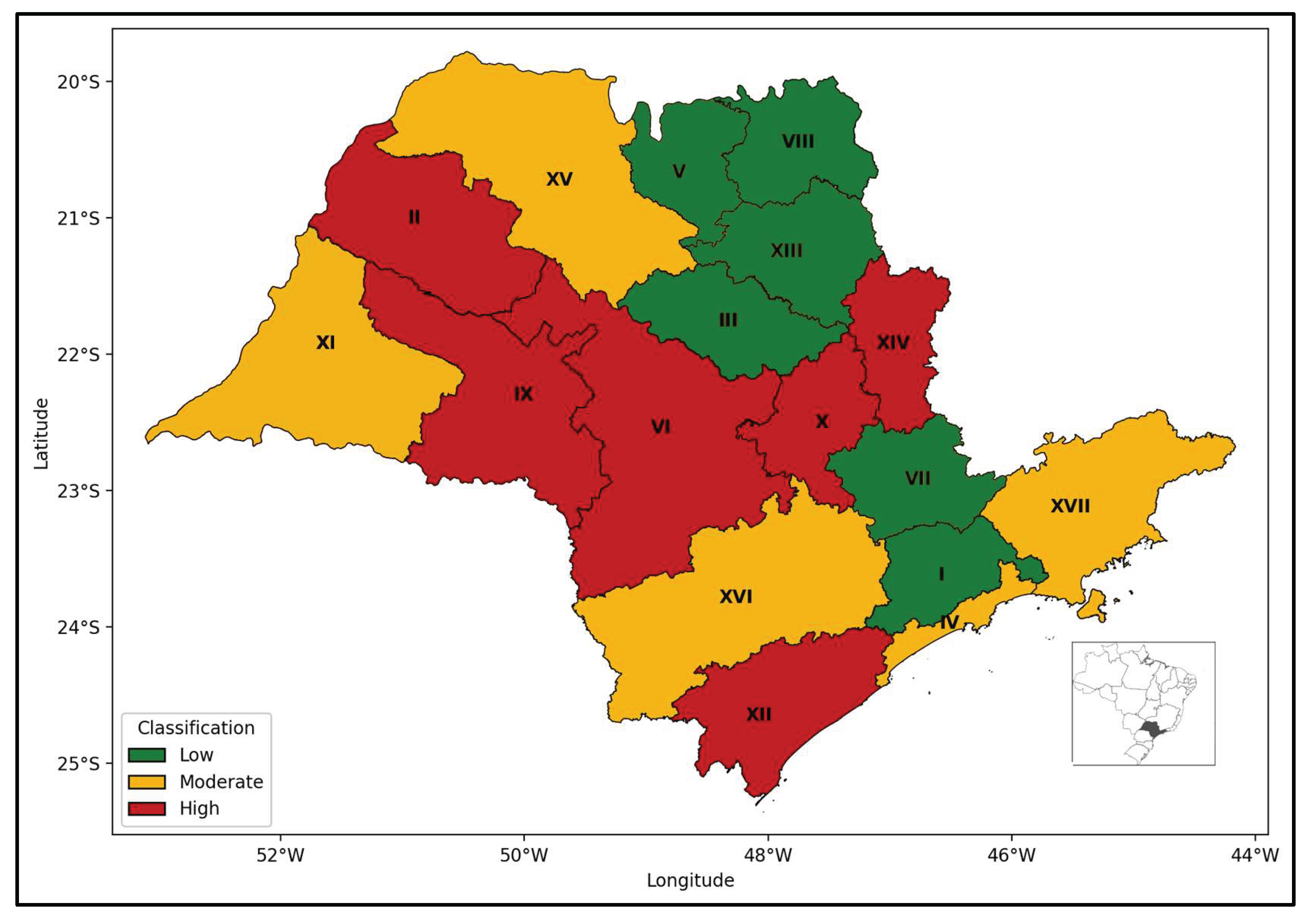

Table 1.
Sociodemographic and health system characteristics of the 17 RHDs in the state of São Paulo, Brazil.
Table 1.
Sociodemographic and health system characteristics of the 17 RHDs in the state of São Paulo, Brazil.
| RHDs | Proportion of older adults (60 years, %) | Mean HDI | Water supply coverage (%) | Sewerage coverage (%) | Primary care coverage (%) ¹ | Health human resources index² | Per capita public health expenditure index³ |
|---|---|---|---|---|---|---|---|
| I – Greater São Paulo | 16 | 0.760 | 98.5 | 94.0 | 2.27 | 1.26 | 2.73 |
| II – Araçatuba | 19 | 0.740 | 95.0 | 92.6 | 2.98 | 3.09 | 2.71 |
| III – Araraquara | 17.8 | 0.743 | 95.1 | 95.0 | 2.36 | 3.00 | 2.79 |
| IV – Baixada Santista | 18.7 | 0.759 | 91.7 | 77.2 | 1.87 | 3.09 | 3.24 |
| V – Barretos | 18.2 | 0.742 | 97.9 | 97.8 | 2.60 | 3.23 | 2.78 |
| VI – Bauru | 17.8 | 0.732 | 95.5 | 93.5 | 2.41 | 3.03 | 2.41 |
| VII – Campinas | 17.1 | 0.757 | 95.4 | 91.1 | 2.32 | 2.81 | 3.18 |
| VIII – Franca | 17 | 0.737 | 97.7 | 97.4 | 3.06 | 3.38 | 2.35 |
| IX – Marília | 19.2 | 0.736 | 95.2 | 94.2 | 2.76 | 2.86 | 2.67 |
| X – Piracicaba | 17.4 | 0.756 | 96.7 | 96.2 | 2.45 | 3.24 | 2.75 |
| XI – Presidente Prudente | 19.6 | 0.736 | 93.1 | 90.4 | 3.23 | 3.39 | 2.44 |
| XII – Registro | 20.6 | 0.703 | 75.1 | 62.9 | 2.79 | 2.63 | 2.74 |
| XIII – Ribeirão Preto | 16.6 | 0.743 | 97.3 | 96.7 | 2.34 | 3.03 | 2.74 |
| XIV – São João da Boa Vista | 19.1 | 0.747 | 95.2 | 92.8 | 2.27 | 2.53 | 2.75 |
| XV – São José do Rio Preto | 20.1 | 0.743 | 96.0 | 94.0 | 2.90 | 2.27 | 2.63 |
| XVI – Sorocaba | 16.7 | 0.717 | 91.2 | 81.8 | 2.23 | 3.02 | 2.51 |
| XVII – Taubaté | 17.2 | 0.735 | 94.1 | 88.7 | 2.33 | 2.42 | 2.85 |
¹ Primary care coverage: estimated population coverage by primary health care and the Family Health Strategy. ² Health human resources index: composite indicator based on total personnel expenditure and the proportion of workers linked to the public SUS system (Paschoalotto et al, 2018). ³ Per capita public health expenditure index: composite index based on total public health expenditure per inhabitant (SIOPS/DATASUS). Data sources: DATASUS; IBGE; SNIS; Fundação SEADE; SIOPS.
Table 2.
Hospitalizations and deaths due to cardiovascular (CV) and respiratory (Resp) causes among older adults (≥60 years) by RHDs, State of São Paulo, 2010–2019, 2023 and 2023–2024.
Table 2.
Hospitalizations and deaths due to cardiovascular (CV) and respiratory (Resp) causes among older adults (≥60 years) by RHDs, State of São Paulo, 2010–2019, 2023 and 2023–2024.
| RHDs | CV hospitalizations (x 1,000) | Respiratory hospitalizations (x 1,000) | CV deaths (x 1,000) | Respiratory deaths (x 1,000) |
|---|---|---|---|---|
| I – Greater São Paulo | 397.5 | 206.2 | 290.3 | 141.6 |
| II – Araçatuba | 21.7 | 22.7 | 9.1 | 7.7 |
| III – Araraquara | 22.4 | 16.0 | 10.0 | 7.0 |
| IV – Baixada Santista | 26.9 | 15.0 | 33.6 | 13.7 |
| V – Barretos | 10.0 | 11.1 | 5.5 | 4.1 |
| VI – Bauru | 47.6 | 40.5 | 22.5 | 16.3 |
| VII – Campinas | 78.5 | 63.9 | 52.1 | 33.6 |
| VIII – Franca | 15.0 | 14.0 | 8.6 | 6.2 |
| IX – Marília | 38.2 | 31.2 | 16.3 | 10.7 |
| X – Piracicaba | 23.0 | 14.8 | 16.2 | 11.2 |
| XI – Presidente Prudente | 27.9 | 21.1 | 10.8 | 7.5 |
| XII – Registro | 5.7 | 4.2 | 4.2 | 2.2 |
| XIII – Ribeirão Preto | 36.7 | 28.9 | 17.2 | 11.7 |
| XIV – São João da Boa Vista | 25.6 | 23.8 | 12.7 | 8.1 |
| XV – São José do Rio Preto | 58.6 | 51.9 | 21.4 | 17.5 |
| XVI – Sorocaba | 47.6 | 47.3 | 28.5 | 19.9 |
| XVII – Taubaté | 54.9 | 33.6 | 26.4 | 17.5 |
Source: Hospital Information System (SIH/SUS); Mortality Information System (SIM/SUS). Note: Totals expressed in thousands of hospitalizations (2010–2019 and 2023–2024) and deaths (2010–2019 and 2023) among older adults (≥60 years).
Table 3.
Cumulative relative risks (RRs) of cardiorespiratory mortality and hospitalizations among older adults associated with heat wave exposure (lag 0–15 days), by RHDs, State of São Paulo, Brazil.
Table 3.
Cumulative relative risks (RRs) of cardiorespiratory mortality and hospitalizations among older adults associated with heat wave exposure (lag 0–15 days), by RHDs, State of São Paulo, Brazil.
| RHDs | Mortality RR (95% CI) | Hospitalization RR (95% CI) |
|---|---|---|
| I – Greater São Paulo | 1.18 (1.18–1.19) | 1.40 (1.39–1.41) |
| II – Araçatuba | 1.65 (1.61–1.69) | 1.26 (1.23–1.30) |
| III – Araraquara | 1.62 (1.58–1.66) | 1.31 (1.28–1.36) |
| IV – Baixada Santista | 1.34 (1.32–1.35) | 1.32 (1.29–1.36) |
| V – Barretos | 1.43 (1.41–1.45) | 1.32 (1.29–1.35) |
| VI – Bauru | 1.75 (1.68–1.82) | 1.23 (1.18–1.28) |
| VII – Campinas | 1.40 (1.38–1.41) | 1.29 (1.27–1.32) |
| VIII – Franca | 1.29 (1.28–1.30) | 1.35 (1.33–1.37) |
| IX – Marília | 1.66 (1.62–1.70) | 1.22 (1.18–1.27) |
| X – Piracicaba | 1.52 (1.50–1.55) | 1.31 (1.27–1.35) |
| XI – Presidente Prudente | 1.59 (1.56–1.63) | 1.22 (1.19–1.26) |
| XII – Registro | 1.75 (1.69–1.83) | 1.08 (1.01-1.14) |
| XIII – Ribeirão Preto | 1.45 (1.43–1.47) | 1.28 (1.25–1.31) |
| XIV – São João da Boa Vista | 1.55 (1.51–1.58) | 1.27 (1.23–1.30) |
| XV – São José do Rio Preto | 1.44 (1.42–1.45) | 1.30 (1.27–1.32) |
| XVI – Sorocaba | 1.34 (1.32–1.35) | 1.34 (1.32–1.37) |
| XVII – Taubaté | 1.39 (1.37–1.40) | 1.31 (1.29–1.34) |
Source: DLNM modelling – SIM/SUS (DATASUS, 2024).
Table 4.
Climate Vulnerability Index to heat waves among older adults, by Regional Health Department (RHD), São Paulo State, 2024.
Table 4.
Climate Vulnerability Index to heat waves among older adults, by Regional Health Department (RHD), São Paulo State, 2024.
| RHD | Sensitivity (0.65) ¹ | Adaptive Capacity (0.35) ² | Index³ | Classification |
|---|---|---|---|---|
| I Greater São Paulo | 0.25 | 0.136 | 0.386 | Low |
| II Araçatuba | 0.44 | 0.088 | 0.528 | High |
| III Araraquara | 0.43 | 0.118 | 0.548 | High |
| IV Baixada Santista | 0.34 | 0.148 | 0.488 | Moderate |
| V Barretos | 0.37 | 0.086 | 0.456 | Low |
| VI Bauru | 0.42 | 0.142 | 0.562 | High |
| VII Campinas | 0.29 | 0.097 | 0.39 | Low |
| VIII Franca | 0.28 | 0.087 | 0.367 | Low |
| IX Marília | 0.42 | 0.113 | 0.533 | High |
| X Piracicaba | 0.37 | 0.087 | 0.457 | Low |
| XI Presidente Prudente | 0.40 | 0.088 | 0.488 | Moderate |
| XII Registro | 0.40 | 0.257 | 0.657 | High |
| XIII Ribeirão Preto | 0.29 | 0.116 | 0.406 | Low |
| XIV São João da Boa Vista | 0.41 | 0.133 | 0.543 | High |
| XV São José do Rio Preto | 0.42 | 0.103 | 0.522 | Moderate |
| XVI Sorocaba | 0.29 | 0.203 | 0.493 | Moderate |
| XVII Taubaté | 0.31 | 0.154 | 0.464 | Moderate |
¹ Sensitivity includes proportion of older adults (0.15) + increase in hospitalizations (0.25) + increase in deaths (0.25). ² Adaptive capacity: Human Development Index (0.08) + coverage of water supply and sanitation (0.10) + health workforce density (0.05) + health financing (0.03). ³ Final Index = weighted mean of the normalized sub-indices (Sensitivity and Adaptive Capacity). Source: Authors’ elaboration based on DLNM data – SIM/SIH/SUS (DATASUS, 2024); ERA5 – ECMWF (2025). Classification: ≤0.459: low vulnerability; >0.459 to ≤0.527: moderate vulnerability; >0.527 : high vulnerability.
Table 5.
Distribution of RHDs according to the Climate Vulnerability Index to heat waves in older adults, São Paulo State, Brazil.
Table 5.
Distribution of RHDs according to the Climate Vulnerability Index to heat waves in older adults, São Paulo State, Brazil.
| Vulnerability category | Index range | Count of RHDs (%) |
RHDs |
|---|---|---|---|
| Low | ≤ 0.459 | 6 (35.3%) | Greater São Paulo,Campinas, Franca, Piracicaba, Ribeirão Preto, Barretos |
| Moderate | > 0.459–≤ 0.526 | 5 (29.4%) | Baixada Santista, Presidente Prudente, São José do Rio Preto, Sorocaba, Taubaté |
| High | > 0.526 | 6 (35.3%) | Araçatuba, Araraquara, Bauru, Marília, São João da Boa Vista, Registro |
Notes: Cut-off values were defined using empirically derived terciles based on the distribution of the Climate Vulnerability Index across the 17 RHDs. RHDs refer to Regional Health Departments of São Paulo State, Brazil.
Disclaimer/Publisher’s Note: The statements, opinions and data contained in all publications are solely those of the individual author(s) and contributor(s) and not of MDPI and/or the editor(s). MDPI and/or the editor(s) disclaim responsibility for any injury to people or property resulting from any ideas, methods, instructions or products referred to in the content. |
© 2026 by the authors. Licensee MDPI, Basel, Switzerland. This article is an open access article distributed under the terms and conditions of the Creative Commons Attribution (CC BY) license (http://creativecommons.org/licenses/by/4.0/).
Copyright: This open access article is published under a Creative Commons CC BY 4.0 license, which permit the free download, distribution, and reuse, provided that the author and preprint are cited in any reuse.


