
Submitted:
27 January 2026
Posted:
29 January 2026
You are already at the latest version
Abstract
Contamination of water with heavy metals remains a life-threatening global concern due to the persistence, toxicity, and bioaccumulation of metals such as Pb(II), Cd(II), Cu(II), and Hg(II). Conventional remediation technologies, including ion exchange, membrane filtration, and precipitation, offer limited scalability and often generate secondary waste. In contrast, bacterial cellulose (BC) and its composite derivatives have emerged as sustainable bioadsorbents with tunable surface chemistry, high porosity, and exceptional biocompatibility. Over the past decade, BC-based materials have achieved adsorption capacities up to 571 mg/g for Pb²⁺, 509 mg/g or Cu²⁺, and 382 mg/g for Cd²⁺, outperforming most traditional bioadsorbents. This review systematically analyses the structural design, surface functionalization, and mechanistic pathways governing metal ion capture by BC composites. Special emphasis is placed on correlating modification strategies (carboxymethylation, amination, and magnetic) with adsorption kinetics, thermodynamics, and regeneration efficiency. Compared to previous reviews, this work uniquely integrates quantitative analysis, multi-metal adsorption behaviour, and insights from real wastewater applications, highlighting critical gaps in scalability, durability, and regulatory readiness. Finally, we outline future research trajectories, including green synthesis optimization and integration with hybrid technologies (photocatalysis and electro-adsorption) to link the gap between performance of research laboratories and industrial deployment. By providing a mechanistically grounded and application-oriented perspective, this review positions BC composites as next-generation materials for sustainable heavy metal remediation.
Keywords:
bacterial cellulose composites
; remediation
; water purification
; sustainable materials
; reusability
1. Introduction
Water pollution from rapid industrialization remains a global challenge, with heavy metals representing a particularly critical threat due to their persistence, non-biodegradability, and toxicity to ecosystems and human health. Major sources include industrial and agricultural goings-on, pharmaceuticals, domestic runoffs, and atmospheric deposition [1]. Toxic ions such as Cd(II), Hg(II), Pb(II), Cu(II), As(III), Cr(VI/III), and Ni(II) readily enter the food chain, bioaccumulating at the highest trophic levels and causing serious health diseases as mentioned in Table 1. Protecting water and food resources from such contamination is therefore an urgent priority [2].
Growing interest in removing and recovering toxic as well as precious metals from water stems from both environmental and resource considerations, with several classifications of raw materials being critical under the Materials Initiative [3]. Existing technologies, including membrane filtration, chemical precipitation, ion exchange process, electrochemical method, and photocatalyst, offer solutions but are often costly or limited in scalability [4,5,6,7,8,9,10]. Among them, adsorption stands out as an efficient and economical approach, valued for its simplicity, versatility, and broad applicability to organic and inorganic pollutants [11,12]. The effectiveness of this process, however, depends strongly on the choice of adsorbent, which must balance stability, capacity, porosity, cost, and biodegradability in line with industrial and environmental policy demands [13,14].
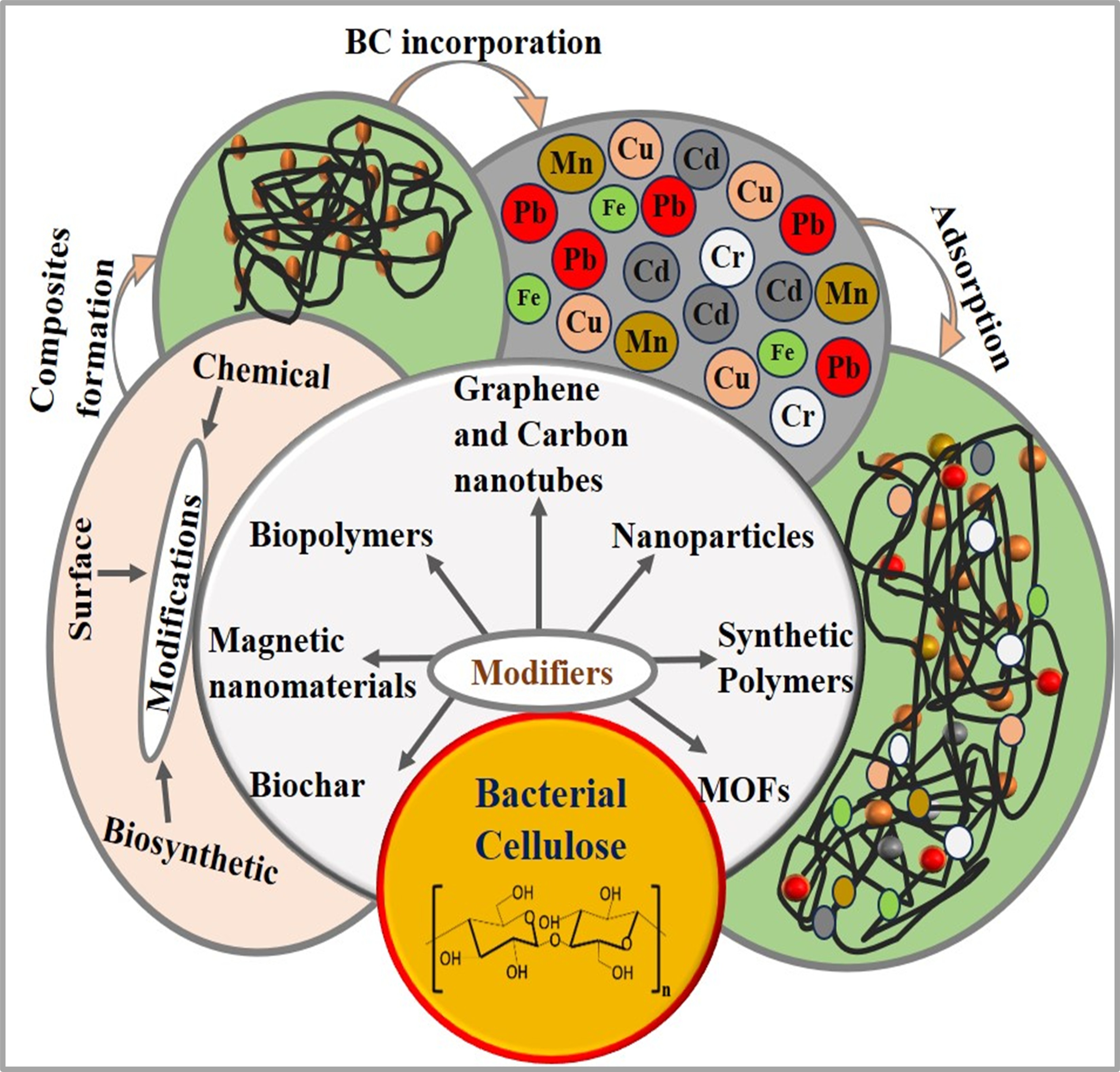
Conventional inorganic adsorbents such as activated alumina, iron oxides, activated carbon, and nanomaterials face drawbacks as well as high cost, complex preparation, and poor biocompatibility [19]. This has accelerated the search for sustainable alternatives that are biodegradable, low-cost, and environmentally friendly [20]. Bioadsorbents derived from renewable biomass have emerged as promising candidates, offering a viable and eco-efficient route for removing toxic metals from water and wastewater [21,22,23] (Figure 1).
Polysaccharides, as renewable and biodegradable biopolymers, can adsorb diverse contaminants via chemical and physical interactions, offering an inexpensive strategy for aquatic decontamination [25]. Among them, cellulose is abundant, non-toxic, and biocompatible, with numerous hydroxyl groups that enable functional modifications and enhance the adsorption of aqueous contaminants [26]. Due to their potential of metal ions adsorption, materials based on cellulose-composite materials have drawn a lot of interest from scientists; in fact, they have been studied since the 1990s [27]. Beyond plant sources, certain bacteria, including Gluconacetobacter, Acetobacter, and Pseudomonas, produce bacterial cellulose (BC), which shares the molecular structure of plant cellulose but forms an ultrafine nanofibrous network [28]. BC can be produced via static fermentation, yielding membranes, or agitated fermentation, generating spherical forms having nanopores and large surface area and, suitable for heavy metal removal and bio-separation [29,30]. Efficient strategies to synthesize high-performance cellulose-based bioadsorbents remain critical.
In this review’s Section 2 briefly explain an overview for adsorbent of cellulose. Next part we will 3 evaluates their classification into three major types: (i) surface functionalized cellulose materials, (ii) blended cellulose materials, and (iii) cellulosic biomaterials. The metal ions evaluation as adsorbent divide into three major parts : (a) ions of PTEs such as Ni(II), Cu(II), Cr(III), Cr(VI), Hg(II), Cd (II), Zn(II), Pb(II), Co(II), Fe(III), As(III), and As(V); (b) ions of RNs such as U(VI), 137Cs(I), 90Sr(II), 60Co(II), 140La(III); and (c) ions of PMs such as Au(III), Ag(I), Pt(IV), and Pd(II). At the end, Section 4 give overview of upcoming trends of cellulose-based adsorbents, while Section 5 discusses challenges and future perspectives.
Bacterial Cellulose (BC) is a promising bioadsorbent for heavy metal removal due to its three-dimensional nanofibrous network, high surface area, porosity, abundant hydroxyl groups, and water-holding capacity [31,32]. However, its limited adsorption capacity, selectivity, and stability under variable conditions restrict practical applications. Composite strategies, incorporating bioactive polymers, nanomaterials, or solid particles, have enhanced BC’s adsorption efficiency and added functionalities such as antimicrobial, conductive, and magnetic properties [33]. Recent research emphasizes developing cost-effective and environmentally friendly BC derivatives for water treatment. This review systematically summarizes BC-based adsorbents, including surface-functionalized cellulose, blended composites, and cellulosic biomaterials, and evaluates their mechanisms and effectiveness for removing diverse metal ions, including potentially toxic elements, radionuclides, and precious metals, while highlighting current trends and future perspectives.
- Design s multifunctional materials for water treatment is still remains a challenge.
- Recently a major challenge is to design derivative BC composite related to economical and environmentally friendly problems.
Mainly this review offers a comprehensive outline of bacterial cellulose (BC) and its composite-based adsorbents as sustainable, cost-effective, and high-performance materials for the elimination and recovery of toxic and valuable metal ions from contaminated water. By examining the structural features, functionalization strategies, and adsorption mechanisms of BC-based systems, this review aims to highlight their potential in addressing both environmental remediation challenges and resource recovery needs. We hope this review will encourage more researchers to design and implement innovative bioadsorbents based on BC, advancing sustainable strategies for water purification and resource recovery.
2. BC Synthesis and Properties
BC produced by Gram-negative bacteria such as Acetobacter and Gluconacetobacter, is synthesized from carbon-rich media, with Hestrin-Schramm (HS) medium widely used [34]. Source to produce the BC by using static, agitated, and bioreactor cultures, affect its morphology and mechanical properties. Static cultures yield strong membranes but face oxygen limitations, agitated cultures improve nutrient supply at the cost of mechanical strength, and bioreactors enhance scalability but introduce shear stress and higher energy demands [35,36,37,38,39,40,41,42,43,44,45]. Method selection depends on the intended application.
BC contains hydroxyl, amino, carboxyl functional groups that facilitate binding with heavy metal ions [46]. Structurally, cellulose is a linear polymer of β-(1→4)-linked glucose units, stabilized by inter- and intramolecular hydrogen bonds between hydroxyl groups and oxygen atoms [47]. BC is an environmentally friendly polymer with high crystallinity (80-90%), mechanical strength (49-422 MPa), and water retention (up to 1000%), owing to extensive hydrogen bonding [48,49]. Its ultrafine nanofibrous network, renewability, biocompatibility, and abundant hydroxyl groups make BC a promising biosorbent for heavy metal ions. Functionalization, such as grafting diethylenetriamine, can enhance metal chelation, though adsorption capacity often remains limited. BC-based composites have further improved performance, demonstrating enhanced heavy metal removal and potential for wastewater treatment [50].
3. BC Modifications for Composite Formation
Composites consist of a matrix supporting a reinforcement material, which imparts specific physico-chemical and biological properties [51]. BC nanocomposites are formed via modification techniques that enhance stability, porosity, and functionality [52]. BC composites have been developed with natural and synthetic polymers, inorganic nanoparticles, metals, metal oxides (Figure 2(a)), clays, and carbon-based nanomaterials, including graphene and carbon nanotubes (Figure 2(d)) [33,52,53] as some of them are mentioned in Table 2. Such reinforcements can confer conductivity, antimicrobial activity, or enhanced adsorption, applied through in situ synthesis, mixing, printing, doping, or coating methods.
BC has been composited by biopolymers such as alginate, chitosan, starch, hyaluronic acid, collagen, keratin, gelatin, PLA, and PHA, as well as synthetic polymers including PVA, PANI, and PAEM [62]. BC composites have also incorporated biomolecules, enzymes, antibiotics, amino acids, peptides, hormones, and cells to extend functionality [63,64]. Magnetic nanomaterials, including metal and metal oxide nanoparticles, provide unique magnetic properties for manipulation and localized effects [65]. For example, an electromagnetic BC composite was produced by culturing Gluconacetobacter xylinus with magnetite nanoparticles, followed by in situ polyaniline polymerization, combining magnetic and conductive properties [66] ( Figure 2(b)).
BC serves as a porous, hydrophilic matrix, with its nanofibrous network enabling the incorporation of nanoparticles and other functional materials. Indeed, BC composition helpful boost its applications; however, current literature is primarily concentrated on the addition of organic functional groups to the BC composite [33,67]. Functionalization with organic groups, such as diethylenetriamine, enhances metal ion adsorption, while embedding nano adsorbents into BC overcomes challenges of low solubility and difficult recovery [68]. In situ preparation allows metal or polymer nanoparticles (Figure 2(c)) to be integrated into the BC matrix without disrupting its three-dimensional nanoporous structure, providing a versatile platform for high-capacity, recyclable heavy metal removal [69].
4. BC Modification
BC, with chemistry similar to plant cellulose but superior physical properties, has been widely used in composite materials. Its abundant surface hydroxyl groups enable diverse modifications: surface functionalization, chemical or biological modification, nanoparticle incorporation, physical treatments, and composite formation to enhance heavy metal adsorption [69]. In particular, in situ composite formation, leveraging BC’s biotechnological production, provides an efficient strategy to improve metal-binding capacity and contaminant removal [71].
4.1. Surface Modification
BC has abundant surface hydroxyl groups that facilitate blending with other materials, enhancing composite properties [72,73]. However, hydrogen bonds with reinforcing agents are often weak, and converting hydroxyls to carboxyl or carboxylate groups improves crosslinking and composite stability [74,75,76,77,78]. Common strategies include hyaluronic acid immersion and carboxymethylation, which introduce functional groups to enhance metal adsorption. Oxidation with TEMPO under harsher conditions achieves similar effects. Hydrophilicity can also be transformed to hydrophobicity via alkoxysilane hydrolysis and surface modifications, creating porous, superhydrophobic BC membranes suitable for applications such as water oil separation [79]. Some surface modification methods are highlighted in (Figure 3(c)).
4.2. Chemical Modification
Biosynthetic modification of BC is sustainable but limited by fermentation constraints and additive microfibril interactions. Chemical modifications, including carboxymethylation, acetylation, and phosphorylation, provide greater flexibility, introducing functional groups that enhance hydrophobicity, ion adsorption, and optical properties while preserving BC’s nanonetwork and mechanical strength [62]. Functionalized derivatives such as diethylenetriamine-BC (EABC), amidoximated-BC (Am-BC), and phosphorylated BC maintain the microporous structure and exhibit improved metal ions adsorption [80,81]. Chemical modification is also carried out using in-situ and ex-situ methods for synthesis of BC nanocomposite, as depicted in (Figure 3(a-b)) [52]. TEMPO-mediated oxidation introduces carboxylate groups under mild aqueous conditions, anchoring metal ions without altering crystallinity or crystal size [69,82].
4.3. Biosynthetic Modification
The morphology and supramolecular structure of bacterial cellulose (BC) can be modified through cultivation situations, including strain selection, carbon source, and media additives (Figure 4(a)) [69,72]. Additives influence BC assembly, affecting crystallinity, ribbon width, pore structure, water content, and mechanical properties. For example, antibiotics such as nalidixic acid increase ribbon width, while reducing agents like dithiothreitol narrow it. Polymers such as CMC, HPMC, MC, PVA, and PEG modify crystallinity, porosity, and water retention, enhancing ion adsorption and thermal stability. Functionalized BC demonstrates improved heavy metal adsorption, highlighting the potential of additive-mediated control during biosynthesis [76,83,84,85].
4.4. Nano-Fibrillated Bacterial Cellulose (NFBC)
Nano-fibrillated Bacterial Cellulose (NFBC) consists of elongated fibers (>17 μm) with diameters around 20 nm, providing a high aspect ratio and enlarged specific surface area, favorable for adsorption [86]. While NFBC lacks inherent metal-binding groups, surface hydroxyls can be functionalized, for example, with EDTA (ethylenediaminetetraacetic acid), to enable efficient heavy metal removal. EDTA-grafted NFBC (EDNFBC) (Figure 4(b)) demonstrates enhanced adsorption capacity, highlighting the potential of surface-modified CNFs as effective biosorbents [87,88,89,90,91].
5. Heavy Metals Adsorption/Removal from Water
Heavy metal elements with atomic numbers >20 and densities ≥5× that of water, such as Cu, Cr, Cd, Pb, pose serious environmental and health risks, including cancer, neuromuscular disorders, and metabolic failure [61,92]. Removal strategies include bioremediation, chemical precipitation, membrane filtration, adsorption, phytoremediation, and microbial conversion [4,5,7,93,94,95]. BC and BC-based composites have emerged as effective adsorbents, with reinforced composites enhancing metal-binding through carboxylate and amine groups via coordination, ion exchange, and electrostatic interactions [25,32,96,97]. Examples include BC-attapulgite magnetic composites for Cr6+ and Cu2+ (91 and 70.5 mg/g, respectively) [25] and poly(amidoxime)-BC aerogels for Pb2+, Cu2+, Zn2+, Mn2+, and Cd2+ (382-571 mg/g) [97]. Functionalization, such as carboxymethylation, further improves adsorption, as demonstrated for Pb2+ (50.2 mg/g within 60 min) [98]. Table 3 represented some applications of composite for metal removal.
[Material Institute Lavoisier-100(Iron)(MIL)-100(Fe)(a), imidazolate framework-67(ZIF-67)/chitosan (CH)(b), attapulgite(ATP) BC nanofibrils chitosan(BCNs/CS))(c), polyamidoxime (PAO)(d), bacterial cellulose-bentonite@polyethylenimine (BCB@PEI)(e), nanoscale zero-valent iron onto BC membranes (BCM-nZVI) (f)]
5.1. Adsorption/Removal Mechanism of BC
In wastewater treatment, adsorption is a promising approach for heavy metal removal. Three-dimensional nanofibrous network of BC provides increased surface area and diverse porosity, facilitating adsorption [100] as (Figure 5(a)) represents the general adsorption mechanism by cellulose based materials. Functional groups, including methoxy, amide, phenolic, thiol, carbonyl, and carboxyl act as electron donors, forming stable complexes with metal ions by hydrophobic interactions, hydrogen bonding, and coordination [100,101,102]. Integration of functional groups into BC enhances adsorption capacity, with the detailed adsorption mechanisms extensively described in the literature [103,104].
Zhao et al. developed BC bentonite@polyethylenimine (BCB@PEI) composite membranes for water treatment combining structural durability, high surface area, and enhanced adsorption sites [60]. Bentonite contributed -OH and aluminum oxide groups for ionic and van der Waals interactions, PEI provided -NH2 /-NH3+ groups for metal coordination, and BC offered -OH and -NHC=O groups for hydrogen bonding and electrostatic interactions (Figure 5(b)). The synergistic effect of these components improved the heavy metals and organic dyes adsorption, illustrating the benefit of multi-component BC-based composites [60,105].
5.1.1. Adsorption Mechanism of Lead Ions
Adsorption of Pb(II) onto BC-hydroxyapatite (BC-HA) nanocomposites ( Figure 6(a)) involves ions exchange, electrostatic interactions, and complexation [106]. In BC, abundant hydroxyl groups provide active sites, but weak electrostatic interactions limit adsorption capacity [107]. Incorporating HA enhances adsorption by introducing additional cation-exchange sites via calcium ions, which readily bind Pb(II) due to similar ionic radius and high electronegativity. Complexation with hydroxyl protons further contributes to Pb(II) removal, collectively improving the efficiency of the BC-HA composite [108].
5.1.2. Adsorption Mechanism of Copper Ions
Xiaorui et al. reported that Cu(II) adsorption by copper-ion imprinted BC (IBCN-Cu) occurs via chemisorption, involving coordination between Cu(II) ions and BC hydroxyl groups ( Figure 6(b)). This chelation creates valence interactions, while the imprinting process generates specific adsorption sites complementary in charge, size, shape, coordination number, and spatial arrangement, conferring high selectivity and resistance to interference for Cu(II) ions [46].
5.1.3. Adsorption Mechanism of Cadmium Ions
Cheng et al. described cadmium removal by BC-nZVI composites (BCM-nZVI), where reduction dominates Cd²⁺ adsorption ( Figure 6(c)). Direct reduction of Cd²⁺ by Fe²⁺ is limited due to similar redox potentials (Fe²⁺, E₀ = -0.41 V; Cd²⁺, E₀ = -0.40 V). In aqueous solutions, Fe⁰ generates hydrated electrons (E₀ = -2.91 V), which reduce Cd²⁺ to insoluble, non-toxic Cd⁰, deposited on the composite. Concurrently, nZVI oxidizes to Fe²⁺/Fe³⁺, forming surface iron oxides (Fe₂O₃, Fe₃O₄, FeOOH), and the solution pH rises to ~8.8, indicating OH⁻ formation [99].
5.1.4. Adsorption Mechanism of Chromium Ions
Qiao et al. described Cr(VI) remediation using BC-nZVI composites [109] (Figure 6(d)). Cr(VI) is chemisorbed via surface pores and oxygen-containing groups, then reduced to Cr(III) through direct electron transfer from nZVI and indirect transfer via BC. The nZVI-BC system continuously generates [H] and Fe²⁺, accelerating Cr(VI) reduction while Fe²⁺ oxidizes to Fe³⁺. Some Cr(III) is initially repelled electrostatically, but interaction with negatively charged CMC-nZVI@BC (carboxymethyl cellulose loaded on biochar) converts repulsion into stable complexes with iron, attraction, and surface functional groups.
5.2. Adsorption Performance of BC Composites Toward Heavy Metals
Adsorption capability of BC composites for heavy metals increases with initial ion concentration until reaching equilibrium, demonstrating excellent removal performance [99,110]. Increasing the adsorbent dosage further enhances removal, as more active sites become available for metal ion binding.
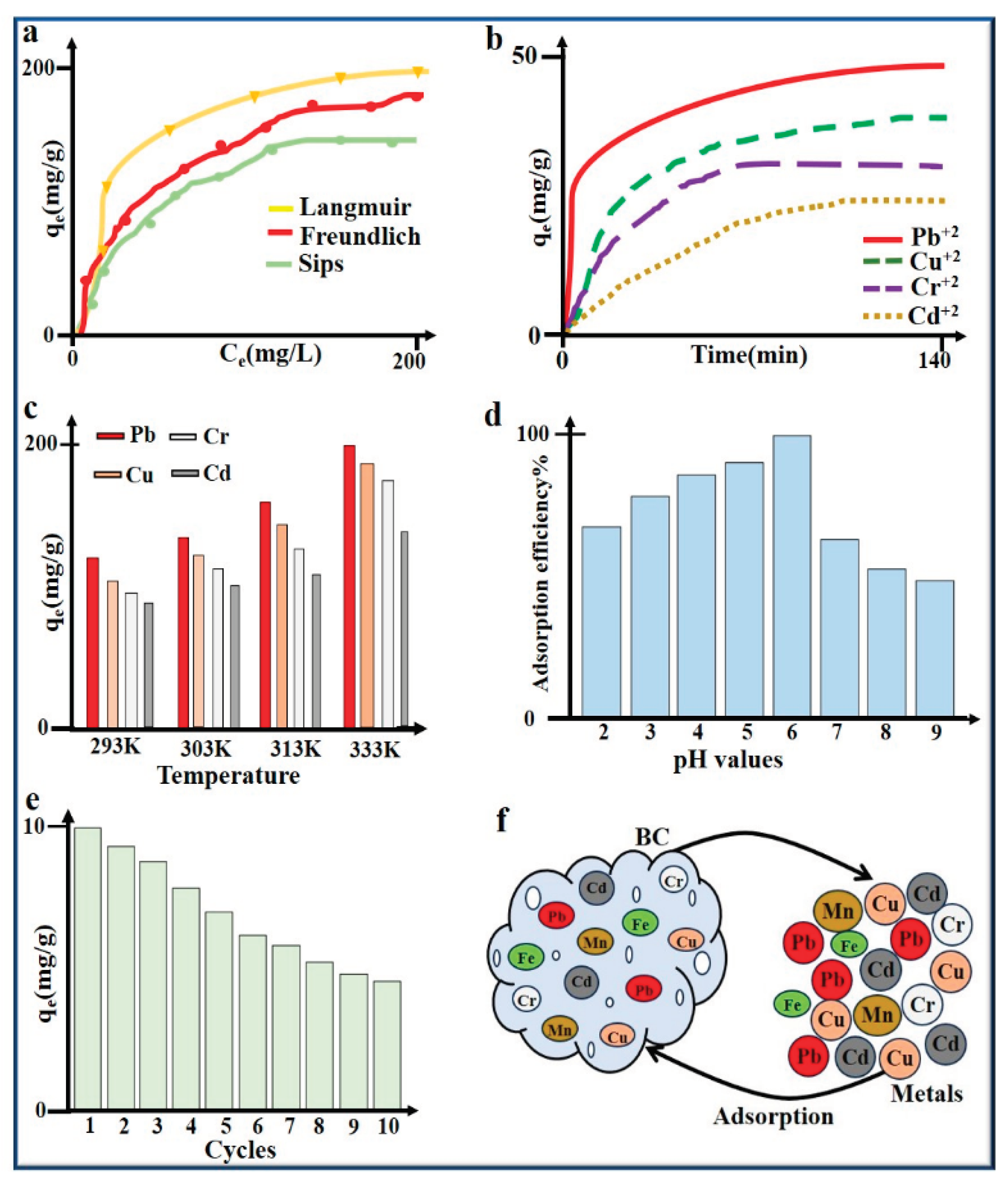
Adsorption isotherms of BC composites for heavy metals were generally analyzed by using Langmuir, Freundlich models, and Sips isotherms (Figure 7(a)) [99,109]. Time-dependent studies show rapid uptake: Pb²⁺ and Cu²⁺ reach 99% removal within 15 min and equilibrium by 20 min, while Mn²⁺, Cr²⁺, and Cd²⁺ reach equilibrium within 25 min with 70-85% removal (Figure 7(b)) [97]. Low-dose BC composites (0.5 g L⁻¹) achieve high removal efficiency in <30 min, demonstrating their suitability for fast water purification. Adsorption kinetics fit both pseudo-first-order and pseudo-second-order models with high correlation (R² > 0.9997), indicating chemisorption as the dominant mechanism. Rapid kinetics are attributed to hierarchical porous channels, facilitating dynamic diffusion to active sites [97,109,111]. The nonlinear equations can describe the adsorption process:
Here, qe and qt (mg/g) are the adsorption capacities at equilibrium and t time, respectively, and k1 (1/h) and k2 (gm/g/h) are the rate constants [106,112,113].
Adsorption of heavy metals is strongly pH-dependent [99,110,114]. Solution pH influences both the surface charge and the metal ions adsorbent. For BC composite aerogels, removal efficiencies of Pb(II), Cu(II), Zn(II), Mn(II), and Cd²⁺ increase with pH from 2 to 6, reaching a maximum at pH 6, and show weak dependence beyond this range, indicating broad pH applicability [97] (Figure 7(d)). At pH <pHPZC (point of zero charge), adsorbent surfaces are positively charged, reducing metal uptake due to electrostatic repulsion. In contrast, at pH >pHPZC, deprotonation of hydroxyl and amino groups generates negative charges, enhancing adsorption via electrostatic interactions and complexation [115,116]. To avoid metal hydroxide precipitation, pH 6 is typically selected for subsequent studies [117]. These composites are effective for water treatment across varying pH conditions [60,110].
The adsorption capacity of BC composites increases with temperature (Figure 7(c)) as elevated thermal energy enhances ion mobility and contact with active sites. Thermodynamic investigation exposed negative ΔG° values, confirming spontaneity, and a positive ΔH° (~59.7 kJ/mol), indicating endothermic chemisorption. The positive ΔS° (~46.0 J/mol/K) enhance interaction at the solid-liquid interface. Together, these parameters demonstrate that higher temperatures favor heavy-metal removal and broaden the operational tolerance of BC composites [60,109,118,119,120].
6. Reusability of the BC Composites
Recyclability is critical for the practical application of adsorbents. BC composites retain >80% of their initial adsorption capacity for Cd²⁺, Pb²⁺, Cr²⁺ and Cu²⁺ after 10 cycles (Figure 7(e)), demonstrating excellent reusability and cost-effectiveness [60,91]. Similar studies report that modified BC-based composites maintain ~79% efficiency after repeated use [121,122,123], underscoring their potential for sustainable wastewater treatment (Figure 7(f)).
7. Conclusion and Future Perspective
Bacterial cellulose (BC) and its composites are emerging and effective materials for heavy metals, dyes, and organic pollutants from aqueous environments. Their three-dimensional polymeric networks, rich in hydrophilic groups, provide large surface areas and abundant binding sites, enabling interactions via, hydrogen bonding, electrostatic attraction, and van der Waals forces. Nano-cellulosic BC composites combine biodegradability, low toxicity, biocompatibility, reusability, and increased adsorption capacity, making them equally cost-effective and environmentally sustainable. Adsorption typically follows Langmuir or Freundlich isotherms, with kinetics described by pseudo-first- or second-order models, reflecting predictable and efficient performance.
Despite these advantages, the higher cost of BC production and chemical functionalization compared with conventional adsorbents remains a challenge. Future efforts should focus on scalable, cost-efficient fabrication, optimized regeneration cycles, and detailed structural and mechanistic characterizations to establish structure–activity relationships. Integrating theoretical modeling with experimental studies will further enable the rational design of high-performance composites. Collectively, BC-based materials offer a versatile, sustainable, and industrially viable platform for next-generation water remediation technologies.
Data availability
No new data were created or analyzed in this study. This article is a comprehensive review of existing literature, and all data supporting the findings are sourced from previously published studies, which are cited accordingly.
Author Contributions
Misbah Noreen: Writing-original draft, Investigation, Formal analysis, Muhammad Usama Raza: Writing, review, and Editing, Amanullah Amanullah: Writing-review & editing, Visualization, Investigation, Conceptualization, Iram Qadeer: Writing, review, editing, Visualization, Conceptualization.
Funding
None.
Acknowledgments
The author would like to thank the School of Material Science and Engineering at Wuhan University of Technology for providing the academic environment and resources necessary to conduct this study.
References
- Garg, S.; Goel, N. Encapsulation of heavy metal ions via adsorption using cellulose/ZnO composite: First principles approach. Journal of Molecular Graphics and Modelling 2023, 124, 108566. [Google Scholar] [CrossRef]
- Kaviani, S.; et al. DFT insight into Cd2+, Hg2+, Pb2+, Sn2+, As3+, Sb3+, and Cr3+ heavy metal ions adsorption onto surface of bowl-like B30 nanosheet. Journal of Molecular Liquids 2022, 365, 120131. [Google Scholar] [CrossRef]
- Perez, J.P.H.; et al. Progress in hydrometallurgical technologies to recover critical raw materials and precious metals from low-concentrated streams. Resources, Conservation and Recycling 2019, 142, 177–188. [Google Scholar] [CrossRef]
- Xie BiHuang, X.B.; et al. One-step removal of Cr (VI) at alkaline pH by UV/sulfite process: reduction to Cr (III) and in situ Cr (III) precipitation. 2016. [Google Scholar]
- Vo, T.S.; et al. Heavy metal removal applications using adsorptive membranes. Nano convergence 2020, 36. [Google Scholar] [CrossRef]
- Bashir, A.; et al. Removal of heavy metal ions from aqueous system by ion-exchange and biosorption methods. Environmental Chemistry Letters 2019, 17, 729–754. [Google Scholar] [CrossRef]
- Priastomo, Y.; et al. Simultaneous removal of lead (II), chromium (III), and copper (II) heavy metal ions through an adsorption process using C-phenylcalix [4] pyrogallolarene material. Journal of Environmental Chemical Engineering 2020, 8, 103971. [Google Scholar]
- Tran, T.-K.; et al. Electrochemical treatment of wastewater: Selectivity of the heavy metals removal process. International Journal of hydrogen energy 2017, 42, 27741–27748. [Google Scholar] [CrossRef]
- Garg, S.; Goel, N. Photodegradation of dye using Polythiophene/ZnO nanocomposite: A computational approach. Journal of Molecular Graphics and Modelling 2022, 117, 108285. [Google Scholar] [CrossRef] [PubMed]
- Ali, A.; et al. Effective removal of metal ions from aquous solution by silver and zinc nanoparticles functionalized cellulose: Isotherm, kinetics and statistical supposition of process. Environmental Nanotechnology, Monitoring & Management 2018, 9, 1–11. [Google Scholar] [CrossRef]
- Luo, Y.; et al. A DFT study of the Pb ion adsorption on smithsonite (1 0 1) surface in aqueous system. Journal of Molecular Liquids 2021, 342, 117560. [Google Scholar] [CrossRef]
- Chakraborty, R.; et al. Adsorption of heavy metal ions by various low-cost adsorbents: a review. International Journal of Environmental Analytical Chemistry 2022, 102, 342–379. [Google Scholar] [CrossRef]
- Wei, Y.-T.; Zheng, Y.-M.; Chen, J.P. Design and fabrication of an innovative and environmental friendly adsorbent for boron removal. Water research 2011, 45, 2297–2305. [Google Scholar] [CrossRef]
- Klemm, D.; et al. Cellulose: fascinating biopolymer and sustainable raw material. Angewandte chemie international edition 2005, 44, 3358–3393. [Google Scholar] [CrossRef]
- Engwa, G.A.; et al. Heavy metal toxicity in humans. Poisoning in the modern world: new tricks for an old dog 2019, 77. [Google Scholar]
- Fu, Z.; Xi, S. The effects of heavy metals on human metabolism. Toxicology mechanisms and methods 2020, 30, 167–176. [Google Scholar] [CrossRef] [PubMed]
- Briffa, J.; Sinagra, E.; Blundell, R. Heavy metal pollution in the environment and their toxicological effects on humans. Heliyon 2020, 6. [Google Scholar] [CrossRef]
- El Mahdaoui, A.; et al. Progress in the modification of cellulose-based adsorbents for the removal of toxic heavy metal ions. Journal of Environmental Chemical Engineering 2024, 12, 113870. [Google Scholar] [CrossRef]
- Chen, H.; et al. Arsenic (iii) removal by nanostructured dialdehyde cellulose–cysteine microscale and nanoscale fibers. ACS omega 2019, 4, 22008–22020. [Google Scholar] [CrossRef] [PubMed]
- Dawoud, M.; et al. Removal of stable and radio isotopes from wastewater by using modified microcrystalline cellulose based on Taguchi L16. International Journal of Environmental Science and Technology 2023, 20, 1289–1300. [Google Scholar] [CrossRef]
- Qasem, N.A.; Mohammed, R.H.; Lawal, D.U. Removal of heavy metal ions from wastewater: a comprehensive and critical review. Npj Clean Water 2021, 4, 36. [Google Scholar] [CrossRef]
- Ramteke, L.P.; Gogate, P.R. Treatment of water containing heavy metals using a novel approach of immobilized modified sludge biomass based adsorbents. Separation and Purification Technology 2016, 163, 215–227. [Google Scholar] [CrossRef]
- Bayar, J.; et al. Biochar-based adsorption for heavy metal removal in water: a sustainable and cost-effective approach. Environmental geochemistry and health 2024, 46, 428. [Google Scholar] [CrossRef] [PubMed]
- Rocky, M.M.H.; et al. Cellulose-based materials for scavenging toxic and precious metals from water and wastewater: A review. Chemical Engineering Journal 2023, 472, 144677. [Google Scholar] [CrossRef]
- Chen, X.; et al. Bacterial cellulose/attapulgite magnetic composites as an efficient adsorbent for heavy metal ions and dye treatment. Carbohydrate polymers 2020, 229, 115512. [Google Scholar] [CrossRef] [PubMed]
- Reis, D.T.; Ribeiro, I.H.S.; Pereira, D.H. DFT study of the application of polymers cellulose and cellulose acetate for adsorption of metal ions (Cd2+, Cu2+ and Cr3+) potentially toxic. Polymer Bulletin 2020, 77, 3443–3456. [Google Scholar] [CrossRef]
- Abdelhamid, H.N.; Mathew, A.P. Cellulose-based materials for water remediation: adsorption, catalysis, and antifouling. Frontiers in Chemical Engineering 2021, 3, 790314. [Google Scholar] [CrossRef]
- Wan, Y.; et al. Biofabrication of a novel bacteria/bacterial cellulose composite for improved adsorption capacity. Composites Part A: Applied Science and Manufacturing 2019, 125, 105560. [Google Scholar] [CrossRef]
- Zhu, H.; et al. Biosynthesis of spherical Fe3O4/bacterial cellulose nanocomposites as adsorbents for heavy metal ions. Carbohydrate Polymers 2011, 86, 1558–1564. [Google Scholar] [CrossRef]
- Shavyrkina, N.A.; et al. Static culture combined with aeration in biosynthesis of bacterial cellulose. Polymers 2021, 13, 4241. [Google Scholar] [CrossRef]
- Yu, K.; et al. Strong, tough, conductive and transparent nanocellulose hydrogel based on Ca2+-induced cross-linked double-networks and its adsorption of methylene blue dye. International Journal of Biological Macromolecules 2024, 274, 133417. [Google Scholar] [CrossRef]
- Cheng, R.; et al. Adsorption of Sr (II) from water by mercerized bacterial cellulose membrane modified with EDTA. Journal of Hazardous Materials 2019, 364, 645–653. [Google Scholar] [CrossRef]
- Shah, N.; et al. Overview of bacterial cellulose composites: a multipurpose advanced material. Carbohydrate polymers 2013, 98, 1585–1598. [Google Scholar] [CrossRef]
- El-Gendi, H.; et al. Recent advances in bacterial cellulose: a low-cost effective production media, optimization strategies and applications. Cellulose 2022, 29, 7495–7533. [Google Scholar] [CrossRef]
- Tran, G.T.; et al. Bacterial cellulose and composites for the treatment of water pollution: a review. Environmental Chemistry Letters 2025, 23, 707–732. [Google Scholar] [CrossRef]
- Tsalagkas, D.; et al. Fabrication of bacterial cellulose thin films self-assembled from sonochemically prepared nanofibrils and its characterization. Ultrasonics sonochemistry 2016, 28, 136–143. [Google Scholar] [CrossRef]
- Andriani, D.; Apriyana, A.Y.; Karina, M. The optimization of bacterial cellulose production and its applications: a review. Cellulose 2020, 27, 6747–6766. [Google Scholar] [CrossRef]
- Pan, X.; et al. Bacterial cellulose hydrogel for sensors. Chemical Engineering Journal 2023, 461, 142062. [Google Scholar] [CrossRef]
- Żywicka, A.; et al. Bacterial cellulose yield increased over 500% by supplementation of medium with vegetable oil. Carbohydrate polymers 2018, 199, 294–303. [Google Scholar] [CrossRef]
- Wang, J.; Tavakoli, J.; Tang, Y. Bacterial cellulose production, properties and applications with different culture methods–A review. Carbohydrate polymers 2019, 219, 63–76. [Google Scholar] [CrossRef]
- Li, W.; et al. Bioconversion of lignocellulosic biomass into bacterial nanocellulose: challenges and perspectives. Green Chemical Engineering 2023, 4, 160–172. [Google Scholar] [CrossRef]
- Esa, F.; Tasirin, S.M.; Abd Rahman, N. Overview of bacterial cellulose production and application. Agriculture and Agricultural Science Procedia 2014, 2, 113–119. [Google Scholar] [CrossRef]
- Soleimani, A.; et al. Design, construction and optimization a flexible bench-scale rotating biological contactor (RBC) for enhanced production of bacterial cellulose by Acetobacter Xylinium. Bioprocess and Biosystems Engineering 2021, 44, 1071–1080. [Google Scholar] [CrossRef] [PubMed]
- Saeed, M.; et al. Recent advances, challenges, and future perspectives of ZnO nanostructure materials towards energy applications. The Chemical Record 2024, 24, e202300106. [Google Scholar] [CrossRef]
- Blanco Parte, F.G.; et al. Current progress on the production, modification, and applications of bacterial cellulose. Critical reviews in biotechnology 2020, 40, 397–414. [Google Scholar] [CrossRef] [PubMed]
- Xiaorui, K.; et al. Copper ion-imprinted bacterial cellulose for selectively removing heavy metal ions from aqueous solution. Cellulose 2022, 29, 4001–4019. [Google Scholar] [CrossRef]
- Skvortsova, Z.; et al. Physicochemical mechanics of bacterial cellulose. Colloid Journal 2019, 81, 366–376. [Google Scholar] [CrossRef]
- Volova, T.G.; et al. Bacterial cellulose (BC) and BC composites: Production and properties. Nanomaterials 2022, 12, 192. [Google Scholar] [CrossRef]
- Almeida, A.P.; et al. Crosslinked bacterial cellulose hydrogels for biomedical applications. European Polymer Journal 2022, 177, 111438. [Google Scholar] [CrossRef]
- Jin, X.; et al. Polyethyleneimine-bacterial cellulose bioadsorbent for effective removal of copper and lead ions from aqueous solution. Bioresource technology 2017, 244, 844–849. [Google Scholar] [CrossRef]
- Revin, V.V.; et al. Bacterial cellulose-based polymer nanocomposites: a review. Polymers 2022, 14, 4670. [Google Scholar] [CrossRef]
- Wasim, M.; et al. Development of bacterial cellulose nanocomposites: An overview of the synthesis of bacterial cellulose nanocomposites with metallic and metallic-oxide nanoparticles by different methods and techniques for biomedical applications. Journal of Industrial Textiles 2022, 51, 1886S–1915S. [Google Scholar] [CrossRef]
- Maria, L.; et al. Preparation and antibacterial activity of silver nanoparticles impregnated in bacterial cellulose. Polimeros 2010, 20, 72–77. [Google Scholar] [CrossRef]
- Saleh, A.K.; Alessa, A.H.; Omran, A.M. Characterization of ex situ developed bacterial cellulose/ZnO-NPs nanocomposite for antimicrobial evaluation. Biomass Conversion and Biorefinery 2025, 15, 4597–4605. [Google Scholar] [CrossRef]
- Wahid, F.; et al. Fabrication of bacterial cellulose with TiO2-ZnO nanocomposites as a multifunctional membrane for water remediation. Journal of Colloid and Interface Science 2022, 620, 1–13. [Google Scholar] [CrossRef] [PubMed]
- Xu, M.; et al. Bacterial cellulose flakes loaded with Bi2MoO6 nanoparticles and quantum dots for the photodegradation of antibiotic and dye pollutants. Chemosphere 2023, 312, 137249. [Google Scholar] [CrossRef] [PubMed]
- Ashour, R.M.; et al. Green synthesis of metal-organic framework bacterial cellulose nanocomposites for separation applications. Polymers 2020, 12, 1104. [Google Scholar] [CrossRef]
- Hassan, A.; et al. Simple synthesis of bacterial cellulose/magnetite nanoparticles composite for the removal of antimony from aqueous solution. International journal of environmental science and technology 2019, 16, 1433–1448. [Google Scholar] [CrossRef]
- Stoica-Guzun, A.; et al. Box-Behnken experimental design for chromium (VI) ions removal by bacterial cellulose-magnetite composites. International Journal of Biological Macromolecules 2016, 91, 1062–1072. [Google Scholar] [CrossRef] [PubMed]
- Zhao, X.; et al. Multifunctional bacterial cellulose-bentonite@ polyethylenimine composite membranes for enhanced water treatment: Sustainable dyes and metal ions adsorption and antibacterial properties. Journal of Hazardous Materials 2024, 477, 135267. [Google Scholar] [CrossRef]
- Jomova, K.; et al. Essential metals in health and disease. Chemico-biological interactions 2022, 367, 110173. [Google Scholar] [CrossRef]
- Brandes, R.; et al. Spherical bacterial cellulose/TiO2 nanocomposite with potential application in contaminants removal from wastewater by photocatalysis. Fibers and Polymers 2018, 19, 1861–1868. [Google Scholar] [CrossRef]
- Nunes, S.B.; et al. Development of bacterial cellulose biocomposites combined with starch and collagen and evaluation of their properties. Materials 2021, 14, 458. [Google Scholar] [CrossRef]
- Aziz, T.; et al. A review on the modification of cellulose and its applications. Polymers 2022, 14, 3206. [Google Scholar] [CrossRef] [PubMed]
- Zhang, H.; et al. Magnetic nanoparticles based cancer therapy: current status and applications. Science China Life Sciences 2018, 61, 400–414. [Google Scholar] [CrossRef]
- Park, M.; et al. Electromagnetic nanocomposite of bacterial cellulose using magnetite nanoclusters and polyaniline. Colloids and Surfaces B: Biointerfaces 2013, 102, 238–242. [Google Scholar] [CrossRef]
- Shoukat, A.; et al. Titanium oxide-bacterial cellulose bioadsorbent for the removal of lead ions from aqueous solution. International Journal of Biological Macromolecules 2019, 129, 965–971. [Google Scholar] [CrossRef] [PubMed]
- Sadegh, H.; et al. The role of nanomaterials as effective adsorbents and their applications in wastewater treatment. Journal of Nanostructure in Chemistry 2017, 7, 1–14. [Google Scholar] [CrossRef]
- Hu, W.; et al. Functionalized bacterial cellulose derivatives and nanocomposites. Carbohydrate polymers 2014, 101, 1043–1060. [Google Scholar] [CrossRef]
- Kiziltas, E.E.; et al. Electrically conductive nano graphite-filled bacterial cellulose composites. Carbohydrate polymers 2016, 136, 1144–1151. [Google Scholar] [CrossRef]
- Mir, I.S.; et al. Removal of cadmium and chromium heavy metals from aqueous medium using composite bacterial cellulose membrane. Chemical Engineering Journal 2024, 490, 151665. [Google Scholar] [CrossRef]
- Heßler, N.; Klemm, D. Alteration of bacterial nanocellulose structure by in situ modification using polyethylene glycol and carbohydrate additives. Cellulose 2009, 16, 899–910. [Google Scholar] [CrossRef]
- Dórame-Miranda, R.; et al. Bacterial cellulose production by Gluconacetobacter entanii using pecan nutshell as carbon source and its chemical functionalization. Carbohydrate polymers 2019, 207, 91–99. [Google Scholar] [CrossRef]
- Xun, X.; et al. Fabrication of robust, shape recoverable, macroporous bacterial cellulose scaffolds for cartilage tissue engineering. Macromolecular Bioscience 2021, 21, 2100167. [Google Scholar] [CrossRef] [PubMed]
- Fu, R.; et al. Preparation, characterization and biocompatibility of chitosan/TEMPO-oxidized bacterial cellulose composite film for potential wound dressing applications. Fibers and Polymers 2021, 22, 1790–1799. [Google Scholar] [CrossRef]
- Hou, Y.; et al. Functional bacterial cellulose membranes with 3D porous architectures: Conventional drying, tunable wettability and water/oil separation. Journal of membrane science 2019, 591, 117312. [Google Scholar] [CrossRef]
- Yin, X.; et al. Oriented 2D metal organic framework coating on bacterial cellulose for nitrobenzene removal from water by filtration. Separation and Purification Technology 2021, 276, 119366. [Google Scholar] [CrossRef]
- Yuan, Q.; Zhu, G. A review on metal organic frameworks (MOFs) modified membrane for remediation of water pollution. Environmental Engineering Research 2021, 26. [Google Scholar] [CrossRef]
- Li, J.; et al. Nisin electroadsorption-enabled multifunctional bacterial cellulose membranes for highly efficient removal of organic and microbial pollutants in water. Chemical Engineering Journal 2022, 440, 135922. [Google Scholar] [CrossRef]
- Chen, S.; et al. Preparation of amidoximated bacterial cellulose and its adsorption mechanism for Cu2+ and Pb2+. Journal of applied polymer science 2010, 117, 8–15. [Google Scholar] [CrossRef]
- Oshima, T.; et al. Preparation of phosphorylated bacterial cellulose as an adsorbent for metal ions. Reactive and Functional Polymers 2008, 68, 376–383. [Google Scholar] [CrossRef]
- Ifuku, S.; et al. Synthesis of silver nanoparticles templated by TEMPO-mediated oxidized bacterial cellulose nanofibers. Biomacromolecules 2009, 10, 2714–2717. [Google Scholar] [CrossRef]
- Seifert, M.; et al. Controlling the water content of never dried and reswollen bacterial cellulose by the addition of water-soluble polymers to the culture medium. Journal of Polymer Science Part A: Polymer Chemistry 2004, 42, 463–470. [Google Scholar] [CrossRef]
- Chen, H.-H.; et al. In situ modification of bacterial cellulose nanostructure by adding CMC during the growth of Gluconacetobacter xylinus. Cellulose 2011, 18, 1573–1583. [Google Scholar] [CrossRef]
- Ruka, D.R.; Simon, G.P.; Dean, K.M. In situ modifications to bacterial cellulose with the water insoluble polymer poly-3-hydroxybutyrate. Carbohydrate polymers 2013, 92, 1717–1723. [Google Scholar] [CrossRef]
- Tajima, K.; et al. One-step production of amphiphilic nanofibrillated cellulose using a cellulose-producing bacterium. Biomacromolecules 2017, 18, 3432–3438. [Google Scholar] [CrossRef]
- Tsujisaki, H.; et al. Detailed structural analyses and viscoelastic properties of nano-fibrillated bacterial celluloses. Carbohydrate Polymer Technologies and Applications 2024, 8, 100565. [Google Scholar] [CrossRef]
- Kose, R.; et al. One-step production of nanofibrillated bacterial cellulose (NFBC) from waste glycerol using Gluconacetobacter intermedius NEDO-01. Cellulose 2013, 20, 2971–2979. [Google Scholar] [CrossRef]
- Elmaghraby, N.A.; et al. Electrospun cellulose acetate/activated carbon composite modified by EDTA (rC/AC-EDTA) for efficient methylene blue dye removal. Scientific Reports 2023, 13, 9919. [Google Scholar] [CrossRef]
- Stachurski, C.D.; et al. Fiber welded EDTA-modified cellulose for remediation of heavy metal ions. Carbohydrate Polymer Technologies and Applications 2024, 7, 100504. [Google Scholar] [CrossRef]
- Fujita, S.; et al. Nano-Fibrillated Bacterial Cellulose Nanofiber Surface Modification with EDTA for the Effective Removal of Heavy Metal Ions in Aqueous Solutions. Materials 2025, 18, 374. [Google Scholar] [CrossRef]
- Nowicka, B. Heavy metal–induced stress in eukaryotic algae—mechanisms of heavy metal toxicity and tolerance with particular emphasis on oxidative stress in exposed cells and the role of antioxidant response. Environmental Science and Pollution Research 2022, 29, 16860–16911. [Google Scholar] [CrossRef]
- Priyadarshanee, M.; Das, S. Biosorption and removal of toxic heavy metals by metal tolerating bacteria for bioremediation of metal contamination: A comprehensive review. Journal of Environmental Chemical Engineering 2021, 9, 104686. [Google Scholar] [CrossRef]
- Awa, S.H.; Hadibarata, T. Removal of heavy metals in contaminated soil by phytoremediation mechanism: a review. Water, Air, & Soil Pollution 2020, 231, 47. [Google Scholar] [CrossRef]
- Yaashikaa, P.; et al. A review on bioremediation approach for heavy metal detoxification and accumulation in plants. Environmental Pollution 2022, 301, 119035. [Google Scholar] [CrossRef]
- Li, D.; et al. Multifunctional adsorbent based on metal-organic framework modified bacterial cellulose/chitosan composite aerogel for high efficient removal of heavy metal ion and organic pollutant. Chemical Engineering Journal 2020, 383, 123127. [Google Scholar] [CrossRef]
- Li, H.; et al. Hierarchically porous poly (amidoxime)/bacterial cellulose composite aerogel for highly efficient scavenging of heavy metals. Journal of Colloid and Interface Science 2021, 600, 752–763. [Google Scholar] [CrossRef] [PubMed]
- Rossi, E.; et al. Carboxymethylated bacterial cellulose: An environmentally friendly adsorbent for lead removal from water. Journal of environmental chemical engineering 2018, 6, 6844–6852. [Google Scholar] [CrossRef]
- Cheng, R.; et al. Deeply removal of trace Cd2+ from water by bacterial cellulose membrane loaded with nanoscale zerovalent iron: practical application and mechanism. Chemical Engineering Journal 2023, 468, 143668. [Google Scholar] [CrossRef]
- Li, J.; et al. The role of surface functional groups of pectin and pectin-based materials on the adsorption of heavy metal ions and dyes. Carbohydrate Polymers 2022, 276, 118789. [Google Scholar] [CrossRef] [PubMed]
- Miretzky, P.; Cirelli, A.F. Cr (VI) and Cr (III) removal from aqueous solution by raw and modified lignocellulosic materials: a review. Journal of hazardous materials 2010, 180, 1–19. [Google Scholar] [CrossRef]
- Wang, L.; et al. Adsorption properties of gold onto a chitosan derivative. International Journal of Biological Macromolecules 2012, 51, 701–704. [Google Scholar] [CrossRef] [PubMed]
- Ho, Y.-S.; McKay, G. Pseudo-second order model for sorption processes. Process biochemistry 1999, 34, 451–465. [Google Scholar] [CrossRef]
- Velazquez-Jimenez, L.H.; Pavlick, A.; Rangel-Mendez, J.R. Chemical characterization of raw and treated agave bagasse and its potential as adsorbent of metal cations from water. Industrial Crops and Products 2013, 43, 200–206. [Google Scholar] [CrossRef]
- Wong, S.; et al. Adsorption of anionic dyes on spent tea leaves modified with polyethyleneimine (PEI-STL). Journal of cleaner production 2019, 206, 394–406. [Google Scholar] [CrossRef]
- Núñez, D.; et al. An ecofriendly nanocomposite of bacterial cellulose and hydroxyapatite efficiently removes lead from water. International Journal of Biological Macromolecules 2020, 165, 2711–2720. [Google Scholar] [CrossRef]
- Zhang, M.; et al. Biomass based hydrogel as an adsorbent for the fast removal of heavy metal ions from aqueous solutions. Journal of Materials Chemistry A 2017, 5, 3434–3446. [Google Scholar] [CrossRef]
- Hokkanen, S.; et al. Adsorption of Ni2+, Cd2+, PO43− and NO3− from aqueous solutions by nanostructured microfibrillated cellulose modified with carbonated hydroxyapatite. Chemical Engineering Journal 2014, 252, 64–74. [Google Scholar] [CrossRef]
- Qiao, H.; et al. Study of the nano zero-valent iron stabilized by carboxymethyl cellulose loaded on biochar for remediation of Cr (VI)-contaminated groundwater. Separation and Purification Technology 2025, 353, 128494. [Google Scholar] [CrossRef]
- Song, S.; et al. Synthesis and adsorption properties of novel bacterial cellulose/graphene oxide/attapulgite materials for Cu and Pb Ions in aqueous solutions. Materials 2020, 13, 3703. [Google Scholar] [CrossRef] [PubMed]
- Shi, Y.; et al. High-efficiency removal of Cr (VI) by modified biochar derived from glue residue. Journal of Cleaner Production 2020, 254, 119935. [Google Scholar] [CrossRef]
- Lagergren, S. About the theory of so-called adsorption of soluble substances; 1898. [Google Scholar]
- Ho, Y.-S.; McKay, G. Sorption of dye from aqueous solution by peat. Chemical engineering journal 1998, 70, 115–124. [Google Scholar] [CrossRef]
- Kaur, J.; Sengupta, P.; Mukhopadhyay, S. Critical review of bioadsorption on modified cellulose and removal of divalent heavy metals (Cd, Pb, and Cu). Industrial & Engineering Chemistry Research 2022, 61, 1921–1954. [Google Scholar] [CrossRef]
- Shen, Y.; Fang, Q.; Chen, B. Environmental applications of three-dimensional graphene-based macrostructures: adsorption, transformation, and detection. Environmental Science & Technology 2015, 49, 67–84. [Google Scholar]
- Wang, D.; et al. Significantly enhanced uranium extraction from seawater with mass produced fully amidoximated nanofiber adsorbent. Advanced Energy Materials 2018, 8, 1802607. [Google Scholar] [CrossRef]
- Mi, X.; et al. Preparation of graphene oxide aerogel and its adsorption for Cu2+ ions. Carbon 2012, 50, 4856–4864. [Google Scholar] [CrossRef]
- Taha, A.; et al. Multi-component adsorption of Pb (II), Cd (II), and Ni (II) onto Egyptian Na-activated bentonite; equilibrium, kinetics, thermodynamics, and application for seawater desalination. Journal of environmental chemical engineering 2016, 4, 1166–1180. [Google Scholar] [CrossRef]
- Zhu, Z.; et al. Dual effects of NaCl on the high temperature adsorption of heavy metals by montmorillonite. Chemical Engineering Journal 2024, 494, 152661. [Google Scholar] [CrossRef]
- Falyouna, O.; et al. Promotion of ciprofloxacin adsorption from contaminated solutions by oxalate modified nanoscale zerovalent iron particles. Journal of Molecular Liquids 2022, 359, 119323. [Google Scholar] [CrossRef]
- Li, B.; et al. Functionalized porous magnetic cellulose/Fe3O4 beads prepared from ionic liquid for removal of dyes from aqueous solution. International Journal of Biological Macromolecules 2020, 163, 309–316. [Google Scholar] [CrossRef]
- Li, W.; et al. A mesoporous nanocellulose/sodium alginate/carboxymethyl-chitosan gel beads for efficient adsorption of Cu2+ and Pb2+. International Journal of Biological Macromolecules 2021, 187, 922–930. [Google Scholar] [CrossRef] [PubMed]
- Yang, H.-R.; et al. Hollow polyethyleneimine/carboxymethyl cellulose beads with abundant and accessible sorption sites for ultra-efficient chromium (VI) and phosphate removal. Separation and Purification Technology 2021, 278, 119607. [Google Scholar] [CrossRef]
Figure 1.
Bacterial Cellulose (BC) vs various bioadsorbents stated in the literature [24].
Figure 1.
Bacterial Cellulose (BC) vs various bioadsorbents stated in the literature [24].
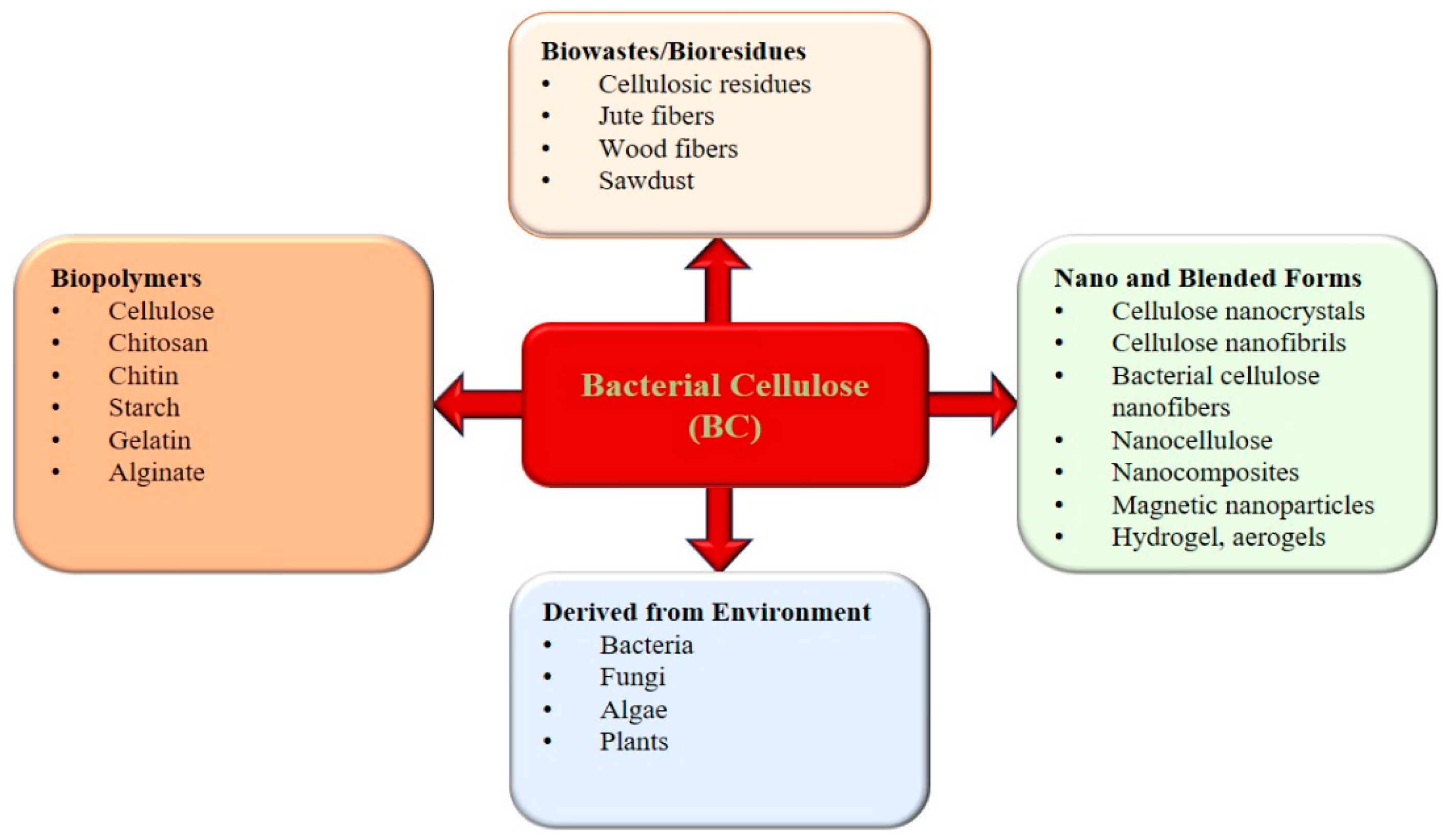
Figure 2.
BC composites with (a) metal oxide [70] (b) electromagnetic nanocomposites [66] (c) nanoparticles(NPs) [69] (d) graphene molecules.
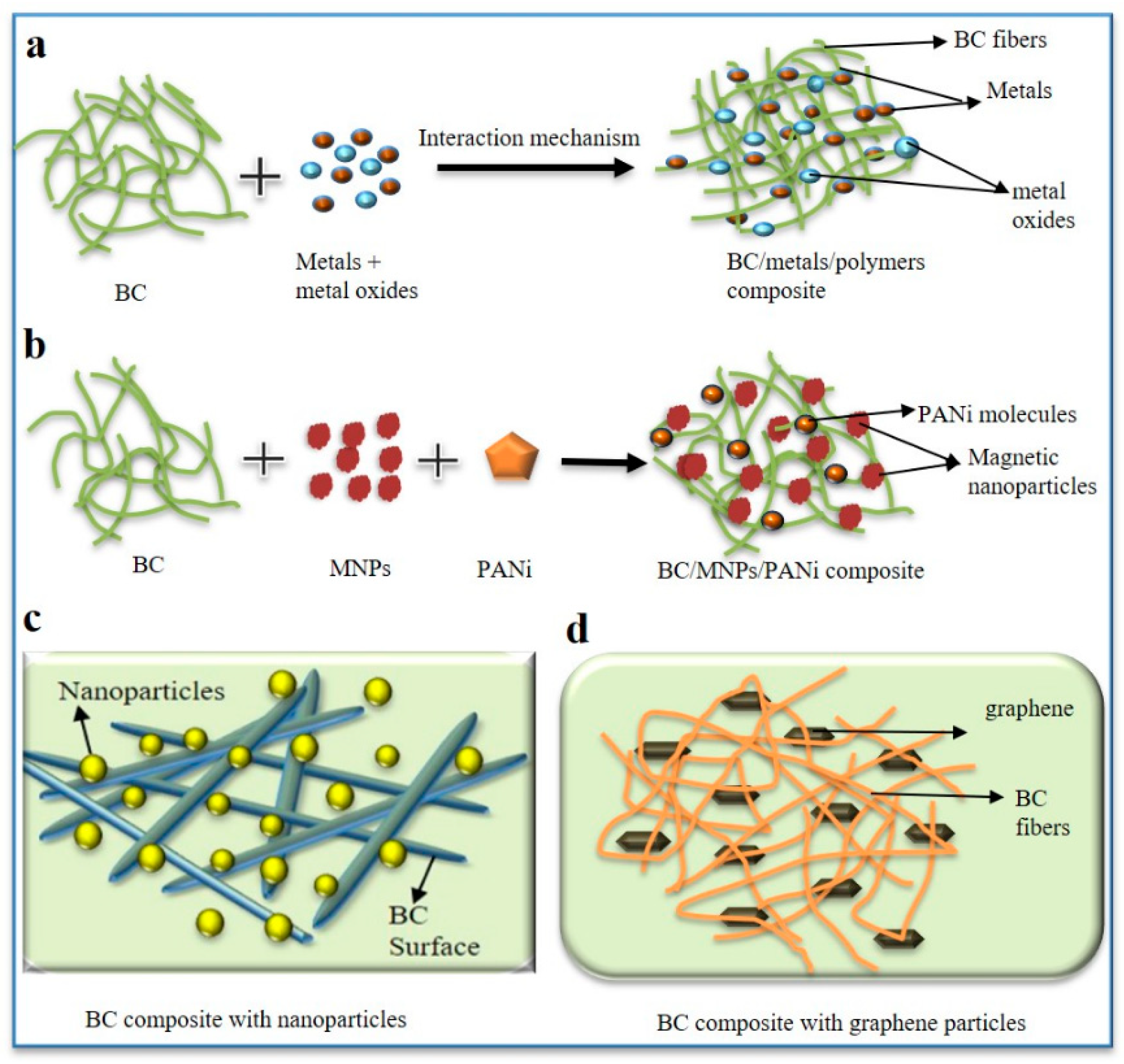
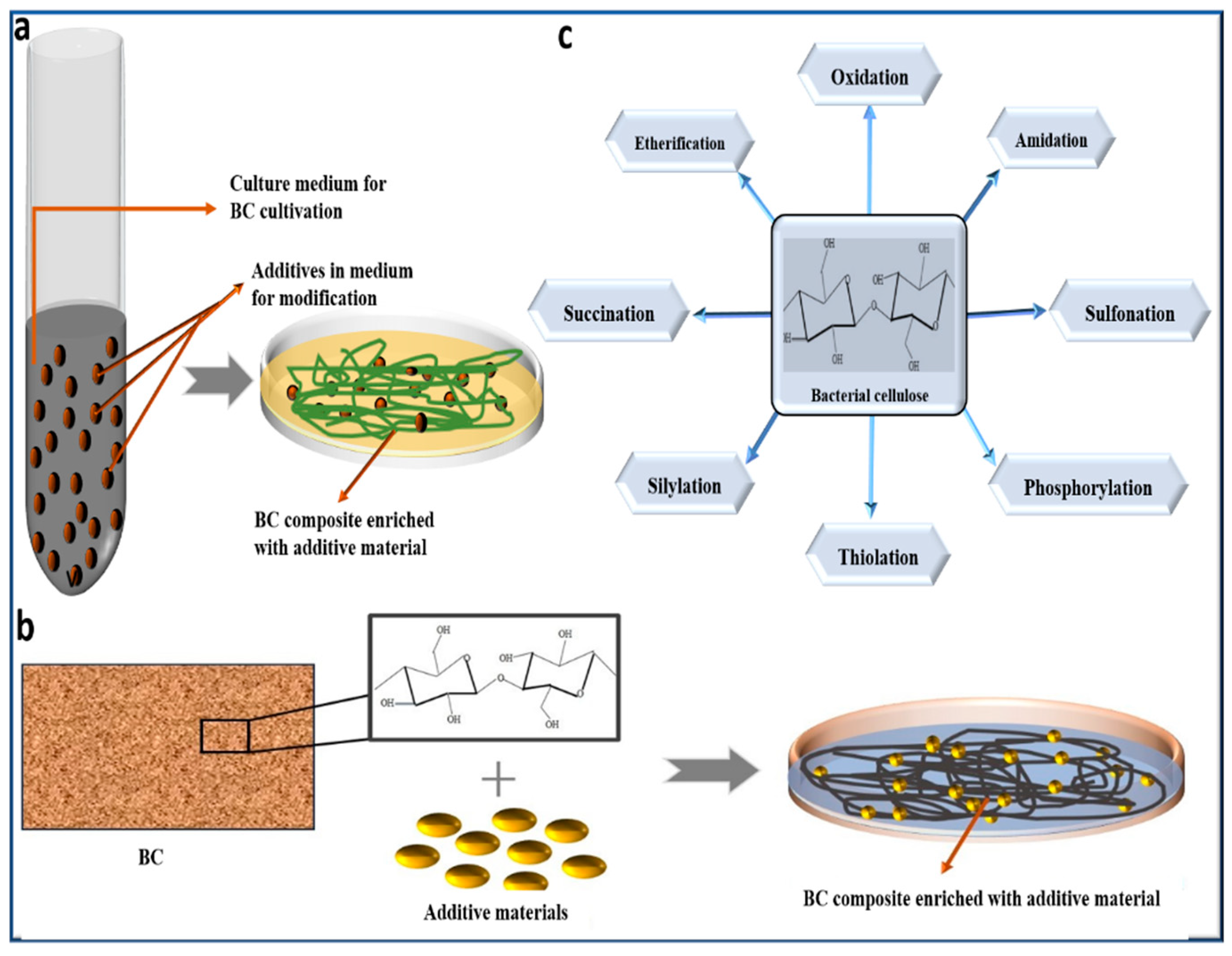
Figure 4.
(a) Biosynthetic modification. (b) EDTA grafted NFBC for metals adsorption [91].
Figure 4.
(a) Biosynthetic modification. (b) EDTA grafted NFBC for metals adsorption [91].
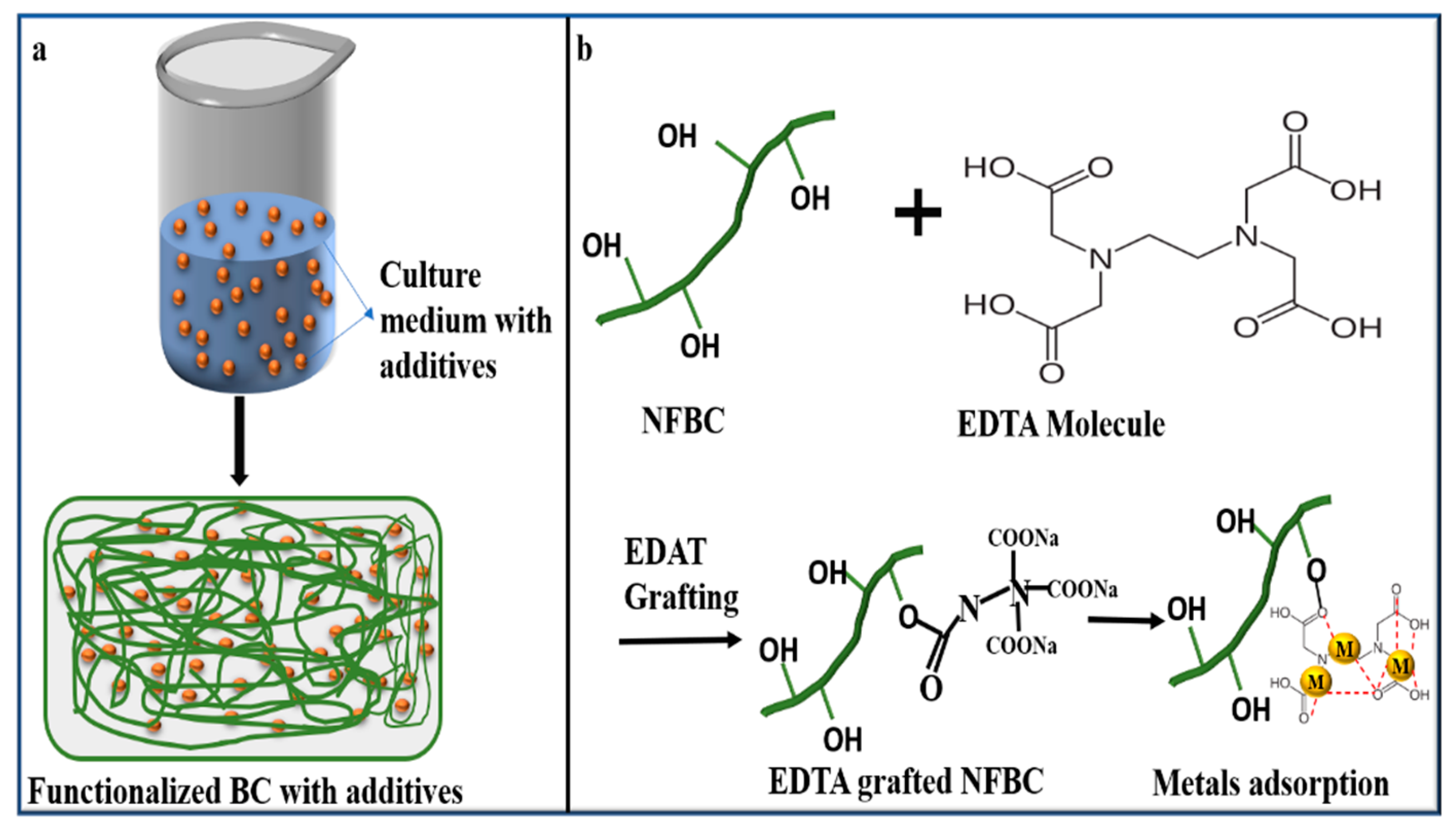
Figure 5.
Illustration of the adsorption mechanism in (a) Cellulose-based materials [24] (b) BCB@PEI composite [60].
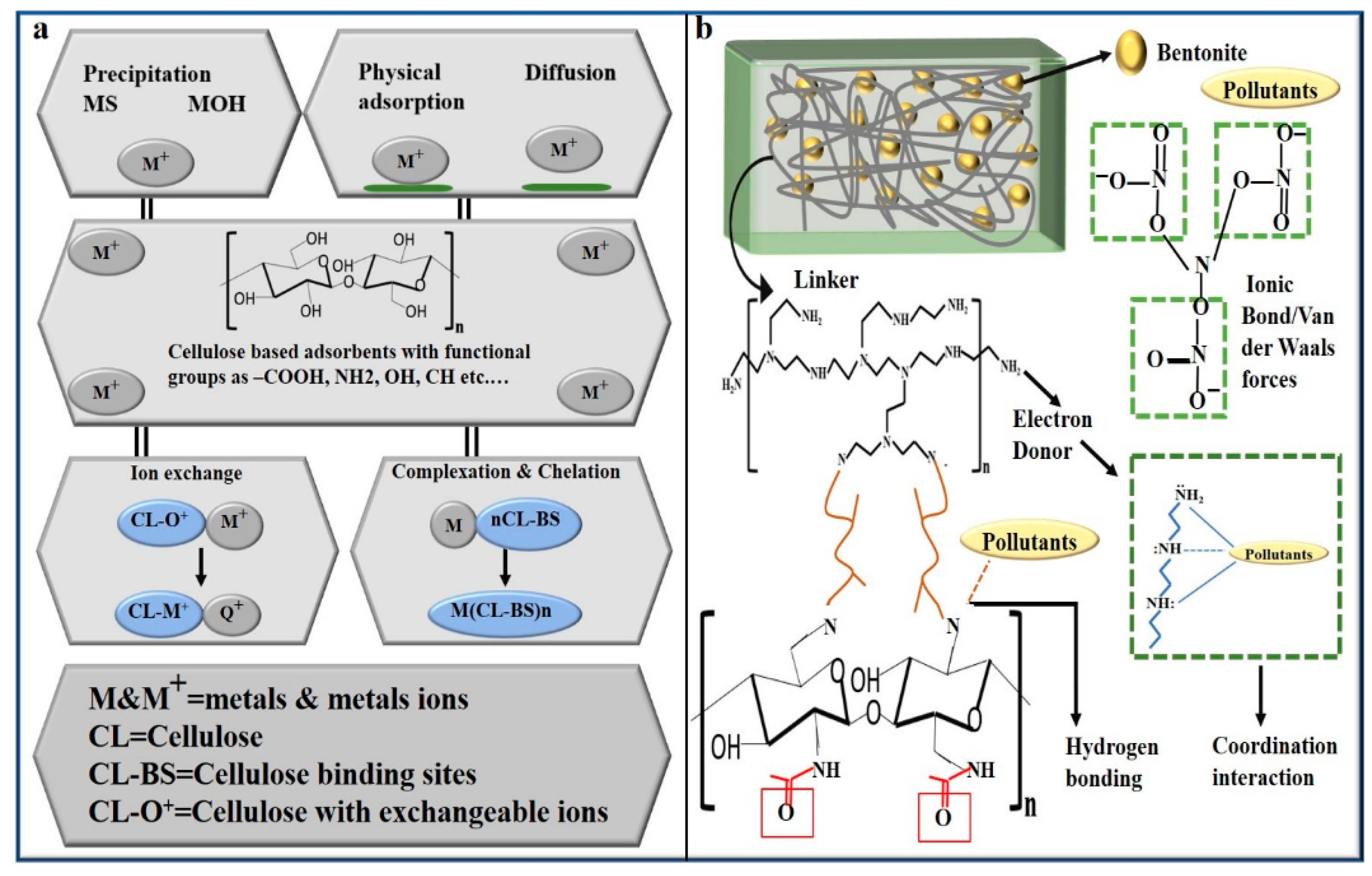
Figure 6.
Adsorption mechanisms of metal ions such as(a) Pb(II) ions [106]. (b) Cu(II) ions [46] (c) Cd(II)ions [99] (d) Cr(VI) ions. [109].
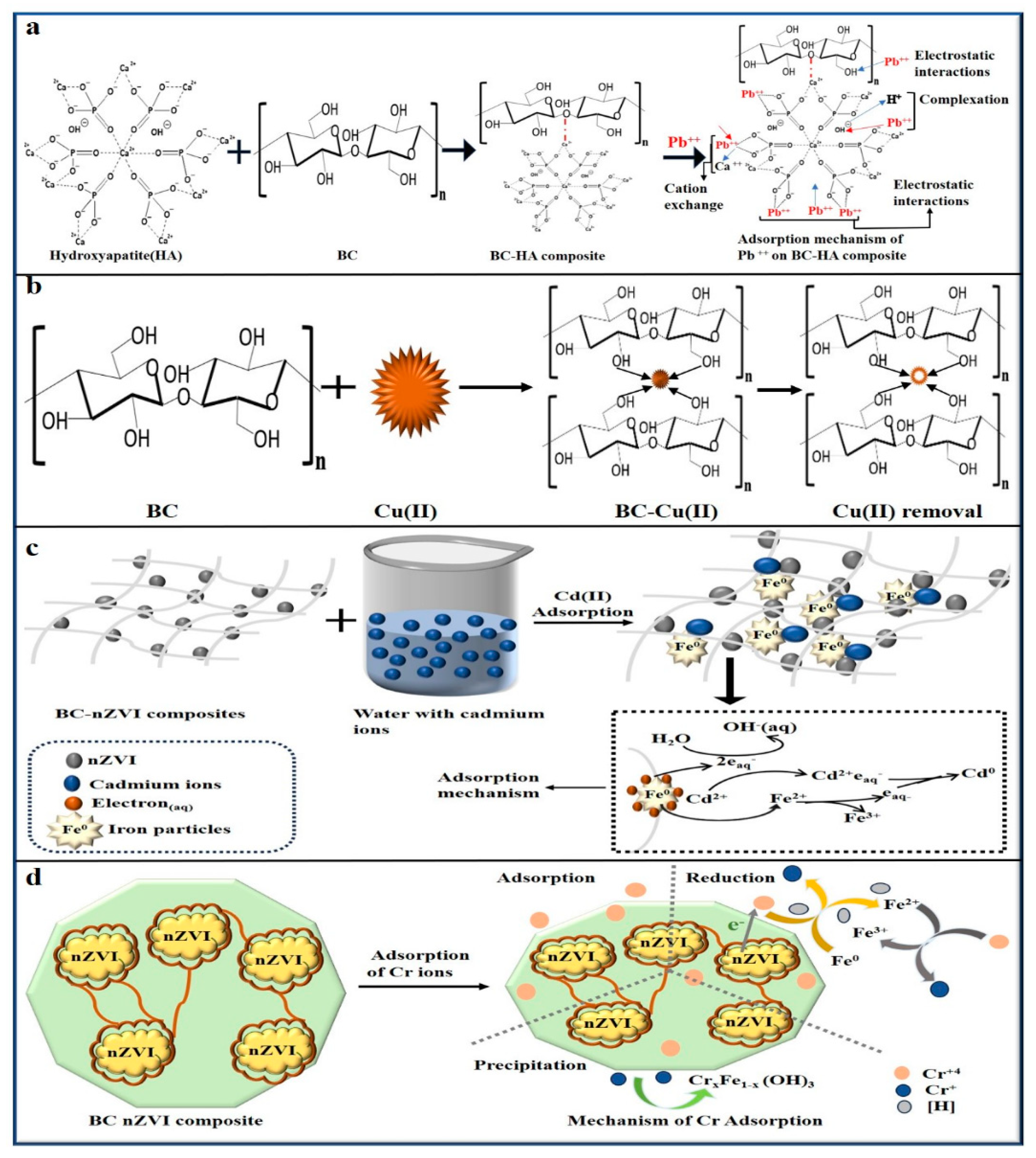
Figure 7.
(a) Langmuir, Freundlich, and Sips isotherms [109] (b) Adsorption Kinetics of various metal ions [97] (c) Effect of temperature [60] (d) pH [97] (f) Recyclability of BC composites for the adsorption of metals [60] (f) Adsorption of metals by BC composite.

| Heavy metals | Toxicity effects |
|---|---|
| Copper | diarrhoea, allergic reactions, nausea, vomiting, and damage to the kidneys and liver. |
| Cadmium | kidney damage, cancer, deterioration of bone health, cardiovascular consequences, respiratory problems, birth defects and infertility, cognitive decline, and gastric impacts. |
| Lead | cognitive decline, impulsivity, anemia, hypertension, kidney damage, neurological disorders, digestive disorders, and trouble absorbing nutrients. |
| Chromium | Lung cancer, skin allergies, respiratory problems, kidney and liver damage, DNA damage, and genetic abnormalities. |
| Nickel | Damage to the kidneys, liver, and lungs; the emergence of long-term respiratory disorders; allergic reactions and skin hypersensitivity. |
| Cobalt and Mercury | polycythemia, peripheral neuropathy, and cognitive impairment. effects on the nervous system, kidney damage, problems with the gastrointestinal tract, respiratory system, heart, reproductive system, immune system, and skin. |
Table 2.
Different composite materials increase physical and mechanical characteristic of BC for removal from wastewater pollutants.
Table 2.
Different composite materials increase physical and mechanical characteristic of BC for removal from wastewater pollutants.
| Composite materials | Reinforcing agents | Modification /Synthesis approach | References |
|---|---|---|---|
| Metal-Oxide Nano-particle | ZnO Nano-particles | 2% of ZnO were scattered in H2O by sonication. This suspension was immersed with BC hydrogel for 24 hours. The composite hydrogel was splashed and freeze-dried. | [54] |
| Metal-Oxide Nano-particles | TiO2 and ZnO Nano-particles | BC was incorporated with TiO2 nanoparticles into 50% ethanol, then mixture was blended with Zn(NO3)2•6H2O and NaOH, stir for 24 hours, and dry at room temperature. | [55] |
| Nanoparticles | Bi2MoO6 | Bi2MoO6 was mixed with BC and stirred for 12 hours. The composite was splashed and dried. | [56] |
| Metals-Organic Framework (MOF) | Iron-based MOF | MIL-100(Fe)@BC was synthesized by refluxing a mixture of iron(III) chloride and benzene tricarboxylate in sonicated BC at 100°C, followed by centrifugation, freeze-drying, and activation. | [57] |
| Magnetite Nanoparticles (MNPs) | (FeCl2·4H2O) (FeCl3·6H2O) | Disperse 500 mg of BC into 100 ml volume solution of de-ionized water (FeCl2·4H2O), (FeCl3·6H2O). Stirred solution for 15 min, and then during the stirring 50 mL of NaCl for further 1 hour at 25 °C. Finally, 200 mL of NH4OH (30% V/V) was dispersed while stirring for 15 min, then washed, collected, and air-dried. | [58] |
| Magnetite Nanoparticles | Fe3O4 | BC membranes were produced by Gluconacetobacter Strain in a modified HS medium. Its nanoparticles deposed on BC membranes were synthesized by coprecipitation method. The resulting BC-Fe3O4 composites, washed and dried at room temperature. | [59] |
| Polymers | Polyethyleneimine (PEI3) | BCB@PEI3 composites were successfully biosynthesized by suspending of bacterial strain Kosakonia oryzendophytica FY-07 in the fermentation medium. Following a 24 hours static fermentation, the resultant BC membrane was crosslinked with PEI33. The resulting BCB@PEI3 were washed by deionized water and freeze-dried for subsequent characterization. | [60] |
| Magnetite composites | Fe3O4 | Fe3O4/BC composite is synthesized by the in-situ coprecipitation method. Where the BC membrane was immersed in Fe (II) / Fe (III) sulphate solution under N2 gas, followed by NaOH addition to induce magnetite deposition. The composites were then rinsed and dried to a constant weight. | [61] |
Table 3.
Different BC-based composites for heavy metals contaminated.
| Composite types | Removal method | Target metals | Removal Capacity (mg/g) | References |
|---|---|---|---|---|
| MIL100(Fe) (a)@BC Nanocomposite | Adsorption | As(III) | 4.81 mg/g | [57] |
| ZIF-67/BC/CH(b) composite aerogels | Adsorption | Cu2+ and Cr6+ | Cu2+:200.6 mg/g, Cr6+:152.1 mg/g | [96] |
| Magnetic composite ATP@(BCNs/CS)7(c) | Adsorption | Pb2+, Cu2+, and Cr6+ | Pb2+:66.4 mg/g, Cu2+: 71.2 mg/g , Cr6+:85 mg/g |
[25] |
| Fe3O4/BC nanocomposites | Adsorption | Pb2+, Mn2+, and Cr3+ | Pb2+:65 mg g−1, Mn2+:33 mg/g , Cr3+:25 mg/g | [29] |
| BC-magnetite composites | Adsorption | Cr(VI) | ,, | [59] |
| PAO(d)/BC composite aerogel | Adsorption | Pb2+, Cu2+, Zn2+, Mn2+ and Cd2+ | Pb2+:571.5 mg/g, Cu2+:509.2 mg/g, Zn2+:494 mg/g, Mn2+:457.2 mg/g, Cd2+:382.3 mg/g | [97] |
| Carboxymethylated Bacterial cellulose | Adsorption | Pb2+ | Pb2+:59.5 mg g–1 | [98] |
| BCB@PEI3(e) composite |
Adsorption | Cd2+, Pb2+, Cu2+ | Cd2+:169.19 mg g1, Pb2+:156.13 mg/g, Cu2+147.2 mg/g |
[60] |
| BCM-nZVI(f) composite | Adsorption | Cd2+ | 134.0 mg/g | [99] |
Disclaimer/Publisher’s Note: The statements, opinions and data contained in all publications are solely those of the individual author(s) and contributor(s) and not of MDPI and/or the editor(s). MDPI and/or the editor(s) disclaim responsibility for any injury to people or property resulting from any ideas, methods, instructions or products referred to in the content. |
© 2026 by the authors. Licensee MDPI, Basel, Switzerland. This article is an open access article distributed under the terms and conditions of the Creative Commons Attribution (CC BY) license (http://creativecommons.org/licenses/by/4.0/).
Copyright: This open access article is published under a Creative Commons CC BY 4.0 license, which permit the free download, distribution, and reuse, provided that the author and preprint are cited in any reuse.


