
Submitted:
28 January 2026
Posted:
28 January 2026
You are already at the latest version
Abstract
Against the backdrop of comprehensively promoting a green economy to drive high-quality development, curbing corporate greenwashing is pivotal to advancing this agenda. Consequently, leveraging the quasi-natural experiment presented by the gradual regional rollout of intermediate environmental courts, this study employs A-share data from Chinese listed companies between 2012 and 2024, utilizing a difference-in-differences approach. It empirically examines the impact of environmental judicial systems on corporate greenwashing practices. The findings reveal that the policy of establishing intermediate environmental courts exerts a restraining effect on corporate greenwashing. This conclusion remains robust across a series of stability and endogeneity tests. Mechanism analysis indicates that this policy reduces greenwashing by enhancing judicial efficiency, upgrading green strategies, and strengthening rights protection oversight. Further analysis indicates that the negative effect of intermediate environmental courts on corporate greenwashing is more pronounced among state-owned enterprises, heavily polluting industries, and regions with stringent environmental regulations. This provides substantial evidence that specialized environmental adjudication effectively curbs corporate greenwashing. Consequently, leveraging environmental judicial mechanisms to curb corporate greenwashing and promote green innovation holds significant implications for advancing high-quality socio-economic development.
Keywords:
environmental judicial specialization
; intermediate environmental court
; corporate greenwashing
; information disclosure
; green innovation
1. Introduction
To thoroughly implement the ecological civilization ideology of socialism with Chinese characteristics in the new era, it is necessary to enforce the strictest systems and the most rigorous rule of law, aiming to provide a rock-solid guarantee, thereby supporting high-quality development with a high-quality ecological environment. The legalization of Chinas ecological rule of law is mainly reflected in the establishment of independent environmental resource trial organizations within the courts, strengthening supervision, adjudication, and enforcement in all aspects of environmental governance, thereby effectively improving judicial efficiency. The most representative example is the establishment of intermediate environmental protection courts. This signifies that at the judicial level, environmental protection has been elevated to a more systematic and professional height. Intermediate environmental protection courts have gradually expanded from localized pilot programs to widespread deployment at the prefecture-level city level, evolving into a significant national strategic deployment, demonstrating Chinas firm determination and long-term planning for the construction of environmental rule of law. Enterprises are important operational vehicles for economic activities. While driving economic growth, they are also the primary sources of heavy pollution [1]. Statistical data reveal that industrial enterprises discharge pollutants including exhaust gases, wastewater, and solid waste during production, exerting severe environmental pressure. This reality positions them as key targets requiring stringent oversight in environmental governance. Yet such measures inevitably increase operational costs. To meet environmental standards, companies must invest in advanced equipment, upgrade production processes, and allocate substantial funds for pollution control. Under these circumstances, some firms resort to unethical practices like greenwashing to circumvent compliance requirements.
The prevailing academic view holds that the typical greenwashing behavior of enterprises is selective information disclosure. For example, companies may not have genuinely taken environmental actions in the short term, but through clever disclosure tactics, they convey a false image of actively practicing environmental protection to the outside world. Such enterprises lack the intrinsic motivation and concrete actions for sustainable development. In the long run, this will inevitably severely undermine consumers trust and recognition of products and brands, causing significant negative impacts on the healthy and orderly development of the market. Environmental information disclosure holds a pivotal position in the modern business environment. It serves not only as the primary channel for stakeholders to understand a company’s environmental responsibilities but also as a critical basis for regulators to verify a company’s environmental performance. When enterprises face the conflict between legal requirements for environmental disclosure and profit demands, they often resort to greenwashing to cleverly conceal their poor environmental performance. The underlying reason for this behavior lies in the fact that China still measures political achievements primarily by economic development, leading local governments to tend to relax environmental supervision standards and excessively pursue performance in practice, thereby tacitly allowing companies to engage in greenwashing. Based on this profound consideration of the severe environmental demands, specialized environmental justice has emerged as a natural response to environmental challenges. It is the key measure and important guarantee of governance challenge, which helps to regulate the behavior of enterprises from the judicial level and rebuild the harmonious symbiosis relationship between the market and the environment.
Environmental legislation serves as the fundamental prerequisite for the entire environmental governance system, providing a legal framework and regulatory basis for all environmental governance initiatives. Environmental reform acts as the starting point, driving continuous innovation and optimization of governance mechanisms to explore more efficient models. Environmental justice, with its authority and impartiality, ensures the effective enforcement of environmental laws. These three components work in concert to enhance judicial service quality, establish a specialized judicial system, foster a positive judicial image, and advance environmental civilization in the new era. Currently, empirical research on the impact of environmental legal frameworks on corporate behavior primarily focuses on environmental regulation [2,3], regional pollution control [4,5], green Innovation [3,5,6], green finance [5,6,7]. In this research field, two fundamentally opposing perspectives have emerged. The first view posits that the establishment of environmental courts creates a powerful reverse pressure mechanism, compelling enterprises to actively pursue green innovation and forming a "Porter Effect." Under this mechanism, corporate financing pressures can be alleviated, thereby enhancing financial performance. The second perspective argues that the creation of intermediate environmental courts increases corporate financing constraints. As enterprises must allocate substantial funds to meet rectification requirements mandated by environmental courts, resources for green innovation become limited, potentially leading to increased greenwashing practices. With the annual expansion of intermediate environmental courts at the regional level and the continuous improvement of environmental resource adjudication divisions, enterprises face growing pressure, which impacts their environmental information disclosure. Therefore, can specialized environmental judicial systems significantly curb corporate greenwashing? This not only concerns corporate conduct standards and long-term development but also relates to the overall effectiveness of China ‘s ecological civilization construction. Clarifying the inhibitory effects of specialized environmental justice on corporate greenwash inland exploring its underlying mechanisms will provide proper guidance for sustainable corporate development, encouraging enterprises to actively fulfill environmental responsibilities and achieve a win-win situation between economic and environmental benefits. Simultaneously, China’s ecological civilization construction provides robust theoretical support and practical experience, which contributes to advancing the modernization of the country’s environmental governance system and capabilities. This issue warrants in-depth research across various sectors to identify more scientifically sound and rational approaches and strategies for environmental governance.
Based on the above analysis, this paper employs data from China A-share listed companies from 2012 to 2024 to construct a difference-in-differences model to explore the impact of environmental judicial specialization on regional-level corporate greenwashing behavior. The marginal contributions of this study may lie in: (1) Enriching the research on the implementation effects of environmental judicial specialization and expanding the understanding of how environmental legalization influences corporate greenwashing behavior. By deeply analyzing the internal logic of how environmental legalization affects corporate greenwashing behavior, it meticulously expands the boundaries of understanding the interactive relationship between environmental justice and corporate greenwashing behavior from different perspectives, injecting new vitality into interdisciplinary research and laying a solid foundation for subsequent academic exploration. (2) Clarifying the impact mechanism of intermediate environmental courts on corporate greenwashing behavior, providing references for improving environmental judicial specialization. This offers precise guidance for optimizing the system of environmental judicial specialization, assisting policymakers and judicial practitioners in implementing targeted measures in key aspects such as the improvement of the structure, refinement of functions, and optimization of trial procedures of intermediate environmental courts, significantly enhancing the professionalism and effectiveness of environmental justice. (3) Verifying the effectiveness of intermediate environmental courts through empirical research methods, transforming institutional advantages in the environmental field into governance efficiency. With precise data quantification and scientific models, it clearly presents the intermediate environmental. The remarkable effect of the court in restraining the environmental behavior of enterprises and curbing the phenomenon of greenwashing provides a strong theoretical support and a practical guide for the judicial practice in the construction of ecological civilization in China.
2. Literature Review, Theoretical Mechanisms and Research Hypotheses
2.1. Literature Review
2.1.1. Research on the Behavior of Greenwashing in Enterprises
The concept of greenwashing is multidimensional. First introduced in the 1980s by American scholar Jay Westerveld, it describes companies that evade environmental obligations through deceptive practices to mask their true operations as green. These tactics aim to cut costs and enhance corporate image, only to be exposed when the truth emerges. In China, the term originated in 2009 when Southern Weekly published its "Greenwashing List" defining it as the disregard of social responsibilities where companies make hollow promises without implementing effective measures [8]. Enterprises and their stakeholders exaggerate the efforts and achievements in environmental protection, engaging in false green propaganda. Li et al. [9] categorizes greenwashing into two types: pseudo-green and green-shifting. Pseudo-green refers to packaging non-environmentally friendly products as eco-friendly to mislead consumers, while green-shifting involves using deceptive means to conceal products failure to meet environmental standards. Laufer [10] posits that greenwashing involves substituting polluting products with environmentally friendly ones through deceptive practices. Initially employed in marketing, it selectively discloses favorable information while concealing unfavorable details [11]. It is applied to the study of the anchoring effect in psychology, using false information disclosure to mislead the media and public attention.
From a micro perspective, companies engage in greenwashing practices. Environmentally friendly products are more appealing to investors and consumers, helping them avoid regulatory penalties. By exploiting information asymmetry, businesses adopt greenwashing as a green marketing strategy to boost sales and profits. Through this approach, companies maintain existing production processes, reduce environmental costs, lower expenses, and ultimately increase profitability [12]. Driven by the desire to avoid exposure, financial constraints, and habitual behaviors, the motivation for greenwashing gradually emerges [8]. Huang et al. [13] and Muhammad et al. [14] elucidate the mechanisms of greenwashing practices. The study reveals a significant positive correlation between debt financing needs and corporate greenwashing behavior, where higher debt financing demands correlate with stronger greenwashing motives. Conversely, green strategic capabilities exhibit a significant negative correlation with greenwashing activities, demonstrating that enhance green strategic capabilities reduce the likelihood of such practices. Through inconsistent statements and actions, companies engage in greenwashing to mislead analysts’ assessments, resulting in inaccurate data [15]. Similar studies show that companies can influence auditors’ judgments through greenwashing practices, which may lead to distorted audit outcomes, harm stakeholders’ interests, and disrupt capital market order [13].
From the macroscopic perspective, the motivation of corporate greenwashing mainly comes from the green demands of stakeholders and environmental regulations [16] and policy incentives [17]. The direct causes of corporate greenwashing are environmental regulations and policy incentives. Both central and local governments have intensified environmental governance through measures such as environmental protection taxes, environmental inspections, and reforms in pollution discharge fee collection standards [18]. The indirect factor stems from information asymmetry that fulfills stakeholders needs. Investors tend to avoid companies violating policies while actively partnering with those compliant with national environmental governance. Due to information asymmetry, corporate greenwashing practices may mislead investors into irrational decisions [19,20]. Regulators have intensified penalties for corporate greenwashing through judicial and administrative measures, including fines and license revocations. The cost of greenwashing far outweighs that of genuine environmental compliance, and once exposed, the losses outweigh the gains. Media and public scrutiny further escalate the reputational costs of such practices. In the age of mass self-media, information spreads rapidly and widely, making it extremely difficult to regain market share once a company’s reputation is damaged. The rise of third-party rating agencies has enhanced transparency in environmental information, effectively curbing corporate greenwashing behaviors.
2.1.2. Research on the Specialization of Environmental Justice
In the early stages, environmental judicial reforms were primarily studied within legal academia, with few scholars from economic or management backgrounds engaging with these topics. Legal scholars predominantly focus on existing environmental pollution issues and regulatory approaches to govern environmental governance. As relevant policies and legal provisions were enacted, discussions emerged regarding their economic impacts. On one hand, environmental courts exert direct influence on corporate environmental compliance. The legalization of environmental regulations helps curb corporate pollution practices, serving as a long-term mechanism to promote sustainable corporate development [21,22].Strengthening the judicial environment and gradually establishing intermediate environmental protection courts will help promote energy conservation and emission reduction at the regional level [23].Leading to a reduction in industrial pollution emissions from neighboring cities [24].The new environmental protection law has forced enterprises to pursue green innovation, leveraging the physical spatial effects of environmental governance [25].To avoid penalties from intermediate environmental courts, including fines, suspension of operations for rectification, or even business license revocation. High-pollution enterprises are compelled to sacrifice some profits and innovate green transformation processes. Meanwhile, these courts exert a deterrent effect on corporate environmental governance. Judicial records of environmental cases reveal that in regions with established intermediate environmental courts, only a small proportion of defendants are enterprises, compared to areas without such courts [26]. Given the high probability of losing lawsuits and the fact that the cost of losing such cases outweighs the cost of green transformation, high-pollution enterprises inevitably opt for green transformation and upgrading [27]. Under the trend of green transition, investors prefer to invest in enterprises with low environmental risks, forcing those with high environmental risks to give up some short-term benefits, improve financing efficiency, and overcome financing difficulties [28].
Environmental courts serve as specialized entities for environmental justice implementation. The establishment and expansion of intermediate environmental courts have underscored their critical role. Their independence and expertise are essential attributes for environmental governance, primarily manifested in two aspects: First, these courts appoint judges with environmental expertise to handle cases, providing regular training and evaluations. When addressing complex cases, they also invite industry experts to participate in case reviews, ensuring professional adjudication. Second, to prevent regional disparities from causing unfair cases, the intermediate environmental courts consolidate comprehensive judicial authority and integrated jurisdictional powers. This management approach not only streamlines departments for environmental case handling but also standardizes trial procedures, significantly improving the efficiency of environmental case adjudication [29]. Thirdly, the intermediate environmental protection court not only has adjudicative power but also enforcement power, effectively implementing the adjudication results and resolving the previous dilemma of the environmental protection department lacking compulsory enforcement power [30].
In conclusion, given the establishment of intermediate environmental courts, there has been relatively limited research on multidimensional assessment of corporate greenwashing from the perspective of specialized environmental justice. This approach not only facilitates in-depth exploration of influencing factors and operational mechanisms but also helps uncover the driving forces behind corporate greenwashing practices. Therefore, this study employs a difference-in-differences model to investigate the impact of specialized environmental justice on corporate greenwashing behavior.
2.2. Theoretical Mechanism
2.2.1. The Impact of the Establishment of Intermediate Environmental Court on the Behavior of Greenwashing
The intermediate environmental court serves as a pivotal mechanism in specialized environmental justice, exerting both direct and deterrent effects on corporate greenwashing practices. It employs dual regulatory approaches combining market incentives with administrative mandates. The progressive establishment of these courts ensures the enforcement of compulsory measures, enhances judicial independence, and improves regional pollution control outcomes [31]. It can also enhance public engagement in corporate environmental protection, serving as a mechanism for public opinion supervision and expanding oversight channels. By organically integrating environmental legislation with public opinion supervision, it strengthens external judicial oversight of environmental matters, thereby further improving pollution control effectiveness. On the other hand, the intermediate environmental court effectively combines administrative authority with market regulation mechanisms [29]. When pollution control conflicts with economic interests, environmental courts can leverage key market mechanisms in resource allocation, such as green finance, ecological compensation, and carbon trading, which are primary methods for market mechanisms to fulfill pollution control functions [32]. Market mechanism plays a green role in new regulation, while administrative mechanism ensures environmental information symmetry and judicial fairness.
2.2.2. The Impact Mechanism of the Establishment of Intermediate Environmental Court on the Greenwashing Behavior of Enterprises
The establishment of intermediate environmental courts impacts corporate greenwashing through three pathways: enhancing judicial efficiency, upgrading green strategies, and strengthening rights protection supervision. This analysis will examine these effects from the perspectives.
1.Mechanism for Enhancing Judicial Efficiency
The low efficiency of regional justice is mainly due to the lack of professional judgment of environmental cases and the uneven ability of judges [33]. The local judicial system is constrained by government interference, which even dominates case adjudication and undermines judicial fairness. For instance, enterprises may bid for government contracts, while authorities exploit commercial disputes to shield illegal activities of bidding companies, compromising the impartiality of court rulings. The establishment of intermediate environmental courts can address two primary issues in judicial inefficiency. On one hand, these courts enhance case processing efficiency through training programs, seminars, and research initiatives to improve judicial personnels professional capabilities. On the other hand, the Supreme Courts centralized management of human resources, financial authority, and property rights for intermediate environmental courts eliminates regional administrative interference, thereby enhancing judicial efficiency and fairness. Further analysis reveals that although the creation of intermediate environmental courts cannot fundamentally eliminate administrative interference at the institutional level, it reduces the cost of corporate rights protection when facing judicial injustice. This indicates that by weakening administrative intervention in the judiciary, the profit margins for such interference are compressed, ultimately promoting judicial independence and fairness [34]. Some local officials, driven by the pursuit of political advancement, prioritize environmental degradation over ecological protection to boost their career prospects in the absence of effective oversight. To address this issue, the establishment of intermediate environmental courts enables legal action against such government agencies. Unlike low-tech production methods, these courts incentivize enterprises to adopt advanced manufacturing processes, thereby accelerating the development and widespread adoption of high-tech solutions [35], reduce the motivation of enterprises to greenwashing, promote the upgrading of industrial structure, and develop new productive forces.
2. Green Strategy Upgrade Mechanism
The need for green strategy upgrading stems from two key considerations: firstly, environmental consciousness. According to the signaling theory, when enterprises proactively assume environmental responsibilities, they send a positive public signal to investors, the public, and other stakeholders [36]. This approach helps secure trust and support from all sectors of society, reduces corporate financing costs, strengthens organizational soft power, and enhances competitiveness, thereby boosting the internal drive for green strategic development. By sending strong environmental signals, such as increasing turnover rates among executives with poor environmental performance and hiring technicians and executives with environmental expertise. Companies can attract green-conscious investors. Furthermore, the gradual establishment of intermediate environmental courts, leveraging peer effects, can elevate regional environmental awareness. The stronger the environmental consciousness of corporate managers, the more effectively they implement environmental practices [37]. Secondly, priority is to enhance green innovation capabilities. Human capital plays a pivotal role in green innovation and transition. Given the extended timelines and complexities of green innovation, it demands greater stability and motivation from research teams compared to other innovation types. Therefore, fostering a sense of professional identity among researchers is crucial. Specialized environmental justice practices compel companies to prioritize environmental protection as a core survival and growth strategy. This approach not only elevates corporate social standing but also boosts researcher satisfaction, reduces turnover rates, and stabilizes human capital supply, ultimately creating a more dynamic development momentum for enterprises [38,39]. Companies that achieve high-quality development recognized by researchers can further enhance their internal division of labor, innovation efficiency, and transformation capabilities.
3. Mechanisms for Safeguarding Rights and Ensuring Supervision
The establishment of intermediate environmental protection court provides opportunities for environmental rights protection and can effectively deal with the problem of greenwashing of enterprises [40]. On one hand, the supervisory mechanism under the intermediate environmental protection court enhances the professional competence of its personnel through various approaches such as specialized training, case studies, and field research, based on issues raised in environmental petitions, thereby improving their ability to identify corporate greenwashing practices. On the other hand, the court establishes targeted supervision standards and an independent supervisory framework according to the nature of environmental petitions, preventing interference from local governments irrational development concepts and vested interests, thus ensuring the fairness and authority of supervision [41]. Further analysis reveals that while the rights protection supervision mechanism cannot entirely eliminate local factors negative impact on oversight, it significantly increases the exposure rate of corporate greenwashing practices. This effectively deters companies from exploiting environmental claims for illicit gains, thereby curbing their motives for such behavior and promoting fair market competition alongside sustainable environmental development. Some enterprises, driven by short-term economic interests and lacking robust regulatory frameworks, have been using fabricated environmental credentials to mislead consumers and regulators for personal gain. To address this, the mechanism leverages environmental complaint leads from prefecture-level cities to enforce strict supervision and legal penalties. Compared to traditional development models that neglect environmental protection, this safeguarding mechanism encourages enterprises to adopt genuine, eco-friendly development paths, reduces their greenwashing incentives, and drives industrial restructuring toward greener, higher-quality growth.
2.3. Research Hypothesis
In conclusion, corporate greenwashing practices are subject to multifaceted impacts. On one hand, unified management of relevant authorities enhances judicial efficiency by preventing administrative interference, strengthening judicial fairness, and reducing corporate incentives for greenwashing. The upgrading of green strategies encourages enterprises to attract investments through environmental awareness, stabilize research teams to boost innovation capabilities, and minimize greenwashing behaviors. The establishment of rights protection and supervision mechanisms improves oversight capacity, promotes green development, and curbs greenwashing practices. On the other hand, practical implementation may face challenges such as local officials’ interference and corporate regulatory evasion, which undermine governance effectiveness. To objectively evaluate the impact of environmental judicial specialization on corporate greenwashing, this paper proposes hypotheses for further investigation to explore its practical role in addressing corporate greenwashing.
Therefore, the following hypothesis is proposed:
H1:
Environmental Judicial Specialization is negatively related to the extent of corporate greenwashing.
3. Research Design
3.1. Sample Selection and Data Sources
This paper is based on the "quasi-natural experiment" established by the China Intermediate Environmental Court, using China A-share listed companies from 2012 to 2024 as the research sample. The sample was processed as follows: (1) Observations of ST companies, *ST companies, and delisted companies were excluded; (2) Observations of financial companies were excluded; (3) Observations of companies with missing financial data were excluded. In addition, all continuous variables were Winsor zed by 1% upper and lower bounds, resulting in 12,097 observations. The data sources for this paper mainly include the following three aspects: (1) Intermediate Environmental Court data, manually collected from the official website of the Intermediate People Court, the "China Environmental Resources Trial" of the Higher Peoples Court, and related news reports; (2) Corporate greenwashing behavior data, derived from ESG ratings of listed companies calculated by Huazheng and Bloomberg; (3) Control variable data, sourced from the CSMAR database.
3.2. Variable Measurement
3.2.1. Dependent Variable
3.2.2. Independent Variable
Whether the Environmental and Resources Tribunal of the Intermediate People Court has been established. Refer to Wang et al. [20]. Whether the Intermediate People Court established an Environmental Resources Tribunal (Court) as a binary variable. The value is 1 if the Intermediate People's Court corresponding to the city where the enterprise is located in the current year has established an environmental resources tribunal; otherwise, the value is 0.
3.2.3. Control Variables
Refer to the research by Zhai et al. [27], researchers specifically selected variables including firm size (Size), financial leverage (Lev), company age (Age), cash flow (CFO), separation of ownership and management (Separation), equity concentration (top 5 shareholders shareholding ratio), concurrent position (concurrent position), and firm growth (Growth), while controlling for individual and annual fixed effects. Additionally, the clustering effect at the prefecture-level city level was considered. The definitions of key variables are presented in Table 1:
3.3. Model Specification
Drawing upon prior research by Yuan et al. [34] and Xu et al. [18] and considering the temporal variation in the implementation of intermediate environmental courts across cities, a multi-period difference-in-differences model [44] is employed. Model (1) is constructed to examine the impact of intermediate environmental courts on corporate greenwashing behavior. As illustrated below:
is the explained variable greenwashing [13]. Model (1) captures the greenwashing behavior () of firm i in city c in year t. is the explanatory variable indicating the establishment of an intermediate environmental court for firm I in city c in year t. represents the control variables, denotes the individual fixed effects, indicates the time fixed effects, and stands for the random disturbance term. Additionally, clustering at the prefecture-city level (Cluster) is accounted for.
3.4. Descriptive Statistics
Table 2 presents the descriptive statistics of key variables, revealing the statistical relationship between the establishment of intermediate environmental courts and corporate greenwashing. The mean value of corporate greenwashing is 0. The coefficient 309, with a standard deviation of 1.163 and a median of -0.393, indicates that while corporate greenwashing exists in the sample population, its prevalence remains relatively low. The maximum value of corporate greenwashing ranges from -4.503 to 5.842, reflecting uneven distribution and significant disparities among sample enterprises. The court mean of 0.474 suggests that nearly half of the sample enterprises have established intermediate environmental courts. Control variables and Huang [13]. The data presented in are comparable, indicating standardized data processing.
4. Empirical Results and Analysis
4.1. Baseline Regression Results
Table 3 presents the baseline regression results of intermediate environmental courts and corporate greenwashing behavior. The four columns of Court variables show negative regression coefficients, indicating that most intermediate environmental courts are established in economically developed cities where companies exhibit better environmental performance and exhibit less greenwashing behavior. Columns (1) and (3) present the environmental outcomes of intermediate environmental courts regarding greenwashing behavior, controlling for individual fixed effects, time fixed effects, and city-level clustering effects respectively. The regression coefficients are significantly negative at the 1% or 5% level, demonstrating that the establishment of intermediate environmental courts can curb corporate greenwashing behavior, thereby validating Hypothesis 1. Columns (2) and (4) present the regression results after adding control variables, which also support H1. Specifically, the regression coefficients of Court variables increase from -0.097 to -0.091, confirming the significant negative correlation between the establishment of environmental courts and corporate greenwashing behavior, with statistically significant results. The increase in Adj_ R2 from 47.3% to 47.7% indicates that the goodness-of-fit of the model improves with the addition of control variables. The findings demonstrate that establishing intermediate environmental courts effectively addresses environmental governance challenges, whether control variables are included or not. This mechanism significantly curbs corporate greenwashing practices, enhances social responsibility fulfillment, and drives high-quality socioeconomic development. Consequently, specialized environmental judicial systems can reduce corporate incentives for greenwashing while accelerating their transition to sustainable operations.
4.2. Endogeneity Test
4.2.1. Parallel Trend Test
The premise of effective implementation of multi-time-point double difference model is to pass the parallel trend test [44]. This study examines whether the treatment group and control group exhibited similar temporal trends prior to the policy shock, while also assessing the dynamic effects of the newly established intermediate environmental protection court. As shown in Figure 1, before policy implementation, the confidence interval crossed the X-axis, indicating no significant difference between the treatment and experimental groups. This suggests that the greenwashing behavior of enterprises in both groups followed similar trends, consistent with the parallel trends test. Following policy implementation, the confidence interval did not cross the X-axis, progressively revealing a divergence. This indicates that the establishment of intermediate environmental legislation has served to curb corporate greenwashing practices, consistent with the parallel trend hypothesis.
4.2.2. Placebo Test
To rule out other policy shocks as the cause of reduced corporate greenwashing behavior rather than the establishment of intermediate environmental courts, this study employs the Bootstrap method to exclude endogenous policy interference, thereby ensuring the exogenous nature of the intermediate environmental courts establishment. Specifically, 500 random samples were drawn from cities implementing intermediate environmental courts to plot the overall distribution of estimated coefficients. As shown in Figure 2, the coefficients follow a normal distribution, with most clustered around zero. This indicates that random treatment has no substantial impact on corporate greenwashing behavior, and other policy shocks have negligible effects on such behavior, confirming the robustness of the null hypothesis.
4.2.3. PSM-DID
To eliminate systematic differences between the treatment group and control group caused by sample selection, Wang et al. [20] were referenced, the propensity score matching (PSM) technique was employed to mitigate the differences between the treatment and control groups. Following the 0.01 kernel radius matching principle, the results (Table 3, Column 1) demonstrate that the regression coefficient for corporate greenwashing behavior is significantly negative at the 1% significance level. This indicates that the establishment of intermediate environmental courts continues to exert a significant negative impact on corporate greenwashing behavior after applying the PSM-DID test, thereby supporting H1.
4.3. Robustness Test
4.3.1. Replacing the Measurement Method of the Dependent Variable
4.3.2. Replacement of the Measurement Method for Explanatory Variables
Modify the measurement approach for establishing intermediate environmental courts. Cities implementing intermediate environmental courts during the first three quarters shall be recorded as having done so in the current year, while those implementing them in the fourth quarter shall be deferred to the following year. The Court setting value for the subsequent year and beyond shall be 1; otherwise, it shall be 0. Re-examine the benchmark regression. Column (3) of Table 3 indicates that the Court coefficient exhibits a significant negative correlation at the 5% level, validating the significance of the regression results.
4.3.3. The First-Order Difference Model
By excluding samples from 2024 where intermediate environmental courts were never established, we constructed a first-order difference model to examine changes in corporate greenwashing behavior before and after the establishment of these courts. As shown in Table 3, the (4) post coefficient is significantly negative at the 1% level, indicating that the establishment of intermediate environmental courts has a suppressive effect on corporate greenwashing behavior, thereby validating the significance of the regression results.
4.3.4. Change the Sample Interval
To mitigate the impact of public emergencies, the study excluded COVID-19 pandemic data and narrowed the sample period to 2012-2019, then re-evaluated the benchmark regression. As shown in Table 4, Column (5) reveals the Court coefficient to be significantly negative at the 1% significance level. This demonstrates that the regression results remain valid even after the sample period was shortened, thereby validating the statistical significance of the findings.
4.4. Mechanism Test
The establishment of intermediate environmental courts may curb corporate greenwashing by enhancing judicial efficiency, facilitating green strategy upgrades, and strengthening rights protection supervision. These measures effectively reduce corporate incentives for greenwashing and minimize such practices. This study examines the mechanism through which intermediate environmental courts influence corporate greenwashing behavior in two stages.
4.4.1. Improving the Efficiency of the Judiciary
Refer to Yuan et al. [34] and Zhen et al. [45] Research. To validate the efficiency enhancement mechanism of intermediate environmental courts, this study examines both the improvement in environmental judicial efficiency brought about by their establishment and the significant impact of these courts in curbing corporate greenwashing practices. The judicial efficiency indicators referenced are those proposed by Chen [46] adopted the case closure rate. Settle rate as a key metric. This comprehensive indicator directly reflects the efficiency and capability of courts in case handling. A higher closure rate demonstrates superior judicial efficiency and competence. The regression coefficient for the case clearance rate exhibits a negative correlation at the 1% significance level, thereby validating the mechanism test. This negative correlation indicates that the continuous development and refinement of the Intermediate Environmental Court have exerted a positive and profound influence on the entire judicial process. In actual judicial practice, the Intermediate Environmental Court has optimized case processing procedures through a series of effective measures, reducing unnecessary delays and obstacles. This enables cases to be concluded more efficiently, resulting in the case closure rate exhibiting a significant characteristic in regression analysis.
The establishment of intermediate environmental courts curbs corporate greenwashing practices through two key mechanisms. Firstly, the gradual implementation of these courts has accumulated substantial judicial experience, developing tailored trial frameworks for environmental cases through long-term practice. Simultaneously, resource integration and streamlined procedures have significantly reduced judicial costs. These improvements collectively enhance local courts expertise in environmental litigation, creating strong deterrence against ESG fraud. When companies recognize the growing professionalism and rigor in environmental case handling, they become more cautious about greenwashing tactics, as detection would lead to more precise and severe penalties. Secondly, intermediate courts reduce administrative interference in judicial processes, ensuring that legal professionals strictly adhere to established standards and procedures. This guarantees judicial fairness, allowing rulings to be grounded in facts and laws without external interference. Consequently, as intermediate environmental courts expand their reach, the case closure rate continues to rise, compelling companies to maintain long-term compliance with environmental regulations. Under the pressure of environmental justice, enterprises must earnestly assume environmental responsibilities and genuinely implement green development. This pressure will compel companies to fundamentally transform their business philosophies and operational practices, integrating environmental protection into their corporate development strategies rather than merely resorting to superficial greenwashing tactics to evade societal and regulatory scrutiny.
4.4.2. Green Strategy Upgrade
Green Strategy of Enterprise Development Includes Environment-oriented Green Innovation and Economy-oriented Green Innovation [27]. The expanding jurisdiction of intermediate environmental courts has placed enterprises under prolonged environmental regulation, making green strategic transformation an inevitable trend. Technological upgrades in green strategies can effectively achieve energy conservation and emission reduction, thereby addressing corporate greenwashing motives. This study therefore adopts green strategy upgrading as a mechanism for evaluation.
1. Environmentally Oriented Green Innovation
Referring to the research by Arfi et al. [47] and Xie et al. [48], environmentally oriented green innovation primarily refers to green process innovation. This innovation primarily targets government-enforced environmental policies, focusing on clean production at the source and scientific governance at the end, aiming to reduce pollution emissions during production and fulfill corporate environmental social responsibility. This paper measures environment-oriented green innovation (Grelnvjg) using the logarithmic value of the sum of word frequencies from five dimensions in corporate social responsibility reports and annual reports: "low energy consumption", "clean production", "recycling and reuse", "reduction of harmful substance and waste emissions" and "reduction of raw material usage." As shown in Table 4, item (2), Grelnvjg is significantly negative at the 10% level, indicating that environment-oriented green innovation can curb corporate greenwashing practices. This demonstrates that the establishment of intermediate environmental courts promotes environment-oriented green innovation, thereby suppressing corporate greenwashing behaviors.
2. Economically Oriented Green Innovation
Refer to Shen et al. [49], the study indicates that economically oriented green innovation primarily refers to green product innovation, which involves R&D to meet market demands, capture larger market shares, and enhance corporate economic performance. This paper measures economically oriented green innovation (Epiaratio) using the logarithmic frequency sum of word frequencies from four dimensions in corporate social responsibility reports and annual reports: "environmentally friendly products and materials", "biodegradable packaging", "easy to recycle, reuse, and decompose" and "green product labeling". As shown in Table 4, Epiaratio is significantly negative at the 10% level, demonstrating that economically oriented green innovation can curb corporate greenwashing practices. This confirms that the establishment of intermediate environmental courts promotes economically oriented green innovation, thereby reducing corporate greenwashing behavior.
The establishment of intermediate environmental courts can drive corporate green innovation for three key reasons. Firstly, environmental policy trends favor low-pollution, low-energy investments, compelling businesses to adapt to market shifts and embrace green transformation. Secondly, green innovation creates a compensation effect—reducing emissions and energy consumption while enhancing production capacity, which not only recoups initial investments but also builds product competitiveness and new productivity. Thirdly, such innovation boosts corporate reputation, attracting media and public attention, setting industry benchmarks, and increasing sales. Thus, these courts foster green innovation, strengthen core competitiveness, and reduce the incentive for greenwashing.
4.5. Heterogeneity Test
Whether the establishment of intermediate environmental protection court can effectively restrain the greenwashing behavior of enterprises is a question worth pondering and discussing. Refer to Fan et al. [23], the 2019 study posits that greenwashing refers to corporate attempts to embellish their environmental accountability. While the establishment of intermediate environmental courts has generally enhanced regulatory effectiveness, practical implementation still faces challenges such as inefficient case handling, ambiguous delineation of responsibilities, and inadequate enforcement. This paper conducts heterogeneity tests across three dimensions: property rights nature, pollution severity, and regional regulatory intensity. These analyses not only validate the preceding research conclusions but also elucidate how specialized environmental adjudication curbs corporate greenwashing practices.
4.5.1. Heterogeneity Test Based on Property Rights Characteristics
Referring to Chang [51], given the differing nature of corporate equity, the relationship between the establishment of intermediate environmental courts and corporate greenwashing behavior may vary. This paper distinguishes the sample into state-owned enterprises and non-state-owned enterprises for examination. The regression results are presented in Column (1) and Column (2) of Table 5. The regression coefficient for the establishment of intermediate environmental courts shows a significant negative correlation in state-owned enterprises, whereas no significant relationship is observed in non-state-owned enterprises. This indicates that intermediate environmental courts are more effective in curbing greenwashing behavior among state-owned enterprises. This stems from the fact that, compared to non-state-owned enterprises, state-owned enterprises face stronger constraints from government and other regulatory bodies. Consequently, their ESG disclosure practices tend to be more standardized, and their motivation for greenwashing is weaker. Conversely, non-state-owned enterprises lack advantages in areas such as credit endorsements, government subsidies, and information resources. To establish a favorable public image while minimizing costs, these enterprises possess stronger incentives for greenwashing.
4.5.2. Heterogeneity Test Based on Industry Pollution Levels
The 2022 study reveals that China ‘s "Industry Classification Guidelines for Listed Companies" (2012 Revised Edition) categorizes industries into heavy-pollution and non-heavy-pollution sectors [52]. As the backbone of the carbon peaking and carbon neutrality economy, heavy-pollution industries face more severe challenges than their non-heavy-pollution counterparts. The establishment of intermediate environmental courts may influence corporate greenwashing practices, with effects contingent on whether an industry falls under heavy-pollution classification. Regression analysis in Columns (3) and (4) demonstrates that the establishment of intermediate environmental courts shows significant regression coefficients in heavy-pollution industries but not in non-heavy-pollution sectors, indicating these courts are more effective in curbing greenwashing in heavy-pollution industries. Compared to non-heavy-pollution industries, heavy-pollution sectors face greater challenges in government regulation, media coverage, and public scrutiny, making corporate greenwashing operations more difficult, risky, and less likely. The lack of significant greenwashing behavior in non-heavy-pollution industries may stem from their established characteristics of feasibility, standardization, and legality.
4.5.3. Heterogeneity Test Based on Regional Environmental Regulation Intensity
The key chain of environmental supervision is "clear rules, rules must be followed, enforcement must be strong, and violations must be punished". In recent years, the intermediate environmental protection court plays an important role in environmental governance, and it accurately identifies and regulates the behavior of enterprises through the analysis of the heterogeneity of environmental rules and indicators [53]. For corporate greenwashing practices such as carbon emission data falsification and deceptive environmental claims, targeted review criteria have been established based on the varying strength of environmental regulations. As shown in Columns (5) and (6) of Table 6, stronger environmental regulations in a company’s location significantly reduce its greenwashing behavior through the establishment of intermediate environmental courts. This phenomenon occurs because robust environmental regulations, backed by governmental authorities, carry greater authority and enforceability. Under such regulations, companies ESG disclosures become more standardized, and stricter penalties for violations lead to a decline in greenwashing activities, forming a significant negative correlation. Conversely, under weak environmental regulations, companies lack clear directives and effective oversight mechanisms. Influenced by factors like resource acquisition and market competition pressures, they tend to maintain or even enhance their social image while reducing costs, resulting in less pronounced greenwashing behavior.
5. Conclusion and Implications
The progressive establishment of intermediate environmental courts serves as a pivotal measure for implementing specialized environmental justice. This study constructs a quasi-natural experiment using A-share listed companies from 20 12 to 202 4 as research subjects, employing the difference-in-differences method. Benchmark analysis demonstrates that intermediate environmental courts effectively curb corporate greenwashing practices. The findings remain robust through rigorous robustness and endogeneity tests. Mechanism analysis reveals that specialized environmental justice operates through three pathways: enhancing judicial efficiency, upgrading green strategies, and strengthening rights protection supervision. Specifically, the expansion of intermediate environmental courts leads to higher case closure rates, compelling enterprises to endure prolonged environmental judicial pressure and fulfill environmental responsibilities, thereby reducing greenwashing. Green strategy upgrades encompass both environment-oriented and economy-oriented green innovations, achieving technological solutions for emission reduction and addressing corporate greenwashing motives. Rights protection supervision integrates public oversight with environmental justice, intensifying corporate accountability and exposing greenwashing behaviors. Further heterogeneity analysis reveals that the establishment of intermediate environmental courts exerts a more pronounced effect on corporate greenwashing in non-state-owned enterprises, heavily polluting industries, and regions with stringent environmental regulations. This provides additional evidence supporting the earlier finding that specialized environmental adjudication curbs corporate greenwashing, thereby contributing to a more comprehensive understanding of the operational mechanisms and requisite conditions linking specialized environmental adjudication to corporate greenwashing behavior.
Firstly, a robust judicial mechanism can establish an industry-wide green benchmark, driving enterprises to innovate environmental protection concepts and practices while incentivizing proactive environmental initiatives. Research findings demonstrate that establishing intermediate environmental courts can regulate corporate environmental responsibilities from a judicial perspective, thereby curbing the motivation for greenwashing and reducing such practices. Simultaneously, the study reveals that corporate decision-making is influenced by the adjudication and enforcement of intermediate environmental courts. This calls for enterprises to integrate environmental considerations into their strategic development goals, aligning with contemporary demands. Additionally, management should enhance legal awareness, strengthen relevant legal departments, and ensure corporate actions comply with environmental protection laws.
Secondly, we must further advance the legalization of environmental governance by optimizing existing judicial systems and enhancing their fairness. On one hand, we should maintain the specialization of environmental courts to strengthen the binding force of the legal framework. This requires not only ensuring the coordinated and steady development of environmental justice but also supporting public interest litigation in environmental cases. On the other hand, we need to cultivate a multidisciplinary team of judges and prosecutors with expertise in law, environmental science, and digital technologies. Additionally, upgrading the informatization of intermediate environmental courts will facilitate evidence collection and drive intelligent environmental justice. Ultimately, these measures will deepen the legalization of environmental governance and curb corporate greenwashing practices.
Thirdly, diversify social oversight mechanisms to facilitate the transition of polluting enterprises into environmentally responsible ones. Faced with challenges in cost control, cash flow, and technological innovation, companies increasingly resort to greenwashing as a means of compliance. Relying solely on specialized judicial systems cannot guarantee effective environmental accountability. To prevent corporate evasion of environmental obligations, a multi-channel supervision framework is essential, including environmental unions, public discourse, and media advocacy. By raising societal expectations for environmental protection across multiple dimensions and sectors, we can curb corporate greenwashing practices. Additionally, enhancing environmental legal education and showcasing exemplary corporate sustainability cases through various platforms will not only boost the social reputation of eco-friendly enterprises but also inspire others to adopt best practices, guiding them from passive compliance to proactive transformation.
References
- Wu, H.G.; Xu, Y.L. Can environmental judicial reform curb corporate greenwashing? Evidence from the establishment of the environmental and resources tribunal. Reform 2024, (09), 47–66. [Google Scholar]
- Yang, J.; Zuo, Z.; Li, Y.; Guo, H. Manufacturing enterprises move towards sustainable development: ESG performance, market-based environmental regulation, and green technological innovation. J. Environ. Manag. 2024, 372, 123244. [Google Scholar] [CrossRef]
- Ji, K.; Kong, X.; Leung, C.-K.; Shum, K.-L. Navigating Sustainability Through Environmental Regulations: Assessing the Effects of Command-and-Control and Market-Incentive Policies on Carbon Emissions in China. Sustainability 2025, 17, 2559. [Google Scholar] [CrossRef]
- Liu, J.; Zhang, L.; Zhu, L. Pay for air pollution: Ecological compensation policy and corporate investment. International Review of Financial Analysis 2025, 97, 103808. [Google Scholar] [CrossRef]
- Peng, W.B.; Lu, J.L. Environmental regulation and green innovation policy: Theoretical logic based on externalities. Social Sciences 2017, (10), 73–83. [Google Scholar]
- Wang, X.; Elahi, E.; Zhang, L. Mandatory Environmental Regulation and Green Technology Innovation: Evidence from China. Sustainability 2022, 14, 13431. [Google Scholar] [CrossRef]
- Wang, Y.; Feng, X.; Sun, G.; Xu, D. Impact of conglomerates on corporate green innovation in China. J. Innov. Knowl. 2025, 12. [Google Scholar] [CrossRef]
- de Jong, M.D.T.; Huluba, G.; Beldad, A.D. Different Shades of Greenwashing: Consumers’ Reactions to Environmental Lies, Half-Lies, and Organizations Taking Credit for Following Legal Obligations. J. Bus. Tech. Commun. 2019, 34, 38–76. [Google Scholar] [CrossRef]
- Li, D.Y.; Sun, Y.; Yang, G. The Relationships among corporate environmental performance,energy efficiency and economic performance. Management Review 2015, 27, 29–37. [Google Scholar]
- Laufer, W.S. Social Accountability and Corporate Greenwashing. J. Bus. Ethics 2003, 43, 253–261. [Google Scholar] [CrossRef]
- Lyon, T.P.; Maxwell, J.W. Greenwash: Corporate Environmental Disclosure under Threat of Audit. J. Econ. Manag. Strat. 2011, 20, 3–41. [Google Scholar] [CrossRef]
- Parguel, B.; Benoît-Moreau, F.; Larceneux, F. How Sustainability Ratings Might Deter ‘Greenwashing’: A Closer Look at Ethical Corporate Communication. J. Bus. Ethic- 2011, 102, 15–28. [Google Scholar] [CrossRef]
- Huang, R.B. Does enterprises greenwashing auditors decision make? Auditing Research 2020, (03), 57–67. [Google Scholar]
- Mubarak, M.F.; Tiwari, S.; Petraite, M.; Mubarik, M.; Rasi, R.Z.R.M. How Industry 4.0 technologies and open innovation can improve green innovation performance? Manag. Environ. Qual. Int. J. 2021, 32, 1007–1022. [Google Scholar] [CrossRef]
- Fabrizio, R.K.; Kim, E.H. Reluctant disclosure and transparency: Evidence from environmental disclosures. Organization Science 2019, 30, 1207–1231. [Google Scholar] [CrossRef]
- El-Kassar, A.N.; Singh, S.K. Green innovation and organizational performance: The influence of big data and the moderating role of management commitment and HR practices. Technol. Forecast. Soc. Chang. 2019, 144, 483–498. [Google Scholar] [CrossRef]
- Roediger-Schluga, T. Some Micro-Evidence on the “Porter Hypothesis” from Austrian VOC Emission Standards. 42nd Congress of the European-Regional-Science-Association; LOCATION OF CONFERENCE, COUNTRYDATE OF CONFERENCE; pp. 359–379.
- Xu, J.; Li, L. Impact of environmental justice specialization on corporate green transformation and its mechanisms. China Population, Resources and Environment 2024, 34, 137–148. [Google Scholar]
- Kuang, C.; Liu, Z.; Zhu, W. Need for speed: High-speed rail and firm performance. J. Corp. Finance 2021, 66. [Google Scholar] [CrossRef]
- Wang, F.R.; Wang, Y.Z.; Gao, W.Y. Is the establishment of environmental courts an effective mechanism for environmental governance? ——An Empirical Research Based on Green M&A of Enterprise. Journal of Shandong University (Philosophy and Social Sciences) 2023, (03), 85–100. [Google Scholar]
- Tang, G.P.; Sun, H.F. Environmental regulation, risk compensation and executive compensation: empirical evidence based on the implementation of the new environmental protection law. Economic Management 2022, 44, 140–158. [Google Scholar]
- Sun, H.; Zhang, K.; Li, Y. ESG performance and the persistence of green innovation: Empirical evidence from Chinese manufacturing enterprises. Multinational Business Review 2025, 33, 268–296. [Google Scholar]
- Fan, Z.Y.; Zhao, R.J. Does rule of law promote pollution control? evidence from the establishment of the environmental courts. economic research journal 2019, 54, 21–37. [Google Scholar]
- Deng, J.; Li, M.; Li, Y.; Lu, J. Effect of Environmental Courts on Pollution Abatement: A Spatial Difference-in-Differences Analysis. Sustainability 2024, 16, 1452. [Google Scholar] [CrossRef]
- Zhang, R.; Zhu, G. Source prevention or end-of-pipe treatment? Green public procurement and corporate environmental investment strategies. J. Environ. Manag. 2025, 379, 124880. [Google Scholar] [CrossRef] [PubMed]
- Liu, D.; Chen, C.; Yao, S.; Yu, N. Environmental litigation risk premium in corporate equity financing costs. Energy Econ. 2025, 143. [Google Scholar] [CrossRef]
- Zhai, H.Y.; Liu, Y.S.; Gao, W.R.; Liu, Y.W. Environmental justice reform and enterprise green innovation-- a quasi-natural experiment based on the environmental Courts. Nankai Business Review 2024, (03), 1–25. [Google Scholar]
- Dyck, A.; Lins, K.V.; Roth, L.; Wagner, H.F. Do institutional investors drive corporate social responsibility? International evidence. J. Financial Econ. 2019, 131, 693–714. [Google Scholar] [CrossRef]
- Lan, M.; Zhang, G.; Yan, W.; Qi, F.; Qin, L. Greening through courts:Environmental law enforcement and corporate green innovation. Econ. Anal. Policy 2024, 83, 223–242. [Google Scholar] [CrossRef]
- Huang, S.; Li, G.B. The legitimacy and justification of environmental courts: A discussion with Dr. Liu Chao. Law Review 2010, 28, 54–59. [Google Scholar]
- Zhang, B.; Chen, X.; Guo, H. Does central supervision enhance local environmental enforcement? Quasi-experimental evidence from China. J. Public Econ. 2018, 164, 70–90. [Google Scholar] [CrossRef]
- Lassoued, N.; Khanchel, I.; Souguir, Z. Carbon Risk and Corporate Tax Avoidance: Do Institutional Investors Drive Business to Organize for Social Good? Strat. Chang. 2024, 34, 75–91. [Google Scholar] [CrossRef]
- Chen, G.Z.; Long, Z.Z. Reflections on several issues regarding deepening judicial reform. China Legal Science 2013, (04), 5–14. [Google Scholar]
- Yuan, C.; Geng, C.X.; Cong, H.Y.; Xiao, T.S. Regional judicial quality and industrial structure upgrading: Evidence from the establishment of circuit courts. Economic Research Journal 2023, 58, 171–189. [Google Scholar]
- An, Y.; Wang, J. Has the instability of the eiscal behavior affected the upgrading of the industrial structure? — An exploration based on the complexity of the industrial technology? Management World 2012, (09), 19–35. [Google Scholar]
- Tao, W.; Zhou, Y.J.; Zhao, L.Y. Research on the path of green technology innovation driven by the environmental protection tax law: Based on data of heavy polluting enterprises. Plos One 2024, 19, e0308215. [Google Scholar] [CrossRef]
- Yuan, G.; Chen, J.; Li, T.; et al. Public environmental attention, media coverage, and corporate green innovation: Evidence from heavily polluting industries in China. Environmental Science and Pollution Research 2023, 30, 86911–86926. [Google Scholar] [CrossRef]
- Glavas, A. Corporate Social Responsibility and Organizational Psychology: An Integrative Review. Front. Psychol. 2016, 7, 144. [Google Scholar] [CrossRef]
- Tsang, A.; Wang, K.T.; Liu, S.; Yu, L. Integrating corporate social responsibility criteria into executive compensation and firm innovation: International evidence. J. Corp. Finance 2021, 70. [Google Scholar] [CrossRef]
- Chang, Y.; Long, X.; Meng, L. Off-Site trial, judicial independence and judges' verdicts-empirical research based on the judicial system reform of Jiangmen, Guangdong province. China Economic Quarterly 2020, 19, 101–120. [Google Scholar]
- Gao, H.; Wen, H. The impact of environmental rule of law on bond financing cost: Evidence from environmental courts in China. Journal of Financial Research 2021, (12), 133–151. [Google Scholar]
- Marquis, C.; Toffel, M.W.; Zhou, Y. Scrutiny, Norms, and Selective Disclosure: A Global Study of Greenwashing. Organ. Sci. 2016, 27, 483–504. [Google Scholar] [CrossRef]
- Zhang, D. Are firms motivated to greenwash by financial constraints? Evidence from global firms' data. J. Int. Financial Manag. Account. 2022, 33, 459–479. [Google Scholar] [CrossRef]
- Beck, T.; Levine, R.; Levkov, A. Big Bad Banks? The Winners and Losers from Bank Deregulation in the United States. J. Finance 2010, 65, 1637–1667. [Google Scholar] [CrossRef]
- Zhen, H.; Wang, X.; Fang, H. Administrative protection of intellectual property rights and corporate digital transformation. Economic Research Journal 2023, 58, 62–79. [Google Scholar]
- Chen, G. Judge rotation and judicial efficiency: Evidence from presiding judges of the higher people's court. China Economic Quarterly 2012, 11, 1171–1192. [Google Scholar]
- Ben Arfi, W.; Hikkerova, L.; Sahut, J.-M. External knowledge sources, green innovation and performance. Technol. Forecast. Soc. Chang. 2018, 129, 210–220. [Google Scholar] [CrossRef]
- Xie, X.; Zhu, Q. How can corporate green innovation practices solve the "Harmonious Coexistence" dilemma? Management World 2021, 37, 128–149. [Google Scholar]
- Shen, Y.; Qian, M.; Lyu, M.; Zhu, J. Minority shareholder supervision and greenwashing governance: A text analysis based on word vector model. China Population, Resources and Environment 2023, 33, 116–129. [Google Scholar]
- Zhang, W.Y.; Ke, R.Z. Reverse choice in lawsuits and its explanation–An empirical study of written judgments on contract disputes by a grassroots court. Social Sciences in China 2002, (02), 31-43+205-206. [Google Scholar]
- Chang, C.-H. The Influence of Corporate Environmental Ethics on Competitive Advantage: The Mediation Role of Green Innovation. J. Bus. Ethic- 2011, 104, 361–370. [Google Scholar] [CrossRef]
- Zhang, Z.; Luo, X.; Du, J.; Xu, B. Does green credit accelerate green transformation of heavily polluting enterprises? Int. Rev. Financial Anal. 2024, 98. [Google Scholar] [CrossRef]
- Li, Z.; Lin, B. Quantity or quality? The impact assessment of environmental regulation on green innovation. Environ. Impact Assess. Rev. 2024, 110. [Google Scholar] [CrossRef]
Figure 1.
Parallel trend test of corporate greenwashing behavior.
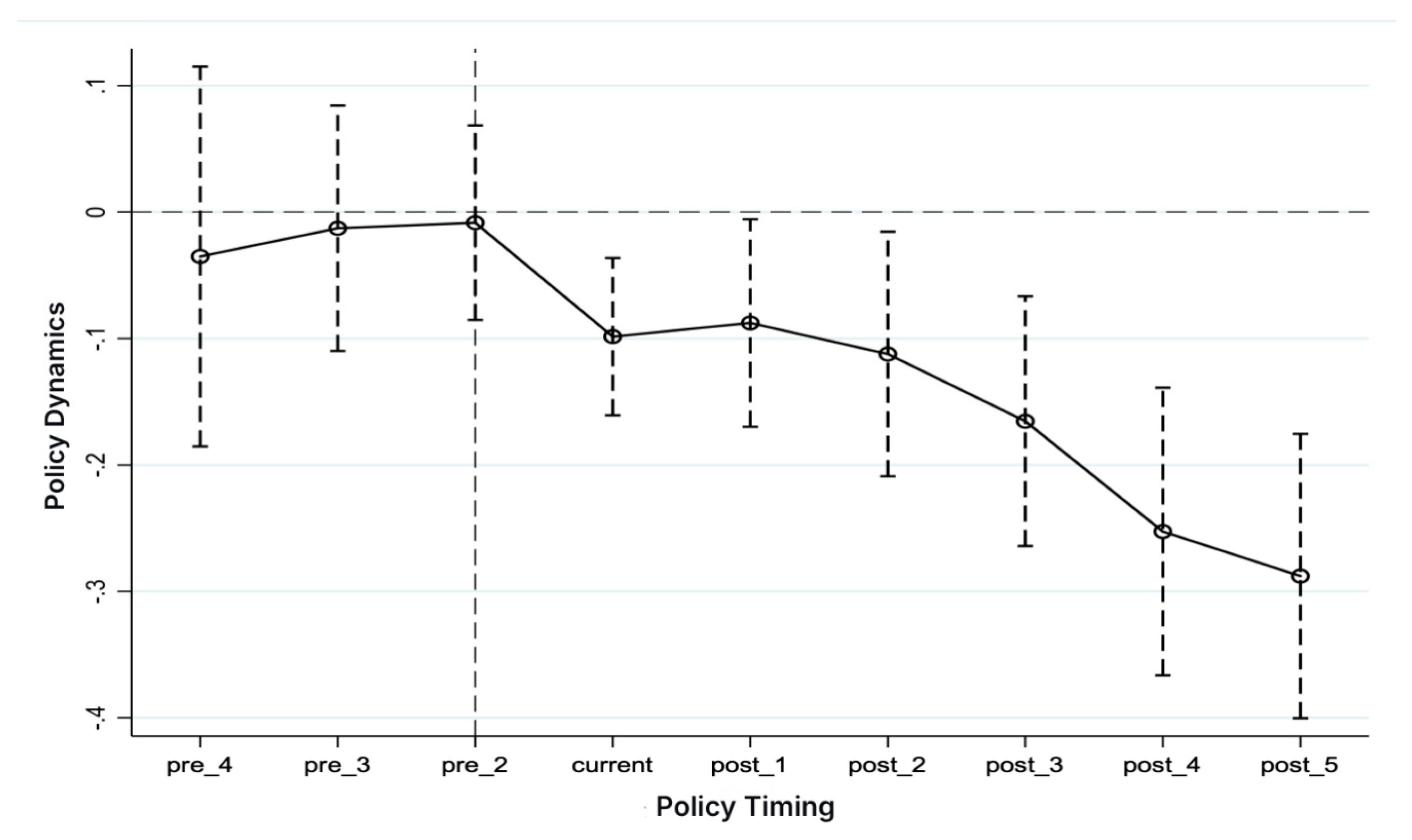
Figure 2.
Placebo test for corporate greenwashing behavior.
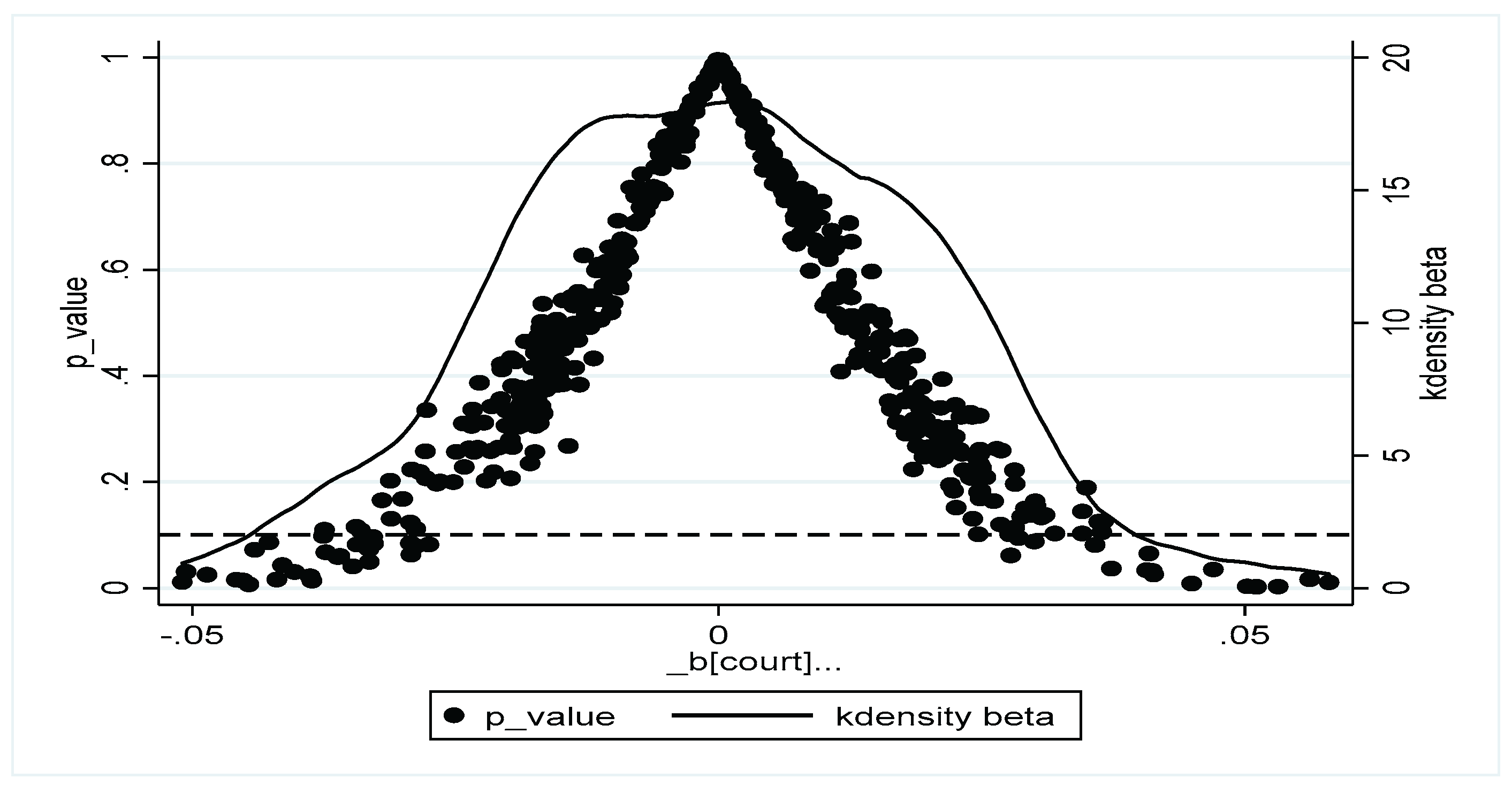

Table 1.
Definition of Primary Variables.
| type of variable | Variable name | Variable Meaning | Variable definition |
|---|---|---|---|
| explained variable | Gws | Greenwashing | Z-score difference between ESG information disclosure and ESG actual performance of enterprises |
| explanatory variable | Court | establishment of environmental court |
The dummy variable is 1 if a prefecture-level city established an intermediate environmental protection court in the current year or before, otherwise it is 0. |
| controlled variable | Size | company size | natural logarithm of total assets |
| Lev | financial leverage | total liabilities / total assets | |
| Age | Company age | The natural logarithm of the company’s age plus 1 | |
| CFO | cash flow | Net cash flow from operating activities / total assets * 100 | |
| Separation | separation of property and management |
control minus cash flow | |
| Top5 | stock concentration | top five shareholders shareholding ratio | |
| CEO_chair_duality | dual role | If the roles of Chairman and General Manager are combined, the value is 1; otherwise, it is 0. | |
| Growth | Company Growth | increase rate of business revenue |
Table 2.
Descriptive statistics of primary variables.
| Variable | Observed value | Average | Standard deviation | Least value | 25th percentile | Median | 75th percentile | Crest value |
|---|---|---|---|---|---|---|---|---|
| Gws | 12 097 | -0.309 | 1.163 | -4.503 | -1.109 | -0.392 | 0.377 | 5.842 |
| Court | 12 097 | 0.474 | 0.499 | 0 | 0 | 0 | 1 | 1 |
| Size | 12 097 | 23.21 | 1.382 | 20.34 | 22.23 | 23.11 | 24.06 | 27.07 |
| Lev | 12 097 | 1.430 | 1.080 | 0.632 | 0.999 | 1.102 | 1.374 | 8.459 |
| Age | 12 097 | 2.463 | 0.674 | 0 | 2.079 | 2.639 | 2.996 | 3.367 |
| CFO | 12 097 | 0.0630 | 0.0700 | -0.147 | 0.0200 | 0.0590 | 0.101 | 0.264 |
| Separation | 12 097 | 5.630 | 8.011 | 0 | 0 | 0 | 10.25 | 29.85 |
| Top5 | 12 097 | 56.16 | 15.88 | 20.21 | 44.65 | 55.85 | 67.35 | 91.41 |
| CEO_chair_duality | 12 097 | 0.554 | 0.497 | 0 | 0 | 1 | 1 | 1 |
| Growth | 12 097 | 0.198 | 0.412 | -0.537 | 0.00700 | 0.124 | 0.279 | 2.780 |
Table 3.
Baseline regression results.
| (1) | (2) | (3) | (4) | |
|---|---|---|---|---|
| VARIABLES | Gws | Gws | Gws | Gws |
| court | -0.097*** | -0.091*** | -0.092** | -0.085* |
| (-2.767) | (-2.602) | (-2.240) | (-1.970) | |
| Size | -0.091*** | -0.091** | ||
| (-3.599) | (-2.006) | |||
| Lev | 0.035*** | 0.035** | ||
| (3.067) | (2.126) | |||
| Age | -0.093 | -0.093 | ||
| (-1.544) | (-0.748) | |||
| CFO | 0.683*** | 0.683*** | ||
| (3.710) | (2.997) | |||
| Separation | -0.002 | -0.002 | ||
| (-0.676) | (-0.497) | |||
| Top5 | 0.004** | 0.004 | ||
| (2.524) | (1.617) | |||
| CEO_chair_duality | -0.055 | -0.055 | ||
| (-0.712) | (-0.536) | |||
| Growth | 0.098*** | 0.098*** | ||
| (3.741) | (3.313) | |||
| Constant | -0.383*** | 1.489*** | -0.262*** | 1.773* |
| (-8.398) | (2.677) | (-12.865) | (1.776) | |
| Observations | 12 ,097 | 12 ,097 | 12 ,0 97 | 12 ,0 97 |
| R-squared | 0.003 | 0.011 | 0.473 | 0.477 |
| Company FE | YES | YES | YES | YES |
| Year FE | YES | YES | YES | YES |
| Cluster City | NO | NO | YES | YES |
Note: t-statistics in parentheses. *** p < 0.01, ** p < 0.05.
Table 4.
Robustness Test.
| (1) | (2) | (3) | (4) | (5) | |
|---|---|---|---|---|---|
| VARIABLES | Nucleic acid matching | Replace the dependent variable | Replacement Explanation variable | First-order difference sub-model |
Excluding the impact of the COVID-19 pandemic |
| Gws | Gws | Gws2 | Gws | Gws | |
| court | -0.091*** | -0.213** | -0.104*** | ||
| (-2.602) | (-2.179) | (-2.582) | |||
| Size | -0.091*** | 0.071 | -0.092*** | -0.091*** | -0.110*** |
| (-3.599) | (0.729) | (-3.622) | (-3.599) | (-3.489) | |
| Lev | 0.035*** | 0.025 | 0.035*** | 0.035*** | 0.037*** |
| (3.067) | (0.866) | (3.067) | (3.067) | (2.842) | |
| Age | --0.093 | -0.364* | -0.095 | -0.093 | -0.105 |
| (-1.544) | (-1.663) | (-1.573) | (-1.544) | (-1.406) | |
| CFO | 0.683*** | 0.212 | 0.685*** | 0.683*** | 0.715*** |
| (3.710) | (0.501) | (3.721) | (3.710) | (3.345) | |
| Separation | -0.002 | 0.003 | -0.002 | -0.002 | -0.003 |
| (-0.676) | (0.420) | (-0.688) | (-0.676) | (-0.961) | |
| Top5 | 0.004** | -0.005 | 0.004** | 0.004** | 0.004** |
| (2.524) | (-1.004) | (2.540) | (2.524) | (2.058) | |
| CEO_chair_duality | -0.055 | 0.042 | -0.054 | -0.055 | -0.220** |
| (-0.712) | (0.207) | (-0.698) | (-0.712) | (-2.272) | |
| Growth | 0.098*** | -0.001 | 0.098*** | 0.098*** | 0.137*** |
| (3.741) | (-0.014) | (3.730) | (3.741) | (4.617) | |
| court2 | -0.079** | ||||
| (-2.256) | |||||
| post | -0.091*** | ||||
| (-2.602) | |||||
| Constant | 1.489*** | 0.199 | 1.503*** | 1.489*** | 2.013*** |
| (2.677) | (0.091) | (2.703) | (2.677) | (2.936) | |
| Observations | 12 ,097 | 9 ,768 | 12 ,097 | 12 ,097 | 9 ,832 |
| R-squared | 0.011 | 0.007 | 0.011 | 0.011 | 0.016 |
| Company FE | YES | YES | YES | YES | YES |
| Year FE | YES | YES | YES | YES | YES |
Table 6.
Heterogeneity Analysis.
| (1) | (2) | (3) | (4) | (5) | (6) | |
|---|---|---|---|---|---|---|
| Non-state-owned enterprise |
state-owned enterprise |
Non-polluting industry |
polluting industry |
Weak environ- mental regulation |
Strong environmental regulation | |
| Gws | Gws | Gws | Gws | Gws | Gws | |
| court | -0.077 | -0.089* | -0.064 | -0.120** | -0.056 | -0.205** |
| (-1.420) | (-1.925) | (-1.482) | (-1.975) | (-1.454) | (-2.369) | |
| Size | -0.009 | -0.151*** | -0.127*** | -0.051 | -0.090*** | -0.023 |
| (-0.229) | (-3.865) | (-4.062) | (-1.047) | (-3.234) | (-0.289) | |
| Lev | 0.035* | 0.029** | 0.063*** | 0.006 | 0.041*** | 0.013 |
| (-1.716) | (-2.061) | (-4.093) | (-0.346) | (-3.13) | (-0.551) | |
| Age | -0.163* | -0.127 | -0.083 | -0.139 | -0.078 | -0.193 |
| (-1.876) | (-1.413) | (-1.167) | (-1.187) | (-1.205) | (-1.061) | |
| CFO | 0.773*** | 0.507** | 0.546** | 0.899*** | 0.439** | 1.568*** |
| (-2.818) | (-2.02) | (-2.461) | (-2.686) | (-2.179) | (-3.331) | |
| Separation | -0.005 | 0.004 | -0.002 | -0.002 | -0.001 | -0.008 |
| (-1.403) | (-1.036) | (-0.697) | (-0.569) | (-0.248) | (-1.280) | |
| Top5 | 0.005** | 0.003 | 0.005** | 0.002 | 0.005*** | -0.002 |
| (-1.966) | (-1.341) | (-2.381) | (-0.727) | (-2.653) | (-0.354) | |
| Growth | 0.089** | 0.106*** | 0.104*** | 0.105** | 0.136*** | -0.096 |
| (-2.473) | (-2.757) | (-3.315) | (-2.126) | (-4.775) | (-1.353) | |
| Constant | -0.518 | 3.093*** | 2.175*** | 0.815 | 1.360** | 0.56 |
| (-0.650) | (3.466) | (3.16) | (-0.767) | (-2.221) | (-0.323) | |
| Observations | 5,553 | 6,544 | 7,435 | 4,662 | 9,130 | 2,967 |
| R-squared | 0.022 | 0.015 | 0.016 | 0.016 | 0.012 | 0.029 |
| Company FE | YES | YES | YES | YES | YES | YES |
| Year FE | YES | YES | YES | YES | YES | YES |
Disclaimer/Publisher’s Note: The statements, opinions and data contained in all publications are solely those of the individual author(s) and contributor(s) and not of MDPI and/or the editor(s). MDPI and/or the editor(s) disclaim responsibility for any injury to people or property resulting from any ideas, methods, instructions or products referred to in the content. |
© 2026 by the authors. Licensee MDPI, Basel, Switzerland. This article is an open access article distributed under the terms and conditions of the Creative Commons Attribution (CC BY) license.
Copyright: This open access article is published under a Creative Commons CC BY 4.0 license, which permit the free download, distribution, and reuse, provided that the author and preprint are cited in any reuse.


