

Submitted:
25 May 2026
Posted:
26 May 2026
You are already at the latest version
Abstract
We reformulate matrix mechanics by incrementally heating a single hydrogen atom in order to derive the complete, diagonalized Hamiltonian matrix. The spectral lines and transition probabilities cannot be generated by reversing time thereby demonstrating asymmetry. Experimental evidence in support of the theoretical model is obtained from experiments performed with the simplest quantum system, an electron cyclotron. Wave mechanics is also reformulated by altering the original Schrödinger equation describing a time symmetric, conservative system to a system of two independent equations describing a time asymmetric, non-conservative system.
Keywords:
energy conservation
; matrix mechanics
; wave mechanics
; non-conservative systems
; time reversal symmetry/asymmetry
; transition probabilities
; wave function
1. Introduction
Microscopic time reversal refers to the fact that the fundamental laws governing individual particles (like electrons and atoms) are symmetric with respect to time, meaning they work the same forwards or backward. The Schrödinger equation possesses time-reversal symmetry because its fundamental dynamics allow for wave function evolution both forward and backward in time. If time is reversed (t―> −t) the equation still holds and results in another valid solution. Consequently a video of a quantum process, if played backward, would look like a physically valid phenomenon. However an equivalent theory, matrix mechanics, is based on “quantum jumps” at single points in time. Thus a conflict has always existed between these two foundational, mathematically equivalent formulations of quantum mechanics concerning how quantum systems evolve in time; discretely or continuously. The first record of the dispute, which included Heisenberg, Bohr, and Schrödinger was conducted verbally and with great vigor and intensity [1]. We will now renew the debate a century later with a renewed focus on the foundations and access to experimental results that directly illustrate the topic of the discussions; that is, how the excitation and decay of an electron evolves in time.
2. Quantum Mechanics
2.1. Time’s Arrow
We see evidence of the arrow of time in the second law of thermodynamics, in evolutionary theory, in Hubble’s law of cosmic expansion; and also subjectively, in our own stream of consciousness. All are irreversible natural phenomena that may well be based on underlying quantum mechanical principles. They are well-known examples of time’s arrow that are observable. However, time is not an observable in quantum mechanics. Observables are measured by bringing a measuring device into contact with the physical system, but time measurements do not make contact with the observed physical system. The time "measured" by clocks is just one of four coordinates, the same as in classical physics, and though clocks are used in quantum mechanics to measure the location of an event, the time of an event has no direction. Thus time asymmetry is concerned with much more than clock time and the time we experience. It is also a determining factor in how material systems evolve in time; whether in the form of a hydrogen atom, a molecule, the cosmos, or life itself.
2.2. Time Reversal Asymmetry
Wave functions describe physical variables in quantum mechanics such as position and momentum which evolve reversibly in time according to the Schrödinger equation. However, there is a mathematically equivalent theory, matrix mechanics, which describes physical variables at single points in time. It derives from the hydrogen spectrum of black body radiation and is the result of many atoms acting in unison. We are able to use it to interpret the energy of a single hydrogen atom by reformulating the Hamiltonian matrix Hij describing all possible electron transitions [2]. The individual matrices Hij are snapshots in time of energy states that are infinite in number, and when placed in a series from low energy to high they may be used in the same way as frames in a motion picture to depict the increase in temperature of a hydrogen atom. Increasing the temperature of a hydrogen atom is a critical, but unacknowledged initial condition for obtaining the spectral lines. The same video shown in reverse is immediately rejected since it depicts spectral lines and transition probabilities being generated in response to a lowering of temperature.
Physics defines time operationally, as the steady tick of a clock. If time is reversible then clocks must be as well. Studies of atomic clocks show that transition probabilities, not wave functions, are what determines the length and direction of the tick of an atomic clock. Although clock transitions involve moving between the same energy levels, the energy involved, the pathways, and their probabilities differ. Because transition probabilities are intrinsically asymmetric in time reversing the transition does not reverse time’s arrow. Thus the hydrogen atom acts as a crude form of clock while deriving the hydrogen spectrum. By describing time’s passage at the microscopic level it forms the basis for a hypothesis concerning the arrow of time at the most fundamental level possible, the quantization of energy.
3. Experimental Evidence
A recent experiment with single electrons provides experimental evidence to support our hypothesis concerning the quantum mechanical asymmetry of time [3]. Electrons from a high voltage discharge tube are cooled to near absolute zero and inserted in a “bottle” made of intersecting electric and magnetic fields. Single particles are trapped indefinitely by the intersection of a homogeneous magnetic field and an electrostatic quadrupole potential. The resultant motion of electrons consists of a fast circular cyclotron motion with a small radius superimposed on a much larger orbit moving slowly. The trapped electrons constitute an artificial atom or “quantum cyclotron”, the simplest quantum mechanical system possible. It is so sensitive to external forces that the influence of the earth’s gravitational field must be taken into account.
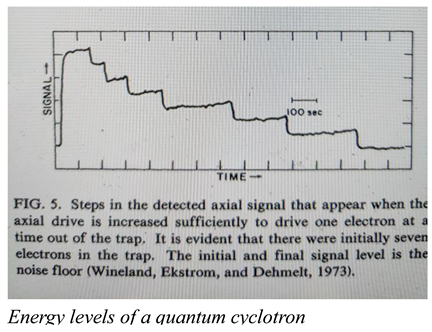
When a signal of alternating frequency is applied to the axial cyclotron motion it causes the electrons to be excited and seek a higher energy level. The “detected current” plotted as a function of energy versus time in the figure shows a pronounced step structure with quantization slowed to a snail’s pace. Initially there are seven electrons in the cavity, each one described by a wave function and probability for decay. Emission proceeds spontaneously in discrete steps of equal energy with each one marking the exit of an electron from the cavity. The system returns to the base level when the final electron exits. The figure gives a complete record of quantization in terms of the physical variables energy and time; beginning at a base level, or ground state, and also ending there. The horizontal lines represent the presence of wave functions, the short vertical lines represent emissions, and the long vertical line at the left represents the input signal. The experimentally derived energy-time curve in the figure is a faithful reproduction of quantization in real time; the continuous, irreversible increase and decrease of energy by a quantum system. The input of a signal causes quantum superposition and an increased energy which then decreases as energy is released in discrete steps. The experiment reduces the complexity of quantization to its most elemental level, the increase and decrease of a potential.
The curve is a complete description of quantization since it describes the absorption of energy by a quantum system in the form of a continuous classical signal, an excited state of indeterminate time, and the discrete emission of energy in the form of a photon. It complies with the conservation of energy by beginning at the ground state, increasing to an excited state, and ending at the ground state. The wave function describes the excited state, but not excitation and decay, so it is a partial record of quantization.
4. Wave Mechanics
Once Heisenberg’s theory is reformulated to describe a single atom the direction in time of a quantum system is no longer in doubt; however, the same cannot be said about wave mechanics. The equations of motion of wave mechanics for a single atom have been substantiated experimentally and it is easily verifiable that reversing the time of the Schrödinger equation (t―> −t) creates a second solution. However, Schrödinger only posited solutions that are valid for conservative systems of constant potential [4].
“We have always postulated up till now that the potential energy V is a pure function of the coordinates and does not depend explicitly on the time. There arises, however, an urgent need for the extension of the theory for non-conservative systems, because it is only in that way that we can study the behavior of the system under the influence of prescribed external forces, e.g. a light wave, or a strange atom flying past.” p. 103
If he had extended his theory to include non-conservative quantum systems, he would have realized that they are asymmetric in time due to the way they function. In fact it occurred to Einstein that something was missing in the way the wave function was conceived [5].
“The light quantum has a definite localization and a definite color. Naturally one cannot do justice to this by means of a wave function. Thus I incline to the opinion that the wave function does not (completely) describe what is real.”
By “real” Einstein means that quantum theory should describe systems of varying potential, a characteristic of all observable phenomena, but not of wave functions; which are not observable. To define a “real quantum state” we proposed in an earlier communication that it is necessary to link the output of matrix mechanics to the input of wave mechanics [2]. The examples cited by Schrödinger for a non-conservative system, “light waves and atoms flying past”, are classical manifestations of heat and can be expressed quantum mechanically by the Hamiltonian matrix at single points in time. They are linked to wave mechanics and the wave function in the simplest possible way, by their physical juxtaposition within the quantum system. The matrix supplies the missing information due to a variable potential V to make the wave function complete and causes the resultant non-conservative system to be asymmetric in time due to the nature of cause and effect.
5. Conclusion
Several proofs of time’s arrow have been proposed. The first is based on the spectral emissions of a single hydrogen atom and the causal relation of heat absorption to the spectral lines. Related to it is the asymmetry in time of the excitation and decay probability transitions. The second proof is based on an experimental curve showing the excitation and decay of single electrons in an electron cyclotron. In conclusion we refer to an assertion by Schrödinger in his original 1926 paper that the derivation of the wave function is incomplete because it is limited to conservative systems. We propose a resolution by linking the classical output of matrix mechanics to the quantum mechanical input of wave mechanics to form a quantum system that is non-conservative and therefore physically irreversible.
Physical consistency is a requirement of the mathematical formulations of quantum mechanics. It is not sufficient to derive equations that correctly predict the outcome of experiments if the equations themselves are not internally consistent. Equations have been derived to accurately predict the probabilities of excitation and decay which define how an atomic clock operates. In physics time is defined operationally; simply as what a clock reads, and clock ticks are determined by the observed probabilities and not by wave functions which cannot be observed.
References
- Heisenberg, W. Physics and Beyond; Encounters and conversations; Harper, NY, 1971; p. 73. [Google Scholar]
- Oldani, R. “On the foundations of quantum mechanics” preprints.org. 2025. [Google Scholar] [CrossRef]
- Brown, L.S.; Gabrielse, G. Geonium theory: physics of a single electron or ion in a Penning trap. Rev. Mod. Phys. 1986, 58(1), 233–311. [Google Scholar] [CrossRef]
- Schrödinger, E. Collected Papers on Wave Mechanics, 2nd edn; Blackie, London 1928; Available online: https://mwolf.pracownicy.uksw.edu.pl/MK/Schrodinger_Collected_Papers_on_Wave_Mechanics.pdf.
- Einstein, A. Letter to Paul Epstein 11/10/1945 Sixty-Two Years of Uncertainty Edited by A. I. Miller; Plenum Press: New York, 1990; p. 103. [Google Scholar]
Disclaimer/Publisher’s Note: The statements, opinions and data contained in all publications are solely those of the individual author(s) and contributor(s) and not of MDPI and/or the editor(s). MDPI and/or the editor(s) disclaim responsibility for any injury to people or property resulting from any ideas, methods, instructions or products referred to in the content. |
© 2026 by the authors. Licensee MDPI, Basel, Switzerland. This article is an open access article distributed under the terms and conditions of the Creative Commons Attribution (CC BY) license (http://creativecommons.org/licenses/by/4.0/).
Copyright: This open access article is published under a Creative Commons CC BY 4.0 license, which permit the free download, distribution, and reuse, provided that the author and preprint are cited in any reuse.