

Submitted:
26 January 2026
Posted:
27 January 2026
You are already at the latest version
Abstract
Background/Objectives: Nowadays, the implementation of modern digital technologies in the diagnosis and treatment of cancer patients is growing worldwide. Therefore, the use of mobile health applications by cancer patients deserves special attention. This investiga-tion aims to analyse oncological patients’ attitudes to the use of mobile health applica-tions for improvement of the effectiveness and quality of cancer diagnosis and treatment as well as at identifying the main advantages and challenges of patients’ usage of mobile health applications. Methods: In 2025, an anonymous survey was conducted among 238 cancer patients (128 women and 110 men) in Varna, Bulgaria. The frequency and types of mobile health applications used were assessed, along with perceived benefits and chal-lenges related to monitoring patients’ physical status. Data were analysed using descrip-tive statistics, variation analysis, and Pearson’s χ² test. Results: Most cancer patients were aged 61–64 years. Mobile health applications were used by 31.51% of patients, mainly for medication and examination reminders. These apps were most frequently used for medi-cation intake and medical examination reminders, particularly among female patients. Easy access to health-related information was identified as the main benefit of monitoring physical status. The most commonly reported challenge was insufficient time for regular data entry and updates. Conclusions: Our results showed that patients with cancer had a positive attitude towards using mobile health applications to monitor their physical sta-tus. These patients also shared several benefits and challenges, proving the need for fur-ther research into this popular topic.
Keywords:
mobile health applications types
; cancer patients
; benefits
; challenges
; inquiry investigation
1. Introduction
Cancer is one of the most severe and socially significant diseases worldwide necessitating united intensive and interdisciplinary research by the scientific community. [1] The World Health Organization recommends that all digital tools or technologies in the field of healthcare be developed and implemented in accordance with the principles of digital development. There is guidance for building an enabling environment for fostering the adoption of digital health, too [2].
A digital health application for supportive cancer care, OncoSupport+, is co-designed, developed in collaboration with cancer patients and health care professionals within a participatory study with the major stakeholders at the University Hospital Zurich, Switzerland, and integrated into the clinical workflow for supportive cancer care [3]. Patients and health care professionals emphasize the necessity for this application to improve patient-healthcare professional communication, digitalize supportive care screening and processes, and enhance self-efficacy. Potential facilitators for adoption include ease of usage, workflow integration, introduction by health care professionals, and technical support, whereas Internet anxiety could be a potential barrier.
The potential of digital health innovations to transform cancer care in Africa by improving access, efficiency, and equity is explored in a recent policy review [4]. It highlights successful examples such mobile health interventions while addressing the barriers to their adoption such as infrastructure gaps, poor digital literacy, and policy constraints. Strategic recommendations are proposed to foster sustainable and scalable digital health ecosystems tailored to the African context.
Recently, there is increasing interest in the development of a variety of mobile health applications in patients with oncological diseases worldwide. These applications enhance patient-provider communication and play a crucial role in the diagnosis, treatment, quality of life, and outcomes for patients living with metastatic breast cancer [5].
The results from the bibliometric analysis of 615 articles dealing with mobile health applications in breast cancer and abstracted between 1991 and 2025 in Web of Science database reveal the dynamics of publication trends, geographic distribution, institutional contributions, authorship patterns, and research hotspots [6]. The USA is the leading country in terms of publication output followed by China and Australia. Recently, research has shifted towards emerging technologies like mobile health applications and patient-centered care, including a focus on patient-reported outcomes.
The comprehensive systematic review including 29 studies abstracted in PubMed and Web of Science until March 2025 and focusing on the utility of mobile health applications for symptom monitoring and management, decision-support and educational tools, and personalized care approaches in patients with genitourinary cancers demonstrates the potential of these applications in revolutionizing uro-oncology patient’s care [7]. These applications are feasible and well-accepted by the patients. The implementation challenges include technical barriers, variations in application quality, high risk of bias, and unequal access to digital healthcare technologies.
The systematic review of 14 studies devoted to the usage of mobile health technologies such as wearables and smartphone applications to monitor cardiovascular health indicators in cancer survivors, published between January 1st, 2016, and June 13th, 2024, and abstracted in PubMed, Scopus, EMBASE, and Web of Science reveals that mobile applications and commercial wearables are most commonly used [8]. Physical activity is the most monitored risk factor. The lack of integration with electronic medical records highlights a gap in clinical implementation.
The results from the systematic review of eight studies (three qualitative and three mixed- method studies, one randomized controlled trial, and one non-randomized trial) abstracted in PubMed, PsycINFO, CINAHL, the Cochrane Library, and Web of Science until October 2024 reveal that mobile health applications for self-managing long-term oral systematic anticancer therapy exhibit acceptability, with usability and satisfaction ratings between 60% and 78% [9]. The following four themes influencing upon acceptability are identified: coherence - perceived benefits; cognitive participation - barriers from technical issues; collective action - burden from excessive notifications and inadequate support, and reflexive monitoring - integration challenges in daily routine. These mobile health applications enhance patient’s awareness of support, online health knowledge, and reduce daily life impact.
The purpose of this investigation is to analyze oncological patients’ attitudes to the application of some modern digital health technologies such as mobile health applications for improvement of the effectiveness and quality of cancer diagnosis and treatment, as well as to identify the main advantages and challenges of patients’ usage of mobile health applications.
2. Materials and Methods
A cross-sectional, anonymous questionnaire-based study was conducted in 2025 among cancer patients who received treatment in public and private hospitals in Varna, Bulgaria. The study included 238 patients (128 females and 110 males) aged ≥18 years with a confirmed oncological diagnosis.
Data were collected using a structured questionnaire assessing access to digital devices, frequency and types of mobile health (mHealth) applications used, and perceived benefits and challenges related to mHealth-supported monitoring of physical status. Applications included tools for symptom tracking, physical activity monitoring, medication reminders, and appointment management.
Descriptive and variation analyses were applied to summarize patient characteristics and mHealth usage patterns. Associations between categorical variables were examined using Pearson’s chi-square (χ²) test, with statistical significance set at p < 0.05.
3. Results
The present study covered a total of 238 cancer patients, 110 males and 128 females, hospitalized in 2025 in Varna, Bulgaria. The anonymous questionnaire assessed the usage of digital health technologies by these patients. Their age distribution is illustrated in Figure 1.
The relative share of the respondents in these six age groups is shown in Table 1. These patients are predominantly aged between 61 and 64 years.
The mobile health applications have been predominantly used among these patients - by a total of 238 cancer patients or by 80.41% of the cases. There are 128 females and 110 males. Their age distribution is presented in Figure 2.
The relative share of the respondents in these six age groups is demonstrated in Table 2. These patients are mainly aged between 61 and 64 years, too.
We examined the frequency and types of mobile health applications used as well as their benefits and challenges for monitoring cancer patients’ physical status.
The frequency of mobile health application usage by cancer patients is indicated in Table 3.
The frequency of mobile health application usage by cancer patients according to age is displayed in Table 4.
The relative share of cancer patients of different age groups according to the frequency of their usage of mobile health applications is presented in Table 5.
The statistical analysis reveals Pearson’s χ2 value of 33.735 at two-sided asymptotic significance <0.001 and a likelihood ratio of 34.290 at at two-sided asymptotic significance <0.001 showing the dependence of the frequency of mobile health application usage on sex. The number and relative share of all the cancer patients according to the different types of mobile health applications used by them for monitoring their physical status are listed in Table 6.
The number and relative share of female and male cancer patients according to the different types of mobile health applications used by them for monitoring their physical status are indicated in Table 7 and in Table 8.
The difference between female and male cancer patients in terms of the mobile health application usage for reminder of taking of medicines and medical examinations is not statistically significant (t=1.592; p>0.05).
The results from the statistical analysis demonstrate Pearson’s χ2 value of 11.943 at two-sided asymptotic significance of 0.018 and a likehood ratio of 12.170 at at two-sided asymptotic significance of 0.016 indicating that the frequency of the mobile health application usage depends on sex.
The benefits of the mobile health application usage for monitoring cancer patients’ physical status shared by themselves are summarized in Table 9.
The challenges faced by cancer patients during mobile health application usage are indicated in Table 10.
4. Discussion
Our study is the first to examine attitudes toward the use of mobile health applications for monitoring physical condition among cancer patients in Varna, Bulgaria. The results demonstrate a relatively common use of different mobile health application types, varying by patients’ sex and age, and identify key benefits and challenges reported by cancer patients.
The frequency of this usage statistically significantly depends on patient’s sex (with Pearson’s χ2 value of 33.735 at two-sided asymptotic significance <0.001 and a likelihood ratio of 34.290 at at two-sided asymptotic significance <0.001) and age (with Pearson’s χ2 value of 11.943 at two-sided asymptotic significance of 0.018 and a likelihood ratio of 12.170 at at two-sided asymptotic significance of 0.016).
The type of the mobile health application usage for reminder of taking of medicines and medical examinations is most common among the whole contingent (in 66 patients or in 27.73% of the cases) and among the female patients (in 46 patients or in 35.94% of the cases). There is a statistically insignificant difference between female and male cancer patient’s reminder of taking of medicines and medical examinations (t=1.592; p>0.05). Two types of the mobile health applications are most commonly made use of by the male patients: physical activity monitoring and follow-up of physiological parameters such as blood pressure and blood glucose (among 30 patients or 27.27% of the cases each).
Easy access to information related to health status is the most common benefit of mobile health application usage for monitoring cancer patients’ physical status. It is shared by 58 cancer patients or by 24.37% of the cases. Next follows the reminder of taking medicines and medical examinations according to 53 cancer patients or 22.27% of the cases.
The absence sufficient time for individual regular data use and updating and the lack of technical literacy for mobile health application usage belong to the most common challenges faced by 61 cancer patients (or by 25.63%) and by 57 ones (or by 23.95% of the cases), respectively.
The review of 21 full-text, English-language articles published after January 2018 and searched in PubMed and the Cochrane Library databases between October and December 2023 identifies the positive impacts and concerns of the mobile health applications for cancer patients [10]. It reveals that mobile technology offers the possibility to manage symptoms via the application-based logging of patient-reported outcomes and transmission of patient reported outcomes to clinical professionals. Mobile health is a sound compound to offer education material related not only to the diagnosis but also to aspects of holistic well-being via measures as simple as a ‘tip of the day’. Users’ preferences of mobile health applications destined for behavioural change in the areas of treatment adherence, symptoms self-management, and communication with healthcare professionals are concerned mainly with application design, available features, and interoperability.
A mobile health application designed to address the significant disruptions in cancer patients’ functional social relationships is developed with six modules within an applied-developmental mixed-methods study in four sequential phases in Isfahan, Iran [11]. Usability testing from the patients’ perspective yields a mean score of 88.62 (between 81.97 and 95.27 at 95% confidence interval) thus reflecting high satisfaction, strong perceived usefulness, and high likelihood of recommendation to other cancer patients. The overall mean score of this mobile health application is 4.15±0.21 and reveals a good-quality design with minimal variability among reviewers. This new application effectively enhances perceived aspects of social relationships among cancer patients.
A recent scoping review has examined mobile health applications designed to support symptom management among adolescents and young adults undergoing cancer treatment. The review, which drew on evidence identified in MEDLINE (OVID), CINAHL, EMBASE, Scopus, Web of Science, and ProQuest, outlines the range of available applications and their clinical functionalities [12]. The Memorial Symptom Assessment Scale is the most common symptom measurement tool. Continuing testing of these applications is warranted to ensure patient’s safety, with alerts and age-appropriate gamification.
A mobile health application designed to enhance self-efficacy and resilience among breast cancer patients undergoing chemotherapy is developed and pilot-tested in Kaohsiung, Southern Taiwan [13]. 37 patients received both standard treatment and access to the application, while 36 received only standard care. High task completion rates, good mobile health application usability, and generally positive user satisfaction (75.88±15.87) are established. The first group demonstrates statistically significant improvements in self-efficacy (p=0.01), especially, in indecision-making (p=0.03) and positive attitude (p=0.01) than the second one. This application has good feasibility, high acceptability, and significant psychosocial benefits by enhancing self-efficacy and mitigating resilience decrease.
The quality of breast cancer mobile health applications using two tools, the Mobile Application Rating Scale and the Feature-based Application Rating Method to guide healthcare stakeholders and patients identify high-quality mobile health applications that meet their needs is evaluated during a cross-sectional study between February and July 2023 in Mashhad, Iran [14]. The average score of these two tools in 44 applications is 3.3±0.19 out of 5, indicating their moderate quality. The evaluation results of both tools reveals that the absence of undesirable features has the highest mean of 4.7±0.2 and the lowest subjective dimension is with an average score of 2.12±0.3. The functionality dimension scored highest at 4.1, reflecting strong technical performance. The strong correlation (r=0.806) between engagement and other quality dimensions demonstrates variability in user engagement across the mobile health applications in breast cancer.
The experiences of gynecological cancer survivors using the Lifestyle Empowerment Techniques in Survivorship of Gynecologic Oncology (LETSGO) smartphone application as a supportive care tool for symptom self-assessment, physical activity goal setting, and encouraging a healthier lifestyle during posttreatment follow-up is qualitatively explored using individual semistructured interviews with 20 women at five hospitals in Oslo, Norway [15]. This application contributes to an increased sense of safety by facilitating symptom monitoring and offering easy access to healthcare providers. It motivates the survivors to adopt a healthier lifestyle, including physical activity, and offers valuable, easily accessible, evidence-based knowledge described in three main themes, i.e., feeling safe, motivation for adopting a healthier lifestyle, and fostering health engagement through knowledge.
The background, current status, and future perspectives of mobile health applications and wireless technologies in patients with gastrointestinal malignancies are summarized using randomized or prospective study results [16]. They are useful tools for managing the clinical course of gastrointestinal cancer and improving the quality of life and physical performance of cancer survivors. The mobile health applications are effective in cancer-related pain management, dietary management after cancer surgery, and cancer surveillance management after treatment in daily clinical practice.
Guidance for designing ‘BlaCancer’, a mobile health application that addresses unfulfilled needs in bladder cancer care is provided based on the results from cross-sectional surveys with 16 patients and 28 physicians in Beirut, Lebanon [17]. The patients perceive their level of understanding of bladder cancer as moderate (at a mean score of 4.75/7). Eleven of them (68.75%) support the mobile health applications for education, medical records, and peer support. Physicians stress the significance of treatment recommendations (89.3%), symptom recording (39.3%), and decision-making tools. Other concerns include data privacy and integration issues.
Nowadays the adoption of mobile health applications integrated with artificial intelligence for skin cancer triage in the general population is rapidly increasing in the Netherlands [18]. These applications should include clear user instructions and automated quality checks for submitted images in order to ensure usability and diagnostic reliability. The importance of a simple and accessible interface as well as of inclusive testing across a diverse user population is emphasized.
In a mixed-methods development and validation study, a cancer-focused mobile health application designed to bridge the communication gaps between cancer patients and health care providers is introduced[19]. It allows patients to immediately report real-time symptoms for chemotherapy patients and enables proactive symptom management by health care providers. The application quality is validated and evaluated by means of the Mobile Application Rating Scale. It seeks to foster health care communication, reduce hospital readmissions, and optimize symptom management thus contributing to a more impactful patient’s experience. An overall Mobile Application Rating Scale score of 3.75±0.42 is achieved indicating consistent quality with a highest functionality scoring (of 4.35±0.52) and a lowest engagement one (of 3.31±0.61).
The results from an on-line anonymous questionnaire developed by the Council of Cardio-Oncology of the European Society of Cardiology and completed by 220 healthcare professionals from 55 countries between June 2023 and January 2024 demonstrate the role of the mobile or wearable digital devices for care of active heart cancer patients [20]. It deals mainly with measuring heart rate, blood pressure, body temperature, physical activity, and sleep. The mobile health applications are used in the setting of atrial fibrillation detection, too. The decision to make use of them is made by the patient in 56.6% and by the physician in 43.4% of the cases. The most important barrier reported to the implementation of the mobile or wearable devices is their cost (weighted average of 3.38 and 3.39, respectively).
A systematic scoping review of the available literature has explored the application of digital therapeutics in the management of prostate cancer. Evidence identified up to November 1, 2024, across multiple databases, including China Biology Medicine, the China Science and Technology Journal Database (VIP), PubMed, EMBASE, Web of Science, the Cochrane Library, and CINAHL, highlights the emerging role of digital interventions in this clinical context [21]. The mobile health applications serve to monitor and share health-related data, including functionalities for reminders, symptom assessment, and tracking of this second most common malignancy in men. Their primary focus in the patients includes survivorship support, side-effect monitoring, psychological support and emotional management, patient education and self-management, health management and rehabilitation, and treatment adherence management.
Limitations of the study include cross-sectional analysis and self-reported data, which limit the possibility of causal conclusions. In addition, limited geographic representation and the lack of clinical characteristics limit the depth of the analysis.
Future studies should use longitudinal and interventional designs, include clinical and indicators, and evaluate the integration of mHealth applications into clinical practice. The development of patient-centered and locally adapted digital solutions may improve their effectiveness and acceptance in cancer care.
5. Conclusions
Cancer patients in Varna, Bulgaria, demonstrate generally positive attitudes toward the use of mobile health applications for monitoring physical status. While mHealth applications offer clear benefits, several practical and technical challenges remain. Addressing these barriers through patient-centred design, improved digital literacy, and integration into clinical workflows may enhance the effectiveness of mHealth solutions in oncology care. Further research is needed to build on current findings and provide more in-depth evidence on the benefits and barriers to the use of mobile health technologies.
Author Contributions
Conceptualization, G.Y., G.P. and S.G.; methodology, G.Y., T.D.; software, Sv.S., N.I.; validation, G.Y., G.P. and S.G.; formal analysis, N.I.; investigation, G.Y., T.D.; data curation, D.C., Sv.S.; writing—original draft preparation, G.Y., D.C., Sv.S. and St.S.; writing—review and editing, T.K., G.P. and S.G.; visualization, St.S.; supervision, T.K., G.P. All authors have read and agreed to the published version of the manuscript.
Funding
This research received no external funding. The Medical University of Varna „Prof. Dr. Paraskev Stoyanov” supported this research.
Institutional Review Board Statement
The study was conducted in accordance with the Declaration of Helsinki, and approved by the Research Ethics Committee of the Medical University of Varna (№ 16/03.06.2025).
Informed Consent Statement
The questionnaire and all related study documents, including the informed consent form for participants, were submitted to the Ethics Committee for Scientific Research at the Medical University of Varna and received ethical approval (Protocol No. 16/03.06.2025). Participation was voluntary, and all respondents signed an informed consent statement prior to inclusion in the study.
Data Availability Statement
Not applicable.
Conflicts of Interest
The authors declare no conflicts of interest.
References
- Nwosu, N. Cancer: A Disease of Modern Times? Cureus 2024, 16, e74666. [CrossRef]
- Jandoo, T. WHO Guidance for Digital Health: What It Means for Researchers. Digit. Health 2020, 6. [CrossRef]
- Difrancesco, S.; Bauert, M.M.; Lehmann, C.; Häsler, S.; Zhang, Y.; Hirsch, S.; Ackermann, P.; Stockinger, K.; Reif, M.; Mathieu, S.; et al. Collaborative Design and Development of a Patient-Centered Digital Health App for Supportive Cancer Care: Participatory Study. JMIR Hum. Factors 2025, 12, e73829. [CrossRef]
- Dako, F.; Moraes, F.Y.; Doo, F.; Abed, M.; Anazodo, U.; Patrick, L.; Favorito, F.M.; Fouad, E.; Alabi, A.; Avery, S.; et al. Digital Health and Artificial Intelligence Innovations for Oncology in Sub-Saharan Africa. Lancet Oncol. 2025, 26, e547–e557. [CrossRef]
- Alves, T.F.; Crosby, K.; Horner, R.D.; Dai, H.D.; Krishnamurthy, J.; Cozad, M.J. Metastatic Breast Cancer MHealth App to Promote Patient-Provider Communication: Protocol for a Usability and Satisfaction Study. JMIR Res. Protoc. 2025, 14, e66050. [CrossRef]
- Yang, X.; Chen, Z.; Xu, Z.; Sun, Y. A Bibliometric Analysis of Mobile Health in Breast Cancer Care: Trends, Impact, and Future Directions. Supportive Care in Cancer 2025, 33, 1003. [CrossRef]
- Gómez-Luque, M.Á.; Rivero-Belenchón, I.; Congregado-Ruiz, C.B.; Escobar-Rodríguez, G.A.; Delgado-Granados, F.J.; Rivas-González, J.A.; Medina-López, R.A. The Role of MHealth Applications in Uro-Oncology: A Systematic Review and Future Directions. Cancers (Basel). 2025, 17, 2613. [CrossRef]
- Benzo, R.M.; Gogineni, A.; Tetrick, M.K.; Singh, R.; Washington, P.; Fernandez, S.; Paskett, E.D.; Penedo, F.J.; Ghazi, S.; Osei, A.; et al. MHealth Technologies in Research Studying Cardiovascular Health in Cancer: A Systematic Review. PLOS Digital Health 2025, 4, e0001027. [CrossRef]
- Mahalingam, L.; Tan, B.K.; Bee, P.C.; Teoh, C.H.; Sellappans, R.; Ng, D.L.C.; Husin, A.; Tan, S.M.; Chen, L.-C. Mobile Health Applications for Supporting Self-Management of Oral Systemic Anticancer Therapy in Haematological Malignancies: A Systematic Review of Acceptability and Efficacy. Digit. Health 2025, 11. [CrossRef]
- Leidong, W.; Monachino, M.; Lloyd-Williams, D.; Nguyen, T.L.H.; Dsouza, B.; Moreira, J.P. Mobile Apps for Cancer Patients: Identifying Positive Impacts and Concerns. Digit. Health 2025, 11. [CrossRef]
- Zarei, B.; Bahrami, M.; Beigi-Harchegani, H.; Kazemi, A. Development, Usability, and Quality Evaluation of a Mobile Application to Enhance the Functional Aspects of Social Relationships Among Cancer Patients: An Applied-Developmental Mixed-Methods Study. Health Sci. Rep. 2025, 8. [CrossRef]
- Heaney, C.; Lally, S.; Dowling, M. Mobile Phone Apps for Adolescent and Young Adult Symptom Management during Cancer Treatment: A Scoping Review. Br. J. Nurs. 2025, 34, S6–S14. [CrossRef]
- Hsu, H.; Yu, C.; Sun, W.; Liang, T.; Weng, S.; Yu, E.; Hsu, Y. Feasibility and Acceptability of a Mobile App Intervention to Promote Self-Efficacy and Resilience Among Breast Cancer Patients Undergoing Chemotherapy: A Pilot Randomized Controlled Trial. Psychooncology 2025, 34. [CrossRef]
- Mohammadi Mogharab, G.; Khajouei, R.; Norouzkhani, N.; Esmaeili, Z.; Bagheri, F.Z.; Mazaheri Habibi, M.R. Expert Evaluation of Mobile Health Apps for Breast Cancer Management: A Feature-Based Analysis Using the Mobile Application Rating Scale (MARS). BMC Health Serv. Res. 2025, 25, 692. [CrossRef]
- Tarabar, Z.; Vistad, I.; Børøsund, E. Gynecological Cancer Survivors’ Experiences Using a Supportive Care Application During Posttreatment Follow-Up. Cancer Nurs. 2025. [CrossRef]
- Aoyama, T.; Cho, H.; Hara, K. Mobile and Wireless Technologies for Gastrointestinal Cancer Treatment. Anticancer Res. 2025, 45, 2249–2256. [CrossRef]
- Assi, A.; Jalbout, J.; Youssef, B.; Diab, E.; Kourie, H.R. BlaCancer: A Mobile Health Solution for Enhancing Bladder Cancer Care. BMC Urol. 2025, 25. [CrossRef]
- Sangers, T.E.; Wakkee, M.; Moolenburgh, F.; Nijsten, T.; Lugtenberg, M. Mobile Health Apps for Skin Cancer Triage in the General Population: A Qualitative Study on Healthcare Providers’ Perspectives. BMC Cancer 2025, 25, 851. [CrossRef]
- Muñoz Olivar, C.; Pineiro, M.; Gómez Quintero, J.S.; Avendaño-Vásquez, C.J.; Ormeño-Arriagada, P.; Palma Rivadeneira, S.; Taramasco Toro, C. Education and Symptom Reporting in an MHealth App for Patients With Cancer: Mixed Methods Development and Validation Study. JMIR Hum. Factors 2025, 12, e60169–e60169. [CrossRef]
- Boriani, G.; Imberti, J.F.; Asteggiano, R.; Ameri, P.; Mei, D.A.; Farkowski, M.; Chun, J.; Merino, J.L.; Lopez-Fernandez, T.; Lyon, A.R. Mobile/Wearable Digital Devices for Care of Active Cancer Patients: A Survey from the ESC Council of Cardio-Oncology. European Heart Journal - Digital Health 2025, 6, 162–169. [CrossRef]
- Chen, M.; Wu, X.; Chen, L.; Wang, Y. The Role of Digital Therapeutics in the Management of Prostate Cancer: A Systematic Scoping Review. Digit. Health 2025, 11. [CrossRef]
Figure 1.
Age distribution of the interviewed cancer patients. The largest proportion of patients is in the 61–64 age group, indicating that the disease and inclusion in the study are most common in older age groups. The next largest groups are 41–50 years and ≥65 years, confirming the trend of higher frequency among middle-aged and older adults.
Figure 1.
Age distribution of the interviewed cancer patients. The largest proportion of patients is in the 61–64 age group, indicating that the disease and inclusion in the study are most common in older age groups. The next largest groups are 41–50 years and ≥65 years, confirming the trend of higher frequency among middle-aged and older adults.
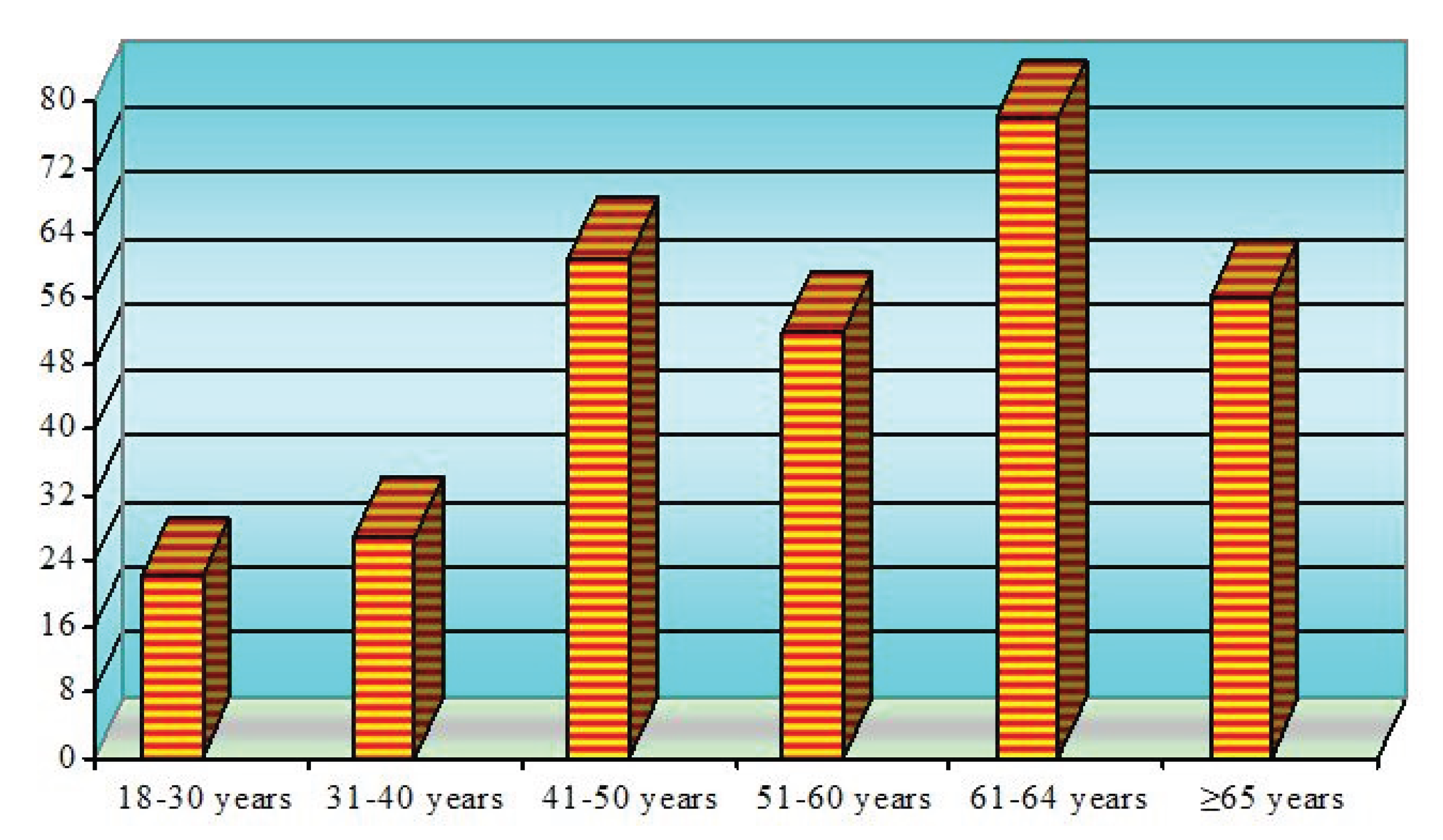
Figure 2.
Age distribution of cancer patients having used mobile health applications. The highest usage rate is observed in the 61–64 age group, which shows that patients in this age group are the most active in using mobile health technologies. The 41–50 and 51–60 age groups also have a significant share, which highlights the good digital engagement of middle-aged and older patients.
Figure 2.
Age distribution of cancer patients having used mobile health applications. The highest usage rate is observed in the 61–64 age group, which shows that patients in this age group are the most active in using mobile health technologies. The 41–50 and 51–60 age groups also have a significant share, which highlights the good digital engagement of middle-aged and older patients.
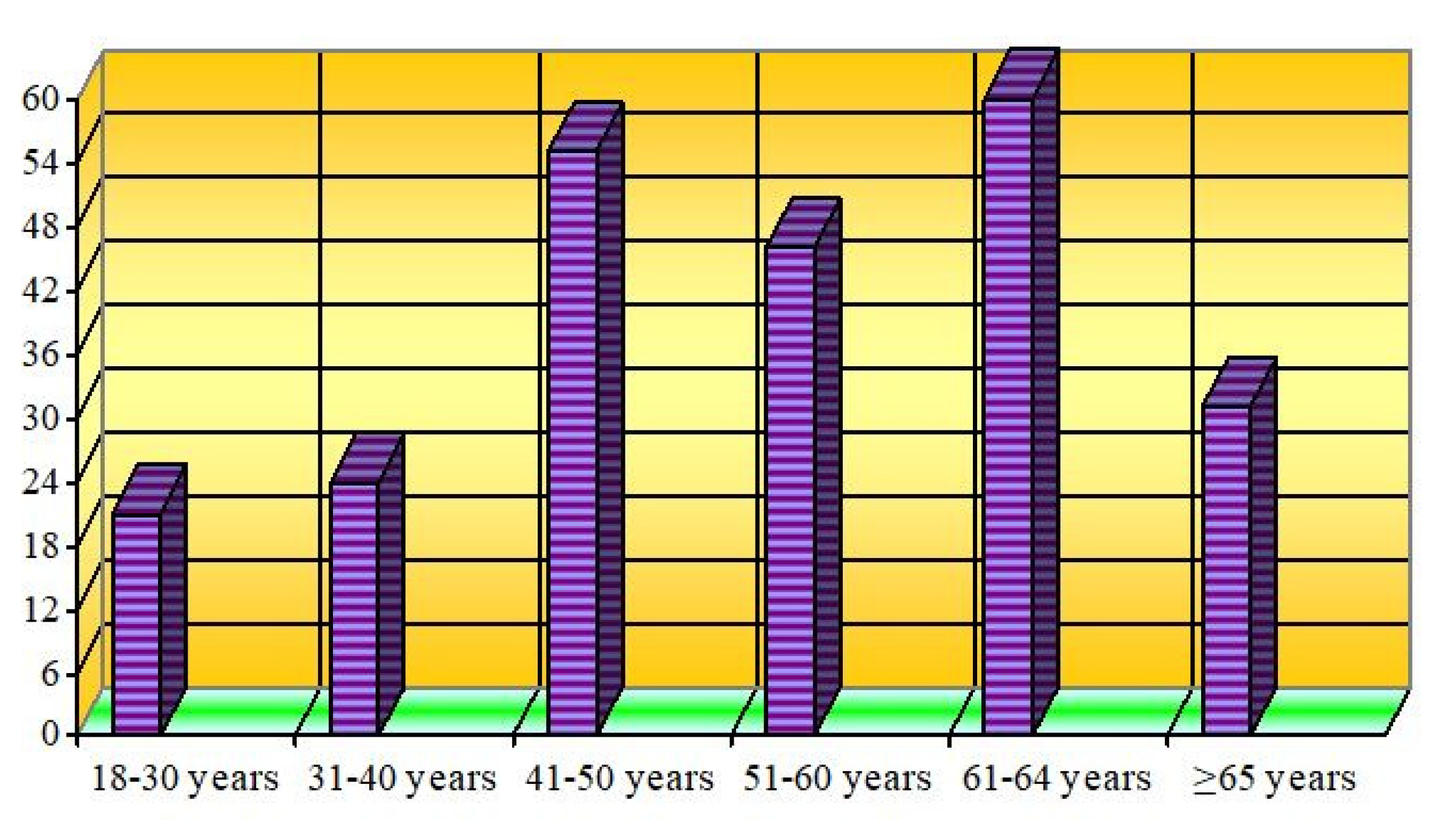

Table 1.
Relative share of cancer patients according to age groups.
| Age groups | Percentage |
| 18-30 years | 7.43 |
| 31-40 years | 9.12 |
| 41-50 years | 20.61 |
| 51-60 years | 17.57 |
| 61-64 years | 26.35 |
| ≥65 years | 18.92 |
| total | 100.00 |
Table 2.
Relative share of cancer patients according to age groups.
| Age groups | Percentage |
| 18-30 years | 8.82 |
| 31-40 years | 10.08 |
| 41-50 years | 23.31 |
| 51-60 years | 19.33 |
| 61-64 years | 25.63 |
| ≥65 years | 13.03 |
| total | 100.00 |
Table 3.
Frequency of mobile health application usage by cancer patients.
| Usage frequency | n | % |
| never | 34 | 14.29 |
| seldom | 35 | 14.71 |
| sometimes | 75 | 31.51 |
| often | 63 | 26.47 |
| every day | 31 | 13.02 |
| total | 238 | 100.00 |
| Usage frequency | n | % |
Table 4.
Frequency of mobile health application usage by cancer patients according to age.
| Age groups | Usage frequency | |||||
| every day | often | sometimes | seldom | never | total | |
| 18-30 years | 6 | 4 | 5 | 3 | 3 | 21 |
| 31-40 years | 3 | 11 | 5 | 3 | 2 | 24 |
| 41-50 years | 4 | 30 | 9 | 4 | 8 | 55 |
| 51-60 years | 8 | 7 | 9 | 15 | 7 | 46 |
| 61-64 years | 6 | 4 | 39 | 5 | 7 | 61 |
| ≥65 years | 4 | 7 | 8 | 5 | 7 | 31 |
| total | 31 | 63 | 75 | 35 | 34 | 238 |
Table 5.
Relative share of cancer patients of different age groups according to the frequency of their usage of mobile health applications (in %).
Table 5.
Relative share of cancer patients of different age groups according to the frequency of their usage of mobile health applications (in %).
| Age groups | Usage frequency | ||||
| every day | often | sometimes | seldom | never | |
| 18-30 years | 19.36 | 6.35 | 6.67 | 8.57 | 8.82 |
| 31-40 years | 9.68 | 17.46 | 6.67 | 8.57 | 5.88 |
| 41-50 years | 12.90 | 47.62 | 12.00 | 11.43 | 23.53 |
| 51-60 years | 25.80 | 11.11 | 12.00 | 42.85 | 20.59 |
| 61-64 years | 19.36 | 6.35 | 52.00 | 14.29 | 20.59 |
| ≥65 years | 12.90 | 11.11 | 10.66 | 14.29 | 20.59 |
Table 6.
Types of mobile health applications used by cancer patients.
| Types of mobile health applications | n | % |
| reminder of taking medicines and medical examinations | 66 | 27.73 |
| physical activity monitoring | 58 | 24.37 |
| follow-up of physiological parameters such as blood pressure and blood glucose | 53 | 22.27 |
| communications with physicians | 36 | 15.13 |
| other types | 25 | 10.50 |
| total | 238 | 100.00 |
Table 7.
Types of mobile health applications used by female cancer patients.
| Types of mobile health applications | n | % |
| reminder of taking medicines and medical examinations | 46 | 35.94 |
| physical activity monitoring | 28 | 21.87 |
| follow-up of physiological parameters such as blood pressure and blood glucose | 23 | 17.97 |
| communications with physicians | 21 | 16.41 |
| other types | 10 | 7.81 |
Table 8.
Types of mobile health applications used by male cancer patients.
| Types of mobile health applications | n | % |
| physical activity monitoring | 30 | 27.27 |
| follow-up of physiological parameters such as blood pressure and blood glucose | 30 | 27.27 |
| reminder of taking medicines and medical examinations | 20 | 18.18 |
| communications with physicians | 15 | 13.64 |
| other types | 15 | 13.64 |
Table 9.
Benefits of mobile health applications for monitoring cancer patients’ physical status.
| Benefits of mobile health applications | n | % |
| easy access to information related to health status | 58 | 24.37 |
| reminder of taking of medicines and medical examinations | 53 | 22.27 |
| enhancement of involvement in and responsibility for own health | 36 | 15.13 |
| easier monitoring of the health status | 34 | 14.29 |
| possibility for share information with physicians and specialists | 22 | 9.24 |
| improvement of communications with physicians | 16 | 6.72 |
| other benefits total |
19 238 |
7.98 100.00 |
Table 10.
Challenges faced by cancer patients during mobile health application usage.
| Challenges of mobile health applications | n | % |
| absence of sufficient time for regular data use and updating | 61 | 25.63 |
| absence of technical literacy for application usage | 57 | 23.95 |
| troubles with preciseness of data or measurements | 38 | 15.97 |
| troubles with personal health data confidentialness and security | 24 | 10.08 |
| absence of appropriate applications for concrete needs | 21 | 8.82 |
| difficulties during synchronization with devices such as medical equipment other total |
14 23 238 |
5.88 9.67 100.00 |
Disclaimer/Publisher’s Note: The statements, opinions and data contained in all publications are solely those of the individual author(s) and contributor(s) and not of MDPI and/or the editor(s). MDPI and/or the editor(s) disclaim responsibility for any injury to people or property resulting from any ideas, methods, instructions or products referred to in the content. |
© 2026 by the authors. Licensee MDPI, Basel, Switzerland. This article is an open access article distributed under the terms and conditions of the Creative Commons Attribution (CC BY) license (http://creativecommons.org/licenses/by/4.0/).
Copyright: This open access article is published under a Creative Commons CC BY 4.0 license, which permit the free download, distribution, and reuse, provided that the author and preprint are cited in any reuse.


