

Submitted:
16 January 2026
Posted:
20 January 2026
You are already at the latest version
Abstract
Galaxy evolution models often treat galaxies as passive processors of inflow, with metallicity and star formation set by one,way scaling relations and instantaneous state variables. Here a different picture is tested: mature galaxies may behave as regulated reservoirs that organise the balance between dynamical depth, enrichment structure, chemical memory and regeneration. A compact, dimensionless state vector is constructed from four observables: an energy or depth proxy H (velocity dispersion or sSFR in simulations), a stability proxy S (structural compactness or an enrichment,maturity coordinate), a chemical memory proxy M (metallicity at fixed mass), and a regeneration proxy R (specific star formation rate or its analogue). Galaxies are ordered by a stability coordinate and split into “infant” and “adult” regimes at the median S. In SDSS DR8 a sharp stability gate is detected, and two coupled inversions appear across it when controlling for stellar mass: (i) the partial correlation between depth and chemical memory changes sign between infants and adults, consistent with an “energy eraser” regime giving way to a retention regime, and (ii) the stability,regeneration relation changes from suppressive to supportive. Cross,catalogue comparisons show that the depth, memory inversion is recovered in EAGLE, while GAMA shows a weaker, same,sign trend and IllustrisTNG remains strongly negative in both regimes, suggesting sensitivity to tracer choice and feedback implementation rather than a trivial selection artefact. Spatially resolved MaNGA measurements provide a sanity check that systems classified as “adult” preferentially host stable inner regions with non,negligible Hα emission. Together these results favour a picture in which at least a subset of mature galaxies behave as regulated reservoirs rather than simple processors, and motivate effective models that encode history dependence in addition to instantaneous scaling relations.
Keywords:
galaxies
; evolution
; star formation
; abundances
; kinematics and dynamics
; methods
; statistical
1. Introduction
Standard descriptions of galaxy evolution often compress a galaxy into a small set of instantaneous state variables such as stellar mass, halo mass, gas fraction and environment, then predict metallicity and star formation through empirical scaling relations. This has been a productive strategy, but it also bakes in a strong assumption: that the future depends primarily on the present, and that correlations are mostly the shadow of monotonic growth.
Yet galaxies are not one–way assembly lines. They are systems that repeatedly heat, cool, eject, reaccrete, mix and reorganise. Feedback is violent, inflow is intermittent, mergers reset structure, and enrichment is not a simple integral of past star formation. If galaxies were purely passive processors, one would expect energetic depth, chemical memory and regeneration to remain aligned in sign once mass is controlled. A robust sign inversion in partial correlations would instead suggest a change of operating mode: a stability boundary that reorganises how energy, metals and star formation couple. The use of the terms infant and adult is to denote dynamical stability regimes, not cosmic time, redshift, or stellar population age. An infant system is defined operationally by (an open, flow dominated configuration in this proxy space), while an adult system is defined by (a more closed, reservoir dominated configuration), regardless of its redshift or stellar age indicators. In other words, these can be read equivalently as the low-S and high-S regimes.
This paper tests a concrete version of that idea using a deliberately compact set of observables. The goal is not to replace detailed models, but to identify an empirical “gate” in a low–dimensional state space that separates two regimes with different internal statistics. The analysis is falsification–oriented: if the proposed stability gate is not real, then ordering galaxies by a stability coordinate should not produce reproducible sign inversions across independent catalogues.
2. Data
2.1. SDSS DR8
An observational proxy catalogue is constructed from SDSS DR8 value–added spectroscopy, restricted to with reliable spectra and finite stellar mass, gas–phase metallicity, specific star formation rate and velocity dispersion. After cleaning, the working SDSS DR8 proxy sample contains galaxies. A larger down–sampled base catalogue is used internally to fit baseline relations, but all correlation results reported here use the proxy sample. For SDSS DR8 the resulting proxy sample spans ; the GAMA, TNG and EAGLE selections cover a similar mass range.
2.2. GAMA DR4
A second observational proxy catalogue is built from GAMA DR4 after applying redshift and quality cuts and requiring finite values for the structural and environmental columns used in the proxy definitions. The working GAMA proxy sample contains galaxies in the configuration used for the regeneration quadrant summary.
2.3. Simulations: IllustrisTNG and EAGLE
To compare against models with known subgrid physics, matched proxy tables are used for IllustrisTNG (TNG100 and TNG300 at ). In addition, an independent simulation cross–check is carried out using EAGLE RefL0100N1504, selecting subhalos with non–zero stellar mass and defined star formation in a 30 pkpc aperture. The EAGLE working sample contains galaxies, of which have non–zero star formation and thus defined proxies.
2.4. MaNGA Integral Field Spectroscopy
A spatially resolved cross–check is performed using a MaNGA test sample. Spaxel–level quantities are extracted from MAPS files, including stellar velocity dispersion and H flux, then collapsed to galaxy–level inner and outer measurements using radial cuts. The resulting MaNGA infant/adult input catalogue contains galaxies passing quality cuts, evenly split at the median stability proxy.
3. Methods
3.1. Baseline Relations and Residualisation
To isolate “memory” and “regeneration” from trivial mass trends, baseline relations are fit and residuals are constructed where appropriate.
For SDSS DR8, a global mass–metallicity relation is fit in the form
yielding coefficients
and the residual metallicity is
A star–forming main sequence is fit in specific star formation rate,
with coefficients
and the residual is
3.2. Proxy Construction and Standardisation
Each proxy is cast into a dimensionless coordinate using robust standardisation (median and MAD) so that correlations are not driven by raw units.
For SDSS DR8 the proxies are:
where denotes the median– and MAD–standardised robust z–score.
For GAMA and the simulations, the same conceptual roles are used (depth or energy injection, stability or compactness, chemical memory residual, and regeneration), with catalogue–specific observables. For EAGLE, for example, the structural proxy is a stellar surface density within the half–mass radius and the memory proxy is the residual from an internal mass–metallicity relation.
3.3. Infant/Adult Split and Partial Correlations
A stability threshold is defined as the median of in each catalogue. Galaxies with are labelled “infant” and those with are labelled “adult”. Within each regime the paper compute Pearson correlations and partial correlations controlling for stellar mass. The key statistics are
interpreted as depth–memory coupling and stability–regeneration coupling at fixed mass.
4. Results
4.1. SDSS DR8: stability gate and the depth–memory inversion
The SDSS DR8 proxy space shows a clear separation when ordered by the stability coordinate , defining an empirical stability gate at by construction.
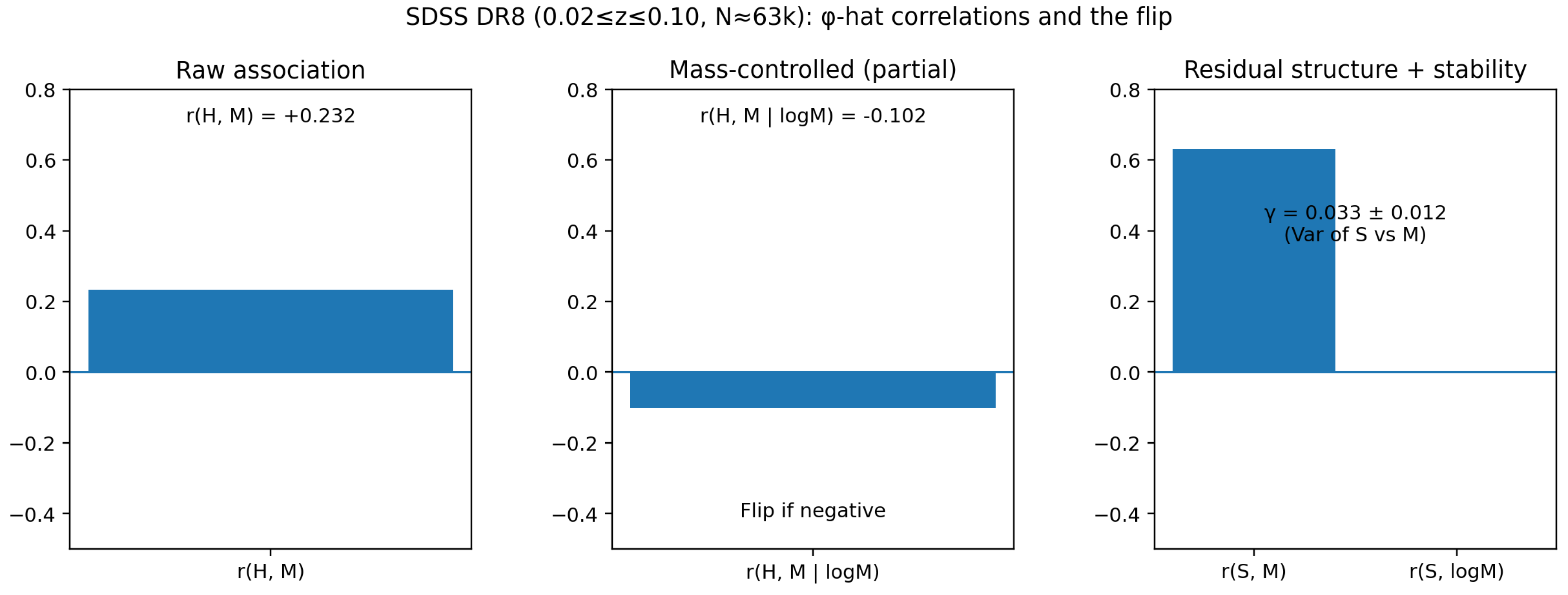
Across the full SDSS proxy sample, the raw association between depth and chemical memory is positive, but the partial correlation at fixed stellar mass is negative, consistent with an “energy eraser” behaviour when mass trends are removed:
When the sample is split at the stability gate, the key inversion appears: in the infant regime the partial correlation is negative, while in the adult regime it is positive. Numerically, for the SDSS DR8 split:
This sign change is the first component of the proposed “double flip”.
Figure 1.
SDSS DR8 triptych illustrating the depth–memory relation (left), the partial correlation at fixed stellar mass (middle), and the stability structure (right). This figure is a compact visual check that the SDSS proxy channels are not trivially circular and that the mass–conditioned sign change is present in the data.
Figure 1.
SDSS DR8 triptych illustrating the depth–memory relation (left), the partial correlation at fixed stellar mass (middle), and the stability structure (right). This figure is a compact visual check that the SDSS proxy channels are not trivially circular and that the mass–conditioned sign change is present in the data.
4.2. Cross–Catalogue Comparison of the Depth–Memory Behaviour
A crucial test is whether the SDSS inversion is a survey artefact. The comparison across catalogues shows a non–trivial pattern.
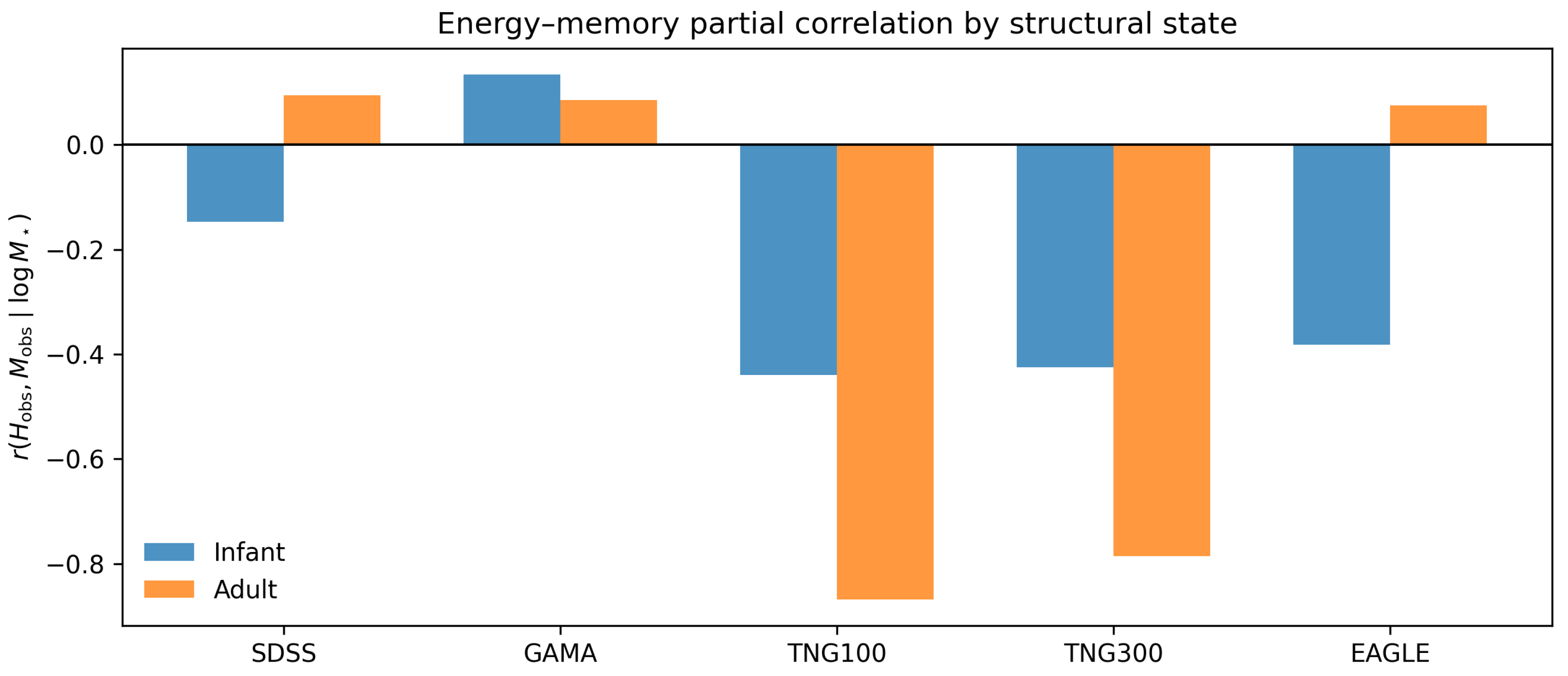
In EAGLE, the infant population shows a negative partial correlation while the adult population becomes positive, reproducing the SDSS qualitative behaviour. In GAMA, the corresponding partial correlations remain positive in both regimes, with no sign inversion. In IllustrisTNG, the partial correlation remains strongly negative in both regimes, with the adult population showing the strongest anti–correlation.
This is an important outcome, not a nuisance. It rules out the simplest story that “every catalogue must show the same flip” and instead points to two concrete possibilities: (i) the flip is tracer–dependent (gas–phase versus stellar metallicity, dispersion versus sSFR as an energy proxy), and or (ii) some feedback implementations keep systems in an “eraser” mode even at high stability.
Figure 2.
Comparison of the partial correlation between infant and adult regimes across SDSS DR8, GAMA DR4, IllustrisTNG (TNG100, TNG300) and EAGLE. SDSS and EAGLE show an infant–to–adult sign change; GAMA remains same–sign and weak; TNG remains strongly negative in both regimes.
Figure 2.
Comparison of the partial correlation between infant and adult regimes across SDSS DR8, GAMA DR4, IllustrisTNG (TNG100, TNG300) and EAGLE. SDSS and EAGLE show an infant–to–adult sign change; GAMA remains same–sign and weak; TNG remains strongly negative in both regimes.
4.3. Regeneration: Stability–Regeneration Inversion and Quadrant Statistics
In SDSS DR8, splitting by yields a clear sign change in the stability–regeneration correlation. In the infant regime, anti–correlates with at fixed mass, , while in the adult regime the sign becomes positive, . This supports a qualitative reorganisation: in unstable systems, higher stability is associated with suppressed regeneration, but in stable systems stability becomes a support for sustained regeneration.
4.4. MaNGA: A Spatially Resolved Sanity Check
Although the MaNGA sample is small, it provides an independent view because its inputs come from spaxel–level spectroscopy rather than global value–added proxies. Galaxies classified as “adult” by the stability proxy preferentially show stable inner regions with non–negligible H emission, consistent with an organised central engine rather than simple exhaustion. The MaNGA quadrant split also places a substantial fraction of the sample into the “infant–alive” and “adult–fossil” categories, reminding us that stability and regeneration are not identical to quenching, and that the gate is a structural divider, not a star formation on–off switch.
Figure 4.
Summary of the two regime-dependent sign inversions across the stability gate. Flip I: the mass-controlled depth–memory coupling changes sign between the low-S and high-S regimes in SDSS (and in the EAGLE cross-check). Flip II: the mass-controlled stability–regeneration coupling changes sign in SDSS, consistent with a reorganisation from “stability suppresses regeneration” to “stability supports regeneration.”
Figure 4.
Summary of the two regime-dependent sign inversions across the stability gate. Flip I: the mass-controlled depth–memory coupling changes sign between the low-S and high-S regimes in SDSS (and in the EAGLE cross-check). Flip II: the mass-controlled stability–regeneration coupling changes sign in SDSS, consistent with a reorganisation from “stability suppresses regeneration” to “stability supports regeneration.”
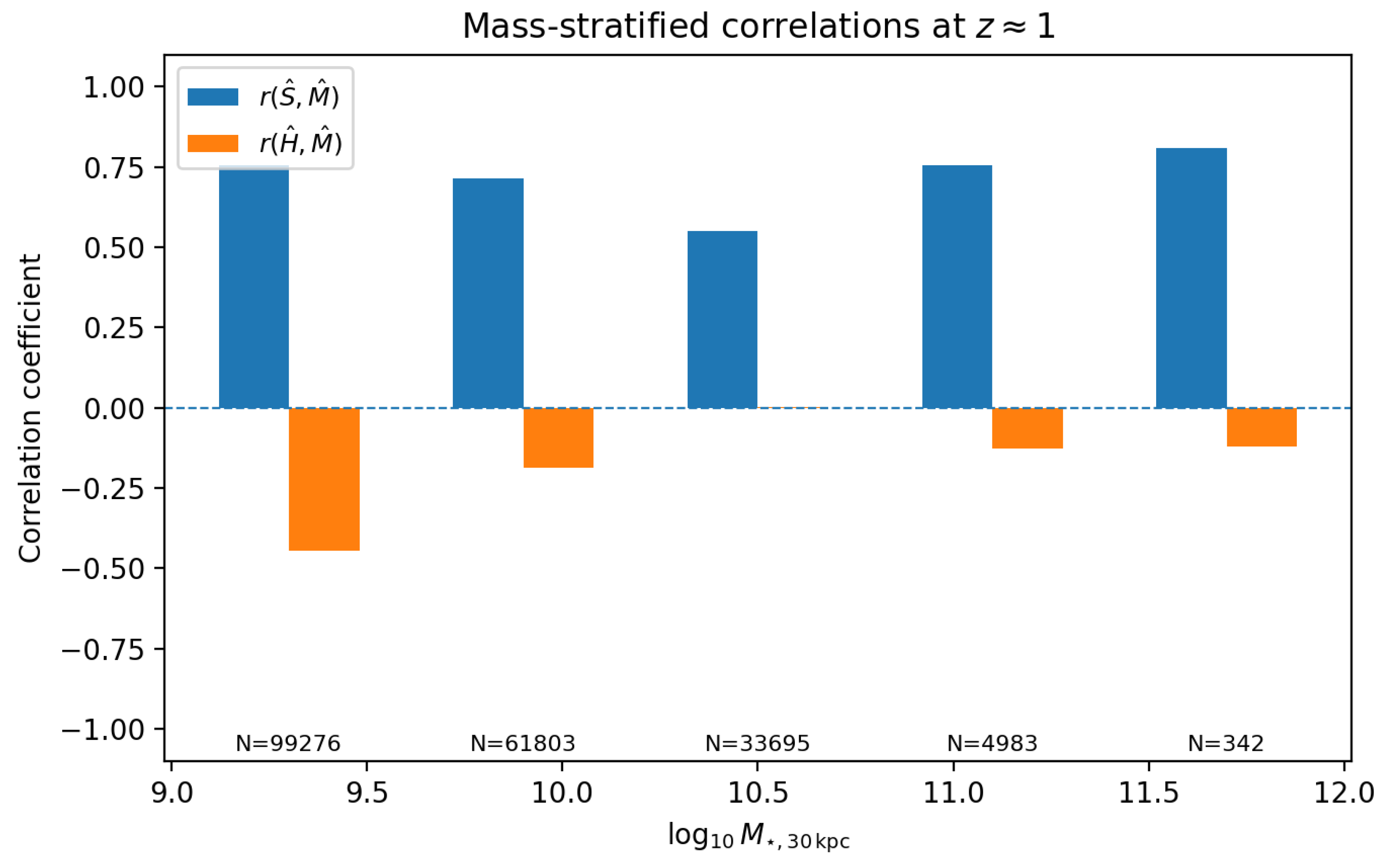
Figure 5.
Summary of the two regime-dependent sign inversions across the stability gate. Flip I: the mass-controlled depth–memory coupling changes sign between the low-S and high-S regimes in SDSS (and in the EAGLE cross-check). Flip II: the mass-controlled stability–regeneration coupling changes sign in SDSS, consistent with a reorganisation from “stability suppresses regeneration” to “stability supports regeneration.”
Figure 5.
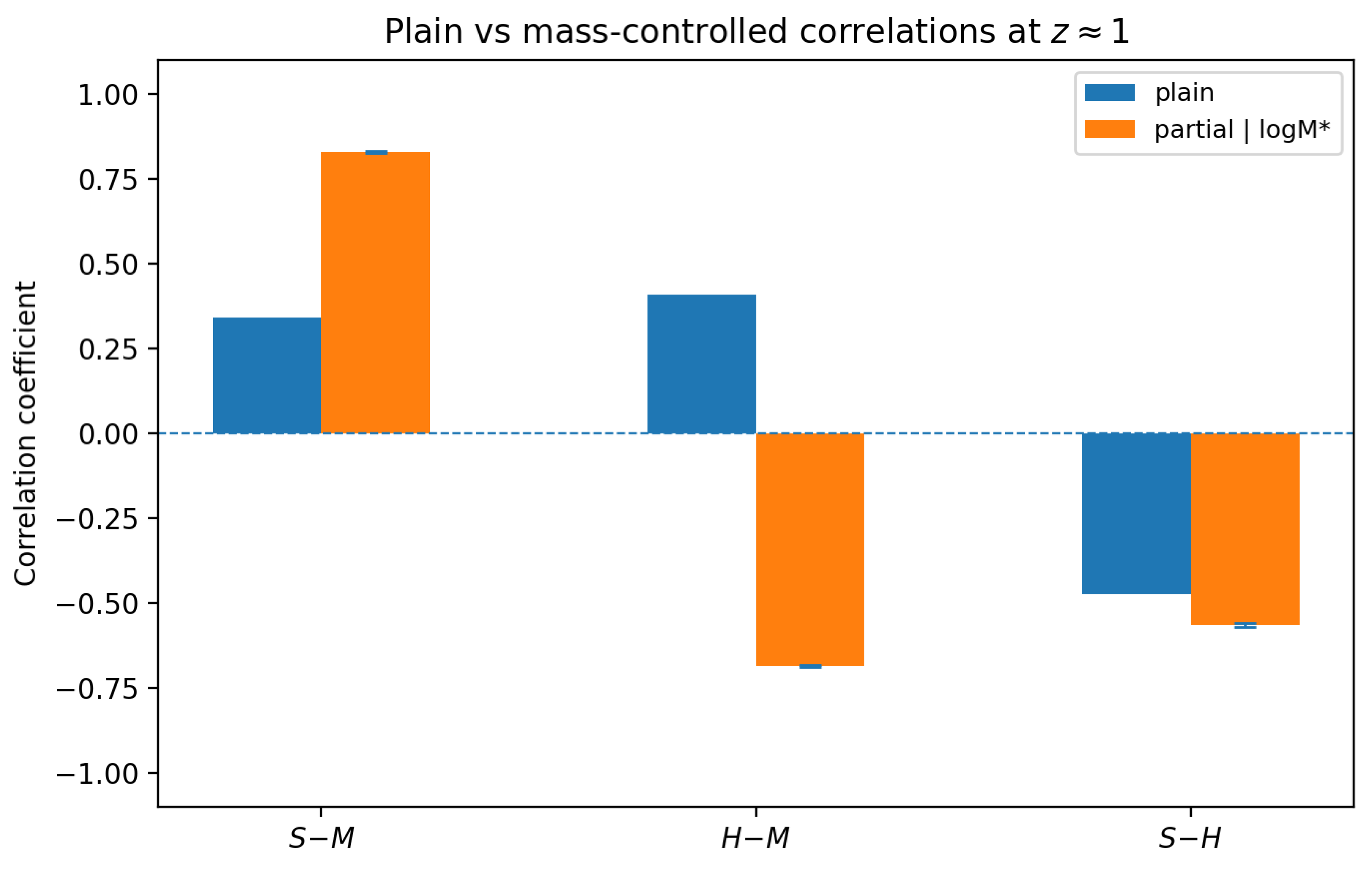
Summary of the two regime-dependent sign inversions across the stability gate. Flip I: the mass-controlled depth–memory coupling changes sign between the low-S and high-S regimes in SDSS (and in the EAGLE cross-check). Flip II: the mass-controlled stability–regeneration coupling changes sign in SDSS, consistent with a reorganisation from “stability suppresses regeneration” to “stability supports regeneration.”
4.5. Variance Scaling as a Convergence Diagnostic
If the adult regime behaves as a convergent “processor” that collapses trajectories onto a narrow attractor, the diversity of structural states at fixed memory should decrease as systems become more enriched. Conversely, if adult systems behave as flexible “reservoirs”, structural diversity should remain approximately constant, or even increase, as memory builds up. To test this, the standard deviation of the stability proxy, , was measured in bins of the chemical memory coordinate, , and a simple power–law relation was fit to the binned scatter,
where is the standard deviation of in each bin and is a variance–scaling exponent.
For the TNG100 high–mass sample at (, ), the analysis uses 15 bins in within the central 2–98 percentile range and requires at least 100 objects per bin. The resulting fit yields
with a Pearson correlation coefficient between and of and . :contentReference[oaicite:0]index=0 The negative exponent and high indicate a strong, monotonic collapse of structural scatter as chemical memory increases: as galaxies move to larger , the allowed range of shrinks steeply.
Repeating the same procedure for the TNG300 high–mass sample at () with 15 bins and at least 200 objects per bin gives
again with a tight anti–correlation, and . :contentReference[oaicite:1]index=1 The two simulations therefore agree that, once conditioned on stellar mass, galaxies with larger occupy a progressively narrower band in stability space. In the language of this paper, the simulated adult regime behaves like an over–efficient processor: depth and stability not only couple strongly to memory, but also suppress structural diversity as memory accumulates.
In contrast, the SDSS DR8 sample exhibits essentially flat variance scaling. Applying the same binning and fitting procedure to the observational proxies yields
consistent with within a few standard deviations. In other words, the standard deviation of the stability proxy at fixed remains nearly constant across the chemically enriched sequence. Observed galaxies can build chemical memory without collapsing onto a narrow structural track: the adult regime behaves more like a reservoir that preserves a wide range of configurations at a given memory level.
Taken together with the double sign inversions in the depth–memory and stability–regeneration couplings, the variance–scaling results support a simple interpretation. The TNG100 and TNG300 implementations converge galaxies too aggressively in space, producing processor–like adults with , whereas the real Universe maintains a homeostatic, reservoir–like adult regime with and persistent structural diversity at fixed chemical memory. This discrepancy suggests that the stability gate and variance–scaling behavior provide a useful calibration target for feedback models in next–generation simulations.
5. Discussion
The analysis was designed to answer a simple question: do galaxies merely react to their current state, or do they enter regimes where structure, memory and regeneration become mutually organised?
5.1. Relation to regulator, equilibrium, and compaction pictures
The idea that galaxies regulate themselves is not new. Gas regulator and equilibrium frameworks model star formation and metallicity as the outcome of a balance between inflow, conversion, recycling, and outflow [1,2,3]. Likewise, the mass–metallicity relation and its extensions connect enrichment to stellar mass and star formation activity [e.g. [4,5]]. The present result adds a sharp empirical refinement: the balance is not described by a single regime. Across a stability gate defined by compactness, the sign structure of the mass-controlled correlations changes, implying that the effective coupling between depth, structure, enrichment, and regeneration is itself state dependent.
This state dependence is qualitatively consistent with compaction and morphological stabilisation scenarios, where the build-up of a dense central component reorganises gas flows, star formation, and subsequent replenishment [e.g. [6,7,8]]. In that context, the observed stability–regeneration inversion provides a compact, survey-scale signature of the transition from a growth-dominated mode to a regulated reservoir mode.
The SDSS DR8 result is the anchor. Ordering by the stability coordinate produces a sharp empirical divide, and across it the mass–conditioned depth–memory relation changes sign. In the infant regime, deeper systems show reduced chemical memory at fixed mass, consistent with turbulence, mixing and outflow erasing enrichment information. In the adult regime, deeper systems retain more chemical memory at fixed mass, consistent with a reservoir mode in which depth and stability support retention rather than destruction.
The regeneration channel provides a second, coupled inversion in SDSS: stability suppresses regeneration in infants but supports it in adults. This matters because it separates two stories that look similar from far away. “Quenching with compaction” would predict stability rising while regeneration fades. The adult SDSS behaviour does not follow that one–way picture. Instead it suggests a reorganised flow pattern where compact structure and ongoing regeneration can coexist.
The cross–catalogue comparison is not uniform, and that is exactly the point. EAGLE reproduces the SDSS sign change, but GAMA remains weak and same–sign, and TNG remains strongly negative in both regimes. The simplest interpretation is that the qualitative behaviour is real but not automatic: it depends on what is used as a depth proxy, what chemical memory tracer is used, and how feedback and metal transport are implemented. In that sense the gate and the sign behaviour become a concrete target for simulations: any successful model should explain why one simulation exhibits the inversion and another does not, using physical differences rather than hand–waving.
MaNGA does not prove the case on its own, but it stops one obvious objection: that the “adult” label is secretly selecting dead bulges. The resolved H signal in stable inner regions is consistent with a regulated engine picture, not a simple shutdown.
A compact way to summarise the SDSS behaviour is that stability acts as an effective gate on long–lived chemical memory. Below the stability threshold , changes in the dimensionless memory coordinate are effectively washed out by feedback and mixing, while above it memory can accumulate:
In this sense, systems below the gate behave approximately Markovian – they process gas but forget most of their detailed history – whereas systems above the gate behave as non–Markovian reservoirs that retain and build up structural and chemical memory. This is the criterion for galactic memory.
The reduced contrast of the depth–memory inversion in the GAMA sample is consistent with data fidelity limits rather than a failure of the mechanism. The H–M flip is a mass-conditioned effect, which means it depends on high-quality kinematic tracers to separate a subtle energy–memory coupling from the dominant mass scaling. In practice, velocity dispersion measurements become noisier for lower-mass galaxies at , and this blurs the partial-correlation structure that is cleanly recovered in SDSS. In this sense, the GAMA behaviour functions as a quality-control check: when kinematic precision degrades, the gate remains visible but the sign structure becomes harder to resolve.
The broader implication is that purely Markovian effective models, where the future depends only on the instantaneous state, will struggle to reproduce regime–dependent sign inversions that persist under mass control. A practical next step is to turn this into a forward model: a minimal dynamical system in which the stability coordinate gates the sign and strength of coupling terms between depth, enrichment memory and regeneration.
6. Conclusions
This work introduced a compact, falsification–oriented framework for testing whether galaxies exhibit regime changes consistent with regulated reservoir behaviour. The main conclusions are:
- 1.
- A low–dimensional proxy state space can be constructed from standard observables and used to search for regime changes in the coupling between depth, chemical memory and regeneration.
- 2.
- In SDSS DR8, ordering by the stability proxy reveals a clear stability gate and a sign inversion in the mass–conditioned depth–memory relation between infant and adult regimes.
- 3.
- In SDSS DR8, the stability–regeneration relation also changes sign across the same stability gate, consistent with a transition from “stability suppresses growth” to “stability supports sustained regeneration”.
- 4.
- Cross–catalogue comparisons are non–trivial: EAGLE reproduces the SDSS sign inversion, while GAMA remains weak and same–sign and IllustrisTNG remains strongly negative in both regimes. This pattern argues against a trivial selection artefact and instead points to tracer and or feedback sensitivity that can be tested explicitly.
- 5.
- Spatially resolved MaNGA measurements provide a sanity check that systems classified as stable need not be dead, and that stable inner regions can coincide with non–negligible H emission.
The simplest reading is that at least a subset of galaxies move from a processor mode to a reservoir mode across a stability gate. The proxy framework developed here turns that qualitative statement into a set of measurable sign and quadrant tests that can be applied to new surveys and used as a target for simulations.
Data Availability Statement
The analysis pipeline for this work, including derived proxy tables, summary products, and figure-generation scripts, is available in the ciou_phi_hat repository at https://github.com/Atalebe/ciou_phi_hat. The observational data analysed here are publicly available from the SDSS DR8 archive, the GAMA DR4 release pages, and the SDSS-IV MaNGA DAP/DRP products. The simulation data are publicly available from the IllustrisTNG and EAGLE collaboration data release portals. This paper makes use only of these public releases and of derived products generated by the accompanying repository.
Acknowledgments
This work makes use of spectroscopic data from the Sloan Digital Sky Survey (SDSS). The SDSS-I/II data release used here is based on SDSS DR8, while the integral-field spectroscopy is drawn from the SDSS-IV MaNGA survey. Further information on SDSS and its participating institutions can be found at https://www.sdss.org. The analysis also uses data from the Galaxy And Mass Assembly (GAMA) survey, specifically the DR4 value–added catalogues. GAMA is a joint European–Australasian project that combines data from a wide range of facilities; the survey and its public data releases are described at http://www.gama-survey.org. Numerical comparisons are performed using the IllustrisTNG simulations (TNG100 and TNG300). The IllustrisTNG project is a collaboration between institutions in Germany and the United States, and the simulations were carried out on computing facilities at the Max Planck Computing and Data Facility and other partner centres. This work further uses catalogues from the EAGLE (Evolution and Assembly of GaLaxies and their Environments) simulations. The EAGLE project is a collaboration led by the Virgo Consortium, and the simulations were performed on computing resources in the UK and Europe; the public database is described in [9] and available at https://eagle.strw.leidenuniv.nl/wordpress/ The MaNGA analysis in this paper is based on the public data products produced by the MaNGA Data Analysis Pipeline (DAP). The authors acknowledge the MaNGA hardware, software and survey teams for making these maps and catalogs available to the community. I thank the anonymous referee for constructive comments that helped to clarify the presentation, and colleagues for discussions that improved the interpretation of the homeostatic potential and the “double flip’’ picture.
References
- Lilly, S.J.; Carollo, C.M.; Pipino, A.; Renzini, A.; Peng, Y. Gas Regulation of Galaxies: The Evolution of the Cosmic Specific Star Formation Rate, the Metallicity–Mass–Star-Formation Rate Relation, and the Stellar Content of Halos. The Astrophysical Journal 2013, arXiv:astro772, 119. [Google Scholar] [CrossRef]
- Finlator, K.; Davé, R. The origin of the galaxy mass–metallicity relation and implications for galactic outflows. MNRAS 2008, 385, 2181. [Google Scholar] [CrossRef]
- Davé, R.; Finlator, K.; Oppenheimer, B.D. An equilibrium model for galaxy evolution. MNRAS 2012, 421, 98. [Google Scholar]
- Tremonti, C.A.; et al. The Origin of the Mass–Metallicity Relation: Insights from 53,000 Star-Forming Galaxies in the SDSS. ApJ 2004, 613, 898. [Google Scholar]
- Mannucci, F.; Cresci, G.; Maiolino, R.; Marconi, A.; Gnerucci, A. A fundamental relation between mass, star formation rate and metallicity in local and high-redshift galaxies. MNRAS 2010, 408, 2115. [Google Scholar] [CrossRef]
- Dekel, A.; Burkert, A. Wet disc contraction to galactic blue nuggets and quenching. MNRAS 2014, 438, 1870. [Google Scholar] [CrossRef]
- Tacchella, S.; Dekel, A.; et al. The confinement of star-forming galaxies into a main sequence through episodes of gas compaction, depletion and replenishment. MNRAS 2016, 457, 2790. [Google Scholar] [CrossRef]
- Martig, M.; Bournaud, F.; Teyssier, R.; Dekel, A. Morphological quenching of star formation: making early-type galaxies red. ApJ 2009, 707, 250. [Google Scholar] [CrossRef]
- McAlpine, S.; et al. The EAGLE simulations of galaxy formation: Public release of halo and galaxy catalogues. Astronomy and Computing 2016, 15, 72–89. [Google Scholar] [CrossRef]
Figure 3.
Fraction of galaxies in each stability–regeneration quadrant (infant/adult × fossil/alive) across SDSS DR8, GAMA DR4, TNG100, TNG300 and MaNGA. The quadrant view emphasises population structure without requiring identical physical definitions of R across catalogues.
Figure 3.
Fraction of galaxies in each stability–regeneration quadrant (infant/adult × fossil/alive) across SDSS DR8, GAMA DR4, TNG100, TNG300 and MaNGA. The quadrant view emphasises population structure without requiring identical physical definitions of R across catalogues.
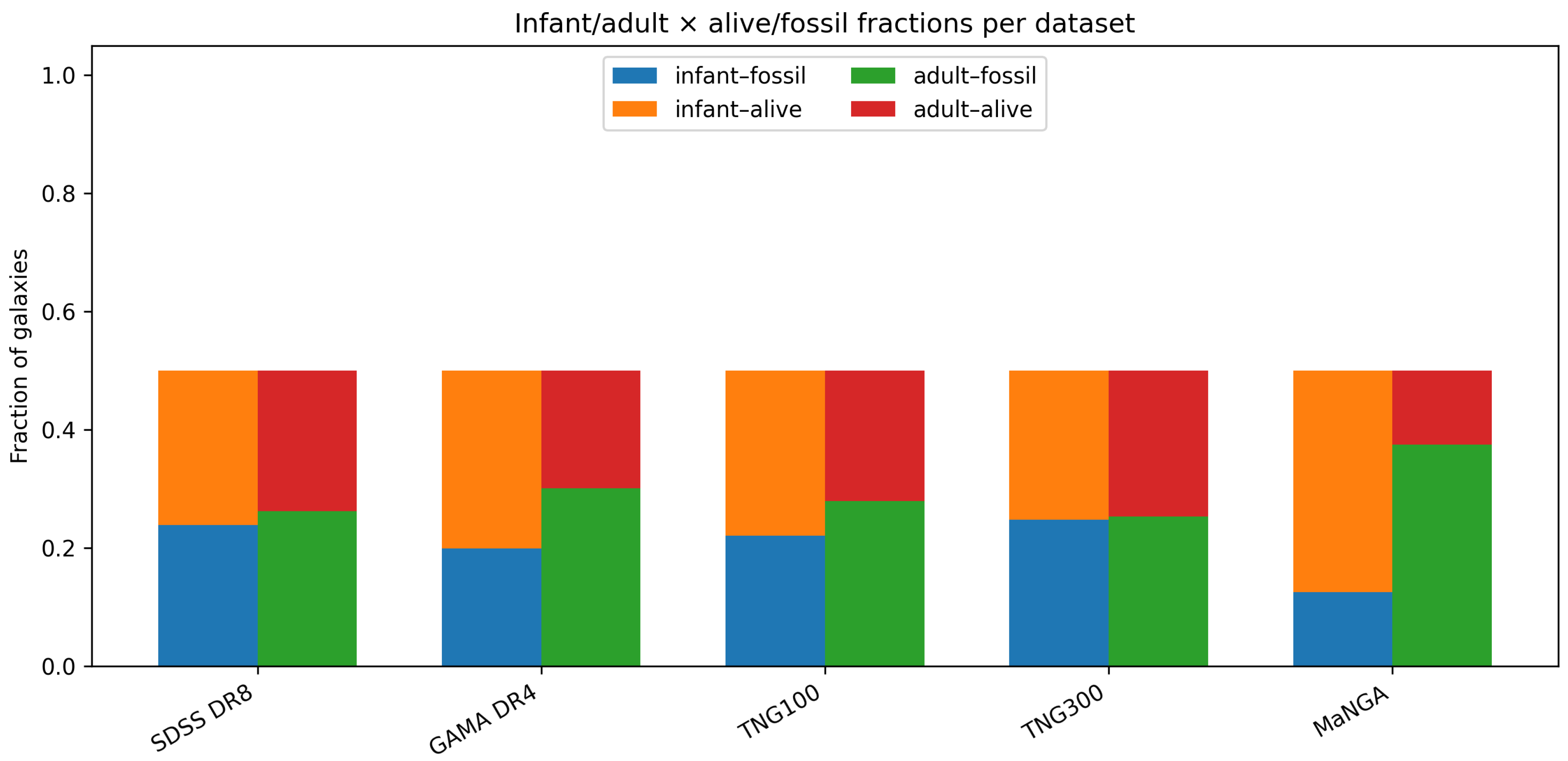

Table 1.
Stability–regeneration quadrant fractions. “Alive” and “fossil” are defined by the median of R within each dataset; “infant” and “adult” by the median of S. The full 5–95% ranges of R and additional quadrant entries (Ad–Fossil) can be included if desired, but the table is kept compact here for the main narrative.
Table 1.
Stability–regeneration quadrant fractions. “Alive” and “fossil” are defined by the median of R within each dataset; “infant” and “adult” by the median of S. The full 5–95% ranges of R and additional quadrant entries (Ad–Fossil) can be included if desired, but the table is kept compact here for the main narrative.
| Dataset | N | Inf–Fossil | Inf–Alive | Ad–Alive | |
| SDSS DR8 | 63077 | 0.136 | 0.238 | 0.262 | 0.238 |
| GAMA DR4 | 14187 | -0.157 | 0.199 | 0.301 | 0.199 |
| TNG100 | 16576 | 0.182 | 0.221 | 0.279 | 0.221 |
| TNG300 | 200108 | 0.166 | 0.247 | 0.253 | 0.247 |
| MaNGA | 40 | -0.568 | 0.125 | 0.375 | 0.125 |
Disclaimer/Publisher’s Note: The statements, opinions and data contained in all publications are solely those of the individual author(s) and contributor(s) and not of MDPI and/or the editor(s). MDPI and/or the editor(s) disclaim responsibility for any injury to people or property resulting from any ideas, methods, instructions or products referred to in the content. |
© 2026 by the authors. Licensee MDPI, Basel, Switzerland. This article is an open access article distributed under the terms and conditions of the Creative Commons Attribution (CC BY) license (http://creativecommons.org/licenses/by/4.0/).
Copyright: This open access article is published under a Creative Commons CC BY 4.0 license, which permit the free download, distribution, and reuse, provided that the author and preprint are cited in any reuse.


