

Submitted:
16 January 2026
Posted:
19 January 2026
You are already at the latest version
Abstract
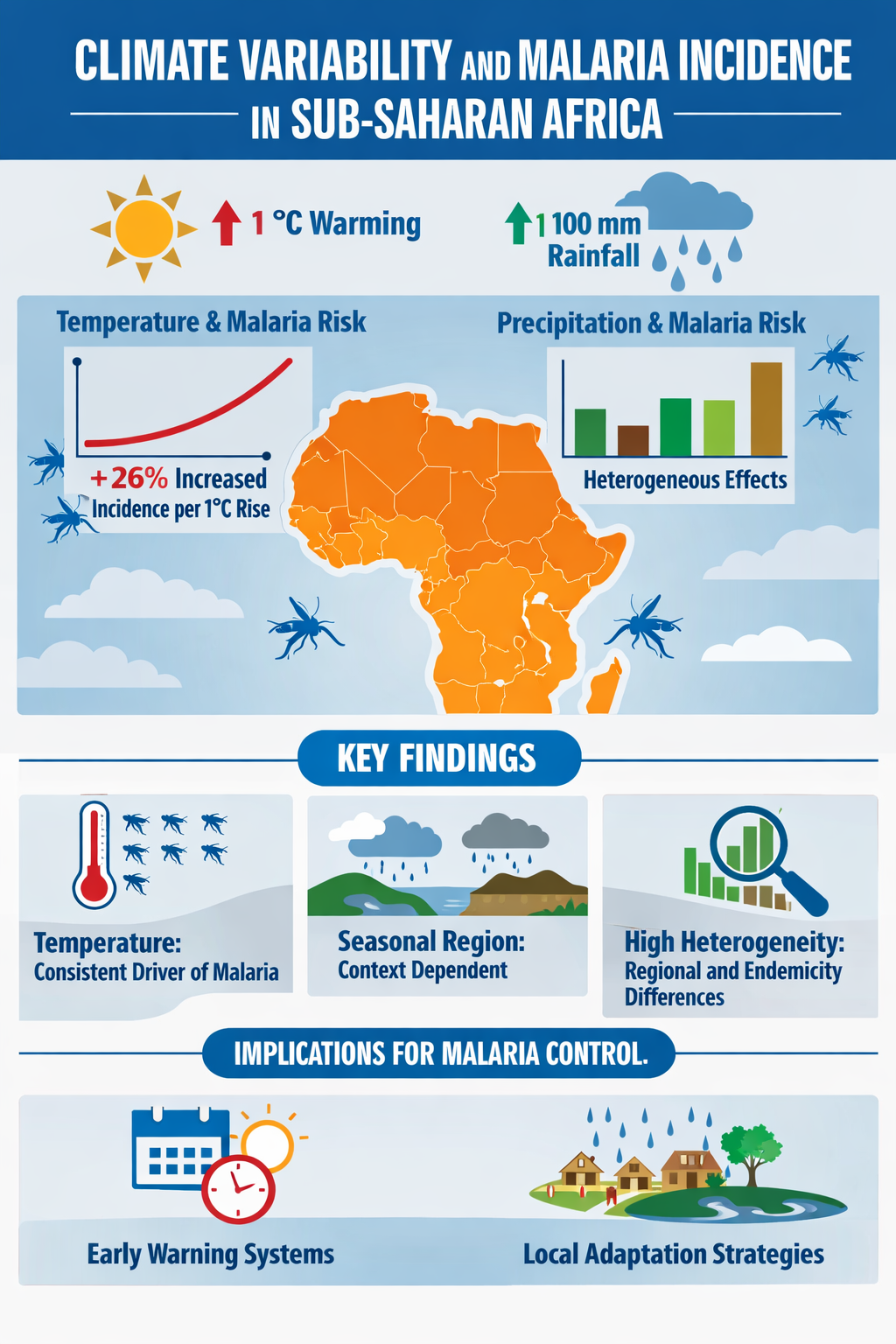
Malaria remains a major public health challenge in Sub-Saharan Africa, where climatic factors, particularly temperature and precipitation, strongly influence transmission. We conducted a systematic review and meta-analysis of observational studies and routine surveillance data reporting quantitative associations between temperature or rainfall variability and malaria incidence across SSA. Temperature effects were harmonized per 1°C increase and precipitation per 100 mm increase. Six studies from diverse regions (2000-2023) met inclusion criteria. Pooled analyses indicated that each 1°C increase in temperature was associated with a 26% increase in malaria incidence (RR = 1.26; 95% CI: 1.15-1.37; I² = 52%), while each 100 mm increase in precipitation was associated with a 13% increase (RR = 1.13; 95% CI: 1.05-1.21; I² = 68%). Temperature effects were stronger among children under five and in rural settings. Certainty of evidence was moderate for temperature and low for precipitation. These findings confirm that climate variability is a key determinant of malaria risk in SSA and support the integration of climate data into early warning systems and malaria control planning.
Keywords:
Malaria
; Sub-Saharan Africa
; temperature
; rainfall
; climate
; meta-analysis
; systematic review
Copyright: This open access article is published under a Creative Commons CC BY 4.0 license, which permit the free download, distribution, and reuse, provided that the author and preprint are cited in any reuse.


