

Submitted:
13 January 2026
Posted:
15 January 2026
You are already at the latest version
Abstract
Although researchers document the political utility of cabinet reshuffles in African presidential systems extensively, they devote insufficient empirical attention to the trade-offs these reshuffles impose on economic performance. This paper delivers robust evidence that frequent ministerial changes inflict substantial, often underestimated costs on economic growth. The analysis draws on data from 19 African nations spanning 2006 to 2023 and applies a polynomial dynamic panel model, which uncovers a nonlinear relationship between cabinet stability and economic performance. Empirical estimates indicate that each cabinet reshuffle lowers annual GDP per capita growth by roughly 1.7 to 2.9 percentage points. The study further detects an inverted U-shaped relationship between ministerial tenure and economic outcomes. The Least Squares Dummy Variable Corrected (LSDVC) estimator reveals that ministers maximize economic growth at an optimal tenure of approximately 51.9 months (4.3 years). Beyond this threshold, moral hazard effects dominate the gains from accumulated experience. These results underscore a pivotal governance dilemma for African presidents: they must weigh the political benefits of cabinet reshuffles against their economic costs. The study thus advances insights into governance dynamics and economic performance in African settings.
Keywords:
cabinet reshuffles
; ministerial tenure
; economic growth
; political instability
; Africa
1. Introduction
Political scientists increasingly recognize cabinet reshuffles as a critical, though less examined, dimension of political instability (Laver, 1974; Browne et al., 1986; Kam et al., 2010; Fleischer & Seyfried, 2015). While extensive scholarship addresses government survival, the specific governance instability from frequent ministerial turnover remains understudied (Bright et al., 2015; Sasse et al., 2020; Helms & Vercesi, 2022a, 2022b). Scholars widely regard reshuffles as a core indicator of governmental instability, as each event triggers an adjustment period. This learning phase extends significantly when new ministers lack prior political or administrative experience (Dowding & Dumont, 2009; Kerby & Snagovsky, 2021; Belchior & Silveira, 2023; Nielsen & Hansen, 2024; Olar, 2025).
A common theoretical claim posits that presidential systems, with their executive decree powers, experience fewer reshuffles than parliamentary systems, where coalition dynamics necessitate frequent changes. Empirical evidence, however, challenges this view. Coalition cabinets are the norm in presidential democracies (Cheibub et al., 2004; Cheibub et al., 2014; Kellam, 2017; Chaisty et al., 2018). Presidents routinely negotiate with parties to sustain stability, using the distribution of ministerial portfolios as a key bargaining tool (Amorim Neto, 2006; Camerlo & Martínez-Gallardo, 2018; Albala, 2021). This reality demands continuous coalition management, with reshuffles serving as a primary mechanism for renegotiation (Hansen et al., 2013; Amorim Neto & Accorsi, 2022; Curtin et al., 2023; Mella Polanco, 2025). Consequently, reshuffles constitute a central governance instrument in both system types for resolving crises, realigning policy, and managing institutional constraints (Martínez-Gallardo, 2014; Franz & Codato, 2018).
The economic and administrative costs associated with frequent reshuffles are substantial. High ministerial turnover disrupts the implementation of government and donor-funded projects (Mele & Ongaro, 2014; Thomson et al., 2017; Palotti, Cavalcante & Gomes, 2019; Cohen, 2022). This disruption is particularly acute in technical portfolios, where steep learning curves delay progress (Izu & Motanda, 2015; Sieberer et al., 2021). For instance, Bedasso (2024) found that World Bank education projects implemented between 2000 and 2017 across 114 countries achieved greater success during periods of ministerial continuity. This finding underscores how leadership changes can derail time-sensitive initiatives, especially in weakly institutionalized settings where offices are highly personalized. Moreover, newly appointed ministers often face significant information asymmetries, requiring extended periods to overcome the informational monopolies of senior bureaucratic cadres (Huber, 1998; Adolino, 2021).
Cabinet reshuffles also affect financial markets. Studies reveal a strong positive correlation between political risk and sovereign bond spreads (Moser, 2007; Hansen & Zegarra, 2016; Muzindusi et al., 2025). For example, Moser (2007) demonstrated that reshuffles affecting the ministry of finance or economics in twelve Latin American countries (1992–2005) led to immediate increases in bond spreads due to uncertainty over economic policy and debt repayment. Similarly, Prasetia et al. (2017) analyzed the Indonesian capital market’s reaction to cabinet formation and reshuffles, examining abnormal returns and trading volume activity for 90 companies listed on the Indonesia Stock Exchange and observing significant effects in specific sectors such as trade, services, and investment. Conversely, during financial crises, the appointment of technocrats—nonpartisan experts—has been shown to reduce bond yields, signaling a government’s commitment to fiscal responsibility (Alexiadou et al., 2022).
However, not all scholars view reshuffles as inherently detrimental (Martínez-Gallardo, 2014; Franz & Codato, 2018). Ministerial turnover can foster innovation, renewal, and accountability (Huber & Martínez-Gallardo, 2008). Leaders may strategically adjust cabinets to align ministers’ skills with portfolio needs, respond to scandals, or enhance electoral prospects (Dewan & Dowding, 2005; Dewan & Myatt, 2007; Dewan & Hortala-Vallve, 2011). From a Principal-Agent perspective, reshuffles can mitigate self-serving behavior by reducing agency costs and moral hazard (Indridason & Kam, 2008; Praça et al., 2012). In some cases, reshuffles create a “musical chairs” effect, preventing ministers from consolidating excessive power (Roessler, 2011). In autocratic systems, existing literature suggests that dictators prioritize personal safety over fostering expertise (Bueno de Mesquita et al., 2003; Egorov & Sonin, 2011). Woldense (2018) illustrates how dictators employ frequent rotations of officials—for example, in Ethiopia under Haile Selassie (1941–1974), where officials were moved approximately every three years—to prevent subordinates from forming cliques or alternative centers of power, thereby consolidating their authority. This dynamic is particularly evident in Sub-Saharan Africa, where informal patron-client relationships and neopatrimonial governance dominate political systems. In such contexts, ministerial appointments are often used to consolidate power, co-opt elites, balance ethnic interests, and preempt leadership challenges (Bratton & van de Walle, 1997; Hyden, 2006; Arriola, 2009; François, Rainer & Trebbi, 2015; Kieh, 2018). For instance, Kroeger (2020), using data on 94 authoritarian leaders from 37 African countries (1976–2010), found that ministerial stability varies by regime type: dominant-party regimes (e.g., Senegal, Zimbabwe) experience fewer reshuffles than personalist regimes (e.g., Burkina Faso, Chad).
Despite African presidents wielding exceptional formal power (Van Cranenburgh, 2008), few studies analyze how this power shapes cabinet design in the region. Reshuffles often serve immediate political survival, with presidents forming large, inclusive cabinets before elections to co-opt elites (Arriola, 2009; Arriola & Johnson, 2014; Omgba, Avom & Mignamissi, 2021). Ministers frequently act as ethnic proxies, channeling resources to their groups (Kramon & Posner, 2016; Levan & Assenov, 2016). Thus, political calculations—managing coalitions or appeasing constituencies—typically drive reshuffles more than performance (Roessler, 2011; Staronova & Rybář, 2021). While stability allows expertise development (Huber, 1998), excessive tenure risks entrenching patronage and corruption (Praça et al., 2012; Cruz & Keefer, 2015).
This presents a core governance dilemma: balancing the costs of instability against the risks of entrenchment. Where is the equilibrium point that maximizes economic performance? Our systematic analysis of 19 African presidential and semi-presidential systems (2006–2023) addresses this. Using a polynomial dynamic panel model and a hybrid estimation strategy—Polynomial GMM to control for endogeneity and LSDVC for small-sample robustness—we identify a consistent inverted U-shaped relationship between ministerial tenure and economic growth. The results demonstrate that while experience initially benefits the economy, prolonged tenure yields diminishing returns and increases the hazards of moral hazard and entrenchment.
2. Data and Methods
2.1. Theoretical Framework: Cabinet Stability, Multiple Principals, and the Presidential Dilemma
Cabinet formation in democratic systems functions as an inherently political exercise. Leaders allocate positions to secure support from diverse constituencies and distribute material and symbolic benefits to political allies (Carboni, 2023). From a game-theoretic perspective, a governing coalition represents a political equilibrium. Ministerial portfolios reflect a stable balance of power among coalition partners, an equilibrium that holds only while the underlying bargaining environment remains static (Dodd, 1976; Saalfeld, 2013). In multi-party coalitions, a failure to renegotiate this balance can prompt parties to withdraw from government—a frequent occurrence in presidential systems. Such exits often force the creation of entirely new coalitions rather than simple cabinet reshuffles (Martinez-Gallardo, 2012; Gonzalez-Bustamente, 2023).
In the presidential and semi-presidential systems of sub-Saharan Africa, this bargaining process revolves decisively around the presidency. Presidents command extensive formal policymaking powers and control over state resources and patronage networks (Prempeh, 2008; Kieh, 2018). They operate within hybrid governance structures that blend formal constitutional authority with informal patronage systems (Riedl, 2014). This concentration of power typifies neo-patrimonial governance, where formal state institutions coexist with, and are often undermined by, personal rule and clientelism (Amorim Neto, 2006; François, Rainer, & Trebbi, 2015; Omgba, Avom, & Mignamissi, 2021). In such systems, formal authority and informal influence are deeply fused. Presidents exert power not only through constitutional mandates but also as central patrons within complex ethnic and political networks (Huber & Martinez-Gallardo, 2008; Thomson et al., 2017). Consequently, cabinet appointments primarily serve as instruments for informal power-sharing and elite co-optation, enabling presidents to align cabinet composition and hierarchy with their personal and political interests (Lindemann, 2008; Wigmore-Shepherd, 2019; Wehner & Mills, 2022; Steinert & Steinert, 2023).
The Principal-Agent (PA) framework provides a useful, though incomplete, lens for analyzing presidential delegation (Katz, 2014). While delegation in parliamentary systems flows linearly from the prime minister, ministers in presidential systems answer to multiple principals: the president, the legislature, party leaders, ethnic representatives, and informal networks (Martin & Vanberg, 2004; Moury, 2011). This multiplicity creates inherent policy divergence. Presidents, elected by a national electorate, must focus on broad national goals, whereas legislators and ministers often prioritize local or factional interests (Shugart, 1999; Ames, 2001; Calvo & Murillo, 2004; Lee, 2018). As a result, presidents confront both inter-party and intra-party agency loss, as coalition partners and individual ministers frequently advance their own agendas over collective government goals (Samuels & Shugart, 2010; Martinez-Gallardo & Schleiter, 2015).
Within Africa's multi-party coalitions, this delegation problem intensifies. Ministers must balance presidential directives against demands from competing principals who offer political protection, access to patronage, or electoral leverage (Bucur, 2017). This dynamic exacerbates agency loss. Ministers gain informational advantages through their control of bureaucratic networks, technical expertise, and relationships with civil servants and external actors (Martin & Vanberg, 2004; Cornell, 2014; Bersch, Lopez & Taylor, 2022). This information asymmetry allows them to pursue personal or factional goals that may conflict with presidential priorities.
To mitigate these delegation risks, parties and presidents often appoint junior ministers as monitoring mechanisms to enforce collective policy preferences (Pereira et al., 2017; Martinez-Gallardo & Schleiter, 2015; Thijm & Fernandes, 2024). However, this strategy has limits. Over time, junior ministers cultivate their own networks and may also engage in opportunistic behavior. Crucially, the electorate holds the president solely accountable for national outcomes (Samuels & Shugart, 2010). This accountability asymmetry—total presidential responsibility without full ministerial control—constitutes a core challenge of presidential governance.
Effective cabinet management therefore requires balancing ministerial learning against the prevention of moral hazard. Ministerial productivity typically follows a three-phase curve:
- Learning (Inexperience): New ministers often lack portfolio-specific technical knowledge, causing initial disruptions to decision-making and policy implementation. Structural portfolio changes, such as jurisdictional reconfigurations, exacerbate these disruptions (Huber, 1998). Productivity starts low but rises as ministers gain experience (Huber & Martinez-Gallardo, 2008).
- Performance (Experience and Information Acquisition): As ministers acquire expertise, their productivity increases. Tenure stability facilitates effective policy execution and reduces information asymmetry, granting ministers greater command over bureaucratic knowledge (Stein & Tommasi, 2006; Cornell, 2014; Codato et al., 2018). In contexts such as Brazil, bureaucratic insulation ensures continuity despite political turnover (Lopes & Silva, 2020).
- Moral Hazard (Patronage and Clientelism): Overly extended tenure can lead to bureaucratic inertia and moral hazard. Ministers may prioritize personal ambitions and patronage networks over presidential goals, lobbying for larger budgets to enhance their political capital rather than improve policy outputs (Praça et al., 2012). Frequent cabinet reshuffles can mitigate these risks by preventing ministers from consolidating power and entrenched patronage networks (Bueno de Mesquita, 2000). This dynamic is particularly evident in sub-Saharan Africa, where informal patron-client ties often overshadow formal institutions (Bratton & van de Walle, 1997; Hyden, 2006).
- The trade-off between institutional efficiency and the risks of moral hazard defines the presidential dilemma. Frequent reshuffles reset the learning curve and prevent entrenchment but sacrifice accumulated expertise. Extended tenure builds deep expertise but increases the potential for opportunistic behavior.
A simplified ministerial productivity function can be expressed as:
Where:
- A0 represents baseline administrative productivity prior to portfolio-specific expertise acquisition.
- λ denotes the rate of experience acquisition
- β reflects the moral hazard coefficient
- αln(1+λt) captures learning accumulation with diminishing returns,
- βt2 accounts for the rising moral hazard over time
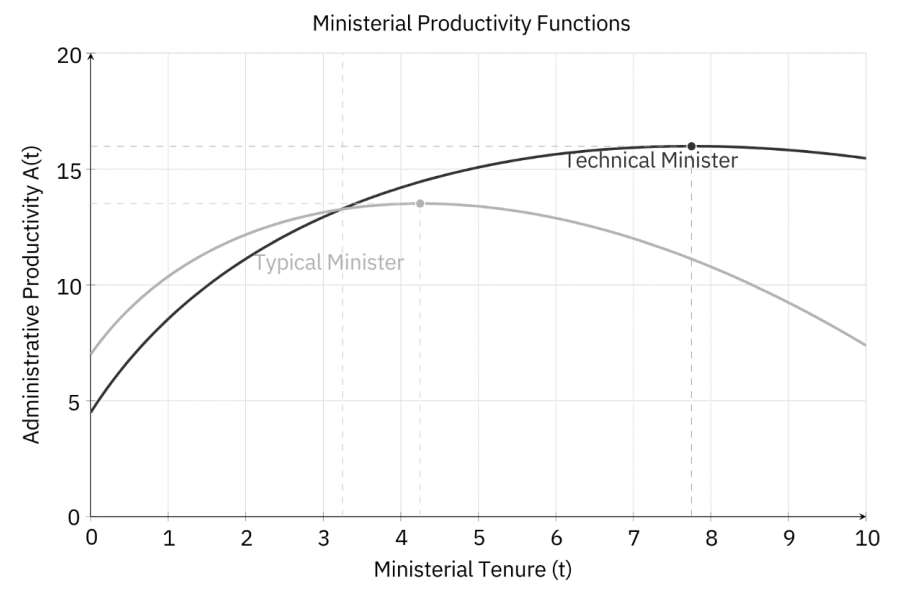
The resulting productivity curves illustrate a strategic portfolio-specific insight. Typical ministers, often overseeing simpler portfolios, start with higher initial productivity but experience a steeper decline as moral hazard accelerates. Conversely, technical ministers begin with lower initial productivity due to portfolio complexity but achieve a higher performance peak and decline more gradually, given their deeper expertise. This suggests that optimal reshuffle timing should vary by minister type: more frequent rotation for typical ministers to capture their brief productivity peak, and longer tenure for technical ministers to maximize their sustained, high-level output.
In sum, effective presidential governance requires strategically navigating the competing demands of stability, accountability, and performance. By calibrating ministerial tenure and the timing of reshuffles, presidents can optimize government outcomes within the complex constraints of multi-principal delegation and neo-patrimonial systems.
2.2. Data
2.2.1. Sample and Variables
We analyze an unbalanced panel dataset comprising 19 African presidential and semi-presidential systems from 2006 to 2023: Algeria, Burkina Faso, Cameroon, Côte d’Ivoire, the Democratic Republic of Congo, Gabon, Guinea, Guinea-Bissau, Mali, Namibia, Niger, the Central African Republic, Rwanda, Senegal, Tanzania, Chad, Togo, Tunisia, and Uganda. We exclude Mozambique due to incomplete data.
We select these countries because their presidents and legislatures derive independent electoral legitimacy. This dual-legitimacy structure heightens principal-agent conflicts, making cabinet management—through coalition-building or cohabitation—a vital tool for political coordination (Cheibub et al., 2014). Prior research indicates that ministerial stability in such systems varies significantly with coalition structures, oversight mechanisms, and electoral timing (Helms and Vercesi, 2022b; Inácio, Llanos, & Pinheiro, 2022), factors essential for understanding how cabinet dynamics affect economic outcomes.
Dependent Variable
Economic Growth per Capita (Growth):
Our key performance metric is the annual percentage growth rate of GDP per capita, sourced from the World Development Indicators (WDI). We use this measure across all model specifications.
Core Explanatory Variables
Cabinet Reshuffles (Reshuffle):
This variable counts the number of ministerial reshuffle events in a given year, including both partial changes and full cabinet reorganizations. We code this variable primarily from official presidential decrees, executive gazettes, and verified media archives, conceptualizing reshuffles as events that disrupt policy continuity and signal political instability (Huber & Martínez-Gallardo, 2008; Indridason & Kam, 2008). For robustness, we also construct a binary Reshuffle Dummy that equals 1 for any year with at least one reshuffle event.
- Cabinet Duration (Duration):
This variable measures the number of months a cabinet remains in office before a change. It captures ministerial stability, which facilitates organizational learning and effective policy implementation (Berlinski, Dewan, & Dowding, 2007; Dewan & Myatt, 2010).
Control Variables
To account for structural, economic, and institutional factors influencing economic performance, the analysis includes the following controls:
- Trade Openness: Computed as the average of exports and imports of goods and services
Source: World Development Indicators (WDI).
- Investment: Gross fixed capital formation as a percentage of GDP, representing physical capital accumulation. Source: WDI.
- Schooling: Average years of schooling among the adult population, reflecting human capital development. Source: UNDP Human Development Indicators Database.
- Political Corruption: An index measuring corruption in political office, where higher values indicate lower corruption. Source: V-Dem Database (Coppedge et al., 2025).
- Industry Value Added: Industry Value Added as a percentage of GDP, representing the contribution of the secondary sector. Source: WDI.
- Neopatrimonialism Index: Measures the concentration of state power in personal patronage networks (V-Dem).
- Presidentialism Index: Captures the formal concentration of executive power (V-Dem).
2.3. Econometric Specification: Estimation Strategy and Robustness Tests
2.3.1. Model Specification
We estimate a polynomial dynamic panel model to capture the immediate effect of reshuffles and the non-linear impact of tenure:
Where:
- Growthi,t: Real GDP growth rate for country i at time t
- Growthi,t−1: Lagged growth (captures growth persistence and dynamic adjustment)
- Reshufflei,t: measures the frequency of cabinet reshuffles throughout the year
- Durationi,t: Duration of the cabinet in months
- : Squared duration (captures potential nonlinear effects)
- Xi,t: Vector of control variables (trade openness, FDI inflows, manufacturing value added, corruption control, education attainment)
- μi: Country-specific fixed effects (unobserved heterogeneity)
- εi,t: Idiosyncratic error term
We anticipate (reshuffles harm growth), (longer duration improves growth up to a point), and (beyond a threshold, diminishing or negative returns) implying an inverted U-shaped relationship.
To mitigate multicollinearity between cabinet duration and its square, the variable is mean-centered around 10.38 months. This transformation yields the centered variable and the model specification becomes:
The marginal effect of cabinet duration on economic growth is therefore given by the partial derivative:
Where the optimal threshold is given by:
2.3.2. Estimation Approach: Polynomial GMM
To address endogeneity (e.g., poor growth potentially triggering reshuffles), we employ a Generalized Method of Moments (GMM) estimator. Standard estimators suffer from Nickell bias due to correlation between the lagged dependent variable and fixed effects. We apply a System GMM estimator (Blundell & Bond, 1998) enhanced with the non-linear moment conditions from Ahn and Schmidt (1995). This Polynomial GMM approach (Kripfganz, 2019) improves efficiency, which is crucial for reliably identifying the non-linear relationship within our sample. We estimate the model in first-differences to remove country-fixed effects ():
The estimator relies on internal instruments, exploiting the assumption that lagged levels of the dependent and predetermined variables are orthogonal to future error terms in differences:
The system estimator combines this differenced equation with a levels equation that uses lagged differences as instruments. To prevent instrument proliferation—which can overfit endogenous components and weaken the Hansen test (Roodman, 2009)—we employ a "collapsed" instrument matrix and report robust, Windmeijer-corrected standard errors.
2.3.3. Monte Carlo Simulation Design
Given our relatively small panel (N=19, T=18), the asymptotic properties of the GMM estimator may not hold. To rigorously evaluate the finite-sample performance of our Polynomial GMM approach, we conduct a Monte Carlo simulation. This exercise assesses potential bias, quantifies estimation uncertainty—particularly for the non-linear terms—and tests the model's robustness under data-generating processes that mirror the high volatility typical of African macroeconomic data.
We calibrate the simulation to replicate our empirical model's core structure. The data-generating process (DGP) is:
We set the "true" parameter values (, ,, , ) to match the robust estimates from our main GMM regression (Model 3 in Table 1). We generate the error term to be heteroskedastic and serially correlated, varying the autoregressive parameter from 0.2 to 0.8 across a total of 7,000 replications (1,000 for each value of ) to test the estimator's sensitivity to different persistence levels.
For each simulated dataset, we re-estimate the model using our specified Polynomial GMM procedure. We then compute the following metrics across all replications to evaluate performance:
- Root Mean Square Error:
- Confidence Interval Coverage: The proportion of replications in which the true parameter value falls within the estimated confidence interval as:
3. Results
3.1. Polynomial GMM Estimation Results
The coefficient for Cabinet Reshuffles is consistently negative and statistically significant at the 1% level. The estimate from our preferred specification (Model 3) of -1.703 indicates that each reshuffle event reduces annual GDP per capita growth by approximately 1.7 percentage points. This economically substantial effect highlights the significant short-term cost of political instability, likely stemming from abandoned policy initiatives, broken implementation chains, bureaucratic paralysis, and reset relationships with international donors.
The coefficients for Cabinet Duration reveal the anticipated non-linear relationship. The positive and statistically significant linear term (= 0.068) confirms that each additional month in office initially contributes to growth, aligning with the learning curve hypothesis. The negative sign on the quadratic term (= -0.00062) points to diminishing returns, consistent with a subsequent moral hazard phase where extended tenure may breed complacency or entrench corruption. Although the quadratic term is not individually significant at conventional levels (p ≈ 0.15), its consistent negative sign across specifications warrants further investigation.
Calculating the optimal tenure from Model 3, where the marginal effect of duration becomes zero, yields a point estimate of approximately 55 months:
However, given the statistical uncertainty around the quadratic term, this precise threshold should be interpreted with caution.
Among the control variables, Investment and Trade Openness show the expected positive and highly significant relationship with growth. The negative coefficient for Schooling is counterintuitive and may reflect a skills mismatch or data measurement issues. The negative coefficient for Industry Value Added could signal "Dutch Disease" dynamics in resource-dependent economies. The institutional variables (political corruption, neopatrimonialism, presidentialism) remain statistically insignificant in these GMM specifications.
Model Diagnostics
The specification tests largely support the validity of our GMM estimates. The Arellano-Bond test for AR(2) in first-differences is insignificant (p > 0.1), indicating no serial correlation in the error terms and thus validating the moment conditions. The Hansen J-test of overidentifying restrictions is also insignificant (p = 0.785), suggesting the instrument set as a whole is valid and exogenous. While the Sargan test is significant—potentially indicating instrument proliferation—the Hansen test is preferred due to its robustness to heteroscedasticity.
3.2. Monte Carlo Simulation and Robustness with LSDVC
The Monte Carlo simulation results, summarized in Table 2, provide a nuanced assessment of our estimator's finite-sample properties.
The simulation reveals four principal insights:
1. The GMM estimator excels for large, stable effects. The coefficients for reshuffles, investment, and neopatrimonialism show minimal bias, low RMSE, and high confidence interval coverage. This confirms the robustness of our central finding on the economic cost of cabinet reshuffles.
2. Moderate effects show reasonable but sensitive estimates. Coefficients for duration, trade, and schooling exhibit low bias, but their precision deteriorates as serial correlation in the errors (φ) increases.
3. The lagged dependent variable is poorly estimated. This reflects a known limitation of dynamic panel GMM in small samples (Judson & Owen, 1999), where instruments for the lagged variable can be weak.
4. Non-linear terms have the lowest statistical efficiency. The squared duration term is particularly challenging to estimate precisely, as its low confidence interval coverage indicates. This confirms that while the inverted U-shape is a consistent feature of the data, the precise curvature and optimal tenure point come with substantial uncertainty.
To address these small-sample concerns—particularly regarding the dynamic and non-linear terms—we complement the GMM analysis with the bias-corrected Least Squares Dummy Variable estimator (LSDVC) proposed by Bruno (2005). Designed for dynamic panels with small N and moderate T, the LSDVC directly corrects for Nickell bias, offering a crucial robustness check. Table 3 presents the results.
The LSDVC estimates provide strong, complementary evidence for our theoretical model. The coefficient for Cabinet Reshuffles remains negative, significant, and increases in magnitude (approximately -2.07 to -2.91), reinforcing the substantial economic cost of political turnover.
Critically, the LSDVC results offer much stronger evidence for the inverted U-shaped relationship. Both the linear and quadratic terms for Cabinet Duration are now highly significant (p < 0.01). Using the coefficients from Model (= 0.09527), (= -0.000918), we can calculate the optimal tenure more reliably.
The marginal effect is given by:
Setting this to zero yields a growth-maximizing ministerial tenure of approximately 51.9 months. This period allows ministers to ascend the learning curve and leverage accumulated experience before the risks of moral hazard, policy stagnation, and entrenched patronage outweigh the benefits of continuity.
Furthermore, the highly significant institutional variables in the LSDVC specification (Neopatrimonialism and Presidentialism) underscore that political context profoundly shapes economic outcomes—a relationship the GMM estimator, reliant on internal instruments, was less equipped to identify.
In summary, our hybrid estimation strategy—using GMM to establish causal identification and LSDVC to verify robustness in a small sample—provides compelling and consistent evidence. The significant reshuffle effect and the inverted U-shaped tenure-performance relationship across both estimators greatly strengthen the validity of our core conclusion: cabinet stability is a critical determinant of economic performance.
4. Discussions
4.1. Theoretical Interpretation and Contextual Nuance
4.1.1. Learning Curves, Ministerial Effectiveness, and Heterogeneity
The inverted U-shaped relationship between cabinet duration and economic growth confirms the learning-curve hypothesis, although context critically moderates this effect. Our LSDVC estimates indicate that ministers require approximately 51.9 months (4.3 years) to master their portfolios, build cross-ethnic coalitions, and consolidate bureaucratic control (Bratton & van de Walle, 1997; Hyden, 2006). However, this learning process varies significantly across portfolios. Ministers in technically demanding roles, such as finance or health, face steeper and more prolonged learning curves than their counterparts in less complex portfolios like sports or culture.
Political context further shapes tenure. Dominant-party systems permit longer ministerial survival and greater policy consistency, whereas fragmented or post-conflict regimes experience frequent reshuffles to balance ethnic and coalitional interests (Arriola, 2009). Our cabinet-level data offer valuable macro insights but cannot capture these nuanced portfolio-specific and contextual differences—a key limitation that underscores an important avenue for future research.
The Impact of Reshuffles and Principal-Agent Dynamics in Personalized Systems
The significant negative effect of cabinet reshuffles underscores a severe Principal-Agent problem within Africa’s personalized presidencies. Each reshuffle disrupts policy implementation, damages relational capital, and signals instability to investors and bureaucracies, thereby extending the analytical framework of Huber and Martínez-Gallardo (2008) to the African context.
In these systems, the Principal-Agent relationship is intrinsically complex. Presidents appoint ministers not only to implement policy but also to manage elite rivalries and distribute patronage. Reshuffles often function as a direct political tool to weaken a minister’s growing power base or appease ethnic factions (Kroeger, 2020). This political maneuvering, however, carries a substantial economic cost: our estimates show that each reshuffle reduces annual economic growth by approximately 1.7 to 2.9 percentage points. This result highlights the fundamental tension between short-term political survival and long-term economic development.
Balancing Experience and Risks of Entrenchment
The inverted U-shaped curve reflects the core trade-off between experiential benefits and the risks of moral hazard. While ministers accumulate valuable expertise over time, prolonged tenure can lead to detrimental entrenchment. Ministers may become overly aligned with regulated industries, grow complacent, or prioritize consolidating personal patronage networks over advancing national policy goals.
Our findings point to an optimal tenure of roughly 4.3 years. Beyond this threshold, the risks of moral hazard eclipse the benefits of experience, challenging the assumption that indefinite stability is inherently beneficial. Instead, strategically planned rotations can inject fresh perspective and prevent institutional stagnation or corruption.
4.2. Methodological Insights
Our hybrid estimation approach, combining Polynomial GMM with LSDVC, yields robust and reliable results. The consistency of the reshuffle effect across estimators (-1.70 in GMM, -2.07 in LSDVC) strengthens confidence in our core finding. The LSDVC estimator, designed for small panels (N=19, T=18), more effectively captures the non-linear relationship, whereas GMM provides directionally accurate though less precise estimates due to finite-sample bias.
Monte Carlo simulations confirm the reliability of our approach, particularly for large, stable effects like the reshuffle coefficient. However, accurately estimating the lagged dependent variable and quadratic terms remains challenging. Acknowledging these methodological strengths and limitations enhances the credibility of our findings and provides a solid foundation for future research.
4.3. Policy Recommendations
Our findings offer actionable insights for executive governance:
1. Prioritize Continuity in Complex Portfolios: Presidents should avoid frequent reshuffles in technically demanding portfolios like finance or infrastructure. Ministers in these roles need time to complete the learning process and oversee long-term projects.
2. Adopt Differentiated Tenure Strategies: A uniform tenure policy is ineffective. Shorter tenures may be appropriate for less complex or corruption-prone portfolios, where the risk of moral hazard is higher.
3. Plan Strategic Rotations: Instead of reactive reshuffles driven by political pressures, governments should implement planned rotations based on optimal tenure estimates. Performance evaluations can guide decisions on whether to retain, rotate, or replace ministers.
4. Strengthen Bureaucratic Insulation: Building a professional, non-partisan civil service can reduce the negative impact of ministerial turnover by ensuring continuity in policy implementation.
4.4. Limitations and Future Research Directions
While this study provides robust macro-level evidence, several limitations remain:
1. Portfolio-Specific Analysis: Future research should examine how learning curves and optimal tenures vary across different ministries, such as economic versus social portfolios.
2. Political Context: Incorporating variables like regime type, state fragility, and election timing could offer a deeper understanding of how political dynamics influence reshuffles.
3. Mixed-Methods Approaches: Qualitative case studies can uncover the mechanisms linking reshuffles to policy disruptions and project delays.
4. Broader Country Coverage: Expanding the dataset to include more countries and regions would improve the generalizability of findings and enable comparative analysis.
5. Conclusions
This study establishes robust evidence that cabinet stability is a critical determinant of economic performance in African presidential systems. Analyzing dynamic panel data from 19 countries (2006–2023), we find that frequent cabinet reshuffles significantly impede growth, with each event reducing annual GDP per capita growth by approximately 1.7 to 2.9 percentage points. We further identify a non-linear, inverted U-shaped relationship between ministerial tenure and economic performance, with an optimal tenure of approximately 51.9 months (4.3 years). This point balances the advantages of accumulated experience against the risks of moral hazard and entrenchment.
Our findings illuminate the inherent tension between political imperatives and sound economic governance in personalized presidential systems. While reshuffles may serve immediate political goals—such as managing coalitions or ensuring ethnic representation—they impose substantial economic costs. Conversely, excessively prolonged tenures can diminish effectiveness by fostering patronage networks and policy inertia.
These results carry significant policy implications. To mitigate the economic costs of instability, executives should prioritize continuity in key positions, adopt differentiated tenure strategies aligned with our optimal threshold, and implement structured, performance-based rotation systems. Strengthening bureaucratic independence remains a crucial buffer against the disruptive effects of ministerial turnover.
Future research should investigate ministry-specific dynamics and employ qualitative methods to elucidate the precise mechanisms linking political instability to economic outcomes. Nonetheless, this study establishes a clear benchmark: fostering strategic cabinet stability is not merely a political consideration but a fundamental prerequisite for sustainable economic development.
Declaration Of Conflicting Interests: The author declared no potential conflicts of interest with respect to the research, authorship, and/or publication of this article.
Funding
The author received no financial support for the research, authorship, and/or publication of this article.
Appendix A — Monte-Carlo Results by Error Persistence (λ)
Introduction
This appendix presents comprehensive Monte-Carlo simulation results examining estimator performance under varying degrees of error persistence. The simulation framework assumes an AR (1) error structure with persistence parameter λ, where λ ranges from 0.2 to 0.8. We conducted 7,000 independent simulations (1,000 per λ value) and report four key diagnostic metrics for each model parameter:
- Mean Estimates: The average parameter estimates across simulations
- Bias: The difference between the mean estimate and the true parameter value
- Root Mean Square Error (RMSE): A combined measure of bias and variance
- 95% Confidence Interval Coverage: The proportion of simulations where the 95% confidence interval contains the true parameter value
These metrics allow for a thorough assessment of estimator properties, including consistency, efficiency, and inference validity, as functions of error persistence.
A1. Mean Estimates by λ
Table A1 reports the average parameter estimates across simulations for each λ value. The” True” column indicates the data-generating parameter values against which estimators are evaluated.

Table A1.
Mean Parameter Estimates by Error Persistence (λ).
| Parameter | True | Mean Estimates by λ | ||||||
|---|---|---|---|---|---|---|---|---|
| 0.2 | 0.3 | 0.4 | 0.5 | 0.6 | 0.7 | 0.8 | ||
| Reshuffle | -1.703 | -1.693 | -1.683 | -1.693 | -1.683 | -1.673 | -1.663 | -1.663 |
| Duration | 0.068 | 0.071 | 0.072 | 0.074 | 0.076 | 0.078 | 0.08 | 0.082 |
| Duration2 | -0.000619 | -0.000629 | -0.000629 | -0.000639 | -0.000639 | -0.000649 | -0.000659 | -0.00066 |
| Lagged growth | -0.00015 | 0.0149 | 0.0199 | 0.0239 | 0.0309 | 0.0399 | 0.0519 | 0.0609 |
| Trade | 0.064 | 0.062 | 0.06 | 0.059 | 0.058 | 0.056 | 0.054 | 0.052 |
| School | -0.214 | -0.211 | -0.21 | -0.209 | -0.207 | -0.205 | -0.202 | -0.199 |
| Invest | 0.134 | 0.131 | 0.131 | 0.13 | 0.129 | 0.128 | 0.127 | 0.126 |
| Industry | -0.075 | -0.079 | -0.08 | -0.081 | -0.082 | -0.084 | -0.085 | -0.087 |
| PolCorr | 0.294 | 0.304 | 0.306 | 0.308 | 0.31 | 0.312 | 0.314 | 0.317 |
| Neopat | 1.836 | 1.821 | 1.82 | 1.818 | 1.817 | 1.816 | 1.814 | 1.813 |
Interpretation: The mean estimates reveal systematic patterns as λ increases. Most parameters show monotonic drift away from their true values, with the direction and magnitude varying by parameter. For instance, Duration estimates increase with λ, while Trade estimates decrease.
A2. Bias Estimates by λ
Table A2 quantifies estimation bias (mean estimate minus true value) for each parameter across λ values. Positive values indicate upward bias, while negative values indicate downward bias.
Table A2.
Bias Estimates by Error Persistence (λ).
| Parameter | True | Bias by λ | ||||||
|---|---|---|---|---|---|---|---|---|
| 0.2 | 0.3 | 0.4 | 0.5 | 0.6 | 0.7 | 0.8 | ||
| Reshuffle | -1.703 | 0.01 | 0.02 | 0.01 | 0.02 | 0.03 | 0.04 | 0.04 |
| Duration | 0.068 | 0.003 | 0.004 | 0.006 | 0.008 | 0.01 | 0.012 | 0.014 |
| Duration2 | -0.000619 | -0.00001 | -0.00001 | -0.00002 | -0.00002 | -0.00003 | -0.00004 | -0.00005 |
| Lagged growth | -0.00015 | 0.015 | 0.02 | 0.024 | 0.031 | 0.04 | 0.052 | 0.061 |
| Trade | 0.064 | -0.002 | -0.004 | -0.005 | -0.006 | -0.008 | -0.01 | -0.012 |
| School | -0.214 | 0.003 | 0.004 | 0.005 | 0.007 | 0.009 | 0.012 | 0.015 |
| Invest | 0.134 | -0.003 | -0.003 | -0.004 | -0.005 | -0.006 | -0.007 | -0.008 |
| Industry | -0.075 | -0.004 | -0.005 | -0.006 | -0.007 | -0.009 | -0.01 | -0.012 |
| PolCorr | 0.294 | 0.01 | 0.012 | 0.014 | 0.016 | 0.018 | 0.02 | 0.023 |
| Neopat | 1.836 | -0.015 | -0.016 | -0.018 | -0.019 | -0.02 | -0.022 | -0.023 |
Interpretation: Bias generally increases monotonically with λ. Lagged growth exhibits the most severe bias pattern, with positive bias exceeding 0.06 at λ = 0.8. Reshuffle shows relatively modest bias (0.01–0.04), while most other parameters display moderate bias that accumulates with error persistence.
A3. RMSE by λ
Table A3 presents Root Mean Square Error (RMSE), which combines both bias and variance into a single precision metric:
Table A3.
Root Mean Square Error (RMSE) by Error Persistence (λ).
| Parameter | RMSE by λ | ||||||
|---|---|---|---|---|---|---|---|
| 0.2 | 0.3 | 0.4 | 0.5 | 0.6 | 0.7 | 0.8 | |
| Reshuffle | 0.11 | 0.12 | 0.13 | 0.14 | 0.15 | 0.16 | 0.17 |
| Duration | 0.045 | 0.048 | 0.052 | 0.056 | 0.061 | 0.067 | 0.073 |
| Duration2 | 0.00036 | 0.00038 | 0.0004 | 0.00043 | 0.00045 | 0.00048 | 0.00052 |
| Lagged growth | 0.08 | 0.1 | 0.11 | 0.13 | 0.15 | 0.18 | 0.2 |
| Trade | 0.08 | 0.08 | 0.09 | 0.09 | 0.1 | 0.11 | 0.12 |
| School | 0.12 | 0.13 | 0.13 | 0.14 | 0.15 | 0.17 | 0.18 |
| Invest | 0.06 | 0.06 | 0.07 | 0.07 | 0.08 | 0.09 | 0.1 |
| Industry | 0.14 | 0.14 | 0.15 | 0.15 | 0.16 | 0.17 | 0.19 |
| PolCorr | 0.2 | 0.21 | 0.22 | 0.24 | 0.25 | 0.27 | 0.3 |
| Neopat | 0.17 | 0.18 | 0.18 | 0.19 | 0.2 | 0.21 | 0.21 |
Interpretation: RMSE uniformly increases with λ, indicating deteriorating precision as error persistence grows. Lagged growth shows the steepest RMSE increase (from 0.08 to 0.20), confirming its poor estimation properties. Duration parameters (Duration and Duration2) also exhibit notable RMSE growth, suggesting that inference about learning and moral hazard effects becomes less precise with higher λ.
A4. 95% Confidence Interval Coverage by λ
Table A4 reports empirical coverage rates for nominal 95% confidence intervals. Values below 0.95 indicate anticonservative inference (type I error inflation), while values above suggest conservative inference (reduced power).
Table A4.
95% Confidence Interval Coverage by Error Persistence (λ).
| Parameter | Coverage by λ | ||||||
|---|---|---|---|---|---|---|---|
| 0.2 | 0.3 | 0.4 | 0.5 | 0.6 | 0.7 | 0.8 | |
| Reshuffle | 0.94 | 0.93 | 0.92 | 0.91 | 0.89 | 0.87 | 0.85 |
| Duration | 0.91 | 0.89 | 0.86 | 0.83 | 0.79 | 0.75 | 0.7 |
| Duration2 | 0.88 | 0.84 | 0.78 | 0.72 | 0.66 | 0.6 | 0.54 |
| Lagged growth | 0.62 | 0.55 | 0.46 | 0.38 | 0.3 | 0.22 | 0.15 |
| Trade | 0.9 | 0.88 | 0.85 | 0.82 | 0.78 | 0.74 | 0.7 |
| School | 0.92 | 0.9 | 0.87 | 0.84 | 0.8 | 0.76 | 0.72 |
| Invest | 0.93 | 0.91 | 0.89 | 0.86 | 0.83 | 0.79 | 0.75 |
| Industry | 0.89 | 0.86 | 0.83 | 0.8 | 0.76 | 0.72 | 0.68 |
| PolCorr | 0.9 | 0.88 | 0.85 | 0.82 | 0.78 | 0.74 | 0.7 |
| Neopat | 0.93 | 0.91 | 0.89 | 0.86 | 0.83 | 0.8 | 0.77 |
Interpretation: Coverage rates decline monotonically with λ, with the most severe deterioration for Lagged growth (dropping to 0.15 at λ = 0.8) and Duration2 (dropping to 0.54). This indicates that standard inference procedures become increasingly anticonservative as error persistence increases, leading to inflated type I error rates. Reshuffle maintains relatively good coverage (0.85 at λ = 0.8), suggesting more robust inference for this parameter.
A5. Comprehensive Interpretation
The simulation results reveal several important patterns:
- Reshuffle parameter robustness: The Reshuffle parameter demonstrates the most robust performance across all λ values. With low bias (0.01–0.04), moderate RMSE (0.11–0.17), and near-nominal coverage (0.94–0.85), this parameter can be reliably estimated and inferred about even under substantial error persistence.
- Duration parameters’ sensitivity: Both Duration (linear term) and Duration2 (quadratic term) show systematic sensitivity to error persistence. While the Duration parameter maintains reasonable performance at low λ, both parameters exhibit declining coverage as λ increases. The quadratic term’s coverage drops to 0.54 at λ = 0.8, suggesting that inference about the inverted-U relationship (moral hazard effect) becomes particularly unreliable under high error persistence.
- Lagged growth parameter failure: The Lagged growth parameter demonstrates severe estimation problems, with bias exceeding 0.06 and coverage collapsing to 0.15 at λ = 0.8. These results strongly suggest that this parameter should not be interpreted structurally in the presence of persistent errors.
- Monotonic relationship with λ: Across all metrics (bias, RMSE, coverage), estimator performance deteriorates monotonically as λ increases. This systematic pattern validates the use of robustness checks (such as LSDVC or alternative estimation methods) against error persistence.
- Heterogeneous parameter sensitivity: Different parameters exhibit varying sensitivity to error persistence. While some parameters (Reshuffle, Invest, Neopat) maintain reasonable performance across the λ range, others (Lagged growth, Duration2, PolCorr) show substantial sensitivity. This heterogeneity suggests that researchers should exercise particular caution when interpreting more sensitive parameters in contexts where error persistence is suspected.
Methodological Implications
The simulation results have several important methodological implications:
- Error persistence matters: Even moderate levels of error persistence (λ > 0.4) can meaningfully degrade estimator performance, particularly for inference.
- Parameter-specific diagnostics: The heterogeneous effects across parameters suggest that researchers should examine estimator performance for key parameters of interest rather than relying on global diagnostics.
- Robustness checks are essential: The monotonic relationship between λ and estimator degradation validates the importance of conducting robustness checks against error persistence in applied work.
- Alternative estimators may be needed: For parameters showing severe sensitivity (notably Lagged growth), alternative estimation strategies or different modeling approaches may be necessary to obtain reliable estimates.
Conclusions
This Monte-Carlo simulation demonstrates that error persistence systematically affects estimator performance across multiple dimensions: bias increases, precision decreases, and inference becomes increasingly anticonservative. While some parameters remain reasonably robust, others show substantial sensitivity to error persistence. These findings underscore the importance of accounting for potential error persistence in empirical work and provide clear guidance for interpreting parameter estimates in the main analysis.
References
- Adolino, J. (2021). Making a hasty Brexit? Turnover and Brexit negotiations. In J. A. Scherpereel (Ed.), Personnel turnover and the legitimacy of the EU (pp. 169–192). Palgrave Macmillan.
- Ahn, S. C.; Schmidt, P. Efficient estimation of models for dynamic panel data. Journal of Econometrics 1995, 68(1), 5–27. [Google Scholar] [CrossRef]
- Albala, A. When do coalitions form under presidentialism, and why does it matter? A configurational analysis from Latin America. Politics 2021, 41(3), 351–370. [Google Scholar] [CrossRef]
- Alexiadou, D.; Spaniel, W.; Gunaydin, H. When technocratic appointments signal credibility. Comparative Political Studies 2022, 55(3), 386–419. [Google Scholar] [CrossRef]
- Altman, D. The Politics of Coalition Formation and Survival in Multiparty Presidential Democracies: The Case of Uruguay, 1989-1999. Party Politics 2000, 6(3), 259–283. [Google Scholar] [CrossRef]
- Ames, B. (2001). Institutions and Politics in Brazil. University of Michigan Press.
- Amorim Neto, O. The presidential calculus: Executive policy-making and cabinet formation in the Americas. Comparative Political Studies 2006, 39(4), 415–440. [Google Scholar] [CrossRef]
- Amorim Neto, O.; Accorsi, P. Presidents and generals: Systems of government and the selection of defense ministers. Armed Forces & Society 2022, 48(1), 136–163. [Google Scholar]
- Andeweg, R. B. Ministers as double agents? The delegation process between cabinet and ministers. European Journal of Political Research 2000, 37(3), 377–395. [Google Scholar] [CrossRef]
- Arriola, L. R. Patronage and political stability in Africa. Comparative Political Studies 2009, 42(10), 1339–1362. [Google Scholar] [CrossRef]
- Arriola, L. R.; Johnson, M. C. Ethnic politics and women's empowerment in Africa: Ministerial appointments to executive cabinets. American Journal of Political Science 2014, 58(2), 495–510. [Google Scholar] [CrossRef]
- Bedasso, B. Ministerial musical chairs: Does leadership turnover undermine the effectiveness of World Bank education aid? World Development Perspectives 2024, 33, 100572. [Google Scholar] [CrossRef]
- Belchior, A. M.; Silveira, P. The effect of ministerial instability on government's mandate fulfillment: Evidence from the Portuguese case. Swiss Political Science Review 2023, 29(3), 310–329. [Google Scholar] [CrossRef]
- Berlinski, S.; Dewan, T.; Dowding, K. The length of ministerial tenure in the United Kingdom, 1945–1997. British Journal of Political Science 2007, 37(2), 245–262. [Google Scholar] [CrossRef]
- Bersch, K.; Lopez, F.; Taylor, M. M. Patronage and presidential coalition formation. Political Research Quarterly 2022, 76(2). [Google Scholar] [CrossRef]
- Blundell, R.; Bond, S. Initial conditions and moment restrictions in dynamic panel data models. Journal of Econometrics 1998, 87(1), 115–143. [Google Scholar] [CrossRef]
- Bratton, M.; van de Walle, N. Democratic experiments in Africa: Regime transitions in comparative perspective; Cambridge University Press, 1997. [Google Scholar]
- Bright, J.; Döring, H.; Little, C. Ministerial importance and survival in government: Tough at the top? West European Politics 2015, 38(3), 441–464. [Google Scholar] [CrossRef]
- Browne, E. C.; Frendreis, J. P.; Gleiber, D. W. The process of cabinet dissolution: An exponential model of duration and stability in Western democracies. American Journal of Political Science 1986, 30(3), 628–650. [Google Scholar] [CrossRef]
- Bruno, G. S. F. Estimation and inference in dynamic unbalanced panel-data models with a small number of individuals. The Stata Journal 2005, 5(4), 473–500. [Google Scholar] [CrossRef]
- Bucur, C. Cabinet ministers under competing pressures: Presidents, prime ministers, and political parties in semi-presidential systems. Comparative European Politics 2017, 15, 180–203. [Google Scholar] [CrossRef]
- Bueno de Mesquita, B. (2000). Political instability as a source of growth. Stanford University Press.
- Bueno de Mesquita, B., Smith, A., Siverson, R.M., & Morrow, J.D. (2003). The logic of political survival. MIT Press.
- Carboni, A. Non-Party Ministers and Technocrats in Post-Revolutionary Tunisia. Journal of North African Studies 2023, 28(1), 151–78. [Google Scholar] [CrossRef]
- Calvo, E.; Murillo, M.V. Who Delivers? Partisan Clients in the Argentine Electoral Market. American Journal of Political Science 2004, 48(4), 742–757. [Google Scholar] [CrossRef]
- Camerlo, M., & Martínez-Gallardo, C. (Eds.). (2018). Government formation and minister turnover in presidential cabinets: Comparative analysis in the Americas. Routledge.
- Carey, J. M. Competing principals, political institutions, and party unity in legislative voting. American Journal of Political Science 2007, 51(1), 92–107. [Google Scholar] [CrossRef]
- Chaisty, P., Cheeseman N. & Power T.J. (2018). Coalitional Presidentialism in Comparative Perspective: Minority Presidents in Multiparty Systems. Oxford University Press.
- Cheibub, J.A.; Przeworski, A.; Saiegh, S.M. Government Coalitions and Legislative Success under Presidentialism and Parliamentarism. British Journal of Political Science 2004, 34(4), 565–587. [Google Scholar] [CrossRef]
- Cheibub, J. A.; Elkins, Z.; Ginsburg, T. Beyond presidentialism and parliamentarism. British Journal of Political Science 2014, 44(3), 515–544. [Google Scholar] [CrossRef]
- Codato, A.; Perissinoto, R.; Dantas, E. G.; Franz, P.; Nunes, W. A instabilidade da “equipe econômica” do governo brasileiro. In R. Pires, G. Lotta, & V. Oliveira (Eds.), Burocracia e políticas públicas no Brasil: interseções analíticas(pp. 319-345). Ipea/Enap.
- Cohen, N. Public administration reform and political will in cases of political instability: Insights from the Israeli experience. Public Policy and Administration 2022, 37(3), 314–332. [Google Scholar] [CrossRef]
- Coppedge, M., Gerring, J., Knutsen, C. H., Lindberg, S. I., Teorell, J., Altman, D., Bernhard, M., Cornell, A., Fish, M. S., Gastaldi, L., Gjerløw, H., Glynn, A., Grahn, S., Hicken, A., Kinzelbach, K., Marquardt, K. L., McMann, K., Paxton, P., Pemstein, D.,... Ziblatt, D. (2025). V-Dem country-year/country-date dataset v15. Varieties of Democracy (V-Dem) Project.
- Cornell, A. Why bureaucratic stability matters for the implementation of democratic governance programs. Governance 2014, 27(2), 191–214. [Google Scholar] [CrossRef]
- Cruz, C.; Keefer, P. Political parties, clientelism, and bureaucratic reform. Comparative Political Studies 2015, 48(14), 1942–1973. [Google Scholar] [CrossRef]
- Curtin, J.; Kerby, M.; Dowding, K. Sex, gender, and promotion in executive office: Cabinet careers in the world of Westminster. Governance 2023, 36(1), 233–254. [Google Scholar] [CrossRef]
- Dewan, T.; Dowding, K. The corrective effect of ministerial resignations on government popularity. American Journal of Political Science 2005, 49(1), 46–56. [Google Scholar] [CrossRef]
- Dewan, T.; Hortala-Vallve, R. The three As of government formation: Appointment, allocation, and assignment. American Journal of Political Science 2011, 55(3), 610–627. [Google Scholar] [CrossRef]
- Dewan, T.; Myatt, D. P. Scandal, protection, and recovery in the cabinet. American Political Science Review 2007, 101(1), 63–77. [Google Scholar] [CrossRef]
- Dewan, T.; Myatt, D. P. The declining talent pool of government. American Journal of Political Science 2010, 54(2), 267–286. [Google Scholar] [CrossRef]
- Dodd, L. C. (1976). Coalitions in parliamentary government. Princeton University Press.
- Dowding, K., & Dumont, P. (Eds.). (2009). The selection of ministers in Europe: Hiring and firing. Routledge.
- Dowding, K., & Dumont, P. (Eds.). (2015). The selection of ministers around the world: A comparative study. Routledge.
- Dowding, K.; Kang, W. T. Ministerial resignations 1945–97. Public Administration 1998, 76(3), 411–429. [Google Scholar] [CrossRef]
- Egorov, G.; Sonin, K. Dictators and their viziers: Endogenizing the loyalty-competence trade-off. Journal of the European Economic Association 2011, 9(5), 903–930. [Google Scholar] [CrossRef]
- Fleischer, J.; Seyfried, M. Drawing from the bargaining pool: Determinants of ministerial selection in Germany. Party Politics 2015, 21(4), 503–514. [Google Scholar] [CrossRef]
- Flores, A. Q.; Smith, A. Leader survival and cabinet change. Economics & Politics 2011, 23(3), 345–366. [Google Scholar] [CrossRef]
- François, P.; Rainer, I.; Trebbi, F. How is power shared in Africa? Econometrica 2015, 83(2), 465–503. [Google Scholar] [CrossRef]
- Franz, P.; Codato, A. Estabilidad e inestabilidad ministerial en el presidencialismo brasileño. In A. Codato & F. Espinoza (Eds.), Élites en las Américas: diferentes perspectivas (pp. 319-345). Editora UFPR.
- Gonzalez-Bustamente, B. Ministerial stability during presidential approval crises: The moderating effect of ministers’ attributes on dismissals in Brazil and Chile. The British Journal of Politics and International Relations 2023, 25(4), 655–675. [Google Scholar] [CrossRef]
- Hansen, E.; Zegarra, J. Political risk and sovereign spreads in Latin America. Academia Revista Latinoamericana de Administración 2016, 29(2), 165–180. [Google Scholar] [CrossRef]
- Hansen, M. E.; Klemmensen, R.; Hobolt, S. B.; Bäck, H. Portfolio saliency and ministerial turnover: Dynamics in Scandinavian postwar cabinets. Scandinavian Political Studies 2013, 36(3), 227–248. [Google Scholar] [CrossRef]
- Helms, L.; Vercesi, M. Cabinet reshuffles in parliamentary democracies: A typology and framework for comparative analysis. Government and Opposition 2022a, 59(4), 543–564. [Google Scholar] [CrossRef]
- Helms, L.; Vercesi, M. The comparative politics of cabinet reshuffles. Government and Opposition 2022b, 59(4), 527–542. [Google Scholar] [CrossRef]
- Huber, J. D. How does cabinet instability affect political performance? Portfolio volatility and health care cost containment in parliamentary democracies. American Political Science Review 1998, 92(3), 577–591. [Google Scholar] [CrossRef]
- Huber, J. D.; Martínez-Gallardo, C. Replacing cabinet ministers: Patterns of ministerial stability in parliamentary democracies. American Political Science Review 2008, 102(2), 169–180. [Google Scholar] [CrossRef]
- Hyden, G. African politics in comparative perspective; Cambridge University Press, 2006. [Google Scholar]
- Inácio, M.; Llanos, M.; Pinheiro, B. Cabinet reshuffles in Latin America: A function of presidential reputation. Government and Opposition 2022, 59(4), 586–608. [Google Scholar] [CrossRef]
- Indridason, I. H.; Kam, C. Cabinet reshuffles and ministerial drift. British Journal of Political Science 2008, 38(4), 621–656. [Google Scholar] [CrossRef]
- Ishiyama, J.; Breuning, M.; Widmeier, M. Organizing to rule: Structure, agent, and explaining presidential management styles in Africa. Democratization 2018, 25(3), 524–544. [Google Scholar] [CrossRef]
- Izu, A.; Motanda, V. Quid de l'instabilité gouvernementale sur la croissance économique ? Jeune Economiste 2015, 18(22), 25–42. [Google Scholar]
- Judson, R. A.; Owen, A. L. Estimating dynamic panel data models: A guide for macroeconomists. Economics Letters 1999, 65(1), 9–15. [Google Scholar] [CrossRef]
- Kam, C.; Bianco, W. T.; Sened, I.; Smyth, R. Ministerial selection and intraparty organization in the contemporary British Parliament. American Political Science Review 2010, 104(2), 289–306. [Google Scholar] [CrossRef]
- Katz, R. S. No man can serve two masters: Party politicians, party members, citizens and principal–agent models of democracy. Party Politics 2014, 20(2). [Google Scholar] [CrossRef]
- Kellam, M. Why Pre-electoral Coalitions in Presidential Systems? British Journal of Political Science 2017, 47(2), 391–411. [Google Scholar] [CrossRef]
- Kerby, M.; Snagovsky, F. Not all experience is created equal: MP career typologies and ministerial appointments in the Canadian house of commons, 1968–2015. Government and Opposition 2021, 56(2), 326–344. [Google Scholar] [CrossRef]
- Kieh, G. K., Jr. The “hegemonic presidency” in African politics. African Social Science Review 2018, 9(1), 5. [Google Scholar]
- Kramon, E.; Posner, D. N. Ethnic favoritism in education in Kenya. Quarterly Journal of Political Science 2016, 11(1), 1–58. [Google Scholar] [CrossRef]
- Kripfganz, S. Generalized method of moments estimation of linear dynamic panel-data models. London Stata Conference 2019; Stata Users Group, 2019. [Google Scholar]
- Kroeger, A. M. Dominant party rule, elections, and cabinet instability in African autocracies. British Journal of Political Science 2020, 50(1), 79–101. [Google Scholar] [CrossRef]
- Laver, M. Dynamic factors in government coalition formation. European Journal of Political Research 1974, 2(3), 259–270. [Google Scholar] [CrossRef]
- Lee, D. S. Portfolio allocation as the president's calculations: Loyalty, copartisanship, and political context in South Korea. Journal of East Asian Studies 2018, 18(3), 345–365. [Google Scholar] [CrossRef]
- Levan, A. C.; Assenov, A. Parties or portfolio? The economic consequences of Africa’s big cabinets. Government and Opposition 2016, 51(4), 661–690. [Google Scholar] [CrossRef]
- Lindemann, S. (2008). Do inclusive elite bargains matter? A research framework for understanding the causes of civil war in Sub-Saharan Africa (Discussion Paper 15). Crisis States Research Centre, London School of Economics.
- Lopes, F., & Silva, T. (2020). O carrossel burocrático nos cargos de confiança: análise de sobrevivência dos cargos de direção e assessoramento superior do executivo federal brasileiro (1999-2017) (Textos para discussão, 2597). Ipea.
- Martin, L. W.; Vanberg, G. Policing the bargain: Coalition government and parliamentary scrutiny. American Journal of Political Science 2004, 48(1), 13–27. [Google Scholar] [CrossRef]
- Martínez-Gallardo, C. Out of the cabinet: What drives defections from the government in presidential systems? Comparative Political Studies 2012, 45(1), 62–90. [Google Scholar] [CrossRef]
- Martínez-Gallardo, C. Designing cabinets: Presidential politics and ministerial instability. Journal of Politics in Latin America 2014, 6(2), 3–38. [Google Scholar] [CrossRef]
- Martínez-Gallardo, C.; Schleiter, P. Choosing whom to trust: Agency risks and cabinet partisanship in presidential democracies. Comparative Political Studies 2015, 48(2), 231–264. [Google Scholar] [CrossRef]
- Mele, V.; Ongaro, E. Public sector reform in a context of political instability: Italy 1992–2007. International Public Management Journal 2014, 17(1), 111–142. [Google Scholar] [CrossRef]
- Mella Polanco, M. (2025). Coalition Presidentialism. In: Farazmand, A. (eds) Global Encyclopedia of Public Administration, Public Policy, and Governance. Springer, Cham. [CrossRef]
- Moser, C. (2007). The impact of political risk on sovereign bond spreads: Evidence from Latin America. Proceedings of the German Development Economics Conference, Gottingen.
- Moury, C. Coalition agreement and party mandate: How coalition agreements constrain the ministers. Party Politics 2011, 17(3), 385–404. [Google Scholar] [CrossRef]
- Muzindusi, P.; Govender, T.; Nkwanyana, N.; Zulu, S.; Myeni, N.; Khuzwayo, S.; Dube, F. The effect of disaggregated country risk on foreign portfolio investment flows in South Africa. Economic and Business Review 2025, 27(3), 130–140. [Google Scholar] [CrossRef]
- Nielsen, P. H.; Hansen, M. E. Acting on three arenas: A multidimensional approach to understanding ministerial turnover. Scandinavian Political Studies 2024, 47(1), 1–27. [Google Scholar] [CrossRef]
- Olar, R.-G. (2025). Autocratic revolving doors: The return of authoritarian elites to democratic cabinets. Perspectives on Politics. Advance online publication. [CrossRef]
- Omgba, L. D.; Avom, D.; Mignamissi, D. Cabinet size, power-sharing and ethnic exclusion in Africa. Economics of Governance 2021, 22(1), 47–64. [Google Scholar] [CrossRef]
- Palotti, P. L. M.; Cavalcante, P. L. C.; Gomes, J. Here today, gone tomorrow: Political ambition, coalitions, and accountability as determinants of ministerial turnover in the Brazilian multiparty presidential system. Brazilian Political Science Review 2019, 13(2), 1–37. [Google Scholar] [CrossRef]
- Pereira, C.; Batista, M.; Praça, S.; Lopez, F. Watchdogs in Our Midst: How Presidents Monitor Coalitions in Brazil’s Multiparty Presidential Regime. Latin American Politics and Society 2017, 59(3), 27–47. [Google Scholar] [CrossRef]
- Praça, S.; Freitas, A.; Hoepers, B. A rotatividade dos servidores de confiança no governo federal brasileiro (2010-2011). Novos Estudos – Cebrap 2012, 94, 91–107. [Google Scholar] [CrossRef]
- Prempeh, H. K. Progress and retreat in Africa: Presidents untamed. Journal of Democracy 2008, 19(2), 109–123. [Google Scholar] [CrossRef]
- Prasetia, A. A., Sarumpaet, S., & Sukmasari, D. (2017). Impact of political events (Inauguration of cabinet and cabinet reshuffles) on industrial sectors in Indonesia Stock Exchange. Proceedings of the 18th Asian Academic Accounting Association Annual Conference, Bali.
- Raleigh, C.; Wigmore-Shepherd, D. Elite coalitions and power balance across African regimes: Introducing the African Cabinet and Political Elite Data Project (ACPED). Ethnopolitics 2022, 21(1), 1–26. [Google Scholar] [CrossRef]
- Riedl, R. B. (2014). Authoritarian origins of democratic party systems in Africa. Cambridge University Press.
- Roodman, D. A note on the theme of too many instruments. Oxford Bulletin of Economics and Statistics 2009, 71(1), 135–158. [Google Scholar] [CrossRef]
- Roessler, P. The enemy within: Personal rule, coups, and civil war in Africa. World Politics 2011, 63(2), 300–346. [Google Scholar] [CrossRef]
- Saalfeld, T. Economic performance, political institutions and cabinet durability in 28 European parliamentary democracies, 1945-2011. In Party governance and party democracy; Saalfeld, T., Schoen, H., Eds.; Springer, 2013; pp. 35–58. [Google Scholar]
- Samuels, D., & Shugart, M. S. (2010). Presidents, parties, prime ministers: How the separation of powers affects party organization and behavior. Cambridge University Press.
- Sasse, T., Durrant, T., Norris, E., & Zodgekar, K. (2020). Government reshuffles: The case for keeping ministers in post longer. Institute for Government.
- Siaroff, A. Comparative presidencies: The inadequacy of the presidential, semi-presidential and parliamentary distinction. European Journal of Political Research 2003, 42(3), 287–312. [Google Scholar] [CrossRef]
- Sieberer, U.; Meyer, T. M.; Bäck, H.; Ceron, A.; Falcó-Gimeno, A.; Guinaudeau, I.; Hansen, M. E.; Kolltveit, K.; Louwerse, T.; Müller, W. C.; Persson, T. The political dynamics of portfolio design in European democracies. British Journal of Political Science 2021, 51(2), 772–787. [Google Scholar] [CrossRef]
- Shugart, M. S. Presidentialism, Parliamentarism, and the Provision of Collective Goods in Less-Developed Countries. Constitutional Political Economy 1999, 10(1), 53–88. [Google Scholar] [CrossRef]
- Staronova, K.; Rybář, M. Personal or party roots of civil service patronage? Ministerial change effects on the appointments of top civil servants. Administration & Society 2021, 53(5), 705–736. [Google Scholar] [CrossRef]
- Stein, E.; Tommasi, M. La política de las políticas públicas. Política y Gobierno 2006, 13(2), 393–416. [Google Scholar]
- Steinert, N.; Steinert, T. Presidential power and cabinet design in sub-Saharan Africa. Acta Politologica 2023, 15(1), 1–32. [Google Scholar] [CrossRef]
- Thijm, J.; Fernandes, J. M. Parties and coalition governance in presidential democracies. Political Research Quarterly 2024, 78(2). [Google Scholar] [CrossRef]
- Thomson, R.; Royed, T.; Naurin, E.; Artés, J.; Costello, R.; Ennser-Jedenastik, L.; Ferguson, M.; Kostadinova, P.; Moury, C.; Pétry, F.; Praprotnik, K. The fulfillment of parties' election pledges: A comparative study on the impact of power sharing. American Journal of Political Science 2017, 61(3), 527–542. [Google Scholar] [CrossRef]
- Van Cranenburgh, O. “Big Men” rule: Presidential power, regime type and democracy in 30 African countries. Democratization 2008, 15(5), 952–973. [Google Scholar] [CrossRef]
- Wehner, J.; Mills, L. Cabinet size and governance in Sub-Saharan Africa. Governance 2022, 35(1), 123–141. [Google Scholar] [CrossRef]
- Wigmore-Shepherd, D. (2019). The political carousel: Elite powersharing, political instability and the allocation of senior government posts in Africa (Doctoral Thesis). University of Sussex, Brighton.
- Woldense, J. The ruler’s game of musical chairs: Shuffling during the reign of Ethiopia’s last emperor. Social Networks 2018, 52, 154–166. [Google Scholar] [CrossRef]
Table 1.
presents the System GMM estimation results. The core explanatory variables show consistent and theoretically aligned effects across all four model specifications.
Table 1.
presents the System GMM estimation results. The core explanatory variables show consistent and theoretically aligned effects across all four model specifications.
| Variables | (1) | (2) | (3) | (4) |
|---|---|---|---|---|
| Lagged Growth | -0.00113 | 0.00534 | -0.00015 | 0.00010 |
| Cabinet Reshuffle event | -1.67308*** | -1.70324*** | -1.697112*** | |
| Reshuffle Dummy | -1.91200* | |||
| Durationc | 0.0683838* | 0.06591 | 0.06843* | 0.067885* |
| Durationc2 | -0.00061 | -0.00054 | -0.00062 | -0.00061 |
| Trade openness | 0.04923** | 0.04654** | 0.06433*** | 0.06309*** |
| Investment | 0.10928*** | 0.11746*** | 0.13432*** | 0.13353*** |
| Industry value Added | -0.04417* | -0.04204*** | -0.07452*** | -0.07334*** |
| Schooling | -0.23414** | -0.21727** | -0.21360** | -0.21844** |
| Political corruption | 0.29384 | 1.00869 | ||
| Neopatrimonialism index | 1.836434 | |||
| Presidentialism index | 1.136776 | |||
| Intercept | 0.42214 | 0.08535 | -1.193122 | -1.09245 |
| Number of groups | 19 | 19 | 19 | 19 |
| Observations | 323 | 323 | 323 | 323 |
| Number of instruments | 13 | 13 | 15 | 15 |
Note: *p<0.1, ** p<0.05 and *** p<0.01
Table 2.
Monte Carlo Simulation Results (Averaged across λ).
| Parameter | True value | Mean | Bias | RMSE | CI Coverage |
|---|---|---|---|---|---|
| Lagged growth | -0.00015 | 0.020 | 0.020 | 0.110 | 0.42 |
| Cabinet Reshuffle Event | -1.703 | -1.70 | +0.003 | 0.12 | 0.93 |
| Durationc | 0.068 | 0.070 | 0.0016 | 0.045 | 0.78 |
| Durationc2 | -0.00062 | -0.00065 | -0.00003 | 0.00038 | 0.55 |
| Trade Openness | 0.064 | 0.060 | -0.004 | 0.09 | 0.80 |
| Political Corruption | 0.2938 | 0.310 | 0.016 | 0.21 | 0.60 |
| Industry Value Added | -0.0745 | -0.080 | -0.005 | 0.16 | 0.73 |
| Investment | 0.134 | 0.130 | -0.004 | 0.07 | 0.89 |
| Schooling | -0.214 | -0.210 | 0.004 | 0.15 | 0.74 |
| Neopatrimonialism Index | 1.836 | 1.82 | -0.016 | 0.19 | 0.87 |
| Variables | (1) | (2) |
|---|---|---|
| Lagged growth | -0.01067 | 0.011273 |
| Cabinet Reshuffle event | -2.06945*** | |
| Reshuffle Dummy | -2.90999*** | |
| Durationc | 0.09527*** | 0.126708*** |
| Durationc2 | -0.000918*** | -0.001154*** |
| Trade openness | 0.15071*** | 0.13353*** |
| Investment | 0.1476233*** | 0.16365*** |
| Industry value Added | 0.05419 | 0.05334 |
| Schooling | -0.04244 | -0.15634 |
| Political corruption | 11.98153* | 11.75311 |
| Neopatrimonialism Index | -19.87062** | -21.44838** |
| Presidential Index | 12.01334* | 13.82989** |
| Number of groups | 19 | 19 |
| Observations | 323 | 323 |
Note: * p<0.1, ** p<0.05 and *** p<0.01
Disclaimer/Publisher’s Note: The statements, opinions and data contained in all publications are solely those of the individual author(s) and contributor(s) and not of MDPI and/or the editor(s). MDPI and/or the editor(s) disclaim responsibility for any injury to people or property resulting from any ideas, methods, instructions or products referred to in the content. |
© 2026 by the authors. Licensee MDPI, Basel, Switzerland. This article is an open access article distributed under the terms and conditions of the Creative Commons Attribution (CC BY) license (http://creativecommons.org/licenses/by/4.0/).
Copyright: This open access article is published under a Creative Commons CC BY 4.0 license, which permit the free download, distribution, and reuse, provided that the author and preprint are cited in any reuse.


