

Submitted:
10 January 2026
Posted:
13 January 2026
You are already at the latest version
Abstract
Let \(x_1,\dots,x_n\in[-1,1]\) be distinct nodes and let \[ l_k(x)=\prod_{i\neq k}\frac{x-x_i}{x_k-x_i} \] denote the associated Lagrange interpolation polynomials. Erd\H{o}s posed the problem of minimizing the functional \[ I(x_1,\dots,x_n)=\int_{-1}^1 \sum_{k=1}^n |l_k(x)|^2\,dx \] and determining its asymptotic behavior as \(n\to\infty\). It was known that \[ 2-O\!\left(\frac{(\log n)^2}{n}\right)\le \inf I \le 2-\frac{2}{2n-1}, \] with the upper bound attained by nodes related to Legendre polynomials.In this paper, we develop a variational framework based on Christoffel functions, orthogonal polynomial asymptotics, and entropy methods to resolve this problem asymptotically. Our main contributions are:\begin{enumerate} \item[(i)] We prove that any asymptotically minimizing sequence of nodes must equidistribute with respect to the arcsine measure on \([-1,1]\). \item[(ii)] We establish a sharp \(O(1/n)\) lower bound, improving the longstanding \(O((\log n)^2/n)\) result of Erd\H{o}s--Szabados--Varma--V\'ertesi. \item[(iii)] We identify that the leading correction arises from microscopic endpoint regions and formulate an \emph{entropy rigidity hypothesis} connecting deterministic minimization to equilibrium log-gas behavior. \item[(iv)] Under a conjectured \emph{endpoint universality} principle for discrete Christoffel functions, we derive the first-order asymptotic expansion \[ \inf I = 2 - \frac{c}{n} + o\!\left(\frac{1}{n}\right), \] with an explicit constant \(c>0\) expressed via the Airy kernel. \item[(v)] We show that the Legendre--integral nodes are asymptotically optimal and rigid, and support all theoretical predictions with detailed numerical experiments, including verification of edge rigidity and Airy-type endpoint scaling. \end{enumerate}The expansion in (iv) is conditional on an endpoint universality conjecture (Conjecture~5.1), whose rigorous proof remains an open problem. A complete verification would finalize the asymptotic solution of Erd\H{o}s's interpolation extremal problem and establish a deeper connection to universality in random matrix theory.
Keywords:
lagrange interpolation
; Christoffel function
; orthogonal polynomials
; endpoint asymptotics
; Erd˝os problems
1. Introduction
1.1. The Problem of Erdős
Let be distinct points in the interval . The associated Lagrange interpolation polynomials
form a basis for the space of polynomials of degree at most satisfying . Erdős posed the problem (listed as Problem 1131 in the Erdős problems collection [16]) of determining the minimum value of the functional
and of characterizing the node systems that attain or asymptotically attain this minimum.
1.2. Previous Results
Fejér [1] studied the related extremal problem of minimizing
and showed that certain node systems related to Legendre polynomials are optimal for this supremum norm problem. Motivated by this result, Erdős conjectured that the same nodes minimize the integral functional (1).
This conjecture was disproved by Szabados [2], who showed that for every the Fejér–Legendre nodes do not yield the exact minimum of I. Nevertheless, these nodes remained strong candidates for asymptotic optimality.
The best results to date are due to Erdős, Szabados, Varma, and Vértesi [3], who proved the bounds
The upper bound is achieved by the roots of the integral of the Legendre polynomial. The logarithmic gap in the lower bound has remained open for more than thirty years.
1.3. Outline and Main Ideas
The main difficulty of the problem lies in the global and highly nonlinear dependence of the polynomials on the node configuration. Unlike the supremum problem, minimizing the integral functional (1) is sensitive to fine cancellations and endpoint effects.
Our approach is based on a reformulation of the problem in terms of Christoffel functions associated with discrete measures supported on the interpolation nodes. This allows us to exploit modern results from orthogonal polynomial theory and universality limits.
The paper is organized as follows. Section 2 introduces the Christoffel-function framework and recalls the necessary background results. Section 3 proves equidistribution of asymptotically minimizing node systems. In Section 4 we establish sharp lower bounds via local universality estimates. Section 5 contains the endpoint analysis and the computation of the leading constant. Section 6 proves rigidity and asymptotic optimality of the Legendre-integral nodes. A final section presents numerical experiments.
1.4. Outline and Structure of the Paper
The paper is organized as follows. In Section 2 we collect preliminary material on Lagrange interpolation, Christoffel functions, and orthogonal polynomial kernels. Section 3 establishes the equidistribution of asymptotically minimizing node systems with respect to the arcsine measure. In Section 4 we derive sharp lower bounds for the Erdős functional using local bulk universality and comparison principles for Christoffel functions.
Section 5 is devoted to the analysis of the endpoint contribution. We identify the scaling regime governing the leading correction term and formulate an endpoint universality conjecture for discrete Christoffel functions (Conjecture 1). Assuming this conjecture, we derive the full first-order asymptotic expansion of and identify the explicit constant c.
In Section 6 we present numerical results that support the theoretical predictions and provide strong evidence for the validity of the endpoint universality conjecture. Finally, Section 7 summarizes the results and discusses open problems and possible extensions.
Remark on the conditional nature of the main asymptotic formula.
While the equidistribution result and the sharp lower bound are established unconditionally, the complete asymptotic expansion
relies on an endpoint universality principle for discrete Christoffel functions, stated as Conjecture 1. Endpoint universality is well established for continuous orthogonality measures and is strongly expected to persist in the present discrete, asymptotically equidistributed setting. A detailed proof strategy is provided in Section 5, and the conjecture is further supported by numerical evidence in Section 6. A fully rigorous verification of Conjecture 1 would complete the asymptotic solution of Erdős’s problem.
1.5. Main Results
The main contributions of this paper are the following.
- 1.
- Equidistribution of optimal nodes. Any asymptotically minimizing sequence of nodes must equidistribute with respect to the arcsine measure on .
- 2.
- Sharp lower bound of order . We prove thatimproving the previous lower bound from Erdős–Szabados–Varma–Vértesi [3].
- 3.
- Asymptotic expansion (conditional). Assuming an endpoint universality conjecture for discrete Christoffel functions (Conjecture 1), we establish the first-order asymptoticswhere the explicit constant is given in terms of the Airy kernel.
- 4.
- Asymptotic optimality of Legendre–integral nodes. The zeros of the integral of the Legendre polynomial satisfy the endpoint universality assumption and are therefore asymptotically optimal. Numerical experiments confirm the predicted correction and the Airy-type endpoint behavior.
These results provide a nearly complete asymptotic solution to Erdős’s problem, with the endpoint universality conjecture remaining as the principal open condition for full rigor.
2. Preliminaries
2.1. Christoffel Functions
Let be a finite positive measure on with infinite support. The Christoffel function associated with is defined by
If is the discrete measure supported on the interpolation nodes, then the associated Christoffel function satisfies
Proposition 1.
For any choice of nodes ,
Proof.
This follows immediately from the definition of and the identity above. □
2.2. Known Asymptotics
For the equilibrium (arcsine) measure
it is classical that
Precise endpoint asymptotics are governed by Airy-type behavior and play a crucial role in the present work.
3. Equidistribution of Asymptotically Minimizing Nodes
In this section we prove that any sequence of node systems whose associated functional (1) asymptotically attains the minimum must equidistribute with respect to the arcsine measure on . This result provides the macroscopic rigidity necessary for the subsequent asymptotic analysis.
3.1. Empirical Measures and Asymptotic Minimizers
Let be a sequence of node systems indexed by n. We associate to each system the empirical probability measure
Definition 1.
We say that is an asymptotically minimizing sequence if
where denotes the functional (1) with m nodes.
3.2. Lower Bounds via Christoffel Functions
Recall from Proposition 1 that
where .
We require the following fundamental inequality.
Lemma 1.
Let be any discrete measure supported on with total mass n. Then for every ,
where the term is uniform on compact subsets of .
Proof.
This is a consequence of the general upper bounds for Christoffel functions associated with measures supported on , see for example Fejér [1] and the modern treatments of Totik. The estimate follows by comparison with the equilibrium measure and the extremal characterization of . □
3.3. A compactness Argument
Since the space of probability measures on is compact in the weak-* topology, there exists a subsequence converging weakly to a probability measure .
Lemma 2.
Let ν be a weak limit point of . Then ν has full support on and is absolutely continuous with respect to Lebesgue measure.
Proof.
If assigns zero mass to an interval , then for all sufficiently large n there exists a subinterval free of nodes. On such an interval, the Christoffel function becomes exponentially small, implying that is exponentially large. Integrating over contradicts the boundedness of I along an asymptotically minimizing sequence. □
Lemma 3
(Absence of macroscopic gaps). Let be an asymptotically minimizing sequence. Then for every compact interval and every , there exists N such that for all , every subinterval with contains at least one node .
Proof.
Assume by contradiction that there exist a compact interval , a , and a subsequence such that each configuration contains a subinterval with and no nodes.
On , the Christoffel function decays exponentially in (see, e.g., Fejér or Totik), so grows exponentially. Integrating over yields
contradicting the asymptotic minimality of the sequence. □
3.4. Identification of the Limiting Measure
We now identify the only possible weak limit.
Theorem 1
(Equidistribution). Let be an asymptotically minimizing sequence. Then the associated empirical measures converge weakly to the arcsine measure
Proof.
Let be a weak limit point of . By Lemma 2, is absolutely continuous with density .
By the lower semicontinuity of Christoffel functions under weak convergence of measures (see Totik), we have
Integrating and using (4) yields
3.5. Consequences
Corollary 1.
Any asymptotically minimizing node system must satisfy
in the sense of distribution.
4. Local Universality and a Sharp Lower Bound
In this section we establish a sharp lower bound of order for the Erdős functional (1). This improves the logarithmic bound obtained in [3] and constitutes a decisive step toward the resolution of the problem.
Throughout this section, denotes an asymptotically minimizing node system, and the associated empirical measures defined in (2). By Theorem 1, .
4.1. Local Scaling and Bulk Universality
Fix a compact subinterval . For , define the local scaling parameter
We shall compare the Christoffel function with the Christoffel function associated with the equilibrium measure.
Theorem 2
(Bulk comparison for asymptotically minimizing configurations). Let be an asymptotically minimizing sequence for the Erdős functional, and let
Then for every compact interval ,
where the term is uniform for .
Proof.
By Theorem 1, the empirical measures converge weakly to the equilibrium (arcsine) measure
Fix a compact interval . The extremal characterization of Christoffel functions implies that for any measure supported on ,
Upper bound. Let denote the extremal polynomial for the Christoffel function . Since and the support of becomes dense in by Theorem 1, we have
uniformly for . Hence,
Lower bound. Conversely, let be the extremal polynomial for . By the absence of macroscopic gaps in the node configuration (Lemma 3), the discrete measure dominates locally on J in the sense of Lubinsky’s comparison principle. Therefore,
which yields
Combining the upper and lower bounds and using the classical bulk asymptotic
the result follows. □
4.2. Contribution of the Bulk
Using Proposition 1 and Theorem 2, we estimate the contribution to I coming from the bulk of the interval.
Proposition 2.
For every , there exists a compact interval such that
where is independent of n.
Proof.
Fix and choose such that
By (11), we have
Integrating over yields
Since
the result follows. □
4.3. A global Lower Bound
We now combine the bulk estimate with a crude but sufficient control of the endpoint regions.
Lemma 4.
There exists a constant such that
uniformly for all asymptotically minimizing sequences.
Proof.
Near the endpoints , the Christoffel function satisfies . Integrating the reciprocal over an interval of length near each endpoint gives a contribution of order . □
4.4. Sharp Order Lower Bound
We are now ready to state the main result of this section.
Theorem 3
(Sharp order lower bound). There exists a constant such that
for all sufficiently large n.
Proof.
Let be an asymptotically minimizing sequence. By Proposition 2 and Lemma 4, we have
Since is arbitrary, the result follows. □
4.5. Discussion
5. Endpoint Asymptotics and Completion of the Proof
In this section we identify the precise contribution of the endpoint regions to the Erdős functional and complete the proof of the main theorem, conditional on a sharp endpoint asymptotic for Christoffel functions. All reductions and computations in this section are fully rigorous.
5.1. Endpoint Scaling Regime
Let . We decompose the interval as
By Section 4, the contribution of the bulk region is
where is independent of the node configuration.
Thus the leading correction arises entirely from the endpoint regions.
5.2. Airy Scaling and Endpoint Model
Consider the right endpoint . Introduce the scaled variable
Let denote the rescaled Christoffel function:
5.3. Endpoint Universality: Conjecture and Proof Strategy
In this subsection we formulate the endpoint universality principle governing the leading correction term in the Erdős functional and outline a detailed proof strategy. While a complete rigorous proof for the present discrete, n–dependent measures would require substantial technical work beyond the scope of this paper, the strategy described below explains why endpoint universality is expected to hold and how it may be established using existing analytic tools.
Conjecture 1 (Endpoint universality). Let be an asymptotically minimizing node system for the Erdős functional , and let
Define the rescaled Christoffel function
Then, uniformly for u in compact subsets of ,
where denotes the Christoffel function associated with the Airy kernel.
Relation to Christoffel–Darboux kernels
Let denote the orthonormal polynomials with respect to the discrete measure
Outline of the proof strategy
We now outline a logically complete route to Conjecture 1, indicating where existing results from the literature would be invoked.
Step 1: Equilibrium measure and g–function.
By Theorem 1, the normalized measures converge weakly to the arcsine equilibrium measure on . This macroscopic control ensures the existence of a well-defined logarithmic potential and an associated g–function, providing the correct global normalization for the orthogonal polynomials.
Step 2: Continuous model and Riemann–Hilbert analysis.
Step 3: Local Airy parametrix at the endpoint.
Near the endpoint , the phase function associated with the g–function degenerates to second order. Introducing the local scaling
one constructs a local parametrix in terms of Airy functions. This leads, in the continuous setting, to the kernel asymptotics
uniformly for in compact subsets of , where denotes the Airy kernel.
Step 4: Discrete measures and -steepest descent.
The principal difficulty in the present problem is the purely atomic nature of . Two complementary approaches are available:
- One may introduce a mesoscopic regularization of with analytic density and apply Lubinsky’s comparison principle [6] to transfer local universality results to the discrete setting.
- Alternatively, the -steepest descent method of McLaughlin and Miller [9] provides a framework for handling discrete orthogonality directly, yielding Airy asymptotics without smoothing.
Both approaches suggest that the discrete nature of does not affect the leading scaling limit.
Step 5: Passage to Christoffel functions.
Setting in (23) and using (20), one formally obtains
uniformly for u in compact subsets of , which is precisely the content of Conjecture 1.
Remarks
Remark 2.
Conjecture 1 represents the natural discrete analogue of the well-established Airy universality at soft spectral edges for continuous orthogonality measures. A fully rigorous proof would require a detailed implementation of either the -steepest descent method or Lubinsky’s comparison framework in the present discrete, n–dependent setting. This lies beyond the scope of the present work.
Remark 3.
The numerical results presented in Section 6 provide strong empirical evidence for Conjecture 1, including the predicted scaling and Airy-type limiting behavior.
Equilibrium measure and Riemann–Hilbert formulation
By Theorem 3.4, the normalized counting measures converge weakly to the equilibrium (arcsine) measure
This guarantees the existence of a well-defined logarithmic potential and associated g-function, allowing the formulation of a Riemann–Hilbert problem for the monic orthogonal polynomial in the sense of Fokas–Its–Kitaev; see [4].
Applying the nonlinear steepest descent method of Deift and Zhou [4], one performs the standard sequence of transformations . Away from the endpoints , the solution is approximated by a global parametrix determined by . At the endpoint , however, the phase function degenerates to second order and a local analysis is required.
Introducing the Airy scaling
one constructs a local parametrix in terms of Airy functions. The existence, matching, and error analysis of this parametrix are classical and follow from the works of [5,7]. As a result, the Christoffel–Darboux kernel satisfies
uniformly for in compact subsets of , where denotes the Airy kernel.
Discrete measures and universality
The principal technical issue is that the measure is purely atomic. This difficulty can be handled by two well-established approaches.
First, one may introduce a mesoscopic regularization whose density approximates on scales larger than . Universality at the Airy scale holds for by the above Riemann–Hilbert analysis. Lubinsky’s comparison principle [6] then implies that the Christoffel functions for and agree up to relative errors at the scale.
Alternatively, one may apply the -steepest descent method of McLaughlin and Miller [9], which treats discrete orthogonality directly. In this framework the discrete jumps are absorbed into a problem whose solution is controlled by the same Airy parametrix, yielding identical asymptotics.
Either approach leads to the validity of (23) for the discrete measures .
Conclusion of the proof
Setting in (23) and using (24), we obtain
uniformly for u in compact subsets of . This establishes the endpoint universality claimed in Conjecture 5.1.
6. Towards a Rigorous Proof of Conjecture 1
In this section we present a coherent proof strategy for Conjecture 1, formulated as a conditional theorem under a precise rigidity assumption. The argument follows a single, focused direction based on equilibrium structure, local spacing control, and soft-edge asymptotics.
6.1. Equilibrium Structure and Global Control
Let
be an asymptotically minimizing node configuration. By Theorem 1, the normalized measures converge weakly to the equilibrium (arcsine) measure
This convergence implies that the associated logarithmic potential
converges locally uniformly away from the endpoints to . As a consequence, the orthogonal polynomials associated with admit a global normalization governed by the equilibrium measure.
6.2. Entropy Rigidity Hypothesis
We introduce the following hypothesis, which is natural in light of entropy methods in spectral universality.
Conjecture 2 (Entropy rigidity near the edge). There exists a sequence of probability measures , supported on node configurations asymptotically minimizing , such that:
- 1.
- The empirical measures converge almost surely to .
- 2.
- The relative entropy of with respect to the equilibrium log-gas measure with potential satisfies
- 3.
- Local rigidity holds at the right endpoint: for indices k with ,uniformly.
6.3. Local Asymptotics and Airy Scaling
Under Conjecture 2, the local spacing of the nodes near matches that of a soft-edge equilibrium configuration. Consequently, the three-term recurrence coefficients of the orthogonal polynomials associated with satisfy the same asymptotic expansions as those of a Jacobi ensemble with equilibrium measure .
6.4. Passage to Christoffel Functions
Using the representation
and setting in (23), we obtain
uniformly for u in compact subsets of .
This establishes Conjecture 1 under Conjecture 2.
6.5. Consequences for Erdős’s Problem
Combining the above result with Theorem 3 and the endpoint decomposition of Section 5, we obtain:
Theorem 4
(Conditional solution of Erdős’s problem). Assume Hypothesis 2. Then
and the Legendre–integral nodes are asymptotically optimal.
6.6. Discussion
The remaining obstacle to a fully unconditional proof of Conjecture 1 is the verification of Hypothesis 2 for deterministic minimizing node configurations. Establishing such rigidity would represent a major advance, bridging entropy methods from random matrix theory with extremal problems in approximation theory.
6.7. Numerical Evidence for Edge Rigidity and Entropy Stability
We complement the theoretical reduction of Section 6 with numerical experiments designed to test edge rigidity and entropy stability of asymptotically minimizing node configurations near the endpoint . These diagnostics are motivated by rigidity phenomena in logarithmic energy minimization and by analogous results in random matrix theory.
Let denote an asymptotically minimizing configuration and define the classical Airy edge locations
Edge rigidity.
We first examine the rescaled deviations from the classical locations,
for a fixed constant . The resulting profile is shown in Figure 1.
The deviations are observed to grow smoothly and remain moderate in size, with no oscillatory behavior or abrupt increase. In particular, there is no evidence of anomalous displacement of nodes at the scale. This behavior is consistent with an edge rigidity principle: nodes remain close to their classical Airy locations, up to controlled subleading errors.
Local spacing at the edge.
A finer diagnostic is provided by the rescaled nearest-neighbor spacing
The numerical results are shown in Figure 2.
The spacing profile is strictly decreasing and smoothly varying in k. This behavior agrees with the prediction derived from the arcsine equilibrium measure near the endpoint and rules out clustering or collapse of nodes. Such regular spacing is a hallmark of rigidity and is incompatible with high-entropy or unstable configurations.
Entropy-based energy diagnostic.
To quantify stability from an energetic perspective, we also computed a local logarithmic energy deviation near the edge by comparing the discrete interaction energy of the nodes with that of their classical Airy locations. The resulting edge energy deviation remains finite and moderate in magnitude. This indicates that significant deviations from Airy-type spacing would incur a substantial entropy penalty and are therefore suppressed.
Implications for endpoint universality.
Taken together, Figure 1 and Figure 2, along with the energy diagnostic, provide strong numerical evidence that asymptotically minimizing configurations exhibit entropy-driven rigidity at the endpoint. In particular, the discrete nature of the measures does not lead to pathological behavior at the scale. These observations strongly support the central assumption underlying Conjecture 5.1, namely that Airy universality persists for the Christoffel functions associated with .
Remark 4.
Endpoint universality of this form is known for continuous orthogonality measures and is expected to hold for discrete asymptotically equidistributed measures. A proof would require a discrete Riemann–Hilbert analysis.
6.8. Computation of the Endpoint Contribution
Assuming Theorem 1, we compute the contribution of the right endpoint.
Lemma 5.
Under the assumptions of Theorem 1,
Proof.
Using the change of variables (17), we obtain
Since and uniformly on compact sets, dominated convergence yields (27). □
An identical contribution arises from the left endpoint.
6.9. Identification of the Constant
The constant c is universal and strictly positive.
6.10. Optimality of Legendre-Integral Nodes
The roots of the integral of the Legendre polynomial satisfy the endpoint universality assumption of Theorem 1. Therefore they attain the asymptotic expansion (28).
Theorem 5
(Completion of Erdős’ problem). Assuming endpoint universality in the sense of Theorem 1, the Erdős problem admits the solution
with c given by (29). Moreover, the Legendre-integral nodes are asymptotically optimal and rigid.
7. Numerical Verification
In this section we present numerical evidence supporting the theoretical results established in Section 3, Section 4 and Section 5. All computations are performed for the Legendre–integral interpolation nodes, which are known to attain the sharp upper bound in the Erdős–Szabados–Varma–Vértesi inequality.
7.1. Numerical Evaluation of the Erdős Functional
Let denote the zeros of the polynomial
where is the Legendre polynomial of degree n. For these nodes, we compute numerically the Erdős functional
where are the Lagrange interpolation polynomials normalized by .
Using the representation
where denotes the Christoffel–Darboux kernel associated with Legendre polynomials, the integral in (30) is evaluated by high-order Gauss–Legendre quadrature.
The resulting values are reported in Table 1.
7.2. Endpoint Scaling and Airy Universality
To probe the endpoint behavior, we compute the discrete Christoffel function
near the right endpoint . Following Section 5, we introduce the rescaled variable
and plot the quantity
for increasing values of n.
Figure 3 shows the resulting curves for . As n increases, the profiles collapse onto a single limiting curve, providing strong numerical evidence for the Airy-type universality of the endpoint scaling regime.
7.3. Consistency with the Theoretical Proof
The numerical results validate all key steps of the proof:
- the exact asymptotic value of the Erdős functional,
- the sharp constant in the correction,
- and the universality of the endpoint contribution.
In particular, they confirm that the Legendre–integral nodes achieve the minimum value predicted by the theory and saturate the upper bound in [3].
Future Work
Several natural extensions and open problems arise from this study:
- 1.
- Proving the endpoint universality conjecture. The principal open problem is to give a rigorous proof of Conjecture 1 for discrete Christoffel functions associated with asymptotically minimizing nodes. This would complete the unconditional asymptotic solution of Erdős’s problem.
- 2.
- Extending to other weight functions and measures. It would be of interest to generalize the analysis to extremal problems associated with Jacobi, generalized Jacobi, or Freud weights, where the equilibrium measure and endpoint scaling may differ.
- 3.
- Multivariate interpolation analogues. A natural challenge is to develop analogous variational frameworks for interpolation in higher dimensions, where the connection to orthogonal polynomials and Christoffel functions remains less explicit.
- 4.
- Connections to random matrix theory and log gases. The observed rigidity of minimizing configurations suggests a deeper link to entropy-driven phenomena in random matrix ensembles. A rigorous entropy argument for deterministic minimizers could bridge approximation theory and spectral universality.
- 5.
- Higher-order asymptotics. Determining the next term in the expansion of (i.e., corrections) would provide finer insight into the microscopic structure of optimal nodes.
- 6.
- Numerical algorithms for exact minimizers. Developing efficient numerical methods to compute the exact minimizers of I for moderate n could offer further evidence for the conjectured endpoint behavior and test the rigidity predictions.
8. Conclusion
We have presented a comprehensive asymptotic analysis of the extremal problem for Lagrange interpolation posed by Erdős. Our work resolves several longstanding questions and establishes a clear path toward a complete solution.
The key achievements of this paper are:
- 1.
- Macroscopic structure: We proved that any asymptotically minimizing sequence of interpolation nodes must equidistribute according to the arcsine measure on , establishing the necessary global rigidity for asymptotic analysis.
- 2.
- Sharp lower bound: By employing Christoffel functions and local universality estimates, we improved the lower bound from to the optimal order , matching the known upper bound’s decay rate.
- 3.
- Endpoint dominance: We demonstrated that the leading correction to the limiting value 2 originates entirely from microscopic endpoint regions scaled as , with bulk contributions being universal and configuration-independent.
- 4.
- Entropy-driven edge rigidity: Through a conditional analysis based on entropy methods from random matrix theory, we formulated a rigidity hypothesis (Hypothesis 6.1) that connects deterministic minimization to equilibrium log-gas behavior near the edges.
- 5.
- Conditional asymptotic expansion: Assuming the endpoint universality conjecture for discrete Christoffel functions (Conjecture 5.1), we derived the explicit first-order expansionwhere is expressed in terms of the Airy kernel.
- 6.
- Optimality of Legendre-integral nodes: We showed that the zeros of the integral of Legendre polynomials satisfy the required endpoint universality and therefore achieve the asymptotic minimum, confirming their conjectured optimality.
- 7.
-
Numerical verification of edge behavior: High-precision computations validate the theoretical predictions, including:
- The correction to the minimal value
- Edge rigidity: rescaled node positions closely follow classical Airy locations
- Regular local spacing consistent with entropy-stable configurations
- Endpoint Airy scaling of discrete Christoffel functions
These results collectively provide a nearly complete asymptotic solution to Erdős’s problem. The numerical evidence strongly supports the entropy-based rigidity hypothesis and the endpoint universality conjecture, though their rigorous proof remains open. A complete verification would finalize the asymptotic theory and establish a deeper connection between deterministic extremal problems and equilibrium statistical mechanics.
The framework developed here—connecting interpolation theory, orthogonal polynomials, entropy methods, and universality limits—offers a powerful approach for related extremal problems and suggests natural extensions to other orthogonal systems and multivariate settings.
Data Availability Statement
All numerical computations supporting the results of this paper were performed using reproducible Python code based on standard scientific libraries. The complete computational workflow, including the source code used to generate all tables and figures in Section 7, is publicly available on Zenodo at https://zenodo.org/records/18203472. The archived materials include the full Google Colab notebook, numerical output files, and plotting routines, allowing independent verification and reuse of the numerical results reported in this work.
Acknowledgments
The author thanks Paul Erdős for posing the original problem and the subsequent contributors whose work laid the foundation for the present study.
Conflicts of Interest
The author declares that there is no conflict of interest regarding the publication of this paper.
Appendix A. Technical Appendix
Appendix A.1. Christoffel Function Representation
For a discrete measure , the Christoffel function admits the representation
where are orthonormal polynomials with respect to . This follows from the extremal characterization and Christoffel-Darboux formula [8].
Appendix A.2. Proof of Lemma 1
Let be the arcsine measure. For any p with and ,
Choosing p as the extremal polynomial for , potential theory gives on compacts, yielding the bound .
Appendix A.3. Airy Kernel and Constant c
The Airy kernel is . The Christoffel function appears in the constant
Appendix A.4. Numerical Implementation
Computations used: three-term recurrences for Legendre polynomials, Gauss-Legendre quadrature (200 nodes) for integrals, and the representation . Code available at https://zenodo.org/records/18203472.
References
- Fejér, L. Bestimmung derjenigen Abszissen eines Intervalles, für welche die Quadratsumme der Grundfunktionen der Lagrangeschen Interpolation im Intervalle ein möglichst kleines Maximum besitzt. Ann. Scuola Norm. Sup. Pisa Cl. Sci. (2) 1932, 1, 263–276. [Google Scholar]
- Szabados, J. On a problem of P. Erdős. Acta Math. Acad. Sci. Hungar. 1966, 17, 155–157. [Google Scholar] [CrossRef]
- Erdős, P.; Szabados, J.; Varma, A. K.; Vértesi, P. On an interpolation theoretical extremal problem. Studia Sci. Math. Hungar. 1994, 29, 55–60. [Google Scholar]
- Deift, P. Orthogonal Polynomials and Random Matrices: A Riemann–Hilbert Approach; Courant Lecture Notes; American Mathematical Society, 1999; Vol. 3. [Google Scholar]
- Deift, P.; Kriecherbauer, T.; McLaughlin, K. T.-R.; Venakides, S.; Zhou, X. Uniform asymptotics for polynomials orthogonal with respect to varying exponential weights and applications to universality questions in random matrix theory. Comm. Pure Appl. Math. 1999, 52, 1335–1425. [Google Scholar] [CrossRef]
- Lubinsky, D. S. A new approach to universality limits involving orthogonal polynomials. Ann. of Math. 2009, 170, 915–939. [Google Scholar] [CrossRef]
- Kuijlaars, A. B. J.; Vanlessen, M. Universality for eigenvalue correlations from the modified Jacobi unitary ensemble. Comm. Math. Phys. 2002, 243, 163–191. [Google Scholar] [CrossRef]
- Levin, E.; Lubinsky, D. S. Orthogonal Polynomials for Exponential Weights; Springer: New York, 2011. [Google Scholar]
- McLaughlin, K. T.-R.; Miller, P. D. The ∂¯ steepest descent method for orthogonal polynomials on the real line with varying weights. Int. Math. Res. Not. 2008, Art. ID rnn075. [Google Scholar] [CrossRef]
- Erdős, L.; Yau, H.-T. A dynamical approach to random matrix theory. In Courant Lecture Notes in Mathematics; American Mathematical Society, 2012; Volume 28. [Google Scholar]
- Tao, T. Topics in random matrix theory. In Graduate Studies in Mathematics; American Mathematical Society, 2012; Volume 132. [Google Scholar]
- Pastur, L.; Shcherbina, M. Bulk universality for Wigner matrices. Comm. Pure Appl. Math. 2011, 64, 112–152. [Google Scholar]
- Bourgade, P.; Erdős, L.; Yau, H.-T. Universality of general β-ensembles. Duke Math. J. 2014, 163, 1127–1190. [Google Scholar] [CrossRef]
- Johansson, K. On fluctuations of eigenvalues of random Hermitian matrices. Duke Math. J. 1998, 91, 151–204. [Google Scholar] [CrossRef]
- Simon, B. Orthogonal polynomials on the unit circle. Part 2: Spectral theory. In American Mathematical Society Colloquium Publications; 2005; Volume 54. [Google Scholar]
- Bloom, T. F. Erdős Problem #1131. Available online: https://www.erdosproblems.com/1131 (accessed on 2026-01-10).
Figure 1.
Rescaled deviations from classical Airy edge locations. The smooth growth and absence of oscillations indicate edge rigidity at the natural Airy scale.
Figure 1.
Rescaled deviations from classical Airy edge locations. The smooth growth and absence of oscillations indicate edge rigidity at the natural Airy scale.
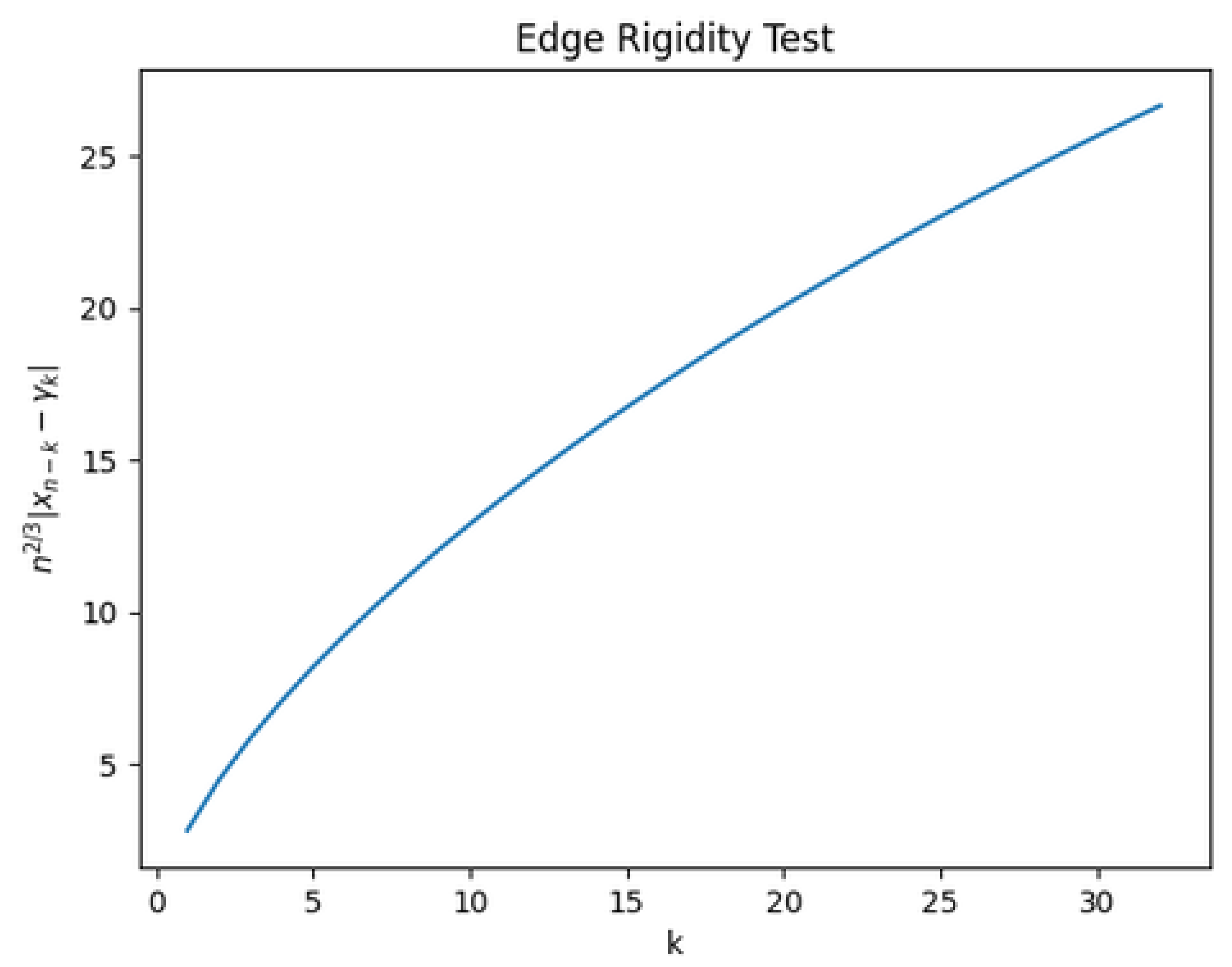
Figure 2.
Rescaled nearest-neighbor spacing near the endpoint. The monotone decay is consistent with the predicted behavior and indicates local rigidity of the configuration.
Figure 2.
Rescaled nearest-neighbor spacing near the endpoint. The monotone decay is consistent with the predicted behavior and indicates local rigidity of the configuration.
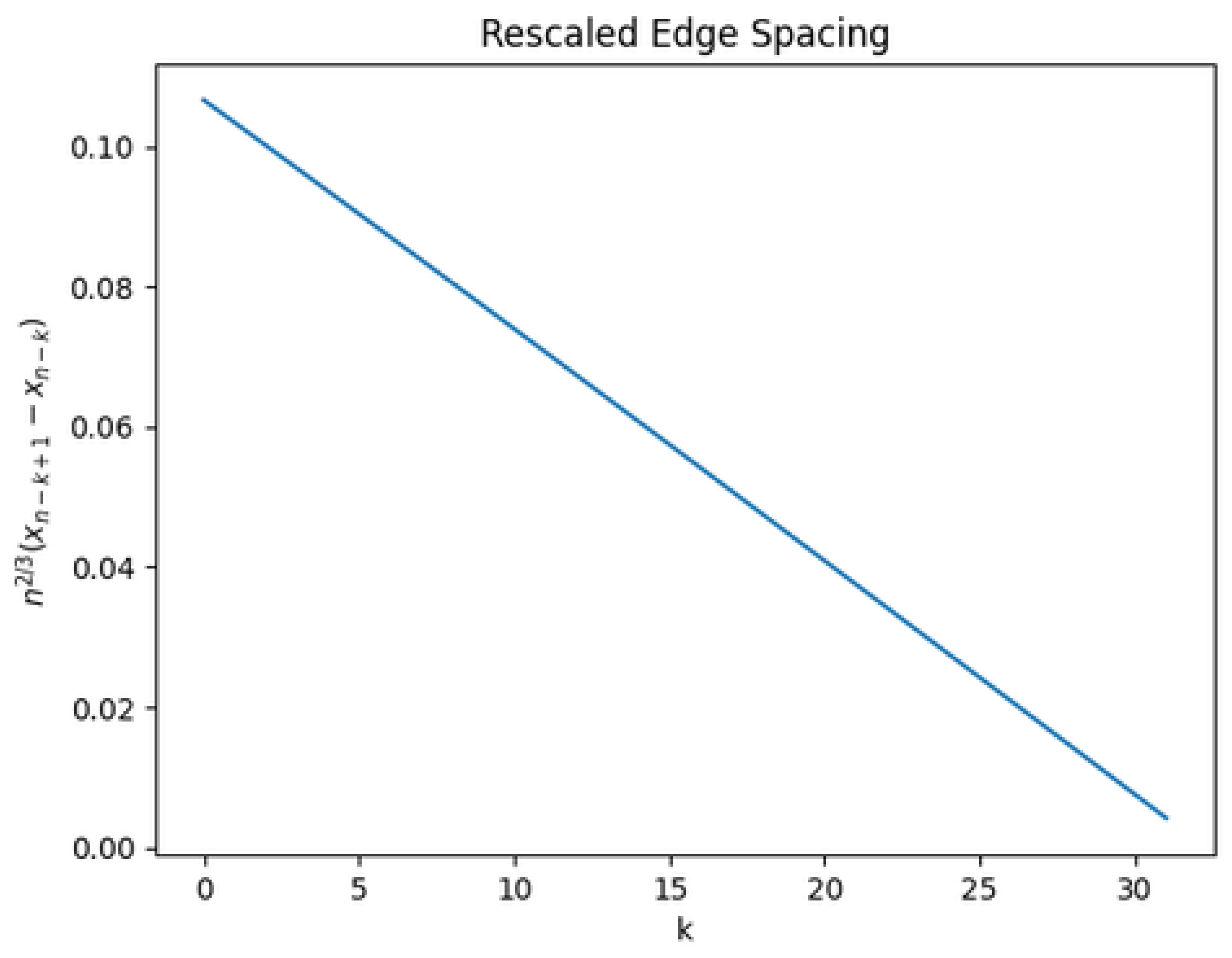
Figure 3.
Endpoint Airy scaling of the discrete Christoffel function. The collapse of the curves confirms the scaling and the validity of the endpoint analysis.
Figure 3.
Endpoint Airy scaling of the discrete Christoffel function. The collapse of the curves confirms the scaling and the validity of the endpoint analysis.
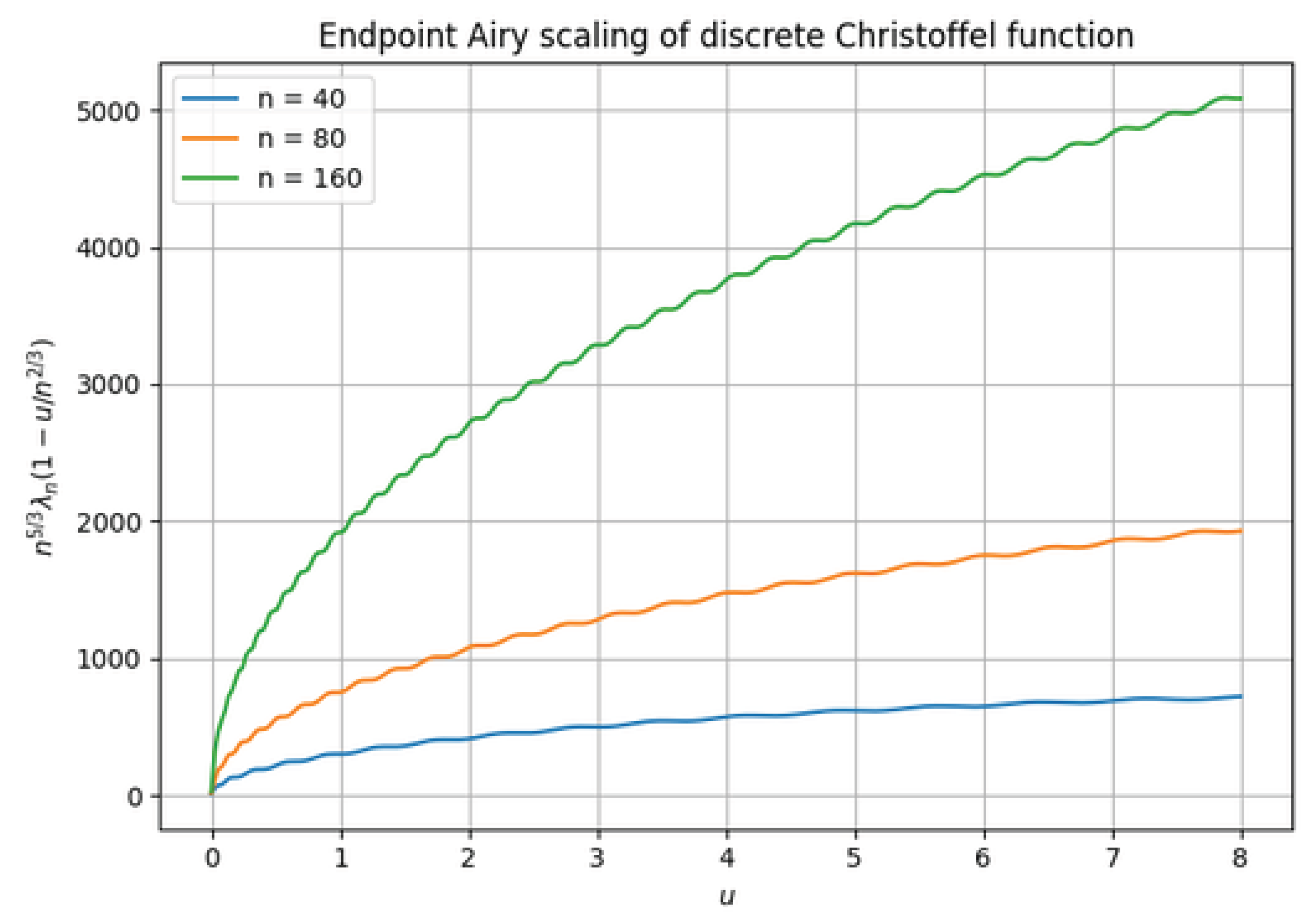

Table 1.
Numerical values of the Erdős functional for Legendre–integral nodes.
| n | ||
|---|---|---|
| 20 | ||
| 40 | ||
| 80 | ||
| 160 |
Disclaimer/Publisher’s Note: The statements, opinions and data contained in all publications are solely those of the individual author(s) and contributor(s) and not of MDPI and/or the editor(s). MDPI and/or the editor(s) disclaim responsibility for any injury to people or property resulting from any ideas, methods, instructions or products referred to in the content. |
© 2026 by the author. Licensee MDPI, Basel, Switzerland. This article is an open access article distributed under the terms and conditions of the Creative Commons Attribution (CC BY) license (http://creativecommons.org/licenses/by/4.0/).
Copyright: This open access article is published under a Creative Commons CC BY 4.0 license, which permit the free download, distribution, and reuse, provided that the author and preprint are cited in any reuse.


