3.3. The Economic Attributes of Enset Production and Its Values
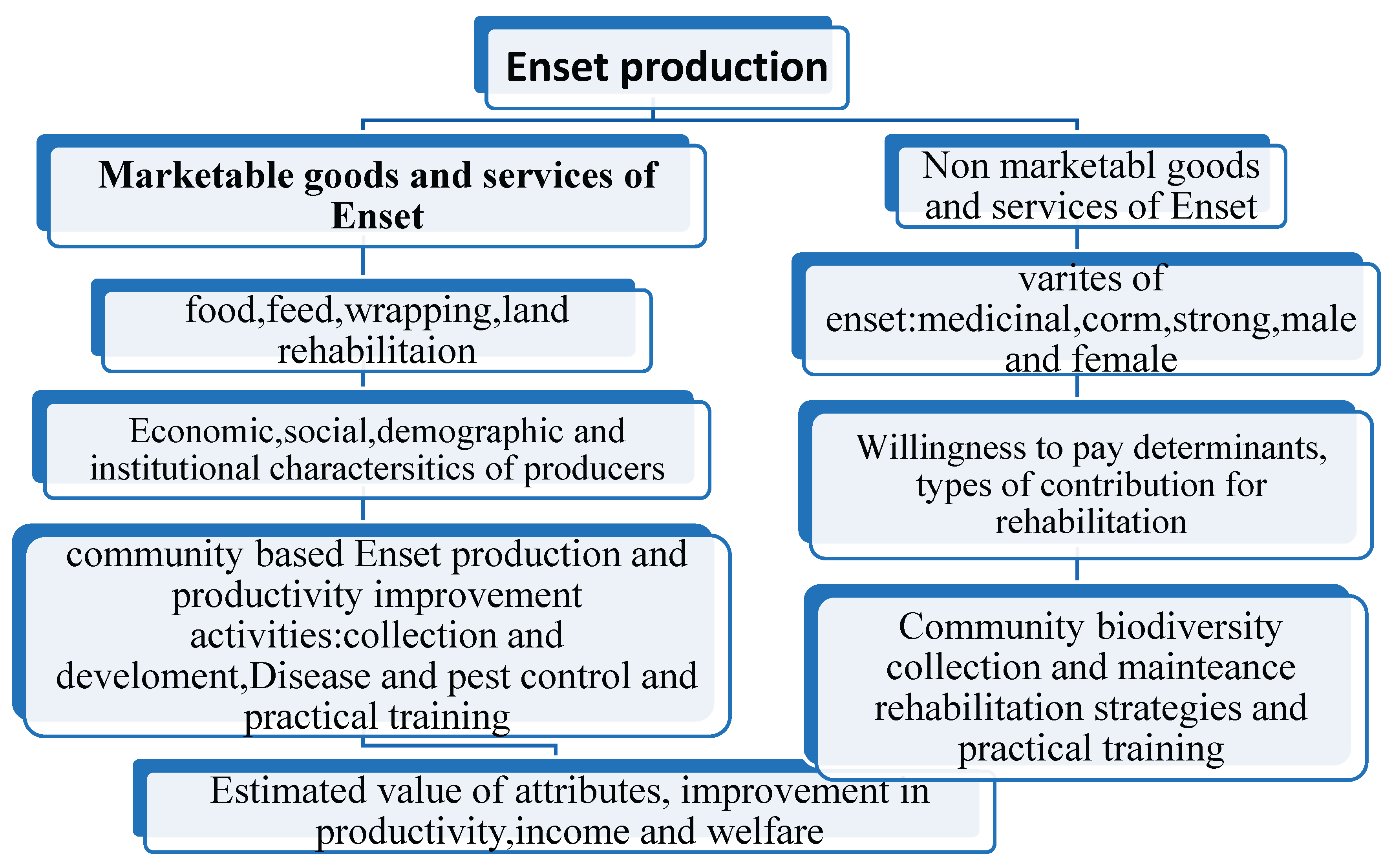
The marketable aspects of enset production include various types and levels of benefits, pricing structures, and their integration into farming systems. Enset stands out as a horticultural crop with multifaceted values. Its marketable attributes are gauged by its diverse benefits, including its role as a human food source, livestock feed, building material for houses, medicinal properties, use in fences and windbreaks, contribution to biological soil and water conservation, and its traditional applications in equipment preparation. This observation aligns with the findings of [
26,
27] that highlighted enset’s versatile uses ranging from food, wrapping and feed to house construction, medicine, income generation, fiber for house construction, cleaning rags and for making mats, sacks and ropes.
3.3.1. Food Attributes of Enset Production and Their Values for the Community
The food benefits of Enset refer to a commodity as a food crop; however, the crop has many unaccounted benefits. Enset ranked first in proportion to household consumption from production, followed by vegetables, root crops, cereals and grain crops [
28].The nutritional value of enset holds significant importance for communities, with its significance varying across districts, seasons, kebeles, agro ecological zones, and households. Enset provides consumable products such as koscho, bulla, and corm, which are utilized in various forms. Enset-based foods are central to traditional dishes Batchyra or Atakana, which are commonly consumed by all producers. These foods are often paired with maize-based dishes, such as cooked meats, dairy products, or consumed raw foods. In southern Ethiopia, festivals are incomplete without the inclusion of enset-based foods, highlighting the integral role they play in local culinary traditions. The extent of end product consumption is influenced by factors such as the type of products available, seasonal variations, Enset harvesting levels, household size, and community wealth. This output is in line with [
29], which indicated that enset is known for its important role in food provision and environmental conservation.
According to the [
30] report, enset production is quantified based on the number of harvested trees, processed products, and cultivated areas nationwide. From a total of 206,422,619 harvested Enset trees, the production levels of Amicho, Kotcho, and Bula were estimated at 57,189,207.53 quintals, 63,445,734.57 quintals, and 1,850,753.1 quintals, respectively. However, this value only accounts for the unprocessed enset products. Through value addition processes, the market value of Enset products is significantly enhanced, estimated at 3.75 billion Birr annually.
Own calculation for survey data,2024 and [
30]. The rank of producers across regions reveals varying contributions (
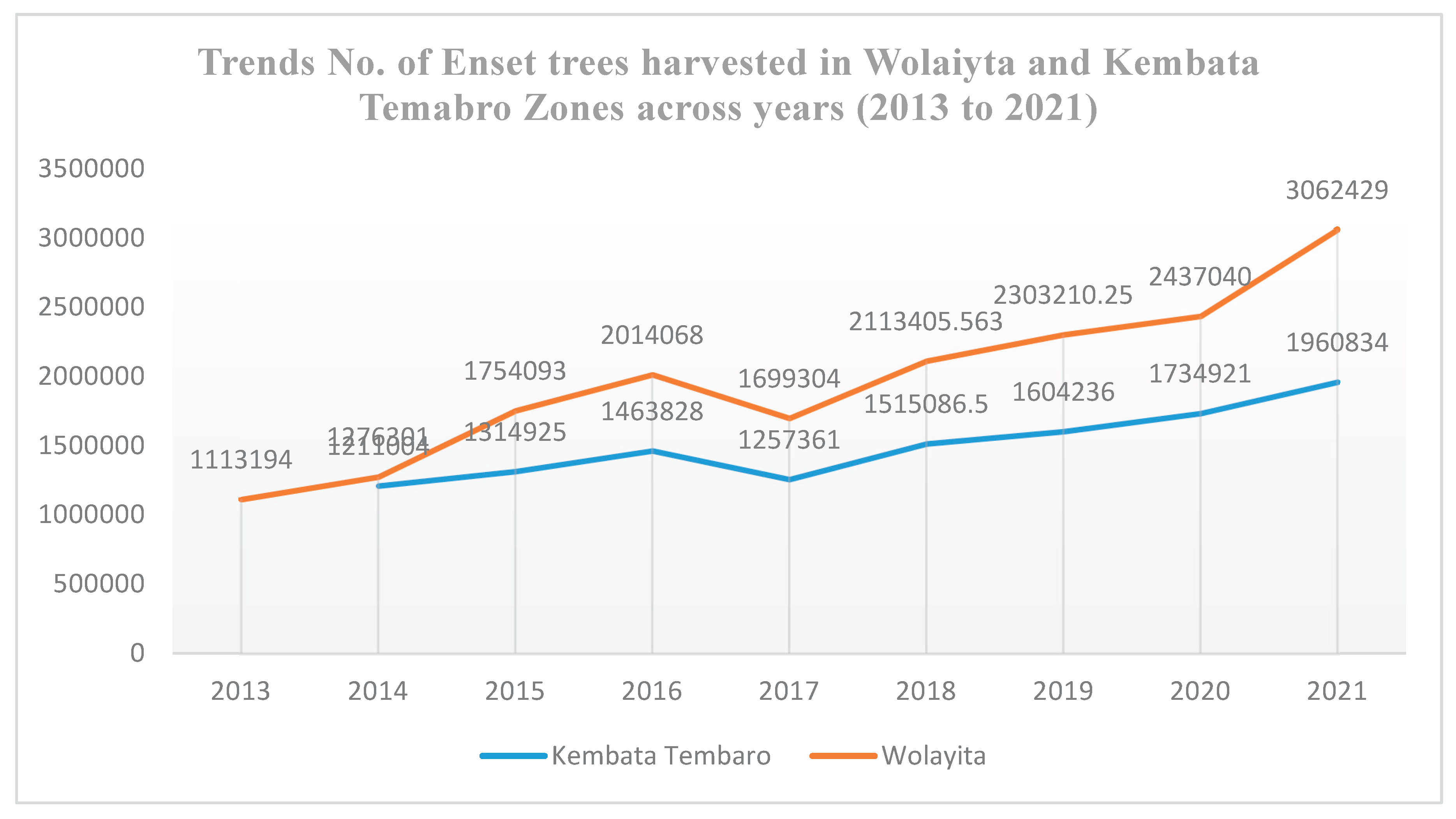
Table 4), with Oromiya, Sidama Region and South West ranked first, second and third for processed and unprocessed Enset products respectively, while South Ethiopia and Central Ethiopia ranked fourth and fifth. The significance of enset as a food source is reflected in social capital, land ownership, farm size, and household characteristics. Enset production has seen an increase in the number of harvested trees and yields across districts in the Wolaita and Kembata zone. While production levels remain similar between the two zones, there is noted divergence, indicating changing dynamics in enset cultivation and utilization practices [
19].
In the districts within the Kembata zone, Enset serves as the primary dietary staple consumed throughout the year, and is enjoyed in various forms and on different occasions. It is regularly consumed as the main meal for dinners, suppers, and breakfasts, and it plays a significant role as a key ingredient in festival dishes. During major holidays, such as festivals, every household in the district prepares and consumes Enset-based dishes such as Atakana, which is a prominent traditional dish enjoyed across the region. The estimated food value Kotcho and Bulla for the Wolaita zone was 620.59 million Birr. Similarly, in the Kembata zone, the tradable value of Kotcho and Bulla was estimated to bear 74.65 million Birr.
Enset consumption occurrences preference depends on the potentiality of the study zone (
Table 4), its area coverage, market distance, farmers training centre distance, Enset source and quantity harvested and family size. The outcome variable, consumption occasion of Enset production levelled as 1 for dearth period consumption, 2 for dearth period and festival consumption and 3 for whole year consumption. The regression result (
Table 5) implied that if we increase the level of Enset area holding by a unit (timad), market distance (walk minute), farmers training centre distance (walk minute) and number of Enset harvested, the ordered log-odds of consuming enset for whole year increases by about 3.99, 1,1.01 and 1.07 respectively , holding all other regressors constant. As it illustrated in the
Table 5 that if we increase travel by 1 unit of potential district (i.e. going from Wolaita to Kembata zone), the odds of whole year consumption vs. the combined dearth period and festival consumption are 3.95 times greater than if neither the household from less potential Woredas , ceteris paribus. For frequent consumption, small holder farmers needs to source from their own production, harvest more enset annually, dwell far away from farmers training and market centres and in the vicinity of potential production zones. The result also in line with [
31] that reported the long-term practices and experiences in cultivation, utilization, and conservation of Enset landraces defined as function of their domestic and market purposes, agro-climatic differences, ethnicity factors, food cultures, and historical backgrounds. The study results supported by [
32] that reported economic viability of Enset enhanced by adapting food use strategies, maximize the utilization of enset resources and promoting enset intensification in regions where it is not currently cultivated.
The regression implied that whole year Enset consumption and utilization attribute of its production can be promoted by potentiality of zone, number of Enset harvested, Enset area coverage, distance to farmers training centre and market distance. Promoting Enset food consumption is provoking organic feeding for human, livestock and environment that can be enhanced by improving service sectors access, improving economic variables of cultivators and well-functioning of institutional sectors.
Level of Enset holder and Area coverage across regions
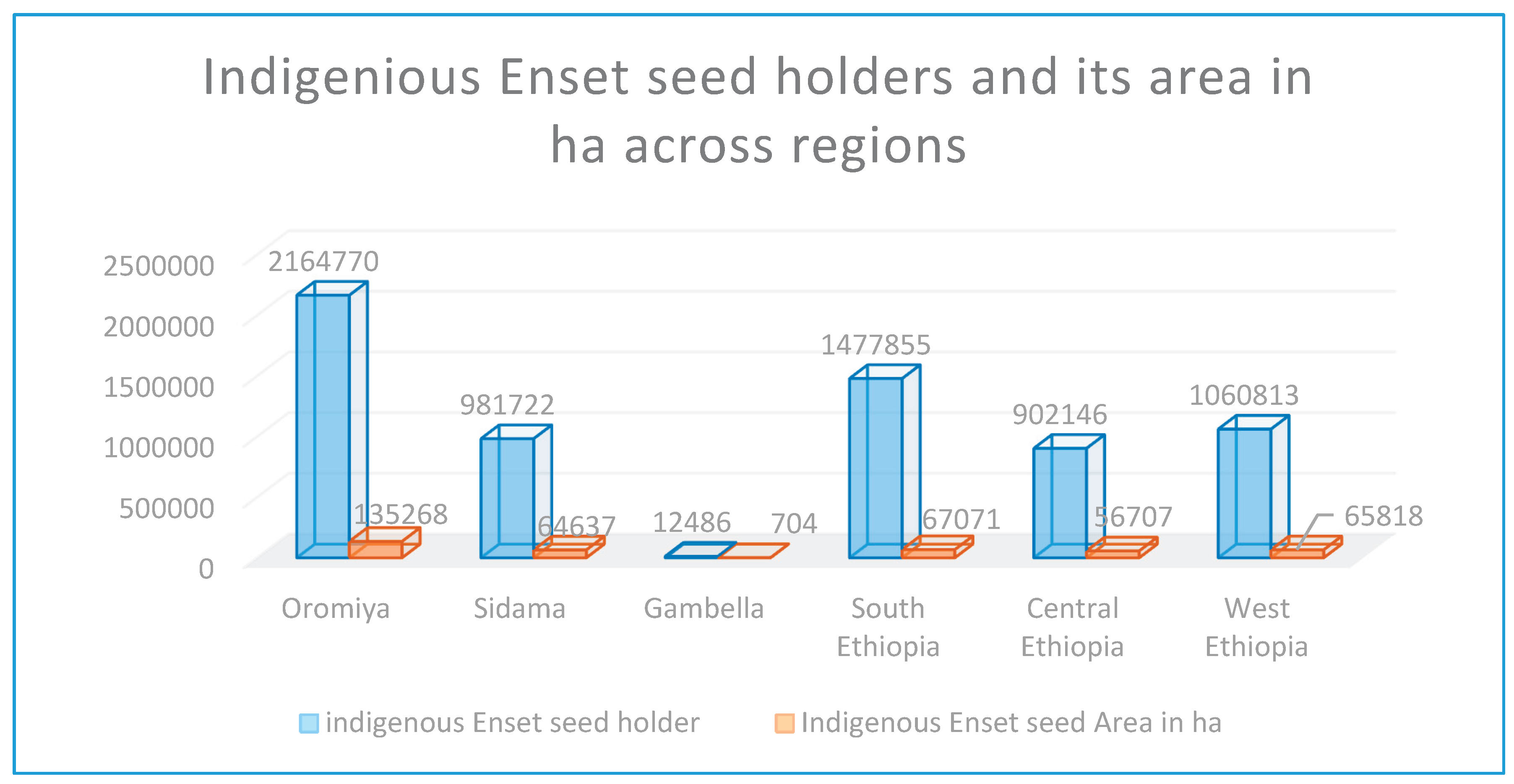
Figure 4.
Indigenous Enset holders and its area across regions.
Figure 4.
Indigenous Enset holders and its area across regions.
The figure above illustrates that majority of Enset cultivators and its area coverage found in Oromiya,South Ethiopia, West Ethiopia and Sidama regions. This calls for integrated and all regions inclusive action for Enset improvement and genetic conservation.
3.3.2. Feed Value of Enset Production in Study Zones
The feed benefits of the enset crop are highly appreciated and referred as feed security crops by producers used for the whole year and ranked first in the level of consumption from production. In relation to the production level, the farming season and its application as both basal and supplemental feed for large ruminants, shots and equines. Enset crops are consumed by calves and kids’ for growth, bulls and heifers for maintenance, oxen in fattening and dairy cows for milk production [
33]. The utilization and value of enset feed in the Kembata Zone vary depending on several factors including district, season, agroecology, and land size. Smallholder farmers with larger Enset cultivation areas typically use the crop for feed throughout the year, providing it as both basal and supplemental feed for their livestock. Conversely, households with smaller Enset cultivation areas tend to use the crop only during specific periods, such as the dry season, and primarily as basal feed. These periods of enset utilization of feed coincide with times of scarcity. In the Kembata Highlands, a higher proportion of farmers use enset as their primary feed than in the Wolaita districts. This finding is consistent with that of [
4], who suggested that Enset constitutes a significant portion of livestock feed owing to its protein-rich composition.
The utilization patterns of Enset parts for livestock feed varied among the study districts, with leaves, pseudo-stems, and corms being the major parts provided to livestock. The proportion of smallholder farmers using these parts for feed in Doyogena, Katchabira, Damot Sore, and Damot Gale was 90%, 69.62%, 33%, and 67%, respectively. Specifically, in Doyogena, 90% of farmers use all parts of the Enset plant for feed, 8% use only leaves, and 3% use only leaves and pseudo-stems.
The estimated value of Enset feed in Wolaita amounts to 5259.47 Birr annually per household, calculated based on the average number of months Enset is used as feed and the daily feed cost for one production period. In the Kembata zone, the feed value of Enset is estimated at 29,190 Birr annually, calculated as the product of daily feed costs and number of feeding days per year.
Supporting Enset producing is inducing climate smart agriculture, improving productivity of agriculture and assuring feed security of livestock sector that explained by demographic, social and economic variables of Enset producers. This endogenous variable, attributes of Enset for feeding levelled as feeding at the dearth period only, feeding at dearth plus supplement occasions for half of the year and feeding the whole year. The parameter estimate of the regression result (
Table 6) implies that the feeding benefits of enset are defined as functions of zone, age, number of enset harvested, Enset area coverage, tropical livestock units and family size. The results indicated promoting factors for whole year consumption of Enset feeds and its attributes listed as enset area coverage, age, enset trees harvested, tropical livestock unit and potential of the zone. The result illustrates that marginal difference in consuming Enset for whole year or on certain occasions manifested by zone, Enset area and harvest and livestock holding.
3.3.3. Fibre Attributes of Enset Production and Its Value in Ethiopia
Fibers constitute a significant portion of enset-derived products obtained by harvesting and processing the plant. It serves as the primary material for crafting ropes used in tethering livestock, manufacturing sacks for storing grains, and constructing traditional houses. Fiber yield typically ranges from 475 quintals in fresh weight to 0.16 tons per hectare, as noted by [
20,
34,
35].
In the year 2022, from a total of 235,669,985 harvested Enset trees, an estimated 1.5 billion quintals of fiber were produced. The market value of this fiber was approximated to be 3.62 billion birr, constituting 95% of the total marketable products derived from Enset. The distribution of the fiber’s marketable value across regions is as follows: 39.9% from the Oromiya Region, 28.99% from Sidama Region, 9.4% from South Ethiopia, and 6.95% from the Central Ethiopia Region.
3.3.4. Soil and Water Conservation Benefits of Enset Production and Its Values
The soil and water conservation attribute of enset production is one of the most important additional services obtained from farming and is called a biological natural resource rehabilitation benefit. According to the survey, the enset plant was employed for soil and water conservation efforts within the district. As a natural method for conserving soil and water, this crop aids smallholder farmers in preserving their fertile lands, thus preventing erosion and runoff-induced loss. When cultivated in farmyards, crops intercepts runoff and diminish erosion originating from residential structures. The value of Enset as a natural soi l and water conservation tool was calculated by multiplying the daily wage rate, the time required for planting, and cost of equivalent plants needed for the district. This assessment yielded an annual valuation of 436.62 Birr for Wolaita and 1118 Birr for Kembata. The value of enset varies across districts depending on factors such as Enset area coverage, daily wage rates, and the accessibility of natural soil and water conservation plants [
28].
3.3.5. Wind Break Attribute of Enset Production
The Predictand variable, wind break attribute of Enset farming is one of the key benefits of production and is referred to as natural resource rehabilitation for controlling winds and related damage. This attribute defined as 1, 2 and 3 figures high, medium and low. The wind break benefit is used by producers through in homestead plantations. The specific wind break attributes of enset production (
Table 7) are explained by producer districts, extent of contribution in Ethiopian Birr for rehabilitation, market distance and source of the commodity for consumption.
The result in the table above showed that Enset provokes homestead attractiveness and environmental regulation of the communities that influenced by the district capability of producing the commodity, service sector and economic viability of producers.
3.3.6. Fuel Attributes of Enset Production and Its Values
The survey findings revealed that dried Enset leaves applied in various purposes such as fuel for fires, material for house construction, and fodder during dry periods. According to a survey, the extent of its utilization is influenced by factors such as the economic condition of the community, availability of alternative firewood and forage options, and prevailing weather conditions. The monetary worth of dried Enset leaves utilized for fuel and fodder in the Wolaita and Kembata zones is estimated at 683.81 and 184.01Ethiopian Birr, respectively. This suggests that the farming community in the Wolaita zone utilizes dried enset leaves to a greater degree than that in the Kembata zone.
3.3.7. Wrapping Attributes of Enset Production and Its Values
The wrapping advantages of the Enset plant constitute a significant feature that enables its diverse applications, and its use is influenced by factors such as varietal types, seasonal conditions, cultural practices in fencing, socioeconomic status, age, and durability. These wrapping benefits are manifest in various applications including traditional house construction, fencing, cooking, preparation of traditional football, crafting hives and livestock tethering ropes, as well as bundling items for storage and transportation. Preferences for Enset varieties regarding wrapping qualities differ based on their strength and longevity. The utilization levels of enset for wrapping purposes vary across districts and zones, influenced by factors such as Enset resource accessibility, land coverage, and growth stages.
Enset varieties preferred for their wrapping attributes, particularly for fence and house construction, include male varieties such as Sisqela, Digomerza, Gishra, Dirbo, Sorpa, Wolanche, Bishato, Unjame, Tassa, and Kesito, known for their strength in the Kembata Zone. Similarly, strong enset varieties in the Wolaita zone prized for their wrapping benefits encompass Halea, Maziya, Godariya, Badadiya, Feleqiya, Kembata, Tuzuma, Mochyiya, Daluliya, Islama, Ankkogena, Alagena, Arigama, Dokozuwa, Sheleqymiya, and Wandadiya.
In the Wolaita Zone, the purpose of enset utilization for wrapping varies across peasant associations, influenced by factors such as the availability of enset leaves, household financial capacities, seasonal variations, and geographical considerations. The estimated market value of Enset used for wrapping in this zone is 217.49 Birr per household, calculated based on the quantity of dried Enset leaves utilized and their market price.
Conversely, in the Kembata Zone, almost all farmers utilize enset leaves for wrapping. The market value of dried Enset leaves employed for wrapping at the household level is calculated at 527.67 Birr. Additionally, Enset farming households produce various household items from dried leaves, including Jiba and traditional bee hives. The estimated market value of Jiba in this zone is 948 Birr annually per household, with an average holding of number of this product owned is 5.23+1.3. Moreover, dried Enset leaves are utilized as bedding material, with a market value estimated at 176.26 Birr per household annually.
Furthermore, in both zones, Enset leaves are utilized for house construction, aiding in the storage of crop residues and harvested crops, with an estimated annual value of 611.92 Birr per household. Additionally, Enset leaves are used for shading sown seeds of various crops, with an average of 16.63 leaves per year, resulting in a market value of 89.26 Birr.
In the Kembata Zone, the wrapping benefits of Enset are predominantly expressed in fencing, grass and firewood holding, holding harvested crops and residue, and house construction. Utilization levels of enset leaves for wrapping purposes vary across districts, influenced by enset farming levels, cereal crop farming, and topographical features.
The survey results also indicate variations in the utilization levels of enset leaves for cooking across districts. For instance, in Doyogena Woreda, over 51% of communities cook using Enset leaves daily, whereas in Katacha Bira, the usage ranges from daily to monthly frequencies. Overall, more than 46% of the communities reported practicing cooking food using Enset leaves daily. The estimated market value of Enset for cooking in Wolaita and Kembata districts is 312.60 and 1471.39 Birr, respectively.
The response variable of the regression, wrapping attribute of Enset is one of the major benefits practiced by almost all farmers who participated in production or not in the study district. The wrapping attributes level of Enset defined as daily, every three days and weekly for utilization frequency across households. The wrapping attribute of Enset was revealed in food cooking, cover for dairy products, cereal crop products, seizing grasses, wood and house construction. The wrapping attribute utilization of Enset was promoted (
Table 8) by family size, potential of the zone, owned land size and multiple sources of the product. The result implied that Enset supports industrial sector and its input function the sector is explained by labour availability, potentiality of the district, economic status of producers and potentiality of the sector.
3.3.8. Medicinal Attributes of Enset Production and Its Value Estimates
Enset is one of the major medicinal plants among the communities. Its medicinal value has been applied to both humans and animals. The mean number of
Enset used for medicine annually was 2.9. The market price of Enset used for medicine annually is 193.24 Birr for
Wolaita Zone and 376.19 Birr for Kembata District. The result supported by [
10] that implied Enset plays a significant role in the wealth distribution and social cohesion within farming communities. Additionally, it serves medicinal purposes and exhibits resilience to environmental stressors such as frost, pests, and pathogens, and therefore warrants robust policy backing. This is also supported by result of [
36], who reported that some Enset varieties were applied to treat bone problems and fed to a mother who gave birth for strengthening and fast recovery.
The major medicinal varieties of Doyogena include Quiyna, Gishra, Sebere, Abatamerza, Oniy, Tassa, Cherqwa, Sheleqa,Sisqela, Leqaqa, and Ginbwa. The farmers in this district confirmed that their level of utilization varies for varieties. From the varieties listed, 47% of respondents used Qeqyile, Gishra, and Qoiyna as medicinal plants, and the remaining proportion used other varieties. The major medicinal Enset varieties of Katchabira district include Quiyna, Qeqyle, Gishra, Cherquwa, Tebere, Dirbo, Tasso, Sebera, and Sisqela. The utilization frequency of certain varieties by farmers was higher than that of others. Of the listed medicinal varieties in the district, 85% of the respondents used Qeqyle, Quiyna, and Gishara. The major medicinal varieties of Damot Gale district of the Wolaita Zone include Qabariya, Felwua, Agina, Gefetanuwa, Arikiya, Sutiya, Esilama,Wanadiya, Ankwa, Kataniya, Neqaqa, Sirariya, Shalaqumiya, Lochyngiya, Anikogena, Buluwa, Wanadiya, Arigama, and Feleqiya. The major medicinal varieties listed in the Damot Sore Woreda of the Wolaita zone include Arkiya, Gefetanawua, Naqaqa, Wanadiya, Kataniya, Ankwa, Suitiya, and Lochyngiya.
3.3.9. Fertility Attributes of Enset Production and Its Value
Enset is recognized as one of the foremost crops contributing to enhanced soil fertility through decomposition, providing soil shading, and enriching it with retained water. The result is in line with [
11] that realized enset’s contributions in soil health maintenance. Smallholder farmers implement crop rotation strategies, utilizing Enset land for the cultivation of crops such as maize, potato, taro, and yam in succession. Typically, enset land yields are produced without the need for fertilizers for over two years on average in the district. The monetary value attributed to the fertility benefits of Enset amounts to 372.94 Birr annually in the Kembata zone and 158.56 Birr in the Wolaita zone. In particular, the significance of Enset’s contribution to soil fertility enhancement was notably high in Doyogena and Kachabira. In the Kembata zone, Enset land can sustain production without fertilizer for approximately 1.99 years, while in the Wolaita zone, this duration averages approximately 1.84 years. Additionally, smallholder farmers emphasize the role of Enset in improving soil moisture levels in various parts of the plant. This result is in line with [
24] who reported that enset intercropping improves soil fertility by decaying its body parts during the growth of crops grown within the vicinity of the commodity for the addition of nutrients and providing shading to the other crops.
The explained variable of fertility attribute defined as high, medium or low for application of Enset leaves for fertility of their whole land, half of their land and or home stead only. The regression results (
Table 9) indicated the likelihood of small holder farmers of cultivating of more fertility attribute explained by holding of tropical livestock unit and vicinity to market points. From the included explanatory variable, the number of livestock owned is known as promoting factor for fertility attributes, while market distance is the reverse factor.
The table above illustrates that Enset production helps to reduce production costs of farming and enhance organic farming that explained by livestock holding and proximity to service sectors.
3.3.10. Income Benefits of Enset Production and Its Values
The revenue generated from enset farming varies significantly between districts and households. In the Kembata zone, the average annual income from enset products is estimated at 910.44 Birr, whereas in the Wolaita Zone, it amounts to 39.45 Birr. In the Wolaita zone, farmers predominantly derive income from the sale of fiber, whereas in the Kembata zone, revenue sources include the sale of kotcho, bulla, and fiber. Owing to differences in production potential and product types, there is a notable disparity in income levels among smallholder farmers in the two study districts. The result is in line with [
37] that implied household income directly linked with Enset cultivation.
The study result showed that the income attribute of Enset explained by the study zone, market distance, farming training centre distance, number of Enset harvested and area coverage. The small holder farmers that earn higher level income are those that dwell in potential zone, held more of Enset, live away from market centres and in vicinity to farmers training centre and harvest more number of Enset. The study points out that the availability of opportunity to earn higher income associated with production promotion and extension service. The result is in line with [
23], who reported that the farmers in the highlands of Southern and South Eastern Ethiopia depend upon enset for income and other multiple benefits.
The outcome variable is income attribute level of Enset that grouped as high, medium and low for more than thousand birr, between nine hundred ninety nine Birr to five hundred Birr and less or equal to four hundred ninety nine Birr income contribution of the households, respectively. The income attribute level of enset producers (
Table 10) is directly related to the potentiality of districts, market distance, number of the commodities harvested annually and multiple source of enset for consumption such as market and own production. The result also showed a trend of negative association between incomes attribute level and farmers training centres distance. The finding indicated that marginal gain of Enset income can be influenced by agroecology, improved service sector and promoting market oriented production.
3.3.11. Social Benefits of Enset and Its Value in Study Zones
The societal significance of enset cultivation underscores its importance within communities, its cultural function, and its integral role in traditions, livelihoods, and food systems. The result also supported by [
10] that reported that Enset plays a significant role in socializing the community in various ways. Research indicates that during religious festivities, Enset-based foods hold paramount value for traditional meal preparations, either on their own or in combination with other ingredients. A prevalent traditional dish during the Meskel festival, known as Bachyra in Wolaita and Atakana in Kembata districts, exemplifies this significance. This special dish comprises a blend of kotcho, bulla, milk, butter, and spices. Enset derived foods are commonly paired with raw and cooked meat, cheese, and milk. Furthermore, Enset products such as Kotcho, bulla, and corm are often shared as gifts with neighbouring communities, particularly benefiting relatives and economically disadvantaged groups. This practice of freely giving Enset products fosters social cohesion within districts and strengthens inter-community ties. The estimated annual value of the enset products given freely per household in the Kembata zone is 437.92 Birr.
This finding aligns with the observations of [
38], who highlight enset cultivation as a cultural emblem for Kembata communities, symbolizing their identity. The significance of Enset as social capital, a source of communal support, and a catalyst for community collaboration is invaluable. It holds potential for furthering cooperation in development initiatives, including genetic conservation efforts, the enhancement of Enset-based commodities, and the overall welfare of communities.
In the Wolaita zone, smallholder farmers traditionally offer enset products to other households, with the provision being contingent upon factors such as the availability of enset products, the season, the economic status of the household, and specific occasions. Enset seedlings and corms are shared during planting seasons, dry and green enset leaves are provided year-round, and Enset Kotcho is distributed during periods of scarcity. The primary Enset products shared with other households included Kotcho, seedlings, corms, green, and dried leaves. The estimated annual market value of freely given enset products in the Wolaita zone amounts to 183.53 Birr.
The free provision of Enset products is known as the major benefit of Enset production, which is highly important for social ties and community development. The gift attribute that represents dependant variable of the model of Enset levelled as zero for no provision, one for up to 400Birr valued provision and three for 401Birr and above gifts. The ordered regression results (
Table 11) predicted that the rank for social attribute level of Enset provision defined as function of potentiality of the districts, tropical livestock unit, and number of enset harvested, market distance and age of small holder farmer. The result implied that certain variables such as tropical livestock units, more enset harvesting and market distance to the residence of the respondent showed a promoting effect on free provision of enset for their surrounding communities. The findings revealed that Enset production helps to develop social capital that by its own can be enhanced by economic viability of producers and infrastructural improvement.
3.3.12. Rainwater Collection Benefits of Enset Farming and Its Values
The degree to which enset leaves are utilized for rainwater collection is influenced by housing design and seasonal variations. A notable contrast exists between the study districts regarding the extent of enset leaf utilization for this purpose. Approximately 25% of farming communities in Doyogena and 47% in Katcha Bira districts have historically applied Enset leaves for rainwater collection. On average, the quantity of water collected using Enset leaves amounts to 838.55 litters, valued at 74.85 Birr for households in the Kembata zone. In contrast, in the Wolaita Zone, the annual market value of rainwater collected using Enset leaves totals 32.94 Birr, with an average water collection of 588.18 litters per household annually for Wolaita districts. The proportion of households utilizing Enset leaves for rainwater collection stood at 48.97% in Damot Sore and 43.75% in Damot Gale districts.
3.3.13. Biodiversity Benefits of Enset Production and Its Value
Enset biodiversity refers to refers to the diversity of varieties cultivated among smallholder farmers and across districts. The assortment of enset varieties and their prevalence across zones and districts varies according to factors such as farming practices, Enset cultivation area, cultural preferences, and dietary habits. In the Wolaita zone, farmers’ preferences for specific Enset varieties are influenced by various factors including the suitability of corm for consumption, the strength of leaves for medicinal purposes, leaf colour, fodder quality, and societal norms. Corm varieties are particularly favoured by smallholder farmers for their consumption of milk products, constitute significant cultural dishes in the region. The finding is in line with [
3,
23] that implied the knowledge system, socio-cultural characteristics, and communal practices related to enset cultivation greatly contribute to preserving enset diversity in Wolaita, South Ethiopia [
3,
39].
Enset varieties are categorized into female and male varieties, as well as corm, kotcho, bulla, and fiber varieties, each serving distinct purposes such as medicinal, fodder, fence and dietary uses in both Wolaita and Kembata regions. A single enset variety may offer multiple benefits and can be further classified as male or female. Male Enset varieties are noted for their high kotcho yield, large size, and resistance to diseases, pests and rain shortages. Bulla varieties are also known as kotcho varieties. Female Enset varieties, on the other hand, are characterized as sweet, soft, small, and among the most exhaustively used varieties. Male Enset varieties are preferred for purposes such as fencing, housing, windbreaks, and fodder. It is recommended to cultivate a combination of male and female Enset varieties to optimize Kotcho production, a finding supported by previous research such as that of [
40], who reported the existence of over fifty-five Enset clones with various utilization purposes.
The major kotcho varieties identified were Halea, Esilama, Ankogena, Gefetanwua, Neqaqa, Wanadiya, Arkiya, Shelequmiya, Mochiya, Tuzuma, Adinano, Kataniya, Qebariya, Lembwua, Gena, Arigema, Fellwua, Badadiya, Sirariya, Dokozwua, Chychya, and Adinona. The fiber enset varieties listed in Wolaita include Halea, Shalaqumaiya, Gefetenawu, Esilama, Godoriya, Kataniya, Felwua, Mochiya, Maziya, Tuzuma, Wanadiya, Arigama, Badadiya, Alagena, Feleqiya, and Sirara.The reported corm varieties included Neqaqa, Shalaqumiya, Agina, Qabariya, Katanya, Gupanaiya, Arkiya, Queiyns, Gidarete, Felwua Quiyna, Suiytiya, Chychiya, Gefetnawua, Neqaqa, Shalaqumiya, Arkiya, Qabariya, Bullwua, Kataniya, Silqanatiya, and Ginwa.The bulla varieties identified include Halea, Gefetanwua, Esilama, Ankogena, Shalaqumiya, Neqaqa, Wanadiya, and Arkiya. This finding is consistent with the observations of [
41], who noted variations in the responses of cultivars to different nematodes and the availability of resistant and susceptible Enset varieties.
The biodiversity attribute of Enset is expressed as a variation of varieties for benefits of food, feed, medicine, fertility, and wrapping. Enset is also described as male and female, hard and strong, big and small varieties. Biodiversity level is levelled high for more than ten varieties, medium for five to ten and low for less or equal to four types per individual producer households. The dependant variable, level of biodiversity attribute (
Table 12) is defined as a function of zone, enset area, Tropical Livestock Unit, father enset area, educational, farmers training centre distance and enset harvested. There is greater likelihood to have higher biodiversity level of Enset for the small holder farmer that dwell around Wolaita than Kembata zone, own more Enset area on fathers land and educated more. The results also indicated that there is less likelihood of having higher biodiversity that own more own Enset land area, harvests more Enset and live in vicinity to farmers training centre. The results point out community and family based intervention and education promotion can help the conservation of biodiversity for optimal utilization and improved production. This result is in line with [
42],who reported that enset richness and diversity in production regions demands conservation for enhanced food security of farmers at household. The finding also supported by [
30] who implied that Enset producers held 15-56 Enset varieties to meet with their diversified demands of nutritional, fiber, fermentative quality, yield and disease and drought resistance. The research findings points out that marginal gain of Enset biodiversity can be improved by training, infrastructural improvement and social capital development.