

Submitted:
11 August 2026
Posted:
12 August 2026
You are already at the latest version
Abstract
Adaptive systems that couple inference to irreversible commitment are governed by a rate-capacity law analogous to Shannon's: agency persists only while the induced informational flux Rself remains below the integrative capacity Cself. We define Recoverable Self-Coding (RSC), a structural framework in which the self - human, organizational, or artificial - is a self-decoder whose feasibility is tracked by a small set of measurable parameters: the capacity ratio CR = Rself/Cself, the margin M = Cself - Rself, the accessible-option entropy Hself, an exploration temperature T, and a finite integration horizon. Sustained CR > 1 makes state evolution non-invertible: options are eliminated faster than they can be reconstituted, and recovery cannot be restored by effort, intelligence, or optimization. We show that the parameters are directly estimable from open longitudinal event streams, verifying the construct on four open cohorts - synthetic health records (~1,900 units), the MIMIC-IV and eICU demonstration cohorts, and ~40,000 ICU stays from the PhysioNet/CinC 2019 sepsis challenge - where critically ill patients concentrate at the feasibility boundary CR ≈ 1 and outcome-labelled populations (sepsis; death in unit) sit measurably deeper into infeasibility without any fitted model. Applications are developed for healthcare capacity monitoring; for human agency under rate shocks - episodes, from a serious diagnosis to AI adoption, that abruptly multiply the induced flux against slow-adapting personal capacity; and for operational systems whose certification backlogs are directly observable. Annealing - regulated exploration followed by feasibility-paced consolidation - emerges as the admissible dynamics for staying recoverable under acceleration.
Keywords:
recoverable self-coding
; recoverability
; rate-capacity constraint
; self-entropy
; annealing
; human-AI systems
; feasibility
1. Introduction
Artificial intelligence is changing not only which decisions are made but the rate at which decisions, updates, and commitments are imposed on the people, organizations, and machines that must integrate them. As candidate decisions become cheap and fast, institutions route ever more judgments through their most efficient decision node [1]; option velocity, feedback cadence, and coupling all rise together. This acceleration is structural, not psychological: it changes the tempo and volume of decision-relevant information, independently of anyone’s motivation or skill.
Under sustained acceleration, the familiar notions of stability stop measuring the thing that fails. A system can remain locally coherent, productive, and even successful while being driven toward a regime from which recovery is no longer possible. What fails first is not accuracy, motivation, or optimization quality, but the ability to integrate incoming uncertainty within finite capacity and finite time—and that failure arrives abruptly, after long periods of apparent stability, as an irreversible loss of options rather than a gradual degradation of performance. Safety science has long described this migration toward the boundary of safe operation under efficiency pressure [2,3,4]; what has been missing for the accelerated setting is a measurable order parameter for how close the irreversible crossing is.
The reframe.
We supply one by analogy with the sharpest structural limit in the information sciences. Shannon’s channel-coding theorem fixes a hard threshold: a channel of capacity C admits reliable recovery of messages if and only if the information rate satisfies [5,6]. Recoverable Self-Coding (RSC) transfers this feasibility logic from messages to commitments. Any system that maps uncertain observations into internal updates and irreversible commitments—a person, a family, a firm, an AI agent, a coupled human–AI system—is a self-decoder. It sustains an induced informational flux that must be integrated by a finite integrative capacity , and its viability is governed by the capacity ratio and the feasibility margin . While , errors and exploratory commitments remain revisable; when exceeds one for sustained periods, commitments accumulate faster than they can be integrated and state evolution becomes locally non-invertible. The binding quantity is not whether beliefs are correct but whether commitments remain recoverable—correctable before option loss becomes permanent. Historically almost everywhere; AI-mediated acceleration is driving it toward unity across many systems at once.
What this paper is.
This paper is the foundational statement of RSC, and it is deliberately narrow: it defines the framework and its parameters, shows that the parameters are measurable from open longitudinal data, and demonstrates applications. Section 2 defines the self-decoder, the rate–capacity constraint, the feasibility boundary and its repelling character, the finite integration horizon, the accessible-option entropy , and the annealing dynamics that constitute admissible adaptation under acceleration. Section 3 gives the excursion/restore estimator and verifies the construct on four open cohorts: synthetic longitudinal health records (∼1,900 units), the MIMIC-IV and eICU demonstration cohorts, and ∼40,000 ICU stays from the PhysioNet/CinC 2019 challenge—two hospital systems, hourly resolution, with an outcome label. Section 4 develops three applications: physiological capacity monitoring in healthcare, human agency under rate shocks, and operational systems whose certification backlogs are directly countable. Section 5 assembles everything into one reproducible worked example — multi-source data in, gated decisions out. Section 6 and Section 7 state what the framework does and does not claim.
Position among existing frameworks.
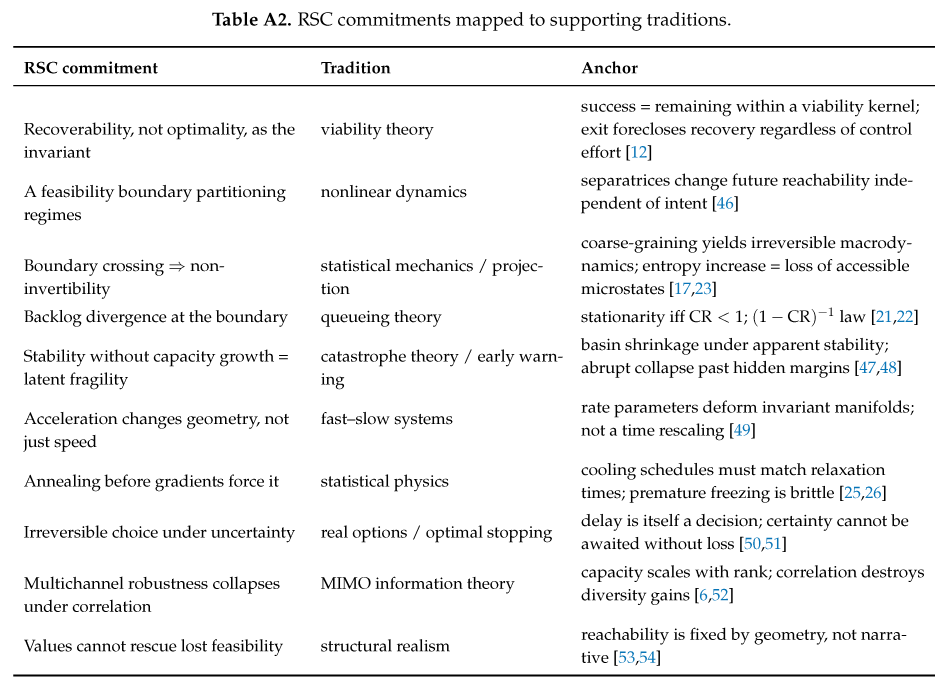
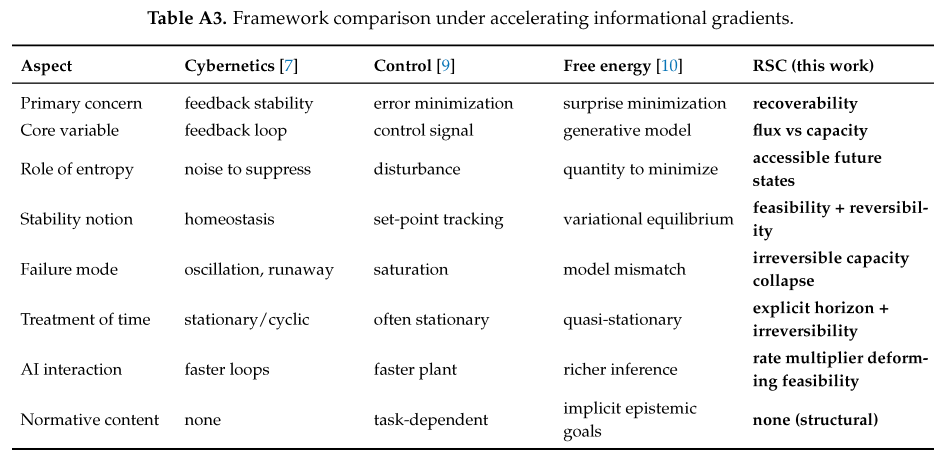
RSC does not compete with cybernetics, control theory, free-energy accounts, or decision theory on their own ground; it asks a logically prior question. Those frameworks ask how a system regulates, infers, or optimizes within a given structure [7,8,9,10]; RSC asks when the structure itself remains recoverable under accelerating informational load—and when it does not, regardless of strategy, intent, or optimization quality. Classical stability is the wrong invariant for this question: a system may track its set-point faithfully while its feasible option space contracts irreversibly. Information theory supplies the right template because it is the one framework whose central results are impossibility statements under rate–capacity mismatch [5,11]; RSC extends that feasibility logic from the reliability of transmitted messages to the recoverability of the decoding system itself. The nearest mathematical tradition is viability theory, where success is defined as remaining within a viability kernel rather than optimizing a cost [12]; Appendix B maps each RSC commitment to its supporting tradition.
Relation to the companion papers.
This paper anchors a small family. A peer-reviewed proceedings paper [13] develops the certification-queue formulation of the constraint—the uncertified-commitment backlog as a single-server queue—together with its boundary law and the margin-based early-warning predictor; a companion physics paper [14] supplies the nonequilibrium-thermodynamic grounding and shows that closing the loop (uncertified outputs re-entering as load) makes the recoverability transition first-order. The present paper states the framework those results instantiate, and carries the empirical verification. An independent treatment reaching the same thesis—AI safety as control of irreversibility—has appeared in [15], which we read as convergent evidence that recoverability, not accuracy, is the binding quantity under acceleration.
Scope discipline.
Throughout, “failure” means structural infeasibility under rate–capacity and horizon constraints, never personal, moral, or organizational deficiency. The framework is structural: it makes no claims about phenomenology, values, or goals, and its variables are defined operationally from observable event streams. All results use a scalar (single-channel) formulation—the most conservative reading, since failure occurs first along the binding dimension—with multichannel extensions noted as future work.
2. Recoverable Self-Coding: Definition and Parameters
This section defines the framework in full. Everything later in the paper — the estimator, the verification, the applications — uses only the objects defined here.
2.1. The Self-Decoder
Call any physical or informational system that maps uncertain observations into internal state updates and downstream commitments—some irreversible—a self-decoder. The abstraction is substrate-independent: biological cognition and physiology, institutions, artificial agents, and coupled human–AI systems all qualify. A self-decoder does not access the world, its goals, or its own configuration directly; it receives noisy, delayed, context-dependent signals and must construct from them an internal configuration—belief weights, commitments, policies, attentional and regulatory settings—that determines which actions are admissible and which future states remain reachable. This is decoding in the Shannon sense: inference of latent state from corrupted channel output under finite resources [5,6,8].
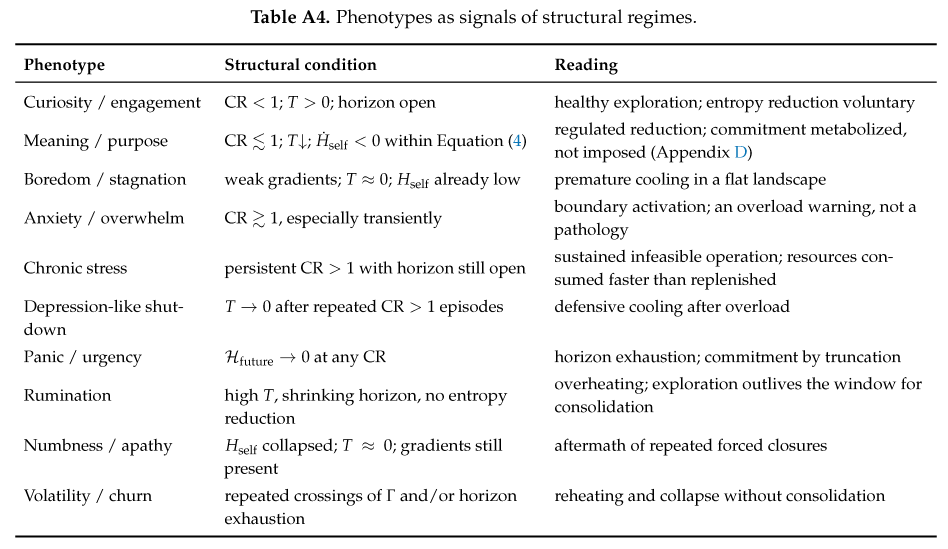
Two levels of description are used throughout, in the standard statistical-mechanical sense [16,17]. A microstate is a fine-grained internal configuration (beliefs, commitments, policies, attention, regulatory gains). A macrostate is a coarse-grained equivalence class of microstates sharing the same feasibility-relevant properties; in the scalar formulation these are the rate–capacity coordinates defined next. Observable phenotypes (fatigue, churn, rigidity, engagement) are downstream signals of the macrostate, not causal variables; the mapping is tabulated in Appendix C. Coarse-graining in this role is identical in structure to state abstraction in cybernetics [8] and to predictive equivalence classes in computational mechanics [18].
2.2. Rate, Capacity, and the Feasibility Constraint
Over a decision horizon, let denote the induced informational flux: the rate at which decision-relevant uncertainty requiring integration before commitment arrives. It is an operational quantity, defined through admissible proxies—band excursions in a monitored physiological panel, forced decisions, opened issues, interrupt and deadline cadence—not raw data rate or tokens per second. Let denote the integrative capacity: the maximum rate at which such uncertainty can be resolved into coherent, revisable internal structure, bounded by attention, working memory, coordination, computation, and available integration time [19,20]. Both are rates over the same events, so their ratio is dimensionless.
The framework’s central objects are then
the capacity ratio and the feasibility margin, and the feasibility condition is strict:
At no stationary recoverable regime exists (the boundary belongs to the infeasible side); this is the structural analogue of Shannon’s [5]. The boundary
is called the recoverability boundary (separatrix). Where redundancy or structured correlation is available, the effective flux presented to the decoder is reduced, ; the margin is always defined with , so buffering enlarges the true margin relative to Equation (1) rather than redefining it.
Two comparisons fix the meaning of the constraint. First, feasibility precedes optimality: below capacity many strategies exist, differing in latency and redundancy; above capacity no strategy succeeds—this is the content of the channel-coding converse, and it transfers intact [5,11]. Second, accuracy and recoverability are distinct: a wrong belief is revisable at no permanent cost, an irreversible commitment is not, so a decoder can remain accurate while losing the ability to undo what it commits. The companion proceedings paper demonstrates this decoupling directly in simulation [13].
2.3. The Backlog, and Why the Boundary Repels
The dynamical content of Equation (2) is carried by the uncertified-commitment backlog: the commitments taken (or pending) whose integration is not yet complete. Modelling integration as a certification queue—arrivals at rate , service at rate —makes the boundary’s character a theorem rather than an assumption: a stationary regime with bounded backlog exists if and only if [21], the mean backlog diverges as at the boundary [22], and for the backlog grows without bound, so the state drifts away from feasibility on both sides of . The queue formulation, its boundary law, and the margin-based early-warning predictor built on it are developed in the companion papers [13,14]; here we import only the qualitative consequence:
Repelling-boundary property. Near , the margin evolves away from the boundary on both sides: transient load below capacity is absorbed (backlog drains), while sustained load above capacity is self-reinforcing (backlog grows, consuming the very capacity needed to clear it).
On this basis the framework’s central claim can be stated honestly—as a structural claim grounded in the queue model and the irreversibility of coarse-grained dynamics [23], not as a theorem proved from axioms:
Structural Claim (Recoverability). If a trajectory crosses and remains at over a sustained interval, macroscopic evolution becomes locally non-invertible: accessible configuration volume contracts irreversibly, and no rate-only reduction restores the pre-crossing option space. Restoration requires exogenous capacity injection or the re-introduction of eliminated degrees of freedom.
Falsifiers are stated with the evidence in Section 3. Two scope notes. (i) The claim concerns the effective capacity: under nonstationarity, the channel itself deforms, and if decoding cannot track the deformation the effective capacity collapses even at fixed nominal throughput—channel drift enters the margin through , not as a separate failure axis. (ii) The claim is scalar-conservative: in multichannel systems, recoverability fails as soon as any binding subchannel saturates, so the scalar constraint reads the earliest failure mode.
2.4. The Horizon Constraint
Feasibility of the rate is not sufficient: integration must also complete in the time that remains before commitments harden. Let denote the remaining integration window and the uncertainty that must be resolved before the pending commitments become irreversible. The horizon constraint is the integral condition
i.e., the capacity available inside the window must cover the required entropy reduction. Violation with is possible and produces a distinct failure mode: commitment by truncation rather than by convergence—decisions forced by time, not resolved by integration (“panic” in the phenotype atlas, Appendix C). Latency couples the two constraints: as the integration time per commitment diverges, so the horizon constraint binds before the rate constraint does.
2.5. Self-Entropy: Option Volume, Not Unresolved Load
Conditioning the microstate distribution on the macrostate defines
the self-entropy: the (Gibbs–Shannon) log-volume of internal configurations that remain reachable and revisable under current constraints [5,16,17]. High means many live roles, models, and futures; low means a narrow, possibly brittle configuration. Under uniform accessibility Equation (5) reduces to the Boltzmann form .
Two quantities must not be conflated, and the framework assigns them different symbols. is option volume: overload contracts it, because commitments are forced before alternatives can be maintained. The unresolved load is the backlog of Section 2.3: overload grows it. Both statements are true simultaneously and jointly characterize infeasible operation—a shrinking space of live options together with a growing pile of uncertified commitments—and the backlog, not , is the quantity whose divergence marks the boundary [13]. Low itself is ambiguous between two structurally different histories: reduction by inference (uncertainty resolved within capacity; reversible, capacity-building) and reduction by constraint (options eliminated by overload or truncation; irreversible). Distinguishing these two modes is the diagnostic role of the projection used in Section 4.
2.6. Annealing: The Admissible Dynamics
How can a self-decoder change its own structure without crossing ? The generic dynamical form for adaptation under gradients and finite throughput is stochastic gradient flow with a controlled noise scale,
where x is the internal configuration, an effective landscape shaped by external gradients and structural constraints , and the exploration temperature governing stochastic breadth versus commitment [24,25,26]. High T keeps many microstates live (raising ); cooling consolidates. Annealing is the schedule by which exploration is followed by regulated consolidation.
The feasibility coupling is the framework’s addition to the classical picture: an annealing schedule is admissible only if the exploratory flux it induces respects Equations (2) and (4). A sufficient local condition is while ; it is not necessary—transient is harmless while stays positive—but must never reach zero during exploration. Two schedule failures follow immediately: quench (cooling too fast relative to integration: option volume collapses by constraint while feasibility still holds; brittle lock-in), and overheat (exploration sustained as the horizon closes: uncertainty is still open when time runs out, and commitment happens by truncation). Capacity grows on the cooling side of the cycle—the long-run consequences are developed in the next subsection. This exploration–consolidation alternation is the canonical resolution of the same trade-off in simulated annealing and stochastic approximation [25,27], here subordinated to a feasibility constraint rather than an optimization objective.
2.7. Capacity on Long Timescales
is not a constant of the decoder; it is its slowest state variable, and three regimes govern its long-run dynamics. Growth: capacity is built by the annealing cycle just described — exploration discovers structure, consolidation certifies it into reusable, lower-latency encodings — and the cycle runs only inside feasibility (), so sustained overload stalls capacity growth precisely when growth is most needed. Erosion: sustained consumes capacity, because backlog service competes with maintenance, sleep, and learning for the same bounded resources; this is the microscopic content of the repelling boundary — chronic overload lowers , steepening the gradient that produced it (burnout is this loop; Appendix C phenotypes it). Secular drift: in organisms, capacity declines with age as repair, clearance, and immune surveillance slow; in institutions it decays through tooling debt and knowledge attrition unless deliberately renewed. The capacity-adaptation rate of the next subsection is the local linearization of these slow dynamics.
Two consequences follow. First, because moves slowly, the response to any fast disturbance is dominated by the capacity brought to it, not the capacity that can be built during it — capacity expansion must precede acceleration. Second, present capacity encodes trajectory history: two decoders facing identical load can carry very different because their pasts scheduled exploration and consolidation differently. Both consequences are visible in the data and applications that follow: the same-load capacity spread measured in Section 3.2, the contrasting stylized trajectories of Section 4.2, and the growth-and-stall regimes read from decade-scale repository histories in Section 4.3.
2.8. Rate Amplification
Within this geometry, a broad class of episodes—a serious diagnosis, litigation, bereavement, displacement, sudden success, the adoption of AI—acts through a single mechanism: the environment multiplies the induced flux,
without directly increasing . The consequence is immediate: the margin becomes , and feasibility fails whenever exceeds the instantaneous critical multiplier
For capacity growing linearly at rate against a constant amplified load , the system is infeasible until capacity catches up at — stronger amplification lengthens the exposure window during which the backlog compounds; and for capacity saturating at , any persistent forces permanent infeasibility regardless of adaptation time. Amplification therefore introduces no new failure mode; it re-scales an existing one. Contemporary AI is the instance with the largest scope: by accelerating option generation, feedback, and commitment cadence it raises persistently rather than episodically [1], and because its varies faster than capacity can adapt, it converts the historically exceptional regime into a default. Section 4.2 develops the general class—rate shocks—and its human consequences; the same inequality governs organizations and AI pipelines themselves.
2.9. Parameter Summary
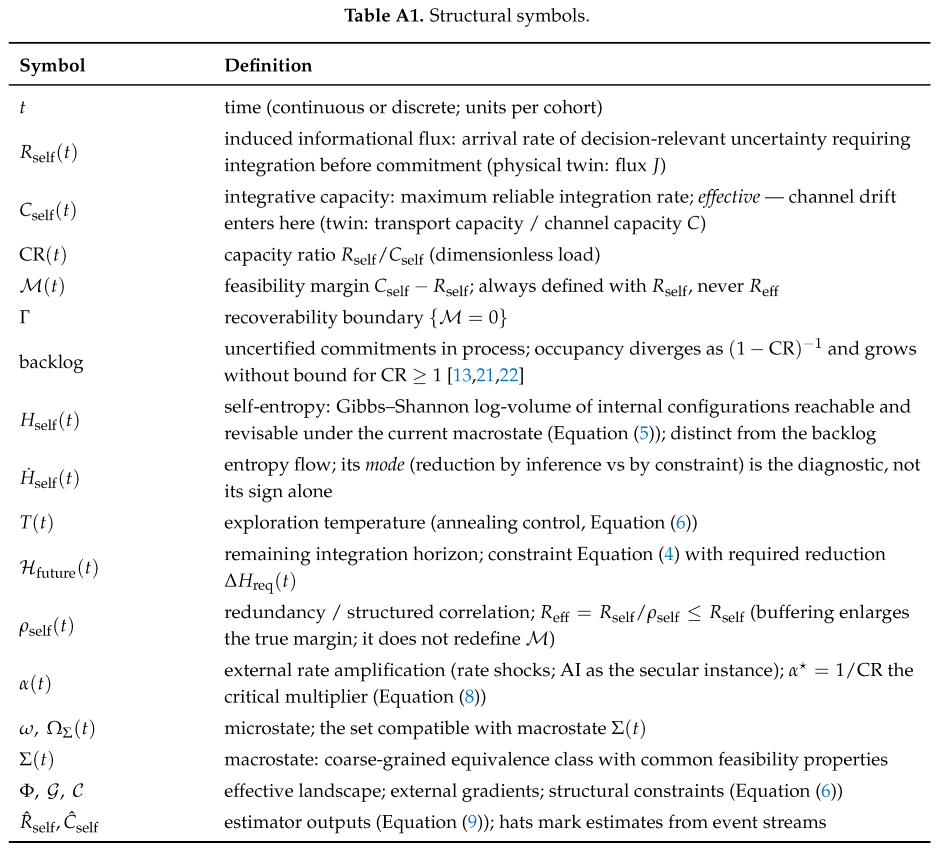
Table 1 collects the framework’s parameters; the full symbol canon, including channel-level quantities, is Appendix A.
3. The Parameters Are Measurable: Estimator and Verification
A structural framework earns its keep only if its parameters can be read from data without access to the system’s internal model. This section gives the estimator and verifies the construct on four open cohorts of increasing scale and realism. Everything reported here reproduces from the public repository [28]; no credentialed or restricted data are used.
3.1. The Excursion/Restore Estimator
Physiological homeostasis is a concrete self-decoder, and it exposes the required events directly. A monitored variable crossing outside its reference band is a candidate commitment—uncertainty injected into the system, which must now be resolved; its return in-range is a certification—the uncertainty integrated. Per unit, over a longitudinal record:
where system-busy time is the union of excursion intervals (censoring-aware: unresolved excursions extend to the end of the record and count no restoration). Then is estimated from rates, while the backlog occupancy — the mean number of variables simultaneously out of range — is estimated independently from interval overlap. Because the two estimates share no algebra, their agreement with the queueing law is a genuine test of the framework’s dynamical picture, not an identity [13]. Three properties matter for what follows: onsets require a fresh in-range → out-of-range crossing, so records that begin already deranged are left-censored rather than counted; the estimator needs only event times and reference bands, never diagnoses or content; and is dimensionless, so cohorts on different timescales (ambulatory years, ICU hours) are compared on the same axis.
3.2. Verification on Open Cohorts
Synthetic ambulatory records (construct check).
On Synthea synthetic electronic health records [29] — a thirteen-analyte panel, 1,898 units with sufficient longitudinal series — both rates are well-defined and non-degenerate across the population, and of units lie below the feasibility boundary (Wilson 95% CI ), a minority above it. The point is methodological: the flux, the capacity, and the margin are measurable from observable counts alone.
Real intensive-care physiology, small cohort (face validity).
The unchanged estimator applied to the openly licensed MIMIC-IV demonstration cohort [30,31] (100 ICU patients, real laboratory series, the database’s own per-assay reference bands) returns non-degenerate rates for 78 patients — and the populations separate exactly as the construct requires: only of the critically ill lie below the boundary (CI ; disjoint from the ambulatory interval), with median . Read structurally: critical illness is operation at the limit of one’s own restorative capacity, sustained only because an ICU supplies capacity exogenously — which is precisely what Section 2.3 says sustained requires.
Real intensive-care physiology at scale (verification).
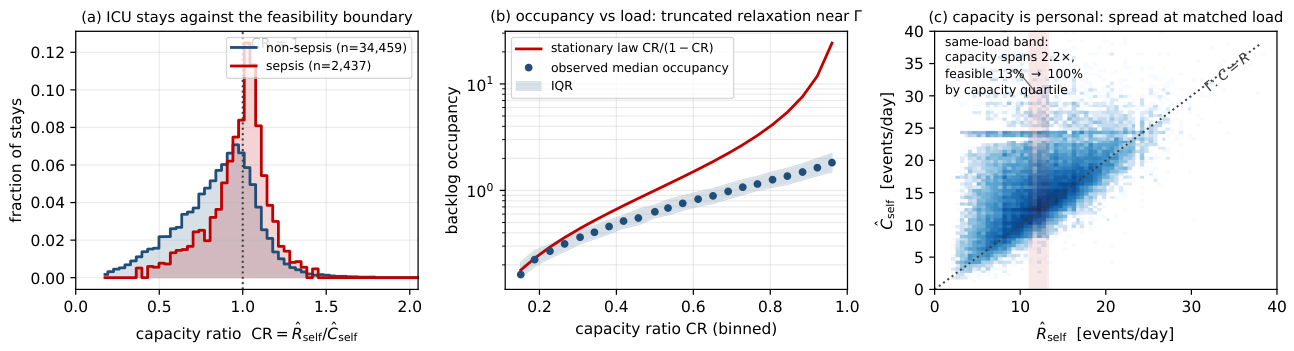
The scale-up cohort is the PhysioNet/CinC Challenge 2019 training set [32]: 36,896 of 40,336 ICU stays are placeable (91.5%), across two hospital systems (BIDMC and Emory), from hourly vitals and laboratory values under CC-BY license. Adaptations for the hourly setting (standard adult clinical reference intervals, since the dataset ships none; a two-hour observation floor) are documented in the public driver. Four results (Figure 2). (i) The general ICU population operates close to the boundary: median , with of stays feasible (CI ) — between the ambulatory cohort () and the sicker, lab-selected MIMIC demonstration cohort (), preserving the acuity ordering the construct requires. (ii) The two hospital systems replicate the picture independently (median vs ; feasible fractions vs ) — the qualitative structure is not an artifact of one system’s case mix or charting practice. (iii) Stays that develop sepsis sit measurably deeper into infeasibility than those that do not: median (the septic population centred on the boundary; feasible, CI ) against ( feasible, CI ) — disjoint intervals at vs — with rank AUC on and on backlog occupancy. This is the construct’s first outcome-labelled discrimination, and it is obtained without fitting anything: a single dimensionless structural quantity, estimated from unlabelled physiology, separates the deteriorating population. (iv) The parameters are personal, not population constants: both rates spread by a factor of ∼3.5 between the 5th and 95th percentiles of the cohort, and holding load fixed — arrival rates confined to the middle quintile, – onsets/day, — capacity still spans , so feasibility at matched load is decided by the patient’s own restoration rate: of that band is feasible in its lowest capacity quartile against in its upper half (Figure 2c). At matched load, stays that develop sepsis carry lower median capacity ( vs restorations/day) — deterioration is a restoration deficit, not merely an excess of disturbance.
Figure 1.
Measured and on the ambulatory synthetic cohort (∼1,900 units; homeostasis as the self-decoder). (a) Both rates are well-defined and non-degenerate across the population. (b) The margin is read off directly; most units lie in the recoverable region.
Figure 1.
Measured and on the ambulatory synthetic cohort (∼1,900 units; homeostasis as the self-decoder). (a) Both rates are well-defined and non-degenerate across the population. (b) The margin is read off directly; most units lie in the recoverable region.
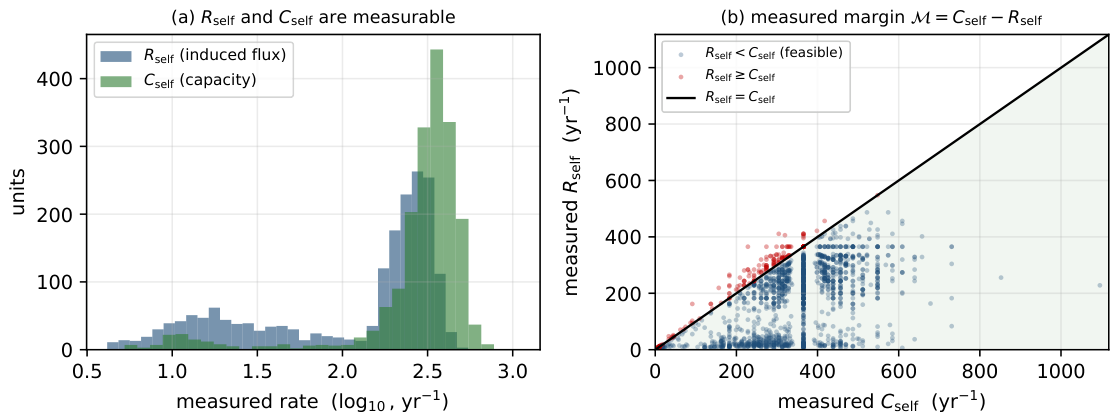
Figure 2.
Verification at scale: 36,896 ICU stays (PhysioNet/CinC 2019 [32]). (a) Capacity-ratio distributions against the feasibility boundary: the non-septic population peaks below ; the septic population piles up at the boundary (median ). (b) Median backlog occupancy per bin (IQR band) against the stationary law : agreement in the fast-relaxation regime and a progressive, expected shortfall near , where two-day stays cannot reach a stationary occupancy whose relaxation time diverges. (c) Per-stay density (events/day, logarithmic colour scale; lattice ridges reflect the hourly charting grid). Vertical spread at fixed R is personal capacity: within the shaded same-load band, capacity spans and feasibility runs from to across capacity quartiles.
Figure 2.
Verification at scale: 36,896 ICU stays (PhysioNet/CinC 2019 [32]). (a) Capacity-ratio distributions against the feasibility boundary: the non-septic population peaks below ; the septic population piles up at the boundary (median ). (b) Median backlog occupancy per bin (IQR band) against the stationary law : agreement in the fast-relaxation regime and a progressive, expected shortfall near , where two-day stays cannot reach a stationary occupancy whose relaxation time diverges. (c) Per-stay density (events/day, logarithmic colour scale; lattice ridges reflect the hourly charting grid). Vertical spread at fixed R is personal capacity: within the shaded same-load band, capacity spans and feasibility runs from to across capacity quartiles.
Robustness: a second multi-center ICU source, a different
outcome label.
The same estimator and band policy applied to the openly downloadable eICU demonstration cohort [33] (a third independent hospital network sample: 20 US hospitals; hourly-median vitals plus laboratory series; adaptations documented in the public driver) places 2,104 of 2,469 stays and reproduces the structure: median with feasible (CI ) — slotting into the acuity ordering between the CinC general-ICU population () and the lab-selected MIMIC demonstration cohort (). The outcome split replicates under a different label: stays ending in death in the unit sit at the boundary (median vs for survivors; vs feasible; rank AUC on , on backlog occupancy; vs ), again with nothing fitted.
3.3. Stationarity, and What the ICU Cohorts Do Not Test
ICU stays are short (median ∼2 days) and driven; the stationary queueing law relating backlog occupancy to is therefore reported here only as a binned consistency check (Figure 2b: monotone growth matching the law at low , truncated relaxation near the boundary), with the caveat that transient, externally supported operation near and above the boundary is exactly what an ICU is for. The clean stationary test belongs to long-horizon ambulatory records and is deferred; Section 4.1 identifies a directly countable whole-person occupancy — latent disease burden — as its natural instrument. Likewise, these cohorts verify measurability and the construct’s discriminative ordering; they do not yet test the early-warning predictor (margin trajectory → first-passage hazard), which is specified in [13] and requires labelled longitudinal outcomes.
3.4. Falsification
The framework is refuted on this evidence class if: (i) the estimator returns degenerate or unstable rates on well-sampled longitudinal records (it does not, on four cohorts spanning four orders of magnitude in timescale); (ii) populations known to differ in restorative capacity fail to separate on (ambulatory vs critical-care cohorts separate with disjoint confidence intervals); or (iii) systems with measured and rising show no growth in unintegrated backlog as . A fourth falsifier is behavioral: if accuracy and recoverability were found to degrade together at a common threshold rather than recoverability failing first, the framework’s central decoupling claim would fail [13].
4. Applications
Three applications show the same parameters doing different work: a measurement application in healthcare, a structural application to human agency under rate shocks, and an operational application to systems whose backlogs are directly countable. In each case the framework supplies the invariant; the domain supplies the events.
4.1. Healthcare: Capacity Monitoring from Routine Longitudinal Data
Section 3 established that a patient’s induced flux and integrative capacity are estimable from routinely collected laboratory and vital-sign series, with no model of disease and no protected content — only event times and reference bands. That turns the framework into a monitoring instrument.
What the gauge adds.
Clinical alarms are overwhelmingly level-based: a variable crosses a threshold and an alert fires. The RSC reading is rate–capacity-based: it asks whether disturbances are arriving faster than this patient’s own regulation restores them. The distinction matters exactly where alarms perform worst. A patient whose every individual variable is only mildly deranged may still be infeasible (: excursions accumulating faster than they resolve), while a patient with an alarming single value may be comfortably recoverable. The ICU cohorts make the point empirically: critical illness concentrates at , and patients who develop sepsis sit measurably deeper into infeasibility than those who do not (Section 3.2) — a discrimination obtained from unlabelled physiology, without fitting a predictive model.
The margin as the monitored quantity.
The clinically natural object is the margin trajectory : present distance to the boundary and its drift. Deterioration is margin erosion before any individual threshold is crossed; recovery is margin restoration even while individual values remain abnormal; and an ICU admission is, structurally, exogenous capacity injection — the system borrows C until its own restoration rate recovers. The margin-based first-passage predictor (specified in the companion proceedings paper [13]) is the formal version of this monitoring loop; fitting it against labelled deterioration outcomes on long-horizon records is the immediate next empirical step, and belongs to a dedicated clinical paper on credentialed cohorts.
The whole-person queue: latent disease burden as backlog.
The estimator of Section 3 reads the queue at the level of monitored variables; the same queue exists one level up, where the units are diseases. A latent condition is uncertainty that has arrived (onset) but has not been certified (detected, diagnosed, resolved): a person’s count of latent and active conditions is an uncertified-commitment backlog, countable in principle. Three predictions follow, offered here as predictions rather than results. (i) Under the stationary law, a measured burden B implies — a third estimator of the capacity ratio sharing no algebra with band-excursion rates (an ordering claim, not a precision one: it assumes near-stationary operation and exchangeable disease units). (ii) With capacity in secular decline (Section 2.7), multimorbidity accumulation with age should follow the boundary law: slow occupancy growth at low , sharp pile-up as , and roughly linear unbounded accumulation beyond — a testable curve shape against the documented age-concentration of multimorbidity [34], and the natural venue for the stationary test deferred in Section 3.3: long-horizon ambulatory records carry both panel-estimated rates and a countable disease-level occupancy. (iii) Screening — including blood-based multi-cancer early detection [35] — is exogenous certification capacity: it converts latent burden into certified, actionable state, and its value in this vocabulary is option-volume preservation, detection while the required commitments still sit on the reversible rungs of the ladder of Section 4.2. The same accounting prices overdiagnosis: certifying a condition that would never have bound spends certification capacity and injects a deliberative rate shock — the diagnosis shock of Section 4.2 — for no option gain. A screening programme is admissible exactly when the option volume it preserves exceeds the decision load it induces; staged confirmation funnels are the rate-control that tips this balance.
Scope.
Nothing here diagnoses, ranks, or replaces clinical judgment. The gauge reads one structural quantity — whether restoration is keeping pace with disturbance — and its value is precisely that it is agnostic to cause.
4.2. Rate Shocks: Agency Under Accelerating Workload
For a person or an organization, is bounded deliberative and validation bandwidth: attention, working memory, institutional review [19,20]. A rate shock is any episode in which the environment abruptly and durably multiplies the induced flux — the of Section 2.8 — while capacity, adapting on the slow timescales of learning, consolidation, and institutional change, stays put. The class is broad, and most of its members predate AI (Table 2): a serious diagnosis, bereavement, litigation, displacement, sudden success, immersion in a new environment. Two structural distinctions organize it. First, many life shocks are double hits: a cancer diagnosis floods the decision queue — treatment permutations with deadlines, second opinions, insurance, disclosure, work, fertility preservation — at the exact moment shock, fear, and sleep deprivation cut integrative capacity, so the margin collapses from both terms of Equation (1) at once; AI, by contrast, is a single-hit amplifier. Second, shocks differ in their horizon clock: what closes the window is disease progression in one case, a court calendar in another, a funeral date in a third — and wherever a clock runs, waiting is itself a commitment: an unanswered deadline defaults, an untreated tumor grows.
Recoverability, made operational.
Under a rate shock the scarce resource is certification capacity, and the framework’s triage question is a pair of costs: what does it cost to be wrong versus what does it cost to wait. Commitments sort into a ladder. Reversible: being wrong is cheap, because undoing restores the option set — a second opinion, a draft, a staged rollout. Recoverable at cost: being wrong is expensive but the option set survives — an asset sold at a loss, a settlement. Irreversible: the option set itself contracts at any price — an organ removed, fertility lost to gonadotoxic treatment without preservation, a disclosure made, a deadline waived, trust destroyed. The practical discipline is a two-by-two, irreversibility against deadline: spend capacity first on the irreversible-and-deadlined quadrant, batch and defer the reversible, and refuse false urgency — the misclassification of reversible decisions as deadlined ones, performed internally by fear and externally by sales pressure. Institutions that face routinely have learned to decide the shedding policy in advance — mass-casualty triage, incident command — because deciding how to shed load while overloaded is itself load.
Why a diagnosis must be delivered with care.
The deliverer of catastrophic news controls the recipient’s arrival rate at the very moment the recipient’s capacity is at its minimum — a rate-control responsibility, not merely an empathic one. Clinical practice has converged on the framework’s levers without its vocabulary: staged disclosure protocols such as SPIKES throttle [36]; written summaries and patient decision aids lower the cost of revisiting information and measurably reduce decisional conflict [37]; the sentence “nothing needs to be decided today” is horizon extension; a nurse navigator is exogenous capacity injection. The patient in this scene is two coupled self-decoders at once: Section 3 gauges the physiological one, whose restoration the ICU supports; here it is the deliberative one whose certification queue the care team can either flood or regulate.
Capacity is personal, and so is the process.
Nothing in Equation (1) is a population constant. The ICU cohort makes this measurable (Section 3.2, result (iv), and Figure 2c): holding the arrival rate fixed, personal capacity still spans , and feasibility at the same load runs from in the lowest capacity quartile to in the upper half. The same shock lands on different people as different geometry. Two stylized trajectories make the structural history behind that spread concrete. One — call her Marli — annealed early in a buffered, institutionally scaffolded environment: identity consolidated into a narrow basin, the margin runs thin though positive, and her dominant risk under a shock is brittleness: an abrupt crossing with little slack and an unexercised adaptation response. The other — call her Nduku — matured under chronic gradients where adaptation was a continuous requirement: redundant, partially overlapping roles keep effective capacity high and option mass distributed, at the price of chronic load; her risk is fatigue, not collapse. Neither is superior; they occupy different regions of the plane with different failure modes. That is why absorbing a rate shock is a personal process: the triage above must be run against one’s own margin — not a population norm — and the levers below tuned to whichever failure mode, brittle crossing or exhaustion, is actually approaching.
AI: the secular rate shock.
Episodic shocks end; AI is the member of the class whose ratchets — persistently, simultaneously, for individuals and institutions alike (Section 2.8). The arithmetic is unforgiving: a process certifying ten decisions a week against nine and a half arriving has wk−1; a five-percent rise in arrivals alone cuts the margin twenty-fold, to wk−1, with nothing about the quality of judgment changed.
The impossible calendar.
Consider a calendar that is perfectly optimized in the conventional sense: every commitment valuable, every task aligned, every choice locally rational. Embed it in a contemporary environment of messaging, notifications, and AI copilots generating drafts, options, and counterfactuals at high velocity, and let the induced arrival rate of decision-relevant commitments double while the horizon stays fixed. No refinement of values, discipline, or prioritization can restore coherence once : attention fragments, interference accumulates, and the calendar stops functioning as a control structure — not because it contains wrong commitments, but because it contains too many correct ones arriving too quickly to integrate. Assistance that raises without raising capacity or extending the horizon makes agency worse in the overload regime; this is a feasibility statement, not a value judgment about AI.
Where the felt experience sits in the geometry.
The framework relocates familiar experiences from character to geometry: the felt inability to keep up is ; acting on momentum is the growing backlog; losing the decision-to-outcome trace is the horizon constraint binding; burnout, churn, paralysis, and premature lock-in are the quench/overheat taxonomy of Section 2.6 (Appendix C tabulates the mapping). One distinction carries most of the practical weight: perceived irreversibility typically precedes structural irreversibility. Options feel gone — and the common response, locking something in early to escape the discomfort — is premature cooling, which shrinks option volume, suppresses the exploration that grows capacity, and thereby manufactures the very irreversibility it feared. The safest strategy under acceleration is not risk minimization but recoverable risk: exploration and staged commitment undertaken while , so that consolidation can convert it into capacity before the next rate shock arrives.
The levers.
Only three structural levers exist, and they act on different terms of Equation (1): reduce (batching, throttling, constraining option generation, limiting concurrent commitments); raise effective capacity (redundancy, staged and reversible commitments, consolidation time, tooling that compresses option space rather than multiplying it); and schedule (protected exploration when , regulated cooling before the horizon closes, reheating after failure instead of clamping down). These are controls on feasibility, not prescriptions about goals — the framework has nothing to say about which recoverable trajectory to choose.
4.3. Operational Systems: Backlogs You Can Count
In engineered and organizational settings the framework’s central object is often directly observable. A software repository is a self-decoder whose commitments are its issues: is the opening rate, the closing rate, and the open-issue backlog is the uncertified-commitment count itself — no proxy required. Public application-programming interfaces expose these streams for millions of repositories, and reading them provides an out-of-domain existence proof that the same gauge reads non-biological decoders (Figure 3). Across the most-starred public repositories with material issue traffic (138 placeable of the top 180; one-year window; aggregate counts only, collected via the public search interface), the population sits at the boundary: median , with only of repositories feasible. The reading is structural, not pejorative — stars select for arrival rate while capacity remains bounded maintainer attention, so popularity-selected repositories are load-selected systems, piling up at exactly as the acuity-selected ICU cohorts of Section 3.2 do. And here the backlog needs no estimator: the open-issue count is the uncertified-commitment count, directly observable, and it separates across the boundary as the queue picture requires — a median of months of work at current closing capacity on the feasible side against months at . The same template applies wherever certification is explicit: ticket queues, review pipelines, regulatory approvals, incident response. And it applies to AI systems themselves: an agentic pipeline that generates actions faster than they can be verified is a self-decoder operating at , and the companion physics paper shows that when its unverified outputs re-enter as load the feasibility transition becomes first-order — abrupt, hysteretic, and preceded by little warning [14]. Rate limits, verification gates, and staged autonomy are, in this reading, not policy preferences but the constraint of Equation (8) applied to machines.
Capacity dynamics, read from a decade of histories.
The same domain supplies decade-scale trajectories against which the long-timescale claims of Section 2.7 can be read. For fifty repositories drawn from the extremes of the Figure 3 snapshot (the 25 lowest- and 25 highest-CR), annual issue counts give a capacity trajectory and load ratio for every calendar year since creation — 316 repo-years (Figure 4). Two readings. Growth: normalizing each repository’s capacity to its own first-year value, the cohort median doubles by age four () and then plateaus — capacity is built, on a timescale of years, and saturates, the shape of Section 2.8. Stall: among the 25 repositories with enough load-bearing history to fit a growth rate, those spending more than the cohort-median share of their years infeasible grow capacity at roughly one-third the rate of the rest (median vs per year) — the direction Section 2.7 predicts, though at this sample size the association is suggestive rather than decisive (; rank correlation ), and the exceptions are themselves informative: the fastest-growing fully-saturated repositories are corporately resourced, which is what exogenous capacity injection predicts, though funding is not measured here. A decisive test wants a larger, funding-annotated sample and within-repository event studies around consolidation events (major releases); this first read establishes only that the growth and stall regimes are visible in decade-scale operational data.
5. A Worked Example: The Pipeline End to End
The framework’s objects have now been defined (Section 2), measured at cohort scale (Section 3), and applied (Section 4). This section assembles them into one continuous, reproducible demonstration — raw multi-source data in, gated decisions out — so that every abstraction in the paper is exercised concretely at least once. Figure 5 shows the pipeline; the complete implementation, with a committed stitch index that reproduces each journey exactly from re-pulled open data, is in the public repository [28] (exemplar/). One framing sentence governs everything below: a stitched synthetic-plus-real journey demonstrates the instrument; the evidence base remains the cohort results of Section 3.
5.1. The Journey Corpus: Stitching Sources with Disjoint Strengths
No single open source spans a whole care journey, so the exemplar builds its own corpus — the dataset is part of the method. Three open sources contribute disjoint strengths: a synthetic ambulatory cohort (Synthea 10k COVID-19 [29]: years of labs, encounters, admissions, and outcomes for 12,026 units, with dense charting around a scripted acute episode); real ICU physiology (the CinC-2019 stays of Section 3.2 [32]); and, for robustness, a second real ICU source (the openly downloadable demonstration subset of the eICU Collaborative Research Database [33]). Every source is harmonized to one event contract — (unit, t, var, value, lo, hi) — under the same band policy as Section 3, after which the estimator cannot tell the sources apart: that is the point of the gauge.
5.2. Microstate to Macrostate, Rendered on Data
Section 2.1 defined microstates and macrostates abstractly; monitored physiology makes the coarse-graining directly renderable (Figure 6). At each hour, the microstate is the panel state vector — which variables are in band, out of band, or not yet observed, under the estimator’s carry-forward convention. The backlog is its column sum: the number of variables simultaneously out of band, the uncertified-commitment occupancy of Section 2.3, counted rather than modelled. The macrostate is the same event stream coarse-grained to rate–capacity coordinates. The rendered stay (real, septic, terminal) shows the three levels agreeing: a backlog that holds at 8–18 variables and never drains, and a capacity ratio pinned at the boundary that climbs with the backlog in the final days. Fine-grained composition changes — which variables are deranged — while the macrostate coordinates barely move: that is coarse-graining doing its work.
5.3. The Dynamic Estimator and the Gates
The whole-record estimator of Equation (9) returns one number per segment; monitoring requires a trajectory. The exemplar’s dynamic layer is a conjugate Gamma–Poisson filter with exponential forgetting (half-life matched to the charting cadence: 14 days ambulatory, 12 hours in the ICU): discounted onset counts against discounted observation time give a Gamma posterior over , discounted restoration counts against discounted busy time give one over , and their ratio is a full posterior over — wide when evidence is scarce, tight when charting is dense. Priors are weakly informative and stated in the code; the filter restarts at care-level boundaries because absolute event rates change with charting intensity by an order of magnitude, while , being dimensionless, remains comparable across segments.
Gating is then one design rule: act on posterior tail probabilities, never on point estimates, so that sparse stretches — where the posterior is honestly wide — cannot fire a gate by accident. Three illustrative gates, fitted to nothing: G1 (escalate): — inject certification capacity (workup, screening); G2 (admit): sustained — inject external capacity (the ICU of Section 4.1); G3 (discharge): with non-negative margin drift — step down. These are the levers of Section 4.2 written as policy on the measured margin.
5.4. Two Journeys Through the Gates
Figure 7 shows two complete journeys. Each begins with a Synthea unit’s own ambulatory record, splices a real CinC-2019 ICU stay at the admission anchor (Synthea’s ground truth, never at a gate — so gate-versus-anchor lead time is a readout, not a construction), and, for the survivor, resumes the unit’s own post-episode record after ICU discharge. The ICU stays are matched on sepsis label and capacity-ratio band; the survivor’s stay is additionally required to end cold (trailing-day ), because — a dataset property worth recording — the challenge trimmed non-septic records mid-course, so an unconstrained match splices a stay that ends still-deranged.
The readouts: in both journeys the quiet baseline fires nothing (wide posterior, calibrated tails); deterioration drives through ; G1 and G2 fire within hours of the splice — capacity injection is visible as jumping an order of magnitude. In the deceased journey the margin never recovers and G3 correctly never fires. In the survivor journey G3 fires 8.7 days after admission — and it visibly waits out a transient post-discharge excursion before firing, the sustained-recovery condition doing exactly what Section 2.3 requires of a repelling boundary: single crossings are noise, occupation is signal.
5.5. The Personalization Pair, from Data
Finally, the personal-capacity claim of Section 2.7 and Section 4.2 at the level of individual trajectories: Figure 8 overlays two real stays selected from the same-load band of Figure 2c at opposite capacity quartiles — arrival rates within five percent of each other (11.6 vs 12.2 events/day), capacities of 11.1 vs 18.7 events/day. The thin-margin trajectory rides above the boundary for its entire stay; the high-reserve trajectory rides below it. This is the paper’s stylized Marli/Nduku contrast selected from data rather than invented, and it is the operational content of “capacity is personal”: the same disturbance stream, read through two different decoders, yields opposite feasibility verdicts — so gates must be run against a unit’s own measured margin, never a population norm.
5.6. What the Exemplar Does and Does Not Show
The exemplar shows that the full loop — harmonize, coarse-grain, estimate, gate, inject capacity, verify recovery — runs end to end on open data with no fitted component and no protected content, and that every object the paper defines has a concrete, renderable referent. It does not show clinical performance: journeys are stitched, gate thresholds are illustrative policy, and no parameter was tuned against an outcome. The evidence for the construct remains Section 3; the exemplar is the manual for wielding it.
6. Discussion
6.1. What the Framework Claims, and What It Does Not
RSC makes a small number of structural claims. Feasibility is governed by rate and capacity: recoverability requires and a satisfiable horizon constraint, and no optimization or effort compensates for their sustained violation. Irreversibility is structural, not moral or motivational: past the boundary, local invertibility is lost independent of intelligence, intent, or correctness. Entropy dynamics explain phenomenology, not feasibility: the mode of reduction (inference versus constraint) determines how failure feels and unfolds, while the rate–capacity geometry alone determines whether recovery remains possible. Perceived and actual irreversibility are distinct, and confusing them — cooling early because options feel gone — is itself a mechanism of feasibility loss. Capacity grows only through exploration–consolidation cycles conducted within feasibility.
Equally important is what the framework does not do. It does not prescribe actions, rank agents, or predict individual outcomes; multiple trajectories remain feasible and it is silent among them. It does not reduce experience to equations: entropy, rate, and capacity are structural abstractions about limits, not claims about worth or meaning (Appendix D makes the one claim it does support: meaning-like coherence is a byproduct of regulated, feasible entropy reduction and cannot be optimized directly). It does not eliminate failure — it distinguishes recoverable from terminal failure. And it does not override domain knowledge; it constrains how any domain account can behave under acceleration.
6.2. Why Existing Frameworks Miss This Failure Mode
Trait and self-regulation psychology attributes breakdown to insufficient grit or discipline, yet cognitive-load research shows lawful degradation once demand exceeds throughput regardless of motivation [38,39]; what these models omit is rate. Decision theory presumes quasi-stationary option sets and deliberation slow relative to change [40]; under high option turnover the optimization problem itself becomes ill-posed. Well-being frameworks optimize phenotypes (happiness, engagement) that Goodhart under acceleration: short-term proxies improve exactly by suppressing the exploration that preserves long-run feasibility [41,42]. And much AI alignment work optimizes objectives and values while implicitly assuming humans absorb arbitrarily rapid feedback; empirically, capability gains often raise cognitive load and compress decision latency instead [43,44,45]. In each case the missing element is the same: an explicit, rate-sensitive feasibility invariant. RSC supplies it, and Appendix B locates each of its commitments in an established structural tradition — the integration is new; the components are orthodox.
6.3. Limitations
Four limitations bound the present evidence. Stationarity: the ICU cohorts are short and driven; the stationary backlog law is checked only in binned form, and the clean test needs long-horizon records. Band dependence: the CinC estimates use standard clinical reference intervals because the dataset ships none; the qualitative findings are insensitive to defensible band choices, but absolute rates are not. Scalar formulation: multichannel systems can hide infeasibility in a saturating subchannel that aggregate summaries miss; the scalar constraint is conservative but not complete. Untested components: the early-warning predictor and the local-invertibility condition are specified but not yet fitted or exercised against labelled outcomes; the evidence here verifies measurability and discriminative ordering, not forecasting skill.
6.4. Future Work
Four extensions are live. Fitting the margin-trajectory predictor against labelled deterioration outcomes on long-horizon clinical records (the dedicated clinical study). The full field instrument for operational data — multi-domain estimators and ROC on GitHub- and Wikipedia-class event streams — developed in a companion special-issue paper. Multichannel (MIMO) recoverability, where correlation collapse can trigger rank-loss infeasibility invisible to scalar summaries. And optimal rate-shaping control: given the constraint, what schedule of deferral, escalation, and suppression maximally preserves recoverability — the control-theoretic question the framework makes well-posed.
7. Conclusions
Recoverable Self-Coding reframes agency as a feasibility property of adaptive decoding under acceleration. Its parameters are few — an induced flux, an integrative capacity, their ratio and margin, an option-volume entropy, an exploration temperature, a finite horizon — and, this paper has shown, they are measured quantities: estimable from open longitudinal event streams, stable across cohorts spanning four orders of magnitude in timescale, and discriminating between populations exactly as the construct requires, with the critically ill concentrated at the feasibility boundary at population scale. The framework’s structural claims — a strict rate–capacity constraint, a repelling recoverability boundary grounded in the certification-queue picture, a horizon condition, and annealing as the admissible dynamics — are carried with their grounding and their falsifiers stated, and the companion papers develop the queueing law, the early-warning predictor, and the nonequilibrium thermodynamics [13,14].
Under rate amplification — episodic in a diagnosis, a bereavement, a lawsuit; secular under AI — the binding constraint on human, organizational, and machine agency shifts from accuracy to recoverability — exactly as Shannon’s theorem shifted reliability from effort to the rate–capacity relation. What the framework offers is not advice but an instrument: measure the margin, watch its drift, keep exploration inside feasibility, and consolidate before the horizon closes. To live with acceleration is not to optimize harder; it is to remain recoverable enough to continue.
Author Contributions
Conceptualization, methodology, formal analysis, software, and writing: P.v.R.
Funding
This research received no external funding.
Institutional Review Board Statement
Not applicable: the study analyses only openly released, de-identified or synthetic data and involved no human subjects.
Informed Consent Statement
Not applicable.
Data Availability Statement
Code for all figures and reported estimates: the public project repository [28]. Data: synthetic electronic health records (Synthea, including the 10k COVID-19 cohort [29]); the MIMIC-IV Clinical Database Demo v2.2 [30,31] (ODbL, no credentialing); the PhysioNet/CinC Challenge 2019 training data [32] (CC-BY 4.0); and the eICU Collaborative Research Database Demo v2.0.1 [33] (open access, no credentialing). No credentialed or restricted data are used.
Acknowledgments
Generative AI tools were used to assist with drafting, editing, and figure code; all theoretical content, formulations, and conclusions were conceived, validated, and finalized by the author.
Conflicts of Interest
The author is an entrepreneur and inventor involved in the development of artificial intelligence and computational systems; these activities did not influence the analysis or conclusions presented in this work. The author declares no conflict of interest.
Appendix A. Symbol Canon
Symbols are defined structurally (rate–capacity feasibility, entropy, horizon, annealing), never phenomenologically. The canon below is shared with the companion papers [13,14]; where a symbol has a physical-channel twin the correspondence is noted inline. Recoverability is strict throughout: recoverable, not (the boundary belongs to the infeasible side).
Channel-level parameters.
Where capacity is resolved into channel terms (used qualitatively in Section 2.2), the standard set applies: bandwidth B (admitted degrees of freedom per unit time, entering capacity linearly), resolvability (entering logarithmically; reference AWGN form [5,6]), energy per distinction , alphabet size m (maximum per-symbol entropy ), and integration latency (which converts nominal capacity into horizon-limited usable capacity). Bandwidth-limited failure destroys distinctions at input and is non-recoverable; resolvability-limited degradation below capacity is recoverable through redundancy and time.
Regime vocabulary.
Fixed meanings, used throughout: overwhelm — high near (large unresolved option mass under rate pressure; recoverability may still hold); quench / brittle collapse — low near (entropy already collapsed; further forcing produces abrupt, typically non-recoverable failure); regulated reduction — interior regime, by inference within feasibility (the regime associated with durable commitment; Appendix D). Churn, fragmentation, burnout, and paralysis are downstream manifestations, not regimes, and never certify irreversibility (Appendix C).
Appendix B. Structural Traditions and Framework Comparison
RSC claims no novelty for its components; each is anchored in an orthodox structural tradition. The contribution is their explicit integration around recoverability under accelerating informational gradients, with parameters that are measured rather than posited.
Appendix C. Failure-Mode Atlas
The atlas maps surface phenomenology to structural condition. Two principles govern it. Structural primacy: every failure mode is a violated feasibility condition; psychological and behavioral labels are downstream signals, never explanatory variables, diagnoses, or clinical claims. Early diagnosability: most irreversible failures produce recognizable signals before recoverability is lost, so boundary-adjacent regimes matter as much as post-collapse states. None of the phenotypes below certifies irreversibility by itself; they indicate proximity, direction, or repeated interaction with the constraints of Section 2.
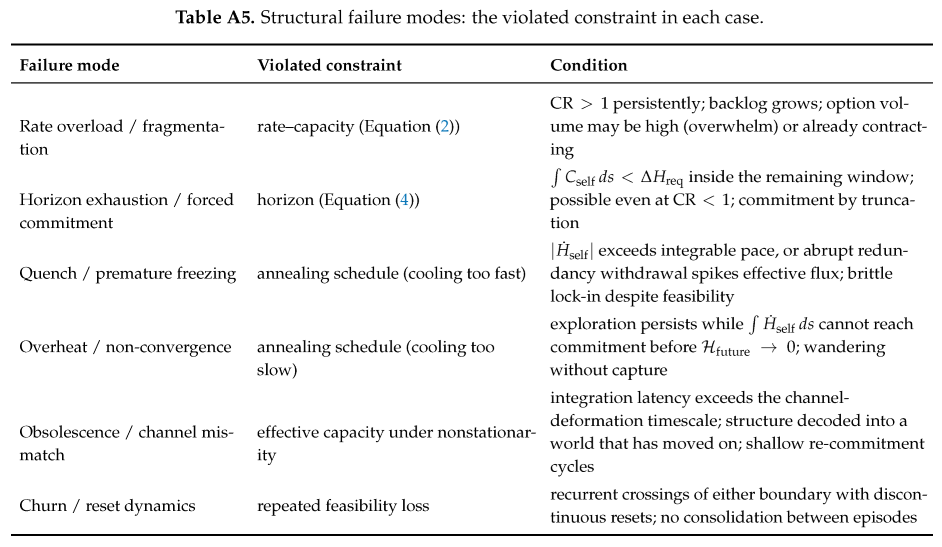
The unifying observation: the diversity of observed failure phenotypes is not evidence of many independent causes. All irreversible failures reduce to a small set of violated feasibility conditions — rate above capacity, horizon exhausted, cooling mistimed, or the channel deforming faster than decoding can track — approached along different trajectories.
Appendix D. Why Meaning Cannot Be Optimized
One point used in Section 6 deserves its own statement, because it is easily misread: within RSC, meaning is not an objective function. It is an emergent signal of regulated reduction — entropy decreasing by inference, within rate–capacity and horizon bounds, with irreversibility entered voluntarily rather than forced by overload or truncation. Meaning in this sense is a diagnostic of process viability, not a scalar reward.
Meaning is therefore not happiness (a valence state), satisfaction, certainty, norm compliance, or success; these may correlate with it in particular regimes but are distinct quantities, and a recurrent failure of blueprint worldviews is to select one of them as a proxy target and optimize it directly — inducing brittle, prematurely cooled configurations under nonstationary gradients. Frankl’s observation that meaning arises from engagement with responsibility and constraint rather than from comfort [55] has, in this framework, a structural reading: meaning tracks a process (feasible annealing), and processes of that kind are destroyed by the very act of optimizing for their signal.
The structural argument is short. Any scalar objective, used as a control target, creates pressure to accelerate convergence: suppress exploratory variance, collapse uncertainty quickly, harden commitments that raise the objective locally. But the conditions under which meaning-like coherence emerges are exactly the opposite: sufficient exploration (nonzero T and entropy support), progressive constraint, voluntary irreversibility, and feasibility throughout (, horizon open). Optimization pressure on the signal induces premature cooling — the quench failure of Section 2.6 — exactly as aggressive cooling schedules trap simulated annealing in brittle minima [25,56]. “Meaning maximization” is therefore generically self-defeating: it short-circuits the exploration–commitment dynamics that produce the signal being maximized.
The practical corollary matches the applications of Section 4: one does not pursue meaning directly; one regulates the annealing schedule — rate, redundancy, horizon, reversibility — and meaning may or may not emerge as a byproduct of commitments that remain feasible while they harden. Goals are local constructs; trajectories are the global objects, and meaning-bearing commitments are available only to systems that remain structurally viable long enough to hold them.
References
- Acemoglu, D.; Restrepo, P. Automation and New Tasks: How Technology Displaces and Reinstates Labor. J. Econ. Perspect. 2019, 33, 3–30. [Google Scholar] [CrossRef]
- Rasmussen, J. Risk management in a dynamic society: A modelling problem. Saf. Sci. 1997, 27, 183–213. [Google Scholar] [CrossRef]
- Perrow, C. Normal Accidents: Living with High-Risk Technologies; Basic Books, 1984. [Google Scholar]
- Reason, J. Human Error; Cambridge University Press: Cambridge, 1990. [Google Scholar]
- Shannon, C.E. A Mathematical Theory of Communication. Bell Syst. Tech. J. 1948, 27, 379–423. [Google Scholar] [CrossRef]
- Cover, T.M.; Thomas, J.A. Elements of Information Theory, 2nd ed.; Wiley-Interscience: Hoboken, NJ, USA, 2006. [Google Scholar]
- Wiener, N. Cybernetics: Or Control and Communication in the Animal and the Machine; MIT Press: Cambridge, MA, 1948. [Google Scholar]
- Ashby, W.R. An Introduction to Cybernetics; Chapman & Hall: London, 1956. [Google Scholar]
- Åström, K.J.; Murray, R.M. Feedback Systems: An Introduction for Scientists and Engineers; Princeton University Press: Princeton, NJ, 2008. [Google Scholar]
- Friston, K. The free-energy Principle: A Unified Brain Theory? Nat. Rev. Neurosci. 2010, 11, 127–138. [Google Scholar] [CrossRef] [PubMed]
- Gallager, R.G. Information Theory and Reliable Communication; John Wiley & Sons: New York, 1968. [Google Scholar]
- Aubin, J.P. Viability Theory; Birkhäuser: Boston, 1991. [Google Scholar] [CrossRef]
- van Rooyen, P. Entropy, Capacity, and the Continuity of Agency in Human–AI Systems: A Recoverable Self-Coding Account. In Proceedings of the Physical Sciences Forum (Proceedings of Entropy 2026), Submitted (manuscript psf-3705961). 2026. [Google Scholar]
- van Rooyen, P. First-Order Recoverability Collapse in Self-Referential Information Decoders. arXiv 2026, arXiv:cond. [Google Scholar] [CrossRef]
- Shu, W.; Wei, P. AI Safety as Control of Irreversibility: A Systems Framework for Decision-Energy and Sovereignty Boundaries, 2026. arXiv arXiv:cs.
- Gibbs, J.W. Elementary Principles in Statistical Mechanics: Developed with Especial Reference to the Rational Foundation of Thermodynamics; Charles Scribner’s Sons: New York, 1902. [Google Scholar]
- Jaynes, E.T. Information Theory and Statistical Mechanics. Phys. Rev. 1957, 106, 620–630. [Google Scholar] [CrossRef]
- Crutchfield, J.P.; Young, K. Inferring Statistical Complexity. Phys. Rev. Lett. 1989, 63, 105–108. [Google Scholar] [CrossRef]
- Simon, H.A. Designing Organizations for an Information-Rich World. In Computers, Communications, and the Public Interest; Greenberger, M., Ed.; Johns Hopkins University Press, 1971; pp. 37–72. [Google Scholar]
- Baddeley, A.D. Working Memory. Science 1992, 255, 556–559. [Google Scholar] [CrossRef] [PubMed]
- Loynes, R.M. The stability of a queue with non-independent inter-arrival and service times. Math. Proc. Camb. Philos. Soc. 1962, 58, 497–520. [Google Scholar] [CrossRef]
- Kingman, J.F.C. The single server queue in heavy traffic. Math. Proc. Camb. Philos. Soc. 1961, 57, 902–904. [Google Scholar] [CrossRef]
- Zwanzig, R. Memory Effects in Irreversible Thermodynamics. Phys. Rev. 1961, 124, 983–992. [Google Scholar] [CrossRef]
- Risken, H. The Fokker–Planck Equation: Methods of Solution and Applications, 2nd ed.; Springer Series in Synergetics; Springer: Berlin, Heidelberg, 1996; Vol. 18. [Google Scholar] [CrossRef]
- Kirkpatrick, S.; Gelatt, C.D.; Vecchi, M.P. Optimization by Simulated Annealing. Science 1983, 220, 671–680. [Google Scholar] [CrossRef] [PubMed]
- Geman, S.; Geman, D. Stochastic Relaxation, Gibbs Distributions, and the Bayesian Restoration of Images. IEEE Trans. Pattern Anal. Mach. Intell. 1984, PAMI-6, 721–741. [Google Scholar] [CrossRef] [PubMed]
- Borkar, V.S. Stochastic Approximation: A Dynamical Systems Viewpoint; Springer, 2008. [Google Scholar]
- van Rooyen, P. Recoverable Self-Coding: Figure-generation and analysis code. Software repository. 2026. Available online: https://github.com/Pietervr/recoverable-self-coding.
- Walonoski, J.; Kramer, M.; Nichols, J.; Quina, A.; Moesel, C.; Hall, D.; Duffett, C.; Dube, K.; Gallagher, T.; McLachlan, S. Synthea: An approach, method, and software mechanism for generating synthetic patients and the synthetic electronic health care record. J. Am. Med. Inform. Assoc. 2018, 25, 230–238. [Google Scholar] [CrossRef]
- Johnson, A.; Bulgarelli, L.; Pollard, T.; Horng, S.; Celi, L.A.; Mark, R. MIMIC-IV Clinical Database Demo (version 2.2). PhysioNet 2023. [Google Scholar] [CrossRef]
- Goldberger, A.L.; Amaral, L.A.N.; Glass, L.; Hausdorff, J.M.; Ivanov, P.C.; Mark, R.G.; Mietus, J.E.; Moody, G.B.; Peng, C.K.; Stanley, H.E. PhysioBank, PhysioToolkit, and PhysioNet: Components of a new research resource for complex physiologic signals. Circulation 2000, 101, e215–e220. [Google Scholar] [CrossRef] [PubMed]
- Reyna, M.A.; Josef, C.S.; Jeter, R.; Shashikumar, S.P.; Westover, M.B.; Nemati, S.; Clifford, G.D.; Sharma, A. Early Prediction of Sepsis From Clinical Data: The PhysioNet/Computing in Cardiology Challenge 2019. Crit. Care Med. 2020, 48, 210–217. [Google Scholar] [CrossRef]
- Pollard, T.J.; Johnson, A.E.W.; Raffa, J.D.; Celi, L.A.; Mark, R.G.; Badawi, O. The eICU Collaborative Research Database, a freely available multi-center database for critical care research. Sci. Data 2018, 5, 180178. [Google Scholar] [CrossRef]
- Barnett, K.; Mercer, S.W.; Norbury, M.; Watt, G.; Wyke, S.; Guthrie, B. Epidemiology of multimorbidity and implications for health care, research, and medical education: A cross-sectional study. The Lancet 2012, 380, 37–43. [Google Scholar] [CrossRef]
- Liu, M.; Oxnard, G.R.; Klein, E.A.; Swanton, C.; Seiden, M.V. Sensitive and specific multi-cancer detection and localization using methylation signatures in cell-free DNA. Ann. Oncol. 2020, 31, 745–759. [Google Scholar] [CrossRef]
- Baile, W.F.; Buckman, R.; Lenzi, R.; Glober, G.; Beale, E.A.; Kudelka, A.P. SPIKES—A Six-Step Protocol for Delivering Bad News: Application to the Patient with Cancer. The Oncologist 2000, 5, 302–311. [Google Scholar] [CrossRef]
- Stacey, D.; Lewis, K.B.; Smith, M.; et al. Decision aids for people facing health treatment or screening decisions. Cochrane Database Syst. Rev. 2024, 1, CD001431. [Google Scholar] [CrossRef] [PubMed]
- Sweller, J. Cognitive Load during Problem Solving: Effects on Learning. Cogn. Sci. 1988, 12, 257–285. [Google Scholar] [CrossRef] [PubMed]
- Eppler, M.J.; Mengis, J. The Concept of Information Overload: A Review of Literature from Organization Science, Accounting, Marketing, MIS, and Related Disciplines. Inf. Soc. 2004, 20, 325–344. [Google Scholar] [CrossRef]
- Simon, H.A. A Behavioral Model of Rational Choice. Q. J. Econ. 1955, 69, 99–118. [Google Scholar] [CrossRef]
- Goodhart, C.A.E. Problems of monetary management: The UK experience. In Papers in Monetary Economics; 1975. [Google Scholar]
- Manheim, D.; Garrabrant, S. Categorizing variants of Goodhart’s Law. arXiv 2019, arXiv:1803.04585. [Google Scholar]
- Bansal, G.; Nushi, B.; Kamar, E.; Weld, D.S.; Lasecki, W.S.; Horvitz, E. Updates in Human–AI Teams: Understanding and Addressing the Performance/Compatibility Tradeoff. Proc. AAAI Conf. Artif. Intell. 2019, Vol. 33, 2429–2437. [Google Scholar] [CrossRef]
- Amodei, D.; et al. Concrete problems in AI safety. arXiv 2016, arXiv:1606.06565. [Google Scholar]
- Russell, S. Human Compatible: Artificial Intelligence and the Problem of Control; Viking, 2019. [Google Scholar]
- Strogatz, S.H. Nonlinear Dynamics and Chaos; Westview Press: Reading, MA, 1994. [Google Scholar]
- Thom, R. Structural Stability and Morphogenesis; W. A. Benjamin: Reading, MA, 1975. [Google Scholar]
- Scheffer, M.; Bascompte, J.; Brock, W.A.; Brovkin, V.; Carpenter, S.R.; Dakos, V.; Held, H.; van Nes, E.H.; Rietkerk, M.; Sugihara, G. Early-warning signals for critical transitions. Nature 2009, 461, 53–59. [Google Scholar] [CrossRef] [PubMed]
- Kuehn, C. Multiple Time Scale Dynamics; Springer: Cham, 2015; Applied Mathematical Sciences; Vol. 191. [Google Scholar] [CrossRef]
- Arrow, K.J.; Fisher, A.C. Environmental Preservation, Uncertainty, and Irreversibility. Q. J. Econ. 1974, 88, 312–319. [Google Scholar] [CrossRef]
- Dixit, A.K.; Pindyck, R.S. Investment under Uncertainty; Princeton University Press: Princeton, NJ, 1994. [Google Scholar]
- Telatar, İ.E. Capacity of multi-antenna Gaussian Channels. Eur. Trans. Telecommun. 1999, 10, 585–595. [Google Scholar] [CrossRef]
- Worrall, J. Structural realism: The best of both worlds? Dialectica 1989, 43, 99–124. [Google Scholar] [CrossRef]
- Ladyman, J. What is structural realism? Stud. Hist. Philos. Sci. Part A 1998, 29, 409–424. [Google Scholar] [CrossRef]
- Frankl, V.E. Man’s Search for Meaning; Beacon Press: Boston, MA, 1959. [Google Scholar]
- Hajek, B. Cooling Schedules for Optimal Annealing. Math. Oper. Res. 1988, 13, 311–329. [Google Scholar] [CrossRef]
Figure 3.
The gauge on a non-biological decoder class: 138 of the 180 most-starred public software repositories with material issue traffic (one-year window ending August 2026; aggregate counts from the public search interface). (a) The population piles up at the feasibility boundary (median ; feasible) — popularity selects for arrival rate against bounded maintainer capacity. (b) The directly countable backlog separates across : open issues expressed as months of work at the current closing rate (median below the boundary vs at ).
Figure 3.
The gauge on a non-biological decoder class: 138 of the 180 most-starred public software repositories with material issue traffic (one-year window ending August 2026; aggregate counts from the public search interface). (a) The population piles up at the feasibility boundary (median ; feasible) — popularity selects for arrival rate against bounded maintainer capacity. (b) The directly countable backlog separates across : open issues expressed as months of work at the current closing rate (median below the boundary vs at ).
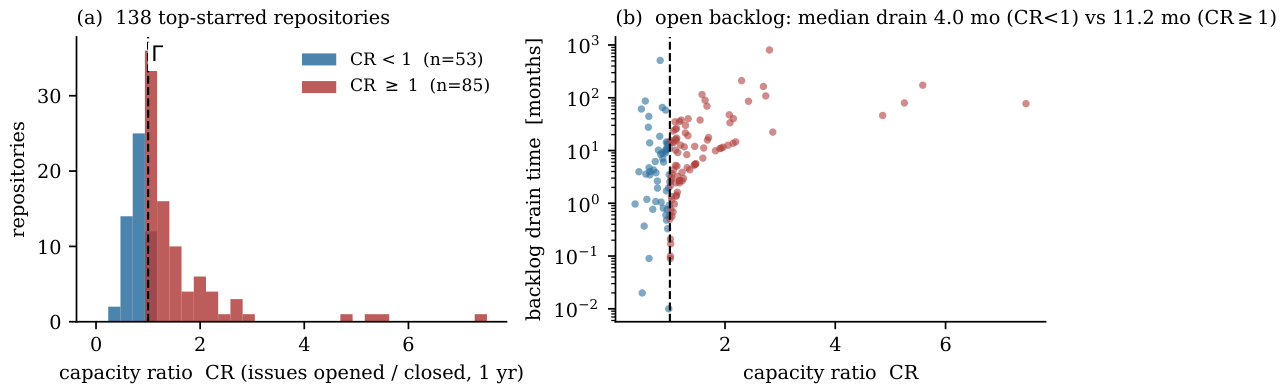
Figure 4.
Capacity dynamics over repository lifetimes (50 repositories, 316 repo-years of annual issue counts). (a) Annual closing capacity, normalized to each repository’s own early value: the cohort median doubles by age four, then plateaus. (b) Per-repository capacity growth rate against the share of load-bearing years spent at : the more-infeasible half grows at roughly one-third the median rate of the rest ( vs /yr; , suggestive rather than decisive).
Figure 4.
Capacity dynamics over repository lifetimes (50 repositories, 316 repo-years of annual issue counts). (a) Annual closing capacity, normalized to each repository’s own early value: the cohort median doubles by age four, then plateaus. (b) Per-repository capacity growth rate against the share of load-bearing years spent at : the more-infeasible half grows at roughly one-third the median rate of the rest ( vs /yr; , suggestive rather than decisive).
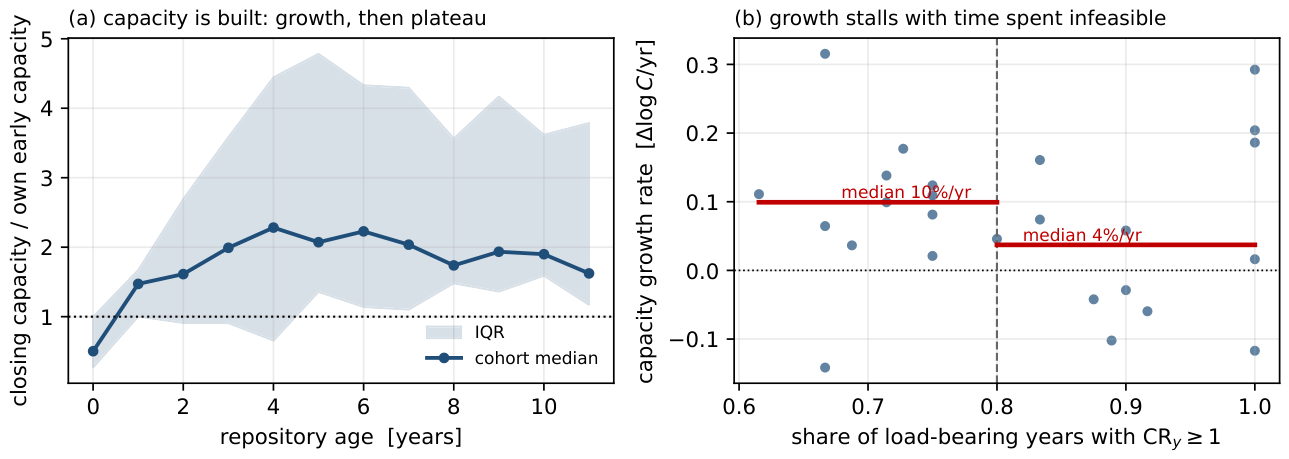
Figure 5.
The exemplar pipeline. Three open sources with disjoint strengths are harmonized to one event contract, coarse-grained from microstate to macrostate, estimated statically and dynamically, and gated on posterior tail probabilities; actions inject capacity that re-enters the stream. Every stage is a section of this paper made executable; the whole loop is reproducible from the public repository [28].
Figure 5.
The exemplar pipeline. Three open sources with disjoint strengths are harmonized to one event contract, coarse-grained from microstate to macrostate, estimated statically and dynamically, and gated on posterior tail probabilities; actions inject capacity that re-enters the stream. Every stage is a section of this paper made executable; the whole loop is reproducible from the public repository [28].
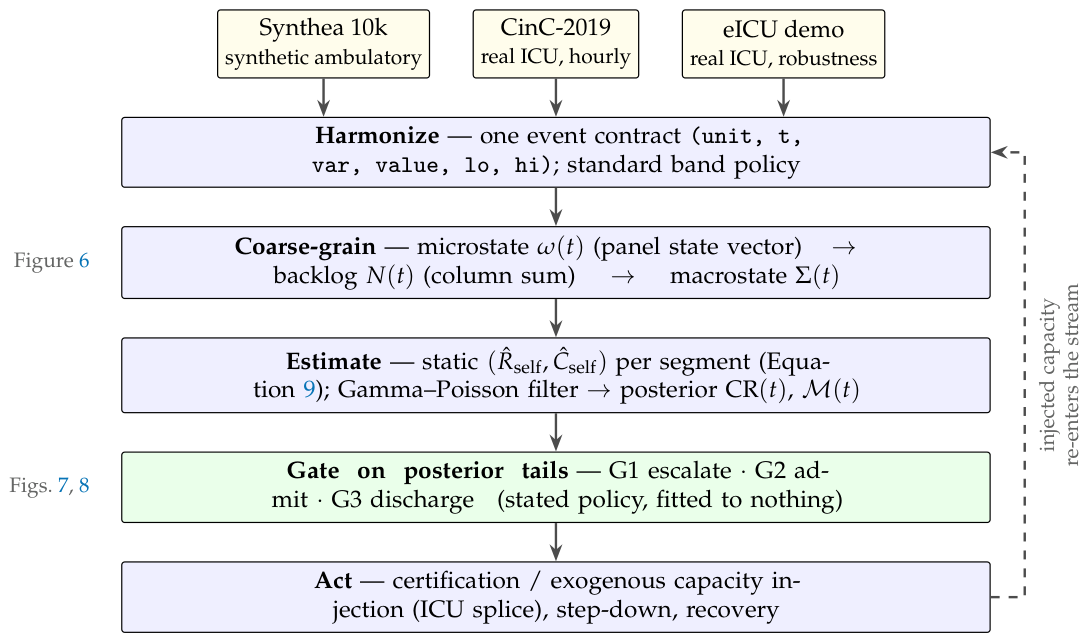
Figure 6.
The microstate → macrostate map on one real terminal ICU stay (CinC-2019), three levels of description on one clock. (a) Microstate: the hourly panel state vector (27 variables; white = not yet observed, blue = in band, red = out of band). (b) Backlog occupancy : the column sum of (a) — directly counted, no estimator. (c) Macrostate: the same events coarse-grained to the filtered capacity ratio (10–90% posterior band; 6 h filter burn-in omitted). The backlog never drains, stays pinned at , and both rise together in the final days.
Figure 6.
The microstate → macrostate map on one real terminal ICU stay (CinC-2019), three levels of description on one clock. (a) Microstate: the hourly panel state vector (27 variables; white = not yet observed, blue = in band, red = out of band). (b) Backlog occupancy : the column sum of (a) — directly counted, no estimator. (c) Macrostate: the same events coarse-grained to the filtered capacity ratio (10–90% posterior band; 6 h filter burn-in omitted). The backlog never drains, stays pinned at , and both rise together in the final days.
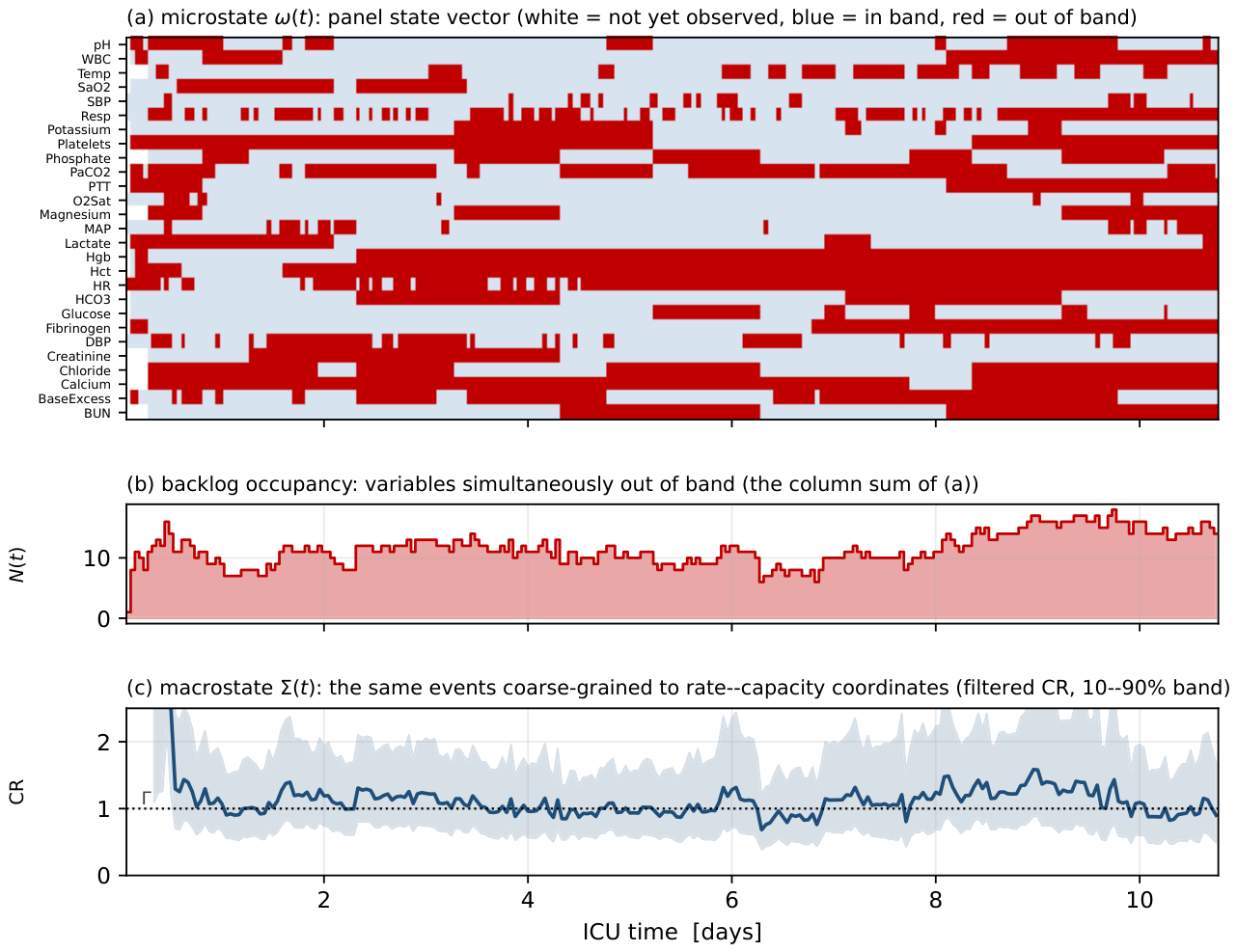
Figure 7.
Two stitched journeys through the gates (broken time axes; segment provenance shaded: synthetic Synthea segments in cream, the real CinC-2019 ICU stay in grey-blue). (a) Deceased journey: 10.8-day septic stay; G1/G2 fire within 4 h of the splice; G3 never fires; death at stay end. (b) Survivor journey: an end-cold non-septic stay; G3 discharges 8.7 d after admission, after waiting out a transient post-discharge excursion. One dimensionless axis serves segments whose absolute event rates differ by an order of magnitude.
Figure 7.
Two stitched journeys through the gates (broken time axes; segment provenance shaded: synthetic Synthea segments in cream, the real CinC-2019 ICU stay in grey-blue). (a) Deceased journey: 10.8-day septic stay; G1/G2 fire within 4 h of the splice; G3 never fires; death at stay end. (b) Survivor journey: an end-cold non-septic stay; G3 discharges 8.7 d after admission, after waiting out a transient post-discharge excursion. One dimensionless axis serves segments whose absolute event rates differ by an order of magnitude.
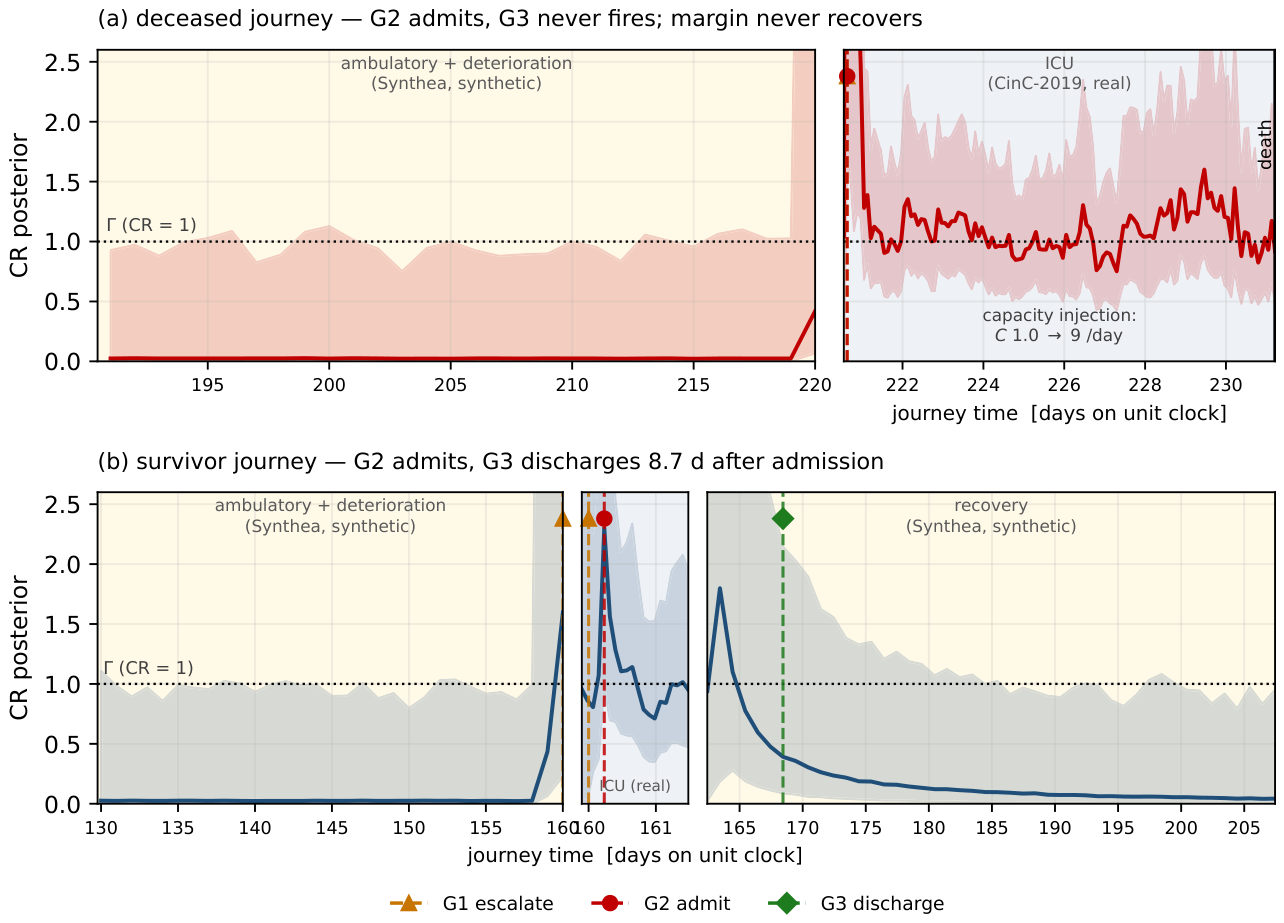
Figure 8.
The personalization pair: two real CinC-2019 stays at matched arrival rate (middle quintile of the cohort) from opposite capacity quartiles, filtered posteriors (medians, 10–90% bands). Same storm, different decoders: persistently opposite sides of .
Figure 8.
The personalization pair: two real CinC-2019 stays at matched arrival rate (middle quintile of the cohort) from opposite capacity quartiles, filtered posteriors (medians, 10–90% bands). Same storm, different decoders: persistently opposite sides of .
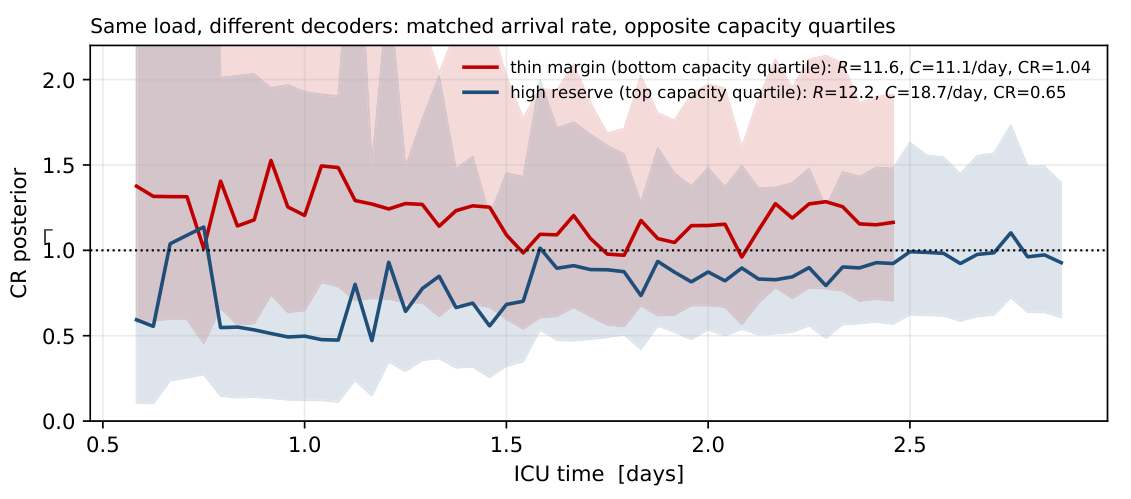

Table 1.
The RSC parameters. All are defined operationally; the first four are estimated from event streams in Section 3.
Table 1.
The RSC parameters. All are defined operationally; the first four are estimated from event streams in Section 3.
| Symbol | Name | Role |
|---|---|---|
| induced informational flux | arrival rate of uncertainty requiring integration before commitment | |
| integrative capacity | maximum reliable integration rate; effective (tracks channel drift) | |
| capacity ratio | dimensionless load; recoverable | |
| feasibility margin | distance to ; the early-warning coordinate | |
| backlog | uncertified commitments in process | grows without bound iff ; occupancy observable |
| self-entropy (option volume) | log-volume of reachable configurations; mode of its reduction (inference vs constraint) is the diagnostic | |
| exploration temperature | annealing control: breadth of microstate sampling | |
| integration horizon | window for Equation (4); truncation failure when exhausted | |
| redundancy | buffers effective flux, | |
| rate amplification | external multiplier on (rate shocks; AI secular); critical value |
Table 2.
Rate shocks share one mechanism — against slow-adapting capacity — and societies have independently evolved the same three levers for each: rate limiting, capacity injection, horizon extension.
Table 2.
Rate shocks share one mechanism — against slow-adapting capacity — and societies have independently evolved the same three levers for each: rate limiting, capacity injection, horizon extension.
| Shock | What multiplies | Horizon clock | Evolved levers |
|---|---|---|---|
| Serious diagnosis | treatment, disclosure, financial and family decisions arrive at once; capacity co-suppressed (double hit) | disease progression | staged disclosure [36], decision aids [37], navigators |
| Bereavement | estate, financial, custody decisions; grief cuts capacity (double hit) | statutory and funeral deadlines | executors; the “no major decisions” year |
| Litigation | filings, discovery, settlement decisions on an external clock | court calendar; waiver by default | counsel as rate filter and injected capacity |
| Sudden success | hiring, customers, capital, incidents compound; good news accelerates load identically | competitive window | staged scaling; explicit triage of commitments |
| New environment | every routine becomes a decision; the old codebook is invalid, so effective capacity collapses (channel drift) | none fixed; cumulative | onboarding structure, sponsors, cohorts |
| AI adoption | option generation, feedback, and commitment cadence accelerate — persistently, for everyone | none — the ratchet is secular | rate limits, verification gates (Section 4.3) |
Disclaimer/Publisher’s Note: The statements, opinions and data contained in all publications are solely those of the individual author(s) and contributor(s) and not of MDPI and/or the editor(s). MDPI and/or the editor(s) disclaim responsibility for any injury to people or property resulting from any ideas, methods, instructions or products referred to in the content. |
© 2026 by the author. Licensee MDPI, Basel, Switzerland. This article is an open access article distributed under the terms and conditions of the Creative Commons Attribution (CC BY) license.
Copyright: This open access article is published under a Creative Commons CC BY 4.0 license, which permit the free download, distribution, and reuse, provided that the author and preprint are cited in any reuse.