
Submitted:
08 January 2026
Posted:
09 January 2026
You are already at the latest version
Abstract
Background: Self-awareness is a core developmental competence that supports psy-chological adjustment, resilience, and adaptive functioning during late adolescence and emerging adulthood, a period characterized by identity exploration, academic demands, and increasing social responsibility. Strengthening domains such as self-esteem, stress management, emotional regulation, and positive thinking may re-duce vulnerability to psychosocial difficulties during this critical life stage. Methods: This study evaluated the effectiveness of the self-awareness module of UNICEF’s Basic Life Skills Training Program (BLSTP) using a randomized controlled design. Sixty Pa-kistani university students aged 18–24 years were randomly assigned to an experi-mental group or a waitlist control group. The intervention targeted four self-awareness subdomains through structured group sessions. Standardized measures were adminis-tered at pre-test, post-test, and follow-up. Data were analyzed using descriptive statis-tics, t-tests, chi-square tests, and repeated-measures ANOVA. Results: Compared to controls, participants in the experimental group showed significant improvements in self-esteem, stress management, emotional regulation, and positive thinking. Large ef-fect sizes were observed (partial η² = 0.46–0.84), and gains were maintained at fol-low-up, indicating sustained intervention effects. Conclusions: The BLSTP self-awareness module appears to be an effective and culturally appropriate preven-tive intervention for enhancing key psychosocial competencies in late adolescents and young adults. Its integration into educational and community-based youth programs may support resilience, adaptive coping, and psychosocial well-being among Pakistani adolescents and emerging adults.
Keywords:
self-awareness
; late adolescence
; emerging adulthood
; life skills education
; psychosocial development
1. Introduction
Basic Life Skills (BLS) are a set of psychosocial competencies and interpersonal skills that enable individuals to make informed decisions, solve problems, think critically and creatively, communicate effectively, build healthy relationships, empathize with others, and manage their lives (Unicef, 2002). During late adolescence and emerging adulthood, these competencies are particularly salient, as individuals face critical developmental tasks related to identity formation, increasing autonomy, and the consolidation of emotional and social functioning (Unicef, 2002; May, 2019). According to the World Health Organization. (1997), life skills represent abilities for adaptive and positive behavior that allow individuals to deal effectively with the demands and challenges of everyday life. Life skills education thus empowers young people to adapt to social, personal, and practical challenges (Unicef, 2019).
The Basic Life Skills Training Program (BLSTP), developed and promoted by UNICEF, is an evidence-based educational framework designed to equip children and young people with essential psychosocial and interpersonal competencies for effective functioning in daily life. Within a developmental perspective, the BLSTP is explicitly designed to support adolescents and emerging adults in navigating age-specific challenges, including emotional maturation, social role transitions, and increasing personal responsibility. Rooted in the definitions of WHO (1997) and (Unicef, 2002), the program emphasizes adaptive and positive behaviors that foster successful navigation of everyday demands. The UNICEF BLS model integrates three interrelated domains: self-awareness, involving recognition of one’s emotions, values, strengths, and limitations; interpersonal skills, including effective communication, empathy, and relationship-building; and decision-making or thinking skills, encompassing critical and creative thinking, problem-solving, and responsible decision-making. Through structured, participatory, and culturally adaptable training modules, the program empowers young people to make informed choices, enhance emotional well-being, and contribute positively to their families, workplaces, and communities. Furthermore, the BLS framework extends beyond formal education, being applicable in non-formal and community-based interventions that promote holistic youth development and resilience (Unicef, 2019).
By learning strategies for emotional management, decision-making, and interpersonal functioning, young individuals can successfully navigate the transition into adulthood (Donnellan & Mathews, 2021; May, 2019), fostering and acquiring / strengthening adaptive functioning. This transitional phase is increasingly conceptualized as a sensitive developmental window in which preventive interventions may have long-lasting effects on psychosocial adjustment.
While the BLSTP emphasizes the interconnected development of self-awareness, interpersonal skills, and decision-making, it is important to recognize that these competencies mutually reinforce one another and contribute collectively to adolescents’ growth. Interpersonal skills shape the quality of social interactions, and decision-making enables young people to navigate challenges and opportunities. Yet, self-awareness provides the underlying orientation that allows both relational and decisional processes to be effective: only by understanding one’s emotions, values, strengths, and limitations can individuals engage meaningfully with others and make choices that align with their goals and well-being. For this reason, the following section focuses specifically on self-awareness as the foundational dimension within this framework.
Self-awareness refers to the ability to identify and understand one’s thoughts and emotions, as well as their relation to the external world, thereby promoting empathy (Koo, 2022) and self-control (Kalinin & Edguer, 2023). From a developmental standpoint, self-awareness represents a core process through which adolescents and emerging adults integrate emotional experiences with a coherent sense of identity. It enhances interpersonal understanding and conflict resolution skills (Suarez Enciso et al., 2024). Although important across the lifespan, self-awareness is especially critical during young adulthood—a period characterized by identity exploration, new social responsibilities, and increased vulnerability to stress. It shapes emotional regulation, emotional intelligence, and social functioning (Farooq et al., 2024), supporting positive mental health outcomes (Pistella et al., 2023). Developing self-awareness at this stage promotes psychological adjustment and personal growth, addressing transitional vulnerabilities that, while not necessarily clinical, warrant timely intervention. Within the BLS framework, self-awareness includes four subdomains (May, 2019): self-esteem, stress management, emotional regulation and positive thinking.
Self-esteem refers to individuals’ evaluation of their worth and capabilities (Rosenberg, 1965b). High self-esteem fosters confidence, resilience, and effective stress management, while low self-esteem increases vulnerability to psychological distress and social maladaptation. Among young adults, low self-esteem is a major concern, with evidence showing its strong association with distress (Gidi et al., 2021) and perceived stress (Bodys-Cupak et al., 2022). Lower self-esteem levels are related to passivity (Rudy & Grusec, 2006); conversely, high self-esteem levels enhance problem-focused coping and reduce avoidance strategies (Banappagoudar et al., 2022; Yıldırım et al., 2017).
Stress management refers to an individual’s ability to recognize sources of stress, monitor their emotional and physiological responses, and apply adaptive strategies to regulate tension in challenging situations. Effective stress management is important because it protects cognitive functioning—such as attention, memory, and problem-solving—that is easily compromised under high stress (Giotakos, 2020). It is also positively associated with emotional well-being (Nakao et al., 2021), resilience (Kallianta et al., 2021), and healthier interpersonal relationships (Smith & Cundiff, 2024), as individuals who can regulate stress tend to communicate more constructively and respond less impulsively. Moreover, strong stress-management skills correlate with higher academic persistence (Baumgartner & Schneider, 2023) and better decision-making (Groombridge et al., 2019), as young people are more capable of evaluating options calmly rather than reacting out of pressure or anxiety.
Emotional regulation refers to the capacity to identify, understand, and modulate one’s emotional responses in ways that are appropriate to the context and supportive of desired outcomes (Lemay Jr et al., 2024; Preece et al., 2025). It involves both the ability to down-regulate intense negative emotions and to harness positive emotions to sustain motivation and engagement. Emotional regulation is essential because dysregulated emotions can interfere with learning, social interactions (Lemay Jr et al., 2024; Main et al., 2025), and decision-making (Lemay Jr et al., 2024), whereas effective regulation promotes psychological well-being (Madden & Reynolds, 2021), resilience, and social adaptability (Polizzi & Lynn, 2021). Strong emotional-regulation skills are associated with better conflict management, greater empathy (Thompson et al., 2022), and more stable interpersonal relationships (Lemay Jr et al., 2024), as individuals can respond thoughtfully rather than react impulsively. Additionally, emotional regulation supports long-term goal pursuit by helping young people maintain focus and composure when facing setbacks or uncertainty.
Positive thinking, defined as maintaining an optimistic outlook and reframing negative experiences constructively, reduces perceived stress (Barjoee et al., 2022) and enhances emotional regulation. Habitual negative thinking contributes to emotional dysregulation (Fisher et al., 2017). Cognitive restructuring, a key component of the BLS training, has been shown to reduce psychological symptoms (Santos et al., 2024). Developing positive thinking fosters resilience, adaptive coping, and well-being, supporting a healthier transition to adulthood.
The relevance of life skills education is particularly evident in developing countries, where young adults often face socio-economic hardship, limited access to mental health resources, and heightened psychosocial stress. In these contexts, structured life skills programs can enhance resilience, emotional regulation, and adaptive coping, contributing to improved educational, social, and occupational outcomes (Lesunyane et al., 2024; Sancassiani et al., 2015; Spalding, 2021). In Pakistan, young adults aged 18–24 experience a critical transitional phase marked by academic and career pressures, evolving social roles, and identity formation (Hussain, 2024; Shah et al., 2025). This age range largely overlaps with late adolescence and emerging adulthood, making it a particularly relevant period for developmental and preventive interventions. Building life skills—especially self-awareness—can equip this group with tools to recognize and manage emotions, reduce stress, maintain positive thinking, and cultivate self-esteem. These competencies are essential for managing early adulthood challenges and promoting long-term psychological well-being.
Despite the growing emphasis on youth mental health and skill-based education, empirical research on self-awareness as a psychosocial competency remains limited in the Pakistani context. Existing studies have largely focused on general well-being, academic performance, or stress, often overlooking the multidimensional construct of self-awareness and its subdomains—self-esteem, stress management, emotional regulation, and positive thinking—as defined in UNICEF’s Basic Life Skills framework. To the best of our knowledge, to date, only one present study is among the few in Pakistan to implement the Basic Life Skills Program in full accordance with UNICEF’s prescribed methodology. In contrast, prior studies (e.g., Farooq & Alyana, 2025) did not evaluate all domains or include follow-up measures. The current research adheres to the official manual’s procedures, focusing on the self-awareness domain (self-esteem, stress management, emotional regulation, and positive thinking), with pre–post and follow-up assessments and proper clinical trial registration.
Considering Pakistan’s predominantly young population and the cultural norms that shape emotional expression, identity development, and interpersonal behavior, investigating the self-awareness domain is particularly meaningful. Youth in collectivistic and family-oriented societies may experience unique challenges in articulating emotions, forming a stable sense of self, and navigating stress within hierarchical social structures (Batool & Gillani, 2008; Gul et al., 2025; Keshf & Nadeem, 2024; Wang et al., 2012). Understanding how these cultural dynamics intersect with self-awareness competencies is therefore essential for designing interventions that are developmentally and contextually appropriate.
Given the foundational importance of self-awareness in personal development, grounded in a developmental framework that views self-awareness as a key psychosocial task of late adolescence, the present study aims to evaluate the effectiveness of the self-awareness domain of the BLSTP in the Pakistani context. Self-awareness comprises four key subdomains—self-esteem, stress management, emotional regulation, and positive thinking—each contributing to individuals’ ability to understand internal states, make adaptive choices, and respond effectively to environmental demands. This study aims to generate preliminary evidence of the effectiveness and cultural applicability of the BLSTP self-awareness module among Pakistani young adults, forming an evidence-based foundation for future interventions.
Evaluating the effectiveness of the BLSTP, specifically its self-awareness component, among Pakistani young adults can provide culturally relevant and empirically grounded evidence for its use by educators, psychologists, and policymakers. Such evidence could inform future preventive and developmental interventions, promoting emotional resilience, adaptive coping, and psychosocial well-being among youth. Moreover, by establishing the psychometric soundness and contextual applicability of the program, this study aims to bridge a significant research gap and contribute to the global discourse on life skills education as a protective factor in emerging adulthood. Given these gaps, the present study conducted a randomized controlled trial to evaluate the effectiveness of the self-awareness module of the BLSTP on four core subdomains: self-esteem, stress management, emotional regulation, and positive thinking. In light of the significance of self-awareness for young adults’ psychosocial development and the limited empirical evidence in the Pakistani context, the present study formulated the following hypotheses to assess the effectiveness of the BLSTP in enhancing key subdomains of self-awareness:
- 1)
- Participants in the experimental group will show a significant increase in self-esteem after the application of the basic life skills training program BLSTP.
- 2)
- Participants in the experimental group will show a significant increase in stress-management skills after the application of the basic life skills training program BLSTP.
- 3)
- Participants in the experimental group will show a significant increase in emotional regulation after the application of the basic life skills training program BLSTP.
- 4)
- Participants in the experimental group will show a significant increase in positive thinking after the application of the basic life skills training program BLSTP.
2. Materials and Methods
2.1. Participants and Procedure
This study employed a true experimental research design, conducted from 5 August 2023 to 31 December 2023. The study was reviewed and approved by the Ethical Review Committee of Bahria University Lahore, Pakistan, ensuring full compliance with established ethical standards. Formal permissions were additionally obtained from the relevant Higher Education Institutions to collect data within their respective departments. Participants were recruited from educational institutions in Lahore and ranged in age from 18 to 24 years. Only individuals living in intact families and with no self-reported history of physical or psychological diagnoses were included, in order to reduce the potential influence of external stressors.
Initially, 100 students were approached and screened for eligibility. Participants scoring below 15 on the Rosenberg Self-Esteem Scale (see Measures section) were included, consistent with established cut-offs indicating low self-esteem in the original scoring framework. This criterion was used to focus the intervention on young adults presenting a psychosocial risk profile, given the well-documented association between self-esteem and emotional or affective dysregulation (Bajaj et al., 2016). The final sample comprised 60 young adults, who were randomly assigned to two homogeneous groups: an experimental group (n = 30) and a control group (n = 30), with an equal ratio of 1:1. To achieve this goal, a randomization schedule was generated using permuted block randomization so that each block contained a random assignment to each of the two groups.
All participants provided written informed consent outlining the nature and purpose of the research. The researcher assured participants that all personal information would remain confidential and be used exclusively for research purposes. Participants were informed that they were free to withdraw from the study at any stage without penalty. Pre-assessment scales were administered to both the experimental and control groups. During the study period, the experimental group received the intervention, whereas the control group received no intervention. Both groups were informed that they would take part in a program assessing different aspects of personal functioning; however, no details were provided regarding which program was expected to produce specific effects.
Participants in the experimental group were thoroughly debriefed on the study’s objectives, the importance of completing the assigned tasks, the nature of session activities, homework expectations, and the anticipated effectiveness of the intervention. After the study concluded, the control group participated in a group counseling session focused on self-awareness skills, and individual sessions were additionally made available upon request.
The intervention was implemented in accordance with the standardized procedures described in UNICEF’s BLSTP manual. The entire data collection process (pre-test, post-test, and follow-up) for both groups was completed across a three-month period, covering all four subdomains of self-awareness: self-esteem, stress management, emotional regulation, and positive thinking. For the experimental group, each session lasted 90 minutes. Two homogeneous sessions (each 90 minutes) were conducted for each subdomain. All sessions were facilitated by the same researcher to maintain procedural consistency and minimize potential researcher bias. The 30 participants in the experimental group were divided into two subgroups based on availability.
All materials required for the training were provided to participants, including a student workbook, manual, pencil, eraser, pen, and relevant assessment scales. Following completion of the BLSTP, all subdomain scales were re-administered as post-assessments to both experimental and control groups. Upon completion of the follow-up phase, all participants were thanked for their cooperation. No monetary or material compensation was provided for participation.
2.2. Measures and Questionnaires
2.2.1. The Rosenberg Self-Esteem Scale
This widely used 10-item scale measures global self-worth by assessing positive and negative self-perceptions (e.g., “On the whole, I am satisfied with myself”). The scale is unidimensional, with items rated on a 4-point Likert scale. Scores are computed continuously, with higher values reflecting greater self-esteem. Cronbach’s α in the current study = .83 (Rosenberg, 1965a).
2.2.2. The Coping Scale
The Coping Scale (Hamby et al., 2015): This 13-item scale assesses coping skills, specifically stress management, by evaluating cognitive, emotional, and behavioral strategies used to deal with problems (e.g., “When dealing with a problem, I spend time trying to understand what happened”). Items are rated on a 4-point scale: 1 = not true about me, 2 = true about me, 3 = somewhat true about me, 4 = mostly true about me. Total scores are calculated as the sum or mean of all items, with higher scores reflecting stronger coping skills. In the current study, Cronbach’s α = .71.
2.2.3. The Emotional Regulation Scale
The Emotional Regulation Scale (Gross & John, 2003): This 10-item scale measures individuals’ tendencies to regulate emotions through cognitive reappraisal and expressive suppression. Cognitive reappraisal (e.g., “When I want to feel more positive emotion such as joy or amusement, I change what I’m thinking about”) involves altering the trajectory of an emotional response before it is fully generated. Expressive suppression (e.g., “I keep my emotions to myself”) refers to inhibiting emotional expression in social interactions, which can impede communication and increase stress. Items are rated on a 7-point Likert scale from 1 (strongly disagree) to 7 (strongly agree). Cronbach’s α in the current study = .87.
2.2.4. The Positive Thinking Scale
The Positive Thinking Scale (Diener et al., 2010): This 22-item scale evaluates patterns of positive and negative thinking about oneself, others, and the surrounding world. Eleven items assess positive thoughts (e.g., “I see much beauty around me”), and eleven assess negative thoughts (e.g., “I see my community as a place full of problems”). Negative items are reverse-scored, and total scores are computed by summing all items, with higher scores indicating more positive thinking. In the current study, Cronbach’s α = .77.
2.4. Statistical Analysis
Descriptive statistics (Mean &SD) were used to calculate sample demographic characteristics. We used the t-test and chi-square test of the scales used at the baseline assessment stage to make the group matchable and comparable on the variables of concern. After the conclusion of the trial, repeated measures ANOVA was used to investigate the differences between groups, time, and group x time interaction. Frequency distribution statistics were also used to find out the subdomains of self-awareness after treatment. An alpha of 0.05 was used for all analyses using IBM SPSS Statistics (Version 26).
3. Results
Recruitment attrition rate: 100 participants were initially assessed for eligibility, of which 40% were excluded. The remaining 60 participants were randomly allocated to the experimental (n=30) or control (n=30) group, maintaining a 1:1 ratio. Dropout rates were 1.67% in the experimental group and 5% in the control group. Mean age was 20.10 ± 1.53 in the experimental group and 19.53 ± 1.88 in the control group. Baseline characteristics did not differ significantly between groups (p > .05), indicating comparability (see Table 1 and Figure 1).
An independent sample t-test was applied on the demographic variable of age, and a chi-square test was used on the variables of gender, semesters, birth order, family system, fathers’ education, and mothers’ education. Results showed that both groups (experimental and waitlist control group) are homogeneous, revealing no significant differences in demographic variables
In the experimental group (Table 2), mean self-esteem scores increased from pre-test (24.50) to post-test (32.73) and follow-up (33.83). In contrast, the waitlist control group showed no meaningful change across pre-test (24.33), post-test (25.16), and follow-up (24.46) assessments (see Figure 2). The effects of time (F = 168.60, p < .001), group (F = 70.74), and the time × group interaction (F = 61.51, p < .001) were all significant. Partial η² indicated that 68% of the variance was explained by the intervention over time (see Table 2), demonstrating that the BLSTP produced a substantial improvement in self-esteem.
A similar pattern emerged for stress management. The experimental group showed marked increases from pre-test (27.16) to post-test (43.60) and follow-up (42.00), whereas the waitlist control group again showed no significant changes—pre-test (28.56), post-test (29.93), and follow-up (29.86) (see Figure 3). Time, group, and time × group effects were all significant (p < .001). Partial η² indicated that 84% of the variance was accounted for by the intervention (see Table 2), reflecting a large effect size. These findings suggest that the BLST program substantially enhanced stress-management skills among young adults.
Emotional regulation, comprising cognitive reappraisal and expressive suppression, also showed significant improvements following the intervention. Cognitive reappraisal scores increased in the experimental group from pre-test (M = 23.56) to post-test (M = 33.80) and follow-up (M = 31.30), while the control group demonstrated no meaningful change—pre-test (M = 22.50), post-test (M = 21.60), and follow-up (M = 21.26) (see Figure 4). All effects (time, group, and time × group) were significant (p < .001), with partial η² indicating that 66% of the variance was explained by the intervention (see Table 2). Expressive suppression decreased as expected in the experimental group—pre-test (M = 20.93), post-test (M = 19.90), and follow-up (M = 10.70)—whereas the control group again showed no significant change—pre-test (M = 21.16), post-test (M = 19.90), and follow-up (M = 21.20) (see Figure 5). Time, group, and time × group effects were all significant (p < .001), and partial η² indicated that 83% of the variance was explained (see Table 2).
Finally, positive thinking increased in the experimental group from pre-test (13.50) to post-test (18.86) and follow-up (18.30), while the waitlist control group showed stable scores—pre-test (13.20), post-test (13.13), and follow-up (13.63) (see Figure 6). Time, group, and time × group effects were significant (p < .001). Partial η² showed that 46% of the variance was explained by the intervention (see Table 2), indicating a substantial improvement in positive thinking.
4. Discussion
The present pilot study examined the effectiveness of UNICEF’s BLSTP in enhancing self-awareness among young adults in Pakistan, focusing on four core subdomains: self-esteem, stress management, emotional regulation, and positive thinking. Findings demonstrated substantial improvements across all domains, with the intervention explaining 46–84% of the variance in outcomes over time. These effects were maintained at follow-up, indicating that BLSTP promotes durable gains in socio-emotional functioning. The results align with prior evidence suggesting that life-skills education fosters adaptive psychological competencies in youth (Surendran et al., 2023). From a developmental perspective, these findings are particularly relevant for late adolescence and emerging adulthood, a period characterized by heightened neurobiological plasticity and consolidation of psychosocial competencies.
Interpreting these findings requires consideration of the cultural context. In collectivistic societies such as Pakistan, self-perception is deeply embedded in interpersonal expectations, social approval, and familial norms. While such environments provide cohesion, they can also heighten vulnerabilities in self-awareness, as individuals may prioritize external expectations over personal needs (Becker et al., 2014). As a result, young adults may oscillate between compliance and internal conflict, potentially increasing susceptibility to anxiety, withdrawal, aggression, and distorted self-evaluations. Consistent with previous research (Cathlin & Salim, 2024; Qian et al., 2022), results from the present study show that the BLSTP framework can effectively address these challenges by introducing psychoeducation on the concept of balanced self-awareness as an instrument that encourages individuals to recognize and connect with personal self-perception and overall well-being.
As regards self-esteem, the results confirmed H1, showing a clear and lasting increase in participants’ self-worth following the intervention. This suggests that BLSTP’s reflective and awareness-based activities effectively supported the development of a more balanced and internalized sense of identity. In Pakistan’s collectivistic society — where self-perception is often shaped by family expectations and social evaluation — young adults may be particularly vulnerable to self-criticism and fluctuating self-esteem, especially during adolescence and emerging adulthood, when identity formation is negotiated within family and community systems. Strengthening self-esteem at this developmental stage therefore represents a culturally relevant protective factor, reducing emotional vulnerability and promoting healthier long-term adjustment. Self-esteem functions as a core component of identity consolidation, influencing motivation, autonomy, and social competence across the transition from adolescence to adulthood.
As regards stress management, findings confirmed H2, with substantial and sustained improvements in participants’ coping skills. Pakistani young adults frequently experience academic burden, job-market uncertainty, and limited access to mental-health services, making adaptive stress management particularly crucial. The BLSTP’s focus on recognizing stress triggers, applying problem-solving strategies, and practicing mindfulness appears to have enhanced participants’ ability to regulate tension and maintain cognitive clarity. Given that stress regulation capacities are still developing during late adolescence and emerging adulthood, interventions targeting these skills may yield long-term benefits for emotional and academic trajectories, supporting academic persistence, healthier interpersonal functioning, and reduced reliance on maladaptive coping strategies (Flórez-Rodríguez & Sánchez-Aragón, 2020; O'Connor et al., 2021). Results are consistent with established research showing that mindfulness practices play a central role in reducing stress reactions (Ghasemi et al., 2024), cognitive and behavioral flexibility to changing demands (Borjalilu, 2023; Jia et al., 2025).
As regards emotional regulation, results confirmed H3, showing increases in cognitive reappraisal and decreases in expressive suppression. Suppression is common in collectivistic contexts, where emotional restraint is often encouraged to maintain harmony and respect relational hierarchies. While culturally normative, excessive suppression may impair communication and heighten stress. By promoting emotional awareness and teaching strategies for reframing emotional responses, the intervention helped participants adopt healthier regulatory styles that remain compatible with cultural expectations while supporting psychological well-being. Improved emotional regulation may facilitate conflict resolution, enhance social adaptation, and strengthen resilience during emerging adulthood (Bird et al., 2023; Wang Haibin et al., 2016; Muda & Arsini, 2025; Thompson et al., 2019).
Finally, as regards positive thinking, findings confirmed H4, indicating significant improvements in participants’ ability to adopt more constructive cognitive patterns. Results align with cognitive-behavioral principles and substantial evidence showing that practice in positive self-talk and training to identify common cognitive distortions are useful in replacing maladaptive thoughts with more balanced interpretations and positive affect (Diachkova et al., 2024). Such skills are known to strengthen the ability to reinterpret challenges more constructively (Mercan et al., 2023; Walsh et al., 2017). Young adults in Pakistan often face socio-economic constraints and uncertainty about future opportunities, which can reinforce pessimistic thinking. Through activities focused on identifying negative automatic thoughts, practicing cognitive restructuring, and engaging in positive self-talk, the BLSTP appears to be a useful tool to buffer the impact of contextual stressors and support adaptive future orientation, fostering a more optimistic and hopeful mindset. From a developmental prevention standpoint, cultivating positive thinking is a relevant aspect during adolescence, especially in developing contexts, as it enhances resilience, reduces vulnerability to emotional distress, and supports long-term psychosocial adjustment.
Overall, the BLSTP showed strong cultural applicability and developmental relevance for Pakistani young adults. By equipping participants with practical tools for self-awareness and adaptive functioning, the program may contribute to improved individual well-being and broader community resilience, particularly in a collectivistic and resource-constrained context. These results support the inclusion of structured life-skills interventions within youth-focused preventive frameworks targeting adolescents and emerging adults.
The present study demonstrates several strengths. The intervention was implemented in strict accordance with UNICEF’s BLSTP, ensuring fidelity to an evidence-based and theoretically grounded framework. Conducted within a collectivistic Pakistani context, the study provides valuable insights into self-awareness development among youth whose identity, self-esteem, and emotional regulation are influenced by family, community, and social expectations. Unlike many prior studies, this research comprehensively assessed all four subdomains of self-awareness—self-esteem, stress management, emotional regulation, and positive thinking—using a randomized pre–post–follow-up design that allowed evaluation of both immediate and short-term sustained effects. Such methodological rigor enhances the relevance of the findings for developmental research focused on adolescence and emerging adulthood.
Nevertheless, several limitations should also be acknowledged. The sample size was relatively small and drawn exclusively from young adults enrolled in educational institutions in Lahore, limiting the generalizability of results. Future research should address these limitations by including larger and more diverse samples. The study employed a waitlist control rather than an active comparison group, limiting causal inferences about the intervention’s specific effects. Future studies should implement active control conditions in order to reduce this possible confounding effect. Moreover, some methodological factors may have contributed to the large effect sizes observed. The selection of participants with low baseline self-esteem raises the possibility of regression to the mean, and the exclusive use of self-report measures may have increased expectancy and social desirability effects. Future studies should recruit participants with a broader range of baseline characteristics to reduce the risk of regression to the mean and incorporate objective or multi-informant assessment methods to minimize expectancy and social desirability biases. Longitudinal designs extending further into adulthood would also be valuable to assess the persistence of developmental gains initiated during adolescence.
5. Conclusions
Overall, the findings indicate that the Basic Life Skills Training Program (BLSTP) represents a culturally relevant and psychologically robust intervention for enhancing self-awareness among young people in collectivistic settings. From a developmental perspective, these results are particularly salient for late adolescence and emerging adulthood, a critical phase characterized by identity consolidation, increasing autonomy, and heightened vulnerability to psychosocial stress. The structured, multi-component approach of the BLSTP appears to foster durable improvements in self-esteem, stress management, emotional regulation, and positive thinking—core capacities that underpin healthy psychosocial development and long-term well-being. Strengthening self-awareness during adolescence may contribute to more adaptive developmental trajectories by supporting emotional regulation, resilience, and constructive coping strategies, thereby reducing vulnerability to later mental health difficulties. The present findings highlight the potential value of implementing the BLSTP more broadly within schools, colleges, and community-based youth programs in Pakistan, where access to preventive mental health resources remains limited. Embedding structured life-skills education within youth-focused preventive frameworks may therefore represent a cost-effective and developmentally informed strategy for promoting psychosocial well-being in resource-constrained contexts. Scaling up such interventions could play a meaningful role in enhancing not only individual functioning but also broader community resilience and societal well-being among Pakistani youth. Future research should examine the differential contribution of specific self-awareness subdomains, explore potential moderating effects of gender and socioeconomic background, and investigate the long-term behavioral and psychosocial outcomes associated with early gains in self-awareness. In particular, longitudinal studies following adolescents into adulthood would be valuable for clarifying the persistence and developmental significance of the gains observed in the present study.
Author Contributions
Conceptualization, U.S., A.I, K.B.B, and L.F; Methodology, K. B. B. and L.F.; Data analysis, U.S., K.B.B; Investigation, A.I.; Supervision, L.F.; Writing – Original Draft: U.S., A.I. and L.F.; Writing— Review and Editing, U.S., K.B.B, and L.F. All authors have read and agreed to the published version of the manuscript.
Funding
This research received no external funding.
Institutional Review Board Statement
The study was conducted in accordance with APA and approved by the Ethics Committee of University Bahria University-Lahore [protocol code BULC/2023/384; date of approval 03-7-2023 and Randomized trial registration no. (Pre-Registration): TCTR20231006005 (https://www.thaiclinicaltrials.org/show/TCTR20231006005).
Informed Consent Statement
Informed consent was obtained from all subjects involved in the study.
Data Availability Statement
Data will be made available upon reasonable request to the corresponding author.
Conflicts of Interest
The authors declare no potential conflicts of interest with respect to the research, authorship, and publication of this article.
References
- Bajaj, B., R. Gupta, and N. Pande. 2016. Self-esteem mediates the relationship between mindfulness and well-being. Personality and Individual Differences 94: 96–100. [Google Scholar] [CrossRef]
- Banappagoudar, S., D. Ajetha, A. Parveen, S. Gomathi, S. Subashini, and P. Malhotra. 2022. Self-esteem of undergraduate nursing students: A cross-sectional study. International Journal of Special Education 37, 3: 4500–4510. [Google Scholar]
- Barjoee, L. K., N. Amini, M. Keykhosrovani, and A. Shafiabadi. 2022. Effectiveness of positive thinking training on perceived stress, metacognitive beliefs, and death anxiety in women with breast cancer: perceived stress in women with breast cancer. Archives of Breast Cancer, 195–203. [Google Scholar] [CrossRef]
- Batool, I., and N. P. Gillani. 2008. Identity development: An overview of adolescents. Pakistan Journal of Social and Clinical Psychology 6: 22. [Google Scholar]
- Baumgartner, P., N Jennifer, P. Schneider, and R. Tamera. 2023. A randomized controlled trial of mindfulness-based stress reduction on academic resilience and performance in college students. Journal of American College Health 71, 6: 1916–1925. [Google Scholar] [CrossRef] [PubMed]
- Becker, M., V. L. Vignoles, E. Owe, M. J. Easterbrook, R. Brown, P. B. Smith, M. H. Bond, C. Regalia, C. Manzi, and M. Brambilla. 2014. Cultural bases for self-evaluation: Seeing oneself positively in different cultural contexts. Personality and Social Psychology Bulletin 40, 5: 657–675. [Google Scholar] [CrossRef]
- Bird, G. A., M. L. Quinton, and J. Cumming. 2023. Promoting athlete mental health: The role of emotion regulation. Journal of Clinical Sport Psychology 17, 2: 112–130. [Google Scholar] [CrossRef]
- Bodys-Cupak, I., L. Ścisło, and M. Kózka. 2022. Psychosocial determinants of stress perceived among Polish nursing students during their education in clinical practice. International Journal of Environmental Research and Public Health 19, 6: 3410. [Google Scholar] [CrossRef]
- Borjalilu, S. 2023. The efficacy of the Persian version of the mindfulness-based stress management app (aramgar) for college’s mindfulness skills and perceived stress. International Journal of Islamic Educational Psychology 4, 1: 1–16. [Google Scholar] [CrossRef]
- Cathlin, C. A., and R. M. A. Salim. 2024. The effectiveness of a psychoeducation intervention program for enhancing self-esteem and empathy: A study of emerging adult college student. Jurnal Paedagogy 11, 3: 462–472. [Google Scholar] [CrossRef]
- Diachkova, O., L. Yeremenko, I. Donets, I. Klymenko, and A. Kononenko. 2024. Harnessing Positive Thinking: A Cognitive Behavioural Approach to Stress Management. International Journal of Religion 5, 9: 380–389. [Google Scholar] [CrossRef]
- Diener, E., D. Wirtz, W. Tov, C. Kim-Prieto, D.-w. Choi, S. Oishi, and R. Biswas-Diener. 2010. New well-being measures: Short scales to assess flourishing and positive and negative feelings. Social indicators research 97, 2: 143–156. [Google Scholar] [CrossRef]
- Do, L.-H. T., M.-H. T. Phan, P.-H. T. Nguyen, T. M. Pham, L. T. Luu, and T.-H. T. Hoang. 2025. Social Support and Mental Health in School Students: Parallel Mediation Effects of Self-Esteem and Mastery. [Google Scholar] [CrossRef]
- Donnellan, L., and E. S. Mathews. 2021. Service providers’ perspectives on life skills and deaf and hard of hearing students with and without additional disabilities: transitioning to independent living. European Journal of Special Needs Education 36, 4: 547–561. [Google Scholar] [CrossRef]
- Farooq, A., and S. I. Alyana. 2025. Efficacy of Basic Life Skills Training Program to Enhance Social Emotional Competence among Adolescent Students in Pakistan. International Research Journal of Arts, Humanities and Social Sciences 2, 02: 738–749, https://irjahss.com/index.php/ir/article/view/134. [Google Scholar]
- Farooq, R., M. Sarwar, and M. Arif. 2024. Meta-Analysis: Investigating the Emotional Intelligence among Undergraduate Students. Bulletin of Business and Economics (BBE) 13, 2: 1134–1138. [Google Scholar] [CrossRef] [PubMed]
- Fisher, N. R., B. R. Mead, P. Lattimore, and P. Malinowski. 2017. Dispositional mindfulness and reward motivated eating: The role of emotion regulation and mental habit. Appetite 118: 41–48. [Google Scholar] [CrossRef] [PubMed]
- Flórez-Rodríguez, Y. N., and R. Sánchez-Aragón. 2020. El estrés visto como reto o amenaza y la rumia. Factores de Riesgo a la Salud. Revista Salud y Administración 7, 20: 17–27. [Google Scholar]
- Ghasemi, F., D. Q. Beversdorf, and K. C. Herman. 2024. Stress and stress responses: A narrative literature review from physiological mechanisms to intervention approaches. Journal of Pacific Rim Psychology 18: 1–20. [Google Scholar] [CrossRef]
- Gidi, N. W., A. Horesa, H. Jarso, W. Tesfaye, G. T. Tucho, M. A. Siraneh, and J. Abafita. 2021. Prevalence of low self-esteem and mental distress among undergraduate medical students in Jimma University: a cross-sectional study. Ethiopian journal of health sciences 31, 3. [Google Scholar] [CrossRef]
- Giotakos, O. 2020. Neurobiology of emotional trauma. Psychiatriki 31, 2: 162–171. [Google Scholar] [CrossRef]
- González Moreno, A., and M. d. M. Molero Jurado. 2023. Healthy lifestyle in adolescence: Associations with stress, self-esteem and the roles of school violence. Healthcare 12, 1: 1–13. [Google Scholar] [CrossRef]
- Groombridge, C. J., Y. Kim, A. Maini, D. V. Smit, and M. C. Fitzgerald. 2019. Stress and decision-making in resuscitation: a systematic review. Resuscitation 144: 115–122. [Google Scholar] [CrossRef]
- Gross, J. J., and O. P. John. 2003. Emotion regulation questionnaire. Journal of personality and social psychology. [Google Scholar] [CrossRef]
- Gul, S., E. Ahmad, I. Ali, and N. Ahmad. 2025. Millennial Parenting and Generation Z Social Adjustment: A Comparative Study of Urban and Rural Contexts in Pakistan. Journal of Social Sciences Research & Policy 3, 04: 268–279. [Google Scholar]
- Hamby, S., J. Grych, and V. Banyard. 2015. Life paths measurement packet. In Sewanee, TN: Life Paths Research Program. [Google Scholar]
- Hussain, S. 2024. The Multifaceted Impact of Academic Pressure on the Mental Health and Well-being of University Students in Pakistan: Exploring the Interplay of Systemic Factors, Individual Vulnerabilities, and Coping Mechanisms. International Research Journal of Education and Innovation 5, 2: 8–14. [Google Scholar]
- Jia, L., C. Cai, and A. P. Rawal. 2025. Examining the Impact of Mindfulness on Academic Emotions and Cognitive Flexibility among Undergraduates in Chinese Higher Education. SAGE Open 15, 3: 1–21. [Google Scholar] [CrossRef]
- Kalinin, V., and N. Edguer. 2023. The Effects of Self-Control and Self-Awareness on Social Media Usage, Self-Esteem, and Affect. Eureka 8, 1. [Google Scholar] [CrossRef]
- Kallianta, M.-D. K., X. E. Katsira, A. K. Tsitsika, D. Vlachakis, G. Chrousos, C. Darviri, and F. Bacopoulou. 2021. Stress management intervention to enhance adolescent resilience: A randomized controlled trial. EMBnet. journal 26: e967. [Google Scholar] [CrossRef]
- Keshf, Z., and A. Nadeem. 2024. Money Matters: How Economic Demographics Shape Wellbeing of Young Adults in a Collectivistic Culture. Pakistan Journal of Professional Psychology: Research and Practice 15, 2: 12–27. [Google Scholar] [CrossRef]
- Koo, O.-H. 2022. Relationship between Self-esteem, Self-awareness, and Empathy of Nursing Students in Un-tact Era. Journal of Industrial Convergence 20, 12: 49–57. [Google Scholar] [CrossRef]
- Lemay, E. P., Jr., N. Teneva, and Z. Xiao. 2024. Interpersonal emotion regulation as a source of positive relationship perceptions: The role of emotion regulation dependence. Emotion 25, 2: 355–371. [Google Scholar] [CrossRef] [PubMed]
- Lesunyane, A., E. Ramano, K. v. Niekerk, K. Boshoff, and J. Dizon. 2024. Life skills programmes for university-based wellness support services for students in health sciences professions: a scoping review. BMC Medical Education 24, 1: 1418. [Google Scholar] [CrossRef]
- Madden, L., and R. Reynolds. 2021. The Process of Emotional Regulation. In The Science of Emotional Intelligence. [Google Scholar] [CrossRef]
- Main, A., S. T. Yung, Y. Chen, and M. J. Zawadzki. 2025. Predicting emotion regulation strategies from aspects of the social context in everyday life. Journal of Social and Personal Relationships 42, 2: 568–590. [Google Scholar] [CrossRef]
- May, M. 2019. Basic Life Skills Course Facilitator’s Manual. UNICEF. [Google Scholar]
- Mercan, N., M. Bulut, and Ç. Yüksel. 2023. Investigation of the relatedness of cognitive distortions with emotional expression, anxiety, and depression. Current Psychology 42, 3: 2176–2185. [Google Scholar] [CrossRef]
- Miranda, V. P., P. R. S. Amorim, R. R. Bastos, V. G. Souza, E. R. Faria, S. C. Franceschini, P. C. Teixeira, N. d. S. de Morais, and S. E. Priore. 2021. Body image disorders associated with lifestyle and body composition of female adolescents. Public health nutrition 24, 1: 95–105. [Google Scholar] [CrossRef]
- Muda, S. N., and Y. Arsini. 2025. Application of Group Counselling With the Cognitive Reappraisal Technique to Enhance Empathy Among Students. Urwatul Wutsqo: Jurnal Studi Kependidikan dan Keislaman 14, 1: 430–448. [Google Scholar] [CrossRef]
- Nakao, M., K. Shirotsuki, and N. Sugaya. 2021. Cognitive–behavioral therapy for management of mental health and stress-related disorders: Recent advances in techniques and technologies. BioPsychoSocial medicine 15, 1: 16. [Google Scholar] [CrossRef]
- Natasya, M., S. Suryati, and M. Muzaiyanah. 2023. Konseling Individu dengan Teknik Self Talk Untuk Menumbuhkan Self Acceptence pada Penyandang Disabilitas Fisik di Sentra Budi Perkasa Palembang. Social Science and Contemporary Issues Journal 1, 2: 367–376. [Google Scholar] [CrossRef]
- O'Connor, D. B., J. F. Thayer, and K. Vedhara. 2021. Stress and health: A review of psychobiological processes. Annual review of psychology 72, 1: 663–688. [Google Scholar] [CrossRef] [PubMed]
- Organization, W. H. 1997. Life skills in schools. Division of Mental Health. Available online: http://apps.who.int/iris/bitstream/handle/10665/63552/WHO_MNH_PSF_93.7ARev.2.pdf.
- Pistella, J., F. Rosati, and R. Baiocco. 2023. Feeling safe and content: Relationship to internalized sexual stigma, self-awareness, and identity uncertainty in Italian lesbian and bisexual women. Journal of lesbian studies 27, 1: 41–59. [Google Scholar] [CrossRef]
- Polizzi, C. P., and S. J. Lynn. 2021. Regulating emotionality to manage adversity: A systematic review of the relation between emotion regulation and psychological resilience. Cognitive Therapy and Research 45, 4: 577–597. [Google Scholar] [CrossRef]
- Preece, D. A., J. Ditzer, and J. J. Gross. 2025. Emotion Regulation. In Oxford Research Encyclopedia of Psychology. [Google Scholar] [CrossRef]
- Qian, Y., X. Yu, and F. Liu. 2022. Comparison of two approaches to enhance self-esteem and self-acceptance in Chinese college students: psychoeducational lecture vs. Group intervention. Frontiers in Psychology 13: 877737. [Google Scholar] [CrossRef]
- Rosenberg, M. 1965a. Rosenberg self-esteem scale. Journal of Religion and Health. [Google Scholar] [CrossRef]
- Rosenberg, M. 1965b. Society and the adolescent self-image, Princeton, NJ. Princeton Press. Russell, DW (1996). UCLA Loneliness Scale (Version 3): Reliability, Validity, and Factor Structure. Journal of Personality Assessment 66, 1: 20–40. [Google Scholar] [CrossRef]
- Rudy, D., and J. E. Grusec. 2006. Authoritarian parenting in individualist and collectivist groups: Associations with maternal emotion and cognition and children's self-esteem. Journal of family psychology 20, 1: 68. [Google Scholar] [CrossRef] [PubMed]
- Saeed, K. M., A. S. Ahmed, Z. M. Rahman, and N. A. Sleman. 2023. How social support predicts academic achievement among secondary students with special needs: the mediating role of self-esteem. Middle East Current Psychiatry 30, 1: 46. [Google Scholar] [CrossRef]
- Sancassiani, F., E. Pintus, A. Holte, P. Paulus, M. F. Moro, G. Cossu, M. C. Angermeyer, M. G. Carta, and J. Lindert. 2015. Enhancing the emotional and social skills of the youth to promote their wellbeing and positive development: a systematic review of universal school-based randomized controlled trials. Clinical practice and epidemiology in mental health: CP & EMH 11 Suppl 1 M2: 21. [Google Scholar] [CrossRef]
- Santos, B., L. Pinho, M. J. Nogueira, R. Pires, C. Sequeira, and P. Montesó-Curto. 2024. Cognitive restructuring during depressive symptoms: A scoping review. Healthcare.
- Shah, R., I. Sabir, and A. Zaka. 2025. Interdependence and waithood: Exploration of family dynamics and young adults' life course trajectories in Pakistan. Advances in life course research 63: 100660. [Google Scholar] [CrossRef]
- Shi, Y. 2022. Assessment of effect of perceived social support on school readiness, mental wellbeing, and self-esteem: mediating role of psychological resilience. Frontiers in Psychology 13: 911841. [Google Scholar] [CrossRef]
- Smith, T. W., and J. M. Cundiff. 2024. An Interpersonal Perspective on the Physiological Stress Response. In Integrating Psychotherapy and Psychophysiology: Theory, Assessment, and Practice. vol. 277. [Google Scholar] [CrossRef]
- Spalding, K. G. 2021. Enhancing occupational performance using the'LifeSkills' program: Evaluation of an occupation-based group in an inpatient rehabilitation setting. [Google Scholar] [CrossRef]
- Suarez Enciso, S., H. M. Yang, and G. Chacon Ugarte. 2024. Skills for Life Series: Self-awareness. [Google Scholar] [CrossRef]
- Sun, D., and B. Lu. 2017. Self-acceptance: concepts, measures and influences. Psychological Research 10, 6: 61–68. [Google Scholar] [CrossRef]
- Surendran, G., S. Sarkar, P. Kandasamy, T. Rehman, S. Eliyas, and M. Sakthivel. 2023. Effect of life skills education on socio-emotional functioning of adolescents in urban Puducherry, India: a mixed-methods study. Journal of education and health promotion 12, 1: 250. [Google Scholar] [CrossRef]
- Thompson, N. M., A. Uusberg, J. J. Gross, and B. Chakrabarti. 2019. Empathy and emotion regulation: An integrative account. Progress in brain research 247: 273–304. [Google Scholar] [CrossRef] [PubMed]
- Thompson, N. M., C. M. Van Reekum, and B. Chakrabarti. 2022. Cognitive and affective empathy relate differentially to emotion regulation. Affective Science 3, 1: 118–134. [Google Scholar] [CrossRef] [PubMed]
- Unicef. 2002. Annual report. United Nations. [Google Scholar]
- Unicef. 2019. Global framework on transferable skills. [Google Scholar]
- Walsh, S., M. Cassidy, and S. Priebe. 2017. The application of positive psychotherapy in mental health care: A systematic review. Journal of Clinical Psychology 73, 6: 638–651. [Google Scholar] [CrossRef] [PubMed]
- Wang, G., L. Mao, Y. Ma, X. Yang, J. Cao, X. Liu, J. Wang, X. Wang, and S. Han. 2012. Neural representations of close others in collectivistic brains. Social Cognitive and Affective Neuroscience 7, 2: 222–229. [Google Scholar] [CrossRef]
- Haibin, Wang, Jiang Cheng, and H. Fei. 2016. A Study on University Students' Emotional Awareness and Its Relationship with Emotion Regulation. Journal of Huangshan University 18, 2: 104–106. [Google Scholar]
- Yıldırım, N., A. Karaca, S. Cangur, F. Acıkgoz, and D. Akkus. 2017. The relationship between educational stress, stress coping, self-esteem, social support, and health status among nursing students in Turkey: A structural equation modeling approach. Nurse education today 48: 33–39. [Google Scholar] [CrossRef]
Figure 1.
Flowchart diagram of Participants
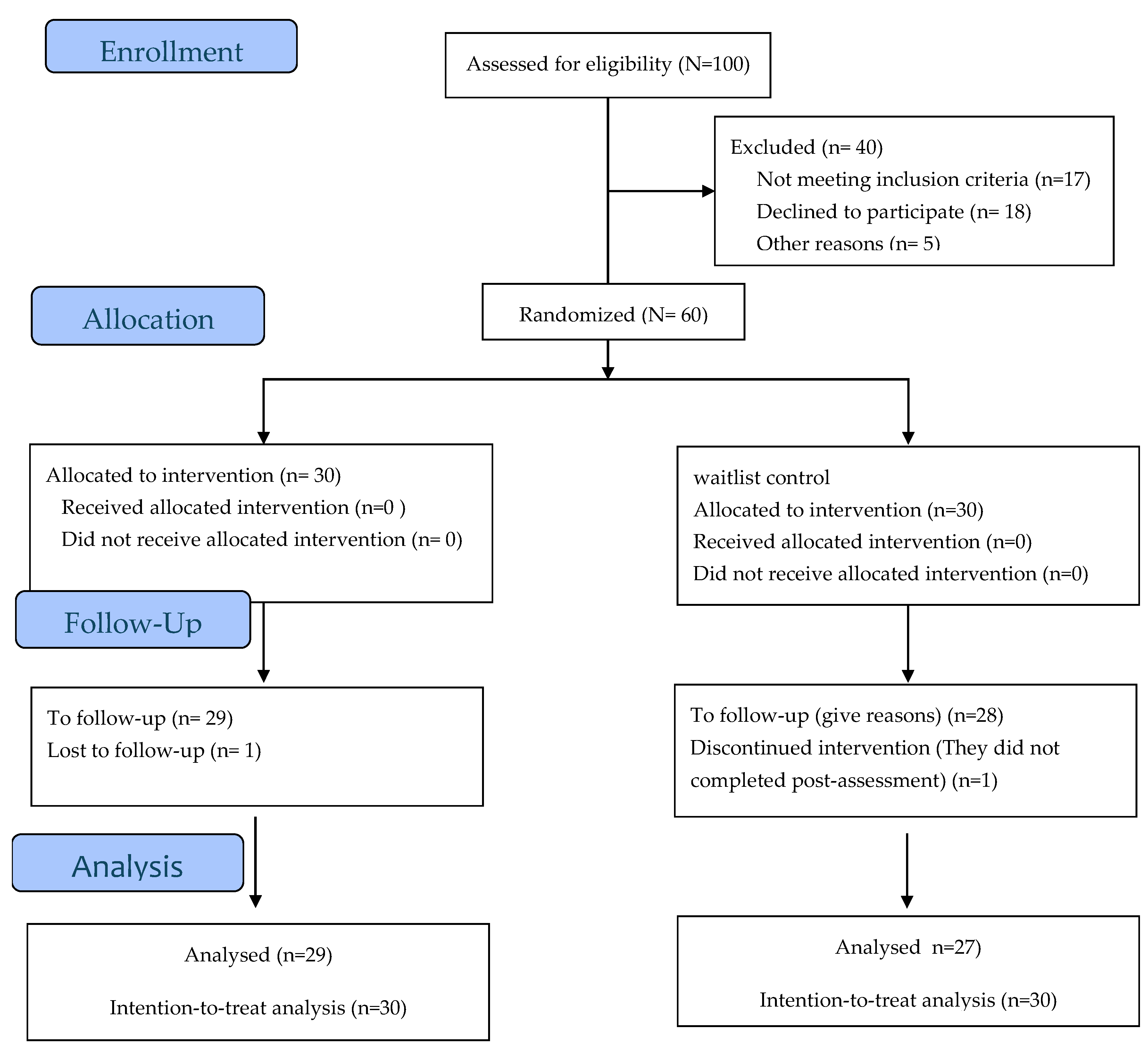
Figure 2.
Self-Esteem.
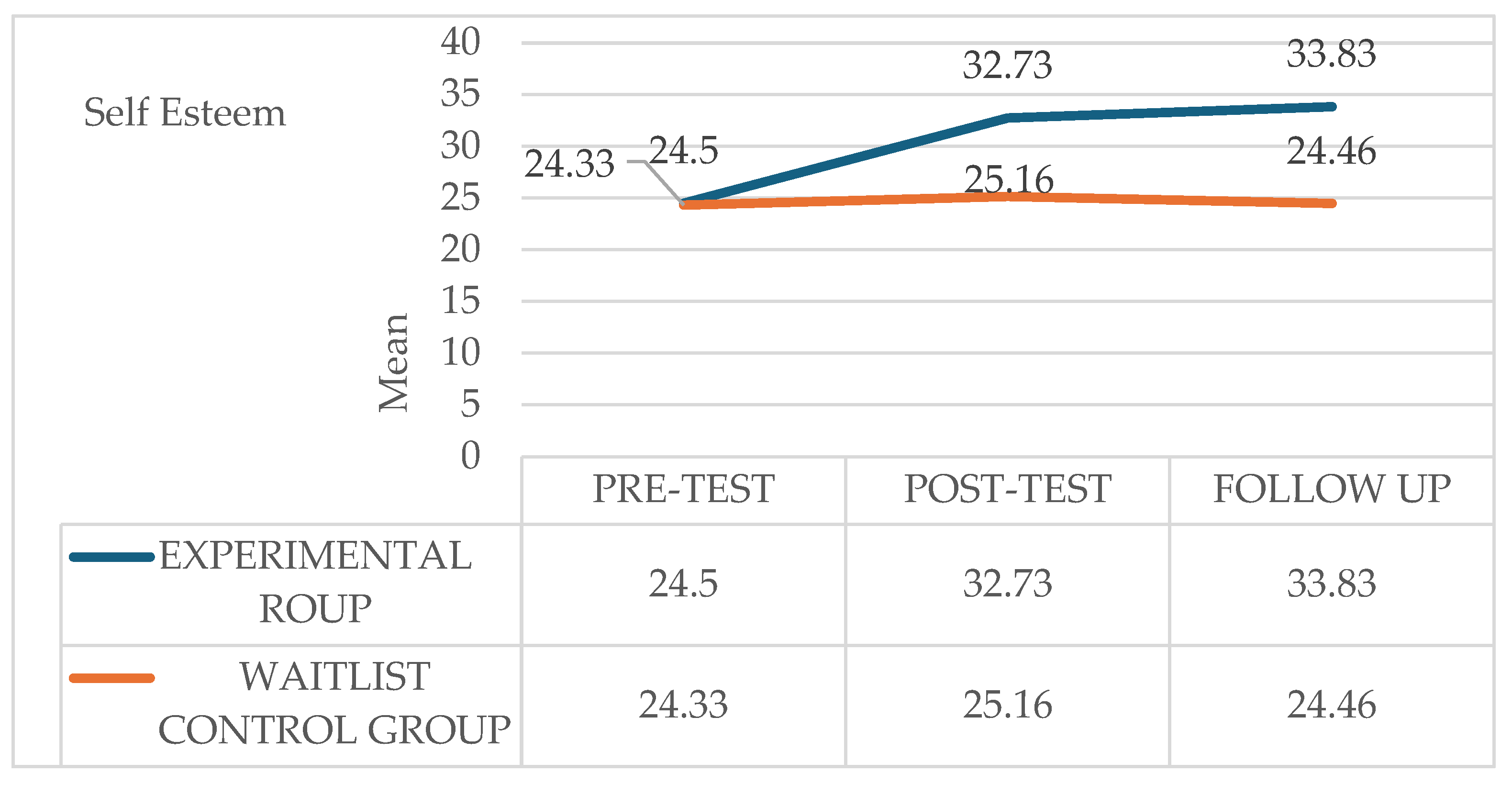
Figure 3.
Stress Management.
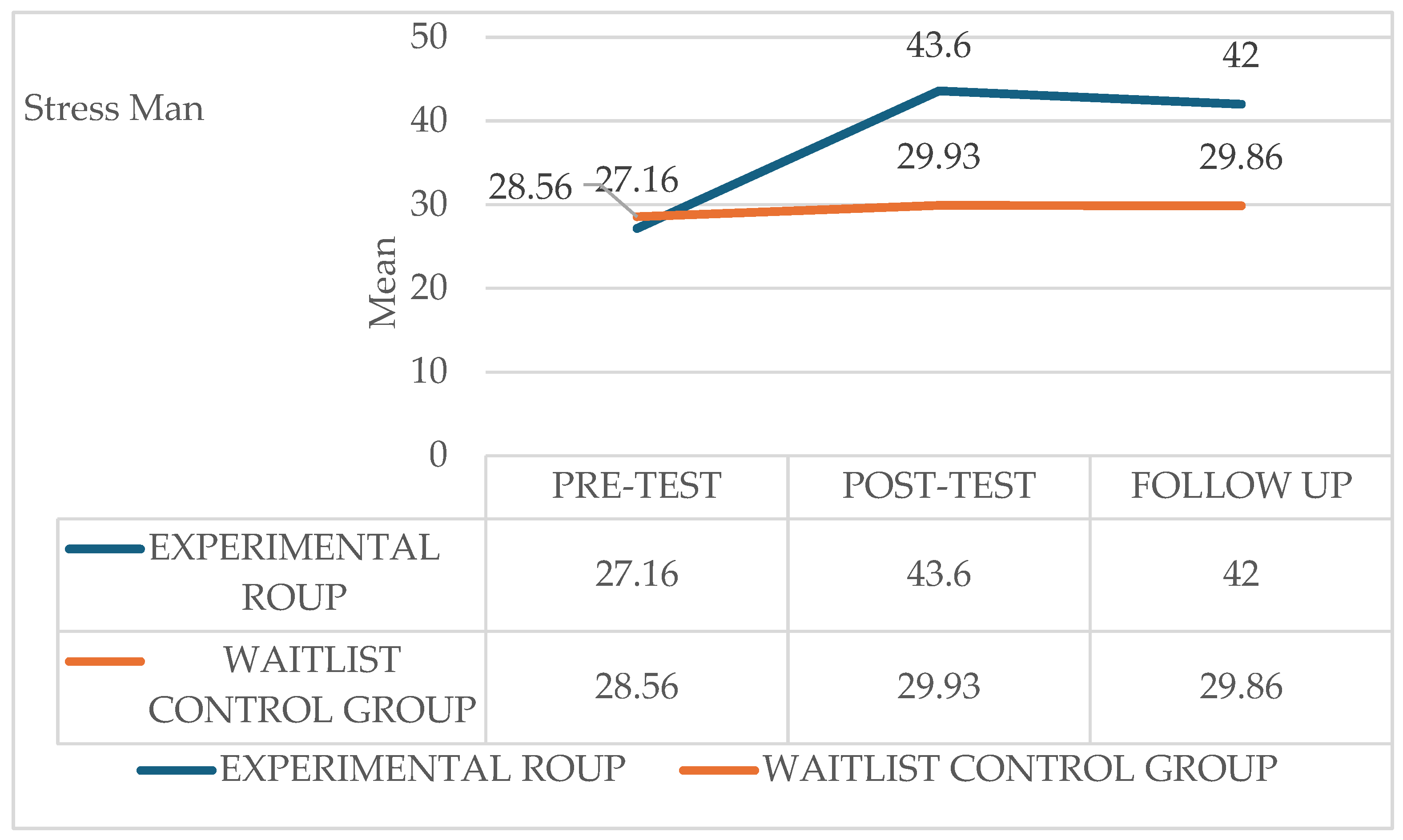
Figure 4.
Emotional Regulation (Cognitive Reappraisal).
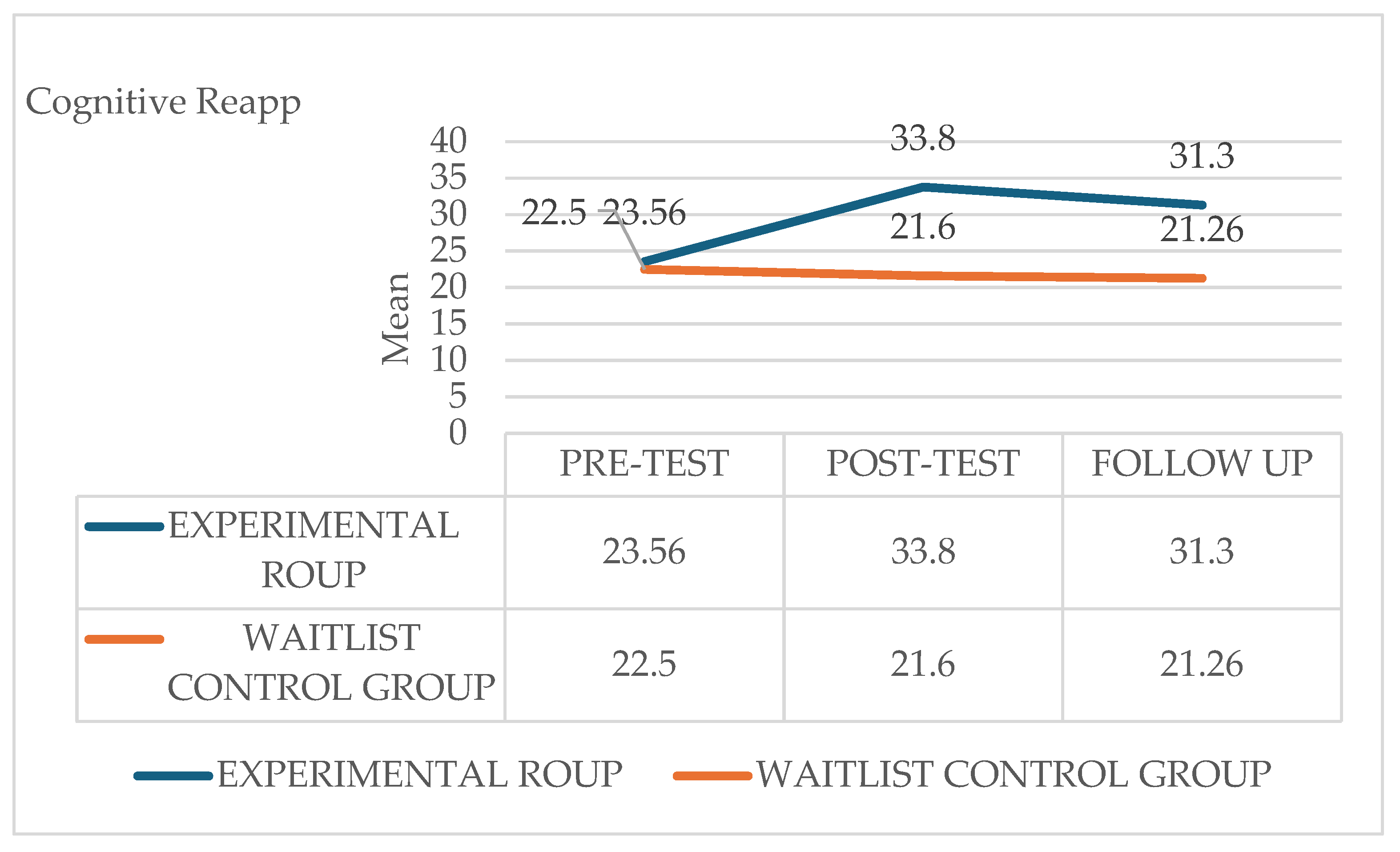
Figure 5.
Emotional Regulation (Expressive Suppression).
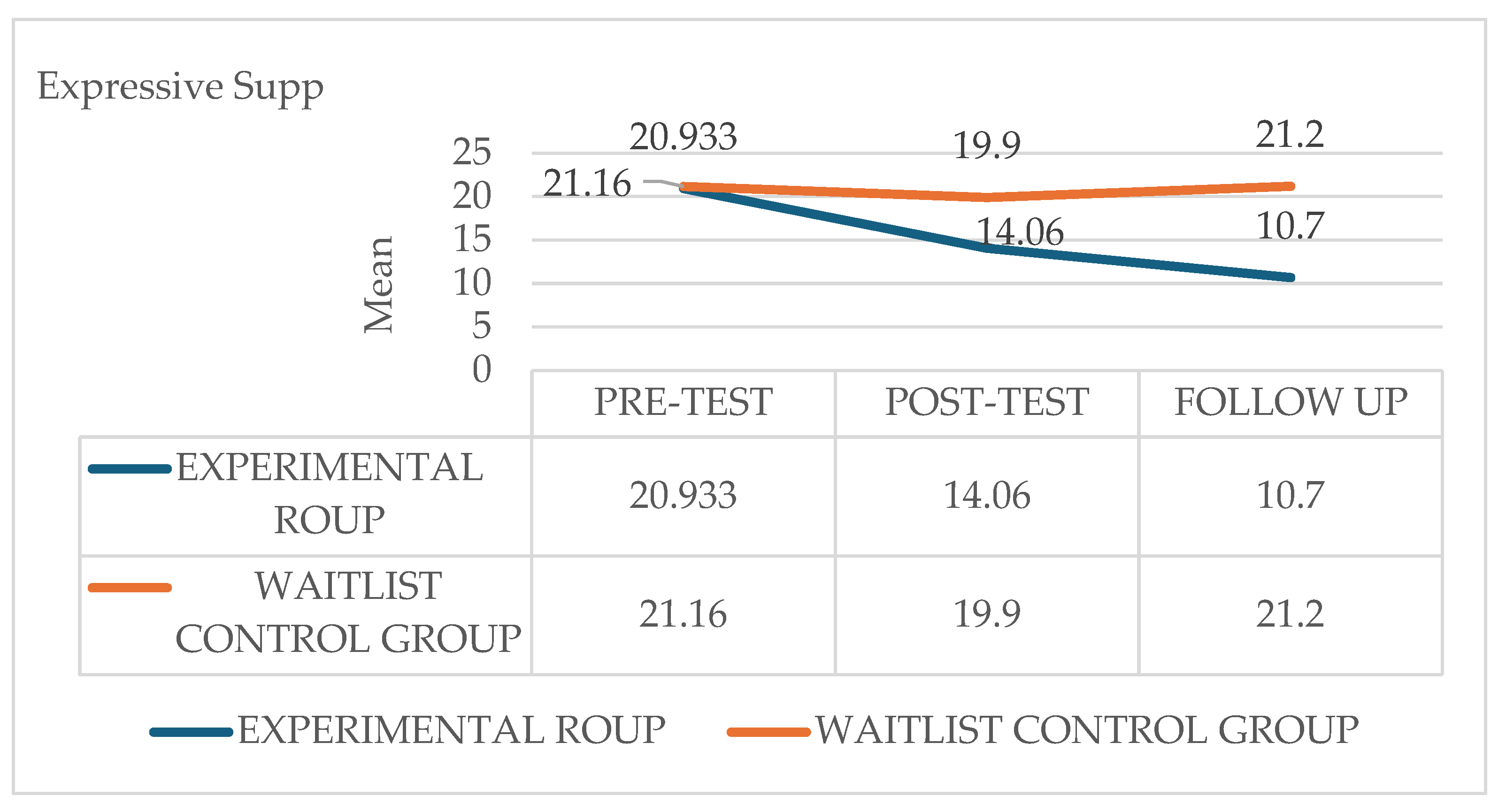
Figure 6.
Positive Thinking.
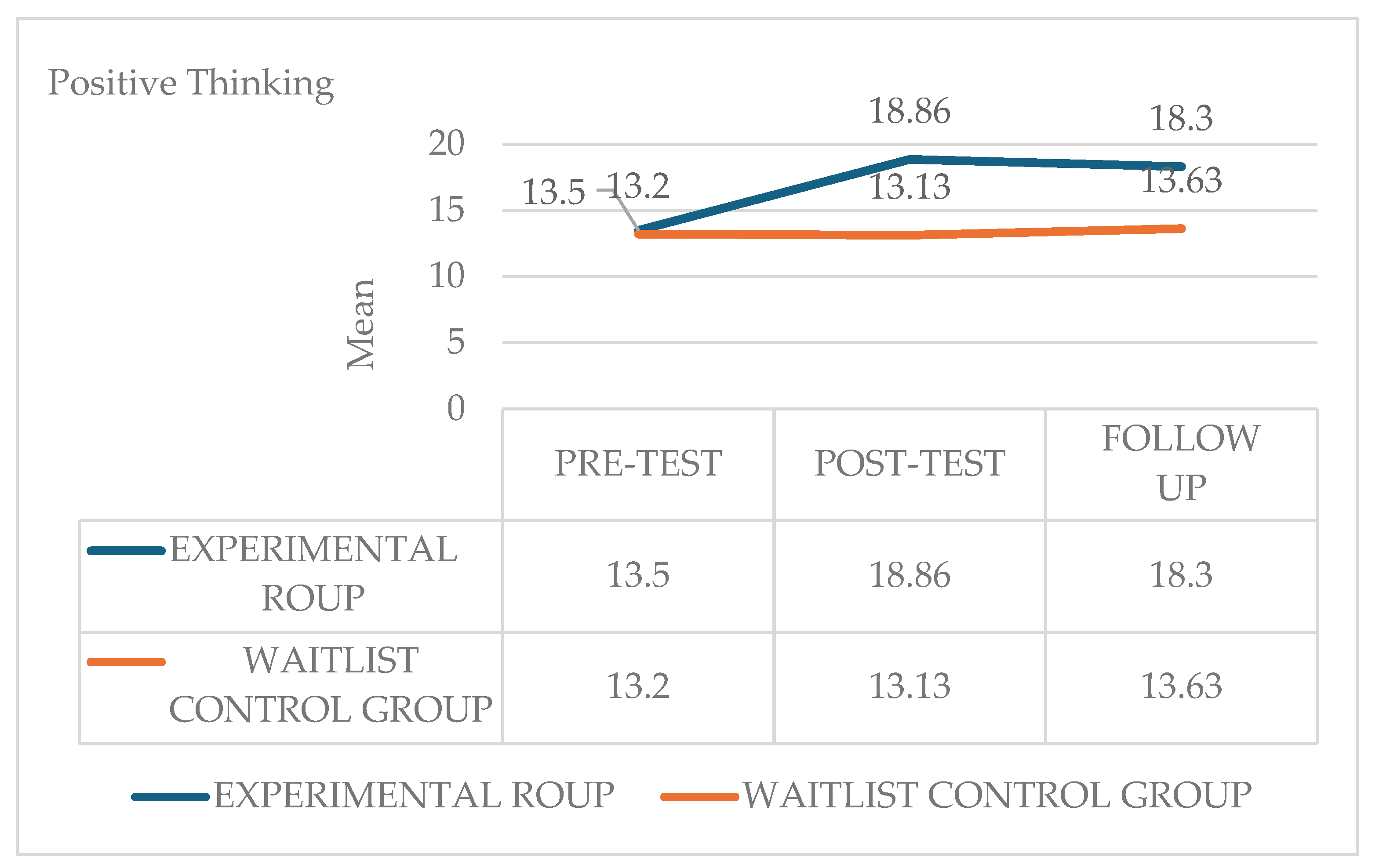

Table 1.
Comparison of participants’ demographic characteristics group-wise and overall.
| Variables | Category | Overall | Groups | ||||
| Characteristics | Experimental | Control | χ2/t | P | |||
| N Total | 100 | _ | _ | ||||
| N ineligible | 40 | 20(50.0%) | 20(50.0%) | ||||
| N allocated | 60 | 30(50.0%) | 30(50.0%) | ||||
| Age (MSD) | 60 | 20.10 (1.53) | 19.53(1.88) | 1.24 | .208 | ||
| Gender | Male (n%) | 36 | 18(30.0%) | 18(30.0%) | .000 | 1.00 | |
| Female (n%) | 24 | 12(20.0%) | 12(20.0%) | ||||
| Semester | First(n%) | 6 | 3 (5.0%) | 3(5.0%) | .538 | .997 | |
| Second (n%) | 10 | 5 (8.3%) | 5 (8.3%) | ||||
| Third (n%) | 19 | 9(15.0%) | 10 (16.7%) | ||||
| Fourth (n%) | 6 | 3 (5.0%) | 3 (5.0%) | ||||
| Fifth (n%) | 7 | 4 (6.7%) | 3 (5.0%) | ||||
| Sixth (n%) | 7 | 3 (5.0%) | 4 (6.7 %) | ||||
| Seventh (n%) | 5 | 3 (5.0%) | 2 (3.3%) | ||||
| Birth Order | First (n%) | 18 | 11(18.3) | 7(11.7%) | 1.504 | .471 | |
| Middle (n%) | 26 | 11(18.3%) | 15(25.0%) | ||||
| Last (n%) | 16 | 8(13.3%) | 8 (13.3%) | ||||
| Family System | Nuclear (n%) | 27 | 11(18.3%) | 16(26.7%) | 1.684 | .194 | |
| Joint (n%) | 33 | 11(31.7%) | 14(23.3%) | ||||
| Fathers Education | Intermediate (n%) | 18 | 9(15.0%) | 9(15.05) | 2.981 | .395 | |
| Bachelors (n%) | 13 | 9(15.0%) | 4(6.75%) | ||||
| Masters (n%) | 23 | 10(16.7%) | 13(21.7%) | ||||
| PhD (n%) | 6 | 2(3.3%) | 4 (6.7%) | ||||
| Mothers’ Education | Intermediate (n%) | 20 | 11(18.3%) | 9(15.05%) | 1.122 | .772 | |
| Bachelors (n%) | 17 | 7(11.7%) | 10(16.7%) | ||||
| Masters (n%) | 16 | 9(15.0%) | 7(11.7%) | ||||
| PhD (n%) | 7 | 3(5.0%) | 4 (6.7%) | ||||
Table 2.
Mean (standard deviation) and repeated-measure design during Pre-test, Post-test, and Follow-up intervention (BLSTP).
Table 2.
Mean (standard deviation) and repeated-measure design during Pre-test, Post-test, and Follow-up intervention (BLSTP).
| Groups | Repeated Measure ANOVA | ||||||||||||
| Experimental Group | Waitlist Control | Group | Time | Group x Time |
ηp2 |
||||||||
| Variables | Baseline M(SD) |
Post- Test M(SD) |
Follow-up M(SD) |
Baseline M(SD) |
Post- Test M(SD) |
Follow-up M(SD |
F | p- Value |
F | p-Value | F | p- Value |
|
| Self-Esteem | 24.50 (2.70) | 32.73 (3.11) | 33.83(2.13) | 24.33(2.35) | 25.16 (1.89) | 24.46 (2.60) |
168.60 | .001 | 70.74 | .001 | 61.51 | .001 | .683 |
| Stress Management | 27.16(3.95) | 43.60(3.45) | 42.00 (3.27) | 28.56(4.05) | 29.93(4.08) | 29.86(3.98) | 45.87 | .001 | 206.85 | .001 | 148.174 | .001 | .839 |
| Emotional regulation | - | - | - | - | - | - | - | - | - | - | - | - | - |
| Cognitive Reappraisal | 23.56(4.71) | 33.80 (3.88) | 31.30(4.25) | 22.50(3.02) | 21.60(4.94) | 21.26(4.57) | 74.85 | .001 | 39.97 | .001 | 56.38 | .001 | .664 |
| Expressive suppression | 20.933(1.43) | 14.06(6.11) | 10.70(2.89) | 21.16(1.64) | 19.90(3.63) | 21.20(1.64) | 105.52 | .001 | 143.19 | .001 | 141.80 | .001 | .833 |
| Positive Thinking | 13.50(2.11) | 18.86(1.94) | 18.30(1.87) | 13.20(3.11) | 13.13(2.41) | 13.63(2.00) | 69.47 | .001 | 25.55 | .001 | 24.32 | .001 | .461 |
Disclaimer/Publisher’s Note: The statements, opinions and data contained in all publications are solely those of the individual author(s) and contributor(s) and not of MDPI and/or the editor(s). MDPI and/or the editor(s) disclaim responsibility for any injury to people or property resulting from any ideas, methods, instructions or products referred to in the content. |
© 2026 by the authors. Licensee MDPI, Basel, Switzerland. This article is an open access article distributed under the terms and conditions of the Creative Commons Attribution (CC BY) license (http://creativecommons.org/licenses/by/4.0/).
Copyright: This open access article is published under a Creative Commons CC BY 4.0 license, which permit the free download, distribution, and reuse, provided that the author and preprint are cited in any reuse.


