

Submitted:
05 January 2026
Posted:
06 January 2026
You are already at the latest version
Abstract
Background/Objectives: Cognicise (multicomponent exercise) and Chlorella (microbial food) improve cognitive function independently. However, their combined effect and underlying mechanisms, including antioxidant capacity and metabolite fluctuations, remains unelucidated. We investigated the effect of multicomponent exercise combined with Chlorella intake on cognitive function in community-dwelling older adults and assessed changes in reactive oxygen species (ROS), free radical scavenging activity, and blood metabolites. Methods: In this double-blind comparative study conducted over 6 months, 16 older adults randomly received either Chlorella (Ex+C group) or a placebo (Ex+P group) alongside performing multicomponent exercise. Cognitive function (memory, attention, executive, and information processing) was assessed using the National Center for Geriatrics and Gerontology-Functional Assessment Tool. The scavenging activity against various ROS and free radicals was measured, and a comprehensive metabolomic analysis was performed. Results: A significant interaction was observed for information processing function, improving significantly in both groups post-intervention. The Ex+P group showed a significant executive function decline; no such change was observed in the Ex+C group. The Ex+C group exhibited significantly improved OH· scavenging activity post-intervention. Free radical scavenging activity increased in both groups. Metabolomic analysis revealed significant changes in 29 and 25 metabolites in the Ex+C and Ex+P groups, respectively, between before and after the intervention. Conclusions: Combining multicomponent exercise and Chlorella intake may increase metabolites, thereby improving the scavenging activity of ROS and free radicals. This approach can improve information processing ability while preventing the significant executive function decline of exercise alone.
Keywords:
multicomponent exercise
; Chlorella
; ROS
; free radical scavenging activity
; metabolites
1. Introduction
In Japan, approximately two-thirds of dementia cases are caused by Alzheimer’s disease (AD) [1], and the number of people with dementia in Japan is projected to reach 7 million by 2025 [2]. Dementia is an irreversible disease, and AD, which is the main cause of dementia, has no established cure. Therefore, it is extremely important to establish preventive measures to suppress cognitive function decline during the mild cognitive impairment (MCI) stage [3], when it is possible to restore cognitive function to normal or pre-MCI levels. Risk factors for AD include depression, diabetes, hypertension, obesity, smoking, and lack of physical activity. Research in the United States has shown that lack of physical activity has the largest impact on AD [4]. Cohort studies have highlighted that improving physical activity and establishing an active lifestyle can reduce the risk of developing AD [5,6,7]. Several interventional studies have reported that aerobic and strength training may improve cognitive function and contribute to AD prevention [8,9]. Dual-task training, which combines physical activity (such as aerobic training) with cognitive tasks, is expected to improve cognitive function [10,11]. Research comparing dual-task training with simple aerobic or strength training has revealed greater improvements in cognitive function with dual-task training [11].
Cognicise (a multicomponent exercise) is a type of dual-task training that is gaining attention. The term “cognicise” is a coined word for “cognition” and “exercise.” It is a complex exercise program that was developed by the National Center for Geriatrics and Gerontology, which combines exercise and cognitive training (Education and Innovation Center for Geriatrics and Gerontology). Multiple reports have revealed the effects of multicomponent exercise on improving cognitive function [12,13]. Shimada et al. [13] showed that 40 weeks of multicomponent exercise improved logical memory and overall cognitive function. Another intervention study showed that 24 weeks of multicomponent exercise improved overall cognitive function, working memory, and executive function [12]. Therefore, multicomponent exercise, which is a type of dual-task training, is believed to be effective in improving cognitive function in older adults.
Additionally, patients with AD have increased levels of oxidative modification products such as nucleic acids and lipids in the brain and cerebrospinal fluid that are in a state of high oxidative stress [14,15]. Antioxidants suppress oxidative stress, and various studies have reported that vitamin intake may prevent AD [16,17]. A cohort study approximately spanning a 4-year period in the United States showed that people with high dietary vitamin E intake had a 0.3-fold lower risk of developing AD than those with low intake [16]. Therefore, intake of appropriate nutraceuticals is thought to be an effective intervention method for preventing decline in cognitive function.
Chlorella is a green alga that lives in freshwater. It is a microbial food that is believed to improve cognitive function. It is a unicellular, spherical or ellipsoidal alga with a 2–10-µm diameter, rich in protein, and contains nutrients such as vitamins, carotenoids, and minerals [18]. Research involving mice have demonstrated that Chlorella intake improves memory function in mice [19]. Furthermore, Miyazawa et al. [20] reported that Chlorella intake reduces peroxidized phospholipid concentrations in red blood cells, which are believed to be common in patients with AD. Studies on humans have reported that Chlorella intake contributes to improvement in cognitive function [21].
The effects of multicomponent exercise and Chlorella on cognitive function have been confirmed individually. Exercise combined with food or dietary advice has been studied for its effects [22,23,24,25,26,27]. Omega-3 fatty acid intake, combined with aerobic exercise and cognitive stimulation, prevents atrophy in AD-related brain regions in MCI patients, compared to omega-3 fatty acid intake with stretching and toning [24]. Aerobic exercise enhances executive function in adults vulnerable to cognitive decline [23]. Among frail older adults, cognitive training provided the greatest cognitive benefits, while nutritional and physical interventions alone offered modest short-term or no cognitive improvements [26]. In frail and pre-frail older adults, resistance exercise combined with protein supplementation improved information processing speed, and exercise alone enhanced attention and working memory [27]. However, creatine supplementation had no significant impact on cognitive function or emotional parameters in healthy older adults [25]. Strength training improved emotional state and muscle strength but not cognition, with no added benefits from creatine [25]. However, to the best of our knowledge, no intervention studies exploring the combination of multicomponent exercise and Chlorella intake have been performed. Hence, investigating the effects of combined exercise and food intake on cognitive function, including in vivo indicators such as antioxidant capacity and metabolite fluctuations, may elucidate the underlying mechanism. The antioxidant enzyme effect of exercise training is inhibited when vitamin C or E is combined with exercise training [28]. When conducting an intervention that combines exercise and nutrient intake, this complexity may prevent the assessment of specific antioxidants and antioxidant enzymes from sufficiently assessing the antioxidant capacity of humans. Therefore, this study aimed to examine the effect of combining multicomponent exercise and Chlorella intake on cognitive function in community-dwelling older adults (68–86 years); to comprehensively investigate changes in Chlorella intake-induced reactive oxygen species (ROS), radical scavenging activity, and the state of blood metabolites using metabolomics analysis; and to assess the effect of a combined intervention of multicomponent exercise and Chlorella intake on human antioxidant capacity from multiple perspectives.
2. Materials and Methods
2.1. Participants
2.1.1. Ethics Statement
This study was conducted in accordance with the principles of the Declaration of Helsinki, and ethical approval was obtained from the Research Ethics Review Committee on Human Subjects of Doshisha University (approval number 18001, dated May 30, 2018). The trial was registered with the UMIN Clinical Trials Registry (UMIN000032847), and written informed consent was obtained from all participants. The participants were informed of the content, purpose, and significance of the study, and their written and verbal consent was obtained for publication of the obtained data. In addition, the participants were given 1 month to decide their willingness to participate.
2.1.2. Recruitment of Participants
Participants were recruited by posting notifications on the community bulletin board and as flyers in the local neighborhood association of Kyoto city from the end of May to early June 2018. The inclusion criterion for participation in the study was healthy Japanese individuals aged 65–90 years. Patients on warfarin or other anticoagulant medications and patients with dementia were excluded. Seventeen individuals applied for the study. These participants were community-dwelling older adults (7 men, 10 women) who did not have dementia or MCI and belonged to Shimogyo PoPPo Juku, an organization that promotes health and social interaction in Shimogyo Ward, Kyoto City. One man dropped out of the study owing to an unrelated injury; therefore, 16 participants (6 men and 10 women) were finally included in the study. CONSORT Flow Diagram and Checklist are attached as Figure S1 and Table S1.
2.2. Intervention Method
2.2.1. Test Food
In this study, participants were divided into two groups using stratified block randomization. The randomization code was set by a researcher who was not engaged in running the trial, using computer-generated random numbers. One group was prescribed a tablet with Chlorella (Sun Chlorella Co., Ltd., Kyoto, Japan) (Ex+C group), and the other was prescribed a placebo (Ex+P group), which contained dextrin instead of Chlorella. The composition of Chlorella and placebo tablets is given in Table 1 and Table 2, respectively. Both tablets were identical in appearance, making it impossible to distinguish between the Chlorella and placebo tablets. The test food provider (Sun Chlorella Co., Ltd., Kyoto, Japan) sorted both tablets into “Group 1” and “Group 2.” The researchers themselves were unaware of which tablet contained Chlorella from the time of distribution until the completion of all assay items. Hence, double blinding was achieved. Participants were instructed to ingest the test food orally twice a day, 20 tablets in each session (8 g in total), after breakfast and dinner for 6 consecutive months between July and December 2018. Each tablet was 8 mm in diameter and 4.5 mm high, making them easy to swallow.
2.2.2. Multicomponent Exercise
Participants in both groups were asked to perform multicomponent exercises for 6 months, beginning 2 weeks after starting the test food intake and lasting till 2 weeks before the end of the test food intake. The multicomponent exercise sessions were conducted using a classroom format twice a month for approximately 60 min per session. The multicomponent exercises were designed to be enjoyable and easy to conduct; mild exercise tasks were selected to avoid strain or pain to the participants, and cognitive tasks were designed to place a cognitive load on their brains. Examples of multicomponent exercises include counting the number of steps during a step exercise, clapping hands when the number is a multiple of three, raising both hands when the number is a multiple of five, or playing a word chain game while tapping one’s feet while seated in a chair. All tests were conducted at Campus Plaza Kyoto, Kyoto City, Japan.
2.2.3. Blood Sampling and Sample Preparation for Measurements
Blood samples were collected at Campus Plaza Kyoto, Kyoto City, Japan. We sampled 2 mL of blood from the participants before beginning the test food intake and on the day after the end of the intake. Samples were collected in vacuum blood sampling tubes (Benoject II; Terumo Corp., Tokyo, Japan) preloaded with an anticoagulant, and human ethylenediaminetetraacetic acid (EDTA) plasma was prepared. The vacuum blood sampling tube was centrifuged (Model 2800 tabletop refrigerated centrifuge, Kubota Corp., Tokyo, Japan) at 4 °C, 1,200 × g rotation speed, and 10-min rotation period. Following centrifugation, we dispensed 200 µL of plasma from the vacuum blood sampling tube into a 1.5-mL microtube and stored the sample at −80 °C until analysis.
2.3. Survey Items
2.3.1. Basic Attributes
We interviewed participants to obtain data regarding their age, sex, height, weight, years of education, certification of long-term care needs, medical history (stroke, Parkinson’s disease, depression, dementia, MCI, or other brain diseases), and activities of daily living (eating, grooming, walking, bathing, or climbing stairs).
2.3.2. Cognitive Function
Cognitive function tests were performed before the start of test food consumption and on the day after the end of test food consumption at Campus Plaza Kyoto, Kyoto City, Japan. The Hasegawa Dementia Scale-Revised [29] was used as a screening test to assess overall cognitive function. We also assessed memory, attention, executive, and information processing functions using the National Center for Geriatrics and Gerontology-Functional Assessment Tool (NCGG-FAT) [30].
The NCGG-FAT is a cognitive function test developed by the National Center for Geriatrics and Gerontology and is administered using a tablet computer. Multiple conventional cognitive function tests and cognitive function assessments from various perspectives, including visual-spatial cognition and working memory, with memory, attention, executive, and information processing functions as basic items, were incorporated in this test. The validity and reliability of the NCGG-FAT have been confirmed previously [31].
2.3.3. Reactive Oxygen Species and Free Radical Scavenging Activity
All tests were performed using plasma samples, as described in section 2.3, on the day following the end of test food consumption at Doshisha University, Kyo-Tanabe City, Japan. Analyses were outsourced to Human Metabolome Technologies, Inc (Tsuruoka, Yamagata, Japan).
The multiple free radical scavenging capacity method (MULTIS method) is used to assess the antioxidant capacity of biological samples from various perspectives by measuring the scavenging activity of six types of ROS and free radicals: hydroxyl (OH·), superoxide (O2·-), alkyloxy (RO·), alkylperoxy (ROO·), methyl radicals (·CH3), and singlet oxygen (1O2) [32]. ROS and free radical scavenging activities are strongly dependent on the ROS and free radical type being scavenged [33], and various antioxidants and antioxidant enzymes have comprehensive effects on the corresponding ROS and free radicals.
We measured the amount of ROS and free radicals scavenged by the samples using the electron spin resonance (ESR) spin-trapping method described below. Subsequently, we calculated the equivalent scavenging capacity of various antioxidants (standard substances) based on the measured amount of ROS and free radicals scavenged, and this value was used to indicate the ROS and free radical scavenging activity.
ESR spin trapping is a type of spectroscopy that detects atoms and molecules with unpaired electrons [34]. The lifespan of ROS and free radicals is extremely short; therefore, they are covalently bonded with a molecule called a spin-trapping agent to make them stable molecules (spin adducts), which are subsequently used to measure the concentration of ROS and free radicals indirectly. The spin trap agents used in this study were 5-(2,2-dimethyl-1, 3-propoxycyclophosphoryl)-5-methyl-1-pyrroline N-oxide (CYPMPO: Mikuni Seiyaku Co., Ltd., Osaka, Japan) and 2,2,6,6-tetramethyl-4-piperidone (TMPD: Mikuni Seiyaku Co., Ltd.). Notably, 1O2 is not radical, as it does not have an unpaired electron; however, it can be measured when it combines with TMPD to generate TMPD· through an oxidation-reduction reaction.
Each radical was measured using an X-band Microwave Unit ESR device (RE Series, JEOL Ltd., Tokyo, Japan) under the conditions listed in Table 3 and analyzed using WIN-RAD (ver. 1.30; Radical Research Co. Ltd., Tokyo, Japan).
We added 200 mM PB (pH 7.4, 100 µL), 100 mM CYPMPO (20 µL), 10 mM dimethyl triamine pentaacetic acid (DTPA: Fujifilm Wako Pure Chemical Corp., Osaka, Japan) (20 µL), distilled water (20 µL), and 100 mM H2O2 (Fujifilm Wako Pure Chemical Corp.) (20 µL) to 20-fold diluted EDTA plasma (20 µL). Next, the mixture was irradiated for 5 s using an ultraviolet (UV) irradiator (SUPERCURE-203, San-Ei Electric Co., Ltd., Osaka, Japan) (using a total reflection mirror and heat-cutting filter). The resulting OH· that was generated was captured by the spin-trapping agent CYPMPO. The relative intensity was assessed using the fifth signal on the detection waveform. Meanwhile, when the sample was added, the relative intensity was calculated with the control set as 100%. A calibration curve was created using the standard substance reduced glutathione (reduced GSH: Fujifilm Wako Pure Chemical Corp.). The relative intensity of the control was set as I0, and when reduced GSH was added at each concentration, the intensity was set as I, with the vertical axis set as I0/I-1 and the horizontal axis set as the reduced GSH concentration.
We added 200 mM PB (pH 7.4, 100 µL), 100 mM CYPMPO (20 µL), 100 mM ethylenediamine-N, N, N’, N’-tetraacetic, acid disodium salt, dehydrate (EDTA·2Na: Fujifilm Wako Pure Chemical Corp.), distilled water (20 µL), and 250 µM riboflavin (Fujifilm Wako Pure Chemical Corp) (20 µL) to 10-fold diluted human EDTA plasma (20 µL). The mixture was subsequently irradiated for 30 s using a UV irradiator (total reflection mirror, filter HA-30, and G533 used in combination). The resulting O2·- generated was captured using CYPMPO. The relative intensity was assessed using the fifth signal, and when the sample was added, the intensity was converted to 100% with the control set. A calibration curve was generated using the standard substance superoxide dismutase (SOD: Fujifilm Wako Pure Chemical Corp.). The relative intensity of the control was set as I0, and when each concentration of SOD was added, the intensity was set as I, with the vertical axis set as I0/I-1 and the horizontal axis set as the SOD concentration.
We added 200 mM PB (pH 7.4, 100 µL), 100 mM CYPMPO (20 µL), distilled water (40 µL), and 10 mM 2,2′-azobis-2-methyl-propanimidamide dihydrochloride (AAPH: Fukakoshi Co., Ltd., Tokyo, Japan) (20 µL) to 10-fold diluted human EDTA plasma (20 µL). The mixture was subsequently irradiated using a UV irradiator for 5 s (using a total reflection mirror and heat-cutting filter), and the generated RO was captured using CYPMPO. The relative intensity was assessed using the fifth signal, and when the sample was added. The relative intensity was converted to 100% with the control set. A calibration curve was constructed using the standard substance Trolox (Fujifilm Wako Pure Chemical Corp.). The relative intensity of the control was set as I0, and when each concentration of trolox was added, the intensity was set as I, with the vertical axis set as I0/I-1 and the horizontal axis set as the Trolox concentration.
We added 200 mM PB (pH 7.4, 100 µL), 100 mM CYPMPO (20 µL), distilled water (40 µL), and 100 mM tert-butyl hydroperoxide solution (t-butyl-oo: Fujifilm Wako Pure Chemical Corp.) (20 µL) to 10-fold diluted human EDTA plasma (20 µL). Next, the mixture was irradiated using a UV irradiator for 5 s (using a total reflection mirror and heat-cutting filter), and the resulting ROO· generated was captured using CYPMPO. The relative intensity was assessed using the fifth signal, and when the sample was added, the relative intensity was converted to 100% with the control set. A calibration curve was created using the standard substance α-lipoic acid (Fujifilm Wako Pure Chemical Corp.). The relative intensity of the control was set as I0, and when each concentration of α-lipoic acid was added, it was set as I, with the vertical axis set as I0/I-1 and the horizontal axis set as the α-lipoic acid concentration.
We added 200 mM PB (pH 7.4, 100 µL), 100 mM CYPMPO (20 µL), distilled water (20 µL), 500 mM DMSO (20 µL), and 1 M H2O2 (20 µL) to 40-fold diluted human EDTA plasma (20 µL). The mixture was subsequently irradiated using a UV irradiator for 5 s (using a total reflection mirror and heat-cutting filter), and the resulting ·CH3 generated was captured using CYPMPO. The relative intensity was assessed using the fifth signal, and when the sample was added, the intensity was converted with the control set to 100%. A calibration curve was created using the standard substance bovine serum albumin (BSA: Fujifilm Wako Pure Chemical Corp.). The relative intensity of the control was set as I0, and when each concentration of BSA was added, it was set to I with the vertical axis set as I0/I-1 and the horizontal axis set as the BSA concentration.
We added 200 mM PB (pH 7.4, 100 µL), 100 mM TMPD (20 µL), distilled water (20 µL), 10 mM DTPA (20 µL), and 1 mM pterin (Fujifilm Wako Pure Chemical Corp.) (20 µL) to 40-fold diluted human EDTA plasma (20 µL). Next, the mixture was irradiated for 60 s using a UV irradiator (total reflection mirror, HA-30, and G533 used in combination), and the resulting 1O2 generated was captured using TMPD. The relative intensity was assessed using the second signal, and when the sample was added, the intensity was converted with the control set to 100%. A calibration curve was generated using a standard that reduces GSH. The relative intensity of the control was set as I0, and when each concentration of reduced GSH was added, the intensity was set as I, with the vertical axis set as I0/I-1 and the horizontal axis set as the reduced GSH concentration.
2.3.4. Metabolomics Analysis
Metabolome refers to the total number of metabolites present in living organisms and tissues. Comprehensive qualitative and quantitative analyses of these metabolites are called metabolomics analysis [31]. In this study, we used metabolomics to comprehensively analyze metabolites that constantly undergo in vivo changes, efficiently capturing changes in cognitive function as well as metabolic state that occur in the body owing to Chlorella intake. All tests were performed using plasma samples described in section 2.3 on the day following the end of test food consumption.
We added 200 µL of methanol containing an internal standard (H3304-1002, Human Metabolome Technologies Inc. [HMT], Yamagata, Japan) to 50 µL of plasma at 0 °C to suppress enzyme activity. Approximately 150 µL of Milli-Q water was added to the extract and mixed thoroughly, after which 300 µL of the mixture was centrifuged at 9,100 × g and 4 °C for 120 min using a Millipore 5-kDa cutoff filter (ULTRAFREE MC PLHCC, HMT, Yamagata, Japan) to remove macromolecules. The filtrate was subsequently evaporated to dryness in a vacuum and redissolved in 50 µL of Milli-Q water.
We added 300 µL of 1% formic acid/acetonitrile containing an internal standard (H3304-1002, HMT) at 0 °C to 100 µL of plasma to suppress enzyme activity. The mixture was centrifuged at 2,300 × g and 4 °C for 5 min and filtered using a Hybrid SPE phospholipid cartridge (Hybrid SPE – Phospholipid 30 mg/mL, SUPELCO, Pennsylvania, United States) to remove the phospholipids. Next, the filtrate was evaporated to dryness under nitrogen and redissolved in 100 µL of 50% isopropanol (v/v).
Metabolomic analysis was commissioned to the HMT and conducted according to the following procedure: Capillary electrophoresis time-of-flight mass spectrometry (CE-TOFMS) and liquid chromatography time-of-flight mass spectrometry (LC-TOFMS) were conducted following previously described methods based on the Dual Scan package of HMT [35,36]. CE-TOF-MS analysis was conducted using an Agilent CE capillary electrophoresis system equipped with an Agilent 6210 time-of-flight mass spectrometer (Agilent Technologies, California, United States). Furthermore, LC-TOF-MS analysis was performed using an Agilent 1200 HPLC pump equipped with an Agilent 6210 time-of-flight mass spectrometer (Agilent Technologies, California, United States). The system was controlled using the Agilent G2201AA ChemStation software version B.03.01 (Agilent Technologies, California, United States) for CE and MassHunter (Agilent Technologies, California, United States) for LC. A spectrometer was used to scan from a mass-to-charge ratio (m/z) of 50–1,000, and the peaks were extracted using the automatic integration software MasterHands (Keio University, Yamagata, Japan). Next, we obtained the m/z, peak area, and migration time (MT) for CE-TOF-MS and the retention time (RT) for LC-TOFMS [37]. Signal peaks corresponding to the known isotopes of metabolites, adduct ions, and other product ions were excluded, and the remaining peaks were annotated with metabolites estimated from the HMT metabolite database based on the m/s value, MT, and RT. To obtain the relative value of each metabolite, the annotated peak areas were standardized using the internal standard and sample amount.
2.4. Statistical Processing
All data are presented as mean ± standard deviation. We assessed cognitive function and ROS/free radical scavenging activity using the unpaired t-test or Mann–Whitney U test to compare the pre- and post-intervention groups. The paired t-test and Wilcoxon signed-rank tests were used to compare the pre- and post-intervention groups. We also conducted a two-way analysis of variance with duplicate measurements for each group (Ex+C group, Ex+P group) × period (pre-intervention and post-intervention). We conducted a metabolomic analysis using the paired t-test or Wilcoxon signed-rank test for within-group comparison based on the pre- and post-intervention. We used the Mann–Whitney U test and Wilcoxon signed-rank tests for items for which normality was not confirmed. We used IBM SPSS Statistics 27 (IBM Japan, Tokyo, Japan] for statistical analysis, and the statistical significance level was set at < 5%. We also used MetaboAnalysist 5.0 [38] (MetaboAnalyst 5.0) for heat map creation and principal component analysis (PCA) in the metabolomics analysis.
3. Results
3.1. Basic Attributes
The average age of all study participants was 76.5 years (range, 68–86 years). The average age of participants in the Ex+C and Ex+P groups was 76.9 years and 76 years, respectively. Table 4 presents the results of the basic attributes compared between the two groups. None of the measurement parameters differed significantly between the Ex+C and Ex+P groups.
3.2. Cognitive Function Assessment
No significant differences were observed in the pre-intervention measurement items between groups (Table 4). Meanwhile, two-way analysis of variance showed a significant interaction in information processing function (F = 4.72, p < 0.05) (Table 5). Pre- and post-intervention comparisons revealed significant improvement in information processing functions in both the Ex+C and Ex+P groups (Ex+C group: t = -13.71, p < 0.01; Ex+P group: t = -8.65, p < 0.01) (Table 5) and significant decline in executive functions in the Ex+P group (z = -2.38, p < 0.01) (Table 5). Furthermore, no significant differences were observed in any post-intervention measurement items between the groups (Table 5).
3.3. ROS and Free Radical Scavenging Activity
No significant differences were observed in pre-intervention measurement items between groups did not (Table 4). Furthermore, no significant interactions or between-group differences were observed in any measurement items in two-way analysis of variance or post-intervention comparisons (Table 5). The Ex+C group showed significant improvement in hydroxyl radical (OH·) levels pre- and post-intervention (Table 5). The standard substance equivalents for each group are shown as radar plots, and the pre-intervention area was set to 100% to compare the pre- and post-intervention areas. The radar plot area for the Ex+C group was 100% pre-intervention and 134.8% post-intervention (Figure 1A). However, for the Ex+P group, it was 100% pre-intervention and 140.9% post-intervention (Figure 1B).
3.4. Metabolomics Analysis
A comprehensive search using metabolomic analysis identified 491 metabolites. We observed significant changes in the levels of 29 metabolites in the Ex+C group (Table S2) and 25 metabolites in the Ex+P group (Table S2). A significant increase was observed in the levels of zeaxanthin-1, zeaxanthin-2, β-cryptoxanthin-2, lutein-1, pyruvic acid, and others, while a significant decrease was observed in the levels of 11-aminoundecanoic acid, Trp, γ-tocopherol, and others in the Ex+C group. A significant increase was observed in the levels of 1-methyladenosine, 2-oxoisovaleric acid, and others, while a significant decrease was observed in the levels of creatinine, cyclohexylamine, and others in the Ex+C group. A complete list of metabolites with changes in both groups is presented in Table S2. Furthermore, the PCA results showed no significant differences between pre- and post-intervention in either the Ex+C or Ex+P group (Figure 2).
4. Discussion
4.1. Influence of Multicomponent Exercise and Chlorella Intake on Cognitive Function
Our findings revealed that the combination of exercise and food intake led to significant improvement in information processing speed and score. Within-group comparisons between pre- and post-intervention showed significant improvement in information processing function in the Ex+C group, along with significant improvement in information processing and significant decline in executive functions in the Ex+P group. A 3-month intervention study on healthy older adults wherein golf training was conducted once every 2 weeks and cognitive function was measured using the NCGG-FAT reported a mean difference of 2.6 in the Digit Symbol Substitution Test score (a test closely aligned with the processing speed), while the mean difference was 20.4 in the present study [39]. Similarly, dual-task training, in which exercise and cognitive tasks were combined, improved scores on the Symbol Digit Modalities Test, which includes elements of information processing function [40]. In our study, both the groups performed multicomponent exercise, and their information processing function improved significantly, suggesting that multicomponent exercise, which is a type of dual-task training, could improve information processing function (processing speed). Furthermore, Ngandu et al. [41] reported that a 2-year intervention combining exercise training, dietary advice, cognitive training, and blood pressure management in older adults improved information processing function. Additionally, a 6-month intervention study in this population reported that adding protein supplementation to exercise training improved information processing function in a group of patients who only underwent exercise training [27].
Meanwhile, executive function declined significantly in the Ex+P group, despite the implementation of multicomponent exercise. Executive function involves setting goals, constructing plans to achieve them, and executing them efficiently [42], which is a higher-level cognitive function. The Trail Making Test (TMT) is widely used as a cognitive task to measure attention and executive function among older adults. It involves connecting randomly arranged circles with a pencil, and comes in Parts A (TMT-A) and B (TMT-B), which are used for functional evaluation of patients with brain injury. Research investigating TMT scores over time in older adults revealed that TMT-B scores tend to decrease with age [43]. As most participants in our study were adults of advanced age, we inferred that the effects of multicomponent exercise were outweighed by aging. The Ex+P group exhibited significant decline in executive function, whereas the Ex+C group did not. Notably, Ngandu et al. [41] also showed improvements in executive function. In our study, we were unable to prevent decline in executive function due to aging, even when healthy older adults performed multicomponent exercise. However, the finding that concomitant intake of Chlorella suppressed the significant decline in executive function highlights the added value of combining nutritional supplementation with exercise.
4.2. Influence of Multicomponent Exercise and Chlorella Intake on ROS and Free Radical Scavenging Activity
The changes in ROS and free radical scavenging activity, associated with changes in cognitive function, showed a significant increase in OH· scavenging activity in the Ex+C group. Chlorella has antioxidant properties [19,20,44,45,46,47,48]. A study in which patients with obstructive pulmonary disease received Chlorella for 2 months [47] and another study in which healthy individuals with a smoking habit received Chlorella for 6 weeks [48], which showed increases in reduced GSH, which is mainly involved in 1O2, OH·, and ROO· scavenging; antioxidant enzymes SOD, catalase, and glutathione peroxidase; and total antioxidant capacity, along with a decrease in malondialdehyde (MDA), which is a marker of lipid peroxidation. Studies have also reported that Chlorella intake influences intestinal flora [49], and short-chain fatty acids produced by intestinal bacteria have antioxidant capacity [50]. Therefore, Chlorella intake may have influenced the increase in OH· scavenging activity through intestinal flora. Exercise training has antioxidant effects [51,52] An intervention study in which healthy older adults underwent dual-task training combining exercise and cognitive tasks for 2 months reported a decrease in d-ROMs, an oxidative stress marker [52]. Furthermore, a study on healthy men showed that endurance exercise or combined endurance exercise and strength training increased antioxidant enzymes and reduced MDA [51]. Therefore, in our study, the combination of multicomponent exercise and Chlorella intake may have improved the ROS/free radical scavenging activity. Furthermore, OH· has the highest reactivity and oxidizing power among the six types of ROS/free radicals measured in this study [36], suggesting that Chlorella intake effectively enhances human antioxidant capacity.
4.3. Influence of Multicomponent Exercise and Chlorella Intake on Changes in the Appearance of Blood Metabolites
In this study, we used metabolomic analysis to comprehensively assess changes in the appearance of blood metabolites due to Chlorella intake. The results showed significant changes in the levels of 29 and 25 metabolites in the Ex+C and Ex+P groups, respectively. Of the 29 metabolites that showed significant changes in the Ex+C group, the levels of lutein, zeaxanthin, and uric acid, which are associated with OH-scavenging activity and cognitive function, were significantly increased. Lutein and zeaxanthin are xanthophyll carotenoids that are abundant in Chlorella. In vitro research showed that they increase the reduced GSH [53]. An intervention study in mice showed that administering lutein for 1 month caused a dose-dependent increase in reduced GSH [54]. Although it was an in vitro study, lutein and zeaxanthin have approximately 1,000 times the OH· scavenging activity of vitamin C [54]. Research has also reported that a high intake of lutein or zeaxanthin is associated with improved cognitive function, with zeaxanthin being associated with information processing function [55]. An interventional study also showed that lutein and zeaxanthin intake improved cognitive function in older adults [56]. Carotenoids with yellow pigments, such as lutein and zeaxanthin, also have scavenging activity against 1O2, which has the same oxidizing power as OH· [57]. Uric acid is a metabolite generated when purines are broken down, and a sustained high concentration of it may cause cardiovascular diseases and renal dysfunction. In contrast, uric acid has been shown to have OH· scavenging activity [58]. A 44-year cohort study reported that individuals with higher uric acid levels had a lower risk of dementia [59]. Therefore, lutein and zeaxanthin, present in contained in uric acid and Chlorella, were believed to have contributed to maintaining and improving cognitive function by improving OH· scavenging activity.
Furthermore, 3-hydroxybutyric acid, testosterone, S-methylcysteine, succinic acid, and stachydrine exhibited significant changes in the Ex+C group and were associated with increased ROS/free radical scavenging activity and improved cognitive function. 3-hydroxybutyric acid is a ketone body that has been reported to have antioxidant effects [60] and cognitive benefits [61]. Testosterone is a steroid hormone belonging to the androgen family and has been associated with antioxidant effects [62], reduced risk of dementia, and cognitive function [63]. Therefore, 3-hydroxybutyric acid and testosterone may be involved in maintaining and improving ROS/free radical scavenging activity and cognitive function. S-methylcysteine is an organic sulfur compound found in many edible vegetables with antioxidant properties [64,65]. Additionally, succinic acid, which also exhibited a significant increase in the Ex+P group, is a carboxylic acid that reduces GSH, SOD, and MDA levels [66]. Stachydrine, a natural compound found in large amounts in citrus fruits and amaranth herbs, has antioxidant properties [67]. Metabolites, such as S-methylcysteine, stachydrine, and succinic acid, may also help improve ROS/free radical scavenging activity.
4.4. Mechanism of the Effect of Maintaining and Improving Cognitive Function by Implementing Multicomponent Exercise Combined with Chlorella Intake
Several possible mechanisms may explain the effects of multicomponent exercise combined with Chlorella intake on maintaining and improving cognitive function. The first mechanism involves maintaining mitochondrial function. Mitochondria are important organelles that produce energy during aerobic respiration. However, they are also the main sources of ROS and free radicals. Mitochondrial DNA is easily damaged by ROS and free radicals [68], and this damage further enhances the production of ROS and free radicals, which can cause various diseases, including AD [69]. The Ex+C group in our study exhibited increased levels of several metabolites associated with maintaining mitochondrial function. Succinic acid is a substrate of the mitochondrial respiratory chain, and its increase may be involved in maintaining mitochondrial function. Reportedly, 3-hydroxybutyric acid reduces the mitochondrial production of ROS and free radicals [70]. Therefore, combining multicomponent exercise and Chlorella intake increases succinic acid and 3-hydroxybutyric acid levels, which contributes to maintaining mitochondrial function. Exercise training is believed to have various effects ranging from mitochondrial biogenesis to removal of damaged mitochondria [71]. In our study, multicomponent exercise may have helped in maintaining mitochondrial function. Based on these results, we speculate that combining multicomponent exercise and Chlorella intake maintains mitochondrial function and helps maintain and improve cognitive function by suppressing ROS and free radical production.
The second mechanism involves inhibiting the oxidation of erythrocyte membrane phospholipids. Erythrocytes in patients with AD are known to exhibit progressive aging [72] and are in an oxidized state. Aging erythrocytes have a reduced ability to supply oxygen to the brain and are thus believed to be involved in the progression of dementia. Previous research has reported that the concentration of phospholipid hydroperoxides (PLOOH), a marker of oxidative damage to membrane lipids, decreased after 1 month of lutein intake in healthy participants [73]. Therefore, in our study, the increase in lutein in the Ex+C group was speculated to suppress the oxidation of erythrocyte membrane phospholipids. Furthermore, other metabolites with ROS and free radical scavenging activities (zeaxanthin, uric acid, 3-hydroxybutyric acid, testosterone, S-methylcysteine, succinic acid, and stachydrine) that showed a significant increase in the Ex+C group may also have contributed to suppressing the oxidation of erythrocyte membrane phospholipids. Thus, it is reasonable to assume that increased lutein and its metabolites derived from Chlorella intake, along with the ROS and free radical scavenging effects of combined multicomponent exercise and Chlorella intake, contribute to maintaining and improving cognitive function by suppressing erythrocyte membrane phospholipid oxidation.
The third mechanism involves preventing damage to the blood-brain barrier (BBB). The BBB controls the movement of substances, nutrients, and cells from the blood to the brain and from the brain to the blood to maintain homeostasis in the central nervous system (CNS). BBB damage can cause various neurological disorders, including AD [74]. Exercise has been shown to prevent BBB damage caused by the kynrenine and renin-angiotensin-aldosterone (RAA) system [75]. Research has confirmed that endurance training increases the expression of kynurenine aminotransferase, which promotes the production of kynurenic acid from neurotoxic kynurenine [75]. The metabolomic analysis in our study showed a significant decrease in kynurenine in the Ex+P group; however, the decrease was not significant in the Ex+C group. Therefore, multicomponent exercise may convert kynurenine into kynurenic acid and prevent BBB damage. Additionally, ROS and free radicals are produced by the kynurenine and RAA systems, and inflammatory cytokines [76], which promote BBB damage and cell death in the CNS. In our study, metabolites with ROS and free radical scavenging activities were increased by multicomponent exercise and Chlorella intake, and these metabolites are believed to contribute to preventing BBB damage caused by ROS and free radicals. Furthermore, the lutein and zeaxanthin contained in Chlorella are lipid-soluble; therefore, they may penetrate the CNS without passing through BBB transporters and prevent cell death caused by ROS and free radicals. The suppression of BBB damage by conducting multicomponent exercise and administering Chlorella may be synergistic in preventing a decrease in the permeability of lutein and zeaxanthin to the CNS or in promoting permeability. Considering these results, we cannot deny the possibility that combining multicomponent exercise with Chlorella intake may have contributed to maintaining and improving cognitive function by protecting the CNS through suppressing BBB damage or maintaining and promoting lutein and zeaxanthin permeability to the CNS, thereby maintaining BBB function. However, we did not measure the functional state of the BBB. Hence, the mechanism through the BBB is still speculative. Further research elucidating the underlying mechanism through experiments in mice is expected in the future.
4.5. Limitations and Future Tasks
This study has some limitations. First, the participants were healthy older adults who belonged to a club where walking was a regular habit. Physical activity, active lifestyle, social participation, and social networks [77,78] are recognized as protective factors against the onset of dementia; therefore, the participants in this study may be relatively healthy on a cognitive level. Therefore, it is unclear whether similar results would have been obtained if those with different physical activity levels and social networks had participated. Second, the sample size of our study was small, and participants were from a particular area. Therefore, future studies with larger sample size and target area are required. Third, we did not confirm an increase in scavenging activity against 1O2 due to Chlorella intake in our study; therefore, further research into the cause may be needed. Finally, adherence to the tablet consumption and exercise intervention was not monitored, and non-adherence may have influenced the study findings.
However, to the best of our knowledge, this is the first study to investigate the effects of exercise and food intake on cognitive function, along with changes in ROS and free radical scavenging activity and changes in metabolites using metabolomic analysis. The mechanism by which cognitive function is maintained and improved by combining multicomponent exercise and Chlorella intake could not be clarified, although our results may help in elucidating this mechanism. Therefore, the fact that combining multicomponent exercise, which is easy to perform and continue, with Chlorella intake can maintain and improve cognitive function is expected to be an important finding in Japan, an ultra-aging society. Previous studies in this field have mostly been basic research or reports using laboratory animals. This study reports the results of actual exercise and food intake by elderly people, and its contribution is significant.
5. Conclusions
In this study, we confirmed the effects of multicomponent exercise and Chlorella intake on cognitive function in community-dwelling older adults. We also conducted a comprehensive search for changes in ROS and free radical scavenging activity and changes in the appearance of blood metabolites due to Chlorella intake. The results showed that combining multicomponent exercise and Chlorella intake improved information processing function and prevented significant decline in executive function. This is believed to result from an increase in metabolites such as lutein, zeaxanthin, uric acid, 3-hydroxybutyric acid, testosterone, S-methylcysteine, succinic acid, and stachydrine, which enhanced ROS/free radical and OH· scavenging activities. Multicomponent exercise twice a month for approximately 60 min each session for 6 months in combination with daily Chlorella intake among healthy older adults can improve information processing function more than conducting multicomponent exercise alone. Additionally, multicomponent exercises are not strenuous or painful and can be enjoyed by friends and family; therefore, it is expected that participants will continue to participate in the activity. Chlorella also contains various nutrients that cannot be easily ingested in a normal diet. Therefore, the fact that combining multicomponent exercise, which is easy to perform and continue, with Chlorella intake has been shown to maintain and improve cognitive function and is expected to be an important finding in Japan, an ultra-aging society.
Supplementary Materials
The following supporting information can be downloaded at the website of this paper posted on Preprints.org, Table S1: CONSORT Checklist; Table S2: Comparison of metabolites in the Ex+C group and Ex+P group before and after intervention; Figure S1: CONSORT Flow Diagram.
Author Contributions
TN, HTaka, HI, KO, HY, TMo, HH, TA, and KI, Writing - review & editing; TMi, HTake, and KI, Writing – original draft; KO, HY, TMo, HH, and TA, Data curation; TN, Validation; TMi and HTake, Resources; KI, Conceptualization, Methodology, Supervision. All authors have read and agreed to the published version of the manuscript.
Institutional Review Board Statement
This study was approved by the Research Ethics Review Committee on Human Subjects of Doshisha University (Approval number: 18001).
Informed Consent Statement
Written informed consent was obtained from all participants.
Data Availability Statement
The data presented in this study are available on request from the corresponding author. The data are not publicly available due to privacy or ethical restrictions.
Acknowledgments
We would like to express our gratitude to the older participants from Shimogyo PoPPo Juku for their kind cooperation in the study; Ms. Yuki Ito and Mr. Takeru Sato, who assisted with exercise instruction; and the students of Doshisha University.
Conflicts of Interest
TM and HT are employees of Sun Chlorella Corporation and provided information about the supplements used in this study. The other authors declare no conflicts of interest. The funders had no role in the design of the study; in the collection, analyses, or interpretation of data; in the writing of the manuscript, or in the decision to publish the results.
Abbreviations
| ¹O₂ | Singlet oxygen |
| AAPH | 2,2′-Azobis-2-methyl-propanimidamide dihydrochloride |
| AC | Acylcarnitine |
| AD | Alzheimer’s disease |
| ADMA | Asymmetric dimethylarginine |
| BBB | Blood–brain barrier |
| BSA | Bovine serum albumin |
| CE | Capillary electrophoresis |
| CE-TOFMS | Capillary electrophoresis time-of-flight mass spectrometry |
| •CH₃ | Methyl radical |
| CNS | Central nervous system |
| CONSORT | Consolidated Standards of Reporting Trials |
| CYPMPO | 5-(2,2-Dimethyl-1,3-propoxycyclophosphoryl)-5-methyl-1-pyrroline N-oxide |
| DMSO | Dimethyl sulfoxide |
| DTPA | Diethylenetriamine pentaacetic acid |
| EDTA | Ethylenediaminetetraacetic acid |
| EDTA·2Na | Ethylenediamine-N,N,N′,N′-tetraacetic acid disodium salt dihydrate |
| ESR | Electron spin resonance |
| Ex+C | Exercise + Chlorella group |
| Ex+P | Exercise + placebo group |
| FCF | Fast Green FCF (Brilliant Blue FCF) |
| GSH | Glutathione |
| HMT | Human Metabolome Technologies, Inc. |
| HPLC | High-performance liquid chromatography |
| LC | Liquid chromatography |
| LC-TOFMS | Liquid chromatography time-of-flight mass spectrometry |
| Lys | Lysine |
| MCI | Mild cognitive impairment |
| MDA | Malondialdehyde |
| MT | Migration time |
| MULTIS | Multiple free radical scavenging capacity method |
| NCGG-FAT | National Center for Geriatrics and Gerontology–Functional Assessment Tool |
| O₂•⁻ | Superoxide radical |
| OH• | Hydroxyl radical |
| PB | Phosphate buffer |
| PCA | Principal component analysis |
| PLOOH | Phospholipid hydroperoxides |
| RAA | Renin–angiotensin–aldosterone |
| RO• | Alkyloxy radical |
| ROO• | Alkylperoxy radical |
| ROS | Reactive oxygen species |
| RT | Retention time |
| SDMA | Symmetric dimethylarginine |
| SOD | Superoxide dismutase |
| SPE | Solid-phase extraction |
| TMT | Trail Making Test |
| TMPD | 2,2,6,6-Tetramethyl-4-piperidone |
| TOFMS | Time-of-flight mass spectrometry |
| Trp | Tryptophan |
| UMIN | University Hospital Medical Information Network |
| UV | Ultraviolet |
| VL | Visible light |
| αLA | α-Lipoic acid |
| γ-Glu-Thr | γ-Glutamyl-threonine |
References
- Asada, T. Prevalence of Dementia in Urban Areas and Responses to Dementia-Related Functional Impairments–FY2012 General and Shared Research Report (Ministry of Health, Labour and Welfare Science Research Grant Dementia Countermeasures Comprehensive Research Project), 2013. Available online: https://mhlw-grants.niph.go.jp/system/files/2012/123021/201218011A/201218011A0001.pdf (accessed on 21 Aug 2025).
- Kinoshita, S.; Kishimoto, T. Dementia in Japan: a societal focus. Lancet Neurol. 2023, 22, 1101–1102. [Google Scholar] [CrossRef] [PubMed]
- Petersen, R.C.; Doody, R.; Kurz, A.; Mohs, R.C.; Morris, J.C.; Rabins, P.V.; Ritchie, K.; Rossor, M.; Thal, L.; Winblad, B. Current concepts in mild cognitive impairment. Arch. Neurol. 2001, 58, 1985–1992. [Google Scholar] [CrossRef] [PubMed]
- Barnes, D.E.; Yaffe, K. The projected effect of risk factor reduction on Alzheimer’s disease prevalence. Lancet Neurol. 2011, 10, 819–828. [Google Scholar] [CrossRef] [PubMed]
- Laurin, D.; Verreault, R.; Lindsay, J.; MacPherson, K.; Rockwood, K. Physical activity and risk of cognitive impairment and dementia in elderly persons. Arch. Neurol. 2001, 58, 498–504. [Google Scholar] [CrossRef]
- Lindsay, J.; Laurin, D.; Verreault, R.; Hébert, R.; Helliwell, B.; Hill, G.B.; McDowell, I. Risk factors for Alzheimer’s disease: a prospective analysis from the Canadian Study of Health and Aging. Am. J. Epidemiol. 2002, 156, 445–453. [Google Scholar] [CrossRef]
- Yoshitake, T.; Kiyohara, Y.; Kato, I.; Ohmura, T.; Iwamoto, H.; Nakayama, K.; Ohmori, S.; Nomiyama, K.; Kawano, H.; Ueda, K. Incidence and risk factors of vascular dementia and Alzheimer’s disease in a defined elderly Japanese population: the Hisayama Study. Neurology 1995, 45, 1161–1168. [Google Scholar] [CrossRef]
- Liu, W.; Zhang, J.; Wang, Y.; Li, J.; Chang, J.; Jia, Q. Effect of physical exercise on cognitive function of Alzheimer’s disease patients: a systematic review and meta-analysis of randomized controlled trial. Front. Psychiatry 2022, 13, 927128. [Google Scholar] [CrossRef]
- Xu, L.; Gu, H.; Cai, X.; Zhang, Y.; Hou, X.; Yu, J.; Sun, T. The effects of exercise for cognitive function in older adults: a systematic review and meta-analysis of randomized controlled trials. Int. J. Environ. Res. Public Health 2023, 20, 1088. [Google Scholar] [CrossRef]
- Nascimento, M.M.; Maduro, P.A.; Rios, P.M.B.; Nascimento, L.S.; Silva, C.N.; Kliegel, M.; Ihle, A. Effects of 12 weeks of physical-cognitive dual-task training on executive functions, depression, sleep quality, and quality of life in older adult women: a randomized pilot study. Sustainability 2023, 15, 97. [Google Scholar] [CrossRef]
- Yokoyama, H.; Okazaki, K.; Imai, D.; Yamashina, Y.; Takeda, R.; Naghavi, N.; Ota, A.; Hirasawa, Y.; Miyagawa, T. The effect of cognitive-motor dual-task training on cognitive function and plasma amyloid β peptide 42/40 ratio in healthy elderly persons: a randomized controlled trial. BMC Geriatr. 2015, 15, 60. [Google Scholar] [CrossRef]
- Park, H.; Park, J.H.; Na, H.R.; Hiroyuki, S.; Kim, G.M.; Jung, M.K.; Kim, W.K.; Park, K.W. Combined intervention of physical activity, aerobic exercise, and cognitive exercise intervention to prevent cognitive decline for patients with mild cognitive impairment: a randomized controlled clinical study. J. Clin. Med. 2019, 8, 940. [Google Scholar] [CrossRef] [PubMed]
- Shimada, H.; Makizako, H.; Doi, T.; Park, H.; Tsutsumimoto, K.; Verghese, J.; Suzuki, T. Effects of combined physical and cognitive exercises on cognition and mobility in patients with mild cognitive impairment: a randomized clinical trial. J. Am. Med. Dir. Assoc. 2018, 19, 584–591. [Google Scholar] [CrossRef] [PubMed]
- Arslan, J.; Jamshed, H.; Qureshi, H. Early detection and prevention of Alzheimer’s disease: role of oxidative markers and natural antioxidants. Front. Aging Neurosci. 2020, 12, 231. [Google Scholar] [CrossRef] [PubMed]
- Perluigi, M.; Di Domenico, F.; Butterfield, D.A. Oxidative damage in neurodegeneration: roles in the pathogenesis and progression of Alzheimer disease. Physiol. Rev. 2024, 104, 103–197. [Google Scholar] [CrossRef]
- Morris, M.C.; Evans, D.A.; Bienias, J.L.; Tangney, C.C.; Bennett, D.A.; Aggarwal, N.; Wilson, R.S.; Scherr, P.A. Dietary intake of antioxidant nutrients and the risk of incident Alzheimer disease in a biracial community study. JAMA 2002, 287, 3230–3237. [Google Scholar] [CrossRef]
- Zhao, R.; Han, X.; Zhang, H.; Liu, J.; Zhang, M.; Zhao, W.; Jiang, S.; Li, R.; Cai, H.; You, H. Association of vitamin E intake in diet and supplements with risk of dementia: a meta-analysis. Front. Aging Neurosci. 2022, 14, 955878. [Google Scholar] [CrossRef]
- Safi, C.; Zebib, B.; Merah, O.; Pontalier, P.Y.; Vaca-Garcia, C. Morphology, composition, production, processing and applications of Chlorella vulgaris: a review. Renew. Sustain. Energy Rev. 2014, 35, 265–278. [Google Scholar] [CrossRef]
- Diaz, J.P.; Pena, E.; El Alam, S.; Matte, C.; Cortés, I.; Figueroa, L.; Siques, P.; Brito, J. Chlorella vulgaris supplementation attenuates lead accumulation, oxidative stress, and memory impairment in rats. Toxics 2025, 13, 313. [Google Scholar] [CrossRef]
- Miyazawa, T.; Nakagawa, K.; Takekoshi, H.; Higuchi, O.; Kato, S.; Kondo, M.; Kimura, F.; Miyazawa, T. Ingestion of Chlorella reduced the oxidation of erythrocyte membrane lipids in senior Japanese subjects. J. Oleo Sci. 2013, 62, 873–881. [Google Scholar] [CrossRef]
- Kiko, T.; Nakagawa, K.; Tsuduki, T.; Suzuki, T.; Arai, H.; Miyazawa, T. Significance of lutein in red blood cells of Alzheimer’s disease patients. J. Alzheimers Dis. 2012, 28, 593–600. [Google Scholar] [CrossRef]
- Andrieu, S.; Guyonnet, S.; Coley, N.; Cantet, C.; Bonnefoy, M.; Bordes, S.; Bories, L.; Cufi, M.N.; Dantoine, T.; Dartigues, J.F.; et al. Effect of long-term omega 3 polyunsaturated fatty acid supplementation with or without multidomain intervention on cognitive function in elderly adults with memory complaints (MAPT): a randomised, placebo-controlled trial. Lancet Neurol. 2017, 16, 377–389. [Google Scholar] [CrossRef] [PubMed]
- Blumenthal, J.A.; Smith, P.J.; Mabe, S.; Hinderliter, A.; Lin, P.H.; Liao, L.; Welsh-Bohmer, K.A.; Browndyke, J.N.; Kraus, W.E.; Doraiswamy, P.M.; et al. Lifestyle and neurocognition in older adults with cognitive impairments: a randomized trial. Neurology 2019, 92, e212–e223. [Google Scholar] [CrossRef] [PubMed]
- Köbe, T.; Witte, A.V.; Schnelle, A.; Lesemann, A.; Fabian, S.; Tesky, V.A.; Pantel, J.; Flöel, A. Combined omega-3 fatty acids, aerobic exercise and cognitive stimulation prevents decline in gray matter volume of the frontal, parietal and cingulate cortex in patients with mild cognitive impairment. Neuroimage 2016, 131, 226–238. [Google Scholar] [CrossRef] [PubMed]
- Komulainen, P.; Tuomilehto, J.; Savonen, K.; Männikkö, R.; Hassinen, M.; Lakka, T.A.; Hänninen, T.; Kiviniemi, V.; Jacobs, D.R.; Kivipelto, M.; et al. Exercise, diet, and cognition in a 4-year randomized controlled trial: dose-responses to exercise training (DR’s EXTRA). Am. J. Clin. Nutr. 2021, 113, 1428–1439. [Google Scholar] [CrossRef]
- Ng, T.P.; Ling, L.H.A.; Feng, L.; Nyunt, M.S.Z.; Feng, L.; Niti, M.; Tan, B.Y.; Chan, G.; Khoo, S.A.; Chan, S.M.; et al. Cognitive effects of multi-domain interventions among pre-frail and frail community-living older persons: randomized controlled trial. J. Gerontol. A Biol. Sci. Med. Sci. 2018, 73, 806–812. [Google Scholar] [CrossRef]
- Van De Rest, O.; van der Zwaluw, N.L.; Tieland, M.; Adam, J.J.; Hiddink, G.J.; Van Loon, L.J.C.; de Groot, L.C.P.G.M. Effect of resistance-type exercise training with or without protein supplementation on cognitive functioning in frail and pre-frail elderly: secondary analysis of a randomized, double-blind, placebo-controlled trial. Mech. Ageing Dev. 2014, 136–137, 85–93. [Google Scholar] [CrossRef]
- Ristow, M.; Zarse, K.; Oberbach, A.; Klöting, N.; Birringer, M.; Kiehntopf, M.; Stumvoll, M.; Kahn, C.R.; Blüher, M. Antioxidants prevent health-promoting effects of physical exercise in humans. Proc. Natl Acad. Sci. U. S. A. 2009, 106, 8665–8670. [Google Scholar] [CrossRef]
- Katoh, S. Development of the revised version of Hasegawa’s dementia scale. Jpn J. Geriatr. Psychiatry 1991, 2, 1339–1347. [Google Scholar]
- Makizako, H.; Shimada, H.; Park, H.; Doi, T.; Yoshida, D.; Uemura, K.; Tsutsumimoto, K.; Suzuki, T. Evaluation of multidimensional neurocognitive function using a tablet personal computer: test–retest reliability and validity in community-dwelling older adults. Geriatr. Gerontol. Int. 2013, 13, 860–866. [Google Scholar] [CrossRef]
- Idle, J.R.; Gonzalez, F.J. Metabolomics. Cell Metab. 2007, 6, 348–351. [Google Scholar] [CrossRef]
- Oowada, S.; Endo, N.; Kameya, H.; Shimmei, M.; Kotake, Y. Multiple free-radical scavenging capacity in serum. J. Clin. Biochem. Nutr. 2012, 51, 117–121. [Google Scholar] [CrossRef] [PubMed]
- Takayanagi, T.; Osaka, T. What Is Active Oxygen? Dream Chemistry-21 Active Oxygen; Maruzen Publishing Company: Tokyo, 1999; pp. 1–40. [Google Scholar]
- Kopáni, M.; Celec, P.; Danišovič, L.; Michalka, P.; Biró, C. Oxidative stress and electron spin resonance. Clin. Chim. Acta 2006, 364, 61–66. [Google Scholar] [CrossRef] [PubMed]
- Ohashi, Y.; Hirayama, A.; Ishikawa, T.; Nakamura, S.; Shimizu, K.; Ueno, Y.; Tomita, M.; Soga, T. Depiction of metabolome changes in histidine-starved Escherichia coli by CE-TOFMS. Mol. Biosyst. 2008, 4, 135–147. [Google Scholar] [CrossRef] [PubMed]
- Ooga, T.; Sato, H.; Nagashima, A.; Sasaki, K.; Tomita, M.; Soga, T.; Ohashi, Y. Metabolomic anatomy of an animal model revealing homeostatic imbalances in dyslipidaemia. Mol. Biosyst. 2011, 7, 1217–1223. [Google Scholar] [CrossRef]
- Sugimoto, M.; Wong, D.T.; Hirayama, A.; Soga, T.; Tomita, M. Capillary electrophoresis mass spectrometry-based saliva metabolomics identified oral, breast and pancreatic cancer-specific profiles. Metabolomics 2010, 6, 78–95. [Google Scholar] [CrossRef]
- Pang, Z.; Chong, J.; Zhou, G.; de Lima Morais, D.A.; Chang, L.; Barrette, M.; Gauthier, C.; Jacques, P.É.; Li, S.; Xia, J. MetaboAnalyst 5.0: narrowing the gap between raw spectra and functional insights. Nucleic Acids Res. 2021, 49, W388–W396. [Google Scholar] [CrossRef]
- Shimada, H.; Lee, S.; Akishita, M.; Kozaki, K.; Iijima, K.; Nagai, K.; Ishii, S.; Tanaka, M.; Koshiba, H.; Tanaka, T.; et al. Effects of golf training on cognition in older adults: a randomised controlled trial. J. Epidemiol. Community Health 2018, 72, 944–950. [Google Scholar] [CrossRef]
- Carral, J.M.C.; Curras, D.M.; Pérez, C.A.; Suárez, M.H.V. Effects of two programmes of combined land-based and water-based exercise on the cognitive function and fitness levels of healthy older adults. Motriz: rev educ fis 2017, 23, e101641. [Google Scholar] [CrossRef]
- Ngandu, T.; Lehtisalo, J.; Solomon, A.; Levälahti, E.; Ahtiluoto, S.; Antikainen, R.; Bäckman, L.; Hänninen, T.; Jula, A.; Laatikainen, T.; et al. A 2 year multidomain intervention of diet, exercise, cognitive training, and vascular risk monitoring versus control to prevent cognitive decline in at-risk elderly people (Finger): a randomised controlled trial. Lancet 2015, 385, 2255–2263. [Google Scholar] [CrossRef]
- Lezak, M.D. The problem of assessing executive functions. Int. J. Psychol. 1982, 17, 281–297. [Google Scholar] [CrossRef]
- Suzuki, H.; Sakuma, N.; Kobayashi, M.; Ogawa, S.; Inagaki, H.; Edahiro, A.; Ura, C.; Sugiyama, M.; Miyamae, F.; Watanabe, Y.; et al. Normative data of the trail making test among urban community-dwelling older adults in Japan. Front. Aging Neurosci. 2022, 14, 832158. [Google Scholar] [CrossRef]
- Haidari, F.; Homayouni, F.; Helli, B.; Haghighizadeh, M.H.; Farahmandpour, F. Effect of Chlorella supplementation on systematic symptoms and serum levels of prostaglandins, inflammatory and oxidative markers in women with primary dysmenorrhea. Eur. J. Obstet. Gynecol. Reprod. Biol. 2018, 229, 185–189. [Google Scholar] [CrossRef] [PubMed]
- Lee, S.H.; Kang, H.J.; Lee, H.J.; Kang, M.H.; Park, Y.K. Six-week supplementation with Chlorella has favorable impact on antioxidant status in Korean male smokers. Nutrition 2010, 26, 175–183. [Google Scholar] [CrossRef] [PubMed]
- Okada, H.; Yoshida, N.; Kakuma, T.; Toyomasu, K. Effect of Chlorella ingestion on oxidative stress and fatigue symptoms in healthy men. Kurume Med. J. 2018, 64, 83–90. [Google Scholar] [CrossRef] [PubMed]
- Panahi, Y.; Tavana, S.; Sahebkar, A.; Masoudi, H.; Madanchi, N. Impact of adjunctive therapy with Chlorellav ulgaris extract on antioxidant status, pulmonary function, and clinical symptoms of patients with obstructive pulmonary diseases. Sci. Pharm. 2012, 80, 719–730. [Google Scholar] [CrossRef]
- Panahi, Y.; Mostafazadeh, B.; Abrishami, A.; Saadat, A.; Beiraghdar, F.; Tavana, S.; Pishgoo, B.; Parvin, S.; Sahebkar, A. Investigation of the effects of Chlorella vulgaris supplementation on the modulation of oxidative stress in apparently healthy smokers. Clin. Lab. 2013, 59, 579–587. [Google Scholar] [CrossRef]
- Guo, M.; Bao, Q.; Chen, S.; Cui, X.; Xu, W.; He, X.; Luo, Y.; Qi, X.; Huang, K. Effects of neutrophils peptide-1 transgenic Chlorella ellipsoidea on the gut microbiota of male Sprague–Dawley rats, as revealed by high-throughput 16S rRNA sequencing. World J. Microbiol. Biotechnol. 2016, 32, 43. [Google Scholar] [CrossRef]
- Yuan, X.; Wang, L.; Bhat, O.M.; Lohner, H.; Li, P.L. Differential effects of short chain fatty acids on endothelial Nlrp3 inflammasome activation and neointima formation: antioxidant action of butyrate. Redox Biol. 2018, 16, 21–31. [Google Scholar] [CrossRef]
- Alghadir, A.H.; Gabr, S.A.; Al-Eisa, E.S. Effects of moderate aerobic exercise on cognitive abilities and redox state biomarkers in older adults. Oxid. Med. Cell. Longev. 2016, 2016, 2545168. [Google Scholar] [CrossRef]
- Yoon, J.; Isoda, H.; Okura, T. Evaluation of beneficial effect of a dual-task exercise based on Japanese transitional games in older adults: a pilot study. Aging (Albany, NY) 2020, 12, 18957–18969. [Google Scholar] [CrossRef]
- Pintea, A.; Rugină, D.O.; Pop, R.; Bunea, A.; Socaciu, C. Xanthophylls protect against induced oxidation in cultured human retinal pigment epithelial cells. J. Food Compos. Anal. 2011, 24, 830–836. [Google Scholar] [CrossRef]
- Sindhu, E.R.; Preethi, K.C.; Kuttan, R. Antioxidant activity of carotenoid lutein in vitro and in vivo. Indian J. Exp. Biol. 2010, 48, 843–848. [Google Scholar] [PubMed]
- Feeney, J.; O’Leary, N.; Moran, R.; O’halloran, A.M.; Nolan, J.M.; Beatty, S.; Young, I.S.; Kenny, R.A. Plasma lutein and zeaxanthin are associated with better cognitive function across multiple domains in a large population-based sample of older adults: findings from the Irish longitudinal study on aging. J. Gerontol. A Biol. Sci. Med. Sci. 2017, 72, 1431–1436. [Google Scholar] [CrossRef]
- Hammond Jr., B.R.; Miller, L.S.; Bello, M.O.; Lindbergh, C.A.; Mewborn, C.; Renzi-Hammond, L.M. Effects of lutein/zeaxanthin supplementation on the cognitive function of community dwelling older adults: a randomized, double-masked, placebo-controlled trial. Front. Aging Neurosci. 2017, 9, 254. [Google Scholar] [CrossRef]
- Boehm, F.; Edge, R.; Truscott, T.G. Anti- and pro-oxidative mechanisms comparing the macular carotenoids zeaxanthin and lutein with other dietary carotenoids—a singlet oxygen, free-radical in vitro and ex vivo study. Photochem. Photobiol. Sci. 2020, 19, 1001–1009. [Google Scholar] [CrossRef]
- Stinefelt, B.; Leonard, S.S.; Blemings, K.P.; Shi, X.; Klandorf, H. Free radical scavenging, DNA protection, and inhibition of lipid peroxidation mediated by uric acid. Ann. Clin. Lab. Sci. 2005, 35, 37–45. [Google Scholar]
- Scheepers, L.E.J.M.; Jacobsson, L.T.H.; Kern, S.; Johansson, L.; Dehlin, M.; Skoog, I. Urate and risk of Alzheimer’s disease and vascular dementia: a population-based study. Alzheimers Dement. 2019, 15, 754–763. [Google Scholar] [CrossRef]
- Jung, J.; Park, W.Y.; Kim, Y.J.; Kim, M.; Choe, M.; Jin, K.; Seo, J.H.; Ha, E. 3-hydroxybutyrate ameliorates the progression of diabetic nephropathy. Antioxidants (Basel) 2022, 11, 381. [Google Scholar] [CrossRef]
- Zheng, J.; Zheng, S.J.; Cai, W.J.; Yu, L.; Yuan, B.F.; Feng, Y.Q. Stable isotope labeling combined with liquid chromatography-tandem mass spectrometry for comprehensive analysis of short-chain fatty acids. Anal. Chim. Acta 2019, 1070, 51–59. [Google Scholar] [CrossRef]
- Unluhizarci, K.; Sık, S.K.; Keti, D.B.; Kose, K.; Hacıoglu, A.; Karaca, Z. Treatment of male hypogonadism partially reverses oxidative stress in patients with hypogonadism. Endocr. J. 2020, 67, 935–940. [Google Scholar] [CrossRef]
- Beauchet, O. Testosterone and cognitive function: current clinical evidence of a relationship. Eur. J. Endocrinol. 2006, 155, 773–781. [Google Scholar] [CrossRef] [PubMed]
- Elmahallawy, E.K.; Elshopakey, G.E.; Saleh, A.A.; Agil, A.; El-Morsey, A.; El-Shewehy, D.M.M.; Sad, A.S.; Yanai, T.; Abdo, W. S-methylcysteine (SMC) ameliorates intestinal, hepatic, and splenic damage induced by Cryptosporidium parvum infection via targeting inflammatory modulators and oxidative stress in swiss albino mice. Biomedicines 2020, 8, 423. [Google Scholar] [CrossRef] [PubMed]
- Khovarnagh, N.; Seyedalipour, B. Antioxidant, histopathological and biochemical outcomes of short-term exposure to acetamiprid in liver and brain of rat: the protective role of N-acetylcysteine and S-methylcysteine. Saudi Pharm. J. 2021, 29, 280–289. [Google Scholar] [CrossRef] [PubMed]
- Zarubina, I.V.; Lukk, M.V.; Shabanov, P.D. Antihypoxic and antioxidant effects of exogenous succinic acid and aminothiol succinate-containing antihypoxants. Bull. Exp. Biol. Med. 2012, 153, 336–339. [Google Scholar] [CrossRef]
- Li, L.; Sun, L.; Qiu, Y.; Zhu, W.; Hu, K.; Mao, J. Protective effect of stachydrine against cerebral ischemia-reperfusion injury by reducing inflammation and apoptosis through P65 and JAK2/STAT3 signaling pathway. Front. Pharmacol. 2020, 11, 64. [Google Scholar] [CrossRef]
- Ionescu-Tucker, A.; Cotman, C.W. Emerging roles of oxidative stress in brain aging and Alzheimer’s disease. Neurobiol. Aging 2021, 107, 86–95. [Google Scholar] [CrossRef]
- Gómez, J.; Mota-Martorell, N.; Jové, M.; Pamplona, R.; Barja, G. Mitochondrial ROS production, oxidative stress and aging within and between species: evidences and recent advances on this aging effector. Exp. Gerontol. 2023, 174, 112134. [Google Scholar] [CrossRef]
- Achanta, L.B.; Rae, C.D. β-hydroxybutyrate in the brain: one molecule, multiple mechanisms. Neurochem. Res. 2017, 42, 35–49. [Google Scholar] [CrossRef]
- Axelrod, C.L.; Fealy, C.E.; Mulya, A.; Kirwan, J.P. Exercise training remodels human skeletal muscle mitochondrial fission and fusion machinery towards a pro-elongation phenotype. Acta Physiol. (Oxf.) 2019, 225, e13216. [Google Scholar] [CrossRef]
- Kosenko, E.A.; Tikhonova, L.A.; Montoliu, C.; Barreto, G.E.; Aliev, G.; Kaminsky, Y.G. Metabolic abnormalities of erythrocytes as a risk factor for Alzheimer’s disease. Front. Neurosci. 2017, 11, 728. [Google Scholar] [CrossRef]
- Nakagawa, K.; Kiko, T.; Hatade, K.; Sookwong, P.; Arai, H.; Miyazawa, T. Antioxidant effect of lutein towards phospholipid hydroperoxidation in human erythrocytes. Br. J. Nutr. 2009, 102, 1280–1284. [Google Scholar] [CrossRef]
- Sweeney, M.D.; Zhao, Z.; Montagne, A.; Nelson, A.R.; Zlokovic, B.V. Blood–brain barrier: from physiology to disease and back. Physiol. Rev. 2019, 99, 21–78. [Google Scholar] [CrossRef]
- Schlittler, M.; Goiny, M.; Agudelo, L.Z.; Venckunas, T.; Brazaitis, M.; Skurvydas, A.; Kamandulis, S.; Ruas, J.L.; Erhardt, S.; Westerblad, H.; et al. Endurance exercise increases skeletal muscle kynurenine aminotransferases and plasma kynurenic acid in humans. Am. J. Physiol., Cell Physiol. 2016, 310, C836–C840. [Google Scholar] [CrossRef]
- Małkiewicz, M.A.; Szarmach, A.; Sabisz, A.; Cubała, W.J.; Szurowska, E.; Winklewski, P.J. Blood–brain barrier permeability and physical exercise. J. Neuroinflamm. 2019, 16, 15. [Google Scholar] [CrossRef]
- Dodds, L.; Brayne, C.; Siette, J. Associations between social networks, cognitive function, and quality of life among older adults in long-term care. BMC Geriatr. 2024, 24, 221. [Google Scholar] [CrossRef]
- Kelly, M.E.; Duff, H.; Kelly, S.; McHugh Power, J.E.; Brennan, S.; Lawlor, B.A.; Loughrey, D.G. The impact of social activities, social networks, social support and social relationships on the cognitive functioning of healthy older adults: a systematic review. Syst. Rev. 2017, 6, 259. [Google Scholar] [CrossRef]
Figure 1.
Change in reactive oxygen species and free radical scavenging activity before and after intervention in the (A) Ex+C group and (B) Ex+P group. Abbreviations: Ex+C: Exercise + Chlorella group, Ex+P: Exercise + Placebo group, OH·: hydroxyl radical, O2-·: superoxide radical, RO·: alkyloxy radical, ROO·: alkylperoxy radical, ·CH3: methyl radical. And 1O2: singlet oxygen.
Figure 1.
Change in reactive oxygen species and free radical scavenging activity before and after intervention in the (A) Ex+C group and (B) Ex+P group. Abbreviations: Ex+C: Exercise + Chlorella group, Ex+P: Exercise + Placebo group, OH·: hydroxyl radical, O2-·: superoxide radical, RO·: alkyloxy radical, ROO·: alkylperoxy radical, ·CH3: methyl radical. And 1O2: singlet oxygen.
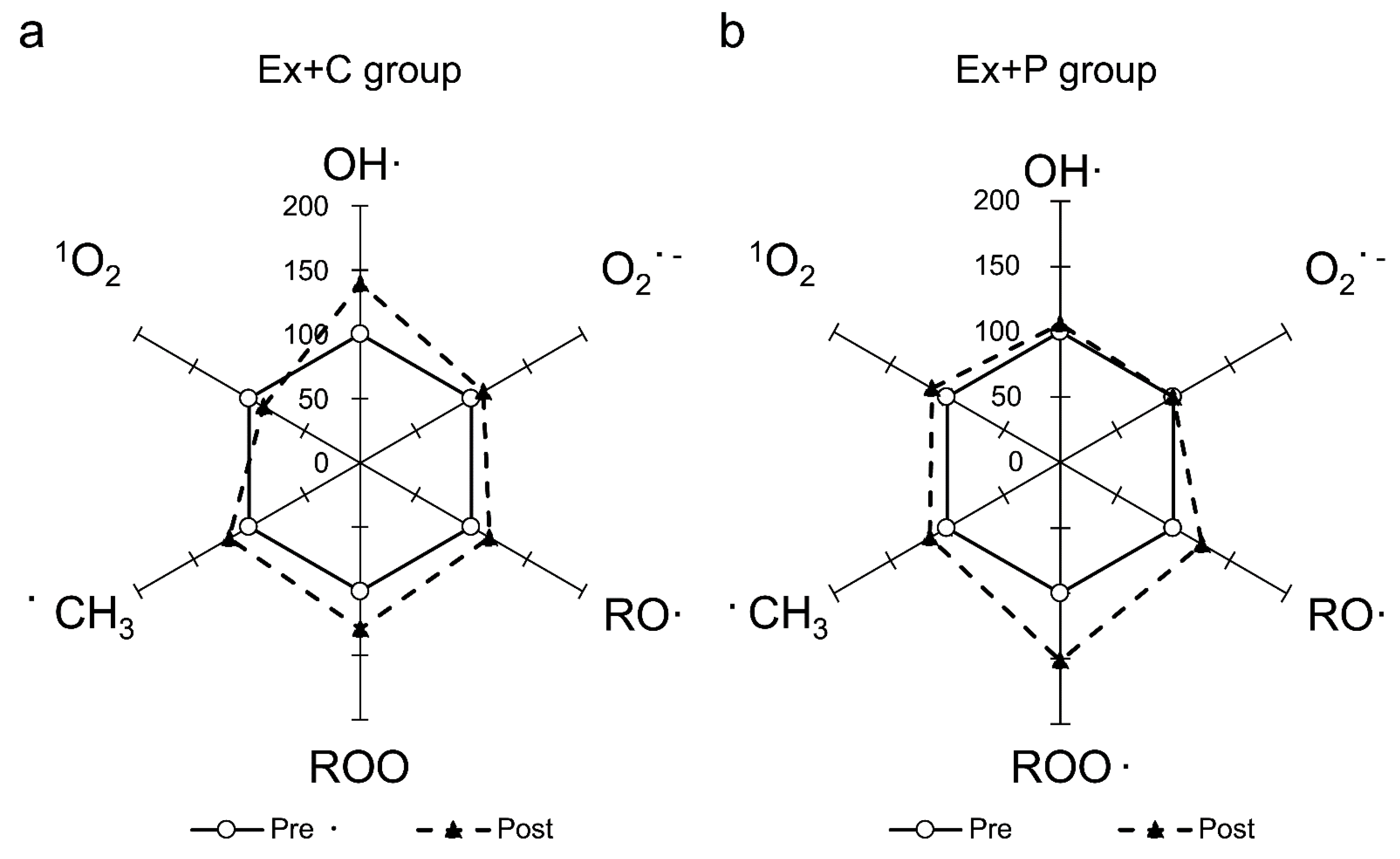
Figure 2.
Principal component analysis plot diagrams in the first and second principal components..
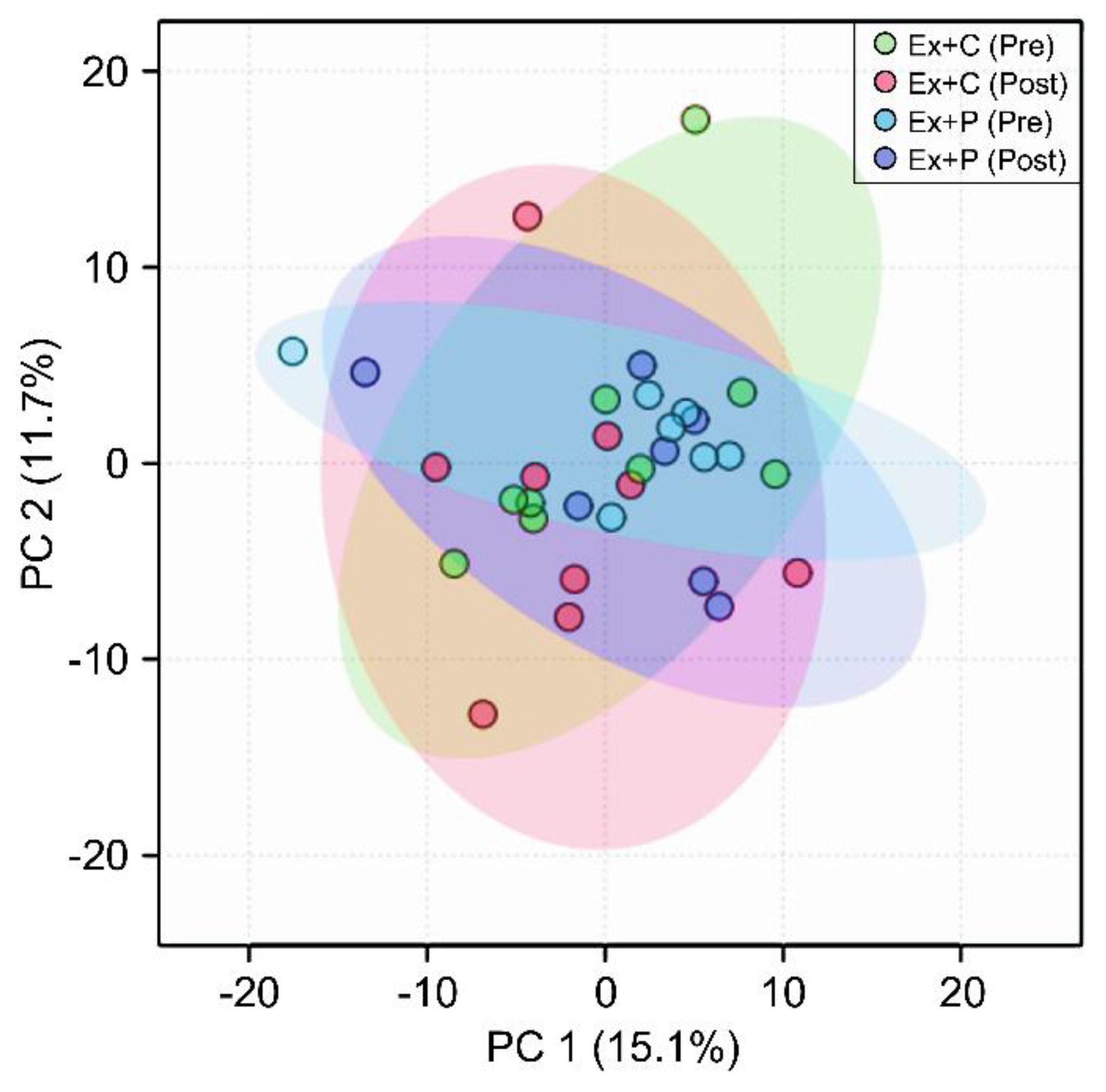

Table 1.
Compositions of Chlorella diets.
| Raw materials | Mixing ratio (%) | Mixing amount (mg/tablet) |
|---|---|---|
| Chlorella dry powder | 95.50 | 191.00 |
| Lecithin | 4.50 | 9.00 |
| Total | 100.00 | 200.00 |
Table 2.
Compositions of placebo diets.
| Raw materials | Mixing ratio (%) | Mixing amount (mg/tablet) |
|---|---|---|
| Digestibility dextrin | 82.50 | 165.00 |
| Brilliant blue FCF | 0.17 | 0.34 |
| Tartrazine | 0.83 | 1.66 |
| Caramel color | 16.50 | 33.00 |
| Total | 100.00 | 200.00 |
Table 3.
Measurement conditions for electron spin resonance (ESR).
| ROS | OH· | O2-· | RO· | ROO· | ·CH3 | 1O2 |
|---|---|---|---|---|---|---|
| Precursor/sensitizer | H2O2 | Riboflavin | AAPH | t-Butyl-oo | H2O2, DMSO | Pterin |
| UV/VL | UV, 5 s | VL, 30 s | UV, 5 s | UV, 5 s | UV, 5 s | UV, 5 s |
| Spin trap | CYPMPO | CYPMPO | CYPMPO | CYPMPO | CYPMPO | TMPD |
| Antioxidant equivalent | GSH | SOD | Trolox | α-lipoic acid | BSA | GSH |
| Sample dilution ratio | 20x | 10x | 10x | 10x | 40x | 40x |
| Sweep Width | 7.5 mT | 7.5 mT | 7.5 mT | 7.5 mT | 7.5 mT | 7.5 mT |
| Gain | 100 | 630 or 790 | 500 or 1,000 | 630 or 2,000 | 100 or 160 | 100 |
| Time constant | 0.03 s | 0.03 s | 0.1 s | 0.1 s | 0.03 s | 0.1 s |
| Sweep time | 2 min | 2 min | 2 min | 2 min | 2 min | 2 min |
| Temperature | 25 °C | 25 °C | 25 °C | 25 °C | 25 °C | 25 °C |
| Power | 6 mW | 6 mW | 6 mW | 6 mW | 6 mW | 6 mW |
ROS: reactive oxygen species, OH·: hydroxyl radical, O2-·: superoxide radical, RO·: alkyloxy radical, ROO·: alkylperoxy radical, ·CH3: methyl radical. 1O2: singlet oxygen, AAPH: 2,2′-azobis-2-methyl-propanimidamide dihydrochloride, t-Butyl-oo: tert-butyl hydroperoxide solution, CYPMPO: 5-(2,2-dimethyl-1, 3-propoxycyclophosphoryl)-5-methyl-1-pyrroline N-oxide, TMPD: 2,2,6,6-tetramethyl-4-piperidone, GSH: glutathione, SOD: superoxide dismutase, BSA: bovine serum albumin.
Table 4.
Baseline characteristics of the participants.
| Ex+C (n = 9) | Ex+P (n = 7) | t(z) | p | |
|---|---|---|---|---|
| Age, y | 76.9 ± 5.6 | 76.0 ± 3.7 | 0.36 | 0.721 |
| Male sex, n (%) | 4 (44%) | 2 (29%) | - | - |
| Height, cm | 156.8 ± 8.9 | 157.2 ± 9.4 | -0.08 | 0.940 |
| Weight, kg | 56.4 ± 7.9 | 63.4 ± 18.1 | -1.05 | 0.312 |
| Educational level, y | 12.1 ± 3.1 | 12.3 ± 2.6 | -0.12 | 0.908 |
| Cognitive functions | ||||
| Word recognition (immediately), score | 7.9 ± 1.4 | 8.4 ± 1.0 | -0.79 | 0.443 |
| Word recall (delay), score | 5.4 ± 2.5 | 4.4 ± 2.2 | 0.85 | 0.407 |
| Word recognition (delay), score | 7.1 ± 2.9 | 7.4 ± 2.6 | (0.00) | 1.000a |
| Attention, s | 18.2 ± 2.5 | 18.4 ± 2.9 | -0.15 | 0.881 |
| Executive, s | 30.0 ± 12.0 | 35.3 ± 16.4 | (-0.69) | 0.536a |
| Processing speed, score | 48.6 ± 9.4 | 47.1 ± 11.8 | 0.27 | 0.793 |
| ROS (equivalent) | ||||
| OH·(mM-GSH) | 33.3 ± 6.6 | 34.4 ± 26.9 | -0.11 | 0.918 |
| O2-·(U/mL-SOD) | 13.9 ± 7.2 | 16.4 ± 9.7 | -0.61 | 0.551 |
| RO·(mM-Trolox) | 9.5 ± 4.2 | 7.6 ± 3.5 | 0.94 | 0.363 |
| ROO·(mM-αLA) | 12.5 ± 6.0 | 15.7 ± 9.9 | -0.80 | 0.435 |
| CH3(mM-BSA) | 169.0 ± 104.4 | 150.3 ± 70.1 | 0.41 | 0.690 |
| 1O2(mM-GSH) | 7.4 ± 3.4 | 7.1 ± 1.7 | (-0.58) | 0.606a |
Ex+C: Exercise + Chlorella group, Ex+P: Exercise + Placebo group, a: Wilcoxon rank sum test OH·:hydroxyl radical, O2-·: superoxide radical, RO·: alkyloxy radical, ROO·: alkylperoxy radical, ·CH3: methyl radical. 1O2: singlet oxygen GSH: glutathione, SOD: superoxide dismutase, αLA: α-lipoic acid, BSA: bovine serum albumin.
Table 5.
Comparison of cognitive function and scavenging capacity of ROS between Ex+C group and Ex+P group.
Table 5.
Comparison of cognitive function and scavenging capacity of ROS between Ex+C group and Ex+P group.
| Ex+C (n = 9) | Ex+P (n = 7) | Group × time | ||||
|---|---|---|---|---|---|---|
| Pre | Post | Pre | Post | F | p | |
| Word recognition (immediately), score | 7.9 ± 1.4 | 8.0 ± 1.6 | 8.4 ± 1.0 | 8.0 ± 1.3 | 0.88 | 0.363 |
| Word recall (delay), score | 5.4 ± 2.5 | 5.6 ± 2.4 | 4.4 ± 2.2 | 4.9 ± 2.8 | 0.17 | 0.686 |
| Word recognition (delay), score | 7.1 ± 2.9 | 7.1 ± 2.8 | 7.4 ± 2.6 | 8.4 ± 0.8 | 1.45 | 0.248 |
| Attention, s | 18.2 ± 2.5 | 19.7 ± 2.6 | 18.4 ± 2.9 | 18.6 ± 3.7 | 1.28 | 0.277 |
| Executive, s | 30.0 ± 12.0 | 36.0 ± 14.5 | 35.3 ± 16.4 | 45.1 ± 18.1† | 0.38 | 0.548 |
| Processing speed, score | 48.6 ± 9.4 | 69.0 ± 12.4†† | 47.1 ± 11.8 | 62.6 ± 15.0†† | 4.72 | 0.048* |
| OH·(mM-GSH) | 33.3 ± 6.6 | 46.3 ± 15.2† | 34.4 ± 26.9 | 36.4 ± 25.1 | 2.47 | 0.138 |
| O2-·(U/mL-SOD) | 13.9 ± 7.2 | 15.3 ± 11.7 | 16.4 ± 9.7 | 16.4 ± 10.4 | 0.12 | 0.739 |
| RO·(mM-Trolox) | 9.5 ± 4.2 | 11.0 ± 2.3 | 7.6 ± 3.5 | 9.5 ± 3.7 | 0.04 | 0.843 |
| ROO·(mM-αLA) | 12.5 ± 6.0 | 16.2 ± 10.2 | 15.7 ± 9.9 | 23.8 ± 11.1 | 0.68 | 0.423 |
| CH3(mM-BSA) | 169.0 ± 104.4 | 199.4 ± 154.3 | 150.3 ± 70.1 | 173.2 ± 120.3 | 0.03 | 0.875 |
| 1O2(mM-GSH) | 7.4 ± 3.4 | 6.5 ± 1.7 | 7.1 ± 1.7 | 8.0 ± 3.0 | 0.98 | 0.338 |
Ex+C: Exercise + Chlorella group, Ex+P: Exercise + Placebo group, *: p < 0.05, †: p < 0.05 vs Pre, ††: p < 0.01 vs Pre, OH·: hydroxyl radical, O2-·: superoxide radical, RO·: alkyloxy radical, ROO·: alkylperoxy radical, ·CH3: methyl radical. 1O2: singlet oxygen, GSH: glutathione, SOD: superoxide dismutase, αLA: α-lipoic acid, BSA: bovine serum albumin.
Disclaimer/Publisher’s Note: The statements, opinions and data contained in all publications are solely those of the individual author(s) and contributor(s) and not of MDPI and/or the editor(s). MDPI and/or the editor(s) disclaim responsibility for any injury to people or property resulting from any ideas, methods, instructions or products referred to in the content. |
© 2026 by the authors. Licensee MDPI, Basel, Switzerland. This article is an open access article distributed under the terms and conditions of the Creative Commons Attribution (CC BY) license (http://creativecommons.org/licenses/by/4.0/).
Copyright: This open access article is published under a Creative Commons CC BY 4.0 license, which permit the free download, distribution, and reuse, provided that the author and preprint are cited in any reuse.


