

Submitted:
26 December 2025
Posted:
02 January 2026
You are already at the latest version
Abstract
Objectives: We investigated the effects of Continuous Positive Airway Pressure (CPAP) on blood pressure (BP) and vigilance in taxi drivers with obstructive sleep apnea (OSA). Methods: Taxi drivers aged ≥60 years were recruited for polysomnography. Those diagnosed with OSA underwent 6 months of CPAP therapy. Baseline and follow-up assessments included 24-hour ambulatory blood pressure monitoring (ABPM) and the psychomotor vigilance test (PVT). Results: Among the 32 participants, 22 (68.8%) were diagnosed with OSA (median age 63.0 [62.0–65.0] years; 21 males). The average CPAP adherence was 3.1±2.3 hours per night, with 23.5% using CPAP for more than 4 hours per night. There were no significant changes in 24-hour mean systolic ABPM (125.9 [116.8–134.9] mmHg to 126.0 [118.3–133.7] mmHg; p=0.93) or reaction times measured by PVT (2.0 [0.0–3.0] lapses to 2.0 [1.0–3.0] lapses; p=0.82) after CPAP therapy. Conclusion: A high prevalence of OSA was observed among taxi drivers. CPAP adherence was suboptimal and did not result in significant improvements in BP or vigilance.
Keywords:
1. Introduction
2. Participants and Methods
3. Results
4. Discussion
5. Conclusions
Supplementary Materials
Data Availability Statement
References
- Stewart, T. Overview of Motor Vehicle Traffic Crashes in 2021; Data Reporting and Information Division National Center for Statistics and Analysis National Highway Traffic Safety Administration; 2023. [Google Scholar]
- Philip, P; Sagaspe, P; Lagarde, E; et al. Sleep disorders and accidental risk in a large group of regular registered highway drivers. Sleep Med. 2010, 11(10), 973–979. [Google Scholar] [CrossRef] [PubMed]
- Ou, YH; Colpani, JT; Cheong, CS; et al. Mandibular Advancement vs CPAP for Blood Pressure Reduction in Patients With Obstructive Sleep Apnea. J Am Coll Cardiol. 2024, 83(18), 1760–1772. [Google Scholar] [CrossRef] [PubMed]
- WHO. Global status report on road safety 2023. Available online: https://www.who.int/teams/social-determinants-of-health/safety-and-mobility/global-status-report-on-road-safety-2023 (accessed on 30 October 2024).
- WHO. Road traffic injuries. Available online: https://www.who.int/news-room/fact-sheets/detail/road-traffic-injuries (accessed on 30 October 2024).
- Karimi, M; Hedner, J; Häbel, H; Nerman, O; Grote, L. Sleep Apnea Related Risk of Motor Vehicle Accidents is Reduced by Continuous Positive Airway Pressure: Swedish Traffic Accident Registry Data. Sleep 2015, 38(3), 341–349. [Google Scholar] [CrossRef] [PubMed]
- Dempsey, JA; Veasey, SC; Morgan, BJ; O’Donnell, CP. Pathophysiology of Sleep Apnea. Physiol Rev. 2010, 90(1), 47–112. [Google Scholar] [CrossRef] [PubMed]
- Brown, J; Yazdi, F; Jodari-Karimi, M; Owen, JG; Reisin, E. Obstructive Sleep Apnea and Hypertension: Updates to a Critical Relationship. Curr Hypertens Rep. 2022, 24(6), 173–184. [Google Scholar] [CrossRef] [PubMed]
- Patil, SP; Ayappa, IA; Caples, SM; Kimoff, RJ; Patel, SR; Harrod, CG. Treatment of Adult Obstructive Sleep Apnea with Positive Airway Pressure: An American Academy of Sleep Medicine Clinical Practice Guideline. J Clin Sleep Med JCSM Off Publ Am Acad Sleep Med. 2019, 15(2), 335–343. [Google Scholar] [CrossRef] [PubMed]
- Shirahama, R; Tanigawa, T; Ida, Y; et al. Long-term effect of continuous positive airway pressure therapy on blood pressure in patients with obstructive sleep apnea. Sci Rep. 2021, 11(1), 19101. [Google Scholar] [CrossRef] [PubMed]
- Hoshide, S; Yoshida, T; Mizuno, H; Aoki, H; Tomitani, N; Kario, K. Association of Night-to-Night Adherence of Continuous Positive Airway Pressure With Day-to-Day Morning Home Blood Pressure and Its Seasonal Variation in Obstructive Sleep Apnea. J Am Heart Assoc. 2022, 11(7), e024865. [Google Scholar] [CrossRef]
- Crawford, MR; Bartlett, DJ; Coughlin, SR; et al. The effect of continuous positive airway pressure usage on sleepiness in obstructive sleep apnoea: real effects or expectation of benefit? Thorax 2012, 67(10), 920–924. [Google Scholar] [CrossRef]
- Firestone, RT; Mihaere, K; Gander, PH. Obstructive sleep apnoea among professional taxi drivers: A pilot study. Accid Anal Prev. 2009, 41(3), 552–556. [Google Scholar] [CrossRef] [PubMed]
- Macey, PM; Kumar, R; Woo, MA; Valladares, EM; Yan-Go, FL; Harper, RM. Brain structural changes in obstructive sleep apnea. Sleep. 2008, 31(7), 967–977. [Google Scholar] [PubMed]
- Tregear, S; Reston, J; Schoelles, K; Phillips, B. Continuous positive airway pressure reduces risk of motor vehicle crash among drivers with obstructive sleep apnea: systematic review and meta-analysis. Sleep 2010, 33(10), 1373–1380. [Google Scholar] [CrossRef] [PubMed]
- Vakulin, A; Baulk, SD; Catcheside, PG; et al. Driving Simulator Performance Remains Impaired In Patients With Severe OSA after CPAP Treatment. J Clin Sleep Med. 2011, 07(03), 246–253. [Google Scholar] [CrossRef] [PubMed]
- Thomann, J; Baumann, CR; Landolt, HP; Werth, E. Psychomotor Vigilance Task Demonstrates Impaired Vigilance in Disorders with Excessive Daytime Sleepiness. J Clin Sleep Med. 2014, 10(09), 1019–1024. [Google Scholar] [CrossRef] [PubMed]

| Baseline (n=18) | 6 months (n=18) | Difference (95% CI) | P Value | |
|---|---|---|---|---|
| Office BP, mmHg* | ||||
| Mean BP | 96.0 (90.7 – 101.2) | 93.3 (86.6 – 100.0) | 2.7 (-3.0 to 8.3) | 0.33 |
| Systolic BP | 135.6 (127.7 – 143.0) | 132.1 (122.6 – 141.5) | 3.5 (-5.1 to 12.2) | 0.39 |
| Diastolic BP | 76.1 (71.5 – 80.7) | 73.9 (67.8 – 80.0) | 2.22 (-2.7 to 7.2) | 0.36 |
| 24-hour, mmHg* | ||||
| Mean BP | 95.5 (89.1 – 102.0) | 95.2 (89.9 – 100.5) | 0.3 (-2.0 to 2.7) | 0.77 |
| Systolic BP | 125.9 (116.8 – 134.9) | 126.0 (118.3 – 133.7) | -0.1 (-3.0 to 2.8) | 0.93 |
| Diastolic BP | 82.2 (77.4 – 87.0) | 79.8 (75.3 – 84.3) | 2.4 (0.6 to 4.2) | 0.01 |
| Pulse pressure | 45.5 (40.5 – 41.6) | 46.2 (41.6 – 50.9) | 0.7 (-3.1 to 1.6) | 0.53 |
| Awake, mmHg* | ||||
| Mean BP | 97.4 (91.8 – 103.1) | 97.0 (91.7 – 102.2) | 0.4 (-1.4 to 2.4) | 0.60 |
| Systolic BP | 127.9 (119.7 – 136.1) | 128.2 (120.3 – 136.1) | -0.2 (-3.1 to 2.5) | 0.83 |
| Diastolic BP | 82.2 (77.4 – 87.0) | 81.3 (77.0 – 85.7) | 0.8 (-1.6 to 2.8) | 0.35 |
| Pulse pressure | 45.6 (40.4 – 50.8) | 46.8 (41.7 – 51.9) | -1.1 (-3.7 to 1.4) | 0.34 |
| Asleep, mmHg* | ||||
| Mean BP | 91.6 (83.2 – 99.9) | 90.5 (84.3 – 96.7) | 1.1 (-3.5 to 5.6) | 0.63 |
| Systolic BP | 121.3 (110.6 – 132.0) | 120.8 (112.9 – 128.7) | 0.5 (-4.5 to 5.6) | 0.82 |
| Diastolic BP | 76.6 (69.3 – 83.9) | 76.2 (70.7 – 81.7) | 0.4 (-4.5 to 5.4) | 0.85 |
| Pulse pressure | 44.8 (40.1 – 49.4) | 44.7 (40.6 – 48.7) | 0.1 (-2.1 to 2.3) | 0.93 |
| KSS | 4 (3 – 5) | 3 (3 – 4) | 0.30 | |
| VAS | ||||
| Sad (0) - Happy (100) | 64.9 (54.6 – 73.7) | 61.7 (52.0 – 80.0) | 0.66 | |
| Alert (0) - Sleepy (100) | 60.5 (41.0 – 79.5) | 65.1 (43.0 – 77.8) | 0.96 | |
| Calm (0) - Excited (100) | 51.7 (46.1 – 64.8) | 54.6 (47.2 – 69.1) | 0.81 | |
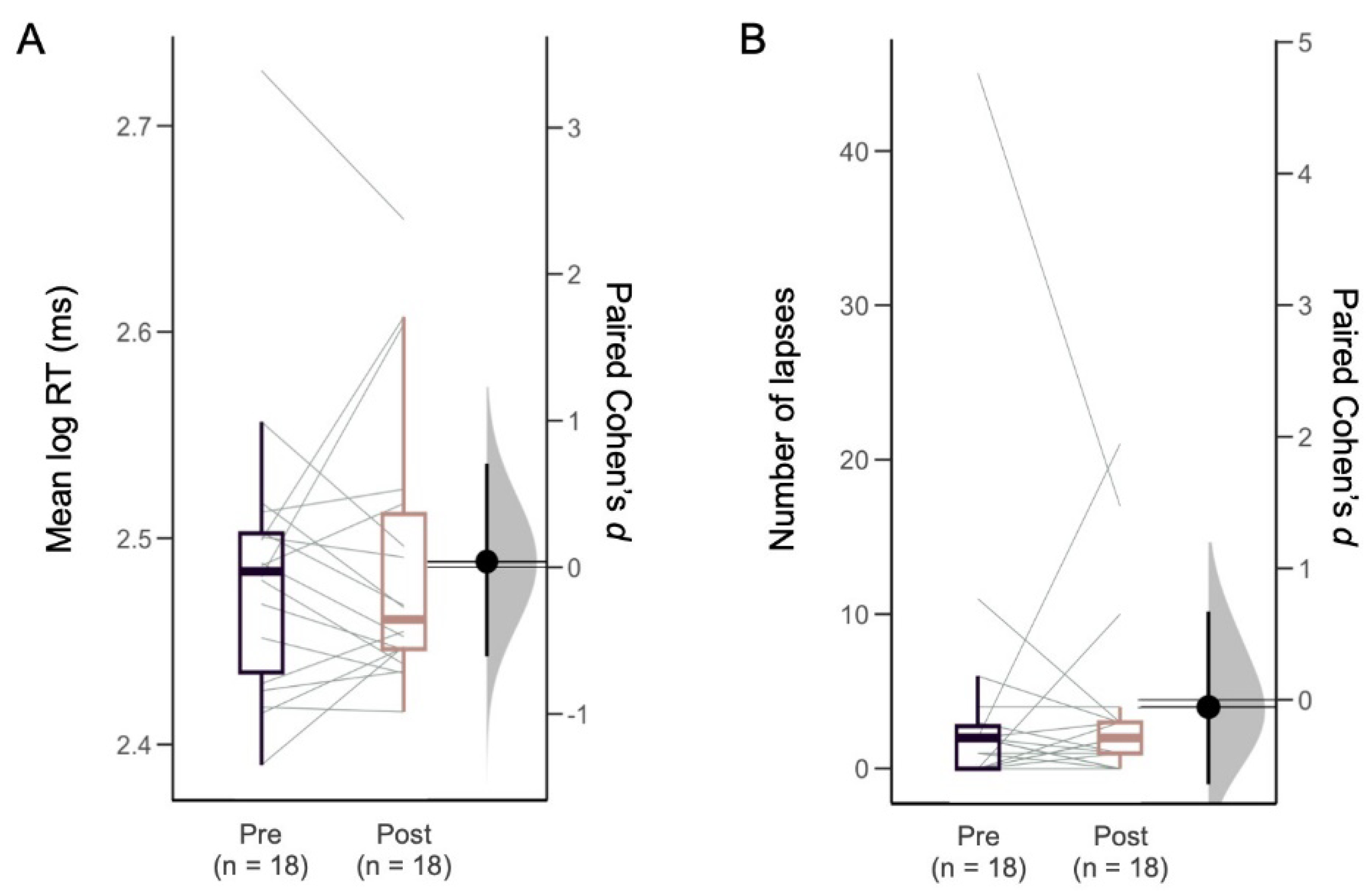
| PVT, lapses | 2.0 (0.0 – 3.0) | 2.0 (1.0 – 3.0) | 0.82 | |
| PVT RT, ms | 294.7 (260.0 – 316.0) | 283.7 (269.0 – 323.0) | 0.75 | |
Disclaimer/Publisher’s Note: The statements, opinions and data contained in all publications are solely those of the individual author(s) and contributor(s) and not of MDPI and/or the editor(s). MDPI and/or the editor(s) disclaim responsibility for any injury to people or property resulting from any ideas, methods, instructions or products referred to in the content. |
© 2026 by the authors. Licensee MDPI, Basel, Switzerland. This article is an open access article distributed under the terms and conditions of the Creative Commons Attribution (CC BY) license (http://creativecommons.org/licenses/by/4.0/).